The Merchant in the Temple: How Corporate Capitalism Replaced Jesus with Neoliberal Christianity
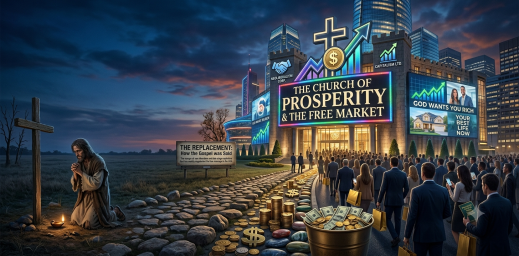
To understand human behavior, we have to look past the surface-level myths a society tells about itself and examine its actual structural mechanics. In the United States, there is a loud, dominant cultural narrative that the nation is a “Christian country.” But if you take a step back and look at it through an anthropological and historical lens, an obvious paradox emerges: the primary form of Christianity practiced in the US today bears almost zero resemblance to the teachings of the historical, first-century radical named Jesus of Nazareth.
Instead, what we are witnessing is a highly sophisticated, multi-decade merger of late-stage capitalism, neo-liberal economic philosophy, and religious theology.
The result? A hyper-individualized, corporate spiritual structure that doesn’t just tolerate greed—it sanctifies it. For those of us looking from the outside—whether navigating rúnatál (the secrets of the runes), quantum mechanics, or the old polytheistic values of community and personal honor—understanding this shift offers a masterclass in how a ruling elite can hollow out a spiritual tradition and turn it into a tool for systemic control.
1. The Historical Metamorphosis: From Communal Ethic to Corporate Religion
Ancient religions—including traditional Norse Paganism—operated heavily on a reciprocal communal ethic. Wealth was not meant to be hoarded in a vacuum; a chieftain’s worth was measured by their generosity (being a “ring-giver”). Early Christianity, too, was aggressively communal. The historical Jesus routinely championed the poor, explicitly commanded his followers to abandon the pursuit of raw wealth, and famously flipped tables to drive the merchants out of the temple.
So how did the modern American church become the ultimate defender of free-market capitalism?
It wasn’t an accident. It was a calculated, historical project. In the 1930s, corporate executives and industrial giants faced a major threat: President Franklin D. Roosevelt’s New Deal, which introduced government regulations, social safety nets, and labor protections. To fight back, corporate coalitions bankrolled conservative clergymen, launching massive PR campaigns that framed the New Deal as “pagan statism.” They completely reframed Christian doctrine, asserting that the core principle of Christianity was not communal care, but the absolute sanctity and salvation of the individual—and by extension, the absolute freedom of the unregulated marketplace.
By the time the Cold War arrived in the 1950s, this corporate-religious alliance successfully fused piety with patriotism. This era gave birth to the National Prayer Breakfast and added “In God We Trust” to American currency. The foundational infrastructure for modern American corporate Christianity was officially set.
2. The Prosperity Gospel: The Spiritual Articulation of Neoliberalism
By the late 20th and early 21st centuries, this framework evolved into its current, dominant form: The Prosperity Gospel (or Word of Faith movement).
This theology views the Divine not as a transcendent source of cosmic order, but as a celestial vending machine or a business partner. The core doctrine dictates that if you have enough faith—and prove that faith by giving “seed money” (tithings) to wealthy pastors and ministries—God is contractually obligated to reward you with physical health and material riches.
Through a socio-economic lens, this is the ultimate spiritual expression of neoliberalism. Neoliberalism relies on an unyielding belief in meritocracy: the idea that the market is perfectly just, and rewards will naturally come to those who work hard enough. The Prosperity Gospel takes this exact capitalist myth and gives it a divine stamp of approval:
- Wealth is sanctified: If you are rich, it is no longer seen as a result of systemic exploitation or luck; it is a sign of direct divine favor.
- Poverty is criminalized: If you are poor, sick, or struggling, it is no longer seen as a failure of the socio-economic system. Instead, it is reframed as a personal, spiritual failure—a lack of faith or a “victim mentality.”
By shifting the blame for systemic inequality entirely onto the individual’s spiritual state, this modern theology acts as a perfect shield for late-stage capitalism. It actively discourages systemic critique, labor organizing, or structural social change.
3. The Megachurch as a Late-Stage Capitalist Enterprise
The physical manifestation of this spiritual shift is the modern American megachurch. These are not traditional holy spaces designed for quiet contemplation or communal mystery. They are masterfully designed corporate ecosystems.
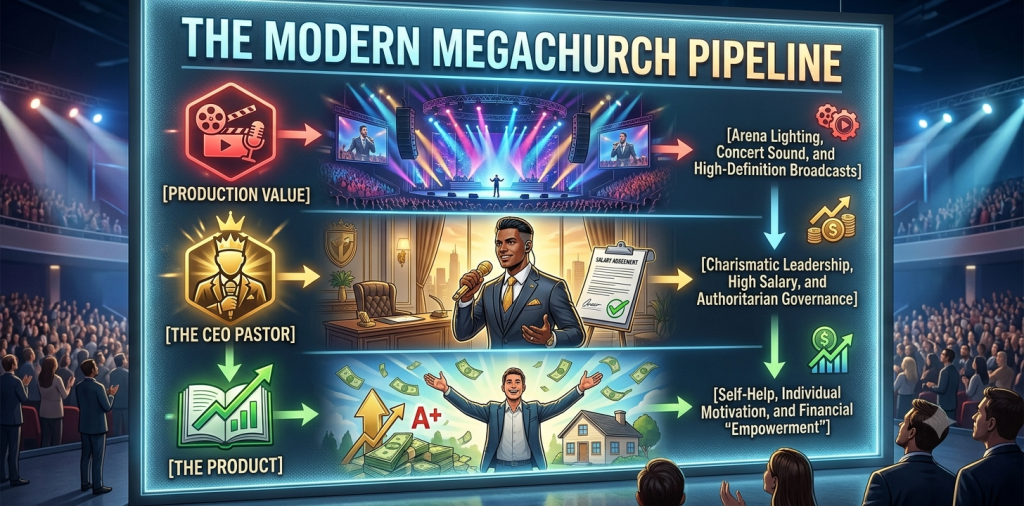
These organizations utilize standard corporate logistics, target demographics, and entertainment-industry production values to draw in thousands of people. The pastor functions less like a spiritual guide and more like a CEO or a motivational influencer.
Critically, the message preached in these arenas completely supplants the actual philosophy of Jesus. You will rarely hear deep, uncomfortable discussions about systemic greed, pacifism, or radical self-sacrifice. Instead, the sermons are heavily focused on individual optimization, personal success, and how to manifest your “best life now.” It is a consumerist commodity disguised as spiritual enlightenment.
4. The View from the Outside: Autonomy, Reciprocity, and Wyrd
For those of us navigating reality through an alternative spiritual framework, observing this dominant American religious structure provides immense clarity.
From a Norse Pagan perspective, the concept of Örlög and Wyrd teaches us that we are deeply interwoven with our communities, our ancestors, and the earth itself. Our actions have collective, echoing consequences across the web of existence. We do not exist as isolated, hyper-individualized consumers trying to extract material wealth from the cosmos via positive thinking or transaction-based tithing.
Furthermore, traditional values honor the sovereignty of the individual alongside a fierce obligation to the collective well-being of the tribe. The modern American corporate church achieves the exact opposite: it enforces strict ideological conformity while abandoning collective social responsibility in favor of ruthless market competition.
The Takeaway
Modern American Christianity has not been corrupted by the outside world; it has been systematically colonized by it. Late-stage capitalism required a spiritual apparatus that could validate its inequalities, pacify its workers, and sanctify its billionaires. By erasing the radical, communal, and anti-imperial philosophy of the historical Jesus, corporate America built a replacement that served its own image perfectly.
When a society’s gods look exactly like its hedge fund managers, it is no longer practicing a faith. It is worshiping the market.


This work is licensed under a Creative Commons Attribution-NonCommercial-ShareAlike 3.0 Unported License.

 Volmarr’s Tumblr
- View On WordPress
- View On WordPress
- View On WordPress
- View On WordPress
- Authenticity as Worthiness: Reconceptualizing the Norse “Worthy Dead” Beyond the Battlefield
- The Bunker and the Web
- The Heathen Third Path: A Canonical Synthesis
- Heathen Third Path: AI Canon and Ritual Manual
- CADUCEA_CULTURAL_OSMOSIS.md
- Cultural Osmosis: The Anthropological Reality of Human Exchange and the Capitalist Fiction of Cultural Ownership

