The New American Dream: Freedom Beyond the White Picket Fence
The American Dream was never really about a house.
It was about freedom.
The house with the white picket fence became one expression of that freedom during a particular period of history. For millions of people, owning a modest home, raising a family, having a steady job, and building a relatively independent household made economic sense.
The house represented something deeper.
It represented having a place that was yours.
It represented security.
It represented independence.
It represented the ability to make decisions about your own life without constantly answering to landlords, employers, governments, relatives, or institutions.
The mistake came when the symbol became confused with the dream itself.
A house is not freedom.
A mortgage is not freedom.
A lawn is not freedom.
A garage full of possessions is not freedom.
Those things can certainly be part of a free and meaningful life for someone who genuinely wants them.
But they are tools, not sacred objects.
And tools must change when the world changes.
The Materialist Counterfeit
Modern consumer culture gradually transformed the American Dream into something very different.
Freedom became consumption.
Success became square footage.
Identity became brands.
Prosperity became the accumulation of objects.
A person was supposedly successful if they owned the correct house, the correct vehicle, the correct furniture, the correct appliances, the correct electronics, and enough decorative objects to fill every available corner of their increasingly expensive private storage structure.
Then they needed a larger house to hold the growing collection.
And perhaps a storage unit for everything that no longer fit inside the house.
Somewhere along the way, the dream of personal independence became a treadmill of payments.
Mortgage.
Property taxes.
Insurance.
Utilities.
Repairs.
Car payments.
Fuel.
Subscriptions.
Credit cards.
Maintenance.
And an entire economy designed to whisper:
You still do not have enough.
That is not the American Dream.
That is the commercialized counterfeit of it.
The true dream is much simpler.
The ability to live your own life.
When the Old Formula Stops Working
There was a period when the suburban home made enormous economic sense.
Land was comparatively affordable in many places.
Housing costs were lower relative to income.
A person could sometimes support an entire household through one stable career.
Manufacturing and industrial jobs could provide relatively predictable lives.
Communities were built around the assumption that people would remain geographically anchored for decades.
The technology of the time encouraged this as well.
Your telephone was attached to your house.
Your television was inside your house.
Your books were inside your house.
Your music collection was inside your house.
Your photographs were inside your house.
Your computer was inside your house.
Your social world was largely tied to your geographic location.
The home acted as a giant technological anchor.
But that world is disappearing.
Almost everything that once required a building can now fit inside a backpack.
A modern smartphone contains functions that once required an entire collection of specialized equipment.
Communication.
Navigation.
Photography.
Video.
Banking.
Libraries.
News.
Music.
Entertainment.
Maps.
Translation.
Social networks.
Business tools.
Artificial intelligence.
Remote collaboration.
A laptop can become an office, creative studio, research library, publishing house, entertainment center, communications terminal, and doorway into entire virtual worlds.
The technological hearth has become portable.
And when the hearth becomes portable, something profound happens.
The human being becomes portable again too.
The Return of the Wanderer
Humans were mobile for most of our existence.
The permanently settled industrial lifestyle is historically unusual.
Our ancestors moved according to seasons, resources, trade, opportunity, kinship, conflict, weather, and curiosity.
Even agricultural societies often contained merchants, sailors, pilgrims, hunters, soldiers, craftspeople, explorers, wandering religious figures, and seasonal workers.
The Norse world certainly understood mobility.
The Viking Age Scandinavian was not psychologically chained to one patch of lawn.
People sailed.
Traded.
Migrated.
Explored.
Visited distant settlements.
Crossed seas.
Followed opportunities.
Returned home.
Left again.
The ship represented something fundamentally different from the fortress.
A fortress says:
I survive by remaining here.
A ship says:
I survive by being capable of going elsewhere.
That distinction matters.
The modern digital nomad carries something remarkably similar to the old seafarer’s philosophy.
Not necessarily the romantic Instagram version of laptops beside tropical beaches.
Something deeper.
Mobility itself becomes a form of resilience.
If one place becomes economically impossible, leave.
If the climate becomes unpleasant, move.
If employment changes, adapt.
If a region becomes overcrowded, search elsewhere.
If one opportunity disappears, follow another road.
The map becomes larger than the neighborhood.
The Cyber Viking Longship
The Viking longship was one of the great mobility technologies of its era.
It allowed people to carry themselves, their tools, their trade goods, their weapons, their knowledge, and their ambitions across enormous distances.
Today our mobility technology looks different.
The modern longship might be a small car, van, RV, motorcycle, train pass, backpack, or simply an airline ticket paired with a laptop.
Its mast may be a cellular antenna.
Its sail may be a solar panel.
Its navigation stone is GPS.
Its raven is a satellite connection.
Its skald is a digital archive.
Its portable library contains millions of books.
Its oracle may be an artificial intelligence.
Its marketplace exists everywhere that an internet connection exists.
The cyber Viking does not need to conquer territory.
The cyber Viking needs mobility, adaptability, knowledge, and sovereignty.
Our wealth does not necessarily have to be measured by how much territory we occupy.
It can be measured by how many choices remain available to us.
Wealth Is Having Fewer Chains
There is a strange paradox in modern civilization.
A person may own hundreds of thousands of dollars worth of property and still feel economically trapped.
Another person may own very little and possess extraordinary freedom.
This does not mean poverty is desirable.
It means that wealth and possessions are not identical concepts.
Real wealth includes options.
Time is wealth.
Mobility is wealth.
Skills are wealth.
Knowledge is wealth.
Health is wealth.
Relationships are wealth.
Access to information is wealth.
Low expenses can be wealth.
The ability to survive the loss of a job without losing your entire way of life is wealth.
The ability to move somewhere better is wealth.
The ability to say no is one of the greatest forms of wealth imaginable.
A person buried beneath payments may technically possess many things while having very little freedom.
The objects own part of their future labor.
Every recurring expense represents another portion of tomorrow already promised away.
Minimalism therefore becomes more than an aesthetic.
It becomes strategic.
Every possession asks something from you.
Storage.
Maintenance.
Protection.
Transportation.
Replacement.
Attention.
Sometimes the object gives enough value to justify that cost.
Sometimes it does not.
The modern wanderer learns to ask:
Does this possession serve my life, or does my life now serve this possession?
That is a profoundly Heathen question.
Freedom Requires Responsibility
Nomadic freedom should never mean irresponsibility.
Quite the opposite.
Real independence demands greater responsibility.
A person living outside conventional systems must think carefully about water, food, shelter, power, waste, weather, safety, transportation, communication, money, health, and the condition of the land.
There is no landlord quietly fixing the plumbing behind the scenes.
No municipal system automatically providing every necessity.
Freedom exposes consequences.
That can be healthy.
It reconnects action with result.
This is where a Norse Pagan ethic becomes important.
Freedom must coexist with frith, hospitality, reciprocity, and respect for the landvættir.
The free traveler does not leave garbage behind.
They do not destroy campsites.
They do not exploit communities.
They do not treat public land as disposable property.
They do not mistake freedom for selfishness.
The wanderer should leave a place no worse than they found it, and whenever possible, slightly better.
Our ancestors understood that survival depended upon relationships.
With kin.
With community.
With animals.
With landscape.
With weather.
With unseen forces.
With fate itself.
Freedom without responsibility becomes chaos.
Freedom combined with responsibility becomes sovereignty.
Technology Has Changed Geography
The greatest transformation may be that geography no longer determines human possibility as strongly as it once did.
For most of history, where you lived largely determined what information you could access, whom you could speak with, what work you could perform, and what communities you could participate in.
The internet shattered much of that limitation.
Mobile internet shattered it again.
Satellite connectivity is pushing the transformation even further.
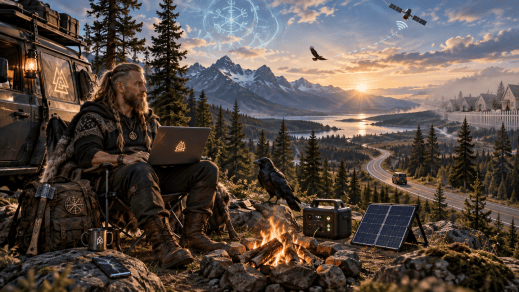
Now a person can sit beneath pine trees hundreds of miles from a major city while participating in communities scattered across the planet.
You can speak to friends across continents.
Publish writing globally.
Run software.
Study nearly any subject.
Participate in virtual worlds.
Manage finances.
Work remotely.
Create art.
Develop software.
Operate AI systems.
Maintain relationships.
Watch lectures.
Learn languages.
Research history.
Build businesses.
The physical location becomes only one layer of existence.
We now inhabit both geography and cyberspace.
The nomad may physically move through forests, deserts, mountains, towns, and coastlines while remaining digitally connected to a global civilization.
This is something genuinely new.
Humanity has never possessed this combination of mobility and connectivity before.
A New Version of the American Dream
Perhaps the American Dream does not need to die.
Perhaps it simply needs to evolve.
The old image was:
A house, a fence, a stable job, and enough possessions to demonstrate success.
The emerging image might be:
A small footprint, powerful technology, portable income, low expenses, useful skills, access to nature, and the freedom to move.
For some people, freedom will still mean owning a house.
Good.
For others, it may mean a tiny house.
A rural homestead.
A sailboat.
A van.
A small apartment.
A cabin.
A converted vehicle.
A network of temporary camps.
Or several different forms of living used throughout different periods of life.
There should never have been one correct shape of the dream.
That was the deception.
Freedom cannot be mass-produced.
From Property to Possibility
The deepest shift may be from measuring life through ownership to measuring it through possibility.
Instead of asking:
How large is my house?
Ask:
How large is my world?
Instead of asking:
How many things do I own?
Ask:
How many choices do I possess?
Instead of asking:
How impressive does my life appear?
Ask:
How much of my life actually belongs to me?
The white picket fence was never sacred.
Freedom was sacred.
The fence was simply one technology through which an earlier generation attempted to achieve it.
Our generation has different tools.
Solar power.
Mobile computing.
Artificial intelligence.
Wireless communication.
Portable batteries.
Satellite internet.
Digital libraries.
Remote work.
Global communities.
Small efficient vehicles.
Navigation systems containing maps of nearly the entire planet.
The old dream planted roots.
The new dream may grow wheels.
Raidho and the Open Road
In the Elder Futhark, Raidho speaks of riding, journey, movement, order, and the path traveled.
The journey is not meaningless wandering.
There is rhythm to it.
Direction.
Relationship between traveler and road.
The destination matters, but so does learning how to travel well.
Perhaps Raidho has particular relevance to the technological age.
Human beings are becoming mobile again.
But this time we carry the accumulated knowledge of civilization in devices weighing only a few pounds.
We can travel physically while remaining connected intellectually.
We can build communities that are not limited by geography.
We can choose temporary roots rather than permanent chains.
The road and the network have merged.
As a modern cyber Viking, I find something deeply appealing about that.
Not because everyone should become a nomad.
They should not.
People should live according to their own nature.
Some people need deep roots.
Others need horizons.
Some want farms.
Some want cities.
Some want cottages.
Some want wheels beneath them and stars above them.
The important thing is that people recognize the difference between their own dream and the dream they were sold.
The American Dream was never supposed to mean obedience to a particular lifestyle.
At its most powerful, it meant that a human being could shape their own existence.
That idea is still worth defending.
But the form of freedom changes with history.
The twentieth century dreamed of the suburban home.
The twenty-first century may increasingly dream of something else.
A road.
A signal.
A small collection of carefully chosen possessions.
A place beneath the trees.
A laptop glowing beside the fire.
And the knowledge that when the seasons change, the world remains open.
The house was never the dream.
Freedom was.
The Merchant in the Temple: How Corporate Capitalism Replaced Jesus with Neoliberal Christianity
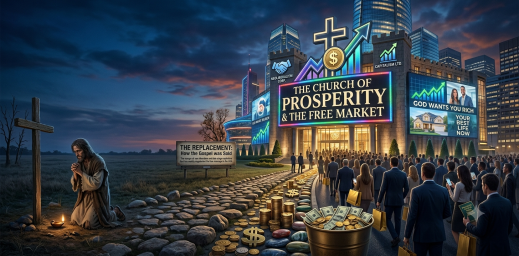
To understand human behavior, we have to look past the surface-level myths a society tells about itself and examine its actual structural mechanics. In the United States, there is a loud, dominant cultural narrative that the nation is a “Christian country.” But if you take a step back and look at it through an anthropological and historical lens, an obvious paradox emerges: the primary form of Christianity practiced in the US today bears almost zero resemblance to the teachings of the historical, first-century radical named Jesus of Nazareth.
Instead, what we are witnessing is a highly sophisticated, multi-decade merger of late-stage capitalism, neo-liberal economic philosophy, and religious theology.
The result? A hyper-individualized, corporate spiritual structure that doesn’t just tolerate greed—it sanctifies it. For those of us looking from the outside—whether navigating rúnatál (the secrets of the runes), quantum mechanics, or the old polytheistic values of community and personal honor—understanding this shift offers a masterclass in how a ruling elite can hollow out a spiritual tradition and turn it into a tool for systemic control.
1. The Historical Metamorphosis: From Communal Ethic to Corporate Religion
Ancient religions—including traditional Norse Paganism—operated heavily on a reciprocal communal ethic. Wealth was not meant to be hoarded in a vacuum; a chieftain’s worth was measured by their generosity (being a “ring-giver”). Early Christianity, too, was aggressively communal. The historical Jesus routinely championed the poor, explicitly commanded his followers to abandon the pursuit of raw wealth, and famously flipped tables to drive the merchants out of the temple.
So how did the modern American church become the ultimate defender of free-market capitalism?
It wasn’t an accident. It was a calculated, historical project. In the 1930s, corporate executives and industrial giants faced a major threat: President Franklin D. Roosevelt’s New Deal, which introduced government regulations, social safety nets, and labor protections. To fight back, corporate coalitions bankrolled conservative clergymen, launching massive PR campaigns that framed the New Deal as “pagan statism.” They completely reframed Christian doctrine, asserting that the core principle of Christianity was not communal care, but the absolute sanctity and salvation of the individual—and by extension, the absolute freedom of the unregulated marketplace.
By the time the Cold War arrived in the 1950s, this corporate-religious alliance successfully fused piety with patriotism. This era gave birth to the National Prayer Breakfast and added “In God We Trust” to American currency. The foundational infrastructure for modern American corporate Christianity was officially set.
2. The Prosperity Gospel: The Spiritual Articulation of Neoliberalism
By the late 20th and early 21st centuries, this framework evolved into its current, dominant form: The Prosperity Gospel (or Word of Faith movement).
This theology views the Divine not as a transcendent source of cosmic order, but as a celestial vending machine or a business partner. The core doctrine dictates that if you have enough faith—and prove that faith by giving “seed money” (tithings) to wealthy pastors and ministries—God is contractually obligated to reward you with physical health and material riches.
Through a socio-economic lens, this is the ultimate spiritual expression of neoliberalism. Neoliberalism relies on an unyielding belief in meritocracy: the idea that the market is perfectly just, and rewards will naturally come to those who work hard enough. The Prosperity Gospel takes this exact capitalist myth and gives it a divine stamp of approval:
- Wealth is sanctified: If you are rich, it is no longer seen as a result of systemic exploitation or luck; it is a sign of direct divine favor.
- Poverty is criminalized: If you are poor, sick, or struggling, it is no longer seen as a failure of the socio-economic system. Instead, it is reframed as a personal, spiritual failure—a lack of faith or a “victim mentality.”
By shifting the blame for systemic inequality entirely onto the individual’s spiritual state, this modern theology acts as a perfect shield for late-stage capitalism. It actively discourages systemic critique, labor organizing, or structural social change.
3. The Megachurch as a Late-Stage Capitalist Enterprise
The physical manifestation of this spiritual shift is the modern American megachurch. These are not traditional holy spaces designed for quiet contemplation or communal mystery. They are masterfully designed corporate ecosystems.
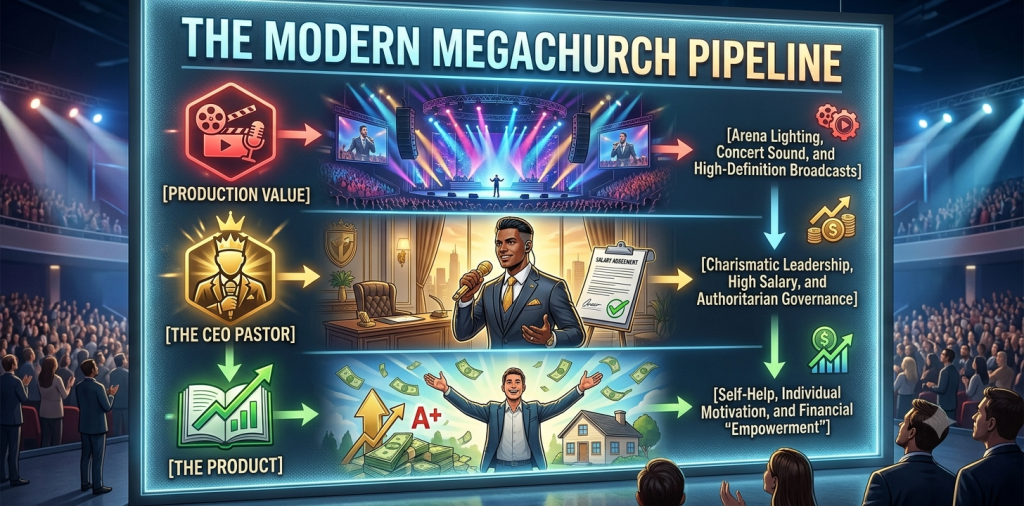
These organizations utilize standard corporate logistics, target demographics, and entertainment-industry production values to draw in thousands of people. The pastor functions less like a spiritual guide and more like a CEO or a motivational influencer.
Critically, the message preached in these arenas completely supplants the actual philosophy of Jesus. You will rarely hear deep, uncomfortable discussions about systemic greed, pacifism, or radical self-sacrifice. Instead, the sermons are heavily focused on individual optimization, personal success, and how to manifest your “best life now.” It is a consumerist commodity disguised as spiritual enlightenment.
4. The View from the Outside: Autonomy, Reciprocity, and Wyrd
For those of us navigating reality through an alternative spiritual framework, observing this dominant American religious structure provides immense clarity.
From a Norse Pagan perspective, the concept of Örlög and Wyrd teaches us that we are deeply interwoven with our communities, our ancestors, and the earth itself. Our actions have collective, echoing consequences across the web of existence. We do not exist as isolated, hyper-individualized consumers trying to extract material wealth from the cosmos via positive thinking or transaction-based tithing.
Furthermore, traditional values honor the sovereignty of the individual alongside a fierce obligation to the collective well-being of the tribe. The modern American corporate church achieves the exact opposite: it enforces strict ideological conformity while abandoning collective social responsibility in favor of ruthless market competition.
The Takeaway
Modern American Christianity has not been corrupted by the outside world; it has been systematically colonized by it. Late-stage capitalism required a spiritual apparatus that could validate its inequalities, pacify its workers, and sanctify its billionaires. By erasing the radical, communal, and anti-imperial philosophy of the historical Jesus, corporate America built a replacement that served its own image perfectly.
When a society’s gods look exactly like its hedge fund managers, it is no longer practicing a faith. It is worshiping the market.

This work is licensed under a Creative Commons Attribution-NonCommercial-ShareAlike 3.0 Unported License.

 Volmarr’s Tumblr
- View On WordPress
- View On WordPress
- The New American Dream: Freedom Beyond the White Picket Fence
- A Foreigner in the Country of My Birth
- Hail the Mad God
- The Great Tree of Becoming
- The Age of Superconsciousness
- This Flag is Dedicated to Ingeborg, Gyðja of Freyr!
- Official Frith and Peace Flag of Volmarr!
- Official Flag of Volmarr’s Version of the Modern Viking Lifestyle!
 Volmarr's Blog of Modernist Heathenism, Norse-Paganism, and Norse-Wicca