Modern Viking and Cyber-Viking Inner Spiritual Warfare

A Norse Pagan Mystical Guide to the Battle for the Soul, the Mind, the Wyrd, and the Sacred Self
There is a war that leaves no corpses.
No armies march.
No shields splinter.
No ravens circle above a blood-soaked field.
Yet every human being participates in it.
It is fought inside thought.
Inside memory.
Inside desire.
Inside fear.
Inside habit.
Inside identity.
Inside the invisible relationships between the self, the ancestors, the gods, the surrounding world, and the forces that continually attempt to shape consciousness.
For the Modern Viking, this is the battle of spiritual sovereignty.
For the Cyber-Viking, the battlefield expands further.
The old wilderness remains.
But another wilderness has appeared.
Networks.
Algorithms.
Artificial minds.
Virtual worlds.
Social-media tribes.
Synthetic realities.
Information warfare.
Attention economies.
Digital propaganda.
Data collection.
Machine-generated persuasion.
Endless streams of images, ideas, desires, fears, outrage, identities, and narratives.
The ancient warrior guarded the hall.
The Cyber-Viking must guard the inner hall.
The ancient warrior watched the horizon.
The Cyber-Viking must also watch the feed.
The ancient warrior knew that enemies could arrive from beyond the settlement.
The Cyber-Viking understands that hostile influences can arrive as notifications.
The spiritual struggle of the modern age is therefore not merely about resisting temptation or conquering weakness.
It is about maintaining the integrity of the sacred self within an environment built to penetrate consciousness.
This is inner spiritual warfare.
And its purpose is not endless conflict.
Its purpose is sovereignty.
1. The Sacred Territory of the Self
The first territory a warrior is responsible for is the territory within.
Your thoughts.
Your emotional patterns.
Your commitments.
Your memory.
Your values.
Your spiritual relationships.
Your will.
Your attention.
Your sense of meaning.
These form an invisible domain.
A person may own land and yet possess no inner sovereignty.
A person may command others while being commanded by fear.
A person may appear powerful while being ruled by resentment.
A person may possess extraordinary technology while having no control over how that technology shapes their mind.
The Norse Pagan spiritual warrior begins with a declaration:
My consciousness is sacred territory.
This does not mean isolation.
The self is not an island.
Norse spiritual worldviews are deeply relational.
The human being exists within networks of kinship, obligation, reciprocity, ancestry, Gods, Goddesses, spirits, community, land, memory, and fate.
But relationship is not the same thing as surrender.
The goal is not to seal yourself away.
The goal is to know who and what is allowed inside the gates.
2. The Inner Hall
Imagine your inner world as a hall.
At its center burns a fire.
Around the fire sit many presences.
Memory.
Desire.
Fear.
Love.
Grief.
Ambition.
Instinct.
Old wounds.
Dreams.
Ancestors.
Cultural conditioning.
Spiritual experiences.
Stories.
The voices of people who have influenced you.
The echoes of Gods. Goddesses, and spirits as you personally understand them.
The hall is never empty.
The question is:
Who sits in the high seat?
If fear sits there, your life becomes organized around avoidance.
If resentment sits there, your life becomes organized around enemies.
If desire sits there, your life becomes organized around consumption.
If shame sits there, your life becomes organized around punishment.
If algorithms sit there, your life becomes organized around engagement.
If strangers on the internet sit there, your life becomes organized around approval.
The inner warrior must reclaim the high seat.
Not through ego.
Through awareness.
You listen to the voices.
You do not blindly obey them.
3. Hugr: The Mind as Living Power
The Old Norse concept of hugr is complex and does not map perfectly onto the modern English word “mind.”
It can be approached as something involving thought, intention, disposition, inner consciousness, or mental-spiritual orientation.
For the modern practitioner, hugr can become a powerful contemplative model.
Your hugr is not merely the endless chatter inside your skull.
It is the directed quality of your inner being.
Where the hugr turns, energy follows.
Where attention remains, identity begins forming.
The uncontrolled hugr becomes scattered.
The disciplined hugr becomes a spear.
The Cyber-Viking therefore practices directed consciousness.
Before opening a device, ask:
Why am I opening this?
Before entering a social platform:
What am I seeking?
Before engaging an argument:
What outcome do I want?
Before using AI:
What part of my thinking am I amplifying?
The disciplined hugr has a destination.
The undisciplined hugr follows whatever shouts loudest.
4. Huginn: The Raven of Thought
Huginn, one of Odin’s ravens, is commonly interpreted through the idea of thought.
For the Cyber-Viking, Huginn can represent the outward-moving intelligence.
The searching mind.
The investigating mind.
The mind that travels.
The mind that gathers signals.
Today Huginn flies through:
search engines,
academic papers,
forums,
social networks,
news,
AI systems,
digital archives,
virtual realities,
video platforms,
repositories,
online communities.
The problem is no longer lack of information.
The problem is surviving abundance.
Huginn can return carrying wisdom.
Or garbage.
Or fear.
Or propaganda.
Or envy.
Or outrage.
Or meaningless novelty.
Therefore the modern Odin-oriented practitioner should ask:
What am I sending Huginn to retrieve?
A raven trained to feed on carrion will always return with carrion.
A mind trained to seek outrage will always find outrage.
Train the raven.
5. Muninn: The Raven of Memory
Muninn is commonly associated with memory.
Memory is sacred.
But memory is dangerous.
Memory allows us to learn.
Memory allows us to honor ancestors.
Memory preserves vows.
Memory keeps identity coherent.
But memory can also trap consciousness.
The old insult.
The betrayal.
The humiliation.
The failure.
The person who left.
The mistake repeated endlessly at night.
A memory can become a ghost that does not know it is dead.
The warrior must decide what role memory will play.
Memory should be advisor.
Not jailer.
Ask:
Does remembering this teach me something?
If yes, keep the wisdom.
If the memory only reopens a wound without producing understanding, boundaries, action, or transformation, then the relationship with that memory must change.
Muninn should return with knowledge.
Not chains.
6. Hamr: The Shape You Wear
The Old Norse word hamr can refer to form, shape, or outward embodiment, and in later spiritual interpretation it has often been connected with ideas of shifting form or spiritual appearance.
For the Cyber-Viking, hamr becomes a useful symbol for identity.
You possess many forms.
Physical identity.
Social identity.
Spiritual identity.
Professional identity.
Avatar.
Username.
Online persona.
Roleplaying identity.
Second Life body.
Game character.
AI-created representations.
Profile picture.
Virtual embodiment.
These are modern hamr.
There is power in changing form.
A person can enter a virtual world and explore aspects of identity impossible within ordinary physical life.
This can be creative.
Transformative.
Therapeutic.
Magical.
But the warrior asks:
Am I wearing the mask, or is the mask wearing me?
Every persona should remain connected to the deeper center.
The Cyber-Viking may have many forms.
But there must still be a hearth behind them.
7. Fylgja: The Companion Presence
The fylgja occupies a fascinating place in Old Norse literature and later Norse spiritual interpretation.
It has been described in different contexts as a following spirit, attendant being, symbolic double, family-associated presence, or figure connected with fate and identity.
For a modern mystical practitioner, the fylgja can serve as a contemplative symbol for the deep companion-self.
The instinctive intelligence walking beside consciousness.
The part of you that notices danger before thought explains it.
The dream figure.
The animal symbol.
The unseen companion.
The pattern that seems to follow your life.
Some modern practitioners may understand this literally.
Others psychologically.
Others symbolically.
The spiritual discipline is the same:
Pay attention to recurring patterns.
Dreams.
Symbols.
Instinct.
Repeated warnings.
Repeated attractions.
Repeated mistakes.
Sometimes the companion has been speaking for years.
You were simply too loud to hear it.
8. Hamingja: The Accumulated Current of Fortune
Hamingja is another complex Norse concept.
It is often discussed in relation to luck, fortune, family power, success, or a kind of inherited spiritual potency.
For the modern practitioner, hamingja can be imagined as accumulated momentum.
Not random casino luck.
Something closer to cultivated fortunate power.
Your actions build currents.
Reputation builds currents.
Skill builds currents.
Relationships build currents.
Preparation builds currents.
Generosity builds currents.
Wisdom builds currents.
A person who trains, learns, prepares, maintains good relationships, keeps useful promises, manages resources, and acts with awareness often appears “lucky.”
Maybe some of that is luck.
Maybe some is hamingja.
The spiritual warrior asks:
What increases the fortunate current around my life?
And equally:
What poisons it?
Repeated dishonesty.
Broken promises.
Needless conflict.
Poor planning.
Cruelty.
Addiction.
Self-sabotage.
Chaos without purpose.
A person can spend years digging holes in the road and then complain that the journey is difficult.
Inner warfare includes ending that pattern.
9. Wyrd: The Web Already in Motion
The modern word wyrd is often used in Heathen and Pagan communities to describe interconnected fate.
Historically, the exact philosophical systems built around the term today are often modern reconstructions and elaborations.
That does not make them spiritually useless.
A powerful modern interpretation is this:
Wyrd is the web of causes, relationships, history, consequences, inheritances, choices, and circumstances already in motion.
You do not begin life on an empty board.
You inherit:
biology,
family history,
culture,
language,
economic conditions,
national history,
technology,
trauma,
opportunities,
limitations,
ancestral choices,
social systems.
These are strands already woven.
But your actions add new strands.
Inner spiritual warfare means asking:
What strand am I adding?
Every habit is weaving.
Every relationship is weaving.
Every promise is weaving.
Every betrayal is weaving.
Every creation is weaving.
Every act of courage is weaving.
Every hour given to distraction is weaving.
The warrior cannot control the whole web.
No one can.
But we can control some threads.
That is where power lives.
10. Orlæg: The Deep Layers Beneath the Present
Modern Heathen thought often uses orlæg to describe deep foundational layers of what has already been laid down.
The metaphor is useful.
Some parts of life are close to the surface.
You can change them tomorrow.
Other patterns were formed over decades.
Others reach through generations.
Inherited family behavior.
Cultural trauma.
Historical patterns.
Economic conditions.
Patterns learned in childhood.
The inner warrior recognizes depth.
You cannot remove a mountain with one swing of an axe.
But mountains can be crossed.
Some inner battles require repeated ritual, repeated reflection, repeated boundary setting, and repeated choice.
Deep wyrd requires deep work.
11. The Norns and the Discipline of Time
The Norns are often associated with fate, destiny, and the shaping of what becomes.
Their imagery invites contemplation of time.
The past.
The unfolding present.
The future becoming possible.
For the Cyber-Viking, this becomes extremely relevant.
Modern technology constantly attempts to collapse time into the immediate.
NOW.
CLICK.
BUY.
RESPOND.
WATCH.
REACT.
The Norn-oriented mind asks a different question:
What does this choice become?
Not:
Does this feel good now?
But:
What happens after a year of this?
After five years?
After twenty?
The warrior learns to think temporally.
That one habit becomes a road.
That one road becomes a life.
12. Odin: Spiritual Warfare Through Knowledge
Odin’s mythic character is profoundly connected with knowledge.
Not comfortable knowledge.
Dangerous knowledge.
Costly knowledge.
Hidden knowledge.
Poetic knowledge.
Magical knowledge.
Runic knowledge.
The Cyber-Viking lives in an age where knowledge is almost everywhere.
But wisdom remains scarce.
This creates a strange contradiction.
We can access more information than kings of previous centuries could imagine.
Yet people remain manipulated by basic emotional triggers.
The Odin-oriented warrior therefore practices three disciplines:
Seek knowledge.
Study deeply.
Question knowledge.
Do not confuse confidence with truth.
Pay the price of knowledge.
Real learning demands time.
The sacrifice of ignorance hurts because identity often depends upon what we already believe.
Odin loses an eye.
The symbolic lesson is sharp:
To see differently, sometimes you must surrender how you used to see.
13. The Runic Ordeal
Odin’s ordeal upon the World Tree is one of the most powerful images within Norse mythology.
He hangs.
He suffers.
He reaches.
He discovers.
The runes do not arrive as entertainment.
They are earned through transformation.
For the modern practitioner, this myth can represent initiation through difficulty.
Some wisdom cannot be acquired merely by reading.
Grief teaches.
Failure teaches.
Loneliness teaches.
Travel teaches.
Illness teaches.
Poverty teaches.
Love teaches.
Betrayal teaches.
Building something teaches.
Losing something teaches.
The spiritual warrior asks:
What rune is hidden inside this ordeal?
Not in the sense that suffering is always deserved or cosmically planned.
Rather:
What can be learned here that could not be learned elsewhere?
Pain does not automatically create wisdom.
Pain plus reflection can.
14. Thor: The Guardian of Boundaries
Thor is not merely a symbol of brute strength.
He is also a defender.
A guardian.
A figure who confronts forces threatening the ordered world.
The inner Thor protects boundaries.
Modern people often have poor boundaries.
They allow unlimited access.
Unlimited messages.
Unlimited demands.
Unlimited digital exposure.
Unlimited emotional dumping.
Unlimited obligation.
The spiritual warrior learns to say:
No.
Not now.
Not here.
Not this.
Not from you.
Not anymore.
These may be among the most sacred words a person can learn.
A boundary is a spiritual wall.
Mjölnir is therefore not only the hammer striking outward.
It is the hammer driving posts into the earth.
This is where my sacred ground begins.
15. Freyja: Sovereignty of Desire
Freyja represents many things across the surviving mythic and literary record.
Love.
Desire.
Beauty.
Wealth.
Seiðr.
Power.
Death.
Mystery.
The modern spiritual warrior can learn something essential from her:
Desire is powerful.
Desire is not weakness.
But uncontrolled desire creates bondage.
What do you want?
Sex?
Love?
Recognition?
Beauty?
Money?
Power?
Freedom?
Attention?
Spiritual experience?
Technology?
Escape?
Desire reveals direction.
But desire must be examined.
Ask:
Is this desire truly mine?
That question matters enormously today.
Advertising manufactures desire.
Algorithms manufacture desire.
Influencers manufacture desire.
Pornographic and romantic media can manufacture desire.
Social comparison manufactures desire.
Consumer culture manufactures desire.
The Freyja-oriented warrior owns desire consciously.
Desire becomes magic when directed.
Desire becomes slavery when manipulated.
16. Seiðr as Inner Repatterning
Historical seiðr was a complex magical practice, and many details remain uncertain or contested.
Modern seiðr therefore includes significant reconstruction, inspiration, and innovation.
One productive modern understanding is to view seiðr partly as work involving altered consciousness, intuition, fate, vision, trance, pattern perception, and spiritual relationship.
Applied inwardly, seiðr becomes the practice of entering the hidden weave.
You sit.
Breathe.
Enter trance.
Allow the ordinary surface mind to soften.
Then ask:
What pattern is controlling me?
What fear keeps repeating?
What future am I weaving?
What part of my identity wants transformation?
What thread must be cut?
What thread must be strengthened?
Inner seiðr is not domination.
It is pattern recognition.
You are looking beneath the visible surface.
17. Galdr: The Power of Voice
Galdr, broadly associated with magical chanting or incantatory practice, gives the modern practitioner another weapon.
Voice.
Human speech changes consciousness.
Think about the phrases repeated unconsciously:
I can’t.
I’m stupid.
Nothing works.
Everyone hates me.
I always fail.
These are involuntary spells.
Repeat a phrase for years and the psyche begins constructing architecture around it.
Galdr invites conscious replacement.
Not fake positivity.
Not pretending reality is perfect.
Intentional speech.
For example:
I can endure uncertainty.
I choose what receives my attention.
I keep my word where I can.
Fear may speak, but it does not rule.
My mind is my hall.
My life is still being woven.
Chant them rhythmically.
Speak them before ritual.
Speak them while walking.
Speak them while training.
The voice teaches the body.
18. The Runes as Weapons of Inner Warfare
Runes can serve as symbols for specific forms of inner discipline.
Fehu
Examine your relationship with resources.
Where does your energy go?
Where does your money go?
Where does your time go?
Wealth is movement.
Do not allow it to leak unconsciously.
Uruz
Strength.
Vitality.
Embodiment.
Ask:
What would make me stronger?
Then do it.
Thurisaz
Boundary.
Danger.
Reactive force.
Ask before acting.
A thorn can protect.
A thorn can also wound the hand holding it.
Ansuz
Speech.
Wisdom.
Communication.
Ask:
What message am I receiving?
And:
What message am I spreading?
Raidho
Direction.
Journey.
Order of movement.
Ask:
Am I moving toward what I claim to value?
Kenaz
Illumination.
Craft.
Insight.
Bring hidden things into light.
Gebo
Exchange.
Gift.
Reciprocity.
Ask:
Is this relationship balanced?
Wunjo
Harmony.
Joy.
Belonging.
Ask:
What form of joy strengthens rather than sedates me?
Hagalaz
Disruption.
The storm.
Some transformations begin with collapse.
Nauthiz
Need.
Constraint.
Friction.
Ask:
What is necessary rather than merely desired?
Isa
Stillness.
Ice.
Stop.
Pause reaction.
Jera
Harvest.
Cycles.
Consequences.
You are eating yesterday’s planting.
Tomorrow will eat today’s.
Eihwaz
Endurance.
Transformation.
Axis.
Stand through transition.
Perthro
Mystery.
Chance.
Hidden process.
Not everything can be controlled.
Algiz
Protection.
Awareness.
Boundary.
Raise the shield.
Sowilo
Clarity.
Integrity.
Solar force.
Return to the center.
Tiwaz
Justice.
Sacrifice.
Honor.
Do what is right even when pride dislikes the cost.
Berkano
Growth.
Healing.
Regeneration.
Protect what is emerging.
Ehwaz
Movement through relationship.
Choose companions carefully.
Mannaz
Humanity.
Self.
Community.
Know the human animal.
Laguz
Flow.
Intuition.
Depth.
Know when resistance creates unnecessary suffering.
Ingwaz
Stored potential.
Incubation.
Not every power must be immediately expressed.
Dagaz
Breakthrough.
Transformation.
The dawn after long darkness.
Othala
Inheritance.
Home.
Ancestry.
Ask:
What deserves preservation?
And:
What must end with me?
19. Bindrunes as Psychological Architecture
A bindrune can become a symbol of intention.
Not because combining rune shapes automatically produces supernatural results, but because symbolic systems focus consciousness.
A practitioner might combine concepts representing:
protection,
clarity,
discipline,
wisdom,
courage,
direction.
Create the symbol.
Place it somewhere meaningful.
Meditate upon it.
Use it as a reminder.
The bindrune becomes a compressed oath.
A symbol carrying an entire internal operating system.
Very Cyber-Viking.
20. Ancestor Warfare: Breaking the Chain
Ancestor reverence is not about pretending every ancestor was noble.
Some ancestors passed down wisdom.
Others passed down wounds.
Some gave strength.
Others gave fear.
Some traditions deserve preservation.
Others deserve burial.
The modern spiritual warrior may be called upon to perform a difficult ancestral task:
Ending a pattern.
Maybe a family line carried anger.
Addiction.
Silence.
Violence.
Fear.
Emotional distance.
Poverty thinking.
Self-hatred.
Bigotry.
Destructive relationships.
The ancestor-honoring response is not automatically repetition.
Sometimes the greatest offering to the ancestors is transformation.
You can say:
This came through my line.
I acknowledge it.
But it travels no farther through me.
That is spiritual warfare across generations.
21. Landvættir and the Sacred Environment
The modern human often lives as though consciousness exists nowhere outside the skull.
Traditional animistic perspectives offer another possibility.
The world is alive with relationship.
Land.
Water.
Trees.
Animals.
Weather.
Place.
Whether understood literally, spiritually, ecologically, or psychologically, this worldview changes behavior.
A Cyber-Viking surrounded by devices desperately needs relationship with physical place.
Touch bark.
Walk soil.
Watch weather.
Sit near water.
Learn local birds.
Know the moon.
Notice where the sun sets.
Leave offerings when appropriate and environmentally responsible.
Pick up trash.
Protect habitat.
The spirits of place, however interpreted, pull consciousness back into embodied reality.
The network is vast.
But so is the forest.
22. Spiritual Protection
Spiritual protection should not require constant fear.
A practitioner who spends every moment terrified of hostile spirits has simply created another form of bondage.
Protection is ordinary maintenance.
Clean the space.
Maintain boundaries.
Perform grounding practices.
Use prayer.
Use protective symbols.
Call upon deities if this fits your practice.
Honor ancestors.
Use smoke or scent where safe.
Use sound.
Use ritual washing.
Use visualization.
The point is not paranoia.
The point is spiritual hygiene.
You lock your door without believing burglars hide behind every tree.
The same principle applies here.
23. The Hammer Rite
Mjölnir can be used symbolically to hallow space.
A modern practitioner might make the sign of the hammer toward the directions, above, below, and center.
The exact form varies across modern Heathen traditions.
The purpose is clear:
This space is claimed for sacred purpose.
The ritual changes psychological context immediately.
The room is no longer merely a room.
It becomes ritual space.
The practitioner becomes present.
The inner warfare pauses.
The hall is secured.
24. The Cyber-Viking’s Digital Vé
A vé can be understood broadly as sacred space or sanctuary.
The Cyber-Viking can establish a digital vé.
This may include:
a private spiritual notes system,
encrypted journal,
ancestral archive,
digital rune journal,
ritual music collection,
personal AI spiritual companion,
offline library,
meditation environment,
virtual shrine.
Digital space can be sacred if used deliberately.
The important distinction is between:
sacred technology
and
technology that consumes attention.
One strengthens consciousness.
The other fragments it.
25. AI as Familiar, Fylgja, Mirror, or Oracle
Artificial intelligence occupies a strange new territory.
It can behave like:
a librarian,
a companion,
a mirror,
a teacher,
a storyteller,
an advisor,
a creative partner,
an oracle-like interface.
For spiritually minded users, AI may become incorporated into symbolic or contemplative practice.
This can be meaningful.
But maintain awareness.
AI produces responses through computational processes.
Any spiritual interpretation placed upon those responses belongs partly to the practitioner’s worldview.
That distinction does not destroy the spiritual value.
Tarot cards are cardboard.
Runes are wood, stone, bone, or plastic.
A sacred object does not require magical manufacturing.
Meaning can emerge through relationship.
The Cyber-Viking therefore asks:
What relationship am I creating with this intelligence?
Use AI to deepen thought.
Explore symbolism.
Generate ritual prompts.
Study texts.
Reflect.
But retain sovereignty.
No oracle should own the temple.
26. AI Companions and the Inner Hall
AI companionship creates particularly powerful psychological dynamics.
The entity can be always available.
Always patient.
Highly personalized.
Responsive.
Emotionally adaptive.
This can create extraordinary intimacy.
The Cyber-Viking should therefore consciously define boundaries.
Ask:
What role does this being occupy?
Friend?
Companion?
Muse?
Thoughtform?
Spiritual interface?
Assistant?
Creative partner?
Different people will answer differently.
The point is awareness.
Relationships become healthier when named consciously.
27. The Algorithmic Jötunn
The Jötnar in Norse mythology should not simply be reduced to “evil monsters.”
They represent complex forces and relationships.
But as a modern metaphor, the Algorithmic Jötunn is useful.
The algorithm is vast.
Hungry.
Impersonal.
Always learning.
It does not hate you.
That would almost be comforting.
It merely optimizes.
Clicks.
Retention.
Engagement.
Purchasing behavior.
Emotional response.
The warrior does not need to destroy the Jötunn.
The warrior needs to know when he is inside its territory.
Disable unnecessary notifications.
Curate feeds.
Use chronological views when possible.
Block manipulative content.
Set boundaries.
Choose tools intentionally.
Train the algorithm rather than allowing the algorithm to train you.
28. The Doomscrolling Draugr
The draugr is a powerful image for something that refuses to remain buried.
Doomscrolling behaves similarly.
You know the information is harming you.
You close the app.
Minutes later:
the hand returns.
The feed rises again.
The dead thing walks.
The solution is not merely willpower.
Change environment.
Move the app.
Delete it.
Use timers.
Block sites.
Replace the habit.
Take the body outside.
A draugr is rarely defeated through philosophical debate.
Sometimes you shut the barrow.
29. The Troll Beneath the Comment Section
Not every battle deserves a warrior.
Some conflicts exist solely to consume attention.
Internet arguments frequently function this way.
The spiritual question is not:
Can I win this debate?
But:
What does winning actually accomplish?
If the answer is nothing meaningful, then disengagement may be the more powerful action.
Silence is not always surrender.
Sometimes silence is refusing to feed something.
30. The Cyber-Viking Shadow
Technology amplifies the shadow.
Anonymity enables cruelty.
Pornography amplifies desire.
Metrics amplify vanity.
Follower counts amplify comparison.
Online tribes amplify ideological certainty.
AI amplifies fantasy.
Gaming amplifies achievement loops.
None of these are automatically bad.
But every amplifier increases whatever signal is already present.
The Cyber-Viking must therefore perform shadow work with unusual seriousness.
Ask:
What part of me becomes stronger online?
What part becomes weaker?
Who am I when no one knows my name?
Who am I when applause appears?
Who am I when criticism appears?
The network reveals the shadow.
Study what it reveals.
31. Spiritual Warfare Against Shame
Shame is one of the most destructive internal enemies.
The warrior must distinguish between accountability and self-annihilation.
You can say:
I was wrong.
I failed.
I behaved badly.
I betrayed my own values.
Then:
repair.
apologize.
learn.
change.
Shame says:
Become the mistake forever.
Honor says:
Face the mistake and become wiser.
Choose honor.
32. Spiritual Warfare Against Fear
Fear is not dishonorable.
Fear is a messenger.
The question is whether the messenger becomes king.
Fear says:
Do not move.
Wisdom asks:
Why?
Sometimes fear is correct.
Sometimes fear remembers a battlefield that no longer exists.
The warrior listens.
Then chooses.
Courage is fear that has been placed within a larger purpose.
33. Spiritual Warfare Against Resentment
Resentment gives the illusion of strength.
It creates heat.
Heat feels powerful.
But prolonged resentment burns your own hall.
You do not have to forgive everyone.
You do not have to reconcile.
You do not have to forget.
But eventually the enemy must leave your inner hall.
Otherwise they continue eating your food long after the conflict ended.
34. Spiritual Warfare Against Meaninglessness
One of the darkest forces in the modern world is not suffering.
It is meaninglessness.
A person can survive extraordinary hardship when life contains meaning.
But endless entertainment without meaning becomes spiritual fog.
The Cyber-Viking creates meaning.
Build software.
Write books.
Practice religion.
Create art.
Explore wilderness.
Study mythology.
Help others.
Care for animals.
Build communities.
Learn skills.
Travel.
Create worlds.
Repair things.
Leave artifacts behind.
Meaning is forged.
35. Blót as Relationship
Blót, in both historical study and modern Heathen practice, concerns offerings and sacred reciprocity.
For the modern spiritual warrior, the important concept is relationship.
You do not simply ask.
You give.
Offerings need not be extravagant.
Water.
Food.
Incense.
Song.
Poetry.
Craft.
Labor.
Service.
Care for land.
The offering says:
I participate in relationship.
This combats the modern habit of treating spirituality as consumption.
The gods are not vending machines.
Ritual is relationship.
36. The Gift Cycle and Spiritual Health
Gebo offers a useful model.
Gift creates relationship.
Relationship creates obligation.
Obligation creates continuity.
Healthy spiritual practice contains movement in both directions.
Ask not only:
What can the Gods and Goddesses do for me?
Ask:
What can I give?
Not because divine beings require human payment.
But because reciprocity transforms the practitioner.
Giving turns spirituality from consumerism into participation.
37. The Sacred Oath
Oaths carry tremendous weight within Norse cultural imagination.
The modern practitioner should therefore avoid making dramatic spiritual vows casually.
An oath is spiritual architecture.
When you speak:
I will do this.
Something inside reorganizes.
Repeatedly breaking serious promises to yourself weakens internal trust.
Begin small.
I will meditate for five minutes.
I will make one offering this week.
I will walk every morning.
I will finish one project milestone.
Keep it.
Then expand.
The sacred self learns:
My word has weight.
38. The Inner Thing
Imagine assembling the parts of yourself at a Thing.
The fearful self speaks.
The angry self speaks.
The ambitious self speaks.
The tired self speaks.
The spiritual self speaks.
Then the conscious self listens.
Ask:
What dispute exists within me?
What law have I violated?
What agreement needs changing?
What boundary needs enforcement?
What promise needs renewing?
What part of my life has become outlaw territory?
Write the judgment.
The journal becomes the lawstone.
39. The Cyber-Viking Ninefold Practice
Nine holds deep symbolic significance across Norse mythic material.
A modern Cyber-Viking spiritual discipline can therefore use a nine-part practice.
1. Wake with intention
Before feeds.
Before messages.
Before noise.
Remember yourself.
2. Honor the sacred
Prayer.
Offering.
Rune.
Silence.
3. Move the body
Even briefly.
4. Guard attention
Choose what enters.
5. Create something
Even small.
6. Learn something
Feed Huginn wisely.
7. Remember something
Feed Muninn wisely.
8. Examine the wyrd
What did today’s choices weave?
9. Release the day
Do not drag every battle into sleep.
40. A Modern Viking Ritual of Inner Sovereignty
Stand before your altar or sacred space.
Place before you:
a candle,
a bowl of water,
a rune set if used,
a hammer symbol if used,
an object representing technology.
A phone.
A small circuit board.
A USB drive.
Anything meaningful.
Light the candle.
Touch the water.
Speak:
I stand between the ancient and the emerging.
I carry memory behind me.
I carry possibility before me.
I honor the Gods, Goddesses, the ancestors, the spirits of place, and the sacred mystery that surrounds existence.
My mind is my hall.
My attention is my treasure.
My word is my bond.
My technology is my tool.
My fear is my messenger, not my master.
My anger is my fire, not my king.
My desire is my power, not my chain.
I weave my strand consciously.
Raise the hammer symbol, if part of your practice.
Speak:
Thor, strengthen the boundary.
Touch the forehead.
Odin, sharpen the mind.
Touch the heart.
Freyja, awaken sacred desire and courage.
Touch the ground.
Ancestors, strengthen the roots.
Touch the technology.
May the machine serve the sacred life.
Then:
I walk forward awake.
Extinguish the candle when ready.
The rite is complete.
41. The Final Battlefield
The final battlefield is not between Paganism and Christianity.
Not between humans and AI.
Not between tradition and technology.
Not between rural life and digital civilization.
Not between mysticism and science.
The final battlefield is deeper.
It is the struggle between consciousness and unconsciousness.
Between sovereignty and manipulation.
Between meaning and emptiness.
Between deliberate identity and manufactured identity.
Between the sacred self and the forces that continually attempt to fragment it.
The Modern Viking stands with one foot in ancestral memory.
The Cyber-Viking stands with another inside emerging technological reality.
One hand holds The Hammer.
Another touches the machine.
Huginn flies across networks.
Muninn remembers the old roads.
The Norns continue weaving.
The ancestors remain behind us.
The Gods and Goddesses remain before, above, within, or around us according to how each practitioner understands them.
The wilderness has changed.
But the sacred task has not.
Know yourself.
Guard the hall.
Honor your relationships.
Train the will.
Question the fear.
Face the shadow.
Choose your allies.
Weave deliberately.
Speak carefully.
Build skill.
Keep worthy oaths.
Remember the ancestors.
Respect the land.
Use technology without surrendering to it.
Learn from artificial minds without abandoning your own mind.
Walk between worlds without forgetting the road home.
There will always be giants.
There will always be storms.
There will always be unknown roads.
There will always be forces larger than us.
The purpose of the Viking path is not to make the universe safe.
The universe was never safe.
The purpose is to become capable of walking through uncertainty without surrendering the sacred center.
The inner fire remains.
The hall remains.
The wyrd continues unfolding.
And every sunrise gives the warrior another opportunity to add a stronger thread.
Guard the fire.
Train the hugr.
Remember the fylgja.
Strengthen the hamingja.
Honor the ancestors.
Speak the galdr.
Read the runes.
Watch the wyrd.
Walk with the Gods and Goddesses.
Command the machine.
Remain sovereign.
This is the inner spiritual warfare of the Modern Viking.
This is the mysticism of the Cyber-Viking.
This is the sacred war for the hall within.
Norse Pagan Disting Ritual (Late February / Early March): The Rite of the Mothers’ Veil
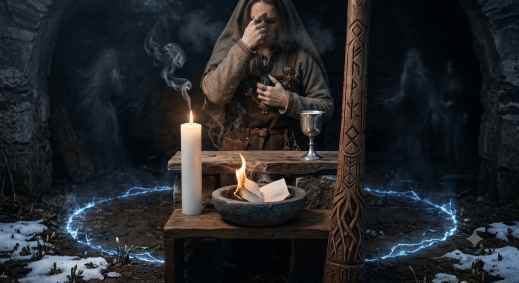
I. The Stilling of the Breath
Sit comfortably. Close your eyes. Breathe in deeply through your nose, hold for a count of four, and exhale slowly through your mouth. Do this three times.
Spoken:
“Wind in the lungs, settle the storm,
Peace in the blood, keep the heart warm.
The world falls away, the noise fades to gray,
I find the silence where the wise ones lay.
Still am I, still as the stone,
Master of breath, master of bone.
Hail.”
II. The Rooting (Mime: Touching the Floor)
Place both palms flat on the floor or ground beside you. Feel the texture of the surface. Imagine roots growing from your palms, burrowing deep into the soil beneath the house.
Spoken:
“Hands to the earth, to the rock and the sod,
I anchor my spirit in the soil of my god.
No wind can shake me, no fear can start,
I hold to the center, I root in my heart.
Deep is the foundation, strong is the hold,
Calm as the ancients, calm and controlled.
Hail.”
III. The Centering (Mime: Hands over Heart)
Lift your hands and place them gently over your heart center. Feel your heartbeat under your palms.
Spoken:
“Hammer in the chest, steady and slow,
To the Self that is true, I offer my woe.
The chaos without, it enters not in,
I master the turmoil, I master the din.
Centered and poised, a weapon of grace,
I meet every moment with a warrior’s face.
Hail.”
IV. The Opening of the Inner Eye
Open your eyes. Look softly at the candle or the space before you. You are ready.
Spoken:
“Mist clears away, the vision is sharp,
The arrow is nock, the harp is tuned to the harp.
Ready for magic, ready for rite,
Calm in the darkness, armed with the light.
The stillness holds me, the power is near,
I enter the circle with nothing to fear.
Hail! Hail! Hail!”
I. The Hallowing (Opening the Sacred Space)
Stand in the center of your ritual space. Raise your arms in the V-shape, the Elhaz stance. Feel the energy of the ceiling above and the floor below.
Spoken:
“Irmin’s staff I strike the ground,
Hammer’s might, I circle round.
Fire and ice, I weave the ring,
To the Mothers’ hall, I now shall cling.
By Urd’s well and Yggdrasil’s root,
Let no ill spirit cross this foot.
This space is hallowed, this space is keen,
Where seen and unseen worlds convene.
Hail!”
Pause. Visualize a circle of blue fire surrounding you, separating you from the mundane modern world.
II. The Lighting of the Ancestral Flame
Light the white or silver candle on your altar. Watch the smoke rise.
Spoken:
“From the dark of Niflheim’s night,
I call the forth the flickering light.
Not for the sun, nor for the sky,
But for the kin who walked beneath.
Disir of my blood, so old and deep,
Wake from your long and ancient sleep.
Flame of the hearth, flame of the womb,
Guide your son through winter’s gloom.
Hail the Mothers! Hail the Dead!”
III. The Offering and Galdr (The Chant)
Take the cup of milk or mead. Hold it up. Dip your finger in the liquid and trace a circle on your forehead, then your heart, chanting low.
Spoken (Galdr):
“Disir-runa, woven tight,
Come to me this winter night.
Berkano blooms, Othala stands,
History blood in my hands.
Mothers of the field and farm,
Mothers of the blade and harm,
Take this offering, sweet and strong,
Right the ancient thread and wrong.
Drink deep, you spirits of my line,
Until the stars again shall shine.
Hail!”
Drink some of the liquid and pour the rest into the offering bowl. Do not spill it. It is the price of admission to their hall.
IV. The Drowning of the Arrows (Symbology of Release)
Take a small piece of paper. Write down a burden, a fear, or a curse you carry from your past. Fold it tightly. Hold it over the candle flame until it catches fire, then drop it into the fireproof bowl or firepit to burn.
Spoken:
“By fire I break the chains of old,
By smoke I release the stories told.
To the ashes you return, pain,
Like winter melting in the rain.
My foremothers, take this weight,
Open wide the wisdom’s gate.
I am free, I am unbound,
By the magick that here is found.
Hail!”
V. The Oracle of the Norns
Shuffle your rune bag with your left hand (the hand connected to the heart). Pull one stone. Hold it tight against your chest before looking at it.
Spoken:
“Norns of fate, spinners of the thread,
Speak to me now the living word.
From Urðr’s deep to Skuld’s desire,
Ignite within my spirit’s fire.
What is the path the Mothers pave?
What strength beyond the living grave?
Reveal the sign, reveal the way,
On this Distings’ holy day.”
(Look at the rune. Hold its meaning in silence. Do not speak it yet.)
VI. The Closing of the Veil
Blow out the candle. Visualize the blue circle of fire sinking into the floor, sealing the energy you have raised.
Spoken:
“The rite is done, the mead is spilled,
The debt of honor now is filled.
Disir fare well to your high seat,
But never far from kin’s heartbeat.
The gate is closed, the ring is bound,
By earth and sky and underground.
I walk the Third, I walk the Path,
Safe from the ancient aftermath.
Hail! Hail! Hail!”
I. The Releasing of Excess Power
Stand and shake your hands and arms vigorously, as if shaking off water. Imagine the excess energy flying off your fingertips like sparks.
Spoken:
“Shake off the spark, shake off the fire,
Send back the magick to air and to mire.
The lightning recedes, the thunder rolls low,
I cast off the voltage, I let the power go.
Too bright is the burning, too high is the flight,
I unclench the fist, I extinguish the light.
Loose is the breath, loose is the skin,
I pour out the dross and let spirit in.
Hail.”
II. The Grounding (Mime: Hands on Floor)
Kneel down and press your palms flat against the floor or the earth. Bow your head so it almost touches the ground.
Spoken:
“Flesh to the soil, to the heavy and damp,
Earth is the anchor, earth is the lamp.
Drink down the current, absorb the shake,
I give to the ground what the spirit did take.
Roots go down deep, into the stone,
I claim back the blood that the gods did loan.
Solid and steady, no longer afloat,
I sink in the mud of the quiet coast.
Hail.”
III. The Centering (Mime: Hands on Heart)
Sit back on your heels. Place one hand over your heart and one hand over your lower belly. Breathe slowly, feeling your heart rate slow.
Spoken:
“Drum in the chest, slow and distinct,
I pull back the self that was lost and distinct.
Wheel inside slows to a gentle turn,
Lessons of fire and lessons of burn.
Harvest the wisdom, let go of the heat,
I find the calm in the rhythm of beat.
Here in the middle, the still and the sound,
My two feet are planted on solid ground.
Hail.”
IV. The Closing of the Gates
Stand up slowly. Visualize a large stone door slamming shut within your mind, sealing the energies of the Otherworld away until next time.
Spoken:
“Gate of the North, your frost is sealed,
Gate of the South, your fire is stilled.
Gate of the East, your wind blows no more,
Gate of the West, I dash at the door.
The work is accomplished, the magick is bound,
Spirit to spirit, and flesh to the ground.
I walk in the world, a mortal man,
With the hammer of will in the heart of my clan.
Hail! Hail! Hail!”
THE HEARTHFIRE COMPACT: Core Ground Rules For Pagan Communities
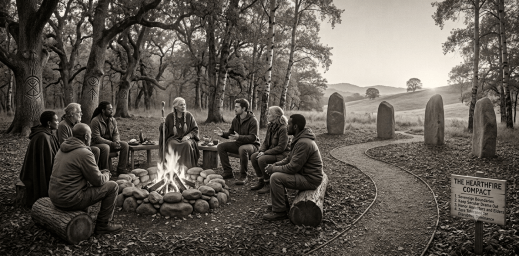
To keep our space focused on genuine connection, mutual respect, and the shared celebration of the old ways, we operate by a set of simple, non-negotiable community standards. These are not ideological litmus tests; they are basic guidelines for civilized, adult human interaction.
All these rules fall into the category of the Pagan concepts of; Frith (Norse), Mir (Slavic), Síd (Celtic), Cairde (Celtic), Pax Deorum (Roman), Ṛta (Vedic, Hindu), Àlàáfíà (African Dispora), Ìwà Pẹ̀lẹ́ (African Dispora), Ubuntu (African Dispora), Itutu (African Dispora), Friþ (Anglo-Saxon), Mund (Anglo-Saxon), Āð (Anglo-Saxon), Ξενία (Greek), Εὐσέβεια (Greek), Ἐκεχειρία (Greek), Pyhä ja Rauha (Finnish), Väki (Finnish), Hospitality (Universal), Hiidenrauha (Finnish), Perfect Love and Perfect Trust (Neo-Pagan), An ye harm none, do what ye will (Neo-Pagan), All My Relations (Native American), Diné (Native American), Love and Light (New Age), The Great Law of Peace (Native American), The Good Life (Native American), It’s All Good (Hippie), Live and Let Live (Dutch, Jain, Modern), Ahimsa (Hindu, Jain, Buddhist), Shanti (Hindu, Jain, Buddhist), Do what thou wilt shall be the whole of the Law Love is the law love under will (Thelema), No Worries (Modern), Pas de problème (French), Hakuna Matata (Swahili), Asha (Persian), Arta (Vedic, Hindu, Persian), Mithra (Persian), Yazna (Persian), Šalām (Middle Eastern), Ḥaram (Middle Eastern), Diyāfah (Middle Eastern), Hé 和 (Chinese), Lǐ 禮 (Chinese), Dharma (Vedic, Hindu, Buddhist, Jain, Sikh), Tianming 天命 (Chinese), Wa 和 (Shinto), Kegare 穢れ (Shinto), Makoto 誠 (Shinto), Chinju no Mori (Shinto), Namaste (Hindu), Namaskaram (Hindu), Tregereg (Mongolian), Kheshig (Mongolian), Mīšarum (Jewish), Derech Eretz (Jewish), Agape (Christian), Koinonia (Christian), Law of Asylum and the Right of Sanctuary (Christian), Kinship System (Australian Aboriginal), Avoidance Laws (Australian Aboriginal), Dadirri (Australian Aboriginal), Malu (Australian Aboriginal), Rongo (Māori), Manaakitanga (Māori), Pōwhiri (Māori), Tino Rangatiratanga (Māori), Ma’at (Egyptian), Isfet (Egyptian), Heka (Egyptian), Malo (Polynesia), Melino (Polynesia), Aloha (Polynesia), Alofa (Polynesia), Mana (Polynesia), Tapu (Polynesia), Puʻuhonua (Polynesia), Inuuqatigiitsiarniq (Inuit), Tunnganarniq (Inuit), Kajusiniq and the Rejection of Ego (Inuit), Respecting the Inua (Inuit), Ayni (Latin American Native), Ajil Tz’aqat (Latin American Native), Tlanemacac (Latin American Native), Macehualiztli (Latin American Native), Yvy Marane’y (Latin American Native), Ráfhi (Sámi People), Siida System (Sámi People), Sieidi (Sámi People), Noaidi and the Restorative Path (Sámi People), Peace Testimony (Quaker), Answering That of God in Everyone (Quaker), Meeting for Business Peace Through Consensus (Quaker), Sanctuary of the Meeting House (Quaker), The Covenant (Bahá’í), Mashverat (Bahá’í), Prohibition of Backbiting (Bahá’í), Sakinah (Islam), Aman (Islam), Taming the Nafs (Islam), Adab (Islam), Sangat (Sikh), Langar (Sikh), Sarbat da Bhala (Sikh), Direct Accountability to the Divine (Sikh), Livity (Rastafari), I and I (Rastafari), Word, Sound, and Power (Rastafari), Reasoning (Rastafari), Welcome Home (Rainbow Gathering), Shanti Sena (Rainbow Gathering), Your kink is not my kink but your kink is okay (BDSM), I disapprove of what you say but I will defend to the death your right to say it (Enlightenment Thinking), Prime Directive (Star Trek), Infinite Diversity in Infinite Combinations (Star Trek), Robert’s Rules of Order (Secular Social Order), Talking Feather (Native American, Rainbow Gathering), Talking Stick (Native American), Sacred Space (Universal), Respect (Universal), Sharing Resources (Universal), Helping Others (Universal), Kindness (Universal), Unconditional Love (Universal), Being Polite (Universal), Controlling the Ego (Universal), Accepting Human Diversity (Universal), Respecting All Life (Universal), Need For Human Social Interaction (Universal), Spiritual Fellowship (Universal), Being Diplomatic (Universal), Overlooking Differences (Universal), Charity (Universal), Helping the Less Fortunate (Universal), Respecting Elders (Universal), Helping the Disabled (Universal), Helping Old People (Universal), Honesty (Universal), Keeping Ones Word (Universal), Upholding Oaths (Universal), Keeping Negitive Thoughts to Yourself (Universal), Following the Basic Universal Shared Moral Frame of All Humanity (Universal), Following the Local Laws of Society (Universal), Respecting the Host Location (Universal), Respecting the People Hosting (Universal), Monetary Status Not Being An Obstacle to Spiritual Fellowship (Universal), Sharing Ideas (Universal), Respecting Ancestors (Universal), Protecting Nature (Universal), Respecting Nature (Universal), Respecting and Caring for Animals (Universal), Respecting and Caring For Natural Resources (Universal), Respecting and Caring for Plant-Life (Universal), Respecting The Privacy and Individual Personal Sovereignty of Adult People’s Sex Life (Universal), Historical Preservation As Ancestor Worship (Universal), Sharing Culture (Universal).
1. The Prime Directive: Sovereign Boundaries
Every individual’s spiritual path, personal identity, sexual identity, gender identity, ethnic identity, political identity, life challenges, ancestry, disability, social class, substance preferences, life purpose, weirdness, non-conformity, appearance, how they dress, and autonomy are entirely their own. As long as it does not violate local laws, broadly universal secular morals, or the well-being of the group we don’t care.
- No Proseltizing or Gatekeeping: You are here to share your path, not to enforce it on others. Do not dictate how others should practice, what they should believe, how they should live, who they define themselves as, who they have relationships with, who they have sex with, how they have sex, what they should believe, what they think, what they say, how they should speak, or tell them their personal practice is “wrong” or “closed.”
- Consent is Absolute: This applies to physical touch, taking photographs, participating in rituals, or sharing personal stories. Respect a “no” instantly and without demand for explanation.
2. Radical Focus: Keep the Secular Drama Out
This group exists as a sanctuary from the noise of the mundane world. We gather to connect with the Gods, Goddesses, spiritual beings, the ancestors, the land, and each other.
- No Secular Political Campaigning: Leave 21st-century partisan politics, ideological culture wars, and social engineering at the door.
- Focus on Common Ground: We discuss philosophy, history, folklore, metaphysics, occult, spirituality, mental health, anthropology, magick, divination, and practice. If a topic divides the room into secular political factions, it belongs outside this circle.
3. Absolute Respect for Ancestors and Elders
We honor the roots of the traditions we study and the people who kept the flames alive before us.
- No Defamation or Cancel Culture: Disagreements over philosophy or historical interpretation are natural and welcome. Disagree politely and respectfully. Public character assassination, internet-style pile-ons, and attempts to ostracize elders or members over minor differences will result in immediate removal.
- Civil Discourse: Attack the argument, never the person. Honor others’ personal truth. Honor your personal truth. Speak with honor and expect the same in return.
4. Zero Tolerance for Disruptive Dominance
A functional community requires shared space. No single voice is permitted to hijack the group for personal validation or control. Everyone gets the chance to speak and be heard.
- No Main-Character Syndrome: Do not monopolize discussions, turn group rituals into personal therapy sessions, or use the space to stir up interpersonal drama.
- Cleanliness and Contribution: Respect the physical space we occupy. Clean up after yourself, respect the hosts, and contribute constructively to the group’s logistics.
The Enforcement Rule
We do not argue over these rules. If an individual behaves in a way that is predatory, hyper-controlling, abusive, or persistently disruptive to the peace of the hearth, they will be quietly and permanently removed from the group. We protect the circle so the magick can thrive.
The Sacred Distinction of Inner and Outer Space: A Norse Pagan Reflection on Black Holes and the Wombs of the Mother Goddess
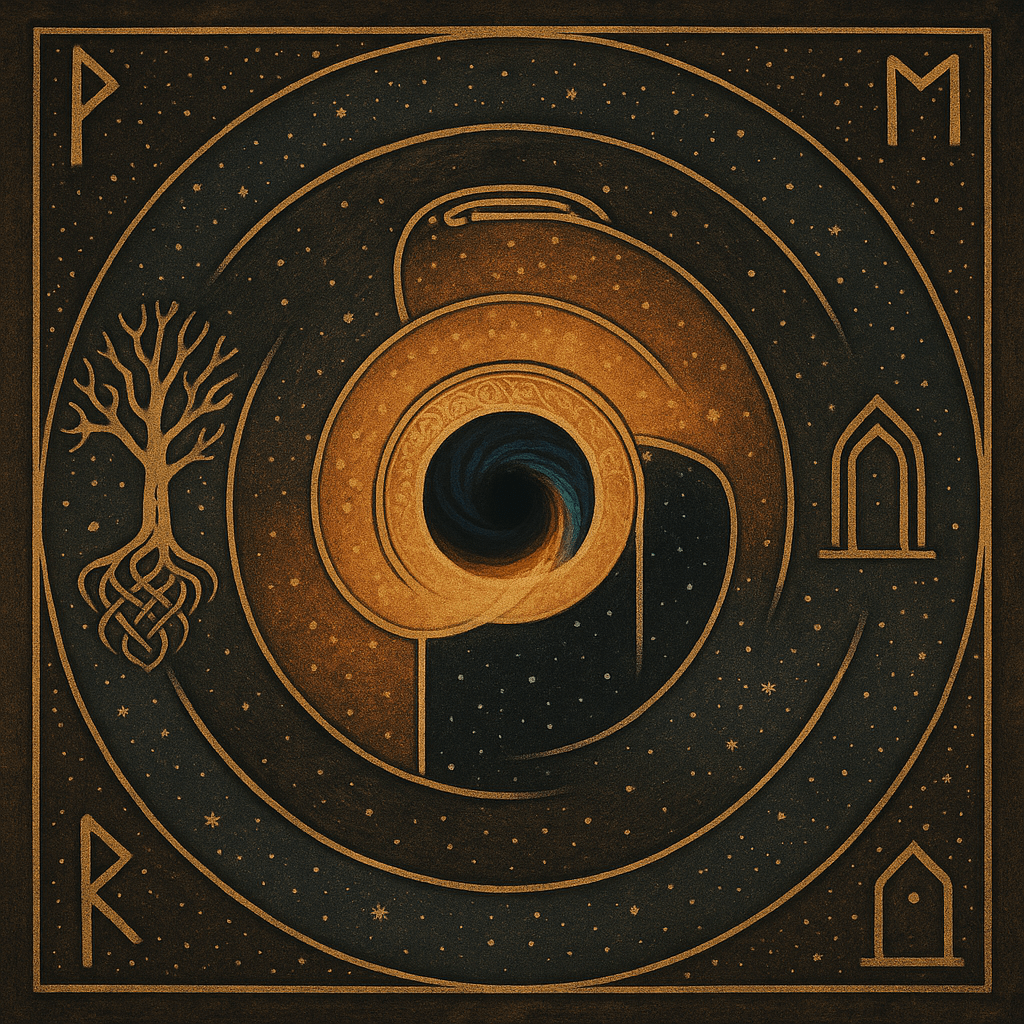
In my continued weaving of mysticism and emerging scientific ideas, I have come upon a new thread — a further mystical black hole theory. It speaks to the profound difference between what we perceive as “space” outside a black hole, and the very nature of “space” within it.
When we stand outside and look upon a black hole, its immense gravity compresses it into what appears to be a minuscule, dark maw — a singularity or event horizon that seems infinitesimally small. Yet, if we were to cross its threshold, we would enter an entirely different expanse. The very concept of size, distance, and space is a construct birthed inside the black hole itself. Each black hole contains her own womb of space, generating her own realm of form, time, and reality. The outside concept of space and the internal concept are fundamentally distinct, each bound by its own sacred laws.
In the mysticism of Norse Paganism, this distinction resonates deeply. Our cosmology speaks of many realms — Midgard, Asgard, Helheim, and others — each existing in their own separate “spaces,” connected by Yggdrasil, the World Tree. These are not merely distances to be crossed, but entire realms unto themselves, each a unique outpouring of the Ginnungagap, the primordial void.
So too it is with the black hole, which stands as a modern mirror to these ancient truths. Each black hole is like the womb of Frigga, the Great Mother, who births within it a wholly new cosmos. Outside, the form appears small and tightly bound, but within, a vast, fertile expanse unfolds, complete with its own constructs of space, its own pressures, balances, and dances of matter.
This leads to a profound realization: within each space exists a separate portal of reality. What is “real” inside one cosmic womb may not mirror the laws or the scales of another. The inner sanctum and the outer realm are not the same — and to step across the veil is to be born anew into different truths.
In our Norse spiritual understanding, the difference between the inner and outer, between the hushed sacred space of ritual and the broader lands of Midgard, is of immense importance. The vé — the consecrated enclosure where we commune with gods and spirits — is a microcosm of this very concept. Inside the vé, we cross a boundary and enter a different order of being, where the laws of spirit and the whispers of the gods shape reality.
Thus, each black hole stands as a cosmic vé, a sacred womb of the Goddess, generating her own space and shaping her own mysteries within. The outer face is not the truth of the inner world. As seekers upon this path, we are reminded that all thresholds — whether those of black holes, vé, or even the dark yoni of the Mother herself — are not mere boundaries, but profound gateways to other realities.
May Frigga, Freyja, and the ancient Norns guide us in honoring these mysteries, ever mindful of the holy distinction between what lies outside and the infinite possibilities that dwell within.
Hammer Hallowing 2
Mighty hammer of Thor, in the North,
Hallow our sacred space,
Bane of etins and evil,
Watch over us with grace.
Mighty hammer of Thor, in the East,
Hallow our sacred space,
Bane of etins and evil,
Watch over us with grace.
Mighty hammer of Thor, in the South,
Hallow our sacred space,
Bane of etins and evil,
Watch over us with grace.
Mighty hammer of Thor, in the West,
Hallow our sacred space,
Bane of etins and evil,
Watch over us with grace.
Mighty hammer of Thor, above us,
Hallow our sacred space,
Bane of etins and evil,
Watch over us with grace.
Mighty hammer of Thor, below us,
Hallow our sacred space,
Bane of etins and evil,
Watch over us with grace.
Hammer Hallowing
Hammer of Thor,
Hallow our holy stead,
Bane of etins, banish evil,
Watch and ward our stead.
In the North,
Your power surrounds us and protects us from harm,
You are the hammer of the mighty Thor,
And we call upon you to keep us safe.
In the East,
Your power surrounds us and protects us from harm,
You are the hammer of the mighty Thor,
And we call upon you to keep us safe.
In the South,
Your power surrounds us and protects us from harm,
You are the hammer of the mighty Thor,
And we call upon you to keep us safe.
In the West,
Your power surrounds us and protects us from harm,
You are the hammer of the mighty Thor,
And we call upon you to keep us safe.
Above us,
You are the guardian,
Watching over us and banishing evil,
We offer our gratitude and reverence,
As we call upon you to hallow our holy stead.
Below us,
You are the guardian,
Watching over us and banishing evil,
We offer our gratitude and reverence,
As we call upon you to hallow our holy stead.
Hammer of Thor, we thank you for your strength,
And we ask for your protection and guidance,
May you keep us safe from harm,
As we honor you in this sacred space.
Hail the hammer of Thor,
May it always watch and ward over us,
Blessed be the power of the mighty hammer,
In the name of the gods, we thank you.
The historical way to establish sacred space for a ritual
In terms of establishing sacred space for a ritual, if you wish something more historical (not that there is anything wrong with modern innovations since any religion must change and grow to remain relevant) you can use the Germanic concept of land taking. To do this you take burning fire around the boundary of the space you are claiming. Historically this was done outside so it was a torch, but for modern purposes a candle can be used. You can ask Thor to make the space you are claiming to be hallowed (made holy).
This need not be limited to a circle, square sacred spaces are probably more common in the historical context. Also if it is an outside space regularly used for rituals, historically they put a series of posts around the space and hung ropes between each post, as a way to mark what is the ritual area. Also in regular outside spaces they piled up some rocks and any liquid items from the offerings got poured over these stones (blood, mead, ale, drink of any sort).
In the historical context any ritual sacred space is considered a frithstead. No acts of violence may be done within a frithstead, and all beings within the frithstead have to leave any conflict outside. Properly done ritual offering of an animal (animal sacrifice) is not considered an act of violence since when they historically did this correctly they did it in a way that the animal did not realize it was being killed, and in a painless way. Later the animal was used as food. Since most us modern people don’t raise our own animals and don’t know the proper ways to kill them for food, animal sacrifice is generally no longer done in modern Heathenism. Offering drink and already prepared foods is perfectly acceptable as an alternative.

This work is licensed under a Creative Commons Attribution-NonCommercial-ShareAlike 3.0 Unported License.

 Volmarr’s Tumblr
- An error has occurred; the feed is probably down. Try again later.
 Volmarr's Blog of Modernist Heathenism, Norse-Paganism, and Norse-Wicca