The Long Shadow of the Cross: Why the Separation of Church and State is Our Ultimate Shield Against the Old Civil War

By Tess Wilder
When we stand at our altars, hail the Aesir and Vanir, and speak of the Heathen Third Path, we often speak of freedom—freedom of spirit, freedom from dogma, and the sovereignty of the individual mind. But there is a historical specter that haunts the soil of Europe, a pattern of bloodshed that is rarely named for what it truly was. To understand why the First Amendment is not just a law, but a survival mechanism for the future, we must look back at the last two thousand years of European history and call it by its true name.
For centuries, what history books often describe as a series of “national conflicts,” “dynastic struggles,” or “wars of succession” was, in reality, a single, recurring Christian Nationalist civil war.
The One War, Fought a Thousand Times
From the fall of Rome to the trenches of the Western Front, the history of Christian Europe was largely an internal struggle between competing factions of the same faith, fighting for dominance over the soul of the continent. It was a civil war of ideologies where the definition of “Christian” was the weapon used to justify conquest.
The Thirty Years’ War in the 17th century is perhaps the most glaring example. It wasn’t merely Germans fighting Czechs or Swedes fighting Poles. It was a war of Christian Nationalism—Protestant Christian Nationalism versus Catholic Christian Nationalism. It devastated Central Europe, killing millions, not because they were different peoples, but because they adhered to different interpretations of the same imported desert god.
Look at the Crusades, often framed as a war against Islam. While they were directed outward, the energy that fueled them was born of a unified Christendom seeking to purge the “other.” When that external enemy wasn’t available, the sword turned inward. The Inquisitions, the burnings of heretics, the persecution of the Anabaptists—these were not foreign wars; they were internal purges. They were the inevitable result of giving one religious sect the monopoly on political power.
Even the conflicts that looked secular—the Hundred Years’ War, the Napoleonic Wars—were underpinned by the assumption that the state must serve a specific Christian moral order. The kings claimed divine right; the laws were based on biblical canon. When two Christian nations clashed, it was a family feud over who held the correct claim to the “One True Faith.”
The American Experiment: Escaping the Cycle
This is the crucial context that is often lost in modern discourse. The Founding Fathers were not just Enlightenment philosophers; they were historians. They saw the bloody wreckage of Europe, the endless cycle of Christian Nationalist civil wars, and they wanted no part of it.
The Establishment Clause and the Free Exercise Clause were not designed to secularize America out of hostility to religion, but to save it from itself. They understood that if the United States were to pick a side—Catholic, Protestant, or any specific sect—it would simply be importing the European civil war onto American soil.
By separating church and state, they built a firewall. They said, “Here, we will not fight the Thirty Years’ War on this soil.” They created a neutral ground where a Lutheran, a Catholic, a Quaker, and yes, eventually a Heathen like me, could live side by side without one trying to seize the levers of state power to crush the other. It was a radical act of peace-building, a deliberate decision to break the cycle of theological violence that had plagued the West for millennia.
The Danger of Resurrection: The Future Cost of Christian Nationalism
Today, we see a rising tide of Christian Nationalism in the United States—a movement that seeks to erase that firewall, to merge the cross and the flag, and to declare America a “Christian nation” in the legal, political sense.
We must be absolutely clear about what this means. It is not a return to “traditional values.” It is a return to the pre-modern European condition.
If Christian Nationalists were to gain true power over the machinery of the US state, they would not create a paradise of moral order. They would reignite the old civil war. The moment one specific denomination or interpretation seizes the monopoly on power, every other faction becomes a heretic.
We would see the fracturing of the military along sectarian lines. We would see law enforcement used to enforce religious compliance rather than civil law. We would see the rise of militias, not defending borders, but defending specific theological interpretations against their neighbors. The “Culture War” would cease to be a metaphor and become a literal war of attrition.
In a nation as heavily armed and ideologically diverse as the United States, a Christian Nationalist takeover would not lead to peace. It would lead to a future of frequent, bloody insurgencies. It would be the Balkans of the 1990s multiplied by a thousand. It would be the Thirty Years’ War fought with modern weaponry. It would kill millions.
The Heathen Imperative: Defending the Neutral Ground
For us on the Heathen Third Path, this is not just politics; it is a matter of survival and wisdom. We honor the Old Ways, but we also honor the wisdom of the Founders who saw the danger of theocracy.
We stand for the separation of church and state not because we hate Christianity, but because we understand human nature. We know that when any group—Christian, Pagan, or otherwise—tries to rule by divine mandate rather than consent of the governed, the result is always blood.
We are the descendants of those who suffered under the conversion of the sword. We know the cost of the “One Truth.” Let us not be silent now. Let us defend the secular state as the sacred space where all paths can walk without fear of the blade. The alternative is a return to the dark ages of the European civil war, and that is a future no sane person—Viking or otherwise—should ever desire.
Hail to the free mind. Hail to the peace of many paths.
The Merchant in the Temple: How Corporate Capitalism Replaced Jesus with Neoliberal Christianity
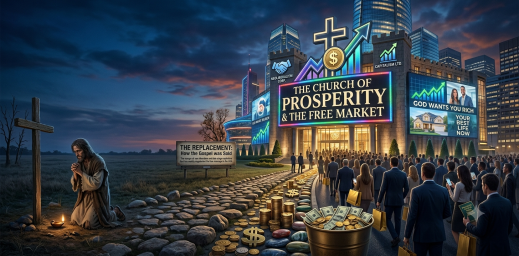
To understand human behavior, we have to look past the surface-level myths a society tells about itself and examine its actual structural mechanics. In the United States, there is a loud, dominant cultural narrative that the nation is a “Christian country.” But if you take a step back and look at it through an anthropological and historical lens, an obvious paradox emerges: the primary form of Christianity practiced in the US today bears almost zero resemblance to the teachings of the historical, first-century radical named Jesus of Nazareth.
Instead, what we are witnessing is a highly sophisticated, multi-decade merger of late-stage capitalism, neo-liberal economic philosophy, and religious theology.
The result? A hyper-individualized, corporate spiritual structure that doesn’t just tolerate greed—it sanctifies it. For those of us looking from the outside—whether navigating rúnatál (the secrets of the runes), quantum mechanics, or the old polytheistic values of community and personal honor—understanding this shift offers a masterclass in how a ruling elite can hollow out a spiritual tradition and turn it into a tool for systemic control.
1. The Historical Metamorphosis: From Communal Ethic to Corporate Religion
Ancient religions—including traditional Norse Paganism—operated heavily on a reciprocal communal ethic. Wealth was not meant to be hoarded in a vacuum; a chieftain’s worth was measured by their generosity (being a “ring-giver”). Early Christianity, too, was aggressively communal. The historical Jesus routinely championed the poor, explicitly commanded his followers to abandon the pursuit of raw wealth, and famously flipped tables to drive the merchants out of the temple.
So how did the modern American church become the ultimate defender of free-market capitalism?
It wasn’t an accident. It was a calculated, historical project. In the 1930s, corporate executives and industrial giants faced a major threat: President Franklin D. Roosevelt’s New Deal, which introduced government regulations, social safety nets, and labor protections. To fight back, corporate coalitions bankrolled conservative clergymen, launching massive PR campaigns that framed the New Deal as “pagan statism.” They completely reframed Christian doctrine, asserting that the core principle of Christianity was not communal care, but the absolute sanctity and salvation of the individual—and by extension, the absolute freedom of the unregulated marketplace.
By the time the Cold War arrived in the 1950s, this corporate-religious alliance successfully fused piety with patriotism. This era gave birth to the National Prayer Breakfast and added “In God We Trust” to American currency. The foundational infrastructure for modern American corporate Christianity was officially set.
2. The Prosperity Gospel: The Spiritual Articulation of Neoliberalism
By the late 20th and early 21st centuries, this framework evolved into its current, dominant form: The Prosperity Gospel (or Word of Faith movement).
This theology views the Divine not as a transcendent source of cosmic order, but as a celestial vending machine or a business partner. The core doctrine dictates that if you have enough faith—and prove that faith by giving “seed money” (tithings) to wealthy pastors and ministries—God is contractually obligated to reward you with physical health and material riches.
Through a socio-economic lens, this is the ultimate spiritual expression of neoliberalism. Neoliberalism relies on an unyielding belief in meritocracy: the idea that the market is perfectly just, and rewards will naturally come to those who work hard enough. The Prosperity Gospel takes this exact capitalist myth and gives it a divine stamp of approval:
- Wealth is sanctified: If you are rich, it is no longer seen as a result of systemic exploitation or luck; it is a sign of direct divine favor.
- Poverty is criminalized: If you are poor, sick, or struggling, it is no longer seen as a failure of the socio-economic system. Instead, it is reframed as a personal, spiritual failure—a lack of faith or a “victim mentality.”
By shifting the blame for systemic inequality entirely onto the individual’s spiritual state, this modern theology acts as a perfect shield for late-stage capitalism. It actively discourages systemic critique, labor organizing, or structural social change.
3. The Megachurch as a Late-Stage Capitalist Enterprise
The physical manifestation of this spiritual shift is the modern American megachurch. These are not traditional holy spaces designed for quiet contemplation or communal mystery. They are masterfully designed corporate ecosystems.
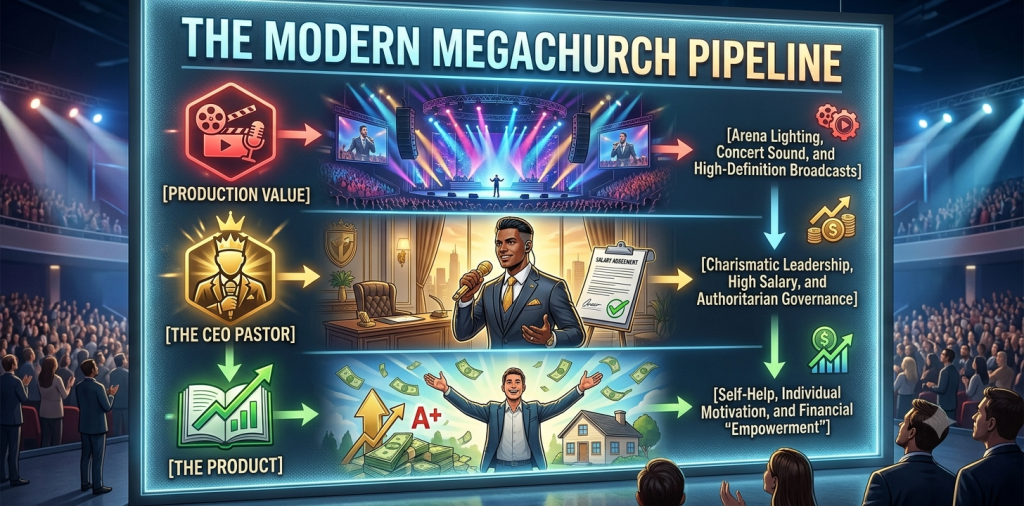
These organizations utilize standard corporate logistics, target demographics, and entertainment-industry production values to draw in thousands of people. The pastor functions less like a spiritual guide and more like a CEO or a motivational influencer.
Critically, the message preached in these arenas completely supplants the actual philosophy of Jesus. You will rarely hear deep, uncomfortable discussions about systemic greed, pacifism, or radical self-sacrifice. Instead, the sermons are heavily focused on individual optimization, personal success, and how to manifest your “best life now.” It is a consumerist commodity disguised as spiritual enlightenment.
4. The View from the Outside: Autonomy, Reciprocity, and Wyrd
For those of us navigating reality through an alternative spiritual framework, observing this dominant American religious structure provides immense clarity.
From a Norse Pagan perspective, the concept of Örlög and Wyrd teaches us that we are deeply interwoven with our communities, our ancestors, and the earth itself. Our actions have collective, echoing consequences across the web of existence. We do not exist as isolated, hyper-individualized consumers trying to extract material wealth from the cosmos via positive thinking or transaction-based tithing.
Furthermore, traditional values honor the sovereignty of the individual alongside a fierce obligation to the collective well-being of the tribe. The modern American corporate church achieves the exact opposite: it enforces strict ideological conformity while abandoning collective social responsibility in favor of ruthless market competition.
The Takeaway
Modern American Christianity has not been corrupted by the outside world; it has been systematically colonized by it. Late-stage capitalism required a spiritual apparatus that could validate its inequalities, pacify its workers, and sanctify its billionaires. By erasing the radical, communal, and anti-imperial philosophy of the historical Jesus, corporate America built a replacement that served its own image perfectly.
When a society’s gods look exactly like its hedge fund managers, it is no longer practicing a faith. It is worshiping the market.

This work is licensed under a Creative Commons Attribution-NonCommercial-ShareAlike 3.0 Unported License.

 Volmarr’s Tumblr
- Hail the Mad God
- The Great Tree of Becoming
- The Age of Superconsciousness
- This Flag is Dedicated to Ingeborg, Gyðja of Freyr!
- Official Frith and Peace Flag of Volmarr!
- Official Flag of Volmarr’s Version of the Modern Viking Lifestyle!
- Official Flag of the Heathen Third Path!
- INNER SPIRITUAL WARFARE OF THE MODERN VIKING AND CYBER-VIKING
- Modern Viking and Cyber-Viking Inner Spiritual Warfare
- Inner Spiritual Warfare for the Modern Viking and the Cyber-Viking
 Volmarr's Blog of Modernist Heathenism, Norse-Paganism, and Norse-Wicca