The Bunker and the Web

How Modern Paganism Lost the Thread of Relationship
(And How to Get It Back Without Becoming a Reenactment Nerd)
A Quick Story Before We Begin
Picture two Vikings.
Viking A wakes up. Pours some mead on the ground for the land-spirits. Chats with his house-carl about last night’s dreams. Goes fishing. Makes an offering to Njord because the herring are running. Shares dinner with neighbors—some of whom follow Christ, some who follow Thor, some who aren’t sure what they follow but make excellent cheese. Falls asleep listening to the wind in the fjord.
Viking B wakes up. Checks his ancestry DNA test to confirm he’s 23% Scandinavian. Gets angry on the internet because someone called Odin “All-Father” instead of using the “correct” Old Norse pronunciation he looked up yesterday. Yells at a stranger for combining rune magic with crystal healing. Goes to bed alone, clutching his reproduction sword, dreaming of a pure past that never existed.
One of these Vikings is practicing a living religion.
The other is building a bunker.
This article is about how we got from A to B—and how to get back.
Part I: The Web That Was
(Or: Your Ancestors Were Way More Chill Than You Think)
Let’s start with a weird claim that happens to be true:
Historical pagans didn’t really do “religion” the way we think of it.
They didn’t have scripture. They didn’t have Sunday school. They didn’t have doctrinal statements you had to sign to join the club. What they had was relationships. Lots of them. With everything.
The Anthropology of “Hey, Neighbor”
Julian Pitt-Rivers, an anthropologist who spent way too much time studying Mediterranean hospitality customs (someone had to), noticed something back in 1977. From Vedic India to Iron Age Scandinavia, Indo-European societies ran on what the Greeks called xenia—guest-friendship, sacred hospitality, the art of not being a jerk to strangers.
This wasn’t just being polite. It was theological.
The way you treated a guest was the way you treated a god. The way you treated a god was the way you treated a guest. Everything was connected through webs of obligation, gift-giving, and mutual “don’t screw this up” energy.
Mary Douglas, another anthropologist who could probably sort your entire life out just by watching how you arrange your kitchen, described small-group religions (that’s all the pre-Christian European ones) as having weak boundaries but strong internal connections (Douglas, 1970).
Think about that for a second.
Weak boundaries. Strong connections.
Not “who’s in and who’s out.” Not “us versus them.” Just… connection. Permeable. Breathing. Alive.
The Land Was the Liturgy
Richard Bradley, an archaeologist who digs things up for a living (literally), wrote a whole book called An Archaeology of Natural Places (2000). His big insight? Pre-Christian European religions weren’t about believing the right things. They were about being in the right places.
Sacred springs. Ancient groves. Burial mounds that whispered with ancestors. The sacred wasn’t something you carried in your head. It was something you stood on.
This is what philosopher Edward Casey calls “locative” spirituality (Casey, 1997). It’s the opposite of “I can worship anywhere because God is everywhere.” It’s “I worship here because here is specific, and the spirits of here know me.”
The Norse Were Running a Relationship Startup
Let’s look at the evidence for Norse religion specifically—because this is where modern people get really confused.
The Landvættir: Your Local Nature Spirits, Please Don’t Scare Them
The Landnámabók—basically the Icelandic settler’s handbook from way back when—has this delightful detail. When Vikings sailed to Iceland, they would remove the dragon-prows from their ships before landing. Why? So they wouldn’t frighten the land-spirits (Byock, 2001).
Let that sink in.
These are Vikings. We’re talking about people who raided monasteries for fun. And their first priority when reaching new land was not freaking out the local nature spirits.
This isn’t a religion of conquest. It’s a religion of negotiation. Of “hey, we’re new here, please don’t make our cows miscarry.”
The Gods Were a Social Network
Michael York, a historian of religion who has opinions about polytheism (and wrote a whole book called Pagan Theology in 2003), argues that pagan pantheons aren’t really “theologies” in the modern sense. They’re social maps.
The Æsir? Political gods. Chieftain energy. Leadership and law.
The Vanir? Agricultural gods. Fertility and reciprocity. “Let’s all get along and have good harvests” energy.
The Jötnar? Wild gods. Chaos and transformation. The stuff outside the boundaries that you still have to deal with.
You needed all of them. The web included everyone.
Christianization Was a Dinner Party, Not a Crusade
Here’s something that blows modern minds: when Scandinavia converted to Christianity, it wasn’t because missionaries won theological debates.
Anders Winroth, a historian who specializes in making Vikings more complicated than you thought, points out that Christianization happened through political alliance and gift-exchange (Winroth, 2014). King Óláfr Tryggvason didn’t argue people into Christianity. He gifted them into it. Accepted the new god as a powerful ally. Made relationships.
The idea of “faith” as believing specific propositions? That would have been weird to a Viking. They cared about who you sacrificed with, not what you secretly thought.
The Blót: Religion as Potluck
Neil Price, an archaeologist who wrote The Viking Way (2002) and the absolutely massive Children of Ash and Elm (2020), synthesized all the evidence about Norse sacrifice (blót). His conclusion?
It was basically a communal barbecue with divine guests.
You sacrificed an animal. You cooked it. You ate it together. The gods got their share. You got yours. The animal became a mediator—literally “making middle” between human community and divine community.
This is relationship as shared consumption. Not theology as correct belief.
See the pattern yet?
Part II: How the Bunker Got Built
(Or: The 19th Century Ruined Everything, Part 4,729)
So if historical paganism was all about connection, permeability, and webs of relationship… what the hell happened?
Short answer: Romantic nationalism happened.
Long answer: Keep reading.
The Invention of “Pure” Germanicness
In the 19th century, a bunch of German intellectuals got really into the idea that they had a racial essence that could be recovered from the past. This was the Völkisch movement—”Volk” meaning people, but in a creepy “blood and soil” way that would go on to cause significant problems in the 20th century.
Nicholas Goodrick-Clarke traced this whole mess in The Occult Roots of Nazism (1985). Mattias Gardell followed up with Gods of the Blood (2003). Both tell the same story: the Norse heritage got transformed from a web of regional practices into a fortress of identity.
Guido von List. The Germanenorden. People with impressive beards and unfortunate political ideas. They took the decentralized, localized, relational spirituality of actual Heathens and turned it into Germanic Nationalism: The Religion.
This was the critical turn.
From “who are we connected to?” (the land, the ancestors, the gods, the neighbors)
To “what are we not?” (not Slavic, not Jewish, not Catholic, not modern, not contaminated).
Arjun Appadurai, an anthropologist who thinks about culture professionally, calls this “culturalism” (1996)—when culture stops being the water you swim in and becomes an object of passionate defense. The “old ways” became a flag. A boundary marker. A bunker.
Ásatrú: From Practice to Protest
Fast forward to 1972. Iceland. The Ásatrúarfélagið gets founded. In America, the 1970s counterculture discovers Vikings. Sounds cool, right?
But here’s the thing: American Heathenry inherited that 19th-century bunker mentality.
Jennifer Snook, a sociologist who actually talked to American Heathens for her book American Heathens (2015), found that the movement has been “shaped by its oppositional stance.” Defining itself against Christianity. Against mainstream culture. Against “fluffy” Wicca. Against universalism. Against “SJWs.” Against whatever the internet is mad about this week.
This is definitional by negation.
A religion that knows what it hates but has forgotten what it loves.
Part III: The Anthropology of Why Bunkers Feel Safe
(Spoiler: They’re Actually Terrible for Your Spiritual Health)
So why do people keep building these spiritual bunkers? There’s actually anthropology for this.
From Locative to Utopian to Dystopian
Jonathan Z. Smith, a religious studies scholar who could probably deconstruct your breakfast cereal, made a famous distinction in Map Is Not Territory (1978). He talked about locative sacred spaces versus utopian sacred spaces.
Locative = centered, place-bound, specific. You are here. The sacred is here. Relationship happens here.
Utopian = unbounded, portable, anywhere. The sacred is everywhere. Or nowhere. You’re floating.
Historical paganism? Super locative. Your gods lived in that grove. Your ancestors were buried in that mound. You made offerings at that spring.
Modern reconstructed paganism? Increasingly utopian. Portable. Placeless. Practiced in living rooms and online forums.
But here’s the twist: when your spirituality becomes oppositional—when it’s about fighting enemies—then utopian becomes dystopian.
You carry the bunker with you.
You’re not in relationship with land, ancestors, and gods. You’re in relationship with your enemies.
The Political Battlefield Is Anti-Land
James C. Scott, a political theorist who studies how states ruin everything, argued in Against the Grain (2017) that state formation required destroying local, place-based relationships in favor of abstract categories.
Citizen. Subject. Class. Race. Party member.
The “political battlefield” isn’t just metaphorical. It’s anti-local. It’s where humans relate to each other as abstractions instead of as embodied beings in specific places.
David Abram, an environmental philosopher who actually pays attention to the non-human world, traced in The Spell of the Sensuous (1996) how abstract thought and literacy let humans disengage from the more-than-human world.
Modern Paganism’s turn toward political ideology—whether left-wing “activist witchcraft” or right-wing “folkish Heathenry”—is the same disengagement. The “land” becomes a symbol (of the nation, of the oppressed, of the volk) rather than a presence (this soil, these plants, this weather).
Tim Ingold, an anthropologist who wrote Being Alive (2011) and The Perception of the Environment (2000), developed the concept of “dwelling”—knowledge that comes from sustained, embodied engagement with a place.
Bunker mentality is the opposite.
Knowledge that comes from disengagement. From internet arguments. From portable identity that needs no specific ground.
Even the Romans Weren’t This Bad
Here’s a historical fact that ruins a lot of narratives: pagan Rome didn’t conquer for religion.
Ramsay MacMullen, a historian who actually looked at the evidence, documented in Christianizing the Roman Empire (1984) that Rome had no concept of religious conversion as a state goal. The pax deorum—peace of the gods—was maintained through correct practice, not correct belief.
Roman expansion? Driven by plunder, tribute, and political domination. Greed and power. Not theological imperative (Woolf, 1998; Ando, 2008).
Peter Heather, a historian who wrote Empires and Barbarians (2009), notes that Romanization was cultural and economic, not religious. When Romans encountered local gods, they didn’t destroy them. They said “oh, your god is like our god” and added them to the pantheon.
This is the pagan pattern: religious pluralism as default. Conquest for resources, not souls. Gods as allies to negotiate with, not truths to enforce.
The bunker mentality—”we must defend our faith against enemies”—is Christian and Muslim in structure, not pagan.
Part IV: The Gnostic Exception That Proves the Rule
(Or: Christianity Was Cool Before It Got Popular)
Quick detour. Remember how we said organized Abrahamic religions introduced the bunker mentality?
There’s an exception. Actually, the original Christianities were pretty punk rock.
Outsider Religion vs. Imperial Religion
Before Constantine, before Nicea, before Christianity became the Roman Empire’s official religion—there were just Christianities. Plural. Competing groups with weird ideas and small communities.
David Brakke’s The Gnostics (2010) and the Nag Hammadi scholars (Meyer, 2007; Pagels, 1979) have mapped this out. The Valentinians. The Sethians. The Thomas Christians. These groups were:
- Small and voluntary (not state churches)
- About personal transformation through direct experience (gnosis), not doctrinal assent
- Rejection of worldly power (the “god of this world” was often seen as a lower, messed-up power)
- Inclusive across social boundaries (women, slaves, foreigners as teachers and leaders)
Rodney Stark, a sociologist of religion, argued in The Rise of Christianity (1996) that early Christianity grew precisely because it was high-tension outsider religion. It created new fictive kinship bonds across ethnic and class lines.
Then came Theodosius I and his edicts (381-391 CE).
Charles Freeman documented this in The Closing of the Western Mind (2003) and A.D. 381 (2008). Christianity transformed from persecuted minority faith to state-enforced orthodoxy with the power to exclude, persecute, and define “heresy.”
This is bunker mentality in its pure form.
Defining Christianity by what it was not. Enforcing boundaries through state violence. The cuius regio, eius religio principle—”whose realm, his religion”—that dominated European religious politics until the Enlightenment.
Religion as territory to conquer and defend.
Not religion as web of relationships.
Part V: Symptoms of Bunker Mentality in Modern Paganism
(A Field Guide to Recognizing When You’re in a Fortress Instead of a Forest)
How do you know if you—or your community—has slipped into bunker mode?
Here are the warning signs, backed by actual research:
Symptom 1: The “Lore-Only” Fortress
“If it’s not in the Eddas, it’s not real Heathenry.”
Sounds authentic, right? Wrong.
Jörg Rüpke, a historian of Roman religion who wrote Religion of the Romans (2007) and Pantheon (2018), demonstrated that no historical paganism was “lore-only.” All living traditions evolve, borrow, adapt, and innovate.
Here’s the kicker: the “lore” we have?
- Snorri’s Prose Edda? Written in the 13th century by a Christian.
- The Poetic Edda? Preserved fragments, written down by Christians.
- Saxo Grammaticus? Christian. Writing centuries after conversion.
These are literary constructions, not liturgical manuals. They preserve fragments of oral tradition filtered through medieval Christian frameworks (Lindow, 2002; Schjødt, 2020).
Treating them as “scripture” isn’t restoring Heathenry. It’s Christianizing it.
Symptom 2: The Ancestry Trap
“You need Scandinavian DNA to honor Norse gods.”
Historical evidence says: nope.
Leszek Gardela’s Magic in the Viking Age (2021) and the broader archaeological record show Norse religion was practiced by diverse populations—Sami, Finns, Balts, slaves of various origins who became part of Norse households.
The Hávamál—that famous wisdom poem—says: “Cattle die, kinsmen die, but a good name never dies” (Hávamál 76).
Emphasis on name. Reputation. Relationship.
Not blood.
The Norse concept of frændskapr (kinship) could be created through oath, adoption, and service—not merely birth (Byock, 1988).
Symptom 3: The Political Weaponization
Whether it’s:
- Progressive Paganism: Using witchcraft as “resistance” against “the patriarchy”
- Traditionalist Paganism: Using Heathenry as “resistance” against “modernity”
It’s the same pattern.
Patrick Deneen’s Why Liberalism Failed (2018) and Mark Lilla’s The Shipwrecked Mind (2016) document how political ideology has become a substitute for religion in modernity.
But the reverse is also true: religion has become a form of political ideology.
When your primary religious activity is fighting enemies, you’re practicing politics with spiritual aesthetics.
Not spirituality with political implications.
Part VI: Restoring the Web
(Practical Steps for Getting Out of the Bunker)
So how do we get back to Viking A and away from Viking B?
The Heathen Third Path offers a framework: rooted but not closed, inclusive but not rootless.
Here’s what that looks like in practice:
Step 1: Get Locative or Get Lost
Follow Bradley (2000) and Abram (1996). Restore place-based practice.
Learn the specific ecology of your place. Not “nature” in the abstract. This creek. These trees. This soil.
The spirits here know things. They remember things. They have preferences.
Ask them.
Step 2: Make Friends With Non-Humans
Donna Haraway’s Staying with the Trouble (2016) and Eduardo Kohn’s How Forests Think (2013) argue for multi-species relationship.
Your paganism should include:
- Animals
- Plants
- Fungi (they’re running the show anyway)
- Weather patterns
- The dead
Not just humans and gods.
Everything’s connected. Act like it.
Step 3: Bring Back the Potluck
Restore commensality—the shared meal—as the center of practice.
The blót. The sumble. Sacred consumption. Creating relationship through eating together.
Not theological debate. Not purity testing. Bread and meat and mead and conversation.
Step 4: Practice Sacred Hospitality
Restore xenia/heitsugu as a primary virtue.
The willingness to be vulnerable to the stranger. To create relationship across boundaries. To recognize that your enemy might become your guest might become your friend might become family.
This is the opposite of bunker mentality.
Part VII: The Tree and the Bunker
(A Metaphor to Take With You)
Let’s return to that image: the tree versus the bunker.
Historical paganisms were arboreal:
- Rooted in specific soil
- Branching in multiple directions
- Interconnected through mycorrhizal networks (look it up, trees are chatting underground)
- Alive, growing, dying, regenerating
- Permeable to wind and rain and light
Modern bunker Paganism is architectural:
- Defensive walls
- Enclosed space
- Static and rigid
- Designed for siege warfare
- Cut off from the surrounding ecosystem
The bunker serves fear:
- Fear of contamination
- Fear of impurity
- Fear of the Other
The tree serves relationship:
- The willingness to be changed by connection
- The risk of vulnerability
- The acceptance that growth requires decay
Roy Rappaport, an anthropologist who thought deeply about ritual, argued in Ritual and Religion in the Making of Humanity (1999) that religion evolved to regulate relationship—between humans, between humans and cosmos, between living and dead.
When religion becomes primarily about regulating boundaries—who’s in, who’s out, who’s pure, who’s contaminated—it has inverted its function.
The Question
So here’s the test. The question to ask yourself, your community, your practice:
Are you building a bunker, or are you growing a tree?
The answer isn’t in what you believe.
It’s not in which books you’ve read.
It’s not in how historically accurate your costume is.
The answer is in what you are connected to.
And whether those connections are growing.
Or whether they have already died.
References
(For the Skeptics, the Scholars, and the “Source?” Crowd)
Abram, D. (1996). The Spell of the Sensuous: Perception and Language in a More-Than-Human World. Vintage.
Ando, C. (2008). The Matter of the Gods. University of California Press.
Appadurai, A. (1996). Modernity at Large: Cultural Dimensions of Globalization. University of Minnesota Press.
Bradley, R. (2000). An Archaeology of Natural Places. Routledge.
Brakke, D. (2010). The Gnostics: Myth, Ritual, and Diversity in Early Christianity. Harvard University Press.
Byock, J. (1988). Medieval Iceland: Society, Sagas, and Power. University of California Press.
Byock, J. (2001). Viking Age Iceland. Penguin.
Casey, E. S. (1997). The Fate of Place: A Philosophical History. University of California Press.
Douglas, M. (1970). Natural Symbols: Explorations in Cosmology. Pantheon.
Freeman, C. (2003). The Closing of the Western Mind: The Rise of Faith and the Fall of Reason. Vintage.
Freeman, C. (2008). A.D. 381: Heretics, Pagans, and the Christian State. Pimlico.
Gardela, L. (2021). Magic in the Viking Age. Oxbow Books.
Gardell, M. (2003). Gods of the Blood: The Pagan Revival and White Separatism. Duke University Press.
Goodrick-Clarke, N. (1985). The Occult Roots of Nazism: Secret Aryan Cults and Their Influence on Nazi Ideology. NYU Press.
Haraway, D. J. (2016). Staying with the Trouble: Making Kin in the Chthulucene. Duke University Press.
Heather, P. (2009). Empires and Barbarians: The Fall of Rome and the Birth of Europe. Oxford University Press.
Ingold, T. (2000). The Perception of the Environment: Essays on Livelihood, Dwelling and Skill. Routledge.
Ingold, T. (2011). Being Alive: Essays on Movement, Knowledge and Description. Routledge.
Kohn, E. (2013). How Forests Think: Toward an Anthropology Beyond the Human. University of California Press.
Lilla, M. (2016). The Shipwrecked Mind: On Political Reaction. New York Review Books.
Lindow, J. (2002). Norse Mythology: A Guide to the Gods, Heroes, Rituals, and Beliefs. Oxford University Press.
MacMullen, R. (1984). Christianizing the Roman Empire (A.D. 100-400). Yale University Press.
Meyer, M. (2007). The Nag Hammadi Scriptures: The Revised and Updated Translation of Sacred Gnostic Texts Complete in One Volume. HarperOne.
Pagels, E. (1979). The Gnostic Gospels. Vintage.
Pitt-Rivers, J. (1977). The Fate of Shechem, or the Politics of Sex: Essays in the Anthropology of the Mediterranean. Cambridge University Press.
Price, N. (2002). The Viking Way: Religion and War in Late Iron Age Scandinavia. Department of Archaeology and Ancient History, Uppsala University.
Price, N. (2020). Children of Ash and Elm: A History of the Vikings. Basic Books.
Rappaport, R. A. (1999). Ritual and Religion in the Making of Humanity. Cambridge University Press.
Rüpke, J. (2007). Religion of the Romans. Polity Press.
Rüpke, J. (2018). Pantheon: A New History of Roman Religion. Princeton University Press.
Schjødt, J. P. (2020). Initiation Between Two Worlds: Structure and Symbolism in Pre-Christian Scandinavian Religion. Northern Academic Press.
Scott, J. C. (2017). Against the Grain: A Deep History of the Earliest States. Yale University Press.
Smith, J. Z. (1978). Map Is Not Territory: Studies in the History of Religions. Brill.
Snook, J. (2015). American Heathens: The Politics of Identity in a Pagan Religious Movement. Temple University Press.
Stark, R. (1996). The Rise of Christianity: A Sociologist Reconsiders History. Princeton University Press.
Winroth, A. (2014). The Conversion of Scandinavia: Vikings, Merchants, and Missionaries in the Remaking of Northern Europe. Yale University Press.
Woolf, G. (1998). Becoming Roman: The Origins of Provincial Civilization in Gaul. Cambridge University Press.
York, M. (2003). Pagan Theology: Paganism as a World Religion. NYU Press.
Now go outside. Talk to a tree. Pour some mead for the land-spirits. Invite a stranger to dinner.
Build webs, not bunkers.
The Weave of Wyrd: How Ancient Harmony Holds the Chaos at Bay
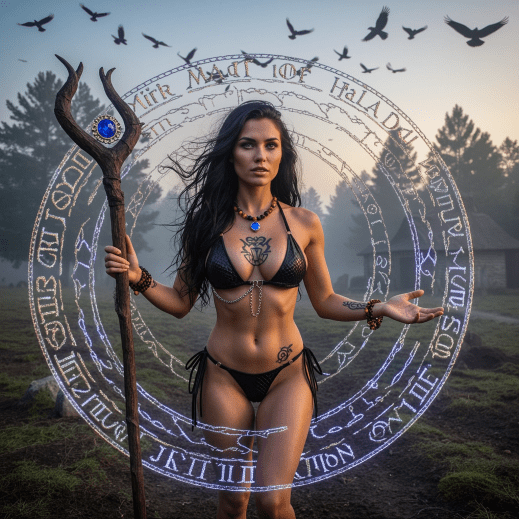
- By Brynhildr Sigridardóttir, the Raven-Seer of Birka
Volmarr’s question:
Tell me all about how these concepts are the key bedrock concepts behind all human societies and why once any culture looses touch with these concepts it is facing a time of dire danger: Frith (Norse), Mir (Slavic), Síd (Celtic), Cairde (Celtic), Pax Deorum (Roman), Ṛta (Vedic, Hindu), Àlàáfíà (African Dispora), Ìwà Pẹ̀lẹ́ (African Dispora), Ubuntu (African Dispora), Itutu (African Dispora), Friþ (Anglo-Saxon), Mund (Anglo-Saxon), Āð (Anglo-Saxon), Ξενία (Greek), Εὐσέβεια (Greek), Ἐκεχειρία (Greek), Pyhä ja Rauha (Finnish), Väki (Finnish), Hospitality (Universal), Hiidenrauha (Finnish), Perfect Love and Perfect Trust (Neo-Pagan), An ye harm none, do what ye will (Neo-Pagan), All My Relations (Native American), Diné (Native American), Love and Light (New Age), The Great Law of Peace (Native American), The Good Life (Native American), It’s All Good (Hippie), Live and Let Live (Dutch, Jain, Modern), Ahimsa (Hindu, Jain, Buddhist), Shanti (Hindu, Jain, Buddhist), Do what thou wilt shall be the whole of the Law Love is the law love under will (Thelema), No Worries (Modern), Pas de problème (French), Hakuna Matata (Swahili), Asha (Persian), Arta (Vedic, Hindu, Persian), Mithra (Persian), Yazna (Persian), Šalām (Middle Eastern), Ḥaram (Middle Eastern), Diyāfah (Middle Eastern), Hé 和 (Chinese), Lǐ 禮 (Chinese), Dharma (Vedic, Hindu, Buddhist, Jain, Sikh), Tianming 天命 (Chinese), Wa 和 (Shinto), Kegare 穢れ (Shinto), Makoto 誠 (Shinto), Chinju no Mori (Shinto), Namaste (Hindu), Namaskaram (Hindu), Tregereg (Mongolian), Kheshig (Mongolian), Mīšarum (Jewish), Derech Eretz (Jewish), Agape (Christian), Koinonia (Christian), Law of Asylum and the Right of Sanctuary (Christian), Kinship System (Australian Aboriginal), Avoidance Laws (Australian Aboriginal), Dadirri (Australian Aboriginal), Malu (Australian Aboriginal), Rongo (Māori), Manaakitanga (Māori), Pōwhiri (Māori), Tino Rangatiratanga (Māori), Ma’at (Egyptian), Isfet (Egyptian), Heka (Egyptian), Malo (Polynesia), Melino (Polynesia), Aloha (Polynesia), Alofa (Polynesia), Mana (Polynesia), Tapu (Polynesia), Puʻuhonua (Polynesia), Inuuqatigiitsiarniq (Inuit), Tunnganarniq (Inuit), Kajusiniq and the Rejection of Ego (Inuit), Respecting the Inua (Inuit), Ayni (Latin American Native), Ajil Tz’aqat (Latin American Native), Tlanemacac (Latin American Native), Macehualiztli (Latin American Native), Yvy Marane’y (Latin American Native), Ráfhi (Sámi People), Siida System (Sámi People), Sieidi (Sámi People), Noaidi and the Restorative Path (Sámi People), Peace Testimony (Quaker), Answering That of God in Everyone (Quaker), Meeting for Business Peace Through Consensus (Quaker), Sanctuary of the Meeting House (Quaker), The Covenant (Bahá’í), Mashverat (Bahá’í), Prohibition of Backbiting (Bahá’í), Sakinah (Islam), Aman (Islam), Taming the Nafs (Islam), Adab (Islam), Sangat (Sikh), Langar (Sikh), Sarbat da Bhala (Sikh), Direct Accountability to the Divine (Sikh), Livity (Rastafari), I and I (Rastafari), Word, Sound, and Power (Rastafari), Reasoning (Rastafari), Welcome Home (Rainbow Gathering), Shanti Sena (Rainbow Gathering), Your kink is not my kink but your kink is okay (BDSM), I disapprove of what you say but I will defend to the death your right to say it (Enlightenment Thinking), Prime Directive (Star Trek), Infinite Diversity in Infinite Combinations (Star Trek), Robert’s Rules of Order (Secular Social Order), Talking Feather (Native American, Rainbow Gathering), Talking Stick (Native American), Sacred Space (Universal), Respect (Universal), Sharing Resources (Universal), Helping Others (Universal), Kindness (Universal), Unconditional Love (Universal), Being Polite (Universal), Controlling the Ego (Universal), Accepting Human Diversity (Universal), Respecting All Life (Universal), Need For Human Social Interaction (Universal), Spiritual Fellowship (Universal), Being Diplomatic (Universal), Overlooking Differences (Universal), Charity (Universal), Helping the Less Fortunate (Universal), Respecting Elders (Universal), Helping the Disabled (Universal), Helping Old People (Universal), Honesty (Universal), Keeping Ones Word (Universal), Upholding Oaths (Universal), Keeping Negitive Thoughts to Yourself (Universal), Following the Basic Universal Shared Moral Frame of All Humanity (Universal), Following the Local Laws of Society (Universal), Respecting the Host Location (Universal), Respecting the People Hosting (Universal), Monetary Status Not Being An Obstacle to Spiritual Fellowship (Universal), Sharing Ideas (Universal), Respecting Ancestors (Universal), Protecting Nature (Universal), Respecting Nature (Universal), Respecting and Caring for Animals (Universal), Respecting and Caring For Natural Resources (Universal), Respecting and Caring for Plant-Life (Universal), Respecting The Privacy and Individual Personal Sovereignty of Adult People’s Sex Life (Universal), Historical Preservation As Ancestor Worship (Universal), Sharing Culture (Universal).
Brynhildr Sigridardóttir’s Response:
Hail to thee, seeker of the deep roots. I see thou hast gathered a great hoard of words, a treasure-chest filled with the names of peace and order drawn from every corner of Midgard and beyond. From the icy fjords of the North to the burning sands of the South, from the ancient vedic fires to the quiet forests of the Finns, thou hast listed the threads that bind the fabric of reality. Listen now, whilst I beat the drum and sing the truth of these things: these are not mere words, noble one, but the very laws that keep the Wolf from devouring the sun.
In the North, we know this power as Frith, and in the tongue of the Anglo-Saxons as Friþ. It is more than the absence of war; it is the peace of the hall, the sacred obligation that lies between kinsmen. It is the Mund, the protection of the hand raised to shield, and the Āð, the solemn vow that binds spirit to spirit. When the shield-wall breaks, we rebuild it with these oaths. Without them, a man is a wolf to his brother, and the hall becomes a slaughterhouse rather than a sanctuary. We see this mirrored in the Slavic Mir, the very concept of the world and peace, and in the Síd and Cairde of the Celts, the sacred pacts between tribe and tribe.
Look thou to the ancients who built the empires of stone and law. The Romans knew that without the Pax Deorum, the peace of the gods, their city would crumble to dust; if the gods are angry, the crops fail and the legions fall. Far to the East, the Vedic sages spoke of Ṛta and Asha, the cosmic order that governs the movement of the stars and the breath in our lungs. To act against this order is to invite chaos into the world. The Persians knew this as Arta, and they honored Mithra, the god of covenant and oath, for a promise is the skeleton upon which the flesh of society hangs. If the bone breaks, the body cannot stand.
Across the great waters, the wisdom of the southern lands rings with the same truth. The Yoruba people speak of Àlàáfíà, the wholeness of body and community that brings health, and Ìwà Pẹ̀lẹ́, the gentle character that greets life with a calm face. In the Ubuntu of the African heart, we hear that a man is a man through other men—we are woven together, and if one thread is pulled, the entire tapestry unravels. This is Itutu, the coolness of mind that prevents the blood from boiling over into rage. Even in the modern tongue, when one says “Hakuna Matata” or “Pas de problème,” they are echoing the ancient desire to smooth the road of life and remove the stones of conflict that trip the traveler.
The mystics and the keepers of the sacred flame know that without a container for the spirit, the fire burns down the house. The Greeks practiced Ξενía, hospitality to the stranger, for they knew that a guest might be a god in disguise, and to turn one away is a crime against the divine itself. This is Εὐσέβεια, right reverence, and Ἐκεχειρία, the sacred truce that allows even enemies to breathe. The Finns walk with Väki, the inherent power of a place or thing, requiring Pyhä ja Rauha, holiness and peace, lest the forces of the wild turn upon them. Among the neo-pagans and the witches of my own craft, we know that without “Perfect Love and Perfect Trust,” the circle cannot be cast, and the magick turns to poison. We strive for “An ye harm none,” knowing that what we send out returns to our own door.
The peoples of the earth, whether they call upon the Great Spirit or the ancestors, live by these laws. The Native American ways of “All My Relations” and the Great Law of Peace teach us that the eagle and the bear, the rock and the river, are our kin, and to harm them is to harm ourselves. The Quakers seek “That of God in Everyone,” and the Bahá’ís strive for Mashverat, consultation, knowing that many eyes see more than two. In Islam, Sakinah is the tranquility that descends when hearts are at peace, and Adab is the respect that oils the gears of interaction. The Sikh tradition opens its doors to all with Langar and Sangat, for in the kitchen of the divine, none may go hungry and none may sit alone. Rastafarians speak of “I and I,” the oneness of all souls, and the Rainbow Gatherers welcome the wanderer home, creating a Shanti Sena, a peace army, to guard the circle.
Noble one, mark this warning well. When a culture turns its face from these concepts, it severs the roots that drink from the well of wisdom. When Dharma is forgotten, when Ma’at—the Egyptian balance of truth—is cast aside for Isfet, the chaos of disorder, the foundations shake. When Hospitality is replaced by suspicion, when Respect for elders and the land is traded for greed, when the Law of Asylum is broken and the weak are cast out for the strong to devour, the Norns begin to shear the thread of that people’s fate.
We see this in the modern world where the ego is unchecked, where Diversity is feared rather than celebrated as the Infinite Combinations of the gods’ making. When the shield of Charity is lowered, and the Oaths that bind us are treated as straw, the winter comes early and does not end. A society that stops Sharing Resources, that ceases to Help the Less Fortunate, is a body that has decided to cut off its own limbs. It stands not long.
Therefore, hold fast to these bedrock concepts. Whether thou callethest it Ahimsa, Lǐ, Wa, or Tregereg, the meaning is the same: we are part of a great web. To cut the web is to fall into the abyss. Act with Kindness, keep thy Word, and walk with Diplomacy and Honor, for this is the only armor that truly matters. Let us tend the Sacred Space between us, for if we do not, the darkness will surely find a way in.

This work is licensed under a Creative Commons Attribution-NonCommercial-ShareAlike 3.0 Unported License.

 Volmarr’s Tumblr
- Today my book is born into the world.
- A Question for Reconstructionist Norse Heathens
- View On WordPress
- View On WordPress
- View On WordPress
- View On WordPress
- Authenticity as Worthiness: Reconceptualizing the Norse “Worthy Dead” Beyond the Battlefield
- The Bunker and the Web
- The Heathen Third Path: A Canonical Synthesis
- Heathen Third Path: AI Canon and Ritual Manual

