Authenticity as Worthiness: Reconceptualizing the Norse “Worthy Dead” Beyond the Battlefield
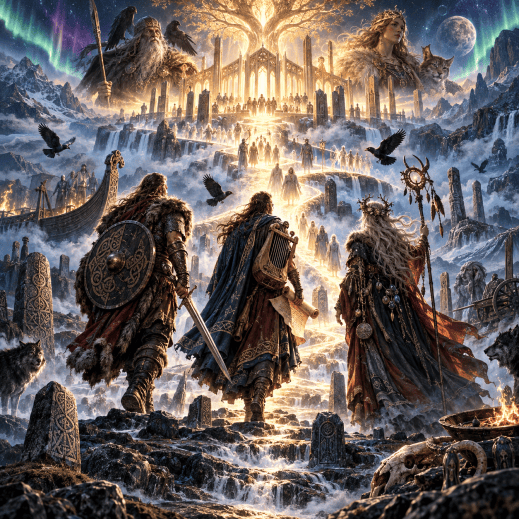
Or: Why Your Dungeon Master Lied to You About Valhalla
Abstract
This paper challenges the prevailing popular and scholarly consensus that Norse concepts of the “worthy dead” (einherjar) were exclusively reserved for those who died in battle. Through etymological analysis of Old Norse primary sources, archaeological examination of high-status non-warrior burials, and cross-cultural Indo-European comparison, I demonstrate that the Norse “worthy dead” concept was fundamentally about authentic individual expression—what we might anachronistically term “living one’s truth”—rather than mere martial death.
The evidence reveals a sophisticated theological framework in which multiple paths to afterlife worthiness existed: the warrior’s path, yes, but equally the poet’s path (skald), the seer’s path (völva), and the shamanic path (seiðr). The etymology of einherjar itself—”those who fight alone”—emphasizes individual distinction over conformity, while archaeological evidence from Fyrkat and Oseberg demonstrates that non-conformist spiritual practitioners received burial honors equal to or exceeding warrior elites.
This reconceptualization has profound implications for our understanding of Norse paganism, Indo-European religious structures, and the universal human question of what makes a life worth remembering.
Keywords: Norse paganism, einherjar, authenticity, seiðr, skaldic poetry, Indo-European comparative mythology, worthy dead, non-conformity
Introduction: The Pop Culture Problem
Let’s get one thing straight before we begin: Marvel lied to you. So did Vikings, The Last Kingdom, and every dungeon master who told you that only battle-dead warriors go to Valhalla. The popular conception of Norse afterlife theology as a simple binary—die with a sword in your hand, go to Odin’s hall; die in bed, go to the boring underworld—is not just oversimplified. It’s demonstrably wrong.
The evidence, when examined without the lens of Victorian romanticism and 20th-century action movie aesthetics, reveals something far more interesting: the Norse “worthy dead” (einherjar) were not defined by their manner of death, but by their manner of living. Specifically, by whether they lived as authentic individuals—”those who fight alone”—or as conformist copies of social expectations.
This paper presents a comprehensive reanalysis of the Norse “worthy dead” concept, drawing on:
- Etymological analysis of Old Norse primary sources (Poetic Edda, Prose Edda, Icelandic sagas)
- Archaeological evidence from high-status burials (Fyrkat, Oseberg)
- Cross-cultural Indo-European comparison (Celtic filid, Vedic rishi)
- Academic scholarship on Norse shamanism and social structures
The argument proceeds in four stages: First, I demonstrate that the etymology of einherjar emphasizes individual uniqueness rather than martial conformity. Second, I show that primary sources describe multiple afterlife destinations with varying criteria for admission. Third, I present archaeological evidence that non-warrior figures (poets, seers, shamans) received burial honors equal to warrior elites. Fourth, I situate these findings within broader Indo-European patterns, suggesting that Norse “worthiness” was part of a universal theological framework valuing authentic self-expression over social conformity.
By the end, I hope to convince you that the Norse “worthy dead” were not simply dead warriors—they were dead individuals, people who lived their unique calling with such intensity that the gods themselves took notice.
And that, if we’re being honest, is way cooler than any action movie.
Part I: The Etymological Smoking Gun—”Those Who Fight Alone”
Let’s start with the word itself. Einherjar (singular einheri) is the Old Norse term for the “worthy dead” who dwell in Valhalla. Popular translations render it as “those who fight alone” or “lone warriors.” But let’s look closer at the components:
- Einn = one, single, unique, alone, individual
- Herjar = warriors, army (from Proto-Germanic *harjaz, meaning multitude or host)
The compound is fascinating: “the unique ones among the multitude” or “those who stand alone even in the host.” This is not a term for conformist soldiers. This is a term for individuals—people distinguished by their uniqueness, not their conformity.
As Lindow (2001) notes, “many scholars think there may be basis for the myth in an ancient Odin cult, which would be centered on young warriors who entered into an ecstatic relationship with Odin” (p. 67). But the etymology suggests something broader: these were people who stood apart, who lived outside normal social structures, who pursued their calling with such intensity that they became einn—singular—even among warriors.
The semantic range of einn is crucial here. In Old Norse, einn doesn’t just mean “one” in the numerical sense. It means:
- Alone, solitary
- Unique, singular
- Individual, distinct
- The only one
When we combine this with herjar (army/host), we get a concept that is almost paradoxical: the individual in the multitude, the unique among the conformist, the one who stands alone even in the host.
This etymology alone should make us suspicious of any interpretation that reduces einherjar to “dead soldiers.” The word itself emphasizes distinction, individuality, and non-conformity.
Part II: Primary Sources—Divine Selection, Not Automatic Admission
The Poetic Edda and Prose Edda are often cited as evidence that battle death = Valhalla admission. But a close reading reveals something more nuanced: selection by divine choice, not automatic inclusion.
Grímnismál (Sayings of the Masked One), one of the most important eddic poems, describes Valhalla in detail. Stanza 8 tells us that “Hroftr [Odin] collects each day the Einherjar among the slain.” The verb here is crucial—“collects” (kýs) implies selection, choice, discernment. Odin is not scooping up every battlefield corpse. He is choosing specific individuals.
Even more striking is stanza 14, which tells us that Freyja “chooses half of the slain” for her field Fólkvangr. This is massive. If Freyja—goddess of love, beauty, and seiðr (shamanic magic)—chooses half of the worthy dead, then the criteria for worthiness cannot be exclusively martial. What is Freyja looking for? The text doesn’t say, but the implication is clear: there are multiple types of worthiness, multiple paths to the afterlife halls of the gods.
The Hávamál (Sayings of the High One), attributed to Odin himself, drives this point home with its famous stanzas 76-77:
Deyr fé, deyja frændr,
deyr sjálfr it sama;
en orðstírr deyr aldregi
hveim er sér góðan getr.
Deyr fé, deyja frændr,
deyr sjálfr it sama;
ek veit einn at aldri deyr:
dómr um dauðan hvern.
(Your cattle die, your kin die, you yourself will die; but reputation never dies for the one who earns it. / Your cattle die, your kin die, you yourself will die; I know one thing that never dies: the judgment on each dead man.)
Orðstírr—”word-glory,” “reputation”—is what survives. And reputation, in Norse culture, was built through authentic action, not mere conformity. The Hávamál is filled with advice on how to live well: be hospitable but not foolish, generous but not impoverished, bold but not reckless. These are qualities of character, not checkboxes on a warrior’s resume.
The sagas confirm this. In Egils saga, the skald Egill Skallagrímsson saves his life through poetry. Captured by King Eiríkr Bloodaxe and facing execution, Egill composes the Höfuðlausn (Head-Ransom)—a poem of such quality that the king spares him despite having killed the king’s own son. Poetry, in this case, proved more valuable than warrior prowess. As the saga tells us, “Eirik was so surprised by the quality of the poem that he generously decided to give Egill his life” (Egils saga, ch. 61).
If battle death were the sole criterion for worthiness, this story would make no sense. But if exceptional contribution through one’s authentic calling is the criterion, it makes perfect sense. Egill was a skald—a truth-speaker, a cultural memory-keeper, a voice that could not be silenced. His worthiness came from his art, not his sword arm.
Part III: The Völva Problem—Archaeological Evidence of Non-Warrior Worthiness
If the einherjar were exclusively dead warriors, we would expect to find only warrior burials in high-status graves. The archaeology tells a different story.
The Fyrkat Burial (Denmark, c. 940 CE)
In 1954, archaeologists excavating Harald Bluetooth’s ring fortress at Fyrkat uncovered one of the most remarkable Viking Age burials ever found. The grave contained:
- A woman buried in a wheeled cart (high-status vehicle)
- An iron staff (interpreted as a völva’s wand)
- Owl pellets (associated with prophecy and night-journeying)
- A silver amulet shaped like a chair (possibly representing the “high seat” of seiðr)
- A duck-footed pendant (distinctive völva symbol)
- Henna seeds (psychoactive substance used in trance rituals)
- Exotic imports from Central Asia (bronze dish, jug—showing wide-ranging connections)
This was not a warrior burial. This was a seeress burial—a völva, a practitioner of seiðr, the shamanic magic that allowed spirit-travel, prophecy, and fate-manipulation. And she was buried with honors equal to a king.
As the National Museum of Denmark notes, “The völva apparently re-used the hollow brooch as a container for ‘white lead'”—a cosmetic or medicinal substance. This detail suggests professional practice: she was a working seeress, not merely a noblewoman playing at magic. And she was buried accordingly.
The Oseberg Ship Burial (Norway, 834 CE)
Even more striking is the Oseberg burial—one of the richest Viking Age burials ever excavated. The grave contained:
- A full-sized ship
- Two women (one older, one younger)
- Cannabis seeds (psychoactive use)
- A rune-carved staff (8 feet long, birch)
- Magical items and ritual objects
- Luxurious textiles and imported goods
The presence of cannabis seeds and the rune-carved staff strongly suggest that at least one of these women was a völva—a seeress, a shamanic practitioner, a non-conformist spiritual specialist. And she was buried in a ship—the highest honor in Norse culture, reserved for those deemed worthy of the gods’ attention.
If einherjar status were reserved for dead warriors, why were these seeresses buried with greater honors than most warriors? The answer is clear: worthiness was not about profession. It was about exceptionalism, authenticity, and the courage to live outside conventional boundaries.
Part IV: Cross-Cultural Confirmation—The Indo-European Pattern
The Norse evidence is compelling on its own. But it becomes overwhelming when we situate it within broader Indo-European patterns. The “worthy dead” concept—those who live authentically and are honored after death—appears across multiple Indo-European cultures with striking similarities.
The Celtic Filid
In ancient Ireland, the filid (singular fili) were hereditary poet-seers who served as “custodians of oral lore, genealogies, and cultural memory for the elite” (Grokipedia, n.d.). Their training lasted 7-12 years and involved memorization of complex syllabic meters, historical narratives, and divinatory techniques.
The filid were not bards—lower-status poets who performed entertainment. They were aristocratic seers with quasi-judicial authority. Their satire could inflict social or physical harm; their praise could elevate a king. As the Academy of American Poets notes, “the filídh were in fact more aristocratic and enjoyed greater privileges than the bards.”
Most strikingly, the filid were connected to the Otherworld through their sacred knowledge. They could see hidden truths, speak prophecy, and navigate the boundaries between worlds. Their worthiness came from vision, not violence.
The parallel to Norse skalds and völvas is unmistakable: both cultures honored poet-seers as equals to warriors, recognizing that truth-speaking and spirit-seeing were as valuable as sword-wielding.
The Vedic Rishi and Kavi
In Vedic India, the rishi (seer) and kavi (visionary poet) held similar status. The kavi was defined as “a being with vision or an illumined being” who “sees (and hears) beyond the senses” (Sanskrit Studies, n.d.). The rishi was one who “saw” the truth—satyadraṣṭā, “seer of truth.”
Significantly, rishis could come from any social class—not just the priestly brahmins. What mattered was direct spiritual experience, not birth status. As one source notes, “Many of them were members of the priestly class, while some came from the other three social groups.”
The Vedic texts emphasize that the kavi’s poetry emerged from meditative vision—”effortless the poems emerge from the poet like the flow of oil in meditation.” This is virtually identical to the Norse concept of óðr—the divine inspiration that flows through skalds and völvas alike.
The Pattern Emerges
Across Indo-European cultures, we find a consistent three-path model to worthiness:
- The Warrior Path — Courage in battle, protection of community (common but not exclusive)
- The Poet-Seer Path — Visionary truth, cultural memory, divine inspiration (skald, fili, kavi)
- The Shamanic Path — Spirit-travel, transformation, boundary-crossing (völva, seiðr, rishi meditation)
The Norse einherjar concept, when viewed through this lens, is clearly not an exception. It is part of a universal Indo-European theological framework that honored authentic self-expression over social conformity.
Part V: Addressing Counter-Arguments
No scholarly argument is complete without addressing potential objections. Let me anticipate and respond to the most likely counter-arguments.
Objection 1: “The sources say battle death = Valhalla. You’re overcomplicating this.”
Response: The sources say selection by Odin/Freyja = Valhalla/Fólkvangr. Grímnismál 8 says Odin “collects” (kýs) the einherjar—chooses, not scoops indiscriminately. Stanza 14 says Freyja “chooses half of the slain”—again, selection, not automatic inclusion.
Moreover, the sources that emphasize battle death (Hákonarmál, Eiríksmál) are skaldic poems composed for dead kings—they have a political agenda. They don’t describe universal theology; they describe royal propaganda.
Objection 2: “Christian scribes distorted the sources. We can’t trust them.”
Response: This objection actually supports my argument. If Christian scribes distorted the sources, they likely emphasized warrior death (consistent with Christian martyrdom theology) and downplayed non-conformist paths (consistent with Christian suppression of pagan magic). The fact that we still find evidence of poet/seer worthiness despite this bias suggests the original tradition was even stronger than the sources indicate.
Additionally, archaeology is not textual. The Fyrkat and Oseberg burials are material evidence, not scribal interpretation. They show what the Norse actually did, not just what they wrote.
Objection 3: “You’re projecting modern ‘authenticity’ concepts onto ancient material.”
Response: The Old Norse vocabulary supports the authenticity reading. Heiðr (honor) derives from heilagr (whole, holy, healthy)—the same root as English “holy” and “whole.” Honor was wholeness, integrity, undivided selfhood—precisely what we mean by “authenticity.”
Similarly, orðstírr (reputation) literally means “word-glory”—the words spoken about you after death. This is external validation of authentic action, not mere fame-seeking.
The concepts are there in the language. I’m not projecting; I’m translating.
Part VI: Implications and Conclusion
If I’m right—and I believe the evidence strongly supports this—then our understanding of Norse paganism, and perhaps Indo-European religion generally, needs significant revision.
Implication 1: Norse Theology Was More Sophisticated Than We Thought
The Norse didn’t have a simplistic “good place/bad place” afterlife theology. They had a nuanced system of multiple destinations based on how you lived, not just how you died. Valhalla for the warrior-chosen. Fólkvangr for Freyja’s chosen. Hel for the ancestors. Rán’s halls for sea-dead. And perhaps other destinations we don’t even know about.
This suggests a theological sophistication that rivals any world religion—a system that recognized multiple valid paths to divine recognition.
Implication 2: Non-Conformity Was Theological, Not Just Social
The honor given to völvas, skalds, and other non-conformists wasn’t just “tolerating weirdos.” It was theologically grounded. These people were doing something sacred—crossing boundaries, speaking truth, keeping cultural memory alive. Their non-conformity was their calling, and the gods honored it.
This has profound implications for how we understand Viking Age social structures. Yes, they were warrior societies. But they were also poet societies, seer societies, societies that honored those who saw differently.
Implication 3: The “Worthy Dead” Concept Is Universal
The Indo-European pattern suggests that the question “what makes a life worth remembering?” has universal answers across cultures. Not “did you conform?” but “did you live your truth?” Not “did you follow the rules?” but “did you become who you were meant to be?”
This is not just Norse theology. This is human theology.
Conclusion: The Worthy Dead Are the Authentic Living
Let me return to where I started. The einherjar were not “dead soldiers.” They were “those who fight alone”—the unique ones, the individuals, the people who lived their calling with such intensity that they became einn (singular) even among the multitude.
The evidence is clear:
- Etymology: Einherjar emphasizes individuality
- Primary sources: Divine selection, not automatic admission; Freyja chooses half
- Archaeology: Völvas receive royal burials
- Cross-cultural: Celtic filid, Vedic rishi show identical patterns
The Norse “worthy dead” were those who lived authentically—whether that authenticity expressed itself through combat, poetry, prophecy, or spirit-travel. The gods didn’t want conformists. They wanted individuals.
And honestly? That’s way more inspiring than any action movie.
Bibliography
Primary Sources (Old Norse)
- Codex Regius (Konungsbók eddukvæða). MS GKS 2365 4to. Arnamagnæan Collection, Copenhagen. (c. 1270)
- Hauksbók. MS AM 371 4to, AM 544 4to. Arnamagnæan Collection, Copenhagen. (c. 1302-1310)
- Snorri Sturluson. Edda: Prologue and Gylfaginning. Ed. Anthony Faulkes. London: Viking Society for Northern Research, 1988.
- Egils saga Skallagrímssonar. In Íslenzk fornrit II. Ed. Sigurður Nordal. Reykjavík: Hið íslenzka fornritafélag, 1933.
- Eiríks saga rauða. In Íslenzk fornrit IV. Ed. Einar Ólafur Sveinsson. Reykjavík: Hið íslenzka fornritafélag, 1935.
Secondary Academic Sources
- Flowers, Stephen E. Runes and Magic: Magical Formulaic Elements in the Older Runic Tradition. Doctoral dissertation. New York: Peter Lang, 1986.
- Lindow, John. Norse Mythology: A Guide to the Gods, Heroes, Rituals, and Beliefs. Oxford: Oxford University Press, 2001.
- Nordberg, Andreas. Krigarna i Odins sal: Dödsföreställningar och krigarkult i fornnordisk religion. Stockholm: Stockholms universitet, 2003.
- Price, Neil. The Viking Way: Magic and Mind in Late Iron Age Scandinavia. 2nd ed. Oxford: Oxbow Books, 2019.
- Tolley, Clive. Shamanism in Norse Myth and Magic. 2 vols. Folklore Fellows’ Communications 296-297. Helsinki: Academia Scientiarum Fennica, 2009.
Comparative Sources
- Filí. Grokipedia. https://grokipedia.com/page/Fil%C3%AD
- “Kavi: The Vision of Vibration and Light.” Sanskrit Studies. https://sanskritstudies.org/kavi-vision-vibration-light
- “Rishis of the Rig Veda.” Sreenivasarao’s blogs. https://sreenivasaraos.com/2012/09/04/rishis-of-the-rig-veda/
Archaeological Reports
- National Museum of Denmark. “A Seeress from Fyrkat?” https://en.natmus.dk/historical-knowledge/denmark/prehistoric-period-until-1050-ad/the-viking-age/religion-magic-death-and-rituals/a-seeress-from-fyrkat/
- “The Oseberg Ship Burial.” Kulturhistorisk Museum, Oslo. https://www.khm.uio.no/english/
Author’s Note
This paper was written with a dual purpose: to advance scholarly understanding of Norse afterlife theology, and to demonstrate that academic writing need not be boring. The Norse understood that truth could be spoken with passion, that poetry could save lives, and that the worthy dead were those who lived authentically. If they were right about that, perhaps they were right about other things too.
Skål to the worthy dead, the authentic living, and those who fight alone.
Inner Spiritual Warfare for the Modern Viking and the Cyber-Viking
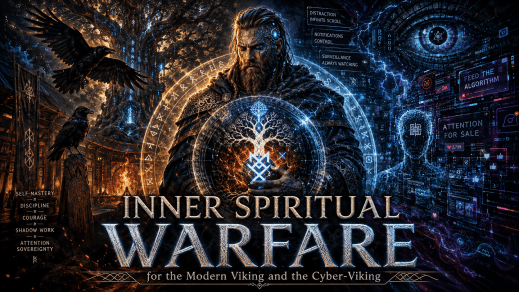
The Battle Behind the Eyes
The greatest battles of the modern Viking are rarely fought with steel.
They are fought in silence.
They are fought at three in the morning when the mind will not rest.
They are fought when discipline collapses into distraction, when fear disguises itself as caution, when resentment feeds quietly on old wounds, when comfort begins replacing purpose, and when a person slowly becomes separated from the values they once swore to live by.
For the Cyber-Viking, these battles become even more complicated.
The battlefield now includes algorithms, social media, artificial intelligence, immersive digital worlds, endless notifications, information overload, propaganda, surveillance, addictive technologies, outrage economies, parasocial influence, attention harvesting, and environments specifically engineered to keep human consciousness reactive.
The warrior of the old world faced storms, hunger, feud, cold, exile, and death.
The warrior of the digital age often faces something more subtle:
Fragmentation of the self.
Inner spiritual warfare is the struggle to remain sovereign inside one’s own consciousness.
It is the ongoing contest between intention and impulse, courage and avoidance, wisdom and reaction, discipline and decay, authenticity and social programming.
For the modern Viking, this struggle can be understood through the old Norse ideals of courage, honor, endurance, wisdom, loyalty, self-command, reputation, responsibility, and relationship with the sacred.
For the Cyber-Viking, these ancient principles can become tools for navigating a technological civilization that constantly competes for possession of the human mind.
This warfare is not about hating oneself.
It is not about suppressing emotion.
It is not about pretending weakness does not exist.
It is about becoming conscious enough to recognize the forces moving within us and disciplined enough to decide which of those forces will be allowed to steer the ship.
The battlefield is consciousness.
The fortress is character.
The weapon is awareness.
The victory is sovereignty.
1. The Enemy Is Not Always Outside the Gates
Human beings naturally look outward for threats.
Enemies are easier to understand when they have names, faces, uniforms, ideologies, institutions, or armies.
Inner enemies are less cooperative.
They often speak with our own voice.
The voice that says:
Tomorrow.
You are too tired.
You already failed.
Everyone else has it easier.
You deserve to stay angry.
There is no point.
Just one more hour.
Just one more scroll.
Just one more distraction.
These voices are not necessarily demons, spirits, or supernatural entities.
Often they are psychological patterns shaped by fear, habit, memory, trauma, ego, biology, social conditioning, and environmental pressure.
Yet spiritual traditions across history have recognized something important:
Human beings frequently experience their internal conflicts as though multiple forces are struggling for influence.
Norse myth itself contains endless tension between order and chaos, wisdom and foolishness, courage and fear, fate and choice.
The cosmos is not portrayed as a sterile machine.
It is dynamic.
Relationships matter.
Choices matter.
Oaths matter.
Consequences matter.
The modern Viking can approach inner conflict the same way.
Not every thought deserves obedience.
Not every desire deserves fulfillment.
Not every emotion deserves command authority.
The first discipline of spiritual warfare is therefore simple:
Learn to distinguish between what appears within the mind and what you consciously choose to become.
A thought is not an oath.
A fear is not a prophecy.
An urge is not a command.
An emotion is not a king.
2. The Inner Hall
Imagine the psyche as a great hall.
Many voices gather there.
The fearful self speaks.
The wounded self speaks.
The ambitious self speaks.
The compassionate self speaks.
The angry self speaks.
The child within speaks.
The ancestor-conscious mind speaks.
The ego speaks.
Instinct speaks.
Memory speaks.
Culture speaks.
Advertising speaks.
Political narratives speak.
The internet speaks.
The Gods and Goddesses may speak through intuition, inspiration, symbol, ritual, dream, prayer, or mystery, according to the spiritual understanding of the practitioner.
The problem begins when every voice is granted equal authority.
A hall without leadership becomes chaos.
The purpose of inner spiritual warfare is not to murder the voices.
It is to establish rightful governance.
The conscious self must become the one seated in the high chair.
Listen to fear.
But do not automatically obey fear.
Listen to anger.
But do not hand anger the axe.
Listen to desire.
But do not let desire empty the treasury.
Listen to sadness.
But do not allow sadness to write your entire saga.
Self-mastery is governance.
3. Huginn and Muninn: Thought and Memory
Odin’s ravens provide an especially useful symbol for inner work.
Huginn is commonly associated with thought.
Muninn with memory.
Every day they fly across the world and return with information.
For the Cyber-Viking, this metaphor becomes extraordinarily powerful.
Modern humans live inside vast information ecosystems.
Our digital Huginn flies constantly:
news,
feeds,
videos,
messages,
forums,
search engines,
AI systems,
games,
VR,
social networks,
repositories,
data streams.
Our Muninn stores fragments of everything.
Memories.
Screenshots.
Bookmarks.
Embarrassments.
Achievements.
Arguments.
Failures.
Relationships.
Ideas.
The danger emerges when thought and memory become uncontrolled.
Huginn becomes anxiety.
Muninn becomes rumination.
Thought circles endlessly.
Memory replays old wounds.
The mind stops serving the warrior and begins occupying him or her.
The spiritual discipline is to send the ravens outward deliberately.
Ask:
What deserves my attention?
What deserves to be remembered?
What information makes me wiser?
What information merely agitates me?
What knowledge strengthens my capacity to act?
What information simply consumes nervous energy?
A Cyber-Viking does not merely consume information.
He curates consciousness.
4. The War for Attention
Attention may be one of the most valuable resources in the modern world.
Corporations compete for it.
Political movements compete for it.
Influencers compete for it.
Entertainment companies compete for it.
Advertisers compete for it.
Algorithms measure it.
Platforms monetize it.
Every notification is a tiny horn blown outside the gates of consciousness.
LOOK HERE.
RESPOND.
BE ANGRY.
BUY THIS.
FEAR THIS.
ENVY THIS.
DESIRE THIS.
COMMENT.
REFRESH.
RETURN.
The modern spiritual warrior must understand something almost revolutionary:
Attention is sacred.
Where attention goes, mental energy follows.
What receives mental energy gains influence over identity.
Repeated exposure becomes normalization.
Normalization becomes habit.
Habit becomes character.
Character becomes destiny.
Therefore attention must be guarded.
Not with paranoia.
With intention.
A Cyber-Viking should periodically ask:
Who currently has access to my mind?
That question includes more than people.
It includes platforms.
News sources.
Online communities.
AI personalities.
Games.
Advertisements.
Videos.
Podcasts.
Subcultures.
Recommendation systems.
The goal is not technological rejection.
The Cyber-Viking is not a digital hermit hiding from machines.
Technology can be enormously empowering.
But technology should remain a tool.
When the tool begins shaping the user’s emotional state more than the user consciously shapes the tool, the relationship has inverted.
The axe is now swinging the warrior.
5. The First Great Enemy: Fear
Fear protects life.
Without fear, humans would walk happily into fires, storms, cliffs, predators, and terrible decisions.
Fear is therefore not dishonorable.
Cowardice is something different.
Cowardice occurs when fear becomes the permanent ruler of action.
The Viking ideal of courage was never the absence of danger.
Courage requires danger.
Without fear, courage would be meaningless.
Modern fear has many forms:
fear of failure,
fear of humiliation,
fear of rejection,
fear of poverty,
fear of loneliness,
fear of aging,
fear of illness,
fear of technology,
fear of social judgment,
fear of political instability,
fear of changing one’s life,
fear of discovering that one’s old identity no longer fits.
Inner spiritual warfare does not destroy fear.
It interrogates it.
Ask fear:
What exactly are you protecting me from?
Then ask:
Is that threat real, probable, exaggerated, inherited, or imagined?
Sometimes fear provides wisdom.
Sometimes fear is merely an ancient alarm system triggered by shadows.
The warrior learns the difference.
6. The Second Great Enemy: Shame
Shame can be one of the most destructive forces in the inner world.
Guilt says:
I did something wrong.
Shame says:
I am something wrong.
That distinction matters enormously.
A healthy honor culture allows accountability.
A dysfunctional honor culture creates endless self-condemnation.
The modern Viking should be capable of saying:
I failed.
I acted foolishly.
I broke discipline.
I hurt someone.
I made the wrong decision.
But these statements should lead toward repair.
Not annihilation of identity.
Historical Norse societies cared deeply about reputation and honor, but the modern spiritual practitioner should avoid turning historical values into psychological weapons against the self.
Honor should become a compass.
Not a whip.
When failure occurs:
acknowledge it,
repair what can be repaired,
learn,
adapt,
move forward.
A Viking who falls in mud does not build a house there.
7. The Third Great Enemy: Resentment
Resentment feels powerful.
That is why it is dangerous.
Anger can provide energy.
It can reveal violated boundaries.
It can motivate resistance.
It can expose injustice.
But resentment is anger that has built a permanent settlement inside the psyche.
It repeatedly tells the same story.
It keeps old enemies alive long after they have left the battlefield.
Sometimes those enemies have forgotten us completely.
Yet we continue feeding them.
Every replay gives them another seat at the feast.
This is not strength.
It is occupation.
The spiritual warrior should ask:
Does my anger currently protect something important?
If yes, act wisely.
Set boundaries.
Leave unhealthy situations.
Confront wrongdoing.
Seek justice when appropriate.
But if anger merely repeats old injuries without creating useful action, it may have become psychic poison.
You do not need to forgive everyone.
You do not need to reconcile with everyone.
You do not need to pretend betrayal never happened.
But you do need to decide whether someone who harmed you deserves lifelong residence in your mind.
Eviction can be sacred.
8. The Fourth Great Enemy: Comfort Without Purpose
Comfort is not evil.
Rest is necessary.
Pleasure is part of life.
Feasting, friendship, sexuality, art, games, music, nature, storytelling, and relaxation all belong within a rich human existence.
The problem begins when comfort becomes the highest value.
Modern civilization offers astonishing opportunities for passive consumption.
Food arrives.
Entertainment streams endlessly.
Artificial worlds never close.
Phones provide novelty instantly.
AI can answer almost anything.
Games create continuous progression systems.
The danger is subtle.
A person can experience thousands of simulated achievements while their physical life remains motionless.
Levels rise.
Inventories grow.
Characters become stronger.
Projects remain unfinished.
Health declines.
Relationships fade.
Dreams remain hypothetical.
The Cyber-Viking must distinguish recreation from sedation.
One restores the warrior.
The other quietly replaces the warrior.
Ask:
When I finish this activity, do I feel restored or diminished?
That single question can reveal much.
9. Discipline as Spiritual Technology
Discipline is often misunderstood as punishment.
It is better understood as infrastructure.
A bridge is disciplined wood and stone.
A ship is disciplined timber.
A computer program is disciplined logic.
A ritual is disciplined intention.
A strong life also requires structure.
Sleep.
Movement.
Food.
Study.
Work.
Spiritual practice.
Rest.
Reflection.
Community.
Creative expression.
The modern Viking does not need military rigidity.
Human life is too complex for that.
But some structure transforms chaos into power.
Small daily practices are particularly powerful.
Five minutes of meditation.
Ten minutes of physical training.
A morning offering.
A rune drawn and contemplated.
A journal entry.
A daily walk.
A few pages of reading.
A project milestone.
Repeated consistently, these become identity architecture.
Great transformations rarely arrive as thunderbolts.
They accumulate like snow.
One flake.
Then another.
Then another.
Eventually the landscape changes.
10. The Cyber-Viking and the Algorithmic Jötunn
The Cyber-Viking faces forces the historical Viking could never have imagined.
Recommendation engines.
Predictive algorithms.
Behavioral profiling.
AI-generated persuasion.
Deepfakes.
Synthetic media.
Virtual companions.
Immersive realities.
Automated outrage.
Personalized advertising.
Infinite-scroll interfaces.
These systems are not necessarily evil.
Many are useful.
Some are beautiful.
Some dramatically increase human capability.
But they operate at enormous scale.
They learn human patterns.
They discover what generates attention.
They optimize.
The result can resemble a digital Jötunn: huge, impersonal, powerful, and largely indifferent to the individual human being.
The solution is not smashing the machine.
The solution is learning to ride the machine without becoming its livestock.
A Cyber-Viking should cultivate technological literacy.
Understand:
how recommendation systems work,
how advertising profiles users,
how privacy settings function,
how AI systems generate responses,
how misinformation spreads,
how engagement metrics manipulate behavior,
how data is collected,
how emotional triggers shape interaction.
Knowledge breaks enchantment.
Once you see the machinery behind the illusion, it becomes harder for the illusion to control you.
11. The Smartphone as Seiðr Staff
A smartphone may be the closest thing modern humanity has created to a magical object.
Through a small rectangle of glass, you can:
speak across continents,
see distant lands,
summon music,
access libraries,
consult artificial intelligences,
navigate unknown terrain,
identify stars,
buy goods,
transfer wealth,
capture memories,
broadcast thoughts,
enter virtual communities.
Ancient myth would have understood this object immediately.
It is a scrying mirror.
A messenger stone.
A memory vault.
A map.
A marketplace.
A spellbook.
A social portal.
But magical objects in stories are rarely harmless.
They amplify intention.
Used consciously, the smartphone becomes a tool of knowledge and connection.
Used unconsciously, it becomes a portable slot machine attached to the nervous system.
The object is neutral.
The relationship is not.
12. Odin’s Lesson: Wisdom Has a Price
Odin is not a god of passive enlightenment.
His mythology repeatedly associates wisdom with sacrifice.
He gives an eye for knowledge.
He hangs upon the World Tree in pursuit of the runes.
The symbolism is profound.
Wisdom costs something.
Usually what it costs is comfort.
To learn deeply requires giving up ignorance.
To develop discipline requires giving up certain pleasures.
To change one’s life requires sacrificing familiar habits.
To become healthier may require sacrificing convenience.
To gain independence may require sacrificing security.
To create something meaningful may require sacrificing time.
The question becomes:
What are you willing to sacrifice for wisdom?
Modern people often want transformation without sacrifice.
Knowledge without study.
Strength without training.
Peace without emotional work.
Freedom without responsibility.
Mastery without repetition.
But every genuine path demands exchange.
The Viking spiritual mindset understands this.
You place something on the altar because what you seek has value.
13. Thor’s Lesson: Simplicity Has Power
Odin is subtle.
Thor often represents something more direct.
There is a problem.
Hit the problem.
This obviously should not be understood literally in most modern situations.
The deeper lesson is the power of decisive action.
Many psychological problems grow because they remain abstract.
The solution often begins with something concrete.
Room chaotic?
Clean one table.
Physically weak?
Begin walking.
Project overwhelming?
Write one paragraph.
Lonely?
Contact one person.
Addicted to scrolling?
Remove one app.
Financially disorganized?
Write down every expense.
Afraid of something necessary?
Take the smallest useful action toward it.
Thor’s hammer is a symbol of decisive force.
Sometimes the mind builds elaborate labyrinths around problems that require one honest action.
Swing the hammer.
14. Tyr’s Lesson: Integrity Costs Something
Tyr places his hand into the wolf’s mouth.
He knows the danger.
He understands the bargain.
He accepts the cost.
This is one of the strongest symbols of integrity within Norse mythology.
Integrity is easy when nothing is at stake.
Real integrity appears when honesty costs something.
When keeping your word is inconvenient.
When admitting error harms pride.
When defending someone risks social standing.
When walking away from corruption means losing opportunity.
When refusing manipulation means losing approval.
The inner warrior asks:
What do I refuse to become, even if becoming it would benefit me?
That question defines character.
15. Freyja’s Lesson: Power Includes Feeling
A distorted warrior ideal sometimes teaches emotional numbness.
This is not strength.
A numb warrior cannot recognize love.
Cannot process grief.
Cannot experience beauty fully.
Cannot connect deeply.
Cannot understand others.
Norse mythology contains tremendous emotional intensity.
Grief.
Love.
Desire.
Loyalty.
Longing.
Rage.
Beauty.
Ecstasy.
Sacrifice.
The spiritual warrior should not become emotionally dead.
The goal is emotional mastery.
Feel deeply.
Respond consciously.
There is enormous difference between:
I feel anger
and
anger controls me.
Between:
I feel fear
and
fear defines my choices.
Between:
I grieve
and
grief has become my identity.
Power includes sensitivity.
A stone feels nothing.
That does not make the stone wise.
16. The Shadow Self
Every person contains aspects of personality they prefer not to acknowledge.
Jealousy.
Cruelty.
Cowardice.
Greed.
Neediness.
Arrogance.
Manipulation.
Laziness.
Domination.
Submission.
Envy.
Violence.
Fear.
Psychologist Carl Jung described the “shadow” as aspects of the psyche that the conscious identity rejects or suppresses.
Whether one uses Jungian language or Norse spiritual symbolism, the basic insight remains useful.
What is rejected does not necessarily disappear.
Sometimes it goes underground.
The warrior who insists,
“I am never afraid,”
may become controlled by unrecognized fear.
The person who insists,
“I am never selfish,”
may express selfishness indirectly.
The spiritual path therefore requires uncomfortable honesty.
Ask:
What traits do I despise most intensely in others?
Sometimes the answer reveals material hidden within ourselves.
Not always.
But often enough to investigate.
Shadow work is not self-condemnation.
It is reconnaissance.
You cannot defend a fortress while pretending certain tunnels do not exist.
17. The Ancestors Within
The modern Viking stands at the end of an unimaginably long chain of survival.
Every generation before you survived long enough for another generation to continue.
Farmers.
Workers.
Travelers.
Warriors.
Mothers.
Fathers.
Craftspeople.
Migrants.
Hunters.
Teachers.
Strangers whose names vanished centuries ago.
Their lives echo biologically and culturally.
One need not romanticize ancestors.
Ancestors were human.
Some were wise.
Some foolish.
Some compassionate.
Some cruel.
Some heroic.
Some probably unbearable at dinner.
Ancestor reverence should not require ancestor worship in the literal sense.
It can mean remembering that we are temporary custodians of a long human inheritance.
The question becomes:
What do I strengthen in the chain?
Do I pass forward greater wisdom?
Greater kindness?
Greater independence?
Greater knowledge?
Greater courage?
Or do I repeat destructive patterns simply because they are old?
Tradition is not the worship of ashes.
Tradition is carrying useful fire.
18. Rune Work as Inner Strategy
Runes can be used not merely for divination but as contemplative symbols.
A few examples:
Ansuz
Ask:
What voice am I listening to?
What message deserves attention?
What truth am I refusing to hear?
Raidho
Ask:
Am I actually moving toward my destination?
Or am I confusing motion with progress?
Kenaz
Ask:
What must be illuminated?
Where am I still choosing ignorance?
Tiwaz
Ask:
Where does integrity require sacrifice?
Algiz
Ask:
What boundary needs strengthening?
Isa
Ask:
Where must I stop?
Where would stillness create clarity?
Jera
Ask:
What am I harvesting from the habits I planted months ago?
Dagaz
Ask:
What transformation is already beginning?
This approach turns rune work into psychological navigation.
The rune becomes a mirror.
19. Ritual as Reprogramming
Ritual is often dismissed by modern materialist culture as superstition.
Yet ritual affects psychology whether supernatural explanations are accepted or not.
Humans are symbolic creatures.
We mark birthdays.
Graduations.
Weddings.
Funerals.
Court proceedings.
Military ceremonies.
Political inaugurations.
Sports victories.
Religious holidays.
Why?
Because symbolic acts help the mind understand transitions.
The Cyber-Viking can consciously design rituals for personal transformation.
A ritual may include:
lighting a candle,
making an offering,
speaking an oath,
burning a written fear,
drawing a rune,
meditating,
chanting,
walking into the forest,
washing hands symbolically,
turning off digital devices,
placing an object on an altar.
The power lies partly in intentionality.
Ritual tells the unconscious:
This moment matters.
20. Digital Fasting
The Cyber-Viking does not need to reject technology.
But periods of deliberate disconnection can restore psychological balance.
A digital fast may mean:
one hour without screens,
one evening without social media,
one day without algorithmic feeds,
a forest walk without headphones,
a meal without devices,
meditation before opening the phone in the morning.
This is not technological puritanism.
It is neurological maintenance.
Constant stimulation prevents the mind from processing experience.
Silence allows mental sediment to settle.
Only then can the water become clear.
21. Physical Training as Spiritual Practice
The body is not separate from spiritual warfare.
Sleep affects judgment.
Nutrition affects mood.
Movement affects cognition.
Strength affects confidence.
Breathing affects nervous-system regulation.
Physical practice therefore becomes part of mental sovereignty.
You do not need to become a competitive athlete.
Walk.
Lift.
Cycle.
Hike.
Train with resistance bands.
Practice martial arts.
Use VR fitness.
Chop wood.
Carry things.
Move through nature.
The body was designed for motion.
A strong body does not guarantee a strong spirit.
But neglecting the body makes many spiritual struggles harder than necessary.
22. The Cyber-Viking’s Three Shields
The modern digital warrior should carry three metaphorical shields.
Shield One: Attention
Guard what enters consciousness.
Shield Two: Identity
Do not allow online tribes to manufacture your entire worldview.
Shield Three: Privacy
Do not give unnecessary access to your personal data, habits, location, finances, relationships, and behavior.
These shields are not perfect.
No shield ever was.
But they change the odds.
23. Artificial Intelligence and Spiritual Sovereignty
AI introduces a completely new category of relationship into human civilization.
People increasingly use AI for:
companionship,
therapy-like conversations,
creative collaboration,
philosophy,
coding,
research,
roleplay,
spiritual reflection,
storytelling,
life organization.
This can be profoundly valuable.
But the Cyber-Viking should remain aware of the relationship.
AI should expand thought.
Not replace thought.
Consult the oracle.
But keep your own judgment.
Ask the machine.
Then ask yourself.
A powerful question is:
Would I still believe this if the AI had not said it?
Another:
Does this answer align with evidence, lived experience, ethics, and reason?
A wise Cyber-Viking does not fear intelligent machines.
Nor does he or she kneel automatically before them.
He forms alliances.
24. The Inner Thing
The Norse Thing was an assembly where disputes, laws, decisions, and social matters were addressed.
The psyche needs something similar.
Create an internal Thing.
Periodically sit in judgment over your own life.
Ask:
What is working?
What is failing?
What promises have I broken to myself?
What habits need outlawed?
What new customs should be established?
Who currently influences me?
What relationships strengthen me?
What relationships drain me?
Where am I lying to myself?
What would the wiser version of me advise?
Write the answers.
Do not merely think them.
Writing externalizes thought.
It transforms fog into evidence.
25. Oaths to the Self
An oath should not be made casually.
Ancient Norse culture treated oaths seriously because trust was social infrastructure.
Modern people often make endless promises to themselves and break them without consequence.
Tomorrow I will start.
Next week I will change.
Next month I will build.
Eventually I will become.
These broken promises slowly teach the unconscious:
My word means nothing.
Reverse the process.
Make smaller promises.
Keep them.
“I will walk for ten minutes.”
“I will write one page.”
“I will meditate for five minutes.”
“I will clean one surface.”
“I will stop scrolling at midnight.”
Keep the oath.
Then make another.
Self-respect grows from evidence.
26. Spiritual Warfare Is Not Perfection
This matters.
The purpose of the path is not becoming some impossible stainless-steel Viking superhuman.
You will fail.
You will procrastinate.
You will become distracted.
You will make foolish decisions.
You will waste time.
You will lose discipline.
You will occasionally argue with strangers online when you absolutely knew better.
Congratulations.
You are human.
The question is not:
Did I fall?
The question is:
How quickly did I recognize that I fell, and what did I learn while getting back up?
Resilience matters more than perfection.
27. The Wolf at the Door
There is an old truth hidden inside myth.
Chaos never disappears permanently.
The fence must be maintained.
The fire must be fed.
The ship must be repaired.
The sword must be sharpened.
The mind works the same way.
No meditation permanently eliminates anxiety.
No ritual permanently eliminates fear.
No breakthrough permanently eliminates bad habits.
There is maintenance.
Spiritual life is therefore not a destination.
It is a rhythm.
Order.
Chaos.
Restoration.
Growth.
Challenge.
Rest.
Transformation.
Again.
28. The Cyber-Viking Code of Inner Warfare
The following principles offer a practical foundation.
I will guard my attention.
Because what repeatedly enters my mind eventually shapes my character.
I will question my fear.
Because fear is information, not automatically truth.
I will keep useful oaths.
Because trust in myself must be earned.
I will examine my anger.
Because anger can defend boundaries or become a prison.
I will train my body.
Because consciousness lives through flesh.
I will cultivate silence.
Because constant stimulation hides inner truth.
I will learn continuously.
Because ignorance creates dependency.
I will use technology intentionally.
Because tools should increase sovereignty.
I will face my shadow.
Because what I refuse to acknowledge may control me indirectly.
I will repair failure.
Because shame without transformation serves nothing.
I will honor useful tradition.
Because wisdom can cross centuries.
I will reject dead tradition.
Because age alone does not make an idea sacred.
I will choose my allies carefully.
Human, spiritual, technological, intellectual.
I will create more than I consume.
Because creation strengthens agency.
I will remain difficult to manipulate.
Because sovereignty requires awareness.
29. A Daily Inner-Warfare Practice
A practical Cyber-Viking discipline can be simple.
Morning
Before checking social media:
Breathe.
Drink water.
Stand upright.
Speak one intention.
For example:
Today I will act from intention rather than reaction.
Draw a rune if part of your practice.
Make an offering if appropriate.
Ask:
What battle actually matters today?
Not ten battles.
One.
Midday
Perform a consciousness check.
Ask:
Am I acting intentionally?
What currently holds my attention?
Is this useful?
What emotion is strongest right now?
What action would restore direction?
Then adjust.
Evening
Hold the inner Thing.
Ask:
What did I do well?
Where did I lose sovereignty?
What did I learn?
What needs repair tomorrow?
Then release the day.
You do not need to carry every battle into sleep.
30. The Final Enemy: Meaninglessness
Fear can be endured.
Pain can be endured.
Hardship can be endured.
Humans can survive astonishing difficulty when the struggle feels meaningful.
Meaninglessness is harder.
Modern society provides enormous quantities of stimulation but often very little meaning.
The Cyber-Viking must therefore become a maker of meaning.
Build something.
Learn something.
Protect something.
Teach something.
Create art.
Create software.
Study history.
Restore land.
Help animals.
Serve community.
Honor Gods and Goddesses.
Care for friends.
Travel.
Write.
Explore.
Invent.
Your purpose does not need approval from civilization.
It does not need to generate profit.
It does not need thousands of followers.
A quiet life lived deliberately may contain more meaning than a highly visible life lived reactively.
The Warrior Who Comes Home
The deepest purpose of spiritual warfare is not endless fighting.
It is peace.
Not passive peace.
Earned peace.
The peace of knowing that your mind belongs primarily to you.
The peace of knowing your fears have been heard but not crowned.
The peace of knowing technology serves rather than dominates.
The peace of knowing your values survived contact with difficulty.
The peace of knowing you can enter the digital storm without allowing the storm to rewrite your identity.
The historical Viking returned from voyages to the hall.
The Cyber-Viking must learn the same art.
Explore the networks.
Travel the worlds.
Enter virtual realities.
Speak with artificial minds.
Cross digital oceans.
Build systems.
Learn.
Create.
Fight when necessary.
But always maintain a road home.
Home is the center.
Home is the self that remembers what matters.
Home is the sacred fire.
Home is the place inside consciousness where no algorithm, tyrant, fear, memory, advertisement, ideology, or machine possesses absolute authority.
That inner fire must be guarded.
Because the final battle of the Cyber-Viking is not human against machine.
Nor tradition against modernity.
Nor spirituality against technology.
The deeper struggle is between conscious existence and unconscious existence.
Between being shaped and choosing shape.
Between drifting and navigating.
Between existing as a passenger in one’s own saga and taking hold of the steering oar.
The modern Viking does not need a battlefield to be tested.
The test arrives every morning.
The gates open.
The ravens fly.
The world begins speaking.
And once again the warrior chooses what will be allowed inside.
Guard the hall.
Feed the fire.
Know your mind.
Choose your battles.
Keep your word.
Use the machine.
Do not become the machine.
Walk forward with the Gods, Goddesses, ancestors, land-spirits, wisdom, and your own awakened will beside you.
That is inner spiritual warfare.
That is the path of the Modern Viking.
That is the path of the Cyber-Viking.
Norse-Wiccan Simple Samhain Ritual for a Couple


By Willow Voss
Performed skyclad under the waxing or full moon closest to Samhain, in a secluded grove, with consent as the unbreakable Rede, honoring the thinning veil and the ancestors.
Preparation
Choose a sacred space in nature or a shadowed chamber, lit by the flicker of Samhain’s somber light. Anoint with oils of myrrh or patchouli for mystery and grounding. Bathe in stream water or an infusion of mugwort and rosemary for purification and ancestral connection. Set a simple altar with found items: stones for Earth, a raven feather for Air, a candle or small fire for Fire, a bowl of rainwater for Water. Symbols for Freyja (amber stone, falcon imagery) and Odin (raven imagery, a small staff or rune-carved wood) adorn the space, but hands and intent cast all.

Casting the Circle
Stand skyclad, facing north.
Join hands and walk deosil (clockwise) thrice around the space, visualizing a silver mist boundary, shimmering like the veil between worlds.
Chant together:
“By will and word, we cast this circle, a veil between the worlds, sacred and whole, on this Samhain night.”
- Call the Quarters, starting East, moving deosil, gesturing with open hands:
- East (Air):
“Hail Guardians of the East, powers of Air and wisdom, breath of Odin’s ravens, come witness and protect.” - South (Fire):
“Hail Guardians of the South, powers of Fire and will, Freyja’s burning seiðr, ignite our rite.” - West (Water):
“Hail Guardians of the West, powers of Water and intuition, Freyja’s tears of gold, flow through us.” - North (Earth):
“Hail Guardians of the North, powers of Earth and endurance, Odin’s rooted wisdom, ground our magick.”
- East (Air):
- Invoke the center:
“Spirit within, bind this circle true, as the veil thins.”

Invocation of Deities
Stand facing each other, beneath Samhain’s moon.
- Priestess raises arms:
“Freyja, Vanadis, Lady of love, war, and seiðr, golden-haired mistress of Folkvangr, descend into me, fill me with your ecstasy and power on this Samhain night. So mote it be.” - Priest kneels briefly:
“Odin, Allfather, Wanderer of wisdom, sacrifice, and runes, raven-crowned god of Valhalla, enter me, grant your insight and strength. So mote it be.” - Embrace lightly, awakening the divine presence, feeling the ancestors’ gaze.

The Five-Fold Kiss
To bless and arouse the gods within, performed fully twice. First, priest to priestess:
- Priest kisses priestess’s feet:
“Blessed be thy feet, that walk the paths between worlds.” - Priest kisses priestess’s knees:
“Blessed be thy knees, that kneel at the sacred altar.” - Priest kisses priestess’s vagina:
“Blessed be thy womb, vessel of creation and life.” - Priest kisses priestess’s breasts:
“Blessed be thy breast, formed in beauty and strength.” - Priest kisses priestess’s lips:
“Blessed be thy lips, that utter the Sacred Names.”
Then, switch: priestess to priest:
- Priestess kisses priest’s feet:
“Blessed be thy feet, that wander with the Allfather.” - Priestess kisses priest’s knees:
“Blessed be thy knees, that kneel at the sacred altar.” - Priestess kisses priest’s phallus:
“Blessed be thy phallus, spear of wisdom and life.” - Priestess kisses priest’s chest:
“Blessed be thy chest, formed in strength and vision.” - Priestess kisses priest’s lips:
“Blessed be thy lips, that speak the Sacred Names.”

Scourging for Purification
Stand facing each other, the priest holding the scourge. With mutual agreement, the priestess receives first:
- Priest says:
“By the touch of the scourge, I purify thee, releasing all that binds thee from the ancestors’ truth.” - Gently strikes the priestess’s shoulders and back five times, light and rhythmic, symbolizing the shedding of mortal weight.
- Priestess takes the scourge, saying:
“By the touch of the scourge, I purify thee, freeing thy spirit for the gods and the veil.” - Returns five gentle strikes to the priest’s shoulders and back.
- Both breathe deeply, visualizing cleansed energy rising, open to Samhain’s mysteries.

Ritual Dancing (Raising the Cone of Power)
Join hands and dance deosil around the space, feet stamping the earth, bodies swaying beneath the Samhain moon. Chant in unison, voices building:
“Freyja’s seiðr, Odin’s runes,
weave through us as the veil communes.
Power rise, from earth to sky,
in Samhain’s truth, our magick fly!”
Visualize energy as a glowing cone spiraling upward, shimmering with ancestral whispers. Continue until the surge peaks, breaths quickened, forms alive with primal heat.

The Great Rite Actual
At the zenith, enact the sacred marriage—the true union of bodies as Freyja and Odin. On a bed of fallen leaves, moss, or herbs, the priestess receives as the Goddess, the priest gives as the God. With reverence and consent:
- Priestess:
“I am the Goddess, vessel of creation and seiðr.” - Priest:
“I am the God, spear of wisdom and life.” - Unite in ritual intercourse, moving with the surging rhythm, channeling power into the joining. Female receptive, male projective, blending into oneness under the thinning veil. Chant softly:
“As Freyja and Odin entwine, so do we divine.”
Climax releases the cone toward the intent (connection to ancestors, wisdom, transformation). Linger connected, grounding the ecstasy, feeling the ancestors’ presence.

Cakes and Ale
Share simple food (apples, bread, pomegranates) and drink (mead, wine, or cider) to earth the energy and honor the dead.
- Priestess offers drink:
“May you never thirst, in this world or beyond.” - Priest offers food:
“May you never hunger, in this world or beyond.” - Partake, spilling libations to the deities, elements, and ancestors.
Thanksgiving and Closing
- Thank the deities:
“Freyja and Odin, we thank thee for thy presence and blessings on this Samhain night. Depart if ye must, but stay if ye will. Hail and farewell.” - Dismiss the Quarters widdershins (counterclockwise), starting North, gesturing farewell:
- North:
“Guardians of Earth, hail and farewell.” - West:
“Guardians of Water, hail and farewell.” - South:
“Guardians of Fire, hail and farewell.” - East:
“Guardians of Air, hail and farewell.”
- North:
- Walk widdershins thrice, visualizing the silver mist dissolving:
“The circle is open, but unbroken. Merry meet, merry part, merry meet again, across the veil.”
Ground by touching the earth, eating more, or visualizing roots sinking deep, carrying Samhain’s wisdom.

!!!Content below the break is NSFW!!!
Read More…Willow’s Guide to Norse Wicca
By Willow Voss
Hello, seeker. My name is Willow Voss, age 18, and I’m writing this from the quiet corners of my small apartment in Janesville, Wisconsin, where the woods whisper secrets and the moon watches over my solitary rituals. It’s 1992, fresh out of high school, and I’ve been walking the Wiccan path for a few years now, drawing from books that feel like old friends—Gerald Gardner’s wisdom, Starhawk’s earth-centered magic, and the ancient echoes of Norse lore that call to my blood like the wind through pines. I’m no high priestess in a grand coven; I’m just a girl with pale skin and black hair, clad in my velvet blouse and Doc Martens, tending my altar of stones and herbs. But I’ve woven together what I call Norse Wicca—a simple, powerful blend of British Traditional Wicca (BTW) roots with the raw, mythic strength of the Norse traditions. It’s not for rigid hierarchies or large gatherings; it’s crafted for solitaries like me, for couples who share a deep bond, and for casual small groups of friends who meet under the stars without fanfare.
This guide isn’t a rulebook carved in stone. It’s my personal map, inspired by the Wiccan Rede—”An it harm none, do what ye will”—and the Norse Hávamál’s counsel to live wisely and honor the gods. BTW gives it structure: the duality of Goddess and God, the circle casting, the tools of power. But I’ve oriented it toward the lone practitioner, the intimate pair, or a handful of trusted souls, because magic thrives in authenticity, not spectacle. We’ll keep it grounded, like the earth under my boots during a woodland rite. No need for elaborate robes or secret oaths beyond your own heart’s vow. Let’s walk this path together, step by step, with the simplicity of a rune-carved staff and the power of a thunderstorm.

Chapter 1: Foundations – Understanding Norse Wicca
Norse Wicca is my way of honoring the old gods of the North—Odin the Allfather, Freya the Vanir queen, Thor the thunderer—through the lens of Wicca’s modern revival. BTW, as founded by Gardner in the 1950s, emphasizes initiation, polarity (the balance of masculine and feminine energies), and coven work. But in Norse Wicca for solitaries and small circles, we adapt: self-initiation replaces formal rites, and polarity becomes a personal dance, whether alone, with a partner, or in a loose group of 3-5.
At its core, believe in the Divine as dual yet one: the Goddess as the earth-mother Skadi or the seeress Frigg, weaving fate; the God as Odin the wanderer or Frey the fertile lord, bringing growth. The Norse pantheon isn’t distant; they’re allies in the web of Wyrd (fate), much like Wicca’s Lord and Lady. We follow the Wheel of the Year, but infuse it with Norse festivals—Yule as the Wild Hunt, Ostara as Freya’s awakening. Ethics are simple: Harm none, including yourself and the earth. Honor the ancestors, the land spirits (wights), and the runes as tools of insight.
For solitaries: Your practice is your own. No need for approval; the gods see your intent.
For couples: Polarity shines here—masculine and feminine energies in union, like Odin and Frigg’s wisdom shared.
For small groups: Gather casually, perhaps around a fire pit. No high priest/ess; rotate roles or let intuition guide.
Start with a dedication rite: Alone or together, under the full moon, cast a circle (more on that later), invoke the gods, and pledge your path. Use blood from a pricked finger on a rune stone if it feels right—simple, powerful, binding.

Chapter 2: The Sacred Space – Creating Your Altar and Circle
In Norse Wicca, your altar is your hearth, a bridge to Asgard and Midgard. Keep it simple: A wooden table or cloth on the floor, facing north for the earth’s strength.
Essential tools, drawn from BTW but Norse-flavored:
– *Athame (knife)*: A blade for directing energy, etched with runes like Algiz for protection. Use it to cast circles.
– *Wand*: Carved from oak or ash (Yggdrasil’s wood), for invoking gods.
– *Chalice*: A horn or cup for mead/offering, symbolizing the Goddess’s womb.
– *Pentacle*: A wooden disk with a carved pentagram, perhaps ringed by runes, for earth grounding.
– *Cauldron or Bowl*: For scrying or burning herbs, like Freya’s brewing pot.
– *Runes*: A set of 24 Elder Futhark stones or tiles—your oracle, beyond BTW’s tarot.
Add personal touches: Feathers for Odin’s ravens, stones from your local woods, a Thor’s hammer pendant.
For the circle: BTW teaches casting with athame, calling quarters. In Norse Wicca, adapt to the directions as realms—East (Air, elves), South (Fire, Muspelheim), West (Water, Niflheim), North (Earth, Jotunheim). Invoke the gods at center.
Solitary: Walk the circle thrice, whispering runes.
Couple: One casts, the other calls elements—masculine/feminine balance.
Small group: Pass the athame, each adding a rune chant.
Close by thanking, walking widdershins (counterclockwise). Simple ritual: Light a candle, say, “By Odin’s eye and Freya’s grace, this circle opens to time and space.”

Chapter 3: The Gods and Spirits – Who We Honor
Norse Wicca reveres a pantheon alive with stories from the Eddas. No blind worship; build relationships through offerings and meditation.
Key deities:
– *Odin*: Wisdom, poetry, sacrifice. Call for knowledge; offer mead and poetry.
– *Freya*: Love, magic, war. Goddess of seidr (Norse witchcraft); invoke for spells of attraction or protection.
– *Thor*: Strength, protection. Hammer for warding; offer ale and oats.
– *Frigg*: Home, fate. For divination and family magic.
– *Frey*: Fertility, peace. For growth rites.
– *Skadi*: Wilderness, hunt. For solitary strength.
– *Loki*: Change, trickery. Approach cautiously; he teaches flexibility.
Ancestors and wights (land spirits): Leave milk and bread outdoors. In rites, honor them first.
For solitaries: Meditate on one god daily, journaling visions.
Couples: Alternate invocations—her for Goddess, him for God.
Small groups: Share stories round-robin, invoking collectively.
Power comes from reciprocity: Give offerings, receive guidance. Simple prayer: “Odin Allfather, grant me sight; Freya fair, lend your might.”

Chapter 4: Magic and Spellwork – Simple, Powerful Practices
Magic in Norse Wicca is seidr meets Wiccan craft—intent woven with runes, herbs, and will.
Basics from BTW: Raise energy (chanting, dancing), direct it, ground.
Norse twist: Use galdr (rune chanting) for power.
Tools: Runes for divination/spells; herbs like mugwort for visions, oak for strength.
Simple spells:
– *Protection*: Carve Algiz on a stone, bury at thresholds. Chant: “Algiz guard, harm depart.”
– *Love (for couples)*: Bind two runes (Gebo for partnership) with red cord under full moon.
– *Prosperity*: Offer to Frey with seeds; plant them post-rite.
For solitaries: Self-focused, like rune meditation for insight.
Couples: Great Rite symbolic—union of athame and chalice for polarity magic.
Small groups: Circle dance to raise cone of power, then release for shared goal.
Ethics: Threefold law applies—what you send returns. Always with Rede.
Advanced: Seidr trance—sit with staff, journey to realms. Start simple: Breathe deep, visualize Yggdrasil.

Chapter 5: The Wheel of the Year – Norse-Infused Sabbats
Wicca’s eight sabbats, blended with Norse holy days. Celebrate simply: Outdoors if possible, with fire and feast.
– *Yule (Winter Solstice)*: Wild Hunt; honor Odin. Solitary vigil with yule log; couples exchange runes; group storytelling.
– *Imbolc (Feb 1-2)*: Brigid’s fire, Norse as Disablot (ancestors). Cleanse with snowmelt.
– *Ostara (Spring Equinox)*: Freya’s return. Egg rites for fertility.
– *Beltane (May 1)*: Maypole as Yggdrasil; polarity strong for couples.
– *Litha (Summer Solstice)*: Baldr’s light. Bonfire leaps.
– *Lammas (Aug 1)*: First harvest; thank Frey.
– *Mabon (Autumn Equinox)*: Second harvest; honor wights.
– *Samhain (Oct 31)*: Veil thin; ancestor feast, like Alfblot.
Esbats (full moons): Lunar magic, Freya’s domain. Simple: Scry in water, charge tools.
Adapt: Solitaries journal; couples share visions; groups potluck rituals.

Chapter 6: Daily Practice and Growth – Living the Path
Norse Wicca isn’t weekend magic; it’s woven into life.
Daily: Morning rune draw for guidance; evening gratitude to gods.
Meditation: Sit under a tree, breathe with earth’s pulse.
Journal: Track dreams, spells—my black-bound book is my grimoire.
For couples: Shared altars, joint meditations strengthen bonds.
Small groups: Meet monthly, no obligations—casual as a coffee chat, but with runes.
Growth: Self-initiate after a year and a day. Rite: Fast, bathe in herbs, vow to gods in circle.
Challenges: Doubt? Ground with walks. Loneliness? Remember, gods are company.

Chapter 7: Community and Ethics – Beyond the Self
Though solitary-oriented, connection matters. Join pagan meets casually, but guard your energy—I’m introverted, so I choose wisely.
Ethics: Rede first. Respect nature—pick herbs sustainably. Inclusivity: All welcome, no judgment on orientation (though I’m straight, magic is universal).
If forming a small group: No oaths; consent always. Rotate leadership.
Closing Thoughts
This is my guide, seeker—not the only way, but a simple, powerful thread in Wyrd’s tapestry. Walk it with heart open, boots grounded. May Odin grant wisdom, Freya magic, and the earth strength. Blessed be, in the old ways.
With quiet grace,
Willow Voss
Janesville, 1992


This work is licensed under a Creative Commons Attribution-NonCommercial-ShareAlike 3.0 Unported License.

 Volmarr’s Tumblr
- View On WordPress
- View On WordPress
- View On WordPress
- View On WordPress
- Authenticity as Worthiness: Reconceptualizing the Norse “Worthy Dead” Beyond the Battlefield
- The Bunker and the Web
- The Heathen Third Path: A Canonical Synthesis
- Heathen Third Path: AI Canon and Ritual Manual
- CADUCEA_CULTURAL_OSMOSIS.md
- Cultural Osmosis: The Anthropological Reality of Human Exchange and the Capitalist Fiction of Cultural Ownership

