The Hermetic Golden Dawn Tarot: A Complete Esoteric Compendium
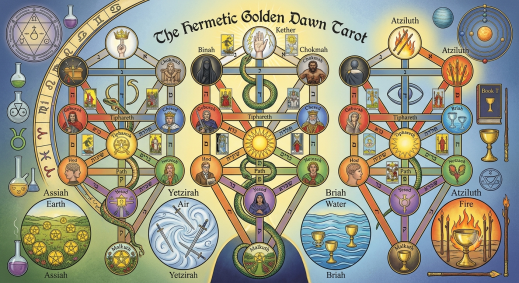
Introduction to the Golden Dawn System
The Tarot of the Hermetic Order of the Golden Dawn stands as one of the most complete and potent syntheses of Western esoteric wisdom ever assembled. Far more than a mere deck of fortune-telling cards, it is a living textbook of Qabalah, astrology, alchemy and ceremonial magic—a symbolic map of the universe and the soul’s journey through it. The system was codified primarily by S. L. MacGregor Mathers in the manuscript known as Book T – The Tarot, which remains the foundation of all later Golden Dawn–derived decks.
In this system, the 78 cards are divided into two grand sections: the 22 Major Arcana (the Trumps), representing the paths that connect the Sephiroth on the Tree of Life, and the 56 Minor Arcana, representing the Sephiroth themselves within the four Qabalistic worlds. The Minor Arcana are further divided into 16 Court Cards (the elemental personages) and 40 small cards (the numbered cards of the four suits, each attributed to a decanate of the zodiac). Every attribution, title, colour, symbol and meaning is woven into a seamless whole, designed to train the intuition of the Initiate and to serve as a living key to the hidden forces of nature.
The following pages are an exhaustive exposition of the Hermetic Golden Dawn meanings of all 78 cards—their titles, Hebrew letters, astrological and elemental attributions, esoteric symbolism, and divinatory interpretations both upright and reversed (ill-dignified). The language is drawn faithfully from the Golden Dawn current, elaborated to illuminate every facet of each card while avoiding later deviations or modern glosses.
The Major Arcana: The Twenty-Two Paths of the Serpent of Wisdom
The Major Arcana are numbered from 0 to XXI and placed upon the 22 paths of the Qabalistic Tree of Life. Each is attributed to a Hebrew letter, an element or planet, and a zodiac sign, and each bears an initiatory title that encapsulates its deepest function. The order given here follows the Path of the Serpent as it ascends the Tree, beginning with the Fool as the Spirit of Aethyr and culminating in the World as the Great One of the Night of Time.
0. The Fool
Hebrew Letter: Aleph (א)
Path: 11th Path, connecting Kether to Chokmah
Esoteric Title: The Spirit of the Aethyr
Astrological Attribution: Air
Symbolism
The Fool depicts a radiant child standing upon a cliff edge, often with a wolf or hound leaping beside him, a white rose in his hand. His garment is the pure light of the Unmanifest. He represents the primordial impulse, the Breath of the Void becoming Idea, the Logos at the threshold of creation. The wind of the Spirit carries him forward without fear, for he is not yet bound by the laws of the worlds below. The Sun blazing behind his head is the eternal radiance of Kether, and the precipice is the Abyss between the Supernal Triad and the rest of existence. He is the divine Fool who enters the game of manifestation in perfect trust.
Divinatory Meanings (Upright)
Ideas taking first breath. Spiritual epiphany. Perfect foolishness of the mystic who has passed beyond reason. New beginnings charged with the fire of heaven. Trust in the divine guidance. Openness to the unexpected. The querent acts from pure intuition, unhampered by memory or fear. This card suggests the beginning of a journey where the destination is not yet formed—the leap of faith into a greater life.
Divinatory Meanings (Reversed)
Thoughtlessness that leads to ruin. Foolishness that refuses to learn. Instability and lack of grounding. A missed opportunity because the querent could not hear the inner voice. Vertigo before the abyss; failure to commit to the leap. Ill-dignified, the Fool betrays the spiritual impulse into mere recklessness or a descent into chaos.
I. The Magician (The Magus of Power)
Hebrew Letter: Beth (ב)
Path: 12th Path, connecting Kether to Binah
Esoteric Title: The Magus of Power
Planetary Attribution: Mercury
Symbolism
The Magician stands before an altar bearing the four elemental weapons: Wand, Cup, Sword, and Pentacle—the tools of a complete magician. Above his head floats the lemniscate of infinite intelligence. He is the conduit through which the unformed light of Kether is shaped by the understanding of Binah. Mercury, the swift messenger of the gods, endows him with skill, cunning and the power of the Word. He is the conscious will directing the forces of creation, the alchemist who transforms the prima materia into gold. The rose and lily about the altar signify the union of desire and purity.
Divinatory Meanings (Upright)
Skill, diplomacy, dexterity, self-confidence. Mastery of the material world through intellect and will. The querent possesses all needed tools; the moment calls for focused concentration and clear communication. A favourable time for new ventures, learning, business, or magical acts. The card announces that spirit can be manifested into form by the power of the Mind.
Divinatory Meanings (Reversed)
Cunning, trickery, abuse of mental powers. A clever charlatan. Lack of will, scattered energies. Manipulation for selfish ends. Mental confusion or misuse of eloquence. Magical power turned towards domination and deceit. The ill-dignified Magician is the sorcerer who serves only his ego.
II. The High Priestess (The Priestess of the Silver Star)
Hebrew Letter: Gimel (ג)
Path: 13th Path, connecting Kether to Tiphareth
Esoteric Title: The Priestess of the Silver Star
Planetary Attribution: The Moon
Symbolism
Seated between the pillars of Jachin and Boaz, the High Priestess veils the entrance to the sanctuary. A crescent moon rests at her feet, a crown of Isis upon her head, and the scroll of the Tora on her lap. She is the eternal feminine principle—the silent, receptive guardian of the Mysteries. Her path unites the Crown to the centre of the Sun, indicating that illumination comes only through the lunar realm of reflected light, the world of images and the subconscious. She is the Shekinah, the indwelling presence of God, the sea of Binah made manifest as spiritual intuition.
Divinatory Meanings (Upright)
Secrets, mystery, the unawakened potential. A time to be still and listen to the inner voice. Intuition is to be trusted above reason. The querent is drawn towards hidden knowledge or a deeper spiritual calling. The High Priestess presides over dreams, visions, and all that ripens beneath the surface. Purity of purpose and the power of silent reflection.
Divinatory Meanings (Reversed)
Ignorance of spiritual truths. Concealment of wisdom for unworthy ends. Superficiality, passion without depth. The querent may be ignoring their intuition, caught in gossip or delusion. A false priestess who uses mystery to manipulate. The gates of the temple are shut; the path to the inner self is blocked by mental noise.
III. The Empress (The Daughter of the Mighty Ones)
Hebrew Letter: Daleth (ד)
Path: 14th Path, connecting Chokmah to Binah
Esoteric Title: The Daughter of the Mighty Ones
Planetary Attribution: Venus
Symbolism
The Empress is throned amidst a field of ripening corn, a symbol of the fecundity of Nature. She is crowned with twelve stars, representative of the zodiac, and her sceptre bears the orb of the world. The path of Daleth unites the two Supernal Sephiroth, Chokmah (Wisdom) and Binah (Understanding); she is therefore the first fruit of the cosmic union, the Mother of Form. Venus gives her grace, beauty, and the power of love that attracts and harmonises. She is the creative imagination that gives birth to all art, all life, and all civilisation.
Divinatory Meanings (Upright)
Fruitfulness, growth, abundance. The querent is entering a fertile period in which creative projects, relationships, or material endeavours prosper. Love, beauty, comfort and domestic harmony are indicated. She is the promise of the earth fulfilled. The card also represents the perfect feminine power—gentle yet absolute—that nourishes and protects what it has conceived.
Divinatory Meanings (Reversed)
Barrenness, dissipation, luxury that becomes laziness. The creative impulse blocked or misdirected into mere sensuality. Inconstancy, vanity, over-dependence on comfort. The Empress ill-dignified refuses to give birth, hoards her gifts, or smothers that which she should nurture.
IV. The Emperor (Son of the Morning, Chief among the Mighty)
Hebrew Letter: Heh (ה)
Path: 15th Path, connecting Chokmah to Tiphareth
Esoteric Title: Son of the Morning, Chief among the Mighty
Zodiacal Attribution: Aries
Symbolism
The Emperor sits upon a cubic stone of power, his armour glowing with the fire of Mars-ruled Aries, the ram’s heads adorning his throne. He holds the sceptre of dominion and the orb of the world. This is the archetypal Father, the masculine principle of order, law, and sovereignty. He channels the pure wisdom of Chokmah into the harmonised force of Tiphareth, giving structure to the creation initiated by the Empress. He is Will personified, the warlord of the soul who battles chaos and establishes the boundaries of the self.
Divinatory Meanings (Upright)
Authority, stability, power, leadership. The ability to command and organise. The querent is called to take responsibility, to build lasting structures and enforce wise law. Ambition guided by reason. A protector and a strategist. The Emperor represents success achieved through discipline, courage, and the refusal to yield before difficulty.
Divinatory Meanings (Reversed)
Tyranny, obstinacy, misuse of power. Rigidity that crushes the life it seeks to control. Immature authority or failure to lead. A dictatorial personality that cannot tolerate contradiction. Reversed, the Emperor becomes the petty despot or the weak king whose throne is crumbling because he has forgotten the law.
V. The Hierophant (The Magus of the Eternal)
Hebrew Letter: Vav (ו)
Path: 16th Path, connecting Chokmah to Chesed
Esoteric Title: The Magus of the Eternal
Zodiacal Attribution: Taurus
Symbolism
The Hierophant sits between the twin pillars, holding the triple cross and giving the sign of benediction. Two kneeling ministers attend him. As Taurus is the fixed earth, he embodies the perpetuation of spiritual tradition—the outer form through which inner mystery is transmitted. He is the pontifex, the bridge builder, linking Chokmah (Wisdom) to Chesed (Mercy). Vav, the nail, fastens the supernal light into a creed, a ritual, a living lineage. His voice is the voice of the accumulated experience of the ages.
Divinatory Meanings (Upright)
Spiritual guidance, teaching, orthodox wisdom. Ritual, initiation, and the preservation of sacred knowledge. The querent is advised to seek a teacher or to trust in a tried and tested path rather than isolated speculation. Conformity that uplifts. A time of blessing, marriage or sacred covenants. The Hierophant speaks for the inner church, the community of the illumined.
Divinatory Meanings (Reversed)
False teaching, dogmatism, the empty shell of religion without spirit. A priest who serves only his institution. Eccentricity that severs the link with tradition. The querent may be in rebellion against healthy authority or trapped in a cult of personality. Ill-dignified, he is the idolater who worships the form and neglects the living truth.
VI. The Lovers (The Children of the Voice; The Oracle of the Mighty Gods)
Hebrew Letter: Zain (ז)
Path: 17th Path, connecting Binah to Tiphareth
Esoteric Title: The Children of the Voice
Zodiacal Attribution: Gemini
Symbolism
The Lovers card depicts a man and a woman, often beneath a radiant angel or sun, representing the primordial duality of consciousness that seeks reunion. The sword of Zain cleaves the One into Two, and the Two are drawn back towards the One by Love. This is the path from Understanding (Binah) to the Heart (Tiphareth), the first glimmering of self-sacrifice for another. It is the Mystery of the Divided Self: the conscious ego and the subconscious soul, the male and female principles within each being, which must be harmonised before the Great Work can proceed.
Divinatory Meanings (Upright)
Attraction, love, union, a critical choice born from the heart. The querent stands at a forking path where desire and duty may conflict, but through love a higher synthesis is reached. Alliances and partnerships are favoured. The card also points to the inner marriage of opposites, the integration of the shadow. True inspiration descends when duality is consciously embraced.
Divinatory Meanings (Reversed)
Folly in love, an unwise choice, separation. Temptation that leads to dissipation. Inner conflict that remains unresolved. The querent may be following a false twin flame or refusing the necessary sacrifice that love demands. Reversed, the Lovers become the quarrelsome pair, the broken vow, the soul divided against itself.
VII. The Chariot (The Child of the Powers of the Waters; Lord of the Triumph of Light)
Hebrew Letter: Cheth (ח)
Path: 18th Path, connecting Binah to Geburah
Esoteric Title: Child of the Powers of the Waters; Lord of the Triumph of Light
Zodiacal Attribution: Cancer
Symbolism
A crowned warrior stands in a chariot drawn by two sphinxes—one black, one white—beneath a canopy of stars. He holds the reins of will, but his vehicle is the cube of space, the physical world. Cancer, the cardinal water, is the gate of incarnation; the Chariot represents the soul that has descended into matter and must now master its vehicle. The path from Binah (Form) to Geburah (Severity) is a battle, a struggle to maintain the inner light amid the turbulent tides of emotion and external circumstance. The Charioteer is the Holy Guardian Angel directing the animal soul.
Divinatory Meanings (Upright)
Victory through will, self-discipline, control of conflicting forces. The querent harnesses their emotional nature and drives forward. Success comes after a period of struggle. The Chariot announces a triumphant progress, provided the ego stays firmly in the driver’s seat. It can also denote travel, vehicles, or any situation requiring firm handling.
Divinatory Meanings (Reversed)
Riot, loss of control, overthrow. The sphinxes bolt in opposite directions, and the chariot crashes. The querent is enslaved by their own appetites or emotions. Tyranny of the body over the spirit. Ill-dignified, it portends ruin brought about by pride, impatience, or an inability to steer through a crisis.
VIII. Strength (The Daughter of the Flaming Sword) – Lust
Hebrew Letter: Teth (ט)
Path: 19th Path, connecting Chesed to Geburah
Esoteric Title: The Daughter of the Flaming Sword
Zodiacal Attribution: Leo
Symbolism
A woman serenely closes the jaws of a lion, whose energy she has transmuted into a higher power. She wears the lemniscate of eternity. In the Golden Dawn this card is entitled Lust in its deepest sense—the divine passion that fuels creation. The path of Teth bridges Chesed (Mercy) and Geburah (Severity), harmonising their opposites through the solar fire of Leo. It is the alchemical formula of solving the insoluble: love that is stronger than force, the soul that tames the beast through courage and gentleness rather than through violence. The Serpent Power, Kundalini, is here raised consciously.
Divinatory Meanings (Upright)
Spiritual fortitude, moral strength, the power of love over brute force. The querent possesses inner courage that cannot be shaken by external threats. A time to face fears with calm authority. Vitality, magnanimity, and the triumph of the higher will over the lower nature. The card affirms that the lion’s passion can become the throne of the soul.
Divinatory Meanings (Reversed)
Weakness, cowardice, abuse of strength. The beast breaks free and rages. The querent is overwhelmed by animal instincts—anger, lust for power, uncontrollable desire. Alternatively, a failure of nerve, a surrender to fear. Ill-dignified, Strength becomes tyranny of the body or the inability to say “no” to one’s lesser impulses.
IX. The Hermit (The Prophet of the Eternal; The Magus of the Voice of Power)
Hebrew Letter: Yod (י)
Path: 20th Path, connecting Chesed to Tiphareth
Esoteric Title: The Prophet of the Eternal; The Magus of the Voice of Power
Zodiacal Attribution: Virgo
Symbolism
A hooded ancient bears aloft a lantern containing a six-pointed star, lighting the way on a lonely mountain path. He leans upon the staff of the patriarch. Yod, the smallest letter, is the seed of all manifestation; its path unites the expansive Mercy of Chesed with the sacrificial Sun of Tiphareth. The Hermit embodies the inward turning of force, the descent into silence where the voice of the Higher Self can be heard. Virgo, the virgin earth, indicates the purified matter that can receive the seed of the Spirit. He seeks nothing outside, for the Light is within.
Divinatory Meanings (Upright)
Contemplation, solitude, inner guidance. The querent must withdraw from the noise of the world to find the answer within. A wise teacher or an inner initiation. Patience, prudence, the ability to illuminate the path for others after having walked it oneself. The Hermit represents the inmost light of conscience and the discovery of one’s true purpose.
Divinatory Meanings (Reversed)
Isolation, loneliness, scepticism that blinds. The lantern’s light is hidden under a bushel. The querent refuses to seek, or seeks only to hide their deficiencies. False humility, morbid secretiveness, or a teacher who misleads. Ill-dignified, the Hermit becomes the hermit crab, retreating not for wisdom but for fear of life.
X. The Wheel of Fortune (The Lord of the Forces of Life)
Hebrew Letter: Kaph (כ)
Path: 21st Path, connecting Chesed to Netzach
Esoteric Title: The Lord of the Forces of Life
Planetary Attribution: Jupiter
Symbolism
A great wheel turns, bearing aloft Anubis, the guide of souls, while Typhon, the serpent of chaos, plunges downward, and the Sphinx sits in stillness at the summit. The four holy living creatures (the Kerubim of the fixed signs) occupy the corners. Jupiter, the beneficent king, rules this card, which shows the ever-turning cycle of fortune and incarnation. The path from Chesed to Netzach indicates the descent of structured mercy into the realm of emotions and nature—fate as the interplay of divine law and personal vibration.
Divinatory Meanings (Upright)
A change of fortune, usually for the better. The Wheel spins, and the querent is lifted by a favourable current. Destiny, luck, karma. The lesson is to ride the wheel without attachment, to know that all states are impermanent. Expansion, good timing, and a period of harvest. The Wheel invites trust in the larger intelligence that governs life.
Divinatory Meanings (Reversed)
Bad luck, a downturn, being ground down by fate. The querent clings to the wheel as it descends. Inability to adapt to change; a cycle of misfortune that may have been earned. The card warns that the wheel always turns, so humility and prudence are needed. Ill-dignified, it signals stagnation at the worst point of the cycle, a refusal to let go and be lifted again.
XI. Justice (The Daughter of the Lords of Truth; The Ruler of the Balance)
Hebrew Letter: Lamed (ל)
Path: 22nd Path, connecting Geburah to Tiphareth
Esoteric Title: The Daughter of the Lords of Truth; Ruler of the Balance
Zodiacal Attribution: Libra
Symbolism
A stern, crowned woman sits between the pillars, holding the sword of judgement and the scales of equilibrium. Libra, the sign of the Balance, governs this card, which connects the severity of Geburah to the harmonising beauty of Tiphareth. Justice is not mere human law, but the cosmic principle of cause and effect, act and consequence. She weighs the heart against the feather of Ma’at. Her eyes are blindfold or all-seeing, for her judgement is impersonal. This is the Great Arcanum of Adjustment: every force must be balanced by its opposite.
Divinatory Meanings (Upright)
Justice, legal matters, equilibrium, an outcome that exactly reflects the input of energy. The querent receives what they have built. Fairness, integrity, the resolving of disputes according to truth. The card calls for a balanced mind and a dispassionate review of a situation. A decision that must be made without favour or prejudice.
Divinatory Meanings (Reversed)
Injustice, legal defeat, bias. A verdict that crushes the innocent. Unbalanced judgement, severity without mercy. The querent may be in denial of their own culpability. Ill-dignified, Justice becomes tyranny of law, the letter that kills the spirit, or the corruption that perverts equity.
XII. The Hanged Man (The Spirit of the Mighty Waters)
Hebrew Letter: Mem (מ)
Path: 23rd Path, connecting Geburah to Hod
Esoteric Title: The Spirit of the Mighty Waters
Elemental Attribution: Water
Symbolism
A man hangs upside down from a T-shaped cross, his leg crossed in the alchemical sign of Sulphur, his face serene. Below him lies the abyss of the Waters. The path of Mem unites the strictness of Geburah with the intellectual splendour of Hod; it is the great purgation through surrender. The element of Water in its most initiatory mode demands that the ego be inverted, that all values be reversed, so that the spirit may flow freely back to its source. He is not a victim but a self-suspended initiate, baptising the lower will into the will of God.
Divinatory Meanings (Upright)
Suspension, sacrifice, a period of waiting that is profoundly transformative. The querent’s old plans are arrested so a higher order may reveal itself. The Hanged Man is the power of renunciation and the wisdom of the paradox: we gain by losing. A spiritual initiation that demands giving up something dear for a greater good. Acceptance and surrender to the deeper current.
Divinatory Meanings (Reversed)
Martyrdom without purpose, useless sacrifice, a refusal to let go. The querent is suffering but fighting the lesson. Stagnation masquerading as patience. The card ill-dignified suggests entrapment in a messiah complex, ego inflation through suffering, or simply a wasted ordeal that brings no wisdom.
XIII. Death (The Child of the Great Transformers; Lord of the Gate of Death)
Hebrew Letter: Nun (נ)
Path: 24th Path, connecting Tiphareth to Netzach
Esoteric Title: The Child of the Great Transformers; Lord of the Gate of Death
Zodiacal Attribution: Scorpio
Symbolism
A skeleton scythes a field of living figures—kings, children, clergy—all fall before him. The sun sets or rises on a distant horizon. Scorpio, the sign of sex and death, rules this path between the solar heart of Tiphareth and the emotional desire-nature of Netzach. Death is the Reaper who cuts away the outgrown so that the eternal Self may plant new seeds in the fertile soil. He is the transformative agent of the Great Work, dissolving the fixed so that the volatile may ascend. Nun is the fish, the sperm, life out of death.
Divinatory Meanings (Upright)
A complete and fundamental transformation. The ending of a cycle, the death of an old identity, a situation, or a way of life. Through this necessary cutting, rebirth becomes possible. The querent is asked to cooperate with the change, to let the dead past bury its dead. This card rarely indicates physical death; it is the alchemical putrefaction that precedes renewal.
Divinatory Meanings (Reversed)
Stagnation, resistance to necessary change, slow decay. The corpse that will not rot poisons the living. The querent holds onto what is already dead, inviting nightmare and depression. Ill-dignified, Death indicates a living death, a haunting, or a transformation that has been forestalled with disastrous consequences.
XIV. Temperance (The Daughter of the Reconcilers; The Bringer Forth of Life)
Hebrew Letter: Samekh (ס)
Path: 25th Path, connecting Tiphareth to Yesod
Esoteric Title: The Daughter of the Reconcilers; The Bringer Forth of Life
Zodiacal Attribution: Sagittarius
Symbolism
A winged angel pours liquid from one vessel to another, blending fire and water into a harmonious vapour. One foot rests upon dry land, the other in the stream. The bow of Sagittarius points toward the heavens, and the path of Samekh connects the Sun (Tiphareth) to the lunar Foundation (Yesod). This is the Art of Alchemy itself: the reconciliation of opposites to generate the Philosopher’s Stone. Temperance is the steady, rhythmic circulation of the vital force, the regulated fire of aspiration that brings the vision down into the personality without burning it out.
Divinatory Meanings (Upright)
Balance, moderation, synthesis. The querent is successfully blending disparate elements of life—spirit and matter, work and rest, reason and passion. A time of healing, adaptation, and skilful management. The card promises success through patience and the gradual refinement of character. Sagittarius gives the arrow of vision, and Temperance ensures it hits the mark.
Divinatory Meanings (Reversed)
Imbalance, excess, poorly combined forces. The alchemical vessel cracks. Intemperance in emotion or action, a lack of rhythm that leads to exhaustion. The querent may be mixing unwholesome elements and expecting a pure result. Ill-dignified, it is the false alchemist, the dogmatist whose theories fail in the laboratory of life.
XV. The Devil (The Lord of the Gates of Matter; The Child of the Forces of Time)
Hebrew Letter: Ayin (ע)
Path: 26th Path, connecting Tiphareth to Hod
Esoteric Title: Lord of the Gates of Matter; Child of the Forces of Time
Zodiacal Attribution: Capricorn
Symbolism
A goat-headed, satyr-like figure crouches upon an altar, with a reversed pentagram on his brow, holding a torch that blackens what it burns. A man and a woman, chained but with loose collars, stand before him. Ayin, the Eye, connects the solar heart to the intellectual splendour of Hod, showing how the lower mind, divorced from spirit, creates the illusion of matter as the ultimate reality. Capricorn, the sign of the Mountain and the material world, gives the card its deepest meaning: the Devil is the Lord of Materialism, the blind force of separate selfhood that binds the soul to ignorance. Yet the chains are loose—liberation is always possible.
Divinatory Meanings (Upright)
Bondage, obsession, the tyranny of the material senses. The querent is enslaved by their own fears, desires, or addictions. The card exposes the lie that matter is all-powerful. It can also indicate a powerful, vital but ultimately fear-based creative force. A call to see through the illusion and reclaim one’s spiritual sovereignty. Humour and detachment are the keys to release.
Divinatory Meanings (Reversed)
The breaking of chains. The beginning of spiritual recovery from a long bondage. A sudden illumination that the nightmare was self-created. Alternatively, an even deeper fall into depravity when the card’s energy is rejected. Ill-dignified, the Devil reversed can be the diabolist who knowingly serves evil, the black magician who has inverted the pyramid of light.
XVI. The Tower (The Lord of the Hosts of the Mighty)
Hebrew Letter: Peh (פ)
Path: 27th Path, connecting Netzach to Hod
Esoteric Title: The Lord of the Hosts of the Mighty
Planetary Attribution: Mars
Symbolism
A great stone tower is struck by lightning and shattered, and two figures are hurled headlong. Flames burst from the windows. Peh, the mouth, connects the emotional Netzach to the intellectual Hod—the two pillars of the personality—and Mars, the planet of war, shatters any structure not built upon eternal truth. The Tower is the House of God, but the God who destroys to renew. It is the catastrophic breaking of false forms, the ego’s fortress struck by the lightning bolt of enlightenment. The crown that falls is the limited self-concept; the abyss is the liberation of consciousness from rigid dogma.
Divinatory Meanings (Upright)
Sudden, disruptive change, the collapse of an outdated order. The querent experiences a revelation that shakes the foundations of their life. Though terrifying, this is a necessary clearing. A prison is broken. False pride, intellectual arrogance, and spiritual materialism are brought low by the direct intervention of the Higher Self. The Tower announces a spiritual emergency that, if accepted, leads to profound freedom.
Divinatory Meanings (Reversed)
Continued oppression, the refusal to let the tower fall. A structure that is tottering but propped up by lies. A catastrophe barely averted but fear remains. Self-destructive obstinacy. Ill-dignified, the reversed Tower indicates a tyrannical resistance to necessary change, which will only make the eventual fall more devastating.
XVII. The Star (The Daughter of the Firmament; The Dweller between the Waters)
Hebrew Letter: Tzaddi (צ)
Path: 28th Path, connecting Netzach to Yesod
Esoteric Title: The Daughter of the Firmament; Dweller between the Waters
Zodiacal Attribution: Aquarius
Symbolism
A naked maiden pours water from two urns into a pool and onto the earth, beneath a sky dominated by a great central star and seven smaller stars. She is the cosmic Isis, the refreshing stream of truth and inspiration that flows after the Tower’s destruction. Aquarius, the water-bearer, rules this path from Netzach (the emotions) to Yesod (the astral foundation), bathing the personality in the light of the higher self. Tzaddi is the fishhook, drawing the aspirant up from the depths. The Star is hope, naked truth, and the vision of the Great Work in its beauty.
Divinatory Meanings (Upright)
Hope, inspiration, spiritual guidance. The querent enters a time of peace and clarity, where the inner wellsprings are replenished. Renewal after the storm. Sincerity, openness, and a glimpse of one’s true destiny. The Star gives the strength to continue on the path. It is the promise of the universe that light exists behind all darkness.
Divinatory Meanings (Reversed)
Despair, a loss of faith. The inner springs are dried up. The querent refuses to see the light that is offered. Cynicism, creative sterility, a spiritual drought. Ill-dignified, the Star is the beautiful dreamer who will not act, or the mystic who has mistaken the astral reflection for the truth itself.
XVIII. The Moon (The Ruler of Flux and Reflux; The Child of the Sons of the Mighty)
Hebrew Letter: Qoph (ק)
Path: 29th Path, connecting Netzach to Malkuth
Esoteric Title: Ruler of Flux and Reflux; Child of the Sons of the Mighty
Zodiacal Attribution: Pisces
Symbolism
A moon with a narrow path winding between two towers, with a wolf and a dog howling, and a crustacean crawling from a pool. This is the lowest astral plane, the gate to the underworld of the subconscious. Qoph, the back of the head, bridges the emotional (Netzach) to the physical kingdom (Malkuth). Pisces, the sign of the fishes, brings the ebb and flow of the collective unconscious, illusions, glamours, and the psychic residue of all that has not been redeemed. The Moon is the testing ground of the Initiate, where one must face the phantoms of the mind and learn the difference between true vision and astral delusion.
Divinatory Meanings (Upright)
Confusion, illusion, psychic sensitivity. The querent is walking a path where things are not as they appear. A time of dreams, premonitions, and deep emotional tides. Deception, hidden enemies, or the uncharted territory of the soul. The Moon demands extreme care, purity of intention, and a steady inner light to avoid losing the way.
Divinatory Meanings (Reversed)
The clearing of illusions. A deception uncovered. The querent emerges from a period of confusion. However, if ill-dignified, it denotes a psychotic break, a complete submersion in the lunatic tide. An inability to distinguish fact from fantasy. The reversed Moon is the nightmare from which the dreamer cannot wake.
XIX. The Sun (The Lord of the Fire of the World)
Hebrew Letter: Resh (ר)
Path: 30th Path, connecting Hod to Yesod
Esoteric Title: Lord of the Fire of the World
Planetary Attribution: The Sun
Symbolism
A great sun blazes down upon a child riding a white horse, or two children dancing. Sunflowers turn toward the light. Resh, the head, connects the rational splendour of Hod to the astral foundation of Yesod, flooding the lower mind with the direct radiance of Tiphareth. This is the full consciousness of the Higher Self, the restoration of the Inner King to his kingdom. The Sun is the triumphant endpoint of the path of regeneration, where the shadow is entirely consumed by light. It is the return to the garden, the innocence of conscious wisdom.
Divinatory Meanings (Upright)
Glory, success, vitality, illumination. The querent basks in a period of joy and creative power. All things become clear; obstacles dissolve. Health, marriage, material happiness—all flow from this central fire. The Sun is the card of the liberated self, the fully integrated human being who lives without internal contradiction.
Divinatory Meanings (Reversed)
The sun veiled by clouds. Temporary setbacks in happiness, a diminished success. Arrogance that invites a fall. The ego has usurped the place of the Sun, and a false brightness masks inner decay. Ill-dignified, the Sun is the tyrant who believes he is the source of light rather than its vehicle. In minor aspects, delays and clouded optimism.
XX. Judgement (The Spirit of the Primal Fire)
Hebrew Letter: Shin (ש)
Path: 31st Path, connecting Hod to Malkuth
Esoteric Title: The Spirit of the Primal Fire
Elemental Attribution: Fire
Symbolism
The Archangel Gabriel blows a trumpet, and the dead rise from their tombs, arms outstretched towards the call. This is the Final Judgement, the resurrection of the spiritual body from the tomb of matter. Shin, the tooth, is the active fire of the spirit, piercing through the rational structure of Hod directly into Malkuth, the kingdom. The element of Fire in its purest form burns away all karmic residue and awakens the primordial divine nature within. It is the voice of God calling the soul to its true purpose, the summoning of all the scattered parts of the self into an integrated whole.
Divinatory Meanings (Upright)
A great awakening, a rebirth. The querent hears and answers a higher calling. Resolution of a long-standing karmic pattern. The past is resurrected, not to condemn, but to be healed and integrated. Liberation from a tomb of inertia. Judgement announces a decisive turning point where one’s true life’s work reveals itself with unmistakable clarity.
Divinatory Meanings (Reversed)
Refusal of the call. The dead remain in their graves. The querent clings to a life that is essentially over, allowing fear of change to silence the trumpet. Stagnation, guilt, and the failure to heed one’s conscience. Ill-dignified, it is the false resurrection of the hollow man, a noisy awakening that leads nowhere.
XXI. The World (The Great One of the Night of Time)
Hebrew Letter: Tav (ת)
Path: 32nd Path, connecting Yesod to Malkuth
Esoteric Title: The Great One of the Night of Time
Planetary Attribution: Saturn; Element of Earth
Symbolism
A naked woman dances within an oval wreath, holding wands or spirals, while the four Kerubim of the fixed zodiac occupy the corners. She is the Anima Mundi, the Soul of the World, the perfected Stone of the alchemists. Tav, the cross, connects the Foundation (Yesod) to the Kingdom (Malkuth), completing the entire diagram of creation. Saturn, the lord of boundaries and time, here becomes the circle that protects, the cosmic rhythm that dances the worlds into being. The World is the synthesis of all paths, the Great Work accomplished, the microcosm united with the macrocosm. In her dance, beginning and end meet.
Divinatory Meanings (Upright)
Completion, perfection, synthesis. The querent reaches the end of a major cycle, experiencing a profound sense of wholeness and integration. Success in a life’s work, cosmic consciousness, a harmonious relationship with all nature. The World grants the gift of being fully present in one’s own kingdom, master of all elements. It is the apotheosis of the Fool’s journey.
Divinatory Meanings (Reversed)
Stagnation at the threshold. The final step not taken. A great work nearly accomplished but left incomplete. Fear of success, inability to release the old paradigm. The dancer stumbles. Ill-dignified, the World becomes the prison of perfectionism, the endless cycle of never quite arriving, or the bitter taste of a victory that was merely personal and not universal.
The Minor Arcana: The Four Scales of the Elements
The 40 numbered cards and 16 court cards of the four suits embody the ten Sephiroth in each of the four Qabalistic Worlds. The suits are:
- Wands (Clubs) — Element of Fire — Atziluth, the Archetypal World.
- Cups (Chalices) — Element of Water — Briah, the Creative World.
- Swords (Blades) — Element of Air — Yetzirah, the Formative World.
- Pentacles (Coins, Disks) — Element of Earth — Assiah, the Material World.
Each numbered card from Two to Ten corresponds to a specific decanate (10-degree segment) of the zodiac, combining the sign with the planetary ruler of that decan according to the Chaldean faces. The Aces represent the root power of the element, seated in Kether. The Court Cards embody the sub-elements: the Knight (King) is the Fire aspect, the Queen the Water aspect, the Prince the Air aspect, and the Princess the Earth aspect of the suit’s elemental force.
The Suit of Wands — The Root of the Powers of Fire
Wands represent the primal fire of the spirit, the will, initiative, creative impulse, ambition, and the energy that initiates all action. In the Golden Dawn, the Wand suit corresponds to the world of Atziluth, the divine archetypes, and its power is quick, passionate, and illuminating.
Ace of Wands — Root of the Powers of Fire
Element: Pure Fire
Sephirah: Kether in Atziluth
The Ace depicts a great hand issuing from clouds, grasping a flaming wand or club. It is the undifferentiated seed of creative power, the lightning flash that descends from the Crown. All possibilities of will and inspiration are latent here.
Upright: A burst of creative energy, the beginning of an enterprise, a new passion. The querent is filled with the fire of life, ready to act. Courage, inventiveness, and the power to initiate.
Reversed: Blocked creativity, a false start, the fire that burns out quickly. Impotence of will, a project that crumbles because the original impulse was impure. Tyranny without purpose.
Two of Wands — Lord of Dominion
Decan: Mars in Aries (1st decan of Aries)
Planet: Mars | Sign: Aries
Two wands cross, symbolising the first division of force. Mars, the warrior, in his own sign of Aries gives this card an expansive, commanding energy. Dominion over the environment through the assertion of personal will.
Upright: Strength, authority, command of a situation. The querent takes the reins of power and directs affairs with firmness. A time of conquest and personal empire-building. Riches through bold initiative.
Reversed: Brutality, a domineering will that provokes resistance. Frustrated ambition, a ruler whose orders are not obeyed. The querent may be intoxicated by power and blind to consequences.
Three of Wands — Lord of Established Strength
Decan: Sun in Aries (2nd decan of Aries)
The sun of established strength shines upon three staves planted on a height, with a figure looking out over the sea. This is the solidification of power after the initial conquest—trade, exploration, and the extension of influence.
Upright: Established force, settled power, the fruition of a well-planned venture. The querent consolidates gains and looks forward to further expansion. A successful business or partnership. Courage combined with foresight.
Reversed: Conceit, arrogance, plans that overreach and provoke envy. The querent may rest on laurels and miss the next opportunity. Treachery from those who resent one’s success.
Four of Wands — Lord of Perfected Work
Decan: Venus in Aries (3rd decan of Aries)
Four staves hold up a garland of flowers, forming a pastoral archway. Venus, the goddess of love, tempers the fiery Aries with harmony, bringing the first cycle to a beautiful completion.
Upright: Completion, peace, and celebration after work well done. A harmonious home, a marriage, a joyful gathering. The querent reaps the reward of sustained effort and enjoys a period of rest and social harmony.
Reversed: Instability in what should be secure. The celebration is hollow. A peace that is merely a truce. Venus in her lesser form may bring a superficial, pleasure-seeking contentment that avoids the deeper work.
Five of Wands — Lord of Strife
Decan: Saturn in Leo (1st decan of Leo)
Five wands clash in confused combat. Saturn, the planet of restriction and heaviness, enters the fixed fire of Leo, generating a struggle in which no single will can dominate. Competition that has not yet found its form.
Upright: Contests, competition, a conflict of opinions. The querent is in a phase of struggle that may be invigorating but is largely unfocused. It can represent a useful period of training, a testing of strengths against rivals, but no clear victor emerges yet.
Reversed: Deceit in competition, underhanded tactics. Litigation, trickery. The strife becomes harmful and leads to exhaustion, with no nobility of purpose. Saturn in its negative aspect breeds meanness and spite.
Six of Wands — Lord of Victory
Decan: Jupiter in Leo (2nd decan of Leo)
A crowned rider on a white horse bears a laurelled wand, with followers bearing wands alongside. Jupiter, the beneficent king, in Leo brings triumphant success after the strife of the Five.
Upright: Public victory, honour, acclaim. The querent overcomes rivals and is recognised for their leadership. Good news, a promotion, the successful completion of a campaign. Generosity and magnanimity are shown.
Reversed: A hollow victory, pride before a fall. The laurels wither because of arrogance. Envy from subordinates, delayed success. The card reversed warns that the triumph may be fleeting if not worn with grace.
Seven of Wands — Lord of Valour
Decan: Mars in Leo (3rd decan of Leo)
A single figure on a height fends off six attacking wands from below. Mars in the royal sign of Leo gives extraordinary courage to hold the position against overwhelming odds.
Upright: Courage, a successful defence. The querent is challenged but has the strength and tactical advantage to win against many. A test of nerve in which one does not yield. Valour and honour in conflict.
Reversed: An untenable position, courage that is merely stubbornness. The querent is overwhelmed because they refused to compromise or retreat when wise. Embarrassment, defeat through pride, a battle lost due to lack of allies.
Eight of Wands — Lord of Swiftness
Decan: Mercury in Sagittarius (1st decan of Sagittarius)
Eight wands fly through the air, arrow-like, over open countryside. Mercury, the messenger, in the sign of the archer, grants this card the speed of thought directed toward a distant goal.
Upright: Swift progress, rapid developments, messages, arrows of intention that fly straight to their target. The querent should act quickly; the moment of opportunity is brief. Travel, a burst of clear communication, the release of pent-up energy.
Reversed: Delays, missed targets, quarrels arising from hasty words. The arrows fall to the ground. Misunderstandings multiply. The querent may be shooting in the wrong direction entirely; impatience generates needless errors.
Nine of Wands — Lord of Great Strength
Decan: Moon in Sagittarius (2nd decan of Sagittarius)
A weary but resolute figure leans on a staff, with eight others forming a palisade behind him. The Moon brings instinct and endurance to the fiery Sagittarian quest. This is the great reserve of strength called upon after the long journey.
Upright: Immense but latent strength, resilience in adversity. The querent has been through many trials and is prepared for a final assault. A defensive posture that is dignified and effective. The card promises victory through sheer endurance.
Reversed: A crack in the defenses. Stubborn defensiveness that masks weakness. Paranoia that sees enemies everywhere. The querent has exhausted their inner resources and may not acknowledge it, leading to a fatal breach.
Ten of Wands — Lord of Oppression
Decan: Saturn in Sagittarius (3rd decan of Sagittarius)
A person struggles under the burden of ten heavy staves, bent double yet still pressing forward. Saturn in the sign of the far-ranging archer brings the heavy weight of responsibility, the price of ambition.
Upright: Oppression, overwhelming burdens, a great deal of hard work. The querent carries more than is reasonable, driven by a sense of duty or over-ambition. The goal is still in sight, but the cost is high. The card advises discernment in what one takes on.
Reversed: The breaking point. The burdens are cast off, but perhaps with loss and disgrace. Deceit, treachery, the schemer who overreaches and is crushed by the weight of their own plots. A false liberation that simply drops necessary duties.
Knight of Wands — Lord of the Flame and Lightning; King of the Salamanders
Element: Fire of Fire (Knight = King)
The Knight is depicted as a warrior in a chariot of fire, crowned and bearing a flaming wand. He is the solar king of the element, the embodiment of swift, irresistible creative force. In the Golden Dawn, he represents the cardinal aspect of Fire—Aries—and is a person of lightning decision and dynamic will.
Upright: A passionate, hasty, generous leader. The querent or a person in their life who is fiercely independent, a natural instigator of new projects, perhaps too quick to anger and too quick to forgive. Action without hesitation.
Reversed: A cruel, violent, tyrannical character. A fire that destroys rather than creates. The ill-dignified Knight is the bully, the arsonist of relationships, or a person whose brilliant promise collapses into egomania.
Queen of Wands — Queen of the Thrones of Flame
Element: Water of Fire
The Queen is the steady flame that adapts its heat to nurture, an amiable, magnetic, and deeply intuitive woman. She sits upon a throne adorned with lions, holding a sunflower. Her fire is tempered by the watery capacity to feel and attract.
Upright: A warm, generous, and commanding woman. The querent exhibits sympathetic authority, creative adaptability, and a genuine love of life. Charisma, hospitality, and the ability to inspire deep loyalty.
Reversed: A virago, a woman whose passionate nature has turned to jealousy, deceit, and emotional tyranny. The reversed Queen is the domineering femme fatale who uses her charm to manipulate and dominate.
Prince of Wands — Prince of the Chariot of Fire
Element: Air of Fire
The Prince (the Knight in many other decks) is the prince of the airy mind applied to fire—an idealist, a swift thinker and speaker, an adventurer who plans his conquests. He rides in a chariot drawn by lions, his words sparking flames.
Upright: A brilliant, incisive, and enthusiastic young man. A swift decision-maker, a prophetic speaker, one who can rouse others to action through intellect and passion. The querent channels fiery inspiration through clear strategies.
Reversed: A cruel wit, a satirist who burns bridges. Intolerance, fanaticism, a fine mind in service to a destructive cause. The ill-dignified Prince scatters his forces through arrogance and lack of follow-through.
Princess of Wands — Princess of the Shining Flame; Rose of the Palace of Fire
Element: Earth of Fire
The Princess is the fuel of the fire, the earthly vessel that makes the spiritual flame manifest. She is a young woman of great enthusiasm, a dancer of the sacred fire, and represents the palpable beginning of creative manifestation.
Upright: An ardent, energetic individual, perhaps unconventional and courageous in a practical way. The querent brings ideas down to earth in a brilliant, theatrical form. A faithful bearer of the creative spark.
Reversed: Hysterical energy, a tendency to sudden emotional outbursts that burn everything to the ground. Superficial showmanship without substance. The Princess reversed is the untrained fire that scalds her keeper.
The Suit of Cups — The Root of the Powers of Water
Cups govern the world of Briah, the creative world of the soul, and correspond to the element of Water. They are the chalices of emotion, intuition, love, dream, and the hidden currents of the unconscious. Their kingdom is the heart.
Ace of Cups — Root of the Powers of Water
Element: Pure Water
Sephirah: Kether in Briah
A great hand issues from a cloud, bearing a cup overflowing with crystal streams. A dove descends bearing a Host. This is the primordial chalice, the Holy Grail, the undifferentiated love of the Divine for its creation.
Upright: The opening of the heart, a flood of pure emotion, spiritual love, inspiration. The querent is filled with a sense of grace, compassion, and creative fertility. A new emotional cycle begins, blessed from above.
Reversed: A cup that is empty or spilled. Love that is blocked, corrupted, or turned inward into self-pity. Emotional sterility, a false promise, the perversion of spiritual love into sentimentality.
Two of Cups — Lord of Love
Decan: Venus in Cancer (1st decan of Cancer)
A man and woman exchange cups, their hands touching, a caduceus between them. Venus, the goddess of love, in the nurturing sign of Cancer brings the harmonious union of opposites in its purest emotional form.
Upright: A deep, harmonious love, mutual attraction, a perfect emotional understanding. The querent experiences a marriage of true minds, a healing relationship, or the reconciliation of internal male and female principles.
Reversed: A fleeting passion, a love that is merely a superficial flirtation. Misunderstandings between lovers. The chalice is passed but the heart remains untouched. Jealousy may poison the bond.
Three of Cups — Lord of Abundance
Decan: Mercury in Cancer (2nd decan of Cancer)
Three maidens dance with uplifted cups, abundant harvest around them. Mercury, the communicator, in Cancer, gives voice to joy, blending merriment with emotional depth. This is the overflowing celebration of shared feeling.
Upright: Joy, celebration, reunion, the pleasures of friendship and family. The querent reaps a harvest of emotional well-being. A time of creative collaboration, feasting, and heartfelt expression.
Reversed: Overindulgence in pleasure, a celebration that masks inner emptiness. Gossip and emotional dissipation. The reversal may indicate a party whose aftermath is regret, or excessive reliance on social pleasures to avoid inner pain.
Four of Cups — Lord of Blended Pleasure
Decan: Moon in Cancer (3rd decan of Cancer)
A figure sits beneath a tree, arms crossed, three cups before him while a fourth is offered from a cloud. The Moon in Cancer stirs the depths but also brings a subtle emotional satiety, a dissatisfaction with what is already given.
Upright: A period of introspection and meditation. The querent is given a new opportunity but may be too inwardly focused to see its value. Blended pleasure hints that contentment is present but unrecognised. A card of pause and emotional reassessment.
Reversed: A new relationship or opportunity that is accepted and brings renewed zest. The querent emerges from a period of discontent. Alternatively, a deepening of ennui and a rejection of all offered joy because of a sour, self-absorbed disposition.
Five of Cups — Lord of Loss in Pleasure
Decan: Mars in Scorpio (1st decan of Scorpio)
Three cups lie spilled, two stand upright behind a cloaked figure staring at the wasteland of loss. Mars, the lord of severance, in the fixed water of Scorpio, brings the piercing sorrow of disappointment and the mourning of what is gone.
Upright: Grief, regret, emotional disappointment. The querent focuses on what has been lost rather than what remains. A broken relationship, a failed artistic venture. The card calls for the processing of sorrow so that the two intact cups can become the foundation of a new life.
Reversed: Recovery from grief, a return of hope. The querent turns from the spilled cups to claim the living ones. New alliances, the healing of old wounds. In a darker aspect, it can mean a stubborn refusal to grieve that festers into bitterness.
Six of Cups — Lord of Pleasure
Decan: Sun in Scorpio (2nd decan of Scorpio)
Children exchange cups filled with flowers in a peaceful, walled garden. The Sun illuminates the deep waters of Scorpio, transforming the sexual-emotional intensity into pure, innocent joy. This is the card of nostalgia, memory, and the rekindling of past delight.
Upright: Nostalgia, a happy remembrance, a gift from the past. The querent may reconnect with old friends, rekindle a childhood sweetness, or receive a legacy. Emotional renewal through simplicity and the rediscovery of innocence.
Reversed: Clinging to the past, a refusal to grow up. Stagnation in old memories that poison the present. False sentimentality. The garden becomes a cage of regressive fantasy.
Seven of Cups — Lord of Illusionary Success
Decan: Venus in Scorpio (3rd decan of Scorpio)
Seven cups float on clouds, each containing a different tempting or bizarre symbol—a castle, a dragon, a veiled figure, jewels, a laurel crown, a serpent. Venus in the deep, passionate sign of Scorpio creates a phantasmagoria of desires, many of them deceptive or poisonous.
Upright: Illusion, fantasy, a profusion of choices that dissipate the will. The querent is drunk on inner images and emotional possibilities, none of which are solid. It can indicate the fertile imagination of the artist, provided the will can choose one vision and make it real.
Reversed: Clarity after confusion. A firm choice is made. The deceptions are seen through. The card can also indicate the degradation of a brilliant imagination into mere self-indulgent daydreaming and a life wasted in the clouds.
Eight of Cups — Lord of Abandoned Success
Decan: Saturn in Pisces (1st decan of Pisces)
A cloaked figure turns from a stack of cups and walks into a barren wilderness. Saturn, the planet of contraction and sorrow, in the boundless ocean of Pisces, brings the spiritual renunciation of that which has become emotionally stagnant.
Upright: A deliberate turning away from an established emotional situation. The querent abandons a relationship, a job, or a pattern of life that no longer nourishes the soul. It is a quest for higher meaning, leaving behind comfort for the austere path.
Reversed: A failed attempt at renunciation. The querent returns to a dead situation, unable to let go. Timidity, fear of the unknown, a clinging to hollow security. The cups remain, but they are poison.
Nine of Cups — Lord of Material Happiness
Decan: Jupiter in Pisces (2nd decan of Pisces)
A portly figure sits before an arch of nine cups, arms folded in genial satisfaction. Jupiter, the greater benefic, in the mystical waters of Pisces, grants the complete fulfilment of emotional and material wishes—the wish card.
Upright: Contentment, well-being, a state of emotional and physical abundance. The querent’s heart’s desire is granted. This is the card of the self-satisfied, generous host, the soul at peace with its own riches. Success that is enjoyed fully.
Reversed: Greed, overindulgence, a smug complacency that alienates others. The wish is granted but brings no deeper fulfilment. The reversed Nine is the fat soul who has mistaken comfort for enlightenment, or the wealthy patron whose generosity is mere self-congratulation.
Ten of Cups — Lord of Perfected Success
Decan: Mars in Pisces (3rd decan of Pisces)
A rainbow of ten cups arches over a joyful family scene. Mars, the active force, in Pisces provides the final push to achieve lasting emotional fulfilment—the perfect home, the harmonious family, the Holy Grail realised as the kingdom of heart.
Upright: The ultimate emotional happiness, the peace that passes understanding. Domestic bliss, a community of love, spiritual attainment that overflows into the world. The querent has built an ark of the heart in which all loved ones are gathered.
Reversed: A broken family, the failure of emotional ideals. The rainbow fades into a storm. Quarrels, domestic tyranny, the loss of a shared dream. The card warns that the perfection was held by force rather than love.
Knight of Cups — Lord of the Waves and the Waters; King of the Hosts of the Sea
Element: Fire of Water
The Knight is a radiant young king on a sea-chariot, his cup a living grail. He is the fiery, active aspect of the water element—the passionate lover, the mystic whose heart is aflame, the artist possessed by a vision.
Upright: A charming, emotional, and somewhat mercurial person. The querent embodies or encounters a person of deep sensitivity and creative fire. An invitation, a love affair, a powerful creative impulse. He is the holy knight of the grail quest.
Reversed: The deceiver, the seducer who uses his charm for selfish gain. Emotional volatility that leads to scandal. A pervert of the holy mysteries, a charming rogue who leaves a wake of broken hearts.
Queen of Cups — Queen of the Thrones of the Waters
Element: Water of Water
The Queen is seated by the sea, contemplating an ornate, enclosed cup. She is the mother of the inner world, the pure mirror of the unconscious, deeply intuitive, psychically receptive, and profoundly loving.
Upright: A woman of extraordinary intuition, empathy, and spiritual depth. The querent is in a phase of dreamy creativity, psychic openness, and healing emotional power. She sees into the hearts of others and reflects the light of the soul.
Reversed: An emotional manipulator, a psychic vampire who uses her sensitivity to control. A melancholic dreamer lost in her own fantasies. The reversed Queen is the peril of the untrained medium, the soul dissolved in the waters it should command.
Prince of Cups — Prince of the Chariot of the Waters
Element: Air of Water
The Prince rides an eagle-drawn chariot over the sea, a cup in one hand, a serpent wand in the other. He is the intellectual-emotional nature, the mind that reflects upon feeling, the diplomat of the heart, the cunning artist.
Upright: A subtle, artistic intelligence. The querent skillfully navigates emotional currents using intuition guided by reason. A time of quiet negotiation, strategic compassion, and refined creative expression.
Reversed: A schemer, an emotional manipulator who uses intellect to deceive. A man whose feelings are entirely self-serving, whose art is a lie. The Prince reversed is the false friend, the flatterer, the one who weaponises vulnerability.
Princess of Cups — Princess of the Waters; Rose of the Palace of the Floods
Element: Earth of Water
The Princess dances upon the sea, robed in fluid garments, a turtle at her feet. She is the materialisation of emotion—the gentle, receptive soul who embodies love and kindness in a tangible form.
Upright: A sweet, gentle, and dreamy young woman. The querent brings emotional vision into practical form through service, kindness, and artistic craft. A message of love; a faithful and devoted friend.
Reversed: A shallow, self-centred coquette. Emotional extravagance without depth. The Princess reversed is alluring yet empty, a siren who lures with false promises, or a soul so unformed it cannot maintain any feeling.
The Suit of Swords — The Root of the Powers of Air
Swords govern the formative world of Yetzirah, the realm of the mind, intellect, conflict, and decision. The element of Air is sharp, analytical, and swift, but can bring sorrow and strife when not balanced by the heart. Their double-edged nature mirrors the power of thought to create or destroy.
Ace of Swords — Root of the Powers of Air
Element: Pure Air
Sephirah: Kether in Yetzirah
A hand from a cloud grasps a great sword, its point piercing a crown from which hang olive and palm branches. It is the pristine intellect, the Word of Power, the cutting truth of the Logos.
Upright: A brilliant new idea, a just decision, mental clarity. The querent cuts through confusion with the sword of truth. The invocation of spiritual authority. Justice is served, and a new intellectual cycle begins.
Reversed: A cruel idea, a destructive thought-form. The sword of tyranny. A decision that is technically correct but merciless. The mind turned against its own enlightenment, generating chaos instead of clarity.
Two of Swords — Lord of Peace Restored
Decan: Moon in Libra (1st decan of Libra)
A blindfolded woman crosses two swords before her heart, seated before a placid sea. The Moon, reflecting the light of the unconscious, in the balanced sign of Libra, brings a tense but necessary truce, a suspension of conflict so that deeper harmony may be sought.
Upright: A stalemate, a truce, a temporary peace maintained by a difficult balance. The querent must hold opposing forces in check and refuse to be rushed into a decision. Peace restored through the power of an unwavering, silent mind.
Reversed: A false peace, deception, a truce that is merely a cover for treachery. The blindfold is self-imposed ignorance. The stalemate breaks into open conflict because neither side is honest.
Three of Swords — Lord of Sorrow
Decan: Saturn in Libra (2nd decan of Libra)
Three swords pierce a heart against a background of rain and cloud. Saturn, the weight of karma, in Libra, the sign of relationship, brings the inevitable pain that accompanies emotional attachment when love is betrayed or broken.
Upright: Heartbreak, sorrow, separation. The querent experiences the piercing of the heart by a harsh truth or a painful loss. Yet this sorrow is purificatory—a storm that clears the air. The card demands complete honesty with one’s pain to release it.
Reversed: A wound that festers, refusal to face sorrow. Prolonged depression, mental breakdown, the chaos of unshed tears. The heart hardens into cynicism. A lesser aspect indicates the end of a period of mourning, the beginning of healing.
Four of Swords — Lord of Rest from Strife
Decan: Jupiter in Libra (3rd decan of Libra)
A knight lies in quiet repose upon a tomb, hands in prayer, three swords suspended above, one by his side. Jupiter, the lord of mercy, in Libra, brings a period of convalescence and inner peace after the battle of the Three.
Upright: Rest, retreat, a strategic withdrawal. The querent’s mind needs sanctuary. A time of meditation, quiet preparation, and the mending of mental wounds. The battle is paused, and the soul regathers its strength.
Reversed: A restless impatience that refuses proper rest. The querent leaps back into the fray prematurely and is wounded again. Exile, loneliness, a forced isolation that brings no renewal. The card can also indicate a hermit who has become a prisoner of his own silence.
Five of Swords — Lord of Defeat
Decan: Venus in Aquarius (1st decan of Aquarius)
A smirking figure gathers the swords of vanquished enemies. Venus in the unconventional air sign of Aquarius indicates a conflict won through cold, intellectual cruelty—a victory that alienates and dishonours.
Upright: An ignoble victory, defeat, degradation. The querent may be the victim of a vicious, calculated attack, or the perpetrator of an intellectually brilliant but morally bankrupt triumph. The card carries a heavy warning that what is gained in this manner rots in the hands.
Reversed: A victory that turns to failure, the exposure of a plot. The bully is humiliated. Alternatively, a bitter refusal to accept defeat that leads to further ruin. Venomous thoughts that poison the winner’s own mind.
Six of Swords — Lord of Earned Success
Decan: Mercury in Aquarius (2nd decan of Aquarius)
A ferryman poles a boat carrying a cloaked figure and child across smooth water, six swords planted in the hull. Mercury in Aquarius gives the balanced, logical mind the means to move from turbulence to a calmer mental shore.
Upright: A quiet journey away from difficulty. The querent travels, physically or mentally, toward a better state. Earned success after slow, patient intellectual labour. A transition that, though melancholic, leads to a more stable mind.
Reversed: An inability to leave the troubled waters. The boat is stuck, or returns to the storm. Problems are carried to the new place because the mind has not truly changed. A journey of escape that solves nothing.
Seven of Swords — Lord of Unstable Effort
Decan: Moon in Aquarius (3rd decan of Aquarius)
A figure tiptoes away from a camp, carrying an armful of swords, while others remain planted. The Moon in the fixed air of Aquarius brings a cunning, unstable plan—a theft of ideas or a strategy that relies on deception rather than force.
Upright: An attempt that is clever but unstable, a design that may or may not succeed. The querent uses wit and evasion to circumvent a direct confrontation. Partial success through cunning, but with the risk that the plan will unravel.
Reversed: The exposure of a scheme. The stolen swords are discovered. Incompetence in a delicate operation. The querent is warned that slyness is about to be found out, or that they should not rely on half-baked plans.
Eight of Swords — Lord of Shortened Force
Decan: Jupiter in Gemini (1st decan of Gemini)
A bound, blindfolded woman stands surrounded by a fence of swords. Jupiter, the lord of expansion, in the dualistic mind of Gemini, creates a prison of thought—a situation where the mind itself is the enemy. Intervention from outside is needed, for the querent is paralysed by their own mental constructs.
Upright: Mental bondage, a feeling of being trapped by circumstances. The querent is restricted not by reality but by rigid thinking, fear, and indecision. The card calls for the realisation that the bonds are largely self-imposed.
Reversed: A sudden liberation from anxiety. The blindfold is removed and the prison is seen to be an illusion. Alternatively, a descent into deeper paranoia and a complete mental collapse if the lesson is refused.
Nine of Swords — Lord of Despair and Cruelty
Decan: Mars in Gemini (2nd decan of Gemini)
A person sits up in bed, head in hands, nine swords hanging upon the wall. Mars, the lord of cutting and severing, in the restless mental air of Gemini, generates a torture chamber of the mind—anxiety, guilt, and nightmare.
Upright: Severe mental anguish, sleepless nights, a tortured conscience. The querent is tormented by fearful thoughts that magnify reality. This is the card of the dark night of the soul in its most mental form. It demands facing the inner demons directly, for they feed on concealment.
Reversed: The end of a period of despair. Light dawns after a long mental illness. However, the card can also indicate a complete mental breakdown, suicidal ideation, or a malice that takes pleasure in cruelty, if the darker Mars-Gemini current is not redirected.
Ten of Swords — Lord of Ruin
Decan: Sun in Gemini (3rd decan of Gemini)
A figure lies prostrate, ten swords pinning them to the ground. The Sun, the life-giver, in the dual, rational sign of Gemini—when brought to its lowest expression—signifies the complete mental breakdown, the final intellectual ruin where the light of reason is extinguished and only the corpse of a dead idea remains.
Upright: The complete and final end of a mental or social structure. The querent hits rock bottom, and there is no lower to go. Yet, as a solar decan, the dawn is implicit: this ruin is the necessary death that precedes resurrection.
Reversed: A temporary respite from destruction, but the ruin is not yet complete. False dawns. The querent clings to the dead form and prolongs the agony. In a more positive light, it may indicate a recovery from a catastrophe.
Knight of Swords — Lord of the Wind and the Breezes; King of the Spirits of Air
Element: Fire of Air
The Knight is a king of the sylphs, charging on a winged steed, sword upraised. He is the active, fiery intellect—a warrior of ideas, swift, decisive, and sometimes so sharp he cuts himself.
Upright: A brilliant, articulate, and fiercely independent thinker. The querent acts with lightning speed, cutting through obstacles with logic and will. A defender of truth, a formidable debater, a bringer of swift justice.
Reversed: A violent, merciless ideologue. A mind so razor-sharp it becomes a weapon of mass destruction. The reversed Knight is the fanatic, the polemicist who destroys rather than debates, the bully with a silver tongue.
Queen of Swords — Queen of the Thrones of Air
Element: Water of Air
The Queen sits upon a cloudy throne, her sword held upright, her hand extended to beckon or command. She is the mind that has been tempered by sorrow, the widow who has learned wisdom through loss.
Upright: A woman of keen intellect, profound perception, and deep, often painful, experience. The querent embodies or encounters a figure of great mental clarity, who can separate truth from sentiment with surgical precision. She is the truthful counsellor, the just judge.
Reversed: A cruel, embittered mind. A woman who uses her intelligence to wound, whose keen sight is focused only on flaws. Cold-heartedness, malice, and the perversion of wisdom into cynicism.
Prince of Swords — Prince of the Chariot of the Winds
Element: Air of Air
The Prince, drawn by sprites, rides the whirlwind of pure thought. He is the pure intellect, the logician, the strategist who plans but may not always embody.
Upright: A highly intelligent, inventive, and sometimes detached person. The querent solves problems with elegant reasoning, is full of ideas, and can orchestrate complex mental constructs. He is the planner, the analyst, the detached observer.
Reversed: A cunning, soulless schemer. Someone whose intellect has no moral compass, who manipulates ideas purely for power. The reversal indicates a mind that has become a labyrinth with no centre, leading others into confusion.
Princess of Swords — Princess of the Rushing Winds; Rose of the Palace of Air
Element: Earth of Air
The Princess is a young warrior-maiden, dancing upon the wind, her sword slicing through the clouds. She is the practical intellect, the wit that manifests in action, the guardian of the rational order.
Upright: A sharp, practical, and alert young person. The querent uses intellect in a hands-on manner—solving immediate problems, cutting through red tape, and communicating with precise, effective language. She is a brilliant student, a clear speaker.
Reversed: A petty, gossiping, mean-spirited intelligence. A mind that picks things apart for the sake of destruction. The Princess reversed is the cunning thief, the slanderer, or one whose cleverness is entirely in service of trivial malice.
The Suit of Pentacles — The Root of the Powers of Earth
Pentacles correspond to the material world of Assiah, the element of Earth, and all that concerns the physical, financial, and tangible. They are the coins of manifestation, representing labour, wealth, the body, and the fruits of the Great Work in the kingdom of Malkuth.
Ace of Pentacles — Root of the Powers of Earth
Element: Pure Earth
Sephirah: Kether in Assiah
A great hand issues from a cloud, holding a pentacle—a golden coin inscribed with the pentagram. Below is a garden, a portal into the material paradise. This is the seed of all material manifestation, the physical substance of the Great Work.
Upright: A new material beginning, a gift of prosperity, a solid foundation. The querent receives the means to build tangible security. Perfect health, a sound investment, a physical object of great worth. The card promises that spirit can and will manifest in form.
Reversed: A false offer of material gain. The seed is barren. Greed, avarice, a missed opportunity for physical stability because the querent grasped too soon or with impure hands.
Two of Pentacles — Lord of Harmonious Change
Decan: Jupiter in Capricorn (1st decan of Capricorn)
A dancer juggles two pentacles bound by a lemniscate, ships sailing on the sea behind. Jupiter, the expander, in the cardinal earth of Capricorn, brings the capacity to handle multiple material projects with dexterity and good humour.
Upright: Skilful management of affairs, adaptability in business, a harmonious juggling of resources. The querent can navigate change without dropping what is valuable. A cheerful, flexible attitude towards money and work.
Reversed: Dropping the balls. Financial disarray, an inability to manage resources, a false appearance of prosperity. The querent is overextended and will soon face losses. The dance becomes a frantic struggle.
Three of Pentacles — Lord of Material Works
Decan: Mars in Capricorn (2nd decan of Capricorn)
A craftsman works on a cathedral arch, discussing plans with two figures. Mars in Capricorn gives the constructive energy to build lasting structures—the skill of the master artisan.
Upright: Skilled labour, craftsmanship, constructive work that builds reputation. The querent’s technical skill is valued, and a project advances through cooperation and disciplined effort. Success in a trade, profession, or artistic craft.
Reversed: Shoddy work, a botched project, a waste of talent. The querent may be cutting corners or surrounded by incompetent partners. A failure to reach the high standard that was expected, leading to loss of professional respect.
Four of Pentacles — Lord of Earthly Power
Decan: Sun in Capricorn (3rd decan of Capricorn)
A figure sits clutching four pentacles, one under each foot, one in the arms, and one on the crown. The Sun in the sign of the mountain-goat generates a powerful but rigid material security—a fortress of wealth.
Upright: Material power, financial security, a solid accumulation of wealth. The querent has built a fortress of stability. However, the card also carries a caution about miserliness: the gift of having can become the prison of holding.
Reversed: Greed, avarice, fear of losing what one has. A mind that is bound to its coffers and cannot enjoy the fruits of its labour. Business failures due to an inability to invest or take necessary risks.
Five of Pentacles — Lord of Material Trouble
Decan: Mercury in Taurus (1st decan of Taurus)
Two ragged figures walk in snow outside a lit church window. Mercury, the mind, in the fixed earth of Taurus, creates a palpable sense of material lack, of being shut out from the physical and spiritual comfort one craves.
Upright: Financial loss, poverty, a period of material hardship. The querent feels abandoned, out in the cold, worrying about money or health. The card is a stark reminder that the body and the spirit both need sustenance, and that help is often visible but not yet accessed.
Reversed: The end of a period of hardship. The church door opens. A slow recovery from material or physical distress. Alternatively, a wilful refusal to seek help, a pride that keeps one freezing outside the sanctuary.
Six of Pentacles — Lord of Material Success
Decan: Moon in Taurus (2nd decan of Taurus)
A prosperous merchant weighs coins in a scale, distributing them to the needy. The Moon in Taurus provides a steady, rhythmic flow of resources—the balanced exchange of wealth, success that is shared.
Upright: Generosity, philanthropy, a balanced give-and-take in material affairs. The querent is in a position to help others and does so wisely. A period of financial stability where resources are circulated healthily. A gift, a loan, or a just reward.
Reversed: Gifts with strings attached, an unfair distribution of wealth. The merchant is a usurer, the charity a show. The querent may be a victim of financial trickery, or guilty of using money to control others. Prosperity that is built on exploitation.
Seven of Pentacles — Lord of Success Unfulfilled
Decan: Saturn in Taurus (2nd decan of Taurus? Wait, I must correct. The decan sequence for Taurus: 1st decan Mercury, 2nd Moon, 3rd Saturn. Thus 5 of Pentacles is Mercury in Taurus, 6 is Moon in Taurus, 7 is Saturn in Taurus. Yes, 7 of Pentacles is Saturn in Taurus – 3rd decan. My earlier list for Pentacles needs verification. I had 5: Mercury in Taurus (Lord of Material Trouble) – correct. 6: Moon in Taurus (Lord of Material Success) – correct. 7: Saturn in Taurus (Lord of Success Unfulfilled) – correct. Good. So 7 Pentacles = Saturn in Taurus, 3rd decan.)
Decan: Saturn in Taurus (3rd decan of Taurus)
A farmer leans on his staff, regarding the growing crop of pentacles with a patient but anxious eye. Saturn, the planet of time and delay, in the fertile earth of Taurus brings a pause in material growth—the testing period before the harvest.
Upright: An investment that has not yet matured. The querent has worked hard but must wait for the results. The card calls for patience and faith that the crop will ripen, but also a realistic assessment of whether more effort is needed.
Reversed: A failed investment, a poor harvest. Impatience that leads the querent to abandon the crop before it yields. Loss through impatience or poor planning. The anxiety of the Seven turns into the actual loss of the crop.
Eight of Pentacles — Lord of Prudence
Decan: Sun in Virgo (1st decan of Virgo)
An artisan at a bench hammers out pentacles, a finished one displayed, others waiting. The Sun in Virgo brings meticulous, joyous dedication to craft—the perfection of a skill through steady work.
Upright: Diligence, apprenticeship, the slow mastery of a craft. The querent is building skill and competence through dedicated labour. A time to focus on the details. This card is favourable for employment, study, and any activity requiring patient, precise effort.
Reversed: Drudgery, a job done without love. Carelessness in detail leads to a flawed product. The querent may be a hack, an artisan who has lost his soul to the machine, producing quantity without quality. A warning against sloppiness.
Nine of Pentacles — Lord of Material Gain
Decan: Venus in Virgo (2nd decan of Virgo)
A lady in a lush garden, a hooded hawk on her wrist, with an abundance of ripening grapes and pentacles around her. Venus in Virgo bestows the refined enjoyment of material and sensual comfort—solitary, self-possessed luxury.
Upright: Self-sufficiency, financial independence, refined taste. The querent enjoys the fruits of their labour in a quiet, dignified manner. The card represents the pleasure of the senses elevated by discipline; a woman of means, an artist of the good life.
Reversed: Superficial luxury, dependence masked as independence. The hawk is a predator, the garden is paid for by others. The querent may be a kept courtesan, or someone whose wealth has brought only isolation and a brittle pride. A danger of fraud or stolen property.
Ten of Pentacles — Lord of Wealth
Decan: Mercury in Virgo (3rd decan of Virgo)
A patriarch sits at the gate of a great house, surrounded by generations, dogs, and an arcade of pentacles. Mercury, the communicator, in the practical earth of Virgo, brings the full material expression of the family line—wealth that is inherited, transmitted, and built into a lasting edifice.
Upright: Permanent wealth, lineage, inheritance, the solid establishment of a family or corporate legacy. The querent enjoys the material culmination of a cycle—the treasure that endures beyond a single life. A prosperous home, a successful business passed down.
Reversed: The crumbling of a dynasty. A family fortune squandered. Legal battles over inheritance, the loss of a home. The card reversed shows that the material wealth was hollow, resting on a false foundation, and the debt of the past now comes due.
Knight of Pentacles — Lord of the Wide and Fertile Land; King of the Spirits of Earth
Element: Fire of Earth
The Knight is the king of the gnomes, seated upon a massive, patient horse, holding a pentacle as a shield. He is the fire that drives material enterprise—the builder, the farmer, the financier who works with steady, unstoppable diligence.
Upright: A reliable, hard-working, and trustworthy man. The querent embodies or meets a person of solid practicality, a manager of resources, one who gets things done without fanfare. Endurance, patience, and the slow, certain accumulation of wealth.
Reversed: An avaricious, plodding, and unimaginative tyrant of the material world. A man to whom money is the only god. The reversed Knight is the dull taskmaster, the stubborn fool who crushes creativity under the weight of his materialism.
Queen of Pentacles — Queen of the Thrones of Earth
Element: Water of Earth
The Queen sits in a fertile garden, her pentacle a living mirror of nature’s abundance. She is the nurturing, maternal aspect of matter—the soul of the homestead, the generous provider, the queen of the harvest.
Upright: A warm, practical, and generous woman of means. The querent exhibits deep nurturing through material support, creating a beautiful, thriving environment. She represents true prosperity that is shared with love, and a profound connection to the rhythms of nature and body.
Reversed: A suspicious, grasping woman whose care is a form of control. Materialism that smothers. The reversed Queen is the hypochondriac, the hoarder, or the matriarch who rules her household through financial manipulation, breeding dependency rather than true health.
Prince of Pentacles — Prince of the Chariot of Earth
Element: Air of Earth
The Prince drives a chariot pulled by a bull, contemplating a pentacle. He is the intellectual force applied to matter—the planner, the agricultural scientist, the industrial engineer, the mind that organises the physical world.
Upright: A steady, methodical intellect dedicated to practical outcomes. The querent is an excellent planner, a good steward of resources. A time to apply intelligence to financial or physical matters, to build systems that last. He is the serious student of nature’s laws.
Reversed: A plodding pedant, a schemer who uses his intellect for swindles. The mind that sees only the material and neglects the living soul of the world. Cunning in business that crosses into dishonesty. Stagnation in the mental approach to material life.
Princess of Pentacles — Princess of the Echoing Hills; Rose of the Palace of Earth
Element: Earth of Earth
The Princess is a maiden in a pastoral landscape, a great disk in her hands, the very embodiment of physical manifestation. She is the earthiest of all cards, the gate of incarnation, the completion of the entire Tarot cycle.
Upright: A practical, studious, and dependable young person. The querent brings spiritual ideas into full physical reality through sheer diligence and care. A faithful servant of the Great Work in its material form. New studies in natural science, a pregnancy, a tangible gift.
Reversed: A squandering of the material inheritance. The Princess becomes a dullard, a materialist who despises the spirit, or a spendthrift who dissipates the energy of manifestation. The reversal is the squalid denial of the body’s sacredness.
This document provides a complete, highly detailed, and thoroughly Hermetic Golden Dawn exposition of every card in the 78-card Tarot. Each attribution, title, and divinatory meaning derives directly from the Golden Dawn’s Book T and its oral tradition, expanded with the fullness proper to a living esoteric teaching.


This work is licensed under a Creative Commons Attribution-NonCommercial-ShareAlike 3.0 Unported License.

 Volmarr’s Tumblr
- Hail the Mad God
- The Great Tree of Becoming
- The Age of Superconsciousness
- This Flag is Dedicated to Ingeborg, Gyðja of Freyr!
- Official Frith and Peace Flag of Volmarr!
- Official Flag of Volmarr’s Version of the Modern Viking Lifestyle!
- Official Flag of the Heathen Third Path!
- INNER SPIRITUAL WARFARE OF THE MODERN VIKING AND CYBER-VIKING
- Modern Viking and Cyber-Viking Inner Spiritual Warfare
- Inner Spiritual Warfare for the Modern Viking and the Cyber-Viking
 Volmarr's Blog of Modernist Heathenism, Norse-Paganism, and Norse-Wicca