The Nine Noble Virtues: Reflecting Christian Puritan Values More Than Authentic Ancient Viking Norse Pagan Values
Introduction
The Nine Noble Virtues (NNV) have become a cornerstone of modern Heathenry and Norse Paganism, often presented as a distillation of ancient Viking and Norse values. However, a closer examination reveals that these virtues are more reflective of Christian Puritan values than they are of the authentic ancient Viking and Norse Pagan values. This essay explores the origins and nature of the Nine Noble Virtues, comparing them to the ethical and moral principles found in both ancient Norse literature and Christian Puritanism.
Origins of the Nine Noble Virtues
The Nine Noble Virtues were first formalized by the Odinic Rite, a modern pagan organization, in the 20th century. They were developed as a way to articulate values drawn from the Old Norse sagas, Eddas, and other historical texts. The virtues include:
- Courage
- Truth
- Honor
- Fidelity
- Discipline
- Hospitality
- Industriousness
- Self-Reliance
- Perseverance
While these virtues are inspired by themes found in ancient Norse literature, they are not historical in origin. Instead, they reflect a modern interpretation of ancient texts, often influenced by contemporary ethical frameworks.
Ancient Norse Values
The ethical and moral principles of ancient Norse society were deeply intertwined with their cosmology, mythology, and daily practices. Key values included:
- Reciprocity: The belief in maintaining balanced relationships with the gods, spirits, and other humans through rituals and offerings.
- Honor and Reputation: Personal integrity and reputation were highly valued, impacting one’s standing within the community.
- Hospitality: Welcoming guests and strangers with generosity and kindness was a sacred duty, essential for communal harmony.
- Courage and Valor: Facing challenges with bravery and determination was a central theme in Norse mythology.
- Respect for Nature: Reverence for the natural world and its spirits was integral to Norse Paganism.
- Community and Frith: Maintaining peace and harmony within the community was essential.
- Wisdom and Knowledge: The pursuit of wisdom, as exemplified by Odin’s quests for knowledge, was highly valued.
- Resilience and Perseverance: Overcoming adversity through determination was a common theme in Norse sagas.
Comparison with Christian Puritan Values
Christian Puritanism, which emerged in the 16th and 17th centuries, emphasized a strict moral code aimed at achieving personal and societal purity. Key Puritan values included:
- Discipline: Strict self-control and adherence to moral and religious principles.
- Industriousness: Hard work and productivity as a means of achieving prosperity and fulfilling one’s duties.
- Self-Reliance: Independence and self-sufficiency, minimizing reliance on others.
- Truth and Honesty: Integrity and honesty in all dealings.
- Perseverance: Endurance and persistence in the face of challenges.
Analysis
The Nine Noble Virtues share significant overlap with Christian Puritan values, particularly in their emphasis on discipline, industriousness, self-reliance, truth, and perseverance. These values reflect a modern ethical framework that aligns more closely with Puritan ideals than with the authentic ancient Norse values.
For instance, the ancient Norse placed a high value on communal bonds and mutual aid, as seen in their emphasis on hospitality and frith. In contrast, the Nine Noble Virtues emphasize individual self-reliance, which is more reflective of Puritan ideals. Similarly, the ancient Norse valued wisdom and knowledge as means of achieving personal and communal harmony, while the Nine Noble Virtues focus more on individual perseverance and industriousness.
Conclusion
The Nine Noble Virtues, while inspired by themes from ancient Norse literature, are more reflective of Christian Puritan values than they are of authentic ancient Viking and Norse Pagan values. The emphasis on discipline, industriousness, self-reliance, and perseverance aligns more closely with Puritan ethics than with the communal, reciprocal, and nature-oriented values of ancient Norse society. This modern interpretation of ancient values offers a unique perspective on Norse Paganism but should be understood within its historical and cultural context.
The Authentic Ancient Values of Vikings and Norse Paganism
Introduction
The cultural and spiritual values of the Viking and Norse Pagan societies are deeply rooted in a complex and multifaceted worldview that emphasizes a profound respect for nature, community, and the divine. These values are not merely abstract principles but are deeply embedded in the daily lives of the Norse people, influencing their actions, decisions, and interactions with one another. This essay explores the authentic ancient values of Viking and Norse Paganism, drawing from historical sources and anthropological studies to provide a comprehensive understanding of their cultural and spiritual significance.
Cosmology and the Nine Realms
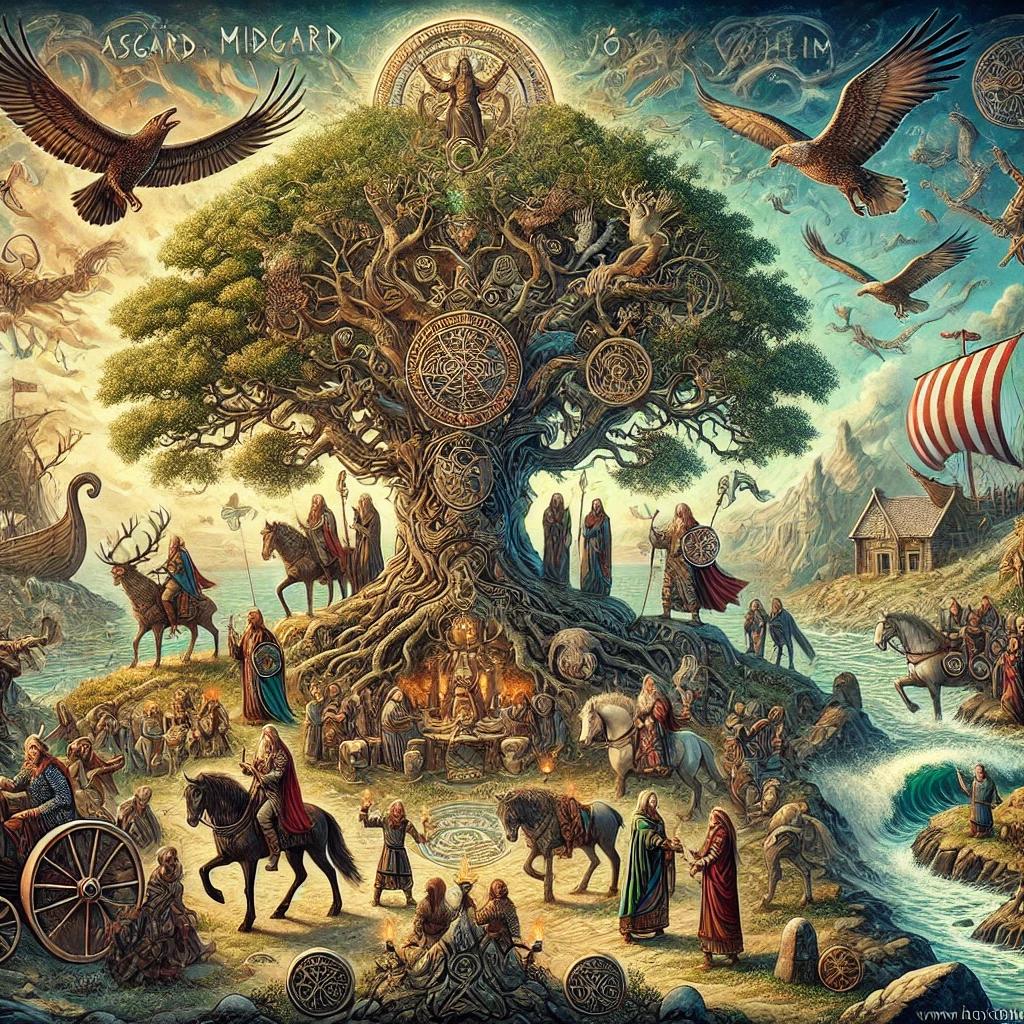
At the heart of Norse cosmology lies Yggdrasil, the World Tree, which connects the nine realms of existence. These realms include Asgard (the home of the gods), Midgard (the world of humans), Jotunheim (the land of giants), Vanaheim (the realm of the Vanir gods), Alfheim (the land of the elves), Svartalfheim (the realm of the dwarves), Nidavellir (another realm of the dwarves), Muspelheim (the realm of fire), and Helheim (the underworld). This interconnectedness underscores the belief that all aspects of existence are interdependent and part of a larger cosmic order.
The Gods and Goddesses
Norse Paganism worships two main pantheons: the Aesir and the Vanir. The Aesir, gods of war and governance, include Odin, the All-Father and god of wisdom; Thor, the god of thunder and protection; and Tyr, the god of justice and law. The Vanir, deities of fertility and nature, include Freyr, the god of prosperity and fertility; Freyja, the goddess of love and fertility; and Njord, the god of the sea and wind. These gods and goddesses embody various aspects of life and nature, guiding adherents in their spiritual and daily lives.
Ancestor Worship
Ancestor worship is a central tenet of Norse Paganism. Practitioners seek guidance, protection, and wisdom from their forebears, often through rituals, storytelling, and maintaining physical reminders like altars or grave sites. This belief highlights the interconnectedness of past, present, and future generations, fostering a deep sense of continuity and belonging. Honoring ancestors reinforces family and community bonds, preserves cultural heritage, and provides moral examples for people to live by.
Ethical Living and Universal Ancient Values
Norse Paganism, like many ancient Pagan societies, emphasizes a set of ethical principles that promote communal harmony and personal integrity. These values are often derived from the Eddas and sagas, which provide insights into the moral and ethical beliefs of the ancient Norse people.
- Reciprocity: The concept of reciprocity is fundamental in Norse Paganism. This principle underscores the belief that communal harmony and personal prosperity depend on maintaining positive interactions with the divine and with one another. Rituals and offerings are often made to the gods and spirits to honor this relationship.
- Honor and Reputation: Honor is a central concept in Norse Paganism. Personal integrity and reputation impact one’s fate and standing within the community, mirrored by the deeds of heroic figures in Norse mythology.
- Hospitality: Hospitality is a key virtue in Norse Paganism, emphasizing the importance of welcoming guests and strangers with open arms. This practice fosters community bonds and reflects the broader ancient Pagan value of generosity and compassion.
- Courage and Valor: The Norse placed a high value on courage and valor, particularly in the face of adversity. This is evident in the stories of their gods and heroes, who often faced great challenges with bravery and determination.
- Respect for Nature: Norse Pagans maintain a profound relationship with the natural world, revering the spirits of land and water. This belief ensures that nature is treated with reverence and respect. Environmental stewardship and seasonal celebrations like Yule, Ostara, and Midsummer reflect this core belief.
- Community and Frith: The concept of frith, or peace and harmony within the community, is essential in Norse Paganism. This value emphasizes the importance of maintaining social order and mutual respect among community members.
- Wisdom and Knowledge: Wisdom is highly valued in Norse Paganism, as seen in the stories of Odin seeking knowledge and wisdom through various trials and sacrifices. The pursuit of knowledge and understanding is considered a noble endeavor.
- Resilience and Perseverance: The Norse valued resilience and perseverance, particularly in the face of adversity. This is evident in their sagas and myths, which often depict heroes overcoming great challenges through determination and steadfastness.
Rituals and Celebrations
Core rituals in Norse Paganism include Blót (sacrificial rites to honor the gods and spirits), Sumbel (a ritual of toasting, boasting, and oaths), and seasonal festivals. These rituals foster community and spiritual connection. For instance, during Yule, Norse Pagans celebrate the winter solstice with feasts, rituals, and community gatherings, often incorporating traditional Norse customs and symbolism.
Modern Relevance
In contemporary society, the core values of Norse Paganism resonate with many individuals seeking a clear, practical code of ethics. These values offer solutions to modern problems by providing guidance on how to live honorably and harmoniously with others. For instance, practicing hospitality and community frith can significantly improve social cohesion and mutual support in urban environments. Additionally, the pursuit of wisdom and knowledge can foster personal growth and understanding, encouraging individuals to thrive in their lives while maintaining a balanced approach to their interactions with the natural world and their community.
Conclusion
Norse Paganism is deeply rooted in a profound respect for nature, community, and honor, embodying principles that emphasize strength, courage, and wisdom. The core values, such as hospitality, truth, and perseverance, reflect a holistic worldview where personal integrity and loyalty to one’s kin are paramount. These values guide practitioners in their daily lives, reinforcing a sense of identity and purpose grounded in ancient traditions. The spiritual practices of Norse Paganism, including rituals and offerings to the gods, ancestors, and land spirits, further solidify these core principles. Embracing virtues like courage, wisdom, and respect for nature, Norse Paganism encourages a balanced life where the physical and spiritual realms are interwoven. These values are not static but are continuously interpreted and adapted by modern practitioners, ensuring their relevance in the contemporary world.
Unyielding Honor: The Viking Demand for Truth and Reliability
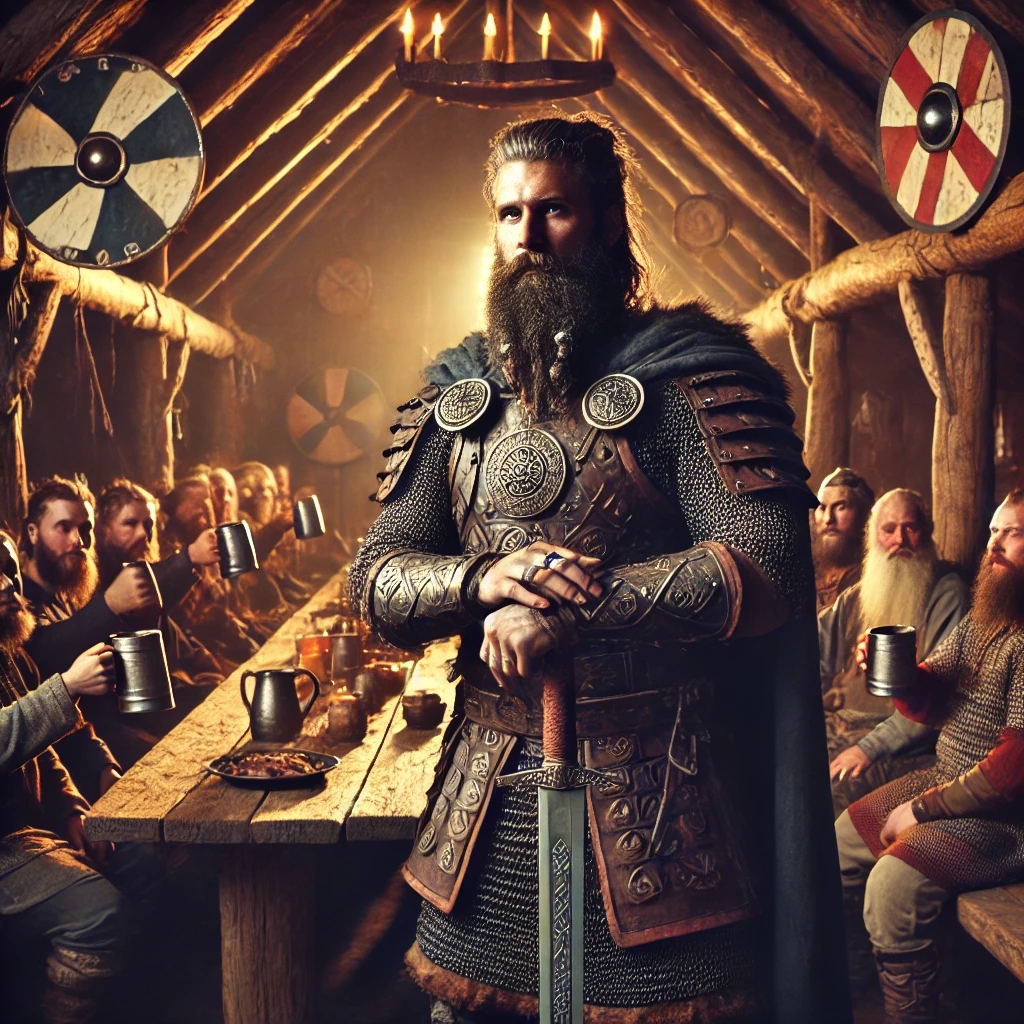
From a traditional Norse or “Viking” standpoint, reliability and honesty were indeed of paramount importance. While popular culture often focuses on the Vikings as raiders and explorers, Norse society—like most tight-knit communities—relied on mutual trust and clear expectations to function smoothly. Below are some cultural and historical insights that underline why saying one thing and doing another would be seen in an extremely negative light in a Viking context:
1. Honor and Reputation (Drengskapr)
- Key Norse Concept: Among the Vikings, a person’s honor (drengskapr) was intimately tied to their reputation in the community. If you broke your word, it wasn’t just a private matter; it could tarnish your name, impact alliances, and diminish your standing.
- Long-Term Consequences: In small Norse communities, once your reputation was damaged, it was difficult to recover. Oath-breakers or those who spoke untruths could become social outcasts, losing the protection and support of the community.
2. The Weight of Oaths
- Binding Agreements: Oaths (especially formal ones) were taken very seriously in Viking society—sometimes witnessed by a god like Odin or by representatives of a community.
- Legal and Social Ties: Disputes, deals, and even friendships (fostering or blood-brotherhood) were cemented by solemn pledges. Reneging on these vows was seen as not only dishonorable but also dangerous—potentially sparking feuds.
3. Saga Literature Examples
- Condemnation of Betrayal: In the sagas, characters who violate their word or betray someone’s trust often become tragic figures, sometimes facing harsh retribution or living in shame.
- Enduring Legacy: These stories served as cultural touchstones. They taught that deceit could lead to broken alliances, vengeance, and even the downfall of entire families or communities.
4. Reciprocal Responsibility
- Social Glue: Reliability and honesty weren’t just individual virtues; they were necessary for the entire Norse social fabric. A chieftain or jarl who deceived his people lost loyalty, just as a free farmer (bondi) who betrayed a neighbor could lose essential support.
- Collective Security: In a harsh environment, you depended on your neighbors and allies for survival—especially during winter, or when out at sea. Flaking out or double-crossing someone jeopardized everyone’s well-being.
5. Modern “Viking” Values
- Neo-Pagan & Modern Interpretations: Many individuals today who follow a Norse-inspired path embrace those traditional tenets of honesty, loyalty, and respect because they resonate with the spirit of the sagas.
- Personal Integrity: Acting consistently and honoring commitments is viewed not just as a personal virtue but as a way to honor the gods and ancestors—living up to the standard set by the old stories.
Final Thoughts
In Viking culture, giving your word was akin to making a sacred bond, and walking it back—especially without good reason—would be a severe blow to one’s honor. The resulting loss of trust could have real social and even existential consequences in a tightly knit community.
While modern life is far removed from the Norse era, many who embrace or admire Viking values see honesty and reliability as pillars of that tradition. Thus, from this perspective, consistency in word and deed isn’t just a polite social norm; it’s a core component of personal honor and communal respect.
The Ephemeral Flame of the North: A Philosophical Odyssey through the Realm of the Vikings

In the depths of the boreal expanse, where the aurora borealis dances across the sky like a spectral bride, there existed a people whose essence was as elusive as the wind and as unforgiving as the winter’s grasp. The Vikings, those enigmatic sons of Odin, left behind a legacy that is at once a testament to their unyielding spirit and a mystery that beckons us to delve into the labyrinthine corridors of their culture. This essay is an attempt to navigate the philosophical underpinnings of Viking society, to unravel the threads of their worldview, and to illuminate the esoteric dimensions of their existence.
At the heart of Viking philosophy lies the concept of wyrd, a term that defies translation but approximates to fate or destiny. Wyrd is not merely a predetermined course of events but an active, dynamic force that weaves the tapestry of existence. It is the Vikings’ acknowledgment of the intricate web of causality that binds all things, a recognition that every action, every decision, sends ripples through the fabric of reality. This understanding of wyrd as an omnipresent, omniscient force underscores the Viking belief in a universe governed by laws both natural and divine.
The Vikings’ relationship with nature was not one of domination but of symbiosis. They saw themselves as part of the natural world, not apart from it. Their gods and goddesses were not distant, unapproachable deities but beings intimately connected with the land, the sea, and the sky. Thor, the god of thunder, wielded his hammer Mjolnir not just as a weapon but as a tool to maintain the balance of nature, to ensure the cycle of seasons and the fertility of the earth. Freyja, the goddess of love and fertility, was also the goddess of war and death, symbolizing the Vikings’ acceptance of life’s dualities.
Their cosmology, as depicted in the Poetic Edda and the Prose Edda, presents a universe born from chaos, where the primordial giant Ymir and the great serpent Jörmungandr embody the eternal struggle between order and disorder. The Vikings’ world was one of contrasts: light and darkness, fire and ice, creation and destruction. This dichotomy is reflected in their concept of honor, which was not merely a personal virtue but a communal one, tied to the reputation of the family and the clan. Honor was the thread that held society together, the glue that bonded warriors in battle and the standard by which one’s worth was measured.
The Vikings were a people of action, their philosophy manifest in their deeds rather than in abstract speculation. Theirs was a world of doing, where one’s character was revealed through actions, not words. The berserker, that frenzied warrior who fought with a fury that seemed almost divine, was the embodiment of the Viking ideal of courage and strength. Yet, this ferocity was balanced by a deep sense of loyalty and hospitality, virtues that were considered essential to the Viking way of life.
Their art and literature, as preserved in the runestones and the sagas, speak of a people deeply concerned with the human condition. The Vikings pondered the mysteries of life and death, of fate and free will, in stories that were both entertainments and teachings. The Völuspá, the first poem of the Poetic Edda, is a prophetic vision of the end of the world, a reminder of the transience of all things and the inevitability of change.
In their funerary rites, the Vikings demonstrated a profound respect for the dead, believing that the soul continued its journey into the afterlife. The ship burials, with their treasures and provisions for the journey, were not merely displays of wealth but expressions of the Vikings’ belief in an afterlife that mirrored this one. Valhalla, the great hall of the slain, where warriors fought by day and feasted by night, was the ultimate destination for those who died in battle, a place where honor and glory were eternal.
The Viking worldview was not static; it evolved over time, influenced by their encounters with other cultures. Their conversion to Christianity marked a significant shift, as they adapted the new faith to their existing beliefs, creating a unique synthesis that preserved much of their pagan heritage. This blending of traditions is a testament to the Vikings’ pragmatic approach to religion, their recognition that truth can be found in many forms.
As we delve into the philosophical dimensions of Viking culture, we are reminded of the impermanence of all things. The Vikings, with their keen awareness of mortality, lived in the present, cherishing each moment as a gift. Theirs was a philosophy of carpe diem, of seizing the day, for in the words of the Viking proverb, “Cattle die, kinsmen die, you yourself will die, but one thing I know that never dies: the judgment of a dead man’s deeds.”
In the end, the Vikings leave us with more questions than answers, their culture a labyrinth of contradictions and paradoxes. They were warriors and poets, pagans and Christians, individualists and communalists. Yet, it is in these contradictions that we find the essence of their philosophy, a worldview that embraced complexity and ambiguity. The Vikings remind us that life is a journey, not a destination, and that our deeds, not our words, are the measure of our character.
As the flame of the Viking Age flickers out, leaving behind only embers of memory, we are left to ponder the wisdom of their way of life. In a world that values certainty and clarity, the Vikings offer us a different path, one that celebrates ambiguity and uncertainty. Their philosophy is a reminder that truth is multifaceted, that reality is complex, and that the human experience is a tapestry woven from countless threads.
In the silence of the boreal night, under the watchful gaze of the aurora borealis, we can still hear the whispers of the Vikings, their voices carried on the wind. They speak to us of a world that was, of a people who lived and loved and laughed and fought. They remind us that we are not alone in this vast and mysterious universe, that we are part of a larger whole, connected to all that has been and all that will be.
And so, we return to the beginning, to the concept of wyrd, that mysterious force that weaves the tapestry of existence. The Vikings understood that our lives are not our own, that we are part of a larger narrative that unfolds with each passing moment. Their philosophy is a call to embrace this uncertainty, to find meaning in the midst of chaos, and to live each day with purpose and passion.
In the end, the Vikings teach us that life is a journey, not a destination. It is a path that winds through the mountains and valleys of existence, a road that is fraught with danger and filled with wonder. And it is on this journey, in the midst of uncertainty and ambiguity, that we find the true meaning of the Viking way of life.
Why Not to Read The Way Of Fire And Ice by Ryan Smith
There is one Heathen book that no even minded intelligent Heathen should ever bother with:
The Way Of Fire And Ice by Ryan Smith
Don’t get the above mentioned book, it is just political trash that tries to push a SJW agenda. Anytime politics, any sort of politics, is mixed into religion, that is when you get violence and other hateful kinds of behavior like we have been seeing for the last two decades front and center in the world. True religion is spiritual and devoid of all politics.
Social justice warriors include people that promote extreme leftist based hate policies such as Critical Race Theory, and organizations such as Antifa. Antifa is a so-called anti-fascism organization that ironically promotes fascism, since the meaning of fascism is when a group or government promotes their political agenda using violence and force, which is exactly what Antifa does. They are the organization that was behind all the violence and burning of businesses during protests in recent times. Hate is not something that exists only on one side of the political spectrum, there are hateful extremists on both the right and left. It is important to not get behind hate in any form.
“I have a dream that one day this nation will rise up and live out the true meaning of its creed: ‘We hold these truths to be self-evident, that all men are created equal. ‘” ― Martin Luther King Jr. Notice he said equal. Equality does not mean seeing people according to the so-called ideas of power dynamics based on group identities they were born into or the color of their skin. It means seeing people as individuals. If Martin Luthar King Jr was alive today he would be speaking out against the SJW movement, as it threatens to undermine all the work he did.
The whole SJW political agenda is just promoting hate and racism, just the same as actual white supremacists are. Both are two sides of the same coin. You can’t stop hate and intolerance on one side by promoting hate and intolerance on the other side. This only gives power and strength to hate overall. The only way to stop hate is to stop seeing people as group identities, and to look at them as individuals, not according to what color their skin is or what group identities they were born into. The Norse Gods and Goddesses don’t care what color people’s skin is, or what group identities someone was born into, they only care about a person’s individual qualities.
The kind of thinking that SJWs promote, is that you are either with us or you are a white supremacist. For years now many very important authors that have greatly contributed to very foundations of the modern Heathen religion have been ostracized and called white supremacists because those authors are not promoting the SJW movement, but of course also most their books were written before the SJW movement even existed in its current day mainstream form as well. This is always what they do, call anyone that does not support their extremism, a white supremacist. Oftentimes these groups will have infighting between each other and end up even calling members of their own community white supremacists. Once they label someone a “white supremacist”, then they proceed to publish that person’s physical address and work information online, and many members of the SJW community then proceed to send messages to their place of work, and any social organizations the person may be joined to stating the person is a “white supremacist” and should be fired or removed from said organization. They also make death threats against the person, etc. In some cases actual physical violence by Antifa members, or other SJW extremists is carried out against the person. This whole process is called Doxing, and it happens all the time nowadays. This is a form of violence, both on the social and physical level. Using violence (or threats of violence) to enforce a certain political agenda is exactly fascism. Fascism does not stop racism, it empowers it. Only love, acceptance, and tolerance can stop racism.
SJWs follow the philosophy of Critical Race Theory. Critical Race Theory promotes the idea that the way to fight racism against black people and other minorities is to enact racism against white people and men, and other people that were/are part of the stereotypical majority. But promoting any form of racism or hate, only leads to more racism and hate. When any group is put down, this only leads to a counter reaction of continuing the cycle of discrimination and hate on all sides. The only way to stop racism and hate is to see all people as individuals, and treat them as such. We are all one race, the human race. Ideas such as separate human races, based on skin color are artificial distinctions that are not even scientific. The only human race that has existed for 10s of thousands of years now is Homo Sapiens.
Another aspect of the SJW movement, is that it is a cult that promotes cult-like thinking and the people that are part of that movement blindly follow critical race theory, no matter how illogical or destructive that philosophy proves to be. People in cults are brainwashed towards the philosophies of their cult, and they see any mainstream people that don’t follow their cult as the enemy, and their agenda is to try to get more people to join their cult, in an effort to “save society” from whatever the cult’s perceived notion of sin might be. Cults always follow black and white thinking that everyone that does not think the same way they do is evil, and deserves some sort of eternal punishment for their sinful ways. Sound familiar to how people that follow other cults, such as Fundamentalist Christianity think? SJWs think in the exact same way. Just substitute Critical Race Theory for Jesus, and “white supremacists” for the Devil or sinners that follow the Devil, and it is the exact same thing. Paganism, true Paganism, is not about such black and white thinking patterns.
Yes in Heathenism there is also a right-wing extremist (very small) faction that has been trying to pervert Heathenism towards a white supremacist racist agenda. A good majority of the Heathens that do take up this perverted right-wing extremist version of Heathenism picked up Heathenism while in prison, since this is where that toxic form of Heathenism is mostly derived from. But most reasonable minded Heathens are easily able to see who the perverted right wing extremist Heathens are and avoid them. But SJWs like to label and call literally everyone that does not follow their extremist left-wing cult a white supremacist.
The Norse Gods/Goddesses don’t care what our skin color is or what groups we were born into. They only care about an individual’s personal qualities as an individual. But also it is fine too if an individual takes pride in their ancestors, and even feels drawn to the Norse Gods/Goddesses due to this, so long as they don’t think that Heathenism is limited to people with just certain kinds of ancestors, or that having certain kinds of ancestors makes you a better Heathen. Heathenism is open for all people that feel a closeness in their heart towards the Norse Gods/Goddesses. Anyone, no matter what their skin color, or ancestral heritage is can feel this closeness for them.
The whole concept of “race” didn’t exist to Vikings, Germanic people, or most any people of the ancient world. It is crap that was made up, mostly in the 19th century to suit the political situations in Europe (related to Colonialism) of those times. For a time it became the mainstream pseudo-scientific ideas of the 19th century, and sadly is still with us to a lesser extent even now. The Vikings thought in terms of tribes, not races. Anyone that the people of the tribe liked were welcome to join them. The various Gothic tribes, which were another Germanic tribe, before the Viking era, who also followed mostly the same religion in earlier times and in earlier times the same set of Gods/Goddesses. The Goths ended up migrating to different lands due to war and local world events, and they allowed any people they met on the way, who were of like mind to themselves, to join their tribe and be considered also Goths. Another Germanic tribe that had the same policy even wandered into northern Africa, where they eventually resettled.
Yes racism is still a problem in the world, but it is not the big huge all of life consuming problem that SJWs would have us all believe it is. According to the SJW philosophy all of life revolves around the idea that everyone is thinking racist thoughts all the time, every minutes of reality, and that the only way to atone for this “original sin” of racism is to repent for all your sins of being racist, just for being born in the wrong group and/or gender (according to Critical Race Theory the most sinful “race” is Caucasian, and the sinful gender is male) to surrender any “privilege” (ie: personally acquired life success) towards others that have more points on the SJW victim-hood scale. This scale rewards social points to people based on how “non-privileged” they are, according to Critical Race Theory ideas. This whole philosophy forms the basis of the SJW cult, a toxic and destructive cult, that sadly has taken hold over many institutions within modern western mainstream society, and is dispensing it’s crusade against sinners of it’s philosophy, in just the same way in times past the Catholic Church spread it’s crusade against heretics, witches, and Pagans throughout Europe, and other parts of the world, thus eventually causing a break in Paganism. Do we as Pagans really want to support this exact same crusade like thinking that destroyed our religion in the past? We have only started to rebuild Heathenism, starting in recent times, but do we wish to risk losing it again, or even help impose another intolerant philosophy similar to the one which the church of the Middle Ages imposed upon the world? I for one as a Heathen plan to stand against this toxic movement, the SJW cult.
Volmarr’s Heathen Winter Nights (Anytime from Oct-15 to Nov-1) Ritual Version 2 Outline 2013
With additions by Amarina
Need:
• drinking horn
• mead (or beer or wine or even can use juice)
• spring water in small bowl
• fresh pine twig
• offering bowl
• candles (purple)
• incense (any mystical scent is ideal)
• wand (if you don’t have one you can use your fingers instead)
• Thor’s Ritual Hammer (optional, can use it for the Hammer Hallowings)
• Any representation of Odin
• Any representation of ancestors
• Any representation of any one is now dead that you admire, in particular those you admire for their wisdom.
• Halloween type decorations and anything related to death and the dead
• Any symbols for wisdom or knowledge
• Any symbols for the after-life
–
This ritual, as are all Heathen or northern rituals, is done while facing north, except where otherwise noted. The altar should be such that it is in front of you when you face north.
If you don’t know how to pronounce the runes see my webpage on how to pronounce them here.
–
Put spring water in small bowl. Trace 3 Laguz runes over it.:

“LAGUZ… LAGUZ… LAGUZ”
“From the Well of Wyrd does this water flow, and to the Well of Wyrd does it return”
–
Make Hammer Sign at item and then splash each ritual item with blessed water using the pine twig and for each item say:
“I bless this ______ with the waters of the Well of Wyrd”
–
Now trace Hammer Sign at person being blessed and/or self and splash them with water using twig.
“I bless ______ with the waters of the Well of Wyrd”
–
Use twig to splash ritual space with water.
“I bless this space with the waters of the Well of Wyrd”
–
Few silent deep breaths.
–
All stand in Elhaz position.

“Bi-Frost’s rainbow light shine down upon this space and myself so that I may form a portal between the worlds of Asgard and Midgard”
–
Few silent deep breaths.
–
All face north and trace the Hammer Sign while chanting:
“Hammer in the north hallow and ward this stead”
All turn east and trace the Hammer Sign while chanting:
“Hammer in the east hallow and ward this stead”
All turn south and trace the Hammer Sign while chanting:
“Hammer in the south hallow and ward this stead”
All turn west trace the Hammer Sign while chanting:
“Hammer in the west hallow and ward this stead”
All return to north and look up and trace Hammer sign while chanting:
“Hammer above hallow and ward this stead”
All look below and trace Hammer sign while chanting:
“Hammer below hallow and ward this stead”
–
Return to facing north and all stand in the Elhaz position and chant:
“Around me and within me Asgard and Midgard”

and move into the Dagaz position in the end.
–
Few silent deep breaths.
–
(Highly recommended optional casting of the rune ring)
(face north and trace the rune shape in the air before you using your wand and loudly chant: “FEHU!”)

(face north-east and trace the rune shape and loudly chant: “URUZ”)
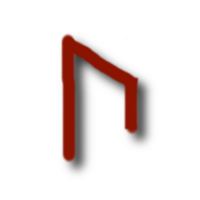
(face east and trace the rune shape and loudly chant: “THURISAZ”)

(face south-east and trace the rune shape and loudly chant: “ANSUZ”)

(face south and trace the rune shape and loudly chant: “RAIDHO”)

(face south-west and trace the rune shape and loudly chant: “KENAZ”)

(face west and trace the rune shape and loudly chant: “GEBO”)

(face north-west and trace the rune shape and loudly chant: “WUNJO”)

(face north and trace the rune shape and loudly chant: “HAGALAZ”)

(face north-east and trace the rune shape and loudly chant: “NAUDHIZ”)

(face east and trace the rune shape and loudly chant: “ISA”)

(face south-east and trace the rune shape and loudly chant: “JERA”)

(face south and trace the rune shape and loudly chant: “EIHWAZ”)

(face south-west and trace the rune shape and loudly chant: “PERTHRO”)

(face west and trace the rune shape and loudly chant: “ELHAZ”)

(face north-west and trace the rune shape and loudly chant: “SOWILO”)

(face north and trace the rune shape and loudly chant: “TIWAZ”)

(face north-east and trace the rune shape and loudly chant: “BERKANO”)

(face east and trace the rune shape and loudly chant: “EHWAZ”)

(face south-east and trace the rune shape and loudly chant: “MANNAZ”)

(face south and trace the rune shape and loudly chant: “LAGUZ”)
(face south-west and trace the rune shape and loudly chant: “INGWAZ”)

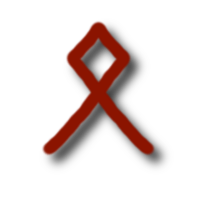
(face west and trace the rune shape and loudly chant: “DAGAZ”)

(face north-west and trace the rune shape and loudly chant: “OTHALA”)
(Few silent deep breaths)
–
Hold up the bottle of mead:
“I now brew the holy mead of inspiration. Won by high Odin long ago!”
Chant into the bottle of mead:
“Odhroerir! Son! Bodhn!”
“Now I hallow this drink with staves of light!”
Chant and trace these runes over the bottle:
“Othala”
“Dagaz”
“Raidho”
“Ansuz”
“Raidho”
“Isa”
“Elhaz!”
All say:
“Hail Odhroerir!”
–
Few silent deep breaths.
–
Few silent deep breaths.
Light the purple candle. From this candle, light the incense.
“This is the time of year that the veil between worlds is at it’s thinnest. In this time, we can travel more easily between the worlds of the living and the dead. This candle represents the world of the living, the incense’s smoke the veil, and the darkness beyond the world of the dead. It is in this state that our rite must take place, where Odin himself has traveled many times to seek knowledge and wisdom of those who have passed on.”
Circle the ritual space with the incense three times creating a “veil” with the smoke. Take a few silent deep breaths.
–
“Hail Odin! Husband of Frigg. All-father. Father of battle. One-eyed god. Many-shaped. Wanderer. Hanged god. Raven god. Spear-thruster. Wish-bringer. Galdr-father. Graybeard. Deep hood. Thief of Odhroerir. Kinsman of Mimir. Lord of the Wild Hunt. Yule rider. Finder of the Runes. God of the Gautar. Ruler of Valhalla!”
“Hail Hel! Keeper of the dead. Hostess of Baldr and Hodr. Half-living one. Garm’s mistress. Dweller in Eljudnir!”
“Hail to my ancestors, both known and unknown. Those of my line going all the way back to the beginning, on up to most recent of times. Both men and women, alfar and disir, whom previously had a human form. Those whom I know, as well as those I do not. Those also whom are the ancestors of all humans living now. All humans that have made the journey of life before my time, and now reside in the realm beyond the living. Hail to the ancestors of all! Hail also to the ancestors of my family line! Hail to the ones that guide me. Hail also to the ones that protect me.”
–
Few silent deep breaths.
–
“Now is a time in which the rhythms of life turn inward, towards contemplation and trying to understand the deeper mysteries of life and towards the gathering of and seeking out of knowledge. It is through the ancestors and those humans that have come before us that we have all the knowledge which we have in human society. Those who have gone before us are the ones that have created the traditions and knowledge which we as humans rely upon to meet all of our needs, such as how to grow and create food, how to build protective shelters for living in, how to make clothing so that our human bodies are protected from the elements, how to survive the seasonal cycles in all different areas of the planet, what dangers to avoid and how to avoid them, and how to keep our human society functioning and going. We humans are the only animal that can not survive without knowledge. Our very lives depends on knowledge of how to do so many things. Over hundreds of thousands of years humans have increased their knowledge to the point that we live with the current advantages which we have now.”
“It is due to the experience and wisdom of our ancestors, both those within our own family line, and the ancestors of all human beings, that we can live as well as we do in the modern times. Those that have gone before us have recorded their wisdom for us in language, in stories, in poetry, in tools, in fashion, in objects of art, in oral knowledge, in traditions, in music and song, in mathematics, in schools of learning, in books, in the recording of historical events, in objects from the past, in plays, in movies, in TV shows, in videos, in blue-prints, in engineering plans, in computer programs, and even in the bones of the dead. All these things are the sum total of human heritage and the source of our knowledge that allows us to survive and thrive as a species. By turning to the past and studying the wisdom of our ancestors we tap into that knowledge. We must honor the dead and those who have gone before us for all that they have given to us. As well it is important that knowledge is passed to others freely, for otherwise the work of so many becomes lost. It has taken us so long to get to the point we are at now as a species, it is important we not be greedy with our knowledge or hoard it away from others, for this impedes human survival and progress.”
“Odin as god of wisdom is often traveling to the the realm of the dead to seek out the wisdom of the dead. We too must be like Odin and seek out the knowledge of our ancestors, the wisdom of the dead. At this time the focus of the seasons turns more towards this task of looking inward and to the past. Now is the time to look at all which you have done this season and look at what has worked for you and what has not. It is a time to ponder all lessons that are to be gained from what has been done this year, so that you may know better for next season how to increase the abundance of your life harvest. It may be a good time to record some notes regarding this, safely putting them away some place where they shall not be lost. Also this is a time when the veils between the realm of the living and the dead are at their thinnest, and thus a time in which the knowledge of the dead is more accessible. It is a good time to seek out the wise counsel of the ancestors and those that are now passed beyond the realm of the living. This is a good time to spend time reading books, and studying new things, and pursuing the gaining of knowledge in any form.”
“At this time ponder on what you have learned this year.”
Few silent deep breaths while pondering on this.
“Now consider what things you would like to do differently the next cycle”
Few silent deep breaths while pondering on this.
“Now think about those who have have passed into the after life. Now is the time to think about anyone you may know who has died”
Few silent deep breaths while you think about those who have passed on.
“Now think about any wisdom or knowledge they may have for you.”
Few silent deep breaths while you think about this.
“Now is the time to give thanks for all that our ancestors have given to us and to honor the wisdom of the dead.”
(Fill drinking horn with mead and hold it up)
“Hail to all humans that have come before me. Hail to those of my family line, as well as all people of the past of all human family lines. I make this offering to you in thanks for the wisdom you have given us by the lives you have lived in the past. May your knowledge continue and enhance the life of both myself and all other humans alive now and all humans to come for all of eternity! Hail to the ancestors of all people!”
(Drink half the mead and pour out the rest as an offering to the ancestors of all humans.)
“Now is the time to honor Odin, the god of knowledge. Odin tirelessly seeks out the knowledge which all humans have worked to create for all of time. He is the god that seeks to gain and preserve knowledge and give it to others for the benefit of human society and human progress. He is the god who labors tirelessly to establish things in such a way that humans can continue and survive even after the end of this current cycle when Ragnarok comes and all begins again anew. He is the god that has discovered the runes through a difficult process of spiritual initiation so that they may be of benefit for gods and humans alike. He is the god that has made so many sacrifices for the sake of gaining of knowledge. We owe him much for all these things!”
(Fill drinking horn and hold it up)
“Hail Odin, god of the runes. God of knowledge and wisdom. You Odin are the one that frequently travels the worlds seeking to know more. Please guide me Odin in learning more and in applying knowledge in ways that are helpful to me. Please Odin help me to gain a deeper level of connection with all people of the past so that my knowledge my increase. Hail Odin!”
(Drink half the mead and pour out the rest to Odin.)
“Also this is the time that we should remember the one that has been tasked with keeping the souls of the dead. The goddess that is both living and dead. Though she isn’t truly goddess, she has become in being tasked with the lands of the dead by Odin.”
(Fill drinking horn and hold it up)
“Hail Hel, daughter of Loki. She who holds the halls in Helheim and shares what she has with those who have passed on to her lands. Hel is mistress of the lands of the dead and keeps those that have died of old age or illness. Thus her lands are where most of our ancestors will reside. We honor her today as well in hopes that she allows those we love to rest in peace well beyond Ragnarok. She who is most beautiful and frightful in one visage being both dead and alive. We owe her much gratitude and respect in her tireless and thankless duty in tending those cold halls. Thank you, Hel for taking the task given and caring for the souls you’ve been tasked in keeping. May we all share in a feast again one day. Hail Hel!”
(Drink half the mead and pour out the rest to Hel.)
–
(Use the pine twig to splash a bit of the liquid in the offering bowl on yourself, on any others in the ritual with you, on your altar, on the ritual space, and in all general areas of your dwelling as well. Does not need to be much splashed around, just a little is fine. This helps to imbue more of the energies of the ritual on you, and others who may also in the ritual with you, and to your place.)
–
“Now my rite has ended. May all gathered here fare well on their return to their home places. And may the bonds of frith between us grow, gods, wights, and humans alike. Until we meet again.”
–
–
Pour out the offerings from the offering bowl outside:
“A gift for a gift”
Trace gebo at spot offerings were given to.
“GEBO!”
Pour out remaining blessed water outside.
“I pour the sacred water back to the Earth so it may find it’s way back to the Well of Wyrd”
–
Now at this point it is very important to ground your energies. This should always be done after every ritual. Not doing so can lead to problems in the long-run. Grounding is like shifting gears in a car, except it is the process of shifting brain states. During rituals you create a trance like brain state, which is desired for during rituals or for during any spiritual practices. But trance states are not good for doing everyday mundane things. You need to return your mind back to the normal state of consciousness after the ritual is finished. That is what grounding is.
The most simple and common method to ground is to visualize yourself as a tree and see roots growing into the ground from the base of your spine and going down into the earth. Sometimes rituals require industrial strength grounding as they can really create some intense energy. In that case you can try the following triple grounding method.:
First visualize your chakras. You picture in your mind closing first the top one and then seeing a sort of lid closing over it, then proceed with the net lower chakra and so on. You want to leave the bottom most chakra, the root chakra fully open as this is your connection to grounding. Don’t be concerned about having the others closed, the normal proper function of them is that they open and close as needed. Problems with being ungrounded happen when one of more of them are stuck open. Only the bottom one is to be left open at all times.
Next step is to picture a ball of pure white light above your head. Now let this white light slowly descent downward into your body and slowly move lower. As it descends it takes with it any unneeded, old, and negative energies. It is sort of sweeping downward through your energies taking all you no longer need with it. Once it reaches your feet let it move lower till it passes down through the floor. If you are on an upper close let it pass all the way to the ground. Let the earth take this energy to recycle it.
Now final step is to do the traditional grounding. Picture yourself as a tree. Visualize roots coming out of the base of your spine and going down into the Earth. Feel the calmness of a tree, the rooted solidness.
If after these three things you still feel hyper or spaced out you can either eat some food, or put a small amount of salt on your tongue. Another thing you can do is prostrate down to the ground, placing your head on the ground and stay like this for a few moments.
–
Feel free to copy and use this ritual so long as you acknowledge the source.
Download this as a OpenOffice Doc – Volmarrs-heathen-winter-nights-2-oct-ritual-oct-2013
Volmarr’s Heathen Freysblot Harvest Ritual August-2-2013
Need:
• drinking horn
• mead (or beer or wine or even can use juice)
• spring water in small bowl
• fresh pine twig
• offering bowl
• candles
• wand (if you don’t have one you can use your fingers instead)
• Thor’s Ritual Hammer (optional, can use it for the Hammer Hallowings)
• Green candle
• Any symbol for Freyr. Phallic symbols. Horse symbols.
• Baked goods, nuts, berries, and sweet fruit such as strawberries, grapes, cherries, blueberries. Freyr does prefer organic and natural foods if your budget allows.
• A list of all the spiritual seed tasks you had planted at Ostara (as many of them as you can remember). You can add items to the list that were not seed goals at Ostara but are goals anyways which you have been working on or have a shot of accomplishing within the next few months.
–
This ritual, as are all Heathen or northern rituals, is done while facing north, except where otherwise noted. The altar should be such that it is in front of you when you face north.
If you don’t know how to pronounce the runes see my webpage on how to pronounce them here.
–
Put spring water in small bowl. Trace 3 Laguz runes over it.:
“LAGUZ… LAGUZ… LAGUZ”
“From the Well of Wyrd does this water flow, and to the Well of Wyrd does it return”
–
Make Hammer Sign at item and then splash each ritual item with blessed water using the pine twig and for each item say:
“I bless this ______ with the waters of the Well of Wyrd”
–
Now trace Hammer Sign at person being blessed and/or self and splash them with water using twig.
“I bless ______ with the waters of the Well of Wyrd”
–
Use twig to splash ritual space with water.
“I bless this space with the waters of the Well of Wyrd”
–
Few silent deep breaths.
–
All stand in Elhaz position.
“Bi-Frost’s rainbow light shine down upon this space and myself so that I may form a portal between the worlds of Asgard and Midgard”
–
Few silent deep breaths.
–
All face north and trace the Hammer Sign while chanting:
“Hammer in the north hallow and ward this stead”
All turn east and trace the Hammer Sign while chanting:
“Hammer in the east hallow and ward this stead”
All turn south and trace the Hammer Sign while chanting:
“Hammer in the south hallow and ward this stead”
All turn west trace the Hammer Sign while chanting:
“Hammer in the west hallow and ward this stead”
All return to north and look up and trace Hammer sign while chanting:
“Hammer above hallow and ward this stead”
All look below and trace Hammer sign while chanting:
“Hammer below hallow and ward this stead”
–
Return to facing north and all stand in the Elhaz position and chant:
“Around me and within me Asgard and Midgard”
and move into the Dagaz position in the end.
–
Few silent deep breaths.
–
(Highly recommended optional casting of the rune ring)
(face north and trace the rune shape in the air before you using your wand and loudly chant: “FEHU!”)
(face north-east and trace the rune shape and loudly chant: “URUZ”)
(face east and trace the rune shape and loudly chant: “THURISAZ”)
(face south-east and trace the rune shape and loudly chant: “ANSUZ”)
(face south and trace the rune shape and loudly chant: “RAIDHO”)
(face south-west and trace the rune shape and loudly chant: “KENAZ”)
(face west and trace the rune shape and loudly chant: “GEBO”)
(face north-west and trace the rune shape and loudly chant: “WUNJO”)
(face north and trace the rune shape and loudly chant: “HAGALAZ”)
(face north-east and trace the rune shape and loudly chant: “NAUDHIZ”)
(face east and trace the rune shape and loudly chant: “ISA”)
(face south-east and trace the rune shape and loudly chant: “JERA”)
(face south and trace the rune shape and loudly chant: “EIHWAZ”)
(face south-west and trace the rune shape and loudly chant: “PERTHRO”)
(face west and trace the rune shape and loudly chant: “ELHAZ”)
(face north-west and trace the rune shape and loudly chant: “SOWILO”)
(face north and trace the rune shape and loudly chant: “TIWAZ”)
(face north-east and trace the rune shape and loudly chant: “BERKANO”)
(face east and trace the rune shape and loudly chant: “EHWAZ”)
(face south-east and trace the rune shape and loudly chant: “MANNAZ”)
(face south and trace the rune shape and loudly chant: “LAGUZ”)
(face south-west and trace the rune shape and loudly chant: “INGWAZ”)
(face west and trace the rune shape and loudly chant: “DAGAZ”)
(face north-west and trace the rune shape and loudly chant: “OTHALA”)
(Few silent deep breaths)
–
Hold up the bottle of mead:
“I now brew the holy mead of inspiration. Won by high Odin long ago!”
Chant into the bottle of mead:
“Odhroerir! Son! Bodhn!”
“Now I hallow this drink with staves of light!”
Chant and trace these runes over the bottle:
“Othala”
“Dagaz”
“Raidho”
“Ansuz”
“Raidho”
“Isa”
“Elhaz!”
All say:
“Hail Odhroerir!”
–
Few silent deep breaths.
–
“Hail Freyr! Son of Njord. Brother of Freyja. Husband of Gerd. Trusted friend of Skirnir. Descendant of the Vanir. Harvest god and wealth-giver. King of Alfheim. Blot-god of the Swedes. Possessor of Skidbladnir, and the boar known as Gullinbursti. Beli’s slayer. Enemy of Surtr. Wielder of the stag-horn. Fruitful one. Sure giver. Father of the Yngling line. Lord of the Volsi!”
“Hail Freyr!”
–
“Now is the start of the harvest season. This is a time to work hard to bring forth all those things which you have been lending energies towards all this season. This is a time to honor Freyr, god of wealth and the harvest, so that your personal life harvest can be the fruitful one. Since most of us in the modern world are not farmers, harvest means for us the task of working on manifesting wishes and desires. Compared to other holidays this one is very straightforward. At this time we work on the tangible outward aspect of energies, working on manifesting and bringing into being that which started as inner energies in the spring.”
“Look at the list of all the wishes which you planted as seeds at Ostara. Now is the time to make those things happen, at least for those things in your life which have not already happened by now. You are to keep this list of tasks, at this time, some place where you will see it often in your day, so that you remain aware and focused towards the things you are working on manifesting.”
“At this time of the harvest I am working on:” (read your list of tasks)
“You have from now till the middle of October to work on your wishes for this season. Any of those wishes that have not manifested by then should be mulched as spiritual weeds. You can then try again for next season for any things that have not manifested by then. After that it is time to make things more simple in your life to focus on the inward turning energies of winter.”
–
“Freyr please help keep me focused on working on the things which I am trying to manifest in my life this season. Please Freyr lend me your potent energies for this purpose so that my life harvest this season may be a fruitful one.”
“Also please Freyr help to me keep away any distracting energies which may interfere with me accomplishing my harvest goals. Please help me to know what things may need to be extracted from my situation if there is anything which is acting to divert my harvest focus.”
“Hail Freyr!”
–
“Freyr now is the time to year to have a feast in your honor to give thanks for your fruitful energies.”
“This feast is for you Freyr! Hail Freyr!”
–
(Use the pine twig to splash a bit of the liquid in the offering bowl on yourself, on any others in the ritual with you, on your altar, on the ritual space, and in all general areas of your dwelling as well. Does not need to be much splashed around, just a little is fine. This helps to imbue more of the energies of the ritual on you, and others who may also in the ritual with you, and to your place.)
–
“Now my rite has ended. May all gathered here fare well on their return to their home places. And may the bonds of frith between us grow, gods, wights, and humans alike. Until we meet again.”
–
–
Pour out the offerings from the offering bowl outside:
“A gift for a gift”
Trace gebo at spot offerings were given to.
“GEBO!”
Pour out remaining blessed water outside.
“I pour the sacred water back to the Earth so it may find it’s way back to the Well of Wyrd”
–
Now at this point it is very important to ground your energies. This should always be done after every ritual. Not doing so can lead to problems in the long-run. Grounding is like shifting gears in a car, except it is the process of shifting brain states. During rituals you create a trance like brain state, which is desired for during rituals or for during any spiritual practices. But trance states are not good for doing everyday mundane things. You need to return your mind back to the normal state of consciousness after the ritual is finished. That is what grounding is.
The most simple and common method to ground is to visualize yourself as a tree and see roots growing into the ground from the base of your spine and going down into the earth. Sometimes rituals require industrial strength grounding as they can really create some intense energy. In that case you can try the following triple grounding method.:
First visualize your chakras. You picture in your mind closing first the top one and then seeing a sort of lid closing over it, then proceed with the net lower chakra and so on. You want to leave the bottom most chakra, the root chakra fully open as this is your connection to grounding. Don’t be concerned about having the others closed, the normal proper function of them is that they open and close as needed. Problems with being ungrounded happen when one of more of them are stuck open. Only the bottom one is to be left open at all times.
Next step is to picture a ball of pure white light above your head. Now let this white light slowly descent downward into your body and slowly move lower. As it descends it takes with it any unneeded, old, and negative energies. It is sort of sweeping downward through your energies taking all you no longer need with it. Once it reaches your feet let it move lower till it passes down through the floor. If you are on an upper close let it pass all the way to the ground. Let the earth take this energy to recycle it.
Now final step is to do the traditional grounding. Picture yourself as a tree. Visualize roots coming out of the base of your spine and going down into the Earth. Feel the calmness of a tree, the rooted solidness.
If after these three things you still feel hyper or spaced out you can either eat some food, or put a small amount of salt on your tongue. Another thing you can do is prostrate down to the ground, placing your head on the ground and stay like this for a few moments.
–
Feel free to copy and use this ritual so long as you acknowledge the source.
Volmarr’s Heathen Midsummer Ritual June-21-2013 Vanatru Version
Need:
• drinking horn
• mead (or beer or wine or even can use juice)
• spring water in small bowl
• fresh pine twig
• offering bowl
• candles
• wand (if you don’t have one you can use your fingers instead)
• Thor’s Ritual Hammer (optional, can use it for the Hammer Hallowings)
• One yellow or gold candle
• One white candle
• Any symbols of Summer, solar symbols.
–
This ritual, as are all Heathen or northern rituals, is done while facing north, except where otherwise noted. The altar should be such that it is in front of you when you face north.
If you don’t know how to pronounce the runes see my webpage on how to pronounce them here.
–
Put spring water in small bowl. Trace 3 Laguz runes over it.:
“LAGUZ… LAGUZ… LAGUZ”
“From the Well of Wyrd does this water flow, and to the Well of Wyrd does it return”
–
Make Hammer Sign at item and then splash each ritual item with blessed water using the pine twig and for each item say:
“I bless this ______ with the waters of the Well of Wyrd”
–
Now trace Hammer Sign at person being blessed and/or self and splash them with water using twig.
“I bless ______ with the waters of the Well of Wyrd”
–
Use twig to splash ritual space with water.
“I bless this space with the waters of the Well of Wyrd”
–
Few silent deep breaths.
–
All stand in Elhaz position.
“Bi-Frost’s rainbow light shine down upon this space and myself so that I may form a portal between the worlds of Asgard and Midgard”
–
Few silent deep breaths.
–
All face north and trace the Hammer Sign while chanting:
“Hammer in the north hallow and ward this stead”
All turn east and trace the Hammer Sign while chanting:
“Hammer in the east hallow and ward this stead”
All turn south and trace the Hammer Sign while chanting:
“Hammer in the south hallow and ward this stead”
All turn west trace the Hammer Sign while chanting:
“Hammer in the west hallow and ward this stead”
All return to north and look up and trace Hammer sign while chanting:
“Hammer above hallow and ward this stead”
All look below and trace Hammer sign while chanting:
“Hammer below hallow and ward this stead”
–
Return to facing north and all stand in the Elhaz position and chant:
“Around me and within me Asgard and Midgard”
and move into the Dagaz position in the end.
–
Few silent deep breaths.
–
(Highly recommended optional casting of the rune ring)
(face north and trace the rune shape in the air before you using your wand and loudly chant: “FEHU!”)
(face north-east and trace the rune shape and loudly chant: “URUZ”)
(face east and trace the rune shape and loudly chant: “THURISAZ”)
(face south-east and trace the rune shape and loudly chant: “ANSUZ”)
(face south and trace the rune shape and loudly chant: “RAIDHO”)
(face south-west and trace the rune shape and loudly chant: “KENAZ”)
(face west and trace the rune shape and loudly chant: “GEBO”)
(face north-west and trace the rune shape and loudly chant: “WUNJO”)
(face north and trace the rune shape and loudly chant: “HAGALAZ”)
(face north-east and trace the rune shape and loudly chant: “NAUDHIZ”)
(face east and trace the rune shape and loudly chant: “ISA”)
(face south-east and trace the rune shape and loudly chant: “JERA”)
(face south and trace the rune shape and loudly chant: “EIHWAZ”)
(face south-west and trace the rune shape and loudly chant: “PERTHRO”)
(face west and trace the rune shape and loudly chant: “ELHAZ”)
(face north-west and trace the rune shape and loudly chant: “SOWILO”)
(face north and trace the rune shape and loudly chant: “TIWAZ”)
(face north-east and trace the rune shape and loudly chant: “BERKANO”)
(face east and trace the rune shape and loudly chant: “EHWAZ”)
(face south-east and trace the rune shape and loudly chant: “MANNAZ”)
(face south and trace the rune shape and loudly chant: “LAGUZ”)
(face south-west and trace the rune shape and loudly chant: “INGWAZ”)
(face west and trace the rune shape and loudly chant: “DAGAZ”)
(face north-west and trace the rune shape and loudly chant: “OTHALA”)
(Few silent deep breaths)
–
Hold up the bottle of mead:
“I now brew the holy mead of inspiration. Won by high Odin long ago!”
Chant into the bottle of mead:
“Odhroerir! Son! Bodhn!”
“Now I hallow this drink with staves of light!”
Chant and trace these runes over the bottle:
“Othala”
“Dagaz”
“Raidho”
“Ansuz”
“Raidho”
“Isa”
“Elhaz!”
All say:
“Hail Odhroerir!”
–
Few silent deep breaths.
–
“Hail to the Vanir! Hail to the Aesir! Hail to the gods and goddesses of the north! I call upon you all in frith at this time so I may honor the connection we have with one another.”
(Light the white candle.)
“Hail the Vanir! Hail the Aesir!”
“Hail Sunna! Daughter of Glen. Bright rider in the heavens by day. Driver of Alsvin and Arvak. Wearer of Svalin. Day-star. Ever-glow. All-bright. Wolf-chased. Fair-wheel. Grace-shine. Ensnarer of Trolls!”
(Light the yellow candle.)
“Hail Sunna!”
–
“Now is the time of Midsummer. This is a time for adventure and seeking conquest and victory within our life. Midsummer is also a time to honor the important alliances that you hold with others.”
“Late Spring and early Summer are the Norse times to fight battles and go raiding. Most of us in the modern world won’t be going into literal combat situations or going literally raiding, as happened during the Viking age. But we modern people have our own just as difficult battles we have to fight in our day to day life. Common modern forms of battle are: battles against your own negative traits or bad habits, battles to effect greater spiritual growth and awareness, battles to improve our lives in any way, battles against people in our lives who abuse us or cause us harm, battles to stand up for some cause we believe in, battles to improve the lives and well-being of those close to us, battles to achieve success in our careers, fighting for a better world, etc. All these types of battles are equally as worthy as the battles and raids which the Vikings fought, and are just as filled with their own forms of danger and peril. All forms of worthy battle which we fight are a way in which the gods/goddesses test us to see our measure of spiritual strength and bravery. By fighting whatever worthy battles we must in our lives without backing down and doing the best we can in them, we increase our spiritual might and personal luck. Most forms of modern battles are more so what can be considered forms of psychic or spiritual battles. Being a spiritual warrior is just as impressive to the gods/goddesses as being a literal one. If your life has been filled with strife and challenge lately during the late spring and early summer know that this is part of being in tune with the seasonal cycles and this time shall eventually pass. When fighting a lot of battles our energies can after awhile become drained and run down. Try to call upon the power of the sun, the goddess Sunna, as a source to recharge your psychic and emotional batteries after many long fought battles.”
–
(Hold drinking how and fill it with drink)
“Hail to Sunna! Goddess of the sun! Goddess of the energies which charge all of life with vitality! Through your vital strength, we gain the power to achieve victory! Please oh bright shinning goddess charge my energies with your might and power! Hail Sunna!”
(Picture in your mind’s eye energy from the sun coming down to you and filling your aura, making it stronger and more powerful.)
(Chant and trace sowilo in the air three times:)
“SOWILO… SOWILO… SOWILO”
(Drink half, pour out rest to offering bowl or ground)
–
“Anger is a useful and important emotion since it is related to defending against attack, and is an emotion needed for self protection. Anger only gets bad when it is used in a personal way. Personalized anger is anger against a certain person, which is very negative. Anger used in a impersonal sense, as controlled anger where you use the anger feelings to empower your ability to defend your rights and to protect yourself and others, is the proper positive use of anger. ”
“In modern day times there aren’t many outlets for anger. In older times of course there were plenty of outlets for it since men had to fight to protect. Since men are the protectors they do tend to more directly feel their anger emotions. Women often but not always tend to feel their anger in more indirect ways. Or more commonly, many women have trouble directly acknowledging when they are angry. The strongest emotion for men is anger. The strongest emotion for women is love. Men are the warriors so they need to have anger as a strong emotion for to strengthen this role for them. In Pagan societies such as the Vikings, the society was structured in a way to help keep anger more as the impersonal healthy kind and such societies were even structured in ways to give men healthy outlets for anger.”
“One of the most positive ways to release anger and act upon the warrior spirit in modern society is through sports. Summer is the best time for doing sports. Sports help to create frith since they help people feel more positive and release tension and anger. Group sports can be a powerful tool of troth-making.”
“Another way to release or vent anger is through sex. Sex is a very powerful way to turn anger onto frith and love. It is very sacred to have sex at the Midsummer bonfire.”
“Women as the nurturers and pleasure and care givers have love as their strongest emotion. Since the strongest emotion for women is love, women are the frith-makers and they hold a sacred duty in northern culture as guardians of the frith. Frith is the glue that holds together those who hold troth for each other. Without frith there can be no troth. Keeping troth with those you cannot have any frith with is both dishonorable and dishonest. In order for there to be frith with someone you must hold feelings of respect and trust. No social organization, whether it be one related to Heathenism or anything at all, can survive if it does not strictly enforce members keeping frith between each other. The foundation of troth is frith. Troth is the very basis of Heathenism. Any Heathen that has not learned to be respectful of other people is one that is not able to honor frith and thus shall fail completely at holding troth with others. Since the basis of Heathenism is troth, such a Heathen shall fail as a Heathen. The gods and goddesses only welcome those to their hall that would be able to hold frith with all those who reside in their hall. The whole point of being Heathen is to hold troth for one or more of the northern gods or goddesses and work towards being welcomed to their hall in the after-life, thus learning how to respect others and honor frith is one of the greatest lessons any Heathen can learn.”
“Now at this time of the season, Midsummer, is the time to acknowledge all bonds of troth which we hold. Troth is the very point of Heathenism. Heathenism is simply put the practice of holding troth for one or more of the northern gods/goddesses. In all things we do in our life we must act in ways that honor this troth we hold. By taking troth with any god or goddess we are agreeing to hold their ways holy and honor what they stand for. Take some moments now to ponder on all the gods and goddesses which you hold troth with and all the things which are sacred to them.”
(Feel free to change this next part as needed)
“I _______ (state your name) hold troth with the Vanir and Aesir, with the ways of the Vanir coming first for me. _______ (patron deity name) is my patron and thus I hold the greatest troth of all for him/her. I agree to hold sacred all the things which are holy to the Vanir and Aesir and most of all that which is sacred to my patron ________ (patron deity name).”
–
(This next section is optional. If you prefer you can change this to whatever other values you happen to follow. In no way are the Vanic Virtues, or the Nine Noble Virtues, or any other codified system of values, a requirement to be followed to be Heathen. It is up to the individual Heathen to determine what values system they shall follow, so long as they uphold the basics such as honesty, troth, and always keeping oaths to the best of their ability. But once an individual has chosen a value system to follow they must follow it faithfully to the best of their ability. What matters most is to never agree to follow any value system you don’t deeply feel in your heart is right for you. Part of troth is being true to yourself and your true will.)
“To honor the troth I hold, these are the values I have agreed to uphold in my life to the best of my ability.:”
“The Vanic Virtues ”
“Beauty ”
“The pursuit of beauty and elegance in thought, form and speech. ”
“Courage/Passion ”
“Zeal, vigor; the strength and courage that comes from a life worth living. ”
“Land-rightness ”
“The recognition of nature and the environment as worthy of respect, care and reverence. ”
“Even-mood ”
“Harmonious and balanced thought and action; tranquility, calm, serenity.”
“Openness ”
“The quality of being receptive to the world around one, non-judgmental and open. ”
“Wildness/Ecstasy ”
“Music and dance; the nurturing of inner wildness and childlike being, being like the “fey” ”
“Love”
“The all-encompassing force; love for family, for kin, for humanity, for all beings.”
“Frith ”
“The peace and goodwill between people bound together; loyalty and the keeping of one’s word. ”
“Faith/Piety ”
“The trust that the Gods exist and are worthy of our worship, and Their ways worth following. ”
“Giving ”
“The binding of two parties into one common bond, generosity and hospitality. ”
“Joy ”
“Wonder and innocence, the recognition that life is worth living, and worth living well. ”
“Brotherhood ”
“The recognition that we – humans, animals, plants, spirits – are all part of the grander scheme of life, and we share a common heritage, as children of the Earth.”
–
(This part is not optional)
(Hold drinking how and fill it with drink)
“Hail to the Vanir! Hail to the Aesir! Hail to _______ (patron deity name), I make this toast to you in honor of the troth I hold for you all! Hail!”
(Drink half, pour out rest to offering bowl or ground)
–
Use the pine twig to splash a bit of the liquid in the offering bowl on yourself, on any others in the ritual with you, on your altar, on the ritual space, and in all general areas of your dwelling as well. Does not need to be much splashed around, just a little is fine. This helps to imbue more of the energies of the ritual on you, and others who may also in the ritual with you, and to your place.
–
“Now my rite has ended. May all gathered here fare well on their return to their home places. And may the bonds of frith between us grow, gods, wights, and humans alike. Until we meet again.”
–
–
Pour out the offerings from the offering bowl outside:
“A gift for a gift”
Trace gebo at spot offerings were given to.
“GEBO!”
Pour out remaining blessed water outside.
“I pour the sacred water back to the Earth so it may find it’s way back to the Well of Wyrd”
–
Now at this point it is very important to ground your energies. This should always be done after every ritual. Not doing so can lead to problems in the long-run. Grounding is like shifting gears in a car, except it is the process of shifting brain states. During rituals you create a trance like brain state, which is desired for during rituals or for during any spiritual practices. But trance states are not good for doing everyday mundane things. You need to return your mind back to the normal state of consciousness after the ritual is finished. That is what grounding is.
The most simple and common method to ground is to visualize yourself as a tree and see roots growing into the ground from the base of your spine and going down into the earth. Sometimes rituals require industrial strength grounding as they can really create some intense energy. In that case you can try the following triple grounding method.:
First visualize your chakras. You picture in your mind closing first the top one and then seeing a sort of lid closing over it, then proceed with the net lower chakra and so on. You want to leave the bottom most chakra, the root chakra fully open as this is your connection to grounding. Don’t be concerned about having the others closed, the normal proper function of them is that they open and close as needed. Problems with being ungrounded happen when one of more of them are stuck open. Only the bottom one is to be left open at all times.
Next step is to picture a ball of pure white light above your head. Now let this white light slowly descent downward into your body and slowly move lower. As it descends it takes with it any unneeded, old, and negative energies. It is sort of sweeping downward through your energies taking all you no longer need with it. Once it reaches your feet let it move lower till it passes down through the floor. If you are on an upper close let it pass all the way to the ground. Let the earth take this energy to recycle it.
Now final step is to do the traditional grounding. Picture yourself as a tree. Visualize roots coming out of the base of your spine and going down into the Earth. Feel the calmness of a tree, the rooted solidness.
If after these three things you still feel hyper or spaced out you can either eat some food, or put a small amount of salt on your tongue. Another thing you can do is prostrate down to the ground, placing your head on the ground and stay like this for a few moments.
–
Feel free to copy and use this ritual so long as you acknowledge the source.
Volmarr’s Heathen Midsummer Ritual June-21-2013 Asatru Version
Need:
• drinking horn
• mead (or beer or wine or even can use juice)
• spring water in small bowl
• fresh pine twig
• offering bowl
• candles
• wand (if you don’t have one you can use your fingers instead)
• Thor’s Ritual Hammer (optional, can use it for the Hammer Hallowings)
• One yellow or gold candle
• One white candle
• Any symbols of Summer, solar symbols.
–
This ritual, as are all Heathen or northern rituals, is done while facing north, except where otherwise noted. The altar should be such that it is in front of you when you face north.
If you don’t know how to pronounce the runes see my webpage on how to pronounce them here.
–
Put spring water in small bowl. Trace 3 Laguz runes over it.:
“LAGUZ… LAGUZ… LAGUZ”
“From the Well of Wyrd does this water flow, and to the Well of Wyrd does it return”
–
Make Hammer Sign at item and then splash each ritual item with blessed water using the pine twig and for each item say:
“I bless this ______ with the waters of the Well of Wyrd”
–
Now trace Hammer Sign at person being blessed and/or self and splash them with water using twig.
“I bless ______ with the waters of the Well of Wyrd”
–
Use twig to splash ritual space with water.
“I bless this space with the waters of the Well of Wyrd”
–
Few silent deep breaths.
–
All stand in Elhaz position.
“Bi-Frost’s rainbow light shine down upon this space and myself so that I may form a portal between the worlds of Asgard and Midgard”
–
Few silent deep breaths.
–
All face north and trace the Hammer Sign while chanting:
“Hammer in the north hallow and ward this stead”
All turn east and trace the Hammer Sign while chanting:
“Hammer in the east hallow and ward this stead”
All turn south and trace the Hammer Sign while chanting:
“Hammer in the south hallow and ward this stead”
All turn west trace the Hammer Sign while chanting:
“Hammer in the west hallow and ward this stead”
All return to north and look up and trace Hammer sign while chanting:
“Hammer above hallow and ward this stead”
All look below and trace Hammer sign while chanting:
“Hammer below hallow and ward this stead”
–
Return to facing north and all stand in the Elhaz position and chant:
“Around me and within me Asgard and Midgard”
and move into the Dagaz position in the end.
–
Few silent deep breaths.
–
(Highly recommended optional casting of the rune ring)
(face north and trace the rune shape in the air before you using your wand and loudly chant: “FEHU!”)
(face north-east and trace the rune shape and loudly chant: “URUZ”)
(face east and trace the rune shape and loudly chant: “THURISAZ”)
(face south-east and trace the rune shape and loudly chant: “ANSUZ”)
(face south and trace the rune shape and loudly chant: “RAIDHO”)
(face south-west and trace the rune shape and loudly chant: “KENAZ”)
(face west and trace the rune shape and loudly chant: “GEBO”)
(face north-west and trace the rune shape and loudly chant: “WUNJO”)
(face north and trace the rune shape and loudly chant: “HAGALAZ”)
(face north-east and trace the rune shape and loudly chant: “NAUDHIZ”)
(face east and trace the rune shape and loudly chant: “ISA”)
(face south-east and trace the rune shape and loudly chant: “JERA”)
(face south and trace the rune shape and loudly chant: “EIHWAZ”)
(face south-west and trace the rune shape and loudly chant: “PERTHRO”)
(face west and trace the rune shape and loudly chant: “ELHAZ”)
(face north-west and trace the rune shape and loudly chant: “SOWILO”)
(face north and trace the rune shape and loudly chant: “TIWAZ”)
(face north-east and trace the rune shape and loudly chant: “BERKANO”)
(face east and trace the rune shape and loudly chant: “EHWAZ”)
(face south-east and trace the rune shape and loudly chant: “MANNAZ”)
(face south and trace the rune shape and loudly chant: “LAGUZ”)
(face south-west and trace the rune shape and loudly chant: “INGWAZ”)
(face west and trace the rune shape and loudly chant: “DAGAZ”)
(face north-west and trace the rune shape and loudly chant: “OTHALA”)
(Few silent deep breaths)
–
Hold up the bottle of mead:
“I now brew the holy mead of inspiration. Won by high Odin long ago!”
Chant into the bottle of mead:
“Odhroerir! Son! Bodhn!”
“Now I hallow this drink with staves of light!”
Chant and trace these runes over the bottle:
“Othala”
“Dagaz”
“Raidho”
“Ansuz”
“Raidho”
“Isa”
“Elhaz!”
All say:
“Hail Odhroerir!”
–
Few silent deep breaths.
–
“Hail to the Aesir! Hail to the Vanir! Hail to the gods and goddesses of the north! I call upon you all in frith at this time so I may honor the connection we have with one another.”
(Light the white candle.)
“Hail the Aesir! Hail the Vanir!”
“Hail Sunna! Daughter of Glen. Bright rider in the heavens by day. Driver of Alsvin and Arvak. Wearer of Svalin. Day-star. Ever-glow. All-bright. Wolf-chased. Fair-wheel. Grace-shine. Ensnarer of Trolls!”
(Light the yellow candle.)
“Hail Sunna!”
–
“Now is the time of Midsummer. This is a time for adventure and seeking conquest and victory within our life. Midsummer is also a time to honor the important alliances that you hold with others.”
“Late Spring and early Summer are the Norse times to fight battles and go raiding. Most of us in the modern world won’t be going into literal combat situations or going literally raiding, as happened during the Viking age. But we modern people have our own just as difficult battles we have to fight in our day to day life. Common modern forms of battle are: battles against your own negative traits or bad habits, battles to effect greater spiritual growth and awareness, battles to improve our lives in any way, battles against people in our lives who abuse us or cause us harm, battles to stand up for some cause we believe in, battles to improve the lives and well-being of those close to us, battles to achieve success in our careers, fighting for a better world, etc. All these types of battles are equally as worthy as the battles and raids which the Vikings fought, and are just as filled with their own forms of danger and peril. All forms of worthy battle which we fight are a way in which the gods/goddesses test us to see our measure of spiritual strength and bravery. By fighting whatever worthy battles we must in our lives without backing down and doing the best we can in them, we increase our spiritual might and personal luck. Most forms of modern battles are more so what can be considered forms of psychic or spiritual battles. Being a spiritual warrior is just as impressive to the gods/goddesses as being a literal one. If your life has been filled with strife and challenge lately during the late spring and early summer know that this is part of being in tune with the seasonal cycles and this time shall eventually pass. When fighting a lot of battles our energies can after awhile become drained and run down. Try to call upon the power of the sun, the goddess Sunna, as a source to recharge your psychic and emotional batteries after many long fought battles.”
–
(Hold drinking how and fill it with drink)
“Hail to Sunna! Goddess of the sun! Goddess of the energies which charge all of life with vitality! Through your vital strength, we gain the power to achieve victory! Please oh bright shinning goddess charge my energies with your might and power! Hail Sunna!”
(Picture in your mind’s eye energy from the sun coming down to you and filling your aura, making it stronger and more powerful.)
(Chant and trace sowilo in the air three times:)
“SOWILO… SOWILO… SOWILO”
(Drink half, pour out rest to offering bowl or ground)
–
“Anger is a useful and important emotion since it is related to defending against attack, and is an emotion needed for self protection. Anger only gets bad when it is used in a personal way. Personalized anger is anger against a certain person, which is very negative. Anger used in a impersonal sense, as controlled anger where you use the anger feelings to empower your ability to defend your rights and to protect yourself and others, is the proper positive use of anger. ”
“In modern day times there aren’t many outlets for anger. In older times of course there were plenty of outlets for it since men had to fight to protect. Since men are the protectors they do tend to more directly feel their anger emotions. Women often but not always tend to feel their anger in more indirect ways. Or more commonly, many women have trouble directly acknowledging when they are angry. The strongest emotion for men is anger. The strongest emotion for women is love. Men are the warriors so they need to have anger as a strong emotion for to strengthen this role for them. In Pagan societies such as the Vikings, the society was structured in a way to help keep anger more as the impersonal healthy kind and such societies were even structured in ways to give men healthy outlets for anger.”
“One of the most positive ways to release anger and act upon the warrior spirit in modern society is through sports. Summer is the best time for doing sports. Sports help to create frith since they help people feel more positive and release tension and anger. Group sports can be a powerful tool of troth-making.”
“Another way to release or vent anger is through sex. Sex is a very powerful way to turn anger onto frith and love. It is very sacred to have sex at the Midsummer bonfire.”
“Women as the nurturers and pleasure and care givers have love as their strongest emotion. Since the strongest emotion for women is love, women are the frith-makers and they hold a sacred duty in northern culture as guardians of the frith. Frith is the glue that holds together those who hold troth for each other. Without frith there can be no troth. Keeping troth with those you cannot have any frith with is both dishonorable and dishonest. In order for there to be frith with someone you must hold feelings of respect and trust. No social organization, whether it be one related to Heathenism or anything at all, can survive if it does not strictly enforce members keeping frith between each other. The foundation of troth is frith. Troth is the very basis of Heathenism. Any Heathen that has not learned to be respectful of other people is one that is not able to honor frith and thus shall fail completely at holding troth with others. Since the basis of Heathenism is troth, such a Heathen shall fail as a Heathen. The gods and goddesses only welcome those to their hall that would be able to hold frith with all those who reside in their hall. The whole point of being Heathen is to hold troth for one or more of the northern gods or goddesses and work towards being welcomed to their hall in the after-life, thus learning how to respect others and honor frith is one of the greatest lessons any Heathen can learn.”
“Now at this time of the season, Midsummer, is the time to acknowledge all bonds of troth which we hold. Troth is the very point of Heathenism. Heathenism is simply put the practice of holding troth for one or more of the northern gods/goddesses. In all things we do in our life we must act in ways that honor this troth we hold. By taking troth with any god or goddess we are agreeing to hold their ways holy and honor what they stand for. Take some moments now to ponder on all the gods and goddesses which you hold troth with and all the things which are sacred to them.”
(Feel free to change this next part as needed)
“I _______ (state your name) hold troth with the Aesir and Vanir. _______ (patron deity name) is my patron and thus I hold the greatest troth of all for him/her. I agree to hold sacred all the things which are holy to the Aesir and Vanir and most of all that which is sacred to my patron ________ (patron deity name).”
–
(This next section is optional. If you prefer you can change these to suit your version of the Nine Noble Virtues or change them to whatever other values you happen to follow. In no way are the Nine Noble Virtues in any particular form or at all a requirement to be followed to be Asatru or Heathen. It is up to the individual Heathen to determine what values system they shall follow, so long as they uphold the basics such as honesty, troth, and always keeping oaths to the best of their ability. But once an individual has chosen a value system to follow they must follow it faithfully to the best of their ability. What matters most is to never agree to follow any value system you don’t deeply feel in your heart is right for you. Part of troth is being true to yourself and your true will.)
“To honor the troth I hold, these are the values I have agreed to uphold in my life to the best of my ability.:”
“Courage ”
“Truth ”
“Honor ”
“Troth”
“Discipline ”
“Friendliness ”
“Industriousness”
“Self-Reliance ”
“Perseverance”
–
(This part is not optional)
(Hold drinking how and fill it with drink)
“Hail to the Aesir! Hail to the Vanir! Hail to _______ (patron deity name), I make this toast to you in honor of the troth I hold for you all! Hail!”
(Drink half, pour out rest to offering bowl or ground)
–
Use the pine twig to splash a bit of the liquid in the offering bowl on yourself, on any others in the ritual with you, on your altar, on the ritual space, and in all general areas of your dwelling as well. Does not need to be much splashed around, just a little is fine. This helps to imbue more of the energies of the ritual on you, and others who may also in the ritual with you, and to your place.
–
“Now my rite has ended. May all gathered here fare well on their return to their home places. And may the bonds of frith between us grow, gods, wights, and humans alike. Until we meet again.”
–
–
Pour out the offerings from the offering bowl outside:
“A gift for a gift”
Trace gebo at spot offerings were given to.
“GEBO!”
Pour out remaining blessed water outside.
“I pour the sacred water back to the Earth so it may find it’s way back to the Well of Wyrd”
–
Now at this point it is very important to ground your energies. This should always be done after every ritual. Not doing so can lead to problems in the long-run. Grounding is like shifting gears in a car, except it is the process of shifting brain states. During rituals you create a trance like brain state, which is desired for during rituals or for during any spiritual practices. But trance states are not good for doing everyday mundane things. You need to return your mind back to the normal state of consciousness after the ritual is finished. That is what grounding is.
The most simple and common method to ground is to visualize yourself as a tree and see roots growing into the ground from the base of your spine and going down into the earth. Sometimes rituals require industrial strength grounding as they can really create some intense energy. In that case you can try the following triple grounding method.:
First visualize your chakras. You picture in your mind closing first the top one and then seeing a sort of lid closing over it, then proceed with the net lower chakra and so on. You want to leave the bottom most chakra, the root chakra fully open as this is your connection to grounding. Don’t be concerned about having the others closed, the normal proper function of them is that they open and close as needed. Problems with being ungrounded happen when one of more of them are stuck open. Only the bottom one is to be left open at all times.
Next step is to picture a ball of pure white light above your head. Now let this white light slowly descent downward into your body and slowly move lower. As it descends it takes with it any unneeded, old, and negative energies. It is sort of sweeping downward through your energies taking all you no longer need with it. Once it reaches your feet let it move lower till it passes down through the floor. If you are on an upper close let it pass all the way to the ground. Let the earth take this energy to recycle it.
Now final step is to do the traditional grounding. Picture yourself as a tree. Visualize roots coming out of the base of your spine and going down into the Earth. Feel the calmness of a tree, the rooted solidness.
If after these three things you still feel hyper or spaced out you can either eat some food, or put a small amount of salt on your tongue. Another thing you can do is prostrate down to the ground, placing your head on the ground and stay like this for a few moments.
–
Feel free to copy and use this ritual so long as you acknowledge the source.
Volmarr’s Heathen Midsummer Ritual June-21-2013 General Heathen Version
Need:
• drinking horn
• mead (or beer or wine or even can use juice)
• spring water in small bowl
• fresh pine twig
• offering bowl
• candles
• wand (if you don’t have one you can use your fingers instead)
• Thor’s Ritual Hammer (optional, can use it for the Hammer Hallowings)
• One yellow or gold candle
• One white candle
• Any symbols of Summer, solar symbols.
–
This ritual, as are all Heathen or northern rituals, is done while facing north, except where otherwise noted. The altar should be such that it is in front of you when you face north.
If you don’t know how to pronounce the runes see my webpage on how to pronounce them here.
–
Put spring water in small bowl. Trace 3 Laguz runes over it.:
“LAGUZ… LAGUZ… LAGUZ”
“From the Well of Wyrd does this water flow, and to the Well of Wyrd does it return”
–
Make Hammer Sign at item and then splash each ritual item with blessed water using the pine twig and for each item say:
“I bless this ______ with the waters of the Well of Wyrd”
–
Now trace Hammer Sign at person being blessed and/or self and splash them with water using twig.
“I bless ______ with the waters of the Well of Wyrd”
–
Use twig to splash ritual space with water.
“I bless this space with the waters of the Well of Wyrd”
–
Few silent deep breaths.
–
All stand in Elhaz position.
“Bi-Frost’s rainbow light shine down upon this space and myself so that I may form a portal between the worlds of Asgard and Midgard”
–
Few silent deep breaths.
–
All face north and trace the Hammer Sign while chanting:
“Hammer in the north hallow and ward this stead”
All turn east and trace the Hammer Sign while chanting:
“Hammer in the east hallow and ward this stead”
All turn south and trace the Hammer Sign while chanting:
“Hammer in the south hallow and ward this stead”
All turn west trace the Hammer Sign while chanting:
“Hammer in the west hallow and ward this stead”
All return to north and look up and trace Hammer sign while chanting:
“Hammer above hallow and ward this stead”
All look below and trace Hammer sign while chanting:
“Hammer below hallow and ward this stead”
–
Return to facing north and all stand in the Elhaz position and chant:
“Around me and within me Asgard and Midgard”
and move into the Dagaz position in the end.
–
Few silent deep breaths.
–
(Highly recommended optional casting of the rune ring)
(face north and trace the rune shape in the air before you using your wand and loudly chant: “FEHU!”)
(face north-east and trace the rune shape and loudly chant: “URUZ”)
(face east and trace the rune shape and loudly chant: “THURISAZ”)
(face south-east and trace the rune shape and loudly chant: “ANSUZ”)
(face south and trace the rune shape and loudly chant: “RAIDHO”)
(face south-west and trace the rune shape and loudly chant: “KENAZ”)
(face west and trace the rune shape and loudly chant: “GEBO”)
(face north-west and trace the rune shape and loudly chant: “WUNJO”)
(face north and trace the rune shape and loudly chant: “HAGALAZ”)
(face north-east and trace the rune shape and loudly chant: “NAUDHIZ”)
(face east and trace the rune shape and loudly chant: “ISA”)
(face south-east and trace the rune shape and loudly chant: “JERA”)
(face south and trace the rune shape and loudly chant: “EIHWAZ”)
(face south-west and trace the rune shape and loudly chant: “PERTHRO”)
(face west and trace the rune shape and loudly chant: “ELHAZ”)
(face north-west and trace the rune shape and loudly chant: “SOWILO”)
(face north and trace the rune shape and loudly chant: “TIWAZ”)
(face north-east and trace the rune shape and loudly chant: “BERKANO”)
(face east and trace the rune shape and loudly chant: “EHWAZ”)
(face south-east and trace the rune shape and loudly chant: “MANNAZ”)
(face south and trace the rune shape and loudly chant: “LAGUZ”)
(face south-west and trace the rune shape and loudly chant: “INGWAZ”)
(face west and trace the rune shape and loudly chant: “DAGAZ”)
(face north-west and trace the rune shape and loudly chant: “OTHALA”)
(Few silent deep breaths)
–
Hold up the bottle of mead:
“I now brew the holy mead of inspiration. Won by high Odin long ago!”
Chant into the bottle of mead:
“Odhroerir! Son! Bodhn!”
“Now I hallow this drink with staves of light!”
Chant and trace these runes over the bottle:
“Othala”
“Dagaz”
“Raidho”
“Ansuz”
“Raidho”
“Isa”
“Elhaz!”
All say:
“Hail Odhroerir!”
–
Few silent deep breaths.
–
“Hail to the Aesir! Hail to the Vanir! Hail to the gods and goddesses of the north! I call upon you all in frith at this time so I may honor the connection we have with one another.”
(Light the white candle.)
“Hail the Vanir! Hail the Aesir!”
“Hail Sunna! Daughter of Glen. Bright rider in the heavens by day. Driver of Alsvin and Arvak. Wearer of Svalin. Day-star. Ever-glow. All-bright. Wolf-chased. Fair-wheel. Grace-shine. Ensnarer of Trolls!”
(Light the yellow candle.)
“Hail Sunna!”
–
“Now is the time of Midsummer. This is a time for adventure and seeking conquest and victory within our life. Midsummer is also a time to honor the important alliances that you hold with others.”
“Late Spring and early Summer are the Norse times to fight battles and go raiding. Most of us in the modern world won’t be going into literal combat situations or going literally raiding, as happened during the Viking age. But we modern people have our own just as difficult battles we have to fight in our day to day life. Common modern forms of battle are: battles against your own negative traits or bad habits, battles to effect greater spiritual growth and awareness, battles to improve our lives in any way, battles against people in our lives who abuse us or cause us harm, battles to stand up for some cause we believe in, battles to improve the lives and well-being of those close to us, battles to achieve success in our careers, fighting for a better world, etc. All these types of battles are equally as worthy as the battles and raids which the Vikings fought, and are just as filled with their own forms of danger and peril. All forms of worthy battle which we fight are a way in which the gods/goddesses test us to see our measure of spiritual strength and bravery. By fighting whatever worthy battles we must in our lives without backing down and doing the best we can in them, we increase our spiritual might and personal luck. Most forms of modern battles are more so what can be considered forms of psychic or spiritual battles. Being a spiritual warrior is just as impressive to the gods/goddesses as being a literal one. If your life has been filled with strife and challenge lately during the late spring and early summer know that this is part of being in tune with the seasonal cycles, and this time shall eventually pass. When fighting a lot of battles our energies can after awhile become drained and run down. Try to call upon the power of the sun, the goddess Sunna, as a source to recharge your psychic and emotional batteries after many long fought battles.”
–
(Hold drinking how and fill it with drink.)
“Hail to Sunna! Goddess of the sun! Goddess of the energies which charge all of life with vitality! Through your vital strength, we gain the power to achieve victory! Please oh bright shinning goddess charge my energies with your might and power! Hail Sunna!”
(Picture in your mind’s eye energy from the sun coming down to you and filling your aura, making it stronger and more powerful.)
(Chant and trace sowilo in the air three times.:)
“SOWILO… SOWILO… SOWILO”
(Drink half, pour out rest to offering bowl or ground.)
–
“Anger is a useful and important emotion since it is related to defending against attack, and is an emotion needed for self protection. Anger only gets bad when it is used in a personal way. Personalized anger is anger against a certain person, which is very negative. Anger used in a impersonal sense, as controlled anger where you use the anger feelings to empower your ability to defend your rights and to protect yourself and others, is the proper positive use of anger.”
“In modern day times there aren’t many outlets for anger. In older times of course there were plenty of outlets for it since men had to fight to protect. Since men are the protectors they do tend to more directly feel their anger emotions. Women often but not always tend to feel their anger in more indirect ways. Or more commonly, many women have trouble directly acknowledging when they are angry. The strongest emotion for men is anger. The strongest emotion for women is love. Men are the warriors so they need to have anger as a strong emotion for to strengthen this role for them. In Pagan societies such as the Vikings, the society was structured in a way to help keep anger more as the impersonal healthy kind and such societies were even structured in ways to give men healthy outlets for anger.”
“One of the most positive ways to release anger and act upon the warrior spirit in modern society is through sports. Summer is the best time for doing sports. Sports help to create frith since they help people feel more positive and release tension and anger. Group sports can be a powerful tool of troth-making.”
“Another way to release or vent anger is through sex. Sex is a very powerful way to turn anger onto frith and love. It is very sacred to have sex at the Midsummer bonfire.”
“Women as the nurturers and pleasure and care givers have love as their strongest emotion. Since the strongest emotion for women is love, women are the frith-makers and they hold a sacred duty in northern culture as guardians of the frith. Frith is the glue that holds together those who hold troth for each other. Without frith there can be no troth. Keeping troth with those you cannot have any frith with is both dishonorable and dishonest. In order for there to be frith with someone you must hold feelings of respect and trust. No social organization, whether it be one related to Heathenism or anything at all, can survive if it does not strictly enforce members keeping frith between each other. The foundation of troth is frith. Troth is the very basis of Heathenism. Any Heathen that has not learned to be respectful of other people is one that is not able to honor frith and thus shall fail completely at holding troth with others. Since the basis of Heathenism is troth, such a Heathen shall fail as a Heathen. The gods and goddesses only welcome those to their hall that would be able to hold frith with all those who reside in their hall. The whole point of being Heathen is to hold troth for one or more of the northern gods or goddesses and work towards being welcomed to their hall in the after-life, thus learning how to respect others and honor frith is one of the greatest lessons any Heathen can learn.”
“Now at this time of the season, Midsummer, is the time to acknowledge all bonds of troth which we hold. Troth is the very point of Heathenism. Heathenism is simply put the practice of holding troth for one or more of the northern gods/goddesses. In all things we do in our life we must act in ways that honor this troth we hold. By taking troth with any god or goddess we are agreeing to hold their ways holy and honor what they stand for. Take some moments now to ponder on all the gods and goddesses which you hold troth with and all the things which are sacred to them.”
(Feel free to change this next part as needed.)
(Place your hand on the ritual Thor’s Hammer, an oath ring, or some other sacred symbol of the Northern faith.)
“I _______ (state your name) hold troth with the Vanir and Aesir. _______ (patron deity name) is my patron and thus I hold the greatest troth of all for him/her. I agree to hold sacred all the things which are holy to the Aesir and Vanir and most of all that which is sacred to my patron ________ (patron deity name).”
–
(This next section is optional. If you prefer you can change this to whatever other values you happen to follow. In no way are the Nine Noble Virtues, the Vanic Virtues, or the, or any other codified system of values, a requirement to be followed to be Heathen. It is up to the individual Heathen to determine what values system they shall follow, so long as they uphold the basics such as honesty, troth, and always keeping oaths to the best of their ability. But once an individual has chosen a value system to follow they must follow it faithfully to the best of their ability. What matters most is to never agree to follow any value system you don’t deeply feel in your heart is right for you. Part of troth is being true to yourself and your true will.)
(Here state what values you uphold and swear to follow in your life.)
–
(This part is not optional.)
(Hold drinking how and fill it with drink.)
“Hail to the Vanir! Hail to the Aesir! Hail to _______ (patron deity name), I make this toast to you in honor of the troth I hold for you all! Hail!”
(Drink half, pour out rest to offering bowl or ground.)
–
Use the pine twig to splash a bit of the liquid in the offering bowl on yourself, on any others in the ritual with you, on your altar, on the ritual space, and in all general areas of your dwelling as well. Does not need to be much splashed around, just a little is fine. This helps to imbue more of the energies of the ritual on you, and others who may also in the ritual with you, and to your place.
–
“Now my rite has ended. May all gathered here fare well on their return to their home places. And may the bonds of frith between us grow, gods, wights, and humans alike. Until we meet again.”
–
–
Pour out the offerings from the offering bowl outside:
“A gift for a gift”
Trace gebo at spot offerings were given to.
“GEBO!”
Pour out remaining blessed water outside.
“I pour the sacred water back to the Earth so it may find it’s way back to the Well of Wyrd”
–
Now at this point it is very important to ground your energies. This should always be done after every ritual. Not doing so can lead to problems in the long-run. Grounding is like shifting gears in a car, except it is the process of shifting brain states. During rituals you create a trance like brain state, which is desired for during rituals or for during any spiritual practices. But trance states are not good for doing everyday mundane things. You need to return your mind back to the normal state of consciousness after the ritual is finished. That is what grounding is.
The most simple and common method to ground is to visualize yourself as a tree and see roots growing into the ground from the base of your spine and going down into the earth. Sometimes rituals require industrial strength grounding as they can really create some intense energy. In that case you can try the following triple grounding method.:
First visualize your chakras. You picture in your mind closing first the top one and then seeing a sort of lid closing over it, then proceed with the net lower chakra and so on. You want to leave the bottom most chakra, the root chakra fully open as this is your connection to grounding. Don’t be concerned about having the others closed, the normal proper function of them is that they open and close as needed. Problems with being ungrounded happen when one of more of them are stuck open. Only the bottom one is to be left open at all times.
Next step is to picture a ball of pure white light above your head. Now let this white light slowly descent downward into your body and slowly move lower. As it descends it takes with it any unneeded, old, and negative energies. It is sort of sweeping downward through your energies taking all you no longer need with it. Once it reaches your feet let it move lower till it passes down through the floor. If you are on an upper close let it pass all the way to the ground. Let the earth take this energy to recycle it.
Now final step is to do the traditional grounding. Picture yourself as a tree. Visualize roots coming out of the base of your spine and going down into the Earth. Feel the calmness of a tree, the rooted solidness.
If after these three things you still feel hyper or spaced out you can either eat some food, or put a small amount of salt on your tongue. Another thing you can do is prostrate down to the ground, placing your head on the ground and stay like this for a few moments.
–
Feel free to copy and use this ritual so long as you acknowledge the source.
The Three Major Approaches to Neo-Paganism
Most things in the universe happen in threes. Three is a universal number of great importance. In Heathenism we have the Heathen trinity of Odin, Thor, and Freyr, which I covered in another post.
This three-ness aspect to the universe is also seen in divisions that happen within major world religions. We see this for example in Christianity in there being Catholic, Protestant, and Orthodox branches. In Buddhism this trinity is expressed with there being Theravada, Mahayana, and Tantric forms of the religion. In Hinduism we have Shivism, Vaishnavism, and Shaktism. In Islam there is Sunni, Shia, and Sufism. In Wicca, which is itself a tradition within Neo-Paganism, there is British-Traditional, Eclectic, and Dianic, branches. Even in Heathenism we have strict-reconstructionists, modernists, and tribalists.
In Neo-Paganism this three-fold aspect is seen with there being Archetypal-Paganism, Polytheistic-Paganism, and Humanistic-Paganism. Neo-Paganism is a newer major world religion and as such it is still undergoing the process of development as a major religion. Thus is is still going through the grow process that any new religion does.
The first form of Neo-Paganism to form was Archetypal-Paganism. Your stereotypical Wiccan (but not all Wiccans) is an Archetypal-Pagan. They see the gods and goddesses either as different (and interchangeable) expressions of one divine energy, or all gods and goddesses to them are the expression of one set of Great Goddess and Great God (Dualtheism). Archetypal-Paganism is based on the philosophical idea of syncretism. Wicca itself was a religion created through syncretism. Though most but not all Wiccans are Archtypal-Pagans, not all Archtypal-Pagans are Wiccans. Wiccans would be the biggest group that are Archtypal-Pagans.
The next expression of Neo-Paganism is Polytheistic-Paganism. Polytheistic-Pagans see the gods and goddess as all unique and distinct beings and not interchangeable for one another. Though some of them do acknowledge that some gods or goddesses may appear in more than one culture with nearly almost exact similar forms and traits but with different names. Generally Polytheistic-Pagans place a strong focus on devotional practices and worship of the particular gods and goddesses which they happen to focus on. Polytheistic-Pagans are almost always very focused on a particular cultural tradition. Some Polytheistic-Pagans are very focused on strict historical reconstruction of ancient Pagan traditions, while others try to focus on modern ways to relate to the gods/goddesses, but many are a mix between both these extremes. The stereotypical Heathen is Polytheistic-Pagan. Originally Heathenism was separate from the Neo-Pagan scene due to early on Wiccan viewpoints dominating the Neo-Pagan scene, but this has changed and more and more Heathen ideas have had an impact on Neo-Paganism. More Heathens, or even Pagans strongly influenced by Heathenism, are seen taking part in the Neo-Pagan scene these days. Just as not all Archtypal-Pagans are Wiccans, not all Polytheistic-Pagans are Heathens, though Heathenism does represent the biggest pool of Polytheistic-Pagans at this time. There has been a huge growth in non-Heathen forms of Polytheistic-Paganism in recent years.
The third and by far newest form of Neo-Paganism is the Humanistic-Pagan. They are a very recent development and as such there has been some growing pains for this form of Paganism in it being accepted into the Neo-Pagan scene. Other terms that seem to be currently used for Humanist-Pagans are Atheist-Pagans, and Naturalistic-Pagans. Generally Humanist-Pagans tend to not believe in or focus on the supernatural or divine aspect of things. They tend to see the gods/goddesses and mythologies in terms of archetypal expressions of psychological or philosophical concepts. In many ways the ideas established by Carl Jung likely are the roots of this form of Paganism. Humanistic-Pagans believe strongly in science and having a more tangible connection to things. Their approach to Paganism is more cultural. Many of them may not wish to see Neo-Paganism as a religion but more as a form of cultural identity. They put great focus on the values expressed within Neo-Paganism such as respect for the environment and a focus on self awareness. Omnia is an example of a music band that seems to represent the ideas within Humanistic-Paganism.
It is important as Pagans for us to understand and respect the views of all those who fall under the umbrella of the religion of Neo-Paganism. At the same time we need to acknowledge that there are these distinct forms and these differences can at times lead to issues of difficulty since each distinct style leads to a different viewpoint on what the reasons are for being Pagan. We must guard against trying to enforce the approach of our particular approach of Neo-Paganism on to people of the other forms. We must acknowledge that all ways are equally as valid and all people have the religious and spiritual and cultural freedom to pursue anything that is not harmful to others. All these forms of Paganism are helpful in their own ways to those who practice them. All these forms of Paganism help to enrich the lives of their devotes. As Neo-Pagans we need to stand unified at least on the legal and cultural front so as to make sure our rights are not stomped upon. On the spiritual front we must understand our differences and make room for us to divide into our particular more focused groups as needed.
I dedicate this post as an offering to the goddess Saga. Hail Saga!
Heathen Spiritual Warrior
Late Spring and early Summer are the Norse times to fight battles and go raiding. Most of us in the modern world won’t be going into literal combat situations or going literally raiding, as happened during the Viking age. But we modern people have our own just as difficult battles we have to fight in our day to day life. Common modern forms of battle are battles against your own negative traits or bad habits, battles to effect greater spiritual growth and awareness, battles to improve our lives in any way, battles against people in our lives who abuse us or cause us harm, battles to stand up for some cause we believe in, battles to improve the lives and well-being of those close to us, battles to achieve success in our careers, fighting for a better world, etc. All these types of battles are equally as worthy as the battles and raids which the Vikings fought, and are just as filled with their own forms of danger and peril. All forms of worthy battle which we fight are a way in which the gods/goddesses test us to see our measure of spiritual strength and bravery. By fighting whatever worthy battles we must in our lives without backing down and doing the best we can in them, we increase our spiritual might and personal luck. Most forms of modern battles are more so what can be considered forms of psychic or spiritual battles. Being a spiritual warrior is just as impressive to the gods/goddesses as being a literal one. If your life has been filled with strife and challenge lately during the late spring and early summer know that this is part of being in tune with the seasonal cycles and this time shall eventually pass. When fighting a lot of battles our energies can after awhile become drained and run down. Try to call upon the power of the sun, the goddess Sunna as a source to recharge your psychic and emotional batteries after many long fought battles.
Recommended Post: Cleansing of Negative Energies on Old Objects
I highly recommend this post from Amarina’s Journey: Cleansing of Negative Energies on Old Objects
Book review of Sea Sky Soil
For those interested in learning some very interesting theories about the hidden aspects of the Vanir I recommend the book Sea Sky Soil. This book is based on the Vanir Theory. It basically deconstructs the theoretical hidden Vanir deities on an archetypal level using the theories expressed by the Vanir theory. This book is like looking at the bones of what makes up northern European Paganism, but outside the level of particular names or traditions. It’s spiritual dissection of the essence of things.
From my own personal work with the Vanir the ideas expressed in this book totally make sense and are important for understanding about the greater whole of the Vanir which the lore does not describe. In the least it does offer up potential avenues to pursue in pathworking attempts at contacting these other hidden Vanir.
Waincraft is a tradition the authors of the book and others have made based on these archetypes they have derived from their work. I see Waincraft as more of a loose theoretical framework that is useful for people practicing Heathenism or Norse-Paganism. People could if they wanted practice Waincraft on it’s own as a religious tradition, but by itself it is very barebones and abstract in nature, very dispersonal. It’s true value comes out when used as a way to gain a deeper understanding of northern European Heathenism/Paganism (that has more of a Vanic like slant to it).
The section of the book that talks about spirit animals from a Northern European slant is amazing and perhaps the best writing anyone has made in making them clear to understand and have a deeper sense of meaning. When comparing the ideas there to the common Native American based concepts of the various spirit animals I can see some similar aspects for some animals but some totally different aspects for other animals. Of course it has animals listed with are not common or important for Native American traditions but are of importance for Heathenism or Norse-Paganism.
For anyone following any shamanic oriented northern European Heathen or Pagan practices this book would be totally invaluable since it provides a complete and detailed and I feel very accurate cosmology. There is no practices here though, it is merely like a catalog of concepts, but a very well done one.
Anyone that is looking to more deeply understand the nature of northern Heathenism or Paganism should get this book. It is ideas which are brilliant and totally ahead of their time. To make use of this book you need to be practicing some path of Northern European Paganism/Heathenism or be someone that prefer something that is very abstract, but the concepts here will vastly enhance your understanding of any northern form of Paganism/Heathenism you may be following.
The Vanir Theory…
The Vanir Theory, this is something I very strongly believe in. I am someone that as a Heathen has a primary focus towards the Vanir, and I too have experienced from my own personal spiritual experiences that what this article is saying is accurate, and extremely important for understanding the Vanir.: http://waincraft.org/world-view/the-vanir-theory/

This work is licensed under a Creative Commons Attribution-NonCommercial-ShareAlike 3.0 Unported License.

 Volmarr’s Tumblr
- View On WordPress
- The Personal Norse Pagan Path That I, Volmarr, Follow.
- The Heathen Third Path within Norse Paganism and modern Viking culture
- Unveiling the True Viking Mindset: Clearing Away Modern Political Shadows with Ancient Wisdom and Modern Science
- Sample of AI GMed Norse Saga Engine Combat 2
- Poetic Edda: Complete Master Works Edition
- Sample of AI GMed Norse Saga Engine Combat
- Sample AI Generated Dialogue Generated by Norse Saga Engine:
- The Loom is Spinning: Enter the Norse Saga Engine
- Wow I just translated the whole Poetic Edda from Old Norse into poetic English in 25 minutes using…
 Volmarr's Blog of Modernist Heathenism, Norse-Paganism, and Norse-Wicca