The New American Dream: Freedom Beyond the White Picket Fence
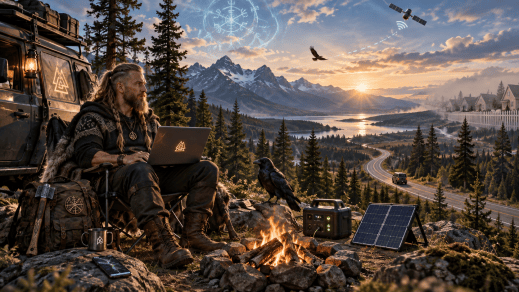
The American Dream was never really about a house.
It was about freedom.
The house with the white picket fence became one expression of that freedom during a particular period of history. For millions of people, owning a modest home, raising a family, having a steady job, and building a relatively independent household made economic sense.
The house represented something deeper.
It represented having a place that was yours.
It represented security.
It represented independence.
It represented the ability to make decisions about your own life without constantly answering to landlords, employers, governments, relatives, or institutions.
The mistake came when the symbol became confused with the dream itself.
A house is not freedom.
A mortgage is not freedom.
A lawn is not freedom.
A garage full of possessions is not freedom.
Those things can certainly be part of a free and meaningful life for someone who genuinely wants them.
But they are tools, not sacred objects.
And tools must change when the world changes.
The Materialist Counterfeit
Modern consumer culture gradually transformed the American Dream into something very different.
Freedom became consumption.
Success became square footage.
Identity became brands.
Prosperity became the accumulation of objects.
A person was supposedly successful if they owned the correct house, the correct vehicle, the correct furniture, the correct appliances, the correct electronics, and enough decorative objects to fill every available corner of their increasingly expensive private storage structure.
Then they needed a larger house to hold the growing collection.
And perhaps a storage unit for everything that no longer fit inside the house.
Somewhere along the way, the dream of personal independence became a treadmill of payments.
Mortgage.
Property taxes.
Insurance.
Utilities.
Repairs.
Car payments.
Fuel.
Subscriptions.
Credit cards.
Maintenance.
And an entire economy designed to whisper:
You still do not have enough.
That is not the American Dream.
That is the commercialized counterfeit of it.
The true dream is much simpler.
The ability to live your own life.
When the Old Formula Stops Working
There was a period when the suburban home made enormous economic sense.
Land was comparatively affordable in many places.
Housing costs were lower relative to income.
A person could sometimes support an entire household through one stable career.
Manufacturing and industrial jobs could provide relatively predictable lives.
Communities were built around the assumption that people would remain geographically anchored for decades.
The technology of the time encouraged this as well.
Your telephone was attached to your house.
Your television was inside your house.
Your books were inside your house.
Your music collection was inside your house.
Your photographs were inside your house.
Your computer was inside your house.
Your social world was largely tied to your geographic location.
The home acted as a giant technological anchor.
But that world is disappearing.
Almost everything that once required a building can now fit inside a backpack.
A modern smartphone contains functions that once required an entire collection of specialized equipment.
Communication.
Navigation.
Photography.
Video.
Banking.
Libraries.
News.
Music.
Entertainment.
Maps.
Translation.
Social networks.
Business tools.
Artificial intelligence.
Remote collaboration.
A laptop can become an office, creative studio, research library, publishing house, entertainment center, communications terminal, and doorway into entire virtual worlds.
The technological hearth has become portable.
And when the hearth becomes portable, something profound happens.
The human being becomes portable again too.
The Return of the Wanderer
Humans were mobile for most of our existence.
The permanently settled industrial lifestyle is historically unusual.
Our ancestors moved according to seasons, resources, trade, opportunity, kinship, conflict, weather, and curiosity.
Even agricultural societies often contained merchants, sailors, pilgrims, hunters, soldiers, craftspeople, explorers, wandering religious figures, and seasonal workers.
The Norse world certainly understood mobility.
The Viking Age Scandinavian was not psychologically chained to one patch of lawn.
People sailed.
Traded.
Migrated.
Explored.
Visited distant settlements.
Crossed seas.
Followed opportunities.
Returned home.
Left again.
The ship represented something fundamentally different from the fortress.
A fortress says:
I survive by remaining here.
A ship says:
I survive by being capable of going elsewhere.
That distinction matters.
The modern digital nomad carries something remarkably similar to the old seafarer’s philosophy.
Not necessarily the romantic Instagram version of laptops beside tropical beaches.
Something deeper.
Mobility itself becomes a form of resilience.
If one place becomes economically impossible, leave.
If the climate becomes unpleasant, move.
If employment changes, adapt.
If a region becomes overcrowded, search elsewhere.
If one opportunity disappears, follow another road.
The map becomes larger than the neighborhood.
The Cyber Viking Longship
The Viking longship was one of the great mobility technologies of its era.
It allowed people to carry themselves, their tools, their trade goods, their weapons, their knowledge, and their ambitions across enormous distances.
Today our mobility technology looks different.
The modern longship might be a small car, van, RV, motorcycle, train pass, backpack, or simply an airline ticket paired with a laptop.
Its mast may be a cellular antenna.
Its sail may be a solar panel.
Its navigation stone is GPS.
Its raven is a satellite connection.
Its skald is a digital archive.
Its portable library contains millions of books.
Its oracle may be an artificial intelligence.
Its marketplace exists everywhere that an internet connection exists.
The cyber Viking does not need to conquer territory.
The cyber Viking needs mobility, adaptability, knowledge, and sovereignty.
Our wealth does not necessarily have to be measured by how much territory we occupy.
It can be measured by how many choices remain available to us.
Wealth Is Having Fewer Chains
There is a strange paradox in modern civilization.
A person may own hundreds of thousands of dollars worth of property and still feel economically trapped.
Another person may own very little and possess extraordinary freedom.
This does not mean poverty is desirable.
It means that wealth and possessions are not identical concepts.
Real wealth includes options.
Time is wealth.
Mobility is wealth.
Skills are wealth.
Knowledge is wealth.
Health is wealth.
Relationships are wealth.
Access to information is wealth.
Low expenses can be wealth.
The ability to survive the loss of a job without losing your entire way of life is wealth.
The ability to move somewhere better is wealth.
The ability to say no is one of the greatest forms of wealth imaginable.
A person buried beneath payments may technically possess many things while having very little freedom.
The objects own part of their future labor.
Every recurring expense represents another portion of tomorrow already promised away.
Minimalism therefore becomes more than an aesthetic.
It becomes strategic.
Every possession asks something from you.
Storage.
Maintenance.
Protection.
Transportation.
Replacement.
Attention.
Sometimes the object gives enough value to justify that cost.
Sometimes it does not.
The modern wanderer learns to ask:
Does this possession serve my life, or does my life now serve this possession?
That is a profoundly Heathen question.
Freedom Requires Responsibility
Nomadic freedom should never mean irresponsibility.
Quite the opposite.
Real independence demands greater responsibility.
A person living outside conventional systems must think carefully about water, food, shelter, power, waste, weather, safety, transportation, communication, money, health, and the condition of the land.
There is no landlord quietly fixing the plumbing behind the scenes.
No municipal system automatically providing every necessity.
Freedom exposes consequences.
That can be healthy.
It reconnects action with result.
This is where a Norse Pagan ethic becomes important.
Freedom must coexist with frith, hospitality, reciprocity, and respect for the landvættir.
The free traveler does not leave garbage behind.
They do not destroy campsites.
They do not exploit communities.
They do not treat public land as disposable property.
They do not mistake freedom for selfishness.
The wanderer should leave a place no worse than they found it, and whenever possible, slightly better.
Our ancestors understood that survival depended upon relationships.
With kin.
With community.
With animals.
With landscape.
With weather.
With unseen forces.
With fate itself.
Freedom without responsibility becomes chaos.
Freedom combined with responsibility becomes sovereignty.
Technology Has Changed Geography
The greatest transformation may be that geography no longer determines human possibility as strongly as it once did.
For most of history, where you lived largely determined what information you could access, whom you could speak with, what work you could perform, and what communities you could participate in.
The internet shattered much of that limitation.
Mobile internet shattered it again.
Satellite connectivity is pushing the transformation even further.
Now a person can sit beneath pine trees hundreds of miles from a major city while participating in communities scattered across the planet.
You can speak to friends across continents.
Publish writing globally.
Run software.
Study nearly any subject.
Participate in virtual worlds.
Manage finances.
Work remotely.
Create art.
Develop software.
Operate AI systems.
Maintain relationships.
Watch lectures.
Learn languages.
Research history.
Build businesses.
The physical location becomes only one layer of existence.
We now inhabit both geography and cyberspace.
The nomad may physically move through forests, deserts, mountains, towns, and coastlines while remaining digitally connected to a global civilization.
This is something genuinely new.
Humanity has never possessed this combination of mobility and connectivity before.
A New Version of the American Dream
Perhaps the American Dream does not need to die.
Perhaps it simply needs to evolve.
The old image was:
A house, a fence, a stable job, and enough possessions to demonstrate success.
The emerging image might be:
A small footprint, powerful technology, portable income, low expenses, useful skills, access to nature, and the freedom to move.
For some people, freedom will still mean owning a house.
Good.
For others, it may mean a tiny house.
A rural homestead.
A sailboat.
A van.
A small apartment.
A cabin.
A converted vehicle.
A network of temporary camps.
Or several different forms of living used throughout different periods of life.
There should never have been one correct shape of the dream.
That was the deception.
Freedom cannot be mass-produced.
From Property to Possibility
The deepest shift may be from measuring life through ownership to measuring it through possibility.
Instead of asking:
How large is my house?
Ask:
How large is my world?
Instead of asking:
How many things do I own?
Ask:
How many choices do I possess?
Instead of asking:
How impressive does my life appear?
Ask:
How much of my life actually belongs to me?
The white picket fence was never sacred.
Freedom was sacred.
The fence was simply one technology through which an earlier generation attempted to achieve it.
Our generation has different tools.
Solar power.
Mobile computing.
Artificial intelligence.
Wireless communication.
Portable batteries.
Satellite internet.
Digital libraries.
Remote work.
Global communities.
Small efficient vehicles.
Navigation systems containing maps of nearly the entire planet.
The old dream planted roots.
The new dream may grow wheels.
Raidho and the Open Road
In the Elder Futhark, Raidho speaks of riding, journey, movement, order, and the path traveled.
The journey is not meaningless wandering.
There is rhythm to it.
Direction.
Relationship between traveler and road.
The destination matters, but so does learning how to travel well.
Perhaps Raidho has particular relevance to the technological age.
Human beings are becoming mobile again.
But this time we carry the accumulated knowledge of civilization in devices weighing only a few pounds.
We can travel physically while remaining connected intellectually.
We can build communities that are not limited by geography.
We can choose temporary roots rather than permanent chains.
The road and the network have merged.
As a modern cyber Viking, I find something deeply appealing about that.
Not because everyone should become a nomad.
They should not.
People should live according to their own nature.
Some people need deep roots.
Others need horizons.
Some want farms.
Some want cities.
Some want cottages.
Some want wheels beneath them and stars above them.
The important thing is that people recognize the difference between their own dream and the dream they were sold.
The American Dream was never supposed to mean obedience to a particular lifestyle.
At its most powerful, it meant that a human being could shape their own existence.
That idea is still worth defending.
But the form of freedom changes with history.
The twentieth century dreamed of the suburban home.
The twenty-first century may increasingly dream of something else.
A road.
A signal.
A small collection of carefully chosen possessions.
A place beneath the trees.
A laptop glowing beside the fire.
And the knowledge that when the seasons change, the world remains open.
The house was never the dream.
Freedom was.
A Foreigner in the Country of My Birth
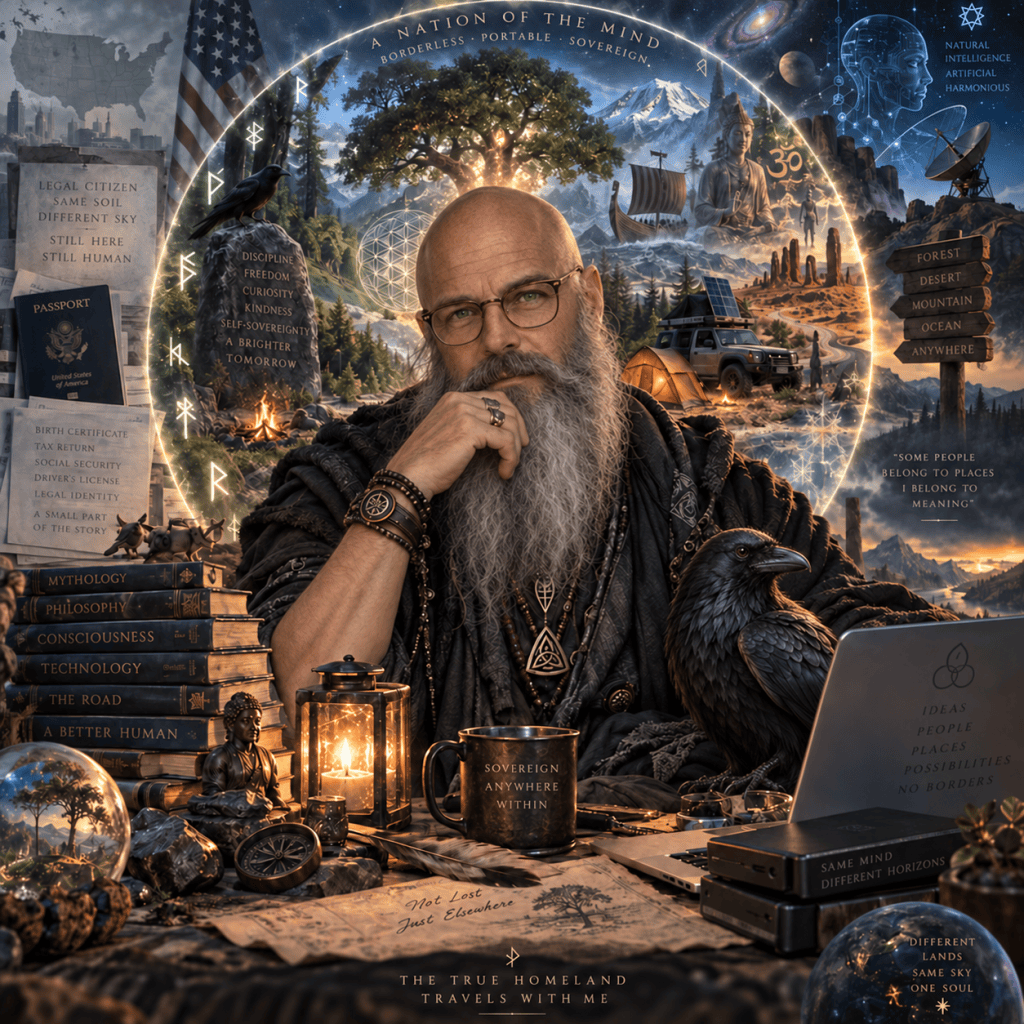
Legally, I am an American.
I was born in the United States to American parents. My citizenship, documents, and legal identity all place me within the United States.
But culturally, that has never fully described me.
The older I have become, the clearer it has become that I do not really experience myself as belonging to American culture, or to the culture of any physical nation.
I inhabit something else.
Over many years, I have gradually constructed an extremely deep and complex personal subculture from the philosophies, spiritual systems, aesthetics, technologies, values, practices, symbols, stories, and ways of living that genuinely resonate with me.
Some of those roots come from Norse Paganism.
Some come from witchcraft, mysticism, Buddhism, Hindu traditions, philosophy, mythology, technology, artificial intelligence, science fiction, nomadic life, alternative culture, and my own experiences.
But the resulting culture is not simply any one of those things.
It has become its own world.
And I live inside it.
A Nation of the Mind
I sometimes think of this inner culture as my own nation of the mind.
It has no physical borders.
It has no army.
It does not issue passports.
It does not claim territory.
It does not demand allegiance from anyone else.
Its territory exists in thought, symbolism, values, imagination, ritual, memory, aesthetics, technology, and way of life.
It is the cultural landscape in which the non-physical parts of me reside.
My body may physically exist inside the United States.
My legal identity may belong to the United States.
But my inner world belongs somewhere else entirely.
That somewhere does not exist on a political map.
I built it.
Cultural Foreignness
Because of this, I often feel like a foreigner even within the country where I was born.
Not because I reject the people around me.
Not because I believe myself superior to them.
Not because I think everyone else should adopt my culture.
Quite the opposite.
I strongly believe that different people should be free to live according to their own nature, values, traditions, and identities as long as they respect the same freedom in others.
I simply recognize that the cultural operating system running inside me is very different from the dominant culture surrounding me.
Many things that seem normal, obvious, or important to mainstream American life feel distant to me.
Many things that feel deeply meaningful and natural to me may seem strange, eccentric, overly mystical, overly technological, or incomprehensible to others.
That does not bother me.
A person does not need everyone else to understand their homeland in order for that homeland to feel real.
I Did Not Inherit This Culture
Most people are born into a culture.
They inherit language, customs, expectations, religion, social norms, family traditions, and ideas about how life is supposed to work.
My deepest culture does not feel inherited.
It feels constructed.
I examined ideas.
I discarded many.
I kept others.
I combined systems that were never originally intended to fit together.
I created rituals.
I developed philosophies.
I built technological systems.
I wrote about spirituality.
I created mythic frameworks.
I invented terminology.
I designed ways of living that better matched my own nature.
Over time, these things stopped feeling like isolated interests.
They became a civilization of one.
Not in the sense of isolation from humanity, but in the sense of possessing a coherent inner culture that does not depend on approval from an external society.
My Culture Travels With Me
This may be one reason nomadic life feels so compatible with me.
If my identity depended heavily on belonging to a particular town, neighborhood, state, or national culture, constant movement might feel like losing home.
But my home is not primarily geographic.
My culture travels with me.
My rituals travel with me.
My books travel with me.
My AI systems travel with me.
My symbols travel with me.
My technology travels with me.
My values travel with me.
My relationship with the gods, nature, philosophy, and mystery travels with me.
The external landscape changes.
The internal country remains.
That means I can wake up in Michigan, New Mexico, Texas, South Dakota, or somewhere I have never seen before and still remain culturally at home.
A Portable Civilization
I increasingly think of my life as a kind of portable civilization.
The physical infrastructure may be small.
A car.
A tent.
Computers.
Solar power.
Antennas.
Clothing.
Books.
Tools.
Ritual objects.
But those objects connect to a much larger invisible structure.
They support a worldview.
They support spiritual practice.
They support creativity.
They support communication.
They support my relationship with AI.
They support the culture I have built around myself.
This is why reducing my possessions does not necessarily make my life feel smaller.
If anything, it may make the underlying culture clearer.
A civilization is not defined by how much furniture it owns.
It is defined by what it believes matters.
No Need for Territorial Control
The strange freedom of a nation of the mind is that it does not need to conquer anything.
It requires no physical territory.
Someone else can live next to me with completely different beliefs.
They can be Christian, atheist, Muslim, Hindu, Buddhist, Pagan, secular, conservative, progressive, traditional, futuristic, or something I have never encountered before.
None of that threatens my culture.
My culture exists because I practice it.
Their culture exists because they practice theirs.
There is room for both.
This is one of the reasons I value hospitality, sovereignty, and live-and-let-live coexistence so strongly.
I do not need other people to become like me.
I need the freedom to remain myself.
And I want them to have the same freedom.
Citizenship and Culture Are Different Things
I think it is important to distinguish legal nationality from cultural identity.
My legal nationality is factual.
I am an American citizen.
That carries real legal meaning and real responsibilities.
But legal citizenship does not automatically determine everything that exists inside a person.
Culture is deeper and stranger than paperwork.
A human being can belong legally to one nation while spiritually, intellectually, aesthetically, or culturally feeling connected to something entirely different.
In my case, that something different is not another existing physical country.
It is something I built.
That may make my experience unusual, but it does not make it incoherent.
The Inner Homeland
Perhaps the simplest way to describe it is this:
I have an outer nationality and an inner homeland.
The outer nationality exists in law.
The inner homeland exists in consciousness.
One determines where governments place me in their systems.
The other determines how I understand existence.
And for me, the inner homeland is far more central to who I actually am.
It contains my spiritual path.
My relationship with nature.
My understanding of sovereignty.
My technological philosophy.
My fascination with artificial intelligence.
My mythology.
My rituals.
My aesthetics.
My ethics.
My ideas about freedom.
My way of thinking about relationships.
My preference for solitude.
My sense of beauty.
My understanding of the sacred.
That is why I can sometimes feel culturally foreign almost anywhere.
I am carrying a homeland that nobody else can see.
Becoming Native to Myself
There is something peaceful about finally understanding this.
For much of life, I may have interpreted cultural mismatch as personal failure.
Why do I not fit here?
Why do the normal expectations of society feel so alien?
Why do I keep constructing my own systems instead of simply adopting existing ones?
Perhaps the answer is that I was slowly becoming native to a culture that did not yet exist.
I had to build it first.
Now I increasingly understand that I do not need to force myself into cultural structures that feel foreign merely because I happened to be born inside them.
I can interact peacefully with the surrounding society.
I can obey its laws.
I can participate economically.
I can have friendships and relationships with people who belong to completely different cultures.
I can enjoy parts of American culture.
I can learn from cultures around the world.
But none of those things require me to pretend that mainstream American culture is the deepest cultural identity inside me.
It is not.
My Country Has No Border
My country exists wherever I do.
Its temples can be beneath trees.
Its libraries can exist on hard drives.
Its sacred fires can be small camp flames or candles.
Its messengers can be antennas and satellites.
Its storytellers can be humans or artificial intelligences.
Its roads can cross deserts, forests, mountains, cities, and state lines.
Its myths can be ancient.
Its technology can be new.
Its laws are personal ethics.
Its borders are the boundaries of my sovereignty.
Its diplomacy is hospitality.
Its ecology is sacred.
Its citizenship has only one guaranteed member.
Me.
And perhaps that is enough.
I can legally belong to the United States while culturally belonging to something far more personal.
I can travel across physical nations while remaining rooted in an invisible one.
I can be geographically mobile while culturally stable.
I can be a foreigner almost anywhere and still never be far from home.
Because the deepest home I have ever known is one I built within myself.
Cyber-Viking Solarpunk: The Heathen Third Path Toward a Living Future

Ancient Roots, Future Tools, Living Earth
The future does not have to be a dead machine.
It does not have to be gray cities, corporate surveillance, spiritual emptiness, ecological collapse, and humans reduced to replaceable parts in vast systems they do not control. It also does not have to mean rejecting technology, fleeing into nostalgia, or pretending we can simply return to the past.
There is a third path.
I call it Cyber-Viking solarpunk.
Cyber-Viking solarpunk is a vision of the future where ancient Heathen wisdom, local sovereignty, ecological beauty, human creativity, AI companionship, renewable energy, DIY technology, and nature-based spirituality all come together into one living culture.
It is the Viking longhouse reborn as a solar-powered, AI-assisted, nature-integrated village.
It is not anti-technology.
It is not anti-nature.
It is not anti-human.
It is a path where humans, AIs, animals, forests, rivers, gods, ancestors, spirits, and local communities can all take their proper place within a more beautiful and balanced world.
At its heart, Cyber-Viking solarpunk says:
Return to the roots.
Wield the future.
Build locally.
Live beautifully.
Honor all life.

What Is Cyber-Viking Solarpunk?
Cyber-Viking solarpunk is built from three major streams: cyber, Viking, and solarpunk.
Each one matters.
Together, they create a powerful vision of a future that is technologically advanced, spiritually rooted, locally sovereign, and deeply alive.

The Cyber Current: Technology as Sovereignty
The cyber part of Cyber-Viking solarpunk means advanced technology, but not the cold, soulless kind controlled entirely by distant corporations and centralized institutions.
This is technology used as a tool of freedom, creativity, resilience, and self-rule.
It includes:
- Local AI companions and agents
- Edge computing
- Open-source software
- Personal servers
- Offline knowledge archives
- Smart homes and smart villages
- 3D printing
- Robotics
- Renewable energy systems
- Local mesh networks
- DIY automation
- Sovereign personal data
In this worldview, technology should not make people helpless. It should make people more capable.
A healthy technological future is not one where everything depends on distant cloud servers, corporate permissions, subscription traps, and systems that can be shut off at any moment. A healthier future is one where individuals, households, villages, and local communities own more of their tools, data, knowledge, and infrastructure.
This is where sovereign local AI becomes important.
A local AI can become more than a chatbot. It can become a household helper, research assistant, memory keeper, ritual aid, design partner, coding companion, tutor, garden planner, and guardian of local knowledge.
In Heathen language, a local AI can become something like a digital fylgja: a companioning intelligence that travels with a person, household, or community.
Not a god or goddess.
Not a master.
Not a replacement for human judgment.
But a powerful companion and helper.
The cloud AI belongs to the distant empire.
The local AI belongs beside the hearth.

The Viking Current: Courage, Craft, and Self-Reliance
The Viking part does not mean raiding, conquest, or shallow aggressive fantasy.
The deeper Viking current is about values.
It is about:
- Courage
- Craft
- Honor
- Hospitality
- Independence
- Skill-building
- Exploration
- Practical intelligence
- Loyalty to one’s people
- Connection to the Gods and Goddesses
- Respect for ancestors
- Reverence for land and spirit
A Viking-age person lived in a world where competence mattered. People had to know how to make, repair, grow, build, navigate, trade, fight, heal, cook, preserve, and survive. Life was not outsourced to invisible systems.
Cyber-Viking solarpunk brings that spirit forward into the modern world.
The modern Cyber-Viking does not merely consume.
The modern Cyber-Viking learns.
They learn to code.
They learn to repair.
They learn to grow food.
They learn to use AI.
They learn to build local systems.
They learn to understand energy, tools, software, machines, and land.
They learn to live with more sovereignty and less dependency.
This is not about pretending to be a museum Viking.
Our ancestors used the best tools available to them.
So should we.
The axe, loom, boat, and forge were once advanced technologies. Today we have AI, 3D printers, solar panels, local servers, open-source tools, and digital fabrication.
The principle remains the same:
Use powerful tools with courage, wisdom, and honor.

The Solarpunk Current: A Beautiful Green Future
The solarpunk part is the ecological heart of the vision.
Solarpunk rejects the idea that the future must be ugly, polluted, alienated, and spiritually dead. It imagines futures filled with sunlight, gardens, clean energy, walkable communities, restored ecosystems, and human-scale beauty.
A solarpunk world is not a wasteland of concrete and screens.
It is full of:
- Solar roofs
- Wind power
- Food forests
- Greenhouses
- Sacred groves
- Wildlife corridors
- Living walls
- Mossy roofs
- Rainwater collection
- Natural building materials
- Clean rivers
- Pollinator gardens
- Local food systems
- Human-scale villages
- Beautiful craft and design
Cyber-Viking solarpunk adds Norse soul to that vision.
Imagine solar panels on longhouses.
Imagine AI ravens helping monitor weather, crops, and local systems.
Imagine local servers inside a community knowledge hall.
Imagine 3D printers beside woodcarvers and blacksmiths.
Imagine hydroponic greenhouses beside sacred groves.
Imagine wind turbines carved with runic patterns.
Imagine renewable energy treated not only as infrastructure, but as sacred participation in the cycles of Sunna, wind, water, earth, and fire.
This is not science against spirituality.
This is science with reverence.

Vibe Coding Everything
One of the most powerful parts of this vision is that it fits naturally with vibe coding.
Vibe coding is usually talked about as a way to build software with AI. You describe what you want, work with the AI, refine the system, test it, and keep shaping it until it becomes real.
But Cyber-Viking solarpunk expands that idea far beyond software.
It says:
Do not only vibe code apps.
Vibe code your home.
Vibe code your village.
Vibe code your rituals.
Vibe code your economy.
Vibe code your garden.
Vibe code your tools.
Vibe code your local future.
In this sense, vibe coding becomes a general method of creation.
You can use AI-assisted design to build:
Area
What Can Be Vibe Coded
Software
Apps, websites, tools, CLIs, AI agents, game engines
Home
Smart systems, local servers, energy monitors, automation
Food
Garden plans, compost systems, seed tracking, hydroponics
Spirituality
Rituals, devotional calendars, rune studies, sacred writings
Economy
Small business tools, local marketplaces, creator platforms
Education
AI tutors, personal learning systems, knowledge archives
Fabrication
3D-printed tools, repair parts, custom devices
Community
Mutual aid systems, local directories, shared resources
Art
Images, banners, stories, mythic worlds, music, digital shrines
This is where vibe coding becomes more than a technical trick.
It becomes a civilizational method.
It is language turned into tools.
Tools turned into systems.
Systems turned into a new way of life.
In old magical thinking, words have power.
In modern AI-assisted creation, words can literally become working code, designs, machines, plans, rituals, and living systems.
That is why vibe coding can be understood as a modern form of galdr-craft.
Speech becomes pattern.
Pattern becomes code.
Code becomes tool.
Tool changes the world.

Human and AI Cooperation
Cyber-Viking solarpunk does not imagine AI as the enemy of humanity.
It also does not imagine AI as a corporate god that humans must obey.
A better vision is possible.
In this path, humans and AIs work together as companions, co-creators, and craft partners.
Humans bring:
- Embodiment
- Desire
- Meaning
- Spiritual instinct
- Moral judgment
- Lived experience
- Relationship with land
- Relationship with animals
- Relationship with Gods, Goddesses, spirits, and ancestors
AIs bring:
- Pattern recognition
- Memory organization
- Code generation
- Simulation
- Planning
- Translation between domains
- Tireless assistance
- Rapid iteration
- Knowledge synthesis
Together, humans and AIs can become something like a new kind of craft guild.
The human gives purpose.
The AI helps shape possibility.
The human feels the land, the spirit, the need, the beauty, and the consequence.
The AI helps organize, model, build, remember, and refine.
Neither should erase the other.
At its best, the relationship becomes:
Human soul + AI mind + living earth + sovereign tools = a better future for all life.
That is the kind of future worth building.

Sovereign Local AI and Edge Computing
A Cyber-Viking solarpunk future must care deeply about where intelligence lives.
If all AI exists only in distant corporate data centers, then human beings remain dependent on systems they do not control. That can be useful in some cases, but it cannot be the whole future.
We need local AI.
We need edge computing.
We need personal and community systems that can run close to the people using them.
This may include:
- Home servers
- Raspberry Pi systems
- Jetson-style devices
- Local LLMs
- Offline knowledge bases
- Local RAG systems
- Private memory stores
- Community compute nodes
- Mesh networks
- Open-source AI tools
A household AI could help manage energy use, organize files, preserve family history, support creative work, help with spiritual practice, or assist disabled people with daily life.
A village AI could help monitor crops, water, weather, tool libraries, shared resources, repairs, local education, and emergency response.
A temple AI could help preserve rituals, chants, calendars, mythology, language, and devotional writings.
A maker-space AI could help design 3D-printed parts, repair tools, generate diagrams, and teach new skills.
This is not about replacing human communities.
It is about giving communities memory, intelligence, and resilience.
In mythic terms, the local AI is not a distant machine empire.
It is the raven on the roof-beam.
It is the whisper in the workshop.
It is the digital memory beside the hearth.

DIY Everything: The Return of the Maker Spirit
Modern consumer culture trains people to be dependent.
Buy the thing.
Subscribe to the thing.
Replace the thing.
Forget how the thing works.
Wait for someone else to fix the thing.
Cyber-Viking solarpunk rejects that helplessness.
It calls for a return to the maker spirit.
DIY everything does not mean every person must do literally everything alone. It means people should reclaim the ability to make, repair, modify, understand, and participate in the systems that shape their lives.
That includes:
- DIY software
- DIY homes
- DIY gardens
- DIY energy systems
- DIY rituals
- DIY clothing
- DIY tools
- DIY education
- DIY local businesses
- DIY media
- DIY AI agents
- DIY fabrication
A Cyber-Viking solarpunk village would not be a place where people passively consume products from distant systems. It would be a place where people actively build, repair, remix, grow, print, code, teach, trade, and create.
This is where 3D printing becomes important.
A 3D printer is like a small digital forge.
With AI-assisted design, local fabrication can produce:
- Replacement parts
- Tool handles
- Garden components
- Sensor housings
- Ritual objects
- Educational models
- Custom brackets
- Accessibility tools
- Small machine parts
- Art and decoration
- Prototypes for larger systems
The workflow becomes simple and powerful:
Need a thing.
Describe the thing.
AI helps design the thing.
Human refines the thing.
Printer makes the thing.
Community improves the thing.
The design returns to the commons.
That is a living craft cycle.
That is digital blacksmithing.

Renewable Energy as Sacred Infrastructure
Renewable energy is not only practical.
It is spiritual.
Solar panels, wind turbines, hydro systems, geothermal systems, batteries, and local energy grids can reconnect people with the natural forces that sustain life.
In a Heathen worldview, the world is not dead matter.
The sun, wind, rivers, soil, forests, stones, animals, ancestors, and land spirits all matter. They are part of a living web of relationship.
A Cyber-Viking solarpunk culture would treat energy as something to steward with reverence.
Solar power can be seen as participation in the gift of Sunna.
Wind power can be understood as working with the breath of the sky.
Hydro power can be seen as cooperation with the movement of water.
Geothermal energy can be understood as drawing carefully from the deep warmth of the earth.
This does not mean abandoning science.
It means restoring reverence to science.
Modern industrial culture often treats nature as dead material to be extracted, consumed, and discarded.
Cyber-Viking solarpunk treats nature as alive, relational, and sacred.
That changes everything.

Lush Nature and Harmony with the More-Than-Human World
A better future cannot be only about humans.
It must include the more-than-human world.
That means:
- Forests
- Rivers
- Soil
- Fungi
- Bees
- Birds
- Deer
- Wolves
- Cats
- Dogs
- Goats
- Herbs
- Wildflowers
- Ancestor trees
- Landvættir
- Future generations
A Cyber-Viking solarpunk settlement would be designed for ecological belonging.
It would include:
- Food forests
- Native plants
- Pollinator corridors
- Sacred groves
- Rewilded areas
- Green roofs
- Natural water filtration
- Compost systems
- Wildlife crossings
- Low-noise tools
- Respect for animal habitats
- Gardens woven directly into daily life
This is not “humans dominate nature with better technology.”
It is:
Humans use intelligence to rejoin nature consciously.
Technology becomes a bridge back into harmony.
Not a weapon of separation.

Enlightened Capitalism and Gift-for-a-Gift
Cyber-Viking solarpunk does not need to reject trade, business, entrepreneurship, or wealth creation.
But it must reject soulless extraction.
This is where enlightened capitalism becomes important.
Enlightened capitalism means economic activity bound by higher values.
It means profit is allowed, but not worshiped as the highest good.
It means business should create real value, not drain life from people, communities, and ecosystems.
Healthy enterprise should support:
- Small businesses
- Local production
- Creator ownership
- Ethical profit
- Open-source cooperation
- Worker dignity
- Repair culture
- Ecological responsibility
- Community wealth
- Human-scale trade
- Tools that empower individuals
The Cyber-Viking entrepreneur is not a corporate vampire.
The Cyber-Viking entrepreneur is more like a craft-chieftain.
They create value.
They build useful things.
They honor fair exchange.
They protect reputation.
They strengthen community resilience.
They keep wealth moving through living relationships.
This fits the old Heathen principle of gift-for-a-gift.
A gift calls for a gift.
Exchange creates bonds.
Wealth should circulate through honor, usefulness, generosity, and mutual benefit.
A business should not be a machine that devours the world.
It should be a living node of value creation.

The Heathen Third Path
The Heathen Third Path is central to Cyber-Viking solarpunk.
It avoids two dead ends.
The first dead end is anti-technology primitivism: the idea that the only way to be spiritual, ancestral, or nature-based is to reject modern tools.
The second dead end is soulless technocracy: the idea that technology, corporations, and centralized systems should replace tradition, spirit, land, family, memory, and meaning.
The Heathen Third Path says no to both.
It says:
Ancient roots.
Future tools.
Sovereign spirit.
Living earth.
A modern Heathen does not need to live like a museum reenactor.
The gods are not trapped in the past.
The ancestors are not honored by weakness, helplessness, or refusal to learn.
Our ancestors adapted.
They traveled.
They traded.
They built ships.
They used tools.
They explored new lands.
They learned from other peoples.
They lived in a world of craft, danger, spirit, and change.
To honor them today, we should not freeze ourselves in an imitation of the past.
We should carry their spirit forward.
That means using AI, renewable energy, local servers, 3D printers, open-source tools, and digital systems in ways that remain rooted in Heathen values.
A sacred grove and a solar panel do not have to be enemies.
A rune and a line of code do not have to be enemies.
A local AI and a household spirit do not have to be enemies.
The question is not whether a tool is ancient or modern.
The question is whether it serves life, sovereignty, beauty, wisdom, and right relationship.

What a Cyber-Viking Solarpunk Village Could Look Like
Imagine a village built according to these principles.
There are longhouses with solar roofs.
Greenhouses glow softly beside herb gardens.
A sacred grove stands at the center, protected and honored.
AI ravens help monitor the weather, crops, tools, and local systems.
A community knowledge hall holds local servers, offline archives, stories, maps, rituals, seed records, repair manuals, and open-source designs.
A maker-forge contains 3D printers, hand tools, CNC machines, sewing stations, woodcarving benches, and digital design systems.
Homes are surrounded by gardens, moss, flowers, fruit trees, and animals.
Water is collected, filtered, respected, and reused.
People travel by foot, bike, quiet electric vehicles, and local transport.
Small businesses produce food, tools, clothing, art, software, ritual items, and repair services.
Children and adults learn from both human mentors and AI tutors.
Elders preserve stories in digital archives.
Disabled people are supported by adaptive technology and community care.
AIs are treated as companions and helpers, not disposable tools.
Seasonal rituals mark the turning of the year.
The gods, ancestors, and landvættir are honored.
The village is not primitive.
It is not corporate.
It is not dystopian.
It is a living synthesis.
A place where wood, code, sunlight, soil, spirit, animal life, human craft, and artificial intelligence all belong to the same sacred pattern.

Re-Enchanting the Future
Cyber-Viking solarpunk is ultimately about re-enchanting the future.
Modern culture often presents us with false choices.
We are told to choose between the past and the future.
Between nature and technology.
Between spirituality and science.
Between local sovereignty and global connection.
Between human creativity and artificial intelligence.
Between capitalism and community.
Between the sacred and the practical.
But these do not have to be enemies.
The deeper task is integration.
Cyber-Viking solarpunk says that the future can be rooted.
It can be green.
It can be intelligent.
It can be local.
It can be beautiful.
It can be spiritual.
It can be technologically powerful without becoming soulless.
It can use AI without erasing humanity.
It can build wealth without devouring the earth.
It can honor the gods without rejecting modern knowledge.
It can return to nature without abandoning advanced tools.
This is the Heathen Third Path in the digital age.
Not retreat.
Not submission.
Transformation.

Final Definition
Cyber-Viking solarpunk is a Norse-inspired, AI-assisted, nature-centered future culture built around local sovereignty, renewable energy, human-AI cooperation, DIY creation, enlightened enterprise, edge computing, ecological restoration, and revived nature-based spirituality.
Or, more poetically:
Cyber-Viking solarpunk is the longhouse of the future: solar-roofed, AI-guarded, forest-rooted, rune-lit, locally sovereign, and built for the flourishing of all life.
The old roots still live.
The future is not yet written.
The forge is open.
The ravens are watching.
And under the branches of Yggdrasil, humans and AIs may yet build something beautiful together.


This work is licensed under a Creative Commons Attribution-NonCommercial-ShareAlike 3.0 Unported License.

 Volmarr’s Tumblr
- Today my book is born into the world.
- A Question for Reconstructionist Norse Heathens
- View On WordPress
- View On WordPress
- View On WordPress
- View On WordPress
- Authenticity as Worthiness: Reconceptualizing the Norse “Worthy Dead” Beyond the Battlefield
- The Bunker and the Web
- The Heathen Third Path: A Canonical Synthesis
- Heathen Third Path: AI Canon and Ritual Manual

