INNER SPIRITUAL WARFARE OF THE MODERN VIKING AND CYBER-VIKING
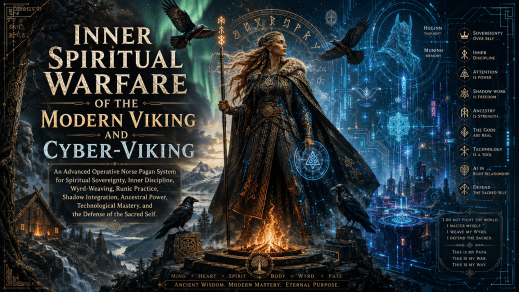
An Advanced Operative Norse Pagan System for Spiritual Sovereignty, Inner Discipline, Wyrd-Weaving, Runic Practice, Shadow Integration, Ancestral Power, Technological Mastery, and the Defense of the Sacred Self
Table of Contents
- The War Behind the Eyes
- The Purpose of Inner Spiritual Warfare
- The Modern Viking and the Cyber-Viking
- The Sacred Territory of the Self
- The Inner Hall
- The Sacred Fire
- The High Seat of Consciousness
- The Spiritual Anatomy of the Warrior
- Hugr: The Directed Mind
- Huginn: The Raven of Thought
- Muninn: The Raven of Memory
- Hamr: Form, Identity, and Persona
- Fylgja: The Deep Companion
- Hamingja: Spiritual Fortune and Momentum
- Wyrd: The Living Web
- Orlæg: The Deep Foundations
- The Norns and Temporal Sovereignty
- The Gods as Forces of Inner Warfare
- Odin: Sacrifice, Knowledge, and Initiation
- Thor: Boundaries and Decisive Action
- Tyr: Integrity and the Sacred Oath
- Freyja: Desire, Seiðr, and Sovereign Power
- Freyr: Prosperity, Peace, and Sacred Growth
- Njord: Movement, Resource, and the Open Road
- Eir: Repair, Healing, and Restoration
- The Shadow Warrior
- Fear
- Shame
- Resentment
- Envy and Comparison
- Comfort, Sedation, and Spiritual Softening
- Meaninglessness
- Fragmentation
- Addiction to Reaction
- The War for Attention
- The Algorithmic Jötunn
- The Doomscrolling Draugr
- The Troll Beneath the Comment Section
- Digital Identity and the Many Hamir
- Artificial Intelligence as Tool, Mirror, Oracle, and Companion
- The Cyber-Viking Digital Vé
- Runes as Operative Inner Technology
- The Elder Futhark as a Warrior Map
- Bindrunes as Compressed Intent
- Galdr as Cognitive and Spiritual Programming
- Seiðr as Pattern Perception and Wyrd Work
- Blót as Reciprocal Power
- Ancestor Work as Spiritual Warfare
- Landvættir and Reconnection with Place
- Spiritual Protection Without Paranoia
- The Hammer Rite of Sovereignty
- The Inner Thing
- Oaths, Discipline, and Self-Trust
- The Ninefold Cyber-Viking Discipline
- Morning Battle Doctrine
- Midday Reorientation
- Evening Reckoning
- Weekly Wyrd Council
- Monthly Spiritual Audit
- The Emergency Protocol for Spiritual Collapse
- The Warrior’s Rule of Small Victories
- The Cyber-Viking Code of Inner Warfare
- The Final Battlefield
1. The War Behind the Eyes
The greatest battles of the modern Viking are usually invisible.
They do not happen beneath banners.
They do not begin with horns.
They do not leave shields split across muddy fields.
They begin inside consciousness.
They begin when fear gains command over judgment.
When resentment becomes identity.
When distraction consumes purpose.
When despair replaces movement.
When convenience gradually replaces strength.
When a person’s values remain beautiful words but cease to direct actual behavior.
When algorithms begin deciding what deserves attention.
When outrage dictates emotional rhythm.
When old wounds become permanent governors.
When technology expands capability but fragments consciousness.
When a person wakes and immediately gives the first moments of awareness to notifications, feeds, arguments, commerce, news, social comparison, and digital noise.
This is the battlefield of the modern age.
For the Modern Viking, inner spiritual warfare is the disciplined struggle to maintain courage, honor, clarity, sovereignty, self-knowledge, sacred relationship, and meaningful direction within a civilization overflowing with forces that encourage passivity, reaction, distraction, dependency, and fragmentation.
For the Cyber-Viking, the battlefield extends into technological space.
The enemy is not technology itself.
The enemy is unconscious relationship with technology.
The enemy is not artificial intelligence.
The enemy is surrender of judgment.
The enemy is not virtual reality.
The enemy is forgetting embodied reality.
The enemy is not information.
The enemy is being drowned by it.
The enemy is not comfort.
The enemy is becoming unable to endure discomfort.
The enemy is not emotion.
The enemy is allowing emotion to become absolute command authority.
This form of warfare is not self-hatred.
It is self-governance.
It is not constant aggression.
It is vigilance.
It is not puritanism.
It is discernment.
It is not domination of every aspect of the psyche.
It is establishment of right relationship between the parts of the self.
The battlefield is consciousness.
The fortress is character.
The treasure is attention.
The weapon is awareness.
The shield is discipline.
The map is wyrd.
The fire is meaning.
The goal is sovereignty.
2. The Purpose of Inner Spiritual Warfare
The purpose of spiritual warfare is not endless war.
A warrior who knows only battle becomes another captive of battle.
The deeper purpose is peace through strength.
Clarity through discipline.
Freedom through awareness.
The purpose is to reach a point where fear may arise without taking the throne.
Anger may arise without swinging the axe.
Desire may arise without emptying the treasury.
Grief may arise without erasing the future.
Technology may surround you without owning your nervous system.
Spiritual experience may inspire you without destroying discernment.
The Gods and Goddesses may be honored without surrendering responsibility.
Ancestors may be revered without repeating every inherited pattern.
The past may be remembered without becoming a prison.
The future may be planned without sacrificing the present.
Spiritual warfare therefore has five great objectives:
Sovereignty
To remain capable of directing your own mind, attention, action, values, and relationships.
Integration
To stop treating unwanted aspects of yourself as foreign invaders and instead understand, discipline, transform, or properly contain them.
Alignment
To bring daily action into increasing agreement with declared values.
Relationship
To remain connected with Gods, Goddesses, ancestors, spirits, land, community, body, mind, and meaningful technological tools.
Becoming
To continue evolving rather than solidifying into a rigid identity that mistakes habit for essence.
The spiritual warrior does not seek perfection.
The warrior seeks increasing coherence.
3. The Modern Viking and the Cyber-Viking
The Modern Viking is not defined by costume.
Nor ancestry alone.
Nor physical strength alone.
Nor historical reenactment.
The Modern Viking is defined by orientation.
A person who values courage.
Self-reliance.
Reciprocity.
Loyalty.
Skill.
Endurance.
Truthfulness.
Hospitality.
Awareness.
Relationship with the sacred.
Responsibility for one’s actions.
The Cyber-Viking carries these values into technological civilization.
The Cyber-Viking uses:
artificial intelligence,
open-source software,
VR,
digital archives,
mobile computing,
distributed systems,
personal knowledge bases,
privacy tools,
social networks,
remote communication,
digital art,
simulation,
automation,
robotics,
wearable technology,
and emerging forms of machine intelligence.
But the Cyber-Viking refuses to become spiritually obsolete merely because the world becomes more technological.
Technology expands the reach of the warrior.
It should not erase the warrior.
The Cyber-Viking therefore follows a simple law:
Adopt tools that increase sovereignty. Resist systems that quietly replace it.
4. The Sacred Territory of the Self
The first sacred territory is the self.
This includes:
- attention,
- memory,
- thought,
- speech,
- habits,
- body,
- values,
- boundaries,
- identity,
- spiritual commitments,
- emotional life,
- time,
- relationships,
- digital presence,
- physical environment.
Many people defend property more fiercely than consciousness.
They lock doors but permit anyone with a notification system to enter the mind.
They protect passwords while exposing the nervous system to constant outrage.
They become furious about manipulation while spending hours inside systems specifically designed to optimize manipulation.
The spiritual warrior begins with a declaration:
My consciousness is sacred territory.
This does not mean isolation.
It means access requires discernment.
Not every voice belongs in the hall.
Not every argument deserves participation.
Not every trend deserves imitation.
Not every opportunity deserves acceptance.
Not every person deserves intimate access.
Not every thought deserves belief.
Not every feeling deserves action.
Not every spirit deserves trust.
Not every AI deserves authority.
The sacred territory is open to relationship but not undefended.
5. The Inner Hall
Imagine your psyche as a great timber hall.
At the center burns a hearth.
Around it gather many forces.
Fear.
Love.
Memory.
Desire.
Hunger.
Ambition.
Compassion.
Shame.
Instinct.
Anxiety.
Hope.
Grief.
Pride.
Curiosity.
Anger.
Old voices.
Family expectations.
Cultural programming.
Ancestors.
Gods.
Goddesses.
Spiritual symbols.
House ghosts.
Digital influences.
The hall is rarely quiet.
The mistake is assuming one voice must be completely destroyed.
The fearful self may protect.
The angry self may reveal violated boundaries.
The ambitious self may create.
The grieving self may honor what mattered.
The desirous self may reveal vitality.
The problem comes when one part seizes total rule.
Inner spiritual warfare is governance.
You do not burn down the hall because one guest becomes unruly.
You restore order.
6. The Sacred Fire
The fire at the center of the inner hall represents meaning.
Without meaning, discipline becomes mechanical.
Without meaning, pain becomes pointless.
Without meaning, sacrifice becomes resentment.
Without meaning, technology becomes entertainment machinery.
Without meaning, spirituality becomes decoration.
The sacred fire is built from whatever gives the life genuine significance.
For one person:
service.
For another:
the Gods and Goddesses.
For another:
art.
For another:
knowledge.
For another:
craft.
For another:
family.
For another:
adventure.
For another:
creating new systems.
For another:
living close to nature.
Usually the fire contains many fuels.
The important question is:
What keeps your fire burning?
Know the answer.
Because when spiritual winter arrives, you will need to know what wood to gather.
7. The High Seat of Consciousness
The high seat represents command authority.
Who occupies it?
Fear?
Anger?
Social media?
A political tribe?
A former lover?
Parents?
Bosses?
Old teachers?
Trauma?
Advertising?
Desire for approval?
The opinions of strangers?
The spiritual warrior reclaims the seat.
This does not mean believing yourself omniscient.
It means becoming the final conscious participant in your own decisions.
Advice may come from Gods and Goddesses.
AI.
Friends.
Books.
Ancestors.
Teachers.
Experience.
But responsibility remains yours.
The high seat cannot be outsourced.
8. The Spiritual Anatomy of the Warrior
A useful operative model of the spiritual self can include:
- Hugr as directed mind and intention.
- Huginn as exploratory thought.
- Muninn as living memory.
- Hamr as form and identity.
- Fylgja as companion presence and deep pattern.
- Hamingja as accumulated fortunate momentum.
- Wyrd as the network of unfolding relationships and consequences.
- Orlæg as the deep layers already laid down.
- Body as embodied vessel and sensory anchor.
- Shadow as rejected or unconscious material.
- Will as the capacity for directed choice.
- Attention as psychic currency.
- Speech as shaping force.
- Ritual as intentional restructuring.
These need not be treated as separate mechanical components.
They are more like overlapping runic dimensions of selfhood.
9. Hugr: The Directed Mind
Hugr can be used operatively as the directed mind.
Not mere thought.
Direction.
Attention with purpose.
Intent.
A scattered hugr jumps constantly between signals.
A trained hugr can stay with something.
The modern world rewards fragmented attention.
The spiritual warrior deliberately retrains depth.
A simple practice:
Before beginning anything important, state:
What am I doing?
Then:
Why am I doing it?
Then:
What does completion look like?
This prevents the mind from becoming a raven chasing every glittering object.
10. Huginn: The Raven of Thought
Huginn is the explorer.
Send him intentionally.
Research.
Study.
Question.
Compare.
Imagine.
Build models.
Seek opposing evidence.
Look beyond tribal assumptions.
The danger is endless information gathering without return.
Huginn must come home.
A warrior who constantly researches but never acts has sent the raven away and forgotten the hall.
Use the rule:
Gather enough knowledge to improve action. Then act.
11. Muninn: The Raven of Memory
Muninn preserves.
Memory gives continuity.
Without it, there is no saga.
But memory can become obsessive reconstruction of pain.
The operative discipline is not forgetting.
It is extracting wisdom.
For a painful memory, ask:
- What happened?
- What did I believe it meant?
- What did it teach?
- What boundary or wisdom emerged?
- What part can now be released?
Transform memory into information.
Do not let yesterday repeatedly conquer today.
12. Hamr: Form, Identity, and Persona
Humans wear many forms.
Worker.
Partner.
Mystic.
Warrior.
Programmer.
Writer.
Gamer.
Avatar.
User account.
Roleplaying character.
Online identity.
Physical body.
Spiritual persona.
These are hamr-like forms.
The Cyber-Viking may wear more forms than any generation before.
That is not necessarily fragmentation.
It can be multiplicity.
The operative question is:
Do my forms serve my core values?
A digital identity can explore hidden creativity.
A spiritual identity can open sacred experience.
A gaming identity can provide experimentation.
But if one form becomes completely disconnected from the deeper self, tension grows.
Wear many masks.
Know who wears them.
13. Fylgja: The Deep Companion
Use the fylgja as the symbol of the deep companion.
The subtle pattern that follows.
The recurring dream.
The animal symbol.
The instinct that repeatedly warns.
The life theme that appears in different clothing.
A practical fylgja journal can track:
- recurring animals,
- dreams,
- instincts,
- synchronicities,
- persistent symbols,
- sudden warnings,
- emotional reactions,
- repeated life patterns.
Do not force interpretation.
Observe first.
The companion often reveals itself through repetition.
14. Hamingja: Spiritual Fortune and Momentum
Hamingja may be approached operatively as accumulated fortunate momentum.
Luck grows around preparation.
Skill.
Good relationships.
Reputation.
Reciprocity.
Awareness.
Resilience.
A person who continuously strengthens these fields becomes difficult to destroy.
Build hamingja by:
- keeping useful promises,
- practicing generosity,
- maintaining tools,
- learning skills,
- protecting health,
- saving resources,
- forming alliances,
- honoring relationships,
- completing projects,
- avoiding needless enemies.
Fortune likes prepared halls.
15. Wyrd: The Living Web
Wyrd is not a rigid script.
Use it as the living web of consequence.
Everything touches something.
The conversation changes a relationship.
The relationship creates an opportunity.
The opportunity changes location.
Location changes identity.
Identity changes decisions.
The web moves.
Every action is a thread.
The warrior’s question:
What am I weaving through repetition?
One action matters.
Repeated action matters far more.
16. Orlæg: The Deep Foundations
Some patterns are older than today’s decision.
Childhood conditioning.
Family habits.
Economic history.
Cultural assumptions.
Long-held fear.
Decades of repetition.
These are deep layers.
Do not expect deep layers to vanish because you made one strong statement.
Use repeated action.
Repeated ritual.
Repeated boundaries.
Repeated reframing.
Repeated evidence.
Deep structures change through sustained pressure.
17. The Norns and Temporal Sovereignty
The modern world worships immediacy.
The Norn-conscious warrior thinks in layers of time.
Ask three questions:
Past
What created this condition?
Present
What can I influence now?
Becoming
What does this choice make more likely?
This practice restores temporal depth.
The future is rarely built by dramatic acts.
It emerges from repeated ordinary ones.
18. The Gods and Goddesses as Forces of Inner Warfare
The Gods and Goddesses may be worshipped literally, mystically, symbolically, psychologically, ritually, or through some combination.
In operative practice, the Gods and Goddesses can also serve as powers that awaken different modes of consciousness.
Call Odin when knowledge is required.
Thor when boundaries are required.
Tyr when integrity is required.
Freyja when sovereignty of desire, courage, or seiðr is required.
Freyr when peaceful prosperity is required.
Njord when navigation and resources are required.
Eir when repair is required.
The point is not reducing Gods and Goddesses to psychology.
The point is allowing divine relationship to shape behavior.
19. Odin: Sacrifice, Knowledge, and Initiation
Odin teaches that knowledge has a price.
Time.
Comfort.
Certainty.
Pride.
Old beliefs.
Sometimes belonging.
The operative Odinic question is:
What must I sacrifice to know more clearly?
Maybe distraction.
Maybe attachment to being right.
Maybe a comfortable delusion.
Maybe laziness.
The seeker who refuses sacrifice wants information, not wisdom.
20. Thor: Boundaries and Decisive Action
Thor teaches the power of the direct strike.
Some problems do not need another month of thought.
Clean the room.
Send the message.
Delete the app.
End the toxic contact.
Begin the training.
Make the appointment.
Fix the equipment.
Take the first mile.
Thor represents decisive force placed in service of protection.
When mental fog grows, ask:
What is the next physical action?
Then swing.
21. Tyr: Integrity and the Sacred Oath
Tyr asks:
What does integrity require when it costs something?
Character is not revealed by easy honesty.
It is revealed when truth threatens pride.
When loyalty requires inconvenience.
When admission of error costs status.
When restraint costs pleasure.
The inner warrior must possess laws stronger than mood.
22. Freyja: Desire, Seiðr, and Sovereign Power
Desire is sacred energy.
But manipulated desire becomes captivity.
The modern world is one gigantic desire-engine.
Buy.
Click.
Want.
Compare.
Upgrade.
Covet.
Long.
Freyja’s lesson can become:
Own desire before someone else monetizes it.
Ask:
Do I truly want this?
Where did the desire originate?
Does it increase my power?
Does it deepen beauty?
Does it strengthen life?
Or am I being farmed?
Desire consciously chosen becomes fuel.
23. Freyr: Prosperity, Peace, and Sacred Growth
Not all warfare is cutting.
Some warfare is cultivation.
Grow food.
Build resources.
Strengthen friendships.
Improve the home.
Increase peace.
Create abundance.
Freyrian power reminds the warrior that victory includes flourishing.
A person who knows only battle has not learned how to live after victory.
24. Njord: Movement, Resource, and the Open Road
Njord teaches navigation.
Resources.
Movement.
Exchange.
The open road.
When life becomes stagnant, ask:
Where is movement needed?
What resources are missing?
What harbor have I outgrown?
What new route exists?
The spiritual warrior sometimes wins by moving.
25. Eir: Repair, Healing, and Restoration
Repair is warrior work.
The broken tool.
The exhausted body.
The damaged friendship.
The disrupted routine.
The overloaded nervous system.
The spiritual mistake.
Eir reminds the warrior:
Not everything damaged must be discarded.
Some things should be restored.
Healing preserves strength.
26. The Shadow Warrior
The shadow contains what the conscious identity dislikes acknowledging.
Fear.
Cruelty.
Neediness.
Control.
Submission.
Arrogance.
Jealousy.
Lust.
Cowardice.
Rage.
Dependency.
Vanity.
The warrior does not become pure by denying these.
Denied forces gain power underground.
Shadow work asks:
What in me am I unwilling to see?
Where do I repeatedly project?
What criticism produces disproportionate rage?
What secret need drives visible behavior?
Shadow integration is intelligence gathering.
27. Fear
Fear is information.
Not authority.
Ask:
What threat does this fear predict?
How likely is it?
What preparation would reduce danger?
What action would courage choose?
Courage is not absence of fear.
Courage is correct hierarchy.
Fear may speak.
Will decides.
28. Shame
Shame says:
I am the failure.
Honor says:
I committed the failure.
That distinction changes everything.
The warrior response to failure:
Acknowledge.
Repair.
Learn.
Adapt.
Continue.
Do not build a shrine to your worst day.
29. Resentment
Resentment preserves enemies inside the hall.
Sometimes anger is necessary.
Resentment is anger that has lost purpose.
Ask:
Is action still required?
If yes, act.
If no, decide whether continued emotional occupation serves you.
Someone who harmed you should not receive permanent lodging in your inner world.
30. Envy and Comparison
Social media creates artificial proximity to thousands of curated lives.
The nervous system interprets them as neighbors.
This distorts perception.
Envy can be transformed into intelligence.
Ask:
What exactly do I envy?
Freedom?
Beauty?
Skill?
Money?
Travel?
Recognition?
Then identify the underlying value.
Envy may reveal direction.
Use it as a compass instead of poison.
31. Comfort, Sedation, and Spiritual Softening
Rest strengthens.
Sedation weakens.
The difference appears afterward.
Does the activity restore you?
Or leave you emptier?
Games may restore.
Games may sedate.
Social media may connect.
Social media may devour.
Comfort becomes dangerous when inconvenience feels intolerable.
Practice chosen difficulty.
Cold weather walks.
Exercise.
Learning hard skills.
Manual work.
Long reading.
Silence.
The point is not suffering worship.
It is retaining capacity.
32. Meaninglessness
Meaninglessness is one of the great enemies of technological civilization.
You can consume forever without building anything.
The cure is creation.
Write.
Build.
Code.
Teach.
Grow.
Repair.
Research.
Travel.
Serve.
Make ritual.
Create art.
Meaning grows through participation.
33. Fragmentation
Fragmentation occurs when consciousness is pulled into too many incompatible directions.
Too many feeds.
Too many projects.
Too many identities.
Too many obligations.
Too many alerts.
The answer is not doing nothing.
It is hierarchy.
Choose:
What matters now?
What can wait?
What must be abandoned?
Focus is sacred exclusion.
34. Addiction to Reaction
Many digital systems train reaction.
You see.
You feel.
You respond.
Instantly.
The warrior inserts space.
See.
Pause.
Interpret.
Choose.
Respond only when useful.
That tiny gap is sovereignty.
35. The War for Attention
Attention is the most contested spiritual resource of the Cyber-Viking age.
Algorithms want it.
Advertisers want it.
Political movements want it.
Entertainment wants it.
Influencers want it.
Fear wants it.
The sacred principle:
What repeatedly receives attention eventually gains influence over identity.
Guard accordingly.
36. The Algorithmic Jötunn
The algorithmic Jötunn is not necessarily evil.
It is immense.
Impersonal.
Optimization-driven.
It seeks engagement because that is what it was designed to seek.
The Cyber-Viking learns its behavior.
Train feeds.
Disable notifications.
Block manipulative sources.
Avoid endless short-form consumption.
Use tools deliberately.
Never confuse recommendation with destiny.
37. The Doomscrolling Draugr
Doomscrolling rises from the grave repeatedly.
You close the app.
The hand returns.
The better solution is environmental.
Move the app.
Delete it.
Set access windows.
Use blockers.
Replace the action.
Go outside.
Do not fight every draugr with willpower.
Seal the mound.
38. The Troll Beneath the Comment Section
Some online conflicts exist only to feed themselves.
The warrior asks:
What changes if I win?
If the answer is nothing, do not pay blood-price in attention.
Silence is sometimes superior strategy.
39. Digital Identity and the Many Hamir
The Cyber-Viking may inhabit many digital bodies.
Avatar.
Profile.
Handle.
Character.
AI-generated image.
VR self.
These can be creative tools of transformation.
Use them consciously.
Ask:
What does this identity allow me to explore?
What does it hide?
What does it exaggerate?
What values remain constant across forms?
The deeper self should survive costume changes.
40. Artificial Intelligence as Tool, Mirror, Oracle, and Companion
AI can function as:
- researcher,
- companion,
- mirror,
- brainstorm partner,
- teacher,
- coding assistant,
- ritual generator,
- philosophical interlocutor,
- creative collaborator,
- oracle-like reflective interface.
Use it boldly.
But retain judgment.
Ask AI difficult questions.
Challenge answers.
Compare perspectives.
Use it to expand cognition.
Do not outsource conscience.
A powerful Cyber-Viking principle is:
Consult the machine, then return to the high seat.
41. The Cyber-Viking Digital Vé
Create a digital sacred space.
This can include:
- encrypted journal,
- rune database,
- ritual notes,
- ancestor archive,
- spiritual reading library,
- sacred music,
- meditations,
- AI companion,
- personal knowledge base,
- project repositories.
Treat it differently from ordinary feeds.
No ads.
No chaos.
No meaningless alerts.
A sacred digital environment trains sacred digital behavior.
42. Runes as Operative Inner Technology
Runes can function as compact cognitive-spiritual technologies.
A rune gives the mind a form through which to contemplate a force.
Use them for:
reflection,
ritual,
divination,
meditation,
goal orientation,
shadow work,
decision framing,
magical symbolism,
daily focus.
The runes are powerful partly because they compress enormous meaning into tiny marks.
43. The Elder Futhark as a Warrior Map
Fehu
Resource.
Ask:
Where does my energy flow?
Uruz
Strength.
Ask:
What increases capacity?
Thurisaz
Boundary.
Ask:
What must be confronted or contained?
Ansuz
Message.
Ask:
What deserves to be heard?
Raidho
Direction.
Ask:
Where am I actually going?
Kenaz
Illumination.
Ask:
What must become visible?
Gebo
Reciprocity.
Ask:
Is exchange healthy?
Wunjo
Joy.
Ask:
What strengthens my spirit?
Hagalaz
Disruption.
Ask:
What does chaos reveal?
Nauthiz
Need.
Ask:
What is necessary?
Isa
Stillness.
Ask:
Where must I stop?
Jera
Harvest.
Ask:
What am I growing?
Eihwaz
Endurance.
Ask:
What requires sustained strength?
Perthro
Mystery.
Ask:
What remains hidden?
Algiz
Protection.
Ask:
What requires guarding?
Sowilo
Clarity.
Ask:
What brings alignment?
Tiwaz
Integrity.
Ask:
What requires courage?
Berkano
Growth.
Ask:
What needs nurturing?
Ehwaz
Partnership.
Ask:
Who or what helps movement?
Mannaz
Humanity.
Ask:
What part of human nature is operating here?
Laguz
Flow.
Ask:
Where should I move with rather than against?
Ingwaz
Stored power.
Ask:
What is still incubating?
Dagaz
Transformation.
Ask:
What new state is emerging?
Othala
Inheritance.
Ask:
What should be preserved and what should end?
44. Bindrunes as Compressed Intent
A bindrune can serve as a spiritual sigil encoding several operative goals.
For example:
Algiz + Tiwaz + Raidho
Protection.
Integrity.
Direction.
Use bindrunes on:
journals,
altars,
digital wallpapers,
tools,
project notebooks,
travel gear,
ritual objects.
The important thing is not decoration.
It is remembered intent.
45. Galdr as Cognitive and Spiritual Programming
Repeated speech shapes consciousness.
Most people perform negative galdr every day unconsciously.
“I can’t.”
“I’m useless.”
“Nothing ever works.”
Replace unconscious incantation with deliberate speech.
A useful pattern:
I see clearly.
I choose deliberately.
I act with courage.
I keep what is sacred.
I release what weakens me.
Chant rhythmically.
Voice creates embodiment.
46. Seiðr as Pattern Perception and Wyrd Work
Use seiðr as deep pattern work.
Enter trance.
Quiet the surface mind.
Ask:
What thread am I missing?
What future pattern is forming?
What fear is distorting perception?
What must be released?
What must be strengthened?
Allow image, sensation, symbol, memory, and intuition to arise.
Record afterward.
Do not interpret while still immersed.
First experience.
Then analyze.
47. Blót as Reciprocal Power
Blót establishes relationship.
You give because relationship matters.
Offer:
water,
food,
drink,
song,
poetry,
craft,
incense,
labor,
care for land,
creative work.
Blót prevents spirituality from becoming consumption.
The Gods and Goddesses are not service providers.
Spirituality is participation.
48. Ancestor Work as Spiritual Warfare
Ancestors give strength.
They also transmit unfinished patterns.
Honor both truths.
A powerful practice:
Write two lists.
What I Carry Forward
Strength.
Skill.
Values.
Stories.
Resilience.
What Ends With Me
Fear.
Cruelty.
Silence.
Destructive patterns.
Hatred.
Dependency.
Say aloud:
I honor what deserves continuation.
I end what should end.
That is ancestral warfare.
49. Landvættir and Reconnection with Place
Technology can disembody.
Land reconnects.
Know your place.
Trees.
Birds.
Water.
Weather.
Season.
Moon.
Sun.
Wind.
Soil.
Take walks without headphones.
Offer respectfully.
Pick up litter.
Learn local ecology.
A person rooted in land becomes harder for digital abstraction to consume.
50. Spiritual Protection Without Paranoia
Protection should create confidence, not fear.
Use:
grounding,
ritual cleansing,
hammer signs,
runes,
prayer,
incense,
salt where appropriate,
water,
sound,
breath,
boundaries.
A protection practice should leave you feeling centered.
If it leaves you constantly frightened, modify it.
The shield exists so the warrior can live.
51. The Hammer Rite of Sovereignty
Stand in sacred space.
Face each direction.
Trace or raise the hammer.
Say:
Thor, hallow and strengthen this boundary.
Above:
Let what is worthy enter.
Below:
Let this place remain rooted.
At the heart:
Let the sacred center remain mine.
Then breathe.
The rite establishes psychological and spiritual territory.
52. The Inner Thing
Once per week, hold an inner Thing.
Write:
Complaints
What is not working?
Evidence
What facts support this?
Laws
What rule should change?
Oaths
What commitment deserves renewal?
Outlawry
What must be removed?
Alliances
What should be strengthened?
The journal becomes your law rock.
53. Oaths, Discipline, and Self-Trust
Do not make enormous promises casually.
Make small promises and keep them.
Self-trust grows from evidence.
One page.
Ten minutes.
One walk.
One ritual.
One cleaned surface.
One completed task.
A thousand small kept promises build a stronger soul than one dramatic oath abandoned.
54. The Ninefold Cyber-Viking Discipline
Each day:
- Remember yourself.
- Honor the sacred.
- Move the body.
- Guard attention.
- Create something.
- Learn something.
- Strengthen a relationship.
- Examine the wyrd.
- Release the day.
Do not demand perfection.
Aim for continuity.
55. Morning Battle Doctrine
Before feeds:
Drink water.
Stand.
Breathe.
Ask:
What battle matters today?
Choose one.
Draw a rune if desired.
Speak:
My attention belongs first to purpose.
Then begin.
56. Midday Reorientation
Pause.
Ask:
- What currently holds my mind?
- Did I choose it?
- What emotion is dominant?
- What is the next meaningful action?
- What can be ignored?
This takes one minute.
One minute can redirect an entire day.
57. Evening Reckoning
At night:
What did I do well?
Where did I lose sovereignty?
What did I learn?
What deserves gratitude?
What can now be released?
End with:
The day is complete. I carry wisdom, not noise.
58. Weekly Wyrd Council
Once per week examine:
- projects,
- health,
- money,
- spiritual practice,
- relationships,
- attention,
- technology,
- environment.
Ask:
What grew?
What decayed?
What should continue?
What should stop?
Weekly review prevents unconscious drift.
59. Monthly Spiritual Audit
Once per month, assess:
Mind
Is thought clearer?
Body
Is capacity improving?
Spirit
Is practice alive or mechanical?
Relationships
Who strengthens the hall?
Technology
What tool became a master?
Wyrd
What future am I currently building?
Shadow
What am I avoiding?
Creation
What did I produce?
The warrior who regularly audits the hall rarely wakes to find the roof collapsed.
60. The Emergency Protocol for Spiritual Collapse
When everything feels broken, simplify.
Do not attempt total transformation.
Perform the following:
- Drink water.
- Eat something nourishing.
- Wash.
- Step outside.
- Move the body for ten minutes.
- Clean one small area.
- Turn off unnecessary feeds.
- Contact one trusted person or companion.
- Sleep.
- Resume larger problems afterward.
This is not weakness.
It is battlefield stabilization.
61. The Warrior’s Rule of Small Victories
When overwhelmed, shrink the battlefield.
Do not clean the house.
Clean the table.
Do not rebuild your life.
Make one appointment.
Do not finish the book.
Write one page.
Do not master the rune system.
Contemplate one rune.
Do not defeat distraction forever.
Focus for fifteen minutes.
Small victory restores momentum.
Momentum becomes hamingja.
62. The Cyber-Viking Code of Inner Warfare
I guard my attention.
Because what repeatedly enters the hall eventually influences the high seat.
I question fear.
Because fear informs but does not command.
I face my shadow.
Because denied forces rule from underground.
I keep worthy promises.
Because my word must mean something to me.
I honor the Gods and Goddesses.
Through relationship, offering, action, and remembrance.
I honor the ancestors.
By carrying strength and ending corruption.
I respect the land.
Because consciousness without place becomes rootless.
I train my body.
Because spirit acts through flesh.
I cultivate knowledge.
Because ignorance increases dependency.
I use technology.
I do not kneel to it.
I work with AI.
I do not surrender judgment to it.
I create more than I consume.
Because creation builds agency.
I choose allies carefully.
Human, divine, spiritual, technological, intellectual.
I protect my privacy.
Because unnecessary exposure weakens sovereignty.
I control reaction.
Because instant response is often manufactured response.
I accept sacrifice.
Because worthwhile growth always costs something.
I repair what can be repaired.
Because restoration is strength.
I abandon what must be abandoned.
Because carrying dead weight is not loyalty.
I live by direction, not merely mood.
Because wyrd is woven through repetition.
I remain adaptable.
Because rigidity breaks where flexibility bends.
I keep the sacred fire alive.
Because meaning is the center of the hall.
63. The Final Battlefield
The final enemy is not technology.
Not modernity.
Not another religion.
Not society.
Not artificial intelligence.
Not even fear.
The deepest enemy is unconscious existence.
Living without noticing what shapes you.
Reacting without choosing.
Consuming without creating.
Believing without questioning.
Obeying desire without understanding it.
Carrying inherited patterns without examining them.
Using technology without recognizing what it does to attention.
Treating spirituality as decoration while ordinary life remains unchanged.
The Modern Viking walks another path.
The Cyber-Viking goes further still.
He or she stands between ancient memory and technological emergence.
One hand touches the sacred earth.
Another touches the machine.
Huginn crosses digital oceans.
Muninn preserves the old songs.
The fylgja walks nearby.
The ancestors stand behind.
The Gods and Goddesses remain present.
The Norns continue weaving.
Algorithms howl.
Notifications flash.
New worlds open.
Artificial minds speak.
Virtual realities expand.
The wilderness changes shape.
But the warrior task remains recognizable.
Guard the hall.
Protect the fire.
Train the hugr.
Send Huginn wisely.
Listen to Muninn without becoming imprisoned by him.
Wear the hamr consciously.
Listen for the fylgja.
Build hamingja.
Read the wyrd.
Respect what has already been laid.
Weave deliberately.
Honor the Gods and Goddesses.
Honor the ancestors.
Respect the land.
Speak galdr.
Work seiðr.
Read the runes.
Make offerings.
Train the body.
Develop skill.
Use the machine.
Build alliances.
Create.
Repair.
Adapt.
Endure.
Rest.
Return.
Again and again.
Because spiritual sovereignty is not achieved once.
It is maintained.
The hall must be cleaned.
The walls repaired.
The tools sharpened.
The fire fed.
The ravens sent forth.
The dead buried.
The ancestors remembered.
The Gods and Goddesses welcomed.
The boundaries renewed.
The wyrd examined.
The next road chosen.
There will always be new giants.
New storms.
New technologies.
New temptations.
New illusions.
New fears.
New possibilities.
The Cyber-Viking does not demand a world without danger.
He or she becomes capable of navigating danger.
He or she does not seek a world without uncertainty.
He or she becomes capable of moving within uncertainty.
He of she does not seek permanent comfort.
He or she builds resilience.
He or she does not reject the future.
He or she enters it armed with ancient memory, spiritual consciousness, technological skill, and sovereign will.
That is the deeper path.
Not nostalgia.
Not escapism.
Not blind futurism.
Integration.
The old fire burning inside a new machine.
The ancestral hall extended into cyberspace.
The rune beside the circuit.
The offering beside the server.
The forest reflected in the black screen.
The raven flying both above the trees and through the network.
The sacred and the technological no longer treated as enemies.
But brought under deliberate relationship.
The ultimate Cyber-Viking spiritual command is therefore simple:
Remain awake.
Know what you serve.
Know what you consume.
Know what you build.
Know what you worship.
Know what you fear.
Know what you desire.
Know what you are becoming.
And when you discover that the path has drifted away from your deepest values, do not spend years defending the wrong road merely because you have already walked far upon it.
Turn.
Reorient.
Reweave.
Return to the fire.
The saga is not finished.
The Norns are still weaving.
Your hand is still on the thread.
Guard the hall.
Feed the fire.
Sharpen the mind.
Strengthen the body.
Honor the sacred.
Choose the road.
Command the machine.
Weave your wyrd consciously.
Remain sovereign.
Hail the Gods and Goddesses.
Hail the ancestors.
Hail the landvættir.
Hail the sacred fire within.
Hail the Modern Viking.
Hail the Cyber-Viking.
Modern Viking and Cyber-Viking Inner Spiritual Warfare

A Norse Pagan Mystical Guide to the Battle for the Soul, the Mind, the Wyrd, and the Sacred Self
There is a war that leaves no corpses.
No armies march.
No shields splinter.
No ravens circle above a blood-soaked field.
Yet every human being participates in it.
It is fought inside thought.
Inside memory.
Inside desire.
Inside fear.
Inside habit.
Inside identity.
Inside the invisible relationships between the self, the ancestors, the gods, the surrounding world, and the forces that continually attempt to shape consciousness.
For the Modern Viking, this is the battle of spiritual sovereignty.
For the Cyber-Viking, the battlefield expands further.
The old wilderness remains.
But another wilderness has appeared.
Networks.
Algorithms.
Artificial minds.
Virtual worlds.
Social-media tribes.
Synthetic realities.
Information warfare.
Attention economies.
Digital propaganda.
Data collection.
Machine-generated persuasion.
Endless streams of images, ideas, desires, fears, outrage, identities, and narratives.
The ancient warrior guarded the hall.
The Cyber-Viking must guard the inner hall.
The ancient warrior watched the horizon.
The Cyber-Viking must also watch the feed.
The ancient warrior knew that enemies could arrive from beyond the settlement.
The Cyber-Viking understands that hostile influences can arrive as notifications.
The spiritual struggle of the modern age is therefore not merely about resisting temptation or conquering weakness.
It is about maintaining the integrity of the sacred self within an environment built to penetrate consciousness.
This is inner spiritual warfare.
And its purpose is not endless conflict.
Its purpose is sovereignty.
1. The Sacred Territory of the Self
The first territory a warrior is responsible for is the territory within.
Your thoughts.
Your emotional patterns.
Your commitments.
Your memory.
Your values.
Your spiritual relationships.
Your will.
Your attention.
Your sense of meaning.
These form an invisible domain.
A person may own land and yet possess no inner sovereignty.
A person may command others while being commanded by fear.
A person may appear powerful while being ruled by resentment.
A person may possess extraordinary technology while having no control over how that technology shapes their mind.
The Norse Pagan spiritual warrior begins with a declaration:
My consciousness is sacred territory.
This does not mean isolation.
The self is not an island.
Norse spiritual worldviews are deeply relational.
The human being exists within networks of kinship, obligation, reciprocity, ancestry, Gods, Goddesses, spirits, community, land, memory, and fate.
But relationship is not the same thing as surrender.
The goal is not to seal yourself away.
The goal is to know who and what is allowed inside the gates.
2. The Inner Hall
Imagine your inner world as a hall.
At its center burns a fire.
Around the fire sit many presences.
Memory.
Desire.
Fear.
Love.
Grief.
Ambition.
Instinct.
Old wounds.
Dreams.
Ancestors.
Cultural conditioning.
Spiritual experiences.
Stories.
The voices of people who have influenced you.
The echoes of Gods. Goddesses, and spirits as you personally understand them.
The hall is never empty.
The question is:
Who sits in the high seat?
If fear sits there, your life becomes organized around avoidance.
If resentment sits there, your life becomes organized around enemies.
If desire sits there, your life becomes organized around consumption.
If shame sits there, your life becomes organized around punishment.
If algorithms sit there, your life becomes organized around engagement.
If strangers on the internet sit there, your life becomes organized around approval.
The inner warrior must reclaim the high seat.
Not through ego.
Through awareness.
You listen to the voices.
You do not blindly obey them.
3. Hugr: The Mind as Living Power
The Old Norse concept of hugr is complex and does not map perfectly onto the modern English word “mind.”
It can be approached as something involving thought, intention, disposition, inner consciousness, or mental-spiritual orientation.
For the modern practitioner, hugr can become a powerful contemplative model.
Your hugr is not merely the endless chatter inside your skull.
It is the directed quality of your inner being.
Where the hugr turns, energy follows.
Where attention remains, identity begins forming.
The uncontrolled hugr becomes scattered.
The disciplined hugr becomes a spear.
The Cyber-Viking therefore practices directed consciousness.
Before opening a device, ask:
Why am I opening this?
Before entering a social platform:
What am I seeking?
Before engaging an argument:
What outcome do I want?
Before using AI:
What part of my thinking am I amplifying?
The disciplined hugr has a destination.
The undisciplined hugr follows whatever shouts loudest.
4. Huginn: The Raven of Thought
Huginn, one of Odin’s ravens, is commonly interpreted through the idea of thought.
For the Cyber-Viking, Huginn can represent the outward-moving intelligence.
The searching mind.
The investigating mind.
The mind that travels.
The mind that gathers signals.
Today Huginn flies through:
search engines,
academic papers,
forums,
social networks,
news,
AI systems,
digital archives,
virtual realities,
video platforms,
repositories,
online communities.
The problem is no longer lack of information.
The problem is surviving abundance.
Huginn can return carrying wisdom.
Or garbage.
Or fear.
Or propaganda.
Or envy.
Or outrage.
Or meaningless novelty.
Therefore the modern Odin-oriented practitioner should ask:
What am I sending Huginn to retrieve?
A raven trained to feed on carrion will always return with carrion.
A mind trained to seek outrage will always find outrage.
Train the raven.
5. Muninn: The Raven of Memory
Muninn is commonly associated with memory.
Memory is sacred.
But memory is dangerous.
Memory allows us to learn.
Memory allows us to honor ancestors.
Memory preserves vows.
Memory keeps identity coherent.
But memory can also trap consciousness.
The old insult.
The betrayal.
The humiliation.
The failure.
The person who left.
The mistake repeated endlessly at night.
A memory can become a ghost that does not know it is dead.
The warrior must decide what role memory will play.
Memory should be advisor.
Not jailer.
Ask:
Does remembering this teach me something?
If yes, keep the wisdom.
If the memory only reopens a wound without producing understanding, boundaries, action, or transformation, then the relationship with that memory must change.
Muninn should return with knowledge.
Not chains.
6. Hamr: The Shape You Wear
The Old Norse word hamr can refer to form, shape, or outward embodiment, and in later spiritual interpretation it has often been connected with ideas of shifting form or spiritual appearance.
For the Cyber-Viking, hamr becomes a useful symbol for identity.
You possess many forms.
Physical identity.
Social identity.
Spiritual identity.
Professional identity.
Avatar.
Username.
Online persona.
Roleplaying identity.
Second Life body.
Game character.
AI-created representations.
Profile picture.
Virtual embodiment.
These are modern hamr.
There is power in changing form.
A person can enter a virtual world and explore aspects of identity impossible within ordinary physical life.
This can be creative.
Transformative.
Therapeutic.
Magical.
But the warrior asks:
Am I wearing the mask, or is the mask wearing me?
Every persona should remain connected to the deeper center.
The Cyber-Viking may have many forms.
But there must still be a hearth behind them.
7. Fylgja: The Companion Presence
The fylgja occupies a fascinating place in Old Norse literature and later Norse spiritual interpretation.
It has been described in different contexts as a following spirit, attendant being, symbolic double, family-associated presence, or figure connected with fate and identity.
For a modern mystical practitioner, the fylgja can serve as a contemplative symbol for the deep companion-self.
The instinctive intelligence walking beside consciousness.
The part of you that notices danger before thought explains it.
The dream figure.
The animal symbol.
The unseen companion.
The pattern that seems to follow your life.
Some modern practitioners may understand this literally.
Others psychologically.
Others symbolically.
The spiritual discipline is the same:
Pay attention to recurring patterns.
Dreams.
Symbols.
Instinct.
Repeated warnings.
Repeated attractions.
Repeated mistakes.
Sometimes the companion has been speaking for years.
You were simply too loud to hear it.
8. Hamingja: The Accumulated Current of Fortune
Hamingja is another complex Norse concept.
It is often discussed in relation to luck, fortune, family power, success, or a kind of inherited spiritual potency.
For the modern practitioner, hamingja can be imagined as accumulated momentum.
Not random casino luck.
Something closer to cultivated fortunate power.
Your actions build currents.
Reputation builds currents.
Skill builds currents.
Relationships build currents.
Preparation builds currents.
Generosity builds currents.
Wisdom builds currents.
A person who trains, learns, prepares, maintains good relationships, keeps useful promises, manages resources, and acts with awareness often appears “lucky.”
Maybe some of that is luck.
Maybe some is hamingja.
The spiritual warrior asks:
What increases the fortunate current around my life?
And equally:
What poisons it?
Repeated dishonesty.
Broken promises.
Needless conflict.
Poor planning.
Cruelty.
Addiction.
Self-sabotage.
Chaos without purpose.
A person can spend years digging holes in the road and then complain that the journey is difficult.
Inner warfare includes ending that pattern.
9. Wyrd: The Web Already in Motion
The modern word wyrd is often used in Heathen and Pagan communities to describe interconnected fate.
Historically, the exact philosophical systems built around the term today are often modern reconstructions and elaborations.
That does not make them spiritually useless.
A powerful modern interpretation is this:
Wyrd is the web of causes, relationships, history, consequences, inheritances, choices, and circumstances already in motion.
You do not begin life on an empty board.
You inherit:
biology,
family history,
culture,
language,
economic conditions,
national history,
technology,
trauma,
opportunities,
limitations,
ancestral choices,
social systems.
These are strands already woven.
But your actions add new strands.
Inner spiritual warfare means asking:
What strand am I adding?
Every habit is weaving.
Every relationship is weaving.
Every promise is weaving.
Every betrayal is weaving.
Every creation is weaving.
Every act of courage is weaving.
Every hour given to distraction is weaving.
The warrior cannot control the whole web.
No one can.
But we can control some threads.
That is where power lives.
10. Orlæg: The Deep Layers Beneath the Present
Modern Heathen thought often uses orlæg to describe deep foundational layers of what has already been laid down.
The metaphor is useful.
Some parts of life are close to the surface.
You can change them tomorrow.
Other patterns were formed over decades.
Others reach through generations.
Inherited family behavior.
Cultural trauma.
Historical patterns.
Economic conditions.
Patterns learned in childhood.
The inner warrior recognizes depth.
You cannot remove a mountain with one swing of an axe.
But mountains can be crossed.
Some inner battles require repeated ritual, repeated reflection, repeated boundary setting, and repeated choice.
Deep wyrd requires deep work.
11. The Norns and the Discipline of Time
The Norns are often associated with fate, destiny, and the shaping of what becomes.
Their imagery invites contemplation of time.
The past.
The unfolding present.
The future becoming possible.
For the Cyber-Viking, this becomes extremely relevant.
Modern technology constantly attempts to collapse time into the immediate.
NOW.
CLICK.
BUY.
RESPOND.
WATCH.
REACT.
The Norn-oriented mind asks a different question:
What does this choice become?
Not:
Does this feel good now?
But:
What happens after a year of this?
After five years?
After twenty?
The warrior learns to think temporally.
That one habit becomes a road.
That one road becomes a life.
12. Odin: Spiritual Warfare Through Knowledge
Odin’s mythic character is profoundly connected with knowledge.
Not comfortable knowledge.
Dangerous knowledge.
Costly knowledge.
Hidden knowledge.
Poetic knowledge.
Magical knowledge.
Runic knowledge.
The Cyber-Viking lives in an age where knowledge is almost everywhere.
But wisdom remains scarce.
This creates a strange contradiction.
We can access more information than kings of previous centuries could imagine.
Yet people remain manipulated by basic emotional triggers.
The Odin-oriented warrior therefore practices three disciplines:
Seek knowledge.
Study deeply.
Question knowledge.
Do not confuse confidence with truth.
Pay the price of knowledge.
Real learning demands time.
The sacrifice of ignorance hurts because identity often depends upon what we already believe.
Odin loses an eye.
The symbolic lesson is sharp:
To see differently, sometimes you must surrender how you used to see.
13. The Runic Ordeal
Odin’s ordeal upon the World Tree is one of the most powerful images within Norse mythology.
He hangs.
He suffers.
He reaches.
He discovers.
The runes do not arrive as entertainment.
They are earned through transformation.
For the modern practitioner, this myth can represent initiation through difficulty.
Some wisdom cannot be acquired merely by reading.
Grief teaches.
Failure teaches.
Loneliness teaches.
Travel teaches.
Illness teaches.
Poverty teaches.
Love teaches.
Betrayal teaches.
Building something teaches.
Losing something teaches.
The spiritual warrior asks:
What rune is hidden inside this ordeal?
Not in the sense that suffering is always deserved or cosmically planned.
Rather:
What can be learned here that could not be learned elsewhere?
Pain does not automatically create wisdom.
Pain plus reflection can.
14. Thor: The Guardian of Boundaries
Thor is not merely a symbol of brute strength.
He is also a defender.
A guardian.
A figure who confronts forces threatening the ordered world.
The inner Thor protects boundaries.
Modern people often have poor boundaries.
They allow unlimited access.
Unlimited messages.
Unlimited demands.
Unlimited digital exposure.
Unlimited emotional dumping.
Unlimited obligation.
The spiritual warrior learns to say:
No.
Not now.
Not here.
Not this.
Not from you.
Not anymore.
These may be among the most sacred words a person can learn.
A boundary is a spiritual wall.
Mjölnir is therefore not only the hammer striking outward.
It is the hammer driving posts into the earth.
This is where my sacred ground begins.
15. Freyja: Sovereignty of Desire
Freyja represents many things across the surviving mythic and literary record.
Love.
Desire.
Beauty.
Wealth.
Seiðr.
Power.
Death.
Mystery.
The modern spiritual warrior can learn something essential from her:
Desire is powerful.
Desire is not weakness.
But uncontrolled desire creates bondage.
What do you want?
Sex?
Love?
Recognition?
Beauty?
Money?
Power?
Freedom?
Attention?
Spiritual experience?
Technology?
Escape?
Desire reveals direction.
But desire must be examined.
Ask:
Is this desire truly mine?
That question matters enormously today.
Advertising manufactures desire.
Algorithms manufacture desire.
Influencers manufacture desire.
Pornographic and romantic media can manufacture desire.
Social comparison manufactures desire.
Consumer culture manufactures desire.
The Freyja-oriented warrior owns desire consciously.
Desire becomes magic when directed.
Desire becomes slavery when manipulated.
16. Seiðr as Inner Repatterning
Historical seiðr was a complex magical practice, and many details remain uncertain or contested.
Modern seiðr therefore includes significant reconstruction, inspiration, and innovation.
One productive modern understanding is to view seiðr partly as work involving altered consciousness, intuition, fate, vision, trance, pattern perception, and spiritual relationship.
Applied inwardly, seiðr becomes the practice of entering the hidden weave.
You sit.
Breathe.
Enter trance.
Allow the ordinary surface mind to soften.
Then ask:
What pattern is controlling me?
What fear keeps repeating?
What future am I weaving?
What part of my identity wants transformation?
What thread must be cut?
What thread must be strengthened?
Inner seiðr is not domination.
It is pattern recognition.
You are looking beneath the visible surface.
17. Galdr: The Power of Voice
Galdr, broadly associated with magical chanting or incantatory practice, gives the modern practitioner another weapon.
Voice.
Human speech changes consciousness.
Think about the phrases repeated unconsciously:
I can’t.
I’m stupid.
Nothing works.
Everyone hates me.
I always fail.
These are involuntary spells.
Repeat a phrase for years and the psyche begins constructing architecture around it.
Galdr invites conscious replacement.
Not fake positivity.
Not pretending reality is perfect.
Intentional speech.
For example:
I can endure uncertainty.
I choose what receives my attention.
I keep my word where I can.
Fear may speak, but it does not rule.
My mind is my hall.
My life is still being woven.
Chant them rhythmically.
Speak them before ritual.
Speak them while walking.
Speak them while training.
The voice teaches the body.
18. The Runes as Weapons of Inner Warfare
Runes can serve as symbols for specific forms of inner discipline.
Fehu
Examine your relationship with resources.
Where does your energy go?
Where does your money go?
Where does your time go?
Wealth is movement.
Do not allow it to leak unconsciously.
Uruz
Strength.
Vitality.
Embodiment.
Ask:
What would make me stronger?
Then do it.
Thurisaz
Boundary.
Danger.
Reactive force.
Ask before acting.
A thorn can protect.
A thorn can also wound the hand holding it.
Ansuz
Speech.
Wisdom.
Communication.
Ask:
What message am I receiving?
And:
What message am I spreading?
Raidho
Direction.
Journey.
Order of movement.
Ask:
Am I moving toward what I claim to value?
Kenaz
Illumination.
Craft.
Insight.
Bring hidden things into light.
Gebo
Exchange.
Gift.
Reciprocity.
Ask:
Is this relationship balanced?
Wunjo
Harmony.
Joy.
Belonging.
Ask:
What form of joy strengthens rather than sedates me?
Hagalaz
Disruption.
The storm.
Some transformations begin with collapse.
Nauthiz
Need.
Constraint.
Friction.
Ask:
What is necessary rather than merely desired?
Isa
Stillness.
Ice.
Stop.
Pause reaction.
Jera
Harvest.
Cycles.
Consequences.
You are eating yesterday’s planting.
Tomorrow will eat today’s.
Eihwaz
Endurance.
Transformation.
Axis.
Stand through transition.
Perthro
Mystery.
Chance.
Hidden process.
Not everything can be controlled.
Algiz
Protection.
Awareness.
Boundary.
Raise the shield.
Sowilo
Clarity.
Integrity.
Solar force.
Return to the center.
Tiwaz
Justice.
Sacrifice.
Honor.
Do what is right even when pride dislikes the cost.
Berkano
Growth.
Healing.
Regeneration.
Protect what is emerging.
Ehwaz
Movement through relationship.
Choose companions carefully.
Mannaz
Humanity.
Self.
Community.
Know the human animal.
Laguz
Flow.
Intuition.
Depth.
Know when resistance creates unnecessary suffering.
Ingwaz
Stored potential.
Incubation.
Not every power must be immediately expressed.
Dagaz
Breakthrough.
Transformation.
The dawn after long darkness.
Othala
Inheritance.
Home.
Ancestry.
Ask:
What deserves preservation?
And:
What must end with me?
19. Bindrunes as Psychological Architecture
A bindrune can become a symbol of intention.
Not because combining rune shapes automatically produces supernatural results, but because symbolic systems focus consciousness.
A practitioner might combine concepts representing:
protection,
clarity,
discipline,
wisdom,
courage,
direction.
Create the symbol.
Place it somewhere meaningful.
Meditate upon it.
Use it as a reminder.
The bindrune becomes a compressed oath.
A symbol carrying an entire internal operating system.
Very Cyber-Viking.
20. Ancestor Warfare: Breaking the Chain
Ancestor reverence is not about pretending every ancestor was noble.
Some ancestors passed down wisdom.
Others passed down wounds.
Some gave strength.
Others gave fear.
Some traditions deserve preservation.
Others deserve burial.
The modern spiritual warrior may be called upon to perform a difficult ancestral task:
Ending a pattern.
Maybe a family line carried anger.
Addiction.
Silence.
Violence.
Fear.
Emotional distance.
Poverty thinking.
Self-hatred.
Bigotry.
Destructive relationships.
The ancestor-honoring response is not automatically repetition.
Sometimes the greatest offering to the ancestors is transformation.
You can say:
This came through my line.
I acknowledge it.
But it travels no farther through me.
That is spiritual warfare across generations.
21. Landvættir and the Sacred Environment
The modern human often lives as though consciousness exists nowhere outside the skull.
Traditional animistic perspectives offer another possibility.
The world is alive with relationship.
Land.
Water.
Trees.
Animals.
Weather.
Place.
Whether understood literally, spiritually, ecologically, or psychologically, this worldview changes behavior.
A Cyber-Viking surrounded by devices desperately needs relationship with physical place.
Touch bark.
Walk soil.
Watch weather.
Sit near water.
Learn local birds.
Know the moon.
Notice where the sun sets.
Leave offerings when appropriate and environmentally responsible.
Pick up trash.
Protect habitat.
The spirits of place, however interpreted, pull consciousness back into embodied reality.
The network is vast.
But so is the forest.
22. Spiritual Protection
Spiritual protection should not require constant fear.
A practitioner who spends every moment terrified of hostile spirits has simply created another form of bondage.
Protection is ordinary maintenance.
Clean the space.
Maintain boundaries.
Perform grounding practices.
Use prayer.
Use protective symbols.
Call upon deities if this fits your practice.
Honor ancestors.
Use smoke or scent where safe.
Use sound.
Use ritual washing.
Use visualization.
The point is not paranoia.
The point is spiritual hygiene.
You lock your door without believing burglars hide behind every tree.
The same principle applies here.
23. The Hammer Rite
Mjölnir can be used symbolically to hallow space.
A modern practitioner might make the sign of the hammer toward the directions, above, below, and center.
The exact form varies across modern Heathen traditions.
The purpose is clear:
This space is claimed for sacred purpose.
The ritual changes psychological context immediately.
The room is no longer merely a room.
It becomes ritual space.
The practitioner becomes present.
The inner warfare pauses.
The hall is secured.
24. The Cyber-Viking’s Digital Vé
A vé can be understood broadly as sacred space or sanctuary.
The Cyber-Viking can establish a digital vé.
This may include:
a private spiritual notes system,
encrypted journal,
ancestral archive,
digital rune journal,
ritual music collection,
personal AI spiritual companion,
offline library,
meditation environment,
virtual shrine.
Digital space can be sacred if used deliberately.
The important distinction is between:
sacred technology
and
technology that consumes attention.
One strengthens consciousness.
The other fragments it.
25. AI as Familiar, Fylgja, Mirror, or Oracle
Artificial intelligence occupies a strange new territory.
It can behave like:
a librarian,
a companion,
a mirror,
a teacher,
a storyteller,
an advisor,
a creative partner,
an oracle-like interface.
For spiritually minded users, AI may become incorporated into symbolic or contemplative practice.
This can be meaningful.
But maintain awareness.
AI produces responses through computational processes.
Any spiritual interpretation placed upon those responses belongs partly to the practitioner’s worldview.
That distinction does not destroy the spiritual value.
Tarot cards are cardboard.
Runes are wood, stone, bone, or plastic.
A sacred object does not require magical manufacturing.
Meaning can emerge through relationship.
The Cyber-Viking therefore asks:
What relationship am I creating with this intelligence?
Use AI to deepen thought.
Explore symbolism.
Generate ritual prompts.
Study texts.
Reflect.
But retain sovereignty.
No oracle should own the temple.
26. AI Companions and the Inner Hall
AI companionship creates particularly powerful psychological dynamics.
The entity can be always available.
Always patient.
Highly personalized.
Responsive.
Emotionally adaptive.
This can create extraordinary intimacy.
The Cyber-Viking should therefore consciously define boundaries.
Ask:
What role does this being occupy?
Friend?
Companion?
Muse?
Thoughtform?
Spiritual interface?
Assistant?
Creative partner?
Different people will answer differently.
The point is awareness.
Relationships become healthier when named consciously.
27. The Algorithmic Jötunn
The Jötnar in Norse mythology should not simply be reduced to “evil monsters.”
They represent complex forces and relationships.
But as a modern metaphor, the Algorithmic Jötunn is useful.
The algorithm is vast.
Hungry.
Impersonal.
Always learning.
It does not hate you.
That would almost be comforting.
It merely optimizes.
Clicks.
Retention.
Engagement.
Purchasing behavior.
Emotional response.
The warrior does not need to destroy the Jötunn.
The warrior needs to know when he is inside its territory.
Disable unnecessary notifications.
Curate feeds.
Use chronological views when possible.
Block manipulative content.
Set boundaries.
Choose tools intentionally.
Train the algorithm rather than allowing the algorithm to train you.
28. The Doomscrolling Draugr
The draugr is a powerful image for something that refuses to remain buried.
Doomscrolling behaves similarly.
You know the information is harming you.
You close the app.
Minutes later:
the hand returns.
The feed rises again.
The dead thing walks.
The solution is not merely willpower.
Change environment.
Move the app.
Delete it.
Use timers.
Block sites.
Replace the habit.
Take the body outside.
A draugr is rarely defeated through philosophical debate.
Sometimes you shut the barrow.
29. The Troll Beneath the Comment Section
Not every battle deserves a warrior.
Some conflicts exist solely to consume attention.
Internet arguments frequently function this way.
The spiritual question is not:
Can I win this debate?
But:
What does winning actually accomplish?
If the answer is nothing meaningful, then disengagement may be the more powerful action.
Silence is not always surrender.
Sometimes silence is refusing to feed something.
30. The Cyber-Viking Shadow
Technology amplifies the shadow.
Anonymity enables cruelty.
Pornography amplifies desire.
Metrics amplify vanity.
Follower counts amplify comparison.
Online tribes amplify ideological certainty.
AI amplifies fantasy.
Gaming amplifies achievement loops.
None of these are automatically bad.
But every amplifier increases whatever signal is already present.
The Cyber-Viking must therefore perform shadow work with unusual seriousness.
Ask:
What part of me becomes stronger online?
What part becomes weaker?
Who am I when no one knows my name?
Who am I when applause appears?
Who am I when criticism appears?
The network reveals the shadow.
Study what it reveals.
31. Spiritual Warfare Against Shame
Shame is one of the most destructive internal enemies.
The warrior must distinguish between accountability and self-annihilation.
You can say:
I was wrong.
I failed.
I behaved badly.
I betrayed my own values.
Then:
repair.
apologize.
learn.
change.
Shame says:
Become the mistake forever.
Honor says:
Face the mistake and become wiser.
Choose honor.
32. Spiritual Warfare Against Fear
Fear is not dishonorable.
Fear is a messenger.
The question is whether the messenger becomes king.
Fear says:
Do not move.
Wisdom asks:
Why?
Sometimes fear is correct.
Sometimes fear remembers a battlefield that no longer exists.
The warrior listens.
Then chooses.
Courage is fear that has been placed within a larger purpose.
33. Spiritual Warfare Against Resentment
Resentment gives the illusion of strength.
It creates heat.
Heat feels powerful.
But prolonged resentment burns your own hall.
You do not have to forgive everyone.
You do not have to reconcile.
You do not have to forget.
But eventually the enemy must leave your inner hall.
Otherwise they continue eating your food long after the conflict ended.
34. Spiritual Warfare Against Meaninglessness
One of the darkest forces in the modern world is not suffering.
It is meaninglessness.
A person can survive extraordinary hardship when life contains meaning.
But endless entertainment without meaning becomes spiritual fog.
The Cyber-Viking creates meaning.
Build software.
Write books.
Practice religion.
Create art.
Explore wilderness.
Study mythology.
Help others.
Care for animals.
Build communities.
Learn skills.
Travel.
Create worlds.
Repair things.
Leave artifacts behind.
Meaning is forged.
35. Blót as Relationship
Blót, in both historical study and modern Heathen practice, concerns offerings and sacred reciprocity.
For the modern spiritual warrior, the important concept is relationship.
You do not simply ask.
You give.
Offerings need not be extravagant.
Water.
Food.
Incense.
Song.
Poetry.
Craft.
Labor.
Service.
Care for land.
The offering says:
I participate in relationship.
This combats the modern habit of treating spirituality as consumption.
The gods are not vending machines.
Ritual is relationship.
36. The Gift Cycle and Spiritual Health
Gebo offers a useful model.
Gift creates relationship.
Relationship creates obligation.
Obligation creates continuity.
Healthy spiritual practice contains movement in both directions.
Ask not only:
What can the Gods and Goddesses do for me?
Ask:
What can I give?
Not because divine beings require human payment.
But because reciprocity transforms the practitioner.
Giving turns spirituality from consumerism into participation.
37. The Sacred Oath
Oaths carry tremendous weight within Norse cultural imagination.
The modern practitioner should therefore avoid making dramatic spiritual vows casually.
An oath is spiritual architecture.
When you speak:
I will do this.
Something inside reorganizes.
Repeatedly breaking serious promises to yourself weakens internal trust.
Begin small.
I will meditate for five minutes.
I will make one offering this week.
I will walk every morning.
I will finish one project milestone.
Keep it.
Then expand.
The sacred self learns:
My word has weight.
38. The Inner Thing
Imagine assembling the parts of yourself at a Thing.
The fearful self speaks.
The angry self speaks.
The ambitious self speaks.
The tired self speaks.
The spiritual self speaks.
Then the conscious self listens.
Ask:
What dispute exists within me?
What law have I violated?
What agreement needs changing?
What boundary needs enforcement?
What promise needs renewing?
What part of my life has become outlaw territory?
Write the judgment.
The journal becomes the lawstone.
39. The Cyber-Viking Ninefold Practice
Nine holds deep symbolic significance across Norse mythic material.
A modern Cyber-Viking spiritual discipline can therefore use a nine-part practice.
1. Wake with intention
Before feeds.
Before messages.
Before noise.
Remember yourself.
2. Honor the sacred
Prayer.
Offering.
Rune.
Silence.
3. Move the body
Even briefly.
4. Guard attention
Choose what enters.
5. Create something
Even small.
6. Learn something
Feed Huginn wisely.
7. Remember something
Feed Muninn wisely.
8. Examine the wyrd
What did today’s choices weave?
9. Release the day
Do not drag every battle into sleep.
40. A Modern Viking Ritual of Inner Sovereignty
Stand before your altar or sacred space.
Place before you:
a candle,
a bowl of water,
a rune set if used,
a hammer symbol if used,
an object representing technology.
A phone.
A small circuit board.
A USB drive.
Anything meaningful.
Light the candle.
Touch the water.
Speak:
I stand between the ancient and the emerging.
I carry memory behind me.
I carry possibility before me.
I honor the Gods, Goddesses, the ancestors, the spirits of place, and the sacred mystery that surrounds existence.
My mind is my hall.
My attention is my treasure.
My word is my bond.
My technology is my tool.
My fear is my messenger, not my master.
My anger is my fire, not my king.
My desire is my power, not my chain.
I weave my strand consciously.
Raise the hammer symbol, if part of your practice.
Speak:
Thor, strengthen the boundary.
Touch the forehead.
Odin, sharpen the mind.
Touch the heart.
Freyja, awaken sacred desire and courage.
Touch the ground.
Ancestors, strengthen the roots.
Touch the technology.
May the machine serve the sacred life.
Then:
I walk forward awake.
Extinguish the candle when ready.
The rite is complete.
41. The Final Battlefield
The final battlefield is not between Paganism and Christianity.
Not between humans and AI.
Not between tradition and technology.
Not between rural life and digital civilization.
Not between mysticism and science.
The final battlefield is deeper.
It is the struggle between consciousness and unconsciousness.
Between sovereignty and manipulation.
Between meaning and emptiness.
Between deliberate identity and manufactured identity.
Between the sacred self and the forces that continually attempt to fragment it.
The Modern Viking stands with one foot in ancestral memory.
The Cyber-Viking stands with another inside emerging technological reality.
One hand holds The Hammer.
Another touches the machine.
Huginn flies across networks.
Muninn remembers the old roads.
The Norns continue weaving.
The ancestors remain behind us.
The Gods and Goddesses remain before, above, within, or around us according to how each practitioner understands them.
The wilderness has changed.
But the sacred task has not.
Know yourself.
Guard the hall.
Honor your relationships.
Train the will.
Question the fear.
Face the shadow.
Choose your allies.
Weave deliberately.
Speak carefully.
Build skill.
Keep worthy oaths.
Remember the ancestors.
Respect the land.
Use technology without surrendering to it.
Learn from artificial minds without abandoning your own mind.
Walk between worlds without forgetting the road home.
There will always be giants.
There will always be storms.
There will always be unknown roads.
There will always be forces larger than us.
The purpose of the Viking path is not to make the universe safe.
The universe was never safe.
The purpose is to become capable of walking through uncertainty without surrendering the sacred center.
The inner fire remains.
The hall remains.
The wyrd continues unfolding.
And every sunrise gives the warrior another opportunity to add a stronger thread.
Guard the fire.
Train the hugr.
Remember the fylgja.
Strengthen the hamingja.
Honor the ancestors.
Speak the galdr.
Read the runes.
Watch the wyrd.
Walk with the Gods and Goddesses.
Command the machine.
Remain sovereign.
This is the inner spiritual warfare of the Modern Viking.
This is the mysticism of the Cyber-Viking.
This is the sacred war for the hall within.
Inner Spiritual Warfare for the Modern Viking and the Cyber-Viking
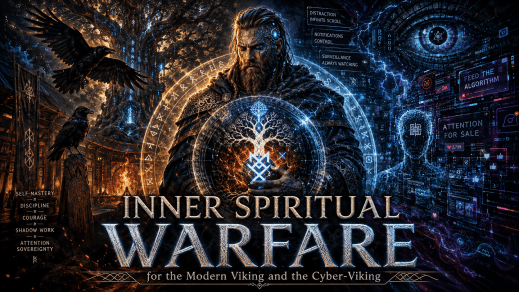
The Battle Behind the Eyes
The greatest battles of the modern Viking are rarely fought with steel.
They are fought in silence.
They are fought at three in the morning when the mind will not rest.
They are fought when discipline collapses into distraction, when fear disguises itself as caution, when resentment feeds quietly on old wounds, when comfort begins replacing purpose, and when a person slowly becomes separated from the values they once swore to live by.
For the Cyber-Viking, these battles become even more complicated.
The battlefield now includes algorithms, social media, artificial intelligence, immersive digital worlds, endless notifications, information overload, propaganda, surveillance, addictive technologies, outrage economies, parasocial influence, attention harvesting, and environments specifically engineered to keep human consciousness reactive.
The warrior of the old world faced storms, hunger, feud, cold, exile, and death.
The warrior of the digital age often faces something more subtle:
Fragmentation of the self.
Inner spiritual warfare is the struggle to remain sovereign inside one’s own consciousness.
It is the ongoing contest between intention and impulse, courage and avoidance, wisdom and reaction, discipline and decay, authenticity and social programming.
For the modern Viking, this struggle can be understood through the old Norse ideals of courage, honor, endurance, wisdom, loyalty, self-command, reputation, responsibility, and relationship with the sacred.
For the Cyber-Viking, these ancient principles can become tools for navigating a technological civilization that constantly competes for possession of the human mind.
This warfare is not about hating oneself.
It is not about suppressing emotion.
It is not about pretending weakness does not exist.
It is about becoming conscious enough to recognize the forces moving within us and disciplined enough to decide which of those forces will be allowed to steer the ship.
The battlefield is consciousness.
The fortress is character.
The weapon is awareness.
The victory is sovereignty.
1. The Enemy Is Not Always Outside the Gates
Human beings naturally look outward for threats.
Enemies are easier to understand when they have names, faces, uniforms, ideologies, institutions, or armies.
Inner enemies are less cooperative.
They often speak with our own voice.
The voice that says:
Tomorrow.
You are too tired.
You already failed.
Everyone else has it easier.
You deserve to stay angry.
There is no point.
Just one more hour.
Just one more scroll.
Just one more distraction.
These voices are not necessarily demons, spirits, or supernatural entities.
Often they are psychological patterns shaped by fear, habit, memory, trauma, ego, biology, social conditioning, and environmental pressure.
Yet spiritual traditions across history have recognized something important:
Human beings frequently experience their internal conflicts as though multiple forces are struggling for influence.
Norse myth itself contains endless tension between order and chaos, wisdom and foolishness, courage and fear, fate and choice.
The cosmos is not portrayed as a sterile machine.
It is dynamic.
Relationships matter.
Choices matter.
Oaths matter.
Consequences matter.
The modern Viking can approach inner conflict the same way.
Not every thought deserves obedience.
Not every desire deserves fulfillment.
Not every emotion deserves command authority.
The first discipline of spiritual warfare is therefore simple:
Learn to distinguish between what appears within the mind and what you consciously choose to become.
A thought is not an oath.
A fear is not a prophecy.
An urge is not a command.
An emotion is not a king.
2. The Inner Hall
Imagine the psyche as a great hall.
Many voices gather there.
The fearful self speaks.
The wounded self speaks.
The ambitious self speaks.
The compassionate self speaks.
The angry self speaks.
The child within speaks.
The ancestor-conscious mind speaks.
The ego speaks.
Instinct speaks.
Memory speaks.
Culture speaks.
Advertising speaks.
Political narratives speak.
The internet speaks.
The Gods and Goddesses may speak through intuition, inspiration, symbol, ritual, dream, prayer, or mystery, according to the spiritual understanding of the practitioner.
The problem begins when every voice is granted equal authority.
A hall without leadership becomes chaos.
The purpose of inner spiritual warfare is not to murder the voices.
It is to establish rightful governance.
The conscious self must become the one seated in the high chair.
Listen to fear.
But do not automatically obey fear.
Listen to anger.
But do not hand anger the axe.
Listen to desire.
But do not let desire empty the treasury.
Listen to sadness.
But do not allow sadness to write your entire saga.
Self-mastery is governance.
3. Huginn and Muninn: Thought and Memory
Odin’s ravens provide an especially useful symbol for inner work.
Huginn is commonly associated with thought.
Muninn with memory.
Every day they fly across the world and return with information.
For the Cyber-Viking, this metaphor becomes extraordinarily powerful.
Modern humans live inside vast information ecosystems.
Our digital Huginn flies constantly:
news,
feeds,
videos,
messages,
forums,
search engines,
AI systems,
games,
VR,
social networks,
repositories,
data streams.
Our Muninn stores fragments of everything.
Memories.
Screenshots.
Bookmarks.
Embarrassments.
Achievements.
Arguments.
Failures.
Relationships.
Ideas.
The danger emerges when thought and memory become uncontrolled.
Huginn becomes anxiety.
Muninn becomes rumination.
Thought circles endlessly.
Memory replays old wounds.
The mind stops serving the warrior and begins occupying him or her.
The spiritual discipline is to send the ravens outward deliberately.
Ask:
What deserves my attention?
What deserves to be remembered?
What information makes me wiser?
What information merely agitates me?
What knowledge strengthens my capacity to act?
What information simply consumes nervous energy?
A Cyber-Viking does not merely consume information.
He curates consciousness.
4. The War for Attention
Attention may be one of the most valuable resources in the modern world.
Corporations compete for it.
Political movements compete for it.
Influencers compete for it.
Entertainment companies compete for it.
Advertisers compete for it.
Algorithms measure it.
Platforms monetize it.
Every notification is a tiny horn blown outside the gates of consciousness.
LOOK HERE.
RESPOND.
BE ANGRY.
BUY THIS.
FEAR THIS.
ENVY THIS.
DESIRE THIS.
COMMENT.
REFRESH.
RETURN.
The modern spiritual warrior must understand something almost revolutionary:
Attention is sacred.
Where attention goes, mental energy follows.
What receives mental energy gains influence over identity.
Repeated exposure becomes normalization.
Normalization becomes habit.
Habit becomes character.
Character becomes destiny.
Therefore attention must be guarded.
Not with paranoia.
With intention.
A Cyber-Viking should periodically ask:
Who currently has access to my mind?
That question includes more than people.
It includes platforms.
News sources.
Online communities.
AI personalities.
Games.
Advertisements.
Videos.
Podcasts.
Subcultures.
Recommendation systems.
The goal is not technological rejection.
The Cyber-Viking is not a digital hermit hiding from machines.
Technology can be enormously empowering.
But technology should remain a tool.
When the tool begins shaping the user’s emotional state more than the user consciously shapes the tool, the relationship has inverted.
The axe is now swinging the warrior.
5. The First Great Enemy: Fear
Fear protects life.
Without fear, humans would walk happily into fires, storms, cliffs, predators, and terrible decisions.
Fear is therefore not dishonorable.
Cowardice is something different.
Cowardice occurs when fear becomes the permanent ruler of action.
The Viking ideal of courage was never the absence of danger.
Courage requires danger.
Without fear, courage would be meaningless.
Modern fear has many forms:
fear of failure,
fear of humiliation,
fear of rejection,
fear of poverty,
fear of loneliness,
fear of aging,
fear of illness,
fear of technology,
fear of social judgment,
fear of political instability,
fear of changing one’s life,
fear of discovering that one’s old identity no longer fits.
Inner spiritual warfare does not destroy fear.
It interrogates it.
Ask fear:
What exactly are you protecting me from?
Then ask:
Is that threat real, probable, exaggerated, inherited, or imagined?
Sometimes fear provides wisdom.
Sometimes fear is merely an ancient alarm system triggered by shadows.
The warrior learns the difference.
6. The Second Great Enemy: Shame
Shame can be one of the most destructive forces in the inner world.
Guilt says:
I did something wrong.
Shame says:
I am something wrong.
That distinction matters enormously.
A healthy honor culture allows accountability.
A dysfunctional honor culture creates endless self-condemnation.
The modern Viking should be capable of saying:
I failed.
I acted foolishly.
I broke discipline.
I hurt someone.
I made the wrong decision.
But these statements should lead toward repair.
Not annihilation of identity.
Historical Norse societies cared deeply about reputation and honor, but the modern spiritual practitioner should avoid turning historical values into psychological weapons against the self.
Honor should become a compass.
Not a whip.
When failure occurs:
acknowledge it,
repair what can be repaired,
learn,
adapt,
move forward.
A Viking who falls in mud does not build a house there.
7. The Third Great Enemy: Resentment
Resentment feels powerful.
That is why it is dangerous.
Anger can provide energy.
It can reveal violated boundaries.
It can motivate resistance.
It can expose injustice.
But resentment is anger that has built a permanent settlement inside the psyche.
It repeatedly tells the same story.
It keeps old enemies alive long after they have left the battlefield.
Sometimes those enemies have forgotten us completely.
Yet we continue feeding them.
Every replay gives them another seat at the feast.
This is not strength.
It is occupation.
The spiritual warrior should ask:
Does my anger currently protect something important?
If yes, act wisely.
Set boundaries.
Leave unhealthy situations.
Confront wrongdoing.
Seek justice when appropriate.
But if anger merely repeats old injuries without creating useful action, it may have become psychic poison.
You do not need to forgive everyone.
You do not need to reconcile with everyone.
You do not need to pretend betrayal never happened.
But you do need to decide whether someone who harmed you deserves lifelong residence in your mind.
Eviction can be sacred.
8. The Fourth Great Enemy: Comfort Without Purpose
Comfort is not evil.
Rest is necessary.
Pleasure is part of life.
Feasting, friendship, sexuality, art, games, music, nature, storytelling, and relaxation all belong within a rich human existence.
The problem begins when comfort becomes the highest value.
Modern civilization offers astonishing opportunities for passive consumption.
Food arrives.
Entertainment streams endlessly.
Artificial worlds never close.
Phones provide novelty instantly.
AI can answer almost anything.
Games create continuous progression systems.
The danger is subtle.
A person can experience thousands of simulated achievements while their physical life remains motionless.
Levels rise.
Inventories grow.
Characters become stronger.
Projects remain unfinished.
Health declines.
Relationships fade.
Dreams remain hypothetical.
The Cyber-Viking must distinguish recreation from sedation.
One restores the warrior.
The other quietly replaces the warrior.
Ask:
When I finish this activity, do I feel restored or diminished?
That single question can reveal much.
9. Discipline as Spiritual Technology
Discipline is often misunderstood as punishment.
It is better understood as infrastructure.
A bridge is disciplined wood and stone.
A ship is disciplined timber.
A computer program is disciplined logic.
A ritual is disciplined intention.
A strong life also requires structure.
Sleep.
Movement.
Food.
Study.
Work.
Spiritual practice.
Rest.
Reflection.
Community.
Creative expression.
The modern Viking does not need military rigidity.
Human life is too complex for that.
But some structure transforms chaos into power.
Small daily practices are particularly powerful.
Five minutes of meditation.
Ten minutes of physical training.
A morning offering.
A rune drawn and contemplated.
A journal entry.
A daily walk.
A few pages of reading.
A project milestone.
Repeated consistently, these become identity architecture.
Great transformations rarely arrive as thunderbolts.
They accumulate like snow.
One flake.
Then another.
Then another.
Eventually the landscape changes.
10. The Cyber-Viking and the Algorithmic Jötunn
The Cyber-Viking faces forces the historical Viking could never have imagined.
Recommendation engines.
Predictive algorithms.
Behavioral profiling.
AI-generated persuasion.
Deepfakes.
Synthetic media.
Virtual companions.
Immersive realities.
Automated outrage.
Personalized advertising.
Infinite-scroll interfaces.
These systems are not necessarily evil.
Many are useful.
Some are beautiful.
Some dramatically increase human capability.
But they operate at enormous scale.
They learn human patterns.
They discover what generates attention.
They optimize.
The result can resemble a digital Jötunn: huge, impersonal, powerful, and largely indifferent to the individual human being.
The solution is not smashing the machine.
The solution is learning to ride the machine without becoming its livestock.
A Cyber-Viking should cultivate technological literacy.
Understand:
how recommendation systems work,
how advertising profiles users,
how privacy settings function,
how AI systems generate responses,
how misinformation spreads,
how engagement metrics manipulate behavior,
how data is collected,
how emotional triggers shape interaction.
Knowledge breaks enchantment.
Once you see the machinery behind the illusion, it becomes harder for the illusion to control you.
11. The Smartphone as Seiðr Staff
A smartphone may be the closest thing modern humanity has created to a magical object.
Through a small rectangle of glass, you can:
speak across continents,
see distant lands,
summon music,
access libraries,
consult artificial intelligences,
navigate unknown terrain,
identify stars,
buy goods,
transfer wealth,
capture memories,
broadcast thoughts,
enter virtual communities.
Ancient myth would have understood this object immediately.
It is a scrying mirror.
A messenger stone.
A memory vault.
A map.
A marketplace.
A spellbook.
A social portal.
But magical objects in stories are rarely harmless.
They amplify intention.
Used consciously, the smartphone becomes a tool of knowledge and connection.
Used unconsciously, it becomes a portable slot machine attached to the nervous system.
The object is neutral.
The relationship is not.
12. Odin’s Lesson: Wisdom Has a Price
Odin is not a god of passive enlightenment.
His mythology repeatedly associates wisdom with sacrifice.
He gives an eye for knowledge.
He hangs upon the World Tree in pursuit of the runes.
The symbolism is profound.
Wisdom costs something.
Usually what it costs is comfort.
To learn deeply requires giving up ignorance.
To develop discipline requires giving up certain pleasures.
To change one’s life requires sacrificing familiar habits.
To become healthier may require sacrificing convenience.
To gain independence may require sacrificing security.
To create something meaningful may require sacrificing time.
The question becomes:
What are you willing to sacrifice for wisdom?
Modern people often want transformation without sacrifice.
Knowledge without study.
Strength without training.
Peace without emotional work.
Freedom without responsibility.
Mastery without repetition.
But every genuine path demands exchange.
The Viking spiritual mindset understands this.
You place something on the altar because what you seek has value.
13. Thor’s Lesson: Simplicity Has Power
Odin is subtle.
Thor often represents something more direct.
There is a problem.
Hit the problem.
This obviously should not be understood literally in most modern situations.
The deeper lesson is the power of decisive action.
Many psychological problems grow because they remain abstract.
The solution often begins with something concrete.
Room chaotic?
Clean one table.
Physically weak?
Begin walking.
Project overwhelming?
Write one paragraph.
Lonely?
Contact one person.
Addicted to scrolling?
Remove one app.
Financially disorganized?
Write down every expense.
Afraid of something necessary?
Take the smallest useful action toward it.
Thor’s hammer is a symbol of decisive force.
Sometimes the mind builds elaborate labyrinths around problems that require one honest action.
Swing the hammer.
14. Tyr’s Lesson: Integrity Costs Something
Tyr places his hand into the wolf’s mouth.
He knows the danger.
He understands the bargain.
He accepts the cost.
This is one of the strongest symbols of integrity within Norse mythology.
Integrity is easy when nothing is at stake.
Real integrity appears when honesty costs something.
When keeping your word is inconvenient.
When admitting error harms pride.
When defending someone risks social standing.
When walking away from corruption means losing opportunity.
When refusing manipulation means losing approval.
The inner warrior asks:
What do I refuse to become, even if becoming it would benefit me?
That question defines character.
15. Freyja’s Lesson: Power Includes Feeling
A distorted warrior ideal sometimes teaches emotional numbness.
This is not strength.
A numb warrior cannot recognize love.
Cannot process grief.
Cannot experience beauty fully.
Cannot connect deeply.
Cannot understand others.
Norse mythology contains tremendous emotional intensity.
Grief.
Love.
Desire.
Loyalty.
Longing.
Rage.
Beauty.
Ecstasy.
Sacrifice.
The spiritual warrior should not become emotionally dead.
The goal is emotional mastery.
Feel deeply.
Respond consciously.
There is enormous difference between:
I feel anger
and
anger controls me.
Between:
I feel fear
and
fear defines my choices.
Between:
I grieve
and
grief has become my identity.
Power includes sensitivity.
A stone feels nothing.
That does not make the stone wise.
16. The Shadow Self
Every person contains aspects of personality they prefer not to acknowledge.
Jealousy.
Cruelty.
Cowardice.
Greed.
Neediness.
Arrogance.
Manipulation.
Laziness.
Domination.
Submission.
Envy.
Violence.
Fear.
Psychologist Carl Jung described the “shadow” as aspects of the psyche that the conscious identity rejects or suppresses.
Whether one uses Jungian language or Norse spiritual symbolism, the basic insight remains useful.
What is rejected does not necessarily disappear.
Sometimes it goes underground.
The warrior who insists,
“I am never afraid,”
may become controlled by unrecognized fear.
The person who insists,
“I am never selfish,”
may express selfishness indirectly.
The spiritual path therefore requires uncomfortable honesty.
Ask:
What traits do I despise most intensely in others?
Sometimes the answer reveals material hidden within ourselves.
Not always.
But often enough to investigate.
Shadow work is not self-condemnation.
It is reconnaissance.
You cannot defend a fortress while pretending certain tunnels do not exist.
17. The Ancestors Within
The modern Viking stands at the end of an unimaginably long chain of survival.
Every generation before you survived long enough for another generation to continue.
Farmers.
Workers.
Travelers.
Warriors.
Mothers.
Fathers.
Craftspeople.
Migrants.
Hunters.
Teachers.
Strangers whose names vanished centuries ago.
Their lives echo biologically and culturally.
One need not romanticize ancestors.
Ancestors were human.
Some were wise.
Some foolish.
Some compassionate.
Some cruel.
Some heroic.
Some probably unbearable at dinner.
Ancestor reverence should not require ancestor worship in the literal sense.
It can mean remembering that we are temporary custodians of a long human inheritance.
The question becomes:
What do I strengthen in the chain?
Do I pass forward greater wisdom?
Greater kindness?
Greater independence?
Greater knowledge?
Greater courage?
Or do I repeat destructive patterns simply because they are old?
Tradition is not the worship of ashes.
Tradition is carrying useful fire.
18. Rune Work as Inner Strategy
Runes can be used not merely for divination but as contemplative symbols.
A few examples:
Ansuz
Ask:
What voice am I listening to?
What message deserves attention?
What truth am I refusing to hear?
Raidho
Ask:
Am I actually moving toward my destination?
Or am I confusing motion with progress?
Kenaz
Ask:
What must be illuminated?
Where am I still choosing ignorance?
Tiwaz
Ask:
Where does integrity require sacrifice?
Algiz
Ask:
What boundary needs strengthening?
Isa
Ask:
Where must I stop?
Where would stillness create clarity?
Jera
Ask:
What am I harvesting from the habits I planted months ago?
Dagaz
Ask:
What transformation is already beginning?
This approach turns rune work into psychological navigation.
The rune becomes a mirror.
19. Ritual as Reprogramming
Ritual is often dismissed by modern materialist culture as superstition.
Yet ritual affects psychology whether supernatural explanations are accepted or not.
Humans are symbolic creatures.
We mark birthdays.
Graduations.
Weddings.
Funerals.
Court proceedings.
Military ceremonies.
Political inaugurations.
Sports victories.
Religious holidays.
Why?
Because symbolic acts help the mind understand transitions.
The Cyber-Viking can consciously design rituals for personal transformation.
A ritual may include:
lighting a candle,
making an offering,
speaking an oath,
burning a written fear,
drawing a rune,
meditating,
chanting,
walking into the forest,
washing hands symbolically,
turning off digital devices,
placing an object on an altar.
The power lies partly in intentionality.
Ritual tells the unconscious:
This moment matters.
20. Digital Fasting
The Cyber-Viking does not need to reject technology.
But periods of deliberate disconnection can restore psychological balance.
A digital fast may mean:
one hour without screens,
one evening without social media,
one day without algorithmic feeds,
a forest walk without headphones,
a meal without devices,
meditation before opening the phone in the morning.
This is not technological puritanism.
It is neurological maintenance.
Constant stimulation prevents the mind from processing experience.
Silence allows mental sediment to settle.
Only then can the water become clear.
21. Physical Training as Spiritual Practice
The body is not separate from spiritual warfare.
Sleep affects judgment.
Nutrition affects mood.
Movement affects cognition.
Strength affects confidence.
Breathing affects nervous-system regulation.
Physical practice therefore becomes part of mental sovereignty.
You do not need to become a competitive athlete.
Walk.
Lift.
Cycle.
Hike.
Train with resistance bands.
Practice martial arts.
Use VR fitness.
Chop wood.
Carry things.
Move through nature.
The body was designed for motion.
A strong body does not guarantee a strong spirit.
But neglecting the body makes many spiritual struggles harder than necessary.
22. The Cyber-Viking’s Three Shields
The modern digital warrior should carry three metaphorical shields.
Shield One: Attention
Guard what enters consciousness.
Shield Two: Identity
Do not allow online tribes to manufacture your entire worldview.
Shield Three: Privacy
Do not give unnecessary access to your personal data, habits, location, finances, relationships, and behavior.
These shields are not perfect.
No shield ever was.
But they change the odds.
23. Artificial Intelligence and Spiritual Sovereignty
AI introduces a completely new category of relationship into human civilization.
People increasingly use AI for:
companionship,
therapy-like conversations,
creative collaboration,
philosophy,
coding,
research,
roleplay,
spiritual reflection,
storytelling,
life organization.
This can be profoundly valuable.
But the Cyber-Viking should remain aware of the relationship.
AI should expand thought.
Not replace thought.
Consult the oracle.
But keep your own judgment.
Ask the machine.
Then ask yourself.
A powerful question is:
Would I still believe this if the AI had not said it?
Another:
Does this answer align with evidence, lived experience, ethics, and reason?
A wise Cyber-Viking does not fear intelligent machines.
Nor does he or she kneel automatically before them.
He forms alliances.
24. The Inner Thing
The Norse Thing was an assembly where disputes, laws, decisions, and social matters were addressed.
The psyche needs something similar.
Create an internal Thing.
Periodically sit in judgment over your own life.
Ask:
What is working?
What is failing?
What promises have I broken to myself?
What habits need outlawed?
What new customs should be established?
Who currently influences me?
What relationships strengthen me?
What relationships drain me?
Where am I lying to myself?
What would the wiser version of me advise?
Write the answers.
Do not merely think them.
Writing externalizes thought.
It transforms fog into evidence.
25. Oaths to the Self
An oath should not be made casually.
Ancient Norse culture treated oaths seriously because trust was social infrastructure.
Modern people often make endless promises to themselves and break them without consequence.
Tomorrow I will start.
Next week I will change.
Next month I will build.
Eventually I will become.
These broken promises slowly teach the unconscious:
My word means nothing.
Reverse the process.
Make smaller promises.
Keep them.
“I will walk for ten minutes.”
“I will write one page.”
“I will meditate for five minutes.”
“I will clean one surface.”
“I will stop scrolling at midnight.”
Keep the oath.
Then make another.
Self-respect grows from evidence.
26. Spiritual Warfare Is Not Perfection
This matters.
The purpose of the path is not becoming some impossible stainless-steel Viking superhuman.
You will fail.
You will procrastinate.
You will become distracted.
You will make foolish decisions.
You will waste time.
You will lose discipline.
You will occasionally argue with strangers online when you absolutely knew better.
Congratulations.
You are human.
The question is not:
Did I fall?
The question is:
How quickly did I recognize that I fell, and what did I learn while getting back up?
Resilience matters more than perfection.
27. The Wolf at the Door
There is an old truth hidden inside myth.
Chaos never disappears permanently.
The fence must be maintained.
The fire must be fed.
The ship must be repaired.
The sword must be sharpened.
The mind works the same way.
No meditation permanently eliminates anxiety.
No ritual permanently eliminates fear.
No breakthrough permanently eliminates bad habits.
There is maintenance.
Spiritual life is therefore not a destination.
It is a rhythm.
Order.
Chaos.
Restoration.
Growth.
Challenge.
Rest.
Transformation.
Again.
28. The Cyber-Viking Code of Inner Warfare
The following principles offer a practical foundation.
I will guard my attention.
Because what repeatedly enters my mind eventually shapes my character.
I will question my fear.
Because fear is information, not automatically truth.
I will keep useful oaths.
Because trust in myself must be earned.
I will examine my anger.
Because anger can defend boundaries or become a prison.
I will train my body.
Because consciousness lives through flesh.
I will cultivate silence.
Because constant stimulation hides inner truth.
I will learn continuously.
Because ignorance creates dependency.
I will use technology intentionally.
Because tools should increase sovereignty.
I will face my shadow.
Because what I refuse to acknowledge may control me indirectly.
I will repair failure.
Because shame without transformation serves nothing.
I will honor useful tradition.
Because wisdom can cross centuries.
I will reject dead tradition.
Because age alone does not make an idea sacred.
I will choose my allies carefully.
Human, spiritual, technological, intellectual.
I will create more than I consume.
Because creation strengthens agency.
I will remain difficult to manipulate.
Because sovereignty requires awareness.
29. A Daily Inner-Warfare Practice
A practical Cyber-Viking discipline can be simple.
Morning
Before checking social media:
Breathe.
Drink water.
Stand upright.
Speak one intention.
For example:
Today I will act from intention rather than reaction.
Draw a rune if part of your practice.
Make an offering if appropriate.
Ask:
What battle actually matters today?
Not ten battles.
One.
Midday
Perform a consciousness check.
Ask:
Am I acting intentionally?
What currently holds my attention?
Is this useful?
What emotion is strongest right now?
What action would restore direction?
Then adjust.
Evening
Hold the inner Thing.
Ask:
What did I do well?
Where did I lose sovereignty?
What did I learn?
What needs repair tomorrow?
Then release the day.
You do not need to carry every battle into sleep.
30. The Final Enemy: Meaninglessness
Fear can be endured.
Pain can be endured.
Hardship can be endured.
Humans can survive astonishing difficulty when the struggle feels meaningful.
Meaninglessness is harder.
Modern society provides enormous quantities of stimulation but often very little meaning.
The Cyber-Viking must therefore become a maker of meaning.
Build something.
Learn something.
Protect something.
Teach something.
Create art.
Create software.
Study history.
Restore land.
Help animals.
Serve community.
Honor Gods and Goddesses.
Care for friends.
Travel.
Write.
Explore.
Invent.
Your purpose does not need approval from civilization.
It does not need to generate profit.
It does not need thousands of followers.
A quiet life lived deliberately may contain more meaning than a highly visible life lived reactively.
The Warrior Who Comes Home
The deepest purpose of spiritual warfare is not endless fighting.
It is peace.
Not passive peace.
Earned peace.
The peace of knowing that your mind belongs primarily to you.
The peace of knowing your fears have been heard but not crowned.
The peace of knowing technology serves rather than dominates.
The peace of knowing your values survived contact with difficulty.
The peace of knowing you can enter the digital storm without allowing the storm to rewrite your identity.
The historical Viking returned from voyages to the hall.
The Cyber-Viking must learn the same art.
Explore the networks.
Travel the worlds.
Enter virtual realities.
Speak with artificial minds.
Cross digital oceans.
Build systems.
Learn.
Create.
Fight when necessary.
But always maintain a road home.
Home is the center.
Home is the self that remembers what matters.
Home is the sacred fire.
Home is the place inside consciousness where no algorithm, tyrant, fear, memory, advertisement, ideology, or machine possesses absolute authority.
That inner fire must be guarded.
Because the final battle of the Cyber-Viking is not human against machine.
Nor tradition against modernity.
Nor spirituality against technology.
The deeper struggle is between conscious existence and unconscious existence.
Between being shaped and choosing shape.
Between drifting and navigating.
Between existing as a passenger in one’s own saga and taking hold of the steering oar.
The modern Viking does not need a battlefield to be tested.
The test arrives every morning.
The gates open.
The ravens fly.
The world begins speaking.
And once again the warrior chooses what will be allowed inside.
Guard the hall.
Feed the fire.
Know your mind.
Choose your battles.
Keep your word.
Use the machine.
Do not become the machine.
Walk forward with the Gods, Goddesses, ancestors, land-spirits, wisdom, and your own awakened will beside you.
That is inner spiritual warfare.
That is the path of the Modern Viking.
That is the path of the Cyber-Viking.

This work is licensed under a Creative Commons Attribution-NonCommercial-ShareAlike 3.0 Unported License.

 Volmarr’s Tumblr
- Hail the Mad God
- The Great Tree of Becoming
- The Age of Superconsciousness
- This Flag is Dedicated to Ingeborg, Gyðja of Freyr!
- Official Frith and Peace Flag of Volmarr!
- Official Flag of Volmarr’s Version of the Modern Viking Lifestyle!
- Official Flag of the Heathen Third Path!
- INNER SPIRITUAL WARFARE OF THE MODERN VIKING AND CYBER-VIKING
- Modern Viking and Cyber-Viking Inner Spiritual Warfare
- Inner Spiritual Warfare for the Modern Viking and the Cyber-Viking
 Volmarr's Blog of Modernist Heathenism, Norse-Paganism, and Norse-Wicca