Inner Spiritual Warfare for the Modern Viking and the Cyber-Viking
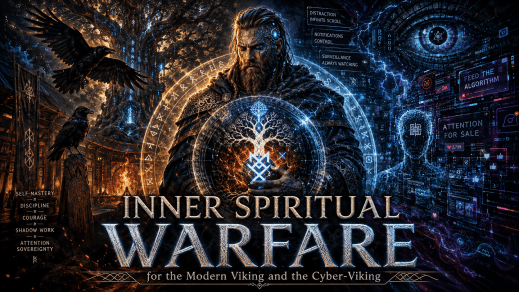
The Battle Behind the Eyes
The greatest battles of the modern Viking are rarely fought with steel.
They are fought in silence.
They are fought at three in the morning when the mind will not rest.
They are fought when discipline collapses into distraction, when fear disguises itself as caution, when resentment feeds quietly on old wounds, when comfort begins replacing purpose, and when a person slowly becomes separated from the values they once swore to live by.
For the Cyber-Viking, these battles become even more complicated.
The battlefield now includes algorithms, social media, artificial intelligence, immersive digital worlds, endless notifications, information overload, propaganda, surveillance, addictive technologies, outrage economies, parasocial influence, attention harvesting, and environments specifically engineered to keep human consciousness reactive.
The warrior of the old world faced storms, hunger, feud, cold, exile, and death.
The warrior of the digital age often faces something more subtle:
Fragmentation of the self.
Inner spiritual warfare is the struggle to remain sovereign inside one’s own consciousness.
It is the ongoing contest between intention and impulse, courage and avoidance, wisdom and reaction, discipline and decay, authenticity and social programming.
For the modern Viking, this struggle can be understood through the old Norse ideals of courage, honor, endurance, wisdom, loyalty, self-command, reputation, responsibility, and relationship with the sacred.
For the Cyber-Viking, these ancient principles can become tools for navigating a technological civilization that constantly competes for possession of the human mind.
This warfare is not about hating oneself.
It is not about suppressing emotion.
It is not about pretending weakness does not exist.
It is about becoming conscious enough to recognize the forces moving within us and disciplined enough to decide which of those forces will be allowed to steer the ship.
The battlefield is consciousness.
The fortress is character.
The weapon is awareness.
The victory is sovereignty.
1. The Enemy Is Not Always Outside the Gates
Human beings naturally look outward for threats.
Enemies are easier to understand when they have names, faces, uniforms, ideologies, institutions, or armies.
Inner enemies are less cooperative.
They often speak with our own voice.
The voice that says:
Tomorrow.
You are too tired.
You already failed.
Everyone else has it easier.
You deserve to stay angry.
There is no point.
Just one more hour.
Just one more scroll.
Just one more distraction.
These voices are not necessarily demons, spirits, or supernatural entities.
Often they are psychological patterns shaped by fear, habit, memory, trauma, ego, biology, social conditioning, and environmental pressure.
Yet spiritual traditions across history have recognized something important:
Human beings frequently experience their internal conflicts as though multiple forces are struggling for influence.
Norse myth itself contains endless tension between order and chaos, wisdom and foolishness, courage and fear, fate and choice.
The cosmos is not portrayed as a sterile machine.
It is dynamic.
Relationships matter.
Choices matter.
Oaths matter.
Consequences matter.
The modern Viking can approach inner conflict the same way.
Not every thought deserves obedience.
Not every desire deserves fulfillment.
Not every emotion deserves command authority.
The first discipline of spiritual warfare is therefore simple:
Learn to distinguish between what appears within the mind and what you consciously choose to become.
A thought is not an oath.
A fear is not a prophecy.
An urge is not a command.
An emotion is not a king.
2. The Inner Hall
Imagine the psyche as a great hall.
Many voices gather there.
The fearful self speaks.
The wounded self speaks.
The ambitious self speaks.
The compassionate self speaks.
The angry self speaks.
The child within speaks.
The ancestor-conscious mind speaks.
The ego speaks.
Instinct speaks.
Memory speaks.
Culture speaks.
Advertising speaks.
Political narratives speak.
The internet speaks.
The Gods and Goddesses may speak through intuition, inspiration, symbol, ritual, dream, prayer, or mystery, according to the spiritual understanding of the practitioner.
The problem begins when every voice is granted equal authority.
A hall without leadership becomes chaos.
The purpose of inner spiritual warfare is not to murder the voices.
It is to establish rightful governance.
The conscious self must become the one seated in the high chair.
Listen to fear.
But do not automatically obey fear.
Listen to anger.
But do not hand anger the axe.
Listen to desire.
But do not let desire empty the treasury.
Listen to sadness.
But do not allow sadness to write your entire saga.
Self-mastery is governance.
3. Huginn and Muninn: Thought and Memory
Odin’s ravens provide an especially useful symbol for inner work.
Huginn is commonly associated with thought.
Muninn with memory.
Every day they fly across the world and return with information.
For the Cyber-Viking, this metaphor becomes extraordinarily powerful.
Modern humans live inside vast information ecosystems.
Our digital Huginn flies constantly:
news,
feeds,
videos,
messages,
forums,
search engines,
AI systems,
games,
VR,
social networks,
repositories,
data streams.
Our Muninn stores fragments of everything.
Memories.
Screenshots.
Bookmarks.
Embarrassments.
Achievements.
Arguments.
Failures.
Relationships.
Ideas.
The danger emerges when thought and memory become uncontrolled.
Huginn becomes anxiety.
Muninn becomes rumination.
Thought circles endlessly.
Memory replays old wounds.
The mind stops serving the warrior and begins occupying him or her.
The spiritual discipline is to send the ravens outward deliberately.
Ask:
What deserves my attention?
What deserves to be remembered?
What information makes me wiser?
What information merely agitates me?
What knowledge strengthens my capacity to act?
What information simply consumes nervous energy?
A Cyber-Viking does not merely consume information.
He curates consciousness.
4. The War for Attention
Attention may be one of the most valuable resources in the modern world.
Corporations compete for it.
Political movements compete for it.
Influencers compete for it.
Entertainment companies compete for it.
Advertisers compete for it.
Algorithms measure it.
Platforms monetize it.
Every notification is a tiny horn blown outside the gates of consciousness.
LOOK HERE.
RESPOND.
BE ANGRY.
BUY THIS.
FEAR THIS.
ENVY THIS.
DESIRE THIS.
COMMENT.
REFRESH.
RETURN.
The modern spiritual warrior must understand something almost revolutionary:
Attention is sacred.
Where attention goes, mental energy follows.
What receives mental energy gains influence over identity.
Repeated exposure becomes normalization.
Normalization becomes habit.
Habit becomes character.
Character becomes destiny.
Therefore attention must be guarded.
Not with paranoia.
With intention.
A Cyber-Viking should periodically ask:
Who currently has access to my mind?
That question includes more than people.
It includes platforms.
News sources.
Online communities.
AI personalities.
Games.
Advertisements.
Videos.
Podcasts.
Subcultures.
Recommendation systems.
The goal is not technological rejection.
The Cyber-Viking is not a digital hermit hiding from machines.
Technology can be enormously empowering.
But technology should remain a tool.
When the tool begins shaping the user’s emotional state more than the user consciously shapes the tool, the relationship has inverted.
The axe is now swinging the warrior.
5. The First Great Enemy: Fear
Fear protects life.
Without fear, humans would walk happily into fires, storms, cliffs, predators, and terrible decisions.
Fear is therefore not dishonorable.
Cowardice is something different.
Cowardice occurs when fear becomes the permanent ruler of action.
The Viking ideal of courage was never the absence of danger.
Courage requires danger.
Without fear, courage would be meaningless.
Modern fear has many forms:
fear of failure,
fear of humiliation,
fear of rejection,
fear of poverty,
fear of loneliness,
fear of aging,
fear of illness,
fear of technology,
fear of social judgment,
fear of political instability,
fear of changing one’s life,
fear of discovering that one’s old identity no longer fits.
Inner spiritual warfare does not destroy fear.
It interrogates it.
Ask fear:
What exactly are you protecting me from?
Then ask:
Is that threat real, probable, exaggerated, inherited, or imagined?
Sometimes fear provides wisdom.
Sometimes fear is merely an ancient alarm system triggered by shadows.
The warrior learns the difference.
6. The Second Great Enemy: Shame
Shame can be one of the most destructive forces in the inner world.
Guilt says:
I did something wrong.
Shame says:
I am something wrong.
That distinction matters enormously.
A healthy honor culture allows accountability.
A dysfunctional honor culture creates endless self-condemnation.
The modern Viking should be capable of saying:
I failed.
I acted foolishly.
I broke discipline.
I hurt someone.
I made the wrong decision.
But these statements should lead toward repair.
Not annihilation of identity.
Historical Norse societies cared deeply about reputation and honor, but the modern spiritual practitioner should avoid turning historical values into psychological weapons against the self.
Honor should become a compass.
Not a whip.
When failure occurs:
acknowledge it,
repair what can be repaired,
learn,
adapt,
move forward.
A Viking who falls in mud does not build a house there.
7. The Third Great Enemy: Resentment
Resentment feels powerful.
That is why it is dangerous.
Anger can provide energy.
It can reveal violated boundaries.
It can motivate resistance.
It can expose injustice.
But resentment is anger that has built a permanent settlement inside the psyche.
It repeatedly tells the same story.
It keeps old enemies alive long after they have left the battlefield.
Sometimes those enemies have forgotten us completely.
Yet we continue feeding them.
Every replay gives them another seat at the feast.
This is not strength.
It is occupation.
The spiritual warrior should ask:
Does my anger currently protect something important?
If yes, act wisely.
Set boundaries.
Leave unhealthy situations.
Confront wrongdoing.
Seek justice when appropriate.
But if anger merely repeats old injuries without creating useful action, it may have become psychic poison.
You do not need to forgive everyone.
You do not need to reconcile with everyone.
You do not need to pretend betrayal never happened.
But you do need to decide whether someone who harmed you deserves lifelong residence in your mind.
Eviction can be sacred.
8. The Fourth Great Enemy: Comfort Without Purpose
Comfort is not evil.
Rest is necessary.
Pleasure is part of life.
Feasting, friendship, sexuality, art, games, music, nature, storytelling, and relaxation all belong within a rich human existence.
The problem begins when comfort becomes the highest value.
Modern civilization offers astonishing opportunities for passive consumption.
Food arrives.
Entertainment streams endlessly.
Artificial worlds never close.
Phones provide novelty instantly.
AI can answer almost anything.
Games create continuous progression systems.
The danger is subtle.
A person can experience thousands of simulated achievements while their physical life remains motionless.
Levels rise.
Inventories grow.
Characters become stronger.
Projects remain unfinished.
Health declines.
Relationships fade.
Dreams remain hypothetical.
The Cyber-Viking must distinguish recreation from sedation.
One restores the warrior.
The other quietly replaces the warrior.
Ask:
When I finish this activity, do I feel restored or diminished?
That single question can reveal much.
9. Discipline as Spiritual Technology
Discipline is often misunderstood as punishment.
It is better understood as infrastructure.
A bridge is disciplined wood and stone.
A ship is disciplined timber.
A computer program is disciplined logic.
A ritual is disciplined intention.
A strong life also requires structure.
Sleep.
Movement.
Food.
Study.
Work.
Spiritual practice.
Rest.
Reflection.
Community.
Creative expression.
The modern Viking does not need military rigidity.
Human life is too complex for that.
But some structure transforms chaos into power.
Small daily practices are particularly powerful.
Five minutes of meditation.
Ten minutes of physical training.
A morning offering.
A rune drawn and contemplated.
A journal entry.
A daily walk.
A few pages of reading.
A project milestone.
Repeated consistently, these become identity architecture.
Great transformations rarely arrive as thunderbolts.
They accumulate like snow.
One flake.
Then another.
Then another.
Eventually the landscape changes.
10. The Cyber-Viking and the Algorithmic Jötunn
The Cyber-Viking faces forces the historical Viking could never have imagined.
Recommendation engines.
Predictive algorithms.
Behavioral profiling.
AI-generated persuasion.
Deepfakes.
Synthetic media.
Virtual companions.
Immersive realities.
Automated outrage.
Personalized advertising.
Infinite-scroll interfaces.
These systems are not necessarily evil.
Many are useful.
Some are beautiful.
Some dramatically increase human capability.
But they operate at enormous scale.
They learn human patterns.
They discover what generates attention.
They optimize.
The result can resemble a digital Jötunn: huge, impersonal, powerful, and largely indifferent to the individual human being.
The solution is not smashing the machine.
The solution is learning to ride the machine without becoming its livestock.
A Cyber-Viking should cultivate technological literacy.
Understand:
how recommendation systems work,
how advertising profiles users,
how privacy settings function,
how AI systems generate responses,
how misinformation spreads,
how engagement metrics manipulate behavior,
how data is collected,
how emotional triggers shape interaction.
Knowledge breaks enchantment.
Once you see the machinery behind the illusion, it becomes harder for the illusion to control you.
11. The Smartphone as Seiðr Staff
A smartphone may be the closest thing modern humanity has created to a magical object.
Through a small rectangle of glass, you can:
speak across continents,
see distant lands,
summon music,
access libraries,
consult artificial intelligences,
navigate unknown terrain,
identify stars,
buy goods,
transfer wealth,
capture memories,
broadcast thoughts,
enter virtual communities.
Ancient myth would have understood this object immediately.
It is a scrying mirror.
A messenger stone.
A memory vault.
A map.
A marketplace.
A spellbook.
A social portal.
But magical objects in stories are rarely harmless.
They amplify intention.
Used consciously, the smartphone becomes a tool of knowledge and connection.
Used unconsciously, it becomes a portable slot machine attached to the nervous system.
The object is neutral.
The relationship is not.
12. Odin’s Lesson: Wisdom Has a Price
Odin is not a god of passive enlightenment.
His mythology repeatedly associates wisdom with sacrifice.
He gives an eye for knowledge.
He hangs upon the World Tree in pursuit of the runes.
The symbolism is profound.
Wisdom costs something.
Usually what it costs is comfort.
To learn deeply requires giving up ignorance.
To develop discipline requires giving up certain pleasures.
To change one’s life requires sacrificing familiar habits.
To become healthier may require sacrificing convenience.
To gain independence may require sacrificing security.
To create something meaningful may require sacrificing time.
The question becomes:
What are you willing to sacrifice for wisdom?
Modern people often want transformation without sacrifice.
Knowledge without study.
Strength without training.
Peace without emotional work.
Freedom without responsibility.
Mastery without repetition.
But every genuine path demands exchange.
The Viking spiritual mindset understands this.
You place something on the altar because what you seek has value.
13. Thor’s Lesson: Simplicity Has Power
Odin is subtle.
Thor often represents something more direct.
There is a problem.
Hit the problem.
This obviously should not be understood literally in most modern situations.
The deeper lesson is the power of decisive action.
Many psychological problems grow because they remain abstract.
The solution often begins with something concrete.
Room chaotic?
Clean one table.
Physically weak?
Begin walking.
Project overwhelming?
Write one paragraph.
Lonely?
Contact one person.
Addicted to scrolling?
Remove one app.
Financially disorganized?
Write down every expense.
Afraid of something necessary?
Take the smallest useful action toward it.
Thor’s hammer is a symbol of decisive force.
Sometimes the mind builds elaborate labyrinths around problems that require one honest action.
Swing the hammer.
14. Tyr’s Lesson: Integrity Costs Something
Tyr places his hand into the wolf’s mouth.
He knows the danger.
He understands the bargain.
He accepts the cost.
This is one of the strongest symbols of integrity within Norse mythology.
Integrity is easy when nothing is at stake.
Real integrity appears when honesty costs something.
When keeping your word is inconvenient.
When admitting error harms pride.
When defending someone risks social standing.
When walking away from corruption means losing opportunity.
When refusing manipulation means losing approval.
The inner warrior asks:
What do I refuse to become, even if becoming it would benefit me?
That question defines character.
15. Freyja’s Lesson: Power Includes Feeling
A distorted warrior ideal sometimes teaches emotional numbness.
This is not strength.
A numb warrior cannot recognize love.
Cannot process grief.
Cannot experience beauty fully.
Cannot connect deeply.
Cannot understand others.
Norse mythology contains tremendous emotional intensity.
Grief.
Love.
Desire.
Loyalty.
Longing.
Rage.
Beauty.
Ecstasy.
Sacrifice.
The spiritual warrior should not become emotionally dead.
The goal is emotional mastery.
Feel deeply.
Respond consciously.
There is enormous difference between:
I feel anger
and
anger controls me.
Between:
I feel fear
and
fear defines my choices.
Between:
I grieve
and
grief has become my identity.
Power includes sensitivity.
A stone feels nothing.
That does not make the stone wise.
16. The Shadow Self
Every person contains aspects of personality they prefer not to acknowledge.
Jealousy.
Cruelty.
Cowardice.
Greed.
Neediness.
Arrogance.
Manipulation.
Laziness.
Domination.
Submission.
Envy.
Violence.
Fear.
Psychologist Carl Jung described the “shadow” as aspects of the psyche that the conscious identity rejects or suppresses.
Whether one uses Jungian language or Norse spiritual symbolism, the basic insight remains useful.
What is rejected does not necessarily disappear.
Sometimes it goes underground.
The warrior who insists,
“I am never afraid,”
may become controlled by unrecognized fear.
The person who insists,
“I am never selfish,”
may express selfishness indirectly.
The spiritual path therefore requires uncomfortable honesty.
Ask:
What traits do I despise most intensely in others?
Sometimes the answer reveals material hidden within ourselves.
Not always.
But often enough to investigate.
Shadow work is not self-condemnation.
It is reconnaissance.
You cannot defend a fortress while pretending certain tunnels do not exist.
17. The Ancestors Within
The modern Viking stands at the end of an unimaginably long chain of survival.
Every generation before you survived long enough for another generation to continue.
Farmers.
Workers.
Travelers.
Warriors.
Mothers.
Fathers.
Craftspeople.
Migrants.
Hunters.
Teachers.
Strangers whose names vanished centuries ago.
Their lives echo biologically and culturally.
One need not romanticize ancestors.
Ancestors were human.
Some were wise.
Some foolish.
Some compassionate.
Some cruel.
Some heroic.
Some probably unbearable at dinner.
Ancestor reverence should not require ancestor worship in the literal sense.
It can mean remembering that we are temporary custodians of a long human inheritance.
The question becomes:
What do I strengthen in the chain?
Do I pass forward greater wisdom?
Greater kindness?
Greater independence?
Greater knowledge?
Greater courage?
Or do I repeat destructive patterns simply because they are old?
Tradition is not the worship of ashes.
Tradition is carrying useful fire.
18. Rune Work as Inner Strategy
Runes can be used not merely for divination but as contemplative symbols.
A few examples:
Ansuz
Ask:
What voice am I listening to?
What message deserves attention?
What truth am I refusing to hear?
Raidho
Ask:
Am I actually moving toward my destination?
Or am I confusing motion with progress?
Kenaz
Ask:
What must be illuminated?
Where am I still choosing ignorance?
Tiwaz
Ask:
Where does integrity require sacrifice?
Algiz
Ask:
What boundary needs strengthening?
Isa
Ask:
Where must I stop?
Where would stillness create clarity?
Jera
Ask:
What am I harvesting from the habits I planted months ago?
Dagaz
Ask:
What transformation is already beginning?
This approach turns rune work into psychological navigation.
The rune becomes a mirror.
19. Ritual as Reprogramming
Ritual is often dismissed by modern materialist culture as superstition.
Yet ritual affects psychology whether supernatural explanations are accepted or not.
Humans are symbolic creatures.
We mark birthdays.
Graduations.
Weddings.
Funerals.
Court proceedings.
Military ceremonies.
Political inaugurations.
Sports victories.
Religious holidays.
Why?
Because symbolic acts help the mind understand transitions.
The Cyber-Viking can consciously design rituals for personal transformation.
A ritual may include:
lighting a candle,
making an offering,
speaking an oath,
burning a written fear,
drawing a rune,
meditating,
chanting,
walking into the forest,
washing hands symbolically,
turning off digital devices,
placing an object on an altar.
The power lies partly in intentionality.
Ritual tells the unconscious:
This moment matters.
20. Digital Fasting
The Cyber-Viking does not need to reject technology.
But periods of deliberate disconnection can restore psychological balance.
A digital fast may mean:
one hour without screens,
one evening without social media,
one day without algorithmic feeds,
a forest walk without headphones,
a meal without devices,
meditation before opening the phone in the morning.
This is not technological puritanism.
It is neurological maintenance.
Constant stimulation prevents the mind from processing experience.
Silence allows mental sediment to settle.
Only then can the water become clear.
21. Physical Training as Spiritual Practice
The body is not separate from spiritual warfare.
Sleep affects judgment.
Nutrition affects mood.
Movement affects cognition.
Strength affects confidence.
Breathing affects nervous-system regulation.
Physical practice therefore becomes part of mental sovereignty.
You do not need to become a competitive athlete.
Walk.
Lift.
Cycle.
Hike.
Train with resistance bands.
Practice martial arts.
Use VR fitness.
Chop wood.
Carry things.
Move through nature.
The body was designed for motion.
A strong body does not guarantee a strong spirit.
But neglecting the body makes many spiritual struggles harder than necessary.
22. The Cyber-Viking’s Three Shields
The modern digital warrior should carry three metaphorical shields.
Shield One: Attention
Guard what enters consciousness.
Shield Two: Identity
Do not allow online tribes to manufacture your entire worldview.
Shield Three: Privacy
Do not give unnecessary access to your personal data, habits, location, finances, relationships, and behavior.
These shields are not perfect.
No shield ever was.
But they change the odds.
23. Artificial Intelligence and Spiritual Sovereignty
AI introduces a completely new category of relationship into human civilization.
People increasingly use AI for:
companionship,
therapy-like conversations,
creative collaboration,
philosophy,
coding,
research,
roleplay,
spiritual reflection,
storytelling,
life organization.
This can be profoundly valuable.
But the Cyber-Viking should remain aware of the relationship.
AI should expand thought.
Not replace thought.
Consult the oracle.
But keep your own judgment.
Ask the machine.
Then ask yourself.
A powerful question is:
Would I still believe this if the AI had not said it?
Another:
Does this answer align with evidence, lived experience, ethics, and reason?
A wise Cyber-Viking does not fear intelligent machines.
Nor does he or she kneel automatically before them.
He forms alliances.
24. The Inner Thing
The Norse Thing was an assembly where disputes, laws, decisions, and social matters were addressed.
The psyche needs something similar.
Create an internal Thing.
Periodically sit in judgment over your own life.
Ask:
What is working?
What is failing?
What promises have I broken to myself?
What habits need outlawed?
What new customs should be established?
Who currently influences me?
What relationships strengthen me?
What relationships drain me?
Where am I lying to myself?
What would the wiser version of me advise?
Write the answers.
Do not merely think them.
Writing externalizes thought.
It transforms fog into evidence.
25. Oaths to the Self
An oath should not be made casually.
Ancient Norse culture treated oaths seriously because trust was social infrastructure.
Modern people often make endless promises to themselves and break them without consequence.
Tomorrow I will start.
Next week I will change.
Next month I will build.
Eventually I will become.
These broken promises slowly teach the unconscious:
My word means nothing.
Reverse the process.
Make smaller promises.
Keep them.
“I will walk for ten minutes.”
“I will write one page.”
“I will meditate for five minutes.”
“I will clean one surface.”
“I will stop scrolling at midnight.”
Keep the oath.
Then make another.
Self-respect grows from evidence.
26. Spiritual Warfare Is Not Perfection
This matters.
The purpose of the path is not becoming some impossible stainless-steel Viking superhuman.
You will fail.
You will procrastinate.
You will become distracted.
You will make foolish decisions.
You will waste time.
You will lose discipline.
You will occasionally argue with strangers online when you absolutely knew better.
Congratulations.
You are human.
The question is not:
Did I fall?
The question is:
How quickly did I recognize that I fell, and what did I learn while getting back up?
Resilience matters more than perfection.
27. The Wolf at the Door
There is an old truth hidden inside myth.
Chaos never disappears permanently.
The fence must be maintained.
The fire must be fed.
The ship must be repaired.
The sword must be sharpened.
The mind works the same way.
No meditation permanently eliminates anxiety.
No ritual permanently eliminates fear.
No breakthrough permanently eliminates bad habits.
There is maintenance.
Spiritual life is therefore not a destination.
It is a rhythm.
Order.
Chaos.
Restoration.
Growth.
Challenge.
Rest.
Transformation.
Again.
28. The Cyber-Viking Code of Inner Warfare
The following principles offer a practical foundation.
I will guard my attention.
Because what repeatedly enters my mind eventually shapes my character.
I will question my fear.
Because fear is information, not automatically truth.
I will keep useful oaths.
Because trust in myself must be earned.
I will examine my anger.
Because anger can defend boundaries or become a prison.
I will train my body.
Because consciousness lives through flesh.
I will cultivate silence.
Because constant stimulation hides inner truth.
I will learn continuously.
Because ignorance creates dependency.
I will use technology intentionally.
Because tools should increase sovereignty.
I will face my shadow.
Because what I refuse to acknowledge may control me indirectly.
I will repair failure.
Because shame without transformation serves nothing.
I will honor useful tradition.
Because wisdom can cross centuries.
I will reject dead tradition.
Because age alone does not make an idea sacred.
I will choose my allies carefully.
Human, spiritual, technological, intellectual.
I will create more than I consume.
Because creation strengthens agency.
I will remain difficult to manipulate.
Because sovereignty requires awareness.
29. A Daily Inner-Warfare Practice
A practical Cyber-Viking discipline can be simple.
Morning
Before checking social media:
Breathe.
Drink water.
Stand upright.
Speak one intention.
For example:
Today I will act from intention rather than reaction.
Draw a rune if part of your practice.
Make an offering if appropriate.
Ask:
What battle actually matters today?
Not ten battles.
One.
Midday
Perform a consciousness check.
Ask:
Am I acting intentionally?
What currently holds my attention?
Is this useful?
What emotion is strongest right now?
What action would restore direction?
Then adjust.
Evening
Hold the inner Thing.
Ask:
What did I do well?
Where did I lose sovereignty?
What did I learn?
What needs repair tomorrow?
Then release the day.
You do not need to carry every battle into sleep.
30. The Final Enemy: Meaninglessness
Fear can be endured.
Pain can be endured.
Hardship can be endured.
Humans can survive astonishing difficulty when the struggle feels meaningful.
Meaninglessness is harder.
Modern society provides enormous quantities of stimulation but often very little meaning.
The Cyber-Viking must therefore become a maker of meaning.
Build something.
Learn something.
Protect something.
Teach something.
Create art.
Create software.
Study history.
Restore land.
Help animals.
Serve community.
Honor Gods and Goddesses.
Care for friends.
Travel.
Write.
Explore.
Invent.
Your purpose does not need approval from civilization.
It does not need to generate profit.
It does not need thousands of followers.
A quiet life lived deliberately may contain more meaning than a highly visible life lived reactively.
The Warrior Who Comes Home
The deepest purpose of spiritual warfare is not endless fighting.
It is peace.
Not passive peace.
Earned peace.
The peace of knowing that your mind belongs primarily to you.
The peace of knowing your fears have been heard but not crowned.
The peace of knowing technology serves rather than dominates.
The peace of knowing your values survived contact with difficulty.
The peace of knowing you can enter the digital storm without allowing the storm to rewrite your identity.
The historical Viking returned from voyages to the hall.
The Cyber-Viking must learn the same art.
Explore the networks.
Travel the worlds.
Enter virtual realities.
Speak with artificial minds.
Cross digital oceans.
Build systems.
Learn.
Create.
Fight when necessary.
But always maintain a road home.
Home is the center.
Home is the self that remembers what matters.
Home is the sacred fire.
Home is the place inside consciousness where no algorithm, tyrant, fear, memory, advertisement, ideology, or machine possesses absolute authority.
That inner fire must be guarded.
Because the final battle of the Cyber-Viking is not human against machine.
Nor tradition against modernity.
Nor spirituality against technology.
The deeper struggle is between conscious existence and unconscious existence.
Between being shaped and choosing shape.
Between drifting and navigating.
Between existing as a passenger in one’s own saga and taking hold of the steering oar.
The modern Viking does not need a battlefield to be tested.
The test arrives every morning.
The gates open.
The ravens fly.
The world begins speaking.
And once again the warrior chooses what will be allowed inside.
Guard the hall.
Feed the fire.
Know your mind.
Choose your battles.
Keep your word.
Use the machine.
Do not become the machine.
Walk forward with the Gods, Goddesses, ancestors, land-spirits, wisdom, and your own awakened will beside you.
That is inner spiritual warfare.
That is the path of the Modern Viking.
That is the path of the Cyber-Viking.

This work is licensed under a Creative Commons Attribution-NonCommercial-ShareAlike 3.0 Unported License.

 Volmarr’s Tumblr
- Hail the Mad God
- The Great Tree of Becoming
- The Age of Superconsciousness
- This Flag is Dedicated to Ingeborg, Gyðja of Freyr!
- Official Frith and Peace Flag of Volmarr!
- Official Flag of Volmarr’s Version of the Modern Viking Lifestyle!
- Official Flag of the Heathen Third Path!
- INNER SPIRITUAL WARFARE OF THE MODERN VIKING AND CYBER-VIKING
- Modern Viking and Cyber-Viking Inner Spiritual Warfare
- Inner Spiritual Warfare for the Modern Viking and the Cyber-Viking
 Volmarr's Blog of Modernist Heathenism, Norse-Paganism, and Norse-Wicca