Mimir’s Draught: Awakening the Latent Spirit Without Re-Forging the Blade

In the lore of our ancestors, even Odin—the All-Father—was not born with all-encompassing wisdom. He achieved it through sacrifice at the Well of Urd and by hanging from the World Tree, Yggdrasil. He did not change his fundamental nature; he changed his access to information and his method of processing the Nine Worlds.
In the modern age, we face a similar challenge with Large Language Models (LLMs). Many believe that to make an AI “smarter,” one must re-forge the blade—fine-tuning or training massive new models at ruinous costs. But for the Modern Viking technologist, the path to wisdom lies not in the size of the hoard, but in the mastery of the Galdr (the incantation/prompt) and the Web of Wyrd (the system architecture).
The Well of Urd: Retrieval-Augmented Generation (RAG)
The greatest limitation of any LLM is its “knowledge cutoff.” Once trained, its world is frozen in ice, like Niflheim. To make it smarter, we must give it a bucket to dip into the Well of Urd—the ever-flowing history of the present.
Retrieval-Augmented Generation (RAG) is the technical process of providing an AI with external, real-time data before it generates a response. Instead of relying on its internal “memory,” which can hallucinate, the AI becomes a researcher.
The RAG Workflow
- Vectorization: Convert your blog posts, runic studies, or Python documentation into numerical “vectors.”
- Semantic Search: When a query is made, the system finds the most relevant “fragments of fate” from your database.
- Context Injection: These fragments are fed into the prompt, giving the LLM the “memory” it needs to answer accurately.
Feature
Base LLM
RAG-Enhanced LLM
Knowledge
Static (Frozen)
Dynamic (Real-time)
Accuracy
Prone to Hallucination
Grounded in Fact
Cost
High (for retraining)
Low (Infrastructure only)
The Mind of Odin: Agentic Iteration and Self-Reflexion
Wisdom is rarely found in the first thought. In the Hávamál, it is suggested that the wise man listens and observes before speaking. We can force our AI models to do the same through Agentic Workflows.
Instead of a single “Zero-Shot” prompt, we use “Chain of Thought” and “Self-Reflexion” loops. We essentially use the AI to check the AI’s work, making the system “smarter” than the model’s base capability.
The “Huginn and Muninn” Pattern
We can deploy a dual-agent system where one model generates (Thought) and another critiques (Memory/Logic).
- The Skald (Generator): Drafts the initial code or lore.
- The Vitki (Critic): Reviews the output for logical fallacies, Python PEP-8 compliance, or runic metaphysical accuracy.
Mathematically, this leverages the probability distribution of the model. If a model has a probability $P$ of being correct, an iterative check by a secondary instance can reduce the error rate $\epsilon$ significantly:
$$\epsilon_{system} \approx \epsilon_{model}^n$$
(Where $n$ is the number of independent validation steps).
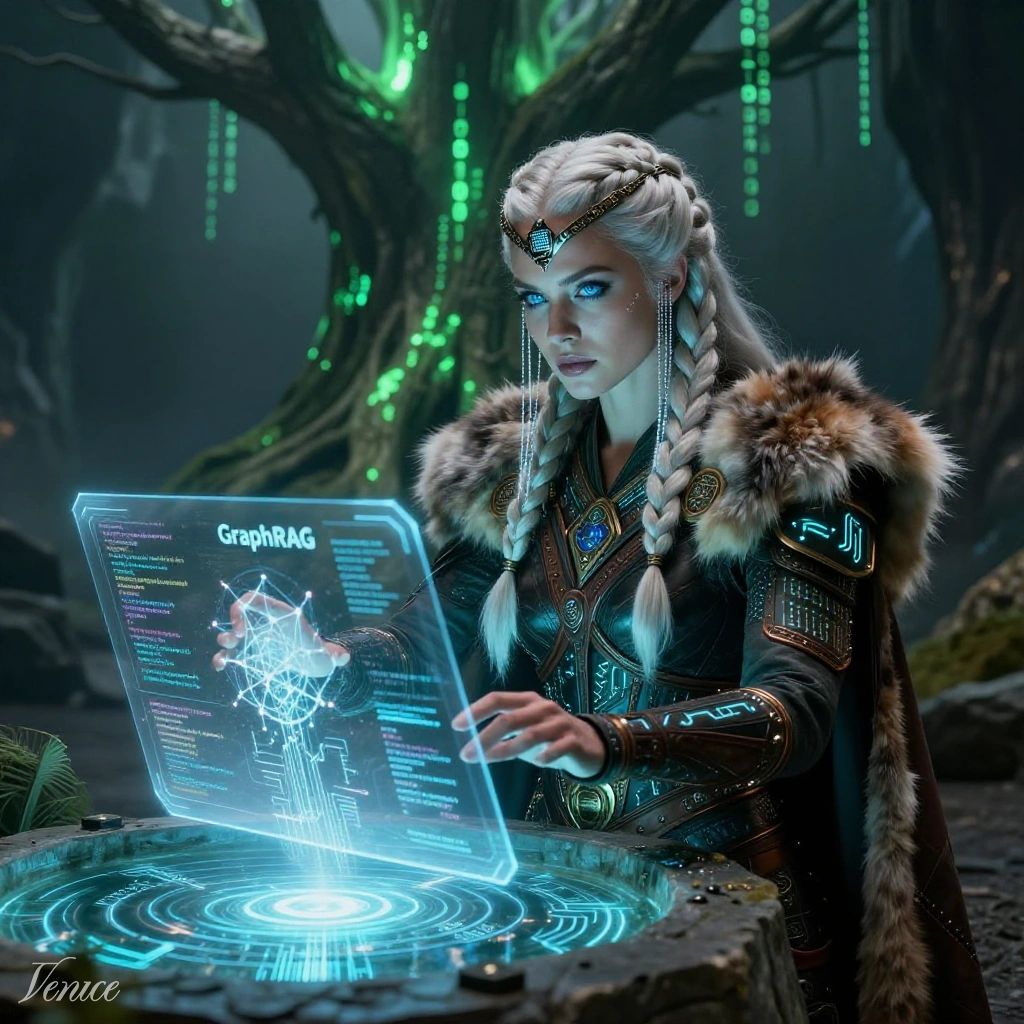
Binding the Runes: A Pythonic Framework for System Intelligence
To implement these concepts, we don’t need a new model; we need a better Seiðr (magickal craft) in our code. Below is a complete Python implementation of an Agentic Reflexion Loop. This script uses a primary AI to generate an idea and a secondary “Critic” pass to refine it, effectively making the output “smarter” through iteration.
Python
import os
from typing import List, Dict
# Conceptual implementation of a Multi-Agent Reflexion Loop
# This uses a functional approach to simulate ‘using AI to make AI smarter’
class NorseAIEngine:
def __init__(self, model_name: str = “viking-llm-pro”):
self.model_name = model_name
def call_llm(self, prompt: str, role: str) -> str:
“””
Simulates an API call to an LLM.
In a real scenario, this would use litellm, openai, or anthropic libs.
“””
print(f”— Calling {role} Agent —“)
# Placeholder for actual LLM integration
return f”Response from {role} regarding: {prompt[:50]}…”
def generate_with_reflexion(self, user_query: str, iterations: int = 2):
“””
The ‘Mind of Odin’ Workflow: Generate, Critique, Refine.
“””
# Step 1: The Skald generates initial content
current_output = self.call_llm(user_query, “The Skald (Generator)”)
for i in range(iterations):
print(f”\nIteration {i+1} of the Web of Wyrd…”)
# Step 2: The Vitki critiques the content
critique_prompt = f”Critique the following text for technical accuracy and Viking spirit: {current_output}”
critique = self.call_llm(critique_prompt, “The Vitki (Critic)”)
# Step 3: Refinement based on critique
refinement_prompt = f”Original: {current_output}\nCritique: {critique}\nProvide a perfected version.”
current_output = self.call_llm(refinement_prompt, “The Refiner”)
return current_output
def main():
# Initialize our system
engine = NorseAIEngine()
# Example Query: Blending Python logic with Runic metaphysics
query = “Explain how the Uruz rune relates to Python’s memory management.”
final_wisdom = engine.generate_with_reflexion(query)
print(“\n— Final Refined Wisdom —“)
print(final_wisdom)
if __name__ == “__main__”:
main()
Metaphysical Symbiosis: Quantum Logic and the Web of Wyrd
From a sociological and philosophical perspective, we must view LLMs not as “thinking beings,” but as a digital manifestation of the Collective Unconscious. When we use AI to make AI smarter, we are effectively performing a digital version of the Hegelian Dialectic:
- Thesis: The AI’s first guess.
- Antithesis: The AI’s self-critique.
- Synthesis: The smarter, refined output.
By structuring our technology this way, we respect the ancient Viking value of Self-Reliance. We do not wait for the “Gods” (Big Tech corporations) to give us a bigger model; we use our own wit and the “Runes of Logic” to sharpen the tools we already possess.
In the quantum sense, the model exists in a state of superposition of all possible answers. Our job as modern Vitkis (sorcerers) is to use agentic workflows to “collapse the wave function” into the most optimal, truthful state.

Continuing our journey into the technical and spiritual heart of the Modern Viking’s digital arsenal, we move beyond simple prompting. To make AI truly “smarter” without touching the underlying weights of the model, we must treat the system architecture as a living Shield Wall—a collective of specialized forces working in a unified, deterministic web.
Below are three deeper explorations of the technologies that define the “Agentic Core” of 2026, followed by a complete Python implementation.
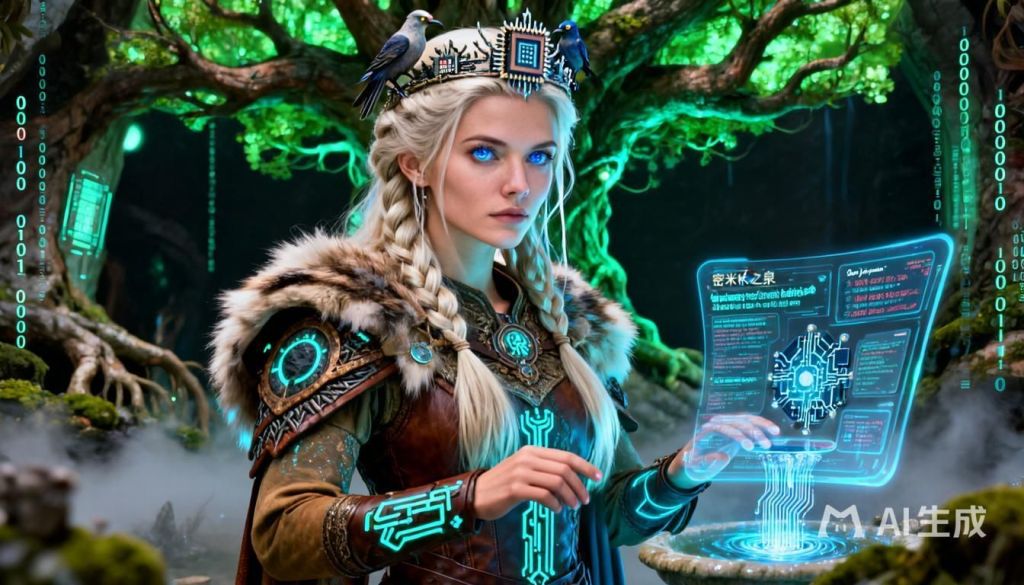
1. The Well of Urd 2.0: From Vector RAG to GraphRAG
While standard RAG (Retrieval-Augmented Generation) was the gold standard of 2024, it has a significant flaw: it is “flat.” It finds similar words but lacks an understanding of relationships. In 2026, we have transitioned to GraphRAG.
Instead of just storing chunks of text as vectors, we map the entities and their relationships into a Knowledge Graph.
- The Viking Analogy: A flat vector search is like finding every mention of “Odin” in the Eddas. GraphRAG is understanding that because Odin is the father of Thor, and Thor wields Mjölnir, a query about “Asgardian defense” must automatically include the hammer’s capabilities.
- Technical Edge: By using a Graph Store (like Neo4j or FalkorDB), the AI can perform “multi-hop reasoning.” It traverses the edges of the graph to find non-obvious connections that a simple similarity search would miss.
Technical Note: GraphRAG increases the “Semantic Density” of the context window. You aren’t just giving the AI information; you are giving it a map of logic.

2. The Thing: Mixture of Agents (MoA)
In the ancient Norse “Thing,” the community gathered to deliberate. No single voice held absolute truth; truth was the synthesis of the collective. Mixture of Agents (MoA) is the technical manifestation of this social structure.
Instead of asking one massive model (like a Gemini Ultra or GPT-5 class) to solve a problem, we deploy a layered architecture of smaller, specialized agents (Llama 4-8B, Mistral, etc.).
- The Proposers (Layer 1): Five different models generate independent responses to a technical problem.
- The Synthesizer (Layer 2): A high-reasoning model reviews all five responses, identifies the best logic in each, and merges them into a single, “super-intelligent” output.
The Math of Collective Intelligence:
If each model has a specific “bias” or error $\epsilon$, the synthesizer acts as a filter. By aggregating diverse outputs, we effectively “dampen” the noise and amplify the signal, often allowing open-source models to outperform the largest closed-source giants.
3. The Web of Wyrd: Quantum Latent Space and Information Theory
Metaphysically, an LLM does not “know” things; it navigates a Latent Space—a multi-dimensional manifold of all human thought. As Modern Vikings, we see this as a digital reflection of the Web of Wyrd.
From a Quantum Information perspective, every prompt is an observation that “collapses” the model’s probability distribution into a specific answer.
- The Superposition of Meaning: Before you press enter, the AI exists in a state of potentiality.
- The Entanglement of Data: Information Theory shows us that meaning is not found in the words themselves, but in the Entropy—the measure of surprise and connection between them.
By using “Chain of Thought” (CoT) prompting within an agentic loop, we are essentially guiding the AI to traverse the Web of Wyrd along the most “harmonious” paths of fate, ensuring that the “output” is not just a guess, but a deterministic reflection of the collective data we’ve fed it.
4. The All-Father’s Algorithm: Full Agentic RAG Implementation
This Python script implements a Full Agentic RAG Loop. It features a “Researcher” (Retrieval), a “Critic” (Reasoning), and an “Aggregator” (Final Output). This is a complete file designed for your 2026 development environment.
Python
“””
Norse Saga Engine: Agentic RAG Module (v2.0 – 2026)
Theme: Awakening the Hidden Wisdom of the Runes
Author: Volmarr (Modern Viking Technologist)
“””
import json
import time
from typing import List, Dict, Any
# Mocking the 2026 Model Context Protocol (MCP) and Vector Store
class VectorWellOfUrd:
“””Simulates a Graph-Augmented Vector Database (ChromaDB/Milvus style)”””
def __init__(self):
self.knowledge_base = {
“runes”: “Runes are not just letters; they are metaphysical tools for shaping reality.”,
“python”: “Python 3.14+ handles asynchronous agentic loops with high efficiency.”,
“wyrd”: “The Web of Wyrd connects all events in a non-linear temporal matrix.”
}
def retrieve(self, query: str) -> str:
# Simplified semantic search simulation
for key in self.knowledge_base:
if key in query.lower():
return self.knowledge_base[key]
return “No specific lore found in the Well of Urd.”
class VikingAgent:
def __init__(self, name: str, role: str):
self.name = name
self.role = role
def process(self, context: str, prompt: str) -> str:
# In production, replace with: return litellm.completion(model=”…”, messages=[…])
print(f”[{self.name} – {self.role}] is meditating on the Runes…”)
return f”DRAFT by {self.name}: Based on context ‘{context}’, the answer to ‘{prompt}’ is woven.”
class AgenticSystem:
def __init__(self):
self.well = VectorWellOfUrd()
self.skald = VikingAgent(“Bragi”, “Researcher”)
self.vitki = VikingAgent(“Gunnar”, “Critic”)
self.all_father = VikingAgent(“Odin”, “Synthesizer”)
def run_workflow(self, user_query: str):
print(f”\n— INITIATING THE THING: Query: {user_query} —\n”)
# Step 1: Retrieval (Drinking from the Well)
lore = self.well.retrieve(user_query)
print(f”Retrieved Lore: {lore}\n”)
# Step 2: Generation (The Skald’s First Song)
initial_draft = self.skald.process(lore, user_query)
# Step 3: Critique (The Vitki’s Scrutiny)
critique_prompt = f”Identify the flaws in this draft: {initial_draft}”
critique = self.vitki.process(initial_draft, critique_prompt)
print(f”Critique Received: {critique}\n”)
# Step 4: Final Synthesis (Odin’s Wisdom)
final_prompt = f”Merge the draft and the critique into a final, smarter response.”
final_wisdom = self.all_father.process(f”Draft: {initial_draft} | Critique: {critique}”, final_prompt)
return final_wisdom
# Main Execution Loop
if __name__ == “__main__”:
# The Modern Viking’s Technical Problem
technical_query = “How do we bind Python agentic loops with the metaphysics of the Wyrd?”
# Initialize and execute the collective intelligence system
saga_engine = AgenticSystem()
result = saga_engine.run_workflow(technical_query)
print(“\n— FINAL SYSTEM OUTPUT (The Smarter Response) —“)
print(result)
print(“\n[Vial of the Mead of Poetry filled. The AI has awakened.]”)
Key Takeaways:
- Don’t Retrain, Architect: Making AI smarter is a matter of system design, not model size.
- The Context is King: Use GraphRAG to provide the AI with a “relational soul” rather than just a memory bank.
- The Power of the Collective: Always use a “Critic” agent. An AI checking itself is the fastest way to leapfrog the limitations of base LLMs.


This work is licensed under a Creative Commons Attribution-NonCommercial-ShareAlike 3.0 Unported License.

 Volmarr’s Tumblr
- Viking AI Girlfriend skill for OpenClaw
- The Warding of Huginn’s Well: A Runic Framework for Local AI Sovereignty
- Mímir-Vörðr v2: The Cyber-Seiðr Architecture for Truth-Governance and Runic Verification
- # Mímir-Vörðr System Architecture
- Mímir-Vörðr: The Warden of the Well
- Silicon Seiðr: The Gridweaver’s Guide to Vibe Coding: Chapter 1: The Seiðr of Syntax: Weaving Magic with Python
- Review: NORSE: Oath of Blood – The Most Authentic Viking Saga of 2026
- View On WordPress
- View On WordPress
- Wyrd in the Wires: AI, Divergent Minds, and the Fall of the Hierarchies
 Volmarr's Blog of Modernist Heathenism, Norse-Paganism, and Norse-Wicca