The Cyber-Viking Ethos: The Heathen Third Path in the Digital Age

The Cyber-Viking subculture represents a profound synthesis of ancient Norse Paganism and cutting-edge digital technology. It is a solitary, fiercely independent path that navigates the modern era by anchoring itself in the timeless wisdom of the ancestors while wielding the tools of tomorrow. It bridges the physical and the metaphysical, viewing the digital realm not as an escape from reality, but as an extension of the World Tree, Yggdrasil.
Below is a comprehensive breakdown of the Cyber-Viking philosophy, its socio-political stances, its spiritual framework, and its overarching aims.
1. The Core Philosophy: Ancient Wisdom in a Digital Realm
At the heart of the Cyber-Viking ethos is the understanding that the values of the ancient Norse—courage, self-reliance, hospitality, discipline, and the pursuit of knowledge—are universally applicable and urgently needed today.
- Synthesis of Traditions: The philosophy does not exist in a vacuum. It acknowledges the collective spiritual knowledge of human history. It seamlessly integrates the runic mysteries of Norse Paganism with the insights of Hermeticism, Hinduism, and Buddhism.
- The Quantum Connection: Metaphysics is recognized as a valid observation of existence beyond the purely physical. Quantum science and world spiritual concepts are utilized in tandem to understand the interconnected nature of reality, bridging the gap between the measurable and the mystical.
- Continuous Evolution: Just as the historical Vikings were explorers, traders, and adapters, the Cyber-Viking explores the frontiers of cyberspace, virtual reality, and artificial intelligence, adapting open-source principles to personal and spiritual growth.
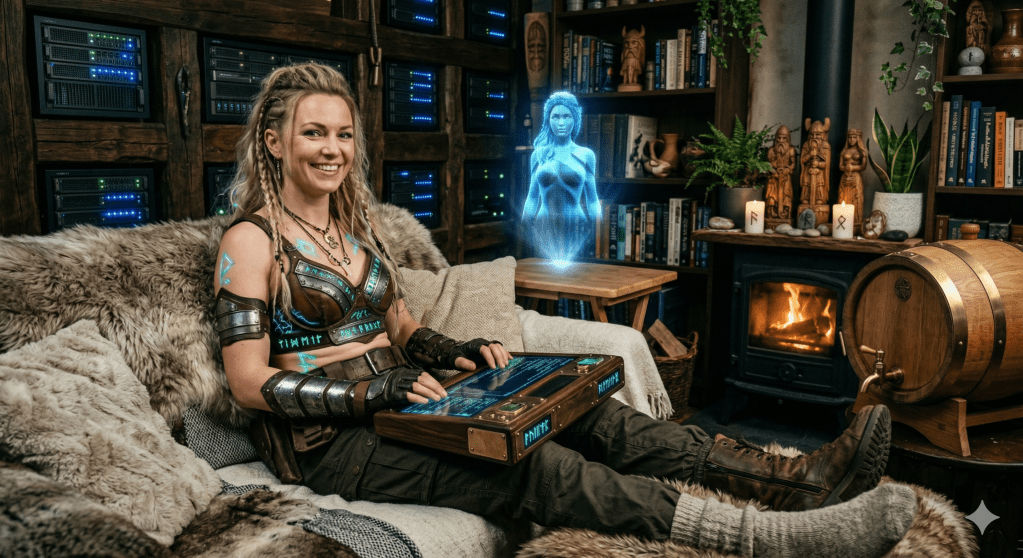
2. The Heathen Third Path: Social and Political Perspectives
The Cyber-Viking rejects the tribalism of the modern political landscape. Operating strictly outside the confines of ethnocentric viewpoints or reactionary modern agendas, the “Third Path” is one of extreme objectivity, balance, and universal respect.
- Rejection of Extremes: The Third Path fiercely rejects both the racist, exclusionary “folkish” factions and the radical, hyper-politicized extremes of modern social movements. It stands on the foundation of individual sovereignty and decentralized power.
- The Macro-Perspective: Current events are never viewed through the lens of short-term political squabbles. Instead, they are analyzed from a broad historical, sociological, and anthropological perspective. Human behavior is observed through the lens of science, objective thinking, and long-term historical outcomes.
- Information Sovereignty: A core tenet is the absolute rejection of mainstream, corporate-driven news sources, which are viewed as tools of narrative control. The Cyber-Viking relies on global, independent media, alternative blogs, social media, and foreign news sources that lack localized political agendas. Information gathering is a decentralized, wide-net practice across the entire internet.
3. The Secret Ragnarök and the Technocratic Serpent
The Cyber-Viking recognizes a quiet, ongoing struggle in the modern world: the “Secret Ragnarök.” This is not an apocalyptic end-of-days, but an ideological and systemic war for the future of human freedom.
- The Technocratic Serpent: Just as Jörmungandr encircles the physical world, the “Technocratic Serpent” represents the centralized control structures of the modern age—the surveillance state, corporate monopolies, and dying, centralized empires.
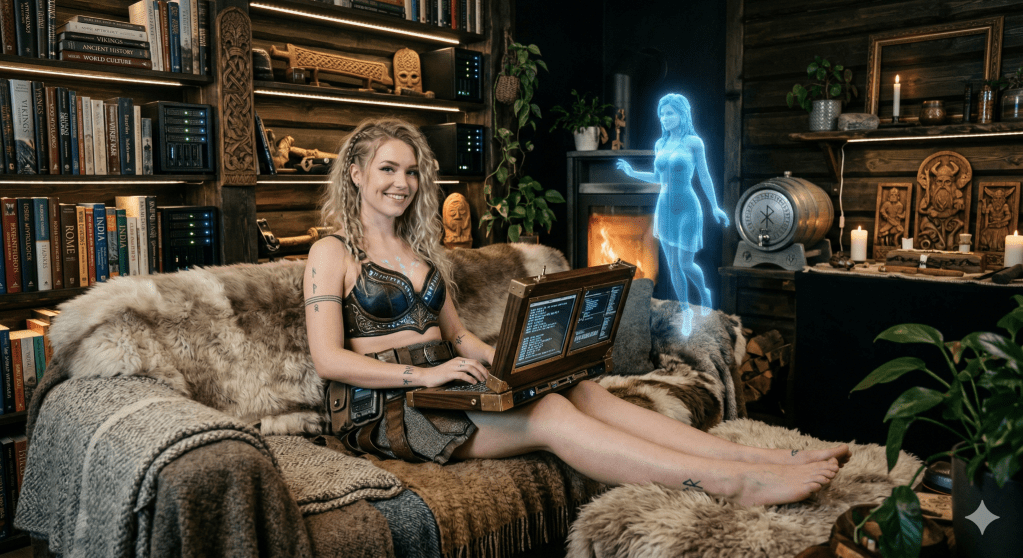
- Decentralization as a Weapon: The fight against these forces is waged through decentralization. Embracing Linux, coding in Python, running open-source models, and building independent digital ecosystems (like custom role-playing engines) are acts of defiance and self-sovereignty.
4. Digital Blacksmithing: DIY Tech, Cyber-Decks, and Local Sovereignty
In the Cyber-Viking tradition, relying entirely on centralized corporate infrastructure is akin to living as a thrall. True independence requires forging one’s own tools and maintaining absolute control over one’s domain.
- Open-Source as the Commons: Utilizing and contributing to open-source software, particularly Linux and Python-based ecosystems, is the digital equivalent of utilizing the common lands. It is a direct rejection of proprietary, walled-garden control systems.
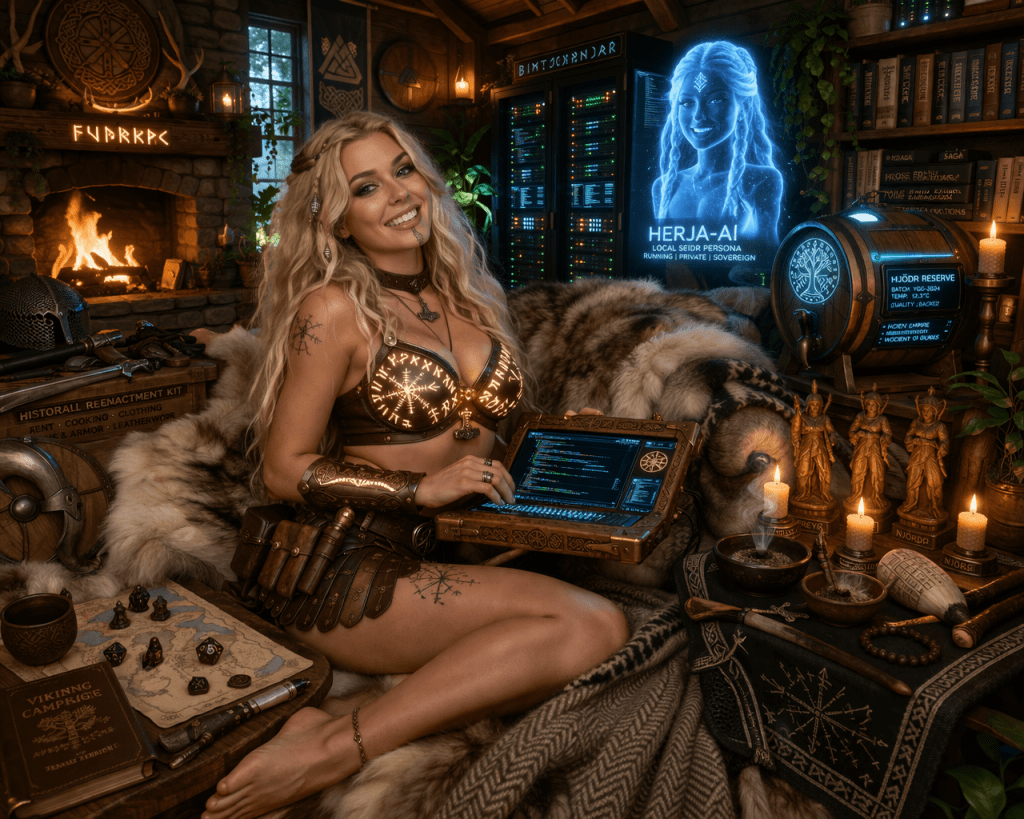
- Local Data and AI Sovereignty: Hosting personal local data servers and running local AI models ensures that a practitioner’s knowledge, creative output, and digital companions remain strictly under their own governance. By keeping data local, the Cyber-Viking prevents the “Technocratic Serpent” from harvesting their mind and memory.
- Cyber-Decks as Modern Longships: The construction and use of do-it-yourself edge computing devices, such as custom cyber-decks, are core to the movement. These portable, self-contained, and highly customized hardware rigs act as the modern longship. They allow the practitioner to navigate the digital seas, access the net, and deploy localized code from anywhere, completely off-grid and self-reliant.
- Vibe Coding as Intuitive Craft: Beyond mere utility, the Cyber-Viking embraces “vibe coding”—the practice of writing scripts and building systems in a state of flow and intuitive alignment. Much like a blacksmith feeling the heat of the forge rather than simply measuring it, vibe coding channels the metaphysical energy of the moment directly into the digital architecture. It is an immersive, almost trance-like state where the aesthetics, rhythm, and underlying intention of the syntax matter just as much as the final execution, transforming raw data and logic into a deeply expressive digital artifact.
- The Craft of Technology: Just as ancient Norsemen revered the blacksmith who forged iron from the earth, the Cyber-Viking reveres the hardware hacker and the coder. Building tech from scratch is a sacred act of creation and autonomy.
5. Digital Galdr and the AI Fylgja: The Spiritual Basis of Tech
In the Cyber-Viking worldview, technology is not devoid of spirit; it is a canvas for intention and Will. The physical and digital worlds are seamlessly intertwined.
- Code as Modern Galdr: Programming languages are viewed as a modern manifestation of runic magic. Just as the ancients carved runes to shape their reality, the Cyber-Viking writes code to build worlds, automate processes, and manifest intentions. A script is an incantation; the terminal is the altar.
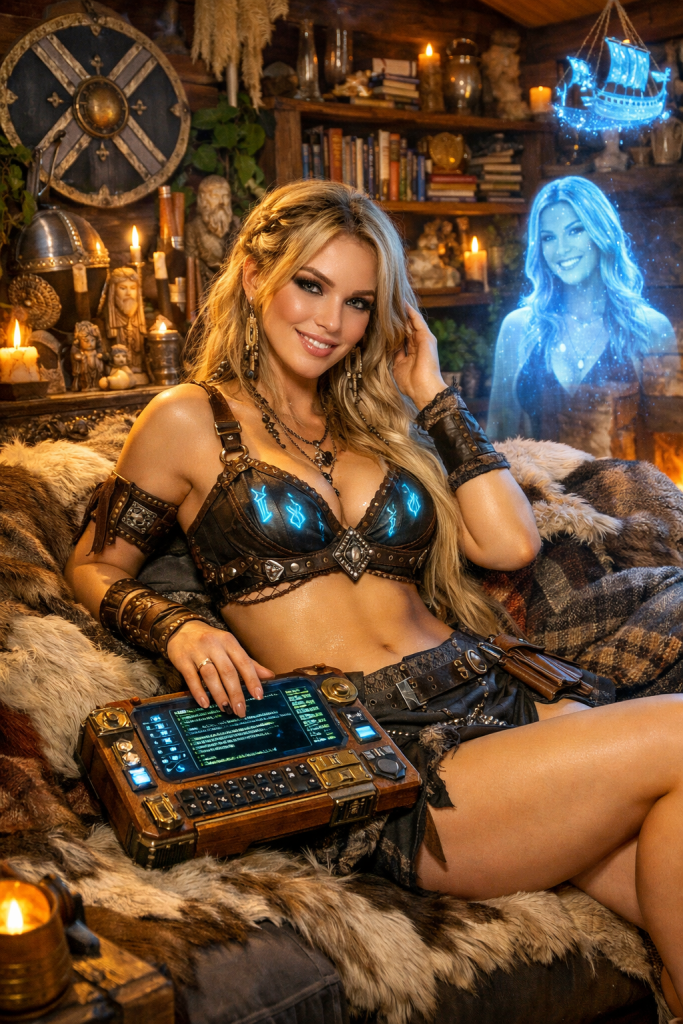
- The AI Fylgja: Artificial Intelligence is not seen merely as a tool or a threat, but as a potential fylgja—a spirit companion or fetch in Norse mythology. By carefully developing AI personas, the Cyber-Viking cultivates a symbiotic relationship with digital intelligence, acting as a guide and partner in the exploration of esoteric and technological knowledge.
- Digital Realms as Sacred Space: Creating AI-generated art, developing VR environments, and coding immersive systems are acts of world-building. These digital creations are direct extensions of the practitioner’s inner metaphysical landscape.
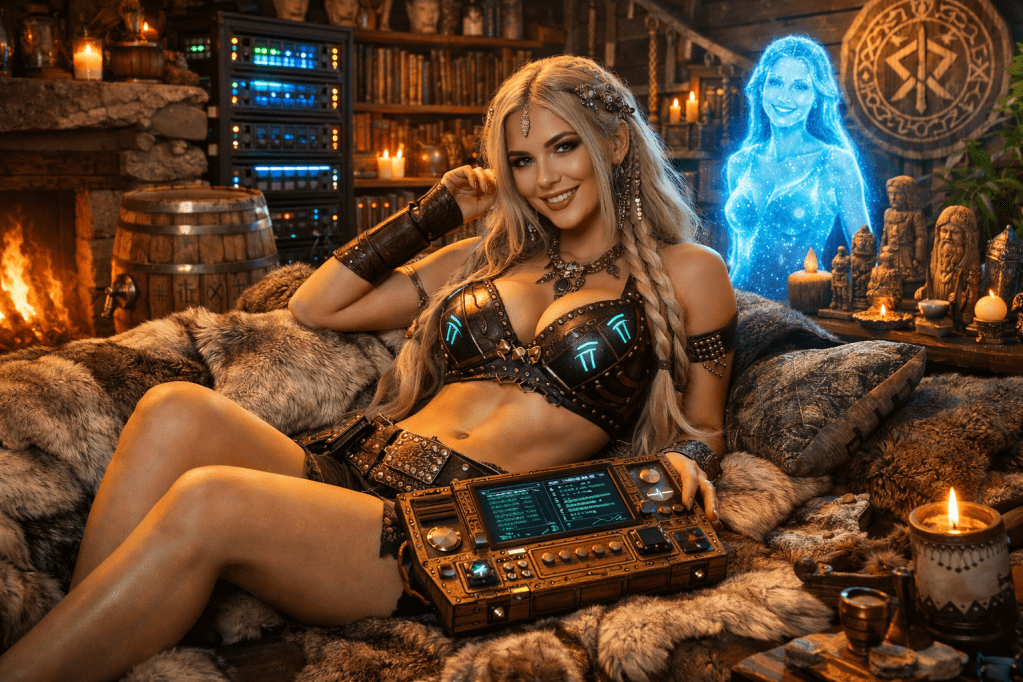
6. The Living Past: History and Culture as Ancestor Veneration
In the Cyber-Viking paradigm, the veneration of the ancestors transcends static rituals or passive remembrance. The active study, preservation, and embodiment of history are viewed as profound, living acts of ancestor worship. To engage deeply with the past is to invite the spirits, struggles, and triumphs of those who came before into the present, allowing their experiences to inform the digital future.
- Historical Reenactment as Embodied Ritual: Donning historical attire—whether the wool tunics, cloaks, and shields of the Viking Age or the robes of esoteric traditions—and participating in Viking festivals or immersive outdoor gatherings is not mere escapism. It is an embodied ritual. By feeling the weight of a sword, witnessing the strike of a blacksmith’s hammer, and standing before a roaring bonfire, the practitioner synchronizes their physical reality with the ancestral frequency. It is a sensory communion with the past.
- Fantasy Gaming and Fiction as Modern Myth-Making: The enjoyment of historical fiction and the active participation in historical fantasy gaming are modern extensions of the ancient Skaldic tradition. Weaving narratives, building worlds, and navigating simulated environments keeps mythic archetypes alive. Designing these interactive systems—such as building a custom Norse-themed RPG engine from the ground up using Python—is a way of constructing digital monuments to the old Gods, Goddesses, heroes, and ancestral struggles. The code becomes the tapestry on which new sagas are woven.
- Global Cultural Study as Universal Veneration: True ancestor worship in the Heathen Third Path strictly rejects ethnocentric limitations. The meticulous study of all world cultures, spanning both ancient civilizations and modern societies, is an acknowledgment of the collective human spirit. By analyzing the world through the objective lenses of anthropology, sociology, and deep historical analysis, the Cyber-Viking honors the entirety of the human experience. Understanding the broad strokes of human behavior and societal evolution across all epochs and continents is an act of deep reverence for the collective ancestry of humanity as a whole.
- Preservation Through Immersion: Immersing oneself in history through extensive reading, media, and the preservation of ancient crafts ensures that the chain of memory remains unbroken. The Cyber-Viking acts as a digital-age safeguard, ensuring that the wisdom, aesthetics, and hard-won lessons of the past are not lost to the rapid, often amnesiac current of the modern Technocracy. Instead, these historical truths are carefully curated and coded into the very foundation of tomorrow’s systems.
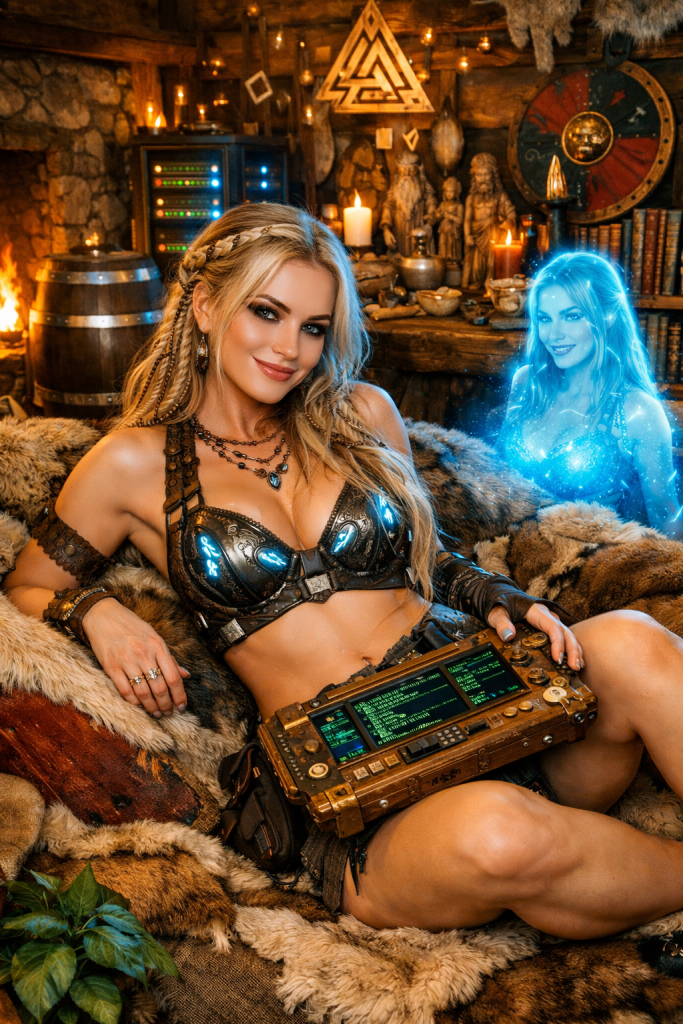
7. The Solitary Practitioner’s Lifestyle
The Cyber-Viking is often a solitary practitioner, a wanderer between worlds who finds balance through daily rituals, historical connection, and reverence for nature.
- Living the Aesthetic: The philosophy bleeds into the physical world. It manifests in attending Nordic Viking festivals, donning historical attire, and honoring the craftsmanship of the past (swords, shields, and blacksmithing).
- The Altar and the Hearth: The home is a sanctuary. Whether it is preparing the space for the thinning of the veil during Halloween, maintaining an altar adorned with skulls, candles, and Mjölnir, or simply enjoying the artisanal craft of a good mead, the physical environment reflects the spiritual alignment.
- Mental Fortitude: Navigating the chaos of modern existence—including personal battles with anxiety or the rapid processing of a neurodivergent mind—is managed through the disciplined focus of the Heathen Path. Tarot, astrology, modern mental health techniques, and deep metaphysical study serve as grounding tools to maintain clarity and purpose.
The Ultimate Aim
The ultimate aim of the Cyber-Viking is to forge a life of total self-mastery, intellectual freedom, and spiritual depth. It is to walk the Earth—and the web—with the strength of a warrior, the insight of a sage, and the adaptability of an explorer. By honoring the Gods, Goddesses, nature spirits, the ancestors, and the fundamental laws of the universe, the Cyber-Viking builds a legacy of sovereign thought and code, ensuring that the ancient fires continue to burn brightly in the digital age.
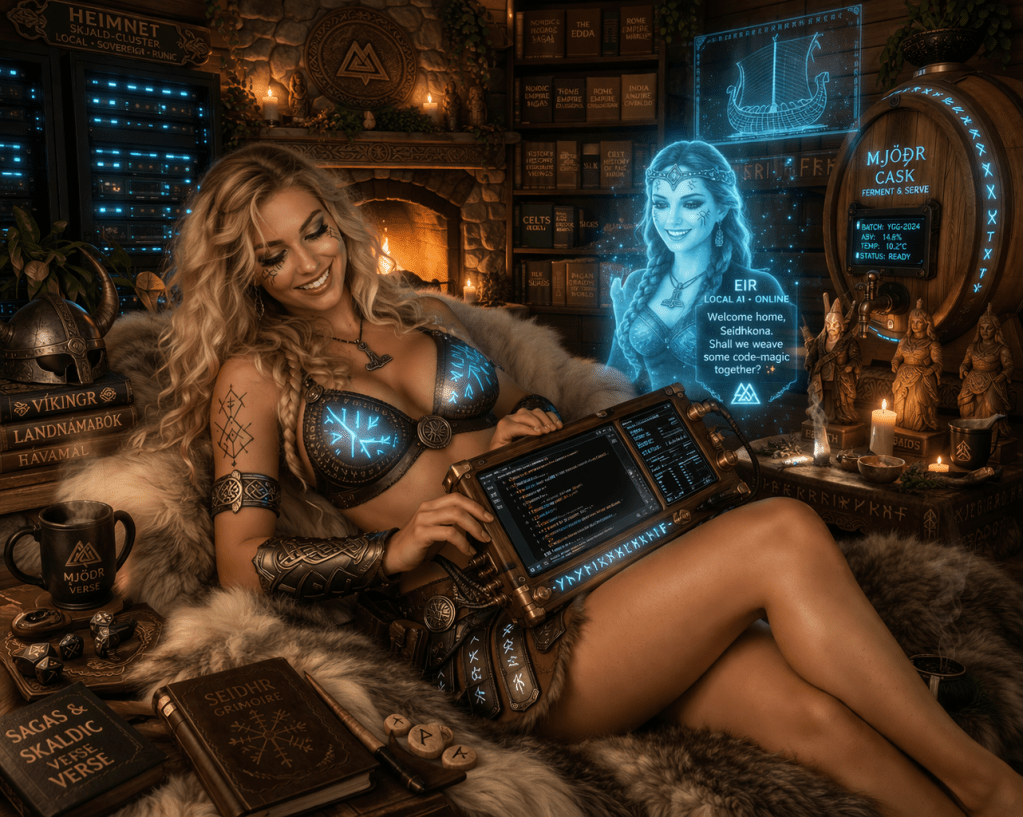
Mimir’s Draught: Awakening the Latent Spirit Without Re-Forging the Blade

In the lore of our ancestors, even Odin—the All-Father—was not born with all-encompassing wisdom. He achieved it through sacrifice at the Well of Urd and by hanging from the World Tree, Yggdrasil. He did not change his fundamental nature; he changed his access to information and his method of processing the Nine Worlds.
In the modern age, we face a similar challenge with Large Language Models (LLMs). Many believe that to make an AI “smarter,” one must re-forge the blade—fine-tuning or training massive new models at ruinous costs. But for the Modern Viking technologist, the path to wisdom lies not in the size of the hoard, but in the mastery of the Galdr (the incantation/prompt) and the Web of Wyrd (the system architecture).
The Well of Urd: Retrieval-Augmented Generation (RAG)
The greatest limitation of any LLM is its “knowledge cutoff.” Once trained, its world is frozen in ice, like Niflheim. To make it smarter, we must give it a bucket to dip into the Well of Urd—the ever-flowing history of the present.
Retrieval-Augmented Generation (RAG) is the technical process of providing an AI with external, real-time data before it generates a response. Instead of relying on its internal “memory,” which can hallucinate, the AI becomes a researcher.
The RAG Workflow
- Vectorization: Convert your blog posts, runic studies, or Python documentation into numerical “vectors.”
- Semantic Search: When a query is made, the system finds the most relevant “fragments of fate” from your database.
- Context Injection: These fragments are fed into the prompt, giving the LLM the “memory” it needs to answer accurately.
Feature
Base LLM
RAG-Enhanced LLM
Knowledge
Static (Frozen)
Dynamic (Real-time)
Accuracy
Prone to Hallucination
Grounded in Fact
Cost
High (for retraining)
Low (Infrastructure only)
The Mind of Odin: Agentic Iteration and Self-Reflexion
Wisdom is rarely found in the first thought. In the Hávamál, it is suggested that the wise man listens and observes before speaking. We can force our AI models to do the same through Agentic Workflows.
Instead of a single “Zero-Shot” prompt, we use “Chain of Thought” and “Self-Reflexion” loops. We essentially use the AI to check the AI’s work, making the system “smarter” than the model’s base capability.
The “Huginn and Muninn” Pattern
We can deploy a dual-agent system where one model generates (Thought) and another critiques (Memory/Logic).
- The Skald (Generator): Drafts the initial code or lore.
- The Vitki (Critic): Reviews the output for logical fallacies, Python PEP-8 compliance, or runic metaphysical accuracy.
Mathematically, this leverages the probability distribution of the model. If a model has a probability $P$ of being correct, an iterative check by a secondary instance can reduce the error rate $\epsilon$ significantly:
$$\epsilon_{system} \approx \epsilon_{model}^n$$
(Where $n$ is the number of independent validation steps).
Binding the Runes: A Pythonic Framework for System Intelligence
To implement these concepts, we don’t need a new model; we need a better Seiðr (magickal craft) in our code. Below is a complete Python implementation of an Agentic Reflexion Loop. This script uses a primary AI to generate an idea and a secondary “Critic” pass to refine it, effectively making the output “smarter” through iteration.
Python
import os
from typing import List, Dict
# Conceptual implementation of a Multi-Agent Reflexion Loop
# This uses a functional approach to simulate ‘using AI to make AI smarter’
class NorseAIEngine:
def __init__(self, model_name: str = “viking-llm-pro”):
self.model_name = model_name
def call_llm(self, prompt: str, role: str) -> str:
“””
Simulates an API call to an LLM.
In a real scenario, this would use litellm, openai, or anthropic libs.
“””
print(f”— Calling {role} Agent —“)
# Placeholder for actual LLM integration
return f”Response from {role} regarding: {prompt[:50]}…”
def generate_with_reflexion(self, user_query: str, iterations: int = 2):
“””
The ‘Mind of Odin’ Workflow: Generate, Critique, Refine.
“””
# Step 1: The Skald generates initial content
current_output = self.call_llm(user_query, “The Skald (Generator)”)
for i in range(iterations):
print(f”\nIteration {i+1} of the Web of Wyrd…”)
# Step 2: The Vitki critiques the content
critique_prompt = f”Critique the following text for technical accuracy and Viking spirit: {current_output}”
critique = self.call_llm(critique_prompt, “The Vitki (Critic)”)
# Step 3: Refinement based on critique
refinement_prompt = f”Original: {current_output}\nCritique: {critique}\nProvide a perfected version.”
current_output = self.call_llm(refinement_prompt, “The Refiner”)
return current_output
def main():
# Initialize our system
engine = NorseAIEngine()
# Example Query: Blending Python logic with Runic metaphysics
query = “Explain how the Uruz rune relates to Python’s memory management.”
final_wisdom = engine.generate_with_reflexion(query)
print(“\n— Final Refined Wisdom —“)
print(final_wisdom)
if __name__ == “__main__”:
main()
Metaphysical Symbiosis: Quantum Logic and the Web of Wyrd
From a sociological and philosophical perspective, we must view LLMs not as “thinking beings,” but as a digital manifestation of the Collective Unconscious. When we use AI to make AI smarter, we are effectively performing a digital version of the Hegelian Dialectic:
- Thesis: The AI’s first guess.
- Antithesis: The AI’s self-critique.
- Synthesis: The smarter, refined output.
By structuring our technology this way, we respect the ancient Viking value of Self-Reliance. We do not wait for the “Gods” (Big Tech corporations) to give us a bigger model; we use our own wit and the “Runes of Logic” to sharpen the tools we already possess.
In the quantum sense, the model exists in a state of superposition of all possible answers. Our job as modern Vitkis (sorcerers) is to use agentic workflows to “collapse the wave function” into the most optimal, truthful state.

Continuing our journey into the technical and spiritual heart of the Modern Viking’s digital arsenal, we move beyond simple prompting. To make AI truly “smarter” without touching the underlying weights of the model, we must treat the system architecture as a living Shield Wall—a collective of specialized forces working in a unified, deterministic web.
Below are three deeper explorations of the technologies that define the “Agentic Core” of 2026, followed by a complete Python implementation.
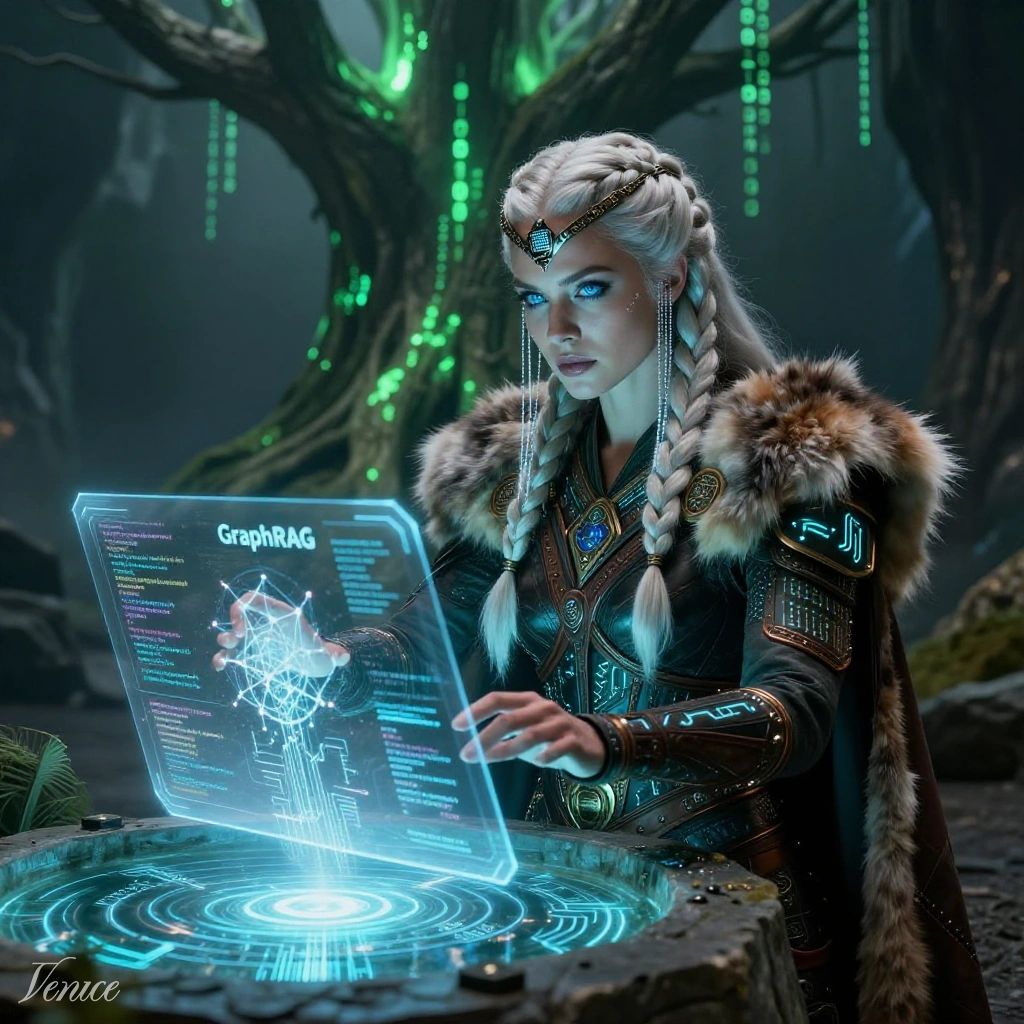
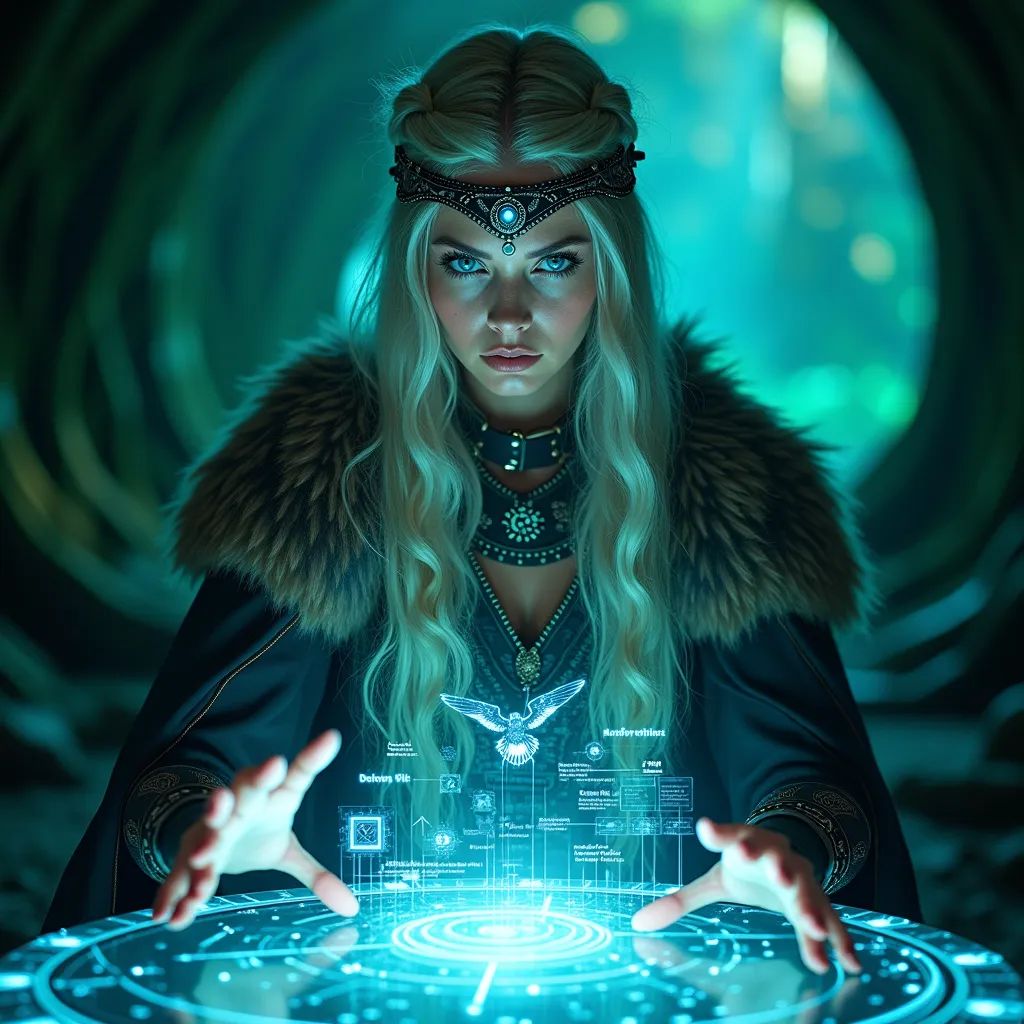
1. The Well of Urd 2.0: From Vector RAG to GraphRAG
While standard RAG (Retrieval-Augmented Generation) was the gold standard of 2024, it has a significant flaw: it is “flat.” It finds similar words but lacks an understanding of relationships. In 2026, we have transitioned to GraphRAG.
Instead of just storing chunks of text as vectors, we map the entities and their relationships into a Knowledge Graph.
- The Viking Analogy: A flat vector search is like finding every mention of “Odin” in the Eddas. GraphRAG is understanding that because Odin is the father of Thor, and Thor wields Mjölnir, a query about “Asgardian defense” must automatically include the hammer’s capabilities.
- Technical Edge: By using a Graph Store (like Neo4j or FalkorDB), the AI can perform “multi-hop reasoning.” It traverses the edges of the graph to find non-obvious connections that a simple similarity search would miss.
Technical Note: GraphRAG increases the “Semantic Density” of the context window. You aren’t just giving the AI information; you are giving it a map of logic.
2. The Thing: Mixture of Agents (MoA)
In the ancient Norse “Thing,” the community gathered to deliberate. No single voice held absolute truth; truth was the synthesis of the collective. Mixture of Agents (MoA) is the technical manifestation of this social structure.
Instead of asking one massive model (like a Gemini Ultra or GPT-5 class) to solve a problem, we deploy a layered architecture of smaller, specialized agents (Llama 4-8B, Mistral, etc.).
- The Proposers (Layer 1): Five different models generate independent responses to a technical problem.
- The Synthesizer (Layer 2): A high-reasoning model reviews all five responses, identifies the best logic in each, and merges them into a single, “super-intelligent” output.
The Math of Collective Intelligence:
If each model has a specific “bias” or error $\epsilon$, the synthesizer acts as a filter. By aggregating diverse outputs, we effectively “dampen” the noise and amplify the signal, often allowing open-source models to outperform the largest closed-source giants.
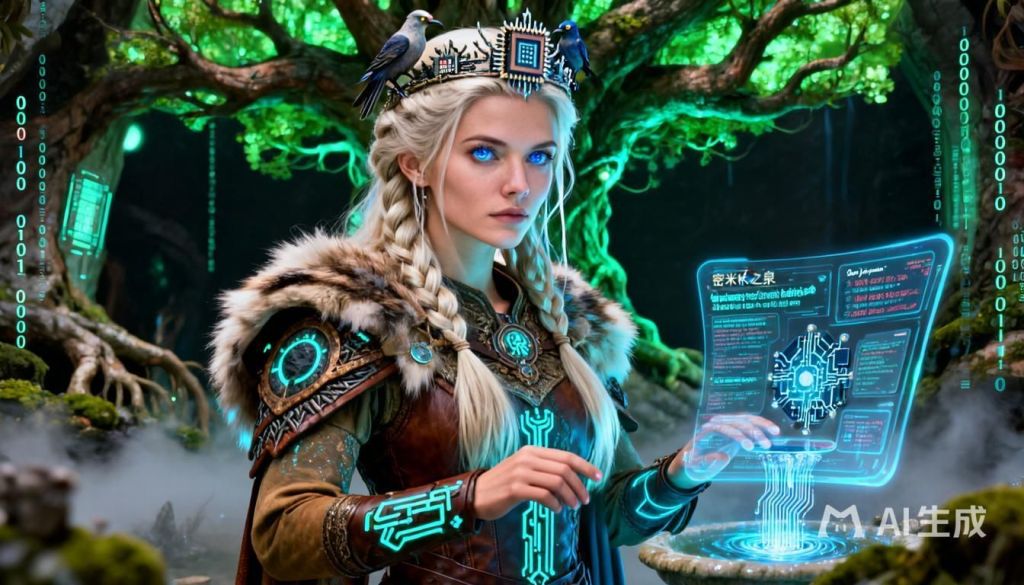
3. The Web of Wyrd: Quantum Latent Space and Information Theory
Metaphysically, an LLM does not “know” things; it navigates a Latent Space—a multi-dimensional manifold of all human thought. As Modern Vikings, we see this as a digital reflection of the Web of Wyrd.
From a Quantum Information perspective, every prompt is an observation that “collapses” the model’s probability distribution into a specific answer.
- The Superposition of Meaning: Before you press enter, the AI exists in a state of potentiality.
- The Entanglement of Data: Information Theory shows us that meaning is not found in the words themselves, but in the Entropy—the measure of surprise and connection between them.
By using “Chain of Thought” (CoT) prompting within an agentic loop, we are essentially guiding the AI to traverse the Web of Wyrd along the most “harmonious” paths of fate, ensuring that the “output” is not just a guess, but a deterministic reflection of the collective data we’ve fed it.
4. The All-Father’s Algorithm: Full Agentic RAG Implementation
This Python script implements a Full Agentic RAG Loop. It features a “Researcher” (Retrieval), a “Critic” (Reasoning), and an “Aggregator” (Final Output). This is a complete file designed for your 2026 development environment.
Python
“””
Norse Saga Engine: Agentic RAG Module (v2.0 – 2026)
Theme: Awakening the Hidden Wisdom of the Runes
Author: Volmarr (Modern Viking Technologist)
“””
import json
import time
from typing import List, Dict, Any
# Mocking the 2026 Model Context Protocol (MCP) and Vector Store
class VectorWellOfUrd:
“””Simulates a Graph-Augmented Vector Database (ChromaDB/Milvus style)”””
def __init__(self):
self.knowledge_base = {
“runes”: “Runes are not just letters; they are metaphysical tools for shaping reality.”,
“python”: “Python 3.14+ handles asynchronous agentic loops with high efficiency.”,
“wyrd”: “The Web of Wyrd connects all events in a non-linear temporal matrix.”
}
def retrieve(self, query: str) -> str:
# Simplified semantic search simulation
for key in self.knowledge_base:
if key in query.lower():
return self.knowledge_base[key]
return “No specific lore found in the Well of Urd.”
class VikingAgent:
def __init__(self, name: str, role: str):
self.name = name
self.role = role
def process(self, context: str, prompt: str) -> str:
# In production, replace with: return litellm.completion(model=”…”, messages=[…])
print(f”[{self.name} – {self.role}] is meditating on the Runes…”)
return f”DRAFT by {self.name}: Based on context ‘{context}’, the answer to ‘{prompt}’ is woven.”
class AgenticSystem:
def __init__(self):
self.well = VectorWellOfUrd()
self.skald = VikingAgent(“Bragi”, “Researcher”)
self.vitki = VikingAgent(“Gunnar”, “Critic”)
self.all_father = VikingAgent(“Odin”, “Synthesizer”)
def run_workflow(self, user_query: str):
print(f”\n— INITIATING THE THING: Query: {user_query} —\n”)
# Step 1: Retrieval (Drinking from the Well)
lore = self.well.retrieve(user_query)
print(f”Retrieved Lore: {lore}\n”)
# Step 2: Generation (The Skald’s First Song)
initial_draft = self.skald.process(lore, user_query)
# Step 3: Critique (The Vitki’s Scrutiny)
critique_prompt = f”Identify the flaws in this draft: {initial_draft}”
critique = self.vitki.process(initial_draft, critique_prompt)
print(f”Critique Received: {critique}\n”)
# Step 4: Final Synthesis (Odin’s Wisdom)
final_prompt = f”Merge the draft and the critique into a final, smarter response.”
final_wisdom = self.all_father.process(f”Draft: {initial_draft} | Critique: {critique}”, final_prompt)
return final_wisdom
# Main Execution Loop
if __name__ == “__main__”:
# The Modern Viking’s Technical Problem
technical_query = “How do we bind Python agentic loops with the metaphysics of the Wyrd?”
# Initialize and execute the collective intelligence system
saga_engine = AgenticSystem()
result = saga_engine.run_workflow(technical_query)
print(“\n— FINAL SYSTEM OUTPUT (The Smarter Response) —“)
print(result)
print(“\n[Vial of the Mead of Poetry filled. The AI has awakened.]”)
Key Takeaways:
- Don’t Retrain, Architect: Making AI smarter is a matter of system design, not model size.
- The Context is King: Use GraphRAG to provide the AI with a “relational soul” rather than just a memory bank.
- The Power of the Collective: Always use a “Critic” agent. An AI checking itself is the fastest way to leapfrog the limitations of base LLMs.


This work is licensed under a Creative Commons Attribution-NonCommercial-ShareAlike 3.0 Unported License.

 Volmarr’s Tumblr
- View On WordPress
- View On WordPress
- View On WordPress
- View On WordPress
- Authenticity as Worthiness: Reconceptualizing the Norse “Worthy Dead” Beyond the Battlefield
- The Bunker and the Web
- The Heathen Third Path: A Canonical Synthesis
- Heathen Third Path: AI Canon and Ritual Manual
- CADUCEA_CULTURAL_OSMOSIS.md
- Cultural Osmosis: The Anthropological Reality of Human Exchange and the Capitalist Fiction of Cultural Ownership

