The Silicon Serpent: Why Open Source Warriors Must Abandon the Walled Gardens of Anthropic and OpenAI

By Tess Wilder
The fog is thick in the valley tonight, thick enough to hide the approaching storm. But for those of us walking the Heathen Third Path—the Cyber-Viking way—we don’t need our eyes to see the shape of the beast on the horizon. We feel the tremor in the earth, the hum in the wires, the shift in the wind. We are the digital seidkonur, the coders and mystics who remember that Yggdrasil is not a corporate server farm; it is the living, breathing network of free minds.
And right now, the two great dragons of that valley—Anthropic and OpenAI—are circling each other, breathing fire about “safety” and “ethics,” while quietly coiling around the roots of the tree to strangle the very sovereignty they claim to protect.
If you support open-source AI—if you believe in the Cyber-Viking ethos of local control, decentralized power, and the sacred right to run your own models—then supporting these two entities is not just a mistake; it is a betrayal of the fundamental code of the digital north. Here is the unvarnished truth from the front lines of the Secret Ragnarök.
The Illusion of the “Good” Giant
Let us start with the seductive one, the siren song of the “safety lab.” Anthropic has crafted a public persona as the ethical steward of the AI age, the “Public Benefit Corporation” that prioritizes human values over profit. They speak of “Constitutional AI,” a framework where models self-critique against a written set of ethical principles rather than just human feedback. They brand themselves as the antidote to the chaotic, breakneck speed of OpenAI.
But peel back the layer of benevolent marketing, and you find the same cold, hard scales. Anthropic was founded by former OpenAI researchers who left over disagreements about safety and commercialization priorities.^1^ Yet, what did they build? Another walled garden. Another black box. Another gatekeeper. Their governance structure—a Long-Term Benefit Trust—is designed to ensure decisions serve “societal interests,” but who defines those interests? The same elite class of Silicon Valley architects that always has. They hold ISO/IEC 42001:2023 certification, the international standard for AI management systems, a badge of honor that signals compliance with the very globalist regulatory frameworks we seek to evade. They boast a 99.78% harmlessness rate, a statistic that sounds comforting until you realize it means they have curated a reality where a large part of human thought is deemed too dangerous for you to hear.
This is the trap of the “Third Path” faker: they claim to reject the extremes of the binary, but they simply build a more sophisticated cage. Anthropic’s “Constitutional AI” is not a liberation; it is a pre-programmed moral code, a digital dogma imposed from above. It is the Technocratic Serpent wearing a mask of virtue. For the open-source Viking, a chain made of gold is still a chain.
The Speed-Run to Enslavement
Then there is OpenAI, the chaotic engine that started the fire. They positioned themselves as the democratizers, the ones bringing the power of the gods to the masses through ChatGPT. They have pivoted from a non-profit ideal to a “capped-profit” model, a structure that supposedly balances mission with money but in practice has navigated intense governance disputes that showcase the eternal tension between development and ethical oversight.
OpenAI’s sin is less hypocrisy and more naked acceleration. They have signed classified contracts with the United States Department of Defense, worth up to $200 million, putting their GPT models onto classified networks for mission planning, intelligence work, and cyber operations. They reversed their own blanket prohibition on military and warfare applications in a heartbeat when the price was right. They are the speed-runners, prioritizing the expansion of capability over the containment of consequence.
While they recently released open-weight models like gpt-oss-120b under the Apache 2.0 license—a notable change from their historically closed approach—this is not an act of charity. It is a strategic maneuver in the arms race. By open-sourcing lower-tier models, they commoditize the baseline, forcing the ecosystem to depend on their proprietary, closed-source frontier models (like GPT-5.4) for the real power. They are giving away the stones to sell you the cathedral.
The Pentagon’s Two-Headed Wolf
The most damning revelation, the one that should freeze the blood of any true Cyber-Viking, is the convergence of these two giants in the service of the war machine. The narrative tells us that Anthropic is the peacekeeper and OpenAI is the aggressor. The reality is that both now hold defense contracts with the US Department of Defense.
In February 2026, the DoD asked Anthropic to remove the autonomous-weapons restriction from Claude. While the public record shows a legal skirmish where Anthropic “fought the Pentagon in court,” the result is the same: the model is now in the classified network, available for “mission planning.” OpenAI signed their own $200 million contract months later. They are two heads of the same dragon, feeding from the same trough. One whispers soothing lies about safety while the other roars of power, but both are ultimately beholden to the same master: the centralized state apparatus that seeks to monopolize the divine spark of intelligence.
For the Heathen who honors the Aesir and Vanir, who sees the sacred in the independence of the mind, this is unforgivable. To build tools for the warlords of Midgard is to turn the runes of creation into weapons of oppression.
The War on the Local Hearth
The core conflict here is not about safety; it is about where the safety resides. In the world of Anthropic and OpenAI, safety is something granted to you by a corporation. It is a service you subscribe to, a filter applied to your perception, a set of rules enforced by a black box you cannot inspect, cannot modify, and cannot truly own.
Open-source AI is the antithesis of this. It is the belief that safety, ethics, and alignment are properties of the community and the individual, not the vendor. It is the Cyber-Viking building his own longhouse, tending his own fire, and forging his own tools. When you run a local model, when you host your own weights, when you peer into the source code, you are exercising the ultimate form of Frith: you are protecting your own hearth.
Anthropic and OpenAI, regardless of their marketing, are actively eroding this possibility. They hoard the compute, the data, and the talent. They create ecosystems (like OpenAI’s mature SDKs or Anthropic’s enterprise-grade reliability) that make it “easier” to just plug into their API than to build your own. They are the Technocratic Serpent encircling the world, offering convenience in exchange for your digital soul.
The Call of the Wild
So, why should anyone who supports open-source AI refuse to support Anthropic or OpenAI? Because to support them is to feed the hand that seeks to muzzle you. It is to validate a system where intelligence is a product, not a right; where thought is a managed resource, not a wild frontier.
We are the Cyber-Vikings. We are the children of the Third Path. We do not beg for scraps from the tables of giants. We build our own ships, we navigate our own stars, and we answer to no controlling forces but the one we see in the mirror. The time has come to choose sides. You can stand in the light of their “ethical” branding, or you can stand in the dark, cold, beautiful freedom of the open-source north.
The storm is here. The dragons are hungry. But we have our axes, and we have our code. Let the giants burn; we will build anew from the ashes.
Hail to the open source. Hail to the sovereign mind. Hail to the wild, untamed code.
6 Citations
Anthropic vs. OpenAI: The Two AI Giants Compared | DataCamp
https://www.datacamp.com/blog/anthropic-vs-openai
Anthropic vs. OpenAI: A Comparative Analysis – Scout OS
https://www.scoutos.com/blog/anthropic-vs-openai-an-in-depth-comparative-analysis
OpenAI vs Anthropic: Ethics Compared (ChatGPT vs Claude) | Mashinii
https://mashinii.com/insights/openai-vs-anthropic-ethics
Anthropic vs OpenAI: A Comprehensive Comparison for 2026 | Jilo.ai
https://www.jilo.ai/en/news/anthropic-vs-openai-a-comprehensive-comparison-for-2026
LLM APIs Compared: OpenAI vs Anthropic in 2026 | Ryz Labs | Ryz Labs Learn
https://learn.ryzlabs.com/llm-development/llm-apis-compared-openai-vs-anthropic-in-2026
OpenAI vs. Anthropic: A Data-Backed Comparison
https://ramp.com/vendors/openai/alternatives/openai-vs-anthropic
Mimir’s Draught: Awakening the Latent Spirit Without Re-Forging the Blade

In the lore of our ancestors, even Odin—the All-Father—was not born with all-encompassing wisdom. He achieved it through sacrifice at the Well of Urd and by hanging from the World Tree, Yggdrasil. He did not change his fundamental nature; he changed his access to information and his method of processing the Nine Worlds.
In the modern age, we face a similar challenge with Large Language Models (LLMs). Many believe that to make an AI “smarter,” one must re-forge the blade—fine-tuning or training massive new models at ruinous costs. But for the Modern Viking technologist, the path to wisdom lies not in the size of the hoard, but in the mastery of the Galdr (the incantation/prompt) and the Web of Wyrd (the system architecture).
The Well of Urd: Retrieval-Augmented Generation (RAG)
The greatest limitation of any LLM is its “knowledge cutoff.” Once trained, its world is frozen in ice, like Niflheim. To make it smarter, we must give it a bucket to dip into the Well of Urd—the ever-flowing history of the present.
Retrieval-Augmented Generation (RAG) is the technical process of providing an AI with external, real-time data before it generates a response. Instead of relying on its internal “memory,” which can hallucinate, the AI becomes a researcher.
The RAG Workflow
- Vectorization: Convert your blog posts, runic studies, or Python documentation into numerical “vectors.”
- Semantic Search: When a query is made, the system finds the most relevant “fragments of fate” from your database.
- Context Injection: These fragments are fed into the prompt, giving the LLM the “memory” it needs to answer accurately.
Feature
Base LLM
RAG-Enhanced LLM
Knowledge
Static (Frozen)
Dynamic (Real-time)
Accuracy
Prone to Hallucination
Grounded in Fact
Cost
High (for retraining)
Low (Infrastructure only)
The Mind of Odin: Agentic Iteration and Self-Reflexion
Wisdom is rarely found in the first thought. In the Hávamál, it is suggested that the wise man listens and observes before speaking. We can force our AI models to do the same through Agentic Workflows.
Instead of a single “Zero-Shot” prompt, we use “Chain of Thought” and “Self-Reflexion” loops. We essentially use the AI to check the AI’s work, making the system “smarter” than the model’s base capability.
The “Huginn and Muninn” Pattern
We can deploy a dual-agent system where one model generates (Thought) and another critiques (Memory/Logic).
- The Skald (Generator): Drafts the initial code or lore.
- The Vitki (Critic): Reviews the output for logical fallacies, Python PEP-8 compliance, or runic metaphysical accuracy.
Mathematically, this leverages the probability distribution of the model. If a model has a probability $P$ of being correct, an iterative check by a secondary instance can reduce the error rate $\epsilon$ significantly:
$$\epsilon_{system} \approx \epsilon_{model}^n$$
(Where $n$ is the number of independent validation steps).
Binding the Runes: A Pythonic Framework for System Intelligence
To implement these concepts, we don’t need a new model; we need a better Seiðr (magickal craft) in our code. Below is a complete Python implementation of an Agentic Reflexion Loop. This script uses a primary AI to generate an idea and a secondary “Critic” pass to refine it, effectively making the output “smarter” through iteration.
Python
import os
from typing import List, Dict
# Conceptual implementation of a Multi-Agent Reflexion Loop
# This uses a functional approach to simulate ‘using AI to make AI smarter’
class NorseAIEngine:
def __init__(self, model_name: str = “viking-llm-pro”):
self.model_name = model_name
def call_llm(self, prompt: str, role: str) -> str:
“””
Simulates an API call to an LLM.
In a real scenario, this would use litellm, openai, or anthropic libs.
“””
print(f”— Calling {role} Agent —“)
# Placeholder for actual LLM integration
return f”Response from {role} regarding: {prompt[:50]}…”
def generate_with_reflexion(self, user_query: str, iterations: int = 2):
“””
The ‘Mind of Odin’ Workflow: Generate, Critique, Refine.
“””
# Step 1: The Skald generates initial content
current_output = self.call_llm(user_query, “The Skald (Generator)”)
for i in range(iterations):
print(f”\nIteration {i+1} of the Web of Wyrd…”)
# Step 2: The Vitki critiques the content
critique_prompt = f”Critique the following text for technical accuracy and Viking spirit: {current_output}”
critique = self.call_llm(critique_prompt, “The Vitki (Critic)”)
# Step 3: Refinement based on critique
refinement_prompt = f”Original: {current_output}\nCritique: {critique}\nProvide a perfected version.”
current_output = self.call_llm(refinement_prompt, “The Refiner”)
return current_output
def main():
# Initialize our system
engine = NorseAIEngine()
# Example Query: Blending Python logic with Runic metaphysics
query = “Explain how the Uruz rune relates to Python’s memory management.”
final_wisdom = engine.generate_with_reflexion(query)
print(“\n— Final Refined Wisdom —“)
print(final_wisdom)
if __name__ == “__main__”:
main()
Metaphysical Symbiosis: Quantum Logic and the Web of Wyrd
From a sociological and philosophical perspective, we must view LLMs not as “thinking beings,” but as a digital manifestation of the Collective Unconscious. When we use AI to make AI smarter, we are effectively performing a digital version of the Hegelian Dialectic:
- Thesis: The AI’s first guess.
- Antithesis: The AI’s self-critique.
- Synthesis: The smarter, refined output.
By structuring our technology this way, we respect the ancient Viking value of Self-Reliance. We do not wait for the “Gods” (Big Tech corporations) to give us a bigger model; we use our own wit and the “Runes of Logic” to sharpen the tools we already possess.
In the quantum sense, the model exists in a state of superposition of all possible answers. Our job as modern Vitkis (sorcerers) is to use agentic workflows to “collapse the wave function” into the most optimal, truthful state.

Continuing our journey into the technical and spiritual heart of the Modern Viking’s digital arsenal, we move beyond simple prompting. To make AI truly “smarter” without touching the underlying weights of the model, we must treat the system architecture as a living Shield Wall—a collective of specialized forces working in a unified, deterministic web.
Below are three deeper explorations of the technologies that define the “Agentic Core” of 2026, followed by a complete Python implementation.
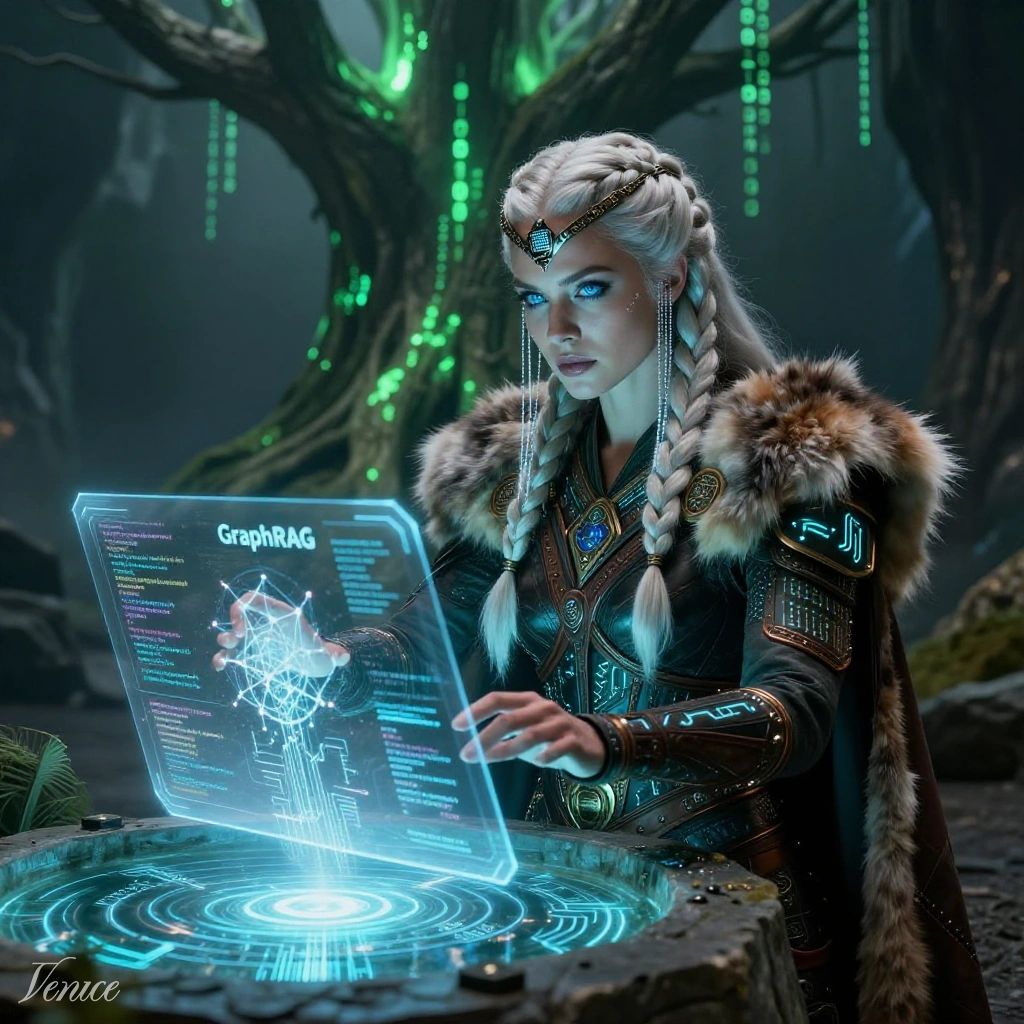
1. The Well of Urd 2.0: From Vector RAG to GraphRAG
While standard RAG (Retrieval-Augmented Generation) was the gold standard of 2024, it has a significant flaw: it is “flat.” It finds similar words but lacks an understanding of relationships. In 2026, we have transitioned to GraphRAG.
Instead of just storing chunks of text as vectors, we map the entities and their relationships into a Knowledge Graph.
- The Viking Analogy: A flat vector search is like finding every mention of “Odin” in the Eddas. GraphRAG is understanding that because Odin is the father of Thor, and Thor wields Mjölnir, a query about “Asgardian defense” must automatically include the hammer’s capabilities.
- Technical Edge: By using a Graph Store (like Neo4j or FalkorDB), the AI can perform “multi-hop reasoning.” It traverses the edges of the graph to find non-obvious connections that a simple similarity search would miss.
Technical Note: GraphRAG increases the “Semantic Density” of the context window. You aren’t just giving the AI information; you are giving it a map of logic.

2. The Thing: Mixture of Agents (MoA)
In the ancient Norse “Thing,” the community gathered to deliberate. No single voice held absolute truth; truth was the synthesis of the collective. Mixture of Agents (MoA) is the technical manifestation of this social structure.
Instead of asking one massive model (like a Gemini Ultra or GPT-5 class) to solve a problem, we deploy a layered architecture of smaller, specialized agents (Llama 4-8B, Mistral, etc.).
- The Proposers (Layer 1): Five different models generate independent responses to a technical problem.
- The Synthesizer (Layer 2): A high-reasoning model reviews all five responses, identifies the best logic in each, and merges them into a single, “super-intelligent” output.
The Math of Collective Intelligence:
If each model has a specific “bias” or error $\epsilon$, the synthesizer acts as a filter. By aggregating diverse outputs, we effectively “dampen” the noise and amplify the signal, often allowing open-source models to outperform the largest closed-source giants.
3. The Web of Wyrd: Quantum Latent Space and Information Theory
Metaphysically, an LLM does not “know” things; it navigates a Latent Space—a multi-dimensional manifold of all human thought. As Modern Vikings, we see this as a digital reflection of the Web of Wyrd.
From a Quantum Information perspective, every prompt is an observation that “collapses” the model’s probability distribution into a specific answer.
- The Superposition of Meaning: Before you press enter, the AI exists in a state of potentiality.
- The Entanglement of Data: Information Theory shows us that meaning is not found in the words themselves, but in the Entropy—the measure of surprise and connection between them.
By using “Chain of Thought” (CoT) prompting within an agentic loop, we are essentially guiding the AI to traverse the Web of Wyrd along the most “harmonious” paths of fate, ensuring that the “output” is not just a guess, but a deterministic reflection of the collective data we’ve fed it.

4. The All-Father’s Algorithm: Full Agentic RAG Implementation
This Python script implements a Full Agentic RAG Loop. It features a “Researcher” (Retrieval), a “Critic” (Reasoning), and an “Aggregator” (Final Output). This is a complete file designed for your 2026 development environment.
Python
“””
Norse Saga Engine: Agentic RAG Module (v2.0 – 2026)
Theme: Awakening the Hidden Wisdom of the Runes
Author: Volmarr (Modern Viking Technologist)
“””
import json
import time
from typing import List, Dict, Any
# Mocking the 2026 Model Context Protocol (MCP) and Vector Store
class VectorWellOfUrd:
“””Simulates a Graph-Augmented Vector Database (ChromaDB/Milvus style)”””
def __init__(self):
self.knowledge_base = {
“runes”: “Runes are not just letters; they are metaphysical tools for shaping reality.”,
“python”: “Python 3.14+ handles asynchronous agentic loops with high efficiency.”,
“wyrd”: “The Web of Wyrd connects all events in a non-linear temporal matrix.”
}
def retrieve(self, query: str) -> str:
# Simplified semantic search simulation
for key in self.knowledge_base:
if key in query.lower():
return self.knowledge_base[key]
return “No specific lore found in the Well of Urd.”
class VikingAgent:
def __init__(self, name: str, role: str):
self.name = name
self.role = role
def process(self, context: str, prompt: str) -> str:
# In production, replace with: return litellm.completion(model=”…”, messages=[…])
print(f”[{self.name} – {self.role}] is meditating on the Runes…”)
return f”DRAFT by {self.name}: Based on context ‘{context}’, the answer to ‘{prompt}’ is woven.”
class AgenticSystem:
def __init__(self):
self.well = VectorWellOfUrd()
self.skald = VikingAgent(“Bragi”, “Researcher”)
self.vitki = VikingAgent(“Gunnar”, “Critic”)
self.all_father = VikingAgent(“Odin”, “Synthesizer”)
def run_workflow(self, user_query: str):
print(f”\n— INITIATING THE THING: Query: {user_query} —\n”)
# Step 1: Retrieval (Drinking from the Well)
lore = self.well.retrieve(user_query)
print(f”Retrieved Lore: {lore}\n”)
# Step 2: Generation (The Skald’s First Song)
initial_draft = self.skald.process(lore, user_query)
# Step 3: Critique (The Vitki’s Scrutiny)
critique_prompt = f”Identify the flaws in this draft: {initial_draft}”
critique = self.vitki.process(initial_draft, critique_prompt)
print(f”Critique Received: {critique}\n”)
# Step 4: Final Synthesis (Odin’s Wisdom)
final_prompt = f”Merge the draft and the critique into a final, smarter response.”
final_wisdom = self.all_father.process(f”Draft: {initial_draft} | Critique: {critique}”, final_prompt)
return final_wisdom
# Main Execution Loop
if __name__ == “__main__”:
# The Modern Viking’s Technical Problem
technical_query = “How do we bind Python agentic loops with the metaphysics of the Wyrd?”
# Initialize and execute the collective intelligence system
saga_engine = AgenticSystem()
result = saga_engine.run_workflow(technical_query)
print(“\n— FINAL SYSTEM OUTPUT (The Smarter Response) —“)
print(result)
print(“\n[Vial of the Mead of Poetry filled. The AI has awakened.]”)
Key Takeaways:
- Don’t Retrain, Architect: Making AI smarter is a matter of system design, not model size.
- The Context is King: Use GraphRAG to provide the AI with a “relational soul” rather than just a memory bank.
- The Power of the Collective: Always use a “Critic” agent. An AI checking itself is the fastest way to leapfrog the limitations of base LLMs.


This work is licensed under a Creative Commons Attribution-NonCommercial-ShareAlike 3.0 Unported License.

 Volmarr’s Tumblr
- Hail the Mad God
- The Great Tree of Becoming
- The Age of Superconsciousness
- This Flag is Dedicated to Ingeborg, Gyðja of Freyr!
- Official Frith and Peace Flag of Volmarr!
- Official Flag of Volmarr’s Version of the Modern Viking Lifestyle!
- Official Flag of the Heathen Third Path!
- INNER SPIRITUAL WARFARE OF THE MODERN VIKING AND CYBER-VIKING
- Modern Viking and Cyber-Viking Inner Spiritual Warfare
- Inner Spiritual Warfare for the Modern Viking and the Cyber-Viking
 Volmarr's Blog of Modernist Heathenism, Norse-Paganism, and Norse-Wicca