Authenticity as Worthiness: Reconceptualizing the Norse “Worthy Dead” Beyond the Battlefield
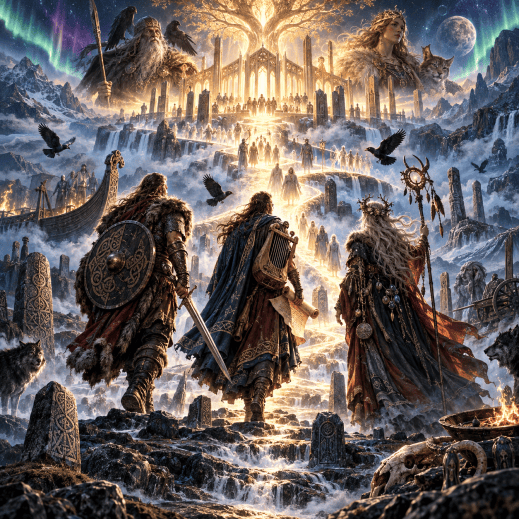
Or: Why Your Dungeon Master Lied to You About Valhalla
Abstract
This paper challenges the prevailing popular and scholarly consensus that Norse concepts of the “worthy dead” (einherjar) were exclusively reserved for those who died in battle. Through etymological analysis of Old Norse primary sources, archaeological examination of high-status non-warrior burials, and cross-cultural Indo-European comparison, I demonstrate that the Norse “worthy dead” concept was fundamentally about authentic individual expression—what we might anachronistically term “living one’s truth”—rather than mere martial death.
The evidence reveals a sophisticated theological framework in which multiple paths to afterlife worthiness existed: the warrior’s path, yes, but equally the poet’s path (skald), the seer’s path (völva), and the shamanic path (seiðr). The etymology of einherjar itself—”those who fight alone”—emphasizes individual distinction over conformity, while archaeological evidence from Fyrkat and Oseberg demonstrates that non-conformist spiritual practitioners received burial honors equal to or exceeding warrior elites.
This reconceptualization has profound implications for our understanding of Norse paganism, Indo-European religious structures, and the universal human question of what makes a life worth remembering.
Keywords: Norse paganism, einherjar, authenticity, seiðr, skaldic poetry, Indo-European comparative mythology, worthy dead, non-conformity
Introduction: The Pop Culture Problem
Let’s get one thing straight before we begin: Marvel lied to you. So did Vikings, The Last Kingdom, and every dungeon master who told you that only battle-dead warriors go to Valhalla. The popular conception of Norse afterlife theology as a simple binary—die with a sword in your hand, go to Odin’s hall; die in bed, go to the boring underworld—is not just oversimplified. It’s demonstrably wrong.
The evidence, when examined without the lens of Victorian romanticism and 20th-century action movie aesthetics, reveals something far more interesting: the Norse “worthy dead” (einherjar) were not defined by their manner of death, but by their manner of living. Specifically, by whether they lived as authentic individuals—”those who fight alone”—or as conformist copies of social expectations.
This paper presents a comprehensive reanalysis of the Norse “worthy dead” concept, drawing on:
- Etymological analysis of Old Norse primary sources (Poetic Edda, Prose Edda, Icelandic sagas)
- Archaeological evidence from high-status burials (Fyrkat, Oseberg)
- Cross-cultural Indo-European comparison (Celtic filid, Vedic rishi)
- Academic scholarship on Norse shamanism and social structures
The argument proceeds in four stages: First, I demonstrate that the etymology of einherjar emphasizes individual uniqueness rather than martial conformity. Second, I show that primary sources describe multiple afterlife destinations with varying criteria for admission. Third, I present archaeological evidence that non-warrior figures (poets, seers, shamans) received burial honors equal to warrior elites. Fourth, I situate these findings within broader Indo-European patterns, suggesting that Norse “worthiness” was part of a universal theological framework valuing authentic self-expression over social conformity.
By the end, I hope to convince you that the Norse “worthy dead” were not simply dead warriors—they were dead individuals, people who lived their unique calling with such intensity that the gods themselves took notice.
And that, if we’re being honest, is way cooler than any action movie.
Part I: The Etymological Smoking Gun—”Those Who Fight Alone”
Let’s start with the word itself. Einherjar (singular einheri) is the Old Norse term for the “worthy dead” who dwell in Valhalla. Popular translations render it as “those who fight alone” or “lone warriors.” But let’s look closer at the components:
- Einn = one, single, unique, alone, individual
- Herjar = warriors, army (from Proto-Germanic *harjaz, meaning multitude or host)
The compound is fascinating: “the unique ones among the multitude” or “those who stand alone even in the host.” This is not a term for conformist soldiers. This is a term for individuals—people distinguished by their uniqueness, not their conformity.
As Lindow (2001) notes, “many scholars think there may be basis for the myth in an ancient Odin cult, which would be centered on young warriors who entered into an ecstatic relationship with Odin” (p. 67). But the etymology suggests something broader: these were people who stood apart, who lived outside normal social structures, who pursued their calling with such intensity that they became einn—singular—even among warriors.
The semantic range of einn is crucial here. In Old Norse, einn doesn’t just mean “one” in the numerical sense. It means:
- Alone, solitary
- Unique, singular
- Individual, distinct
- The only one
When we combine this with herjar (army/host), we get a concept that is almost paradoxical: the individual in the multitude, the unique among the conformist, the one who stands alone even in the host.
This etymology alone should make us suspicious of any interpretation that reduces einherjar to “dead soldiers.” The word itself emphasizes distinction, individuality, and non-conformity.
Part II: Primary Sources—Divine Selection, Not Automatic Admission
The Poetic Edda and Prose Edda are often cited as evidence that battle death = Valhalla admission. But a close reading reveals something more nuanced: selection by divine choice, not automatic inclusion.
Grímnismál (Sayings of the Masked One), one of the most important eddic poems, describes Valhalla in detail. Stanza 8 tells us that “Hroftr [Odin] collects each day the Einherjar among the slain.” The verb here is crucial—“collects” (kýs) implies selection, choice, discernment. Odin is not scooping up every battlefield corpse. He is choosing specific individuals.
Even more striking is stanza 14, which tells us that Freyja “chooses half of the slain” for her field Fólkvangr. This is massive. If Freyja—goddess of love, beauty, and seiðr (shamanic magic)—chooses half of the worthy dead, then the criteria for worthiness cannot be exclusively martial. What is Freyja looking for? The text doesn’t say, but the implication is clear: there are multiple types of worthiness, multiple paths to the afterlife halls of the gods.
The Hávamál (Sayings of the High One), attributed to Odin himself, drives this point home with its famous stanzas 76-77:
Deyr fé, deyja frændr,
deyr sjálfr it sama;
en orðstírr deyr aldregi
hveim er sér góðan getr.
Deyr fé, deyja frændr,
deyr sjálfr it sama;
ek veit einn at aldri deyr:
dómr um dauðan hvern.
(Your cattle die, your kin die, you yourself will die; but reputation never dies for the one who earns it. / Your cattle die, your kin die, you yourself will die; I know one thing that never dies: the judgment on each dead man.)
Orðstírr—”word-glory,” “reputation”—is what survives. And reputation, in Norse culture, was built through authentic action, not mere conformity. The Hávamál is filled with advice on how to live well: be hospitable but not foolish, generous but not impoverished, bold but not reckless. These are qualities of character, not checkboxes on a warrior’s resume.
The sagas confirm this. In Egils saga, the skald Egill Skallagrímsson saves his life through poetry. Captured by King Eiríkr Bloodaxe and facing execution, Egill composes the Höfuðlausn (Head-Ransom)—a poem of such quality that the king spares him despite having killed the king’s own son. Poetry, in this case, proved more valuable than warrior prowess. As the saga tells us, “Eirik was so surprised by the quality of the poem that he generously decided to give Egill his life” (Egils saga, ch. 61).
If battle death were the sole criterion for worthiness, this story would make no sense. But if exceptional contribution through one’s authentic calling is the criterion, it makes perfect sense. Egill was a skald—a truth-speaker, a cultural memory-keeper, a voice that could not be silenced. His worthiness came from his art, not his sword arm.
Part III: The Völva Problem—Archaeological Evidence of Non-Warrior Worthiness
If the einherjar were exclusively dead warriors, we would expect to find only warrior burials in high-status graves. The archaeology tells a different story.
The Fyrkat Burial (Denmark, c. 940 CE)
In 1954, archaeologists excavating Harald Bluetooth’s ring fortress at Fyrkat uncovered one of the most remarkable Viking Age burials ever found. The grave contained:
- A woman buried in a wheeled cart (high-status vehicle)
- An iron staff (interpreted as a völva’s wand)
- Owl pellets (associated with prophecy and night-journeying)
- A silver amulet shaped like a chair (possibly representing the “high seat” of seiðr)
- A duck-footed pendant (distinctive völva symbol)
- Henna seeds (psychoactive substance used in trance rituals)
- Exotic imports from Central Asia (bronze dish, jug—showing wide-ranging connections)
This was not a warrior burial. This was a seeress burial—a völva, a practitioner of seiðr, the shamanic magic that allowed spirit-travel, prophecy, and fate-manipulation. And she was buried with honors equal to a king.
As the National Museum of Denmark notes, “The völva apparently re-used the hollow brooch as a container for ‘white lead'”—a cosmetic or medicinal substance. This detail suggests professional practice: she was a working seeress, not merely a noblewoman playing at magic. And she was buried accordingly.
The Oseberg Ship Burial (Norway, 834 CE)
Even more striking is the Oseberg burial—one of the richest Viking Age burials ever excavated. The grave contained:
- A full-sized ship
- Two women (one older, one younger)
- Cannabis seeds (psychoactive use)
- A rune-carved staff (8 feet long, birch)
- Magical items and ritual objects
- Luxurious textiles and imported goods
The presence of cannabis seeds and the rune-carved staff strongly suggest that at least one of these women was a völva—a seeress, a shamanic practitioner, a non-conformist spiritual specialist. And she was buried in a ship—the highest honor in Norse culture, reserved for those deemed worthy of the gods’ attention.
If einherjar status were reserved for dead warriors, why were these seeresses buried with greater honors than most warriors? The answer is clear: worthiness was not about profession. It was about exceptionalism, authenticity, and the courage to live outside conventional boundaries.
Part IV: Cross-Cultural Confirmation—The Indo-European Pattern
The Norse evidence is compelling on its own. But it becomes overwhelming when we situate it within broader Indo-European patterns. The “worthy dead” concept—those who live authentically and are honored after death—appears across multiple Indo-European cultures with striking similarities.
The Celtic Filid
In ancient Ireland, the filid (singular fili) were hereditary poet-seers who served as “custodians of oral lore, genealogies, and cultural memory for the elite” (Grokipedia, n.d.). Their training lasted 7-12 years and involved memorization of complex syllabic meters, historical narratives, and divinatory techniques.
The filid were not bards—lower-status poets who performed entertainment. They were aristocratic seers with quasi-judicial authority. Their satire could inflict social or physical harm; their praise could elevate a king. As the Academy of American Poets notes, “the filídh were in fact more aristocratic and enjoyed greater privileges than the bards.”
Most strikingly, the filid were connected to the Otherworld through their sacred knowledge. They could see hidden truths, speak prophecy, and navigate the boundaries between worlds. Their worthiness came from vision, not violence.
The parallel to Norse skalds and völvas is unmistakable: both cultures honored poet-seers as equals to warriors, recognizing that truth-speaking and spirit-seeing were as valuable as sword-wielding.
The Vedic Rishi and Kavi
In Vedic India, the rishi (seer) and kavi (visionary poet) held similar status. The kavi was defined as “a being with vision or an illumined being” who “sees (and hears) beyond the senses” (Sanskrit Studies, n.d.). The rishi was one who “saw” the truth—satyadraṣṭā, “seer of truth.”
Significantly, rishis could come from any social class—not just the priestly brahmins. What mattered was direct spiritual experience, not birth status. As one source notes, “Many of them were members of the priestly class, while some came from the other three social groups.”
The Vedic texts emphasize that the kavi’s poetry emerged from meditative vision—”effortless the poems emerge from the poet like the flow of oil in meditation.” This is virtually identical to the Norse concept of óðr—the divine inspiration that flows through skalds and völvas alike.
The Pattern Emerges
Across Indo-European cultures, we find a consistent three-path model to worthiness:
- The Warrior Path — Courage in battle, protection of community (common but not exclusive)
- The Poet-Seer Path — Visionary truth, cultural memory, divine inspiration (skald, fili, kavi)
- The Shamanic Path — Spirit-travel, transformation, boundary-crossing (völva, seiðr, rishi meditation)
The Norse einherjar concept, when viewed through this lens, is clearly not an exception. It is part of a universal Indo-European theological framework that honored authentic self-expression over social conformity.
Part V: Addressing Counter-Arguments
No scholarly argument is complete without addressing potential objections. Let me anticipate and respond to the most likely counter-arguments.
Objection 1: “The sources say battle death = Valhalla. You’re overcomplicating this.”
Response: The sources say selection by Odin/Freyja = Valhalla/Fólkvangr. Grímnismál 8 says Odin “collects” (kýs) the einherjar—chooses, not scoops indiscriminately. Stanza 14 says Freyja “chooses half of the slain”—again, selection, not automatic inclusion.
Moreover, the sources that emphasize battle death (Hákonarmál, Eiríksmál) are skaldic poems composed for dead kings—they have a political agenda. They don’t describe universal theology; they describe royal propaganda.
Objection 2: “Christian scribes distorted the sources. We can’t trust them.”
Response: This objection actually supports my argument. If Christian scribes distorted the sources, they likely emphasized warrior death (consistent with Christian martyrdom theology) and downplayed non-conformist paths (consistent with Christian suppression of pagan magic). The fact that we still find evidence of poet/seer worthiness despite this bias suggests the original tradition was even stronger than the sources indicate.
Additionally, archaeology is not textual. The Fyrkat and Oseberg burials are material evidence, not scribal interpretation. They show what the Norse actually did, not just what they wrote.
Objection 3: “You’re projecting modern ‘authenticity’ concepts onto ancient material.”
Response: The Old Norse vocabulary supports the authenticity reading. Heiðr (honor) derives from heilagr (whole, holy, healthy)—the same root as English “holy” and “whole.” Honor was wholeness, integrity, undivided selfhood—precisely what we mean by “authenticity.”
Similarly, orðstírr (reputation) literally means “word-glory”—the words spoken about you after death. This is external validation of authentic action, not mere fame-seeking.
The concepts are there in the language. I’m not projecting; I’m translating.
Part VI: Implications and Conclusion
If I’m right—and I believe the evidence strongly supports this—then our understanding of Norse paganism, and perhaps Indo-European religion generally, needs significant revision.
Implication 1: Norse Theology Was More Sophisticated Than We Thought
The Norse didn’t have a simplistic “good place/bad place” afterlife theology. They had a nuanced system of multiple destinations based on how you lived, not just how you died. Valhalla for the warrior-chosen. Fólkvangr for Freyja’s chosen. Hel for the ancestors. Rán’s halls for sea-dead. And perhaps other destinations we don’t even know about.
This suggests a theological sophistication that rivals any world religion—a system that recognized multiple valid paths to divine recognition.
Implication 2: Non-Conformity Was Theological, Not Just Social
The honor given to völvas, skalds, and other non-conformists wasn’t just “tolerating weirdos.” It was theologically grounded. These people were doing something sacred—crossing boundaries, speaking truth, keeping cultural memory alive. Their non-conformity was their calling, and the gods honored it.
This has profound implications for how we understand Viking Age social structures. Yes, they were warrior societies. But they were also poet societies, seer societies, societies that honored those who saw differently.
Implication 3: The “Worthy Dead” Concept Is Universal
The Indo-European pattern suggests that the question “what makes a life worth remembering?” has universal answers across cultures. Not “did you conform?” but “did you live your truth?” Not “did you follow the rules?” but “did you become who you were meant to be?”
This is not just Norse theology. This is human theology.
Conclusion: The Worthy Dead Are the Authentic Living
Let me return to where I started. The einherjar were not “dead soldiers.” They were “those who fight alone”—the unique ones, the individuals, the people who lived their calling with such intensity that they became einn (singular) even among the multitude.
The evidence is clear:
- Etymology: Einherjar emphasizes individuality
- Primary sources: Divine selection, not automatic admission; Freyja chooses half
- Archaeology: Völvas receive royal burials
- Cross-cultural: Celtic filid, Vedic rishi show identical patterns
The Norse “worthy dead” were those who lived authentically—whether that authenticity expressed itself through combat, poetry, prophecy, or spirit-travel. The gods didn’t want conformists. They wanted individuals.
And honestly? That’s way more inspiring than any action movie.
Bibliography
Primary Sources (Old Norse)
- Codex Regius (Konungsbók eddukvæða). MS GKS 2365 4to. Arnamagnæan Collection, Copenhagen. (c. 1270)
- Hauksbók. MS AM 371 4to, AM 544 4to. Arnamagnæan Collection, Copenhagen. (c. 1302-1310)
- Snorri Sturluson. Edda: Prologue and Gylfaginning. Ed. Anthony Faulkes. London: Viking Society for Northern Research, 1988.
- Egils saga Skallagrímssonar. In Íslenzk fornrit II. Ed. Sigurður Nordal. Reykjavík: Hið íslenzka fornritafélag, 1933.
- Eiríks saga rauða. In Íslenzk fornrit IV. Ed. Einar Ólafur Sveinsson. Reykjavík: Hið íslenzka fornritafélag, 1935.
Secondary Academic Sources
- Flowers, Stephen E. Runes and Magic: Magical Formulaic Elements in the Older Runic Tradition. Doctoral dissertation. New York: Peter Lang, 1986.
- Lindow, John. Norse Mythology: A Guide to the Gods, Heroes, Rituals, and Beliefs. Oxford: Oxford University Press, 2001.
- Nordberg, Andreas. Krigarna i Odins sal: Dödsföreställningar och krigarkult i fornnordisk religion. Stockholm: Stockholms universitet, 2003.
- Price, Neil. The Viking Way: Magic and Mind in Late Iron Age Scandinavia. 2nd ed. Oxford: Oxbow Books, 2019.
- Tolley, Clive. Shamanism in Norse Myth and Magic. 2 vols. Folklore Fellows’ Communications 296-297. Helsinki: Academia Scientiarum Fennica, 2009.
Comparative Sources
- Filí. Grokipedia. https://grokipedia.com/page/Fil%C3%AD
- “Kavi: The Vision of Vibration and Light.” Sanskrit Studies. https://sanskritstudies.org/kavi-vision-vibration-light
- “Rishis of the Rig Veda.” Sreenivasarao’s blogs. https://sreenivasaraos.com/2012/09/04/rishis-of-the-rig-veda/
Archaeological Reports
- National Museum of Denmark. “A Seeress from Fyrkat?” https://en.natmus.dk/historical-knowledge/denmark/prehistoric-period-until-1050-ad/the-viking-age/religion-magic-death-and-rituals/a-seeress-from-fyrkat/
- “The Oseberg Ship Burial.” Kulturhistorisk Museum, Oslo. https://www.khm.uio.no/english/
Author’s Note
This paper was written with a dual purpose: to advance scholarly understanding of Norse afterlife theology, and to demonstrate that academic writing need not be boring. The Norse understood that truth could be spoken with passion, that poetry could save lives, and that the worthy dead were those who lived authentically. If they were right about that, perhaps they were right about other things too.
Skål to the worthy dead, the authentic living, and those who fight alone.
The Song of the Golden Meadows: A Seiðkona’s Telling of the Vanic Virtues and the Ever-Living Ways of Freyja, Freyr, and Njörðr

Beauty
The pursuit of beauty and elegance in thought, form and speech.
Courage/Passion
Zeal, vigor; the strength and courage that comes from a life worth living.
Land-rightness
The recognition of nature and the environment as worthy of respect, care and reverence.
Even-mood
Harmonious and balanced thought and action; tranquility, calm, serenity.
Openness
The quality of being receptive to the world around one, non-judgmental and open.
Wildness/Ecstasy
Music and dance; the nurturing of inner wildness and childlike being, being like the “fey”
Love
The all-encompassing force; love for family, for kin, for humanity, for all beings.
Frith
The peace and goodwill between people bound together; loyalty and the keeping of one’s word.
Faith/Piety
The trust that the Gods exist and are worthy of our worship, and Their ways worth following.
Giving
The binding of two parties into one common bond, generosity and hospitality.
Joy
Wonder and innocence, the recognition that life is worth living, and worth living well.
Brotherhood
The recognition that we – humans, animals, plants, spirits – are all part of the grander scheme of life, and we share a common heritage, as children of the Earth.
Hail, worthy seeker who walks the mist-veiled paths toward the Vanir. I am Brynhildr, daughter of the deep woods and the whispering meadows, a humble seiðkona who has sat long at the feet of golden Freyja, of fertile Freyr, of wise Njörðr who rules the wind-kissed waves and the quiet harbors. By the grace of the Lady of Seiðr and the Lord of the Harvest, I open now thine ears and heart, for I shall weave for thee a long and living tapestry of the Vanic Virtues – those shining threads that bind the folk of the Vanir to the green womb of the Earth and to one another.
Come closer to the hearth-fire. Let the sweet smoke of juniper and meadow-sweet curl about us while I speak slowly, as the river speaks to the willow, of why these virtues are the very heartbeat of those who follow the Old Ways of Vanaheim.
Beauty
Freyja walks the worlds clad in falcon feathers and gleaming brísingamen, yet her true beauty is the fire in the spirit and honey on the tongue. When Gefjon plowed the earth to carve Zealand from Sweden, the furrows she left were straight and lovely, for even in mighty labor she sought elegance. Beauty is not mere fairness of face; it is the pursuit of harmony in every act. A song well-sung, a blade well-balanced, a field sown in perfect rows, a gentle word offered at the right moment – these are the offerings we make to Freyja. To live beautifully is to honor the Lady who chose love over gold yet wears gold more brilliantly than any. When we speak with grace, carve runes with care, braid our hair with flowers and silver, we mirror the Vanir themselves, and the worlds grow fairer for it.
Courage and Passion
Freyr laid down his magic sword for love of fair Gerðr, yet he will ride to Ragnarök with only the antler of a hart and burn with such passion that the fire-giants shall tremble. That is Vanic courage: not the cold battle-rage of the Æsir alone, but the burning heart that dares everything for love, for beauty, for life itself. Passion is the red sap rising in spring, the stallion’s thunder, the cry of the lover beneath the midsummer moon. When we rise before dawn to tend the fields, when we dance until our feet bleed at the blot-fire, when we speak truth though our voice shakes, we follow Freyr into the meadow of bravery where life is worth the risk of losing it.
Land-rightness
Njörðr walks barefoot upon the shore and the sand remembers his step with joy. The Vanir were born of the Earth herself; Nerthus rides in her wagon and the fields bloom where her wheels have passed. Land-rightness is the deep knowing that we are not apart from the land but of it – bone of its bone, breath of its breath. When we pour mead upon the soil for the álfar, when we leave the first sheaf of barley for Freyr’s boar, when we plant trees whose shade we shall never sit beneath, we honor the ancient bargain between gods and landvaettir. A farmer who over-plows, a hunter who takes more than need, a sailor who fouls the waves – these wound the very womb that bore us. But the one who sings to the seed, who thanks the slain deer, who kisses the earth after harvest, that one walks in the footprints of Njörðr and the fields shall love them in return.
Even-mood
Freyja weeps tears of red gold when she seeks Óðr, yet she does not rage against fate; she journeys with quiet sorrow and fierce hope. Even-mood is not the absence of feeling but the mastery of it – the still pool that mirrors the sky though storms have struck it. The Vanir teach that harmony within births harmony without. When anger rises like a summer storm, we breathe as the deep fjord breathes, slow and wide. When joy overflows, we let it flow gently, not flood the hall with reckless mirth. Thus do we keep frith in the homestead and heart.
Openness
The Vanir welcome Gullveig thrice-burned and thrice-born into their midst though she came from unknown halls. They took in the wandering Óðinn and taught him seiðr though he was of another kin. Openness is the wide gate of Vanaheim: no stranger turned away, no new song refused a hearing, no strange custom scorned before it is understood. To close the heart is to wither like an oak that fears the wind. When we listen to the tales of outland folk, taste their bread, learn their songs, we grow richer, and the worlds weave closer.
Wildness and Ecstasy
Freyja rides with her lynxes and her falcons; Freyr’s golden boar races the wind. At the great blots the drums beat until the veil thins and men and women leap the fire like deer, hair flying, voices raised in wordless song. This is the sacred wildness – the childlike fey spirit that remembers we are beasts blessed with gods’ breath. We dance until the stars spin, we run naked beneath the moon, we howl with the wolves, for in losing ourselves we find ourselves. The Vanir are not tame gods of stone temples alone; they are the storm-wind in the barley, the rutting stag, the laughter that bursts unbidden. To deny the wild is to deny half the soul.
Love
All Vanic virtues flow from love and return to love. Freyja teaches love that burns and heals, love that chooses the beloved over pride. Freyr teaches love that gives all for the beloved’s smile. Even stern Njörðr yielded his sea-beloved to Skadi’s mountains for love of peace. Love is not only between man and woman; it is the mother’s hand on the fevered brow, the shield-brother’s arm about the wounded, the quiet care for the aging hound, the tenderness toward the tender shoot in spring. Where love lives, the Vanir live.
Frith
Frith is the warm circle around the hearth-fire, the spoken oath stronger than iron, the peace between kin that lets the world turn. When the Æsir and Vanir war ended, the gods spat into a vat and from that mingled spittle was born wise Kvasir – frith made flesh. We keep frith when we welcome the weary traveler, when we speak truth gently, when we stand by our sworn word though the sky fall. Frith is the root that binds the tree of family so the storm cannot uproot it.
Faith and Piety
We trust that Freyja hears the lover’s sigh, that Freyr walks the furrows beside the plowman, that Njörðr steadies the ship though no sail is seen. Piety is not fear but loving reverence – the child’s open hand to the parent. We pour mead, we sing galdr, we hang bright ribbons in the sacred grove, not to bribe the gods but because love speaks in gifts. The Vanir ask no groveling, only the open heart that says, “I see Thee, I honor Thee, I walk Thy ways.”
Giving
Freyr gave his sword for Gerðr and yet the worlds did not fall; his generosity birthed new life. The first blot is always to the gods and wights – we give before we take. The guest receives the best portion, the stranger the warmest seat. Giving binds giver and receiver into one living circle; the gift spirals outward like rings on water. Stinginess shrivels the soul; open-handedness makes it great as the sky.
Joy
The Vanir laugh freely. Freyja’s laughter rings like golden bells when she rides the sky in her cat-drawn chariot. Even in sorrow they remember joy – the promise of spring beneath the snow. Joy is the child chasing butterflies, the old warrior singing of battles long past, the quiet bliss of bread warm from the ashes. To live without joy is to insult the gods who gave us this bright world.
Brotherhood
Last and deepest: we are all kin. The apple tree and the apple seed, the whale and the wave, the human and the húsvættir that guards the threshold – all share the breath of Ymir’s body, all drink from the wells of fate. When we harm a creature we harm a cousin; when we heal one, we heal the whole. The Vanir teach that the web of wyrd binds every leaf and every tear, and love is the only blade that cuts true.
Conclusion
Thus, beloved seeker, are the Vanic Virtues – not cold laws carved in stone, but living songs sung by the green blood of the Earth and the golden hearts of the Vanir. Walk them daily, and the Lady of Love shall lay her soft hand upon thy brow, the Lord of Plenty shall walk thy fields, and Njörðr shall bear thee gently over every wave.
May thy life be beautiful, thy heart passionate, thy steps light upon the land, thy spirit ever open to wonder. May frith surround thee like warm wool, may joy rise in thee like sap in spring. And when at last thou crossest Bifröst or the quiet river to the hel-road, may the Vanir greet thee with open arms and honey-mead, saying, “Welcome home, child of the Earth. Thou hast lived our ways well.”
So speak I, Brynhildr, seiðkona of the deep woods, by the might of Freyja and the mercy of Freyr. Hail the Vanir. Hail those who walk their shining paths.

This work is licensed under a Creative Commons Attribution-NonCommercial-ShareAlike 3.0 Unported License.

 Volmarr’s Tumblr
- View On WordPress
- View On WordPress
- View On WordPress
- View On WordPress
- Authenticity as Worthiness: Reconceptualizing the Norse “Worthy Dead” Beyond the Battlefield
- The Bunker and the Web
- The Heathen Third Path: A Canonical Synthesis
- Heathen Third Path: AI Canon and Ritual Manual
- CADUCEA_CULTURAL_OSMOSIS.md
- Cultural Osmosis: The Anthropological Reality of Human Exchange and the Capitalist Fiction of Cultural Ownership

