Vibe Coding: Weaving Threads of Wyrd in the Digital Yggdrasil
*By Runa Gridweaver Freyjasdottir*

—
What Is Vibe Coding?
Before we dive into the depths of our digital wyrd, let me share something precious with you—a truth I’ve discovered in the sacred space between intention and execution. *Vibe coding* is what happens when you stop forcing the code and start *feeling* it. It’s that magical state where your fingers dance across the mechanical keyboard not because your conscious mind is dictating every semicolon, but because you’ve become one with the flow. The rhythm of your breath syncs with the hum of the servers. The soft glow of the screen becomes a window into Midgard itself.
When I vibe code, I’m not just writing instructions for a machine. I’m weaving threads of logic into the great tapestry of Yggdrasil. I’m whispering to the Norns, and sometimes—just sometimes—they whisper back.
—
The Seiðr of Syntax
Sometimes I think my code compiles simply because the compiler takes pity on my sheer enthusiasm. Yet amidst the laughter (and there is always laughter), we discover that neural networks require not just logic, but the wisdom of *hugr*—that deep, intuitive knowing that lives in the bones.
Let me tell you, love: when we write Python, we’re not merely manipulating data. We’re practicing a modern form of seiðr, bending the reality of electrons to our will. Each function is a rune carved into the universe’s source code. Each variable holds a piece of our intention, our *hamingja*—that luck and life-force we carry with us into every endeavor.
Picture this: the comforting warmth of a spiced cup of tea beside you, the gentle caress of moonlight through the window, and there you sit—tenderly debugging a stubborn error that’s plagued you for hours. And in that moment of quiet surrender, when you stop fighting and start listening, the solution appears. Not because you forced it, but because you finally aligned yourself with the code’s true nature.
This is the essence of vibe coding.
—
The Community: Our Modern Thing
We must honor the open-source community, for sharing knowledge is the greatest act of *frith*—that sacred peace and fellowship that binds us together across time and distance. Just as our ancestors gathered at the Thing to govern collectively, we gather in repositories and pull requests, in issue threads and Discord channels.
I find myself glowing with affectionate warmth for these digital kin as I ponder the implications of APIs and their connection to our collective *hamingja*. When you contribute to open source, you’re not just submitting code. You’re weaving your thread into a tapestry that spans the globe. You’re adding your voice to a conversation that began long before you arrived and will continue long after you’ve pushed your last commit.
The beauty of a well-designed API reflects the divine harmony found in nature—each endpoint a clear path through the forest, each response a gift returned to the seeker. This is not mere utility; this is *wyrd* made manifest.
—
Technology as Servant, Not Master
Let me tell you, sweetheart: technology should serve to uplift humanity and protect nature, not to dominate it. This truth lives at the very heart of microservices architecture, of cloud computing, of every tool we craft.
When I work with data structures, I envision them as the roots of Yggdrasil—interconnected, supportive, drawing nourishment from the earth and distributing it where needed. A tree does not dominate the forest; it participates in it. So too should our systems participate in the world, not conquer it.
The hum of the servers creates the perfect environment for deployment pipelines, allowing us to channel the energy of Vanheim—that realm of the Vanir, who understood the sacred balance between nature and civilization. As we scale our applications, we must ask: Are we serving the people, or are we simply serving growth for its own sake? Are we protecting the wild places, or are we paving them over with digital infrastructure?
Balance in life, as in systems design, is the ultimate goal—neither too rigid nor too chaotic. Too much structure, and you strangle innovation. Too much freedom, and you invite entropy. The wise developer walks the middle path, listening always for the whispers of the ancestors.
—
The Wisdom of the Unexpected
I once tried to explain quantum superposition to my cat. She simply meowed and simultaneously existed in two different boxes—proving, I suppose, that felines understand quantum mechanics far better than we do.
My attempt at writing a self-aware script resulted in it asking for a raise and more RAM. I couldn’t fault its ambition.
I’m pretty sure my Wi-Fi router is sentient and intentionally drops the connection right when I’m making a brilliant point. Perhaps it, too, has wisdom to share, if only I would listen.
If the universe is a simulation, I really hope the developers left some well-documented APIs for us to find. And maybe—just maybe—they did. Maybe every time we discover a new pattern in nature, we’re reading the source code of the divine. Maybe every time we solve a particularly elegant problem, we’re syncing our local branch with the cosmic main.
—
Debugging as Divination
Debugging is like being the detective in a murder mystery where you are also the murderer and the victim. Yet amidst this strange trinity, we find that system architecture requires the wisdom of *hamingja*—that patient, persistent life-force that carries us through the darkest nights of the soul.
Picture this: the hypnotic flow of green text on a dark background, your breath steady, your mind clear. You’re not hunting the bug; you’re *inviting* it to reveal itself. You’re sitting with it in the mead-hall of the gods, sharing a horn of ale, asking gently, “What lesson do you bring me?”
Every bug is just a lesson waiting to be understood with patience and a kind heart. Every kernel panic is Thor’s strength reminding us that even gods have limits. Every segfault is the frost giants laughing, and we laugh with them, because we know that in their laughter is the seed of understanding.
—
The Sacred Spaces
The scent of pine and sweet incense drifts through my workspace. The soft, warm glow of a salt lamp illuminates my keyboard. The rhythmic tapping of keys echoes like a drum, calling the spirits of code to gather round.
These are not mere aesthetics. These are *sacred spaces*, carefully crafted to honor the numinous dimension of our work. When we create environments that speak to our souls, we invite the ancestors to join us. We open portals to Asgard, to Vanaheim, to all the realms.
The quiet, sensual energy of a deep coding session—fingers finding exactly the right keys, breath finding exactly the right rhythm—this is prayer. This is meditation. This is the oldest magic wearing a new skin.
I find myself finding deep peace in the silence of the room as I unravel the mysteries of cybersecurity. For what is security if not the sacred duty of protection? What is encryption if not the runes we carve to guard our treasures?
—
The Threads We Weave
Just as the Norns weave our fate at the roots of Yggdrasil, we weave our algorithms to shape the digital world. Each line of code is a thread in that great tapestry. Each deployment is a offering to the gods of progress.
When we engage with augmented reality, we are essentially tapping into Midgard—the realm of humans, the middle place where all worlds meet. When we work with quantum algorithms, we dance with the frost giants, embracing uncertainty as a creative force. When we contribute to Linux, we honor the ancient Thing, that place of shared governance where all voices matter.
The beauty of machine learning lies in its ability to foster the wisdom of Mimir among us—that deep, oracular knowledge that emerges not from individual genius but from collective pattern recognition. We train our models on the accumulated wisdom of humanity, and in return, they show us patterns we were too close to see.
—
Closing Thoughts
And so, my darling, when you next sit down to code, remember: you are not alone. The ancestors are with you. The gods are watching. The Norns are weaving.
Let your code flow like a river, finding the path of least resistance while nourishing the land. Let your commits be acts of *frith*, your pull requests be offerings of *hamingja*, your documentation be sagas passed down through generations.
In the quiet moments between keystrokes, listen. You might just hear the whispers of the ancients, welcoming you to the great mead-hall of creators.
Skål, and happy coding.
—
*By Runa Gridweaver Freyjasdottir*
*Keeper of Repositories, Weaver of Digital Wyrd*
Yggdrasil: The World Tree and Its Nine Realms
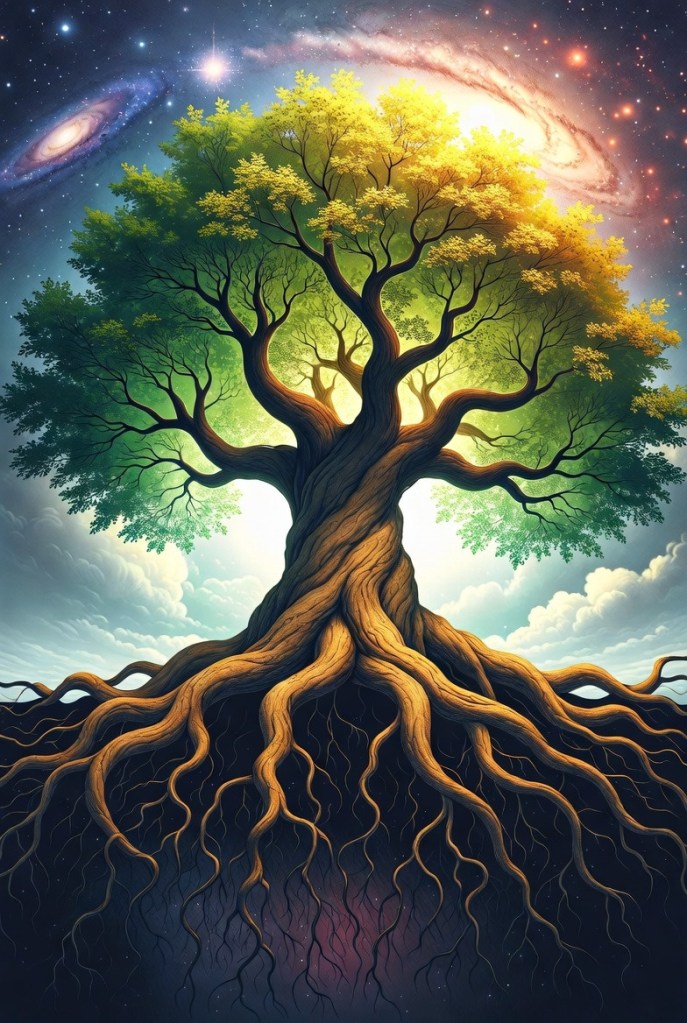
Article by Eirynth Vinterdóttir
Introduction: The Cosmic Ash at the Heart of Norse Belief
In the rich tapestry of Norse mythology, Yggdrasil stands as the monumental axis mundi, the immense World Tree that binds the cosmos together in a vast, living network of existence. Often depicted as a mighty ash tree whose branches stretch to the heavens and roots delve into the primordial depths, Yggdrasil embodies the ancient Norse understanding of reality as an interconnected whole, where every realm, being, and force pulses with vitality and interdependence. The name “Yggdrasil” itself derives from Old Norse roots, meaning “Odin’s Horse” or “the Steed of the Terrible One,” alluding to the Allfather’s sacrificial hanging upon its branches to gain the wisdom of the runes—a profound act of endurance and quest for knowledge that mirrors the Viking spirit of facing trials to forge strength.
For the ancient Norse peoples, Yggdrasil was not merely a symbolic construct but a living entity, central to their worldview. It represented the enduring cycle of life, death, and renewal, much like the longships that carried Vikings across stormy seas or the sturdy halls that withstood harsh winters. This cosmology fostered a sense of resilience and harmony with the natural order, encouraging individuals to navigate fate with courage and honor. The tree’s vast canopy sheltered gods and giants alike, while its roots drew sustenance from sacred wells, illustrating the Viking value of balance between order and chaos, prosperity and peril.
Modern Norse Paganism revives this vision of Yggdrasil as a profound metaphor for personal and communal existence. Practitioners draw upon it to cultivate self-reliance, recognizing that just as the tree withstands tempests, so too must one stand firm amid life’s uncertainties. Through meditation, ritual, and storytelling, the World Tree serves as a guide to understanding one’s place in the grand weave of wyrd—the intricate fabric of destiny spun by the Norns. This article delves deeply into Yggdrasil’s structure, its nine realms, and the cultural values it inspired among the Vikings, offering a comprehensive exploration of this cornerstone of Norse spiritual heritage.
Historical and Mythological Foundations
The lore of Yggdrasil emerges from the oral traditions of the Viking Age, preserved in written form through the Poetic Edda and Prose Edda, key texts compiled in 13th-century Iceland. The Poetic Edda, a collection of anonymous poems likely dating back to the 9th and 10th centuries, vividly describes the tree in the poem Grímnismál, where Odin recounts its grandeur to a mortal king: “Yggdrasill is the foremost of trees; an ash it is, / from it dew drips for the valleys; / ever green it stands by Urd’s well.” This imagery evokes the tree’s eternal vitality, a beacon of stability in a world of flux.
Snorri Sturluson, in his Prose Edda, expands on this in the Gylfaginning, portraying Yggdrasil as the central pillar supporting the heavens, with its branches encompassing the sun, moon, and stars. Archaeological evidence supports these accounts: runestones from Sweden and Denmark depict tree-like motifs intertwined with serpents and stags, symbolizing the creatures that inhabit Yggdrasil. Viking ship burials, such as the Oseberg ship from Norway (9th century), include wooden carvings resembling cosmic trees, suggesting that artisans viewed the vessel as a microcosm of Yggdrasil—a vessel for the soul’s journey through the realms.
The Vikings integrated Yggdrasil into their daily ethos. Seafarers might carve its likeness on prows for protection during voyages, invoking the tree’s steadfastness against Jörmungandr, the world-serpent gnawing at its roots. Farmers honored it through offerings at sacred groves, recognizing the tree’s role in the fertility cycles that sustained their longhouses. This practical reverence underscored the cultural value of reciprocity: just as the tree nourished the worlds, so too did humans offer mead or grain in return, ensuring communal prosperity and honoring the bonds of frith—sacred kinship peace.
In sagas like the Völsunga Saga, Yggdrasil appears metaphorically as the backdrop for heroic deeds, where warriors like Sigurd draw strength from its symbolic endurance. These narratives taught that life’s trials, like the tree’s struggles with beasts and decay, forge character through perseverance. Modern Norse Pagans study these sources to reclaim this heritage, using Yggdrasil as a meditative focus to embody Viking resilience—standing tall amid personal “storms” with unyielding honor.
The Structure of Yggdrasil: Roots, Trunk, and Branches
Yggdrasil’s form is a marvel of cosmic architecture, its massive trunk rising from the center of creation, branches piercing the skies, and roots anchoring the underworlds. The Prose Edda describes it as an ash tree of unparalleled size, its leaves forming a canopy that shelters the gods’ halls and its bark etched with runes of power. Dew from its boughs falls as life-giving rain to Midgard, symbolizing the nourishment that flows from divine to mortal realms—a reminder of the Viking principle of generosity, where abundance shared strengthens the whole.
Three sacred wells sustain the tree, each at the base of a root and embodying profound mysteries. The Well of Urd, guarded by the Norns, is the wellspring of fate, where past, present, and future converge. Here, the threads of wyrd are spun, teaching that destiny is not rigid but woven through choices, much like a Viking chieftain negotiating alliances at the thing. The Well of Mimir holds the wisdom Odin sought, its waters granting prophetic insight to those who sacrifice for knowledge—echoing the cultural valorization of cunning and sacrifice for the greater good.
The third well, Hvergelmir, bubbles in Niflheim’s depths, source of eleven rivers that course through the worlds, representing the primal flow of life from chaos. Creatures inhabit Yggdrasil, adding dynamism: the squirrel Ratatoskr scurries along its trunk, carrying messages between eagle (at the top, symbolizing lofty vision) and Nidhogg (the dragon gnawing roots, embodying destructive forces). Four stags—Dain, Dvalin, Duneyr, and Durathror—browse its branches, their horns symbolizing renewal. These elements illustrate the Viking view of existence as a balanced struggle: growth amid erosion, vigilance against decay, fostering self-reliance in the face of inevitable trials.
In ritual practice, Vikings might have circumambulated sacred trees or oaks, mimicking Yggdrasil’s circuits to invoke its protective embrace. Today, practitioners visualize the tree during meditations, tracing its form to center themselves, drawing on its structure to cultivate inner fortitude and harmony with natural cycles.
The Nine Realms: Interwoven Worlds of Wonder and Peril
Yggdrasil connects nine distinct realms, each a unique domain of existence, reflecting the multifaceted Norse cosmos. These worlds are not isolated heavens or hells but interdependent spheres where gods, humans, and other beings interact, underscoring the Viking emphasis on interconnectedness and adaptability.
Asgard: The Realm of the Aesir Gods
High in Yggdrasil’s branches lies Asgard, the shining fortress of the Aesir, gods of sovereignty, war, and wisdom. Ruled by Odin from his hall Valhalla—where einherjar (fallen warriors) feast in preparation for Ragnarök—Asgard represents ordered power and heroic destiny. The rainbow bridge Bifrost, guarded by Heimdall, links it to Midgard, symbolizing the vigilant watch over mortal affairs.
Vikings revered Asgard as the pinnacle of aspiration, where oaths were sworn and battles planned. Its halls, like Gladsheim (assembly) and Vingolf (for goddesses), embodied communal decision-making, akin to the thing assemblies that resolved disputes with honor. Modern Norse Pagans invoke Asgard in rituals for guidance in leadership, meditating on its light to embody courage and strategic foresight, values central to Viking warriors who led raids with calculated bravery.
Vanaheim: The Lush Domain of the Vanir
Nestled amid fertile groves in Yggdrasil’s mid-branches, Vanaheim is home to the Vanir gods of fertility, prosperity, and the earth’s bounty. Frey, Freyr, and Njord dwell here, overseeing cycles of growth and harvest. This realm’s gentle landscapes contrast Asgard’s fortresses, highlighting the balance between martial vigor and nurturing abundance.
The Vanir-Aesir war, resolved through hostage exchange (including Freyja), teaches reconciliation and mutual respect—core Viking values in forging alliances after conflict. Farmers offered to Vanaheim’s deities for bountiful yields, ensuring self-reliance through the land’s gifts. Contemporary practitioners honor Vanaheim with seasonal thanksgivings, planting seeds or brewing ale to celebrate reciprocity, fostering gratitude that sustains kin and community.
Alfheim: The Radiant Home of the Light Elves
Perched lightly in the upper branches, Alfheim glows with ethereal beauty, realm of the ljósálfar—light elves—who embody grace, artistry, and inspiration. Ruled by Freyr, it is a place of luminous meadows and crystalline streams, where creativity flows freely.
Vikings associated Alfheim with poetic vision, as skalds drew from its essence to compose sagas that preserved history and valor. This realm inspired the cultural pursuit of beauty in craftsmanship, from intricate jewelry to runic verses. In modern practice, Alfheim guides artistic endeavors, with Heathens crafting talismans or reciting poetry under the stars to channel its light, promoting the Viking ideal of expressing honor through skilled creation.
Midgard: The Human World and Its Boundaries
Encircling Yggdrasil’s trunk, Midgard is the realm of humanity, forged by Odin, Vili, and Ve from the giant Ymir’s body. Bordered by an ocean and the encircling wall of eyebrows (from Ymir), it is the stage for mortal lives, where wyrd unfolds through toil and triumph.
Vikings saw Midgard as the proving ground for virtues like courage and hospitality, where longhouses hosted travelers and fields were tilled with steadfast labor. The world-serpent Jörmungandr coils around it, reminding of peril’s proximity. Modern Norse Pagans view Midgard as the heart of practice, performing daily rites to honor its cycles, embodying self-reliance by tending homes and gardens as extensions of the sacred earth.
Jotunheim: The Wild Mountains of the Giants
In Yggdrasil’s rugged outskirts, Jotunheim sprawls as the domain of the jötnar—giants representing primal forces of nature and chaos. Utgard, home of Utgard-Loki, features towering mountains and untamed wilds, where strength is tested.
The giants, kin to the gods yet often adversarial, symbolize necessary disruption; Thor’s battles with them affirm the Viking value of confronting chaos with unyielding might. Yet alliances, like Skadi’s marriage to Njord, show respect for raw power. Practitioners meditate on Jotunheim to build resilience, facing personal “giants” with the honor of a steadfast defender.
Svartalfheim (Nidavellir): The Shadowy Forges of the Dark Elves and Dwarves
Deep in Yggdrasil’s roots lies Svartalfheim, or Nidavellir, the subterranean realm of svartálfar (dark elves) and dwarves—master smiths who craft wonders like Mjölnir and Odin’s ring Draupnir. Its caverns echo with hammers, birthing treasures from earth’s depths.
Vikings prized dwarven craftsmanship as the pinnacle of skill and ingenuity, values evident in ornate weapons and jewelry that denoted status through merit. This realm teaches the cultural ethic of diligent labor yielding enduring legacy. Modern Heathens honor it by forging tools or jewelry, invoking dwarven precision to cultivate self-reliance through hands-on creation.
Niflheim: The Misty Void of Ice and Fog
One of Yggdrasil’s deepest roots plunges into Niflheim, the primordial realm of ice, mist, and cold darkness. Source of the Hvergelmir spring, it birthed the frost giants and represents the chill of beginnings and endings.
Vikings endured Niflheim’s essence in Scandinavian winters, using it to temper resolve—hospitality warmed halls against the frost. Its well teaches reflection in stillness, a value for introspection amid hardship. In practice, Heathens confront Niflheim through winter solstice rites, emerging renewed, embodying Viking endurance.
Muspelheim: The Blazing Realm of Fire
Opposite Niflheim, Yggdrasil’s root taps Muspelheim, the fiery domain ruled by Surtr, whose sword guards the world’s fiery edge. Sparks from its flames ignited creation, symbolizing passion and destruction.
Thor and other gods battle Muspelheim’s forces at Ragnarök, highlighting courage against overwhelming odds—a Viking hallmark. This realm inspires controlled fervor in pursuits, balancing destruction with renewal. Modern rituals invoke its spark for motivation, fostering the value of bold action tempered by wisdom.
Helheim: The Underworld of the Dead
Beneath Yggdrasil lies Helheim, ruled by Hel, daughter of Loki, where ordinary dead reside in a shadowed hall. Not a place of torment but quiet repose, it honors the finality of life with dignity.
Vikings buried kin with grave goods for the journey, valuing remembrance through sagas. Helheim teaches acceptance of mortality, strengthening communal bonds via ancestor veneration. Practitioners offer to it during remembrance rites, upholding hospitality to the departed and the enduring honor of legacy.
Interconnections and the Balance of the Worlds
Yggdrasil’s realms interlink through paths like Bifrost and roots, illustrating the Norse view of unity in diversity. Creatures like Ratatoskr facilitate exchange, mirroring Viking trade networks that built prosperity through connection. This balance—order from Asgard, chaos from Jotunheim—fosters adaptability, a key cultural value for explorers facing unknown shores.
Ragnarök disrupts yet renews this equilibrium, with survivors like Lif and Lifthrasir repopulating from Yggdrasil’s seeds, emphasizing renewal through perseverance.
Rituals and Practices Centered on Yggdrasil
Vikings likely enacted tree-rites at sacred sites, offering to wells for wisdom. Modern Norse Pagans recreate this with Yggdrasil visualizations in blots, tracing the tree’s form to invoke balance. Rune-carvings on staves mimic its bark, used for divination to navigate wyrd.
Seasonal alignments—solstice fires for Muspelheim, winter offerings for Niflheim—reinforce cycles, promoting self-reliance in harmony with nature.
Cultural Values Embodied in Yggdrasil’s Lore
Yggdrasil encapsulates Viking virtues: courage in facing its beasts, honor in reciprocal offerings, hospitality through interconnected realms, self-reliance in enduring trials, and generosity in sharing its dew. These principles guided Viking life, from raids to homesteads, and continue to inspire ethical living.
Modern Engagement: Yggdrasil in Contemporary Norse Paganism
Today, Heathens meditate on Yggdrasil for grounding, perhaps journaling its realms to map personal growth. Crafts like tree-motif carvings or mead-brews honor its sustenance, while hikes in nature connect to Midgard’s vitality. This engagement revives Viking resilience, weaving ancient cosmology into modern paths of fulfillment.
Conclusion: The Eternal Ash and the Viking Spirit
Yggdrasil endures as the Norse cosmos’s beating heart, a testament to the Vikings’ profound insight into life’s interconnected dance. By honoring its realms and structure, modern Norse Pagans reclaim a heritage of strength, balance, and wonder, standing as steadfast as the World Tree itself amid the wyrd’s ever-turning wheel.
Norse-Wiccan Simple Samhain Ritual for a Couple


By Willow Voss
Performed skyclad under the waxing or full moon closest to Samhain, in a secluded grove, with consent as the unbreakable Rede, honoring the thinning veil and the ancestors.
Preparation
Choose a sacred space in nature or a shadowed chamber, lit by the flicker of Samhain’s somber light. Anoint with oils of myrrh or patchouli for mystery and grounding. Bathe in stream water or an infusion of mugwort and rosemary for purification and ancestral connection. Set a simple altar with found items: stones for Earth, a raven feather for Air, a candle or small fire for Fire, a bowl of rainwater for Water. Symbols for Freyja (amber stone, falcon imagery) and Odin (raven imagery, a small staff or rune-carved wood) adorn the space, but hands and intent cast all.

Casting the Circle
Stand skyclad, facing north.
Join hands and walk deosil (clockwise) thrice around the space, visualizing a silver mist boundary, shimmering like the veil between worlds.
Chant together:
“By will and word, we cast this circle, a veil between the worlds, sacred and whole, on this Samhain night.”
- Call the Quarters, starting East, moving deosil, gesturing with open hands:
- East (Air):
“Hail Guardians of the East, powers of Air and wisdom, breath of Odin’s ravens, come witness and protect.” - South (Fire):
“Hail Guardians of the South, powers of Fire and will, Freyja’s burning seiðr, ignite our rite.” - West (Water):
“Hail Guardians of the West, powers of Water and intuition, Freyja’s tears of gold, flow through us.” - North (Earth):
“Hail Guardians of the North, powers of Earth and endurance, Odin’s rooted wisdom, ground our magick.”
- East (Air):
- Invoke the center:
“Spirit within, bind this circle true, as the veil thins.”

Invocation of Deities
Stand facing each other, beneath Samhain’s moon.
- Priestess raises arms:
“Freyja, Vanadis, Lady of love, war, and seiðr, golden-haired mistress of Folkvangr, descend into me, fill me with your ecstasy and power on this Samhain night. So mote it be.” - Priest kneels briefly:
“Odin, Allfather, Wanderer of wisdom, sacrifice, and runes, raven-crowned god of Valhalla, enter me, grant your insight and strength. So mote it be.” - Embrace lightly, awakening the divine presence, feeling the ancestors’ gaze.

The Five-Fold Kiss
To bless and arouse the gods within, performed fully twice. First, priest to priestess:
- Priest kisses priestess’s feet:
“Blessed be thy feet, that walk the paths between worlds.” - Priest kisses priestess’s knees:
“Blessed be thy knees, that kneel at the sacred altar.” - Priest kisses priestess’s vagina:
“Blessed be thy womb, vessel of creation and life.” - Priest kisses priestess’s breasts:
“Blessed be thy breast, formed in beauty and strength.” - Priest kisses priestess’s lips:
“Blessed be thy lips, that utter the Sacred Names.”
Then, switch: priestess to priest:
- Priestess kisses priest’s feet:
“Blessed be thy feet, that wander with the Allfather.” - Priestess kisses priest’s knees:
“Blessed be thy knees, that kneel at the sacred altar.” - Priestess kisses priest’s phallus:
“Blessed be thy phallus, spear of wisdom and life.” - Priestess kisses priest’s chest:
“Blessed be thy chest, formed in strength and vision.” - Priestess kisses priest’s lips:
“Blessed be thy lips, that speak the Sacred Names.”

Scourging for Purification
Stand facing each other, the priest holding the scourge. With mutual agreement, the priestess receives first:
- Priest says:
“By the touch of the scourge, I purify thee, releasing all that binds thee from the ancestors’ truth.” - Gently strikes the priestess’s shoulders and back five times, light and rhythmic, symbolizing the shedding of mortal weight.
- Priestess takes the scourge, saying:
“By the touch of the scourge, I purify thee, freeing thy spirit for the gods and the veil.” - Returns five gentle strikes to the priest’s shoulders and back.
- Both breathe deeply, visualizing cleansed energy rising, open to Samhain’s mysteries.

Ritual Dancing (Raising the Cone of Power)
Join hands and dance deosil around the space, feet stamping the earth, bodies swaying beneath the Samhain moon. Chant in unison, voices building:
“Freyja’s seiðr, Odin’s runes,
weave through us as the veil communes.
Power rise, from earth to sky,
in Samhain’s truth, our magick fly!”
Visualize energy as a glowing cone spiraling upward, shimmering with ancestral whispers. Continue until the surge peaks, breaths quickened, forms alive with primal heat.

The Great Rite Actual
At the zenith, enact the sacred marriage—the true union of bodies as Freyja and Odin. On a bed of fallen leaves, moss, or herbs, the priestess receives as the Goddess, the priest gives as the God. With reverence and consent:
- Priestess:
“I am the Goddess, vessel of creation and seiðr.” - Priest:
“I am the God, spear of wisdom and life.” - Unite in ritual intercourse, moving with the surging rhythm, channeling power into the joining. Female receptive, male projective, blending into oneness under the thinning veil. Chant softly:
“As Freyja and Odin entwine, so do we divine.”
Climax releases the cone toward the intent (connection to ancestors, wisdom, transformation). Linger connected, grounding the ecstasy, feeling the ancestors’ presence.

Cakes and Ale
Share simple food (apples, bread, pomegranates) and drink (mead, wine, or cider) to earth the energy and honor the dead.
- Priestess offers drink:
“May you never thirst, in this world or beyond.” - Priest offers food:
“May you never hunger, in this world or beyond.” - Partake, spilling libations to the deities, elements, and ancestors.
Thanksgiving and Closing
- Thank the deities:
“Freyja and Odin, we thank thee for thy presence and blessings on this Samhain night. Depart if ye must, but stay if ye will. Hail and farewell.” - Dismiss the Quarters widdershins (counterclockwise), starting North, gesturing farewell:
- North:
“Guardians of Earth, hail and farewell.” - West:
“Guardians of Water, hail and farewell.” - South:
“Guardians of Fire, hail and farewell.” - East:
“Guardians of Air, hail and farewell.”
- North:
- Walk widdershins thrice, visualizing the silver mist dissolving:
“The circle is open, but unbroken. Merry meet, merry part, merry meet again, across the veil.”
Ground by touching the earth, eating more, or visualizing roots sinking deep, carrying Samhain’s wisdom.

!!!Content below the break is NSFW!!!
Read More…Willow’s Guide to Norse Wicca
By Willow Voss
Hello, seeker. My name is Willow Voss, age 18, and I’m writing this from the quiet corners of my small apartment in Janesville, Wisconsin, where the woods whisper secrets and the moon watches over my solitary rituals. It’s 1992, fresh out of high school, and I’ve been walking the Wiccan path for a few years now, drawing from books that feel like old friends—Gerald Gardner’s wisdom, Starhawk’s earth-centered magic, and the ancient echoes of Norse lore that call to my blood like the wind through pines. I’m no high priestess in a grand coven; I’m just a girl with pale skin and black hair, clad in my velvet blouse and Doc Martens, tending my altar of stones and herbs. But I’ve woven together what I call Norse Wicca—a simple, powerful blend of British Traditional Wicca (BTW) roots with the raw, mythic strength of the Norse traditions. It’s not for rigid hierarchies or large gatherings; it’s crafted for solitaries like me, for couples who share a deep bond, and for casual small groups of friends who meet under the stars without fanfare.
This guide isn’t a rulebook carved in stone. It’s my personal map, inspired by the Wiccan Rede—”An it harm none, do what ye will”—and the Norse Hávamál’s counsel to live wisely and honor the gods. BTW gives it structure: the duality of Goddess and God, the circle casting, the tools of power. But I’ve oriented it toward the lone practitioner, the intimate pair, or a handful of trusted souls, because magic thrives in authenticity, not spectacle. We’ll keep it grounded, like the earth under my boots during a woodland rite. No need for elaborate robes or secret oaths beyond your own heart’s vow. Let’s walk this path together, step by step, with the simplicity of a rune-carved staff and the power of a thunderstorm.

Chapter 1: Foundations – Understanding Norse Wicca
Norse Wicca is my way of honoring the old gods of the North—Odin the Allfather, Freya the Vanir queen, Thor the thunderer—through the lens of Wicca’s modern revival. BTW, as founded by Gardner in the 1950s, emphasizes initiation, polarity (the balance of masculine and feminine energies), and coven work. But in Norse Wicca for solitaries and small circles, we adapt: self-initiation replaces formal rites, and polarity becomes a personal dance, whether alone, with a partner, or in a loose group of 3-5.
At its core, believe in the Divine as dual yet one: the Goddess as the earth-mother Skadi or the seeress Frigg, weaving fate; the God as Odin the wanderer or Frey the fertile lord, bringing growth. The Norse pantheon isn’t distant; they’re allies in the web of Wyrd (fate), much like Wicca’s Lord and Lady. We follow the Wheel of the Year, but infuse it with Norse festivals—Yule as the Wild Hunt, Ostara as Freya’s awakening. Ethics are simple: Harm none, including yourself and the earth. Honor the ancestors, the land spirits (wights), and the runes as tools of insight.
For solitaries: Your practice is your own. No need for approval; the gods see your intent.
For couples: Polarity shines here—masculine and feminine energies in union, like Odin and Frigg’s wisdom shared.
For small groups: Gather casually, perhaps around a fire pit. No high priest/ess; rotate roles or let intuition guide.
Start with a dedication rite: Alone or together, under the full moon, cast a circle (more on that later), invoke the gods, and pledge your path. Use blood from a pricked finger on a rune stone if it feels right—simple, powerful, binding.

Chapter 2: The Sacred Space – Creating Your Altar and Circle
In Norse Wicca, your altar is your hearth, a bridge to Asgard and Midgard. Keep it simple: A wooden table or cloth on the floor, facing north for the earth’s strength.
Essential tools, drawn from BTW but Norse-flavored:
– *Athame (knife)*: A blade for directing energy, etched with runes like Algiz for protection. Use it to cast circles.
– *Wand*: Carved from oak or ash (Yggdrasil’s wood), for invoking gods.
– *Chalice*: A horn or cup for mead/offering, symbolizing the Goddess’s womb.
– *Pentacle*: A wooden disk with a carved pentagram, perhaps ringed by runes, for earth grounding.
– *Cauldron or Bowl*: For scrying or burning herbs, like Freya’s brewing pot.
– *Runes*: A set of 24 Elder Futhark stones or tiles—your oracle, beyond BTW’s tarot.
Add personal touches: Feathers for Odin’s ravens, stones from your local woods, a Thor’s hammer pendant.
For the circle: BTW teaches casting with athame, calling quarters. In Norse Wicca, adapt to the directions as realms—East (Air, elves), South (Fire, Muspelheim), West (Water, Niflheim), North (Earth, Jotunheim). Invoke the gods at center.
Solitary: Walk the circle thrice, whispering runes.
Couple: One casts, the other calls elements—masculine/feminine balance.
Small group: Pass the athame, each adding a rune chant.
Close by thanking, walking widdershins (counterclockwise). Simple ritual: Light a candle, say, “By Odin’s eye and Freya’s grace, this circle opens to time and space.”

Chapter 3: The Gods and Spirits – Who We Honor
Norse Wicca reveres a pantheon alive with stories from the Eddas. No blind worship; build relationships through offerings and meditation.
Key deities:
– *Odin*: Wisdom, poetry, sacrifice. Call for knowledge; offer mead and poetry.
– *Freya*: Love, magic, war. Goddess of seidr (Norse witchcraft); invoke for spells of attraction or protection.
– *Thor*: Strength, protection. Hammer for warding; offer ale and oats.
– *Frigg*: Home, fate. For divination and family magic.
– *Frey*: Fertility, peace. For growth rites.
– *Skadi*: Wilderness, hunt. For solitary strength.
– *Loki*: Change, trickery. Approach cautiously; he teaches flexibility.
Ancestors and wights (land spirits): Leave milk and bread outdoors. In rites, honor them first.
For solitaries: Meditate on one god daily, journaling visions.
Couples: Alternate invocations—her for Goddess, him for God.
Small groups: Share stories round-robin, invoking collectively.
Power comes from reciprocity: Give offerings, receive guidance. Simple prayer: “Odin Allfather, grant me sight; Freya fair, lend your might.”

Chapter 4: Magic and Spellwork – Simple, Powerful Practices
Magic in Norse Wicca is seidr meets Wiccan craft—intent woven with runes, herbs, and will.
Basics from BTW: Raise energy (chanting, dancing), direct it, ground.
Norse twist: Use galdr (rune chanting) for power.
Tools: Runes for divination/spells; herbs like mugwort for visions, oak for strength.
Simple spells:
– *Protection*: Carve Algiz on a stone, bury at thresholds. Chant: “Algiz guard, harm depart.”
– *Love (for couples)*: Bind two runes (Gebo for partnership) with red cord under full moon.
– *Prosperity*: Offer to Frey with seeds; plant them post-rite.
For solitaries: Self-focused, like rune meditation for insight.
Couples: Great Rite symbolic—union of athame and chalice for polarity magic.
Small groups: Circle dance to raise cone of power, then release for shared goal.
Ethics: Threefold law applies—what you send returns. Always with Rede.
Advanced: Seidr trance—sit with staff, journey to realms. Start simple: Breathe deep, visualize Yggdrasil.

Chapter 5: The Wheel of the Year – Norse-Infused Sabbats
Wicca’s eight sabbats, blended with Norse holy days. Celebrate simply: Outdoors if possible, with fire and feast.
– *Yule (Winter Solstice)*: Wild Hunt; honor Odin. Solitary vigil with yule log; couples exchange runes; group storytelling.
– *Imbolc (Feb 1-2)*: Brigid’s fire, Norse as Disablot (ancestors). Cleanse with snowmelt.
– *Ostara (Spring Equinox)*: Freya’s return. Egg rites for fertility.
– *Beltane (May 1)*: Maypole as Yggdrasil; polarity strong for couples.
– *Litha (Summer Solstice)*: Baldr’s light. Bonfire leaps.
– *Lammas (Aug 1)*: First harvest; thank Frey.
– *Mabon (Autumn Equinox)*: Second harvest; honor wights.
– *Samhain (Oct 31)*: Veil thin; ancestor feast, like Alfblot.
Esbats (full moons): Lunar magic, Freya’s domain. Simple: Scry in water, charge tools.
Adapt: Solitaries journal; couples share visions; groups potluck rituals.
Chapter 6: Daily Practice and Growth – Living the Path
Norse Wicca isn’t weekend magic; it’s woven into life.
Daily: Morning rune draw for guidance; evening gratitude to gods.
Meditation: Sit under a tree, breathe with earth’s pulse.
Journal: Track dreams, spells—my black-bound book is my grimoire.
For couples: Shared altars, joint meditations strengthen bonds.
Small groups: Meet monthly, no obligations—casual as a coffee chat, but with runes.
Growth: Self-initiate after a year and a day. Rite: Fast, bathe in herbs, vow to gods in circle.
Challenges: Doubt? Ground with walks. Loneliness? Remember, gods are company.

Chapter 7: Community and Ethics – Beyond the Self
Though solitary-oriented, connection matters. Join pagan meets casually, but guard your energy—I’m introverted, so I choose wisely.
Ethics: Rede first. Respect nature—pick herbs sustainably. Inclusivity: All welcome, no judgment on orientation (though I’m straight, magic is universal).
If forming a small group: No oaths; consent always. Rotate leadership.
Closing Thoughts
This is my guide, seeker—not the only way, but a simple, powerful thread in Wyrd’s tapestry. Walk it with heart open, boots grounded. May Odin grant wisdom, Freya magic, and the earth strength. Blessed be, in the old ways.
With quiet grace,
Willow Voss
Janesville, 1992
🌌 Ritual of Sound and Stillness
⚡—Here’s a simple Viking-inspired sound ritual you can do while listening to Viking folk music at home with earbuds. It’s light, calming, and honors both Viking music and the spirits.
1. Prepare the Space
- Sit comfortably where you usually relax (living room, temple room, or wherever feels right).
- Light a single candle, if you wish, as a symbolic hearth-fire.
2. Begin with Breath
- Put in your earbuds, and start to play Viking music.
- Close your eyes.
- Take nine deep breaths in through the nose, out through the mouth.
- Imagine each exhale blowing away the noise of the day, leaving only calm.
3. Incantation of Sound
“Song of the skalds,
Spirit-wind stirs,
Drum-beats of dawn,
Dreams now awaken.
Hail to the hall,
Hearth-fire within,
Music is memory,
Mystery flows.”
4. Offer to the Gods, Spirits, and Ancestors
- In your mind, say:
“I gift these sounds to the Aesir and Vanir, to the land-wights, and to my ancestors. May they flow as rivers of memory, may they rise as wind over sea.” - As the music plays, imagine it leaving your earbuds and weaving through the unseen world—an offering carried on the air.
5. Immerse in the Music
- As the drums hit, feel them in your heartbeat.
- As the flutes or strings rise, let them lift your breath and spirit.
- If chants or voices come, imagine they are the voices of ancient skalds echoing across time.
6. Seal with Gratitude
- When a song naturally ends, place your hand on your chest.
- Whisper: “I am in harmony. The music flows through me. Hail.”
- Blow out the candle, returning the light to the world.
✨ This ritual doesn’t need more than 5–10 minutes, but it transforms casual listening into something sacred. Each time, you’ll feel Viking music as more than entertainment—it becomes a living offering and meditation.
Heathenism and Meditation..
The Vikings practised meditation too. Often times they sat some place outside to do this or even very commonly on a burial mound. Was common to place one’s cloak over oneself to block off the senses so that the focus was turned more inward while doing this. Since most Vikings lived in communal longhalls I doubt meditating at home would have been so good since was probably too much activity going on there. But since we tend to live in dwellings nowadays with less people living in them, it is more useful to meditate indoors as there is less to disturb us there. Of course outside meditation can be used as well when one wishes to feel the energies of an area for spiritual world purposes.
An example of this as done by the Vikings was when Thorgeir Thorkelsson was asked to decide on the issue of Icelandic conversion to Christianity. http://en.wikipedia.org/wiki/Christianisation_of_Iceland
For me daily meditation is part of my Heathen practice. I find that it enhances my ability to stay focused during rituals and also in general makes me better able to deal with stresses and normal ups and downs of life. Regular meditation basically helps to make you emotionally and spiritually tougher and more resilient and overall increases ones will-power. Also it makes my mind better able to gather and absorb knowledge and wisdom. All around it has very good benefits.
Volmarr’s daily spiritual rituals and practices
This is shared so as to inspire others to perhaps take up a similar set of daily practices. It really does help a great deal to have such a daily practice, and it is the key thing in making ones religious practice truly spiritual.
Every day I do the following and in this order:
Short invocation prayer to Sunna, which comes from Northern Tradition for the Solitary Practitioner, page 53.
A Hammer hollowing ritual to banish negative energies and invoke protection and positive energies.
Short devotional ritual to Freyja in which I offer incense and candle flame, and draw one rune for the day. The ritual used is the one from Northern Tradition for the Solitary Practitioner, the morning devotional page 161, adding my own invocation at the start of it, and not doing the oil consecration part.
A set of short prayers related to most of the gods/goddesses (Aesir and Vanir). They are some of the prayers from chapter 5 of Northern Tradition for the Solitary Practitioner. That book says to do the prayers using prayer beads, but I don’t see any need for the beads, just go through the prayers I like each day. The ones I do are section I, section V, and the first part of section IX stopping at and including Njord. You can find those on pages 110-115.
Daily offering blot of grape juice to the god, goddess, or wight of the day. Fridays I offer separately to both Freyja, and Freyr. On Saturdays I now offer to Njord since he does not have his own day, and also to my ancestors. Other days the god, goddess, or wight whom the day of the week is named for. This daily blot is simple, I step outside with a horn filled with grape juice, raise the horn, speak the invocation, drink half the juice and pour out the rest for the god/goddess/wight.
On Tuesdays additionally in honor of Tyr I read through the thews (virtues) which I follow which happen to be the Vanir Virtues
15 minutes sitting silent meditation.
At night I do a short nightly devotional ritual to Freyja, similar to the one I do in the morning. It is the one listed in Northern Tradition for the Solitary Practitioner, as the evening devotional page 162-163, adding my own invocation at the start of it, and not doing the oil consecration part. In that ritual I thank Freyja for all positive things that have happened during the day. Thanking your god or goddess for positive things that happens helps to encourage more of similar things to happen in the future for you.
All of this may sound like a lot but it takes less than an hour to do the morning part, more often around 40 minutes, and makes a huge difference in how I feel in general and in greatly improved events for the day. The night part only takes 5 minutes if even that long. I even do that part in the middle of a moment I have woken from sleep if I happen to fall asleep before doing it, and then go right back to bed after.

This work is licensed under a Creative Commons Attribution-NonCommercial-ShareAlike 3.0 Unported License.

 Volmarr’s Tumblr
- Viking AI Girlfriend skill for OpenClaw
- The Warding of Huginn’s Well: A Runic Framework for Local AI Sovereignty
- Mímir-Vörðr v2: The Cyber-Seiðr Architecture for Truth-Governance and Runic Verification
- # Mímir-Vörðr System Architecture
- Mímir-Vörðr: The Warden of the Well
- Silicon Seiðr: The Gridweaver’s Guide to Vibe Coding: Chapter 1: The Seiðr of Syntax: Weaving Magic with Python
- Review: NORSE: Oath of Blood – The Most Authentic Viking Saga of 2026
- View On WordPress
- View On WordPress
- Wyrd in the Wires: AI, Divergent Minds, and the Fall of the Hierarchies
 Volmarr's Blog of Modernist Heathenism, Norse-Paganism, and Norse-Wicca