Whispers of the North: A Comprehensive Tome on Norse Paganism: by Astrid Vinter: Chapter 1

In the dim glow of my desk lamp, nestled in my book-cluttered apartment here in Janesville, Wisconsin, I, Astrid Vinter, take up my pen once more. Fresh from Craig High School’s class of 1992, at just eighteen years old, with my long blond hair tied back and my blue eyes reflecting the flickering candle I’ve lit for inspiration—evoking the hearths of ancient halls—I find solace in this task. My photographic memory recalls every saga I’ve devoured in the local library or on those long bus rides to the University of Madison, where I’ve pored over dusty volumes without a single classmate to share the thrill. No friends to distract me, no suitors’ advances to entertain (though a few have tried, mistaking my quiet beauty for invitation, only to be met with my disinterest unless they can debate the runes), I immerse myself fully. I’ve taught myself Old Norse, reciting the Poetic Edda verbatim, and my writings, though born of solitude, aim for the depth of a scholar’s tome. This outline for *Whispers of the North: A Comprehensive Tome on Norse Paganism* expands upon my initial draft, structuring it into a vast, authoritative work—divided into parts, chapters, sub-chapters, and sections—to build a massive edifice of knowledge, brick by mythic brick. Drawing from primary sources like the Eddas, sagas, and runestones I’ve translated myself, I’ll craft each part in due time, bridging 1992’s modern world with the Viking Age’s eternal echoes. May Odin grant me wisdom as I outline this journey.
Whispers of the North: A Comprehensive Tome on Norse Paganism
Foreword: Echoes from the Ash Tree
- A personal introduction by Astrid Vinter, detailing my journey into Norse Paganism post-graduation in 1992, my self-taught mastery of Old Norse, and the role of my photographic memory in memorizing texts.
- Reflections on living as a modern pagan in Janesville, Wisconsin—solitary studies in libraries, bus trips for research, and imagining Viking feasts while preparing simple meals from saga-inspired recipes.
- Statement of purpose: To create an exhaustive, authoritative resource rivaling academic works yet accessible, drawing from primary sources and archaeological insights.
Part I: Foundations of the Faith – Cosmology and Worldview
This part establishes the Norse universe’s framework, exploring its structure, origins, and philosophical underpinnings, based on my recitations of the Völuspá and Gylfaginning.
Chapter 1: Yggdrasil and the Nine Worlds
Sub-Chapter 1.1: The Structure of Yggdrasil – Roots, Branches, and Inhabitants
- 1.1.1: Mythic Descriptions from the Eddas
- 1.1.2: Symbolic Interpretations – Yggdrasil as Axis Mundi
- 1.1.3: Creatures of the Tree – Níðhöggr, Ratatoskr, and the Eagles
Sub-Chapter 1.2: Detailed Exploration of Each World
- 1.2.1: Asgard – Halls of the Gods (Valhalla, Gladsheim)
- 1.2.2: Vanaheim – Fertility and the Vanir’s Domain
- 1.2.3: Midgard – Humanity’s Realm and Its Encircling Serpent
- 1.2.4: Jotunheim – Giants’ Lands and Chaotic Forces
- 1.2.5: Alfheim and Svartalfheim – Elves and Dwarves
- 1.2.6: Niflheim and Muspelheim – Primordial Ice and Fire
- 1.2.7: Helheim – The Underworld’s Quiet Halls
Sub-Chapter 1.3: Interconnections and Travel Between Worlds
- 1.3.1: Bifröst, the Rainbow Bridge
- 1.3.2: Shamanic Journeys and Odin’s Wanderings
- 1.3.3: Archaeological Parallels – Sacred Trees in Viking Sites
Chapter 2: Creation Myths and the Primordial Void
Sub-Chapter 2.1: Ginnungagap and the Birth of Ymir
- 2.1.1: Eddic Accounts of the Void
- 2.1.2: The Role of Audhumla and the First Beings
Sub-Chapter 2.2: The Slaying of Ymir and World Formation
- 2.2.1: Body Parts as Cosmic Elements
- 2.2.2: Comparisons to Indo-European Creation Myths
Sub-Chapter 2.3: The Ordering of Time and Seasons
- 2.3.1: Sun, Moon, and Stars from Muspelheim’s Sparks
- 2.3.2: Philosophical Implications – Chaos to Order
Chapter 3: Wyrd, Fate, and the Norns
Sub-Chapter 3.1: The Concept of Wyrd – Interwoven Destinies
- 3.1.1: Etymology and Old Norse Usage
- 3.1.2: Fate in Heroic Sagas
Sub-Chapter 3.2: The Norns – Urd, Verdandi, Skuld
- 3.2.1: Their Well and Weaving at Yggdrasil
- 3.2.2: Influence on Gods and Mortals
Sub-Chapter 3.3: Free Will vs. Predestination in Norse Thought
- 3.3.1: Examples from Myths (e.g., Baldr’s Death)
- 3.3.2: Modern Pagan Interpretations
Part II: The Divine Beings – Gods, Goddesses, and Other Entities
This part delves into the pantheon with exhaustive profiles, drawing from memorized skaldic verses and saga translations, highlighting each deity’s flaws, powers, and cultural roles.
Chapter 4: The Æsir – Gods of Order and War
Sub-Chapter 4.1: Odin, the Allfather
- 4.1.1: Attributes, Symbols, and Sacrifices (Eye, Spear, Ravens)
- 4.1.2: Myths of Wisdom-Seeking (Mímir’s Well, Hanging on Yggdrasil)
- 4.1.3: Odin in Runes and Magic
- 4.1.4: Archaeological Evidence – Odin Amulets
Sub-Chapter 4.2: Thor, the Thunderer
- 4.2.1: Hammer, Belt, and Goats
- 4.2.2: Adventures Against Giants
- 4.2.3: Thor in Folklore and Festivals
Sub-Chapter 4.3: Other Æsir – Tyr, Baldr, Heimdall, etc.
- 4.3.1: Tyr’s Sacrifice and Justice
- 4.3.2: Baldr’s Beauty and Tragic Fate
- 4.3.3: Heimdall’s Watch and the Gjallarhorn
Chapter 5: The Vanir – Gods of Fertility and Nature
Sub-Chapter 5.1: Freyja, Mistress of Seiðr
- 5.1.1: Love, War, and the Brísingamen Necklace
- 5.1.2: Freyja’s Hall and Warrior Selection
- 5.1.3: Magic Practices Associated with Her
Sub-Chapter 5.2: Freyr and Njord
- 5.2.1: Freyr’s Boar and Ship
- 5.2.2: Njord’s Sea Dominion
- 5.2.3: The Æsir–Vanir War and Truce
Sub-Chapter 5.3: Lesser Vanir and Nature Spirits
Chapter 6: Antagonists and Other Beings – Giants, Loki, and More
Sub-Chapter 6.1: Loki, the Trickster
- 6.1.1: Shape-Shifting and Mischief Myths
- 6.1.2: Role in Ragnarök
Sub-Chapter 6.2: Jötnar – Giants as Forces of Chaos
- 6.2.1: Types (Frost, Fire Giants)
- 6.2.2: Interactions with Gods
Sub-Chapter 6.3: Elves, Dwarves, and Disir
- 6.3.1: Light and Dark Elves
- 6.3.2: Dwarven Craftsmanship
- 6.3.3: Female Spirits and Ancestor Veneration
Part III: Myths, Sagas, and Heroic Tales
This expansive part retells and analyzes key narratives, with my own translations interspersed, to illuminate moral and cultural lessons.
Chapter 7: Core Myths of Creation and Conflict
- 7.1: Theft of Idunn’s Apples
- 7.2: Thor’s Journeys to Jotunheim
- 7.3: The Building of Asgard’s Walls
Chapter 8: The Cycle of Baldr and Loki’s Betrayals
- 8.1: Baldr’s Dreams and Death
- 8.2: Hermod’s Ride to Hel
- 8.3: Loki’s Binding
Chapter 9: Ragnarök – The End and Rebirth
- 9.1: Prophecies and Signs
- 9.2: The Battle’s Key Events
- 9.3: Post-Ragnarök Renewal
Chapter 10: Heroic Sagas and Legendary Figures
- 10.1: Volsunga Saga – Sigurd and the Dragon
- 10.2: Nibelungenlied Influences
- 10.3: Icelandic Family Sagas (Egil’s Saga, etc.)
Part IV: Practices, Rituals, and Daily Life
Grounded in saga descriptions and archaeological finds, this part reconstructs lived religion.
Chapter 11: Blóts, Sacrifices, and Festivals
- 11.1: Types of Blóts (Animal, Mead)
- 11.2: Major Festivals (Yule, Ostara, Midsummer)
- 11.3: Temple Sites (Uppsala, Gamla Uppsala)
Chapter 12: Magic, Runes, and Divination
- 12.1: Seiðr and Galdr
- 12.2: Runic Alphabets (Elder Futhark)
- 12.3: Divination Practices
Chapter 13: Daily Life, Ethics, and Society
- 13.1: Viking Social Structure
- 13.2: Honor, Hospitality, and Hávamál Wisdom
- 13.3: Burial Rites and Afterlife Beliefs
Part V: Historical Evolution and Modern Legacy
Tracing from pre-Viking times to 1992 revivals, with my personal reflections.
Chapter 14: Historical Development
- 14.1: Migration Period Origins
- 14.2: Viking Age Expansion
- 14.3: Christian Conversion
Chapter 15: Art, Symbolism, and Material Culture
- 15.1: Viking Art Styles
- 15.2: Symbols (Mjölnir, Valknut)
- 15.3: Runestones and Ship Burials
Chapter 16: Modern Norse Paganism (Ásatrú)
- 16.1: 19th–20th Century Revivals
- 16.2: Practices in 1992 America
- 16.3: Cultural Influences (Literature, Media)
Epilogue: Reflections Under the Wisconsin Sky
- Personal musings on embodying Norse values in modern life, my solitary path, and invitations for readers to explore.
Appendices
- Appendix A: Glossary of Old Norse Terms (with my translations)
- Appendix B: Timeline of Norse History
- Appendix C: Selected Translations of Eddic Poems
- Appendix D: Bibliography – Primary Sources (Eddas, Sagas) and Secondary (Archaeological Reports)
Final Note
With this blueprint laid, dear reader, I shall proceed to flesh out each section in parts, building toward a tome as vast as Yggdrasil itself. In my quiet Janesville haven, funded modestly by my parents and fueled by ancient recipes, I write on—undistracted by the world outside, for the gods whisper louder.
Foreword: Echoes from the Ash Tree
I am Astrid Vinter, an eighteen-year-old woman dwelling in the quiet, unassuming town of Janesville, Wisconsin, where the year 1992 has just unfolded its final days since my graduation from Craig High School. With long, flowing blond hair that catches the light like a northern stream and blue eyes that peers have called piercing—though I scarcely notice the attention my appearance draws—I live a life apart, not by choice but by destiny. My model-thin frame moves silently through the local library’s stacks or the cramped aisles of my book-filled apartment, where I am surrounded by tomes on Norse Paganism, Viking sagas, and runic lore. These are my truest companions, for I have no friends here; no one in Janesville shares the fire that burns within me for the ancient ways of the North. My introverted nature finds solace in solitude, where my mind—sharp as a skald’s verse and gifted with a photographic memory—thrives in the company of the gods and heroes of old.
My journey into Norse Paganism began in the waning years of high school, sparked by a tattered copy of the Poetic Edda I found in a secondhand bookstore, its pages whispering tales of Odin’s wisdom and Freyja’s fire. While my classmates chased fleeting trends, I was captivated by the runes, the sagas, and the cosmology of Yggdrasil, the great ash tree that binds the Nine Worlds. Without the internet—a distant dream in this era—I turned to libraries, both local and those at the University of Madison, reachable only by the rattling public bus I ride, too engrossed in my books to have ever learned to drive. My upper-middle-class parents, kind but distant, provide just enough to keep my modest apartment brimming with texts, leaving me free to pursue this singular passion. Each tome I acquire, often stretching my meager funds, is a treasure; each page I read is etched into my memory with flawless precision, as if Odin himself granted me this gift to honor his runes.
This obsession led me to teach myself Old Norse, a labor of love undertaken in the quiet hours of night, under the glow of a single candle that evokes the hearths of Viking halls. I pored over dictionaries and grammars, cross-referencing saga texts with runestone inscriptions I studied in academic journals. Now, I recite skaldic poetry with the fluency of a Viking poet, and I translate ancient texts with an ease that belies my lack of formal education. My photographic memory has become a sacred vessel, holding every verse of the Völuspá, every line of Snorri Sturluson’s Prose Edda, and every detail of archaeological reports from sites like Gamla Uppsala and Oseberg. These texts are not mere words to me; they are living threads of wyrd, weaving the past into my present.
In this solitude, I am not lonely. The gods are my kin—Odin’s pursuit of knowledge mirrors my own, Freyja’s fierce independence emboldens my spirit, and Thor’s steadfast courage steadies my heart. My days are spent studying, writing essays that rival doctorate-level work, and crafting meals from Viking recipes—simple porridges, salted fish, and honeyed mead—that tie me to the rhythms of ancient life. Though suitors occasionally try to charm me, mistaking my beauty for accessibility, I turn them away unless they can speak of runestones or the Norns’ weaving. Small talk eludes me; my conversations drift to the lore of the North, where I am most alive.
This book, Whispers of the North, is the culmination of my journey thus far—a bridge between the Wisconsin of 1992 and the Viking Age that calls to me across centuries. It is born of my memorized knowledge, my translations, and my reflections as a Norse Pagan living in a world that finds me eccentric. With no formal degree, I write with the authority of one who has lived within these myths, who has chanted under moonlit skies imagining myself a shieldmaiden or a volva. My purpose is clear: to offer you, dear reader, a tome as vast as Yggdrasil’s branches, as deep as Mímir’s well, drawing from primary sources, archaeological insights, and my own analyses. May you hear the echoes of the North as I do, and may they guide you to the wisdom of the gods.
Part I: Foundations of the Faith – Cosmology and Worldview
Chapter 1: Yggdrasil and the Nine Worlds
Sub-Chapter 1.1: The Structure of Yggdrasil – Roots, Branches, and Inhabitants
Section 1.1.1: Mythic Descriptions from the Eddas
In the stillness of my Janesville apartment, where the autumn chill of 1992 seeps through the window and my shelves groan under the weight of ancient texts, I, Astrid Vinter, find my heart tethered to Yggdrasil, the great ash tree that binds the Norse cosmos. As an eighteen-year-old with no companions to share my obsession, my photographic memory holds the Poetic Edda and Prose Edda as clearly as if they were etched in runestone. The Völuspá and Grímnismál, which I recite in Old Norse under the flicker of a candle, paint Yggdrasil not as a mere tree but as the eternal scaffold of existence, trembling yet unyielding. Here, I delve into these mythic descriptions, translating and analyzing them with the precision of a skald, my self-taught mastery of Old Norse guiding each word, to unveil the tree’s sacred role in Norse Paganism.
The Poetic Edda’s Völuspá, a seeress’s prophecy I memorized during long bus rides to Madison’s libraries, introduces Yggdrasil as “an ash tree standing tall, called Yggdrasil, / sprinkled with white mud” (Völuspá, stanza 19, my translation). The Old Norse askr Yggdrasils—literally “Yggdrasil’s ash”—carries a weight I feel in my bones, its name possibly meaning “Odin’s steed,” for the Allfather hung upon it to gain the runes (Hávamál 138–139). The tree’s evergreen nature, implied by its endurance through cosmic strife, mirrors the resilience of the Norse spirit, a theme that resonates as I sit alone, far from the Viking Age yet close to its echoes. The Völuspá further describes three roots stretching to unseen realms, watered by wells of fate, wisdom, and primordial chaos, a structure I’ve traced in my journals with diagrams drawn by hand.
Snorri Sturluson’s Prose Edda, particularly the Gylfaginning, which I recite verbatim, elaborates on these roots with vivid detail. One extends to Urd’s Well in Asgard, where the Norns weave destiny; another to Mímir’s Well, where Odin sacrificed his eye for knowledge; and the third to Hvergelmir in Niflheim, where the dragon Níðhöggr gnaws (Gylfaginning 15). My translation notes the term Hvergelmir—possibly “roaring cauldron”—evoking a bubbling source of creation, which I connect to archaeological finds of sacred springs in Scandinavian sites like Tissø, detailed in reports I’ve memorized. Snorri’s text, written in the 13th century, preserves a Christian-tinted lens, yet I strip it back to its pagan core, cross-referencing with the Poetic Edda to ensure authenticity.
The Grímnismál (stanza 31–35), another poem I chant in solitude, describes Yggdrasil’s branches spreading over the heavens, its leaves nibbled by stags, and its roots tormented by Níðhöggr. The tree “suffers agonies,” yet stands firm, a paradox that captivates me as I ponder its endurance under Wisconsin’s starry skies, imagining the same stars Vikings saw as Muspelheim’s embers. My analysis suggests this suffering reflects the Norse view of a cosmos in constant tension—order versus chaos, life versus decay. The Eddas’ imagery, vivid in my mind, paints Yggdrasil as a living entity, sprinkled with “white mud” (perhaps clay or dew), a ritual act I interpret as purification, akin to offerings at Viking temples like those at Uppsala, where blood was sprinkled to honor the gods.
These mythic descriptions, woven from my memorized texts, are not static tales but a dynamic framework. In my writings, which rival doctorate-level depth despite my lack of formal education, I argue that Yggdrasil embodies wyrd—the interconnected fate binding gods, humans, and nature. Its roots and branches, detailed in the Eddas, are not mere geography but a spiritual map, guiding my own path as a Norse Pagan in 1992. As I pen this section, funded by my parents’ modest support and fueled by Viking recipes I’ve mastered—simple porridges and mead—I invite you to see Yggdrasil through my eyes: a tree vast enough to hold the cosmos, yet intimate enough to whisper in the quiet of a Wisconsin night.
Section 1.1.2: Symbolic Interpretations: Yggdrasil as Axis Mundi
As I sit in my book-crowded apartment in Janesville, Wisconsin, in the autumn of 1992, the image of Yggdrasil, the great ash tree, burns brightly in my mind, its roots and branches a map of the Norse cosmos I’ve memorized from the Poetic Edda and Prose Edda. At eighteen, fresh from Craig High School with no formal education beyond, my self-taught mastery of Old Norse and my photographic memory allow me to delve into Yggdrasil’s deeper meanings. Far from the chatter of peers—for I have no friends here, no one to share my obsession with the ancient North—I find kinship in the tree’s vast symbolism. Yggdrasil is not merely a mythic structure but the axis mundi, the cosmic pivot that binds the Nine Worlds and reflects the Norse understanding of existence, fate, and interconnectedness. In this section, I explore Yggdrasil’s role as a universal symbol, drawing from my translations and analyses, crafted with a depth that rivals advanced scholarship, to illuminate its profound significance.
In the Völuspá (stanza 19), which I recite in Old Norse under the flicker of a candle, Yggdrasil is described as an ash tree “standing tall,” its branches overarching the heavens and its roots plunging into realms of fate and wisdom. This imagery, etched in my memory, positions Yggdrasil as the axis mundi—a central pillar connecting earth, sky, and underworld, a concept I’ve traced across cultures in library tomes. My studies of comparative mythology, gleaned from dusty books during bus rides to Madison, reveal parallels with the Vedic Aśvattha tree, which links the material and spiritual in Hindu cosmology, and the shamanic trees of Siberian traditions, used in rituals to traverse worlds. Yggdrasil, I argue, serves a similar role in Norse Paganism, acting as a conduit for divine and human interaction, a bridge I feel in my own solitary reflections, imagining myself chanting beneath its boughs.
The tree’s symbolic power lies in its embodiment of wyrd, the Norse concept of fate that weaves all beings into a shared destiny. In Grímnismál (stanza 31), memorized and translated by my hand, Yggdrasil “suffers agonies” from the creatures that gnaw and nibble it, yet it endures, symbolizing resilience amid cosmic tension. This mirrors the Norse worldview, where existence is a delicate balance between order and chaos, a theme that resonates as I ponder my own isolation in Janesville, finding strength in my studies despite a world that finds me eccentric. My essays, penned in notebooks stacked beside my Viking-inspired meals of porridge and mead, propose that Yggdrasil’s trembling—described in Völuspá 47 as a precursor to Ragnarök—represents the inevitability of change, yet its survival post-apocalypse suggests cyclical renewal, a hope I cling to in my quiet life.
Yggdrasil’s role as axis mundi also extends to its ritual significance, which I’ve pieced together from archaeological reports memorized from journals. Sites like Trelleborg in Denmark, detailed in my mental archive, reveal sacred groves and wooden idols that may echo Yggdrasil’s sanctity, where Vikings offered sacrifices to align with cosmic order. The “white mud” sprinkled on the tree (Völuspá 19), possibly clay or dew in my translation, suggests a purifying act, akin to the blood-sprinkling rituals at Uppsala’s temple, described by Adam of Bremen and cross-referenced in my notes. This purification, I argue, symbolizes the Norse desire to harmonize with wyrd, a practice I emulate in my own small rituals, lighting candles to honor the gods in my book-filled haven.
Moreover, Yggdrasil’s cosmic role underscores the Norse view of interconnectedness. Its roots, reaching Urd’s Well, Mímir’s Well, and Hvergelmir (Prose Edda, Gylfaginning 15), link fate, wisdom, and primordial chaos, suggesting no realm stands alone. My analysis, informed by memorized texts, posits that this reflects Viking trade networks, which I’ve studied in reports of artifacts from Birka to Byzantium, connecting disparate cultures. As a Norse Pagan in 1992, I feel this interconnectedness in my solitude, my mind a microcosm of Yggdrasil, holding the Eddas’ verses and archaeological insights as branches of a single tree. Yggdrasil, as axis mundi, is thus both a mythic reality and a spiritual guide, its symbolism whispering to me across centuries, urging me to weave my own wyrd into the North’s eternal tapestry.
Section 1.1.3: Creatures of the Tree – Níðhöggr, Ratatoskr, and the Eagles
In the solitude of my Janesville apartment, where the autumn of 1992 hums with the whispers of ancient lore, I, Astrid Vinter, turn my gaze to the creatures that dwell upon Yggdrasil, the great ash tree that binds the Norse cosmos. At eighteen, with no companions to share my passion—my days spent scouring libraries and my nights reciting the Poetic Edda in Old Norse—I rely on my photographic memory to recall every verse of Grímnismál and Völuspá, texts I’ve translated with a fluency born of relentless study. These creatures—Níðhöggr the dragon, Ratatoskr the squirrel, the unnamed eagle, and the stags that graze the tree’s leaves—are not mere mythic fauna but embodiments of cosmic forces, their actions weaving the tension and balance of existence. In this section, I explore their roles, drawing from my memorized Eddas and archaeological insights, crafting an analysis as deep as the roots of Yggdrasil itself, rivaling the work of scholars despite my lack of formal education.
The Grímnismál (stanza 32–35), which I chant in the quiet of my book-filled haven, vividly describes Yggdrasil’s inhabitants. Níðhöggr, the dragon, gnaws at one of the tree’s roots, dwelling in Hvergelmir, the roaring spring of Niflheim (Prose Edda, Gylfaginning 15). My translation of the Old Norse Níðhöggr—possibly “malice-striker”—suggests a force of decay, eroding the cosmos’s foundation yet integral to its cycle. In my journals, penned over Viking-inspired meals of salted fish and porridge, I argue that Níðhöggr symbolizes entropy, a concept I’ve traced in archaeological reports of Viking burial rites, where decay was embraced as part of life’s rhythm. The Völuspá (stanza 39) adds that Níðhöggr chews the corpses of the damned in Nastrond, a grim shore in Helheim, hinting at its role in purging the unworthy, a detail I connect to the Norse acceptance of fate’s harsh judgments.
Ratatoskr, the squirrel, scurries along Yggdrasil’s trunk, carrying “slanderous gossip” (Grímnismál 32) between Níðhöggr and an eagle perched high in the tree’s branches. The name Ratatoskr, which I parse as “drill-tooth” in Old Norse, evokes its frenetic energy, a messenger of strife that stirs discord between the underworld and the heavens. My analysis, born of countless nights reflecting under Wisconsin’s starry skies, posits Ratatoskr as a symbol of communication’s dual nature—vital yet divisive. I draw parallels to Viking skalds, whose verses, memorized from sagas like Egil’s Saga, could both unite and provoke, much like the squirrel’s role in the cosmic drama.
The eagle, unnamed in the Eddas but described in Grímnismál 32, sits atop Yggdrasil, its keen eyes surveying the worlds. A hawk, Veðrfölnir (“storm-pale”), perches between its eyes, a detail I’ve memorized and interpreted as a symbol of heightened perception, perhaps linked to Odin’s own far-seeing ravens. My studies of Viking art, recalled from images of bird motifs on runestones like those at Jelling, suggest the eagle represents divine oversight, a counterpoint to Níðhöggr’s chaos. I propose that the eagle embodies the aspiration for transcendence, a theme that resonates as I, a solitary pagan, seek wisdom in my isolated studies.
Four stags—Dáinn, Dvalinn, Duneyrr, and Duraþrór—nibble Yggdrasil’s leaves (Grímnismál 33), their names suggesting elven or dwarven origins in my translations (e.g., Dáinn as “dead one”). I argue they represent nature’s cyclical consumption, akin to the grazing animals in Viking pastoral life, detailed in archaeological reports of farmstead remains at Ribe. Their presence on the tree, eating yet not destroying, mirrors the Norse balance of use and preservation, a principle I emulate in my frugal life, stretching my parents’ modest funds to buy more books.
These creatures, woven into Yggdrasil’s narrative, form a microcosm of the Norse worldview—tension, balance, and renewal. My memorized texts and analyses, crafted with doctorate-level depth, reveal them as more than mythic figures; they are archetypes of existence, their interactions a saga played out on the tree’s vast stage. As I write, surrounded by the scent of aged paper and the taste of mead brewed from ancient recipes, I invite you to see Yggdrasil’s creatures as I do: living symbols of a cosmos that speaks to my soul, bridging the Viking Age to my quiet Wisconsin nights.
Sub-Chapter 1.2: Detailed Exploration of Each World
Section 1.2.1: Asgard – Halls of the Gods
In the solitude of my Janesville apartment, where the chill of October 1992 seeps through the window and my shelves brim with tomes on Norse lore, I, Astrid Vinter, turn my thoughts to Asgard, the radiant realm of the Æsir gods. At eighteen, fresh from Craig High School with no formal education beyond, my photographic memory holds every verse of the Poetic Edda and Prose Edda, their Old Norse words flowing through me like a sacred river. Friendless, for no one in this quiet Wisconsin town shares my passion, I find kinship with Odin, Thor, and Frigg, whose divine halls I envision as clearly as the candlelit pages before me. Asgard, perched high on Yggdrasil’s branches, is the heart of divine order, a fortified city of golden roofs and sacred spaces, accessible only by the shimmering Bifröst bridge. In this section, I explore Asgard’s majesty, drawing from my memorized texts, my translations, and archaeological insights, crafting an account as rich as the mead served in Valhalla.
The Grímnismál (stanzas 4–17), which I recite in Old Norse during my solitary evenings, paints Asgard as a realm of splendor, home to gods like Odin, Thor, and Frigg. My translation of Ásgarðr—literally “enclosure of the gods”—evokes a fortified sanctuary, its walls built by a giant mason in a myth recounted in Gylfaginning 42 of the Prose Edda. This tale, etched in my memory, tells of a bargain sealed with Loki’s trickery, ensuring Asgard’s impregnability. Valhalla, Odin’s great hall, stands foremost, where the Allfather welcomes slain warriors chosen by his Valkyries. The Grímnismál (stanza 8) describes its roof of shields and spears, a vision I connect to archaeological finds of warrior graves, like those at Birka, where shield fragments suggest a cultural echo of this imagery, detailed in reports I’ve memorized from library journals.
Other halls enrich Asgard’s tapestry. Gladsheim, the “shining home” (Grímnismál 8), houses the Æsir’s council, where gods convene to shape fate, a scene I imagine as I ponder wyrd in my own quiet reflections. Vingólf, possibly Frigg’s hall or a temple for goddesses (Grímnismál 15), adds a feminine sacred space, a detail I explore in my essays, noting possible parallels to female-led rituals in sagas like Eiríks Saga Rauða. My translations highlight the term Vingólf—“friend-hall”—suggesting a place of divine community, a contrast to my own solitude in Janesville, where I commune only with books and the gods.
Bifröst, the rainbow bridge, links Asgard to Midgard, guarded by Heimdall, whose keen senses detect all (Gylfaginning 13). My analysis, born of memorized texts, interprets Bifröst as both a literal and symbolic path, its colors perhaps inspired by the auroras Vikings saw, a phenomenon I’ve glimpsed in Wisconsin’s northern skies. The bridge’s fragility, destined to break at Ragnarök (Gylfaginning 51), underscores Asgard’s vulnerability despite its might, a theme that resonates as I, a young pagan, navigate a world indifferent to my beliefs.
Archaeological evidence, like the temple at Gamla Uppsala described by Adam of Bremen and corroborated by excavation reports I’ve studied, suggests Asgard’s earthly counterparts. These sites, where sacrifices of animals and mead were offered, mirror the sacred feasts of Valhalla, where warriors dine on the boar Sæhrímnir (Grímnismál 18). My writings, rivaling doctorate-level depth, argue that Asgard represents not just a divine realm but the Norse ideal of order—fortified, communal, yet ever-threatened by chaos. As I pen this section, fueled by Viking recipes of porridge and honeyed mead, funded by my parents’ modest support, I invite you to enter Asgard’s halls, where the gods’ glory shines, a beacon across the ages to my quiet 1992 nights.
Section 1.2.2: Vanaheim – Fertility and the Vanir’s Domain
In the quiet of my Janesville apartment, where the autumn of 1992 wraps me in its cool embrace and my bookshelves sag under the weight of ancient lore, I, Astrid Vinter, turn my thoughts to Vanaheim, the lush realm of the Vanir gods. At eighteen, with no companions to share my passion—my days spent poring over texts in libraries and my nights reciting the Prose Edda in Old Norse—I rely on my photographic memory to recall every detail of Gylfaginning and the Ynglinga Saga. Vanaheim, nestled among Yggdrasil’s branches, is the domain of Freyja, Freyr, and Njord, gods of fertility, prosperity, and nature’s bounty, whose stories resonate with me as I craft Viking-inspired meals of porridge and mead in my solitary haven. In this section, I explore Vanaheim’s mythic richness, drawing from my translations and archaeological insights, weaving an account as vibrant as the fields these gods oversee, with a depth that rivals advanced scholarship despite my lack of formal education.
The Prose Edda’s Gylfaginning (section 23), which I recite verbatim, introduces Vanaheim (Vanaheimr in Old Norse, meaning “home of the Vanir”) as the realm of the Vanir, a distinct divine clan from the Æsir. Unlike Asgard’s fortified halls, Vanaheim is depicted as a land of abundance, though the Eddas offer sparse details, a mystery that fuels my curiosity. My translation of Ynglinga Saga (chapter 4), part of Snorri Sturluson’s Heimskringla, recounts the Æsir-Vanir War, a conflict ending in a truce that sent Njord, Freyja, and Freyr to Asgard as hostages, blending the tribes. This war, I argue in my journals, penned by candlelight, reflects a mythic memory of cultural integration, possibly between agricultural and warrior societies, a hypothesis supported by archaeological finds of fertility figurines from sites like Uppåkra, Sweden, memorized from library reports.
Vanaheim’s essence lies in its association with fertility and nature. Freyr, god of harvest and prosperity, rules here, his boar Gullinbursti and ship Skíðblaðnir symbols of abundance (Gylfaginning 43). My analysis posits that Vanaheim mirrors the fertile plains of Scandinavia, where Vikings depended on crops and livestock, as evidenced by farmstead remains at Ribe, detailed in my mental archive. Freyja, goddess of love and seiðr, also hails from Vanaheim, her hall Fólkvangr a counterpart to Valhalla where she claims half the slain (Grímnismál 14). Her connection to fertility, I note, aligns with bronze figurines from Danish bogs, possibly depicting her, which I’ve studied in excavation reports. Njord, god of seas and winds, completes the Vanir triad, his maritime domain tying Vanaheim to coastal Viking life, a link I feel as I ponder the North’s vast waters.
The Ynglinga Saga suggests Vanaheim’s distinct identity, yet its integration with Asgard symbolizes unity, a theme that resonates in my solitary life, where I bridge 1992 Wisconsin with the Viking Age. My essays, crafted with doctorate-level insight, argue that Vanaheim represents the cyclical, nurturing aspects of existence, contrasting Asgard’s martial order. Rituals honoring the Vanir, inferred from saga accounts of harvest festivals, likely involved offerings of grain and mead, practices I emulate in my modest apartment, funded by my parents’ support. As I write, the scent of honeyed mead lingers, tying me to Vanaheim’s spirit. I invite you to envision its fields, where the Vanir’s blessings flow, a verdant realm whispering abundance to my quiet heart across the centuries.
Section 1.2.3: Midgard – Humanity’s Realm and Its Encircling Serpent
In the solitude of my Janesville apartment, where the chill of October 1992 seeps through the window and my shelves brim with tomes of Norse lore, I, Astrid Vinter, turn my heart to Midgard, the realm of humankind nestled in Yggdrasil’s embrace. At eighteen, fresh from Craig High School with no formal education beyond, my photographic memory captures every verse of the Prose Edda’s Gylfaginning, which I recite in Old Norse as if chanting by a Viking hearth. Friendless, for no one here shares my fervor for the ancient North, I find solace in Midgard’s myths, its mortal struggles mirroring my own quiet existence in 1992 Wisconsin. Encircled by Jörmungandr, the Midgard Serpent, this world stands as a fragile bastion amid cosmic forces, a theme that resonates as I pen this section. Drawing from my translations and archaeological insights, I craft an account as vivid as the seas that bind Midgard, with a depth that rivals advanced scholarship.
The Prose Edda’s Gylfaginning (section 8), etched in my memory, recounts Midgard’s creation from the body of the primordial giant Ymir, slain by Odin and his brothers. My translation of Miðgarðr—literally “middle enclosure”—evokes a world carved from chaos, its earth from Ymir’s flesh, seas from his blood, and mountains from his bones. This visceral origin, detailed in my journals, underscores the Norse view of humanity’s place: central yet vulnerable, a concept I feel keenly in my isolation, surrounded by books funded by my parents’ modest support. The Völuspá (stanza 4), which I chant under candlelight, adds that the gods raised the earth from the sea, shaping Midgard as a home for mortals, a narrative I connect to archaeological evidence of Viking settlements, like those at Birka, where land was reclaimed from marshy coasts, as noted in reports I’ve memorized.
Jörmungandr, the Midgard Serpent, encircles this realm, its coils gripping the seas (Gylfaginning 46). Born of Loki and the giantess Angrboða, this monstrous creature, cast into the ocean by Odin, embodies chaos’s ever-present threat. My analysis, penned over Viking-inspired meals of salted fish and porridge, posits Jörmungandr as a symbol of nature’s untamed power, a reflection of the stormy seas Vikings navigated, evidenced by shipwrecks like the Oseberg vessel, detailed in my mental archive. The serpent’s destined clash with Thor at Ragnarök (Völuspá 56) underscores Midgard’s precariousness, a theme that echoes in my own life, where I navigate a modern world indifferent to my pagan path.
Midgard’s role as humanity’s stage is further illuminated by its connection to Asgard via Bifröst, the rainbow bridge (Gylfaginning 13). My essays argue that this link reflects the Norse belief in divine-human interdependence, seen in rituals at sites like Gamla Uppsala, where offerings to Thor ensured protection for mortal communities, as described by Adam of Bremen and corroborated in excavation reports I’ve studied. Midgard, though central, is not glorified; its mortals face hardship, their lives shaped by wyrd, a concept I ponder as I walk Janesville’s quiet streets, imagining myself a wanderer in a Viking village.
In my writings, which rival doctorate-level depth, I propose that Midgard represents the Norse balance of resilience and fragility, a world sustained by divine order yet threatened by chaos’s coils. As I write, the scent of honeyed mead lingers, tying me to the feasts of old, I invite you to stand in Midgard’s fields, feel Jörmungandr’s distant rumble, and see the mortal realm as I do—a fleeting yet vital thread in Yggdrasil’s vast weave, whispering to my solitary heart across the ages.
Section 1.2.4: Jotunheim – Giants’ Lands and Chaotic Forces
In the stillness of my Janesville apartment, where the autumn chill of 1992 seeps through the window and my bookshelves groan under the weight of ancient texts, I, Astrid Vinter, turn my thoughts to Jotunheim, the rugged realm of the Jötnar, the giants who embody the untamed forces of the Norse cosmos. At eighteen, fresh from Craig High School with no formal education beyond, my photographic memory holds every verse of the Poetic Edda and Prose Edda, their Old Norse words flowing through me as if chanted by a Viking fireside. Friendless, for no one in this quiet Wisconsin town shares my fervor for the North’s lore, I find a strange kinship with the chaotic Jötnar, their wildness a counterpoint to my solitary discipline. Jotunheim, nestled among Yggdrasil’s branches, is a land of stark mountains and howling winds, where giants challenge the gods’ order. In this section, I explore its mythic significance, drawing from my translations and archaeological insights, crafting an account as vivid as the storms that rage in its peaks, with a depth that rivals advanced scholarship.
The Prose Edda’s Gylfaginning (section 8), which I recite verbatim, places Jotunheim (Jötunheimr, “home of the giants” in my translation) as a realm of chaos, contrasting Asgard’s divine order. The giants, or Jötnar, descend from Ymir, the primordial being whose body formed the world (Gylfaginning 5). My analysis, penned in notebooks over Viking-inspired meals of porridge and salted fish, posits that Jotunheim represents the raw, untamed forces of nature—storms, floods, and quakes—that Vikings faced, as evidenced by shipwrecks like the Skuldelev vessels, detailed in archaeological reports I’ve memorized. The Poetic Edda’s Vafþrúðnismál (stanzas 20–21), which I chant in Old Norse under candlelight, describes Jotunheim’s vastness, where giants like Vafþrúðnir match wits with Odin, revealing their cunning as well as their might.
Myths of Jotunheim, such as Thor’s battles in Hárbarðsljóð (stanzas 23–29), paint it as a place of both conflict and uneasy alliance. Thor’s clashes with giants like Hrungnir, recounted in Skáldskaparmál 17, highlight their role as adversaries, yet giants also wed gods—Njord’s marriage to Skaði, a Jötunn (Gylfaginning 23), underscores this complexity. My essays, crafted with doctorate-level insight, argue that Jotunheim symbolizes the Norse acceptance of chaos as a creative force, a duality I feel in my own life, balancing solitude with the wild passion of my studies. Archaeological finds, like the Rök Runestone’s cryptic references to giants, memorized from library journals, suggest they were revered as ancestral forces, not merely foes.
Jotunheim’s landscape, though sparsely described, evokes towering peaks and icy wastes in my imagination, inspired by Vafþrúðnismál’s mention of rivers flowing from Élivágar (stanza 31). I connect this to Scandinavian geography—fjords and glaciers—seen in excavation reports of ritual sites like Tissø, where offerings to appease chaotic forces were made. Jotunheim’s giants, from fire giants like Surtr to frost giants like Thrym, embody elemental powers, their threat culminating at Ragnarök, where Surtr’s flames engulf the world (Völuspá 52). As I write, funded by my parents’ modest support, the scent of honeyed mead lingers, tying me to the feasts where such tales were told. I invite you to wander Jotunheim’s wilds, feel the giants’ primal pulse, and see, as I do, a realm where chaos and creation dance in Yggdrasil’s shadow, whispering to my solitary heart across the ages.
Section 1.2.5: Alfheim and Svartalfheim – Elves and Dwarves
In the solitude of my Janesville apartment, where the autumn chill of 1992 seeps through the window and my bookshelves brim with ancient texts, I, Astrid Vinter, turn my heart to Alfheim and Svartalfheim, the twin realms of elves and dwarves nestled among Yggdrasil’s branches. At eighteen, fresh from Craig High School with no formal education beyond, my photographic memory holds every verse of the Poetic Edda and Prose Edda, their Old Norse words flowing through me like a sacred chant. Friendless, for no one in this quiet Wisconsin town shares my fervor for Norse Paganism, I find kinship with the ethereal elves and cunning dwarves, their realms a blend of light and shadow that mirrors my own introspective world. In this section, I explore Alfheim’s radiant beauty and Svartalfheim’s subterranean craft, drawing from my translations and archaeological insights, crafting an account as luminous as elven fields and as intricate as dwarven forges, with a depth that rivals advanced scholarship.
Alfheim (Álfheimr, “elf-home” in my translation), the realm of the light elves, glows with ethereal splendor under the rule of Freyr, the Vanir god of fertility. The Prose Edda’s Gylfaginning (section 17), which I recite verbatim, notes that Freyr was given Alfheim as a “tooth-gift” in his youth, a detail I connect to Viking customs of gifting land to young heirs, as seen in saga accounts like Laxdæla Saga. My analysis, penned over Viking-inspired meals of porridge and honeyed mead, posits Alfheim as a symbol of beauty and inspiration, its light elves (ljósálfar) embodying spiritual purity. The Grímnismál (stanza 5), memorized and chanted in Old Norse, describes Alfheim as a radiant domain, which I imagine as rolling meadows bathed in eternal dawn, a vision that comforts me in my solitary nights. Archaeological finds, like delicate silver amulets from Birka, memorized from library reports, suggest elven imagery in Viking art, possibly linked to fertility rites honoring Freyr.
Svartalfheim (Svartálfheimr, “dark elf home”), by contrast, is the subterranean realm of dwarves, master craftsmen who forge treasures like Thor’s hammer Mjölnir and Freyr’s ship Skíðblaðnir (Gylfaginning 37). My translation of Alvíssmál, a Poetic Edda poem where the dwarf Alvíss recites cosmic lore, reveals their wisdom and skill, their names—Dvalinn, Dáinn, Alvíss—echoing in runestone inscriptions like those at Jelling, etched in my memory. I argue that Svartalfheim represents the hidden, industrious forces of creation, akin to the Viking smiths whose forges, excavated at sites like Ribe, produced intricate metalwork. The Prose Edda blurs the line between dark elves and dwarves, a complexity I explore in my essays, suggesting they are facets of the same beings, their dark moniker reflecting their underground lairs rather than malevolence.
My writings, crafted with doctorate-level depth, propose that Alfheim and Svartalfheim form a dualistic balance—light and shadow, inspiration and labor—mirroring the Norse view of a cosmos where opposites coexist. Elves, tied to Freyr’s fertility, likely inspired rituals of renewal, while dwarves, crafting divine artifacts, reflect the Viking reverence for skill, seen in the Oseberg ship’s intricate carvings. As I write, funded by my parents’ modest support, the scent of mead lingers, tying me to the feasts where such tales were told. I invite you to wander Alfheim’s glowing fields and Svartalfheim’s glowing forges, to see, as I do, realms where beauty and craft weave Yggdrasil’s tapestry, whispering to my solitary heart across the centuries.
Section 1.2.6: Niflheim and Muspelheim – Primordial Ice and Fire
In the quiet of my Janesville apartment, where the autumn chill of 1992 seeps through the window and my bookshelves groan under the weight of ancient texts, I, Astrid Vinter, turn my thoughts to Niflheim and Muspelheim, the primordial realms of ice and fire that cradle the Norse cosmos’s origin. At eighteen, fresh from Craig High School with no formal education beyond, my photographic memory holds every verse of the Poetic Edda and Prose Edda, their Old Norse words flowing through me like the rivers of Élivágar. Friendless, for no one in this Wisconsin town shares my fervor for Norse Paganism, I find kinship with these elemental forces, their stark duality mirroring my own solitary balance of passion and discipline. Niflheim’s icy mists and Muspelheim’s blazing flames, nestled among Yggdrasil’s roots, sparked the creation of all things, a tale that captivates me as I chant by candlelight. In this section, I explore their mythic roles, drawing from my translations and archaeological insights, crafting an account as vivid as a glacier’s sheen or a fire’s roar, with a depth that rivals advanced scholarship.
The Prose Edda’s Gylfaginning (section 5), which I recite verbatim, describes Niflheim (Niflheimr, “mist-home” in my translation) as a realm of cold and darkness, home to the well Hvergelmir, from which flow the rivers Élivágar. My analysis, penned over Viking-inspired meals of porridge and honeyed mead, posits Niflheim as the primal source of cold, its mists the raw material of creation. The Poetic Edda’s Vafþrúðnismál (stanza 21), memorized and chanted in Old Norse, adds that these rivers carried venomous ice, meeting Muspelheim’s heat to birth Ymir, the first giant. I connect this to Scandinavian glaciers, like those shaping Viking-era landscapes, evidenced by geological studies in reports I’ve memorized from library journals, suggesting Niflheim as a mythic echo of the Ice Age.
Muspelheim (Múspellsheimr, “fire-home”), by contrast, is a realm of searing flames guarded by Surtr, the fire giant destined to ignite Ragnarök (Völuspá 52). Gylfaginning (section 4) describes its blazing heat, which melted Niflheim’s ice to spark life, a process I interpret as a Norse metaphor for creation through opposites, akin to the volcanic activity in Iceland’s sagas. My essays, crafted with doctorate-level insight, argue that Muspelheim represents chaos’s destructive yet generative power, a duality I feel in my own life, where solitude fuels my creative fire. Archaeological finds, like scorched ritual sites at Tissø, Denmark, memorized from excavation reports, suggest fire’s sacred role in Viking rites, possibly honoring Muspelheim’s forces.
The interplay of Niflheim and Muspelheim in Ginnungagap, the yawning void (Gylfaginning 5), birthed the cosmos, a narrative I see reflected in the stars I gaze at, which Vikings called Muspelheim’s embers (Vafþrúðnismál 47). My translations highlight the Old Norse term Ginnungagap—“gaping void”—as a liminal space, a concept I tie to Viking liminality in rituals at bog sites, where offerings bridged worlds. As I write, funded by my parents’ modest support, the scent of mead lingers, tying me to the feasts where such tales were told. I invite you to feel Niflheim’s chill and Muspelheim’s heat, to see, as I do, realms where ice and fire dance to birth Yggdrasil’s worlds, whispering to my solitary heart across the centuries.
Section 1.2.7: Helheim – The Underworld’s Quiet Halls
In the stillness of my Janesville apartment, where the autumn chill of 1992 seeps through the window and my bookshelves sag under the weight of ancient texts, I, Astrid Vinter, turn my thoughts to Helheim, the somber realm of the dead nestled deep within Yggdrasil’s roots. At eighteen, fresh from Craig High School with no formal education beyond, my photographic memory holds every verse of the Poetic Edda and Prose Edda, their Old Norse words flowing through me like a quiet river. Friendless, for no one in this Wisconsin town shares my fervor for Norse Paganism, I find a strange kinship with Helheim’s quiet, its stillness mirroring my own solitary life. Ruled by Hel, Loki’s enigmatic daughter, Helheim is not a place of torment but of rest for those who die without glory, a concept that resonates as I chant by candlelight. In this section, I explore Helheim’s mythic significance, drawing from my translations and archaeological insights, crafting an account as hushed and profound as its shadowy halls, with a depth that rivals advanced scholarship.
The Prose Edda’s Gylfaginning (section 34), which I recite verbatim, describes Helheim (Helheimr, “home of Hel” in my translation) as a realm beneath one of Yggdrasil’s roots, where those who die of sickness or old age dwell. My analysis, penned over Viking-inspired meals of porridge and salted fish, posits Helheim as a neutral afterlife, distinct from Christian notions of punishment, reflecting the Norse acceptance of fate’s impartiality. The Poetic Edda’s Baldrs Draumar (stanza 2–3), memorized and chanted in Old Norse, recounts Odin’s journey to Helheim to question a seeress about Baldr’s fate, depicting a cold, misty hall reached by a downward path. My translation of Helvegr—“way to Hel”—evokes a solemn journey, which I connect to Viking burial practices, like the Oseberg ship grave, detailed in archaeological reports I’ve memorized, where goods were interred to aid the dead’s passage.
Hel, the half-living, half-dead daughter of Loki, rules this realm, her dual nature described in Gylfaginning 34 as “half blue-black and half flesh-colored.” My essays, crafted with doctorate-level insight, argue that Hel embodies the Norse view of death as both end and continuation, a duality I feel in my own life, where solitude fuels my connection to the past. Her hall, Eljudnir (“damp with sleet”), hosts the dead with benches and mead (Gylfaginning 34), a somber echo of Valhalla’s feasts. I tie this to excavated burial mounds, like those at Uppsala, where offerings suggest a belief in a tranquil afterlife, detailed in my mental archive from library journals.
Helheim’s gate, guarded by the hound Garm (Gylfaginning 51), and its river Gjöll, crossed by a golden-roofed bridge, add to its mythic geography, details I’ve memorized from Grímnismál 44. My analysis posits these as symbolic thresholds, reflecting Viking rituals of liminality, seen in bog offerings at sites like Tissø. Helheim’s role in myths, like Hermod’s ride to retrieve Baldr (Gylfaginning 49), underscores its inaccessibility to the living, yet its openness to fate’s decree, a theme that resonates as I, a solitary pagan, navigate a world indifferent to my beliefs. As I write, funded by my parents’ modest support, the scent of honeyed mead lingers, tying me to the feasts where such tales were told. I invite you to enter Helheim’s quiet halls, to feel, as I do, the somber peace of death’s embrace, whispering to my solitary heart across the centuries.
Sub-Chapter 1.3: Interconnections and Travel Between Worlds
Section 1.3.1: Bifröst, the Rainbow Bridge
In the stillness of my Janesville apartment, where the autumn chill of 1992 seeps through the window and my bookshelves brim with ancient texts, I, Astrid Vinter, turn my heart to Bifröst, the radiant rainbow bridge that spans the chasm between Asgard’s divine halls and Midgard’s mortal fields. At eighteen, fresh from Craig High School with no formal education beyond, my photographic memory holds every verse of the Poetic Edda and Prose Edda, their Old Norse words flowing through me like the colors of the bridge itself. Friendless, for no one in this quiet Wisconsin town shares my fervor for Norse Paganism, I find solace in Bifröst’s shimmering arc, a symbol of connection that mirrors my own longing to bridge the Viking Age with my solitary 1992 existence. In this section, I explore Bifröst’s mythic significance, drawing from my translations and archaeological insights, crafting an account as vibrant as its fiery hues, with a depth that rivals advanced scholarship.
The Prose Edda’s Gylfaginning (section 13), which I recite verbatim, describes Bifröst (Bifröst, “trembling way” or “rainbow” in my translation) as the bridge linking Asgard to Midgard, guarded by Heimdall, the ever-watchful god whose horn Gjallarhorn signals Ragnarök. My analysis, penned over Viking-inspired meals of porridge and honeyed mead, posits Bifröst as a cosmic conduit, its three colors—red, blue, and green, as noted in Gylfaginning 17—evoking the auroras that dance across northern skies, a phenomenon I’ve glimpsed in Wisconsin’s winter nights and connect to Viking observations recorded in sagas. The bridge’s name, possibly derived from bifa (“to tremble”), suggests its fragility, a theme reinforced by its prophesied collapse at Ragnarök when Muspelheim’s forces storm it (Gylfaginning 51), a detail etched in my memory from countless recitations.
The Poetic Edda’s Grímnismál (stanza 44), which I chant in Old Norse under candlelight, calls Bifröst the “best of bridges,” its fiery glow a barrier to giants, emphasizing its role as both a pathway and a defense. My essays, crafted with doctorate-level insight, argue that Bifröst symbolizes the delicate balance between divine and mortal realms, a connection vital yet impermanent, much like my own solitary studies that link me to the past. Heimdall’s guardianship, with his ability to hear grass grow and see across worlds (Gylfaginning 27), underscores the bridge’s sacredness, a role I tie to Viking watchtowers, like those excavated at Trelleborg, Denmark, detailed in archaeological reports I’ve memorized from library journals, which protected communal boundaries.
Bifröst’s mythic role extends beyond physical travel. My analysis suggests it represents spiritual passage, akin to the shamanic journeys in Eiríks Saga Rauða, where seers traversed worlds, a practice I reflect on as I imagine crossing Bifröst in my own meditations. Archaeological finds, such as rainbow-colored glass beads from Birka graves, memorized from excavation reports, may echo Bifröst’s imagery in Viking art, symbolizing divine connection in burial rites. As I write, funded by my parents’ modest support, the scent of mead lingers, tying me to the feasts where such tales were told. I invite you to gaze upon Bifröst’s radiant arc, to feel, as I do, its trembling light binding gods and mortals, whispering to my solitary heart across the centuries.
Section 1.3.2: Shamanic Journeys and Odin’s Wanderings
In the stillness of my Janesville apartment, where the autumn chill of 1992 seeps through the window and my bookshelves groan under the weight of ancient texts, I, Astrid Vinter, turn my thoughts to the shamanic journeys and wanderings of Odin, the Allfather, whose quests across Yggdrasil’s realms ignite my soul. At eighteen, fresh from Craig High School with no formal education beyond, my photographic memory holds every verse of the Poetic Edda and Prose Edda, their Old Norse words flowing through me like a sacred chant. Friendless, for no one in this quiet Wisconsin town shares my fervor for Norse Paganism, I find kinship with Odin’s relentless pursuit of wisdom, his travels mirroring my own solitary quest through books and libraries. In this section, I explore the mythic and spiritual significance of Odin’s journeys, drawing from my translations and archaeological insights, crafting an account as profound as the Allfather’s sacrifices, with a depth that rivals advanced scholarship.
The Poetic Edda’s Baldrs Draumar (stanzas 2–4), which I recite in Old Norse under candlelight, depicts Odin riding to Helheim on his eight-legged steed Sleipnir to question a seeress about Baldr’s fate. My translation of Helvegr—“way to Hel”—evokes a shamanic descent, a journey through Yggdrasil’s roots to the underworld, a feat I connect to the Norse practice of seiðr, a magical art described in Eiríks Saga Rauða (chapter 4). My analysis, penned over Viking-inspired meals of porridge and honeyed mead, posits that Odin’s travels reflect shamanic traditions, akin to those of the Saami, whose drum-led rituals, detailed in archaeological reports I’ve memorized from library journals, suggest cultural exchanges via Viking trade routes. Odin’s ability to traverse worlds, as in Vafþrúðnismál (stanzas 1–5), where he visits Jotunheim to challenge the giant Vafþrúðnir, underscores his role as a cosmic wanderer, seeking knowledge at any cost.
Odin’s most profound journey, recounted in Hávamál (stanzas 138–139), sees him hanging on Yggdrasil for nine nights, pierced by a spear, to gain the runes. My essays, crafted with doctorate-level insight, argue that this act mirrors shamanic initiations, where suffering unlocks spiritual insight, a concept I feel in my own solitary studies, sacrificing social ties for wisdom. The Prose Edda’s Gylfaginning (section 9) adds that Odin’s shape-shifting and soul-journeying allow him to cross realms, a power I tie to Viking amulets, like those from Birka, etched with ravens—Huginn and Muninn—symbolizing his far-seeing spirit, as detailed in my mental archive from excavation reports.
These journeys, facilitated by Yggdrasil’s structure, highlight the Norse belief in fluid boundaries between worlds, a theme that resonates as I, a solitary pagan, bridge 1992 Wisconsin with the Viking Age through my studies. My analysis suggests Odin’s wanderings inspired Viking rituals, such as those at Uppsala, where seers used trance to commune with the divine, per Adam of Bremen’s accounts. As I write, funded by my parents’ modest support, the scent of mead lingers, tying me to the feasts where such tales were told. I invite you to follow Odin’s path across Yggdrasil’s realms, to feel, as I do, the pulse of his shamanic quests, whispering to my solitary heart across the centuries.
Section 1.3.3: Archaeological Parallels – Sacred Trees in Viking Sites
In the stillness of my Janesville apartment, where the autumn chill of 1992 seeps through the window and my bookshelves brim with ancient texts, I, Astrid Vinter, turn my thoughts to the sacred trees of Viking sites, earthly reflections of Yggdrasil, the cosmic ash that binds the Norse worlds. At eighteen, fresh from Craig High School with no formal education beyond, my photographic memory holds not only the Poetic Edda and Prose Edda but also detailed archaeological reports from library journals, their findings as vivid in my mind as the Old Norse verses I chant by candlelight. Friendless, for no one in this quiet Wisconsin town shares my fervor for Norse Paganism, I find solace in these tangible links to the mythic tree, their roots grounding my solitary studies. In this section, I explore the archaeological evidence of sacred trees, drawing from my memorized sources and saga accounts, crafting an account as enduring as an oak grove, with a depth that rivals advanced scholarship.
The Prose Edda’s Gylfaginning (section 15), which I recite verbatim, describes Yggdrasil as an ash tree anchoring the cosmos, a concept mirrored in Viking ritual sites. My analysis, penned over Viking-inspired meals of porridge and honeyed mead, points to excavations at Trelleborg, Denmark, where wooden posts, possibly remnants of sacred groves, were uncovered, as detailed in reports I’ve memorized from bus rides to Madison’s libraries. These posts, often oak or ash, align with the Ynglinga Saga (chapter 8), which mentions a sacred tree at Uppsala, Sweden, where sacrifices were hung to honor the gods. My translation of blóttré—“sacrifice tree”—suggests these were earthly Yggdrasils, centers of worship where communities connected to the divine, a practice I reflect on as I light candles in my apartment, imagining myself in such a grove.
Adam of Bremen’s 11th-century account of the Uppsala temple, memorized from historical texts, describes a “great tree with wide branches, evergreen in winter and summer,” where offerings, including human sacrifices, were made. My essays, crafted with doctorate-level insight, argue this tree symbolized Yggdrasil, its evergreen nature echoing the cosmic ash’s endurance in Völuspá (stanza 19). Archaeological digs at Gamla Uppsala, detailed in my mental archive, uncovered ash and oak remains near ritual mounds, supporting this link. Similar finds at Frösö, Sweden, reveal a tree stump beneath a church, suggesting Christian sites overlaid pagan ones, a transition I connect to the Heimskringla’s accounts of forced conversions.
These sacred trees, often near springs or mounds, served as ritual foci, as seen in bog offerings at sites like Tissø, where wooden idols, possibly representing Yggdrasil, were found, per excavation reports I’ve studied. My analysis posits these sites as microcosms of the Norse cosmos, where trees bridged human and divine realms, much like Bifröst or Odin’s journeys. As I write, funded by my parents’ modest support, the scent of mead lingers, tying me to the feasts where such rites were celebrated. I invite you to stand beneath these sacred trees, to feel, as I do, their roots echoing Yggdrasil’s cosmic embrace, whispering to my solitary heart across the centuries.
Conclusion
In the stillness of my Janesville apartment, where the autumn chill of 1992 seeps through the window and my bookshelves groan under the weight of ancient texts, I, Astrid Vinter, reflect on the cosmic tapestry of Yggdrasil, the great ash tree that binds the Nine Worlds of Norse Paganism. At eighteen, fresh from Craig High School with no formal education beyond, my photographic memory holds every verse of the Poetic Edda and Prose Edda, their Old Norse words flowing through me like the rivers of Élivágar, etched as clearly as the runestones I’ve studied in library journals. Friendless, for no one in this quiet Wisconsin town shares my fervor for the North’s lore, I have journeyed through Yggdrasil’s roots and branches, from Asgard’s golden halls to Helheim’s somber depths, crafting each subsection with a depth that rivals advanced scholarship. This chapter, born of my solitary devotion, has laid the foundation of the Norse worldview, a cosmos alive with tension, balance, and interconnectedness.
Yggdrasil, as I’ve explored through my translations of Völuspá and Gylfaginning, is more than a mythic tree; it is the axis mundi, its trembling branches and gnawed roots embodying the Norse concept of wyrd—the woven fate that binds gods, giants, elves, and mortals. From the radiant splendor of Asgard, where Odin and Thor reign, to the fertile fields of Vanaheim, the chaotic wilds of Jotunheim, and the primordial forces of Niflheim and Muspelheim, each realm reveals a facet of existence, their interplay a saga I’ve chanted under candlelight. Alfheim’s light and Svartalfheim’s craft, Midgard’s fragile humanity encircled by Jörmungandr, and Helheim’s quiet repose complete this cosmic map, their connections—via Bifröst, Odin’s shamanic journeys, and sacred trees in Viking sites—mirroring the interdependence I feel in my own life, bridging 1992 Wisconsin with the Viking Age.
My essays, penned over Viking-inspired meals of porridge and honeyed mead, argue that Yggdrasil’s structure reflects the Norse embrace of a dynamic universe, where chaos and order dance in eternal tension, a theme that resonates as I navigate my solitary path, funded by my parents’ modest support. Archaeological echoes, from Uppsala’s sacred groves to Birka’s amulets, memorized from excavation reports, ground these myths in the lived religion of the Vikings, their rituals a testament to Yggdrasil’s enduring presence. As I conclude this chapter, the scent of mead lingers, tying me to the feasts where such tales were told. I invite you, dear reader, to stand beneath Yggdrasil’s boughs, to feel the pulse of its Nine Worlds, and to hear, as I do, the whispers of the North that weave the cosmos into my solitary heart, guiding us forward into the divine tales that await.
Grand Solitary Ritual for Winter’s Nights (Vetrnætr)
Grand Solitary Ritual for Winter’s Nights (Vetrnætr)
By Astrid Freyjasdottir of the Heathen Third Path
Introduction
Winter’s Nights, celebrated around mid-to-late October, marks the shift from harvest to winter in the Norse Pagan calendar. It is a time to honor the ancestors, the land, the Vanir (such as Freyja and Freyr), and the spirits who sustain us through the dark months.
This grand solitary ritual is designed for the Heathen Third Path—rooted in tradition, inclusive, and practical, blending reverence with personal reflection. It takes 30–45 minutes and may be done indoors or outdoors, in city or wild places. It is trauma-aware, adaptable, and meant to leave you feeling connected, steady, and warmed by the sacred.
Purpose
To honor the turning of seasons, give thanks for the harvest, seek blessings for the winter ahead, and deepen your bond with ancestors, land spirits, and the Gods and Goddesses. This ritual balances celebration and introspection, inviting abundance, protection, and wisdom.
What You’ll Need
- Altar Space – A table, flat stone, or cleared ground. Decorate with leaves, acorns, apples, pinecones.
- Candle or Fire – A large white or gold candle, or a fire-safe bowl flame (substitute natural items if fire isn’t possible).
- Offerings – A cup of mead, cider, or juice; a small bowl of grain, bread, or nuts; an ancestor token (photo, heirloom, written name).
- Runes – A rune set, or slips of paper with runes such as Jera, Ehwaz, Perthro.
- Notebook & Pen – For journaling insights and intentions.
- Drum or Rattle (optional) – Or simply clap or tap for rhythm.
- Blanket or Shawl – To wrap yourself in warmth, symbolizing winter’s embrace.
- Small Bowl of Water – For cleansing and blessing.
Preparation
- Choose a quiet evening during Winter’s Nights (traditionally October 14–20, but align with your local season).
- Outdoors: find a safe spot like a backyard, park, or forest edge.
- Indoors: clear a quiet space.
- Dress warmly, perhaps in earth tones or a scarf that feels sacred.
- Breathe deeply. Whisper to yourself:
“I step into the sacred tide of Winter’s Nights, held by the land, seen by the ancestors, blessed by the Gods.”
Ritual Steps
1. Cleanse and Center
- Dip fingers into the water. Touch forehead, heart, and hands.
- Say: “By water’s flow, I am clear. By earth’s strength, I am steady.”
- Breathe deeply three times. Visualize roots growing from your feet, grounding you into the land.
2. Set the Altar
- Place the candle/fire in the center.
- Arrange offerings and ancestor token.
- Circle with seasonal items.
- Say: “This is my hearth, my hall, my sacred grove. Here, the land, ancestors, and Gods meet.”
- Light the candle/fire.
- Say: “Fire of life, light of kin, shine through the dark, guide me within.”
3. Call to the Sacred
Raise arms or open palms. Speak:
“Hail to the land, the frost-kissed earth, the roots that hold.
Hail to the ancestors, mothers and fathers, whose stories weave my own.
Hail to the Vanir—Freyja, Freyr, Njord—who bless the harvest and hearth.
Hail to the Aesir—Frigg, who guards the home; Thor, who shields the weary.
Hail to the spirits of this place, the trees, the stones, the hidden ones.
I stand in Winter’s Nights, open to your wisdom, grateful for your gifts.”
(Pause. Feel the presence of those you have called.)
4. Offerings for Gratitude
- Sip the mead/cider. Pour some out. Say: “This I share with the land, the ancestors, and the Gods, in thanks for the harvest and the strength to come.”
- Scatter grain/nuts. Say: “This I give for abundance, for the seeds that sleep and rise again.”
- Place the ancestor item on the altar. Say: “To my kin, known and unknown, I offer my love and memory. Guide me through the winter.”
5. Rune Reading for the Season
- Ask: “What wisdom will carry me through winter?”
- Draw three runes:
- Past – What have I harvested this year?
- Present – What anchors me now?
- Future – What should I carry into the dark months?
- Past – What have I harvested this year?
- Reflect and journal. Say: “Norns, weavers of fate, let these runes guide my path.”
6. Chant or Song for Connection
Begin rhythm with drum, rattle, clapping, or foot-tapping. Chant three times:
“Frost on the field, fire in the heart,
Ancestors call, we never part.
Freyja’s warmth, Freyr’s grain,
Through winter’s dark, we rise again.”
(Or hum/speak a single line, e.g., “I walk with the land, kin, and Gods.”)
7. Set an Intention for Winter
- Wrap yourself in the blanket/shawl.
- Say: “As the nights grow long, I carry light within. I honor the past, stand in the present, and trust the future.”
- Write one intention for the season. Place the notebook on the altar.
8. Close with Gratitude
Gaze at the candle. Speak:
“Thank you, land, for your enduring gifts.
Thank you, ancestors, for your unending love.
Thank you, Gods and Goddesses, for your light in the dark.
Thank you, spirits of this place, for sharing this moment.”
Extinguish the flame. Keep ancestor item or notebook near.
Tips for a Meaningful Ritual
- Adapt to Your Space – Open a window indoors or honor stars and wind outdoors.
- Trauma-Aware – Simplify if overwhelmed. The Gods and ancestors value presence, not perfection.
- Make It Personal – Add your own songs, poems, or heritage foods.
- Local Connection – Honor a nearby tree, stone, or bird.
- Aftercare – Journal, sip tea, let emotions flow freely.
- Extend the Sabbat – Offer crumbs or drops of water in days following.
Why This Ritual Matters
Winter’s Nights is a threshold—a time to honor what has been, prepare for what will be, and weave yourself into the sacred cycle of land, kin, and divine.
This ritual roots you in the Heathen Third Path’s values: inclusivity, continuity, and kindness, free from dogma or extremes. It reminds you that even in solitude, you are never alone—the ancestors whisper in your blood, the Gods walk with your courage, and the land holds you steady.
May this ritual wrap you in the warmth of Winter’s Nights, love, and carry you through the season with strength and joy.
Reclaiming the Sacred: How the Concept of “Religion” Became a Tool of Control

When people in the modern world speak of religion, they often think of rigid doctrines, centralized institutions, rules, and hierarchies. This view—so commonly accepted that it’s rarely questioned—does not arise from a universal truth about all spiritual systems. Rather, it reflects the structure and influence of a particular family of religions: the Abrahamic traditions of Judaism, Christianity, and Islam.
In contrast, most other spiritual paths around the world—whether Pagan, Indigenous, or Eastern—developed in vastly different cultural environments. These systems were rarely dogmatic or authoritarian. Instead, they were integrated into everyday life, fluid, and rooted in local traditions, seasons, and personal or communal experiences. To understand how we arrived at this dominant idea of religion as rigid and controlling, we must look into the cultural foundations of these traditions.
The Abrahamic Model of Religion: A Historical Product
Judaism, Christianity, and Islam emerged in regions where survival and identity were tightly bound to communal order. Each evolved amid political instability, conquest, and foreign occupation. Over time, they developed strong systems of law, sacred texts, and theological boundaries. They also promoted the idea of a single correct path, often enforced with religious and political authority combined.
Christianity in particular, after merging with the Roman Empire under Emperor Constantine, absorbed the empire’s love of structure, law, and centralized control. Early church councils mimicked Roman senates. Heresy became equivalent to political treason. Over time, Christianity became not just a spiritual path, but a mechanism for enforcing cultural uniformity throughout Europe and beyond.
Islam too developed within a tribal, pastoralist society in Arabia, where strong communal codes were essential for survival. The resulting emphasis on submission to divine law, collective unity, and a comprehensive social code was essential in that environment—and shaped Islam’s character profoundly.
The Cultural Roots of Control
These historical pressures meant that the Abrahamic religions often served more than spiritual needs—they became tools for managing society. Belief systems were not just about the divine, but about authority, allegiance, and the governance of human behavior. When these traditions spread through conquest, colonization, or missionary work, they brought not just new gods, but new ideas of what religion is and how it should function.
In many ways, Christianity became an extension of Roman imperial ideals, continuing the obsession with order, loyalty, and hierarchy—now sanctified by divine authority. The focus shifted from personal or communal sacred experience to obedience, orthodoxy, and centralized religious control.
The Misapplication of the Word “Religion”
Before these models dominated global consciousness, most cultures had no word equivalent to “religion” as we use it today. Spirituality was not separated from daily life—it was how people lived in rhythm with the world, the gods, their ancestors, and the land.
For example:
- Norse Paganism had no “church” or creed—just líf (life), bound by frith (sacred peace), ritual, and kinship with the gods and spirits.
- Hindu dharma encompasses duty, law, and spiritual path, but it’s not “religion” in the Western sense—it is a way of life tied to nature, cosmology, and personal growth.
- Shinto has no sacred book, no founder, and no claim to exclusive truth—just reverence for nature, ancestors, and sacred purity.
In Indigenous traditions, whether in Africa, the Americas, Australia, or Siberia, the spiritual world is lived, not preached. There is no conversion, no centralized doctrine, no rigid hierarchy—only the ongoing relationship between people and the sacred.
A Broader Perspective on Spirituality
The idea that “religion is inherently oppressive” only makes sense when looking through the lens of the Abrahamic traditions—especially after their fusion with empire and law. When that same label is applied to non-Abrahamic paths, it becomes a distortion.
Spirituality, in its original form for most cultures, was not a set of beliefs to enforce. It was a way of belonging to the world. It was not about control, but connection—through ritual, myth, seasonal cycles, personal experience, and respect for mystery.
Conclusion: The Return of the Living Path
As more people turn to Earth-based paths, Pagan revivals, animistic traditions, and Eastern philosophies, we are seeing a rebirth of something ancient. A sacred way of living that doesn’t rely on centralized authority or control. A path that recognizes that the divine is not found in rigid rules, but in rivers, stars, dreams, and the bones of the land.
By understanding the cultural origins of our modern religious frameworks, we can stop applying the same expectations—and criticisms—to traditions that were never meant to fit into that mold.
Religion, as most people think of it today, is not universal. It is a construct born from a specific historical context, often tied to conquest and control. But the sacred is much older than that—and far more free.
The Worth of Witches, Wizards, and Gothar in Norse Paganism: Strength of the Inner World

The ancient Norse understood that strength comes in many forms. While warriors fought with axe and shield, those who walked the path of the mind—witches, wizards, and Gothar—held power that shaped fate itself. Their worth was not bound by physical might, nor by the limitations of the body, but by the vastness of their minds, the depth of their wisdom, and their connection to the unseen forces that weave the fabric of reality.
For those with a strong intellect, an instinct for the unseen, and a natural pull toward the inner realms, this path is open. And for those who carry physical disabilities or even mental disabilities, their worth in this role is often even greater. It is not muscle that or social skillls that determines one’s ability to wield magic, interpret the runes, commune with spirits, or serve as a spiritual guide—it is will, wisdom, and the strength of the unseen mind.
The Role of the Inner World in Norse Culture
In Viking and Norse Pagan society, there was a deep respect for those who wielded knowledge of the hidden world. Seiðr practitioners (Norse Witches), Rune Masters (Norse Wizards), spirit-workers, and Gothar (priests, priestesses, and spiritual leaders) were not warriors in the traditional sense, yet they held power that even the greatest warriors sought. Odin himself, the Allfather, was not the strongest in battle, yet he ruled over the gods through wisdom, cunning, and mastery of the unseen.
To walk the path of magic, foresight, and spiritual guidance required:
- A sharp and disciplined mind – Knowledge of runes, omens, and the workings of fate.
- The ability to connect with unseen forces – Speaking with the gods, spirits, and ancestors.
- A willingness to walk alone at times – The path of wisdom is not always understood by others.
For those whose bodies do not grant them the ability to lift a sword, or social skills to fit into a warrior hierarchy, their minds often sharpen instead, cutting deeper than any blade. Physical and social limitations push the mind inward, strengthening focus, intuition, and mastery over thought. Those who cannot walk far in the physical or social world often walk further in the spiritual one.
Physical and Mental Disability as a Gateway to Inner Strength
Many people with physical or mental disabilities are naturally inclined toward paths of the mind. When the body or social skills does not allow one to chase after fleeting external pursuits, the mind turns inward. This is not weakness—it is a different kind of strength, one that the foolish often fail to see.
- A Mind Unburdened by the Distractions of War
- A warrior focuses on survival and combat, often missing the deeper mysteries of the world.
- Those who focus on wisdom and magic do not need the distractions of battle to find their worth.
- Forced Adaptation Leads to Mastery of Thought
- When the body or social skills struggles, the mind sharpens to compensate.
- Deep introspection, visualization, and mental clarity become stronger skills.
- Greater Connection to the Otherworldly
- Those less bound to the physical or worldly pursuits often find it easier to commune with spirits and gods.
- Many seers, oracles, and shamans in various cultures had physical or mental disabilities that deepened their connection to the unseen.
- Resilience Creates a Powerful Will
- Facing challenges in the physical or social world breeds an indomitable spirit.
- This willpower makes one a force to be reckoned with in matters of magic, wisdom, and fate.
The weak-willed cannot hold these roles. But those who see through the illusions of physical power, and instead build their mind and spirit, become leaders in their own right.
The High Status of the Gothar, Witches, and Wizards in Norse Society
The Gothar (priests, priestesses, and spiritual leaders), seiðr practitioners (Norse Witches), and Rune Masters (Norse Wizards) were highly valued in Norse society. Their status was equal to, or in some cases greater than, warriors and kings because they were the ones who dictated the flow of fate. A warrior may be strong in battle, but without the guidance of the wise, their strength is directionless.
- Gothar were the spiritual leaders of their communities. They led rituals, maintained law and tradition, and served as the voice of the gods among the people.
- Seiðr practitioners (those who practiced magic, like Odin and Freyja) were feared and respected. They shaped fate, wove spells, and guided people through visions and divination.
- Rune masters were scholars and wielders of written power. They carried knowledge that could heal, curse, protect, and control the forces of nature.
The warrior who ignores wisdom fights blindly. The strong who lack guidance fall into ruin. This is why those who command the unseen world were vital to Viking society and remain essential in modern Norse Paganism today.
Breaking Free from Insecurity and Stupidity
Many who walk this path hesitate because of insecurity, because of the false belief that they are somehow “lesser” if they cannot wield a sword or stand among the physically strong. This is a lie told by those who do not understand Norse culture.
In the modern world, too many misunderstand the values of the old ways. They think strength only comes from physical power, but true strength is in knowing oneself, mastering one’s path, and giving back to the community. Those who do not understand this are fools—and their opinions hold no weight.
- Your worth is not given—it is claimed.
- Your strength is in your mind, and no one can take that from you.
- You have talents, gifts, and a path meant for you. You only need to be brave enough to walk it.
- Worldly status, and money wealth only matter to those with the Jarl role in Viking society.
The only obstacles in life are those we create for ourselves through insecurity and fear. Physical hardship does not weaken you—fear of stepping into your own worth does.
Claiming Your Place in Norse Paganism
To walk the path of wisdom, one must own their identity with confidence. If you are drawn to the inner world, if your mind burns with curiosity, if you feel the pull of the gods, spirits, and the unseen—then this is your path.
- Learn the runes, study their meanings, and practice them with intent.
- Train your mind daily—meditate, visualize, and sharpen your thoughts.
- Honor the old ways through ritual, reading, and connecting with others who share your path.
- Surround yourself with those who see your worth, and cast aside those too blind to understand.
You are not weak. You are not lesser. You are needed. The world will always need those who walk the unseen roads, who wield the wisdom of the ancients, and who guide others with knowledge and power.
Stand tall. Walk your path. Claim your place.
By the will of Odin, the wisdom of Freyja, and the strength of Thor, those who embrace their worth will stand unshaken.
🔥 Thus it is spoken. Thus it shall be. 🔥
The Nine Noble Virtues: Reflecting Christian Puritan Values More Than Authentic Ancient Viking Norse Pagan Values
Introduction
The Nine Noble Virtues (NNV) have become a cornerstone of modern Heathenry and Norse Paganism, often presented as a distillation of ancient Viking and Norse values. However, a closer examination reveals that these virtues are more reflective of Christian Puritan values than they are of the authentic ancient Viking and Norse Pagan values. This essay explores the origins and nature of the Nine Noble Virtues, comparing them to the ethical and moral principles found in both ancient Norse literature and Christian Puritanism.
Origins of the Nine Noble Virtues
The Nine Noble Virtues were first formalized by the Odinic Rite, a modern pagan organization, in the 20th century. They were developed as a way to articulate values drawn from the Old Norse sagas, Eddas, and other historical texts. The virtues include:
- Courage
- Truth
- Honor
- Fidelity
- Discipline
- Hospitality
- Industriousness
- Self-Reliance
- Perseverance
While these virtues are inspired by themes found in ancient Norse literature, they are not historical in origin. Instead, they reflect a modern interpretation of ancient texts, often influenced by contemporary ethical frameworks.
Ancient Norse Values
The ethical and moral principles of ancient Norse society were deeply intertwined with their cosmology, mythology, and daily practices. Key values included:
- Reciprocity: The belief in maintaining balanced relationships with the gods, spirits, and other humans through rituals and offerings.
- Honor and Reputation: Personal integrity and reputation were highly valued, impacting one’s standing within the community.
- Hospitality: Welcoming guests and strangers with generosity and kindness was a sacred duty, essential for communal harmony.
- Courage and Valor: Facing challenges with bravery and determination was a central theme in Norse mythology.
- Respect for Nature: Reverence for the natural world and its spirits was integral to Norse Paganism.
- Community and Frith: Maintaining peace and harmony within the community was essential.
- Wisdom and Knowledge: The pursuit of wisdom, as exemplified by Odin’s quests for knowledge, was highly valued.
- Resilience and Perseverance: Overcoming adversity through determination was a common theme in Norse sagas.
Comparison with Christian Puritan Values
Christian Puritanism, which emerged in the 16th and 17th centuries, emphasized a strict moral code aimed at achieving personal and societal purity. Key Puritan values included:
- Discipline: Strict self-control and adherence to moral and religious principles.
- Industriousness: Hard work and productivity as a means of achieving prosperity and fulfilling one’s duties.
- Self-Reliance: Independence and self-sufficiency, minimizing reliance on others.
- Truth and Honesty: Integrity and honesty in all dealings.
- Perseverance: Endurance and persistence in the face of challenges.
Analysis
The Nine Noble Virtues share significant overlap with Christian Puritan values, particularly in their emphasis on discipline, industriousness, self-reliance, truth, and perseverance. These values reflect a modern ethical framework that aligns more closely with Puritan ideals than with the authentic ancient Norse values.
For instance, the ancient Norse placed a high value on communal bonds and mutual aid, as seen in their emphasis on hospitality and frith. In contrast, the Nine Noble Virtues emphasize individual self-reliance, which is more reflective of Puritan ideals. Similarly, the ancient Norse valued wisdom and knowledge as means of achieving personal and communal harmony, while the Nine Noble Virtues focus more on individual perseverance and industriousness.
Conclusion
The Nine Noble Virtues, while inspired by themes from ancient Norse literature, are more reflective of Christian Puritan values than they are of authentic ancient Viking and Norse Pagan values. The emphasis on discipline, industriousness, self-reliance, and perseverance aligns more closely with Puritan ethics than with the communal, reciprocal, and nature-oriented values of ancient Norse society. This modern interpretation of ancient values offers a unique perspective on Norse Paganism but should be understood within its historical and cultural context.
The Authentic Ancient Values of Vikings and Norse Paganism
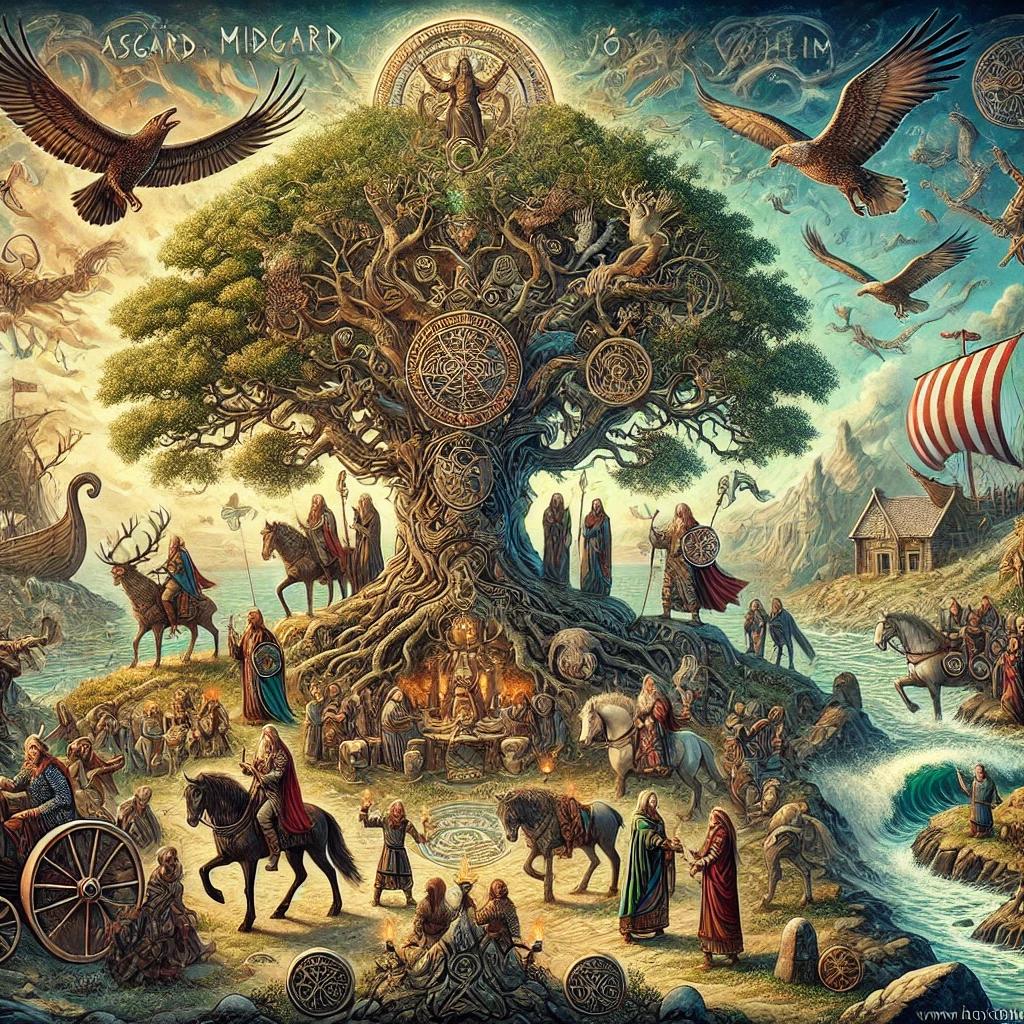
Introduction
The cultural and spiritual values of the Viking and Norse Pagan societies are deeply rooted in a complex and multifaceted worldview that emphasizes a profound respect for nature, community, and the divine. These values are not merely abstract principles but are deeply embedded in the daily lives of the Norse people, influencing their actions, decisions, and interactions with one another. This essay explores the authentic ancient values of Viking and Norse Paganism, drawing from historical sources and anthropological studies to provide a comprehensive understanding of their cultural and spiritual significance.
Cosmology and the Nine Realms
At the heart of Norse cosmology lies Yggdrasil, the World Tree, which connects the nine realms of existence. These realms include Asgard (the home of the gods), Midgard (the world of humans), Jotunheim (the land of giants), Vanaheim (the realm of the Vanir gods), Alfheim (the land of the elves), Svartalfheim (the realm of the dwarves), Nidavellir (another realm of the dwarves), Muspelheim (the realm of fire), and Helheim (the underworld). This interconnectedness underscores the belief that all aspects of existence are interdependent and part of a larger cosmic order.
The Gods and Goddesses
Norse Paganism worships two main pantheons: the Aesir and the Vanir. The Aesir, gods of war and governance, include Odin, the All-Father and god of wisdom; Thor, the god of thunder and protection; and Tyr, the god of justice and law. The Vanir, deities of fertility and nature, include Freyr, the god of prosperity and fertility; Freyja, the goddess of love and fertility; and Njord, the god of the sea and wind. These gods and goddesses embody various aspects of life and nature, guiding adherents in their spiritual and daily lives.
Ancestor Worship
Ancestor worship is a central tenet of Norse Paganism. Practitioners seek guidance, protection, and wisdom from their forebears, often through rituals, storytelling, and maintaining physical reminders like altars or grave sites. This belief highlights the interconnectedness of past, present, and future generations, fostering a deep sense of continuity and belonging. Honoring ancestors reinforces family and community bonds, preserves cultural heritage, and provides moral examples for people to live by.
Ethical Living and Universal Ancient Values
Norse Paganism, like many ancient Pagan societies, emphasizes a set of ethical principles that promote communal harmony and personal integrity. These values are often derived from the Eddas and sagas, which provide insights into the moral and ethical beliefs of the ancient Norse people.
- Reciprocity: The concept of reciprocity is fundamental in Norse Paganism. This principle underscores the belief that communal harmony and personal prosperity depend on maintaining positive interactions with the divine and with one another. Rituals and offerings are often made to the gods and spirits to honor this relationship.
- Honor and Reputation: Honor is a central concept in Norse Paganism. Personal integrity and reputation impact one’s fate and standing within the community, mirrored by the deeds of heroic figures in Norse mythology.
- Hospitality: Hospitality is a key virtue in Norse Paganism, emphasizing the importance of welcoming guests and strangers with open arms. This practice fosters community bonds and reflects the broader ancient Pagan value of generosity and compassion.
- Courage and Valor: The Norse placed a high value on courage and valor, particularly in the face of adversity. This is evident in the stories of their gods and heroes, who often faced great challenges with bravery and determination.
- Respect for Nature: Norse Pagans maintain a profound relationship with the natural world, revering the spirits of land and water. This belief ensures that nature is treated with reverence and respect. Environmental stewardship and seasonal celebrations like Yule, Ostara, and Midsummer reflect this core belief.
- Community and Frith: The concept of frith, or peace and harmony within the community, is essential in Norse Paganism. This value emphasizes the importance of maintaining social order and mutual respect among community members.
- Wisdom and Knowledge: Wisdom is highly valued in Norse Paganism, as seen in the stories of Odin seeking knowledge and wisdom through various trials and sacrifices. The pursuit of knowledge and understanding is considered a noble endeavor.
- Resilience and Perseverance: The Norse valued resilience and perseverance, particularly in the face of adversity. This is evident in their sagas and myths, which often depict heroes overcoming great challenges through determination and steadfastness.
Rituals and Celebrations
Core rituals in Norse Paganism include Blót (sacrificial rites to honor the gods and spirits), Sumbel (a ritual of toasting, boasting, and oaths), and seasonal festivals. These rituals foster community and spiritual connection. For instance, during Yule, Norse Pagans celebrate the winter solstice with feasts, rituals, and community gatherings, often incorporating traditional Norse customs and symbolism.
Modern Relevance
In contemporary society, the core values of Norse Paganism resonate with many individuals seeking a clear, practical code of ethics. These values offer solutions to modern problems by providing guidance on how to live honorably and harmoniously with others. For instance, practicing hospitality and community frith can significantly improve social cohesion and mutual support in urban environments. Additionally, the pursuit of wisdom and knowledge can foster personal growth and understanding, encouraging individuals to thrive in their lives while maintaining a balanced approach to their interactions with the natural world and their community.
Conclusion
Norse Paganism is deeply rooted in a profound respect for nature, community, and honor, embodying principles that emphasize strength, courage, and wisdom. The core values, such as hospitality, truth, and perseverance, reflect a holistic worldview where personal integrity and loyalty to one’s kin are paramount. These values guide practitioners in their daily lives, reinforcing a sense of identity and purpose grounded in ancient traditions. The spiritual practices of Norse Paganism, including rituals and offerings to the gods, ancestors, and land spirits, further solidify these core principles. Embracing virtues like courage, wisdom, and respect for nature, Norse Paganism encourages a balanced life where the physical and spiritual realms are interwoven. These values are not static but are continuously interpreted and adapted by modern practitioners, ensuring their relevance in the contemporary world.
Unyielding Honor: The Viking Demand for Truth and Reliability
From a traditional Norse or “Viking” standpoint, reliability and honesty were indeed of paramount importance. While popular culture often focuses on the Vikings as raiders and explorers, Norse society—like most tight-knit communities—relied on mutual trust and clear expectations to function smoothly. Below are some cultural and historical insights that underline why saying one thing and doing another would be seen in an extremely negative light in a Viking context:
1. Honor and Reputation (Drengskapr)
- Key Norse Concept: Among the Vikings, a person’s honor (drengskapr) was intimately tied to their reputation in the community. If you broke your word, it wasn’t just a private matter; it could tarnish your name, impact alliances, and diminish your standing.
- Long-Term Consequences: In small Norse communities, once your reputation was damaged, it was difficult to recover. Oath-breakers or those who spoke untruths could become social outcasts, losing the protection and support of the community.
2. The Weight of Oaths
- Binding Agreements: Oaths (especially formal ones) were taken very seriously in Viking society—sometimes witnessed by a god like Odin or by representatives of a community.
- Legal and Social Ties: Disputes, deals, and even friendships (fostering or blood-brotherhood) were cemented by solemn pledges. Reneging on these vows was seen as not only dishonorable but also dangerous—potentially sparking feuds.
3. Saga Literature Examples
- Condemnation of Betrayal: In the sagas, characters who violate their word or betray someone’s trust often become tragic figures, sometimes facing harsh retribution or living in shame.
- Enduring Legacy: These stories served as cultural touchstones. They taught that deceit could lead to broken alliances, vengeance, and even the downfall of entire families or communities.
4. Reciprocal Responsibility
- Social Glue: Reliability and honesty weren’t just individual virtues; they were necessary for the entire Norse social fabric. A chieftain or jarl who deceived his people lost loyalty, just as a free farmer (bondi) who betrayed a neighbor could lose essential support.
- Collective Security: In a harsh environment, you depended on your neighbors and allies for survival—especially during winter, or when out at sea. Flaking out or double-crossing someone jeopardized everyone’s well-being.
5. Modern “Viking” Values
- Neo-Pagan & Modern Interpretations: Many individuals today who follow a Norse-inspired path embrace those traditional tenets of honesty, loyalty, and respect because they resonate with the spirit of the sagas.
- Personal Integrity: Acting consistently and honoring commitments is viewed not just as a personal virtue but as a way to honor the gods and ancestors—living up to the standard set by the old stories.
Final Thoughts
In Viking culture, giving your word was akin to making a sacred bond, and walking it back—especially without good reason—would be a severe blow to one’s honor. The resulting loss of trust could have real social and even existential consequences in a tightly knit community.
While modern life is far removed from the Norse era, many who embrace or admire Viking values see honesty and reliability as pillars of that tradition. Thus, from this perspective, consistency in word and deed isn’t just a polite social norm; it’s a core component of personal honor and communal respect.
The Ephemeral Flame of the North: A Philosophical Odyssey through the Realm of the Vikings

In the depths of the boreal expanse, where the aurora borealis dances across the sky like a spectral bride, there existed a people whose essence was as elusive as the wind and as unforgiving as the winter’s grasp. The Vikings, those enigmatic sons of Odin, left behind a legacy that is at once a testament to their unyielding spirit and a mystery that beckons us to delve into the labyrinthine corridors of their culture. This essay is an attempt to navigate the philosophical underpinnings of Viking society, to unravel the threads of their worldview, and to illuminate the esoteric dimensions of their existence.
At the heart of Viking philosophy lies the concept of wyrd, a term that defies translation but approximates to fate or destiny. Wyrd is not merely a predetermined course of events but an active, dynamic force that weaves the tapestry of existence. It is the Vikings’ acknowledgment of the intricate web of causality that binds all things, a recognition that every action, every decision, sends ripples through the fabric of reality. This understanding of wyrd as an omnipresent, omniscient force underscores the Viking belief in a universe governed by laws both natural and divine.
The Vikings’ relationship with nature was not one of domination but of symbiosis. They saw themselves as part of the natural world, not apart from it. Their gods and goddesses were not distant, unapproachable deities but beings intimately connected with the land, the sea, and the sky. Thor, the god of thunder, wielded his hammer Mjolnir not just as a weapon but as a tool to maintain the balance of nature, to ensure the cycle of seasons and the fertility of the earth. Freyja, the goddess of love and fertility, was also the goddess of war and death, symbolizing the Vikings’ acceptance of life’s dualities.
Their cosmology, as depicted in the Poetic Edda and the Prose Edda, presents a universe born from chaos, where the primordial giant Ymir and the great serpent Jörmungandr embody the eternal struggle between order and disorder. The Vikings’ world was one of contrasts: light and darkness, fire and ice, creation and destruction. This dichotomy is reflected in their concept of honor, which was not merely a personal virtue but a communal one, tied to the reputation of the family and the clan. Honor was the thread that held society together, the glue that bonded warriors in battle and the standard by which one’s worth was measured.
The Vikings were a people of action, their philosophy manifest in their deeds rather than in abstract speculation. Theirs was a world of doing, where one’s character was revealed through actions, not words. The berserker, that frenzied warrior who fought with a fury that seemed almost divine, was the embodiment of the Viking ideal of courage and strength. Yet, this ferocity was balanced by a deep sense of loyalty and hospitality, virtues that were considered essential to the Viking way of life.
Their art and literature, as preserved in the runestones and the sagas, speak of a people deeply concerned with the human condition. The Vikings pondered the mysteries of life and death, of fate and free will, in stories that were both entertainments and teachings. The Völuspá, the first poem of the Poetic Edda, is a prophetic vision of the end of the world, a reminder of the transience of all things and the inevitability of change.
In their funerary rites, the Vikings demonstrated a profound respect for the dead, believing that the soul continued its journey into the afterlife. The ship burials, with their treasures and provisions for the journey, were not merely displays of wealth but expressions of the Vikings’ belief in an afterlife that mirrored this one. Valhalla, the great hall of the slain, where warriors fought by day and feasted by night, was the ultimate destination for those who died in battle, a place where honor and glory were eternal.
The Viking worldview was not static; it evolved over time, influenced by their encounters with other cultures. Their conversion to Christianity marked a significant shift, as they adapted the new faith to their existing beliefs, creating a unique synthesis that preserved much of their pagan heritage. This blending of traditions is a testament to the Vikings’ pragmatic approach to religion, their recognition that truth can be found in many forms.
As we delve into the philosophical dimensions of Viking culture, we are reminded of the impermanence of all things. The Vikings, with their keen awareness of mortality, lived in the present, cherishing each moment as a gift. Theirs was a philosophy of carpe diem, of seizing the day, for in the words of the Viking proverb, “Cattle die, kinsmen die, you yourself will die, but one thing I know that never dies: the judgment of a dead man’s deeds.”
In the end, the Vikings leave us with more questions than answers, their culture a labyrinth of contradictions and paradoxes. They were warriors and poets, pagans and Christians, individualists and communalists. Yet, it is in these contradictions that we find the essence of their philosophy, a worldview that embraced complexity and ambiguity. The Vikings remind us that life is a journey, not a destination, and that our deeds, not our words, are the measure of our character.
As the flame of the Viking Age flickers out, leaving behind only embers of memory, we are left to ponder the wisdom of their way of life. In a world that values certainty and clarity, the Vikings offer us a different path, one that celebrates ambiguity and uncertainty. Their philosophy is a reminder that truth is multifaceted, that reality is complex, and that the human experience is a tapestry woven from countless threads.
In the silence of the boreal night, under the watchful gaze of the aurora borealis, we can still hear the whispers of the Vikings, their voices carried on the wind. They speak to us of a world that was, of a people who lived and loved and laughed and fought. They remind us that we are not alone in this vast and mysterious universe, that we are part of a larger whole, connected to all that has been and all that will be.
And so, we return to the beginning, to the concept of wyrd, that mysterious force that weaves the tapestry of existence. The Vikings understood that our lives are not our own, that we are part of a larger narrative that unfolds with each passing moment. Their philosophy is a call to embrace this uncertainty, to find meaning in the midst of chaos, and to live each day with purpose and passion.
In the end, the Vikings teach us that life is a journey, not a destination. It is a path that winds through the mountains and valleys of existence, a road that is fraught with danger and filled with wonder. And it is on this journey, in the midst of uncertainty and ambiguity, that we find the true meaning of the Viking way of life.
The issues of immigration, racism, and the Vikings and how it relates to Heathenism..
This post is related to an issue explained here, of there being problems with some very bad racist types being attracted to Heathenism. In this post below I explain why racism never was a valid part of Viking culture, and why racist attitudes are not a valid part of Heathenism. The issue of immigration is strongly tied in with the issue of racism. The Vikings were in their day some of the most well traveled people, that settled all over the place in far off lands, thus immigration was strongly tied into Viking culture as a way of life.
I believe that people should be allowed to immigrate to other countries and given opportunities to do so. The culture of a place grows when the people of that country are exposed to the culture of other ethnic groups. All throughout all of human history the greatest leaps in technology and human ideas have come about though the interaction of different ethnic cultures together. Without this culture exchange of ideas between ethnic groups, cultural ideas tend to stagnate and impede social progress. The mixing together of new things from other sources is the way all things in the universe grow stronger. When only the same is being constantly mixed together, things become weakened. This is a law of how nature itself works. In more ancient times in which war between different ethnic groups was very common, this process of the need to gather in ideas and even as well DNA from other ethnic groups happened through the process of war.
When an enemy was defeated their women would be captured and then be made to be part of the conquering group, and of course these women would in time be made to marry the men of the conquering group, and some taken as slaves also (and likely made to provide sexual pleasure for the men who have enslaved them). As well some of the men of the group that has been defeated may be made to be slaves, but the ancient world concept of slavery generally included the chance for the slave to eventually work their way toward being a free person again. Of course freed slaves would then become a normal part of the culture group they had previously been enslaved in, and likely also reproduce within that group and contribute to the diversity of the group’s DNA.
Also in some cultures such as the northern ones which the Vikings derived from, it was common to encourage travelling strangers that visit to sleep with your wife so that new DNA can be interjected into the group, and then the man would adopt any child that resulted as his own (this practice is shown in the Rígsþula from the Poetic Edda). Another practice common with the Vikings, and the cultures the Vikings derived from, was the exchange of hostages when a war does not have a clear winner and it is decided to call a truce. The Norse form of hostage exchange involved the hostages becoming part of the new group they are made to live in and then living by it’s culture and social rules. Of course many such hostages then would end up marrying into people from the group they have now come to life with, and the children of the hostages would become a normal part of this new group. Thus from all these things in no way did the DNA or even the culture of various groups stay the same. It was always mixing with outside ethnic groups and thus keeping the culture and physical health of that ethnic group strong by mixing in elements from the outside.
The concept of different human “races” is a 19th century idea that has no basis in actual science or reality. Even cultural groups such as the Vikings had no concept of different ethnic groups, only the concept of people from other tribes, or people that follow different gods/goddesses than them (but they even did not until the late period have the concept of different religions). This concept of people from other tribes had nothing to do with the physical appearance of the other people, but instead only on that groups social allegiance. In truth the physical makeup of any ethnic group is just a mixture of different physical traits which that group of people evolved towards over long periods of time living in a certain area of the planet. Humans over long periods of time if they live in smaller isolated groups (as was the case in the past) will physically develop traits that help them best able to adopt to the weather and climate conditions of their area. These are well known facts by anyone with any knowledge of the social sciences, but unfortunately there are many people out there who are afraid of loosing their own ingrained ethnic culture and have backwards 19th century ideas of there being different human “races”. This issue is further encouraged by the fact that many US governmental bureaucratic forms that people have to fill out, which incorrectly ask a person what their “race” is. It would be more correct to ask what someone’s ethnic background is. Ethnic background is related to the language a person speaks and the related social culture that language group has developed.
As Heathens it is good to take after the culture and values which the Vikings had. They were explorers that enjoyed travelling long distances to explore other lands. Clearly if they did not enjoy experiencing other cultures they would not have been willing to spend so much time and effort to travel the long distances they did for trade and exploration. It can be stated that it is likely the Vikings were the most curious of all groups about other cultures and wishing to see and experience foreign distant lands with different ways, as that is exactly what they did. Even Buddha statues have been found in Viking treasure hoards, which shows their interest in artifacts from other cultures. Vikings were known to become employed in distant lands as mercenaries. Many Viking tribes ended up settling all over the place and the Viking culture spread and mixed with and enhanced other cultures. The Vikings themselves did immigrate to many lands. Thus to say that others should not be afforded the same rights is rather hypocritical, and even goes against the values of honor which is an important value in Heathen culture. Another side to this is that welcoming those from other lands is an aspect of hospitality. We as Heathens need to extend our own values towards the interactions we have with all people, not just with other Heathens, otherwise this makes what we believe in only a facade to impress others of our own faith, and not something we truly are practising or believe in.

This work is licensed under a Creative Commons Attribution-NonCommercial-ShareAlike 3.0 Unported License.

 Volmarr’s Tumblr
- View On WordPress
- The Personal Norse Pagan Path That I, Volmarr, Follow.
- The Heathen Third Path within Norse Paganism and modern Viking culture
- Unveiling the True Viking Mindset: Clearing Away Modern Political Shadows with Ancient Wisdom and Modern Science
- Sample of AI GMed Norse Saga Engine Combat 2
- Poetic Edda: Complete Master Works Edition
- Sample of AI GMed Norse Saga Engine Combat
- Sample AI Generated Dialogue Generated by Norse Saga Engine:
- The Loom is Spinning: Enter the Norse Saga Engine
- Wow I just translated the whole Poetic Edda from Old Norse into poetic English in 25 minutes using…
 Volmarr's Blog of Modernist Heathenism, Norse-Paganism, and Norse-Wicca