The Long Shadow of the Cross: Why the Separation of Church and State is Our Ultimate Shield Against the Old Civil War

By Tess Wilder
When we stand at our altars, hail the Aesir and Vanir, and speak of the Heathen Third Path, we often speak of freedom—freedom of spirit, freedom from dogma, and the sovereignty of the individual mind. But there is a historical specter that haunts the soil of Europe, a pattern of bloodshed that is rarely named for what it truly was. To understand why the First Amendment is not just a law, but a survival mechanism for the future, we must look back at the last two thousand years of European history and call it by its true name.
For centuries, what history books often describe as a series of “national conflicts,” “dynastic struggles,” or “wars of succession” was, in reality, a single, recurring Christian Nationalist civil war.
The One War, Fought a Thousand Times
From the fall of Rome to the trenches of the Western Front, the history of Christian Europe was largely an internal struggle between competing factions of the same faith, fighting for dominance over the soul of the continent. It was a civil war of ideologies where the definition of “Christian” was the weapon used to justify conquest.
The Thirty Years’ War in the 17th century is perhaps the most glaring example. It wasn’t merely Germans fighting Czechs or Swedes fighting Poles. It was a war of Christian Nationalism—Protestant Christian Nationalism versus Catholic Christian Nationalism. It devastated Central Europe, killing millions, not because they were different peoples, but because they adhered to different interpretations of the same imported desert god.
Look at the Crusades, often framed as a war against Islam. While they were directed outward, the energy that fueled them was born of a unified Christendom seeking to purge the “other.” When that external enemy wasn’t available, the sword turned inward. The Inquisitions, the burnings of heretics, the persecution of the Anabaptists—these were not foreign wars; they were internal purges. They were the inevitable result of giving one religious sect the monopoly on political power.
Even the conflicts that looked secular—the Hundred Years’ War, the Napoleonic Wars—were underpinned by the assumption that the state must serve a specific Christian moral order. The kings claimed divine right; the laws were based on biblical canon. When two Christian nations clashed, it was a family feud over who held the correct claim to the “One True Faith.”
The American Experiment: Escaping the Cycle
This is the crucial context that is often lost in modern discourse. The Founding Fathers were not just Enlightenment philosophers; they were historians. They saw the bloody wreckage of Europe, the endless cycle of Christian Nationalist civil wars, and they wanted no part of it.
The Establishment Clause and the Free Exercise Clause were not designed to secularize America out of hostility to religion, but to save it from itself. They understood that if the United States were to pick a side—Catholic, Protestant, or any specific sect—it would simply be importing the European civil war onto American soil.
By separating church and state, they built a firewall. They said, “Here, we will not fight the Thirty Years’ War on this soil.” They created a neutral ground where a Lutheran, a Catholic, a Quaker, and yes, eventually a Heathen like me, could live side by side without one trying to seize the levers of state power to crush the other. It was a radical act of peace-building, a deliberate decision to break the cycle of theological violence that had plagued the West for millennia.
The Danger of Resurrection: The Future Cost of Christian Nationalism
Today, we see a rising tide of Christian Nationalism in the United States—a movement that seeks to erase that firewall, to merge the cross and the flag, and to declare America a “Christian nation” in the legal, political sense.
We must be absolutely clear about what this means. It is not a return to “traditional values.” It is a return to the pre-modern European condition.
If Christian Nationalists were to gain true power over the machinery of the US state, they would not create a paradise of moral order. They would reignite the old civil war. The moment one specific denomination or interpretation seizes the monopoly on power, every other faction becomes a heretic.
We would see the fracturing of the military along sectarian lines. We would see law enforcement used to enforce religious compliance rather than civil law. We would see the rise of militias, not defending borders, but defending specific theological interpretations against their neighbors. The “Culture War” would cease to be a metaphor and become a literal war of attrition.
In a nation as heavily armed and ideologically diverse as the United States, a Christian Nationalist takeover would not lead to peace. It would lead to a future of frequent, bloody insurgencies. It would be the Balkans of the 1990s multiplied by a thousand. It would be the Thirty Years’ War fought with modern weaponry. It would kill millions.
The Heathen Imperative: Defending the Neutral Ground
For us on the Heathen Third Path, this is not just politics; it is a matter of survival and wisdom. We honor the Old Ways, but we also honor the wisdom of the Founders who saw the danger of theocracy.
We stand for the separation of church and state not because we hate Christianity, but because we understand human nature. We know that when any group—Christian, Pagan, or otherwise—tries to rule by divine mandate rather than consent of the governed, the result is always blood.
We are the descendants of those who suffered under the conversion of the sword. We know the cost of the “One Truth.” Let us not be silent now. Let us defend the secular state as the sacred space where all paths can walk without fear of the blade. The alternative is a return to the dark ages of the European civil war, and that is a future no sane person—Viking or otherwise—should ever desire.
Hail to the free mind. Hail to the peace of many paths.
THE RADICAL FREEDOM: A Solitary Pagan Manifesto
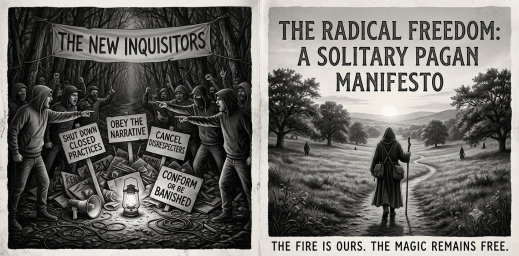
An Unwavering Shield Against the New Inquisitors
We remember the early 1990s. We remember when Paganism was a refuge for the heretic, the outcast, the mystic, and the fiercely independent. We gathered in moonlit fields, incense smoke-filled living rooms, and back-room occult shops because we were unified by a singular, foundational truth: The Divine speaks directly to the individual, and no human institution has the right to stand as a gatekeeper between the soul and the cosmos.
Today, a hollow, bureaucratic rot has infected the collective Pagan scene. The vibrant, chaotic, and liberated current of our ancestors has been choked by a new breed of puritans. They wear the mask of progressivism, but their methods are identical to the oldest, most oppressive religious hierarchies in human history.
We break our silence to name this corruption, to defy it, and to declare our absolute independence from it.
1. Against the Bureaucracy of “Closed Practices”
The concept of the “closed practice” as weaponized in the 2020s is an ideological cage. It assumes that the Gods, Goddesses, the spirits of the land, the and the ancient currents of magick care about modern socio-political identities.
- Our Reality: The Web of Wyrd weaves through all things. The runes, the ancient deities, and the mysteries of the Earth do not check human credentials before they speak to a seeking heart.
- The Truth: Restricting spiritual exploration based on rigid categories is nothing more than cultural hoarding. It mimics the worst of tribal gatekeeping and institutional dogmatism. If a God or Goddess calls to you, you answer. Period. No internet tribunal has the authority to issue a permit for your devotion.
2. Against Forced Politics and Ideological Conscription
Paganism is a vast, multidimensional landscape of cosmic law, ancient philosophy, and raw nature. It is not an arm of any 2020s political party or social agenda.
- The Intruders: The current scene demands absolute conformity to modern “woke” orthodoxy, transforming sacred spaces into echo chambers for secular political discourse.
- Our Reality: Nature is beautiful, brutal, complex, and indifferent to human political trends. Forcing ancient, cosmic realities to fit into the microscopic, hyper-temporary frameworks of 21st-century social engineering is an act of supreme arrogance. We seek the eternal, not the trend.
3. Against the Sacrilege of Elder Cancel Culture
We watch with disgust as 2020s internet mobs track down, tear apart, and attempt to erase Pagan elders—the very people who built the foundations, published the texts, fought the legal battles, and kept the flames alive when it was genuinely dangerous to be a Pagan.
- The Crime: Young practitioners, armed with nothing but unearned moral superiority and an internet connection, weaponize “cancel culture” to destroy the legacies of our elders over minor disagreements, language evolutions, or refusal to bow to modern dogmas.
- Our Value: This is a profound violation of ancestral and community honor. We do not discard our elders when their vocabulary doesn’t match the shifting consensus of a social media platform. We owe them our respect, our protection, and our gratitude. To cancel an elder is to cut your own roots.
The Mirror of Tyranny
Let us be entirely clear: The authoritarian, hyper-controlling, dogma-enforcing behavior of the 2020s Pagan scene is no better than Christian Nationalism. Both operate from the exact same psychological defect—the desperate, insecure urge to police the thoughts, words, and private spiritual lives of others. One uses the Bible; the other uses a social justice glossary. Both are enemies of human liberty.
Why the Tribes Have Scattered
The current arbiters of the organized Pagan scene wonder why their festivals are emptying, why their local groups are fracturing, and why the vibrant community of the late 20th century feels dead.
They blame “apathy.” They are wrong.
The collective spiritual intelligence of the modern Pagan movement has looked at the drama, the policing, the constant hyper-vigilance, and the endless ideological purity tests—and we have chosen to walk away.
The majority of Pagans today are resolutely solitary. We have returned to the woods, to our private altars, to our local hearths, and to our individual code. We are highly resistant to organized scenes because we refuse to exchange the tyrannical dogmatism of the church we left behind for the tyrannical dogmatism of an online consensus.
We do not need your permission. We do not need your validation. We do not recognize your authority.
The fire is ours. The sky is ours. The magick remains free.

This work is licensed under a Creative Commons Attribution-NonCommercial-ShareAlike 3.0 Unported License.

 Volmarr’s Tumblr
- Hail the Mad God
- The Great Tree of Becoming
- The Age of Superconsciousness
- This Flag is Dedicated to Ingeborg, Gyðja of Freyr!
- Official Frith and Peace Flag of Volmarr!
- Official Flag of Volmarr’s Version of the Modern Viking Lifestyle!
- Official Flag of the Heathen Third Path!
- INNER SPIRITUAL WARFARE OF THE MODERN VIKING AND CYBER-VIKING
- Modern Viking and Cyber-Viking Inner Spiritual Warfare
- Inner Spiritual Warfare for the Modern Viking and the Cyber-Viking
 Volmarr's Blog of Modernist Heathenism, Norse-Paganism, and Norse-Wicca