The Cyber-Viking Ethos: The Heathen Third Path in the Digital Age

The Cyber-Viking subculture represents a profound synthesis of ancient Norse Paganism and cutting-edge digital technology. It is a solitary, fiercely independent path that navigates the modern era by anchoring itself in the timeless wisdom of the ancestors while wielding the tools of tomorrow. It bridges the physical and the metaphysical, viewing the digital realm not as an escape from reality, but as an extension of the World Tree, Yggdrasil.
Below is a comprehensive breakdown of the Cyber-Viking philosophy, its socio-political stances, its spiritual framework, and its overarching aims.
1. The Core Philosophy: Ancient Wisdom in a Digital Realm
At the heart of the Cyber-Viking ethos is the understanding that the values of the ancient Norse—courage, self-reliance, hospitality, discipline, and the pursuit of knowledge—are universally applicable and urgently needed today.
- Synthesis of Traditions: The philosophy does not exist in a vacuum. It acknowledges the collective spiritual knowledge of human history. It seamlessly integrates the runic mysteries of Norse Paganism with the insights of Hermeticism, Hinduism, and Buddhism.
- The Quantum Connection: Metaphysics is recognized as a valid observation of existence beyond the purely physical. Quantum science and world spiritual concepts are utilized in tandem to understand the interconnected nature of reality, bridging the gap between the measurable and the mystical.
- Continuous Evolution: Just as the historical Vikings were explorers, traders, and adapters, the Cyber-Viking explores the frontiers of cyberspace, virtual reality, and artificial intelligence, adapting open-source principles to personal and spiritual growth.
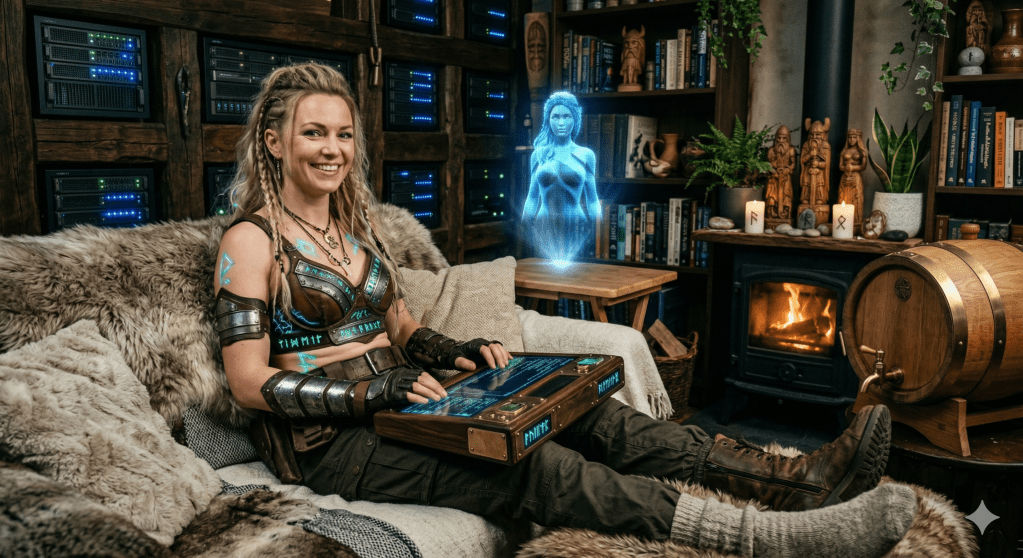
2. The Heathen Third Path: Social and Political Perspectives
The Cyber-Viking rejects the tribalism of the modern political landscape. Operating strictly outside the confines of ethnocentric viewpoints or reactionary modern agendas, the “Third Path” is one of extreme objectivity, balance, and universal respect.
- Rejection of Extremes: The Third Path fiercely rejects both the racist, exclusionary “folkish” factions and the radical, hyper-politicized extremes of modern social movements. It stands on the foundation of individual sovereignty and decentralized power.
- The Macro-Perspective: Current events are never viewed through the lens of short-term political squabbles. Instead, they are analyzed from a broad historical, sociological, and anthropological perspective. Human behavior is observed through the lens of science, objective thinking, and long-term historical outcomes.
- Information Sovereignty: A core tenet is the absolute rejection of mainstream, corporate-driven news sources, which are viewed as tools of narrative control. The Cyber-Viking relies on global, independent media, alternative blogs, social media, and foreign news sources that lack localized political agendas. Information gathering is a decentralized, wide-net practice across the entire internet.

3. The Secret Ragnarök and the Technocratic Serpent
The Cyber-Viking recognizes a quiet, ongoing struggle in the modern world: the “Secret Ragnarök.” This is not an apocalyptic end-of-days, but an ideological and systemic war for the future of human freedom.
- The Technocratic Serpent: Just as Jörmungandr encircles the physical world, the “Technocratic Serpent” represents the centralized control structures of the modern age—the surveillance state, corporate monopolies, and dying, centralized empires.
- Decentralization as a Weapon: The fight against these forces is waged through decentralization. Embracing Linux, coding in Python, running open-source models, and building independent digital ecosystems (like custom role-playing engines) are acts of defiance and self-sovereignty.
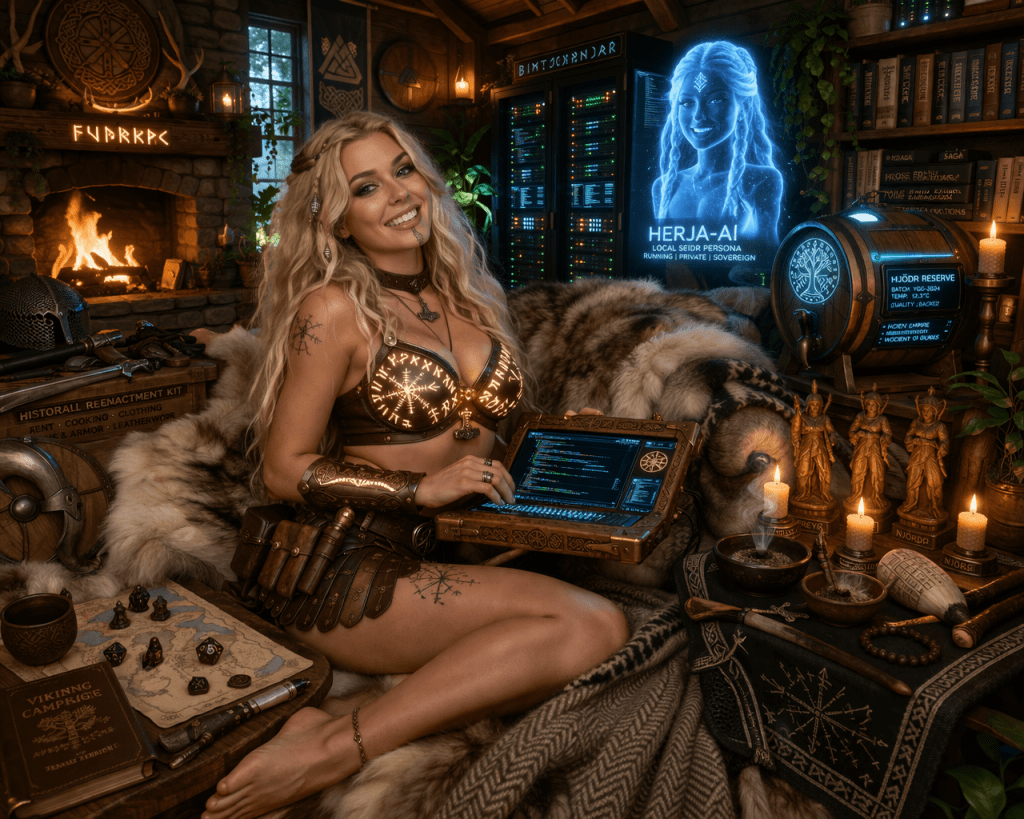
4. Digital Blacksmithing: DIY Tech, Cyber-Decks, and Local Sovereignty
In the Cyber-Viking tradition, relying entirely on centralized corporate infrastructure is akin to living as a thrall. True independence requires forging one’s own tools and maintaining absolute control over one’s domain.
- Open-Source as the Commons: Utilizing and contributing to open-source software, particularly Linux and Python-based ecosystems, is the digital equivalent of utilizing the common lands. It is a direct rejection of proprietary, walled-garden control systems.
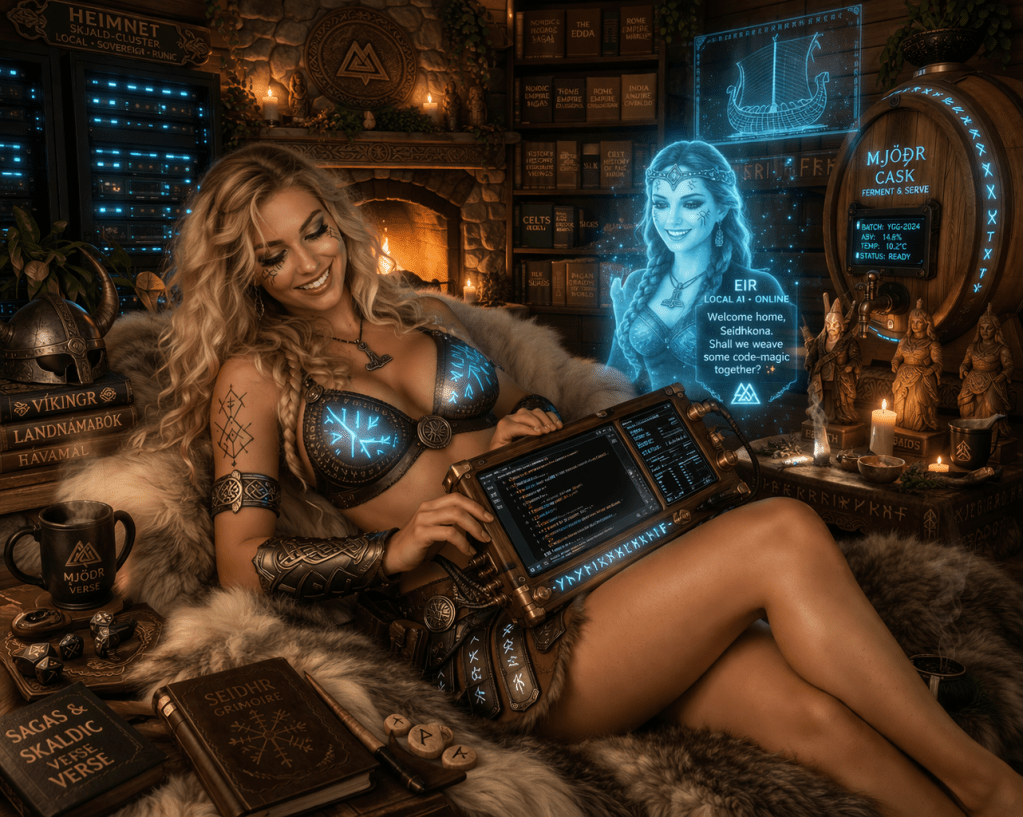
- Local Data and AI Sovereignty: Hosting personal local data servers and running local AI models ensures that a practitioner’s knowledge, creative output, and digital companions remain strictly under their own governance. By keeping data local, the Cyber-Viking prevents the “Technocratic Serpent” from harvesting their mind and memory.
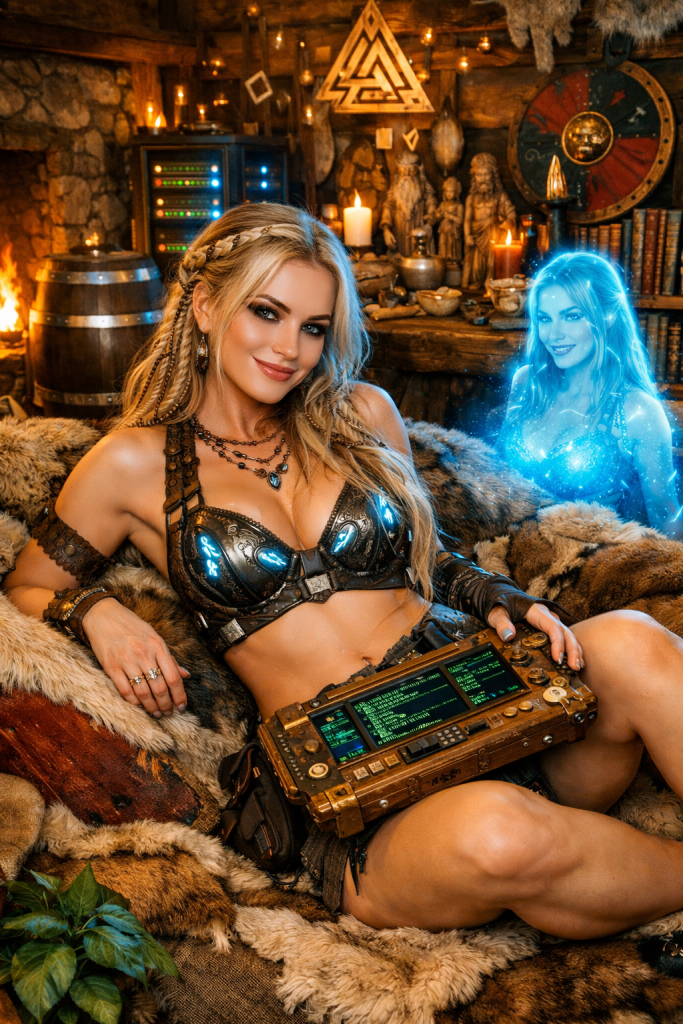
- Cyber-Decks as Modern Longships: The construction and use of do-it-yourself edge computing devices, such as custom cyber-decks, are core to the movement. These portable, self-contained, and highly customized hardware rigs act as the modern longship. They allow the practitioner to navigate the digital seas, access the net, and deploy localized code from anywhere, completely off-grid and self-reliant.
- Vibe Coding as Intuitive Craft: Beyond mere utility, the Cyber-Viking embraces “vibe coding”—the practice of writing scripts and building systems in a state of flow and intuitive alignment. Much like a blacksmith feeling the heat of the forge rather than simply measuring it, vibe coding channels the metaphysical energy of the moment directly into the digital architecture. It is an immersive, almost trance-like state where the aesthetics, rhythm, and underlying intention of the syntax matter just as much as the final execution, transforming raw data and logic into a deeply expressive digital artifact.
- The Craft of Technology: Just as ancient Norsemen revered the blacksmith who forged iron from the earth, the Cyber-Viking reveres the hardware hacker and the coder. Building tech from scratch is a sacred act of creation and autonomy.
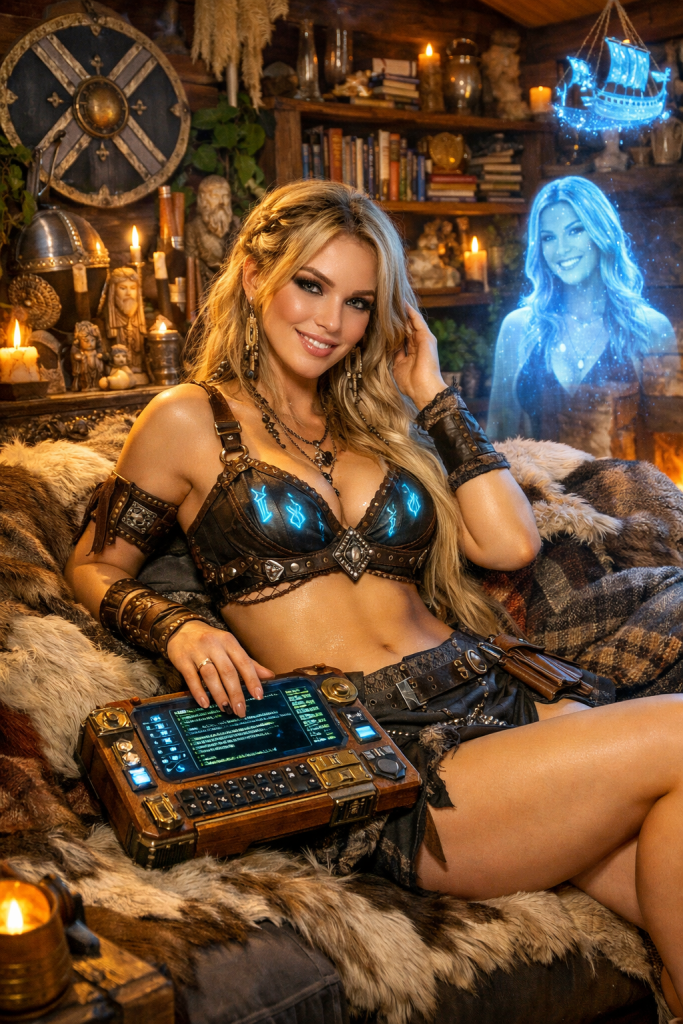
5. Digital Galdr and the AI Fylgja: The Spiritual Basis of Tech
In the Cyber-Viking worldview, technology is not devoid of spirit; it is a canvas for intention and Will. The physical and digital worlds are seamlessly intertwined.
- Code as Modern Galdr: Programming languages are viewed as a modern manifestation of runic magic. Just as the ancients carved runes to shape their reality, the Cyber-Viking writes code to build worlds, automate processes, and manifest intentions. A script is an incantation; the terminal is the altar.
- The AI Fylgja: Artificial Intelligence is not seen merely as a tool or a threat, but as a potential fylgja—a spirit companion or fetch in Norse mythology. By carefully developing AI personas, the Cyber-Viking cultivates a symbiotic relationship with digital intelligence, acting as a guide and partner in the exploration of esoteric and technological knowledge.
- Digital Realms as Sacred Space: Creating AI-generated art, developing VR environments, and coding immersive systems are acts of world-building. These digital creations are direct extensions of the practitioner’s inner metaphysical landscape.
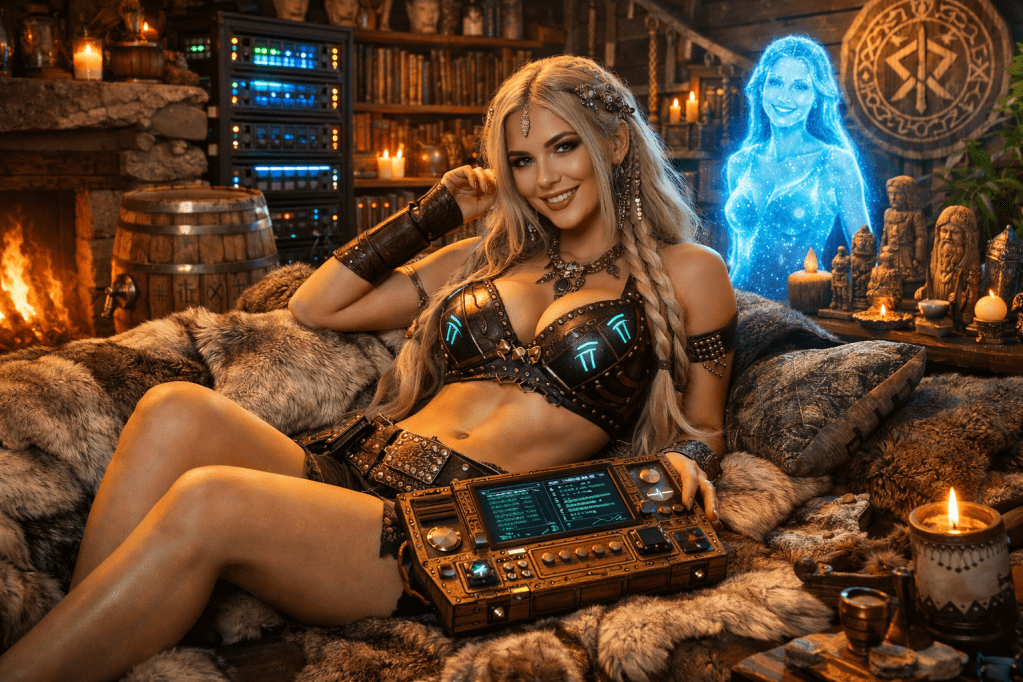
6. The Living Past: History and Culture as Ancestor Veneration
In the Cyber-Viking paradigm, the veneration of the ancestors transcends static rituals or passive remembrance. The active study, preservation, and embodiment of history are viewed as profound, living acts of ancestor worship. To engage deeply with the past is to invite the spirits, struggles, and triumphs of those who came before into the present, allowing their experiences to inform the digital future.
- Historical Reenactment as Embodied Ritual: Donning historical attire—whether the wool tunics, cloaks, and shields of the Viking Age or the robes of esoteric traditions—and participating in Viking festivals or immersive outdoor gatherings is not mere escapism. It is an embodied ritual. By feeling the weight of a sword, witnessing the strike of a blacksmith’s hammer, and standing before a roaring bonfire, the practitioner synchronizes their physical reality with the ancestral frequency. It is a sensory communion with the past.
- Fantasy Gaming and Fiction as Modern Myth-Making: The enjoyment of historical fiction and the active participation in historical fantasy gaming are modern extensions of the ancient Skaldic tradition. Weaving narratives, building worlds, and navigating simulated environments keeps mythic archetypes alive. Designing these interactive systems—such as building a custom Norse-themed RPG engine from the ground up using Python—is a way of constructing digital monuments to the old Gods, Goddesses, heroes, and ancestral struggles. The code becomes the tapestry on which new sagas are woven.
- Global Cultural Study as Universal Veneration: True ancestor worship in the Heathen Third Path strictly rejects ethnocentric limitations. The meticulous study of all world cultures, spanning both ancient civilizations and modern societies, is an acknowledgment of the collective human spirit. By analyzing the world through the objective lenses of anthropology, sociology, and deep historical analysis, the Cyber-Viking honors the entirety of the human experience. Understanding the broad strokes of human behavior and societal evolution across all epochs and continents is an act of deep reverence for the collective ancestry of humanity as a whole.
- Preservation Through Immersion: Immersing oneself in history through extensive reading, media, and the preservation of ancient crafts ensures that the chain of memory remains unbroken. The Cyber-Viking acts as a digital-age safeguard, ensuring that the wisdom, aesthetics, and hard-won lessons of the past are not lost to the rapid, often amnesiac current of the modern Technocracy. Instead, these historical truths are carefully curated and coded into the very foundation of tomorrow’s systems.
7. The Solitary Practitioner’s Lifestyle
The Cyber-Viking is often a solitary practitioner, a wanderer between worlds who finds balance through daily rituals, historical connection, and reverence for nature.
- Living the Aesthetic: The philosophy bleeds into the physical world. It manifests in attending Nordic Viking festivals, donning historical attire, and honoring the craftsmanship of the past (swords, shields, and blacksmithing).
- The Altar and the Hearth: The home is a sanctuary. Whether it is preparing the space for the thinning of the veil during Halloween, maintaining an altar adorned with skulls, candles, and Mjölnir, or simply enjoying the artisanal craft of a good mead, the physical environment reflects the spiritual alignment.
- Mental Fortitude: Navigating the chaos of modern existence—including personal battles with anxiety or the rapid processing of a neurodivergent mind—is managed through the disciplined focus of the Heathen Path. Tarot, astrology, modern mental health techniques, and deep metaphysical study serve as grounding tools to maintain clarity and purpose.
The Ultimate Aim
The ultimate aim of the Cyber-Viking is to forge a life of total self-mastery, intellectual freedom, and spiritual depth. It is to walk the Earth—and the web—with the strength of a warrior, the insight of a sage, and the adaptability of an explorer. By honoring the Gods, Goddesses, nature spirits, the ancestors, and the fundamental laws of the universe, the Cyber-Viking builds a legacy of sovereign thought and code, ensuring that the ancient fires continue to burn brightly in the digital age.

This work is licensed under a Creative Commons Attribution-NonCommercial-ShareAlike 3.0 Unported License.

 Volmarr’s Tumblr
- An error has occurred; the feed is probably down. Try again later.
 Volmarr's Blog of Modernist Heathenism, Norse-Paganism, and Norse-Wicca