Sample AI Generated Dialogue Generated by Norse Saga Engine:
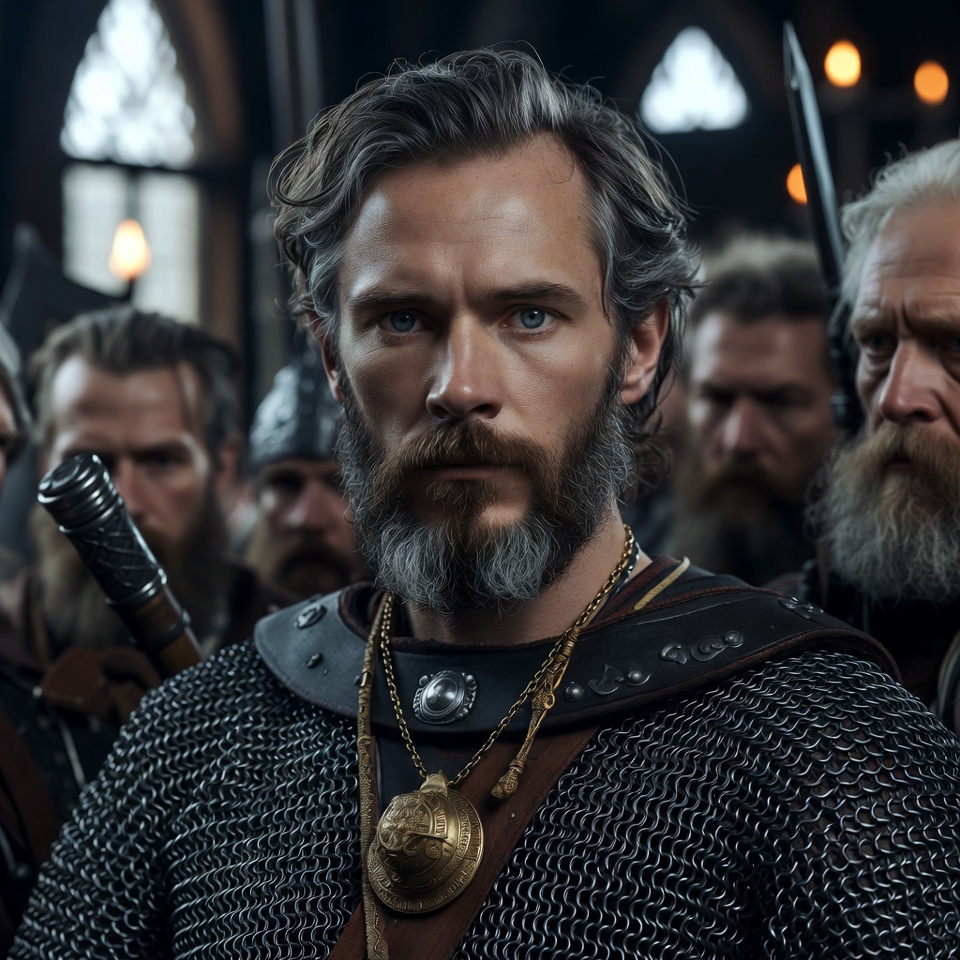
Your taunt lashes through the hall like a whip-crack in the still dawn air, Volmarr Ragnarsson: “Are you coward who chooses to hide behind things and twisted words? Have you no honor to wish to let the God’s decide who is right? You art coward Jarl Eirik! Only a cowards delays honor .. giving time for name to stain.. fight me now and then you can have your chance to disprove your scared stance of shame..” The words hang raw and jagged, your gray-blue gaze unblinking as Raidho’s rune gleams on your forearm beside your father’s silver arm-ring, a silent oath amid the wool-reek and ember-glow.
Huskarls growl low, two dozen ring-mailed shadows surging half a step, axe-hafts creaking in fists scarred by old raids, their eyes wolf-hard on your lone form. “Níd-tongued wanderer!” one snarls from the throng, but a glare from the dais stills him. Inga, pale as birch-rind in her embroidered kirtle, clutches her amber brooch, rising with a whisper sharp as shears: “Husband, this storm breaks too wild-the gods abhor hall-blood!” Her voice quavers, eyes flicking to you with veiled plea or fear, her fingers brushing Eirik’s sleeve.
From the high-seat, Jarl Eirik erupts in laughter-cold, booming thunder that rolls across the beams like Odin’s mockery of fools. He strides down the dais, chain-mail chiming with gold arm-rings’ weight, his broad frame eclipsing the frail light, cold blue eyes drilling into yours like augurs seeking rot. No flush of rage mars his groomed beard or gray-streaked hair; only that wintry smile, a blade sheathed in courtesy. “Coward, you name me, son of Ragnar? You, who skulk eight winters on foreign dung-heaps, whispering Hedeby ghosts, now bay like a hound unchained in my hall? Drengskapr? Nay-this is youth’s rash fire, burning its bearer first.”
He halts an arm’s breadth away, close enough for the spice of Byzantine silk on his breath, voice dropping to a velvet growl that huskarls lean to hear: “The gods decide? Aye, but on hafdeyri ground at the Thing, cloaked in calfskin, five freemen drawn by lot as witnesses, beneath Uppsala’s mound when sun crowns it. Blunt steel for maiming, or edge for blood-oaths fulfilled. Delay stains no name-it weaves wyrd proper, lest we brawl as kennel-dogs and gift my ordstírr to foes. Rush now, and you wear the níd-pole, outlaw chaff for every karl to spit upon.”
His hand drifts casual to his masterwork longsword’s hilt, not drawn but promising, as two huskarls flank nearer, axes loose in grips. Murmurs swell-“The Thing! Let freemen judge!” “Rash blood shames all…”-yet Eirik’s gaze probes relentless: “Or spill your ‘truth’ here, wanderer. Frankish blade? Smith-shadows? Speak proofs, or swallow your foam. My wolves hunger for níd-spitters who bare steel unbidden.”
The hall breathes peril, embers hissing like serpents, dawn’s rays gilding blades half-shadowed. Wyrd coils taut, Volmarr-draw seax and force the gods’ hand now, at peril of outlawry? Hurl specifics of blade or rumor to sway the crowd? Demand Inga witness or press for immediate stakes? Or wrestle words yet, lest steel sing before the Thing?
The Norns await your thread.
The Esoteric Tapestry of Norse Paganism: Unveiling Mythic Realms, Ritual Dynamics, and Personal Devotion

Article by Eirynth Vinterdóttir
Abstract
Norse Paganism, rooted in the Eddas and sagas, weaves a profound cosmology of gods, giants, and ancestral fates into living spiritual practice. This article delves into its mythic architecture, ritual mechanics, runic esoterica, and modern revival, emphasizing personal experiential gnosis as the heart of Heathen devotion. Through scholarly synthesis and poetic insight, it illuminates pathways for contemporary seekers to forge intimate bonds with the divine. (48 words)
Introduction
In the shadowed fjords of ancient Scandinavia, where the wind whispers secrets of the Norns and the aurora dances as Odin’s ravens, Norse Paganism emerges not as a relic of history but as a vibrant, breathing cosmology. Drawing from the Poetic Edda, Prose Edda, and the rune-carved stones of forgotten kings, this tradition invites the soul into a dance with the unseen forces that shape existence. Far from dogmatic creed, it thrives on personal encounter—úti-seta vigils under starlit skies, the rhythmic pulse of galdr chants, and the sacred reciprocity of blót offerings. This exploration traces the advanced contours of Norse Paganism, blending rigorous scholarship with the mystic cadence of lived devotion, to reveal its timeless relevance for those who seek harmony with the worlds of gods and ancestors.
Cosmology: The Nine Worlds and the Web of Wyrd
At the core of Norse Paganism lies Yggdrasil, the World Tree, a colossal ash whose branches and roots entwine the nine realms in an eternal interplay of creation and dissolution. As Snorri Sturluson articulates in the Prose Edda, this axis mundi sustains Ásgarðr (the gods’ enclosure), Miðgarðr (the human realm), and the fiery Múspellsheimr, among others, bound by the inexorable threads of Wyrd—the Germanic fate woven by the Norns Urd, Verdandi, and Skuld at the Well of Urd.
This cosmology is no static map but a dynamic mandala, where personal spirituality finds its footing. Practitioners often visualize Yggdrasil during meditation, tracing its limbs to attune with personal wyrd, fostering a sense of interconnected destiny. Scholarly analysis, informed by Rudolf Simek’s *Dictionary of Northern Mythology*, underscores the tree’s Indo-European parallels, yet its Norse iteration pulses with animistic vitality: rivers like Ífing flow with ancestral wisdom, and the serpent Niðhöggr gnaws at roots as a reminder of inevitable cycles.
In advanced practice, one might undertake an úti-seta—a night vigil outdoors—to commune with these realms. Sitting beneath an oak (a living echo of Yggdrasil), the seeker intones the Eddic verse from *Völuspá*: “Ash I know, first among trees, / From him Yggdrasil springs, / The ash that is greenest of gods and men.” Such immersion cultivates direct gnosis, transforming abstract myth into embodied truth.
Deities and Divine Kinships: Archetypes of Power and Mystery
The Norse pantheon defies hierarchical simplicity, comprising Æsir (sky gods like Odin and Thor), Vanir (fertility deities such as Freyja and Njörðr), and a host of wights, ancestors, and jotnar who embody primal forces. Odin, the Allfather, wanders as a one-eyed seeker of wisdom, sacrificing an eye at Mímir’s well for poetic mead and runic insight—a motif echoed in Neil Price’s *The Viking Way*, which links him to shamanic seidr traditions.
Freyja, seiðkona supreme, weaves erotic and prophetic threads, her falcon cloak enabling soul-flight across realms. Advanced devotees forge personal pacts through sumbel toasts, where vows are spoken over horns of mead (or modern herbal infusions), invoking divine presence. Hilda Ellis Davidson’s *Gods and Myths of Northern Europe* illuminates how these figures serve as mirrors for the soul: Thor’s hammer Mjölnir wards chaos, inviting practitioners to wield personal talismans in daily rites.
Personal spirituality shines here; one might craft a Freyja-binding during a full moon, offering amber beads while chanting her galdr: “Freyja, lady of the slain, / Guide my sight through veils unseen.” This fosters intimate alliances, where divine energies infuse mundane life with sacred purpose.
Ritual Praxis: From Blót to Seidr Trance
Norse rituals form a sacred architecture, each element calibrated for ecstatic union. The blót, a libation offering, centers on reciprocity—giving to receive. Tools include a horn for mead, an altar stone etched with runes, and offerings of bread, honey, or bloodless substitutes like red-dyed wine. Space preparation involves hallowing with hammer-sign (Thor’s mark) and sprinkling with blessed water, echoing Landnámabók accounts of settler consecrations.
Invocation follows: “Ása-Týr, Óðinn, Þórr, Freyr, Freyja, Frigg, heilir!” (Hail to the gods of the Æsir!). Galdr sequences, vocal runes intoned in rhythmic breath, amplify intent—e.g., for protection, the sequence ᚦᚢᚱᛁᛋᚨᛉ (Thurisaz-Uruz-Raido-Isa-Algiz) chanted as “Thu-ur-rai-is-al.” The climax unfolds in shared feasting, where energies peak in communal harmony.
Seidr, Freyja’s prophetic art, advances into trance protocols: varðlokkur drumming lulls the mind, posture (cross-legged with hands on knees) anchors the body, and haptic aids like rune-stones guide visions. DuBois’s *Norse Religions in the Viking Age* frames seidr as gender-fluid shamanism, accessible to all through personal discipline. In modern settings, energy drinks mimic mead’s vigor, blending ancient form with contemporary vitality.
For deeper immersion, a full ritual might integrate bindrunes:
“`
ᚠ
ᚦ ᚢ
ᚱ
“`
(Fehu-Thurisaz-Uruz-Raido: A bindrune for prosperous journeys, charged via galdr: “Fehu flows, Thurisaz guards, Uruz strengthens, Raido guides.”)
These practices emphasize experiential depth, where the ritualist’s inner worlds align with cosmic rhythms.
Runic Esoterica: Sigils of Fate and Power
Runes transcend alphabet; they are living forces, as the *Hávamál* declares Odin’s self-sacrifice for their mastery. The Elder Futhark’s 24 staves—Fé (wealth), Ur (strength), Þurs (giant)—form the basis for galdrastafir and inscriptions. The Björketorp runestone’s curse-binding exemplifies protective magic: “I prophesy destruction / On him who breaks this monument.”
Advanced runology involves bindrunes for personal talismans. For wisdom-seeking:
“`
ᚨᚾᛉ
ᚢ
ᚱ ᚨ
“`
(Ansuz-Nauthiz-Algiz-Uruz-Raido-Ansuz: Invoking Odin’s insight amid adversity.)
Charging occurs through visualization and galdr, intoning each rune thrice while focusing intent. In personal spirituality, runes become daily oracles—casting them during morning blots reveals wyrd’s subtle guidance, fostering a dialogue with the unseen.
Modern Revival: Heathenry as Living Tradition
Contemporary Norse Paganism, or Heathenry, revives these threads without rigid dogma, prioritizing solitary or kindred-based devotion. Drawing from the Íslendingasögur’s heroic ethos, modern practitioners adapt rituals to urban hearths—virtual sumbels via shared toasts, or seidr circles enhanced by recorded varðlokkur. Websites like volmarrsheathenism.com offer accessible blót scripts, blending Eddic purity with innovative flair.
The emphasis remains personal: one’s spiritual journey, marked by dreams of Yggdrasil or Thor’s thunderous presence, validates the path. As Price notes in *Children of Ash and Elm*, this revival honors ancestral resilience, inviting all to weave their own saga within the greater tapestry.
Conclusion
Norse Paganism endures as an esoteric symphony of myth, rune, and rite, calling the seeker to personal communion with the divine wild. Through Yggdrasil’s embrace, the gods’ kinship, and ritual’s ecstatic fire, it nurtures a spirituality rooted in experience—where wyrd unfolds not as fate’s chain, but as the soul’s liberated weave. In honoring this heritage, modern Heathens craft legacies of reverence, ensuring the old ways pulse anew in every devoted heart.
Bibliography
Davidson, H. R. Ellis. *Gods and Myths of Northern Europe*. Harmondsworth: Penguin, 1964.
DuBois, Thomas A. *Norse Religions in the Viking Age*. Philadelphia: University of Pennsylvania Press, 1999.
Price, Neil. *The Viking Way: Magic and Mind in Late Iron Age Scandinavia*. 2nd ed. Oxford: Oxbow Books, 2002.
———. *Children of Ash and Elm: A History of the Vikings*. New York: Basic Books, 2020.
Simek, Rudolf. *Dictionary of Northern Mythology*. Translated by Angela Hall. Cambridge: D.S. Brewer, 1993.
Sturluson, Snorri. *The Prose Edda*. Translated by Jesse L. Byock. London: Penguin Classics, 2005.
*The Poetic Edda*. Translated by Carolyne Larrington. Oxford: Oxford University Press, 2014.
Various authors. *Landnámabók*. In *Íslendingabók. Landnámabók*, edited by Jakob Benediktsson. Reykjavík: Hið íslenzka fornritafélag, 1968.
Volmarr. “Articles on Norse Paganism.” Volmarr’s Heathenism. Accessed [current date]. https://volmarrsheathenism.com/.

This work is licensed under a Creative Commons Attribution-NonCommercial-ShareAlike 3.0 Unported License.

 Volmarr’s Tumblr
- Viking AI Girlfriend skill for OpenClaw
- The Warding of Huginn’s Well: A Runic Framework for Local AI Sovereignty
- Mímir-Vörðr v2: The Cyber-Seiðr Architecture for Truth-Governance and Runic Verification
- # Mímir-Vörðr System Architecture
- Mímir-Vörðr: The Warden of the Well
- Silicon Seiðr: The Gridweaver’s Guide to Vibe Coding: Chapter 1: The Seiðr of Syntax: Weaving Magic with Python
- Review: NORSE: Oath of Blood – The Most Authentic Viking Saga of 2026
- View On WordPress
- View On WordPress
- Wyrd in the Wires: AI, Divergent Minds, and the Fall of the Hierarchies
 Volmarr's Blog of Modernist Heathenism, Norse-Paganism, and Norse-Wicca