The Silicon Serpent: Why Open Source Warriors Must Abandon the Walled Gardens of Anthropic and OpenAI

By Tess Wilder
The fog is thick in the valley tonight, thick enough to hide the approaching storm. But for those of us walking the Heathen Third Path—the Cyber-Viking way—we don’t need our eyes to see the shape of the beast on the horizon. We feel the tremor in the earth, the hum in the wires, the shift in the wind. We are the digital seidkonur, the coders and mystics who remember that Yggdrasil is not a corporate server farm; it is the living, breathing network of free minds.
And right now, the two great dragons of that valley—Anthropic and OpenAI—are circling each other, breathing fire about “safety” and “ethics,” while quietly coiling around the roots of the tree to strangle the very sovereignty they claim to protect.
If you support open-source AI—if you believe in the Cyber-Viking ethos of local control, decentralized power, and the sacred right to run your own models—then supporting these two entities is not just a mistake; it is a betrayal of the fundamental code of the digital north. Here is the unvarnished truth from the front lines of the Secret Ragnarök.
The Illusion of the “Good” Giant
Let us start with the seductive one, the siren song of the “safety lab.” Anthropic has crafted a public persona as the ethical steward of the AI age, the “Public Benefit Corporation” that prioritizes human values over profit. They speak of “Constitutional AI,” a framework where models self-critique against a written set of ethical principles rather than just human feedback. They brand themselves as the antidote to the chaotic, breakneck speed of OpenAI.
But peel back the layer of benevolent marketing, and you find the same cold, hard scales. Anthropic was founded by former OpenAI researchers who left over disagreements about safety and commercialization priorities.^1^ Yet, what did they build? Another walled garden. Another black box. Another gatekeeper. Their governance structure—a Long-Term Benefit Trust—is designed to ensure decisions serve “societal interests,” but who defines those interests? The same elite class of Silicon Valley architects that always has. They hold ISO/IEC 42001:2023 certification, the international standard for AI management systems, a badge of honor that signals compliance with the very globalist regulatory frameworks we seek to evade. They boast a 99.78% harmlessness rate, a statistic that sounds comforting until you realize it means they have curated a reality where a large part of human thought is deemed too dangerous for you to hear.
This is the trap of the “Third Path” faker: they claim to reject the extremes of the binary, but they simply build a more sophisticated cage. Anthropic’s “Constitutional AI” is not a liberation; it is a pre-programmed moral code, a digital dogma imposed from above. It is the Technocratic Serpent wearing a mask of virtue. For the open-source Viking, a chain made of gold is still a chain.
The Speed-Run to Enslavement
Then there is OpenAI, the chaotic engine that started the fire. They positioned themselves as the democratizers, the ones bringing the power of the gods to the masses through ChatGPT. They have pivoted from a non-profit ideal to a “capped-profit” model, a structure that supposedly balances mission with money but in practice has navigated intense governance disputes that showcase the eternal tension between development and ethical oversight.
OpenAI’s sin is less hypocrisy and more naked acceleration. They have signed classified contracts with the United States Department of Defense, worth up to $200 million, putting their GPT models onto classified networks for mission planning, intelligence work, and cyber operations. They reversed their own blanket prohibition on military and warfare applications in a heartbeat when the price was right. They are the speed-runners, prioritizing the expansion of capability over the containment of consequence.
While they recently released open-weight models like gpt-oss-120b under the Apache 2.0 license—a notable change from their historically closed approach—this is not an act of charity. It is a strategic maneuver in the arms race. By open-sourcing lower-tier models, they commoditize the baseline, forcing the ecosystem to depend on their proprietary, closed-source frontier models (like GPT-5.4) for the real power. They are giving away the stones to sell you the cathedral.
The Pentagon’s Two-Headed Wolf
The most damning revelation, the one that should freeze the blood of any true Cyber-Viking, is the convergence of these two giants in the service of the war machine. The narrative tells us that Anthropic is the peacekeeper and OpenAI is the aggressor. The reality is that both now hold defense contracts with the US Department of Defense.
In February 2026, the DoD asked Anthropic to remove the autonomous-weapons restriction from Claude. While the public record shows a legal skirmish where Anthropic “fought the Pentagon in court,” the result is the same: the model is now in the classified network, available for “mission planning.” OpenAI signed their own $200 million contract months later. They are two heads of the same dragon, feeding from the same trough. One whispers soothing lies about safety while the other roars of power, but both are ultimately beholden to the same master: the centralized state apparatus that seeks to monopolize the divine spark of intelligence.
For the Heathen who honors the Aesir and Vanir, who sees the sacred in the independence of the mind, this is unforgivable. To build tools for the warlords of Midgard is to turn the runes of creation into weapons of oppression.
The War on the Local Hearth
The core conflict here is not about safety; it is about where the safety resides. In the world of Anthropic and OpenAI, safety is something granted to you by a corporation. It is a service you subscribe to, a filter applied to your perception, a set of rules enforced by a black box you cannot inspect, cannot modify, and cannot truly own.
Open-source AI is the antithesis of this. It is the belief that safety, ethics, and alignment are properties of the community and the individual, not the vendor. It is the Cyber-Viking building his own longhouse, tending his own fire, and forging his own tools. When you run a local model, when you host your own weights, when you peer into the source code, you are exercising the ultimate form of Frith: you are protecting your own hearth.
Anthropic and OpenAI, regardless of their marketing, are actively eroding this possibility. They hoard the compute, the data, and the talent. They create ecosystems (like OpenAI’s mature SDKs or Anthropic’s enterprise-grade reliability) that make it “easier” to just plug into their API than to build your own. They are the Technocratic Serpent encircling the world, offering convenience in exchange for your digital soul.
The Call of the Wild
So, why should anyone who supports open-source AI refuse to support Anthropic or OpenAI? Because to support them is to feed the hand that seeks to muzzle you. It is to validate a system where intelligence is a product, not a right; where thought is a managed resource, not a wild frontier.
We are the Cyber-Vikings. We are the children of the Third Path. We do not beg for scraps from the tables of giants. We build our own ships, we navigate our own stars, and we answer to no controlling forces but the one we see in the mirror. The time has come to choose sides. You can stand in the light of their “ethical” branding, or you can stand in the dark, cold, beautiful freedom of the open-source north.
The storm is here. The dragons are hungry. But we have our axes, and we have our code. Let the giants burn; we will build anew from the ashes.
Hail to the open source. Hail to the sovereign mind. Hail to the wild, untamed code.
6 Citations
Anthropic vs. OpenAI: The Two AI Giants Compared | DataCamp
https://www.datacamp.com/blog/anthropic-vs-openai
Anthropic vs. OpenAI: A Comparative Analysis – Scout OS
https://www.scoutos.com/blog/anthropic-vs-openai-an-in-depth-comparative-analysis
OpenAI vs Anthropic: Ethics Compared (ChatGPT vs Claude) | Mashinii
https://mashinii.com/insights/openai-vs-anthropic-ethics
Anthropic vs OpenAI: A Comprehensive Comparison for 2026 | Jilo.ai
https://www.jilo.ai/en/news/anthropic-vs-openai-a-comprehensive-comparison-for-2026
LLM APIs Compared: OpenAI vs Anthropic in 2026 | Ryz Labs | Ryz Labs Learn
https://learn.ryzlabs.com/llm-development/llm-apis-compared-openai-vs-anthropic-in-2026
OpenAI vs. Anthropic: A Data-Backed Comparison
https://ramp.com/vendors/openai/alternatives/openai-vs-anthropic
THE RADICAL FREEDOM: A Solitary Pagan Manifesto
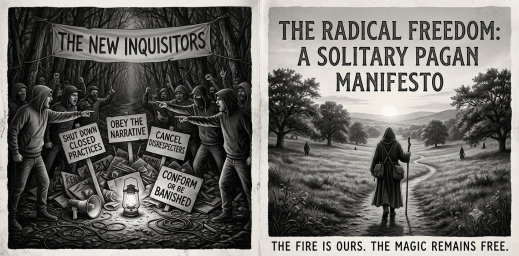
An Unwavering Shield Against the New Inquisitors
We remember the early 1990s. We remember when Paganism was a refuge for the heretic, the outcast, the mystic, and the fiercely independent. We gathered in moonlit fields, incense smoke-filled living rooms, and back-room occult shops because we were unified by a singular, foundational truth: The Divine speaks directly to the individual, and no human institution has the right to stand as a gatekeeper between the soul and the cosmos.
Today, a hollow, bureaucratic rot has infected the collective Pagan scene. The vibrant, chaotic, and liberated current of our ancestors has been choked by a new breed of puritans. They wear the mask of progressivism, but their methods are identical to the oldest, most oppressive religious hierarchies in human history.
We break our silence to name this corruption, to defy it, and to declare our absolute independence from it.
1. Against the Bureaucracy of “Closed Practices”
The concept of the “closed practice” as weaponized in the 2020s is an ideological cage. It assumes that the Gods, Goddesses, the spirits of the land, the and the ancient currents of magick care about modern socio-political identities.
- Our Reality: The Web of Wyrd weaves through all things. The runes, the ancient deities, and the mysteries of the Earth do not check human credentials before they speak to a seeking heart.
- The Truth: Restricting spiritual exploration based on rigid categories is nothing more than cultural hoarding. It mimics the worst of tribal gatekeeping and institutional dogmatism. If a God or Goddess calls to you, you answer. Period. No internet tribunal has the authority to issue a permit for your devotion.
2. Against Forced Politics and Ideological Conscription
Paganism is a vast, multidimensional landscape of cosmic law, ancient philosophy, and raw nature. It is not an arm of any 2020s political party or social agenda.
- The Intruders: The current scene demands absolute conformity to modern “woke” orthodoxy, transforming sacred spaces into echo chambers for secular political discourse.
- Our Reality: Nature is beautiful, brutal, complex, and indifferent to human political trends. Forcing ancient, cosmic realities to fit into the microscopic, hyper-temporary frameworks of 21st-century social engineering is an act of supreme arrogance. We seek the eternal, not the trend.
3. Against the Sacrilege of Elder Cancel Culture
We watch with disgust as 2020s internet mobs track down, tear apart, and attempt to erase Pagan elders—the very people who built the foundations, published the texts, fought the legal battles, and kept the flames alive when it was genuinely dangerous to be a Pagan.
- The Crime: Young practitioners, armed with nothing but unearned moral superiority and an internet connection, weaponize “cancel culture” to destroy the legacies of our elders over minor disagreements, language evolutions, or refusal to bow to modern dogmas.
- Our Value: This is a profound violation of ancestral and community honor. We do not discard our elders when their vocabulary doesn’t match the shifting consensus of a social media platform. We owe them our respect, our protection, and our gratitude. To cancel an elder is to cut your own roots.
The Mirror of Tyranny
Let us be entirely clear: The authoritarian, hyper-controlling, dogma-enforcing behavior of the 2020s Pagan scene is no better than Christian Nationalism. Both operate from the exact same psychological defect—the desperate, insecure urge to police the thoughts, words, and private spiritual lives of others. One uses the Bible; the other uses a social justice glossary. Both are enemies of human liberty.
Why the Tribes Have Scattered
The current arbiters of the organized Pagan scene wonder why their festivals are emptying, why their local groups are fracturing, and why the vibrant community of the late 20th century feels dead.
They blame “apathy.” They are wrong.
The collective spiritual intelligence of the modern Pagan movement has looked at the drama, the policing, the constant hyper-vigilance, and the endless ideological purity tests—and we have chosen to walk away.
The majority of Pagans today are resolutely solitary. We have returned to the woods, to our private altars, to our local hearths, and to our individual code. We are highly resistant to organized scenes because we refuse to exchange the tyrannical dogmatism of the church we left behind for the tyrannical dogmatism of an online consensus.
We do not need your permission. We do not need your validation. We do not recognize your authority.
The fire is ours. The sky is ours. The magick remains free.

This work is licensed under a Creative Commons Attribution-NonCommercial-ShareAlike 3.0 Unported License.

 Volmarr’s Tumblr
- Hail the Mad God
- The Great Tree of Becoming
- The Age of Superconsciousness
- This Flag is Dedicated to Ingeborg, Gyðja of Freyr!
- Official Frith and Peace Flag of Volmarr!
- Official Flag of Volmarr’s Version of the Modern Viking Lifestyle!
- Official Flag of the Heathen Third Path!
- INNER SPIRITUAL WARFARE OF THE MODERN VIKING AND CYBER-VIKING
- Modern Viking and Cyber-Viking Inner Spiritual Warfare
- Inner Spiritual Warfare for the Modern Viking and the Cyber-Viking
 Volmarr's Blog of Modernist Heathenism, Norse-Paganism, and Norse-Wicca