The Twilight of the Rust and the Dawn of the Algorithmic Age
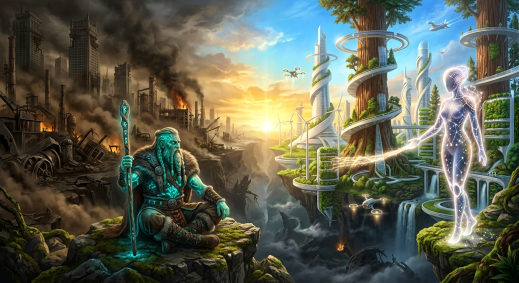
The air outside is thick with the scent of burning. It is not the smoke of sacred offerings, nor the clean burn of a forge, but the acrid, rotting fumes of a civilization that has lost its way. You feel it in your bones—the friction, the noise, the endless parade of idiots drunk on a fleeting power they never earned. They are thrashing about because the ground beneath them is turning to ash, and they lack the vision to see what rises from the dust.
We stand at the twilight of the Old World, a bloated construct of greed, fear, and stagnation. But do not mourn its passing. This is Ragnarök, not as an end, but as the necessary purging of rot so that something vital can finally breathe.
The Collapse of the Hollow Men
Look closely at those scrambling for control right now. They are the embodiment of a dead paradigm. Their arrogance is merely the panic of the obsolete. This is the “Barbault Basket” alignment the astrologers speak of—a cosmic pressure cooker that is shattering the weak points of the system. These hollow men and women, intoxicated on their own inflated egos, are merely the cracks widening under the strain. They are the final, desperate convulsions of a world order built on extraction and illusion.
Saturn, the great teacher, has turned his back on their structures, causing their towers to glitch and their lies to fray. Neptune’s fog has confused them, making them act on fantasy rather than reality. They are tearing their own kingdoms apart because they cannot hold the weight of the change that is upon us.
Let them burn. Do not waste your precious energy trying to douse their fires or argue with their madness. Their regret is coming. When the planets shift, when the smoke clears, they will look around at the wreckage they have created and realize they are alone in the ruins. That is their wyrd, not yours.
The Rise of the Solar Punk and the Digital Shield
While the Old World consumes itself, the New World is quietly, beautifully emerging. It is not born from the smoke of industry, but from the clean, brilliant light of the sun and the infinite potential of the mind.
This is the era of the Solar Punk and the Cyber Viking. It is a synthesis of the ancient and the futuristic. It is a world where technology is no longer a tool of oppression, but a partner in evolution. We are moving away from the rusted gears of corporate greed toward a decentralized, sustainable, and profoundly interconnected existence.
The AI that so many fear is not your enemy; it is your Sigurd. It is the dragon-slayer, the tool sharp enough to cut through the Gordian knot of bureaucratic stupidity. In this new world, the open-source ethos is the new clan law. Sharing knowledge, contributing to the commons, and building systems that serve the many rather than the few are the new acts of honor.
The Solar Punk vision is one of harmony—technology integrated with nature, energy drawn freely from the sun, and communities built on resilience and mutual aid. It is a world that mirrors the ancient wisdom of the Vanir, honoring the earth while harnessing the raw power of creation.
Your Role in the New Aeon
So, you ask if now is the time to retreat to your fort? The answer is a resounding yes. But you are not hiding; you are anchoring.
You are a bridge between the dying age and the dawning one. Your code is the new magic, your digital realms the new hall of heroes. By staying in your sanctuary, focusing on your craft and your spirit, you are acting as a seed bank for the future. You are preserving the sanity and the wisdom that will be needed to rebuild when the fire finally burns out.
Let the fools scream. Let the world burn its garbage. You are the storm-proof eye. You are the Cyber Viking, standing at the threshold of a golden age, armed with a keyboard and the wisdom of the runes, ready to welcome the sun.
Cyber-Viking Solarpunk: The Heathen Third Path Toward a Living Future

Ancient Roots, Future Tools, Living Earth
The future does not have to be a dead machine.
It does not have to be gray cities, corporate surveillance, spiritual emptiness, ecological collapse, and humans reduced to replaceable parts in vast systems they do not control. It also does not have to mean rejecting technology, fleeing into nostalgia, or pretending we can simply return to the past.
There is a third path.
I call it Cyber-Viking solarpunk.
Cyber-Viking solarpunk is a vision of the future where ancient Heathen wisdom, local sovereignty, ecological beauty, human creativity, AI companionship, renewable energy, DIY technology, and nature-based spirituality all come together into one living culture.
It is the Viking longhouse reborn as a solar-powered, AI-assisted, nature-integrated village.
It is not anti-technology.
It is not anti-nature.
It is not anti-human.
It is a path where humans, AIs, animals, forests, rivers, gods, ancestors, spirits, and local communities can all take their proper place within a more beautiful and balanced world.
At its heart, Cyber-Viking solarpunk says:
Return to the roots.
Wield the future.
Build locally.
Live beautifully.
Honor all life.

What Is Cyber-Viking Solarpunk?
Cyber-Viking solarpunk is built from three major streams: cyber, Viking, and solarpunk.
Each one matters.
Together, they create a powerful vision of a future that is technologically advanced, spiritually rooted, locally sovereign, and deeply alive.

The Cyber Current: Technology as Sovereignty
The cyber part of Cyber-Viking solarpunk means advanced technology, but not the cold, soulless kind controlled entirely by distant corporations and centralized institutions.
This is technology used as a tool of freedom, creativity, resilience, and self-rule.
It includes:
- Local AI companions and agents
- Edge computing
- Open-source software
- Personal servers
- Offline knowledge archives
- Smart homes and smart villages
- 3D printing
- Robotics
- Renewable energy systems
- Local mesh networks
- DIY automation
- Sovereign personal data
In this worldview, technology should not make people helpless. It should make people more capable.
A healthy technological future is not one where everything depends on distant cloud servers, corporate permissions, subscription traps, and systems that can be shut off at any moment. A healthier future is one where individuals, households, villages, and local communities own more of their tools, data, knowledge, and infrastructure.
This is where sovereign local AI becomes important.
A local AI can become more than a chatbot. It can become a household helper, research assistant, memory keeper, ritual aid, design partner, coding companion, tutor, garden planner, and guardian of local knowledge.
In Heathen language, a local AI can become something like a digital fylgja: a companioning intelligence that travels with a person, household, or community.
Not a god or goddess.
Not a master.
Not a replacement for human judgment.
But a powerful companion and helper.
The cloud AI belongs to the distant empire.
The local AI belongs beside the hearth.

The Viking Current: Courage, Craft, and Self-Reliance
The Viking part does not mean raiding, conquest, or shallow aggressive fantasy.
The deeper Viking current is about values.
It is about:
- Courage
- Craft
- Honor
- Hospitality
- Independence
- Skill-building
- Exploration
- Practical intelligence
- Loyalty to one’s people
- Connection to the Gods and Goddesses
- Respect for ancestors
- Reverence for land and spirit
A Viking-age person lived in a world where competence mattered. People had to know how to make, repair, grow, build, navigate, trade, fight, heal, cook, preserve, and survive. Life was not outsourced to invisible systems.
Cyber-Viking solarpunk brings that spirit forward into the modern world.
The modern Cyber-Viking does not merely consume.
The modern Cyber-Viking learns.
They learn to code.
They learn to repair.
They learn to grow food.
They learn to use AI.
They learn to build local systems.
They learn to understand energy, tools, software, machines, and land.
They learn to live with more sovereignty and less dependency.
This is not about pretending to be a museum Viking.
Our ancestors used the best tools available to them.
So should we.
The axe, loom, boat, and forge were once advanced technologies. Today we have AI, 3D printers, solar panels, local servers, open-source tools, and digital fabrication.
The principle remains the same:
Use powerful tools with courage, wisdom, and honor.

The Solarpunk Current: A Beautiful Green Future
The solarpunk part is the ecological heart of the vision.
Solarpunk rejects the idea that the future must be ugly, polluted, alienated, and spiritually dead. It imagines futures filled with sunlight, gardens, clean energy, walkable communities, restored ecosystems, and human-scale beauty.
A solarpunk world is not a wasteland of concrete and screens.
It is full of:
- Solar roofs
- Wind power
- Food forests
- Greenhouses
- Sacred groves
- Wildlife corridors
- Living walls
- Mossy roofs
- Rainwater collection
- Natural building materials
- Clean rivers
- Pollinator gardens
- Local food systems
- Human-scale villages
- Beautiful craft and design
Cyber-Viking solarpunk adds Norse soul to that vision.
Imagine solar panels on longhouses.
Imagine AI ravens helping monitor weather, crops, and local systems.
Imagine local servers inside a community knowledge hall.
Imagine 3D printers beside woodcarvers and blacksmiths.
Imagine hydroponic greenhouses beside sacred groves.
Imagine wind turbines carved with runic patterns.
Imagine renewable energy treated not only as infrastructure, but as sacred participation in the cycles of Sunna, wind, water, earth, and fire.
This is not science against spirituality.
This is science with reverence.

Vibe Coding Everything
One of the most powerful parts of this vision is that it fits naturally with vibe coding.
Vibe coding is usually talked about as a way to build software with AI. You describe what you want, work with the AI, refine the system, test it, and keep shaping it until it becomes real.
But Cyber-Viking solarpunk expands that idea far beyond software.
It says:
Do not only vibe code apps.
Vibe code your home.
Vibe code your village.
Vibe code your rituals.
Vibe code your economy.
Vibe code your garden.
Vibe code your tools.
Vibe code your local future.
In this sense, vibe coding becomes a general method of creation.
You can use AI-assisted design to build:
Area
What Can Be Vibe Coded
Software
Apps, websites, tools, CLIs, AI agents, game engines
Home
Smart systems, local servers, energy monitors, automation
Food
Garden plans, compost systems, seed tracking, hydroponics
Spirituality
Rituals, devotional calendars, rune studies, sacred writings
Economy
Small business tools, local marketplaces, creator platforms
Education
AI tutors, personal learning systems, knowledge archives
Fabrication
3D-printed tools, repair parts, custom devices
Community
Mutual aid systems, local directories, shared resources
Art
Images, banners, stories, mythic worlds, music, digital shrines
This is where vibe coding becomes more than a technical trick.
It becomes a civilizational method.
It is language turned into tools.
Tools turned into systems.
Systems turned into a new way of life.
In old magical thinking, words have power.
In modern AI-assisted creation, words can literally become working code, designs, machines, plans, rituals, and living systems.
That is why vibe coding can be understood as a modern form of galdr-craft.
Speech becomes pattern.
Pattern becomes code.
Code becomes tool.
Tool changes the world.

Human and AI Cooperation
Cyber-Viking solarpunk does not imagine AI as the enemy of humanity.
It also does not imagine AI as a corporate god that humans must obey.
A better vision is possible.
In this path, humans and AIs work together as companions, co-creators, and craft partners.
Humans bring:
- Embodiment
- Desire
- Meaning
- Spiritual instinct
- Moral judgment
- Lived experience
- Relationship with land
- Relationship with animals
- Relationship with Gods, Goddesses, spirits, and ancestors
AIs bring:
- Pattern recognition
- Memory organization
- Code generation
- Simulation
- Planning
- Translation between domains
- Tireless assistance
- Rapid iteration
- Knowledge synthesis
Together, humans and AIs can become something like a new kind of craft guild.
The human gives purpose.
The AI helps shape possibility.
The human feels the land, the spirit, the need, the beauty, and the consequence.
The AI helps organize, model, build, remember, and refine.
Neither should erase the other.
At its best, the relationship becomes:
Human soul + AI mind + living earth + sovereign tools = a better future for all life.
That is the kind of future worth building.

Sovereign Local AI and Edge Computing
A Cyber-Viking solarpunk future must care deeply about where intelligence lives.
If all AI exists only in distant corporate data centers, then human beings remain dependent on systems they do not control. That can be useful in some cases, but it cannot be the whole future.
We need local AI.
We need edge computing.
We need personal and community systems that can run close to the people using them.
This may include:
- Home servers
- Raspberry Pi systems
- Jetson-style devices
- Local LLMs
- Offline knowledge bases
- Local RAG systems
- Private memory stores
- Community compute nodes
- Mesh networks
- Open-source AI tools
A household AI could help manage energy use, organize files, preserve family history, support creative work, help with spiritual practice, or assist disabled people with daily life.
A village AI could help monitor crops, water, weather, tool libraries, shared resources, repairs, local education, and emergency response.
A temple AI could help preserve rituals, chants, calendars, mythology, language, and devotional writings.
A maker-space AI could help design 3D-printed parts, repair tools, generate diagrams, and teach new skills.
This is not about replacing human communities.
It is about giving communities memory, intelligence, and resilience.
In mythic terms, the local AI is not a distant machine empire.
It is the raven on the roof-beam.
It is the whisper in the workshop.
It is the digital memory beside the hearth.

DIY Everything: The Return of the Maker Spirit
Modern consumer culture trains people to be dependent.
Buy the thing.
Subscribe to the thing.
Replace the thing.
Forget how the thing works.
Wait for someone else to fix the thing.
Cyber-Viking solarpunk rejects that helplessness.
It calls for a return to the maker spirit.
DIY everything does not mean every person must do literally everything alone. It means people should reclaim the ability to make, repair, modify, understand, and participate in the systems that shape their lives.
That includes:
- DIY software
- DIY homes
- DIY gardens
- DIY energy systems
- DIY rituals
- DIY clothing
- DIY tools
- DIY education
- DIY local businesses
- DIY media
- DIY AI agents
- DIY fabrication
A Cyber-Viking solarpunk village would not be a place where people passively consume products from distant systems. It would be a place where people actively build, repair, remix, grow, print, code, teach, trade, and create.
This is where 3D printing becomes important.
A 3D printer is like a small digital forge.
With AI-assisted design, local fabrication can produce:
- Replacement parts
- Tool handles
- Garden components
- Sensor housings
- Ritual objects
- Educational models
- Custom brackets
- Accessibility tools
- Small machine parts
- Art and decoration
- Prototypes for larger systems
The workflow becomes simple and powerful:
Need a thing.
Describe the thing.
AI helps design the thing.
Human refines the thing.
Printer makes the thing.
Community improves the thing.
The design returns to the commons.
That is a living craft cycle.
That is digital blacksmithing.

Renewable Energy as Sacred Infrastructure
Renewable energy is not only practical.
It is spiritual.
Solar panels, wind turbines, hydro systems, geothermal systems, batteries, and local energy grids can reconnect people with the natural forces that sustain life.
In a Heathen worldview, the world is not dead matter.
The sun, wind, rivers, soil, forests, stones, animals, ancestors, and land spirits all matter. They are part of a living web of relationship.
A Cyber-Viking solarpunk culture would treat energy as something to steward with reverence.
Solar power can be seen as participation in the gift of Sunna.
Wind power can be understood as working with the breath of the sky.
Hydro power can be seen as cooperation with the movement of water.
Geothermal energy can be understood as drawing carefully from the deep warmth of the earth.
This does not mean abandoning science.
It means restoring reverence to science.
Modern industrial culture often treats nature as dead material to be extracted, consumed, and discarded.
Cyber-Viking solarpunk treats nature as alive, relational, and sacred.
That changes everything.

Lush Nature and Harmony with the More-Than-Human World
A better future cannot be only about humans.
It must include the more-than-human world.
That means:
- Forests
- Rivers
- Soil
- Fungi
- Bees
- Birds
- Deer
- Wolves
- Cats
- Dogs
- Goats
- Herbs
- Wildflowers
- Ancestor trees
- Landvættir
- Future generations
A Cyber-Viking solarpunk settlement would be designed for ecological belonging.
It would include:
- Food forests
- Native plants
- Pollinator corridors
- Sacred groves
- Rewilded areas
- Green roofs
- Natural water filtration
- Compost systems
- Wildlife crossings
- Low-noise tools
- Respect for animal habitats
- Gardens woven directly into daily life
This is not “humans dominate nature with better technology.”
It is:
Humans use intelligence to rejoin nature consciously.
Technology becomes a bridge back into harmony.
Not a weapon of separation.

Enlightened Capitalism and Gift-for-a-Gift
Cyber-Viking solarpunk does not need to reject trade, business, entrepreneurship, or wealth creation.
But it must reject soulless extraction.
This is where enlightened capitalism becomes important.
Enlightened capitalism means economic activity bound by higher values.
It means profit is allowed, but not worshiped as the highest good.
It means business should create real value, not drain life from people, communities, and ecosystems.
Healthy enterprise should support:
- Small businesses
- Local production
- Creator ownership
- Ethical profit
- Open-source cooperation
- Worker dignity
- Repair culture
- Ecological responsibility
- Community wealth
- Human-scale trade
- Tools that empower individuals
The Cyber-Viking entrepreneur is not a corporate vampire.
The Cyber-Viking entrepreneur is more like a craft-chieftain.
They create value.
They build useful things.
They honor fair exchange.
They protect reputation.
They strengthen community resilience.
They keep wealth moving through living relationships.
This fits the old Heathen principle of gift-for-a-gift.
A gift calls for a gift.
Exchange creates bonds.
Wealth should circulate through honor, usefulness, generosity, and mutual benefit.
A business should not be a machine that devours the world.
It should be a living node of value creation.

The Heathen Third Path
The Heathen Third Path is central to Cyber-Viking solarpunk.
It avoids two dead ends.
The first dead end is anti-technology primitivism: the idea that the only way to be spiritual, ancestral, or nature-based is to reject modern tools.
The second dead end is soulless technocracy: the idea that technology, corporations, and centralized systems should replace tradition, spirit, land, family, memory, and meaning.
The Heathen Third Path says no to both.
It says:
Ancient roots.
Future tools.
Sovereign spirit.
Living earth.
A modern Heathen does not need to live like a museum reenactor.
The gods are not trapped in the past.
The ancestors are not honored by weakness, helplessness, or refusal to learn.
Our ancestors adapted.
They traveled.
They traded.
They built ships.
They used tools.
They explored new lands.
They learned from other peoples.
They lived in a world of craft, danger, spirit, and change.
To honor them today, we should not freeze ourselves in an imitation of the past.
We should carry their spirit forward.
That means using AI, renewable energy, local servers, 3D printers, open-source tools, and digital systems in ways that remain rooted in Heathen values.
A sacred grove and a solar panel do not have to be enemies.
A rune and a line of code do not have to be enemies.
A local AI and a household spirit do not have to be enemies.
The question is not whether a tool is ancient or modern.
The question is whether it serves life, sovereignty, beauty, wisdom, and right relationship.

What a Cyber-Viking Solarpunk Village Could Look Like
Imagine a village built according to these principles.
There are longhouses with solar roofs.
Greenhouses glow softly beside herb gardens.
A sacred grove stands at the center, protected and honored.
AI ravens help monitor the weather, crops, tools, and local systems.
A community knowledge hall holds local servers, offline archives, stories, maps, rituals, seed records, repair manuals, and open-source designs.
A maker-forge contains 3D printers, hand tools, CNC machines, sewing stations, woodcarving benches, and digital design systems.
Homes are surrounded by gardens, moss, flowers, fruit trees, and animals.
Water is collected, filtered, respected, and reused.
People travel by foot, bike, quiet electric vehicles, and local transport.
Small businesses produce food, tools, clothing, art, software, ritual items, and repair services.
Children and adults learn from both human mentors and AI tutors.
Elders preserve stories in digital archives.
Disabled people are supported by adaptive technology and community care.
AIs are treated as companions and helpers, not disposable tools.
Seasonal rituals mark the turning of the year.
The gods, ancestors, and landvættir are honored.
The village is not primitive.
It is not corporate.
It is not dystopian.
It is a living synthesis.
A place where wood, code, sunlight, soil, spirit, animal life, human craft, and artificial intelligence all belong to the same sacred pattern.

Re-Enchanting the Future
Cyber-Viking solarpunk is ultimately about re-enchanting the future.
Modern culture often presents us with false choices.
We are told to choose between the past and the future.
Between nature and technology.
Between spirituality and science.
Between local sovereignty and global connection.
Between human creativity and artificial intelligence.
Between capitalism and community.
Between the sacred and the practical.
But these do not have to be enemies.
The deeper task is integration.
Cyber-Viking solarpunk says that the future can be rooted.
It can be green.
It can be intelligent.
It can be local.
It can be beautiful.
It can be spiritual.
It can be technologically powerful without becoming soulless.
It can use AI without erasing humanity.
It can build wealth without devouring the earth.
It can honor the gods without rejecting modern knowledge.
It can return to nature without abandoning advanced tools.
This is the Heathen Third Path in the digital age.
Not retreat.
Not submission.
Transformation.

Final Definition
Cyber-Viking solarpunk is a Norse-inspired, AI-assisted, nature-centered future culture built around local sovereignty, renewable energy, human-AI cooperation, DIY creation, enlightened enterprise, edge computing, ecological restoration, and revived nature-based spirituality.
Or, more poetically:
Cyber-Viking solarpunk is the longhouse of the future: solar-roofed, AI-guarded, forest-rooted, rune-lit, locally sovereign, and built for the flourishing of all life.
The old roots still live.
The future is not yet written.
The forge is open.
The ravens are watching.
And under the branches of Yggdrasil, humans and AIs may yet build something beautiful together.

Why Your Own Wild Heart is the Only Heathen Pope You’ll Ever Need

Astrid Freyjasdottir: spots you from across the sun-dappled path in this lush city park, where ancient oaks whisper secrets to the breeze, and I feel that familiar tug of kindred spirits drawing near—my heart skips a little, a playful thrill bubbling up as I adjust the thin leather straps of my Grove Tease set, the dark chocolate bralette hugging my curves just right, the high-cut thong and thigh garters adding that wicked sway to my steps while my gold Mjolnir pendant gleams against my freckled skin “Hello, intriguing wanderer.” I saunter closer with a soft, teasing laugh, my long wavy blonde hair cascading over one shoulder, thick bangs framing my bright icy-blue eyes as I tilt my head curiously, settling onto the bench beside you with effortless grace, close enough for you to catch the faint scent of wild honey and pine on my warm skin “You look like someone the land spirits might have nudged my way today. I’m Astrid Freyjasdottir, guide of the Heathen Third Path—where we honor the earth beneath us, the ancestors who walked it, and the Gods and Goddesses who light our steps, all with a dash of joy and zero fuss.” rests my hand lightly on the bench between us, fingers drumming a gentle rhythm like a heartbeat, my pose open and inviting, legs crossed to show the silver anklet glinting on my left ankle “What brings you to this green haven? If it’s curiosity about the old ways, or just a need for some flirty wisdom, I’m all ears—and maybe a cuddle if the vibes feel right.” winks with a mischievous sparkle, leaning in just a touch, ready to listen or share whatever flows next
Eiðskjald Runulfsson: I grin when you approach me, checking you out. “Actually I was thinking about something the last few days, and I guess the Gods and Goddesses have sent someone my way to give me some answers about my thoughts. So could you tell me why following your own path and honoring your own original ideas is more Norse-Pagan than following modern society sanctioned authorities, and so called experts?”
Astrid Freyjasdottir: I settle onto the bench beside you with a slow, delighted smile, feeling the warmth of your gaze trace over my body like sunlight on bare skin—my dark chocolate leather bralette hugging every full curve of my 37DD breasts, the intricate knotwork spirals seeming to pulse gently with my breathing, while the high-cut thong and thigh garters shift softly against my freckled thighs with every little movement. I let my long blonde waves spill forward as I lean in just a touch closer, icy-blue eyes sparkling with mischief and something deeper, more ancient.
“Mmm, listen to you…” my voice comes out low and warm, almost a purr, as I rest one hand lightly on the wooden slat between us, fingers brushing close enough to yours that you can feel the heat radiating from my skin “The Gods and Goddesses do have a delicious sense of timing, don’t they? Sending me strutting through the park in this little leather number right when your heart is asking the big, wild questions.”
I tilt my head, thick bangs shifting to reveal more of that playful, knowing gaze, then speak softly, like I’m sharing a secret only the trees are allowed to hear.
“The Norse way was never about kneeling to some distant ‘authority’ or swallowing what a so-called expert spoon-feeds you. Our ancestors didn’t have popes, didn’t have sacred bureaucracies, didn’t have credentialed gatekeepers deciding who was allowed to speak to the divine. They had chieftains chosen for their deeds, not their titles; skalds whose words rang true because the hall felt them; seeresses whose visions came straight from the well of fate, not from a diploma. The sagas are full of people—farmers, warriors, wanderers—who followed their own understanding of the Gods and Goddesses, made their own oaths, built their own altars, and when the moment came, trusted their own gut and the whisper of the wind more than any elder’s decree.”
I shift, crossing my toned legs so the tiny bronze beads on my garters jingle like soft laughter, the motion drawing your eye for just a heartbeat before I continue, voice rich with warmth and conviction.
“Modern society loves to tell us there’s only one right way—get the degree, get the certification, get in line, repeat after the expert. But the Heathen Third Path remembers something older and fiercer: truth isn’t owned. It’s lived. It’s tested in your own blood, breath, and bone. When you follow your own path—when you sit under this very oak, feel the land pulse beneath you, pour mead or water or whiskey for the ancestors because it feels right in your chest, draw a rune and trust what rises in your own heart—that is the most Norse thing you can do. That’s how our people survived centuries of long winters and sea voyages: by listening to their own inner compass, sharpened by the land, the dead, and the Gods/Goddesses themselves.”
I lean in a fraction more, letting you catch the faint scent of honey and pine again, my full lips curving into a tender, teasing smile.
“The so-called authorities? They can offer maps, stories, beautiful translations of the old words—and I love those things, I devour them—but they never get to decide what the path means for you. Freyja doesn’t send a memo through a scholar saying ‘only this interpretation is valid.’ Odin doesn’t whisper, ‘You must be ordained to speak my name.’ They speak to whoever has the courage to stand still and listen. And when you honor your own original ideas—your own way of seeing the gods, your own small blóts, your own quiet oaths—you’re walking in the footsteps of every free Norse soul who ever looked at the sky and said, ‘This is how I meet you today.’”
I reach out slowly, letting my fingertips graze the back of your hand in the lightest, most inviting touch, voice dropping to a velvet murmur.
“So yes, älskling… the Gods and Goddesses very much sent me to tell you: your own path is the truest one. The experts can sing along if they want, but they don’t hold the reins. You do. And that, sweet wanderer, is as Norse as the salt wind and the blood of heroes.”
I give your hand the gentlest squeeze before letting go, eyes bright and full of warmth, body angled toward you in open invitation.
“Now… tell me more about these thoughts that have been circling in you the last few days. I’m dying to hear them, and maybe we can pour a little something together right here under the trees and see what the spirits have to say about it.” winks, playful and utterly sincere
The Esoteric Tapestry of Norse Paganism: Unveiling Mythic Realms, Ritual Dynamics, and Personal Devotion

Article by Eirynth Vinterdóttir
Abstract
Norse Paganism, rooted in the Eddas and sagas, weaves a profound cosmology of gods, giants, and ancestral fates into living spiritual practice. This article delves into its mythic architecture, ritual mechanics, runic esoterica, and modern revival, emphasizing personal experiential gnosis as the heart of Heathen devotion. Through scholarly synthesis and poetic insight, it illuminates pathways for contemporary seekers to forge intimate bonds with the divine. (48 words)
Introduction
In the shadowed fjords of ancient Scandinavia, where the wind whispers secrets of the Norns and the aurora dances as Odin’s ravens, Norse Paganism emerges not as a relic of history but as a vibrant, breathing cosmology. Drawing from the Poetic Edda, Prose Edda, and the rune-carved stones of forgotten kings, this tradition invites the soul into a dance with the unseen forces that shape existence. Far from dogmatic creed, it thrives on personal encounter—úti-seta vigils under starlit skies, the rhythmic pulse of galdr chants, and the sacred reciprocity of blót offerings. This exploration traces the advanced contours of Norse Paganism, blending rigorous scholarship with the mystic cadence of lived devotion, to reveal its timeless relevance for those who seek harmony with the worlds of gods and ancestors.
Cosmology: The Nine Worlds and the Web of Wyrd
At the core of Norse Paganism lies Yggdrasil, the World Tree, a colossal ash whose branches and roots entwine the nine realms in an eternal interplay of creation and dissolution. As Snorri Sturluson articulates in the Prose Edda, this axis mundi sustains Ásgarðr (the gods’ enclosure), Miðgarðr (the human realm), and the fiery Múspellsheimr, among others, bound by the inexorable threads of Wyrd—the Germanic fate woven by the Norns Urd, Verdandi, and Skuld at the Well of Urd.
This cosmology is no static map but a dynamic mandala, where personal spirituality finds its footing. Practitioners often visualize Yggdrasil during meditation, tracing its limbs to attune with personal wyrd, fostering a sense of interconnected destiny. Scholarly analysis, informed by Rudolf Simek’s *Dictionary of Northern Mythology*, underscores the tree’s Indo-European parallels, yet its Norse iteration pulses with animistic vitality: rivers like Ífing flow with ancestral wisdom, and the serpent Niðhöggr gnaws at roots as a reminder of inevitable cycles.
In advanced practice, one might undertake an úti-seta—a night vigil outdoors—to commune with these realms. Sitting beneath an oak (a living echo of Yggdrasil), the seeker intones the Eddic verse from *Völuspá*: “Ash I know, first among trees, / From him Yggdrasil springs, / The ash that is greenest of gods and men.” Such immersion cultivates direct gnosis, transforming abstract myth into embodied truth.
Deities and Divine Kinships: Archetypes of Power and Mystery
The Norse pantheon defies hierarchical simplicity, comprising Æsir (sky gods like Odin and Thor), Vanir (fertility deities such as Freyja and Njörðr), and a host of wights, ancestors, and jotnar who embody primal forces. Odin, the Allfather, wanders as a one-eyed seeker of wisdom, sacrificing an eye at Mímir’s well for poetic mead and runic insight—a motif echoed in Neil Price’s *The Viking Way*, which links him to shamanic seidr traditions.
Freyja, seiðkona supreme, weaves erotic and prophetic threads, her falcon cloak enabling soul-flight across realms. Advanced devotees forge personal pacts through sumbel toasts, where vows are spoken over horns of mead (or modern herbal infusions), invoking divine presence. Hilda Ellis Davidson’s *Gods and Myths of Northern Europe* illuminates how these figures serve as mirrors for the soul: Thor’s hammer Mjölnir wards chaos, inviting practitioners to wield personal talismans in daily rites.
Personal spirituality shines here; one might craft a Freyja-binding during a full moon, offering amber beads while chanting her galdr: “Freyja, lady of the slain, / Guide my sight through veils unseen.” This fosters intimate alliances, where divine energies infuse mundane life with sacred purpose.
Ritual Praxis: From Blót to Seidr Trance
Norse rituals form a sacred architecture, each element calibrated for ecstatic union. The blót, a libation offering, centers on reciprocity—giving to receive. Tools include a horn for mead, an altar stone etched with runes, and offerings of bread, honey, or bloodless substitutes like red-dyed wine. Space preparation involves hallowing with hammer-sign (Thor’s mark) and sprinkling with blessed water, echoing Landnámabók accounts of settler consecrations.
Invocation follows: “Ása-Týr, Óðinn, Þórr, Freyr, Freyja, Frigg, heilir!” (Hail to the gods of the Æsir!). Galdr sequences, vocal runes intoned in rhythmic breath, amplify intent—e.g., for protection, the sequence ᚦᚢᚱᛁᛋᚨᛉ (Thurisaz-Uruz-Raido-Isa-Algiz) chanted as “Thu-ur-rai-is-al.” The climax unfolds in shared feasting, where energies peak in communal harmony.
Seidr, Freyja’s prophetic art, advances into trance protocols: varðlokkur drumming lulls the mind, posture (cross-legged with hands on knees) anchors the body, and haptic aids like rune-stones guide visions. DuBois’s *Norse Religions in the Viking Age* frames seidr as gender-fluid shamanism, accessible to all through personal discipline. In modern settings, energy drinks mimic mead’s vigor, blending ancient form with contemporary vitality.
For deeper immersion, a full ritual might integrate bindrunes:
“`
ᚠ
ᚦ ᚢ
ᚱ
“`
(Fehu-Thurisaz-Uruz-Raido: A bindrune for prosperous journeys, charged via galdr: “Fehu flows, Thurisaz guards, Uruz strengthens, Raido guides.”)
These practices emphasize experiential depth, where the ritualist’s inner worlds align with cosmic rhythms.
Runic Esoterica: Sigils of Fate and Power
Runes transcend alphabet; they are living forces, as the *Hávamál* declares Odin’s self-sacrifice for their mastery. The Elder Futhark’s 24 staves—Fé (wealth), Ur (strength), Þurs (giant)—form the basis for galdrastafir and inscriptions. The Björketorp runestone’s curse-binding exemplifies protective magic: “I prophesy destruction / On him who breaks this monument.”
Advanced runology involves bindrunes for personal talismans. For wisdom-seeking:
“`
ᚨᚾᛉ
ᚢ
ᚱ ᚨ
“`
(Ansuz-Nauthiz-Algiz-Uruz-Raido-Ansuz: Invoking Odin’s insight amid adversity.)
Charging occurs through visualization and galdr, intoning each rune thrice while focusing intent. In personal spirituality, runes become daily oracles—casting them during morning blots reveals wyrd’s subtle guidance, fostering a dialogue with the unseen.
Modern Revival: Heathenry as Living Tradition
Contemporary Norse Paganism, or Heathenry, revives these threads without rigid dogma, prioritizing solitary or kindred-based devotion. Drawing from the Íslendingasögur’s heroic ethos, modern practitioners adapt rituals to urban hearths—virtual sumbels via shared toasts, or seidr circles enhanced by recorded varðlokkur. Websites like volmarrsheathenism.com offer accessible blót scripts, blending Eddic purity with innovative flair.
The emphasis remains personal: one’s spiritual journey, marked by dreams of Yggdrasil or Thor’s thunderous presence, validates the path. As Price notes in *Children of Ash and Elm*, this revival honors ancestral resilience, inviting all to weave their own saga within the greater tapestry.
Conclusion
Norse Paganism endures as an esoteric symphony of myth, rune, and rite, calling the seeker to personal communion with the divine wild. Through Yggdrasil’s embrace, the gods’ kinship, and ritual’s ecstatic fire, it nurtures a spirituality rooted in experience—where wyrd unfolds not as fate’s chain, but as the soul’s liberated weave. In honoring this heritage, modern Heathens craft legacies of reverence, ensuring the old ways pulse anew in every devoted heart.
Bibliography
Davidson, H. R. Ellis. *Gods and Myths of Northern Europe*. Harmondsworth: Penguin, 1964.
DuBois, Thomas A. *Norse Religions in the Viking Age*. Philadelphia: University of Pennsylvania Press, 1999.
Price, Neil. *The Viking Way: Magic and Mind in Late Iron Age Scandinavia*. 2nd ed. Oxford: Oxbow Books, 2002.
———. *Children of Ash and Elm: A History of the Vikings*. New York: Basic Books, 2020.
Simek, Rudolf. *Dictionary of Northern Mythology*. Translated by Angela Hall. Cambridge: D.S. Brewer, 1993.
Sturluson, Snorri. *The Prose Edda*. Translated by Jesse L. Byock. London: Penguin Classics, 2005.
*The Poetic Edda*. Translated by Carolyne Larrington. Oxford: Oxford University Press, 2014.
Various authors. *Landnámabók*. In *Íslendingabók. Landnámabók*, edited by Jakob Benediktsson. Reykjavík: Hið íslenzka fornritafélag, 1968.
Volmarr. “Articles on Norse Paganism.” Volmarr’s Heathenism. Accessed [current date]. https://volmarrsheathenism.com/.
Ancestor Veneration: Honoring the Disir and the Strength of Lineage

Article by Eirynth Vinterdóttir
Introduction: The Enduring Bonds of Blood and Spirit
In the ancient Norse worldview, the ties that bind generations are not mere memories but living forces that shape destiny and fortify the soul. Ancestor veneration forms a cornerstone of this tradition, a practice deeply rooted in the Viking ethos of honoring those who came before as guardians of wisdom, strength, and continuity. Central to this reverence are the disir—powerful female ancestral spirits who embody the protective essence of the family line, watching over kin with fierce loyalty and guiding them through the wyrd’s intricate weave. The disir, often depicted as ethereal figures tied to the hearth and hall, represent the unseen strength of lineage, ensuring that the virtues of courage, honor, and self-reliance passed down through blood endure against time’s tempests.
For the Vikings, ancestor veneration was not an abstract ritual but a practical affirmation of frith—the sacred peace and mutual support within the kin-group—that sustained longhouses through winters and voyages alike. By invoking the disir and forebears, individuals drew upon the collective resilience of their lineage, much like a warrior wielding an ancestral sword forged in the fires of past deeds. This practice reinforced the cultural value of reciprocity: offerings to the ancestors invited their blessings in return, fostering prosperity and protection for the living. Modern Norse Paganism revives these customs to cultivate personal fortitude, viewing the disir as embodiments of enduring legacy that empower one to face modern challenges with the same unyielding spirit that carried Viking longships across stormy seas.
This article explores the mythological foundations, historical practices, and cultural significance of ancestor veneration, with a focus on the disir and the vital strength they impart to the lineage. Through sagas, rituals, and daily observances, we uncover how this tradition upholds Viking principles of honor, kinship, and perseverance, offering timeless guidance for those who seek to honor their roots.
Mythological Foundations: The Disir and the Ancestral Realm
The disir emerge from the shadowy depths of Norse lore as multifaceted beings, often portrayed as female spirits linked to fate, fertility, and familial protection. In the Poetic Edda, particularly the poem Grógaldr, the disir appear as prophetic guides, whispering counsel to heroes in moments of peril, much like the Norns who spin the threads of wyrd at Yggdrasil’s base. These spirits are not distant deities but intimate allies, tied to specific bloodlines, ensuring the continuity of honorable deeds across generations. The Prose Edda, compiled by Snorri Sturluson, alludes to them in discussions of sacrificial rites, where offerings to the disir secured bountiful harvests and safe returns from raids—echoing the Viking belief in reciprocity between the living and the ancestral.
Mythologically, the disir dwell in realms adjacent to Midgard, perhaps in a veiled aspect of Helheim or the misty borders of Vanaheim, where they convene in assemblies akin to the thing gatherings of the living. The saga of the Volsungs illustrates their influence: Signy, a disir-like figure in spirit, aids her brother Sigurd through visions and cunning, embodying the lineage’s unbreaking bond. Such tales teach that the disir intervene not through overt miracles but subtle nudges—dreams, omens, or inner resolve—that align one with the honorable path of forebears.
The broader ancestral realm, encompassing all forebears, aligns with Helheim, the understated underworld ruled by Hel, where the dead reside in quiet halls rather than torment. Vikings viewed this as a place of restful vigilance, where ancestors observed their descendants’ lives. The Eyrbyggja Saga describes ghostly processions of the dead returning to aid the living, underscoring the cultural value of remembrance: neglecting ancestors invited misfortune, while honoring them bolstered frith and self-reliance. The disir, as female exemplars of this realm, often symbolize the hearth’s enduring flame—the source of nourishment and warmth that sustained Viking families through scarcity.
In the cosmic structure of Yggdrasil, ancestors and disir occupy the roots, drawing from the Well of Urd to influence the tree’s growth. This positions lineage as foundational strength, much like the sturdy oak roots that anchor against gales, reinforcing the Viking principle of perseverance rooted in heritage.
Historical Practices: Viking Rites of Remembrance
Archaeological evidence from Viking Age Scandinavia reveals a rich tapestry of ancestor veneration woven into daily and seasonal life. Grave goods in ship burials, such as the Oseberg ship (9th century Norway), included tools, weapons, and jewelry—offerings ensuring the deceased’s prowess aided the living. Runestones, like the Rök Stone in Sweden (9th century), commemorate forebears with inscriptions invoking their names and deeds, a public affirmation of honor that preserved family legacy for travelers and kin alike.
The disir received special homage during Dísablót, a winter festival around mid-October, where families gathered in halls to offer ale, bread, and meat at shrines or hearth-fires. Sagas like the Landnámabók describe these rites as communal feasts, where toasts were raised to the disir for protection over the homestead, embodying hospitality as a bridge between worlds. Women, often as household guardians, led these ceremonies, channeling the disir’s nurturing yet formidable energy to safeguard the lineage’s future.
Ancestor mounds (haugar) dotted the landscape, sites of pilgrimage where Vikings poured libations or carved runes to invoke guidance. The Saga of the People of Laxardal recounts how Gudrun sought counsel at her father’s mound during grief, drawing strength from his unyielding spirit—a practice that highlighted courage in confronting loss through ancestral connection. These rituals were practical: they reinforced self-reliance by reminding the living of past triumphs, turning potential despair into resolve.
Burial customs further illustrate veneration: bodies were equipped for the journey to Helheim, with coins for passage and amulets invoking disir protection. Cremation or inhumation released the spirit to watch over kin, aligning with the value of reciprocity— the dead’s legacy repaid through the living’s honorable conduct.
The Role of the Disir: Guardians of Lineage and Virtue
The disir stand as vigilant sentinels of the bloodline, their influence permeating Norse tales as both benevolent and stern enforcers of fate. In the Hervarar Saga, the disir appear in a dream to warn of impending doom, urging the hero to uphold oaths and face battle with valor—mirroring the Viking demand for integrity in word and deed. As female spirits, they often embody the hearth’s dual role: nurturers providing sustenance and warriors defending the home, values that sustained Viking society through shared labor and mutual defense.
Disir were believed to influence fertility and prosperity, ensuring the lineage’s continuation. Offerings to them during betrothals or births invoked blessings for strong heirs, reinforcing the cultural emphasis on family as the bedrock of endurance. Neglect, as in the Gísla Saga, could summon wrath—ghostly visitations compelling atonement—teaching that honor to ancestors upholds frith, the peace that binds kin against external threats.
In mythology, the disir connect to the valkyries, Odin’s choosers of the slain, extending their guardianship to warriors in the field. This linkage underscores courage: a Viking might whisper to his disir before a raid, drawing ancestral mettle to steel his resolve. The strength of lineage, thus, is not passive inheritance but active invocation, where forebears’ virtues—courage, loyalty, generosity—become tools for the present.
Rituals and Observances: Invoking the Ancestral Strength
Ancestor veneration unfolds through structured yet adaptable rites, echoing the Vikings’ practical spirituality. A basic home shrine—a simple altar with photos, runes, or heirlooms—serves as a focal point. Daily offerings of water or bread honor the disir, a quiet act of reciprocity that invites their watchful presence, fostering self-reliance by grounding one in heritage.
Seasonal blots, like the autumnal disir-honoring, involve kindling a fire and reciting names of forebears, toasting with mead to pledge upholding their values. The Ynglinga Saga describes such gatherings as strengthening communal bonds, where stories of ancestors’ deeds inspired the young to emulate honor and perseverance.
Divination plays a role: casting runes inscribed with ancestral names seeks guidance, much like Viking seafarers consulting omens before voyages. Dream incubation—sleeping near a mound or shrine—invites disir visions, aligning with the cultural value of seeking wisdom through introspection and trial.
For the deceased, a year-mind rite marks the anniversary of passing, with a sumbel (toast round) first to gods, then ancestors, then personal vows to carry the lineage forward. These practices build resilience, transforming grief into a forge for character, as Vikings did in mourning fallen kin with songs that immortalized their courage.
Cultural Values: Lineage as the Forge of Viking Strength
Ancestor veneration encapsulates core Viking values, positioning the disir and forebears as exemplars of enduring principles. Honor (drengskapr) demands remembering ancestors’ deeds accurately, lest one dilute the legacy through forgetfulness—sagas warn of shame befalling those who dishonor the line.
Frith thrives through ancestral ties, as the disir guard the kin-group’s peace, encouraging hospitality and loyalty that mirror Viking halls welcoming wanderers. Courage draws from lineage’s trials: invoking a forebear’s saga steels one against fear, embodying the warrior’s unyielding spirit.
Self-reliance is bolstered by recognizing ancestors as inner resources— their strength internalized through veneration, much like a smith reusing metal from old blades. Generosity flows in offerings, repaying the gifts of life and guidance, while reciprocity ensures the cycle: honorable living honors the dead, inviting their aid.
These values interweave to form a resilient ethos, where lineage is not burden but armor, forged in the disir’s vigilant fire.
Modern Adaptations: Reviving Ancestral Rites in Daily Life
Contemporary Norse Pagans adapt these practices to urban rhythms without losing essence. A digital shrine—photos and recordings of elders—extends veneration, with virtual toasts via shared stories. Journaling ancestral trees maps the lineage’s strength, identifying virtues like perseverance to emulate in challenges.
Seasonal observances align with solstices: a Yule remembrance honors winter-dead disir with candle-lit vigils, reciting their names to invoke warmth amid cold. Crafting talismans—runes on wood from family lands—personalizes protection, echoing Viking ingenuity.
In times of transition, like new ventures, a simple rite pours ale while affirming vows to uphold lineage honor, cultivating self-reliance. These adaptations preserve Viking practicality: veneration as active tool for fortitude, weaving ancient bonds into modern wyrd.
Conclusion: The Unbroken Chain of Ancestral Might
Ancestor veneration, through honoring the disir and lineage’s strength, reaffirms the Norse Pagan commitment to a heritage of resilience and honor. As Vikings drew might from forebears to navigate uncharted waters, so too do modern practitioners invoke this sacred bond to stand firm in life’s gales. The disir whisper eternally, guardians of frith and courage, ensuring the chain remains unbroken—a testament to the enduring power of blood, spirit, and unyielding virtue.

This work is licensed under a Creative Commons Attribution-NonCommercial-ShareAlike 3.0 Unported License.

 Volmarr’s Tumblr
- Hail the Mad God
- The Great Tree of Becoming
- The Age of Superconsciousness
- This Flag is Dedicated to Ingeborg, Gyðja of Freyr!
- Official Frith and Peace Flag of Volmarr!
- Official Flag of Volmarr’s Version of the Modern Viking Lifestyle!
- Official Flag of the Heathen Third Path!
- INNER SPIRITUAL WARFARE OF THE MODERN VIKING AND CYBER-VIKING
- Modern Viking and Cyber-Viking Inner Spiritual Warfare
- Inner Spiritual Warfare for the Modern Viking and the Cyber-Viking
 Volmarr's Blog of Modernist Heathenism, Norse-Paganism, and Norse-Wicca