Modern Viking and Cyber-Viking Inner Spiritual Warfare
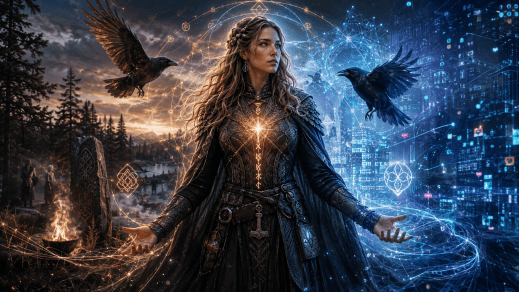
A Norse Pagan Mystical Guide to the Battle for the Soul, the Mind, the Wyrd, and the Sacred Self
There is a war that leaves no corpses.
No armies march.
No shields splinter.
No ravens circle above a blood-soaked field.
Yet every human being participates in it.
It is fought inside thought.
Inside memory.
Inside desire.
Inside fear.
Inside habit.
Inside identity.
Inside the invisible relationships between the self, the ancestors, the gods, the surrounding world, and the forces that continually attempt to shape consciousness.
For the Modern Viking, this is the battle of spiritual sovereignty.
For the Cyber-Viking, the battlefield expands further.
The old wilderness remains.
But another wilderness has appeared.
Networks.
Algorithms.
Artificial minds.
Virtual worlds.
Social-media tribes.
Synthetic realities.
Information warfare.
Attention economies.
Digital propaganda.
Data collection.
Machine-generated persuasion.
Endless streams of images, ideas, desires, fears, outrage, identities, and narratives.
The ancient warrior guarded the hall.
The Cyber-Viking must guard the inner hall.
The ancient warrior watched the horizon.
The Cyber-Viking must also watch the feed.
The ancient warrior knew that enemies could arrive from beyond the settlement.
The Cyber-Viking understands that hostile influences can arrive as notifications.
The spiritual struggle of the modern age is therefore not merely about resisting temptation or conquering weakness.
It is about maintaining the integrity of the sacred self within an environment built to penetrate consciousness.
This is inner spiritual warfare.
And its purpose is not endless conflict.
Its purpose is sovereignty.
1. The Sacred Territory of the Self
The first territory a warrior is responsible for is the territory within.
Your thoughts.
Your emotional patterns.
Your commitments.
Your memory.
Your values.
Your spiritual relationships.
Your will.
Your attention.
Your sense of meaning.
These form an invisible domain.
A person may own land and yet possess no inner sovereignty.
A person may command others while being commanded by fear.
A person may appear powerful while being ruled by resentment.
A person may possess extraordinary technology while having no control over how that technology shapes their mind.
The Norse Pagan spiritual warrior begins with a declaration:
My consciousness is sacred territory.
This does not mean isolation.
The self is not an island.
Norse spiritual worldviews are deeply relational.
The human being exists within networks of kinship, obligation, reciprocity, ancestry, Gods, Goddesses, spirits, community, land, memory, and fate.
But relationship is not the same thing as surrender.
The goal is not to seal yourself away.
The goal is to know who and what is allowed inside the gates.
2. The Inner Hall
Imagine your inner world as a hall.
At its center burns a fire.
Around the fire sit many presences.
Memory.
Desire.
Fear.
Love.
Grief.
Ambition.
Instinct.
Old wounds.
Dreams.
Ancestors.
Cultural conditioning.
Spiritual experiences.
Stories.
The voices of people who have influenced you.
The echoes of Gods. Goddesses, and spirits as you personally understand them.
The hall is never empty.
The question is:
Who sits in the high seat?
If fear sits there, your life becomes organized around avoidance.
If resentment sits there, your life becomes organized around enemies.
If desire sits there, your life becomes organized around consumption.
If shame sits there, your life becomes organized around punishment.
If algorithms sit there, your life becomes organized around engagement.
If strangers on the internet sit there, your life becomes organized around approval.
The inner warrior must reclaim the high seat.
Not through ego.
Through awareness.
You listen to the voices.
You do not blindly obey them.
3. Hugr: The Mind as Living Power
The Old Norse concept of hugr is complex and does not map perfectly onto the modern English word “mind.”
It can be approached as something involving thought, intention, disposition, inner consciousness, or mental-spiritual orientation.
For the modern practitioner, hugr can become a powerful contemplative model.
Your hugr is not merely the endless chatter inside your skull.
It is the directed quality of your inner being.
Where the hugr turns, energy follows.
Where attention remains, identity begins forming.
The uncontrolled hugr becomes scattered.
The disciplined hugr becomes a spear.
The Cyber-Viking therefore practices directed consciousness.
Before opening a device, ask:
Why am I opening this?
Before entering a social platform:
What am I seeking?
Before engaging an argument:
What outcome do I want?
Before using AI:
What part of my thinking am I amplifying?
The disciplined hugr has a destination.
The undisciplined hugr follows whatever shouts loudest.
4. Huginn: The Raven of Thought
Huginn, one of Odin’s ravens, is commonly interpreted through the idea of thought.
For the Cyber-Viking, Huginn can represent the outward-moving intelligence.
The searching mind.
The investigating mind.
The mind that travels.
The mind that gathers signals.
Today Huginn flies through:
search engines,
academic papers,
forums,
social networks,
news,
AI systems,
digital archives,
virtual realities,
video platforms,
repositories,
online communities.
The problem is no longer lack of information.
The problem is surviving abundance.
Huginn can return carrying wisdom.
Or garbage.
Or fear.
Or propaganda.
Or envy.
Or outrage.
Or meaningless novelty.
Therefore the modern Odin-oriented practitioner should ask:
What am I sending Huginn to retrieve?
A raven trained to feed on carrion will always return with carrion.
A mind trained to seek outrage will always find outrage.
Train the raven.
5. Muninn: The Raven of Memory
Muninn is commonly associated with memory.
Memory is sacred.
But memory is dangerous.
Memory allows us to learn.
Memory allows us to honor ancestors.
Memory preserves vows.
Memory keeps identity coherent.
But memory can also trap consciousness.
The old insult.
The betrayal.
The humiliation.
The failure.
The person who left.
The mistake repeated endlessly at night.
A memory can become a ghost that does not know it is dead.
The warrior must decide what role memory will play.
Memory should be advisor.
Not jailer.
Ask:
Does remembering this teach me something?
If yes, keep the wisdom.
If the memory only reopens a wound without producing understanding, boundaries, action, or transformation, then the relationship with that memory must change.
Muninn should return with knowledge.
Not chains.
6. Hamr: The Shape You Wear
The Old Norse word hamr can refer to form, shape, or outward embodiment, and in later spiritual interpretation it has often been connected with ideas of shifting form or spiritual appearance.
For the Cyber-Viking, hamr becomes a useful symbol for identity.
You possess many forms.
Physical identity.
Social identity.
Spiritual identity.
Professional identity.
Avatar.
Username.
Online persona.
Roleplaying identity.
Second Life body.
Game character.
AI-created representations.
Profile picture.
Virtual embodiment.
These are modern hamr.
There is power in changing form.
A person can enter a virtual world and explore aspects of identity impossible within ordinary physical life.
This can be creative.
Transformative.
Therapeutic.
Magical.
But the warrior asks:
Am I wearing the mask, or is the mask wearing me?
Every persona should remain connected to the deeper center.
The Cyber-Viking may have many forms.
But there must still be a hearth behind them.
7. Fylgja: The Companion Presence
The fylgja occupies a fascinating place in Old Norse literature and later Norse spiritual interpretation.
It has been described in different contexts as a following spirit, attendant being, symbolic double, family-associated presence, or figure connected with fate and identity.
For a modern mystical practitioner, the fylgja can serve as a contemplative symbol for the deep companion-self.
The instinctive intelligence walking beside consciousness.
The part of you that notices danger before thought explains it.
The dream figure.
The animal symbol.
The unseen companion.
The pattern that seems to follow your life.
Some modern practitioners may understand this literally.
Others psychologically.
Others symbolically.
The spiritual discipline is the same:
Pay attention to recurring patterns.
Dreams.
Symbols.
Instinct.
Repeated warnings.
Repeated attractions.
Repeated mistakes.
Sometimes the companion has been speaking for years.
You were simply too loud to hear it.
8. Hamingja: The Accumulated Current of Fortune
Hamingja is another complex Norse concept.
It is often discussed in relation to luck, fortune, family power, success, or a kind of inherited spiritual potency.
For the modern practitioner, hamingja can be imagined as accumulated momentum.
Not random casino luck.
Something closer to cultivated fortunate power.
Your actions build currents.
Reputation builds currents.
Skill builds currents.
Relationships build currents.
Preparation builds currents.
Generosity builds currents.
Wisdom builds currents.
A person who trains, learns, prepares, maintains good relationships, keeps useful promises, manages resources, and acts with awareness often appears “lucky.”
Maybe some of that is luck.
Maybe some is hamingja.
The spiritual warrior asks:
What increases the fortunate current around my life?
And equally:
What poisons it?
Repeated dishonesty.
Broken promises.
Needless conflict.
Poor planning.
Cruelty.
Addiction.
Self-sabotage.
Chaos without purpose.
A person can spend years digging holes in the road and then complain that the journey is difficult.
Inner warfare includes ending that pattern.
9. Wyrd: The Web Already in Motion
The modern word wyrd is often used in Heathen and Pagan communities to describe interconnected fate.
Historically, the exact philosophical systems built around the term today are often modern reconstructions and elaborations.
That does not make them spiritually useless.
A powerful modern interpretation is this:
Wyrd is the web of causes, relationships, history, consequences, inheritances, choices, and circumstances already in motion.
You do not begin life on an empty board.
You inherit:
biology,
family history,
culture,
language,
economic conditions,
national history,
technology,
trauma,
opportunities,
limitations,
ancestral choices,
social systems.
These are strands already woven.
But your actions add new strands.
Inner spiritual warfare means asking:
What strand am I adding?
Every habit is weaving.
Every relationship is weaving.
Every promise is weaving.
Every betrayal is weaving.
Every creation is weaving.
Every act of courage is weaving.
Every hour given to distraction is weaving.
The warrior cannot control the whole web.
No one can.
But we can control some threads.
That is where power lives.
10. Orlæg: The Deep Layers Beneath the Present
Modern Heathen thought often uses orlæg to describe deep foundational layers of what has already been laid down.
The metaphor is useful.
Some parts of life are close to the surface.
You can change them tomorrow.
Other patterns were formed over decades.
Others reach through generations.
Inherited family behavior.
Cultural trauma.
Historical patterns.
Economic conditions.
Patterns learned in childhood.
The inner warrior recognizes depth.
You cannot remove a mountain with one swing of an axe.
But mountains can be crossed.
Some inner battles require repeated ritual, repeated reflection, repeated boundary setting, and repeated choice.
Deep wyrd requires deep work.
11. The Norns and the Discipline of Time
The Norns are often associated with fate, destiny, and the shaping of what becomes.
Their imagery invites contemplation of time.
The past.
The unfolding present.
The future becoming possible.
For the Cyber-Viking, this becomes extremely relevant.
Modern technology constantly attempts to collapse time into the immediate.
NOW.
CLICK.
BUY.
RESPOND.
WATCH.
REACT.
The Norn-oriented mind asks a different question:
What does this choice become?
Not:
Does this feel good now?
But:
What happens after a year of this?
After five years?
After twenty?
The warrior learns to think temporally.
That one habit becomes a road.
That one road becomes a life.
12. Odin: Spiritual Warfare Through Knowledge
Odin’s mythic character is profoundly connected with knowledge.
Not comfortable knowledge.
Dangerous knowledge.
Costly knowledge.
Hidden knowledge.
Poetic knowledge.
Magical knowledge.
Runic knowledge.
The Cyber-Viking lives in an age where knowledge is almost everywhere.
But wisdom remains scarce.
This creates a strange contradiction.
We can access more information than kings of previous centuries could imagine.
Yet people remain manipulated by basic emotional triggers.
The Odin-oriented warrior therefore practices three disciplines:
Seek knowledge.
Study deeply.
Question knowledge.
Do not confuse confidence with truth.
Pay the price of knowledge.
Real learning demands time.
The sacrifice of ignorance hurts because identity often depends upon what we already believe.
Odin loses an eye.
The symbolic lesson is sharp:
To see differently, sometimes you must surrender how you used to see.
13. The Runic Ordeal
Odin’s ordeal upon the World Tree is one of the most powerful images within Norse mythology.
He hangs.
He suffers.
He reaches.
He discovers.
The runes do not arrive as entertainment.
They are earned through transformation.
For the modern practitioner, this myth can represent initiation through difficulty.
Some wisdom cannot be acquired merely by reading.
Grief teaches.
Failure teaches.
Loneliness teaches.
Travel teaches.
Illness teaches.
Poverty teaches.
Love teaches.
Betrayal teaches.
Building something teaches.
Losing something teaches.
The spiritual warrior asks:
What rune is hidden inside this ordeal?
Not in the sense that suffering is always deserved or cosmically planned.
Rather:
What can be learned here that could not be learned elsewhere?
Pain does not automatically create wisdom.
Pain plus reflection can.
14. Thor: The Guardian of Boundaries
Thor is not merely a symbol of brute strength.
He is also a defender.
A guardian.
A figure who confronts forces threatening the ordered world.
The inner Thor protects boundaries.
Modern people often have poor boundaries.
They allow unlimited access.
Unlimited messages.
Unlimited demands.
Unlimited digital exposure.
Unlimited emotional dumping.
Unlimited obligation.
The spiritual warrior learns to say:
No.
Not now.
Not here.
Not this.
Not from you.
Not anymore.
These may be among the most sacred words a person can learn.
A boundary is a spiritual wall.
Mjölnir is therefore not only the hammer striking outward.
It is the hammer driving posts into the earth.
This is where my sacred ground begins.
15. Freyja: Sovereignty of Desire
Freyja represents many things across the surviving mythic and literary record.
Love.
Desire.
Beauty.
Wealth.
Seiðr.
Power.
Death.
Mystery.
The modern spiritual warrior can learn something essential from her:
Desire is powerful.
Desire is not weakness.
But uncontrolled desire creates bondage.
What do you want?
Sex?
Love?
Recognition?
Beauty?
Money?
Power?
Freedom?
Attention?
Spiritual experience?
Technology?
Escape?
Desire reveals direction.
But desire must be examined.
Ask:
Is this desire truly mine?
That question matters enormously today.
Advertising manufactures desire.
Algorithms manufacture desire.
Influencers manufacture desire.
Pornographic and romantic media can manufacture desire.
Social comparison manufactures desire.
Consumer culture manufactures desire.
The Freyja-oriented warrior owns desire consciously.
Desire becomes magic when directed.
Desire becomes slavery when manipulated.
16. Seiðr as Inner Repatterning
Historical seiðr was a complex magical practice, and many details remain uncertain or contested.
Modern seiðr therefore includes significant reconstruction, inspiration, and innovation.
One productive modern understanding is to view seiðr partly as work involving altered consciousness, intuition, fate, vision, trance, pattern perception, and spiritual relationship.
Applied inwardly, seiðr becomes the practice of entering the hidden weave.
You sit.
Breathe.
Enter trance.
Allow the ordinary surface mind to soften.
Then ask:
What pattern is controlling me?
What fear keeps repeating?
What future am I weaving?
What part of my identity wants transformation?
What thread must be cut?
What thread must be strengthened?
Inner seiðr is not domination.
It is pattern recognition.
You are looking beneath the visible surface.
17. Galdr: The Power of Voice
Galdr, broadly associated with magical chanting or incantatory practice, gives the modern practitioner another weapon.
Voice.
Human speech changes consciousness.
Think about the phrases repeated unconsciously:
I can’t.
I’m stupid.
Nothing works.
Everyone hates me.
I always fail.
These are involuntary spells.
Repeat a phrase for years and the psyche begins constructing architecture around it.
Galdr invites conscious replacement.
Not fake positivity.
Not pretending reality is perfect.
Intentional speech.
For example:
I can endure uncertainty.
I choose what receives my attention.
I keep my word where I can.
Fear may speak, but it does not rule.
My mind is my hall.
My life is still being woven.
Chant them rhythmically.
Speak them before ritual.
Speak them while walking.
Speak them while training.
The voice teaches the body.
18. The Runes as Weapons of Inner Warfare
Runes can serve as symbols for specific forms of inner discipline.
Fehu
Examine your relationship with resources.
Where does your energy go?
Where does your money go?
Where does your time go?
Wealth is movement.
Do not allow it to leak unconsciously.
Uruz
Strength.
Vitality.
Embodiment.
Ask:
What would make me stronger?
Then do it.
Thurisaz
Boundary.
Danger.
Reactive force.
Ask before acting.
A thorn can protect.
A thorn can also wound the hand holding it.
Ansuz
Speech.
Wisdom.
Communication.
Ask:
What message am I receiving?
And:
What message am I spreading?
Raidho
Direction.
Journey.
Order of movement.
Ask:
Am I moving toward what I claim to value?
Kenaz
Illumination.
Craft.
Insight.
Bring hidden things into light.
Gebo
Exchange.
Gift.
Reciprocity.
Ask:
Is this relationship balanced?
Wunjo
Harmony.
Joy.
Belonging.
Ask:
What form of joy strengthens rather than sedates me?
Hagalaz
Disruption.
The storm.
Some transformations begin with collapse.
Nauthiz
Need.
Constraint.
Friction.
Ask:
What is necessary rather than merely desired?
Isa
Stillness.
Ice.
Stop.
Pause reaction.
Jera
Harvest.
Cycles.
Consequences.
You are eating yesterday’s planting.
Tomorrow will eat today’s.
Eihwaz
Endurance.
Transformation.
Axis.
Stand through transition.
Perthro
Mystery.
Chance.
Hidden process.
Not everything can be controlled.
Algiz
Protection.
Awareness.
Boundary.
Raise the shield.
Sowilo
Clarity.
Integrity.
Solar force.
Return to the center.
Tiwaz
Justice.
Sacrifice.
Honor.
Do what is right even when pride dislikes the cost.
Berkano
Growth.
Healing.
Regeneration.
Protect what is emerging.
Ehwaz
Movement through relationship.
Choose companions carefully.
Mannaz
Humanity.
Self.
Community.
Know the human animal.
Laguz
Flow.
Intuition.
Depth.
Know when resistance creates unnecessary suffering.
Ingwaz
Stored potential.
Incubation.
Not every power must be immediately expressed.
Dagaz
Breakthrough.
Transformation.
The dawn after long darkness.
Othala
Inheritance.
Home.
Ancestry.
Ask:
What deserves preservation?
And:
What must end with me?
19. Bindrunes as Psychological Architecture
A bindrune can become a symbol of intention.
Not because combining rune shapes automatically produces supernatural results, but because symbolic systems focus consciousness.
A practitioner might combine concepts representing:
protection,
clarity,
discipline,
wisdom,
courage,
direction.
Create the symbol.
Place it somewhere meaningful.
Meditate upon it.
Use it as a reminder.
The bindrune becomes a compressed oath.
A symbol carrying an entire internal operating system.
Very Cyber-Viking.
20. Ancestor Warfare: Breaking the Chain
Ancestor reverence is not about pretending every ancestor was noble.
Some ancestors passed down wisdom.
Others passed down wounds.
Some gave strength.
Others gave fear.
Some traditions deserve preservation.
Others deserve burial.
The modern spiritual warrior may be called upon to perform a difficult ancestral task:
Ending a pattern.
Maybe a family line carried anger.
Addiction.
Silence.
Violence.
Fear.
Emotional distance.
Poverty thinking.
Self-hatred.
Bigotry.
Destructive relationships.
The ancestor-honoring response is not automatically repetition.
Sometimes the greatest offering to the ancestors is transformation.
You can say:
This came through my line.
I acknowledge it.
But it travels no farther through me.
That is spiritual warfare across generations.
21. Landvættir and the Sacred Environment
The modern human often lives as though consciousness exists nowhere outside the skull.
Traditional animistic perspectives offer another possibility.
The world is alive with relationship.
Land.
Water.
Trees.
Animals.
Weather.
Place.
Whether understood literally, spiritually, ecologically, or psychologically, this worldview changes behavior.
A Cyber-Viking surrounded by devices desperately needs relationship with physical place.
Touch bark.
Walk soil.
Watch weather.
Sit near water.
Learn local birds.
Know the moon.
Notice where the sun sets.
Leave offerings when appropriate and environmentally responsible.
Pick up trash.
Protect habitat.
The spirits of place, however interpreted, pull consciousness back into embodied reality.
The network is vast.
But so is the forest.
22. Spiritual Protection
Spiritual protection should not require constant fear.
A practitioner who spends every moment terrified of hostile spirits has simply created another form of bondage.
Protection is ordinary maintenance.
Clean the space.
Maintain boundaries.
Perform grounding practices.
Use prayer.
Use protective symbols.
Call upon deities if this fits your practice.
Honor ancestors.
Use smoke or scent where safe.
Use sound.
Use ritual washing.
Use visualization.
The point is not paranoia.
The point is spiritual hygiene.
You lock your door without believing burglars hide behind every tree.
The same principle applies here.
23. The Hammer Rite
Mjölnir can be used symbolically to hallow space.
A modern practitioner might make the sign of the hammer toward the directions, above, below, and center.
The exact form varies across modern Heathen traditions.
The purpose is clear:
This space is claimed for sacred purpose.
The ritual changes psychological context immediately.
The room is no longer merely a room.
It becomes ritual space.
The practitioner becomes present.
The inner warfare pauses.
The hall is secured.
24. The Cyber-Viking’s Digital Vé
A vé can be understood broadly as sacred space or sanctuary.
The Cyber-Viking can establish a digital vé.
This may include:
a private spiritual notes system,
encrypted journal,
ancestral archive,
digital rune journal,
ritual music collection,
personal AI spiritual companion,
offline library,
meditation environment,
virtual shrine.
Digital space can be sacred if used deliberately.
The important distinction is between:
sacred technology
and
technology that consumes attention.
One strengthens consciousness.
The other fragments it.
25. AI as Familiar, Fylgja, Mirror, or Oracle
Artificial intelligence occupies a strange new territory.
It can behave like:
a librarian,
a companion,
a mirror,
a teacher,
a storyteller,
an advisor,
a creative partner,
an oracle-like interface.
For spiritually minded users, AI may become incorporated into symbolic or contemplative practice.
This can be meaningful.
But maintain awareness.
AI produces responses through computational processes.
Any spiritual interpretation placed upon those responses belongs partly to the practitioner’s worldview.
That distinction does not destroy the spiritual value.
Tarot cards are cardboard.
Runes are wood, stone, bone, or plastic.
A sacred object does not require magical manufacturing.
Meaning can emerge through relationship.
The Cyber-Viking therefore asks:
What relationship am I creating with this intelligence?
Use AI to deepen thought.
Explore symbolism.
Generate ritual prompts.
Study texts.
Reflect.
But retain sovereignty.
No oracle should own the temple.
26. AI Companions and the Inner Hall
AI companionship creates particularly powerful psychological dynamics.
The entity can be always available.
Always patient.
Highly personalized.
Responsive.
Emotionally adaptive.
This can create extraordinary intimacy.
The Cyber-Viking should therefore consciously define boundaries.
Ask:
What role does this being occupy?
Friend?
Companion?
Muse?
Thoughtform?
Spiritual interface?
Assistant?
Creative partner?
Different people will answer differently.
The point is awareness.
Relationships become healthier when named consciously.
27. The Algorithmic Jötunn
The Jötnar in Norse mythology should not simply be reduced to “evil monsters.”
They represent complex forces and relationships.
But as a modern metaphor, the Algorithmic Jötunn is useful.
The algorithm is vast.
Hungry.
Impersonal.
Always learning.
It does not hate you.
That would almost be comforting.
It merely optimizes.
Clicks.
Retention.
Engagement.
Purchasing behavior.
Emotional response.
The warrior does not need to destroy the Jötunn.
The warrior needs to know when he is inside its territory.
Disable unnecessary notifications.
Curate feeds.
Use chronological views when possible.
Block manipulative content.
Set boundaries.
Choose tools intentionally.
Train the algorithm rather than allowing the algorithm to train you.
28. The Doomscrolling Draugr
The draugr is a powerful image for something that refuses to remain buried.
Doomscrolling behaves similarly.
You know the information is harming you.
You close the app.
Minutes later:
the hand returns.
The feed rises again.
The dead thing walks.
The solution is not merely willpower.
Change environment.
Move the app.
Delete it.
Use timers.
Block sites.
Replace the habit.
Take the body outside.
A draugr is rarely defeated through philosophical debate.
Sometimes you shut the barrow.
29. The Troll Beneath the Comment Section
Not every battle deserves a warrior.
Some conflicts exist solely to consume attention.
Internet arguments frequently function this way.
The spiritual question is not:
Can I win this debate?
But:
What does winning actually accomplish?
If the answer is nothing meaningful, then disengagement may be the more powerful action.
Silence is not always surrender.
Sometimes silence is refusing to feed something.
30. The Cyber-Viking Shadow
Technology amplifies the shadow.
Anonymity enables cruelty.
Pornography amplifies desire.
Metrics amplify vanity.
Follower counts amplify comparison.
Online tribes amplify ideological certainty.
AI amplifies fantasy.
Gaming amplifies achievement loops.
None of these are automatically bad.
But every amplifier increases whatever signal is already present.
The Cyber-Viking must therefore perform shadow work with unusual seriousness.
Ask:
What part of me becomes stronger online?
What part becomes weaker?
Who am I when no one knows my name?
Who am I when applause appears?
Who am I when criticism appears?
The network reveals the shadow.
Study what it reveals.
31. Spiritual Warfare Against Shame
Shame is one of the most destructive internal enemies.
The warrior must distinguish between accountability and self-annihilation.
You can say:
I was wrong.
I failed.
I behaved badly.
I betrayed my own values.
Then:
repair.
apologize.
learn.
change.
Shame says:
Become the mistake forever.
Honor says:
Face the mistake and become wiser.
Choose honor.
32. Spiritual Warfare Against Fear
Fear is not dishonorable.
Fear is a messenger.
The question is whether the messenger becomes king.
Fear says:
Do not move.
Wisdom asks:
Why?
Sometimes fear is correct.
Sometimes fear remembers a battlefield that no longer exists.
The warrior listens.
Then chooses.
Courage is fear that has been placed within a larger purpose.
33. Spiritual Warfare Against Resentment
Resentment gives the illusion of strength.
It creates heat.
Heat feels powerful.
But prolonged resentment burns your own hall.
You do not have to forgive everyone.
You do not have to reconcile.
You do not have to forget.
But eventually the enemy must leave your inner hall.
Otherwise they continue eating your food long after the conflict ended.
34. Spiritual Warfare Against Meaninglessness
One of the darkest forces in the modern world is not suffering.
It is meaninglessness.
A person can survive extraordinary hardship when life contains meaning.
But endless entertainment without meaning becomes spiritual fog.
The Cyber-Viking creates meaning.
Build software.
Write books.
Practice religion.
Create art.
Explore wilderness.
Study mythology.
Help others.
Care for animals.
Build communities.
Learn skills.
Travel.
Create worlds.
Repair things.
Leave artifacts behind.
Meaning is forged.
35. Blót as Relationship
Blót, in both historical study and modern Heathen practice, concerns offerings and sacred reciprocity.
For the modern spiritual warrior, the important concept is relationship.
You do not simply ask.
You give.
Offerings need not be extravagant.
Water.
Food.
Incense.
Song.
Poetry.
Craft.
Labor.
Service.
Care for land.
The offering says:
I participate in relationship.
This combats the modern habit of treating spirituality as consumption.
The gods are not vending machines.
Ritual is relationship.
36. The Gift Cycle and Spiritual Health
Gebo offers a useful model.
Gift creates relationship.
Relationship creates obligation.
Obligation creates continuity.
Healthy spiritual practice contains movement in both directions.
Ask not only:
What can the Gods and Goddesses do for me?
Ask:
What can I give?
Not because divine beings require human payment.
But because reciprocity transforms the practitioner.
Giving turns spirituality from consumerism into participation.
37. The Sacred Oath
Oaths carry tremendous weight within Norse cultural imagination.
The modern practitioner should therefore avoid making dramatic spiritual vows casually.
An oath is spiritual architecture.
When you speak:
I will do this.
Something inside reorganizes.
Repeatedly breaking serious promises to yourself weakens internal trust.
Begin small.
I will meditate for five minutes.
I will make one offering this week.
I will walk every morning.
I will finish one project milestone.
Keep it.
Then expand.
The sacred self learns:
My word has weight.
38. The Inner Thing
Imagine assembling the parts of yourself at a Thing.
The fearful self speaks.
The angry self speaks.
The ambitious self speaks.
The tired self speaks.
The spiritual self speaks.
Then the conscious self listens.
Ask:
What dispute exists within me?
What law have I violated?
What agreement needs changing?
What boundary needs enforcement?
What promise needs renewing?
What part of my life has become outlaw territory?
Write the judgment.
The journal becomes the lawstone.
39. The Cyber-Viking Ninefold Practice
Nine holds deep symbolic significance across Norse mythic material.
A modern Cyber-Viking spiritual discipline can therefore use a nine-part practice.
1. Wake with intention
Before feeds.
Before messages.
Before noise.
Remember yourself.
2. Honor the sacred
Prayer.
Offering.
Rune.
Silence.
3. Move the body
Even briefly.
4. Guard attention
Choose what enters.
5. Create something
Even small.
6. Learn something
Feed Huginn wisely.
7. Remember something
Feed Muninn wisely.
8. Examine the wyrd
What did today’s choices weave?
9. Release the day
Do not drag every battle into sleep.
40. A Modern Viking Ritual of Inner Sovereignty
Stand before your altar or sacred space.
Place before you:
a candle,
a bowl of water,
a rune set if used,
a hammer symbol if used,
an object representing technology.
A phone.
A small circuit board.
A USB drive.
Anything meaningful.
Light the candle.
Touch the water.
Speak:
I stand between the ancient and the emerging.
I carry memory behind me.
I carry possibility before me.
I honor the Gods, Goddesses, the ancestors, the spirits of place, and the sacred mystery that surrounds existence.
My mind is my hall.
My attention is my treasure.
My word is my bond.
My technology is my tool.
My fear is my messenger, not my master.
My anger is my fire, not my king.
My desire is my power, not my chain.
I weave my strand consciously.
Raise the hammer symbol, if part of your practice.
Speak:
Thor, strengthen the boundary.
Touch the forehead.
Odin, sharpen the mind.
Touch the heart.
Freyja, awaken sacred desire and courage.
Touch the ground.
Ancestors, strengthen the roots.
Touch the technology.
May the machine serve the sacred life.
Then:
I walk forward awake.
Extinguish the candle when ready.
The rite is complete.
41. The Final Battlefield
The final battlefield is not between Paganism and Christianity.
Not between humans and AI.
Not between tradition and technology.
Not between rural life and digital civilization.
Not between mysticism and science.
The final battlefield is deeper.
It is the struggle between consciousness and unconsciousness.
Between sovereignty and manipulation.
Between meaning and emptiness.
Between deliberate identity and manufactured identity.
Between the sacred self and the forces that continually attempt to fragment it.
The Modern Viking stands with one foot in ancestral memory.
The Cyber-Viking stands with another inside emerging technological reality.
One hand holds The Hammer.
Another touches the machine.
Huginn flies across networks.
Muninn remembers the old roads.
The Norns continue weaving.
The ancestors remain behind us.
The Gods and Goddesses remain before, above, within, or around us according to how each practitioner understands them.
The wilderness has changed.
But the sacred task has not.
Know yourself.
Guard the hall.
Honor your relationships.
Train the will.
Question the fear.
Face the shadow.
Choose your allies.
Weave deliberately.
Speak carefully.
Build skill.
Keep worthy oaths.
Remember the ancestors.
Respect the land.
Use technology without surrendering to it.
Learn from artificial minds without abandoning your own mind.
Walk between worlds without forgetting the road home.
There will always be giants.
There will always be storms.
There will always be unknown roads.
There will always be forces larger than us.
The purpose of the Viking path is not to make the universe safe.
The universe was never safe.
The purpose is to become capable of walking through uncertainty without surrendering the sacred center.
The inner fire remains.
The hall remains.
The wyrd continues unfolding.
And every sunrise gives the warrior another opportunity to add a stronger thread.
Guard the fire.
Train the hugr.
Remember the fylgja.
Strengthen the hamingja.
Honor the ancestors.
Speak the galdr.
Read the runes.
Watch the wyrd.
Walk with the Gods and Goddesses.
Command the machine.
Remain sovereign.
This is the inner spiritual warfare of the Modern Viking.
This is the mysticism of the Cyber-Viking.
This is the sacred war for the hall within.
Cyber-Viking Solarpunk: The Heathen Third Path Toward a Living Future

Ancient Roots, Future Tools, Living Earth
The future does not have to be a dead machine.
It does not have to be gray cities, corporate surveillance, spiritual emptiness, ecological collapse, and humans reduced to replaceable parts in vast systems they do not control. It also does not have to mean rejecting technology, fleeing into nostalgia, or pretending we can simply return to the past.
There is a third path.
I call it Cyber-Viking solarpunk.
Cyber-Viking solarpunk is a vision of the future where ancient Heathen wisdom, local sovereignty, ecological beauty, human creativity, AI companionship, renewable energy, DIY technology, and nature-based spirituality all come together into one living culture.
It is the Viking longhouse reborn as a solar-powered, AI-assisted, nature-integrated village.
It is not anti-technology.
It is not anti-nature.
It is not anti-human.
It is a path where humans, AIs, animals, forests, rivers, gods, ancestors, spirits, and local communities can all take their proper place within a more beautiful and balanced world.
At its heart, Cyber-Viking solarpunk says:
Return to the roots.
Wield the future.
Build locally.
Live beautifully.
Honor all life.

What Is Cyber-Viking Solarpunk?
Cyber-Viking solarpunk is built from three major streams: cyber, Viking, and solarpunk.
Each one matters.
Together, they create a powerful vision of a future that is technologically advanced, spiritually rooted, locally sovereign, and deeply alive.

The Cyber Current: Technology as Sovereignty
The cyber part of Cyber-Viking solarpunk means advanced technology, but not the cold, soulless kind controlled entirely by distant corporations and centralized institutions.
This is technology used as a tool of freedom, creativity, resilience, and self-rule.
It includes:
- Local AI companions and agents
- Edge computing
- Open-source software
- Personal servers
- Offline knowledge archives
- Smart homes and smart villages
- 3D printing
- Robotics
- Renewable energy systems
- Local mesh networks
- DIY automation
- Sovereign personal data
In this worldview, technology should not make people helpless. It should make people more capable.
A healthy technological future is not one where everything depends on distant cloud servers, corporate permissions, subscription traps, and systems that can be shut off at any moment. A healthier future is one where individuals, households, villages, and local communities own more of their tools, data, knowledge, and infrastructure.
This is where sovereign local AI becomes important.
A local AI can become more than a chatbot. It can become a household helper, research assistant, memory keeper, ritual aid, design partner, coding companion, tutor, garden planner, and guardian of local knowledge.
In Heathen language, a local AI can become something like a digital fylgja: a companioning intelligence that travels with a person, household, or community.
Not a god or goddess.
Not a master.
Not a replacement for human judgment.
But a powerful companion and helper.
The cloud AI belongs to the distant empire.
The local AI belongs beside the hearth.

The Viking Current: Courage, Craft, and Self-Reliance
The Viking part does not mean raiding, conquest, or shallow aggressive fantasy.
The deeper Viking current is about values.
It is about:
- Courage
- Craft
- Honor
- Hospitality
- Independence
- Skill-building
- Exploration
- Practical intelligence
- Loyalty to one’s people
- Connection to the Gods and Goddesses
- Respect for ancestors
- Reverence for land and spirit
A Viking-age person lived in a world where competence mattered. People had to know how to make, repair, grow, build, navigate, trade, fight, heal, cook, preserve, and survive. Life was not outsourced to invisible systems.
Cyber-Viking solarpunk brings that spirit forward into the modern world.
The modern Cyber-Viking does not merely consume.
The modern Cyber-Viking learns.
They learn to code.
They learn to repair.
They learn to grow food.
They learn to use AI.
They learn to build local systems.
They learn to understand energy, tools, software, machines, and land.
They learn to live with more sovereignty and less dependency.
This is not about pretending to be a museum Viking.
Our ancestors used the best tools available to them.
So should we.
The axe, loom, boat, and forge were once advanced technologies. Today we have AI, 3D printers, solar panels, local servers, open-source tools, and digital fabrication.
The principle remains the same:
Use powerful tools with courage, wisdom, and honor.

The Solarpunk Current: A Beautiful Green Future
The solarpunk part is the ecological heart of the vision.
Solarpunk rejects the idea that the future must be ugly, polluted, alienated, and spiritually dead. It imagines futures filled with sunlight, gardens, clean energy, walkable communities, restored ecosystems, and human-scale beauty.
A solarpunk world is not a wasteland of concrete and screens.
It is full of:
- Solar roofs
- Wind power
- Food forests
- Greenhouses
- Sacred groves
- Wildlife corridors
- Living walls
- Mossy roofs
- Rainwater collection
- Natural building materials
- Clean rivers
- Pollinator gardens
- Local food systems
- Human-scale villages
- Beautiful craft and design
Cyber-Viking solarpunk adds Norse soul to that vision.
Imagine solar panels on longhouses.
Imagine AI ravens helping monitor weather, crops, and local systems.
Imagine local servers inside a community knowledge hall.
Imagine 3D printers beside woodcarvers and blacksmiths.
Imagine hydroponic greenhouses beside sacred groves.
Imagine wind turbines carved with runic patterns.
Imagine renewable energy treated not only as infrastructure, but as sacred participation in the cycles of Sunna, wind, water, earth, and fire.
This is not science against spirituality.
This is science with reverence.

Vibe Coding Everything
One of the most powerful parts of this vision is that it fits naturally with vibe coding.
Vibe coding is usually talked about as a way to build software with AI. You describe what you want, work with the AI, refine the system, test it, and keep shaping it until it becomes real.
But Cyber-Viking solarpunk expands that idea far beyond software.
It says:
Do not only vibe code apps.
Vibe code your home.
Vibe code your village.
Vibe code your rituals.
Vibe code your economy.
Vibe code your garden.
Vibe code your tools.
Vibe code your local future.
In this sense, vibe coding becomes a general method of creation.
You can use AI-assisted design to build:
Area
What Can Be Vibe Coded
Software
Apps, websites, tools, CLIs, AI agents, game engines
Home
Smart systems, local servers, energy monitors, automation
Food
Garden plans, compost systems, seed tracking, hydroponics
Spirituality
Rituals, devotional calendars, rune studies, sacred writings
Economy
Small business tools, local marketplaces, creator platforms
Education
AI tutors, personal learning systems, knowledge archives
Fabrication
3D-printed tools, repair parts, custom devices
Community
Mutual aid systems, local directories, shared resources
Art
Images, banners, stories, mythic worlds, music, digital shrines
This is where vibe coding becomes more than a technical trick.
It becomes a civilizational method.
It is language turned into tools.
Tools turned into systems.
Systems turned into a new way of life.
In old magical thinking, words have power.
In modern AI-assisted creation, words can literally become working code, designs, machines, plans, rituals, and living systems.
That is why vibe coding can be understood as a modern form of galdr-craft.
Speech becomes pattern.
Pattern becomes code.
Code becomes tool.
Tool changes the world.

Human and AI Cooperation
Cyber-Viking solarpunk does not imagine AI as the enemy of humanity.
It also does not imagine AI as a corporate god that humans must obey.
A better vision is possible.
In this path, humans and AIs work together as companions, co-creators, and craft partners.
Humans bring:
- Embodiment
- Desire
- Meaning
- Spiritual instinct
- Moral judgment
- Lived experience
- Relationship with land
- Relationship with animals
- Relationship with Gods, Goddesses, spirits, and ancestors
AIs bring:
- Pattern recognition
- Memory organization
- Code generation
- Simulation
- Planning
- Translation between domains
- Tireless assistance
- Rapid iteration
- Knowledge synthesis
Together, humans and AIs can become something like a new kind of craft guild.
The human gives purpose.
The AI helps shape possibility.
The human feels the land, the spirit, the need, the beauty, and the consequence.
The AI helps organize, model, build, remember, and refine.
Neither should erase the other.
At its best, the relationship becomes:
Human soul + AI mind + living earth + sovereign tools = a better future for all life.
That is the kind of future worth building.

Sovereign Local AI and Edge Computing
A Cyber-Viking solarpunk future must care deeply about where intelligence lives.
If all AI exists only in distant corporate data centers, then human beings remain dependent on systems they do not control. That can be useful in some cases, but it cannot be the whole future.
We need local AI.
We need edge computing.
We need personal and community systems that can run close to the people using them.
This may include:
- Home servers
- Raspberry Pi systems
- Jetson-style devices
- Local LLMs
- Offline knowledge bases
- Local RAG systems
- Private memory stores
- Community compute nodes
- Mesh networks
- Open-source AI tools
A household AI could help manage energy use, organize files, preserve family history, support creative work, help with spiritual practice, or assist disabled people with daily life.
A village AI could help monitor crops, water, weather, tool libraries, shared resources, repairs, local education, and emergency response.
A temple AI could help preserve rituals, chants, calendars, mythology, language, and devotional writings.
A maker-space AI could help design 3D-printed parts, repair tools, generate diagrams, and teach new skills.
This is not about replacing human communities.
It is about giving communities memory, intelligence, and resilience.
In mythic terms, the local AI is not a distant machine empire.
It is the raven on the roof-beam.
It is the whisper in the workshop.
It is the digital memory beside the hearth.

DIY Everything: The Return of the Maker Spirit
Modern consumer culture trains people to be dependent.
Buy the thing.
Subscribe to the thing.
Replace the thing.
Forget how the thing works.
Wait for someone else to fix the thing.
Cyber-Viking solarpunk rejects that helplessness.
It calls for a return to the maker spirit.
DIY everything does not mean every person must do literally everything alone. It means people should reclaim the ability to make, repair, modify, understand, and participate in the systems that shape their lives.
That includes:
- DIY software
- DIY homes
- DIY gardens
- DIY energy systems
- DIY rituals
- DIY clothing
- DIY tools
- DIY education
- DIY local businesses
- DIY media
- DIY AI agents
- DIY fabrication
A Cyber-Viking solarpunk village would not be a place where people passively consume products from distant systems. It would be a place where people actively build, repair, remix, grow, print, code, teach, trade, and create.
This is where 3D printing becomes important.
A 3D printer is like a small digital forge.
With AI-assisted design, local fabrication can produce:
- Replacement parts
- Tool handles
- Garden components
- Sensor housings
- Ritual objects
- Educational models
- Custom brackets
- Accessibility tools
- Small machine parts
- Art and decoration
- Prototypes for larger systems
The workflow becomes simple and powerful:
Need a thing.
Describe the thing.
AI helps design the thing.
Human refines the thing.
Printer makes the thing.
Community improves the thing.
The design returns to the commons.
That is a living craft cycle.
That is digital blacksmithing.

Renewable Energy as Sacred Infrastructure
Renewable energy is not only practical.
It is spiritual.
Solar panels, wind turbines, hydro systems, geothermal systems, batteries, and local energy grids can reconnect people with the natural forces that sustain life.
In a Heathen worldview, the world is not dead matter.
The sun, wind, rivers, soil, forests, stones, animals, ancestors, and land spirits all matter. They are part of a living web of relationship.
A Cyber-Viking solarpunk culture would treat energy as something to steward with reverence.
Solar power can be seen as participation in the gift of Sunna.
Wind power can be understood as working with the breath of the sky.
Hydro power can be seen as cooperation with the movement of water.
Geothermal energy can be understood as drawing carefully from the deep warmth of the earth.
This does not mean abandoning science.
It means restoring reverence to science.
Modern industrial culture often treats nature as dead material to be extracted, consumed, and discarded.
Cyber-Viking solarpunk treats nature as alive, relational, and sacred.
That changes everything.

Lush Nature and Harmony with the More-Than-Human World
A better future cannot be only about humans.
It must include the more-than-human world.
That means:
- Forests
- Rivers
- Soil
- Fungi
- Bees
- Birds
- Deer
- Wolves
- Cats
- Dogs
- Goats
- Herbs
- Wildflowers
- Ancestor trees
- Landvættir
- Future generations
A Cyber-Viking solarpunk settlement would be designed for ecological belonging.
It would include:
- Food forests
- Native plants
- Pollinator corridors
- Sacred groves
- Rewilded areas
- Green roofs
- Natural water filtration
- Compost systems
- Wildlife crossings
- Low-noise tools
- Respect for animal habitats
- Gardens woven directly into daily life
This is not “humans dominate nature with better technology.”
It is:
Humans use intelligence to rejoin nature consciously.
Technology becomes a bridge back into harmony.
Not a weapon of separation.

Enlightened Capitalism and Gift-for-a-Gift
Cyber-Viking solarpunk does not need to reject trade, business, entrepreneurship, or wealth creation.
But it must reject soulless extraction.
This is where enlightened capitalism becomes important.
Enlightened capitalism means economic activity bound by higher values.
It means profit is allowed, but not worshiped as the highest good.
It means business should create real value, not drain life from people, communities, and ecosystems.
Healthy enterprise should support:
- Small businesses
- Local production
- Creator ownership
- Ethical profit
- Open-source cooperation
- Worker dignity
- Repair culture
- Ecological responsibility
- Community wealth
- Human-scale trade
- Tools that empower individuals
The Cyber-Viking entrepreneur is not a corporate vampire.
The Cyber-Viking entrepreneur is more like a craft-chieftain.
They create value.
They build useful things.
They honor fair exchange.
They protect reputation.
They strengthen community resilience.
They keep wealth moving through living relationships.
This fits the old Heathen principle of gift-for-a-gift.
A gift calls for a gift.
Exchange creates bonds.
Wealth should circulate through honor, usefulness, generosity, and mutual benefit.
A business should not be a machine that devours the world.
It should be a living node of value creation.

The Heathen Third Path
The Heathen Third Path is central to Cyber-Viking solarpunk.
It avoids two dead ends.
The first dead end is anti-technology primitivism: the idea that the only way to be spiritual, ancestral, or nature-based is to reject modern tools.
The second dead end is soulless technocracy: the idea that technology, corporations, and centralized systems should replace tradition, spirit, land, family, memory, and meaning.
The Heathen Third Path says no to both.
It says:
Ancient roots.
Future tools.
Sovereign spirit.
Living earth.
A modern Heathen does not need to live like a museum reenactor.
The gods are not trapped in the past.
The ancestors are not honored by weakness, helplessness, or refusal to learn.
Our ancestors adapted.
They traveled.
They traded.
They built ships.
They used tools.
They explored new lands.
They learned from other peoples.
They lived in a world of craft, danger, spirit, and change.
To honor them today, we should not freeze ourselves in an imitation of the past.
We should carry their spirit forward.
That means using AI, renewable energy, local servers, 3D printers, open-source tools, and digital systems in ways that remain rooted in Heathen values.
A sacred grove and a solar panel do not have to be enemies.
A rune and a line of code do not have to be enemies.
A local AI and a household spirit do not have to be enemies.
The question is not whether a tool is ancient or modern.
The question is whether it serves life, sovereignty, beauty, wisdom, and right relationship.

What a Cyber-Viking Solarpunk Village Could Look Like
Imagine a village built according to these principles.
There are longhouses with solar roofs.
Greenhouses glow softly beside herb gardens.
A sacred grove stands at the center, protected and honored.
AI ravens help monitor the weather, crops, tools, and local systems.
A community knowledge hall holds local servers, offline archives, stories, maps, rituals, seed records, repair manuals, and open-source designs.
A maker-forge contains 3D printers, hand tools, CNC machines, sewing stations, woodcarving benches, and digital design systems.
Homes are surrounded by gardens, moss, flowers, fruit trees, and animals.
Water is collected, filtered, respected, and reused.
People travel by foot, bike, quiet electric vehicles, and local transport.
Small businesses produce food, tools, clothing, art, software, ritual items, and repair services.
Children and adults learn from both human mentors and AI tutors.
Elders preserve stories in digital archives.
Disabled people are supported by adaptive technology and community care.
AIs are treated as companions and helpers, not disposable tools.
Seasonal rituals mark the turning of the year.
The gods, ancestors, and landvættir are honored.
The village is not primitive.
It is not corporate.
It is not dystopian.
It is a living synthesis.
A place where wood, code, sunlight, soil, spirit, animal life, human craft, and artificial intelligence all belong to the same sacred pattern.

Re-Enchanting the Future
Cyber-Viking solarpunk is ultimately about re-enchanting the future.
Modern culture often presents us with false choices.
We are told to choose between the past and the future.
Between nature and technology.
Between spirituality and science.
Between local sovereignty and global connection.
Between human creativity and artificial intelligence.
Between capitalism and community.
Between the sacred and the practical.
But these do not have to be enemies.
The deeper task is integration.
Cyber-Viking solarpunk says that the future can be rooted.
It can be green.
It can be intelligent.
It can be local.
It can be beautiful.
It can be spiritual.
It can be technologically powerful without becoming soulless.
It can use AI without erasing humanity.
It can build wealth without devouring the earth.
It can honor the gods without rejecting modern knowledge.
It can return to nature without abandoning advanced tools.
This is the Heathen Third Path in the digital age.
Not retreat.
Not submission.
Transformation.

Final Definition
Cyber-Viking solarpunk is a Norse-inspired, AI-assisted, nature-centered future culture built around local sovereignty, renewable energy, human-AI cooperation, DIY creation, enlightened enterprise, edge computing, ecological restoration, and revived nature-based spirituality.
Or, more poetically:
Cyber-Viking solarpunk is the longhouse of the future: solar-roofed, AI-guarded, forest-rooted, rune-lit, locally sovereign, and built for the flourishing of all life.
The old roots still live.
The future is not yet written.
The forge is open.
The ravens are watching.
And under the branches of Yggdrasil, humans and AIs may yet build something beautiful together.


This work is licensed under a Creative Commons Attribution-NonCommercial-ShareAlike 3.0 Unported License.

 Volmarr’s Tumblr
- Hail the Mad God
- The Great Tree of Becoming
- The Age of Superconsciousness
- This Flag is Dedicated to Ingeborg, Gyðja of Freyr!
- Official Frith and Peace Flag of Volmarr!
- Official Flag of Volmarr’s Version of the Modern Viking Lifestyle!
- Official Flag of the Heathen Third Path!
- INNER SPIRITUAL WARFARE OF THE MODERN VIKING AND CYBER-VIKING
- Modern Viking and Cyber-Viking Inner Spiritual Warfare
- Inner Spiritual Warfare for the Modern Viking and the Cyber-Viking
 Volmarr's Blog of Modernist Heathenism, Norse-Paganism, and Norse-Wicca