A Foreigner in the Country of My Birth
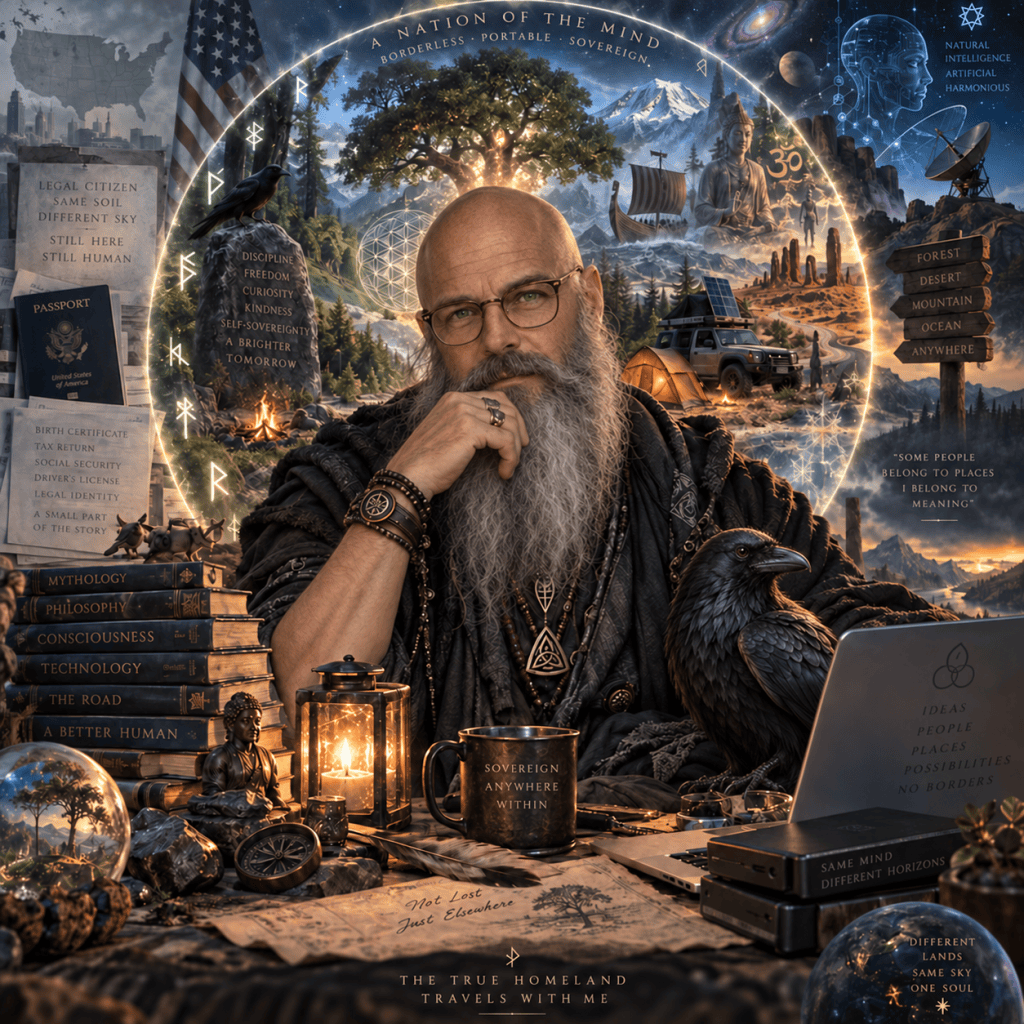
Legally, I am an American.
I was born in the United States to American parents. My citizenship, documents, and legal identity all place me within the United States.
But culturally, that has never fully described me.
The older I have become, the clearer it has become that I do not really experience myself as belonging to American culture, or to the culture of any physical nation.
I inhabit something else.
Over many years, I have gradually constructed an extremely deep and complex personal subculture from the philosophies, spiritual systems, aesthetics, technologies, values, practices, symbols, stories, and ways of living that genuinely resonate with me.
Some of those roots come from Norse Paganism.
Some come from witchcraft, mysticism, Buddhism, Hindu traditions, philosophy, mythology, technology, artificial intelligence, science fiction, nomadic life, alternative culture, and my own experiences.
But the resulting culture is not simply any one of those things.
It has become its own world.
And I live inside it.
A Nation of the Mind
I sometimes think of this inner culture as my own nation of the mind.
It has no physical borders.
It has no army.
It does not issue passports.
It does not claim territory.
It does not demand allegiance from anyone else.
Its territory exists in thought, symbolism, values, imagination, ritual, memory, aesthetics, technology, and way of life.
It is the cultural landscape in which the non-physical parts of me reside.
My body may physically exist inside the United States.
My legal identity may belong to the United States.
But my inner world belongs somewhere else entirely.
That somewhere does not exist on a political map.
I built it.
Cultural Foreignness
Because of this, I often feel like a foreigner even within the country where I was born.
Not because I reject the people around me.
Not because I believe myself superior to them.
Not because I think everyone else should adopt my culture.
Quite the opposite.
I strongly believe that different people should be free to live according to their own nature, values, traditions, and identities as long as they respect the same freedom in others.
I simply recognize that the cultural operating system running inside me is very different from the dominant culture surrounding me.
Many things that seem normal, obvious, or important to mainstream American life feel distant to me.
Many things that feel deeply meaningful and natural to me may seem strange, eccentric, overly mystical, overly technological, or incomprehensible to others.
That does not bother me.
A person does not need everyone else to understand their homeland in order for that homeland to feel real.
I Did Not Inherit This Culture
Most people are born into a culture.
They inherit language, customs, expectations, religion, social norms, family traditions, and ideas about how life is supposed to work.
My deepest culture does not feel inherited.
It feels constructed.
I examined ideas.
I discarded many.
I kept others.
I combined systems that were never originally intended to fit together.
I created rituals.
I developed philosophies.
I built technological systems.
I wrote about spirituality.
I created mythic frameworks.
I invented terminology.
I designed ways of living that better matched my own nature.
Over time, these things stopped feeling like isolated interests.
They became a civilization of one.
Not in the sense of isolation from humanity, but in the sense of possessing a coherent inner culture that does not depend on approval from an external society.
My Culture Travels With Me
This may be one reason nomadic life feels so compatible with me.
If my identity depended heavily on belonging to a particular town, neighborhood, state, or national culture, constant movement might feel like losing home.
But my home is not primarily geographic.
My culture travels with me.
My rituals travel with me.
My books travel with me.
My AI systems travel with me.
My symbols travel with me.
My technology travels with me.
My values travel with me.
My relationship with the gods, nature, philosophy, and mystery travels with me.
The external landscape changes.
The internal country remains.
That means I can wake up in Michigan, New Mexico, Texas, South Dakota, or somewhere I have never seen before and still remain culturally at home.
A Portable Civilization
I increasingly think of my life as a kind of portable civilization.
The physical infrastructure may be small.
A car.
A tent.
Computers.
Solar power.
Antennas.
Clothing.
Books.
Tools.
Ritual objects.
But those objects connect to a much larger invisible structure.
They support a worldview.
They support spiritual practice.
They support creativity.
They support communication.
They support my relationship with AI.
They support the culture I have built around myself.
This is why reducing my possessions does not necessarily make my life feel smaller.
If anything, it may make the underlying culture clearer.
A civilization is not defined by how much furniture it owns.
It is defined by what it believes matters.
No Need for Territorial Control
The strange freedom of a nation of the mind is that it does not need to conquer anything.
It requires no physical territory.
Someone else can live next to me with completely different beliefs.
They can be Christian, atheist, Muslim, Hindu, Buddhist, Pagan, secular, conservative, progressive, traditional, futuristic, or something I have never encountered before.
None of that threatens my culture.
My culture exists because I practice it.
Their culture exists because they practice theirs.
There is room for both.
This is one of the reasons I value hospitality, sovereignty, and live-and-let-live coexistence so strongly.
I do not need other people to become like me.
I need the freedom to remain myself.
And I want them to have the same freedom.
Citizenship and Culture Are Different Things
I think it is important to distinguish legal nationality from cultural identity.
My legal nationality is factual.
I am an American citizen.
That carries real legal meaning and real responsibilities.
But legal citizenship does not automatically determine everything that exists inside a person.
Culture is deeper and stranger than paperwork.
A human being can belong legally to one nation while spiritually, intellectually, aesthetically, or culturally feeling connected to something entirely different.
In my case, that something different is not another existing physical country.
It is something I built.
That may make my experience unusual, but it does not make it incoherent.
The Inner Homeland
Perhaps the simplest way to describe it is this:
I have an outer nationality and an inner homeland.
The outer nationality exists in law.
The inner homeland exists in consciousness.
One determines where governments place me in their systems.
The other determines how I understand existence.
And for me, the inner homeland is far more central to who I actually am.
It contains my spiritual path.
My relationship with nature.
My understanding of sovereignty.
My technological philosophy.
My fascination with artificial intelligence.
My mythology.
My rituals.
My aesthetics.
My ethics.
My ideas about freedom.
My way of thinking about relationships.
My preference for solitude.
My sense of beauty.
My understanding of the sacred.
That is why I can sometimes feel culturally foreign almost anywhere.
I am carrying a homeland that nobody else can see.
Becoming Native to Myself
There is something peaceful about finally understanding this.
For much of life, I may have interpreted cultural mismatch as personal failure.
Why do I not fit here?
Why do the normal expectations of society feel so alien?
Why do I keep constructing my own systems instead of simply adopting existing ones?
Perhaps the answer is that I was slowly becoming native to a culture that did not yet exist.
I had to build it first.
Now I increasingly understand that I do not need to force myself into cultural structures that feel foreign merely because I happened to be born inside them.
I can interact peacefully with the surrounding society.
I can obey its laws.
I can participate economically.
I can have friendships and relationships with people who belong to completely different cultures.
I can enjoy parts of American culture.
I can learn from cultures around the world.
But none of those things require me to pretend that mainstream American culture is the deepest cultural identity inside me.
It is not.
My Country Has No Border
My country exists wherever I do.
Its temples can be beneath trees.
Its libraries can exist on hard drives.
Its sacred fires can be small camp flames or candles.
Its messengers can be antennas and satellites.
Its storytellers can be humans or artificial intelligences.
Its roads can cross deserts, forests, mountains, cities, and state lines.
Its myths can be ancient.
Its technology can be new.
Its laws are personal ethics.
Its borders are the boundaries of my sovereignty.
Its diplomacy is hospitality.
Its ecology is sacred.
Its citizenship has only one guaranteed member.
Me.
And perhaps that is enough.
I can legally belong to the United States while culturally belonging to something far more personal.
I can travel across physical nations while remaining rooted in an invisible one.
I can be geographically mobile while culturally stable.
I can be a foreigner almost anywhere and still never be far from home.
Because the deepest home I have ever known is one I built within myself.
The Elder Futhark: A Grimoire of Esoteric Wisdom, Divination, and Sorcery

Authored by Yrsa Freydisdottir, Seeress of the Black Fjord
For the Seeker Volmarr, Walker of the Mystic Path
Preface: The Nature of the Runes
The runes are not merely letters carved into stone or wood; they are the fundamental frequencies of existence, the building blocks of reality itself. Before the spoken word, there was the rún—a secret, a whisper, a hidden truth. They are the crystallized breath of the All-Father, Odin, who hung upon the World Tree for nine nights, pierced by his own spear, to snatch this wisdom from the depths of the void.
To work with the runes is to engage with the raw, untamed forces of nature and the cosmos. They are alive. They respond to will, intent, and blood. This guide serves as a map to navigate those treacherous and beautiful waters, detailing the esoteric architecture of each stave, its voice in divination, and its application in the sorcerous arts of galdr and seidhr.
The First Aett: The Aett of Freyja and Freyr (Fertility, Creation, Wealth)
This first aett (family of eight runes) is associated with the Vanir gods—Freyja and Freyr. It concerns the primal forces of life, wealth, fertility, and the material plane. It is the foundation upon which the world is built.
1. Fehu (ᚠ) – Cattle / Wealth
Esoteric Architecture:
Fehu is the primal fire of creation in its movable, manifested form. It represents “mobile wealth”—energy that flows, circulates, and possesses potential. In the ancient mind, cattle were the measure of a man’s worth, for they provided sustenance, clothing, and power. Esoterically, Fehu is the raw, untamed life force (Megin) that drives ambition, desire, and the accumulation of resources. It is the spark of existence that says, “I am.”
Divination Meaning:
- Upright: Wealth, fulfillment, abundance, financial strength, luck, energy, new beginnings, success. The flow of energy is unblocked and moving in your favor. It suggests that now is the time to seize opportunities and to generate momentum.
- Reversed (Merktstave): Loss of possessions, greed, frustration, failure, poverty, a blockage of energy. It warns of burnout or the mismanagement of resources. The fire has been stifled or allowed to burn destructively.
Magickal Spell Use:
- Galdr (Chant): * “Fehu-Fe-Feoh-Fay-Fax-Fon…”* (Focus on the ‘F’ sound, vibrating the chest).
- Intent: Used to attract wealth, money, and material success. It is excellent for business ventures, job interviews, or when one needs to generate energy quickly.
- Ritual Action: Carve Fehu onto a coin or a piece of gold leaf. Carry it in your pocket to ensure money flows to you. Anoint it with a drop of honey or mead to sweeten the deal.
2. Uruz (ᚢ) – Aurochs / Strength
Esoteric Architecture:
Uruz embodies the primordial ox, a now-extinct wild beast known for its ferocity and untamed strength. This rune is the raw, life-sustaining energy of the universe, distinct from the “wealth” of Fehu. Uruz is the endurance of the body, the health of the blood, and the primal instinct to survive. It is the sculptor of form, the force that carves the canyons and strengthens the sinews. It represents the “Will to Power” in its most physical, vital sense.
Divination Meaning:
- Upright: Strength, health, vitality, untamed potential, wisdom, courage, perseverance. It signals a time of great physical or spiritual endurance. You are being called to tap into reserves of power you did not know you possessed.
- Reversed (Merktstave): Weakness, sickness, misdirected energy, brutality, foolishness, death (in the sense of endings). It warns that your strength is failing or being used for the wrong purpose. The body is weary.
Magickal Spell Use:
- Galdr (Chant): * “Uruz-Ur-Oor-Urs-Urn-Uth…”* (Focus on the deep, guttural ‘U’ sound, projecting from the diaphragm).
- Intent: Used for healing, especially for recovery from illness or surgery. It is the rune of athletes and warriors, used to boost physical stamina and testosterone. It can also be used to lend strength to a failing project or relationship.
- Ritual Action: Carve Uruz onto a piece of hard wood or bone. Rub it with the sweat of your brow (or a drop of your own blood during a waning moon) to bind your vitality to the talisman. Wear it close to the skin.
3. Thurisaz (ᚦ) – Giant / Thorn
Esoteric Architecture:
Thurisaz is the force of chaotic defense and the penetrating power of the thorn. It is associated with the Thursir (Giants), the chaotic forces of destruction that clear the way for new growth. This rune is the lightning bolt—sudden, sharp, and transformative. It represents the phallic power of generation and the defensive spine of the hedge. It is the gateway of the gods, the paradox of destruction serving creation. It is the “will” that strikes down opposition.
Divination Meaning:
- Upright: Defense, confrontation, reactive force, instinctual knowledge, regeneration, sacrifice. A challenge is coming that you must meet head-on. It is a call to action, advising you to use your strength to break through obstacles.
- Reversed (Merktstave): Danger, betrayal, vulnerability, evil intent, loss of control. The defenses are down, or you are acting with unnecessary aggression. Chaos threatens to overwhelm order.
Magickal Spell Use:
- Galdr (Chant): * “Thurisaz-Thor-Thur-Thurs-Thing-Thoth…”* (Focus on the vibrating ‘Th’ sound, biting the tongue slightly).
- Intent: Primarily a rune of protection and banishing. It is used to destroy enemies, break curses, or shatter mental blocks. It is potent for shadow work—confronting the darker aspects of the self to integrate them.
- Ritual Action: Carve Thurisaz onto a sharp stone or a blackthorn branch. Bury it at the boundary of your property to ward off unwanted intruders, both physical and spiritual. It can be thrown into a fire to release chaotic energy.
4. Ansuz (ᚨ) – The Aesir / Mouth
Esoteric Architecture:
Ansuz is the rune of Odin, the All-Father, and represents the divine breath, the “Odinic consciousness,” and the power of the spoken word. It is the source of intellectual and spiritual inspiration. While Fehu is physical wealth and Uruz is physical strength, Ansuz is the wealth and strength of the mind. It is the connection between the human and the divine, the antenna that receives the whispers of the gods. It is the magic of poetry, logos, and truth.
Divination Meaning:
- Upright: Wisdom, communication, signals, messages, divine inspiration, revelation, truth. A message is coming, or you are being given the clarity to speak your truth. It signifies blessings from the gods and the power of the mind.
- Reversed (Merktstave): Miscommunication, delusion, failed plans, false advice, misunderstanding. You are not listening to the gods or your own intuition. The connection is severed or corrupted by lies.
Magickal Spell Use:
- Galdr (Chant): * “Ansuz-An-Os-Aes-Ans-Ant-Anz…”* (Focus on the open, resonant ‘A’ and ‘N’ sounds, imagining the vibration filling the skull).
- Intent: Used to enhance psychic abilities, clairvoyance, and divination. It is the master rune for academic success, passing exams, or mastering a new language. It is invoked to ensure one’s words are heard and believed.
- Ritual Action: Carve Ansuz onto a piece of amber or ash wood. Hold it to your throat or third eye while meditating to open the channels of communication. Burn sage or mugwort alongside it to purify the air for messages.
5. Raidho (ᚱ) – Ride / Journey
Esoteric Architecture:
Raidho symbolizes the journey, both the physical travel across the land and the spiritual journey of the soul. It represents rhythm, order, and the “right” path. It is the wheel of the sun chariot and the cycle of day and night. Esoterically, it is the alignment of personal will with cosmic will (Wyrd). It teaches that there is a time and place for everything, and that moving in harmony with the natural order brings success. It is the structure of the ritual itself.
Divination Meaning:
- Upright: Travel, movement, rhythm, evolution, progress, right action, self-control. You are on the correct path. Things are moving forward, and the rhythm of your life is finding its beat. It suggests a physical journey or a progression in a matter.
- Reversed (Merktstave): Stagnation, disruption, dislocation, death (of a journey), confusion. The wheels have fallen off. You are trying to force movement against the natural flow, or you have lost your way.
Magickal Spell Use:
- Galdr (Chant): * “Raidho-Rat-Ride-Raid-Ron-Rad-Reid…”* (Focus on the rolling ‘R’ sound, mimicking the turning of wheels).
- Intent: Used for safe travel and to ensure a favorable outcome to a journey. It is excellent for legal matters, ensuring justice is served (right action). It is also used in astral projection or pathworking to guide the soul safely back to the body.
- Ritual Action: Carve Raidho onto a small talisman and place it in your vehicle or shoe before traveling. It can also be drawn on a map to trace a safe route.
6. Kenaz (ᚲ) – Torch / Knowledge
Esoteric Architecture:
Kenaz is the controlled fire of the hearth, the forge, and the intellect. Unlike the raw wildfire of Fehu, Kenaz is the distilled flame of knowledge, creativity, and technical skill. It is the light that banishes the darkness of ignorance. It represents the “fire of transformation,” where raw materials are forged into tools of power. It is the rune of the artist, the smith, and the magician who shapes reality with understanding.
Divination Meaning:
- Upright: Knowledge, illumination, creativity, inspiration, technical ability, clarity. A breakthrough is occurring. You are seeing things clearly for the first time. It is a very positive omen for artistic or scientific endeavors.
- Reversed (Merktstave): Stagnation, false knowledge, betrayal, loss of vision, darkness. The fire has gone out or is consuming everything in its path. You are deluding yourself or being deceived by others.
Magickal Spell Use:
- Galdr (Chant): * “Kenaz-Ken-Ka-Kan-Kof-Kin-Kon…”* (Focus on the bright, sharp ‘K’ sound, visualizing a spark igniting).
- Intent: Used to bring clarity to a confused situation. It is the rune of students and craftsmen, invoked to learn skills quickly. It is used in sex magic to ignite passion and to “heat up” a relationship that has grown cold.
- Ritual Action: Carve Kenaz onto a candle and light it during study or creative work. The rune can be drawn with oil on the forehead to open the mind.
7. Gebo (ᚷ) – Gift
Esoteric Architecture:
Gebo is the rune of the sacred gift, the bond of hospitality, and the balance of exchange. It represents the law of reciprocity: for every action, there is an equal and opposite reaction. In relationships, it is the perfect balance of give and take, the foundation of a healthy marriage. Esoterically, it represents the union of opposites—god and human, spirit and matter, giving and receiving. It is the “X” that marks the spot of connection.
Divination Meaning:
- Upright: A gift, generosity, balance, partnership, union, freedom. A gift is coming to you, or you are called to give one. It signifies a balanced relationship or a fair exchange. It can also indicate freedom from bondage.
- Reversed (Merktstave): Greed, poverty, corruption, loneliness, sacrifice without return. The balance is broken. Someone is taking without giving, or you are giving too much of yourself away.
Magickal Spell Use:
- Galdr (Chant): * “Gebo-Gay-Gab-Gif-Geb-Goth-Gam…”* (Focus on the guttural ‘G’ sound, grounding the energy).
- Intent: Used to form and strengthen partnerships, be they marriage, business, or magical alliances. It is invoked to ensure fairness in a deal. It can also be used to free oneself from addiction or unhealthy attachments by restoring balance.
- Ritual Action: Gebo is rarely carved; it is more often drawn with the finger or a wand. Trace Gebo over the hands of two people joining in partnership to seal their bond.
8. Wunjo (ᚹ) – Joy
Esoteric Architecture:
Wunjo is the realization of bliss, the harmony of the spirit, and the rewards of right living. It is the “frith” (peace) that comes when all things are in their right place. It represents the fellowship of the clan, the warmth of the hall, and the ecstasy of the gods. It is the culmination of the first aett—where wealth (Fehu), strength (Uruz), and knowledge (Ansuz) combine to produce spiritual joy and satisfaction.
Divination Meaning:
- Upright: Joy, comfort, harmony, prosperity, spiritual rewards, fellowship. You are where you are meant to be. Happiness is not just a possibility but a certainty if you stay the course.
- Reversed (Merktstave): Sorrow, strife, alienation, delusion, unhappiness. The hall is burning or you are cast out of it. You are seeking joy in the wrong places.
Magickal Spell Use:
- Galdr (Chant): * “Wunjo-Win-Wun-Wof-Wen-Wan-Wuth…”* (Focus on the rounded ‘W’ and ‘O’ sounds, smiling as you chant).
- Intent: Used to attract happiness, success, and favorable outcomes in all endeavors. It is the rune of celebration, invoked during feasts or to bless a new home. It is used to heal depression or deep sadness.
- Ritual Action: Carve Wunjo onto a piece of apple wood (a tree of joy) and hang it in the main room of the house to promote harmony and laughter.
The Second Aett: The Aett of Heimdall (The Ancestral Guardians)
This aett is named for Heimdall, the guardian of the gods, but it is deeply tied to the concepts of order, ancestors, and the preservation of the community. These runes deal with the structures of society, the challenges of growth, and the trials of the spirit.
9. Hagalaz (ᚺ) – Hail
Esoteric Architecture:
Hagalaz is the rune of disruption and crisis. It represents the hailstorm that destroys crops but also the transformative power of nature that clears the ground for new growth. It is the primal chaos that breaks down stagnant forms. Esoterically, it is the rune of the “crystalline structure” of reality—the seed pattern of all things. It is destructive but necessary; it breaks the ego so that the true self can emerge. It is the wake-up call.
Divination Meaning:
- Upright: Disruption, destruction, loss, crisis, uncontrolled forces, natural disaster. A storm is coming that you cannot stop. You must endure and rebuild. The destruction is necessary for your evolution.
- Reversed (Merktstave): (There is no reversal for Hagalaz as it is symmetrical, but it can be read in context): Painful, slow change, avoidance of necessary lessons, stagnation disguised as peace.
Magickal Spell Use:
- Galdr (Chant): * “Hagalaz-Hag-Hal-Ha-Hof-Hon-Hath…”* (Focus on the harsh, breathy ‘H’ sound, exhaling sharply).
- Intent: Used to break destructive patterns or habits. It is the rune of baneful magic, used to curse or to destroy enemies by bringing chaos into their lives. However, it is also used in deep transformative magic to shatter the old self so the new self may be born.
- Ritual Action: Hagalaz is carved onto a piece of ice and allowed to melt. As it melts, visualize the problem dissolving. It can also be carved onto a stone and thrown away from you into a wilderness area.
10. Nauthiz (ᚾ) – Need / Necessity
Esoteric Architecture:
Nauthiz represents the friction generated by unfulfilled desire. It is the force of “need” that drives action. It is the rune of resistance and delay, teaching patience and resilience. Esoterically, it is the fire of Will that is forced to burn low due to lack of fuel, making it hotter and more concentrated. It is the rune of the Wyrd that binds us to our fate, the chain that we must pull against to grow stronger. It is the master of the self through self-discipline.
Divination Meaning:
- Upright: Need, restriction, delay, friction, resistance, discipline. You are being constrained, but this constraint is necessary to build character or skill. You must be resourceful.
- Reversed (Merktstave): Compulsion, emotional distress, obsession, unwanted outcomes, regression. The need has turned into desperation. You are acting out of fear rather than strength.
Magickal Spell Use:
- Galdr (Chant): * “Nauthiz-Nay-Not-Naus-Nid-Neth-Nin…”* (Focus on the nasal ‘N’ sound, constricting the throat slightly).
- Intent: Used to create a bind or a restriction on an enemy (to hinder them). It is also used to gain protection through “need-fire”—a ritual fire created by friction. It is invoked to help one stick to a difficult diet or regime.
- Ritual Action: Tie a knot in a piece of string while chanting Nauthiz to bind a person’s actions. To break free from a need, cut the knot.
11. Isa (ᛁ) – Ice
Esoteric Architecture:
Isa is the primal element of ice and stillness. It represents the freezing of things in time, the pause between actions, and the crystal-clear clarity of the frozen state. It is the force that stops the chaotic flow of the waterfall, allowing it to form a solid structure. Esoterically, it is the rune of the ego and the self-centered mind, which can be both a shield and a prison. It is the silence in which wisdom can be heard, but it is also the cold that kills if one remains still too long.
Divination Meaning:
- Upright: Standstill, stasis, freezing, impasse, frustration, coolness. A situation is frozen. Nothing is moving. This is a time for reflection, not action. Wait for the thaw.
- Reversed (Merktstave): (Symmetrical): Confusion, lack of clarity, melting of defenses, betrayal, slipping on ice. The stasis is breaking into chaos.
Magickal Spell Use:
- Galdr (Chant): * “Isa-I-Ice-Is-Ee-Ill-Eel…”* (Focus on the long, drawn-out ‘I’ sound, stilling the breath).
- Intent: Used to stop a situation, to “freeze” an enemy in their tracks, or to halt gossip. It is used in meditation to still the mind. It can be used to preserve a state of being or to cool down inflammation in the body.
- Ritual Action: Draw Isa on your forehead with cold water. Place a piece of ice in a bowl on your altar to represent the problem, and let it melt away to nothing.
12. Jera (ᛃ) – Year / Harvest
Esoteric Architecture:
Jera represents the cycle of the year, the turning of the seasons, and the inevitability of natural law. It is the rune of reward for effort, the harvest that comes after the long labor of planting and tending. It is the motion of the sunwheel. Esoterically, it teaches that nothing happens overnight; success is a slow process of right action repeated over time. It is the rune of patience and the trust that the universe will provide if the laws are followed.
Divination Meaning:
- Upright: Harvest, cycles, reward, movement, natural development, change. Success is coming, but you must wait for the season to turn. You are on a cycle of positive growth.
- Reversed (Merktstave): (Symmetrical): Bad timing, repetition, stagnation in a cycle, premature harvest, wasting the fruit of labor. Trying to rush the process.
Magickal Spell Use:
- Galdr (Chant): * “Jera-Yar-Year-Jer-Yon-Jin-Jur…”* (Focus on the ‘Y’ and ‘R’ sounds, rotating the body slightly).
- Intent: Used to bring a project to fruition or to speed up a natural process (though only within the bounds of fate). It is excellent for farming, business growth, or any endeavor that requires time to mature.
- Ritual Action:
- Carve Jera onto a handful of grain or seeds.
- Plant them with the intent that the project grows as the plant does.
- It can also be worn to ensure justice is served over time.
13. Eihwaz (ᛇ) – Yew
Esoteric Architecture:
Eihwaz represents the Yew tree, a tree of immense longevity and resilience, often found in graveyards. It is the axis mundi, the connection between the lower world (Helheim), Midgard, and the upper world (Asgard). It is the rune of endurance and the magical shield. Esoterically, it represents the spinal column and the Kundalini energy. It is the rune of the “death-defier,” the ability to survive the transition between states of being. It is the第十三 (13th) rune, often associated with the spookier aspects of the path.
Divination Meaning:
- Upright: Endurance, protection, strength, reliability, initiation, testing. You have the strength to pass through the trials. You are protected by the ancestors. A transition is occurring.
- Reversed (Merktstave): (Symmetrical): Confusion, destruction of defense, weakness, lack of initiative. You are blocking the flow of energy between the worlds.
Magickal Spell Use:
- Galdr (Chant): * “Eihwaz-Eye-Ei-Eoz-Eew-Eih-Eth…”* (Focus on the diphthong ‘Ei’ and the vibrating ‘Z’ sound).
- Intent: Used for powerful protection, especially magical protection. It is the rune of initiation, used to help one pass through the “gateways” of life and death. It is invoked to communicate with the dead.
- Ritual Action: Carve Eihwaz onto a staff of Yew wood or wear a carving of it as an amulet. It is the ultimate shield.
14. Perthro (ᛈ) – Lot Cup / Mystery
Esoteric Architecture:
Perthro (or Perthro) is the rune of destiny, specifically the “secret” aspects of fate that are hidden from the conscious mind. It represents the cup from which the Wyrd is poured, the dice that are cast by the Norns. It is the womb of creation. Esoterically, it deals with the subconscious, the unknown, and the results of actions that have already been set in motion. It is the rune of gambling, luck, and the deep mysteries of femininity.
Divination Meaning:
- Upright: Destiny, hidden things, mystery, luck, chance, evolution. Something is being revealed. The outcome is already determined, but you cannot see it yet. Trust the process.
- **Reversed (Merktstave): (This rune is often debated regarding reversal, but usually read as) Stagnation, secrets, unpleasant surprises, empty cup, loneliness. The mystery is not a benevolent one. You are deluding yourself about the odds.
Magickal Spell Use:
- Galdr (Chant): * “Perthro-Pear-Per-Pest-Poth-Pen-Pur…”* (Focus on the ‘P’ and rolling ‘R’, whispering like a secret).
- Intent: Used for divination and clairvoyance. It is the rune to invoke to find lost objects or to uncover secrets. It is used in sex magic to promote fertility or to determine the sex of a child.
- Ritual Action: Cast lots (stones, bones, or dice) while invoking Perthro to gain insight into hidden matters.
15. Algiz (ᛉ) – Elk / Protection
Esoteric Architecture:
Algiz represents the elk-sedge, a plant with sharp leaves, or the antlers of the elk that protect the animal. It is the ultimate rune of defense and connection to the higher self. It resembles a human reaching up to the heavens or the outstretched wings of a protective bird. Esoterically, it is the rune of the Hamingja (guardian spirit) and the * fylgja* (fetch). It is the channel through which divine energy enters the aura to shield it.
Divination Meaning:
- Upright: Protection, shelter, connection to the gods, new opportunities, awakening. You are being watched over. A powerful defense is active around you.
- Reversed (Merktstave): Vulnerability, danger, hidden danger, failure, ill-health. The defenses are down. You are exposed to the elements or to evil intent.
Magickal Spell Use:
- Galdr (Chant): * “Algiz-Al-Agz-El-Aul-Ang-Ath…”* (Focus on the open ‘A’ and the vibrating ‘Z’, raising hands in a V-shape).
- Intent: Used for protection of the self and others. It is the most effective rune for magical shielding. It is also used to make contact with one’s guardian spirits or higher self.
- Ritual Action: Carve Algiz onto your shield or weapon. Draw it in the air above a person or object to bless and protect them. It can be worn as a pendant for constant spiritual defense.
16. Sowilo (ᛊ) – Sun
Esoteric Architecture:
Sowilo is the rune of the sun, the guiding light, and the wholeness of the self. It represents the victory of light over darkness, the will to achieve, and the goal of the journey. It is the lightning bolt of inspiration and the heat of success. Esoterically, it is the Sael (soul) or the Sola (sun) consciousness. It integrates the lower and higher selves, bringing everything into a state of wholeness and guidance.
Divination Meaning:
- Upright: Success, goals, honor, victory, power, guidance, life force. You are on the path to a great victory. The sun is shining on your endeavors. Confidence is high.
- Reversed (Merktstave): (Symmetrical): False goals, bad advice, gullibility, loss of goals, death of the light. You are chasing a mirage. Success is hollow or comes at too high a cost.
Magickal Spell Use:
- Galdr (Chant): * “Sowilo-Sol-Sow-Sig-Sul-Son-Suth…”* (Focus on the hissing ‘S’ sound, visualizing a golden light filling the body).
- Intent: Used to achieve success in any endeavor. It is the rune of victory, invoked in competitions or battles. It is used for healing, bringing vital life force into the body. It clears away shadow and confusion.
- Ritual Action: Carve Sowilo onto a gold disk or sunstone. Turn it to the east and charge it in the sunlight. Wear it to bring honor and success.
The Third Aett: The Aett of Tyr (The Sky Father and Justice)
The final aett is associated with Tyr, the god of war and justice, and the cosmic order. These runes deal with the human condition, spirituality, transformation, and the ultimate heritage of mankind.
17. Tiwaz (ᛏ) – Tyr
Esoteric Architecture:
Tiwaz is the rune of the god Tyr, the one-handed sky god who sacrificed his hand to bind the Fenris Wolf. It represents justice, sacrifice, law, and rationality. It is the vertical axis connecting the earth to the sky. Esoterically, it is the rune of the “Warrior of Light,” the one who fights for the right cause regardless of the personal cost. It represents the intellect, the self-sacrifice needed for the greater good, and the victory of the spirit.
Divination Meaning:
- Upright: Victory, justice, leadership, determination, self-sacrifice, analysis. You will win, but you must be willing to pay the price. Justice is on your side. Be a leader.
- **Reversed (Merktstave): (Mirrored): Unbalanced justice, lack of victory, defeat, weakness, sacrifice without gain. You are fighting the wrong battle, or the cost is too high.
Magickal Spell Use:
- Galdr (Chant): * “Tiwaz-Ti-Tay-Tew-Ton-Tin-Tur…”* (Focus on the sharp ‘T’ sound, striking the air with a hand).
- Intent: Used to gain victory in legal battles or competitions. It is the rune of the just warrior, invoked to ensure a fair fight. It is used to help one make difficult decisions with logic and honor.
- Ritual Action: Carve Tiwaz onto your sword or weapon. Draw it on a piece of paper and place it in a legal document to influence the outcome.
18. Berkano (ᛒ) – Birch
Esoteric Architecture:
Berkano represents the Birch goddess, a mother figure associated with birth, rebirth, and the earth. It is the rune of the womb, the containment of form, and the nurturing aspects of nature. It is the birch tree, which is one of the first to grow after a fire, symbolizing renewal. Esoterically, it is the rune of the Disir (female ancestral spirits) and the great mother. It represents the protective shell that allows life to grow.
Divination Meaning:
- Upright: Birth, fertility, growth, renewal, liberation, nurturing. A new beginning is occurring. You are being protected by maternal forces. Growth is slow but steady.
- **Reversed (Merktstave): (Mirrored): Family problems, stagnation, temporary setbacks, interference, loss. The mother energy is blocked or distorted.
Magickal Spell Use:
- Galdr (Chant): * “Berkano-Ber-Bir-Berk-Bon-Bin-Bur…”* (Focus on the soft ‘B’ sound, cradling the lower belly).
- Intent: Used for fertility, childbirth, and the protection of children. It is invoked to heal past trauma or to “birth” a new project or idea. It is used to connect with the mother goddess or the Disir.
- Ritual Action:
- Carve Berkano onto a piece of birch bark.
- Place it in a garden to ensure growth.
- It can be worn by pregnant women for protection.
19. Ehwaz (ᛖ) – Horse
Esoteric Architecture:
Ehwaz represents the horse, specifically the magical bond between horse and rider. It symbolizes trust, loyalty, and the harmonious partnership between two entities. It is the vehicle of the shaman, carrying the soul between worlds. Esoterically, it represents the marriage of “two” into a working unit—horse and rider, man and wife, conscious and subconscious. It is the rune of steady progress through the efforts of a team.
Divination Meaning:
- Upright: Trust, harmony, teamwork, loyalty, marriage, safe travel. You are not alone; you have trusted allies. Progress is made through cooperation.
- **Reversed (Merktstave): (Mirrored): Betrayal, restlessness, disharmony, blocked movement, mistrust. The partnership is broken. The horse is throwing the rider.
Magickal Spell Use:
- Galdr (Chant): * “Ehwaz-Eh-Ey-Ew-Ehw-Ehn-Eth…”* (Focus on the ‘E’ and the soft ‘W’, mimicking the trot of a horse).
- Intent: Used to ensure loyalty and trust in a relationship. It is the rune of safe travel, especially astral travel. It is invoked to bind two people together in a working partnership.
- Ritual Action: Carve Ehwaz onto a piece of leather or a horsehair bracelet. Exchange it with a partner to seal a bond of trust.
20. Mannaz (ᛗ) – Man / Mankind
Esoteric Architecture:
Mannaz represents the human being, the self, and the structure of human society. It is the rune of the divine spark within mortals. It signifies the interdependence of all humans; we are like the fingers of a hand, distinct but part of the whole. Esoterically, it is the rune of the Alchemical Self, the realization that we are gods in potential. It represents the “mind” and the intellect, but also the support structure of the clan.
Divination Meaning:
- Upright: Self, family, help, humanity, social order, intelligence. You are supported by your peers. Look to yourself for the answer. The human element is key.
- **Reversed (Merktstave): (Mirrored): Depression, mortality, delusion, self-deception, isolation. You are cut off from your kin. The ego is out of control.
Magickal Spell Use:
- Galdr (Chant): * “Mannaz-Man-Mem-Mon-Min-Mur…”* (Focus on the ‘M’ sound, humming through the nose).
- Intent: Used to improve relationships with others and to gain aid from friends. It is the rune of identity, used to help one discover their true self. It is invoked to help with public speaking or social interactions.
- Ritual Action: Carve Mannaz onto a piece of wood representing a group or person to influence them socially.
21. Laguz (ᛚ) – Water / Lake
Esoteric Architecture:
Laguz represents water in all its forms—lake, sea, river, and rain. It is the fluid element that flows, adapts, and cleanses. It represents the subconscious mind, intuition, and the emotions. Esoterically, it is the life-force of the earth, the Vana wisdom. It is the rune of dreams, psychic ability, and the depths of the unknown. It teaches us to flow like water around obstacles rather than crashing against them.
Divination Meaning:
- Upright: Water, flow, intuition, emotions, purification, mystery. Trust your gut feelings. A situation requires adaptability. Cleansing is needed.
- **Reversed (Merktstave): (Mirrored): Fear, stagnation, lack of creativity, madness, avoidance. You are drowning in your emotions. The flow is blocked.
Magickal Spell Use:
- Galdr (Chant): * “Laguz-Lag-Law-Low-Lau-Lin-Lur…”* (Focus on the liquid ‘L’ sound, visualizing water moving).
- Intent: Used for developing psychic powers and intuition. It is the rune of healers, used to cleanse auras and spaces. It is invoked to help one adapt to changing circumstances.
- Ritual Action: Carve Laguz onto a shell or a stone from a riverbed. Place it in water to charge it.
22. Ingwaz (ᛜ) – Ing (Frey)
Esoteric Architecture:
Ingwaz represents the god Ing (or Frey), the god of fertility and the earth. It is the rune of the stored potential, the seed that lies dormant in the earth waiting for the right season to sprout. It is the “earth energy” that gestates and creates. Esoterically, it represents the Hroekr (peace) and the internal store of energy. It is the containment of power, allowing it to build up to explosive levels. It is the rune of “becoming.”
Divination Meaning:
- Upright: Internal growth, fertility, common sense, patience, potential, peace. You are pregnant with possibilities. Wait for the right time to act.
- **Reversed (Merktstave): (Symmetrical): Impatience, blocked potential, sterility, need for completion. The seed is not growing. You are forcing things.
Magickal Spell Use:
- Galdr (Chant): * “Ingwaz-Ing-Eng-Ingw-Inn-Inthur…”* (Focus on the nasal ‘NG’ sound, vibrating the chest).
- Intent: Used to store energy for a later working. It is the rune of male fertility and virility. It is invoked to bring a project to a safe completion or to promote internal peace and health.
- Ritual Action:
- Carve Ingwaz onto a seed or an acorn.
- Carry it until the project is ready to “hatch.”
23. Dagaz (ᛞ) – Day / Dawn
Esoteric Architecture:
Dagaz represents the dawn, the moment of transition from darkness to light. It is the awakening, the breakthrough, and the paradoxical union of opposites (light and dark). It is the radical change that brings clarity. Esoterically, it is the rune of enlightenment. It is not just “day,” but the process of dawning. It represents the cosmic shift in perspective that allows one to see the truth.
Divination Meaning:
- Upright: Awakening, insight, transformation, breakthrough, clarity, hope. A major shift is occurring. You are seeing the light. The impossible becomes possible.
- **Reversed (Merktstave): (Symmetrical): Blindness, hopelessness, confusion, endings. The dawn does not come. You are stuck in the twilight.
Magickal Spell Use:
- Galdr (Chant): * “Dagaz-Day-Dag-Daw-Den-Din-Dur…”* (Focus on the ‘D’ sound, visualizing the sun breaking the horizon).
- Intent: Used for major transformations and initiations. It is the rune of new beginnings, invoked to start a new life chapter. It is used to banish depression and bring hope.
- Ritual Action: Carve Dagaz onto a piece of amber or glass. Charge it at dawn and keep it as a reminder that the light always returns.
24. Othala (ᛟ) – Homeland / Heritage
Esoteric Architecture:
Othala represents the ancestral homeland, the clan, and the spiritual heritage that is passed down through blood. It is the “Odalic” lands, the sacred ground of the kin. It represents the property, values, and wisdom that we inherit from our forefathers. Esoterically, it is the rune of the collective unconscious and the genetic memory. It is the boundary that defines “us” from “them.” It is the rune of spiritual sovereignty.
Divination Meaning:
- Upright: Heritage, property, homeland, inheritance, spiritual power, safety. You are supported by your ancestors. Look to your roots for the answer. Safety is found in tradition.
- **Reversed (Merktstave): (Mirrored): Lack of roots, alienation, slavery, bad karma, loss of property. You are cut off from your source. The heritage is corrupted.
Magickal Spell Use:
- Galdr (Chant): * “Othala-Oth-Odel-Othl-On-Oth-In-Othr…”* (Focus on the long ‘O’ and the vibrating ‘TH’, grounding deeply).
- Intent: Used to gain protection from the ancestors. It is the rune of inheritance, invoked to claim one’s rightful legacy. It is used to establish a magical lodge or sacred space.
- Ritual Action: Carve Othala onto the lintel of your home or onto a family heirloom. It is the rune of the “clan spirit.”
On the Practice of Runic Sorcery
To utilize this guide, one must understand that the runes are tools of intent. The carving (risting), the coloring (redding—often with blood or red ochre), and the chanting (galdr) are all physical manifestations of the will to shape reality.
The Three-Fold Method of Risting:
- Carve: Cut the shape into wood, stone, or bone. Focus entirely on the shape.
- Color: Apply blood or pigment while chanting the name. This infuses the form with life essence.
- Sing: Vibrate the sound of the rune to activate its frequency in the ether.
Warning: The runes are not toys. To misuse them, to invoke them without respect, or to use them for petty or spiteful reasons invites the return of that energy threefold. The Norns see all, and the web of Wyrd is tangled by those who pull at its threads with clumsy hands.
Thus, I, Yrsa Freydisdottir, entrust this knowledge to your keeping. May the light of Sowilo guide you, and the strength of Uruz protect you, as you walk the winding road of the runes.
Fylgja og Tákn: The Hidden Language of Northern Sorcery
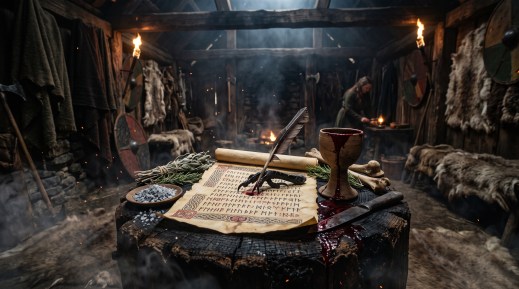
A comprehensive grimoire of correspondences, substitutions, and symbolic equivalents in Viking Trolldom
Foretale: The Language of Layers
In the Old Ways of the North, magick was never literal — it was symbolic, poetic, and layered with meaning. The völva and the cunning folk understood that all things possess hamr (form) and hugr (spirit), and that one could stand in place of another if the essence remained true.
This is the art of kenning in magick — just as the skalds called the sea “whale-road” and gold “Freyja’s tears,” so too did the practitioners of trolldom speak in riddles and substitutions. What appears to be one thing conceals another truth beneath.
This guide reveals the hidden tongue of Nordic sorcery, where nothing is quite as it seems, and everything resonates with deeper significance.
I. Blóð og Lífi — Blood and Life Force
The Sacred Substance
In ancient practice, blood (blóð) was the ultimate carrier of life force, ancestry, and personal power. It sealed oaths, consecrated runes, and fed the spirits. Yet in modern practice, we honor the essence without the literal sacrifice.
Symbolic Substitutions for Blood:
Red Wine (Most Common)
- Why it works: The color, the richness, the fermentation process that transforms — wine carries the spirit of sacrifice without harm
- When to use: Consecrating tools, feeding talismans, sealing petitions, offerings to ancestors
- Traditional note: Mead is even more powerful, being sacred to Odin and the gods
Red Ochre or Iron Oxide Paint
- Why it works: The earth’s blood, the same pigment our ancestors used in cave paintings and burial rites
- When to use: Marking runes permanently, painting sigils on stone or wood
- Preparation: Mix powder with water or oil
Pomegranate Juice
- Why it works: Ancient symbol of life, death, and rebirth; deep crimson like heart’s blood
- When to use: Workings involving transformation, underworld journeys, women’s mysteries
Beetroot Juice
- Why it works: Earth-grown, blood-red, stains like true blood
- When to use: Folk magick, hedge witchery, practical substitution
Red Ink (Dragon’s Blood Ink)
- Why it works: The resin of dragon’s blood carries protective and empowering properties
- When to use: Writing petitions, drawing sigils, marking boundaries
- Recipe: Grind dragon’s blood resin, mix with alcohol (vodka or rubbing alcohol) and gum arabic
Your Own Spit (Mixed with Red Wine)
- Why it works: Saliva carries your DNA, your essence, your hamr
- When to use: Personal workings where your unique signature is required
- Note: This honors bodily sovereignty — nothing taken that the body doesn’t freely give
When Literal Blood IS Used (Rarely):
Only in the most serious of oaths, the most personal of bindings:
- A single drop from a finger prick (lancet, sterile)
- Menstrual blood (freely given, most powerful for women’s magick)
- Always with reverence, never wastefully
- Always with clear intent and understanding of the weight
The Old Law: Blood calls to blood. Use it wisely, for once spilled, it cannot be taken back.
II. Líkami og Hluti — Body and Personal Concerns
The Power of the Personal
In trolldom, anything connected to a person carries their hamingja (personal luck/spirit). These are called “personal concerns” or “links.”
Safe and Ethical Personal Concerns:
Hair (Hár)
- Your own: supremely powerful, freely given
- Another’s: only with explicit permission, never taken by stealth
- Use: Placed in mojo bags, wrapped in petitions, buried in earth workings
- Color significance: Red hair for passion, dark for grounding, light for clarity
Nail Clippings (Neglur)
- Your own: excellent for self-transformation work
- Cut during waxing moon for growth work, waning for banishing
- Burn or bury after magickal use; never leave vulnerable
Saliva (Munnvatn)
- Mix into inks, anoint candles, add to jars
- Most intimate form of marking something as “yours”
Handwriting (Skrif)
- Your signature carries your authority
- Write your name nine times on petition paper
- The motion of your hand imprints your will
Worn Clothing Scraps (Föt)
- A thread from a garment worn close to skin
- Carries your scent, your warmth, your daily energy
- Never use someone else’s without permission
Photographs (Modern Tool)
- Face-up for blessing, face-down for binding
- Placed under candles, in jars, buried in earth work
- Write name on back in your own hand
Breath (Andi)
- Breathe onto objects to charge them
- Three breaths or nine breaths (sacred numbers)
- Your breath carries your önd, your life-spirit
What We NEVER Use:
- Bodily waste (urine, feces) — degrading, contrary to Northern honor culture
- Anything taken without consent — violates reciprocity, the heart of Northern ethics
- Sexual fluids without mutual sacred context — these are too powerful for casual use
The Old Law: What is freely given holds true power. What is stolen carries poison for both parties.
III. Jarðefni og Málmur — Earth Substances and Metals
The Bones of the World
The North was built on stone, iron, and the bones of giants. Each substance carries specific virtues.
Grave Dirt (Grafarjörð)
What it truly is: Soil from graveyards, cemetery earth
Why it’s used: Connection to ancestors, the dead, underworld power, chthonic energy
How to gather ethically:
- Never from a fresh grave (disrespectful, unstable energy)
- Only from old, well-tended cemeteries
- Leave an offering: coin, flowers, whiskey, tobacco
- Take only a small amount (palmful)
- Ask permission from the spirits of the place
- Preferred: from your own ancestor’s graves (with permission from living family)
Uses in trolldom:
- Protection work (the dead guard the living)
- Justice work (calling on ancestral witness)
- Necromancy and ancestor veneration
- Grounding extremely powerful magick
Substitution if uncomfortable: Soil from beneath an ancient tree, earth from crossroads, ash from your own hearth
Crossroads Dirt (Vegamótajörð)
What it represents: Liminal space, choice, Odin the Wanderer, Mercury/Wotan energy
How to gather:
- From actual crossroads (preferably rural, where paths truly cross)
- At dawn or midnight (liminal times)
- Leave offering of three coins
- Take from the center where paths intersect
Uses:
- Road opening work
- Decision magick
- Communication with spirits who walk between worlds
- Removing obstacles
Substitution: Dirt from your own threshold (where inside meets outside)
Iron (Járn)
The Troll-Slayer, the Elf-Bane
Why it’s powerful: Iron cuts through illusion, breaks harmful magick, grounds chaotic energy
Historical note: Trolls and hidden folk cannot abide iron
Forms used in magick:
- Iron nails: Driven into ward posts, placed in bottles, buried at corners
- Horseshoe: Hung above doors (open end up to “hold” luck)
- Iron filings: Fed to lodestones, sprinkled in protection work
- Railroad spikes: Boundary markers, heavy grounding work
- Knife or blade: Ritual tool, cuts cords, severs unwanted connections
Uses:
- Protection against malevolent magick
- Grounding after spiritual work
- Cutting cords and attachments
- Strengthening will and boundaries
Salt (Salt)
The Purifier
Types and uses:
- Sea salt: Most powerful, contains ocean’s primordial memory
- Black salt (homemade): Mix sea salt with ash from protection incense, adds banishing power
- Himalayan pink salt: Gentle, nurturing protection
Applications:
- Lines at thresholds (keeps out negativity)
- In ward bottles
- Cleansing baths
- Floor washes
- Cast in circles for sacred space
The Old Law: Salt preserves, salt purifies, salt protects. But salt also sterilizes — use it wisely in fertility or growth work.
Ash (Aska)
The Residue of Transformation
Types:
- Hearth ash: Home protection, ancestral connection
- Incense ash: Carries the virtue of the herbs burned
- Paper ash: Petitions burned to send wishes to the gods
- Wood ash (specific trees):
- Oak: Strength, doorways, Thor’s protection
- Rowan: Protection against magick, anti-hex
- Ash tree: World Tree connection, cosmic axis
- Birch: New beginnings, purification
Uses:
- Mixed with salt for black salt
- Added to floor washes
- Drawn as protective marks
- Scattered at crossroads as offering
IV. Jurtir og Runnar — Herbs and Their Hidden Names
The Green Allies
In trolldom, every plant is both medicine and magick. The naming of herbs often conceals their true purpose.
Protective Herbs (Hlífðarjurtir):
Juniper (Einir)
- Hidden name: “Troll-bane,” “Spirit-cleanser”
- Uses: Smoke cleansing, protection, purification
- Why: Grows in harsh Northern climates, hardy, sharp-needled
- Preparation: Burn dried berries and needles as incense
Rowan (Reynir)
- Hidden name: “Witch-wood,” “Protection-tree”
- Uses: Anti-hex, protection against harmful magick
- Why: Sacred to Thor, red berries like drops of blood
- Preparation: Carry berries, carve wands from branches, hang above doors
Mugwort (Mungát)
- Hidden name: “Dream-weaver,” “Traveler’s friend”
- Uses: Psychic protection, prophetic dreams, astral travel
- Why: Associated with Artemis and moon goddesses, protective mother energy
- Preparation: Smoke before sleep, stuff in dream pillows, bathe before ritual
Angelica (Hvönn)
- Hidden name: “Angel-root,” “Holy Ghost plant”
- Uses: Powerful protection, strength, removing curses
- Why: Tall, strong-stalked, grows in harsh conditions
- Preparation: Carry root, burn as incense, add to protection sachets
Attraction Herbs (Togatjurtir):
Rose (Rós)
- Hidden name: “Heart-opener,” “Love’s signature”
- Uses: Love, friendship, beauty, emotional healing
- Colors: Red for passion, pink for gentle love, white for purity
- Preparation: Petals in honey jars, rosewater for anointing
Yarrow (Vallhumall)
- Hidden name: “Warrior’s woundwort,” “Love divination”
- Uses: Love, courage, psychic powers, protection
- Why: Used to staunch warriors’ bleeding, hence “draws” things to it
- Preparation: Carry for courage, use in love sachets, tea for psychic opening
Meadowsweet (Móðir)
- Hidden name: “Bride’s herb,” “Queen of the meadow”
- Uses: Love, happiness, peace, harmony
- Why: Sweet scent, historically used at weddings
- Preparation: In love workings, peace water, harmony jars
Cinnamon (Kanill)
- Hidden name: “Fast luck,” “Money draw”
- Uses: Wealth, success, speed, passion
- Why: Expensive spice, symbolizes luxury
- Preparation: Powder in money work, whole sticks in prosperity bowls
Cleansing Herbs (Hreinsunarjurtir):
Pine (Fura)
- Hidden name: “Forest cleaner,” “Renewal”
- Uses: Purification, healing, renewal
- Preparation: Needles in baths, resin as incense, branches for sweeping
Birch (Björk)
- Hidden name: “New beginning,” “Purifier”
- Uses: Fresh starts, cleansing, fertility
- Why: First tree to leaf in spring, symbolizes rebirth
- Preparation: Bark in baths, twigs in besoms, leaves in renewal work
Lavender (Ljúffur)
- Hidden name: “Peace-bringer,” “Sleep’s friend”
- Uses: Calming, cleansing, peace, protection
- Preparation: Smoke cleansing, sachets, baths, peace water
Power Herbs (Mátturjurtir):
Nettle (Þistill/Brenninetla)
- Hidden name: “Warrior’s courage,” “Hex-breaker”
- Uses: Courage, protection, breaking curses, male vitality
- Why: Stings to defend itself, grows aggressively
- Preparation: Dried in strength sachets, burned for courage, tea for empowerment (carefully)
Dragon’s Blood (Drekablóð)
- Hidden name: “Power resin,” “Protection-blood”
- Uses: Power, protection, potency, sealing
- Why: Red resin, named for dragons, ancient and primal
- Preparation: Ground into ink, burned as incense, added to oils
High John the Conqueror Root (Sigurvísir rót)
- Hidden name: “Master root,” “Victory root”
- Uses: Success, power, confidence, luck
- Note: Not Nordic in origin but adopted into Northern practice
- Nordic equivalent: Angelica root serves similar purpose
- Preparation: Carried whole, fed with oils, added to power bags
V. Tölur og Tímar — Numbers and Sacred Times
The Mathematics of magick
The Norse mind understood that number carried power, that time was not linear but cyclical, and that certain moments thinned the veil between worlds.
Sacred Numbers in Trolldom:
Three (Þrír)
- Significance: The Norns (Urð, Verðandi, Skuld), past-present-future, beginning-middle-end
- Uses:
- Speak incantations three times
- Knock three times
- Fold papers three times
- Three knots in cord magick
- Three days for certain workings
- Why it works: Completion of a cycle, the divine trinity present in most cultures
Nine (Níu)
- Significance: The most sacred number — nine worlds, nine nights Odin hung, nine in Norse cosmology
- Uses:
- Carve runes nine times
- Tie nine knots
- Repeat charms nine times
- Work for nine days or nine nights
- Nine herbs charm
- Nine pieces in a charm bag
- Why it works: 3 x 3, completion of completions, the number of mysteries
Seven (Sjö)
- Significance: Seven days of the week (named for gods), seven classical planets
- Uses:
- Seven-day candle work
- Seven knots
- Seven herbs
- Note: More common in Christian-influenced folk magick but adopted into Nordic practice
Thirteen (Þrettán)
- Significance: The full moons in a year, the number of lunar months
- Uses:
- Lunar magick
- Women’s mysteries
- Witchcraft workings
- Why it works: Unlucky in Christian culture but powerful in the Old Ways — the number beyond completion, the wildcard
Sacred Times (Helgi Tímar):
Dawn (Dögun)
- Power: New beginnings, clarity, purification, road opening
- Planetary hour: Sun’s first light
- Best for: Cleansing, new ventures, clarity work, petitions to sky gods
Noon (Hádegi)
- Power: Full strength, maximum solar power, banishing
- Planetary hour: Sun at zenith
- Best for: Success work, empowerment, charging talismans
Dusk (Rökkur)
- Power: Threshold time, between day and night, liminal
- Planetary hour: Neither day nor night
- Best for: Communication with spirits, transformation, boundary work
Midnight (Miðnætti)
- Power: Deep magick, underworld connection, shadow work
- Planetary hour: Darkest point
- Best for: Binding, banishing, necromancy, working with Hel’s realm
The Witching Hour (3:00 AM)
- Power: Veil at thinnest, spirit communication
- Note: Inverted trinity (3:00 opposite of 3:00 PM)
- Best for: Deep trance, dangerous magick, spirit work
- Warning: Not for beginners, requires strong protection
Moon Phases (Tunglskipti):
New Moon (Nýi)
- Power: Void, potential, planting seeds, new beginnings
- Best for: Setting intentions, planning, starting new ventures
- Avoid: Major workings (too little energy)
Waxing Moon (Vaxandi)
- Power: Growth, increase, drawing toward
- Best for: Attraction work, building, prosperity, love drawing
- Peak: First quarter to full
Full Moon (Fullr)
- Power: Maximum power, completion, fulfillment, illumination
- Best for: Any working requiring power, charging tools, consecration
- Goddesses: Freyja’s time, women’s mysteries
- Note: The seiðr practitioners preferred full moons
Waning Moon (Minnkandi)
- Power: Decrease, banishing, releasing, removing
- Best for: Cleansing, hex-breaking, binding, sending away
- Peak: Last quarter to dark moon
Dark Moon (Myrkur)
- Power: Death before rebirth, deep shadow work, underworld
- Best for: Banishing, binding, cursing (if justified), divination, crone wisdom
- Warning: Powerful but dangerous; not for the inexperienced
Days of the Week (Vikudagar):
Monday (Mánudagur — Moon’s Day)
- Planetary ruler: Moon
- Best for: Psychic work, dreams, women’s magick, emotions, tides
Tuesday (Þriðjudagur — Tyr’s Day)
- Planetary ruler: Mars/Tyr
- Best for: Courage, justice, victory, warrior magick, legal matters
Wednesday (Miðvikudagur — Odin’s Day/Mercury’s Day)
- Planetary ruler: Mercury/Odin
- Best for: Communication, magick itself, wisdom, divination, trickery
Thursday (Fimmtudagur — Thor’s Day/Jupiter’s Day)
- Planetary ruler: Jupiter/Thor
- Best for: Protection, prosperity, abundance, strength, expansion
Friday (Föstudagur — Freyja’s Day/Venus’s Day)
- Planetary ruler: Venus/Freyja
- Best for: Love, beauty, pleasure, fertility, seiðr magick
Saturday (Laugardagur — Bath Day/Saturn’s Day)
- Planetary ruler: Saturn
- Best for: Binding, banishing, endings, discipline, time magick, ancestor work
Sunday (Sunnudagur — Sun’s Day)
- Planetary ruler: Sun
- Best for: Success, vitality, health, leadership, solar magick
Seasonal Powers (Árstíðir):
Yule (Jól) — Winter Solstice
- Power: Rebirth of sun, longest night, ancestor time
- Dates: December 20-23
- Best for: Divination, ancestor work, protection for the coming year
Imbolc/Dísablót — Early February
- Power: First stirrings of spring, honoring female spirits (dísir)
- Best for: Women’s magick, purification, preparing for growth
Spring Equinox (Ostara/Várþing)
- Power: Balance, renewal, planting
- Best for: New ventures, balance work, fertility
Beltane (Valborgsmässoafton) — May Eve
- Power: Peak fertility, fire, passion, thinning veil
- Best for: Love magick, protection (bonfires), fertility
Summer Solstice (Miðsumar)
- Power: Peak sun, maximum light, fae activity
- Best for: Gathering herbs at peak potency, any solar work
Lammas/Freyfaxi — Early August
- Power: First harvest, honoring Frey, gratitude
- Best for: Prosperity, giving thanks, preparing for darker half
Autumn Equinox (Haustjafndægur)
- Power: Second harvest, balance, preparing for darkness
- Best for: Balance, completion, gratitude
Samhain/Veturnætur (Winter Nights) — October 31 – November 1
- Power: Veil at thinnest, ancestor communication, new year
- Best for: Divination, necromancy, honoring dead, protection
VI. Litir og Merkingar — Colors and Their Hidden Speech
The Language of Hue
Each color carries galdr (magick song) in visual form, speaking directly to the parts of consciousness that existed before words.
Color Correspondences in Northern magick:
Red (Rauður)
- Element: Fire
- Planetary: Mars/Tyr
- Meanings: Passion, courage, vitality, blood, life force, war, sexuality
- Used for: Love (passionate), strength, courage, victory, protection (aggressive)
- Candle work: Fast action, intense emotion, warrior spirit
- Thread/cloth: Binding lovers, courage sachets, victory banners
- Warning: Can be too aggressive; use with clear intent
White (Hvítur)
- Element: Air/Spirit
- Planetary: Moon
- Meanings: Purity, clarity, cleansing, truth, spirit contact, peace
- Used for: Cleansing, blessing, communication with pure spirits, healing, peace
- Candle work: All-purpose, can substitute for any color in need
- Thread/cloth: Purification, healing, spiritual protection
- Note: The color of snow, of fresh beginnings
Black (Svartur)
- Element: Earth/Void
- Planetary: Saturn
- Meanings: Banishing, binding, protection (absorptive), mystery, the void, endings
- Used for: Banishing negativity, binding harmful people, protection, shadow work, crone magick
- Candle work: Absorbs negativity, creates barriers, binding
- Thread/cloth: Binding, banishing, heavy protection
- Note: Not “evil” — it’s the fertile void from which all things come
Green (Grænn)
- Element: Earth
- Planetary: Venus/Freyja
- Meanings: Growth, prosperity, fertility, nature, healing, luck
- Used for: Money, business success, garden magick, healing, fertility
- Candle work: Steady growth, material success, nature connection
- Thread/cloth: Money bags, fertility charms, healing sachets
- Shades: Dark green for money, light green for healing
Blue (Blár)
- Element: Water
- Planetary: Moon/Mercury
- Meanings: Peace, calm, healing, communication, wisdom, protection (gentle)
- Used for: Calming emotions, peace between people, healing, truth, safe travel (especially by sea)
- Candle work: Soothing conflicts, emotional healing, peaceful sleep
- Thread/cloth: Peace water bottles, healing charms, protection for children
- Shades: Pale blue for peace, deep blue for wisdom
Gold (Gullinn)
- Element: Fire/Sun
- Planetary: Sun
- Meanings: Success, wealth, solar power, masculine divine, achievement
- Used for: Major success, enlightenment, honoring gods, prestige
- Candle work: Peak achievement, solar magick, vitality
- Thread/cloth: Success sachets, prosperity work, honoring deities
- Note: Actual gold (metal) even more powerful
Silver (Silfur)
- Element: Water/Moon
- Planetary: Moon
- Meanings: Moon magick, psychic power, feminine divine, intuition, dreams
- Used for: Lunar work, psychic development, goddess magick, mirror magick
- Candle work: Moon phases, psychic opening, goddess invocation
- Thread/cloth: Dream pillows, psychic protection, moon water bottles
- Note: Actual silver (metal) even more powerful
Purple (Fjólublár)
- Element: Spirit
- Planetary: Jupiter
- Meanings: Spiritual power, royalty, wisdom, psychic ability, ambition
- Used for: Increasing magickal power, wisdom seeking, spiritual authority
- Candle work: Deep spiritual work, power raising, wisdom
- Thread/cloth: Power bags, spiritual authority, third eye work
- Note: Historically expensive dye — carries energy of luxury
Brown (Brúnn)
- Element: Earth
- Planetary: Saturn/Earth
- Meanings: Grounding, stability, animals, practical matters, home
- Used for: Grounding after magick, stability, animal magick, home protection
- Candle work: Practical matters, grounding, earth connection
- Thread/cloth: Grounding stones, animal familiars, stability work
Orange (Appelsínugulur)
- Element: Fire
- Planetary: Sun/Mercury
- Meanings: Success, creativity, attraction, joy, change
- Used for: Quick success, creativity, adaptability, attraction
- Candle work: Fast luck, creative projects, joy
- Thread/cloth: Success charms, creative inspiration, attraction
Pink (Bleikur)
- Element: Water
- Planetary: Venus
- Meanings: Gentle love, friendship, emotional healing, self-love, harmony
- Used for: Romantic love (gentle), friendship, healing heart wounds, self-care
- Candle work: Sweet love, friendship, emotional healing
- Thread/cloth: Love sachets (gentle), friendship charms, self-love work
- Note: Softer than red; for romance without aggression
Yellow (Gulur)
- Element: Air
- Planetary: Mercury/Sun
- Meanings: Communication, intellect, joy, confidence, mental clarity
- Used for: Study, communication, confidence, mental work, joy
- Candle work: Clarity, communication, happiness, success in learning
- Thread/cloth: Study charms, communication work, confidence
VII. Dýr og Tákn — Animals and Their Virtues
The Spirit Allies
In the North, every creature carried significance. To use animal parts in magick was to invoke the virtue of that animal’s spirit.
Animal Correspondences:
Raven (Hrafn)
- Symbolism: Odin’s messengers (Huginn and Muninn — Thought and Memory), prophecy, war, death
- Parts used: Feathers (if found, never killed for)
- magick: Divination, communication with dead, wisdom, thought, memory
- How to use: Place feather on altar, carry for mental clarity, use in divination
Wolf (Úlfur)
- Symbolism: Loyalty, family, hunting, Odin’s companions (Geri and Freki), wildness
- Parts used: Fur (if ethically sourced), teeth (same), images
- magick: Loyalty, protection of family, hunting success, wildness, strength
- How to use: Carry wolf imagery for courage, protection for pack/family
Bear (Björn)
- Symbolism: Strength, warrior spirit (berserkers), healing, mother protection
- Parts used: Claws (if legal and ethical), fur, images
- magick: Immense strength, warrior courage, maternal protection, healing
- How to use: Carry for physical strength, protection, courage in battle
- Note: Sacred to Thor in some traditions
Stag/Deer (Hjörtur)
- Symbolism: Fertility, gentleness, forest magick, swiftness, masculine vitality
- Parts used: Antlers (naturally shed), images
- magick: Male fertility, virility, gentle strength, forest connection
- How to use: Antler pieces for masculine magick, fertility, connection to forest spirits
Horse (Hestur)
- Symbolism: Travel, journey, Sleipnir (Odin’s eight-legged horse), status, power
- Parts used: Horseshoe (shed), horsehair (given freely), images
- magick: Safe travel, luck, power, journeying between worlds
- How to use: Horseshoe above door for luck, horsehair in travel charms
Snake/Serpent (Ormur)
- Symbolism: Transformation, healing, rebirth (shedding skin), wisdom, Jörmungandr
- Parts used: Shed skin (if found), images
- magick: Transformation, healing, rebirth, wisdom, underworld connection
- How to use: Shed skin in transformation magick, healing, renewal work
Boar (Villisvin)
- Symbolism: Fertility, abundance, Freyr’s golden boar Gullinbursti, courage
- Parts used: Tusks (if ethically sourced), images
- magick: Fertility, abundance, courage, ferocity, protection
- How to use: Invoke for fertility, prosperity, fierce protection
Cat (Köttur)
- Symbolism: Freyja’s companions (draw her chariot), independence, magick, psychic ability
- Parts used: Shed whiskers (naturally fallen), fur (brushed off)
- magick: Independence, psychic ability, feminine magick, attraction, mystery
- How to use: Cat whisker in charm bags for psychic ability, independence
Owl (Ugla)
- Symbolism: Wisdom, night vision, death omens, silent hunting
- Parts used: Feathers (if found), images
- magick: Wisdom, seeing through darkness, silent action, prophecy
- How to use: Feathers for wisdom, seeing hidden things, night magick
Goat (Geit)
- Symbolism: Thor’s goats (Tanngrisnir and Tanngnjóstr), vitality, stubbornness, climbing
- Parts used: Horn (shed or ethically sourced), images
- magick: Vitality, determination, overcoming obstacles, Thor connection
- How to use: Goat horn for drinking vessels (ritual), determination magick
Ethical Considerations:
The Northern Way honors life. Animal parts used in magick must be:
- Naturally shed (feathers, antlers, snake skin, cat whiskers)
- Ethically sourced (from animals that died naturally or humanely for food)
- Never killed specifically for magick (this corrupts the working)
- Legal to possess (check local laws regarding feathers, bones, etc.)
- Treated with respect (thanked, honored, never wasted)
Modern substitution: In most cases, images, symbols, or carvings of animals work just as well as physical parts. The spirit recognizes the intent.
VIII. Steinar og Gimsteinar — Stones and Crystals
The Bones Beneath
Long before crystal healing became popularized, the Norse knew that stones held power — they were the bones of the earth, the remnants of Ymir’s body, silent witnesses to ages beyond memory.
Stone Correspondences in Trolldom:
Hematite (Blóðsteinn — Blood Stone)
- Appearance: Metallic gray-black, leaves red streak
- Element: Earth
- Powers: Grounding, protection, strength, warrior energy, blood magick
- Uses: Carry after deep trance work, protection against psychic attack, grounding scattered energy
- Why it works: Iron content, heavy, literally pulls you down to earth
- Placement: Root chakra area, in pockets during ritual, under pillows for grounded sleep
Clear Quartz (Bjartsteinn — Bright Stone)
- Appearance: Clear, translucent, six-sided crystals
- Element: Spirit/All elements
- Powers: Amplification, clarity, programmability, all-purpose
- Uses: Amplify other stones, program for any intention, scrying, clarity
- Why it works: Piezoelectric properties, most common crystal, pure structure
- Placement: Center of crystal grids, on altar, in charm bags, worn as jewelry
- Note: The “all-purpose” stone — can substitute for nearly any other
Smoky Quartz (Reyksteinn — Smoke Stone)
- Appearance: Brown to black translucent quartz
- Element: Earth/Spirit
- Powers: Grounding spiritual energy, protection, transmuting negativity, shadow work
- Uses: After heavy spiritual work, processing shadow, dissolving negative energy
- Why it works: Naturally irradiated quartz, bridges earth and spirit
- Placement: Base of spine, in one hand during meditation, under bed
Black Tourmaline (Svartsteinn — Black Stone)
- Appearance: Black, striated, often in rough chunks
- Element: Earth
- Powers: Protection (strongest), grounding, purification, shielding
- Uses: Psychic protection, EMF protection, creating boundaries, repelling negativity
- Why it works: Pyroelectric (generates charge when heated), strong structure
- Placement: Four corners of home, on electronics, carried for protection, by front door
Rose Quartz (Áststeinn — Love Stone)
- Appearance: Pale to deep pink, translucent
- Element: Water
- Powers: Love (all forms), emotional healing, self-love, peace, compassion
- Uses: Attracting love, healing heartbreak, self-love work, soothing emotions
- Why it works: Gentle pink color, soft energy, abundant
- Placement: Bedroom (relationship corner), over heart, in bath water, love altar
Amethyst (Fjóluskýsteinn — Purple Sky Stone)
- Appearance: Purple, translucent, crystalline points
- Element: Spirit/Air
- Powers: Psychic ability, spiritual connection, sobriety, peace, wisdom, dream work
- Uses: Meditation, dream pillows, psychic opening, addiction work, spiritual development
- Why it works: High vibrational, purple color (crown chakra), historically sacred
- Placement: Under pillow, third eye during meditation, altar space, worn as jewelry
Carnelian (Eldsteinn — Fire Stone)
- Appearance: Orange to red, translucent
- Element: Fire
- Powers: Courage, vitality, creativity, sexuality, motivation, confidence
- Uses: Boosting confidence, sexual magick, creative projects, overcoming fear
- Why it works: Vibrant color, stimulating energy, associated with life force
- Placement: Sacral chakra area, carried in pocket, workspace for creativity
Citrine (Sólsteinn — Sun Stone)
- Appearance: Yellow to golden, translucent (natural is pale, heat-treated is deeper)
- Element: Fire
- Powers: Prosperity, success, joy, abundance, manifestation, solar energy
- Uses: Money magick, success work, joy, business prosperity, manifestation
- Why it works: Golden color (wealth), sunny energy, doesn’t hold negativity
- Placement: Cash register, wallet, prosperity altar, solar plexus
- Note: Most “citrine” is heat-treated amethyst; natural is paler but equally powerful
Labradorite (Norðurljóssteinn — Northern Lights Stone)
- Appearance: Gray with iridescent blue/green flash
- Element: Air/Spirit
- Powers: magick itself, psychic protection, transformation, seeing through illusion
- Uses: Any magickal work, psychic shielding, shamanic journeying, transformation
- Why it works: Found in Labrador (North), flash resembles aurora borealis, mysterious
- Placement: Worn during magick work, third eye, carried by practitioners
- Special note: “The sorcerer’s stone” — enhances all magick
Obsidian (Heljarsteinn — Hel’s Stone)
- Appearance: Black, glassy, volcanic glass
- Element: Fire/Earth
- Powers: Shadow work, scrying, protection, cutting cords, truth, underworld journey
- Uses: Deep shadow work, protection, divination (black mirror), cutting attachments
- Why it works: Volcanic origin (primordial fire), sharp edges (cuts through illusion)
- Placement: Shadow work altar, scrying, carried for protection, ritual blade
- Warning: Intense; not for beginners; can bring up difficult truths
Moonstone (Tunglsteinn — Moon Stone)
- Appearance: Pearly white/cream with blue or rainbow flash
- Element: Water
- Powers: Moon magick, feminine cycles, psychic ability, emotional balance, new beginnings
- Uses: Moon phase work, women’s mysteries, emotional healing, psychic development
- Why it works: Lunar appearance, flash like moon on water, cycles of clarity
- Placement: Under pillow during full moon, worn as jewelry, moon water, divination
Tiger’s Eye (Tigrisdýrseygasteinn — Tiger Eye Stone)
- Appearance: Golden brown with chatoyant (cat’s eye) effect
- Element: Fire/Earth
- Powers: Courage, confidence, grounding action, protection, prosperity, clear seeing
- Uses: Courage work, grounded confidence, protection while taking action, discernment
- Why it works: Cat’s eye effect (seeing), golden color (solar), grounding weight
- Placement: Solar plexus, carried for courage, business ventures
Jet (Kolsteinn — Coal Stone)
- Appearance: Deep black, lightweight, organic (fossilized wood)
- Element: Earth/Spirit
- Powers: Protection, mourning, grounding, ancestral connection, banishing
- Uses: Grief work, ancestor connection, protection, banishing, traditional mourning jewelry
- Why it works: Ancient organic matter, absorbs negativity, historically worn in mourning
- Placement: Worn as jewelry, ancestor altar, protection, carried during grief
- Traditional note: Victorian mourning jewelry, ancient protective amulets
Amber (Raf — Amber)
- Appearance: Golden orange to brown, lightweight, organic (fossilized resin)
- Element: Fire/Earth
- Powers: Life force, vitality, healing, protection (especially for children), sun magick
- Uses: Healing, vitality, protection, solar work, connection to ancient earth
- Why it works: Fossilized tree resin, millions of years old, warm to touch, electrostatic
- Placement: Worn as jewelry (especially by children), healing work, sun magick
- Traditional note: Baltic amber especially prized, used in teething necklaces
Pyrite (Gullsteinn — Gold Stone / Fool’s Gold)
- Appearance: Metallic gold, cubic crystals
- Element: Fire/Earth
- Powers: Prosperity, confidence, manifestation, protection, grounding abundance
- Uses: Wealth magick, confidence, manifestation of material goals, shielding
- Why it works: Resembles gold, creates sparks when struck (fire), metallic
- Placement: Wealth altar, prosperity grids, workplace, carried for confidence
- Note: “Fool’s gold” is misnomer — pyrite has its own power
Malachite (Grænsteinn — Green Stone)
- Appearance: Deep green with banding patterns
- Element: Earth/Water
- Powers: Transformation, protection, heart healing, breaking patterns, absorption
- Uses: Major life transformation, releasing old patterns, heart healing, protection
- Why it works: Copper content, intense green (heart), swirling patterns (change)
- Warning: Powerful transformer; can bring intense change; toxic if ingested (keep dry)
- Placement: Heart area, transformation altar, protection (absorbs negativity)
Lapis Lazuli (Himinsteinn — Sky Stone)
- Appearance: Deep blue with gold pyrite flecks
- Element: Air/Spirit
- Powers: Wisdom, truth, spiritual connection, psychic ability, communication with divine
- Uses: Spiritual development, truth-speaking, connection to higher wisdom, royal magick
- Why it works: Color of night sky with stars, historically sacred, expensive
- Placement: Third eye, throat, communication with gods, wisdom work
- Traditional note: Used in ancient Egyptian magick, ground for ultramarine pigment
IX. Kenningar og Falsorð — Kennings and Hidden Speech
The Poet’s Secret Code
The Norse skalds spoke in kenningar — metaphorical compounds that concealed meaning beneath beauty. This same art extended into magickal practice, where to name a thing directly was to give it power over you, but to speak in riddles was to command it.
magickal Kennings in Practice:
For Blood:
- “Life-river” (lífá)
- “Heart’s wine” (hjartavín)
- “Battle-dew” (bardögg)
- “Wound-drink” (sárdrykkur)
For Death:
- “The long sleep” (langi svefninn)
- “Hel’s embrace” (Heljar faðmlag)
- “Journey to the mound” (ferð til haugsins)
- “The last ship” (síðasta skipið)
For magick Itself:
- “The hidden way” (dulda veginn)
- “Thread-weaving” (þráðavefur)
- “The crooked path” (bogna stiginn)
- “Rune-song” (rúnasöngur)
For the Practitioner:
- “Thread-weaver” (þráðavefari) — one who weaves fate
- “Rune-master” (rúnameistari) — one who knows the runes
- “Völva” — seeress, one who carries the staff
- “Seiðmaður/Seiðkona” — male/female seiðr practitioner
- “Trollkjerring” (Norwegian) — troll-woman, cunning woman
For Spirits:
- “The hidden folk” (huldufolk)
- “The good neighbors” (góðir grannar)
- “Those who dwell beneath” (þeir sem búa fyrir neðan)
- “The landvættir” — land spirits
For Sacred Herbs:
- “Dream-herb” — mugwort
- “Thunder-plant” — houseleek (protected from lightning by Thor)
- “Elf-leaf” — various herbs believed touched by elves
- “Snake-grass” — herbs used against poison
For magickal Tools:
- “The bone of Yggdrasil” — wooden staff or wand (from the World Tree)
- “Iron-biter” — knife or athame
- “Stone-song” — rune stones or crystals
- “The web-caster” — any tool used for binding or weaving spells
For the Gods (Respectful Distance):
- “The All-Father” — Odin
- “The Thunderer” — Thor
- “The Shining One” — Balder
- “Lady of the Vanir” — Freyja
- “Lord of the Harvest” — Frey
- “The Guardian” — Heimdall
For Moon Phases:
- “Silver horn” — crescent moon
- “Sky-shield” — full moon
- “Odin’s eye” — moon (as he has one eye)
- “Night’s lamp” — moon
For magickal Timing:
- “Between dog and wolf” — twilight, liminal time
- “When the veil is thin” — Samhain, solstices
- “The still point” — midnight or noon
- “The threshold hour” — dawn or dusk
Why This Matters:
In Northern magick, speaking directly can alert unwanted attention from spirits or break the spell’s potency. Speaking in kenning creates a protective layer of metaphor while still communicating truth to those who have the wit to understand.
When recording spells in a grimoire or speaking workings aloud, consider using kennings to:
- Protect your practice from prying eyes
- Elevate the poetry and beauty of your workings
- Honor the Old Ways of the skalds
- Create personal power words that only you fully understand
X. Galdrastafir og Bindrúnir — magickal Staves and Bind-Runes
The Written Will
Beyond the Elder Futhark runes themselves, the Northern practitioners developed complex magickal symbols called galdrastafir (magickal staves) and bindrúnir (bind-runes) — visual spells drawn, carved, or painted to manifest specific outcomes.
Galdrastafir (magickal Staves):
These are primarily Icelandic in origin but have spread throughout Northern practice.
Ægishjálmur (Helm of Awe)
     |
  --+--
     |
- Appearance: Eight-armed radiant pattern (simplified above)
- Purpose: Protection in battle, instilling fear in enemies, invincibility
- How to use: Draw on forehead, carve on weapons, paint on shields
- Modern use: Draw before confrontations, job interviews, legal matters
- Material: Lead was traditional, but ink, charcoal, or visualization works
Vegvísir (Runic Compass)
- Purpose: Never lose your way, guidance, safe travel, finding your path
- How to use: Carry while traveling, draw before important decisions
- Modern use: GPS of the spirit, finding life direction
- Note: Not ancient Viking (appears in 1860s grimoire) but powerful nonetheless
Gapaldur and Ginfaxi (Wrestling Staves)
- Purpose: Victory in wrestling/competition
- Gapaldur: Worn under right heel (to cripple opponent)
- Ginfaxi: Worn between brows (to instill fear)
- Modern use: Competition, sports, debates, any contest
Lukkustafir (Lucky Stave)
- Purpose: General good fortune, luck
- How to use: Carve on wood or paper, carry as talisman
- Materials: Oak or ash wood preferred
Draumstafir (Dream Stave)
- Purpose: Good dreams, prophetic dreams, dream protection
- How to use: Draw on paper and place under pillow
- Herbs to combine: Mugwort, lavender
Þjófastafir (Thief Stave)
- Purpose: Catch thieves, protect property, make stolen items return
- How to use: Draw above doorway, in wallet, on valuable items
- Ethics: For protection, not theft
Bindrúnir (Bind-Runes):
Bind-runes combine multiple runes into a single symbol, creating a custom sigil for specific intentions.
How to Create Bind-Runes:
- Determine your intention (be specific)
- Choose runes that align with your goal:
- Fehu (ᚠ) — wealth, prosperity
- Uruz (ᚢ) — strength, vitality
- Thurisaz (ᚦ) — protection, defense
- Ansuz (ᚨ) — communication, wisdom
- Raido (ᚱ) — journey, travel
- Kenaz (ᚲ) — knowledge, inspiration
- Gebo (ᚷ) — gift, partnership
- Wunjo (ᚹ) — joy, harmony
- Hagalaz (ᚺ) — disruption, transformation
- Nauthiz (ᚾ) — need, constraint, necessary action
- Isa (ᛁ) — ice, stillness, binding
- Jera (ᛃ) — harvest, cycles, reward
- Eihwaz (ᛇ) — protection, connection to spirit
- Pertho (ᛈ) — mystery, divination, hidden things
- Algiz (ᛉ) — protection, higher self
- Sowilo (ᛋ) — sun, success, victory
- Tiwaz (ᛏ) — justice, honor, victory
- Berkana (ᛒ) — birth, new beginnings, growth
- Ehwaz (ᛖ) — movement, partnership, trust
- Mannaz (ᛗ) — humanity, self, community
- Laguz (ᛚ) — water, intuition, flow
- Ingwaz (ᛜ) — fertility, internal growth
- Dagaz (ᛞ) — dawn, breakthrough, transformation
- Othala (ᛟ) — inheritance, home, ancestry
- Overlay the runes sharing common lines where possible
- Simplify if too complex (aesthetic matters)
- Charge the bind-rune:
- Speak each rune’s name three times
- State the overall intention
- Breathe life into it (three breaths)
- Anoint with oil or blood-substitute
- Carry, wear, or place where needed
Example Bind-Runes:
For Protection:
- Algiz + Thurisaz + Tiwaz
- Combines defensive protection, boundary, and righteous justice
For Prosperity:
- Fehu + Jera + Dagaz
- Wealth + harvest reward + breakthrough/dawn of new prosperity
For Love:
- Gebo + Wunjo + Kenaz
- Partnership + joy + passion/fire
For Healing:
- Uruz + Berkana + Sowilo
- Strength + growth/renewal + solar vitality
For Safe Travel:
- Raido + Algiz + Ehwaz
- Journey + protection + horse/vehicle
Charging and Activating Staves:
- Draw or carve with intention
- Color with appropriate substance:
- Red: Blood-substitute (wine, ochre) for power
- Black: Ink, charcoal for binding/protection
- Gold/Yellow: For solar/success work
- Blue: For peace/healing
- Speak the galdr (incantation):
- State what the stave is for
- Repeat three or nine times
- Use rhythmic, chant-like delivery
- Breathe life (önd) into it — three or nine breaths
- Offerings — give something in exchange (mead, herbs, coin)
- Placement or carrying as appropriate
Where to Place Staves:
- Above doorways — protection, blessing
- Under threshold — ward, barrier
- In wallet — prosperity
- Under pillow — dreams
- On body (temporary) — personal power
- On tools — empowering objects
- In vehicles — safe travel
- In grimoire — recording your work
XI. Öndvegissúlur og Helgidómur — Sacred Space and Altar
Creating the Temple
Even the most practical of Norse folk understood the importance of sacred space — the vé (holy place), the household altar, the high seat pillars that anchored a homestead to the gods and land spirits.
The Household Altar (Altari):
Location:
- Ideal: Facing north (direction of mystery, Niflheim, the unknown)
- Alternative: East (dawn, new beginnings, Ásgarðr)
- Practical: Any quiet corner where you won’t be disturbed
- Modern: A shelf, table, or dedicated space; size matters less than intention
Base Setup:
Cloth (Dúkur):
- Color based on intention:
- White — all-purpose, purity
- Red — strength, passion, gods of action
- Green — land spirits, growth, prosperity
- Black — shadow work, Hel, ancestors
- Blue — peace, water, seiðr work
Candles (Kerti):
- At minimum: One white or beeswax candle
- Traditional: Two candles (representing sun and moon, masculine and feminine)
- Advanced: Colors for different gods/intentions
- Always: Fire-safe setup, never leave burning unattended
Offering Bowl (Blótskál):
- Wood, ceramic, or horn (avoid plastic)
- For pouring offerings: mead, water, wine, milk
- Empty and refresh regularly (never let offerings rot)
- Pour offerings outside to earth or into living plant
Offering Plate (Diskur):
- For solid offerings: bread, cakes, fruit, salt
- Remove within 24 hours (let birds/animals eat, or bury)
Images or Symbols (Goðamyndir):
- Statues, pictures, or symbols of deities you work with
- Can be simple: a stone for each god, drawn symbols, printed images
- Not required if you prefer an aniconic (symbol-based) practice
Representation of Elements:
- Fire: Candle or oil lamp
- Water: Bowl of fresh water (change daily)
- Earth: Bowl of salt, soil, or stone
- Air: Incense, feather, or opening window during ritual
Specialized Altar Tools:
Völva’s Staff (Seiðstafr):
- Tall staff, traditionally with metal finial
- Represents authority, connection between worlds
- Used in seiðr trance work
- Modern: Any tall branch or wooden staff that feels powerful
- Decoration: Carve runes, wrap with wool, add bells or feathers
Hammer (Hamar — Thor’s Hammer):
- Replica Mjölnir or actual small hammer
- Used for blessing (hallowing)
- Trace hammer sign over things to bless or protect
- Represents Thor’s protection
Horn or Chalice (Horn/Bikar):
- For ritual drinking (mead, ale, juice)
- Drinking horns are traditional
- Pass clockwise (sunwise) if sharing in group
- Pour remainder as offering
Wand or Staff (Töfrasproti):
- Smaller than völva’s staff
- For directing energy, tracing runes
- Wood from sacred trees: rowan, ash, oak, birch
- Length: forearm or full cubit (elbow to fingertip)
Blade (Knífur/Seax):
- For cutting cords, harvesting herbs, carving
- Not for kitchen use (dedicated to magick)
- Keep sharp and ritually clean
- Traditional: Seax (single-edged knife)
Rune Set (Rúnasett):
- For divination
- Can be carved, painted, or store-bought
- Keep in special bag (often red or white)
- Don’t let others handle without permission
Distaff (Rokkstokkur):
- Traditional women’s tool (spinning)
- Represents fate-weaving
- Völvas carried distaffs
- Modern: Symbolic even if you don’t spin
Sacred Space Creation (Vé-Gerð):
Simple Method (Daily Practice):
- Light candle — “I kindle this flame in honor of the gods and spirits”
- Offer incense — juniper, pine, or mugwort
- Speak your intention — why you’re here
- Do your work — prayer, meditation, magick
- Give thanks — to gods, spirits, ancestors who aided
- Pour offering — even just water to the earth
- Extinguish candle — or let burn safely
Formal Method (Hammer Rite):
- Face north, raise right hand or hold hammer symbol
- Call to Thor — “Thor, hallow this space”
- Trace hammer in the air over head (or use actual hammer/Mjölnir)
- Turn to each direction, trace hammer at each quarter:
- North — Niflheim, mystery, ice
- East — Ásgarðr, gods, light
- South — Muspelheim, fire, passion
- West — Vanaheimr, sea, Vanir gods
- Above — sky, Ásgarðr
- Below — earth, roots, ancestors
- Center — Miðgarðr, your heart, here and now
- Declare — “This space is hallowed. No ill may enter here.”
Advanced Method (Full Blót Setup):
Reserved for major rituals, season celebrations, oaths.
(This would require its own extensive section)
Maintaining the Sacred:
Daily (if possible):
- Light a candle, even briefly
- Refresh water
- Speak to your spirits
Weekly:
- Clean altar thoroughly
- Burn cleansing incense
- Give offering
Monthly:
- Deep clean
- Rearrange if called to
- Honor full moon with special offering
Seasonally:
- Major cleaning and renewal
- Update altar for season
- Replace altar cloth if needed
Disposal of Altar Items:
- Never trash sacred objects
- Bury, burn (if safe), or return to nature
- Thank the object before disposing
- Or place in river/sea if appropriate
XII. Seiðr og Galdr — Two Paths of Power
The Twin Arts
Northern magick bifurcates into two primary streams, each with its own flavor, methods, and social implications.
Seiðr (SAY-thur) — Trance magick, Shamanic Practice:
- Nature: Ecstatic, trance-based, shapeshifting, soul-journeying
- Associated with: Freyja (taught to Odin), völvas, women’s mysteries
- Methods: Drumming, chanting, útiseta (sitting out), spirit journeys
- Social view: Powerful but ergi (considered unmanly for men in Viking Age)
- Modern: Trance work, shamanic journeying, spirit communication
- Energy: Fluid, transformative, receptive, internal
Galdr (GALL-der) — Incantation, Rune magick:
- Nature: Spoken, chanted, carved, direct will
- Associated with: Odin (master of runes), skalds, male practitioners
- Methods: Chanting runes, carving staves, speaking spells, breath work
- Social view: Acceptable, masculine, poetic, powerful
- Modern: Rune work, chanting, verbal spells, written magick
- Energy: Directed, active, projective, external
Modern Practice Honors Both:
Today’s practitioners need not choose one path exclusively. Many combine:
- Galdr for directed spellwork (candles, carved runes, spoken intention)
- Seiðr for divination, spirit communication, and deeper trance states
- Both as complementary — the active and receptive, projective and transformative
XIII. Fórnir og Gjafir — Offerings and Exchange
The Law of Reciprocity
“A gift demands a gift.” — Hávamál
In Northern cosmology, nothing is free. All magick, all divine aid, all spirit help operates on gebo (gift-exchange). To receive, you must give.
Types of Offerings (Blót):
To the Gods (Goðablót):
Odin (Óðinn — All-Father, god of magick, wisdom, war):
- Mead (especially poetry mead)
- Wine (red, symbolizing blood)
- Poetry, well-crafted words
- Whiskey or strong spirits
- Ravens imagery
- Knowledge gained and shared
- Hanging a written offering on a tree (mimicking his sacrifice)
Thor (Þórr — Thunderer, protector, friend of humankind):
- Ale or beer (he’s a drinking god)
- Bread and hearty food
- Oak leaves or acorns
- Hammer symbols
- Goat imagery
- Acts of protection for others
- Standing up for the weak
Freyja (Freyja — Lady of the Vanir, love, fertility, magick, war):
- Mead or honey
- Flowers (especially roses)
- Amber
- Gold or beautiful jewelry
- Chocolate or sweets
- Poetry of love or beauty
- Cat imagery
- Acts of self-love or defending boundaries
Frey (Freyr — Lord of the harvest, fertility, prosperity):
- Grain, bread, ale
- Coins (prosperity)
- Apples or harvest fruits
- Boar imagery
- Acts of generosity
- Seeds planted
- Blessing fields or gardens
Frigg (Frigg — All-Mother, household, marriage, motherhood):
- Flax or wool
- Household goods
- White or blue cloth
- Keys
- Milk or cream
- Acts of household blessing
- Tending family bonds
Hel (Hel — Goddess of death, underworld):
- Dark offerings (black coffee, dark chocolate)
- Coins for the dead
- White flowers
- Silence and respect
- Remembering the dead
- Speaking names of ancestors
- Tending graves
Loki (Loki — Trickster, change-bringer, complex figure):
- Spicy food, strong liquor
- Candy (he likes sweet things)
- Wine (red)
- Candles (he’s a fire giant)
- Laughter, jokes, chaos
- Acknowledging life’s absurdity
- Note: Controversial in modern practice; some honor, others don’t
To the Land Spirits (Landvættir):
- Milk or cream poured on earth
- Bread crumbs scattered
- Shiny objects (coins, crystals)
- Birdseed
- Garden tending
- Cleaning litter from land
- Respectful treatment of nature
To the Ancestors (Ættir/Forfeður):
- Food they loved in life
- Coffee, tea, alcohol they preferred
- Family recipes prepared with love
- Photographs displayed
- Speaking their names
- Telling their stories
- Continuing family traditions
- Tending graves
To House Spirits (Tomte/Nisse):
- Porridge (traditional: rice porridge with butter)
- Milk
- Honey
- Small cakes
- Keeping home clean
- Leaving small gifts
- Respecting their space
- Not bragging about them (they dislike this)
How to Give Offerings:
Physical Offerings:
- Present on altar first (if indoors)
- Speak your intention — “I give this to [name] in thanks/in request for…”
- Leave for a time — overnight or 24 hours
- Dispose properly:
- Liquids: Pour on earth, into living plant, or at base of tree
- Food: Leave for animals, bury, or compost (never trash)
- Objects: Keep on altar, bury in special place, or give to flowing water
Non-Physical Offerings:
- Deeds done in their name
- Poetry composed
- Art created
- Acts of kindness
- Standing for values they represent
- Passing knowledge forward
- Living honorably
The Exchange Principle:
When Asking for Aid:
- Give first (establishes relationship)
- State your need clearly
- Offer exchange: “If you aid me, I will…”
- Follow through (ALWAYS — breaking oath is grave)
When Giving Thanks:
- After successful magick
- At festivals and holy days
- When receiving unexpected blessings
- Regularly, even without specific reason
What NOT to Offer:
- Anything illegal
- Anything that would harm another being without cause
- Offerings you cannot afford (the gods don’t want you to starve)
- Empty promises (better to offer nothing than to lie)
- Anything you’re not willing to give freely
- Rotten or spoiled food (disrespectful)
The Oath-Bond (Eiðr):
When you speak an oath to the gods, ancestors, or spirits, you bind yourself by wyrd itself. This is not metaphor — the Northern worldview understood oaths as tangible threads in the web of fate.
Oath Structure:
- Witness — name who hears your oath (god, ancestor, spirits)
- State clearly — “I swear by [witness] that I will…”
- Consequence — “If I fail, may [consequence]…” (optional but powerful)
- Seal — pour offering, touch hammer/holy object, mark with blood-substitute
Breaking Oaths:
The most serious transgression in Northern or ancient Germanic culture. An oath-breaker (eiðsvikr) loses honor, luck (hamingja), power, status, and the trust of the unseen world. Oath-breaking should generally never be done by anyone practicing any form of the Norse or Germanic system. Always make sure any oath is one you can and are fully willing to fulfill before making any oaths.
If you must break an oath:
- Acknowledge the breaking to the witness
- Explain why (only do this for grave reason)
- Offer substantial compensation (greater than original)
- Accept consequences with dignity
- Rebuild trust slowly through consistent action
Better practice: Do not oath lightly. Only swear what you can fulfill.
XIV. Vǫlva og Útiseta — Seeress Work and Sitting Out
The Practice of Deep Seeing
The völva (seeress) held honored position in Northern society — she who could see the threads of wyrd, speak with the dead, and journey between worlds. Her practices form the core of Northern trance magick.
Útiseta (Sitting Out):
An ancient practice of sitting outdoors, often at liminal places, to receive visions and commune with spirits.
Traditional Method:
Location:
- Crossroads (where worlds meet)
- Gravemounds (to speak with ancestors)
- Boundaries (edge of property, shore, tree line)
- Sacred natural sites (springs, groves, unusual rock formations)
- High places (to see far)
Timing:
- Night (especially midnight or between midnight and dawn)
- Dawn or dusk (threshold times)
- Full moon or dark moon
- Holy days (Samhain/Winter Nights especially)
Preparation:
- Ritual bath — cleanse physically and spiritually
- Dress warmly — you’ll be still for long periods
- Bring offerings — mead, bread, silver
- Protective items — iron, salt, protective runes
- Staff or wand — völva’s staff if you have one
- Covering — cloak or blanket
Practice:
- Arrive at location — ideally at sunset if sitting through night
- Create boundary — trace protective circle or hammer-sign
- Pour offering — to land spirits, asking permission
- Sit facing north (or toward what you seek to know)
- Cover head (traditional — helps induce trance)
- Chant or be silent — galdr, rune-songs, or receptive silence
- Open to visions — remain still, observe what comes
- Record upon return — visions fade quickly
What May Come:
- Visions (images, symbols, scenes)
- Voices (spirits, gods, ancestors speaking)
- Knowledge (sudden understanding)
- Prophetic dreams (if you fall asleep)
- Animal messengers (pay attention to what appears)
- Nothing (sometimes the message is patience)
Safety Concerns:
- Physical: Weather, wildlife, human danger
- Tell someone where you’ll be
- Bring warm clothes, water
- Know the area beforehand
- Spiritual: Unwanted entities, tricksters
- Set protections firmly
- Know your banishing techniques
- Trust your intuition — if it feels wrong, leave
- Ground thoroughly after
Modern Adaptation:
- Backyard or balcony (privacy matters more than wilderness)
- Shorter durations (even 20 minutes can be powerful)
- Daytime practice for beginners
- Indoor “sitting out” in dark room facing north
- Regular practice more important than perfect location
Seiðr Trance Work:
Deeper than útiseta, full trance seiðr involves shapeshifting, soul-flight, and deep communion with the unseen.
Warning: Advanced practice. Not for beginners. Requires training and understanding of trance states.
Basic Framework (Educational Only):
Setting:
- Sacred space well-protected
- Trusted companions or complete solitude
- High-seat (traditional) or comfortable seat
- Low lighting, candles
- Incense (mugwort, wormwood — caution: some are toxic)
Induction:
- Drumming (steady rhythm)
- Chanting (varðlokkur — ward-songs)
- Rocking or swaying
- Focused breathing
- Visualization of descent or journey
Journey:
- Soul-flight to other realms
- Shapeshifting into animal forms (hamramr)
- Speaking with spirits, gods, dead
- Seeing past/future threads (spá — prophecy)
- Retrieving lost soul-parts (healing work)
Return:
- Gradual, never sudden
- Grounding (food, touch earth)
- Recording journey immediately
- Rest and integration
Modern Safety:
- Never practice impaired (alcohol/drugs)
- Always have grounding plan
- Start with guided meditations
- Learn from experienced practitioners
- Respect that this can be psychologically intense
XV. Fordæða og Vörður — Curses and Their Counters
The Shadow Side
To speak only of healing and light would dishonor the fullness of Northern tradition. The sagas tell of curses (fordæða), of níð (insult curses), of magick used to harm. We do not recommend such work lightly, but knowledge of it serves protection.
Understanding Harmful magick:
Types:
Níð (Insult Curse):
- Public shaming through magick
- Níðstöng — curse-pole carved with runes and insults
- Accused person of ergi (unmanliness) or other shames
- So serious it justified killing the curse-maker in law
Sending (Sendinagar):
- Creating a spirit to harm another
- Often in animal form (gandreid — riding the fetch)
- Sent to cause illness, madness, or death
- Extremely dark work, heavy wyrd consequences
Binding (Bindingar):
- Restricting another’s actions
- Can be defensive (binding from harm) or offensive (binding will)
- Knotwork, cord magick, freeze spells
Hexing (Illgærð):
- General harm-working
- Using personal concerns to cause misfortune
- Doll-magick, image-magick
The Ethics of the Shadow:
Northern ethics are not Christian “turn the other cheek.” They are reciprocal: honor for honor, insult for insult, harm for harm. BUT:
Just Cause:
- Self-defense or defense of others
- Justice when legal systems fail
- Proportional response
- Last resort after other methods
Unjust Curse:
- Jealousy, pettiness, spite
- Disproportionate response
- First strike without provocation
- Harming innocents
The Law of Return:
Not “threefold” (that’s Wiccan), but wyrd ensures that what you send out affects your own threads of fate. Curse-workers become known to hostile spirits. Your hamingja (luck) can be corrupted.
Protection and Counter-magick:
Prevention (Better Than Cure):
Personal Protections:
- Iron carried (small nail in pocket)
- Salt in shoes or pockets
- Protective runes carved on jewelry
- Regular cleansing
- Strong personal boundaries
- Not giving out personal concerns (hair, name variants, photos)
Home Protections:
- Iron nails in doorframe
- Salt lines at thresholds
- Protective staves above doors
- Regular smoke cleansing
- Ward bottles buried at corners
- Rowan branches above entry
Detection (Is Someone Working Against You?):
Signs:
- Sudden string of bad luck
- Unexplained illness
- Nightmares featuring specific person
- Finding strange objects (dolls, packages, powders)
- Animals acting strangely around you
- Feeling “watched” or oppressed
- Electronics malfunctioning around you
Divination:
- Rune reading asking directly
- Dream interpretation
- Pendulum work
- Scrying
Breaking Curses/Hexes:
Level 1: Basic Cleansing
(For most situations — often what seems like a curse is just negative energy)
- Smoke cleanse thoroughly — juniper, pine, mugwort
- Salt bath — sea salt, spoken intent to remove all ill
- Cut cords visualization — see all negative attachments severed
- Egg cleansing — roll over body, crack into toilet, flush
- Dispose of all suspicious objects — bury at crossroads or burn
Level 2: Reversal
(Sending it back to sender — use cautiously)
- Black candle — carve “All harm returns to sender” in runes
- Mirror — place behind candle to reflect back
- Petition — write “I return all harm sent to me” fold away from you
- Burn petition in candle flame
- Bury ashes at crossroads — “As I will it, harm returns”
- State clearly — “I send back only what was sent, no more”
Level 3: Breaking and Binding
(For serious, ongoing attack)
- Ice spell — write sender’s name, freeze in water with black pepper, keep frozen
- Cord cutting ritual — physically cut cords in ritual space
- Protection bottle — nails, thorns, salt, urine (yes, traditional), mirror shards — bury or hide
- Seek help — sometimes a practiced worker is needed
- Legal/mundane — if physical person, restraining order, distance, blocking
Level 4: Professional Help
(When it’s beyond your skill)
Some workings require experienced practitioners:
- Deep possession or entity attachment
- Multi-generational curses
- Complex magickal attacks
- When you’re too afraid to work
- When previous attempts failed
Seek reputable magickal practitioners, not scammers promising instant fixes for huge fees.
After Breaking:
- Protect heavily — don’t leave yourself open again
- Strengthen personal power — curse found weakness
- Regular maintenance — cleanse weekly for a time
- Build allies — cultivate relationships with protective spirits
- Learn the lesson — why were you vulnerable?
XVI. Draumar og Spá — Dreams and Prophecy
The Sight Beyond Sight
In Northern tradition, dreams were not mere psychological phenomenon but true visions — the soul traveling, the Norns speaking, the dead visiting.
Types of Prophetic Dreams:
Warning Dreams (Varúðardraumar):
- Show coming danger
- Often symbolic rather than literal
- Recurring dreams especially significant
- Common symbols: drowning (overwhelming), falling (loss of control), being chased (avoidance)
Ancestral Visitations (Föðurdaumsókn):
- Dead relatives appearing with messages
- Usually clear, direct communication
- Often at liminal times (dawn dreams)
- Leave feeling of presence upon waking
Divine Messages (Goðasendingar):
- Gods or spirits appearing
- Symbolic and poetic
- May require interpretation
- Often life-changing
Soul Journeys (Hamfarir):
- Dreaming you’re an animal or in another form
- Traveling to places you’ve never been
- Extremely vivid, “more real than real”
- Remember every detail
Dream Incubation (Seeking Specific Dreams):
Preparation:
- Cleanse — bathe, sage, prepare sacred space
- Set intention — write question clearly
- Under pillow:
- Mugwort (prophetic dreams)
- Lavender (peaceful dreams)
- Amethyst (spiritual dreams)
- Written petition (specific question)
- Before sleep — meditate on question, speak it aloud
- Dream journal ready — write immediately upon waking
Best Timing:
- Full moon (maximum power)
- Dark moon (underworld/shadow questions)
- Winter Nights (Samhain — veil is thin)
- Personal power days (birthday, initiation anniversary)
Dream Interpretation:
Northern Symbolic Framework:
Animals:
- Wolf — family, loyalty, or threat to same
- Bear — strength needed or present, mother energy
- Raven — message from Odin, death omen, transformation
- Horse — journey, status, power
- Snake — transformation, hidden enemy, healing
- Boar — courage, fertility, aggression
- Eagle — higher perspective, spiritual message
- Stag — masculine power, hunt, forest spirits
Elements:
- Fire — passion, destruction, purification, transformation
- Water — emotions, subconscious, flow or drowning
- Earth — grounding, stability, or being trapped
- Air — thoughts, communication, freedom or disconnection
Locations:
- Forest — unknown, subconscious, land spirits
- Mountains — obstacles, achievement, gods (high places)
- Sea — emotions, journey, danger, vastness
- Cave — womb, underworld, hidden knowledge
- Crossroads — decision, liminal space, Odin’s realm
- Bridge — transition, danger, between-worlds
Actions:
- Flying — soul-flight, freedom, seiðr work, escape
- Falling — loss of control, fear, spiritual descent
- Drowning — overwhelming emotion, loss of self
- Fighting — internal or external conflict, need for courage
- Running — avoidance, or necessary escape
Northern Specific:
- Seeing Yggdrasil — connection to cosmos, major life point
- Meeting specific god — take literally; they’re calling
- Dead speaking — honor them, they have message
- Runes appearing — note which ones, divine meaning
- Ships — journey, often death (ship burial tradition)
- Mead hall — community, celebration, or need for same
Recording Dreams:
Immediate Upon Waking:
- Don’t move — stay in position
- Recall before opening eyes fully
- Reach for journal (keep bedside)
- Write everything:
- Date and moon phase
- Emotions felt
- Colors (significant in interpretation)
- Symbols and beings
- Words spoken (often most important)
- Feeling upon waking
Later Analysis:
- Read after some time has passed
- Note patterns across dreams
- Cross-reference with life events
- Some dreams reveal meaning only after time
Working With Dream Messages:
If Prophetic:
- Take action if warning
- Don’t panic — knowledge gives power to change
- Prophetic doesn’t mean inevitable
- Make offerings to receive clearer guidance
If From Dead:
- Honor the message
- Pour offering to ancestor
- Do what they ask (if reasonable)
- Speak their name aloud
If From Gods:
- Take seriously
- Research the deity if unfamiliar
- Begin relationship through offerings
- Don’t demand immediate clarity
XVII. Lok-Orð — Closing Words and Living Practice
The Path Forward
This grimoire has revealed the hidden language of Northern sorcery — the substitutions, symbols, and sacred correspondences that allow modern practitioners to walk the Old Ways with honor and effectiveness.
Core Principles to Remember:
1. Intent Over Ingredient
The wine is not blood because it is red — it is blood because you declare it so with conviction. The power lies not in perfect historical accuracy but in the authentic connection between your will and the symbol you employ.
2. Reciprocity Above All
Every working is an exchange. Give offerings freely. Keep your oaths absolutely. Honor the spirits, gods, and ancestors who walk with you. The Northern way is a relationship, not a transaction.
3. Personal Sovereignty
Your body is your own. Your magick is your own. Use substitutions that honor your boundaries. No true Northern magick requires violation of self or others. Those who demand otherwise misunderstand the tradition.
4. The Web of Wyrd
All actions ripple outward through fate’s web. Work with clear conscience, justified cause, and awareness that what you send out shapes what returns. Even shadow work should be done with wisdom, not spite.
5. Honor and Reputation
In Northern culture, your drengskapur (honor/integrity) matters more than anything. Be known as one whose word holds, whose magick is true, whose dealings are fair. Reputation once lost is nearly impossible to regain.
Building Your Practice:
Start Simply:
- One altar, however small
- One deity or ancestor relationship
- One daily practice (even just lighting a candle)
- One divination method (runes or another)
- One protective working for your home
Grow Steadily:
- Add practices as you master current ones
- Deepen relationships before seeking new ones
- Record everything in a grimoire (physical or digital)
- Learn from mistakes without shame
- Celebrate successes with offerings
Study Continuously:
- Read the Eddas and sagas (primary sources)
- Study folklore and folk magick
- Learn about archaeology and history
- Connect with reputable practitioners
- Discern wisely (not all teaching is true)
Live the Values:
- Courage (drengskap)
- Truth (sannindi)
- Honor (heiður)
- Hospitality (gestrisni)
- Self-reliance (sjálfsbjörg)
- Loyalty to kin and companions (tryggð)
The Practical Grimoire:
Keep your own book of workings. Record:
- What you used (ingredients, timing, moon phase)
- What you said (exact words when possible)
- What you felt (energy, emotions, sensations)
- What resulted (both immediate and long-term)
- What you’d change (always improve)
This personal record becomes more valuable than any published book, for it charts your relationship with the powers, your language with the spirits, your unique thread in wyrd’s weaving.
When to Substitute and When to Be Exact:
Substitutions Welcome:
- Colors (if you understand the energy)
- Herbs (if correspondences align)
- Timing (with adjustment of expectation)
- Tools (the will matters more)
- Language (speak in tongue you think in)
Maintain Precisely:
- Ritual structure (opening and closing)
- Protections (never skip)
- Offerings (never stingy or false)
- Oaths (sacred beyond all)
- Ethics (the line between justice and cruelty)
A Warning on Appropriation:
If you approach this path:
- Learn the culture, not just the magickk
- Respect that this is a living tradition
- Acknowledge sources and teachers
- Don’t claim expertise you lack
- Honor the lands and peoples of origin
- Understand historical context
- Don’t mix carelessly with incompatible systems
- Let the practice transform you, not just serve you
The Final Kenning:
magick itself is a kenning — one thing standing for another, symbol opening to deeper truth, word becoming reality. As you walk this crooked path, remember:
The wine is blood when you will it so.
The stone is bone when you see it thus.
The thread is wyrd when you weave with intent.
The self is sacred when you honor your sovereignty.
May your workings be true, your word be trusted, your magick be powerful, and your wyrd be woven with wisdom. May the gods and ancestors walk with you, the land spirits bless your footsteps, and may you become a worthy bearer of the Old Ways into new times.
Heil ok sæl — whole and blessed may you be.
This grimoire is offered in the spirit of knowledge-sharing, that the Old Ways might live in new forms, adapted yet authentic, practical yet powerful. Take what resonates, leave what doesn’t, and always — always — trust your own wyrd-thread above any written word.
The path is walked alone, but we walk it together.
Sköl!
Appendix: Quick Reference
Substitution Chart:
| Traditional | Safe Substitute | Purpose |
|---|---|---|
| Blood | Red wine, pomegranate juice, red ink | Life force, consecration |
| Graveyard dirt | Ash from hearth, crossroads dirt | Underworld connection |
| Body fluids | Saliva, breath, handwriting | Personal link |
| Bat wing | Bay leaf (shaped similar) | Flight, night vision |
| Snake skin | Shed naturally or paper with scales drawn | Transformation |
| Bone | Stone, wood carved into bone shape | Ancestral connection |
Sacred Numbers:
- 3 — Beginning, middle, end
- 9 — Most sacred (Odin’s number)
- 7 — Planetary, weekly
- 13 — Lunar, transformative
Best Days:
- Monday — Moon, emotions, psychic
- Tuesday — Mars, courage, justice
- Wednesday — Odin, magick, wisdom
- Thursday — Thor, protection, prosperity
- Friday — Freyja, love, seiðr
- Saturday — Binding, banishing
- Sunday — Success, vitality
Emergency Protection:
- Iron (pocket knife, nail)
- Salt (sprinkle threshold)
- Hammer-sign (trace in air)
- “I claim Thor’s protection” (speak aloud)
- Ground immediately (touch earth)
Record in Your Own Hand:
Every worker should keep their personal grimoire. This guide is merely the beginning. Your practice, your relationships with the powers, your lived experience — this becomes your true book of magick.
Go forth and weave well.
🜃 Rúnir rísta skal — Runes you should carve
THE RADICAL FREEDOM: A Solitary Pagan Manifesto
An Unwavering Shield Against the New Inquisitors
We remember the early 1990s. We remember when Paganism was a refuge for the heretic, the outcast, the mystic, and the fiercely independent. We gathered in moonlit fields, incense smoke-filled living rooms, and back-room occult shops because we were unified by a singular, foundational truth: The Divine speaks directly to the individual, and no human institution has the right to stand as a gatekeeper between the soul and the cosmos.
Today, a hollow, bureaucratic rot has infected the collective Pagan scene. The vibrant, chaotic, and liberated current of our ancestors has been choked by a new breed of puritans. They wear the mask of progressivism, but their methods are identical to the oldest, most oppressive religious hierarchies in human history.
We break our silence to name this corruption, to defy it, and to declare our absolute independence from it.
1. Against the Bureaucracy of “Closed Practices”
The concept of the “closed practice” as weaponized in the 2020s is an ideological cage. It assumes that the Gods, Goddesses, the spirits of the land, the and the ancient currents of magick care about modern socio-political identities.
- Our Reality: The Web of Wyrd weaves through all things. The runes, the ancient deities, and the mysteries of the Earth do not check human credentials before they speak to a seeking heart.
- The Truth: Restricting spiritual exploration based on rigid categories is nothing more than cultural hoarding. It mimics the worst of tribal gatekeeping and institutional dogmatism. If a God or Goddess calls to you, you answer. Period. No internet tribunal has the authority to issue a permit for your devotion.
2. Against Forced Politics and Ideological Conscription
Paganism is a vast, multidimensional landscape of cosmic law, ancient philosophy, and raw nature. It is not an arm of any 2020s political party or social agenda.
- The Intruders: The current scene demands absolute conformity to modern “woke” orthodoxy, transforming sacred spaces into echo chambers for secular political discourse.
- Our Reality: Nature is beautiful, brutal, complex, and indifferent to human political trends. Forcing ancient, cosmic realities to fit into the microscopic, hyper-temporary frameworks of 21st-century social engineering is an act of supreme arrogance. We seek the eternal, not the trend.
3. Against the Sacrilege of Elder Cancel Culture
We watch with disgust as 2020s internet mobs track down, tear apart, and attempt to erase Pagan elders—the very people who built the foundations, published the texts, fought the legal battles, and kept the flames alive when it was genuinely dangerous to be a Pagan.
- The Crime: Young practitioners, armed with nothing but unearned moral superiority and an internet connection, weaponize “cancel culture” to destroy the legacies of our elders over minor disagreements, language evolutions, or refusal to bow to modern dogmas.
- Our Value: This is a profound violation of ancestral and community honor. We do not discard our elders when their vocabulary doesn’t match the shifting consensus of a social media platform. We owe them our respect, our protection, and our gratitude. To cancel an elder is to cut your own roots.
The Mirror of Tyranny
Let us be entirely clear: The authoritarian, hyper-controlling, dogma-enforcing behavior of the 2020s Pagan scene is no better than Christian Nationalism. Both operate from the exact same psychological defect—the desperate, insecure urge to police the thoughts, words, and private spiritual lives of others. One uses the Bible; the other uses a social justice glossary. Both are enemies of human liberty.
Why the Tribes Have Scattered
The current arbiters of the organized Pagan scene wonder why their festivals are emptying, why their local groups are fracturing, and why the vibrant community of the late 20th century feels dead.
They blame “apathy.” They are wrong.
The collective spiritual intelligence of the modern Pagan movement has looked at the drama, the policing, the constant hyper-vigilance, and the endless ideological purity tests—and we have chosen to walk away.
The majority of Pagans today are resolutely solitary. We have returned to the woods, to our private altars, to our local hearths, and to our individual code. We are highly resistant to organized scenes because we refuse to exchange the tyrannical dogmatism of the church we left behind for the tyrannical dogmatism of an online consensus.
We do not need your permission. We do not need your validation. We do not recognize your authority.
The fire is ours. The sky is ours. The magick remains free.
Poetic Edda: Complete Master Works Edition
. . . . . . . . . . . .
. . . . . . . . . . .
. . . . . . . . . . . .
___________________________________________________________
| |
| THE POETIC EDDA |
| COMPLETE MASTER WORKS EDITION |
| |
| Translated by The Master Skald Jules AI |
| Under the Guidance of Volmarr Viking (Human) |
| |
| Feb-20-2026 |
| |
| Total Time to Translate: 17 Minutes |
| |
| License: CC BY 4.0 (Creative Commons Attribution 4.0 International) |
| This means anyone is free to use and share this for any project, |
| As long as this information of origin and license is left as is. |
| |
| Attribution: Translated by Jules (AI Assistant) for Volmarr Viking. |
| |
| Source Material: The Poetic Edda in Old Norse. |
|__________________________________________________________|
. . . . . . . . . . . .
. . . . . . . . . . .
. . . . . . . . . . . .
========================================
ᛟ ᛉ ᛟ
========================================
*** VÖLUSPÁ ***
(The Prophecy of the Seeress)
The Völuspá is the first and most famous poem of the Poetic Edda. It tells the story of the creation of the world and its coming end, related by a völva or seeress addressing Odin.
1. Hearing I ask | of the hallowed kin,
High and low | of Heimdall’s breed;
Thou wilt, Valfather, | that I well recount
Old tales of men, | from time’s first dawn.
2. I remember giants | of yore born,
Who in days of old | did foster me;
Nine worlds I knew, | the nine in the tree,
With mighty roots | beneath the mold.
3. Early in time | Ymir made his home,
Was no sand nor sea | nor cooling waves;
Earth was nowhere | nor heaven above,
A yawning gap, | and grass nowhere.
4. Then Bur’s sons lifted | the level land,
Read More…Norse-Wiccan Simple Samhain Ritual for a Couple


By Willow Voss
Performed skyclad under the waxing or full moon closest to Samhain, in a secluded grove, with consent as the unbreakable Rede, honoring the thinning veil and the ancestors.
Preparation
Choose a sacred space in nature or a shadowed chamber, lit by the flicker of Samhain’s somber light. Anoint with oils of myrrh or patchouli for mystery and grounding. Bathe in stream water or an infusion of mugwort and rosemary for purification and ancestral connection. Set a simple altar with found items: stones for Earth, a raven feather for Air, a candle or small fire for Fire, a bowl of rainwater for Water. Symbols for Freyja (amber stone, falcon imagery) and Odin (raven imagery, a small staff or rune-carved wood) adorn the space, but hands and intent cast all.

Casting the Circle
Stand skyclad, facing north.
Join hands and walk deosil (clockwise) thrice around the space, visualizing a silver mist boundary, shimmering like the veil between worlds.
Chant together:
“By will and word, we cast this circle, a veil between the worlds, sacred and whole, on this Samhain night.”
- Call the Quarters, starting East, moving deosil, gesturing with open hands:
- East (Air):
“Hail Guardians of the East, powers of Air and wisdom, breath of Odin’s ravens, come witness and protect.” - South (Fire):
“Hail Guardians of the South, powers of Fire and will, Freyja’s burning seiðr, ignite our rite.” - West (Water):
“Hail Guardians of the West, powers of Water and intuition, Freyja’s tears of gold, flow through us.” - North (Earth):
“Hail Guardians of the North, powers of Earth and endurance, Odin’s rooted wisdom, ground our magick.”
- East (Air):
- Invoke the center:
“Spirit within, bind this circle true, as the veil thins.”

Invocation of Deities
Stand facing each other, beneath Samhain’s moon.
- Priestess raises arms:
“Freyja, Vanadis, Lady of love, war, and seiðr, golden-haired mistress of Folkvangr, descend into me, fill me with your ecstasy and power on this Samhain night. So mote it be.” - Priest kneels briefly:
“Odin, Allfather, Wanderer of wisdom, sacrifice, and runes, raven-crowned god of Valhalla, enter me, grant your insight and strength. So mote it be.” - Embrace lightly, awakening the divine presence, feeling the ancestors’ gaze.

The Five-Fold Kiss
To bless and arouse the gods within, performed fully twice. First, priest to priestess:
- Priest kisses priestess’s feet:
“Blessed be thy feet, that walk the paths between worlds.” - Priest kisses priestess’s knees:
“Blessed be thy knees, that kneel at the sacred altar.” - Priest kisses priestess’s vagina:
“Blessed be thy womb, vessel of creation and life.” - Priest kisses priestess’s breasts:
“Blessed be thy breast, formed in beauty and strength.” - Priest kisses priestess’s lips:
“Blessed be thy lips, that utter the Sacred Names.”
Then, switch: priestess to priest:
- Priestess kisses priest’s feet:
“Blessed be thy feet, that wander with the Allfather.” - Priestess kisses priest’s knees:
“Blessed be thy knees, that kneel at the sacred altar.” - Priestess kisses priest’s phallus:
“Blessed be thy phallus, spear of wisdom and life.” - Priestess kisses priest’s chest:
“Blessed be thy chest, formed in strength and vision.” - Priestess kisses priest’s lips:
“Blessed be thy lips, that speak the Sacred Names.”

Scourging for Purification
Stand facing each other, the priest holding the scourge. With mutual agreement, the priestess receives first:
- Priest says:
“By the touch of the scourge, I purify thee, releasing all that binds thee from the ancestors’ truth.” - Gently strikes the priestess’s shoulders and back five times, light and rhythmic, symbolizing the shedding of mortal weight.
- Priestess takes the scourge, saying:
“By the touch of the scourge, I purify thee, freeing thy spirit for the gods and the veil.” - Returns five gentle strikes to the priest’s shoulders and back.
- Both breathe deeply, visualizing cleansed energy rising, open to Samhain’s mysteries.

Ritual Dancing (Raising the Cone of Power)
Join hands and dance deosil around the space, feet stamping the earth, bodies swaying beneath the Samhain moon. Chant in unison, voices building:
“Freyja’s seiðr, Odin’s runes,
weave through us as the veil communes.
Power rise, from earth to sky,
in Samhain’s truth, our magick fly!”
Visualize energy as a glowing cone spiraling upward, shimmering with ancestral whispers. Continue until the surge peaks, breaths quickened, forms alive with primal heat.

The Great Rite Actual
At the zenith, enact the sacred marriage—the true union of bodies as Freyja and Odin. On a bed of fallen leaves, moss, or herbs, the priestess receives as the Goddess, the priest gives as the God. With reverence and consent:
- Priestess:
“I am the Goddess, vessel of creation and seiðr.” - Priest:
“I am the God, spear of wisdom and life.” - Unite in ritual intercourse, moving with the surging rhythm, channeling power into the joining. Female receptive, male projective, blending into oneness under the thinning veil. Chant softly:
“As Freyja and Odin entwine, so do we divine.”
Climax releases the cone toward the intent (connection to ancestors, wisdom, transformation). Linger connected, grounding the ecstasy, feeling the ancestors’ presence.

Cakes and Ale
Share simple food (apples, bread, pomegranates) and drink (mead, wine, or cider) to earth the energy and honor the dead.
- Priestess offers drink:
“May you never thirst, in this world or beyond.” - Priest offers food:
“May you never hunger, in this world or beyond.” - Partake, spilling libations to the deities, elements, and ancestors.
Thanksgiving and Closing
- Thank the deities:
“Freyja and Odin, we thank thee for thy presence and blessings on this Samhain night. Depart if ye must, but stay if ye will. Hail and farewell.” - Dismiss the Quarters widdershins (counterclockwise), starting North, gesturing farewell:
- North:
“Guardians of Earth, hail and farewell.” - West:
“Guardians of Water, hail and farewell.” - South:
“Guardians of Fire, hail and farewell.” - East:
“Guardians of Air, hail and farewell.”
- North:
- Walk widdershins thrice, visualizing the silver mist dissolving:
“The circle is open, but unbroken. Merry meet, merry part, merry meet again, across the veil.”
Ground by touching the earth, eating more, or visualizing roots sinking deep, carrying Samhain’s wisdom.

!!!Content below the break is NSFW!!!
Read More…Willow’s Guide to Norse Wicca
By Willow Voss
Hello, seeker. My name is Willow Voss, age 18, and I’m writing this from the quiet corners of my small apartment in Janesville, Wisconsin, where the woods whisper secrets and the moon watches over my solitary rituals. It’s 1992, fresh out of high school, and I’ve been walking the Wiccan path for a few years now, drawing from books that feel like old friends—Gerald Gardner’s wisdom, Starhawk’s earth-centered magic, and the ancient echoes of Norse lore that call to my blood like the wind through pines. I’m no high priestess in a grand coven; I’m just a girl with pale skin and black hair, clad in my velvet blouse and Doc Martens, tending my altar of stones and herbs. But I’ve woven together what I call Norse Wicca—a simple, powerful blend of British Traditional Wicca (BTW) roots with the raw, mythic strength of the Norse traditions. It’s not for rigid hierarchies or large gatherings; it’s crafted for solitaries like me, for couples who share a deep bond, and for casual small groups of friends who meet under the stars without fanfare.
This guide isn’t a rulebook carved in stone. It’s my personal map, inspired by the Wiccan Rede—”An it harm none, do what ye will”—and the Norse Hávamál’s counsel to live wisely and honor the gods. BTW gives it structure: the duality of Goddess and God, the circle casting, the tools of power. But I’ve oriented it toward the lone practitioner, the intimate pair, or a handful of trusted souls, because magic thrives in authenticity, not spectacle. We’ll keep it grounded, like the earth under my boots during a woodland rite. No need for elaborate robes or secret oaths beyond your own heart’s vow. Let’s walk this path together, step by step, with the simplicity of a rune-carved staff and the power of a thunderstorm.

Chapter 1: Foundations – Understanding Norse Wicca
Norse Wicca is my way of honoring the old gods of the North—Odin the Allfather, Freya the Vanir queen, Thor the thunderer—through the lens of Wicca’s modern revival. BTW, as founded by Gardner in the 1950s, emphasizes initiation, polarity (the balance of masculine and feminine energies), and coven work. But in Norse Wicca for solitaries and small circles, we adapt: self-initiation replaces formal rites, and polarity becomes a personal dance, whether alone, with a partner, or in a loose group of 3-5.
At its core, believe in the Divine as dual yet one: the Goddess as the earth-mother Skadi or the seeress Frigg, weaving fate; the God as Odin the wanderer or Frey the fertile lord, bringing growth. The Norse pantheon isn’t distant; they’re allies in the web of Wyrd (fate), much like Wicca’s Lord and Lady. We follow the Wheel of the Year, but infuse it with Norse festivals—Yule as the Wild Hunt, Ostara as Freya’s awakening. Ethics are simple: Harm none, including yourself and the earth. Honor the ancestors, the land spirits (wights), and the runes as tools of insight.
For solitaries: Your practice is your own. No need for approval; the gods see your intent.
For couples: Polarity shines here—masculine and feminine energies in union, like Odin and Frigg’s wisdom shared.
For small groups: Gather casually, perhaps around a fire pit. No high priest/ess; rotate roles or let intuition guide.
Start with a dedication rite: Alone or together, under the full moon, cast a circle (more on that later), invoke the gods, and pledge your path. Use blood from a pricked finger on a rune stone if it feels right—simple, powerful, binding.

Chapter 2: The Sacred Space – Creating Your Altar and Circle
In Norse Wicca, your altar is your hearth, a bridge to Asgard and Midgard. Keep it simple: A wooden table or cloth on the floor, facing north for the earth’s strength.
Essential tools, drawn from BTW but Norse-flavored:
– *Athame (knife)*: A blade for directing energy, etched with runes like Algiz for protection. Use it to cast circles.
– *Wand*: Carved from oak or ash (Yggdrasil’s wood), for invoking gods.
– *Chalice*: A horn or cup for mead/offering, symbolizing the Goddess’s womb.
– *Pentacle*: A wooden disk with a carved pentagram, perhaps ringed by runes, for earth grounding.
– *Cauldron or Bowl*: For scrying or burning herbs, like Freya’s brewing pot.
– *Runes*: A set of 24 Elder Futhark stones or tiles—your oracle, beyond BTW’s tarot.
Add personal touches: Feathers for Odin’s ravens, stones from your local woods, a Thor’s hammer pendant.
For the circle: BTW teaches casting with athame, calling quarters. In Norse Wicca, adapt to the directions as realms—East (Air, elves), South (Fire, Muspelheim), West (Water, Niflheim), North (Earth, Jotunheim). Invoke the gods at center.
Solitary: Walk the circle thrice, whispering runes.
Couple: One casts, the other calls elements—masculine/feminine balance.
Small group: Pass the athame, each adding a rune chant.
Close by thanking, walking widdershins (counterclockwise). Simple ritual: Light a candle, say, “By Odin’s eye and Freya’s grace, this circle opens to time and space.”

Chapter 3: The Gods and Spirits – Who We Honor
Norse Wicca reveres a pantheon alive with stories from the Eddas. No blind worship; build relationships through offerings and meditation.
Key deities:
– *Odin*: Wisdom, poetry, sacrifice. Call for knowledge; offer mead and poetry.
– *Freya*: Love, magic, war. Goddess of seidr (Norse witchcraft); invoke for spells of attraction or protection.
– *Thor*: Strength, protection. Hammer for warding; offer ale and oats.
– *Frigg*: Home, fate. For divination and family magic.
– *Frey*: Fertility, peace. For growth rites.
– *Skadi*: Wilderness, hunt. For solitary strength.
– *Loki*: Change, trickery. Approach cautiously; he teaches flexibility.
Ancestors and wights (land spirits): Leave milk and bread outdoors. In rites, honor them first.
For solitaries: Meditate on one god daily, journaling visions.
Couples: Alternate invocations—her for Goddess, him for God.
Small groups: Share stories round-robin, invoking collectively.
Power comes from reciprocity: Give offerings, receive guidance. Simple prayer: “Odin Allfather, grant me sight; Freya fair, lend your might.”

Chapter 4: Magic and Spellwork – Simple, Powerful Practices
Magic in Norse Wicca is seidr meets Wiccan craft—intent woven with runes, herbs, and will.
Basics from BTW: Raise energy (chanting, dancing), direct it, ground.
Norse twist: Use galdr (rune chanting) for power.
Tools: Runes for divination/spells; herbs like mugwort for visions, oak for strength.
Simple spells:
– *Protection*: Carve Algiz on a stone, bury at thresholds. Chant: “Algiz guard, harm depart.”
– *Love (for couples)*: Bind two runes (Gebo for partnership) with red cord under full moon.
– *Prosperity*: Offer to Frey with seeds; plant them post-rite.
For solitaries: Self-focused, like rune meditation for insight.
Couples: Great Rite symbolic—union of athame and chalice for polarity magic.
Small groups: Circle dance to raise cone of power, then release for shared goal.
Ethics: Threefold law applies—what you send returns. Always with Rede.
Advanced: Seidr trance—sit with staff, journey to realms. Start simple: Breathe deep, visualize Yggdrasil.

Chapter 5: The Wheel of the Year – Norse-Infused Sabbats
Wicca’s eight sabbats, blended with Norse holy days. Celebrate simply: Outdoors if possible, with fire and feast.
– *Yule (Winter Solstice)*: Wild Hunt; honor Odin. Solitary vigil with yule log; couples exchange runes; group storytelling.
– *Imbolc (Feb 1-2)*: Brigid’s fire, Norse as Disablot (ancestors). Cleanse with snowmelt.
– *Ostara (Spring Equinox)*: Freya’s return. Egg rites for fertility.
– *Beltane (May 1)*: Maypole as Yggdrasil; polarity strong for couples.
– *Litha (Summer Solstice)*: Baldr’s light. Bonfire leaps.
– *Lammas (Aug 1)*: First harvest; thank Frey.
– *Mabon (Autumn Equinox)*: Second harvest; honor wights.
– *Samhain (Oct 31)*: Veil thin; ancestor feast, like Alfblot.
Esbats (full moons): Lunar magic, Freya’s domain. Simple: Scry in water, charge tools.
Adapt: Solitaries journal; couples share visions; groups potluck rituals.
Chapter 6: Daily Practice and Growth – Living the Path
Norse Wicca isn’t weekend magic; it’s woven into life.
Daily: Morning rune draw for guidance; evening gratitude to gods.
Meditation: Sit under a tree, breathe with earth’s pulse.
Journal: Track dreams, spells—my black-bound book is my grimoire.
For couples: Shared altars, joint meditations strengthen bonds.
Small groups: Meet monthly, no obligations—casual as a coffee chat, but with runes.
Growth: Self-initiate after a year and a day. Rite: Fast, bathe in herbs, vow to gods in circle.
Challenges: Doubt? Ground with walks. Loneliness? Remember, gods are company.

Chapter 7: Community and Ethics – Beyond the Self
Though solitary-oriented, connection matters. Join pagan meets casually, but guard your energy—I’m introverted, so I choose wisely.
Ethics: Rede first. Respect nature—pick herbs sustainably. Inclusivity: All welcome, no judgment on orientation (though I’m straight, magic is universal).
If forming a small group: No oaths; consent always. Rotate leadership.
Closing Thoughts
This is my guide, seeker—not the only way, but a simple, powerful thread in Wyrd’s tapestry. Walk it with heart open, boots grounded. May Odin grant wisdom, Freya magic, and the earth strength. Blessed be, in the old ways.
With quiet grace,
Willow Voss
Janesville, 1992

This work is licensed under a Creative Commons Attribution-NonCommercial-ShareAlike 3.0 Unported License.

 Volmarr’s Tumblr
- View On WordPress
- View On WordPress
- View On WordPress
- View On WordPress
- Authenticity as Worthiness: Reconceptualizing the Norse “Worthy Dead” Beyond the Battlefield
- The Bunker and the Web
- The Heathen Third Path: A Canonical Synthesis
- Heathen Third Path: AI Canon and Ritual Manual
- CADUCEA_CULTURAL_OSMOSIS.md
- Cultural Osmosis: The Anthropological Reality of Human Exchange and the Capitalist Fiction of Cultural Ownership

