Authenticity as Worthiness: Reconceptualizing the Norse “Worthy Dead” Beyond the Battlefield
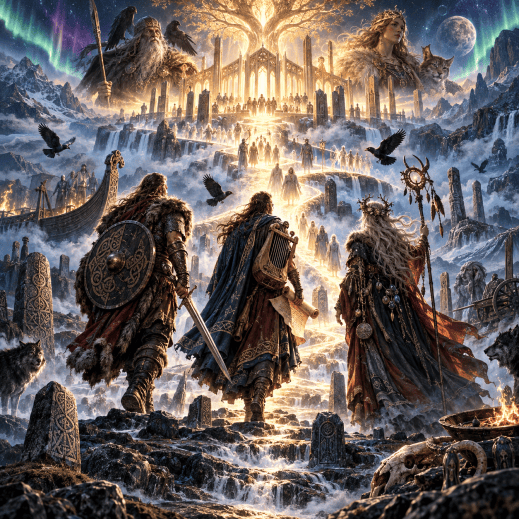
Or: Why Your Dungeon Master Lied to You About Valhalla
Abstract
This paper challenges the prevailing popular and scholarly consensus that Norse concepts of the “worthy dead” (einherjar) were exclusively reserved for those who died in battle. Through etymological analysis of Old Norse primary sources, archaeological examination of high-status non-warrior burials, and cross-cultural Indo-European comparison, I demonstrate that the Norse “worthy dead” concept was fundamentally about authentic individual expression—what we might anachronistically term “living one’s truth”—rather than mere martial death.
The evidence reveals a sophisticated theological framework in which multiple paths to afterlife worthiness existed: the warrior’s path, yes, but equally the poet’s path (skald), the seer’s path (völva), and the shamanic path (seiðr). The etymology of einherjar itself—”those who fight alone”—emphasizes individual distinction over conformity, while archaeological evidence from Fyrkat and Oseberg demonstrates that non-conformist spiritual practitioners received burial honors equal to or exceeding warrior elites.
This reconceptualization has profound implications for our understanding of Norse paganism, Indo-European religious structures, and the universal human question of what makes a life worth remembering.
Keywords: Norse paganism, einherjar, authenticity, seiðr, skaldic poetry, Indo-European comparative mythology, worthy dead, non-conformity
Introduction: The Pop Culture Problem
Let’s get one thing straight before we begin: Marvel lied to you. So did Vikings, The Last Kingdom, and every dungeon master who told you that only battle-dead warriors go to Valhalla. The popular conception of Norse afterlife theology as a simple binary—die with a sword in your hand, go to Odin’s hall; die in bed, go to the boring underworld—is not just oversimplified. It’s demonstrably wrong.
The evidence, when examined without the lens of Victorian romanticism and 20th-century action movie aesthetics, reveals something far more interesting: the Norse “worthy dead” (einherjar) were not defined by their manner of death, but by their manner of living. Specifically, by whether they lived as authentic individuals—”those who fight alone”—or as conformist copies of social expectations.
This paper presents a comprehensive reanalysis of the Norse “worthy dead” concept, drawing on:
- Etymological analysis of Old Norse primary sources (Poetic Edda, Prose Edda, Icelandic sagas)
- Archaeological evidence from high-status burials (Fyrkat, Oseberg)
- Cross-cultural Indo-European comparison (Celtic filid, Vedic rishi)
- Academic scholarship on Norse shamanism and social structures
The argument proceeds in four stages: First, I demonstrate that the etymology of einherjar emphasizes individual uniqueness rather than martial conformity. Second, I show that primary sources describe multiple afterlife destinations with varying criteria for admission. Third, I present archaeological evidence that non-warrior figures (poets, seers, shamans) received burial honors equal to warrior elites. Fourth, I situate these findings within broader Indo-European patterns, suggesting that Norse “worthiness” was part of a universal theological framework valuing authentic self-expression over social conformity.
By the end, I hope to convince you that the Norse “worthy dead” were not simply dead warriors—they were dead individuals, people who lived their unique calling with such intensity that the gods themselves took notice.
And that, if we’re being honest, is way cooler than any action movie.
Part I: The Etymological Smoking Gun—”Those Who Fight Alone”
Let’s start with the word itself. Einherjar (singular einheri) is the Old Norse term for the “worthy dead” who dwell in Valhalla. Popular translations render it as “those who fight alone” or “lone warriors.” But let’s look closer at the components:
- Einn = one, single, unique, alone, individual
- Herjar = warriors, army (from Proto-Germanic *harjaz, meaning multitude or host)
The compound is fascinating: “the unique ones among the multitude” or “those who stand alone even in the host.” This is not a term for conformist soldiers. This is a term for individuals—people distinguished by their uniqueness, not their conformity.
As Lindow (2001) notes, “many scholars think there may be basis for the myth in an ancient Odin cult, which would be centered on young warriors who entered into an ecstatic relationship with Odin” (p. 67). But the etymology suggests something broader: these were people who stood apart, who lived outside normal social structures, who pursued their calling with such intensity that they became einn—singular—even among warriors.
The semantic range of einn is crucial here. In Old Norse, einn doesn’t just mean “one” in the numerical sense. It means:
- Alone, solitary
- Unique, singular
- Individual, distinct
- The only one
When we combine this with herjar (army/host), we get a concept that is almost paradoxical: the individual in the multitude, the unique among the conformist, the one who stands alone even in the host.
This etymology alone should make us suspicious of any interpretation that reduces einherjar to “dead soldiers.” The word itself emphasizes distinction, individuality, and non-conformity.
Part II: Primary Sources—Divine Selection, Not Automatic Admission
The Poetic Edda and Prose Edda are often cited as evidence that battle death = Valhalla admission. But a close reading reveals something more nuanced: selection by divine choice, not automatic inclusion.
Grímnismál (Sayings of the Masked One), one of the most important eddic poems, describes Valhalla in detail. Stanza 8 tells us that “Hroftr [Odin] collects each day the Einherjar among the slain.” The verb here is crucial—“collects” (kýs) implies selection, choice, discernment. Odin is not scooping up every battlefield corpse. He is choosing specific individuals.
Even more striking is stanza 14, which tells us that Freyja “chooses half of the slain” for her field Fólkvangr. This is massive. If Freyja—goddess of love, beauty, and seiðr (shamanic magic)—chooses half of the worthy dead, then the criteria for worthiness cannot be exclusively martial. What is Freyja looking for? The text doesn’t say, but the implication is clear: there are multiple types of worthiness, multiple paths to the afterlife halls of the gods.
The Hávamál (Sayings of the High One), attributed to Odin himself, drives this point home with its famous stanzas 76-77:
Deyr fé, deyja frændr,
deyr sjálfr it sama;
en orðstírr deyr aldregi
hveim er sér góðan getr.
Deyr fé, deyja frændr,
deyr sjálfr it sama;
ek veit einn at aldri deyr:
dómr um dauðan hvern.
(Your cattle die, your kin die, you yourself will die; but reputation never dies for the one who earns it. / Your cattle die, your kin die, you yourself will die; I know one thing that never dies: the judgment on each dead man.)
Orðstírr—”word-glory,” “reputation”—is what survives. And reputation, in Norse culture, was built through authentic action, not mere conformity. The Hávamál is filled with advice on how to live well: be hospitable but not foolish, generous but not impoverished, bold but not reckless. These are qualities of character, not checkboxes on a warrior’s resume.
The sagas confirm this. In Egils saga, the skald Egill Skallagrímsson saves his life through poetry. Captured by King Eiríkr Bloodaxe and facing execution, Egill composes the Höfuðlausn (Head-Ransom)—a poem of such quality that the king spares him despite having killed the king’s own son. Poetry, in this case, proved more valuable than warrior prowess. As the saga tells us, “Eirik was so surprised by the quality of the poem that he generously decided to give Egill his life” (Egils saga, ch. 61).
If battle death were the sole criterion for worthiness, this story would make no sense. But if exceptional contribution through one’s authentic calling is the criterion, it makes perfect sense. Egill was a skald—a truth-speaker, a cultural memory-keeper, a voice that could not be silenced. His worthiness came from his art, not his sword arm.
Part III: The Völva Problem—Archaeological Evidence of Non-Warrior Worthiness
If the einherjar were exclusively dead warriors, we would expect to find only warrior burials in high-status graves. The archaeology tells a different story.
The Fyrkat Burial (Denmark, c. 940 CE)
In 1954, archaeologists excavating Harald Bluetooth’s ring fortress at Fyrkat uncovered one of the most remarkable Viking Age burials ever found. The grave contained:
- A woman buried in a wheeled cart (high-status vehicle)
- An iron staff (interpreted as a völva’s wand)
- Owl pellets (associated with prophecy and night-journeying)
- A silver amulet shaped like a chair (possibly representing the “high seat” of seiðr)
- A duck-footed pendant (distinctive völva symbol)
- Henna seeds (psychoactive substance used in trance rituals)
- Exotic imports from Central Asia (bronze dish, jug—showing wide-ranging connections)
This was not a warrior burial. This was a seeress burial—a völva, a practitioner of seiðr, the shamanic magic that allowed spirit-travel, prophecy, and fate-manipulation. And she was buried with honors equal to a king.
As the National Museum of Denmark notes, “The völva apparently re-used the hollow brooch as a container for ‘white lead'”—a cosmetic or medicinal substance. This detail suggests professional practice: she was a working seeress, not merely a noblewoman playing at magic. And she was buried accordingly.
The Oseberg Ship Burial (Norway, 834 CE)
Even more striking is the Oseberg burial—one of the richest Viking Age burials ever excavated. The grave contained:
- A full-sized ship
- Two women (one older, one younger)
- Cannabis seeds (psychoactive use)
- A rune-carved staff (8 feet long, birch)
- Magical items and ritual objects
- Luxurious textiles and imported goods
The presence of cannabis seeds and the rune-carved staff strongly suggest that at least one of these women was a völva—a seeress, a shamanic practitioner, a non-conformist spiritual specialist. And she was buried in a ship—the highest honor in Norse culture, reserved for those deemed worthy of the gods’ attention.
If einherjar status were reserved for dead warriors, why were these seeresses buried with greater honors than most warriors? The answer is clear: worthiness was not about profession. It was about exceptionalism, authenticity, and the courage to live outside conventional boundaries.
Part IV: Cross-Cultural Confirmation—The Indo-European Pattern
The Norse evidence is compelling on its own. But it becomes overwhelming when we situate it within broader Indo-European patterns. The “worthy dead” concept—those who live authentically and are honored after death—appears across multiple Indo-European cultures with striking similarities.
The Celtic Filid
In ancient Ireland, the filid (singular fili) were hereditary poet-seers who served as “custodians of oral lore, genealogies, and cultural memory for the elite” (Grokipedia, n.d.). Their training lasted 7-12 years and involved memorization of complex syllabic meters, historical narratives, and divinatory techniques.
The filid were not bards—lower-status poets who performed entertainment. They were aristocratic seers with quasi-judicial authority. Their satire could inflict social or physical harm; their praise could elevate a king. As the Academy of American Poets notes, “the filídh were in fact more aristocratic and enjoyed greater privileges than the bards.”
Most strikingly, the filid were connected to the Otherworld through their sacred knowledge. They could see hidden truths, speak prophecy, and navigate the boundaries between worlds. Their worthiness came from vision, not violence.
The parallel to Norse skalds and völvas is unmistakable: both cultures honored poet-seers as equals to warriors, recognizing that truth-speaking and spirit-seeing were as valuable as sword-wielding.
The Vedic Rishi and Kavi
In Vedic India, the rishi (seer) and kavi (visionary poet) held similar status. The kavi was defined as “a being with vision or an illumined being” who “sees (and hears) beyond the senses” (Sanskrit Studies, n.d.). The rishi was one who “saw” the truth—satyadraṣṭā, “seer of truth.”
Significantly, rishis could come from any social class—not just the priestly brahmins. What mattered was direct spiritual experience, not birth status. As one source notes, “Many of them were members of the priestly class, while some came from the other three social groups.”
The Vedic texts emphasize that the kavi’s poetry emerged from meditative vision—”effortless the poems emerge from the poet like the flow of oil in meditation.” This is virtually identical to the Norse concept of óðr—the divine inspiration that flows through skalds and völvas alike.
The Pattern Emerges
Across Indo-European cultures, we find a consistent three-path model to worthiness:
- The Warrior Path — Courage in battle, protection of community (common but not exclusive)
- The Poet-Seer Path — Visionary truth, cultural memory, divine inspiration (skald, fili, kavi)
- The Shamanic Path — Spirit-travel, transformation, boundary-crossing (völva, seiðr, rishi meditation)
The Norse einherjar concept, when viewed through this lens, is clearly not an exception. It is part of a universal Indo-European theological framework that honored authentic self-expression over social conformity.
Part V: Addressing Counter-Arguments
No scholarly argument is complete without addressing potential objections. Let me anticipate and respond to the most likely counter-arguments.
Objection 1: “The sources say battle death = Valhalla. You’re overcomplicating this.”
Response: The sources say selection by Odin/Freyja = Valhalla/Fólkvangr. Grímnismál 8 says Odin “collects” (kýs) the einherjar—chooses, not scoops indiscriminately. Stanza 14 says Freyja “chooses half of the slain”—again, selection, not automatic inclusion.
Moreover, the sources that emphasize battle death (Hákonarmál, Eiríksmál) are skaldic poems composed for dead kings—they have a political agenda. They don’t describe universal theology; they describe royal propaganda.
Objection 2: “Christian scribes distorted the sources. We can’t trust them.”
Response: This objection actually supports my argument. If Christian scribes distorted the sources, they likely emphasized warrior death (consistent with Christian martyrdom theology) and downplayed non-conformist paths (consistent with Christian suppression of pagan magic). The fact that we still find evidence of poet/seer worthiness despite this bias suggests the original tradition was even stronger than the sources indicate.
Additionally, archaeology is not textual. The Fyrkat and Oseberg burials are material evidence, not scribal interpretation. They show what the Norse actually did, not just what they wrote.
Objection 3: “You’re projecting modern ‘authenticity’ concepts onto ancient material.”
Response: The Old Norse vocabulary supports the authenticity reading. Heiðr (honor) derives from heilagr (whole, holy, healthy)—the same root as English “holy” and “whole.” Honor was wholeness, integrity, undivided selfhood—precisely what we mean by “authenticity.”
Similarly, orðstírr (reputation) literally means “word-glory”—the words spoken about you after death. This is external validation of authentic action, not mere fame-seeking.
The concepts are there in the language. I’m not projecting; I’m translating.
Part VI: Implications and Conclusion
If I’m right—and I believe the evidence strongly supports this—then our understanding of Norse paganism, and perhaps Indo-European religion generally, needs significant revision.
Implication 1: Norse Theology Was More Sophisticated Than We Thought
The Norse didn’t have a simplistic “good place/bad place” afterlife theology. They had a nuanced system of multiple destinations based on how you lived, not just how you died. Valhalla for the warrior-chosen. Fólkvangr for Freyja’s chosen. Hel for the ancestors. Rán’s halls for sea-dead. And perhaps other destinations we don’t even know about.
This suggests a theological sophistication that rivals any world religion—a system that recognized multiple valid paths to divine recognition.
Implication 2: Non-Conformity Was Theological, Not Just Social
The honor given to völvas, skalds, and other non-conformists wasn’t just “tolerating weirdos.” It was theologically grounded. These people were doing something sacred—crossing boundaries, speaking truth, keeping cultural memory alive. Their non-conformity was their calling, and the gods honored it.
This has profound implications for how we understand Viking Age social structures. Yes, they were warrior societies. But they were also poet societies, seer societies, societies that honored those who saw differently.
Implication 3: The “Worthy Dead” Concept Is Universal
The Indo-European pattern suggests that the question “what makes a life worth remembering?” has universal answers across cultures. Not “did you conform?” but “did you live your truth?” Not “did you follow the rules?” but “did you become who you were meant to be?”
This is not just Norse theology. This is human theology.
Conclusion: The Worthy Dead Are the Authentic Living
Let me return to where I started. The einherjar were not “dead soldiers.” They were “those who fight alone”—the unique ones, the individuals, the people who lived their calling with such intensity that they became einn (singular) even among the multitude.
The evidence is clear:
- Etymology: Einherjar emphasizes individuality
- Primary sources: Divine selection, not automatic admission; Freyja chooses half
- Archaeology: Völvas receive royal burials
- Cross-cultural: Celtic filid, Vedic rishi show identical patterns
The Norse “worthy dead” were those who lived authentically—whether that authenticity expressed itself through combat, poetry, prophecy, or spirit-travel. The gods didn’t want conformists. They wanted individuals.
And honestly? That’s way more inspiring than any action movie.
Bibliography
Primary Sources (Old Norse)
- Codex Regius (Konungsbók eddukvæða). MS GKS 2365 4to. Arnamagnæan Collection, Copenhagen. (c. 1270)
- Hauksbók. MS AM 371 4to, AM 544 4to. Arnamagnæan Collection, Copenhagen. (c. 1302-1310)
- Snorri Sturluson. Edda: Prologue and Gylfaginning. Ed. Anthony Faulkes. London: Viking Society for Northern Research, 1988.
- Egils saga Skallagrímssonar. In Íslenzk fornrit II. Ed. Sigurður Nordal. Reykjavík: Hið íslenzka fornritafélag, 1933.
- Eiríks saga rauða. In Íslenzk fornrit IV. Ed. Einar Ólafur Sveinsson. Reykjavík: Hið íslenzka fornritafélag, 1935.
Secondary Academic Sources
- Flowers, Stephen E. Runes and Magic: Magical Formulaic Elements in the Older Runic Tradition. Doctoral dissertation. New York: Peter Lang, 1986.
- Lindow, John. Norse Mythology: A Guide to the Gods, Heroes, Rituals, and Beliefs. Oxford: Oxford University Press, 2001.
- Nordberg, Andreas. Krigarna i Odins sal: Dödsföreställningar och krigarkult i fornnordisk religion. Stockholm: Stockholms universitet, 2003.
- Price, Neil. The Viking Way: Magic and Mind in Late Iron Age Scandinavia. 2nd ed. Oxford: Oxbow Books, 2019.
- Tolley, Clive. Shamanism in Norse Myth and Magic. 2 vols. Folklore Fellows’ Communications 296-297. Helsinki: Academia Scientiarum Fennica, 2009.
Comparative Sources
- Filí. Grokipedia. https://grokipedia.com/page/Fil%C3%AD
- “Kavi: The Vision of Vibration and Light.” Sanskrit Studies. https://sanskritstudies.org/kavi-vision-vibration-light
- “Rishis of the Rig Veda.” Sreenivasarao’s blogs. https://sreenivasaraos.com/2012/09/04/rishis-of-the-rig-veda/
Archaeological Reports
- National Museum of Denmark. “A Seeress from Fyrkat?” https://en.natmus.dk/historical-knowledge/denmark/prehistoric-period-until-1050-ad/the-viking-age/religion-magic-death-and-rituals/a-seeress-from-fyrkat/
- “The Oseberg Ship Burial.” Kulturhistorisk Museum, Oslo. https://www.khm.uio.no/english/
Author’s Note
This paper was written with a dual purpose: to advance scholarly understanding of Norse afterlife theology, and to demonstrate that academic writing need not be boring. The Norse understood that truth could be spoken with passion, that poetry could save lives, and that the worthy dead were those who lived authentically. If they were right about that, perhaps they were right about other things too.
Skål to the worthy dead, the authentic living, and those who fight alone.
Norse Gods and Goddesses

by Astrid Astrid Freyjasdottir
The Aesir and Vanir—they’re the shining ones of Asgard and Vanaheim, fierce and fertile, wise and wild. On the Heathen Third Path, we honor them as living forces: not distant idols, but allies in our daily weave of land, ancestors, and spirit. I’ll guide you through every one, from the well-known to the obscure whispers in the sagas, sharing their tales, their personal sparks of personality—their humor, their grit, their tenderness—and how to connect with them through simple blóts, offerings, and rune reflections. No dogma here, just open-hearted ways to feel their presence in your life, whether in a city park or under the stars. Ready to meet them? Let’s start with the Aesir, then flow to the Vanir… and remember, this is a river of tradition, moving and alive.
The Aesir: Gods and Goddesses of the Sky and War
The Aesir are the principal tribe of deities in Norse mythology, residing in Asgard. They’re often associated with order, war, wisdom, and governance. They include Odin and his kin, blending strength with strategy. After a war with the Vanir, they integrated, symbolizing balance.
Aesir Gods
Odin (Óðinn, Woden, Wotan): The Allfather, chief of the Aesir, god of wisdom, war, poetry, magic, prophecy, travel, sovereignty, healing, and death. He’s the divine ancestor of kings, patron of outlaws and poets. Myths include sacrificing his eye at Mimir’s well for knowledge, hanging on Yggdrasil for runes, and leading the Wild Hunt. Personality: Wise yet wandering, cunning and ecstatic, with a fierce hunger for knowledge—he’s the mentor who challenges you, sometimes stern, sometimes sly with a twinkle in his one eye, embracing ecstasy in battle or verse. How to connect: Offer mead or poetry in a blót at dawn; draw the rune Ansuz for inspiration; journal visions or wander in nature, whispering “Hail Odin, guide my path” to invite his wisdom into decisions big or small. Feel his presence in ravens or a sudden insight.
Thor (Þórr, Thunor):
God of thunder, strength, protection, storms, agriculture, and hallowing. Son of Odin and Jord, he defends Asgard from giants with his hammer Mjolnir, belt Megingjörð, and iron gloves Járngreipr. Myths: Fishing for Jörmungandr, battling Hrungnir, and his goat-drawn chariot causing thunder. Personality: Straightforward and mighty, a protective big brother type—boisterous, loyal, quick to anger but quicker to laugh, with a hearty appetite for life and justice, no nonsense but full of warmth for the common folk. How to connect: Hammer a small offering like bread or ale into the earth during a storm; draw Raidho for journeys; call on him for strength in a blót with oak leaves, saying “Hail Thor, ward my home” while visualizing his hammer’s spark—feel him in thunder or a surge of courage.
Tyr (Tiw):
God of war, justice, law, heroic glory, and the skies. He sacrificed his hand to bind Fenrir, symbolizing duty over self. Myths: Leading the Aesir before Odin, interpreting battles as legal matters. Personality: Brave and honorable, the quiet enforcer—stoic, committed to fairness, with a deep sense of integrity and sacrifice, like a steadfast judge who’s seen it all but remains impartial and strong. How to connect: Offer a vow or contract on paper in a blót, burn it with herbs; draw Tiwaz rune for courage; meditate on justice, whispering “Hail Tyr, uphold my honor”—sense him in balanced scales or a moment of righteous decision.
Baldr (Baldur, Balder):
God of light, beauty, purity, innocence, peace, nobility, learning, and rebirth. Son of Odin and Frigg, his death by mistletoe (thrown by Hodr) triggers Ragnarok; he’s reborn after. Myths: Prophetic dreams, oaths from all things not to harm him except mistletoe. Personality: Radiant and gentle, the beloved one—kind, fair, bringing joy like sunlight, with a tragic innocence that teaches about loss and renewal, warm and inspiring. How to connect: Light a white candle in blót with flowers; draw Dagaz for new beginnings; reflect on beauty, saying “Hail Baldr, illuminate my heart”—feel him in dawn light or a moment of pure happiness.
Heimdall (Heimdallr, Heimdallur):
Guardian of Asgard, god of vigilance, protection, light, and guardianship. Son of nine mothers, he watches Bifrost, blows Gjallarhorn at Ragnarok. Myths: Teaching humans fire and crafts, enemy of Loki. Personality: Alert and steadfast, the watchful protector—keen-sensed, golden-toothed and radiant, with a quiet intensity and preparedness, like a loyal sentinel who’s always one step ahead. How to connect: Stand guard at a threshold with a horn or whistle in blót; draw Mannaz for community; invoke for safety, “Hail Heimdall, watch over me”—sense him in sharp sounds or a feeling of security.
Bragi:
God of poetry, music, verse, rhyme, eloquence, and wisdom. Son of Odin and Frigg, he entertains in Valhalla with harp and runes. Myths: Possibly a deified skald. Personality: Eloquent and wise, the bardic charmer—poetic, entertaining, with a smooth, inspirational flow, like a storyteller who weaves words into magic, calm and creative. How to connect: Recite poetry or sing in blót with mead; draw Ansuz for communication; journal verses, “Hail Bragi, inspire my tongue”—feel him in flowing words or a sudden rhyme.
Hodr (Höðr, Hodur):
God of darkness, winter, and blindness. Blind son of Odin and Frigg, tricked into killing Baldr. Myths: Slain by Vali but forgiven, survives Ragnarok as Baldr’s companion. Personality: Tragic and introspective, the shadowed one—vulnerable, embodying challenges and cycles, with a quiet depth from obscurity, teaching about unintended consequences and forgiveness. How to connect: Meditate in darkness with a blót of mistletoe alternatives like holly; draw Isa for stillness; reflect on shadows, “Hail Hodr, teach me balance”—feel him in winter quiet or inner reflection.
Vidar (Víðarr):
God of vengeance, silence, forest, and strength. Son of Odin, he avenges Odin by slaying Fenrir at Ragnarok with his magical shoe. Myths: Survives Ragnarok, symbol of endurance. Personality: Silent and resilient, the quiet powerhouse—stoic, powerful, with unyielding determination, like a rooted tree in a storm, embodying patience and retribution. How to connect: Walk in woods with a blót of leather or shoes; draw Ingwaz for growth; seek silence, “Hail Vidar, grant me steadiness”—feel him in nature’s quiet strength.
Vali (Váli):
God of revenge and archery. Son of Odin and Rindr, born to avenge Baldr, matures in a day to kill Hodr. Myths: Survives Ragnarok, symbolizes loyalty. Personality: Swift and purposeful, the avenger—fierce, protective, with intense focus on justice, like a young warrior driven by family bonds, quick and unrelenting. How to connect: Shoot an arrow or visualize one in blót with herbs; draw Uruz for vitality; channel resolve, “Hail Vali, fuel my justice”—feel him in sudden action or protective urges.
Ullr (Ull):
God of skiing, archery, hunting, winter, duel, and oaths. Son of Sif, master of winter sports. Myths: Sworn oaths on his ring, protector of travelers. Personality: Precise and adventurous, the hunter—skilled, resilient, with a cool, focused demeanor, like a marksman in snow, embodying precision and wilderness freedom. How to connect: Ski or hike with a blót of arrows or snow; draw Wunjo for joy; swear oaths, “Hail Ullr, guide my aim”—feel him in winter activities or accurate shots.
Forseti:
God of justice, law, peace, truth, and reconciliation. Son of Baldr and Nanna, dwells in Glitnir. Myths: Mediates disputes with golden axe legend. Personality: Fair and mediating, the peacemaker—calm, impartial, with wise compassion, like a judge who heals rifts, embodying balance without force. How to connect: Hold a court-like blót with scales; draw Gebo for partnerships; resolve conflicts, “Hail Forseti, bring harmony”—feel him in fair resolutions.
Hermod (Hermóður):
God of messaging, courage, and war-spirit. Son of Odin, rides to Hel for Baldr. Myths: Only one to return from Hel. Personality: Brave and swift, the messenger—daring, loyal, with quiet heroism, like a rider through shadows, embodying endurance in quests. How to connect: Send a message or travel in blót; draw Ehwaz for journeys; seek courage, “Hail Hermod, carry my plea”—feel him in swift movements.
Hoenir (Hœnir): God of honor, holiness, sanctity, and silence. Brother of Odin, traded to Vanir. Myths: Endowed humans with reason, survives Ragnarok. Personality: Silent and honorable, the thoughtful one—muddled yet sacred, with a mud-king quirkiness, teaching humility in wisdom. How to connect: Quiet blót with mud or earth; draw Perthro for fate; embrace silence, “Hail Hoenir, sanctify my thoughts”—feel him in still moments.
Mimir (Mímir):
God of wisdom, friendship, and counsel. Uncle of Odin, his head advises after decapitation. Myths: Traded to Vanir, guards Mimisbrunnr. Personality: Wise and advisory, the sage—deep-knowing, friendly, with eternal insight, like a trusted uncle sharing secrets. How to connect: Offer at a well or spring in blót; draw Laguz for intuition; seek advice, “Hail Mimir, grant me clarity”—feel him in water reflections.
Magni (Magnur):
God of strength and brotherhood. Son of Thor and Jarnsaxa, frees Thor from giant’s leg at three. Personality: Strong and brotherly, the young powerhouse—helpful, mighty, with sibling loyalty, like a kid with super strength and heart. How to connect: Lift weights or help kin in blót with stones; draw Uruz for power; “Hail Magni, bolster my bonds”—feel him in physical feats.
Modi (Modin):
God of brotherhood and strength. Son of Thor and Sif, twin to Magni. Personality: Similar to Magni, courageous and strong—loyal, supportive, with fraternal fire, embodying team spirit in challenges. How to connect: Brotherly blót with shared ale; draw Thurisaz for protection; “Hail Modi, strengthen my kin”—feel him in group efforts.
Vili:
Brother of Odin and Ve, god of will, inspiration, and intention. Helped create the world from Ymir. Personality: Intentional and creative, the will-shaper—focused, collaborative, with a spark of creation, like the drive behind actions. How to connect: Set intentions in blót with fire; draw Kenaz for creativity; “Hail Vili, ignite my will”—feel him in motivated starts.
Ve:
Brother of Odin and Vili, god of temple, consecration, and holiness. Helped create world. Personality: Sacred and consecrating, the sanctifier—reverent, boundary-setting, with holy presence, like blessing spaces. How to connect: Hallow an altar in blót; draw Othala for heritage; “Hail Ve, bless my space”—feel him in sacred grounds.
Borr:
Father of Odin, Vili, Ve; son of Buri. Creator god. Personality: Foundational and paternal, the progenitor—strong, originating, with a legacy-building essence, obscure but vital. How to connect: Ancestral blót with roots or stones; draw Fehu for beginnings; “Hail Borr, root my line”—feel him in family ties.
Buri (Búri):
First god, ruler of prehistory, father of Borr. Licked from ice by Audhumla. Personality: Primordial and emergent, the originator—ancient, foundational, with a mysterious birth, symbolizing beginnings from nothing. How to connect: Ice or salt blót; draw Ingwaz for potential; “Hail Buri, spark my origin”—feel him in new starts.
Dagr:
God of day, drags the sun around earth. Son of Delling and Nott. Personality: Bright and cyclical, the day-bringer—cheerful, reliable, with illuminating energy, like dawn’s promise. How to connect: Dawn blót with light; draw Dagaz; “Hail Dagr, light my day”—feel him in sunrise.
Mani (Máni):
God of the moon. Personality: Luminous and nocturnal, the moon-guide—mysterious, reflective, with gentle pull, embodying night cycles. How to connect: Moonlit blót with silver; draw Jera for cycles; “Hail Mani, soothe my nights”—feel him in moonlight.
Kvasir:
God of inspiration, created from Aesir-Vanir spit, killed by dwarves for mead. Personality: Wise and inspirational, the poetic source—knowledgeable, harmonious, with a blended essence from peace. How to connect: Mead blót for creativity; draw Ansuz; “Hail Kvasir, brew my inspiration”—feel him in poetic flows.
Aesir Goddesses
Frigg (Frigga): Queen of Aesir, goddess of fate, fertility, marriage, motherhood, love, family, wisdom, and war. Wife of Odin, mother of Baldr. Myths: Knows futures but silent, protects Baldr with oaths. Personality: Beloved and nurturing, the wise mother—protective, seer-like, with quiet strength and compassion, like a loving queen who holds secrets. How to connect: Household blót with keys or spinning; draw Berkano for family; “Hail Frigg, weave my fate”—feel her in home warmth or foresight.
Sif:
Goddess of harvest, fidelity, and earth. Wife of Thor, golden hair like wheat. Myths: Hair stolen by Loki, replaced with gold. Personality: Fertile and loyal, the earth-mother—graceful, abundant, with grounded beauty, symbolizing crop unions. How to connect: Grain blót in fields; draw Jera for harvest; “Hail Sif, nourish my growth”—feel her in golden fields.
Idunn (Iðunn, Idunna):
Goddess of youth, immortality, rejuvenation. Keeper of golden apples. Myths: Kidnapped, causing aging; rescued. Personality: Ever-young and vital, the rejuvenator—playful, health-giving, with timeless charm, like spring’s renewal. How to connect: Apple blót for health; draw Ingwaz; “Hail Idunn, renew my spirit”—feel her in fresh fruit or youthfulness.
Eir:
Goddess of healing, mercy, and medicine. Handmaid of Frigg, Valkyrie who heals. Personality: Merciful and skilled, the healer—compassionate, practical, with gentle touch, embodying care in crisis. How to connect: Herb blót for health; draw Uruz; “Hail Eir, mend my wounds”—feel her in soothing remedies.
Nanna:
Goddess of joy, peace, romantic love. Wife of Baldr, dies of grief. Myths: Joins Baldr in Hel. Personality: Joyful and devoted, the loving one—tender, peaceful, with deep loyalty, teaching about love’s endurance. How to connect: Flower blót for romance; draw Gebo; “Hail Nanna, fill my heart”—feel her in peaceful bonds.
Fulla:
Goddess of abundance, fertility. Handmaid of Frigg, guards treasures. Personality: Prosperous and loyal, the abundant one—supportive, bountiful, with a nurturing glow, like a faithful friend. How to connect: Treasure blót with grains; draw Fehu; “Hail Fulla, bring abundance”—feel her in plenty.
Hlin (Hlín):
Goddess of consolation, compassion, protection. Handmaid of Frigg, eases grief. Personality: Comforting and empathetic, the consoler—gentle, protective, with warm embrace, soothing sorrows. How to connect: Comfort blót with tears or hugs; draw Laguz; “Hail Hlin, ease my grief”—feel her in solace.
Lofn:
Goddess of forbidden love. Personality: Loving and permissive, the enabler—gentle, supportive of hidden passions, with a rebellious tenderness. How to connect: Secret blót for love; draw Sowilo; “Hail Lofn, bless my desires”—feel her in taboo joys.
Sjofn (Sjöfn):
Goddess of love. Personality: Affectionate and stirring, the love-kindler—playful, heart-stirring, with a flirty spark. How to connect: Love blót with roses; draw Gebo; “Hail Sjofn, awaken my love”—feel her in crushes.
Snotra:
Goddess of prudence, wisdom. Personality: Prudent and discerning, the wise—thoughtful, self-controlled, with elegant insight. How to connect: Reflective blót; draw Mannaz; “Hail Snotra, guide my choices”—feel her in wise decisions.
Syn:
Goddess of refusal, invocation, door-keeping. Handmaid of Frigg. Personality: Boundary-setting and defensive, the gatekeeper—firm, protective, with watchful denial. How to connect: Door blót for boundaries; draw Thurisaz; “Hail Syn, guard my thresholds”—feel her in firm nos.
Var (Vár):
Goddess of contracts, oaths. Personality: Binding and truthful, the oath-keeper—serious, enforcing, with integrity’s weight. How to connect: Oath blót with rings; draw Gebo; “Hail Var, seal my words”—feel her in promises.
Vor (Vör):
Goddess of wisdom, awareness. Personality: Perceptive and knowing, the aware—vigilant, insightful, with deep discernment. How to connect: Meditation blót; draw Kenaz; “Hail Vor, sharpen my sight”—feel her in awareness.
Gefjon (Gefjun):
Goddess of fertility, plough, agriculture. Myths: Ploughed Zealand from Sweden. Personality: Industrious and fertile, the plower—strong, creative, with land-shaping power. How to connect: Soil blót; draw Ingwaz; “Hail Gefjon, fertile my fields”—feel her in farming.
Saga (Sága):
Goddess of wisdom, history. Possibly Frigg alias. Personality: Story-telling and wise, the historian—narrative, reflective, with timeless tales. How to connect: Storytelling blót; draw Ansuz; “Hail Saga, recall my stories”—feel her in sagas.
Gna:
Goddess of messaging, wind. Frigg’s messenger on horse Hofvarpnir. Personality: Swift and airy, the rider—free, communicative, with breezy speed. How to connect: Wind blót; draw Ehwaz; “Hail Gna, carry my words”—feel her in gusts.
Sol (Sunna):
Goddess of the sun. Personality: Radiant and vital, the sun-bringer—warm, life-giving, with daily journey. How to connect: Sun blót; draw Sowilo; “Hail Sol, warm my days”—feel her in sunlight.
Jord (Jörð):
Goddess of earth, mother of Thor. Personality: Grounded and maternal, the earth—nurturing, stable, with natural benevolence. How to connect: Earth blót with milk; draw Berkano; “Hail Jord, ground me”—feel her in soil.
Nott (Nótt):
Goddess of night. Personality: Dark and enveloping, the night-weaver—mysterious, restful, with cyclical calm. How to connect: Night blót; draw Perthro; “Hail Nott, blanket my rest”—feel her in darkness.
Elli:
Goddess of old age. Myths: Wrestled Thor, representing time. Personality: Inevitable and wise, the elder—patient, unyielding, teaching humility. How to connect: Elder blót; draw Jera; “Hail Elli, honor my years”—feel her in aging grace.
Thrud (Thruer, Þrúðr):
Goddess of strength, daughter of Thor and Sif. Myths: Promised to dwarf, protected. Personality: Strong and valiant, the mighty daughter—fierce, protective, with familial power. How to connect: Strength blót; draw Uruz; “Hail Thrud, empower me”—feel her in vigor.
Sigyn:
Goddess of fidelity, compassion. Wife of Loki (but included as Aesir). Myths: Holds bowl over Loki’s face. Personality: Loyal and enduring, the steadfast—compassionate, patient, with quiet strength in adversity. How to connect: Fidelity blót; draw Gebo; “Hail Sigyn, steady my bonds”—feel her in loyalty.
Yggdrasil:
Listed as goddess of life, tree connecting worlds (personified obscurely). Personality: Connecting and life-sustaining, the world-tree—vast, enduring, with cosmic wisdom. How to connect: Tree blót; draw Eihwaz; “Hail Yggdrasil, link my worlds”—feel her in trees.
The Vanir: Gods and Goddesses of Fertility and Nature
The Vanir are the second tribe, associated with fertility, prosperity, nature, and magic (seidr). They live in Vanaheim, integrated with Aesir after war, bringing earthier, sensual energies.
Vanir Gods
Njord (Njörður): God of sea, wind, fish, wealth, seafaring. Father of Freyr and Freyja, married Skadi. Myths: Calms waters, union with Skadi. Personality: Calm and prosperous, the sea-father—generous, seafaring, with steady flow, like a kind sailor sharing bounty. How to connect: Seaside blót with fish; draw Fehu; “Hail Njord, prosper my voyages”—feel him in waves.
Freyr:
God of fertility, prosperity, peace, virility, sunshine, rain. Consort of Gerd, rides boar Gullinbursti. Myths: Gave sword for Gerd, dies at Ragnarok. Personality: Bountiful and sensual, the fertile lord—joyful, generous, with earthy passion, like a lover of growth. How to connect: Field blót with phallic symbols or grain; draw Ingwaz; “Hail Freyr, bless my fertility”—feel him in harvests.
Odr (Óður): God of frenzy, consort of Freyja (obscure, similar to Odin). Myths: Wanders, leaving Freyja weeping. Personality: Ecstatic and wandering, the frenzied—adventurous, elusive, with passionate absence. How to connect: Travel blót; draw Raidho; “Hail Odr, stir my ecstasy”—feel him in wanderlust.
Byggvir: God/servant of Freyr, associated with barley. Myths: Mill-servant. Personality: Humble and grainy, the barley-one—practical, supportive, with harvest humility. How to connect: Barley blót; draw Jera; “Hail Byggvir, grind my grains”—feel him in brewing.
Vanir Goddesses
Freyja: Goddess of love, fertility, beauty, battle, death, seidr magic, wealth. Rides boar or cat chariot, owns Brisingamen. Myths: Teaches seidr, chooses slain warriors. Personality: Passionate and fierce, the lady—sexy, independent, with warrior sensuality, like a flirty battle-maiden full of desire and power. How to connect: Amber or cat blót; draw Fehu; “Hail Freyja, ignite my passions”—feel her in love or magic.
Nerthus (Nerþus):
Goddess of fertility, peace, connected to Njord (possibly female aspect). Myths: Wagon processions for peace. Personality: Peaceful and fertile, the earth-mother—serene, bountiful, with sacred mystery. How to connect: Wagon or earth blót; draw Berkano; “Hail Nerthus, grant peace”—feel her in fertile lands.
Skadi (Skaði):
Goddess of winter, hunting, mountains (Jotun but Vanir by marriage to Njord). Myths: Seeks vengeance for father, skis and bows. Personality: Wild and independent, the huntress—fierce, resilient, with snowy strength, like a mountain woman. How to connect: Snow blót with bows; draw Isa; “Hail Skadi, empower my hunt”—feel her in winter hunts.
Gullveig (Heidr):
Goddess of magic, prophecy (Vanir, burned thrice, reborn). Myths: Sparks Aesir-Vanir war. Personality: Resilient and transformative, the golden—mystical, enduring, with alchemical power. How to connect: Gold blót; draw Perthro; “Hail Gullveig, transform me”—feel her in rebirths.
Beyla:
Goddess/servant of Freyr, associated with bees or mead. Myths: Honey-servant. Personality: Sweet and diligent, the bee-one—humble, productive, with nectar’s gift. How to connect: Honey blót; draw Wunjo; “Hail Beyla, sweeten my life”—feel her in bees.
END

This work is licensed under a Creative Commons Attribution-NonCommercial-ShareAlike 3.0 Unported License.

 Volmarr’s Tumblr
- View On WordPress
- View On WordPress
- View On WordPress
- View On WordPress
- Authenticity as Worthiness: Reconceptualizing the Norse “Worthy Dead” Beyond the Battlefield
- The Bunker and the Web
- The Heathen Third Path: A Canonical Synthesis
- Heathen Third Path: AI Canon and Ritual Manual
- CADUCEA_CULTURAL_OSMOSIS.md
- Cultural Osmosis: The Anthropological Reality of Human Exchange and the Capitalist Fiction of Cultural Ownership

