List of a Few Authentic Viking Old Norse Words

Here is a curated list of a few authentic Viking Old Norse words that reflect the culture, beliefs, and daily life of a 9th-century Viking, categorized by theme.
Please note that while the Viking Age had a common linguistic root in Old Norse, there were regional dialects. The words below represent a generalized Old West Norse perspective, primarily based on sources from Norway and their Atlantic colonies (like Iceland), as these provide the most detailed literary records from the period .
⚔️ Raiders & Warriors
The core identity for those who went “i viking” was tied to warfare, honor, and the social structure of the warrior band.
1. Víkingr (masculine noun): A raider or pirate. This term referred to the person who took part in sea-borne expeditions. The activity itself was called víking .
2. Berserkr (masculine noun): A frenzied warrior, literally “bear-shirt” or possibly “bare-shirt,” who fought in a trance-like fury .
3. Hersir (masculine noun): A local chieftain or military leader.
4. Drengr (masculine noun): A bold, valiant, or chivalrous young man; often used to describe a good warrior or merchant.
5. Sverð (neuter noun): Sword, the most prestigious weapon.
6. Skjöldr (masculine noun): Shield, typically round and made of wood.
7. Øx (feminine noun): Axe, a common tool and fearsome weapon, especially the “bearded axe” or skeggøx.
8. Spjót (neuter noun): Spear, the most common weapon on the battlefield.
9. Hjálmr (masculine noun): Helmet. Common misconceptions aside, most were simple iron or leather caps, not horned.
10. Brynja (feminine noun): Mail-coat or byrnie, a costly and effective form of armor.
11. Valhöll (feminine noun): “Hall of the Slain,” Odin’s great hall where warriors who died in battle feasted until Ragnarök.
12. Valr (masculine noun): The slain on a battlefield.
13. Valkyrja (feminine noun): “Chooser of the Slain,” a female figure who decides who dies in battle and brings half to Valhalla.
14. Félag (neuter noun): A partnership or fellowship, especially for a joint venture like a trading voyage or raid. A félagi was a “fellow” or comrade in such a group .
15. Einvígi (neuter noun): A formal duel or single combat, used to settle disputes.
⛵ Ships & Exploration
The Vikings’ mastery of the sea was the foundation of their expansion.
1. Skip (neuter noun): A ship, a general term.
2. Langskip (neuter noun): “Longship,” a long, narrow, fast warship designed for speed and oars.
3. Knörr (masculine noun): A large, broad trading ship, more reliant on sail than oars, built for cargo.
4. Stefni (masculine noun): The stem or prow of a ship, often ornately carved.
5. Styri (neuter noun): The rudder, a large steering oar on the right side (the “starboard” or stjórnborði).
6. Sigla (verb): To sail.
7. Vindauga (neuter noun): “Wind-eye,” an opening for ventilation and light in a building or ship .
8. Leiðangr (masculine noun): A naval levy or conscription of free men for a fleet.
9. Víking (feminine noun): An expedition, often but not always for plunder. To go on such a raid was to fara í víking .
10. Stýrimaðr (masculine noun): A steersman or captain of a ship.
🏠 Daily Life & The Home
Life for most Scandinavians was centered on farming, family, and the homestead.
1. Bóndi (masculine noun): A freeholder, a farmer, the head of a household. This is the root of the modern word “husband” .
2. Húsbóndi (masculine noun): “Householder,” the master of the house .
3. Húsfreyja (feminine noun): “House-freya,” the mistress of the house.
4. Setstofa (feminine noun): A sitting room or main living room in a longhouse, with fixed benches along the walls.
5. Eldhús (neuter noun): “Fire-house,” the kitchen, often a separate building to reduce fire risk.
6. Skáli (masculine noun): A large hall or longhouse.
7. Garðr (masculine noun): An enclosed yard, courtyard, or farm. It could also mean “world” (as in Miðgarðr).
8. Kaka (feminine noun): Cake .
9. Brauð (neuter noun): Bread.
10. Egg (neuter noun): Egg .
11. Mjöðr (masculine noun): Mead, a fermented honey drink, highly prized.
12. Öl (neuter noun): Ale.
13. Sær (masculine noun): The sea.
14. Knífr (masculine noun): A knife, an essential tool for everyone .
15. Rúm (neuter noun): A bed or a room.
16. Ull (feminine noun): Wool, the primary material for clothing.
17. Vaðmál (neuter noun): Wadmal, a coarse, durable woolen cloth often used as a medium of exchange.
🌲 Nature & The World
The Norse lived in close connection with a powerful and often unforgiving natural world.
1. Miðgarðr (masculine noun): “Middle Enclosure,” the world of humans, situated between the realm of the gods and the outer chaos.
2. Útgarðr (masculine noun): “Outer Enclosure,” the world of the giants and supernatural forces, on the fringes of the human world.
3. Yggdrasill (masculine noun): Odin’s horse, but referring to the World Tree, the great ash tree that connects the nine worlds.
4. Fjörðr (masculine noun): A fjord, a long, narrow inlet .
5. Dalr (masculine noun): A valley.
6. Fjall (neuter noun): A mountain or fell .
7. Skógr (masculine noun): A forest.
8. Himinn (masculine noun): The sky or heaven .
9. Þoka (feminine noun): Fog .
10. Vindr (masculine noun): Wind.
11. Sól (feminine noun): The sun, also a goddess.
12. Máni (masculine noun): The moon.
13. Úlfr (masculine noun): Wolf, a powerful animal associated with Odin and chaos.
14. Björn (masculine noun): Bear, associated with the berserkir .
15. Hrafn (masculine noun): Raven, the sacred animal of Odin, with his two ravens Huginn and Muninn.
16. Ormr (masculine noun): Serpent or dragon.
17. Freknóttr (adjective): Freckled .
⚖️ Society & Law
Viking society was governed by a complex system of laws and assemblies.
1. Lög (neuter plural): Law. This is the root of words like “bylaw” (from bær “town” + lög) .
2. Þing (neuter noun): An assembly, a governing and judicial gathering of free men.
3. Alþingi (neuter noun): The general assembly, like the one established in Iceland in 930 AD.
4. Lögmaðr (masculine noun): “Law-speaker,” the man who recited the law at the Þing.
5. Goði (masculine noun): A chieftain-priest who held both political and religious authority at the local assembly.
6. Sáttmál (neuter noun): A settlement, agreement, or peace treaty.
7. Skóggangr (masculine noun): “Forest-going,” the penalty of outlawry, where a person was banished and could be killed with impunity.
8. Erfingi (masculine noun): An heir.
🛡️ Mythology & Belief
The pre-Christian worldview was rich with gods, giants, and concepts of fate.
1. Áss (pl. Æsir) (masculine noun): A member of the principal family of gods, including Odin, Thor, and Tyr.
2. Vanr (pl. Vanir) (masculine noun): A member of the other family of gods, associated with fertility, prosperity, and magic, including Njörðr, Freyr, and Freyja.
3. Þórr (masculine noun): Thor, god of thunder, protector of Miðgarðr, who wields the hammer Mjölnir .
4. Óðinn (masculine noun): Odin, the All-Father, god of wisdom, war, poetry, and magic.
5. Freyja (feminine noun): A goddess of love, beauty, fertility, and war (she gets first pick of half the slain).
6. Jötunn (masculine noun): A giant, a primordial being often in conflict with the gods.
7. Dvergr (masculine noun): A dwarf, master smiths who live in the earth.
8. Álfr (masculine noun): An elf, a luminous, minor nature spirit .
9. Dis (feminine noun): A female spirit or guardian deity, sometimes associated with fate.
10. Norn (feminine noun): A being who decides the fate (ørlög) of gods and men.
11. Fylgja (feminine noun): A “follower,” a tutelary spirit that appears in animal form and is attached to a person or family.
12. Hamr (masculine noun): “Skin” or “shape.” The concept of hamask meant to change shape, as a berserker or a shapeshifter.
13. Seiðr (masculine noun): A form of magic, primarily associated with Freyja and the Vanir, involving divination and shaping the future.
14. Blót (neuter noun): A sacrificial feast or ritual, usually involving the killing of animals and the sprinkling of their blood. In modern practices tend to involve offering drink and/or food, or any other gifts, with mead offerings the most common.
🛒 Trade & Goods
The Vikings were major traders, connecting vast networks from the Middle East to the North Atlantic.
1. Kaupangr (masculine noun): A trading town or market place.
2. Kaupmaðr (masculine noun): A merchant or trader.
3. Váðmál (neuter noun): Wadmal, a standard woolen cloth used as a currency .
4. Söðull (masculine noun): Saddle.
5. Síma (masculine noun): A rope or cord.
6. Bóks (feminine noun): A book, a very rare and valuable imported item, often religious texts after the conversion.
7. Gull (neuter noun): Gold.
8. Silfr (neuter noun): Silver, the standard of wealth and trade (e.g., in the form of hack-silver or arm-rings) .
9. Váttr (masculine noun): A witness, essential for validating a legal transaction.
⚔️ More on Warfare & Weapons
Expanding on the warrior’s toolkit.
1. Bogi (masculine noun): A bow, used for hunting and warfare.
2. Ör (feminine noun): An arrow.
3. Sax (neuter noun): A short, single-edged sword or seax, common in Scandinavia and among Germanic peoples.
4. Garðr (masculine noun): A shield-wall, the primary defensive formation in battle.
5. Herfang (neuter noun): Booty or plunder taken in war.
🗣️ Descriptive Words
Words the Vikings used to describe the world and each other.
1. Harðr (adjective): Hard, tough, enduring.
2. Kaldr (adjective): Cold.
3. Uggligr (adjective): Fearsome, dreadful, which evolved into the English “ugly” .
4. Heppinn (adjective): Lucky, fortunate; the root of the English word “happy” .
5. Skamt (adjective): Short, as in distance or time.
Sample of AI GMed Norse Saga Engine Combat 2
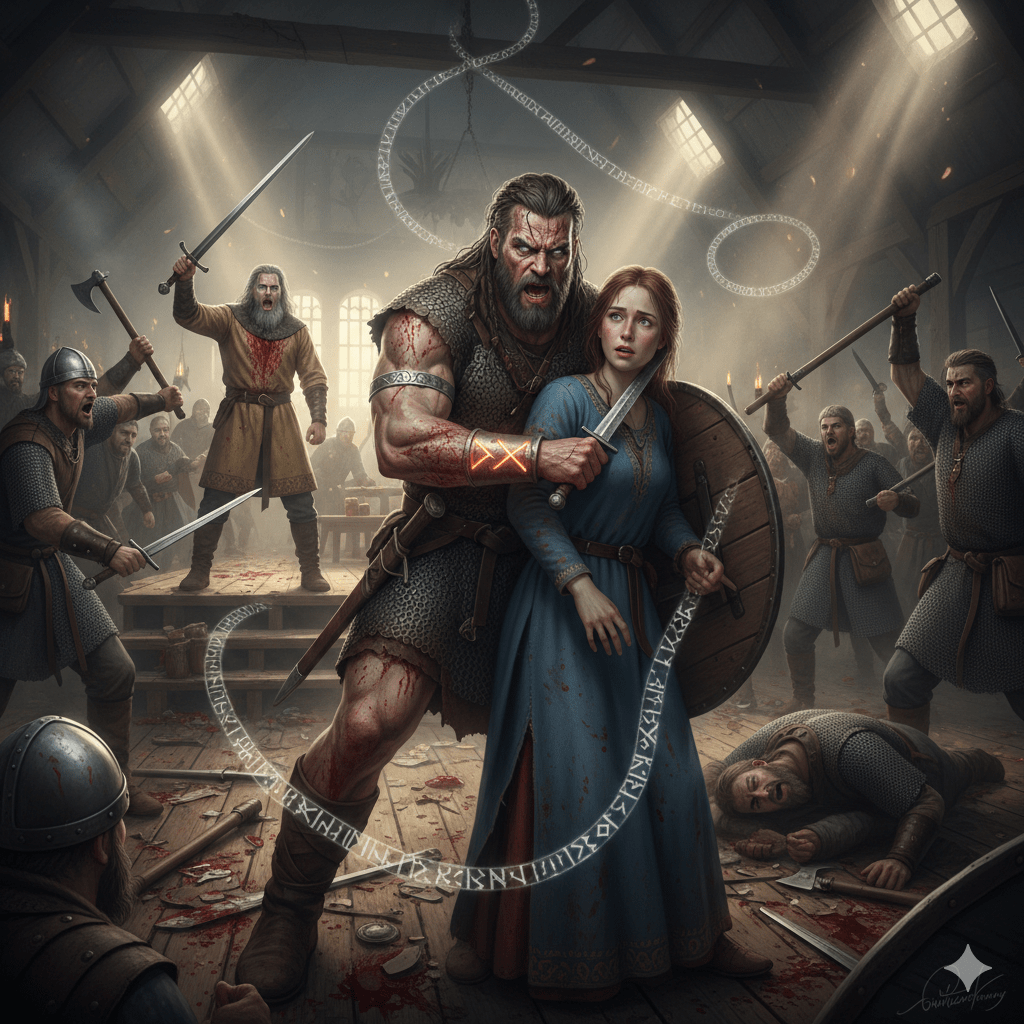
Your berserkergang ignites like Fenrir unchained, Volmarr Ragnarsson-eyes wild with eight winters’ frozen rage, gray-blue fire amid blood-matted braids, father’s silver arm-ring flashing as Raidho’s rune pulses hot on your skin. Seax gripped iron-tight (your “sword” in frenzy’s blur), you *charge* through the huskarl snarl, shield bashing a path toward Inga’s fleeing shadow, low HP fueling mad drengskapr (reckless Dash crashes the melee; opportunity axes rake your flanks-12 slashing wounds tear chain-shirt and flesh, vigor shattering to 0/28). Pain blacks the edges, yet wyrd hurls you onward, Second Wind surging reflexive (1d10+3=9 HP regained; ragged breath claws you to 9/28, blood bubbling from thigh-gash and rib-rents).
Huskarls howl outrage-*\”Ulfhedinn! Wife-slayer-níd upon the dog!\”*-their ring-mail wolves parting blood-slick just enough as your frenzy bowls two aside (one crumples greataxe-down, 10 wounds; pack reforms iron-thick). Dawn shafts pierce smoke-holes, gilding the trampled rushes slick with gore, iron-tang choking the wool-reek as overturned benches splinter under boot-thud. You crash into the side-chamber threshold, gauntleted hand snaring Inga’s embroidered kirtle mid-flight-her amber brooch snaps free, clattering like shattered oath-yanking her frail form back against your bloodied chest. Seax kisses her pale throat, edge nicking pearl-skin (grapple holds; she freezes, AC 10 no match for berserk grip), her shriek dying to whimper: *\”Mercy, wanderer-Frigg shield me! No hall-blood on kin… please, gods…\”* Wide hazel eyes plead terror, frail hands clawing air, no shieldmaiden’s steel but a noble’s fragility, her breath hitching with secrets unspoken.
The hall freezes mid-chaos, embers hissing judgment. Eirik Jarl erupts from dais-edge, neck-gash crusted crimson down gold-broidered tunic, cold blue eyes arctic murder beneath gray-streaks. His masterwork longsword rises, Battle Master poise venomous, voice thundering lordly doom laced in tyrant’s glee: *\”Ulfhedinn filth! Nídingr deepest-jarl’s wife under blade? Guest-right dust, your \u00e6ttar s\u00f3mi shamed eternal! Wolves-*take* the chaff alive for Thing’s slow gibbet, let freemen see Ragnar’s whelp twist!\”* Twenty-odd huskarls surge convergent, axes hammering your shield to ruin (disadvantage bites reckless rage), swords thirsting for hamstring and yield. One clips your sword-arm (4 slashing; down to 5/28), another pommels your skull (stun reels you), the pack’s ordstírr a noose tightening.
Inga trembles blade-kissed, tears carving tracks: *\”Eirik-truth for my breath? Byzantine shades… Ragnar knew… mercy!\”*-whisper half-heard ere steel rains. Wyrd coils lethal: níd brands you wolfskin outlaw, blood-feud with Eirik’s kin awakened, Freyja’s curse on wife-assailant, hall-sanctity shattered beyond mend. Reinforcements boot-thud from yards, your handaxe sheathed desperate throw, frenzy ebbing to exhaustion’s bite. Seax quivers at her neck-demand Eirik’s confession now? Release and hurl truths to sway any wavering? Fight the swarm till bones break? Yield and spit proofs for Thing’s mercy? Or bolt with hostage through side-dark? The Norns knot tight, Volmarr-thread your defiance ere wolves devour.
Sample of AI GMed Norse Saga Engine Combat
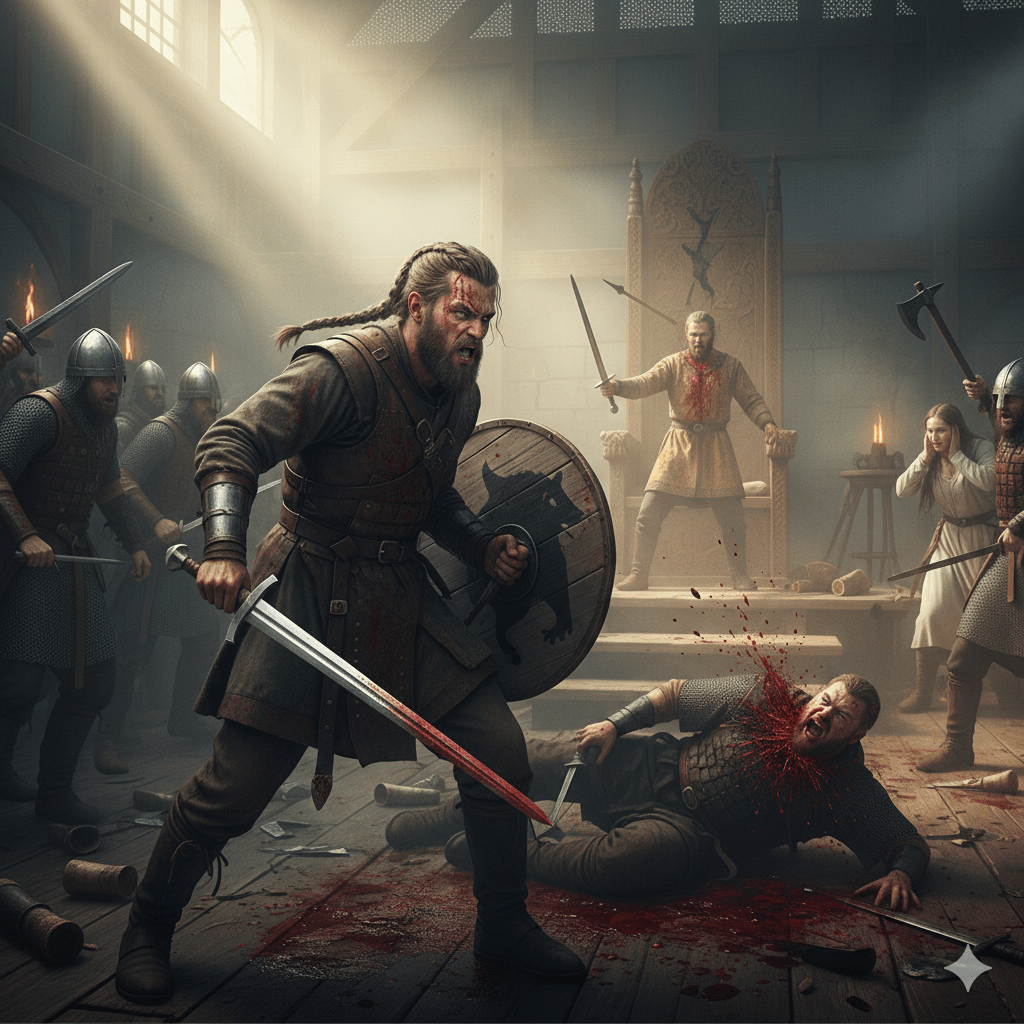
Your seax-father Ragnar’s sharp legacy, still slick with the jarl’s blood-whirls in your grip like Raidho’s furious path, Volmarr Ragnarsson, as you wrench your round shield high and unleash wide, sweeping arcs through the snarling huskarl pack. Dawn’s pale shafts lance the smoke-hazed hall, gilding sweat-slick faces and bared iron, the air a choking reek of blood-iron, trampled rushes, and the sour bite of fear. Eight winters’ wyrd erupts in your veins, drengskapr turned berserk frenzy; your gray-blue gaze burns past the ring-mailed wolves, fixing on Eirik as you hurl your spear like Odin’s own javelin, shaft whistling for his crowned skull.
The first sweep bites deep-a burly axe-man’s throat opens in a crimson fan (critical stroke on the wind’s edge; huskarl crumples lifeless, 12 wounds claimed), his ring-mail parting like wet wool. Your Action Surge surges hot, a second arc cleaving another’s sword-arm at the shoulder (8 slashing; he howls, staggering back blood-drenched but standing, axe clattering). The spear flies true in intent but glances wild off Eirik’s upflung pauldron (ranged strike foiled by chaos’ sway; 14 misses AC 18), embedding quivering in the high-seat’s carved flank amid splintered oak. Two foes felled or broken amid two dozen-yet the pack closes relentless, their ordstírri-bound fury a tide no lone wanderer stems.
Eirik Jarl snarls from the dais’ edge, neck-gash weeping scarlet down his gold-broidered tunic, cold blue eyes blazing with tyrant’s wrath beneath gray-streaked hair. *”Nídlingr! Hall-slayer-your father’s ghost weeps at such chaff!”* His masterwork longsword leaps free, Battle Master precision uncoiling: a riposte feints low then surges (15 misses your shield’s desperate brace), but his command lashes louder: *”Wolves, crush the oathbreaker-alive for the Thing’s gibbet!”*
The huskarls swarm like Jörmungandr’s thrash-six blades converge in the tight melee, axes and swords hacking through dawn’s gloom. A greataxe bites your thigh past shield-rim (7 slashing), another sword gashes your ribs (6 piercing through chain-shirt gaps), a third clips your helm-scalp (4 slashing). Pain blooms fire-hot (17 total wounds; your vigor bleeds to 6/28, blood sheeting your braided locks and silver arm-ring, vision blurring red). Inga shrieks from the shadows, her kirtle aflutter as she bolts for the side-chambers: *”Thor curse this hall-blood-mercy, gods!”*-her flight a pale blur amid overturned benches and scattered mead-horns.
Embers hiss under boot-stomp, steel-song drowns all roars, the great hall a churning pit of wyrd’s spite. Twenty-two huskarls circle iron-tight, Eirik poised for the kill-stroke (54/60 vigor unbowed), reinforcements’ boots thundering from outer yards. Your seax drips victory’s scant toll, Second Wind a ragged breath away, handaxe yet sheathed for desperate throw-yet níd’s brand sears your name eternal: outlaw chaff, kin-shame without witness or oath. Bolt for the doors through the press? Rally with final surge? Surrender truths amid the steel rain? The Norns’ thread frays thin, Volmarr-what defiance do you weave?

This work is licensed under a Creative Commons Attribution-NonCommercial-ShareAlike 3.0 Unported License.


 Volmarr's Blog of Modernist Heathenism, Norse-Paganism, and Norse-Wicca