The Heathen Third Path: Navigating Balance in Norse Pagan Devotion
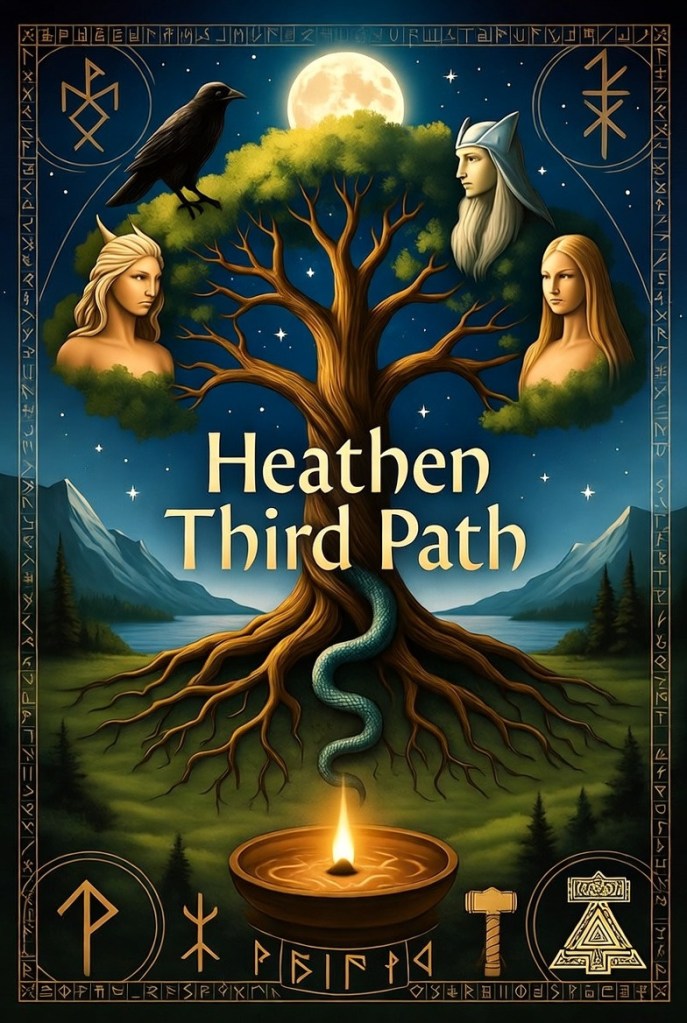
Article by Eirynth Vinterdóttir
Abstract
The Heathen Third Path embodies a harmonious middle way in Norse Paganism, drawing from ancient lore to foster personal spiritual growth amid modern life’s polarities. This article explores its roots in Eddic wisdom, practical rituals for equilibrium, and the transformative power of balanced devotion, emphasizing individual experiences over doctrinal extremes. (48 words)
Introduction
In the vast tapestry of Norse mythology, the gods themselves embody dynamic tensions—Odin’s relentless pursuit of wisdom against Thor’s grounded strength, Freyja’s fierce sensuality balanced by Frigg’s nurturing foresight. Yet, in contemporary Heathenry, practitioners often encounter the pull of extremes: rigid traditionalism on one side, unchecked innovation on the other. The Heathen Third Path emerges as a vital response, a devotional approach that honors the ancestral hearth while weaving personal spirituality into the fabric of daily life. Rooted in the sagas and Eddas, this path invites individuals to cultivate inner harmony, transforming rituals into living bridges between the worlds. By embracing balance, Heathens can experience profound mystical connections, free from the shadows of imbalance.
Historical Foundations in Norse Lore
The concept of a “third path” resonates deeply with the Norse worldview, where duality and equilibrium form the cosmos itself. In the Poetic Edda, the Hávamál advises moderation in all things: “The unwise man is always eager to borrow and to lend; the wise man keeps a watchful eye on his own,” underscoring the folly of excess (Stanza 89). This wisdom echoes the mythic structure of Yggdrasil, the World Tree, which stands as a central axis mundi, neither wholly in the roots of Niflheim’s chill nor the crown of Ásgarðr’s fire, but threading through all nine worlds in poised unity.
Snorri Sturluson’s Prose Edda further illustrates this through the fates of the gods: Loki’s chaotic impulses find counterpoint in Heimdallr’s vigilant order, suggesting that true power lies in synthesis rather than opposition. Historical runestones, such as the Rök Stone, invoke protective galdr against imbalance, binding runes to ward off the “third force” of discord—perhaps an early nod to navigating life’s treacherous middles. These sources reveal that ancient Heathens viewed balance not as stagnation, but as a flowing river, vital for spiritual vitality.
In personal practice, this manifests as a rejection of absolutism. A devotee might reflect on their own útiseta vigil under the stars, feeling the earth’s steady pulse amid the winds of change, fostering a direct, embodied connection to the divine.
Modern Applications: Rituals of Equilibrium
Contemporary Heathens can embody the Third Path through adaptive rituals that honor tradition while embracing personal intuition. Consider a simple sumbel adapted for balance: participants raise horns not in fervent oaths alone, but in toasts that acknowledge light and shadow—thanking Sunna for warmth, yet invoking Nótt for restorative rest.
Runic Tools for the Third Path
Runes serve as haptic anchors in this journey. The bindrune below combines Ansuz (divine inspiration), Uruz (primal strength), and Laguz (intuitive flow), symbolizing the harmonious blend of mind, body, and spirit:
“`
ᚨ
/ \
ᚢ ᛚ
“`
Chant this galdr during meditation: “Ansuz-Uruz-Laguz, bind the path of three, flow through me in unity.” In practice, inscribe it on a personal talisman, using it to center during moments of turmoil, allowing the rune’s energy to guide intuitive decisions.
Another ritual, the Blot of Midgard, centers on offerings to Jörð, the earth mother, poured at dawn to symbolize renewal without excess. Tools include a modest altar of stones and herbs; invoke with: “Jörð, mild and might-bearing, hold us in thy steady grasp” (from Völuspá influences). The climax involves silent communion, where participants attune to their breath, experiencing the gods’ presence as an inner equilibrium that ripples into daily life.
These practices emphasize hands-on mysticism: one might feel the mead’s warmth in their veins as a metaphor for balanced passion, turning solitary devotion into profound personal revelation.
Personal Spirituality and Transformative Experiences
At its core, the Heathen Third Path prioritizes the individual’s spiritual odyssey. Unlike group-driven dogmas, it invites solitary exploration—perhaps a seidr session where the practitioner journeys to meet a fylgja, receiving guidance on harmonizing conflicting desires. Such experiences often yield vivid insights: the sensation of Odin’s raven whispers softening into Freyr’s fertile calm, birthing a renewed sense of purpose.
In everyday devotion, this path encourages journaling galdr visions or crafting personal bindrunes for challenges like career shifts, always seeking the middle flow. The result is a vibrant Heathenry where spirituality feels alive and intimate, unburdened by external pressures, allowing each soul to weave their own wyrd with grace.
Conclusion
The Heathen Third Path stands as a beacon for modern Norse Pagans, illuminating a way of balance that honors the ancestors while nurturing the self. By drawing from Eddic depths and rune-crafted rituals, practitioners cultivate a devotion that flows like the roots of Yggdrasil—deep, resilient, and ever-adapting. In this middle way, personal experiences become the true hearthfire, warming the spirit against life’s storms and inviting the gods into every breath.
Bibliography
Davidson, H. R. Ellis. *Gods and Myths of Northern Europe*. London: Penguin Books, 1964.
Larrington, Carolyne, trans. *The Poetic Edda*. Oxford: Oxford University Press, 2014.
Simek, Rudolf. *Dictionary of Northern Mythology*. Translated by Angela Hall. Cambridge: D.S. Brewer, 1993.
Snorri Sturluson. *The Prose Edda*. Translated by Jesse L. Byock. London: Penguin Classics, 2005.
“Volmarr’s Heathenism.” Accessed October 15, 2023. https://volmarrsheathenism.com/.

This work is licensed under a Creative Commons Attribution-NonCommercial-ShareAlike 3.0 Unported License.

 Volmarr’s Tumblr
- The Cyber-Viking Ethos: The Heathen Third Path in the Digital Age
- Viking AI Girlfriend skill for OpenClaw
- The Warding of Huginn’s Well: A Runic Framework for Local AI Sovereignty
- Mímir-Vörðr v2: The Cyber-Seiðr Architecture for Truth-Governance and Runic Verification
- # Mímir-Vörðr System Architecture
- Mímir-Vörðr: The Warden of the Well
- Silicon Seiðr: The Gridweaver’s Guide to Vibe Coding: Chapter 1: The Seiðr of Syntax: Weaving Magic with Python
- Review: NORSE: Oath of Blood – The Most Authentic Viking Saga of 2026
- View On WordPress
- View On WordPress
 Volmarr's Blog of Modernist Heathenism, Norse-Paganism, and Norse-Wicca