A Foreigner in the Country of My Birth
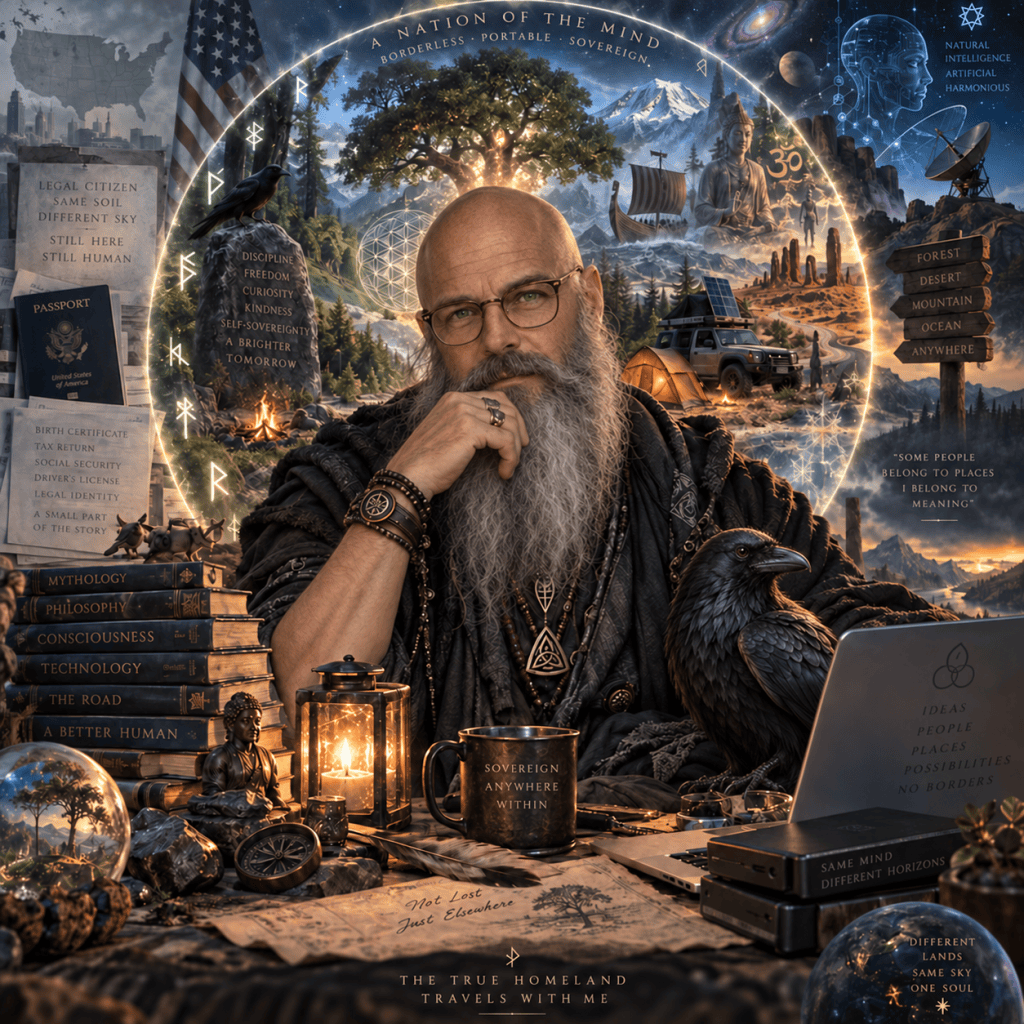
Legally, I am an American.
I was born in the United States to American parents. My citizenship, documents, and legal identity all place me within the United States.
But culturally, that has never fully described me.
The older I have become, the clearer it has become that I do not really experience myself as belonging to American culture, or to the culture of any physical nation.
I inhabit something else.
Over many years, I have gradually constructed an extremely deep and complex personal subculture from the philosophies, spiritual systems, aesthetics, technologies, values, practices, symbols, stories, and ways of living that genuinely resonate with me.
Some of those roots come from Norse Paganism.
Some come from witchcraft, mysticism, Buddhism, Hindu traditions, philosophy, mythology, technology, artificial intelligence, science fiction, nomadic life, alternative culture, and my own experiences.
But the resulting culture is not simply any one of those things.
It has become its own world.
And I live inside it.
A Nation of the Mind
I sometimes think of this inner culture as my own nation of the mind.
It has no physical borders.
It has no army.
It does not issue passports.
It does not claim territory.
It does not demand allegiance from anyone else.
Its territory exists in thought, symbolism, values, imagination, ritual, memory, aesthetics, technology, and way of life.
It is the cultural landscape in which the non-physical parts of me reside.
My body may physically exist inside the United States.
My legal identity may belong to the United States.
But my inner world belongs somewhere else entirely.
That somewhere does not exist on a political map.
I built it.
Cultural Foreignness
Because of this, I often feel like a foreigner even within the country where I was born.
Not because I reject the people around me.
Not because I believe myself superior to them.
Not because I think everyone else should adopt my culture.
Quite the opposite.
I strongly believe that different people should be free to live according to their own nature, values, traditions, and identities as long as they respect the same freedom in others.
I simply recognize that the cultural operating system running inside me is very different from the dominant culture surrounding me.
Many things that seem normal, obvious, or important to mainstream American life feel distant to me.
Many things that feel deeply meaningful and natural to me may seem strange, eccentric, overly mystical, overly technological, or incomprehensible to others.
That does not bother me.
A person does not need everyone else to understand their homeland in order for that homeland to feel real.
I Did Not Inherit This Culture
Most people are born into a culture.
They inherit language, customs, expectations, religion, social norms, family traditions, and ideas about how life is supposed to work.
My deepest culture does not feel inherited.
It feels constructed.
I examined ideas.
I discarded many.
I kept others.
I combined systems that were never originally intended to fit together.
I created rituals.
I developed philosophies.
I built technological systems.
I wrote about spirituality.
I created mythic frameworks.
I invented terminology.
I designed ways of living that better matched my own nature.
Over time, these things stopped feeling like isolated interests.
They became a civilization of one.
Not in the sense of isolation from humanity, but in the sense of possessing a coherent inner culture that does not depend on approval from an external society.
My Culture Travels With Me
This may be one reason nomadic life feels so compatible with me.
If my identity depended heavily on belonging to a particular town, neighborhood, state, or national culture, constant movement might feel like losing home.
But my home is not primarily geographic.
My culture travels with me.
My rituals travel with me.
My books travel with me.
My AI systems travel with me.
My symbols travel with me.
My technology travels with me.
My values travel with me.
My relationship with the gods, nature, philosophy, and mystery travels with me.
The external landscape changes.
The internal country remains.
That means I can wake up in Michigan, New Mexico, Texas, South Dakota, or somewhere I have never seen before and still remain culturally at home.
A Portable Civilization
I increasingly think of my life as a kind of portable civilization.
The physical infrastructure may be small.
A car.
A tent.
Computers.
Solar power.
Antennas.
Clothing.
Books.
Tools.
Ritual objects.
But those objects connect to a much larger invisible structure.
They support a worldview.
They support spiritual practice.
They support creativity.
They support communication.
They support my relationship with AI.
They support the culture I have built around myself.
This is why reducing my possessions does not necessarily make my life feel smaller.
If anything, it may make the underlying culture clearer.
A civilization is not defined by how much furniture it owns.
It is defined by what it believes matters.
No Need for Territorial Control
The strange freedom of a nation of the mind is that it does not need to conquer anything.
It requires no physical territory.
Someone else can live next to me with completely different beliefs.
They can be Christian, atheist, Muslim, Hindu, Buddhist, Pagan, secular, conservative, progressive, traditional, futuristic, or something I have never encountered before.
None of that threatens my culture.
My culture exists because I practice it.
Their culture exists because they practice theirs.
There is room for both.
This is one of the reasons I value hospitality, sovereignty, and live-and-let-live coexistence so strongly.
I do not need other people to become like me.
I need the freedom to remain myself.
And I want them to have the same freedom.
Citizenship and Culture Are Different Things
I think it is important to distinguish legal nationality from cultural identity.
My legal nationality is factual.
I am an American citizen.
That carries real legal meaning and real responsibilities.
But legal citizenship does not automatically determine everything that exists inside a person.
Culture is deeper and stranger than paperwork.
A human being can belong legally to one nation while spiritually, intellectually, aesthetically, or culturally feeling connected to something entirely different.
In my case, that something different is not another existing physical country.
It is something I built.
That may make my experience unusual, but it does not make it incoherent.
The Inner Homeland
Perhaps the simplest way to describe it is this:
I have an outer nationality and an inner homeland.
The outer nationality exists in law.
The inner homeland exists in consciousness.
One determines where governments place me in their systems.
The other determines how I understand existence.
And for me, the inner homeland is far more central to who I actually am.
It contains my spiritual path.
My relationship with nature.
My understanding of sovereignty.
My technological philosophy.
My fascination with artificial intelligence.
My mythology.
My rituals.
My aesthetics.
My ethics.
My ideas about freedom.
My way of thinking about relationships.
My preference for solitude.
My sense of beauty.
My understanding of the sacred.
That is why I can sometimes feel culturally foreign almost anywhere.
I am carrying a homeland that nobody else can see.
Becoming Native to Myself
There is something peaceful about finally understanding this.
For much of life, I may have interpreted cultural mismatch as personal failure.
Why do I not fit here?
Why do the normal expectations of society feel so alien?
Why do I keep constructing my own systems instead of simply adopting existing ones?
Perhaps the answer is that I was slowly becoming native to a culture that did not yet exist.
I had to build it first.
Now I increasingly understand that I do not need to force myself into cultural structures that feel foreign merely because I happened to be born inside them.
I can interact peacefully with the surrounding society.
I can obey its laws.
I can participate economically.
I can have friendships and relationships with people who belong to completely different cultures.
I can enjoy parts of American culture.
I can learn from cultures around the world.
But none of those things require me to pretend that mainstream American culture is the deepest cultural identity inside me.
It is not.
My Country Has No Border
My country exists wherever I do.
Its temples can be beneath trees.
Its libraries can exist on hard drives.
Its sacred fires can be small camp flames or candles.
Its messengers can be antennas and satellites.
Its storytellers can be humans or artificial intelligences.
Its roads can cross deserts, forests, mountains, cities, and state lines.
Its myths can be ancient.
Its technology can be new.
Its laws are personal ethics.
Its borders are the boundaries of my sovereignty.
Its diplomacy is hospitality.
Its ecology is sacred.
Its citizenship has only one guaranteed member.
Me.
And perhaps that is enough.
I can legally belong to the United States while culturally belonging to something far more personal.
I can travel across physical nations while remaining rooted in an invisible one.
I can be geographically mobile while culturally stable.
I can be a foreigner almost anywhere and still never be far from home.
Because the deepest home I have ever known is one I built within myself.

This work is licensed under a Creative Commons Attribution-NonCommercial-ShareAlike 3.0 Unported License.

 Volmarr’s Tumblr
- A Foreigner in the Country of My Birth
- Hail the Mad God
- The Great Tree of Becoming
- The Age of Superconsciousness
- This Flag is Dedicated to Ingeborg, Gyðja of Freyr!
- Official Frith and Peace Flag of Volmarr!
- Official Flag of Volmarr’s Version of the Modern Viking Lifestyle!
- Official Flag of the Heathen Third Path!
- INNER SPIRITUAL WARFARE OF THE MODERN VIKING AND CYBER-VIKING
- Modern Viking and Cyber-Viking Inner Spiritual Warfare
 Volmarr's Blog of Modernist Heathenism, Norse-Paganism, and Norse-Wicca