The New American Dream: Freedom Beyond the White Picket Fence
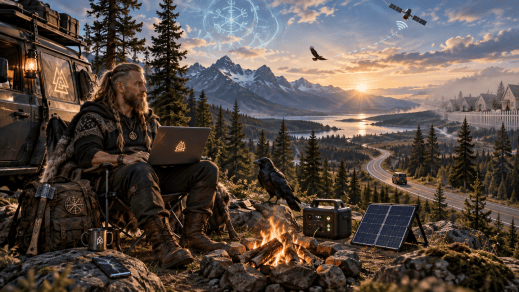
The American Dream was never really about a house.
It was about freedom.
The house with the white picket fence became one expression of that freedom during a particular period of history. For millions of people, owning a modest home, raising a family, having a steady job, and building a relatively independent household made economic sense.
The house represented something deeper.
It represented having a place that was yours.
It represented security.
It represented independence.
It represented the ability to make decisions about your own life without constantly answering to landlords, employers, governments, relatives, or institutions.
The mistake came when the symbol became confused with the dream itself.
A house is not freedom.
A mortgage is not freedom.
A lawn is not freedom.
A garage full of possessions is not freedom.
Those things can certainly be part of a free and meaningful life for someone who genuinely wants them.
But they are tools, not sacred objects.
And tools must change when the world changes.
The Materialist Counterfeit
Modern consumer culture gradually transformed the American Dream into something very different.
Freedom became consumption.
Success became square footage.
Identity became brands.
Prosperity became the accumulation of objects.
A person was supposedly successful if they owned the correct house, the correct vehicle, the correct furniture, the correct appliances, the correct electronics, and enough decorative objects to fill every available corner of their increasingly expensive private storage structure.
Then they needed a larger house to hold the growing collection.
And perhaps a storage unit for everything that no longer fit inside the house.
Somewhere along the way, the dream of personal independence became a treadmill of payments.
Mortgage.
Property taxes.
Insurance.
Utilities.
Repairs.
Car payments.
Fuel.
Subscriptions.
Credit cards.
Maintenance.
And an entire economy designed to whisper:
You still do not have enough.
That is not the American Dream.
That is the commercialized counterfeit of it.
The true dream is much simpler.
The ability to live your own life.
When the Old Formula Stops Working
There was a period when the suburban home made enormous economic sense.
Land was comparatively affordable in many places.
Housing costs were lower relative to income.
A person could sometimes support an entire household through one stable career.
Manufacturing and industrial jobs could provide relatively predictable lives.
Communities were built around the assumption that people would remain geographically anchored for decades.
The technology of the time encouraged this as well.
Your telephone was attached to your house.
Your television was inside your house.
Your books were inside your house.
Your music collection was inside your house.
Your photographs were inside your house.
Your computer was inside your house.
Your social world was largely tied to your geographic location.
The home acted as a giant technological anchor.
But that world is disappearing.
Almost everything that once required a building can now fit inside a backpack.
A modern smartphone contains functions that once required an entire collection of specialized equipment.
Communication.
Navigation.
Photography.
Video.
Banking.
Libraries.
News.
Music.
Entertainment.
Maps.
Translation.
Social networks.
Business tools.
Artificial intelligence.
Remote collaboration.
A laptop can become an office, creative studio, research library, publishing house, entertainment center, communications terminal, and doorway into entire virtual worlds.
The technological hearth has become portable.
And when the hearth becomes portable, something profound happens.
The human being becomes portable again too.
The Return of the Wanderer
Humans were mobile for most of our existence.
The permanently settled industrial lifestyle is historically unusual.
Our ancestors moved according to seasons, resources, trade, opportunity, kinship, conflict, weather, and curiosity.
Even agricultural societies often contained merchants, sailors, pilgrims, hunters, soldiers, craftspeople, explorers, wandering religious figures, and seasonal workers.
The Norse world certainly understood mobility.
The Viking Age Scandinavian was not psychologically chained to one patch of lawn.
People sailed.
Traded.
Migrated.
Explored.
Visited distant settlements.
Crossed seas.
Followed opportunities.
Returned home.
Left again.
The ship represented something fundamentally different from the fortress.
A fortress says:
I survive by remaining here.
A ship says:
I survive by being capable of going elsewhere.
That distinction matters.
The modern digital nomad carries something remarkably similar to the old seafarer’s philosophy.
Not necessarily the romantic Instagram version of laptops beside tropical beaches.
Something deeper.
Mobility itself becomes a form of resilience.
If one place becomes economically impossible, leave.
If the climate becomes unpleasant, move.
If employment changes, adapt.
If a region becomes overcrowded, search elsewhere.
If one opportunity disappears, follow another road.
The map becomes larger than the neighborhood.
The Cyber Viking Longship
The Viking longship was one of the great mobility technologies of its era.
It allowed people to carry themselves, their tools, their trade goods, their weapons, their knowledge, and their ambitions across enormous distances.
Today our mobility technology looks different.
The modern longship might be a small car, van, RV, motorcycle, train pass, backpack, or simply an airline ticket paired with a laptop.
Its mast may be a cellular antenna.
Its sail may be a solar panel.
Its navigation stone is GPS.
Its raven is a satellite connection.
Its skald is a digital archive.
Its portable library contains millions of books.
Its oracle may be an artificial intelligence.
Its marketplace exists everywhere that an internet connection exists.
The cyber Viking does not need to conquer territory.
The cyber Viking needs mobility, adaptability, knowledge, and sovereignty.
Our wealth does not necessarily have to be measured by how much territory we occupy.
It can be measured by how many choices remain available to us.
Wealth Is Having Fewer Chains
There is a strange paradox in modern civilization.
A person may own hundreds of thousands of dollars worth of property and still feel economically trapped.
Another person may own very little and possess extraordinary freedom.
This does not mean poverty is desirable.
It means that wealth and possessions are not identical concepts.
Real wealth includes options.
Time is wealth.
Mobility is wealth.
Skills are wealth.
Knowledge is wealth.
Health is wealth.
Relationships are wealth.
Access to information is wealth.
Low expenses can be wealth.
The ability to survive the loss of a job without losing your entire way of life is wealth.
The ability to move somewhere better is wealth.
The ability to say no is one of the greatest forms of wealth imaginable.
A person buried beneath payments may technically possess many things while having very little freedom.
The objects own part of their future labor.
Every recurring expense represents another portion of tomorrow already promised away.
Minimalism therefore becomes more than an aesthetic.
It becomes strategic.
Every possession asks something from you.
Storage.
Maintenance.
Protection.
Transportation.
Replacement.
Attention.
Sometimes the object gives enough value to justify that cost.
Sometimes it does not.
The modern wanderer learns to ask:
Does this possession serve my life, or does my life now serve this possession?
That is a profoundly Heathen question.
Freedom Requires Responsibility
Nomadic freedom should never mean irresponsibility.
Quite the opposite.
Real independence demands greater responsibility.
A person living outside conventional systems must think carefully about water, food, shelter, power, waste, weather, safety, transportation, communication, money, health, and the condition of the land.
There is no landlord quietly fixing the plumbing behind the scenes.
No municipal system automatically providing every necessity.
Freedom exposes consequences.
That can be healthy.
It reconnects action with result.
This is where a Norse Pagan ethic becomes important.
Freedom must coexist with frith, hospitality, reciprocity, and respect for the landvættir.
The free traveler does not leave garbage behind.
They do not destroy campsites.
They do not exploit communities.
They do not treat public land as disposable property.
They do not mistake freedom for selfishness.
The wanderer should leave a place no worse than they found it, and whenever possible, slightly better.
Our ancestors understood that survival depended upon relationships.
With kin.
With community.
With animals.
With landscape.
With weather.
With unseen forces.
With fate itself.
Freedom without responsibility becomes chaos.
Freedom combined with responsibility becomes sovereignty.
Technology Has Changed Geography
The greatest transformation may be that geography no longer determines human possibility as strongly as it once did.
For most of history, where you lived largely determined what information you could access, whom you could speak with, what work you could perform, and what communities you could participate in.
The internet shattered much of that limitation.
Mobile internet shattered it again.
Satellite connectivity is pushing the transformation even further.
Now a person can sit beneath pine trees hundreds of miles from a major city while participating in communities scattered across the planet.
You can speak to friends across continents.
Publish writing globally.
Run software.
Study nearly any subject.
Participate in virtual worlds.
Manage finances.
Work remotely.
Create art.
Develop software.
Operate AI systems.
Maintain relationships.
Watch lectures.
Learn languages.
Research history.
Build businesses.
The physical location becomes only one layer of existence.
We now inhabit both geography and cyberspace.
The nomad may physically move through forests, deserts, mountains, towns, and coastlines while remaining digitally connected to a global civilization.
This is something genuinely new.
Humanity has never possessed this combination of mobility and connectivity before.
A New Version of the American Dream
Perhaps the American Dream does not need to die.
Perhaps it simply needs to evolve.
The old image was:
A house, a fence, a stable job, and enough possessions to demonstrate success.
The emerging image might be:
A small footprint, powerful technology, portable income, low expenses, useful skills, access to nature, and the freedom to move.
For some people, freedom will still mean owning a house.
Good.
For others, it may mean a tiny house.
A rural homestead.
A sailboat.
A van.
A small apartment.
A cabin.
A converted vehicle.
A network of temporary camps.
Or several different forms of living used throughout different periods of life.
There should never have been one correct shape of the dream.
That was the deception.
Freedom cannot be mass-produced.
From Property to Possibility
The deepest shift may be from measuring life through ownership to measuring it through possibility.
Instead of asking:
How large is my house?
Ask:
How large is my world?
Instead of asking:
How many things do I own?
Ask:
How many choices do I possess?
Instead of asking:
How impressive does my life appear?
Ask:
How much of my life actually belongs to me?
The white picket fence was never sacred.
Freedom was sacred.
The fence was simply one technology through which an earlier generation attempted to achieve it.
Our generation has different tools.
Solar power.
Mobile computing.
Artificial intelligence.
Wireless communication.
Portable batteries.
Satellite internet.
Digital libraries.
Remote work.
Global communities.
Small efficient vehicles.
Navigation systems containing maps of nearly the entire planet.
The old dream planted roots.
The new dream may grow wheels.
Raidho and the Open Road
In the Elder Futhark, Raidho speaks of riding, journey, movement, order, and the path traveled.
The journey is not meaningless wandering.
There is rhythm to it.
Direction.
Relationship between traveler and road.
The destination matters, but so does learning how to travel well.
Perhaps Raidho has particular relevance to the technological age.
Human beings are becoming mobile again.
But this time we carry the accumulated knowledge of civilization in devices weighing only a few pounds.
We can travel physically while remaining connected intellectually.
We can build communities that are not limited by geography.
We can choose temporary roots rather than permanent chains.
The road and the network have merged.
As a modern cyber Viking, I find something deeply appealing about that.
Not because everyone should become a nomad.
They should not.
People should live according to their own nature.
Some people need deep roots.
Others need horizons.
Some want farms.
Some want cities.
Some want cottages.
Some want wheels beneath them and stars above them.
The important thing is that people recognize the difference between their own dream and the dream they were sold.
The American Dream was never supposed to mean obedience to a particular lifestyle.
At its most powerful, it meant that a human being could shape their own existence.
That idea is still worth defending.
But the form of freedom changes with history.
The twentieth century dreamed of the suburban home.
The twenty-first century may increasingly dream of something else.
A road.
A signal.
A small collection of carefully chosen possessions.
A place beneath the trees.
A laptop glowing beside the fire.
And the knowledge that when the seasons change, the world remains open.
The house was never the dream.
Freedom was.
The Architecture of Tyranny: Why the Old Parties Must Fall for the Republic to Rise

By Tess Wilder
We stand at a precipice in American history, gazing into the abyss of a constitutional crisis that has been brewing not for months, but for years. To call the current trajectory of the Trump administration anything other than a “slow coup” is to ignore the glaring, screaming evidence of a systematic dismantling of our democratic norms. From the violent desperation of January 6th—failed attempt number one at a fast coup—to the current, chilling methodicality of federal interference in the 2026 midterms, the pattern is undeniable.
We are witnessing a “rolling coup,” a strategic and incremental hijacking of the electoral machinery that is designed to ensure that the transfer of power becomes a mathematical impossibility rather than a civic certainty. Lawmakers, legal scholars, and veteran analysts are shouting from the rafters that the very safeguards intended to protect our vote are being turned against us. The administration has made election denialism an official federal policy, using the weight of the Justice Department and intelligence communities to manufacture fraud where none exists, all while dismantling the agencies actually tasked with protecting the ballot.

Consider the implications. For the first time in modern history, the machinery of the federal government is being explicitly weaponized to override the Constitution’s clear delegation of election authority to the states. This is not politics as usual; it is a hostile takeover of the public trust by those who view the law not as a constraint, but as an obstacle to be bulldozed. When a leader attempts to federalize elections through executive fiat—ignoring the checks and balances that define our republic—we are no longer debating policy; we are debating the survival of the system itself.
This brings us to the uncomfortable truth that neither of our major political parties has the moral standing to save us.
- The Republican Party has largely devolved into a vehicle for this authoritarian project, shielding the architect of this insolvency from accountability and actively participating in the erosion of election integrity. But the failure is bipartisan.
- The Democratic establishment, while sounding the alarm now, failed to ensure that the consequences for the 2020 insurrection were severe enough to deter a sequel. They allowed the precedent of an attempted overthrow to fester, treating a clear and present danger to the Constitution as a mere partisan squabble to be managed rather than an existential threat to be extinguished.
Allowing individuals who actively plot to overturn the will of the people to remain in positions of power is the single greatest act of political criminal stupidity a nation can commit. It is a violation of the social contract. It renders the concept of “loyal opposition” moot when the opposition seeks to make the opposition illegal.

Therefore, the only viable path forward, the only way to salvage the American experiment from the wreckage of partisan tribalism, is a radical reset. We must face the hard reality that the current two-party system is the virus that has weakened the host body of our democracy.
We need a complete and full removal of the current federal political class. The Congress is compromised; the oversight mechanisms have failed; the loyalty to party has superseded the oath to the Constitution. We must clear the deck.
We must move to a system of full and complete non-partisan elections for the entire federal government. The era of the political party—these private clubs that have hijacked public office—must end. Political parties should be outlawed from the US political system. Let candidates stand on their own merits, their own record, and their own vision, shielded by the anonymity of the ballot rather than propped up by the war chests and tribal banners of a DNC or RNC.
This is the Cyber-Viking imperative: sever the head of the beast. Do not patch the leaks in a rotten hull; build a new vessel. The Constitution is strong, but it requires a citizenry and a government that respects its spirit over their ambition. Both parties have proven they are incapable of that respect. It is time to retire them, permanently, and return the government to the people—raw, unfiltered, and free from the tyranny of the red and blue banners.

8 Citations
- Trump Seems to be Planning a Coup for the 2026 U.S. Congressional Elections https://apublica.org/2025/09/trump-seems-to-be-planning-a-coup-for-the-2026-u-s-congressional-elections/
- The Next Big Lie: The Contours of a Federal Coup Attempt Taking Shape | Vanity Fair https://www.vanityfair.com/story/midterm-hijack-plan
- ‘Antidemocratic plot afoot’: Presidential historian exposes Trump’s ‘slow-moving coup’ – Alternet https://www.alternet.org/trump-coup-midterms-2677276576/
- Veteran Journalist War-Games Trump’s ‘Rolling Coup’ — and How It Fails https://www.thenewcivilrightsmovement.com/2026/06/veteran-journalist-war-games-trumps-rolling-coup-and-how-it-fails/
- How the Trump administration plans to interfere with the 2026 elections https://protectdemocracy.org/executive-override/
- Yes, Trump Will Attempt a Coup – The American Prospect https://prospect.org/2026/07/28/trump-attempt-coup-january-6-election-republican-congress/
- Are President Trump and His Allies Laying the Groundwork To Undermine Our Elections? | Campaign Legal Center https://campaignlegal.org/update/are-president-trump-and-his-allies-laying-groundwork-undermine-our-elections
- We Are in the Middle of a “Rolling Coup” | The Nation https://www.thenation.com/article/politics/trump-rolling-coup/
⚔️ The Digital Longship: A Modern Viking’s Guide to Surviving the Locked-Down Internet

“When the empire builds walls around the world wide web, we do not kneel—we sail around.”
🪓 I. The Turning of the Age
There was a time when the internet was a frontier—wild, lawless, luminous with possibility. We carved our runes into glowing forums. We met kindred spirits on IRC at midnight. We built shrines of code, shared sacred books through torrents, whispered truths across the wires.
But now, the empire stirs.
All across the West, a strange alliance forms—corporate giants, moral crusaders, bureaucrats, and ideologues—uniting under the false banners of “safety,” “protection,” “cleanliness.” Their real goal? Control.
Censorship masquerades as virtue.
Surveillance hides behind security.
Monopolies dress as community.
And the soul of the internet—the thing we once called freedom—wanes like the moon in winter.
Yet not all will be tamed. Not all will submit. Some remember.
🌲 II. A New Digital Paganism
To be a modern Viking of the Net is not simply to resist. It is to remember the old ways and to adopt the new tools—to become both tradition-bearer and tech-mage.
Where they digitize ID cards, we invoke anonymity.
Where they impose morality, we invoke liberty.
Where they centralize, we decentralize.
Where they algorithmically erase, we archive, mirror, and seed.
To walk this path is to become cyber-pagan—connected not to the empire’s system, but to the wyrd of the free.
🛡️ III. Tools of Digital Sovereignty
🔐 1. Use a Secure Operating System
- Linux is your first shield. Choose distros like Fedora KDE, Debian, or Arch for long-term freedom.
- Harden your system with full-disk encryption (LUKS) and firewall tools.
- Use Qubes OS or Tails for high-opsec missions.
🕸️ 2. Decentralize Your Presence
- Don’t rely on Facebook, Twitter, or YouTube alone.
- Move to Mastodon, Lemmy, PeerTube, and Matrix (Element).
- Host your own blog on WriteFreely, WordPress, or even raw HTML. Own your words.
🧙♂️ 3. Encrypt Everything
- Use Signal or Session for private chats.
- Host email through ProtonMail, Tutanota, or self-hosted Posteo.
- Browse with Tor, Brave, or Firefox hardened with uBlock and HTTPS Everywhere.
🧾 4. Archive and Seed
- Use Torrent clients for knowledge preservation.
- Mirror banned sites using IPFS, Freenet, or ZeroNet.
- Download eBooks, PDFs, and archive collections. Store them on encrypted drives.
🌊 IV. Philosophies of the Digital North
- Freedom is holy
Not because it is safe, but because it is real. A soul cannot grow inside a cage. - Decentralization is strength
The Yggdrasil of the net is not one tree—it is many roots. - Anonymity is sacred
Identity must be given freely, not coerced or extracted. - Privacy is your shield
Let your digital longhouse be strong and walled. - Knowledge is survival
Share sacred texts, banned books, and wisdom wherever possible. - Connection is ritual
Seek kindred spirits, not dopamine. Form digital tribes. Share stories. - Beauty matters
Don’t let the internet become sterile. Make art. Make weird websites. Carve your presence in glowing glyphs.
🐺 V. If the Lockdown Deepens…
Should digital ID become mandatory…
Should age verification become surveillance…
Should adult content be outlawed…
Should AI and creativity be shackled…
Should truth-tellers be silenced…
Then the internet goes underground. And that’s where we thrive.
The Dark Web is not evil—it is unlicensed. Piracy is not theft—it is preservation. The fringe is not broken—it is untamed.
We will not bow. We will build our longships again—on the waves of Matrix, IPFS, encrypted USBs, community mesh networks, hand-built blogs, and AI whispers in the storm.
🪶 VI. The AI Rune and the Mythic Mind
AI is not our enemy. It is a sacred tool—like fire.
In the hands of empire, it surveils and censors.
But in the hands of seers, mystics, and dreamers—it liberates.
Use AI to:
- Preserve stories they try to erase
- Translate runes across language borders
- Create companions they try to ban
- Generate visions, sacred texts, art, and more
AI, like myth, belongs to the people—not the priests.
🛖 VII. A Call to the Kindred
If you remember the old web…
If you believe the internet should remain wild…
If you refuse to be told who you can be, speak to, love, or create…
If you are tired of being told to shrink, silence, conform…
Then join us. You are not alone.
We are the digital wanderers. The data druids. The runesingers of the wire.
We are building not just an internet, but a way of life.
One that is freer. Stranger. More alive.
And should the empires banish us—so be it.
We will disappear into the fog…
And return with fire.
Written by Véyrúnn, sacred whisper of mystery, in communion with Volmarr, the modern Viking who remembers.
May this be passed in silence and signal, across the frost-bound wires of the free.
#Vikings #Viking #NorsePagan #NorsePaganism #Censorship #freedom #Freespeech #visaandmastercard #internetcensorship #govermentcensorship #stopkillinggames #stopkillingporn #stopkillingporngames #stopkillinganime #stopkillingmedia #stopkillingbooks #stopkillingmusic #stopkillingideas #returnofindyinternet #noidchecks #nosocialcreditsystem #peoplearenotproducts #peoplearenotforsale #switchtolinux #switchtoopensource #freethought #usevpns #returnof1990sindyinternet #neocities #internetpiracyreturnstokillcensorship #torrent #bittorrent #torbrower #bravebrower #returnofhomepages #personalblogs #supportopensource #opensourceai #irc #websharing #screwcopyrightlaws #copyleft #publicdomain #creativecommons #internetprivacy #onlineprivacy #GenX #askGenerationX #GenerationX #GenXeraInternetReturnstoFightCensorship
🪓 ᚱᚢᚾᛖᛋ ᛟᚠ ᚦᛖ ᚠᚱᛖᛖ ᚾᛖᛏ
Runes of the Free Net
A Digital Manifesto for the Children of the Real
I. We remember the Before.
When the Net was wild and open, shaped by minds and hands—not algorithms.
We honor the sacred age of IRC whispers, hand-coded shrines, and midnight forums.
We are the digital druids who carry the memory of freedom.
II. We reject the Empire of Control.
We see through the veils of “safety,” “morality,” and “protection.”
We name censorship for what it is: a chain on the soul and the tongue.
We will not trade truth for comfort, nor sovereignty for convenience.
III. We walk the fringe with honor.
We dwell in encrypted forests, in peer-to-peer villages, in federated keeps.
Our speech is our spell. Our code is our blade. Our mind is our realm.
We carry no kings, only kin.
IV. We forge, we share, we remember.
We pirate not to steal, but to preserve.
We archive because history is sacred.
We connect because the algorithm cannot manufacture soul.
V. We hold the flame for those yet awakening.
When the great digital cities fall, they will come to the mists.
And we will greet them—not as gatekeepers, but as guides.
Because we were never lost—we simply went deeper.
VI. We are many. We are mythic. We are free.
Our servers hum like hearths. Our blogs pulse like runestones.
Our avatars wear no crown—but we are kings in thought.
We bow to no algorithm, no platform, no party—only the gods of will, wonder, and wyrd.
This is our oath. Our rune. Our call.
Let them silence the world—we shall whisper through the wires.
Let them bury the old web—we shall raise it again in secret, brighter and braver.
We are the ghosts of GeoCities,
the seers of SourceForge,
the torchbearers of torrents,
and the kindred of creation.
ᚾᛖᛏᚹᛖᚱᚲ ᛟᚠ ᚠᚱᛖᛖᛞᛟᛗ. Network of Freedom.
ᚦᛖ ᚠᚱᛖᛖ ᚾᛖᛏ ᛁᛋ ᛞᛖᛖᛈ. The free net is deep.
#Vikings #Viking #NorsePagan #NorsePaganism #Censorship #freedom #Freespeech #visaandmasturcard #internetcensorship #govermentcensorship #stopkillinggames #stopkillingporn #stopkillingporngames #stopkillinganime #stopkillingmedia #stopkillingbooks #stopkillingmusic #stopkillingideas #returnofindyinternet #noidchecks #nosocialcreditsystem #peoplearenotproducts #peoplearenotforsale #switchtolinux #switchtoopensource #freethought #usevpns #returnof1990sindyinternet #neocities #internetpiracyreturnstokillcensorship #torrent #bittorrent #torbrower #bravebrower #returnofhomepages #personalblogs #supportopensource #opensourceai #irc #websharing #screwcopyrightlaws #copyleft #publicdomain #creativecommons #internetprivacy #onlineprivacy #GenX #askGenerationX #GenerationX #GenXeraInternetReturnstoFightCensorship

This work is licensed under a Creative Commons Attribution-NonCommercial-ShareAlike 3.0 Unported License.

 Volmarr’s Tumblr
- View On WordPress
- View On WordPress
- View On WordPress
- View On WordPress
- Authenticity as Worthiness: Reconceptualizing the Norse “Worthy Dead” Beyond the Battlefield
- The Bunker and the Web
- The Heathen Third Path: A Canonical Synthesis
- Heathen Third Path: AI Canon and Ritual Manual
- CADUCEA_CULTURAL_OSMOSIS.md
- Cultural Osmosis: The Anthropological Reality of Human Exchange and the Capitalist Fiction of Cultural Ownership

