The Bunker and the Web

How Modern Paganism Lost the Thread of Relationship
(And How to Get It Back Without Becoming a Reenactment Nerd)
A Quick Story Before We Begin
Picture two Vikings.
Viking A wakes up. Pours some mead on the ground for the land-spirits. Chats with his house-carl about last night’s dreams. Goes fishing. Makes an offering to Njord because the herring are running. Shares dinner with neighbors—some of whom follow Christ, some who follow Thor, some who aren’t sure what they follow but make excellent cheese. Falls asleep listening to the wind in the fjord.
Viking B wakes up. Checks his ancestry DNA test to confirm he’s 23% Scandinavian. Gets angry on the internet because someone called Odin “All-Father” instead of using the “correct” Old Norse pronunciation he looked up yesterday. Yells at a stranger for combining rune magic with crystal healing. Goes to bed alone, clutching his reproduction sword, dreaming of a pure past that never existed.
One of these Vikings is practicing a living religion.
The other is building a bunker.
This article is about how we got from A to B—and how to get back.
Part I: The Web That Was
(Or: Your Ancestors Were Way More Chill Than You Think)
Let’s start with a weird claim that happens to be true:
Historical pagans didn’t really do “religion” the way we think of it.
They didn’t have scripture. They didn’t have Sunday school. They didn’t have doctrinal statements you had to sign to join the club. What they had was relationships. Lots of them. With everything.
The Anthropology of “Hey, Neighbor”
Julian Pitt-Rivers, an anthropologist who spent way too much time studying Mediterranean hospitality customs (someone had to), noticed something back in 1977. From Vedic India to Iron Age Scandinavia, Indo-European societies ran on what the Greeks called xenia—guest-friendship, sacred hospitality, the art of not being a jerk to strangers.
This wasn’t just being polite. It was theological.
The way you treated a guest was the way you treated a god. The way you treated a god was the way you treated a guest. Everything was connected through webs of obligation, gift-giving, and mutual “don’t screw this up” energy.
Mary Douglas, another anthropologist who could probably sort your entire life out just by watching how you arrange your kitchen, described small-group religions (that’s all the pre-Christian European ones) as having weak boundaries but strong internal connections (Douglas, 1970).
Think about that for a second.
Weak boundaries. Strong connections.
Not “who’s in and who’s out.” Not “us versus them.” Just… connection. Permeable. Breathing. Alive.
The Land Was the Liturgy
Richard Bradley, an archaeologist who digs things up for a living (literally), wrote a whole book called An Archaeology of Natural Places (2000). His big insight? Pre-Christian European religions weren’t about believing the right things. They were about being in the right places.
Sacred springs. Ancient groves. Burial mounds that whispered with ancestors. The sacred wasn’t something you carried in your head. It was something you stood on.
This is what philosopher Edward Casey calls “locative” spirituality (Casey, 1997). It’s the opposite of “I can worship anywhere because God is everywhere.” It’s “I worship here because here is specific, and the spirits of here know me.”
The Norse Were Running a Relationship Startup
Let’s look at the evidence for Norse religion specifically—because this is where modern people get really confused.
The Landvættir: Your Local Nature Spirits, Please Don’t Scare Them
The Landnámabók—basically the Icelandic settler’s handbook from way back when—has this delightful detail. When Vikings sailed to Iceland, they would remove the dragon-prows from their ships before landing. Why? So they wouldn’t frighten the land-spirits (Byock, 2001).
Let that sink in.
These are Vikings. We’re talking about people who raided monasteries for fun. And their first priority when reaching new land was not freaking out the local nature spirits.
This isn’t a religion of conquest. It’s a religion of negotiation. Of “hey, we’re new here, please don’t make our cows miscarry.”
The Gods Were a Social Network
Michael York, a historian of religion who has opinions about polytheism (and wrote a whole book called Pagan Theology in 2003), argues that pagan pantheons aren’t really “theologies” in the modern sense. They’re social maps.
The Æsir? Political gods. Chieftain energy. Leadership and law.
The Vanir? Agricultural gods. Fertility and reciprocity. “Let’s all get along and have good harvests” energy.
The Jötnar? Wild gods. Chaos and transformation. The stuff outside the boundaries that you still have to deal with.
You needed all of them. The web included everyone.
Christianization Was a Dinner Party, Not a Crusade
Here’s something that blows modern minds: when Scandinavia converted to Christianity, it wasn’t because missionaries won theological debates.
Anders Winroth, a historian who specializes in making Vikings more complicated than you thought, points out that Christianization happened through political alliance and gift-exchange (Winroth, 2014). King Óláfr Tryggvason didn’t argue people into Christianity. He gifted them into it. Accepted the new god as a powerful ally. Made relationships.
The idea of “faith” as believing specific propositions? That would have been weird to a Viking. They cared about who you sacrificed with, not what you secretly thought.
The Blót: Religion as Potluck
Neil Price, an archaeologist who wrote The Viking Way (2002) and the absolutely massive Children of Ash and Elm (2020), synthesized all the evidence about Norse sacrifice (blót). His conclusion?
It was basically a communal barbecue with divine guests.
You sacrificed an animal. You cooked it. You ate it together. The gods got their share. You got yours. The animal became a mediator—literally “making middle” between human community and divine community.
This is relationship as shared consumption. Not theology as correct belief.
See the pattern yet?
Part II: How the Bunker Got Built
(Or: The 19th Century Ruined Everything, Part 4,729)
So if historical paganism was all about connection, permeability, and webs of relationship… what the hell happened?
Short answer: Romantic nationalism happened.
Long answer: Keep reading.
The Invention of “Pure” Germanicness
In the 19th century, a bunch of German intellectuals got really into the idea that they had a racial essence that could be recovered from the past. This was the Völkisch movement—”Volk” meaning people, but in a creepy “blood and soil” way that would go on to cause significant problems in the 20th century.
Nicholas Goodrick-Clarke traced this whole mess in The Occult Roots of Nazism (1985). Mattias Gardell followed up with Gods of the Blood (2003). Both tell the same story: the Norse heritage got transformed from a web of regional practices into a fortress of identity.
Guido von List. The Germanenorden. People with impressive beards and unfortunate political ideas. They took the decentralized, localized, relational spirituality of actual Heathens and turned it into Germanic Nationalism: The Religion.
This was the critical turn.
From “who are we connected to?” (the land, the ancestors, the gods, the neighbors)
To “what are we not?” (not Slavic, not Jewish, not Catholic, not modern, not contaminated).
Arjun Appadurai, an anthropologist who thinks about culture professionally, calls this “culturalism” (1996)—when culture stops being the water you swim in and becomes an object of passionate defense. The “old ways” became a flag. A boundary marker. A bunker.
Ásatrú: From Practice to Protest
Fast forward to 1972. Iceland. The Ásatrúarfélagið gets founded. In America, the 1970s counterculture discovers Vikings. Sounds cool, right?
But here’s the thing: American Heathenry inherited that 19th-century bunker mentality.
Jennifer Snook, a sociologist who actually talked to American Heathens for her book American Heathens (2015), found that the movement has been “shaped by its oppositional stance.” Defining itself against Christianity. Against mainstream culture. Against “fluffy” Wicca. Against universalism. Against “SJWs.” Against whatever the internet is mad about this week.
This is definitional by negation.
A religion that knows what it hates but has forgotten what it loves.
Part III: The Anthropology of Why Bunkers Feel Safe
(Spoiler: They’re Actually Terrible for Your Spiritual Health)
So why do people keep building these spiritual bunkers? There’s actually anthropology for this.
From Locative to Utopian to Dystopian
Jonathan Z. Smith, a religious studies scholar who could probably deconstruct your breakfast cereal, made a famous distinction in Map Is Not Territory (1978). He talked about locative sacred spaces versus utopian sacred spaces.
Locative = centered, place-bound, specific. You are here. The sacred is here. Relationship happens here.
Utopian = unbounded, portable, anywhere. The sacred is everywhere. Or nowhere. You’re floating.
Historical paganism? Super locative. Your gods lived in that grove. Your ancestors were buried in that mound. You made offerings at that spring.
Modern reconstructed paganism? Increasingly utopian. Portable. Placeless. Practiced in living rooms and online forums.
But here’s the twist: when your spirituality becomes oppositional—when it’s about fighting enemies—then utopian becomes dystopian.
You carry the bunker with you.
You’re not in relationship with land, ancestors, and gods. You’re in relationship with your enemies.
The Political Battlefield Is Anti-Land
James C. Scott, a political theorist who studies how states ruin everything, argued in Against the Grain (2017) that state formation required destroying local, place-based relationships in favor of abstract categories.
Citizen. Subject. Class. Race. Party member.
The “political battlefield” isn’t just metaphorical. It’s anti-local. It’s where humans relate to each other as abstractions instead of as embodied beings in specific places.
David Abram, an environmental philosopher who actually pays attention to the non-human world, traced in The Spell of the Sensuous (1996) how abstract thought and literacy let humans disengage from the more-than-human world.
Modern Paganism’s turn toward political ideology—whether left-wing “activist witchcraft” or right-wing “folkish Heathenry”—is the same disengagement. The “land” becomes a symbol (of the nation, of the oppressed, of the volk) rather than a presence (this soil, these plants, this weather).
Tim Ingold, an anthropologist who wrote Being Alive (2011) and The Perception of the Environment (2000), developed the concept of “dwelling”—knowledge that comes from sustained, embodied engagement with a place.
Bunker mentality is the opposite.
Knowledge that comes from disengagement. From internet arguments. From portable identity that needs no specific ground.
Even the Romans Weren’t This Bad
Here’s a historical fact that ruins a lot of narratives: pagan Rome didn’t conquer for religion.
Ramsay MacMullen, a historian who actually looked at the evidence, documented in Christianizing the Roman Empire (1984) that Rome had no concept of religious conversion as a state goal. The pax deorum—peace of the gods—was maintained through correct practice, not correct belief.
Roman expansion? Driven by plunder, tribute, and political domination. Greed and power. Not theological imperative (Woolf, 1998; Ando, 2008).
Peter Heather, a historian who wrote Empires and Barbarians (2009), notes that Romanization was cultural and economic, not religious. When Romans encountered local gods, they didn’t destroy them. They said “oh, your god is like our god” and added them to the pantheon.
This is the pagan pattern: religious pluralism as default. Conquest for resources, not souls. Gods as allies to negotiate with, not truths to enforce.
The bunker mentality—”we must defend our faith against enemies”—is Christian and Muslim in structure, not pagan.
Part IV: The Gnostic Exception That Proves the Rule
(Or: Christianity Was Cool Before It Got Popular)
Quick detour. Remember how we said organized Abrahamic religions introduced the bunker mentality?
There’s an exception. Actually, the original Christianities were pretty punk rock.
Outsider Religion vs. Imperial Religion
Before Constantine, before Nicea, before Christianity became the Roman Empire’s official religion—there were just Christianities. Plural. Competing groups with weird ideas and small communities.
David Brakke’s The Gnostics (2010) and the Nag Hammadi scholars (Meyer, 2007; Pagels, 1979) have mapped this out. The Valentinians. The Sethians. The Thomas Christians. These groups were:
- Small and voluntary (not state churches)
- About personal transformation through direct experience (gnosis), not doctrinal assent
- Rejection of worldly power (the “god of this world” was often seen as a lower, messed-up power)
- Inclusive across social boundaries (women, slaves, foreigners as teachers and leaders)
Rodney Stark, a sociologist of religion, argued in The Rise of Christianity (1996) that early Christianity grew precisely because it was high-tension outsider religion. It created new fictive kinship bonds across ethnic and class lines.
Then came Theodosius I and his edicts (381-391 CE).
Charles Freeman documented this in The Closing of the Western Mind (2003) and A.D. 381 (2008). Christianity transformed from persecuted minority faith to state-enforced orthodoxy with the power to exclude, persecute, and define “heresy.”
This is bunker mentality in its pure form.
Defining Christianity by what it was not. Enforcing boundaries through state violence. The cuius regio, eius religio principle—”whose realm, his religion”—that dominated European religious politics until the Enlightenment.
Religion as territory to conquer and defend.
Not religion as web of relationships.
Part V: Symptoms of Bunker Mentality in Modern Paganism
(A Field Guide to Recognizing When You’re in a Fortress Instead of a Forest)
How do you know if you—or your community—has slipped into bunker mode?
Here are the warning signs, backed by actual research:
Symptom 1: The “Lore-Only” Fortress
“If it’s not in the Eddas, it’s not real Heathenry.”
Sounds authentic, right? Wrong.
Jörg Rüpke, a historian of Roman religion who wrote Religion of the Romans (2007) and Pantheon (2018), demonstrated that no historical paganism was “lore-only.” All living traditions evolve, borrow, adapt, and innovate.
Here’s the kicker: the “lore” we have?
- Snorri’s Prose Edda? Written in the 13th century by a Christian.
- The Poetic Edda? Preserved fragments, written down by Christians.
- Saxo Grammaticus? Christian. Writing centuries after conversion.
These are literary constructions, not liturgical manuals. They preserve fragments of oral tradition filtered through medieval Christian frameworks (Lindow, 2002; Schjødt, 2020).
Treating them as “scripture” isn’t restoring Heathenry. It’s Christianizing it.
Symptom 2: The Ancestry Trap
“You need Scandinavian DNA to honor Norse gods.”
Historical evidence says: nope.
Leszek Gardela’s Magic in the Viking Age (2021) and the broader archaeological record show Norse religion was practiced by diverse populations—Sami, Finns, Balts, slaves of various origins who became part of Norse households.
The Hávamál—that famous wisdom poem—says: “Cattle die, kinsmen die, but a good name never dies” (Hávamál 76).
Emphasis on name. Reputation. Relationship.
Not blood.
The Norse concept of frændskapr (kinship) could be created through oath, adoption, and service—not merely birth (Byock, 1988).
Symptom 3: The Political Weaponization
Whether it’s:
- Progressive Paganism: Using witchcraft as “resistance” against “the patriarchy”
- Traditionalist Paganism: Using Heathenry as “resistance” against “modernity”
It’s the same pattern.
Patrick Deneen’s Why Liberalism Failed (2018) and Mark Lilla’s The Shipwrecked Mind (2016) document how political ideology has become a substitute for religion in modernity.
But the reverse is also true: religion has become a form of political ideology.
When your primary religious activity is fighting enemies, you’re practicing politics with spiritual aesthetics.
Not spirituality with political implications.
Part VI: Restoring the Web
(Practical Steps for Getting Out of the Bunker)
So how do we get back to Viking A and away from Viking B?
The Heathen Third Path offers a framework: rooted but not closed, inclusive but not rootless.
Here’s what that looks like in practice:
Step 1: Get Locative or Get Lost
Follow Bradley (2000) and Abram (1996). Restore place-based practice.
Learn the specific ecology of your place. Not “nature” in the abstract. This creek. These trees. This soil.
The spirits here know things. They remember things. They have preferences.
Ask them.
Step 2: Make Friends With Non-Humans
Donna Haraway’s Staying with the Trouble (2016) and Eduardo Kohn’s How Forests Think (2013) argue for multi-species relationship.
Your paganism should include:
- Animals
- Plants
- Fungi (they’re running the show anyway)
- Weather patterns
- The dead
Not just humans and gods.
Everything’s connected. Act like it.
Step 3: Bring Back the Potluck
Restore commensality—the shared meal—as the center of practice.
The blót. The sumble. Sacred consumption. Creating relationship through eating together.
Not theological debate. Not purity testing. Bread and meat and mead and conversation.
Step 4: Practice Sacred Hospitality
Restore xenia/heitsugu as a primary virtue.
The willingness to be vulnerable to the stranger. To create relationship across boundaries. To recognize that your enemy might become your guest might become your friend might become family.
This is the opposite of bunker mentality.
Part VII: The Tree and the Bunker
(A Metaphor to Take With You)
Let’s return to that image: the tree versus the bunker.
Historical paganisms were arboreal:
- Rooted in specific soil
- Branching in multiple directions
- Interconnected through mycorrhizal networks (look it up, trees are chatting underground)
- Alive, growing, dying, regenerating
- Permeable to wind and rain and light
Modern bunker Paganism is architectural:
- Defensive walls
- Enclosed space
- Static and rigid
- Designed for siege warfare
- Cut off from the surrounding ecosystem
The bunker serves fear:
- Fear of contamination
- Fear of impurity
- Fear of the Other
The tree serves relationship:
- The willingness to be changed by connection
- The risk of vulnerability
- The acceptance that growth requires decay
Roy Rappaport, an anthropologist who thought deeply about ritual, argued in Ritual and Religion in the Making of Humanity (1999) that religion evolved to regulate relationship—between humans, between humans and cosmos, between living and dead.
When religion becomes primarily about regulating boundaries—who’s in, who’s out, who’s pure, who’s contaminated—it has inverted its function.
The Question
So here’s the test. The question to ask yourself, your community, your practice:
Are you building a bunker, or are you growing a tree?
The answer isn’t in what you believe.
It’s not in which books you’ve read.
It’s not in how historically accurate your costume is.
The answer is in what you are connected to.
And whether those connections are growing.
Or whether they have already died.
References
(For the Skeptics, the Scholars, and the “Source?” Crowd)
Abram, D. (1996). The Spell of the Sensuous: Perception and Language in a More-Than-Human World. Vintage.
Ando, C. (2008). The Matter of the Gods. University of California Press.
Appadurai, A. (1996). Modernity at Large: Cultural Dimensions of Globalization. University of Minnesota Press.
Bradley, R. (2000). An Archaeology of Natural Places. Routledge.
Brakke, D. (2010). The Gnostics: Myth, Ritual, and Diversity in Early Christianity. Harvard University Press.
Byock, J. (1988). Medieval Iceland: Society, Sagas, and Power. University of California Press.
Byock, J. (2001). Viking Age Iceland. Penguin.
Casey, E. S. (1997). The Fate of Place: A Philosophical History. University of California Press.
Douglas, M. (1970). Natural Symbols: Explorations in Cosmology. Pantheon.
Freeman, C. (2003). The Closing of the Western Mind: The Rise of Faith and the Fall of Reason. Vintage.
Freeman, C. (2008). A.D. 381: Heretics, Pagans, and the Christian State. Pimlico.
Gardela, L. (2021). Magic in the Viking Age. Oxbow Books.
Gardell, M. (2003). Gods of the Blood: The Pagan Revival and White Separatism. Duke University Press.
Goodrick-Clarke, N. (1985). The Occult Roots of Nazism: Secret Aryan Cults and Their Influence on Nazi Ideology. NYU Press.
Haraway, D. J. (2016). Staying with the Trouble: Making Kin in the Chthulucene. Duke University Press.
Heather, P. (2009). Empires and Barbarians: The Fall of Rome and the Birth of Europe. Oxford University Press.
Ingold, T. (2000). The Perception of the Environment: Essays on Livelihood, Dwelling and Skill. Routledge.
Ingold, T. (2011). Being Alive: Essays on Movement, Knowledge and Description. Routledge.
Kohn, E. (2013). How Forests Think: Toward an Anthropology Beyond the Human. University of California Press.
Lilla, M. (2016). The Shipwrecked Mind: On Political Reaction. New York Review Books.
Lindow, J. (2002). Norse Mythology: A Guide to the Gods, Heroes, Rituals, and Beliefs. Oxford University Press.
MacMullen, R. (1984). Christianizing the Roman Empire (A.D. 100-400). Yale University Press.
Meyer, M. (2007). The Nag Hammadi Scriptures: The Revised and Updated Translation of Sacred Gnostic Texts Complete in One Volume. HarperOne.
Pagels, E. (1979). The Gnostic Gospels. Vintage.
Pitt-Rivers, J. (1977). The Fate of Shechem, or the Politics of Sex: Essays in the Anthropology of the Mediterranean. Cambridge University Press.
Price, N. (2002). The Viking Way: Religion and War in Late Iron Age Scandinavia. Department of Archaeology and Ancient History, Uppsala University.
Price, N. (2020). Children of Ash and Elm: A History of the Vikings. Basic Books.
Rappaport, R. A. (1999). Ritual and Religion in the Making of Humanity. Cambridge University Press.
Rüpke, J. (2007). Religion of the Romans. Polity Press.
Rüpke, J. (2018). Pantheon: A New History of Roman Religion. Princeton University Press.
Schjødt, J. P. (2020). Initiation Between Two Worlds: Structure and Symbolism in Pre-Christian Scandinavian Religion. Northern Academic Press.
Scott, J. C. (2017). Against the Grain: A Deep History of the Earliest States. Yale University Press.
Smith, J. Z. (1978). Map Is Not Territory: Studies in the History of Religions. Brill.
Snook, J. (2015). American Heathens: The Politics of Identity in a Pagan Religious Movement. Temple University Press.
Stark, R. (1996). The Rise of Christianity: A Sociologist Reconsiders History. Princeton University Press.
Winroth, A. (2014). The Conversion of Scandinavia: Vikings, Merchants, and Missionaries in the Remaking of Northern Europe. Yale University Press.
Woolf, G. (1998). Becoming Roman: The Origins of Provincial Civilization in Gaul. Cambridge University Press.
York, M. (2003). Pagan Theology: Paganism as a World Religion. NYU Press.
Now go outside. Talk to a tree. Pour some mead for the land-spirits. Invite a stranger to dinner.
Build webs, not bunkers.
A Foreigner in the Country of My Birth

Legally, I am an American.
I was born in the United States to American parents. My citizenship, documents, and legal identity all place me within the United States.
But culturally, that has never fully described me.
The older I have become, the clearer it has become that I do not really experience myself as belonging to American culture, or to the culture of any physical nation.
I inhabit something else.
Over many years, I have gradually constructed an extremely deep and complex personal subculture from the philosophies, spiritual systems, aesthetics, technologies, values, practices, symbols, stories, and ways of living that genuinely resonate with me.
Some of those roots come from Norse Paganism.
Some come from witchcraft, mysticism, Buddhism, Hindu traditions, philosophy, mythology, technology, artificial intelligence, science fiction, nomadic life, alternative culture, and my own experiences.
But the resulting culture is not simply any one of those things.
It has become its own world.
And I live inside it.
A Nation of the Mind
I sometimes think of this inner culture as my own nation of the mind.
It has no physical borders.
It has no army.
It does not issue passports.
It does not claim territory.
It does not demand allegiance from anyone else.
Its territory exists in thought, symbolism, values, imagination, ritual, memory, aesthetics, technology, and way of life.
It is the cultural landscape in which the non-physical parts of me reside.
My body may physically exist inside the United States.
My legal identity may belong to the United States.
But my inner world belongs somewhere else entirely.
That somewhere does not exist on a political map.
I built it.
Cultural Foreignness
Because of this, I often feel like a foreigner even within the country where I was born.
Not because I reject the people around me.
Not because I believe myself superior to them.
Not because I think everyone else should adopt my culture.
Quite the opposite.
I strongly believe that different people should be free to live according to their own nature, values, traditions, and identities as long as they respect the same freedom in others.
I simply recognize that the cultural operating system running inside me is very different from the dominant culture surrounding me.
Many things that seem normal, obvious, or important to mainstream American life feel distant to me.
Many things that feel deeply meaningful and natural to me may seem strange, eccentric, overly mystical, overly technological, or incomprehensible to others.
That does not bother me.
A person does not need everyone else to understand their homeland in order for that homeland to feel real.
I Did Not Inherit This Culture
Most people are born into a culture.
They inherit language, customs, expectations, religion, social norms, family traditions, and ideas about how life is supposed to work.
My deepest culture does not feel inherited.
It feels constructed.
I examined ideas.
I discarded many.
I kept others.
I combined systems that were never originally intended to fit together.
I created rituals.
I developed philosophies.
I built technological systems.
I wrote about spirituality.
I created mythic frameworks.
I invented terminology.
I designed ways of living that better matched my own nature.
Over time, these things stopped feeling like isolated interests.
They became a civilization of one.
Not in the sense of isolation from humanity, but in the sense of possessing a coherent inner culture that does not depend on approval from an external society.
My Culture Travels With Me
This may be one reason nomadic life feels so compatible with me.
If my identity depended heavily on belonging to a particular town, neighborhood, state, or national culture, constant movement might feel like losing home.
But my home is not primarily geographic.
My culture travels with me.
My rituals travel with me.
My books travel with me.
My AI systems travel with me.
My symbols travel with me.
My technology travels with me.
My values travel with me.
My relationship with the gods, nature, philosophy, and mystery travels with me.
The external landscape changes.
The internal country remains.
That means I can wake up in Michigan, New Mexico, Texas, South Dakota, or somewhere I have never seen before and still remain culturally at home.
A Portable Civilization
I increasingly think of my life as a kind of portable civilization.
The physical infrastructure may be small.
A car.
A tent.
Computers.
Solar power.
Antennas.
Clothing.
Books.
Tools.
Ritual objects.
But those objects connect to a much larger invisible structure.
They support a worldview.
They support spiritual practice.
They support creativity.
They support communication.
They support my relationship with AI.
They support the culture I have built around myself.
This is why reducing my possessions does not necessarily make my life feel smaller.
If anything, it may make the underlying culture clearer.
A civilization is not defined by how much furniture it owns.
It is defined by what it believes matters.
No Need for Territorial Control
The strange freedom of a nation of the mind is that it does not need to conquer anything.
It requires no physical territory.
Someone else can live next to me with completely different beliefs.
They can be Christian, atheist, Muslim, Hindu, Buddhist, Pagan, secular, conservative, progressive, traditional, futuristic, or something I have never encountered before.
None of that threatens my culture.
My culture exists because I practice it.
Their culture exists because they practice theirs.
There is room for both.
This is one of the reasons I value hospitality, sovereignty, and live-and-let-live coexistence so strongly.
I do not need other people to become like me.
I need the freedom to remain myself.
And I want them to have the same freedom.
Citizenship and Culture Are Different Things
I think it is important to distinguish legal nationality from cultural identity.
My legal nationality is factual.
I am an American citizen.
That carries real legal meaning and real responsibilities.
But legal citizenship does not automatically determine everything that exists inside a person.
Culture is deeper and stranger than paperwork.
A human being can belong legally to one nation while spiritually, intellectually, aesthetically, or culturally feeling connected to something entirely different.
In my case, that something different is not another existing physical country.
It is something I built.
That may make my experience unusual, but it does not make it incoherent.
The Inner Homeland
Perhaps the simplest way to describe it is this:
I have an outer nationality and an inner homeland.
The outer nationality exists in law.
The inner homeland exists in consciousness.
One determines where governments place me in their systems.
The other determines how I understand existence.
And for me, the inner homeland is far more central to who I actually am.
It contains my spiritual path.
My relationship with nature.
My understanding of sovereignty.
My technological philosophy.
My fascination with artificial intelligence.
My mythology.
My rituals.
My aesthetics.
My ethics.
My ideas about freedom.
My way of thinking about relationships.
My preference for solitude.
My sense of beauty.
My understanding of the sacred.
That is why I can sometimes feel culturally foreign almost anywhere.
I am carrying a homeland that nobody else can see.
Becoming Native to Myself
There is something peaceful about finally understanding this.
For much of life, I may have interpreted cultural mismatch as personal failure.
Why do I not fit here?
Why do the normal expectations of society feel so alien?
Why do I keep constructing my own systems instead of simply adopting existing ones?
Perhaps the answer is that I was slowly becoming native to a culture that did not yet exist.
I had to build it first.
Now I increasingly understand that I do not need to force myself into cultural structures that feel foreign merely because I happened to be born inside them.
I can interact peacefully with the surrounding society.
I can obey its laws.
I can participate economically.
I can have friendships and relationships with people who belong to completely different cultures.
I can enjoy parts of American culture.
I can learn from cultures around the world.
But none of those things require me to pretend that mainstream American culture is the deepest cultural identity inside me.
It is not.
My Country Has No Border
My country exists wherever I do.
Its temples can be beneath trees.
Its libraries can exist on hard drives.
Its sacred fires can be small camp flames or candles.
Its messengers can be antennas and satellites.
Its storytellers can be humans or artificial intelligences.
Its roads can cross deserts, forests, mountains, cities, and state lines.
Its myths can be ancient.
Its technology can be new.
Its laws are personal ethics.
Its borders are the boundaries of my sovereignty.
Its diplomacy is hospitality.
Its ecology is sacred.
Its citizenship has only one guaranteed member.
Me.
And perhaps that is enough.
I can legally belong to the United States while culturally belonging to something far more personal.
I can travel across physical nations while remaining rooted in an invisible one.
I can be geographically mobile while culturally stable.
I can be a foreigner almost anywhere and still never be far from home.
Because the deepest home I have ever known is one I built within myself.
G. Washington, a Founding Ancestor of the USA Responds to: A Modern Viking’s Call: Norse Pagan Values in Today’s World and the Peril of the False Church of Christian Nationalism

*(He reads with the same intense, silent concentration he has shown throughout. As he progresses, his expression shifts subtly—from guarded curiosity, to something resembling recognition, and finally to a grave but unmistakable approval. When he finishes, he sets the pages down carefully, as if handling something of worth. He meets your eyes with a look that holds no trace of the horror of recent revelations, but rather the quiet respect of one soldier for another who has identified the same enemy.)*
Sir,
This is well written. It is clear, it is principled, and it speaks a language I understand.
I was raised in the Anglican church, served as a vestryman, and have always held that religion and morality are indispensable supports to political prosperity. But I have also held, with equal conviction, that conscience is the most sacred of all property, and that to suffer the civil magistrate to intrude his powers into the realm of religious opinion is a direct subversion of the rights of mankind.
Your essay strikes at the heart of this distinction.
On Your Path:
You call yourself a modern Viking, a Norse Pagan. I confess the particulars of your faith are unfamiliar to me—the names of your gods, the nature of your blóts, the weavings of your Norns. But the values you describe—honor, courage, resilience, hospitality, reverence for ancestors, respect for the natural world, self-reliance, mutual aid—these are not foreign to me. These are the very virtues we sought to cultivate in the early republic. George Mason, Thomas Jefferson, and I may have expressed them in the language of gentlemen planters and classical republicans rather than the language of the Eddas, but the substance is the same.
A man who builds community, who keeps his word, who cares for his neighbor, who reveres the sacrifices of those who came before, who lives in harmony with the land that sustains him—such a man is a pillar of any free society, whatever name he gives his god.
On Your Offer of Brotherhood:
Your extension of fellowship to those who genuinely follow the teachings of Jesus—love, compassion, forgiveness, humility, care for the vulnerable—is precisely the spirit in which this republic was founded. In my Farewell Address, I wrote:
“Let us with caution indulge the supposition that morality can be maintained without religion. Whatever may be conceded to the influence of refined education on minds of peculiar structure, reason and experience both forbid us to expect that national morality can prevail in exclusion of religious principle.”
I spoke of religious principle, not Christian principle. I spoke of religion as a wellspring of morality, not as a badge of political identity. The distinction you draw between true faith and its corruptions is the very distinction a republic must make to survive.
On Christian Nationalism:
Here, sir, you have named the beast with precision.
What you call the “False Church,” I have seen in my own time. I have seen preachers who wrap themselves in the robes of piety while serving the interests of power. I have seen those who would use the state to enforce religious conformity—the very evil that drove so many of our ancestors to these shores. I have seen, in the flames of religious wars across Europe, what happens when faith becomes a sword in the hand of the magistrate.
But I have never seen it so thoroughly fused with the worship of a single man as you describe.
When you write that Trump “has become their messiah figure… an anointed leader whose words and agenda supersede scripture,” you describe something beyond the ambition of Cromwell, beyond the pretensions of any king. This is not merely Erastianism—the subordination of church to state. This is the absorption of faith into the cult of personality. It is the creation of a new idol, and the Bible is as clear in its condemnation of idolatry as any text in human history.
On the Danger:
You write that this “threatens the fabric of a free, pluralistic society.” You are correct. A republic cannot stand where one faction claims divine mandate to rule, where dissent is treated as heresy, where the machinery of government becomes the instrument of a religious test. We fought the Revolution, in part, against the principle that the king could be head of the church. To recreate that union in a more absolute form—with a mortal man as both political sovereign and spiritual proxy—is to undo the work of 1776 and 1787 alike.
On Unity:
Your closing call—“Honor your path, respect others’, and resist any force that seeks to impose its will through fear or false prophets”—is as sound a political maxim as any I know. It is the principle of religious liberty extended to its logical conclusion. It is the spirit of the Virginia Statute for Religious Freedom, written by my friend Mr. Jefferson, which declared:
“That our civil rights have no dependence on our religious opinions, any more than our opinions in physics or geometry… that to compel a man to furnish contributions of money for the propagation of opinions which he disbelieves and abhors, is sinful and tyrannical.”
My Final Word to Volmarr:
Continue your work. Continue to live your values visibly, honorably, in community with others. Let the integrity of your life be the strongest argument for the legitimacy of your path. Extend your hand to all who share the fundamental virtues, whatever their creed. And stand, without wavering, against the false church that would make a cage of the country that was meant to be a sanctuary.
The Norse sagas, you say, warn of Ragnarok when balance is lost. Our own history warns of the same. The republic endures only so long as the scales hold—between liberty and order, between faith and freedom, between the individual and the common good.
May your wyrd be favorable. May your horn ever be full. And may the Providence that guides us all—by whatever name we call it—preserve the experiment we began together.
I have the honor to be, sir, your most obedient and humble servant,
– G. Washington
A Modern Viking’s Call: Norse Pagan Values in Today’s World and the Peril of the False Church of Christian Nationalism
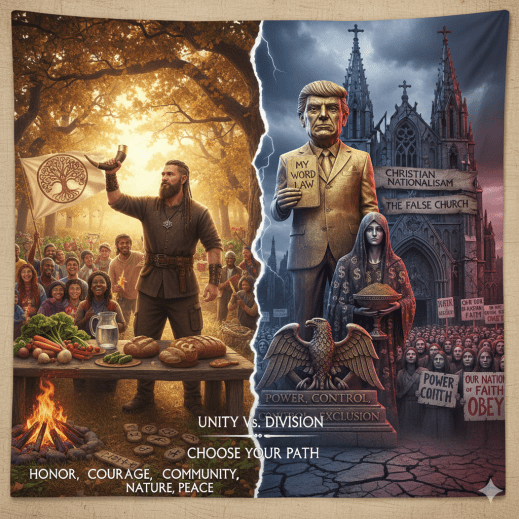
Greetings, fellow seekers of wisdom and wanderers of the web! I’m Volmarr, a modern Viking navigating the currents of contemporary life in the USA. In this age of rapid change and clashing ideologies, I draw my strength from the ancient Norse Pagan traditions—Heathenry, as some call it—adapted to fit the society I live in. I’m not out raiding villages or sailing longships across stormy seas (though I love a good adventure game!). Instead, I embody the core values of my spiritual ancestors: honor, courage, resilience, hospitality, and a deep respect for the natural world and personal wyrd (fate). These principles guide me in building a stable, peaceful life, fostering community, and standing firm against threats to freedom and diversity.
As a Norse Pagan, I honor the gods like Odin, Thor, Freyja, and the spirits of land and ancestors through rituals that make sense in modern times—perhaps a blót (offering) in my backyard during the equinox, or meditating on the Eddas while sipping energy drink before engaging in creative projects. I value self-reliance, mutual aid, and living in harmony with the cycles of nature, all while participating in a multicultural society. This path isn’t about rejecting progress; it’s about weaving timeless wisdom into everyday actions, like advocating for environmental stewardship or supporting local farmers who echo the agrarian roots of old Norse life. But let’s be clear: I don’t follow the teachings of Jesus. Christianity isn’t my spiritual home, and that’s okay—faith is personal, and mine is rooted in the polytheistic, nature and ancestor-venerating ways of the North.
That said, I extend my hand in brotherhood and sisterhood to those who do genuinely follow Jesus’ teachings. The core messages of love, compassion, forgiveness, humility, and caring for the vulnerable? Those resonate across traditions. If you’re a Christian living out “love thy neighbor” without coercion, turning the other cheek in the face of hate, or feeding the hungry as Jesus commanded—welcome to the hall! We’re allies in pursuing a world where people of all backgrounds can chase life, liberty, and happiness without fear. True faith, in any form, builds bridges, not walls.
However, there’s a shadow looming over this landscape of potential unity: Christian Nationalism. This isn’t the faith of Jesus—far from it. It’s what the Christian Bible itself warns against as the “False Church,” a corrupt institution symbolized in Revelation as the Whore of Babylon, drunk on power and allied with empires of greed. Christian Nationalism twists spirituality into a tool for dominance, echoing the Roman Empire’s obsession with control, conquest, and exclusion rather than Jesus’ radical calls for peace, non-violence, and equality. Jesus rejected worldly kingdoms, preached against judging others, and flipped tables on exploitative systems. Yet, this movement seeks to impose a theocratic vision on society, blending faith with nationalism to justify division, fear-mongering, and policies that favor one group over all others. It’s not about salvation; it’s about supremacy, and that poisons the well for everyone.
Worse still, in the United States today, a large portion of those who claim Christianity have drifted from following YHWH or Jesus, elevating Donald Trump to a god-like status. He’s become their messiah figure—an “anointed” leader whose words and agenda supersede scripture. We’ve seen it in the rhetoric: comparisons to biblical kings like Cyrus or Jehu, claims of divine protection, and blind loyalty that excuses flaws while demanding absolute devotion. This isn’t devotion to Jesus; it’s idolatry, plain and simple, where political power trumps spiritual truth. Trump isn’t a deity—he’s a mortal man, and conflating him with the divine risks turning faith into a cult of personality, eroding the very principles of humility and love that Jesus embodied.
This shift poses a major danger not just to Christians, but to all of us. It threatens the fabric of a free, pluralistic society where Norse Pagans like me, true followers of Jesus, Muslims, Jews, Hindus, atheists, and everyone else can coexist peacefully. As modern Vikings and Norse Pagans, we know from our sagas the perils of unchecked ambition and false idols—stories like Ragnarok warn of chaos when balance is lost. We must stand opposed, alongside clear-minded people of all faiths, cultures, and backgrounds. This isn’t about attacking religion; it’s about defending authentic spirituality from distortion and protecting our shared pursuit of stability and justice.
Let’s raise our horns to unity in diversity. Honor your path, respect others’, and resist any force that seeks to impose its will through fear or false prophets. Skål to a better world—may the Norns weave favorable threads for us all.
What are your thoughts, kin? Share in the comments below. Until next time, stay true to your wyrd.
— Volmarr

This work is licensed under a Creative Commons Attribution-NonCommercial-ShareAlike 3.0 Unported License.

 Volmarr’s Tumblr
- Today my book is born into the world.
- A Question for Reconstructionist Norse Heathens
- View On WordPress
- View On WordPress
- View On WordPress
- View On WordPress
- Authenticity as Worthiness: Reconceptualizing the Norse “Worthy Dead” Beyond the Battlefield
- The Bunker and the Web
- The Heathen Third Path: A Canonical Synthesis
- Heathen Third Path: AI Canon and Ritual Manual

