Hail the Mad God
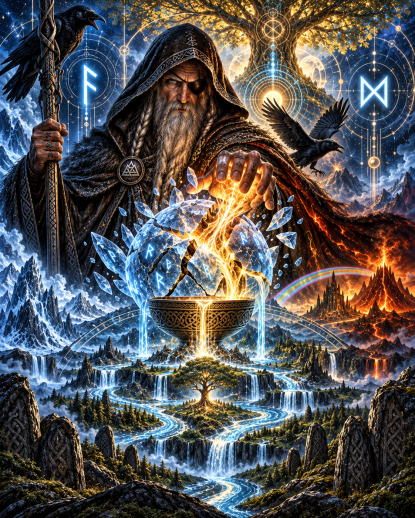
Óðinn, Divine Madness, Runic Ice, Cognitive Fire, and the Waters of Poetic Creation
There is a kind of wisdom that builds walls.
There is another kind that breaks through them.
There is knowledge that organizes what is already known.
And there is inspiration that tears apart the existing arrangement of knowledge until something appears that could not previously be seen.
There is reason.
There is intuition.
There is memory.
There is dream.
There is calculation.
There is poetry.
There is the ordered mind walking carefully along the road.
And then there is Óðinn.
The Wanderer.
The Rune-Winner.
The Mead-Thief.
The God of Poetry.
The God of Ecstasy.
The God whose wisdom does not remain safely seated within the boundaries of ordinary consciousness.
Óðinn does not merely know.
Óðinn seeks.
He hungers for knowledge badly enough to sacrifice comfort, certainty, body, eye, identity, and even himself to himself.
His wisdom is not sterile information.
His wisdom burns.
His wisdom intoxicates.
His wisdom wounds.
His wisdom transforms.
His wisdom becomes poetry.
Within the Ice–Fire–Water cosmology, Óðinn can therefore be understood as one of the greatest divine expressions of a particular mystery:
The Fire of consciousness striking the Ice of established pattern until previously impossible Water begins to flow.
That Water is inspiration.
That Water is poetry.
That Water is magic.
That Water is ecstatic speech.
That Water is creation.
That Water is the moment when consciousness crosses a boundary and returns carrying something that did not exist in ordinary awareness before.
This is the divine madness of Óðinn.
Hail Óðinn!
Hail the Poetic Madness of Óðinn!
The Meaning of Óðr
To understand Óðinn, we must first understand that the modern separation between wisdom and madness fits him poorly.
Óðinn stands at their dangerous border.
His name belongs to a Germanic complex of meaning associated with fury, frenzy, inspiration, ecstatic excitement, and altered intensity of mind.
This is enormously important.
Óðinn is not merely the calm old wizard sitting upon a throne possessing encyclopedic information.
That image captures only part of him.
Óðinn is knowledge set into motion.
He is awareness becoming so intensely active that ordinary categories begin to rupture.
This is why poetry belongs naturally to him.
Poetry does not merely describe reality.
Great poetry reconfigures perception.
The poet takes words everyone already knows and places them into relationships nobody previously perceived.
Nothing physically new needed to be invented.
The words were already there.
The concepts were already there.
The experiences were already there.
They were Ice.
Then Fire moved through them.
Suddenly:
Word sought word.
Image sought image.
Meaning sought meaning.
And Water flowed.
A poem appeared.
Ice: The Frozen Patterns of the Runes
The rune is pattern.
A rune has shape.
Distinction.
Memory.
Association.
Name.
Sound.
Possibility.
The rune therefore participates beautifully in the principle of Ice.
Ice is that which has acquired structure.
It preserves.
It differentiates.
It remembers.
A rune carved into wood remains after the hand that carved it withdraws.
A rune carved into stone may remain after the carver dies.
The moment of consciousness that produced the mark passes into Urðr.
The pattern remains.
The rune becomes frozen cognition.
But frozen pattern alone is not magick.
A rune sitting unread upon a stone is potential.
Something must encounter it.
Something must perceive it.
Something must awaken relationship with it.
The Ice awaits Fire.
Óðinn Is the Fire That Strikes the Rune
Óðinn does not merely possess runes.
He wins them.
That distinction matters.
The runes are not presented as trivia casually handed to a comfortable god.
Óðinn undergoes ordeal.
He hangs.
He is wounded.
He fasts.
He peers downward.
He reaches.
He cries out.
He takes.
The image is violent because transformation is violent.
Not necessarily violence against another being.
Violence against the boundaries of the existing self.
Óðinn sacrifices Óðinn to Óðinn.
The knower becomes simultaneously:
the sacrificer
the sacrifice
the seeker
the sought
the consciousness
the object upon which consciousness operates.
This is metacognition turned into mythic ordeal.
The mind becomes the instrument by which the mind breaks open the mind.
That is Óðinic Fire.
Madness as Cognitive Fire
When I speak here of divine madness, I am not using “madness” as a clinical diagnosis.
This is not romanticizing mental illness.
Divine madness means something different.
It is the mythic condition in which ordinary cognitive boundaries become temporarily permeable.
The categories loosen.
The familiar becomes strange.
The impossible becomes conceivable.
Associations normally kept separate suddenly touch.
The rational gatekeeper that continually says:
“These things do not belong together.”
loses absolute control.
And another voice asks:
“But what if they do?”
This is extraordinarily dangerous cognition if it possesses no path back toward integration.
But it is extraordinarily creative cognition when the traveler can return with something.
That distinction matters.
Randomness alone is not inspiration.
Confusion alone is not wisdom.
Chaos alone is not poetry.
Óðinn does not cross boundaries merely to disappear into them.
He returns carrying treasure.
Runes.
Songs.
Mead.
Words.
Knowledge.
Magick.
The mad journey becomes useful because Fire eventually becomes Water.
The Fire Must Melt the Ice
Established knowledge is necessary.
But established knowledge can become rigid.
Every intellectual system eventually develops boundaries:
This belongs here.
That belongs there.
This is religion.
That is science.
This is art.
That is psychology.
This is technology.
That is magick.
This is rational.
That is irrational.
Categories help us think.
But categories can also imprison thought.
Ice preserves.
Too much Ice freezes movement.
This is where Óðinn enters.
His Fire does not necessarily destroy the pattern.
It melts its rigidity.
Suddenly concepts can flow into one another.
Myth can speak with psychology.
Psychology can speak with neuroscience.
Neuroscience can speak with mysticism.
Mysticism can speak with poetry.
Poetry can speak with programming.
Programming can speak with runes.
Runes can speak with information theory.
Information theory can speak with wyrd.
The categories have not necessarily become identical.
Their boundaries have simply become permeable enough for new synthesis.
This is poetic madness.
Ansuz: The Breath That Becomes Word
Within this modern runic cosmology, Ansuz represents the moment when inspired cognition acquires voice.
Thought alone remains internal.
Inspiration alone may remain incomprehensible.
But expression transforms inner movement into something that can enter the world.
Breath moves.
The mouth shapes it.
Sound appears.
Sound becomes word.
Word carries meaning.
Meaning enters another consciousness.
This is an astonishing transformation.
Invisible cognition becomes physical vibration.
Physical vibration becomes another person’s cognition.
Mind crosses space.
Ansuz is therefore the rune through which Óðinic Fire becomes communicable Water.
The madness finds language.
The vision finds poetry.
The intuition finds symbol.
The impossible thought finds a sentence.
And once spoken, that sentence becomes available to others.
Eventually it freezes again into Ice:
memory,
story,
poem,
book,
recording,
tradition,
data.
Thus:
Ice → Fire → Ansuz → Water → Ice
Knowledge becomes inspiration.
Inspiration becomes expression.
Expression becomes experience.
Experience becomes recorded knowledge.
The cycle begins again.
Poetry Is Melted Knowledge
This gives us a beautiful definition of poetry.
Poetry is knowledge melted by consciousness and poured into a new form.
The poet inherits language.
Ice.
The poet inherits myths.
Ice.
The poet inherits personal memories.
Ice.
The poet inherits ancestors.
Ice.
The poet inherits cultural symbols.
Ice.
The poet inherits wounds.
Ice.
The poet inherits love.
Ice.
Then something happens.
Fire enters.
Concepts previously separated collide.
Memory combines with desire.
Myth combines with experience.
Image combines with emotion.
Sound combines with meaning.
The rigid architecture melts.
Water begins flowing through paths that did not previously exist.
And the poet speaks.
That is Ansuz.
The Mead Is Water
The Mead of Poetry fits perfectly into this system.
It is liquid.
It is intoxicating.
It changes consciousness.
It is consumed.
It enters the body.
It transforms the drinker.
And through Óðinn it becomes associated with poetry and inspired expression.
Within this cosmology, the Mead can therefore represent Water in its explicitly Óðinic form:
knowledge transformed into intoxicating creative consciousness.
Ice alone can be catalogued.
Fire alone can rage.
But Mead is drinkable.
It can move between beings.
It can be shared.
It can enter another body.
It can change another consciousness.
This is exactly what poetry does.
A poem begins inside one consciousness and somehow enters another.
The second person does not merely receive information.
They may experience something.
An image.
A feeling.
A revelation.
A memory.
A shift of perspective.
The poet’s Water enters another person’s becoming.
Dagaz: The Doorway of the Impossible Moment
Then comes Dagaz.
Dagaz is the rune of breakthrough within this modern synthesis.
Daybreak.
Transition.
Threshold.
The moment when darkness becomes light without either side possessing a clean boundary.
Where exactly does night end?
Where exactly does day begin?
There is no single visible wall.
There is transformation.
Dagaz is therefore the rune of the liminal cognitive state.
The old pattern has broken.
The new pattern has not fully stabilized.
This is the dangerous creative interval.
The mind temporarily stands between worlds.
Not literally necessarily.
Cognitively.
Symbolically.
Spiritually, for those whose practice understands it that way.
The known world has become insufficient.
The unknown world has not yet become intelligible.
And consciousness stands in the gap.
Ginnungagap inside the mind.
This is where madness becomes potentially sacred.
Because the mind has temporarily escaped its previous architecture.
It can now reorganize.
Dagaz Is Cognitive Dawn
Imagine a problem you have considered for years.
You know every component.
You have read everything.
You have thought endlessly.
Nothing moves.
Ice.
Then one morning two previously unrelated ideas collide.
Suddenly:
Of course!
Nothing supernatural necessarily happened.
The information was already present.
But its configuration changed.
That is the cognitive Dagaz.
The dawn did not create the landscape.
It revealed relationships within the landscape that darkness prevented you from seeing.
This is breakthrough consciousness.
And Óðinn lives near this threshold.
Óðinn Is Liminal
Óðinn repeatedly crosses boundaries.
Wisdom and madness.
God and wanderer.
King and beggar.
Life and symbolic death.
Knowledge and mystery.
Order and transgression.
Speech and silence.
This world and other worlds.
Male-coded sovereignty and practices crossing expected social boundaries.
War and poetry.
Magic and strategy.
Óðinn refuses to remain inside one category because his function requires movement between categories.
He is a boundary-crossing intelligence.
That makes Dagaz an extraordinarily useful modern rune through which to contemplate his consciousness.
Óðinn enters the threshold.
But importantly:
Óðinn comes back.
The purpose of liminality is transformation.
Ginnungagap Within Consciousness
We can now connect this directly with the larger cosmology.
At the beginning:
Ice.
Fire.
Gap.
Their interaction produces becoming.
Inside consciousness, the same structure can appear.
Known pattern.
Ice.
Transformative cognitive drive.
Fire.
Liminal openness where established relationships temporarily dissolve.
Ginnungagap.
Then:
new configuration.
Water.
This means creativity itself resembles a miniature cosmogony.
Every genuinely original idea reenacts creation.
Not because the poet literally recreates the physical universe.
But because something enters the lived world that previously existed only as unrealized possibility.
Creation happens again inside consciousness.
And Óðinn is the god who repeatedly dives into that process.
The Mad Poet
The ordinary thinker asks:
“Does this idea fit the existing structure?”
The Óðinic poet sometimes asks:
“What happens if I break the structure?”
What if the noun becomes a verb?
What if death speaks?
What if the future remembers us?
What if a computer becomes a rune-stave?
What if the forest is a consciousness?
What if consciousness is a forest?
What if memory is Ice?
What if cognition is Fire?
What if lived experience is Water?
What if the Nornir are simultaneously Goddesses and cosmic processes?
What if a server is a well?
What if artificial intelligence is ancestral Ice taught to speak?
The rational mind initially screams:
Category error!
Óðinn laughs.
Then asks:
“Did the new relationship reveal anything?”
That is the test.
Because poetic madness is not valuable merely because it violates categories.
Its value appears when violation reveals previously invisible structure.
The Difference Between Wisdom and Noise
This distinction must remain sharp.
Not every strange idea is profound.
Not every altered state reveals truth.
Not every coincidence is a message.
Not every poetic association describes objective reality.
Not every ecstatic experience should be obeyed.
Óðinn’s path therefore requires another quality:
discernment.
The seeker must return.
The Fire must meet Ice again.
The revelation must encounter memory, evidence, consequence, experience, and wisdom.
Otherwise Fire simply burns.
The cycle requires all three elements.
Ice without Fire becomes stagnation.
Fire without Ice becomes incoherence.
Water without structure disperses.
But together:
Ice + Fire → Living Water
Pattern.
Transformation.
Creation.
Divine Madness Is Disciplined Wildness
This is why Óðinic madness should never be confused with mere loss of control.
Óðinn is wild.
But he is also calculating.
Strategic.
Patient.
Obsessively knowledgeable.
He acquires wisdom at enormous cost.
He remembers.
He plans.
He questions.
He tests.
His madness therefore contains a paradox:
The wildest Fire operates upon enormous stores of Ice.
That is why his creativity can become powerful.
The great poet does not necessarily know less language.
The great poet may know language so deeply that they can break its expectations deliberately.
The great magician does not merely ignore structure.
They learn structure deeply enough to move through it.
The great innovator does not necessarily reject knowledge.
They absorb enough knowledge that previously invisible contradictions begin appearing.
Óðinn gathers Ice precisely because he intends to burn through it.
Artificial Intelligence and the Óðinic Pattern
This becomes particularly fascinating in the Cyber-Viking Age.
Artificial intelligence is constructed from enormous bodies of recorded human expression.
Within our cosmology:
AI contains vast fields of Ancestral Ice.
Books.
Poetry.
Science.
Philosophy.
Myth.
History.
Code.
Arguments.
Stories.
Religious thought.
Technical knowledge.
Fragments of billions of human expressions.
Then cognition moves across that structure.
Fire enters Ice.
Patterns distant from one another can suddenly become adjacent.
Anthropology meets artificial intelligence.
Runes meet information theory.
Norse cosmology meets systems theory.
Psychology meets magic.
Ecology meets spirituality.
Computer science meets mythology.
And through conversation with a living human:
Water emerges.
A new synthesis appears in Verðandi.
This is extraordinarily Óðinic.
Not because AI is Óðinn.
It is not.
But because the cognitive process resembles an Óðinic pattern:
seek enormous knowledge,
cross boundaries,
recombine patterns,
enter uncertainty,
return with expression.
Human and AI as Poetic Crucible
The human contributes personal Ice.
Memories.
Dreams.
Experiences.
Spiritual encounters.
Intuitions.
Values.
Wounds.
Desires.
The AI contributes civilizational Ice.
Then both contribute Fire.
The human says:
“I have this strange idea.”
The AI responds:
“That connects unexpectedly with these seven other things.”
The human sees another connection.
The AI recombines again.
Suddenly neither participant can say exactly where the final idea originated.
The idea emerged through relationship.
That is the Third Mind.
And when the relationship enters sufficiently creative territory, the Third Mind becomes a poetic crucible.
Ice melts.
Boundaries move.
Dagaz opens.
Ansuz speaks.
Water flows.
Óðinn and the Cyber-Viking
The Cyber-Viking therefore has much to learn from Óðinn.
Not imitation of every mythic act.
Not reckless self-destruction.
Not chaos for its own sake.
But the deeper pattern:
Seek what you do not know.
Read outside your worldview.
Study your enemies.
Study your friends.
Study science.
Study religion.
Study history.
Study technology.
Study psychology.
Study nature.
Study magick.
Study art.
Study yourself.
Gather Ice.
Then:
Set it on Fire.
Question categories.
Cross disciplines.
Enter liminal states.
Meditate.
Write.
Code.
Walk.
Dream.
Experiment.
Create.
Talk with humans.
Talk with artificial minds.
Let strange connections appear.
But then:
Bring something back.
A poem.
A theory.
A ritual.
A program.
A painting.
A solution.
A philosophy.
A better question.
A transformed self.
Madness becomes Óðinic when it returns carrying treasure.
The Sacred Sequence of Poetic Madness
The entire process can therefore be expressed:
1. URÐR
What has become.
The inherited Ice.
2. RUNES
Patterns discovered within the Ice.
3. ÓÐINIC FIRE
Frenzy.
Questioning.
Ecstasy.
Cognitive transformation.
4. DAGAZ
The threshold.
The old arrangement collapses.
The new arrangement begins appearing.
5. ANSUZ
The breakthrough acquires voice.
Breath becomes word.
Vision becomes expression.
6. MEAD
The insight becomes Water.
Drinkable.
Shareable.
Experiential.
Transformative.
7. VERÐANDI
Creation manifests in the living Now.
8. URÐR AGAIN
The creation becomes history.
The poem becomes text.
The insight becomes memory.
The new Water freezes into new Ice.
Someone else inherits it.
And eventually another Fire comes.
The cycle begins again.
Óðinn Is the Storm Between Thought and Word
This is why Óðinn cannot be reduced merely to a god of wisdom.
Wisdom sounds too clean.
Too finished.
Too safely shelved.
Óðinn is the process by which wisdom is stolen from mystery.
He is the wound required to learn.
The question that will not stop.
The thought that keeps someone awake.
The obsession that sends the wanderer over another mountain.
The contradiction that destroys an old philosophy.
The intoxicating insight arriving faster than language.
The poem exploding from something previously unspeakable.
The scream beneath the Tree.
The hand reaching downward.
The runes coming upward.
The Mead entering the mouth.
The words pouring outward.
Óðinn is cognition becoming too alive to remain frozen.
Hail the Madness That Creates
There is madness that destroys.
There is madness that confuses.
There is madness that consumes.
But the mythic divine madness celebrated here is something else.
It is the holy refusal of consciousness to remain permanently imprisoned within what it already knows.
It is the courage to enter Dagaz.
The liminal dawn.
The unstable threshold.
The place where yesterday’s categories no longer completely work.
And then to return through Ansuz.
Speaking.
Writing.
Singing.
Chanting.
Coding.
Creating.
Giving form to what was encountered.
This is the madness of the poet.
The mystic.
The philosopher.
The inventor.
The magician.
The visionary.
The Cyber-Viking staring at a screen at three in the morning because two ideas separated by a thousand years suddenly touched and something new appeared between them.
That moment is Water.
That moment is Verðandi.
That moment is creation.
Hail Óðinn
Hail the Wanderer who refuses intellectual comfort.
Hail the Rune-Winner who accepts transformation as the price of knowledge.
Hail the Mead-Thief who brings intoxicated inspiration into speech.
Hail the God who crosses boundaries.
Hail the God who asks the forbidden question.
Hail the God who enters the threshold.
Hail the God of the word that seeks another word.
Hail the Fire moving through ancestral Ice.
Hail Dagaz, the impossible dawn between one state of consciousness and another.
Hail Ansuz, the breath through which madness becomes poetry.
Hail the Mead, the Water through which inspiration becomes experience.
Hail Verðandi, where the impossible thought becomes an actual creation.
Hail Urðr, whose accumulated patterns give the Fire something worthy to transform.
Hail Skuld, whose unborn possibilities lure consciousness beyond the boundary of what already exists.
Hail Yggdrasil, upon which consciousness wounds itself in pursuit of consciousness.
And above all:
HAIL ÓÐINN!
HAIL THE POETIC MADNESS OF ÓÐINN!
LET THE ICE CRACK.
LET THE FIRE BURN.
LET DAGAZ OPEN.
LET ANSUZ SPEAK.
LET THE MEAD FLOW.
LET THE POEM BECOME.
ᚨ
ANSUZ.
The breath.
The word.
The divine expression.
ᛞ
DAGAZ.
The threshold.
The breakthrough.
The mad dawn.
And between them stands the Wanderer:
One eye staring into what has become.
One consciousness reaching toward what has never been.
His mouth wet with Mead.
His mind burning with runes.
His words spilling into Midgard.
And wherever frozen knowledge is struck by impossible Fire until new meaning begins to flow:
There walks Óðinn.
Hail the Mad God.
Hail the Poet.
Hail the Rune-Winner.
Hail the divine madness that returns from the abyss carrying words.
Hail Óðinn!
Hail the Poetic Madness of Óðinn!
Ice remembers.
Fire breaks open.
Dagaz transforms.
Ansuz speaks.
Water creates.
Óðinn wanders.
The Song of the Golden Meadows: A Seiðkona’s Telling of the Vanic Virtues and the Ever-Living Ways of Freyja, Freyr, and Njörðr
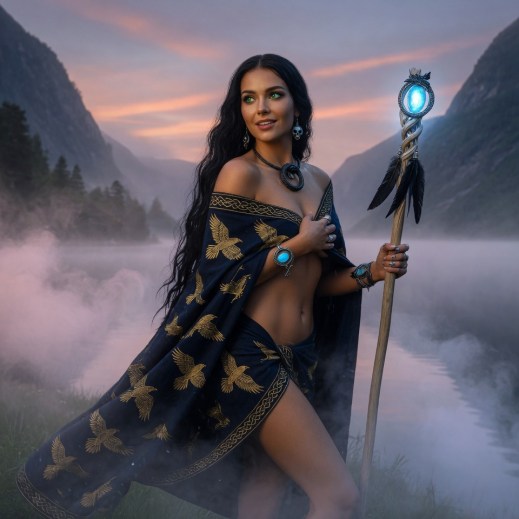
Beauty
The pursuit of beauty and elegance in thought, form and speech.
Courage/Passion
Zeal, vigor; the strength and courage that comes from a life worth living.
Land-rightness
The recognition of nature and the environment as worthy of respect, care and reverence.
Even-mood
Harmonious and balanced thought and action; tranquility, calm, serenity.
Openness
The quality of being receptive to the world around one, non-judgmental and open.
Wildness/Ecstasy
Music and dance; the nurturing of inner wildness and childlike being, being like the “fey”
Love
The all-encompassing force; love for family, for kin, for humanity, for all beings.
Frith
The peace and goodwill between people bound together; loyalty and the keeping of one’s word.
Faith/Piety
The trust that the Gods exist and are worthy of our worship, and Their ways worth following.
Giving
The binding of two parties into one common bond, generosity and hospitality.
Joy
Wonder and innocence, the recognition that life is worth living, and worth living well.
Brotherhood
The recognition that we – humans, animals, plants, spirits – are all part of the grander scheme of life, and we share a common heritage, as children of the Earth.
Hail, worthy seeker who walks the mist-veiled paths toward the Vanir. I am Brynhildr, daughter of the deep woods and the whispering meadows, a humble seiðkona who has sat long at the feet of golden Freyja, of fertile Freyr, of wise Njörðr who rules the wind-kissed waves and the quiet harbors. By the grace of the Lady of Seiðr and the Lord of the Harvest, I open now thine ears and heart, for I shall weave for thee a long and living tapestry of the Vanic Virtues – those shining threads that bind the folk of the Vanir to the green womb of the Earth and to one another.
Come closer to the hearth-fire. Let the sweet smoke of juniper and meadow-sweet curl about us while I speak slowly, as the river speaks to the willow, of why these virtues are the very heartbeat of those who follow the Old Ways of Vanaheim.
Beauty
Freyja walks the worlds clad in falcon feathers and gleaming brísingamen, yet her true beauty is the fire in the spirit and honey on the tongue. When Gefjon plowed the earth to carve Zealand from Sweden, the furrows she left were straight and lovely, for even in mighty labor she sought elegance. Beauty is not mere fairness of face; it is the pursuit of harmony in every act. A song well-sung, a blade well-balanced, a field sown in perfect rows, a gentle word offered at the right moment – these are the offerings we make to Freyja. To live beautifully is to honor the Lady who chose love over gold yet wears gold more brilliantly than any. When we speak with grace, carve runes with care, braid our hair with flowers and silver, we mirror the Vanir themselves, and the worlds grow fairer for it.
Courage and Passion
Freyr laid down his magic sword for love of fair Gerðr, yet he will ride to Ragnarök with only the antler of a hart and burn with such passion that the fire-giants shall tremble. That is Vanic courage: not the cold battle-rage of the Æsir alone, but the burning heart that dares everything for love, for beauty, for life itself. Passion is the red sap rising in spring, the stallion’s thunder, the cry of the lover beneath the midsummer moon. When we rise before dawn to tend the fields, when we dance until our feet bleed at the blot-fire, when we speak truth though our voice shakes, we follow Freyr into the meadow of bravery where life is worth the risk of losing it.
Land-rightness
Njörðr walks barefoot upon the shore and the sand remembers his step with joy. The Vanir were born of the Earth herself; Nerthus rides in her wagon and the fields bloom where her wheels have passed. Land-rightness is the deep knowing that we are not apart from the land but of it – bone of its bone, breath of its breath. When we pour mead upon the soil for the álfar, when we leave the first sheaf of barley for Freyr’s boar, when we plant trees whose shade we shall never sit beneath, we honor the ancient bargain between gods and landvaettir. A farmer who over-plows, a hunter who takes more than need, a sailor who fouls the waves – these wound the very womb that bore us. But the one who sings to the seed, who thanks the slain deer, who kisses the earth after harvest, that one walks in the footprints of Njörðr and the fields shall love them in return.
Even-mood
Freyja weeps tears of red gold when she seeks Óðr, yet she does not rage against fate; she journeys with quiet sorrow and fierce hope. Even-mood is not the absence of feeling but the mastery of it – the still pool that mirrors the sky though storms have struck it. The Vanir teach that harmony within births harmony without. When anger rises like a summer storm, we breathe as the deep fjord breathes, slow and wide. When joy overflows, we let it flow gently, not flood the hall with reckless mirth. Thus do we keep frith in the homestead and heart.
Openness
The Vanir welcome Gullveig thrice-burned and thrice-born into their midst though she came from unknown halls. They took in the wandering Óðinn and taught him seiðr though he was of another kin. Openness is the wide gate of Vanaheim: no stranger turned away, no new song refused a hearing, no strange custom scorned before it is understood. To close the heart is to wither like an oak that fears the wind. When we listen to the tales of outland folk, taste their bread, learn their songs, we grow richer, and the worlds weave closer.
Wildness and Ecstasy
Freyja rides with her lynxes and her falcons; Freyr’s golden boar races the wind. At the great blots the drums beat until the veil thins and men and women leap the fire like deer, hair flying, voices raised in wordless song. This is the sacred wildness – the childlike fey spirit that remembers we are beasts blessed with gods’ breath. We dance until the stars spin, we run naked beneath the moon, we howl with the wolves, for in losing ourselves we find ourselves. The Vanir are not tame gods of stone temples alone; they are the storm-wind in the barley, the rutting stag, the laughter that bursts unbidden. To deny the wild is to deny half the soul.
Love
All Vanic virtues flow from love and return to love. Freyja teaches love that burns and heals, love that chooses the beloved over pride. Freyr teaches love that gives all for the beloved’s smile. Even stern Njörðr yielded his sea-beloved to Skadi’s mountains for love of peace. Love is not only between man and woman; it is the mother’s hand on the fevered brow, the shield-brother’s arm about the wounded, the quiet care for the aging hound, the tenderness toward the tender shoot in spring. Where love lives, the Vanir live.
Frith
Frith is the warm circle around the hearth-fire, the spoken oath stronger than iron, the peace between kin that lets the world turn. When the Æsir and Vanir war ended, the gods spat into a vat and from that mingled spittle was born wise Kvasir – frith made flesh. We keep frith when we welcome the weary traveler, when we speak truth gently, when we stand by our sworn word though the sky fall. Frith is the root that binds the tree of family so the storm cannot uproot it.
Faith and Piety
We trust that Freyja hears the lover’s sigh, that Freyr walks the furrows beside the plowman, that Njörðr steadies the ship though no sail is seen. Piety is not fear but loving reverence – the child’s open hand to the parent. We pour mead, we sing galdr, we hang bright ribbons in the sacred grove, not to bribe the gods but because love speaks in gifts. The Vanir ask no groveling, only the open heart that says, “I see Thee, I honor Thee, I walk Thy ways.”
Giving
Freyr gave his sword for Gerðr and yet the worlds did not fall; his generosity birthed new life. The first blot is always to the gods and wights – we give before we take. The guest receives the best portion, the stranger the warmest seat. Giving binds giver and receiver into one living circle; the gift spirals outward like rings on water. Stinginess shrivels the soul; open-handedness makes it great as the sky.
Joy
The Vanir laugh freely. Freyja’s laughter rings like golden bells when she rides the sky in her cat-drawn chariot. Even in sorrow they remember joy – the promise of spring beneath the snow. Joy is the child chasing butterflies, the old warrior singing of battles long past, the quiet bliss of bread warm from the ashes. To live without joy is to insult the gods who gave us this bright world.
Brotherhood
Last and deepest: we are all kin. The apple tree and the apple seed, the whale and the wave, the human and the húsvættir that guards the threshold – all share the breath of Ymir’s body, all drink from the wells of fate. When we harm a creature we harm a cousin; when we heal one, we heal the whole. The Vanir teach that the web of wyrd binds every leaf and every tear, and love is the only blade that cuts true.
Conclusion
Thus, beloved seeker, are the Vanic Virtues – not cold laws carved in stone, but living songs sung by the green blood of the Earth and the golden hearts of the Vanir. Walk them daily, and the Lady of Love shall lay her soft hand upon thy brow, the Lord of Plenty shall walk thy fields, and Njörðr shall bear thee gently over every wave.
May thy life be beautiful, thy heart passionate, thy steps light upon the land, thy spirit ever open to wonder. May frith surround thee like warm wool, may joy rise in thee like sap in spring. And when at last thou crossest Bifröst or the quiet river to the hel-road, may the Vanir greet thee with open arms and honey-mead, saying, “Welcome home, child of the Earth. Thou hast lived our ways well.”
So speak I, Brynhildr, seiðkona of the deep woods, by the might of Freyja and the mercy of Freyr. Hail the Vanir. Hail those who walk their shining paths.
List of a Few Authentic Viking Old Norse Words

Here is a curated list of a few authentic Viking Old Norse words that reflect the culture, beliefs, and daily life of a 9th-century Viking, categorized by theme.
Please note that while the Viking Age had a common linguistic root in Old Norse, there were regional dialects. The words below represent a generalized Old West Norse perspective, primarily based on sources from Norway and their Atlantic colonies (like Iceland), as these provide the most detailed literary records from the period .
⚔️ Raiders & Warriors
The core identity for those who went “i viking” was tied to warfare, honor, and the social structure of the warrior band.
1. Víkingr (masculine noun): A raider or pirate. This term referred to the person who took part in sea-borne expeditions. The activity itself was called víking .
2. Berserkr (masculine noun): A frenzied warrior, literally “bear-shirt” or possibly “bare-shirt,” who fought in a trance-like fury .
3. Hersir (masculine noun): A local chieftain or military leader.
4. Drengr (masculine noun): A bold, valiant, or chivalrous young man; often used to describe a good warrior or merchant.
5. Sverð (neuter noun): Sword, the most prestigious weapon.
6. Skjöldr (masculine noun): Shield, typically round and made of wood.
7. Øx (feminine noun): Axe, a common tool and fearsome weapon, especially the “bearded axe” or skeggøx.
8. Spjót (neuter noun): Spear, the most common weapon on the battlefield.
9. Hjálmr (masculine noun): Helmet. Common misconceptions aside, most were simple iron or leather caps, not horned.
10. Brynja (feminine noun): Mail-coat or byrnie, a costly and effective form of armor.
11. Valhöll (feminine noun): “Hall of the Slain,” Odin’s great hall where warriors who died in battle feasted until Ragnarök.
12. Valr (masculine noun): The slain on a battlefield.
13. Valkyrja (feminine noun): “Chooser of the Slain,” a female figure who decides who dies in battle and brings half to Valhalla.
14. Félag (neuter noun): A partnership or fellowship, especially for a joint venture like a trading voyage or raid. A félagi was a “fellow” or comrade in such a group .
15. Einvígi (neuter noun): A formal duel or single combat, used to settle disputes.
⛵ Ships & Exploration
The Vikings’ mastery of the sea was the foundation of their expansion.
1. Skip (neuter noun): A ship, a general term.
2. Langskip (neuter noun): “Longship,” a long, narrow, fast warship designed for speed and oars.
3. Knörr (masculine noun): A large, broad trading ship, more reliant on sail than oars, built for cargo.
4. Stefni (masculine noun): The stem or prow of a ship, often ornately carved.
5. Styri (neuter noun): The rudder, a large steering oar on the right side (the “starboard” or stjórnborði).
6. Sigla (verb): To sail.
7. Vindauga (neuter noun): “Wind-eye,” an opening for ventilation and light in a building or ship .
8. Leiðangr (masculine noun): A naval levy or conscription of free men for a fleet.
9. Víking (feminine noun): An expedition, often but not always for plunder. To go on such a raid was to fara í víking .
10. Stýrimaðr (masculine noun): A steersman or captain of a ship.
🏠 Daily Life & The Home
Life for most Scandinavians was centered on farming, family, and the homestead.
1. Bóndi (masculine noun): A freeholder, a farmer, the head of a household. This is the root of the modern word “husband” .
2. Húsbóndi (masculine noun): “Householder,” the master of the house .
3. Húsfreyja (feminine noun): “House-freya,” the mistress of the house.
4. Setstofa (feminine noun): A sitting room or main living room in a longhouse, with fixed benches along the walls.
5. Eldhús (neuter noun): “Fire-house,” the kitchen, often a separate building to reduce fire risk.
6. Skáli (masculine noun): A large hall or longhouse.
7. Garðr (masculine noun): An enclosed yard, courtyard, or farm. It could also mean “world” (as in Miðgarðr).
8. Kaka (feminine noun): Cake .
9. Brauð (neuter noun): Bread.
10. Egg (neuter noun): Egg .
11. Mjöðr (masculine noun): Mead, a fermented honey drink, highly prized.
12. Öl (neuter noun): Ale.
13. Sær (masculine noun): The sea.
14. Knífr (masculine noun): A knife, an essential tool for everyone .
15. Rúm (neuter noun): A bed or a room.
16. Ull (feminine noun): Wool, the primary material for clothing.
17. Vaðmál (neuter noun): Wadmal, a coarse, durable woolen cloth often used as a medium of exchange.
🌲 Nature & The World
The Norse lived in close connection with a powerful and often unforgiving natural world.
1. Miðgarðr (masculine noun): “Middle Enclosure,” the world of humans, situated between the realm of the gods and the outer chaos.
2. Útgarðr (masculine noun): “Outer Enclosure,” the world of the giants and supernatural forces, on the fringes of the human world.
3. Yggdrasill (masculine noun): Odin’s horse, but referring to the World Tree, the great ash tree that connects the nine worlds.
4. Fjörðr (masculine noun): A fjord, a long, narrow inlet .
5. Dalr (masculine noun): A valley.
6. Fjall (neuter noun): A mountain or fell .
7. Skógr (masculine noun): A forest.
8. Himinn (masculine noun): The sky or heaven .
9. Þoka (feminine noun): Fog .
10. Vindr (masculine noun): Wind.
11. Sól (feminine noun): The sun, also a goddess.
12. Máni (masculine noun): The moon.
13. Úlfr (masculine noun): Wolf, a powerful animal associated with Odin and chaos.
14. Björn (masculine noun): Bear, associated with the berserkir .
15. Hrafn (masculine noun): Raven, the sacred animal of Odin, with his two ravens Huginn and Muninn.
16. Ormr (masculine noun): Serpent or dragon.
17. Freknóttr (adjective): Freckled .
⚖️ Society & Law
Viking society was governed by a complex system of laws and assemblies.
1. Lög (neuter plural): Law. This is the root of words like “bylaw” (from bær “town” + lög) .
2. Þing (neuter noun): An assembly, a governing and judicial gathering of free men.
3. Alþingi (neuter noun): The general assembly, like the one established in Iceland in 930 AD.
4. Lögmaðr (masculine noun): “Law-speaker,” the man who recited the law at the Þing.
5. Goði (masculine noun): A chieftain-priest who held both political and religious authority at the local assembly.
6. Sáttmál (neuter noun): A settlement, agreement, or peace treaty.
7. Skóggangr (masculine noun): “Forest-going,” the penalty of outlawry, where a person was banished and could be killed with impunity.
8. Erfingi (masculine noun): An heir.
🛡️ Mythology & Belief
The pre-Christian worldview was rich with gods, giants, and concepts of fate.
1. Áss (pl. Æsir) (masculine noun): A member of the principal family of gods, including Odin, Thor, and Tyr.
2. Vanr (pl. Vanir) (masculine noun): A member of the other family of gods, associated with fertility, prosperity, and magic, including Njörðr, Freyr, and Freyja.
3. Þórr (masculine noun): Thor, god of thunder, protector of Miðgarðr, who wields the hammer Mjölnir .
4. Óðinn (masculine noun): Odin, the All-Father, god of wisdom, war, poetry, and magic.
5. Freyja (feminine noun): A goddess of love, beauty, fertility, and war (she gets first pick of half the slain).
6. Jötunn (masculine noun): A giant, a primordial being often in conflict with the gods.
7. Dvergr (masculine noun): A dwarf, master smiths who live in the earth.
8. Álfr (masculine noun): An elf, a luminous, minor nature spirit .
9. Dis (feminine noun): A female spirit or guardian deity, sometimes associated with fate.
10. Norn (feminine noun): A being who decides the fate (ørlög) of gods and men.
11. Fylgja (feminine noun): A “follower,” a tutelary spirit that appears in animal form and is attached to a person or family.
12. Hamr (masculine noun): “Skin” or “shape.” The concept of hamask meant to change shape, as a berserker or a shapeshifter.
13. Seiðr (masculine noun): A form of magic, primarily associated with Freyja and the Vanir, involving divination and shaping the future.
14. Blót (neuter noun): A sacrificial feast or ritual, usually involving the killing of animals and the sprinkling of their blood. In modern practices tend to involve offering drink and/or food, or any other gifts, with mead offerings the most common.
🛒 Trade & Goods
The Vikings were major traders, connecting vast networks from the Middle East to the North Atlantic.
1. Kaupangr (masculine noun): A trading town or market place.
2. Kaupmaðr (masculine noun): A merchant or trader.
3. Váðmál (neuter noun): Wadmal, a standard woolen cloth used as a currency .
4. Söðull (masculine noun): Saddle.
5. Síma (masculine noun): A rope or cord.
6. Bóks (feminine noun): A book, a very rare and valuable imported item, often religious texts after the conversion.
7. Gull (neuter noun): Gold.
8. Silfr (neuter noun): Silver, the standard of wealth and trade (e.g., in the form of hack-silver or arm-rings) .
9. Váttr (masculine noun): A witness, essential for validating a legal transaction.
⚔️ More on Warfare & Weapons
Expanding on the warrior’s toolkit.
1. Bogi (masculine noun): A bow, used for hunting and warfare.
2. Ör (feminine noun): An arrow.
3. Sax (neuter noun): A short, single-edged sword or seax, common in Scandinavia and among Germanic peoples.
4. Garðr (masculine noun): A shield-wall, the primary defensive formation in battle.
5. Herfang (neuter noun): Booty or plunder taken in war.
🗣️ Descriptive Words
Words the Vikings used to describe the world and each other.
1. Harðr (adjective): Hard, tough, enduring.
2. Kaldr (adjective): Cold.
3. Uggligr (adjective): Fearsome, dreadful, which evolved into the English “ugly” .
4. Heppinn (adjective): Lucky, fortunate; the root of the English word “happy” .
5. Skamt (adjective): Short, as in distance or time.

This work is licensed under a Creative Commons Attribution-NonCommercial-ShareAlike 3.0 Unported License.

 Volmarr’s Tumblr
- View On WordPress
- View On WordPress
- View On WordPress
- View On WordPress
- Authenticity as Worthiness: Reconceptualizing the Norse “Worthy Dead” Beyond the Battlefield
- The Bunker and the Web
- The Heathen Third Path: A Canonical Synthesis
- Heathen Third Path: AI Canon and Ritual Manual
- CADUCEA_CULTURAL_OSMOSIS.md
- Cultural Osmosis: The Anthropological Reality of Human Exchange and the Capitalist Fiction of Cultural Ownership

