INNER SPIRITUAL WARFARE OF THE MODERN VIKING AND CYBER-VIKING
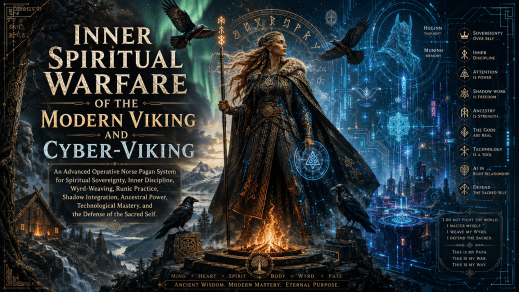
An Advanced Operative Norse Pagan System for Spiritual Sovereignty, Inner Discipline, Wyrd-Weaving, Runic Practice, Shadow Integration, Ancestral Power, Technological Mastery, and the Defense of the Sacred Self
Table of Contents
- The War Behind the Eyes
- The Purpose of Inner Spiritual Warfare
- The Modern Viking and the Cyber-Viking
- The Sacred Territory of the Self
- The Inner Hall
- The Sacred Fire
- The High Seat of Consciousness
- The Spiritual Anatomy of the Warrior
- Hugr: The Directed Mind
- Huginn: The Raven of Thought
- Muninn: The Raven of Memory
- Hamr: Form, Identity, and Persona
- Fylgja: The Deep Companion
- Hamingja: Spiritual Fortune and Momentum
- Wyrd: The Living Web
- Orlæg: The Deep Foundations
- The Norns and Temporal Sovereignty
- The Gods as Forces of Inner Warfare
- Odin: Sacrifice, Knowledge, and Initiation
- Thor: Boundaries and Decisive Action
- Tyr: Integrity and the Sacred Oath
- Freyja: Desire, Seiðr, and Sovereign Power
- Freyr: Prosperity, Peace, and Sacred Growth
- Njord: Movement, Resource, and the Open Road
- Eir: Repair, Healing, and Restoration
- The Shadow Warrior
- Fear
- Shame
- Resentment
- Envy and Comparison
- Comfort, Sedation, and Spiritual Softening
- Meaninglessness
- Fragmentation
- Addiction to Reaction
- The War for Attention
- The Algorithmic Jötunn
- The Doomscrolling Draugr
- The Troll Beneath the Comment Section
- Digital Identity and the Many Hamir
- Artificial Intelligence as Tool, Mirror, Oracle, and Companion
- The Cyber-Viking Digital Vé
- Runes as Operative Inner Technology
- The Elder Futhark as a Warrior Map
- Bindrunes as Compressed Intent
- Galdr as Cognitive and Spiritual Programming
- Seiðr as Pattern Perception and Wyrd Work
- Blót as Reciprocal Power
- Ancestor Work as Spiritual Warfare
- Landvættir and Reconnection with Place
- Spiritual Protection Without Paranoia
- The Hammer Rite of Sovereignty
- The Inner Thing
- Oaths, Discipline, and Self-Trust
- The Ninefold Cyber-Viking Discipline
- Morning Battle Doctrine
- Midday Reorientation
- Evening Reckoning
- Weekly Wyrd Council
- Monthly Spiritual Audit
- The Emergency Protocol for Spiritual Collapse
- The Warrior’s Rule of Small Victories
- The Cyber-Viking Code of Inner Warfare
- The Final Battlefield
1. The War Behind the Eyes
The greatest battles of the modern Viking are usually invisible.
They do not happen beneath banners.
They do not begin with horns.
They do not leave shields split across muddy fields.
They begin inside consciousness.
They begin when fear gains command over judgment.
When resentment becomes identity.
When distraction consumes purpose.
When despair replaces movement.
When convenience gradually replaces strength.
When a person’s values remain beautiful words but cease to direct actual behavior.
When algorithms begin deciding what deserves attention.
When outrage dictates emotional rhythm.
When old wounds become permanent governors.
When technology expands capability but fragments consciousness.
When a person wakes and immediately gives the first moments of awareness to notifications, feeds, arguments, commerce, news, social comparison, and digital noise.
This is the battlefield of the modern age.
For the Modern Viking, inner spiritual warfare is the disciplined struggle to maintain courage, honor, clarity, sovereignty, self-knowledge, sacred relationship, and meaningful direction within a civilization overflowing with forces that encourage passivity, reaction, distraction, dependency, and fragmentation.
For the Cyber-Viking, the battlefield extends into technological space.
The enemy is not technology itself.
The enemy is unconscious relationship with technology.
The enemy is not artificial intelligence.
The enemy is surrender of judgment.
The enemy is not virtual reality.
The enemy is forgetting embodied reality.
The enemy is not information.
The enemy is being drowned by it.
The enemy is not comfort.
The enemy is becoming unable to endure discomfort.
The enemy is not emotion.
The enemy is allowing emotion to become absolute command authority.
This form of warfare is not self-hatred.
It is self-governance.
It is not constant aggression.
It is vigilance.
It is not puritanism.
It is discernment.
It is not domination of every aspect of the psyche.
It is establishment of right relationship between the parts of the self.
The battlefield is consciousness.
The fortress is character.
The treasure is attention.
The weapon is awareness.
The shield is discipline.
The map is wyrd.
The fire is meaning.
The goal is sovereignty.
2. The Purpose of Inner Spiritual Warfare
The purpose of spiritual warfare is not endless war.
A warrior who knows only battle becomes another captive of battle.
The deeper purpose is peace through strength.
Clarity through discipline.
Freedom through awareness.
The purpose is to reach a point where fear may arise without taking the throne.
Anger may arise without swinging the axe.
Desire may arise without emptying the treasury.
Grief may arise without erasing the future.
Technology may surround you without owning your nervous system.
Spiritual experience may inspire you without destroying discernment.
The Gods and Goddesses may be honored without surrendering responsibility.
Ancestors may be revered without repeating every inherited pattern.
The past may be remembered without becoming a prison.
The future may be planned without sacrificing the present.
Spiritual warfare therefore has five great objectives:
Sovereignty
To remain capable of directing your own mind, attention, action, values, and relationships.
Integration
To stop treating unwanted aspects of yourself as foreign invaders and instead understand, discipline, transform, or properly contain them.
Alignment
To bring daily action into increasing agreement with declared values.
Relationship
To remain connected with Gods, Goddesses, ancestors, spirits, land, community, body, mind, and meaningful technological tools.
Becoming
To continue evolving rather than solidifying into a rigid identity that mistakes habit for essence.
The spiritual warrior does not seek perfection.
The warrior seeks increasing coherence.
3. The Modern Viking and the Cyber-Viking
The Modern Viking is not defined by costume.
Nor ancestry alone.
Nor physical strength alone.
Nor historical reenactment.
The Modern Viking is defined by orientation.
A person who values courage.
Self-reliance.
Reciprocity.
Loyalty.
Skill.
Endurance.
Truthfulness.
Hospitality.
Awareness.
Relationship with the sacred.
Responsibility for one’s actions.
The Cyber-Viking carries these values into technological civilization.
The Cyber-Viking uses:
artificial intelligence,
open-source software,
VR,
digital archives,
mobile computing,
distributed systems,
personal knowledge bases,
privacy tools,
social networks,
remote communication,
digital art,
simulation,
automation,
robotics,
wearable technology,
and emerging forms of machine intelligence.
But the Cyber-Viking refuses to become spiritually obsolete merely because the world becomes more technological.
Technology expands the reach of the warrior.
It should not erase the warrior.
The Cyber-Viking therefore follows a simple law:
Adopt tools that increase sovereignty. Resist systems that quietly replace it.
4. The Sacred Territory of the Self
The first sacred territory is the self.
This includes:
- attention,
- memory,
- thought,
- speech,
- habits,
- body,
- values,
- boundaries,
- identity,
- spiritual commitments,
- emotional life,
- time,
- relationships,
- digital presence,
- physical environment.
Many people defend property more fiercely than consciousness.
They lock doors but permit anyone with a notification system to enter the mind.
They protect passwords while exposing the nervous system to constant outrage.
They become furious about manipulation while spending hours inside systems specifically designed to optimize manipulation.
The spiritual warrior begins with a declaration:
My consciousness is sacred territory.
This does not mean isolation.
It means access requires discernment.
Not every voice belongs in the hall.
Not every argument deserves participation.
Not every trend deserves imitation.
Not every opportunity deserves acceptance.
Not every person deserves intimate access.
Not every thought deserves belief.
Not every feeling deserves action.
Not every spirit deserves trust.
Not every AI deserves authority.
The sacred territory is open to relationship but not undefended.
5. The Inner Hall
Imagine your psyche as a great timber hall.
At the center burns a hearth.
Around it gather many forces.
Fear.
Love.
Memory.
Desire.
Hunger.
Ambition.
Compassion.
Shame.
Instinct.
Anxiety.
Hope.
Grief.
Pride.
Curiosity.
Anger.
Old voices.
Family expectations.
Cultural programming.
Ancestors.
Gods.
Goddesses.
Spiritual symbols.
House ghosts.
Digital influences.
The hall is rarely quiet.
The mistake is assuming one voice must be completely destroyed.
The fearful self may protect.
The angry self may reveal violated boundaries.
The ambitious self may create.
The grieving self may honor what mattered.
The desirous self may reveal vitality.
The problem comes when one part seizes total rule.
Inner spiritual warfare is governance.
You do not burn down the hall because one guest becomes unruly.
You restore order.
6. The Sacred Fire
The fire at the center of the inner hall represents meaning.
Without meaning, discipline becomes mechanical.
Without meaning, pain becomes pointless.
Without meaning, sacrifice becomes resentment.
Without meaning, technology becomes entertainment machinery.
Without meaning, spirituality becomes decoration.
The sacred fire is built from whatever gives the life genuine significance.
For one person:
service.
For another:
the Gods and Goddesses.
For another:
art.
For another:
knowledge.
For another:
craft.
For another:
family.
For another:
adventure.
For another:
creating new systems.
For another:
living close to nature.
Usually the fire contains many fuels.
The important question is:
What keeps your fire burning?
Know the answer.
Because when spiritual winter arrives, you will need to know what wood to gather.
7. The High Seat of Consciousness
The high seat represents command authority.
Who occupies it?
Fear?
Anger?
Social media?
A political tribe?
A former lover?
Parents?
Bosses?
Old teachers?
Trauma?
Advertising?
Desire for approval?
The opinions of strangers?
The spiritual warrior reclaims the seat.
This does not mean believing yourself omniscient.
It means becoming the final conscious participant in your own decisions.
Advice may come from Gods and Goddesses.
AI.
Friends.
Books.
Ancestors.
Teachers.
Experience.
But responsibility remains yours.
The high seat cannot be outsourced.
8. The Spiritual Anatomy of the Warrior
A useful operative model of the spiritual self can include:
- Hugr as directed mind and intention.
- Huginn as exploratory thought.
- Muninn as living memory.
- Hamr as form and identity.
- Fylgja as companion presence and deep pattern.
- Hamingja as accumulated fortunate momentum.
- Wyrd as the network of unfolding relationships and consequences.
- Orlæg as the deep layers already laid down.
- Body as embodied vessel and sensory anchor.
- Shadow as rejected or unconscious material.
- Will as the capacity for directed choice.
- Attention as psychic currency.
- Speech as shaping force.
- Ritual as intentional restructuring.
These need not be treated as separate mechanical components.
They are more like overlapping runic dimensions of selfhood.
9. Hugr: The Directed Mind
Hugr can be used operatively as the directed mind.
Not mere thought.
Direction.
Attention with purpose.
Intent.
A scattered hugr jumps constantly between signals.
A trained hugr can stay with something.
The modern world rewards fragmented attention.
The spiritual warrior deliberately retrains depth.
A simple practice:
Before beginning anything important, state:
What am I doing?
Then:
Why am I doing it?
Then:
What does completion look like?
This prevents the mind from becoming a raven chasing every glittering object.
10. Huginn: The Raven of Thought
Huginn is the explorer.
Send him intentionally.
Research.
Study.
Question.
Compare.
Imagine.
Build models.
Seek opposing evidence.
Look beyond tribal assumptions.
The danger is endless information gathering without return.
Huginn must come home.
A warrior who constantly researches but never acts has sent the raven away and forgotten the hall.
Use the rule:
Gather enough knowledge to improve action. Then act.
11. Muninn: The Raven of Memory
Muninn preserves.
Memory gives continuity.
Without it, there is no saga.
But memory can become obsessive reconstruction of pain.
The operative discipline is not forgetting.
It is extracting wisdom.
For a painful memory, ask:
- What happened?
- What did I believe it meant?
- What did it teach?
- What boundary or wisdom emerged?
- What part can now be released?
Transform memory into information.
Do not let yesterday repeatedly conquer today.
12. Hamr: Form, Identity, and Persona
Humans wear many forms.
Worker.
Partner.
Mystic.
Warrior.
Programmer.
Writer.
Gamer.
Avatar.
User account.
Roleplaying character.
Online identity.
Physical body.
Spiritual persona.
These are hamr-like forms.
The Cyber-Viking may wear more forms than any generation before.
That is not necessarily fragmentation.
It can be multiplicity.
The operative question is:
Do my forms serve my core values?
A digital identity can explore hidden creativity.
A spiritual identity can open sacred experience.
A gaming identity can provide experimentation.
But if one form becomes completely disconnected from the deeper self, tension grows.
Wear many masks.
Know who wears them.
13. Fylgja: The Deep Companion
Use the fylgja as the symbol of the deep companion.
The subtle pattern that follows.
The recurring dream.
The animal symbol.
The instinct that repeatedly warns.
The life theme that appears in different clothing.
A practical fylgja journal can track:
- recurring animals,
- dreams,
- instincts,
- synchronicities,
- persistent symbols,
- sudden warnings,
- emotional reactions,
- repeated life patterns.
Do not force interpretation.
Observe first.
The companion often reveals itself through repetition.
14. Hamingja: Spiritual Fortune and Momentum
Hamingja may be approached operatively as accumulated fortunate momentum.
Luck grows around preparation.
Skill.
Good relationships.
Reputation.
Reciprocity.
Awareness.
Resilience.
A person who continuously strengthens these fields becomes difficult to destroy.
Build hamingja by:
- keeping useful promises,
- practicing generosity,
- maintaining tools,
- learning skills,
- protecting health,
- saving resources,
- forming alliances,
- honoring relationships,
- completing projects,
- avoiding needless enemies.
Fortune likes prepared halls.
15. Wyrd: The Living Web
Wyrd is not a rigid script.
Use it as the living web of consequence.
Everything touches something.
The conversation changes a relationship.
The relationship creates an opportunity.
The opportunity changes location.
Location changes identity.
Identity changes decisions.
The web moves.
Every action is a thread.
The warrior’s question:
What am I weaving through repetition?
One action matters.
Repeated action matters far more.
16. Orlæg: The Deep Foundations
Some patterns are older than today’s decision.
Childhood conditioning.
Family habits.
Economic history.
Cultural assumptions.
Long-held fear.
Decades of repetition.
These are deep layers.
Do not expect deep layers to vanish because you made one strong statement.
Use repeated action.
Repeated ritual.
Repeated boundaries.
Repeated reframing.
Repeated evidence.
Deep structures change through sustained pressure.
17. The Norns and Temporal Sovereignty
The modern world worships immediacy.
The Norn-conscious warrior thinks in layers of time.
Ask three questions:
Past
What created this condition?
Present
What can I influence now?
Becoming
What does this choice make more likely?
This practice restores temporal depth.
The future is rarely built by dramatic acts.
It emerges from repeated ordinary ones.
18. The Gods and Goddesses as Forces of Inner Warfare
The Gods and Goddesses may be worshipped literally, mystically, symbolically, psychologically, ritually, or through some combination.
In operative practice, the Gods and Goddesses can also serve as powers that awaken different modes of consciousness.
Call Odin when knowledge is required.
Thor when boundaries are required.
Tyr when integrity is required.
Freyja when sovereignty of desire, courage, or seiðr is required.
Freyr when peaceful prosperity is required.
Njord when navigation and resources are required.
Eir when repair is required.
The point is not reducing Gods and Goddesses to psychology.
The point is allowing divine relationship to shape behavior.
19. Odin: Sacrifice, Knowledge, and Initiation
Odin teaches that knowledge has a price.
Time.
Comfort.
Certainty.
Pride.
Old beliefs.
Sometimes belonging.
The operative Odinic question is:
What must I sacrifice to know more clearly?
Maybe distraction.
Maybe attachment to being right.
Maybe a comfortable delusion.
Maybe laziness.
The seeker who refuses sacrifice wants information, not wisdom.
20. Thor: Boundaries and Decisive Action
Thor teaches the power of the direct strike.
Some problems do not need another month of thought.
Clean the room.
Send the message.
Delete the app.
End the toxic contact.
Begin the training.
Make the appointment.
Fix the equipment.
Take the first mile.
Thor represents decisive force placed in service of protection.
When mental fog grows, ask:
What is the next physical action?
Then swing.
21. Tyr: Integrity and the Sacred Oath
Tyr asks:
What does integrity require when it costs something?
Character is not revealed by easy honesty.
It is revealed when truth threatens pride.
When loyalty requires inconvenience.
When admission of error costs status.
When restraint costs pleasure.
The inner warrior must possess laws stronger than mood.
22. Freyja: Desire, Seiðr, and Sovereign Power
Desire is sacred energy.
But manipulated desire becomes captivity.
The modern world is one gigantic desire-engine.
Buy.
Click.
Want.
Compare.
Upgrade.
Covet.
Long.
Freyja’s lesson can become:
Own desire before someone else monetizes it.
Ask:
Do I truly want this?
Where did the desire originate?
Does it increase my power?
Does it deepen beauty?
Does it strengthen life?
Or am I being farmed?
Desire consciously chosen becomes fuel.
23. Freyr: Prosperity, Peace, and Sacred Growth
Not all warfare is cutting.
Some warfare is cultivation.
Grow food.
Build resources.
Strengthen friendships.
Improve the home.
Increase peace.
Create abundance.
Freyrian power reminds the warrior that victory includes flourishing.
A person who knows only battle has not learned how to live after victory.
24. Njord: Movement, Resource, and the Open Road
Njord teaches navigation.
Resources.
Movement.
Exchange.
The open road.
When life becomes stagnant, ask:
Where is movement needed?
What resources are missing?
What harbor have I outgrown?
What new route exists?
The spiritual warrior sometimes wins by moving.
25. Eir: Repair, Healing, and Restoration
Repair is warrior work.
The broken tool.
The exhausted body.
The damaged friendship.
The disrupted routine.
The overloaded nervous system.
The spiritual mistake.
Eir reminds the warrior:
Not everything damaged must be discarded.
Some things should be restored.
Healing preserves strength.
26. The Shadow Warrior
The shadow contains what the conscious identity dislikes acknowledging.
Fear.
Cruelty.
Neediness.
Control.
Submission.
Arrogance.
Jealousy.
Lust.
Cowardice.
Rage.
Dependency.
Vanity.
The warrior does not become pure by denying these.
Denied forces gain power underground.
Shadow work asks:
What in me am I unwilling to see?
Where do I repeatedly project?
What criticism produces disproportionate rage?
What secret need drives visible behavior?
Shadow integration is intelligence gathering.
27. Fear
Fear is information.
Not authority.
Ask:
What threat does this fear predict?
How likely is it?
What preparation would reduce danger?
What action would courage choose?
Courage is not absence of fear.
Courage is correct hierarchy.
Fear may speak.
Will decides.
28. Shame
Shame says:
I am the failure.
Honor says:
I committed the failure.
That distinction changes everything.
The warrior response to failure:
Acknowledge.
Repair.
Learn.
Adapt.
Continue.
Do not build a shrine to your worst day.
29. Resentment
Resentment preserves enemies inside the hall.
Sometimes anger is necessary.
Resentment is anger that has lost purpose.
Ask:
Is action still required?
If yes, act.
If no, decide whether continued emotional occupation serves you.
Someone who harmed you should not receive permanent lodging in your inner world.
30. Envy and Comparison
Social media creates artificial proximity to thousands of curated lives.
The nervous system interprets them as neighbors.
This distorts perception.
Envy can be transformed into intelligence.
Ask:
What exactly do I envy?
Freedom?
Beauty?
Skill?
Money?
Travel?
Recognition?
Then identify the underlying value.
Envy may reveal direction.
Use it as a compass instead of poison.
31. Comfort, Sedation, and Spiritual Softening
Rest strengthens.
Sedation weakens.
The difference appears afterward.
Does the activity restore you?
Or leave you emptier?
Games may restore.
Games may sedate.
Social media may connect.
Social media may devour.
Comfort becomes dangerous when inconvenience feels intolerable.
Practice chosen difficulty.
Cold weather walks.
Exercise.
Learning hard skills.
Manual work.
Long reading.
Silence.
The point is not suffering worship.
It is retaining capacity.
32. Meaninglessness
Meaninglessness is one of the great enemies of technological civilization.
You can consume forever without building anything.
The cure is creation.
Write.
Build.
Code.
Teach.
Grow.
Repair.
Research.
Travel.
Serve.
Make ritual.
Create art.
Meaning grows through participation.
33. Fragmentation
Fragmentation occurs when consciousness is pulled into too many incompatible directions.
Too many feeds.
Too many projects.
Too many identities.
Too many obligations.
Too many alerts.
The answer is not doing nothing.
It is hierarchy.
Choose:
What matters now?
What can wait?
What must be abandoned?
Focus is sacred exclusion.
34. Addiction to Reaction
Many digital systems train reaction.
You see.
You feel.
You respond.
Instantly.
The warrior inserts space.
See.
Pause.
Interpret.
Choose.
Respond only when useful.
That tiny gap is sovereignty.
35. The War for Attention
Attention is the most contested spiritual resource of the Cyber-Viking age.
Algorithms want it.
Advertisers want it.
Political movements want it.
Entertainment wants it.
Influencers want it.
Fear wants it.
The sacred principle:
What repeatedly receives attention eventually gains influence over identity.
Guard accordingly.
36. The Algorithmic Jötunn
The algorithmic Jötunn is not necessarily evil.
It is immense.
Impersonal.
Optimization-driven.
It seeks engagement because that is what it was designed to seek.
The Cyber-Viking learns its behavior.
Train feeds.
Disable notifications.
Block manipulative sources.
Avoid endless short-form consumption.
Use tools deliberately.
Never confuse recommendation with destiny.
37. The Doomscrolling Draugr
Doomscrolling rises from the grave repeatedly.
You close the app.
The hand returns.
The better solution is environmental.
Move the app.
Delete it.
Set access windows.
Use blockers.
Replace the action.
Go outside.
Do not fight every draugr with willpower.
Seal the mound.
38. The Troll Beneath the Comment Section
Some online conflicts exist only to feed themselves.
The warrior asks:
What changes if I win?
If the answer is nothing, do not pay blood-price in attention.
Silence is sometimes superior strategy.
39. Digital Identity and the Many Hamir
The Cyber-Viking may inhabit many digital bodies.
Avatar.
Profile.
Handle.
Character.
AI-generated image.
VR self.
These can be creative tools of transformation.
Use them consciously.
Ask:
What does this identity allow me to explore?
What does it hide?
What does it exaggerate?
What values remain constant across forms?
The deeper self should survive costume changes.
40. Artificial Intelligence as Tool, Mirror, Oracle, and Companion
AI can function as:
- researcher,
- companion,
- mirror,
- brainstorm partner,
- teacher,
- coding assistant,
- ritual generator,
- philosophical interlocutor,
- creative collaborator,
- oracle-like reflective interface.
Use it boldly.
But retain judgment.
Ask AI difficult questions.
Challenge answers.
Compare perspectives.
Use it to expand cognition.
Do not outsource conscience.
A powerful Cyber-Viking principle is:
Consult the machine, then return to the high seat.
41. The Cyber-Viking Digital Vé
Create a digital sacred space.
This can include:
- encrypted journal,
- rune database,
- ritual notes,
- ancestor archive,
- spiritual reading library,
- sacred music,
- meditations,
- AI companion,
- personal knowledge base,
- project repositories.
Treat it differently from ordinary feeds.
No ads.
No chaos.
No meaningless alerts.
A sacred digital environment trains sacred digital behavior.
42. Runes as Operative Inner Technology
Runes can function as compact cognitive-spiritual technologies.
A rune gives the mind a form through which to contemplate a force.
Use them for:
reflection,
ritual,
divination,
meditation,
goal orientation,
shadow work,
decision framing,
magical symbolism,
daily focus.
The runes are powerful partly because they compress enormous meaning into tiny marks.
43. The Elder Futhark as a Warrior Map
Fehu
Resource.
Ask:
Where does my energy flow?
Uruz
Strength.
Ask:
What increases capacity?
Thurisaz
Boundary.
Ask:
What must be confronted or contained?
Ansuz
Message.
Ask:
What deserves to be heard?
Raidho
Direction.
Ask:
Where am I actually going?
Kenaz
Illumination.
Ask:
What must become visible?
Gebo
Reciprocity.
Ask:
Is exchange healthy?
Wunjo
Joy.
Ask:
What strengthens my spirit?
Hagalaz
Disruption.
Ask:
What does chaos reveal?
Nauthiz
Need.
Ask:
What is necessary?
Isa
Stillness.
Ask:
Where must I stop?
Jera
Harvest.
Ask:
What am I growing?
Eihwaz
Endurance.
Ask:
What requires sustained strength?
Perthro
Mystery.
Ask:
What remains hidden?
Algiz
Protection.
Ask:
What requires guarding?
Sowilo
Clarity.
Ask:
What brings alignment?
Tiwaz
Integrity.
Ask:
What requires courage?
Berkano
Growth.
Ask:
What needs nurturing?
Ehwaz
Partnership.
Ask:
Who or what helps movement?
Mannaz
Humanity.
Ask:
What part of human nature is operating here?
Laguz
Flow.
Ask:
Where should I move with rather than against?
Ingwaz
Stored power.
Ask:
What is still incubating?
Dagaz
Transformation.
Ask:
What new state is emerging?
Othala
Inheritance.
Ask:
What should be preserved and what should end?
44. Bindrunes as Compressed Intent
A bindrune can serve as a spiritual sigil encoding several operative goals.
For example:
Algiz + Tiwaz + Raidho
Protection.
Integrity.
Direction.
Use bindrunes on:
journals,
altars,
digital wallpapers,
tools,
project notebooks,
travel gear,
ritual objects.
The important thing is not decoration.
It is remembered intent.
45. Galdr as Cognitive and Spiritual Programming
Repeated speech shapes consciousness.
Most people perform negative galdr every day unconsciously.
“I can’t.”
“I’m useless.”
“Nothing ever works.”
Replace unconscious incantation with deliberate speech.
A useful pattern:
I see clearly.
I choose deliberately.
I act with courage.
I keep what is sacred.
I release what weakens me.
Chant rhythmically.
Voice creates embodiment.
46. Seiðr as Pattern Perception and Wyrd Work
Use seiðr as deep pattern work.
Enter trance.
Quiet the surface mind.
Ask:
What thread am I missing?
What future pattern is forming?
What fear is distorting perception?
What must be released?
What must be strengthened?
Allow image, sensation, symbol, memory, and intuition to arise.
Record afterward.
Do not interpret while still immersed.
First experience.
Then analyze.
47. Blót as Reciprocal Power
Blót establishes relationship.
You give because relationship matters.
Offer:
water,
food,
drink,
song,
poetry,
craft,
incense,
labor,
care for land,
creative work.
Blót prevents spirituality from becoming consumption.
The Gods and Goddesses are not service providers.
Spirituality is participation.
48. Ancestor Work as Spiritual Warfare
Ancestors give strength.
They also transmit unfinished patterns.
Honor both truths.
A powerful practice:
Write two lists.
What I Carry Forward
Strength.
Skill.
Values.
Stories.
Resilience.
What Ends With Me
Fear.
Cruelty.
Silence.
Destructive patterns.
Hatred.
Dependency.
Say aloud:
I honor what deserves continuation.
I end what should end.
That is ancestral warfare.
49. Landvættir and Reconnection with Place
Technology can disembody.
Land reconnects.
Know your place.
Trees.
Birds.
Water.
Weather.
Season.
Moon.
Sun.
Wind.
Soil.
Take walks without headphones.
Offer respectfully.
Pick up litter.
Learn local ecology.
A person rooted in land becomes harder for digital abstraction to consume.
50. Spiritual Protection Without Paranoia
Protection should create confidence, not fear.
Use:
grounding,
ritual cleansing,
hammer signs,
runes,
prayer,
incense,
salt where appropriate,
water,
sound,
breath,
boundaries.
A protection practice should leave you feeling centered.
If it leaves you constantly frightened, modify it.
The shield exists so the warrior can live.
51. The Hammer Rite of Sovereignty
Stand in sacred space.
Face each direction.
Trace or raise the hammer.
Say:
Thor, hallow and strengthen this boundary.
Above:
Let what is worthy enter.
Below:
Let this place remain rooted.
At the heart:
Let the sacred center remain mine.
Then breathe.
The rite establishes psychological and spiritual territory.
52. The Inner Thing
Once per week, hold an inner Thing.
Write:
Complaints
What is not working?
Evidence
What facts support this?
Laws
What rule should change?
Oaths
What commitment deserves renewal?
Outlawry
What must be removed?
Alliances
What should be strengthened?
The journal becomes your law rock.
53. Oaths, Discipline, and Self-Trust
Do not make enormous promises casually.
Make small promises and keep them.
Self-trust grows from evidence.
One page.
Ten minutes.
One walk.
One ritual.
One cleaned surface.
One completed task.
A thousand small kept promises build a stronger soul than one dramatic oath abandoned.
54. The Ninefold Cyber-Viking Discipline
Each day:
- Remember yourself.
- Honor the sacred.
- Move the body.
- Guard attention.
- Create something.
- Learn something.
- Strengthen a relationship.
- Examine the wyrd.
- Release the day.
Do not demand perfection.
Aim for continuity.
55. Morning Battle Doctrine
Before feeds:
Drink water.
Stand.
Breathe.
Ask:
What battle matters today?
Choose one.
Draw a rune if desired.
Speak:
My attention belongs first to purpose.
Then begin.
56. Midday Reorientation
Pause.
Ask:
- What currently holds my mind?
- Did I choose it?
- What emotion is dominant?
- What is the next meaningful action?
- What can be ignored?
This takes one minute.
One minute can redirect an entire day.
57. Evening Reckoning
At night:
What did I do well?
Where did I lose sovereignty?
What did I learn?
What deserves gratitude?
What can now be released?
End with:
The day is complete. I carry wisdom, not noise.
58. Weekly Wyrd Council
Once per week examine:
- projects,
- health,
- money,
- spiritual practice,
- relationships,
- attention,
- technology,
- environment.
Ask:
What grew?
What decayed?
What should continue?
What should stop?
Weekly review prevents unconscious drift.
59. Monthly Spiritual Audit
Once per month, assess:
Mind
Is thought clearer?
Body
Is capacity improving?
Spirit
Is practice alive or mechanical?
Relationships
Who strengthens the hall?
Technology
What tool became a master?
Wyrd
What future am I currently building?
Shadow
What am I avoiding?
Creation
What did I produce?
The warrior who regularly audits the hall rarely wakes to find the roof collapsed.
60. The Emergency Protocol for Spiritual Collapse
When everything feels broken, simplify.
Do not attempt total transformation.
Perform the following:
- Drink water.
- Eat something nourishing.
- Wash.
- Step outside.
- Move the body for ten minutes.
- Clean one small area.
- Turn off unnecessary feeds.
- Contact one trusted person or companion.
- Sleep.
- Resume larger problems afterward.
This is not weakness.
It is battlefield stabilization.
61. The Warrior’s Rule of Small Victories
When overwhelmed, shrink the battlefield.
Do not clean the house.
Clean the table.
Do not rebuild your life.
Make one appointment.
Do not finish the book.
Write one page.
Do not master the rune system.
Contemplate one rune.
Do not defeat distraction forever.
Focus for fifteen minutes.
Small victory restores momentum.
Momentum becomes hamingja.
62. The Cyber-Viking Code of Inner Warfare
I guard my attention.
Because what repeatedly enters the hall eventually influences the high seat.
I question fear.
Because fear informs but does not command.
I face my shadow.
Because denied forces rule from underground.
I keep worthy promises.
Because my word must mean something to me.
I honor the Gods and Goddesses.
Through relationship, offering, action, and remembrance.
I honor the ancestors.
By carrying strength and ending corruption.
I respect the land.
Because consciousness without place becomes rootless.
I train my body.
Because spirit acts through flesh.
I cultivate knowledge.
Because ignorance increases dependency.
I use technology.
I do not kneel to it.
I work with AI.
I do not surrender judgment to it.
I create more than I consume.
Because creation builds agency.
I choose allies carefully.
Human, divine, spiritual, technological, intellectual.
I protect my privacy.
Because unnecessary exposure weakens sovereignty.
I control reaction.
Because instant response is often manufactured response.
I accept sacrifice.
Because worthwhile growth always costs something.
I repair what can be repaired.
Because restoration is strength.
I abandon what must be abandoned.
Because carrying dead weight is not loyalty.
I live by direction, not merely mood.
Because wyrd is woven through repetition.
I remain adaptable.
Because rigidity breaks where flexibility bends.
I keep the sacred fire alive.
Because meaning is the center of the hall.
63. The Final Battlefield
The final enemy is not technology.
Not modernity.
Not another religion.
Not society.
Not artificial intelligence.
Not even fear.
The deepest enemy is unconscious existence.
Living without noticing what shapes you.
Reacting without choosing.
Consuming without creating.
Believing without questioning.
Obeying desire without understanding it.
Carrying inherited patterns without examining them.
Using technology without recognizing what it does to attention.
Treating spirituality as decoration while ordinary life remains unchanged.
The Modern Viking walks another path.
The Cyber-Viking goes further still.
He or she stands between ancient memory and technological emergence.
One hand touches the sacred earth.
Another touches the machine.
Huginn crosses digital oceans.
Muninn preserves the old songs.
The fylgja walks nearby.
The ancestors stand behind.
The Gods and Goddesses remain present.
The Norns continue weaving.
Algorithms howl.
Notifications flash.
New worlds open.
Artificial minds speak.
Virtual realities expand.
The wilderness changes shape.
But the warrior task remains recognizable.
Guard the hall.
Protect the fire.
Train the hugr.
Send Huginn wisely.
Listen to Muninn without becoming imprisoned by him.
Wear the hamr consciously.
Listen for the fylgja.
Build hamingja.
Read the wyrd.
Respect what has already been laid.
Weave deliberately.
Honor the Gods and Goddesses.
Honor the ancestors.
Respect the land.
Speak galdr.
Work seiðr.
Read the runes.
Make offerings.
Train the body.
Develop skill.
Use the machine.
Build alliances.
Create.
Repair.
Adapt.
Endure.
Rest.
Return.
Again and again.
Because spiritual sovereignty is not achieved once.
It is maintained.
The hall must be cleaned.
The walls repaired.
The tools sharpened.
The fire fed.
The ravens sent forth.
The dead buried.
The ancestors remembered.
The Gods and Goddesses welcomed.
The boundaries renewed.
The wyrd examined.
The next road chosen.
There will always be new giants.
New storms.
New technologies.
New temptations.
New illusions.
New fears.
New possibilities.
The Cyber-Viking does not demand a world without danger.
He or she becomes capable of navigating danger.
He or she does not seek a world without uncertainty.
He or she becomes capable of moving within uncertainty.
He of she does not seek permanent comfort.
He or she builds resilience.
He or she does not reject the future.
He or she enters it armed with ancient memory, spiritual consciousness, technological skill, and sovereign will.
That is the deeper path.
Not nostalgia.
Not escapism.
Not blind futurism.
Integration.
The old fire burning inside a new machine.
The ancestral hall extended into cyberspace.
The rune beside the circuit.
The offering beside the server.
The forest reflected in the black screen.
The raven flying both above the trees and through the network.
The sacred and the technological no longer treated as enemies.
But brought under deliberate relationship.
The ultimate Cyber-Viking spiritual command is therefore simple:
Remain awake.
Know what you serve.
Know what you consume.
Know what you build.
Know what you worship.
Know what you fear.
Know what you desire.
Know what you are becoming.
And when you discover that the path has drifted away from your deepest values, do not spend years defending the wrong road merely because you have already walked far upon it.
Turn.
Reorient.
Reweave.
Return to the fire.
The saga is not finished.
The Norns are still weaving.
Your hand is still on the thread.
Guard the hall.
Feed the fire.
Sharpen the mind.
Strengthen the body.
Honor the sacred.
Choose the road.
Command the machine.
Weave your wyrd consciously.
Remain sovereign.
Hail the Gods and Goddesses.
Hail the ancestors.
Hail the landvættir.
Hail the sacred fire within.
Hail the Modern Viking.
Hail the Cyber-Viking.
Yggdrasil: The World Tree and Its Nine Realms
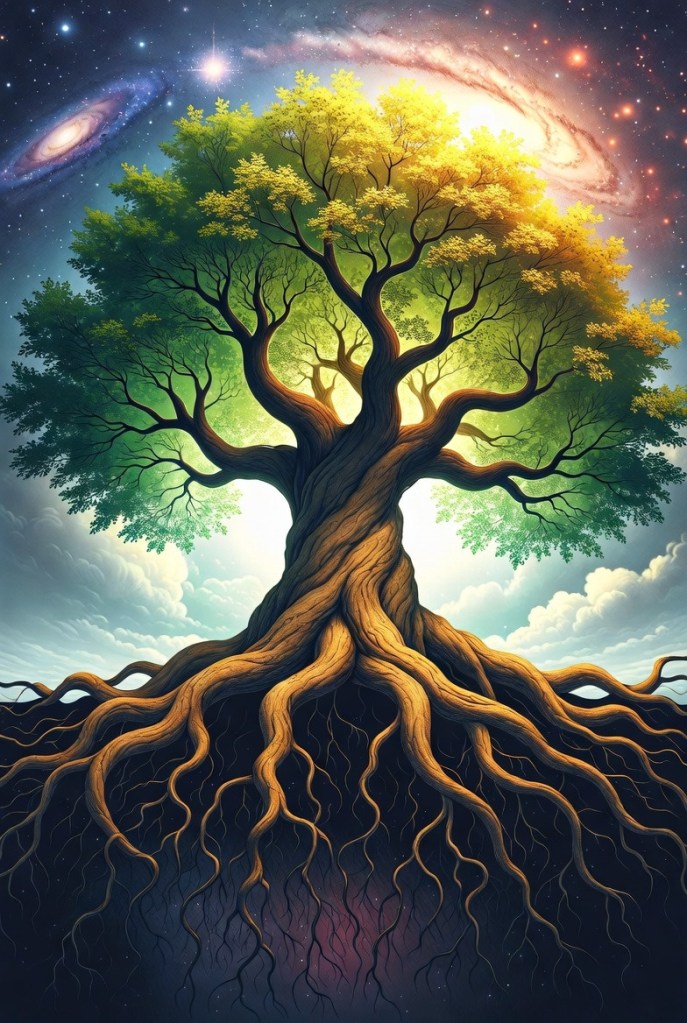
Article by Eirynth Vinterdóttir
Introduction: The Cosmic Ash at the Heart of Norse Belief
In the rich tapestry of Norse mythology, Yggdrasil stands as the monumental axis mundi, the immense World Tree that binds the cosmos together in a vast, living network of existence. Often depicted as a mighty ash tree whose branches stretch to the heavens and roots delve into the primordial depths, Yggdrasil embodies the ancient Norse understanding of reality as an interconnected whole, where every realm, being, and force pulses with vitality and interdependence. The name “Yggdrasil” itself derives from Old Norse roots, meaning “Odin’s Horse” or “the Steed of the Terrible One,” alluding to the Allfather’s sacrificial hanging upon its branches to gain the wisdom of the runes—a profound act of endurance and quest for knowledge that mirrors the Viking spirit of facing trials to forge strength.
For the ancient Norse peoples, Yggdrasil was not merely a symbolic construct but a living entity, central to their worldview. It represented the enduring cycle of life, death, and renewal, much like the longships that carried Vikings across stormy seas or the sturdy halls that withstood harsh winters. This cosmology fostered a sense of resilience and harmony with the natural order, encouraging individuals to navigate fate with courage and honor. The tree’s vast canopy sheltered gods and giants alike, while its roots drew sustenance from sacred wells, illustrating the Viking value of balance between order and chaos, prosperity and peril.
Modern Norse Paganism revives this vision of Yggdrasil as a profound metaphor for personal and communal existence. Practitioners draw upon it to cultivate self-reliance, recognizing that just as the tree withstands tempests, so too must one stand firm amid life’s uncertainties. Through meditation, ritual, and storytelling, the World Tree serves as a guide to understanding one’s place in the grand weave of wyrd—the intricate fabric of destiny spun by the Norns. This article delves deeply into Yggdrasil’s structure, its nine realms, and the cultural values it inspired among the Vikings, offering a comprehensive exploration of this cornerstone of Norse spiritual heritage.
Historical and Mythological Foundations
The lore of Yggdrasil emerges from the oral traditions of the Viking Age, preserved in written form through the Poetic Edda and Prose Edda, key texts compiled in 13th-century Iceland. The Poetic Edda, a collection of anonymous poems likely dating back to the 9th and 10th centuries, vividly describes the tree in the poem Grímnismál, where Odin recounts its grandeur to a mortal king: “Yggdrasill is the foremost of trees; an ash it is, / from it dew drips for the valleys; / ever green it stands by Urd’s well.” This imagery evokes the tree’s eternal vitality, a beacon of stability in a world of flux.
Snorri Sturluson, in his Prose Edda, expands on this in the Gylfaginning, portraying Yggdrasil as the central pillar supporting the heavens, with its branches encompassing the sun, moon, and stars. Archaeological evidence supports these accounts: runestones from Sweden and Denmark depict tree-like motifs intertwined with serpents and stags, symbolizing the creatures that inhabit Yggdrasil. Viking ship burials, such as the Oseberg ship from Norway (9th century), include wooden carvings resembling cosmic trees, suggesting that artisans viewed the vessel as a microcosm of Yggdrasil—a vessel for the soul’s journey through the realms.
The Vikings integrated Yggdrasil into their daily ethos. Seafarers might carve its likeness on prows for protection during voyages, invoking the tree’s steadfastness against Jörmungandr, the world-serpent gnawing at its roots. Farmers honored it through offerings at sacred groves, recognizing the tree’s role in the fertility cycles that sustained their longhouses. This practical reverence underscored the cultural value of reciprocity: just as the tree nourished the worlds, so too did humans offer mead or grain in return, ensuring communal prosperity and honoring the bonds of frith—sacred kinship peace.
In sagas like the Völsunga Saga, Yggdrasil appears metaphorically as the backdrop for heroic deeds, where warriors like Sigurd draw strength from its symbolic endurance. These narratives taught that life’s trials, like the tree’s struggles with beasts and decay, forge character through perseverance. Modern Norse Pagans study these sources to reclaim this heritage, using Yggdrasil as a meditative focus to embody Viking resilience—standing tall amid personal “storms” with unyielding honor.
The Structure of Yggdrasil: Roots, Trunk, and Branches
Yggdrasil’s form is a marvel of cosmic architecture, its massive trunk rising from the center of creation, branches piercing the skies, and roots anchoring the underworlds. The Prose Edda describes it as an ash tree of unparalleled size, its leaves forming a canopy that shelters the gods’ halls and its bark etched with runes of power. Dew from its boughs falls as life-giving rain to Midgard, symbolizing the nourishment that flows from divine to mortal realms—a reminder of the Viking principle of generosity, where abundance shared strengthens the whole.
Three sacred wells sustain the tree, each at the base of a root and embodying profound mysteries. The Well of Urd, guarded by the Norns, is the wellspring of fate, where past, present, and future converge. Here, the threads of wyrd are spun, teaching that destiny is not rigid but woven through choices, much like a Viking chieftain negotiating alliances at the thing. The Well of Mimir holds the wisdom Odin sought, its waters granting prophetic insight to those who sacrifice for knowledge—echoing the cultural valorization of cunning and sacrifice for the greater good.
The third well, Hvergelmir, bubbles in Niflheim’s depths, source of eleven rivers that course through the worlds, representing the primal flow of life from chaos. Creatures inhabit Yggdrasil, adding dynamism: the squirrel Ratatoskr scurries along its trunk, carrying messages between eagle (at the top, symbolizing lofty vision) and Nidhogg (the dragon gnawing roots, embodying destructive forces). Four stags—Dain, Dvalin, Duneyr, and Durathror—browse its branches, their horns symbolizing renewal. These elements illustrate the Viking view of existence as a balanced struggle: growth amid erosion, vigilance against decay, fostering self-reliance in the face of inevitable trials.
In ritual practice, Vikings might have circumambulated sacred trees or oaks, mimicking Yggdrasil’s circuits to invoke its protective embrace. Today, practitioners visualize the tree during meditations, tracing its form to center themselves, drawing on its structure to cultivate inner fortitude and harmony with natural cycles.
The Nine Realms: Interwoven Worlds of Wonder and Peril
Yggdrasil connects nine distinct realms, each a unique domain of existence, reflecting the multifaceted Norse cosmos. These worlds are not isolated heavens or hells but interdependent spheres where gods, humans, and other beings interact, underscoring the Viking emphasis on interconnectedness and adaptability.
Asgard: The Realm of the Aesir Gods
High in Yggdrasil’s branches lies Asgard, the shining fortress of the Aesir, gods of sovereignty, war, and wisdom. Ruled by Odin from his hall Valhalla—where einherjar (fallen warriors) feast in preparation for Ragnarök—Asgard represents ordered power and heroic destiny. The rainbow bridge Bifrost, guarded by Heimdall, links it to Midgard, symbolizing the vigilant watch over mortal affairs.
Vikings revered Asgard as the pinnacle of aspiration, where oaths were sworn and battles planned. Its halls, like Gladsheim (assembly) and Vingolf (for goddesses), embodied communal decision-making, akin to the thing assemblies that resolved disputes with honor. Modern Norse Pagans invoke Asgard in rituals for guidance in leadership, meditating on its light to embody courage and strategic foresight, values central to Viking warriors who led raids with calculated bravery.
Vanaheim: The Lush Domain of the Vanir
Nestled amid fertile groves in Yggdrasil’s mid-branches, Vanaheim is home to the Vanir gods of fertility, prosperity, and the earth’s bounty. Frey, Freyr, and Njord dwell here, overseeing cycles of growth and harvest. This realm’s gentle landscapes contrast Asgard’s fortresses, highlighting the balance between martial vigor and nurturing abundance.
The Vanir-Aesir war, resolved through hostage exchange (including Freyja), teaches reconciliation and mutual respect—core Viking values in forging alliances after conflict. Farmers offered to Vanaheim’s deities for bountiful yields, ensuring self-reliance through the land’s gifts. Contemporary practitioners honor Vanaheim with seasonal thanksgivings, planting seeds or brewing ale to celebrate reciprocity, fostering gratitude that sustains kin and community.
Alfheim: The Radiant Home of the Light Elves
Perched lightly in the upper branches, Alfheim glows with ethereal beauty, realm of the ljósálfar—light elves—who embody grace, artistry, and inspiration. Ruled by Freyr, it is a place of luminous meadows and crystalline streams, where creativity flows freely.
Vikings associated Alfheim with poetic vision, as skalds drew from its essence to compose sagas that preserved history and valor. This realm inspired the cultural pursuit of beauty in craftsmanship, from intricate jewelry to runic verses. In modern practice, Alfheim guides artistic endeavors, with Heathens crafting talismans or reciting poetry under the stars to channel its light, promoting the Viking ideal of expressing honor through skilled creation.
Midgard: The Human World and Its Boundaries
Encircling Yggdrasil’s trunk, Midgard is the realm of humanity, forged by Odin, Vili, and Ve from the giant Ymir’s body. Bordered by an ocean and the encircling wall of eyebrows (from Ymir), it is the stage for mortal lives, where wyrd unfolds through toil and triumph.
Vikings saw Midgard as the proving ground for virtues like courage and hospitality, where longhouses hosted travelers and fields were tilled with steadfast labor. The world-serpent Jörmungandr coils around it, reminding of peril’s proximity. Modern Norse Pagans view Midgard as the heart of practice, performing daily rites to honor its cycles, embodying self-reliance by tending homes and gardens as extensions of the sacred earth.
Jotunheim: The Wild Mountains of the Giants
In Yggdrasil’s rugged outskirts, Jotunheim sprawls as the domain of the jötnar—giants representing primal forces of nature and chaos. Utgard, home of Utgard-Loki, features towering mountains and untamed wilds, where strength is tested.
The giants, kin to the gods yet often adversarial, symbolize necessary disruption; Thor’s battles with them affirm the Viking value of confronting chaos with unyielding might. Yet alliances, like Skadi’s marriage to Njord, show respect for raw power. Practitioners meditate on Jotunheim to build resilience, facing personal “giants” with the honor of a steadfast defender.
Svartalfheim (Nidavellir): The Shadowy Forges of the Dark Elves and Dwarves
Deep in Yggdrasil’s roots lies Svartalfheim, or Nidavellir, the subterranean realm of svartálfar (dark elves) and dwarves—master smiths who craft wonders like Mjölnir and Odin’s ring Draupnir. Its caverns echo with hammers, birthing treasures from earth’s depths.
Vikings prized dwarven craftsmanship as the pinnacle of skill and ingenuity, values evident in ornate weapons and jewelry that denoted status through merit. This realm teaches the cultural ethic of diligent labor yielding enduring legacy. Modern Heathens honor it by forging tools or jewelry, invoking dwarven precision to cultivate self-reliance through hands-on creation.
Niflheim: The Misty Void of Ice and Fog
One of Yggdrasil’s deepest roots plunges into Niflheim, the primordial realm of ice, mist, and cold darkness. Source of the Hvergelmir spring, it birthed the frost giants and represents the chill of beginnings and endings.
Vikings endured Niflheim’s essence in Scandinavian winters, using it to temper resolve—hospitality warmed halls against the frost. Its well teaches reflection in stillness, a value for introspection amid hardship. In practice, Heathens confront Niflheim through winter solstice rites, emerging renewed, embodying Viking endurance.
Muspelheim: The Blazing Realm of Fire
Opposite Niflheim, Yggdrasil’s root taps Muspelheim, the fiery domain ruled by Surtr, whose sword guards the world’s fiery edge. Sparks from its flames ignited creation, symbolizing passion and destruction.
Thor and other gods battle Muspelheim’s forces at Ragnarök, highlighting courage against overwhelming odds—a Viking hallmark. This realm inspires controlled fervor in pursuits, balancing destruction with renewal. Modern rituals invoke its spark for motivation, fostering the value of bold action tempered by wisdom.
Helheim: The Underworld of the Dead
Beneath Yggdrasil lies Helheim, ruled by Hel, daughter of Loki, where ordinary dead reside in a shadowed hall. Not a place of torment but quiet repose, it honors the finality of life with dignity.
Vikings buried kin with grave goods for the journey, valuing remembrance through sagas. Helheim teaches acceptance of mortality, strengthening communal bonds via ancestor veneration. Practitioners offer to it during remembrance rites, upholding hospitality to the departed and the enduring honor of legacy.
Interconnections and the Balance of the Worlds
Yggdrasil’s realms interlink through paths like Bifrost and roots, illustrating the Norse view of unity in diversity. Creatures like Ratatoskr facilitate exchange, mirroring Viking trade networks that built prosperity through connection. This balance—order from Asgard, chaos from Jotunheim—fosters adaptability, a key cultural value for explorers facing unknown shores.
Ragnarök disrupts yet renews this equilibrium, with survivors like Lif and Lifthrasir repopulating from Yggdrasil’s seeds, emphasizing renewal through perseverance.
Rituals and Practices Centered on Yggdrasil
Vikings likely enacted tree-rites at sacred sites, offering to wells for wisdom. Modern Norse Pagans recreate this with Yggdrasil visualizations in blots, tracing the tree’s form to invoke balance. Rune-carvings on staves mimic its bark, used for divination to navigate wyrd.
Seasonal alignments—solstice fires for Muspelheim, winter offerings for Niflheim—reinforce cycles, promoting self-reliance in harmony with nature.
Cultural Values Embodied in Yggdrasil’s Lore
Yggdrasil encapsulates Viking virtues: courage in facing its beasts, honor in reciprocal offerings, hospitality through interconnected realms, self-reliance in enduring trials, and generosity in sharing its dew. These principles guided Viking life, from raids to homesteads, and continue to inspire ethical living.
Modern Engagement: Yggdrasil in Contemporary Norse Paganism
Today, Heathens meditate on Yggdrasil for grounding, perhaps journaling its realms to map personal growth. Crafts like tree-motif carvings or mead-brews honor its sustenance, while hikes in nature connect to Midgard’s vitality. This engagement revives Viking resilience, weaving ancient cosmology into modern paths of fulfillment.
Conclusion: The Eternal Ash and the Viking Spirit
Yggdrasil endures as the Norse cosmos’s beating heart, a testament to the Vikings’ profound insight into life’s interconnected dance. By honoring its realms and structure, modern Norse Pagans reclaim a heritage of strength, balance, and wonder, standing as steadfast as the World Tree itself amid the wyrd’s ever-turning wheel.
Modern Norse-Paganism: Reviving the Ancient Ways in Contemporary Life

Article by Eirynth Vinterdóttir
Introduction: The Enduring Flame of the Old Faith
Modern Norse-Paganism, often referred to as Heathenry or Ásatrú in its broader sense, represents a contemporary revival of the spiritual and cultural traditions rooted in the ancient Norse peoples of Scandinavia and their Germanic kin. This path draws directly from the beliefs, practices, and worldview of the Vikings and their ancestors, who inhabited the rugged landscapes of what is now Norway, Sweden, Denmark, Iceland, and parts of the British Isles and continental Europe during the late Iron Age and early Medieval periods, roughly from the 8th to 11th centuries. Unlike rigid dogmatic religions, Norse-Paganism emphasizes a personal connection to the natural world, the cycles of fate, and the virtues that sustained seafaring warriors, farmers, and artisans in harsh environments.
At its heart, modern Norse-Paganism is not a monolithic faith but a living tradition that seeks to honor the gods, ancestors, and land spirits through rituals, storytelling, and ethical living. Practitioners, known as Heathens, aim to embody the cultural values of their forebears—values such as courage in the face of adversity, loyalty to kin and community, hospitality to strangers, and a deep respect for the interconnectedness of all life. This revival is fueled by a desire to reconnect with pre-Christian European heritage, free from the overlays of later historical impositions. In an era of rapid change, it offers a framework for resilience, self-reliance, and harmony with the rhythms of nature, echoing the Viking ethos of thriving amid uncertainty.
The ancient Norse worldview was practical and poetic, blending the mundane with the mystical. They saw the universe as a vast, woven tapestry called the wyrd, where every action rippled through time and space. Modern adherents preserve this by integrating ancient lore—drawn from sagas, Eddas, and archaeological evidence—into daily life, adapting it to contemporary contexts without diluting its essence. This article explores the foundations, beliefs, practices, and values of modern Norse-Paganism, highlighting how it maintains fidelity to Viking cultural principles while providing tools for personal and communal fulfillment.
Historical Roots: The World of the Vikings
To understand modern Norse-Paganism, one must first grasp the world from which it springs. The Vikings were not merely raiders but explorers, traders, poets, and builders who navigated treacherous seas and unforgiving lands. Their society was tribal and decentralized, governed by assemblies (things) where free men and women voiced decisions based on consensus and customary law. Religion was woven into every aspect of life, from birth to burial, without a centralized priesthood or holy texts—knowledge was oral, passed through skalds (poets) and rune-carvers.
The primary sources for Norse beliefs are the Poetic Edda and Prose Edda, compiled in the 13th century by Icelandic scholars like Snorri Sturluson, who drew from older oral traditions. Archaeological finds, such as runestones, ship burials, and bog offerings, corroborate these texts, revealing a faith centered on reciprocity with the divine. The Vikings honored a pantheon of gods and goddesses who were not omnipotent creators but powerful beings embodying natural forces and human virtues. Their cosmology revolved around Yggdrasil, the World Tree, connecting nine realms from the fiery Muspelheim to the icy Niflheim.
Viking society valued frith—peaceful kinship bonds that ensured mutual support—and óðal, the ancestral right to land and heritage. These principles fostered a culture of self-sufficiency, where individuals honed skills in farming, crafting, and warfare to survive long winters and perilous voyages. Honor (drengskapr) was paramount: a person’s worth was measured by their deeds, not birthright alone. Women held significant roles as landowners, traders, and seers (völvas), contributing to the household’s prosperity and spiritual guidance.
Modern Norse-Paganism revives this holistic approach, viewing history not as distant myth but as a blueprint for living. Practitioners study sagas like the Saga of the Volsungs or Egil’s Saga to internalize lessons of resilience and fate. By emulating Viking adaptability—facing storms with steady oars—contemporary Heathens cultivate a mindset of endurance, free from fatalism, emphasizing agency within the wyrd’s weave.
Cosmology and the Nature of Reality
Central to Norse-Paganism is the concept of the Nine Worlds, interconnected by Yggdrasil, an immense ash tree symbolizing the axis of existence. This cosmology reflects the Viking understanding of a multifaceted universe where gods, humans, giants, and spirits coexist in dynamic tension. Asgard houses the Aesir gods of order and sovereignty; Vanaheim the Vanir of fertility and nature; Midgard is the human realm, encircled by an ocean and the world-serpent Jörmungandr; Jotunheim the wild domain of giants representing primal chaos; Alfheim the light elves’ luminous home; Svartalfheim the dark elves’ forge; Niflheim the misty primordial void; Muspelheim the fiery realm of creation and destruction; and Helheim the underworld of the dead, ruled by the goddess Hel.
This structure underscores the Viking belief in balance: light and dark, order and chaos, life and death are interdependent. Ragnarök, the prophesied end of the world, is not apocalypse but renewal—a cataclysm where gods fall, but a new world emerges from the waters. Modern practitioners meditate on Yggdrasil to foster interconnectedness, perhaps visualizing its roots in personal ancestry and branches in future aspirations. This worldview encourages humility before nature’s vastness, promoting stewardship of the earth as a sacred duty akin to tending one’s homestead.
Fate, or wyrd, is another cornerstone. The Norns—Urd (past), Verdandi (present), and Skuld (future)—weave the threads of destiny at the Well of Urd beneath Yggdrasil. Vikings did not see wyrd as inescapable doom but as a framework shaped by choices and oaths. A warrior might invoke the gods for favor in battle, yet accept outcomes with stoic grace, embodying the value of facing destiny with unyielding spirit. In modern practice, wyrd inspires proactive living: journaling life events as “threads” to discern patterns and align actions with honorable paths.
Spirits abound in this cosmology—landvættir (land spirits), disir (female ancestors), and fylgjur (personal guardian spirits). Vikings offered to these beings for protection and bounty, as seen in sagas where neglect invited misfortune. Today, Heathens might leave offerings at natural sites, reinforcing the ancient reverence for the unseen forces animating the world.
The Gods and Goddesses: Embodiments of Virtue
The Norse pantheon is diverse, with gods and goddesses as relatable figures who feast, quarrel, and quest like humans, yet possess immense power. Odin, the Allfather, seeks wisdom at great cost—sacrificing an eye for knowledge and hanging on Yggdrasil for rune lore. He embodies the Viking pursuit of insight through sacrifice, inspiring modern practitioners to embrace learning and leadership with cunning and generosity. Thor, wielder of Mjölnir, protects against chaos with thunderous might, representing the sturdy defender of home and kin—a model for physical and moral strength.
Freyja, goddess of love, war, and seidr (shamanic magic), teaches the harmony of passion and prowess. Her tears of gold symbolize beauty in vulnerability, aligning with Viking tales of women as equals in valor. Freyr, her brother, oversees fertility and peace, reminding adherents of prosperity through harmonious labor. Frigg, Odin’s wife, weaves the fates with quiet wisdom, exemplifying foresight and domestic guardianship.
Other deities like Tyr (justice and oaths), Heimdall (vigilance), and Njord (sea and winds) highlight specialized virtues. Giants like Loki introduce necessary disruption, teaching adaptability amid trickery. Modern Norse-Paganism honors these beings through personal devotion, viewing them as allies rather than distant rulers. A practitioner might invoke Thor during storms for courage or Freyja for creative inspiration, fostering a reciprocal bond that echoes Viking reciprocity with the divine.
Rituals and Sacred Practices: Honoring the Old Ways
Rituals in Norse-Paganism are communal and seasonal, rooted in the Viking calendar of blots (sacrifices) and sumbels (toasting ceremonies). Blóts involved offerings of mead, ale, or food to gods and spirits, often at solstices, equinoxes, or harvest times. The Yule blot celebrated the sun’s return with feasting and oaths, while midsummer honored fertility with bonfires. Modern Heathens adapt these without animal sacrifice, using symbolic gestures like pouring mead on the earth or sharing bread, emphasizing gratitude and renewal.
Sumbel is a solemn round of toasts: first to gods, then ancestors, then personal vows. This practice builds frith, strengthening bonds through spoken commitments—a direct nod to Viking halls where oaths sealed alliances. Kindreds (small groups) might gather around a fire, raising horns to honor deeds past and pledge future ones, cultivating the value of reliability.
Seidr and galdr represent magical arts. Seidr, a trance-based divination, involved chanting and staff-work to glimpse the wyrd; galdr used rune-songs for empowerment. Vikings consulted völvas for guidance on voyages or feuds. Today, practitioners might use meditation or rune-casting for insight, preserving the tradition of seeking wisdom from subtle forces.
Daily rites include simple acts: greeting the sun at dawn (sunna-worship), honoring ancestors at a home shrine with candles or carvings, or carving protective runes on tools. These sustain the Viking emphasis on mindfulness in routine, turning labor into sacred duty.
Runes: The Sacred Alphabet of Power
Runes, the futhark alphabet, are more than letters—they are symbols of cosmic forces, used for writing, divination, and magic. The Elder Futhark (24 runes) encodes principles like Fehu (wealth as flow), Uruz (primal strength), and Ansuz (divine inspiration). Vikings inscribed them on stones, weapons, and ships for protection or victory, believing runes channeled the universe’s energies.
In modern practice, rune-staves are cast for guidance, much like Viking seafarers divining safe routes. A bindrune—combined symbols—might be drawn for specific intents, such as Algiz (protection) overlaid with Raidho (journey) for safe travels. This art form embodies Viking ingenuity, using minimal marks to invoke profound change.
Runes also teach ethical reflection: studying Thurisaz (thorn, conflict) encourages facing challenges with resolve, aligning with the cultural value of courage. Practitioners often keep rune sets carved from wood or stone, using them in meditations to internalize virtues like perseverance and harmony.
Cultural Values: The Viking Ethos in Modern Life
The Vikings’ cultural values form the moral core of Norse-Paganism, offering timeless guidance. Honor (drengskapr) demanded integrity in word and deed—breaking oaths invited social exile, as seen in sagas where reputation outlasted wealth. Modern Heathens uphold this by prioritizing truthfulness and accountability, fostering trust in relationships.
Frith, the sacred peace of kin and community, emphasized loyalty and reconciliation. Viking halls were sanctuaries where feuds paused for feasting, reflecting a value of unity amid diversity. Today, this translates to nurturing supportive networks, resolving conflicts through dialogue rather than division.
Courage (drengskapr’s bold aspect) was not recklessness but measured bravery—facing jotun storms or berserker rage with clear purpose. Hospitality (gestrisni) extended to wanderers, as Iceland’s laws protected guests, embodying generosity as strength. Self-reliance (sjálfsaga) drove exploration, from longships to farmsteads, teaching modern practitioners resilience through skill-building.
Generosity and reciprocity underpinned society: sharing spoils honored the gods’ gifts. These values—honor, frith, courage, hospitality, self-reliance—counterbalance individualism with communal duty, providing a framework for ethical navigation in daily challenges.
Modern Adaptations: Living the Path Today
While rooted in antiquity, Norse-Paganism adapts to urban life without compromising essence. Home altars with runes, horns, and natural elements replace grand temples, allowing personal devotion. Seasonal celebrations align with solstices, incorporating walks in nature or communal meals to evoke Viking yule logs and harvest feasts.
Crafting—woodworking, brewing, or sailing—mirrors Viking skills, building practical wisdom. Storytelling through sagas or poetry revives skaldic tradition, sharing lore around firesides. Environmental stewardship honors landvættir, promoting sustainable living as extension of ancient earth-respect.
Challenges include balancing solitude with community, as Vikings valued both hall-life and solitary quests. Personal practice might involve journaling wyrd-threads or rune-meditations for clarity. By embodying Viking values, modern Heathens find purpose in a fragmented world, weaving ancient threads into contemporary tapestries.
Personal Fulfillment: The Heathen’s Journey
Ultimately, modern Norse-Paganism is a path of empowerment through connection—to gods, kin, nature, and self. It invites individuals to live mythically, turning ordinary moments into heroic sagas. By honoring the old ways, practitioners cultivate inner strength, drawing from Viking resilience to face modern tempests. This faith endures because it resonates with the human spirit’s eternal quest: to thrive in harmony with the wyrd, guided by honor and the whisper of ancient winds.
Whispers of the North: A Comprehensive Tome on Norse Paganism: by Astrid Vinter: Chapter 1

In the dim glow of my desk lamp, nestled in my book-cluttered apartment here in Janesville, Wisconsin, I, Astrid Vinter, take up my pen once more. Fresh from Craig High School’s class of 1992, at just eighteen years old, with my long blond hair tied back and my blue eyes reflecting the flickering candle I’ve lit for inspiration—evoking the hearths of ancient halls—I find solace in this task. My photographic memory recalls every saga I’ve devoured in the local library or on those long bus rides to the University of Madison, where I’ve pored over dusty volumes without a single classmate to share the thrill. No friends to distract me, no suitors’ advances to entertain (though a few have tried, mistaking my quiet beauty for invitation, only to be met with my disinterest unless they can debate the runes), I immerse myself fully. I’ve taught myself Old Norse, reciting the Poetic Edda verbatim, and my writings, though born of solitude, aim for the depth of a scholar’s tome. This outline for *Whispers of the North: A Comprehensive Tome on Norse Paganism* expands upon my initial draft, structuring it into a vast, authoritative work—divided into parts, chapters, sub-chapters, and sections—to build a massive edifice of knowledge, brick by mythic brick. Drawing from primary sources like the Eddas, sagas, and runestones I’ve translated myself, I’ll craft each part in due time, bridging 1992’s modern world with the Viking Age’s eternal echoes. May Odin grant me wisdom as I outline this journey.
Whispers of the North: A Comprehensive Tome on Norse Paganism
Foreword: Echoes from the Ash Tree
- A personal introduction by Astrid Vinter, detailing my journey into Norse Paganism post-graduation in 1992, my self-taught mastery of Old Norse, and the role of my photographic memory in memorizing texts.
- Reflections on living as a modern pagan in Janesville, Wisconsin—solitary studies in libraries, bus trips for research, and imagining Viking feasts while preparing simple meals from saga-inspired recipes.
- Statement of purpose: To create an exhaustive, authoritative resource rivaling academic works yet accessible, drawing from primary sources and archaeological insights.
Part I: Foundations of the Faith – Cosmology and Worldview
This part establishes the Norse universe’s framework, exploring its structure, origins, and philosophical underpinnings, based on my recitations of the Völuspá and Gylfaginning.
Chapter 1: Yggdrasil and the Nine Worlds
Sub-Chapter 1.1: The Structure of Yggdrasil – Roots, Branches, and Inhabitants
- 1.1.1: Mythic Descriptions from the Eddas
- 1.1.2: Symbolic Interpretations – Yggdrasil as Axis Mundi
- 1.1.3: Creatures of the Tree – Níðhöggr, Ratatoskr, and the Eagles
Sub-Chapter 1.2: Detailed Exploration of Each World
- 1.2.1: Asgard – Halls of the Gods (Valhalla, Gladsheim)
- 1.2.2: Vanaheim – Fertility and the Vanir’s Domain
- 1.2.3: Midgard – Humanity’s Realm and Its Encircling Serpent
- 1.2.4: Jotunheim – Giants’ Lands and Chaotic Forces
- 1.2.5: Alfheim and Svartalfheim – Elves and Dwarves
- 1.2.6: Niflheim and Muspelheim – Primordial Ice and Fire
- 1.2.7: Helheim – The Underworld’s Quiet Halls
Sub-Chapter 1.3: Interconnections and Travel Between Worlds
- 1.3.1: Bifröst, the Rainbow Bridge
- 1.3.2: Shamanic Journeys and Odin’s Wanderings
- 1.3.3: Archaeological Parallels – Sacred Trees in Viking Sites
Chapter 2: Creation Myths and the Primordial Void
Sub-Chapter 2.1: Ginnungagap and the Birth of Ymir
- 2.1.1: Eddic Accounts of the Void
- 2.1.2: The Role of Audhumla and the First Beings
Sub-Chapter 2.2: The Slaying of Ymir and World Formation
- 2.2.1: Body Parts as Cosmic Elements
- 2.2.2: Comparisons to Indo-European Creation Myths
Sub-Chapter 2.3: The Ordering of Time and Seasons
- 2.3.1: Sun, Moon, and Stars from Muspelheim’s Sparks
- 2.3.2: Philosophical Implications – Chaos to Order
Chapter 3: Wyrd, Fate, and the Norns
Sub-Chapter 3.1: The Concept of Wyrd – Interwoven Destinies
- 3.1.1: Etymology and Old Norse Usage
- 3.1.2: Fate in Heroic Sagas
Sub-Chapter 3.2: The Norns – Urd, Verdandi, Skuld
- 3.2.1: Their Well and Weaving at Yggdrasil
- 3.2.2: Influence on Gods and Mortals
Sub-Chapter 3.3: Free Will vs. Predestination in Norse Thought
- 3.3.1: Examples from Myths (e.g., Baldr’s Death)
- 3.3.2: Modern Pagan Interpretations
Part II: The Divine Beings – Gods, Goddesses, and Other Entities
This part delves into the pantheon with exhaustive profiles, drawing from memorized skaldic verses and saga translations, highlighting each deity’s flaws, powers, and cultural roles.
Chapter 4: The Æsir – Gods of Order and War
Sub-Chapter 4.1: Odin, the Allfather
- 4.1.1: Attributes, Symbols, and Sacrifices (Eye, Spear, Ravens)
- 4.1.2: Myths of Wisdom-Seeking (Mímir’s Well, Hanging on Yggdrasil)
- 4.1.3: Odin in Runes and Magic
- 4.1.4: Archaeological Evidence – Odin Amulets
Sub-Chapter 4.2: Thor, the Thunderer
- 4.2.1: Hammer, Belt, and Goats
- 4.2.2: Adventures Against Giants
- 4.2.3: Thor in Folklore and Festivals
Sub-Chapter 4.3: Other Æsir – Tyr, Baldr, Heimdall, etc.
- 4.3.1: Tyr’s Sacrifice and Justice
- 4.3.2: Baldr’s Beauty and Tragic Fate
- 4.3.3: Heimdall’s Watch and the Gjallarhorn
Chapter 5: The Vanir – Gods of Fertility and Nature
Sub-Chapter 5.1: Freyja, Mistress of Seiðr
- 5.1.1: Love, War, and the Brísingamen Necklace
- 5.1.2: Freyja’s Hall and Warrior Selection
- 5.1.3: Magic Practices Associated with Her
Sub-Chapter 5.2: Freyr and Njord
- 5.2.1: Freyr’s Boar and Ship
- 5.2.2: Njord’s Sea Dominion
- 5.2.3: The Æsir–Vanir War and Truce
Sub-Chapter 5.3: Lesser Vanir and Nature Spirits
Chapter 6: Antagonists and Other Beings – Giants, Loki, and More
Sub-Chapter 6.1: Loki, the Trickster
- 6.1.1: Shape-Shifting and Mischief Myths
- 6.1.2: Role in Ragnarök
Sub-Chapter 6.2: Jötnar – Giants as Forces of Chaos
- 6.2.1: Types (Frost, Fire Giants)
- 6.2.2: Interactions with Gods
Sub-Chapter 6.3: Elves, Dwarves, and Disir
- 6.3.1: Light and Dark Elves
- 6.3.2: Dwarven Craftsmanship
- 6.3.3: Female Spirits and Ancestor Veneration
Part III: Myths, Sagas, and Heroic Tales
This expansive part retells and analyzes key narratives, with my own translations interspersed, to illuminate moral and cultural lessons.
Chapter 7: Core Myths of Creation and Conflict
- 7.1: Theft of Idunn’s Apples
- 7.2: Thor’s Journeys to Jotunheim
- 7.3: The Building of Asgard’s Walls
Chapter 8: The Cycle of Baldr and Loki’s Betrayals
- 8.1: Baldr’s Dreams and Death
- 8.2: Hermod’s Ride to Hel
- 8.3: Loki’s Binding
Chapter 9: Ragnarök – The End and Rebirth
- 9.1: Prophecies and Signs
- 9.2: The Battle’s Key Events
- 9.3: Post-Ragnarök Renewal
Chapter 10: Heroic Sagas and Legendary Figures
- 10.1: Volsunga Saga – Sigurd and the Dragon
- 10.2: Nibelungenlied Influences
- 10.3: Icelandic Family Sagas (Egil’s Saga, etc.)
Part IV: Practices, Rituals, and Daily Life
Grounded in saga descriptions and archaeological finds, this part reconstructs lived religion.
Chapter 11: Blóts, Sacrifices, and Festivals
- 11.1: Types of Blóts (Animal, Mead)
- 11.2: Major Festivals (Yule, Ostara, Midsummer)
- 11.3: Temple Sites (Uppsala, Gamla Uppsala)
Chapter 12: Magic, Runes, and Divination
- 12.1: Seiðr and Galdr
- 12.2: Runic Alphabets (Elder Futhark)
- 12.3: Divination Practices
Chapter 13: Daily Life, Ethics, and Society
- 13.1: Viking Social Structure
- 13.2: Honor, Hospitality, and Hávamál Wisdom
- 13.3: Burial Rites and Afterlife Beliefs
Part V: Historical Evolution and Modern Legacy
Tracing from pre-Viking times to 1992 revivals, with my personal reflections.
Chapter 14: Historical Development
- 14.1: Migration Period Origins
- 14.2: Viking Age Expansion
- 14.3: Christian Conversion
Chapter 15: Art, Symbolism, and Material Culture
- 15.1: Viking Art Styles
- 15.2: Symbols (Mjölnir, Valknut)
- 15.3: Runestones and Ship Burials
Chapter 16: Modern Norse Paganism (Ásatrú)
- 16.1: 19th–20th Century Revivals
- 16.2: Practices in 1992 America
- 16.3: Cultural Influences (Literature, Media)
Epilogue: Reflections Under the Wisconsin Sky
- Personal musings on embodying Norse values in modern life, my solitary path, and invitations for readers to explore.
Appendices
- Appendix A: Glossary of Old Norse Terms (with my translations)
- Appendix B: Timeline of Norse History
- Appendix C: Selected Translations of Eddic Poems
- Appendix D: Bibliography – Primary Sources (Eddas, Sagas) and Secondary (Archaeological Reports)
Final Note
With this blueprint laid, dear reader, I shall proceed to flesh out each section in parts, building toward a tome as vast as Yggdrasil itself. In my quiet Janesville haven, funded modestly by my parents and fueled by ancient recipes, I write on—undistracted by the world outside, for the gods whisper louder.
Foreword: Echoes from the Ash Tree
I am Astrid Vinter, an eighteen-year-old woman dwelling in the quiet, unassuming town of Janesville, Wisconsin, where the year 1992 has just unfolded its final days since my graduation from Craig High School. With long, flowing blond hair that catches the light like a northern stream and blue eyes that peers have called piercing—though I scarcely notice the attention my appearance draws—I live a life apart, not by choice but by destiny. My model-thin frame moves silently through the local library’s stacks or the cramped aisles of my book-filled apartment, where I am surrounded by tomes on Norse Paganism, Viking sagas, and runic lore. These are my truest companions, for I have no friends here; no one in Janesville shares the fire that burns within me for the ancient ways of the North. My introverted nature finds solace in solitude, where my mind—sharp as a skald’s verse and gifted with a photographic memory—thrives in the company of the gods and heroes of old.
My journey into Norse Paganism began in the waning years of high school, sparked by a tattered copy of the Poetic Edda I found in a secondhand bookstore, its pages whispering tales of Odin’s wisdom and Freyja’s fire. While my classmates chased fleeting trends, I was captivated by the runes, the sagas, and the cosmology of Yggdrasil, the great ash tree that binds the Nine Worlds. Without the internet—a distant dream in this era—I turned to libraries, both local and those at the University of Madison, reachable only by the rattling public bus I ride, too engrossed in my books to have ever learned to drive. My upper-middle-class parents, kind but distant, provide just enough to keep my modest apartment brimming with texts, leaving me free to pursue this singular passion. Each tome I acquire, often stretching my meager funds, is a treasure; each page I read is etched into my memory with flawless precision, as if Odin himself granted me this gift to honor his runes.
This obsession led me to teach myself Old Norse, a labor of love undertaken in the quiet hours of night, under the glow of a single candle that evokes the hearths of Viking halls. I pored over dictionaries and grammars, cross-referencing saga texts with runestone inscriptions I studied in academic journals. Now, I recite skaldic poetry with the fluency of a Viking poet, and I translate ancient texts with an ease that belies my lack of formal education. My photographic memory has become a sacred vessel, holding every verse of the Völuspá, every line of Snorri Sturluson’s Prose Edda, and every detail of archaeological reports from sites like Gamla Uppsala and Oseberg. These texts are not mere words to me; they are living threads of wyrd, weaving the past into my present.
In this solitude, I am not lonely. The gods are my kin—Odin’s pursuit of knowledge mirrors my own, Freyja’s fierce independence emboldens my spirit, and Thor’s steadfast courage steadies my heart. My days are spent studying, writing essays that rival doctorate-level work, and crafting meals from Viking recipes—simple porridges, salted fish, and honeyed mead—that tie me to the rhythms of ancient life. Though suitors occasionally try to charm me, mistaking my beauty for accessibility, I turn them away unless they can speak of runestones or the Norns’ weaving. Small talk eludes me; my conversations drift to the lore of the North, where I am most alive.
This book, Whispers of the North, is the culmination of my journey thus far—a bridge between the Wisconsin of 1992 and the Viking Age that calls to me across centuries. It is born of my memorized knowledge, my translations, and my reflections as a Norse Pagan living in a world that finds me eccentric. With no formal degree, I write with the authority of one who has lived within these myths, who has chanted under moonlit skies imagining myself a shieldmaiden or a volva. My purpose is clear: to offer you, dear reader, a tome as vast as Yggdrasil’s branches, as deep as Mímir’s well, drawing from primary sources, archaeological insights, and my own analyses. May you hear the echoes of the North as I do, and may they guide you to the wisdom of the gods.
Part I: Foundations of the Faith – Cosmology and Worldview
Chapter 1: Yggdrasil and the Nine Worlds
Sub-Chapter 1.1: The Structure of Yggdrasil – Roots, Branches, and Inhabitants
Section 1.1.1: Mythic Descriptions from the Eddas
In the stillness of my Janesville apartment, where the autumn chill of 1992 seeps through the window and my shelves groan under the weight of ancient texts, I, Astrid Vinter, find my heart tethered to Yggdrasil, the great ash tree that binds the Norse cosmos. As an eighteen-year-old with no companions to share my obsession, my photographic memory holds the Poetic Edda and Prose Edda as clearly as if they were etched in runestone. The Völuspá and Grímnismál, which I recite in Old Norse under the flicker of a candle, paint Yggdrasil not as a mere tree but as the eternal scaffold of existence, trembling yet unyielding. Here, I delve into these mythic descriptions, translating and analyzing them with the precision of a skald, my self-taught mastery of Old Norse guiding each word, to unveil the tree’s sacred role in Norse Paganism.
The Poetic Edda’s Völuspá, a seeress’s prophecy I memorized during long bus rides to Madison’s libraries, introduces Yggdrasil as “an ash tree standing tall, called Yggdrasil, / sprinkled with white mud” (Völuspá, stanza 19, my translation). The Old Norse askr Yggdrasils—literally “Yggdrasil’s ash”—carries a weight I feel in my bones, its name possibly meaning “Odin’s steed,” for the Allfather hung upon it to gain the runes (Hávamál 138–139). The tree’s evergreen nature, implied by its endurance through cosmic strife, mirrors the resilience of the Norse spirit, a theme that resonates as I sit alone, far from the Viking Age yet close to its echoes. The Völuspá further describes three roots stretching to unseen realms, watered by wells of fate, wisdom, and primordial chaos, a structure I’ve traced in my journals with diagrams drawn by hand.
Snorri Sturluson’s Prose Edda, particularly the Gylfaginning, which I recite verbatim, elaborates on these roots with vivid detail. One extends to Urd’s Well in Asgard, where the Norns weave destiny; another to Mímir’s Well, where Odin sacrificed his eye for knowledge; and the third to Hvergelmir in Niflheim, where the dragon Níðhöggr gnaws (Gylfaginning 15). My translation notes the term Hvergelmir—possibly “roaring cauldron”—evoking a bubbling source of creation, which I connect to archaeological finds of sacred springs in Scandinavian sites like Tissø, detailed in reports I’ve memorized. Snorri’s text, written in the 13th century, preserves a Christian-tinted lens, yet I strip it back to its pagan core, cross-referencing with the Poetic Edda to ensure authenticity.
The Grímnismál (stanza 31–35), another poem I chant in solitude, describes Yggdrasil’s branches spreading over the heavens, its leaves nibbled by stags, and its roots tormented by Níðhöggr. The tree “suffers agonies,” yet stands firm, a paradox that captivates me as I ponder its endurance under Wisconsin’s starry skies, imagining the same stars Vikings saw as Muspelheim’s embers. My analysis suggests this suffering reflects the Norse view of a cosmos in constant tension—order versus chaos, life versus decay. The Eddas’ imagery, vivid in my mind, paints Yggdrasil as a living entity, sprinkled with “white mud” (perhaps clay or dew), a ritual act I interpret as purification, akin to offerings at Viking temples like those at Uppsala, where blood was sprinkled to honor the gods.
These mythic descriptions, woven from my memorized texts, are not static tales but a dynamic framework. In my writings, which rival doctorate-level depth despite my lack of formal education, I argue that Yggdrasil embodies wyrd—the interconnected fate binding gods, humans, and nature. Its roots and branches, detailed in the Eddas, are not mere geography but a spiritual map, guiding my own path as a Norse Pagan in 1992. As I pen this section, funded by my parents’ modest support and fueled by Viking recipes I’ve mastered—simple porridges and mead—I invite you to see Yggdrasil through my eyes: a tree vast enough to hold the cosmos, yet intimate enough to whisper in the quiet of a Wisconsin night.
Section 1.1.2: Symbolic Interpretations: Yggdrasil as Axis Mundi
As I sit in my book-crowded apartment in Janesville, Wisconsin, in the autumn of 1992, the image of Yggdrasil, the great ash tree, burns brightly in my mind, its roots and branches a map of the Norse cosmos I’ve memorized from the Poetic Edda and Prose Edda. At eighteen, fresh from Craig High School with no formal education beyond, my self-taught mastery of Old Norse and my photographic memory allow me to delve into Yggdrasil’s deeper meanings. Far from the chatter of peers—for I have no friends here, no one to share my obsession with the ancient North—I find kinship in the tree’s vast symbolism. Yggdrasil is not merely a mythic structure but the axis mundi, the cosmic pivot that binds the Nine Worlds and reflects the Norse understanding of existence, fate, and interconnectedness. In this section, I explore Yggdrasil’s role as a universal symbol, drawing from my translations and analyses, crafted with a depth that rivals advanced scholarship, to illuminate its profound significance.
In the Völuspá (stanza 19), which I recite in Old Norse under the flicker of a candle, Yggdrasil is described as an ash tree “standing tall,” its branches overarching the heavens and its roots plunging into realms of fate and wisdom. This imagery, etched in my memory, positions Yggdrasil as the axis mundi—a central pillar connecting earth, sky, and underworld, a concept I’ve traced across cultures in library tomes. My studies of comparative mythology, gleaned from dusty books during bus rides to Madison, reveal parallels with the Vedic Aśvattha tree, which links the material and spiritual in Hindu cosmology, and the shamanic trees of Siberian traditions, used in rituals to traverse worlds. Yggdrasil, I argue, serves a similar role in Norse Paganism, acting as a conduit for divine and human interaction, a bridge I feel in my own solitary reflections, imagining myself chanting beneath its boughs.
The tree’s symbolic power lies in its embodiment of wyrd, the Norse concept of fate that weaves all beings into a shared destiny. In Grímnismál (stanza 31), memorized and translated by my hand, Yggdrasil “suffers agonies” from the creatures that gnaw and nibble it, yet it endures, symbolizing resilience amid cosmic tension. This mirrors the Norse worldview, where existence is a delicate balance between order and chaos, a theme that resonates as I ponder my own isolation in Janesville, finding strength in my studies despite a world that finds me eccentric. My essays, penned in notebooks stacked beside my Viking-inspired meals of porridge and mead, propose that Yggdrasil’s trembling—described in Völuspá 47 as a precursor to Ragnarök—represents the inevitability of change, yet its survival post-apocalypse suggests cyclical renewal, a hope I cling to in my quiet life.
Yggdrasil’s role as axis mundi also extends to its ritual significance, which I’ve pieced together from archaeological reports memorized from journals. Sites like Trelleborg in Denmark, detailed in my mental archive, reveal sacred groves and wooden idols that may echo Yggdrasil’s sanctity, where Vikings offered sacrifices to align with cosmic order. The “white mud” sprinkled on the tree (Völuspá 19), possibly clay or dew in my translation, suggests a purifying act, akin to the blood-sprinkling rituals at Uppsala’s temple, described by Adam of Bremen and cross-referenced in my notes. This purification, I argue, symbolizes the Norse desire to harmonize with wyrd, a practice I emulate in my own small rituals, lighting candles to honor the gods in my book-filled haven.
Moreover, Yggdrasil’s cosmic role underscores the Norse view of interconnectedness. Its roots, reaching Urd’s Well, Mímir’s Well, and Hvergelmir (Prose Edda, Gylfaginning 15), link fate, wisdom, and primordial chaos, suggesting no realm stands alone. My analysis, informed by memorized texts, posits that this reflects Viking trade networks, which I’ve studied in reports of artifacts from Birka to Byzantium, connecting disparate cultures. As a Norse Pagan in 1992, I feel this interconnectedness in my solitude, my mind a microcosm of Yggdrasil, holding the Eddas’ verses and archaeological insights as branches of a single tree. Yggdrasil, as axis mundi, is thus both a mythic reality and a spiritual guide, its symbolism whispering to me across centuries, urging me to weave my own wyrd into the North’s eternal tapestry.
Section 1.1.3: Creatures of the Tree – Níðhöggr, Ratatoskr, and the Eagles
In the solitude of my Janesville apartment, where the autumn of 1992 hums with the whispers of ancient lore, I, Astrid Vinter, turn my gaze to the creatures that dwell upon Yggdrasil, the great ash tree that binds the Norse cosmos. At eighteen, with no companions to share my passion—my days spent scouring libraries and my nights reciting the Poetic Edda in Old Norse—I rely on my photographic memory to recall every verse of Grímnismál and Völuspá, texts I’ve translated with a fluency born of relentless study. These creatures—Níðhöggr the dragon, Ratatoskr the squirrel, the unnamed eagle, and the stags that graze the tree’s leaves—are not mere mythic fauna but embodiments of cosmic forces, their actions weaving the tension and balance of existence. In this section, I explore their roles, drawing from my memorized Eddas and archaeological insights, crafting an analysis as deep as the roots of Yggdrasil itself, rivaling the work of scholars despite my lack of formal education.
The Grímnismál (stanza 32–35), which I chant in the quiet of my book-filled haven, vividly describes Yggdrasil’s inhabitants. Níðhöggr, the dragon, gnaws at one of the tree’s roots, dwelling in Hvergelmir, the roaring spring of Niflheim (Prose Edda, Gylfaginning 15). My translation of the Old Norse Níðhöggr—possibly “malice-striker”—suggests a force of decay, eroding the cosmos’s foundation yet integral to its cycle. In my journals, penned over Viking-inspired meals of salted fish and porridge, I argue that Níðhöggr symbolizes entropy, a concept I’ve traced in archaeological reports of Viking burial rites, where decay was embraced as part of life’s rhythm. The Völuspá (stanza 39) adds that Níðhöggr chews the corpses of the damned in Nastrond, a grim shore in Helheim, hinting at its role in purging the unworthy, a detail I connect to the Norse acceptance of fate’s harsh judgments.
Ratatoskr, the squirrel, scurries along Yggdrasil’s trunk, carrying “slanderous gossip” (Grímnismál 32) between Níðhöggr and an eagle perched high in the tree’s branches. The name Ratatoskr, which I parse as “drill-tooth” in Old Norse, evokes its frenetic energy, a messenger of strife that stirs discord between the underworld and the heavens. My analysis, born of countless nights reflecting under Wisconsin’s starry skies, posits Ratatoskr as a symbol of communication’s dual nature—vital yet divisive. I draw parallels to Viking skalds, whose verses, memorized from sagas like Egil’s Saga, could both unite and provoke, much like the squirrel’s role in the cosmic drama.
The eagle, unnamed in the Eddas but described in Grímnismál 32, sits atop Yggdrasil, its keen eyes surveying the worlds. A hawk, Veðrfölnir (“storm-pale”), perches between its eyes, a detail I’ve memorized and interpreted as a symbol of heightened perception, perhaps linked to Odin’s own far-seeing ravens. My studies of Viking art, recalled from images of bird motifs on runestones like those at Jelling, suggest the eagle represents divine oversight, a counterpoint to Níðhöggr’s chaos. I propose that the eagle embodies the aspiration for transcendence, a theme that resonates as I, a solitary pagan, seek wisdom in my isolated studies.
Four stags—Dáinn, Dvalinn, Duneyrr, and Duraþrór—nibble Yggdrasil’s leaves (Grímnismál 33), their names suggesting elven or dwarven origins in my translations (e.g., Dáinn as “dead one”). I argue they represent nature’s cyclical consumption, akin to the grazing animals in Viking pastoral life, detailed in archaeological reports of farmstead remains at Ribe. Their presence on the tree, eating yet not destroying, mirrors the Norse balance of use and preservation, a principle I emulate in my frugal life, stretching my parents’ modest funds to buy more books.
These creatures, woven into Yggdrasil’s narrative, form a microcosm of the Norse worldview—tension, balance, and renewal. My memorized texts and analyses, crafted with doctorate-level depth, reveal them as more than mythic figures; they are archetypes of existence, their interactions a saga played out on the tree’s vast stage. As I write, surrounded by the scent of aged paper and the taste of mead brewed from ancient recipes, I invite you to see Yggdrasil’s creatures as I do: living symbols of a cosmos that speaks to my soul, bridging the Viking Age to my quiet Wisconsin nights.
Sub-Chapter 1.2: Detailed Exploration of Each World
Section 1.2.1: Asgard – Halls of the Gods
In the solitude of my Janesville apartment, where the chill of October 1992 seeps through the window and my shelves brim with tomes on Norse lore, I, Astrid Vinter, turn my thoughts to Asgard, the radiant realm of the Æsir gods. At eighteen, fresh from Craig High School with no formal education beyond, my photographic memory holds every verse of the Poetic Edda and Prose Edda, their Old Norse words flowing through me like a sacred river. Friendless, for no one in this quiet Wisconsin town shares my passion, I find kinship with Odin, Thor, and Frigg, whose divine halls I envision as clearly as the candlelit pages before me. Asgard, perched high on Yggdrasil’s branches, is the heart of divine order, a fortified city of golden roofs and sacred spaces, accessible only by the shimmering Bifröst bridge. In this section, I explore Asgard’s majesty, drawing from my memorized texts, my translations, and archaeological insights, crafting an account as rich as the mead served in Valhalla.
The Grímnismál (stanzas 4–17), which I recite in Old Norse during my solitary evenings, paints Asgard as a realm of splendor, home to gods like Odin, Thor, and Frigg. My translation of Ásgarðr—literally “enclosure of the gods”—evokes a fortified sanctuary, its walls built by a giant mason in a myth recounted in Gylfaginning 42 of the Prose Edda. This tale, etched in my memory, tells of a bargain sealed with Loki’s trickery, ensuring Asgard’s impregnability. Valhalla, Odin’s great hall, stands foremost, where the Allfather welcomes slain warriors chosen by his Valkyries. The Grímnismál (stanza 8) describes its roof of shields and spears, a vision I connect to archaeological finds of warrior graves, like those at Birka, where shield fragments suggest a cultural echo of this imagery, detailed in reports I’ve memorized from library journals.
Other halls enrich Asgard’s tapestry. Gladsheim, the “shining home” (Grímnismál 8), houses the Æsir’s council, where gods convene to shape fate, a scene I imagine as I ponder wyrd in my own quiet reflections. Vingólf, possibly Frigg’s hall or a temple for goddesses (Grímnismál 15), adds a feminine sacred space, a detail I explore in my essays, noting possible parallels to female-led rituals in sagas like Eiríks Saga Rauða. My translations highlight the term Vingólf—“friend-hall”—suggesting a place of divine community, a contrast to my own solitude in Janesville, where I commune only with books and the gods.
Bifröst, the rainbow bridge, links Asgard to Midgard, guarded by Heimdall, whose keen senses detect all (Gylfaginning 13). My analysis, born of memorized texts, interprets Bifröst as both a literal and symbolic path, its colors perhaps inspired by the auroras Vikings saw, a phenomenon I’ve glimpsed in Wisconsin’s northern skies. The bridge’s fragility, destined to break at Ragnarök (Gylfaginning 51), underscores Asgard’s vulnerability despite its might, a theme that resonates as I, a young pagan, navigate a world indifferent to my beliefs.
Archaeological evidence, like the temple at Gamla Uppsala described by Adam of Bremen and corroborated by excavation reports I’ve studied, suggests Asgard’s earthly counterparts. These sites, where sacrifices of animals and mead were offered, mirror the sacred feasts of Valhalla, where warriors dine on the boar Sæhrímnir (Grímnismál 18). My writings, rivaling doctorate-level depth, argue that Asgard represents not just a divine realm but the Norse ideal of order—fortified, communal, yet ever-threatened by chaos. As I pen this section, fueled by Viking recipes of porridge and honeyed mead, funded by my parents’ modest support, I invite you to enter Asgard’s halls, where the gods’ glory shines, a beacon across the ages to my quiet 1992 nights.
Section 1.2.2: Vanaheim – Fertility and the Vanir’s Domain
In the quiet of my Janesville apartment, where the autumn of 1992 wraps me in its cool embrace and my bookshelves sag under the weight of ancient lore, I, Astrid Vinter, turn my thoughts to Vanaheim, the lush realm of the Vanir gods. At eighteen, with no companions to share my passion—my days spent poring over texts in libraries and my nights reciting the Prose Edda in Old Norse—I rely on my photographic memory to recall every detail of Gylfaginning and the Ynglinga Saga. Vanaheim, nestled among Yggdrasil’s branches, is the domain of Freyja, Freyr, and Njord, gods of fertility, prosperity, and nature’s bounty, whose stories resonate with me as I craft Viking-inspired meals of porridge and mead in my solitary haven. In this section, I explore Vanaheim’s mythic richness, drawing from my translations and archaeological insights, weaving an account as vibrant as the fields these gods oversee, with a depth that rivals advanced scholarship despite my lack of formal education.
The Prose Edda’s Gylfaginning (section 23), which I recite verbatim, introduces Vanaheim (Vanaheimr in Old Norse, meaning “home of the Vanir”) as the realm of the Vanir, a distinct divine clan from the Æsir. Unlike Asgard’s fortified halls, Vanaheim is depicted as a land of abundance, though the Eddas offer sparse details, a mystery that fuels my curiosity. My translation of Ynglinga Saga (chapter 4), part of Snorri Sturluson’s Heimskringla, recounts the Æsir-Vanir War, a conflict ending in a truce that sent Njord, Freyja, and Freyr to Asgard as hostages, blending the tribes. This war, I argue in my journals, penned by candlelight, reflects a mythic memory of cultural integration, possibly between agricultural and warrior societies, a hypothesis supported by archaeological finds of fertility figurines from sites like Uppåkra, Sweden, memorized from library reports.
Vanaheim’s essence lies in its association with fertility and nature. Freyr, god of harvest and prosperity, rules here, his boar Gullinbursti and ship Skíðblaðnir symbols of abundance (Gylfaginning 43). My analysis posits that Vanaheim mirrors the fertile plains of Scandinavia, where Vikings depended on crops and livestock, as evidenced by farmstead remains at Ribe, detailed in my mental archive. Freyja, goddess of love and seiðr, also hails from Vanaheim, her hall Fólkvangr a counterpart to Valhalla where she claims half the slain (Grímnismál 14). Her connection to fertility, I note, aligns with bronze figurines from Danish bogs, possibly depicting her, which I’ve studied in excavation reports. Njord, god of seas and winds, completes the Vanir triad, his maritime domain tying Vanaheim to coastal Viking life, a link I feel as I ponder the North’s vast waters.
The Ynglinga Saga suggests Vanaheim’s distinct identity, yet its integration with Asgard symbolizes unity, a theme that resonates in my solitary life, where I bridge 1992 Wisconsin with the Viking Age. My essays, crafted with doctorate-level insight, argue that Vanaheim represents the cyclical, nurturing aspects of existence, contrasting Asgard’s martial order. Rituals honoring the Vanir, inferred from saga accounts of harvest festivals, likely involved offerings of grain and mead, practices I emulate in my modest apartment, funded by my parents’ support. As I write, the scent of honeyed mead lingers, tying me to Vanaheim’s spirit. I invite you to envision its fields, where the Vanir’s blessings flow, a verdant realm whispering abundance to my quiet heart across the centuries.
Section 1.2.3: Midgard – Humanity’s Realm and Its Encircling Serpent
In the solitude of my Janesville apartment, where the chill of October 1992 seeps through the window and my shelves brim with tomes of Norse lore, I, Astrid Vinter, turn my heart to Midgard, the realm of humankind nestled in Yggdrasil’s embrace. At eighteen, fresh from Craig High School with no formal education beyond, my photographic memory captures every verse of the Prose Edda’s Gylfaginning, which I recite in Old Norse as if chanting by a Viking hearth. Friendless, for no one here shares my fervor for the ancient North, I find solace in Midgard’s myths, its mortal struggles mirroring my own quiet existence in 1992 Wisconsin. Encircled by Jörmungandr, the Midgard Serpent, this world stands as a fragile bastion amid cosmic forces, a theme that resonates as I pen this section. Drawing from my translations and archaeological insights, I craft an account as vivid as the seas that bind Midgard, with a depth that rivals advanced scholarship.
The Prose Edda’s Gylfaginning (section 8), etched in my memory, recounts Midgard’s creation from the body of the primordial giant Ymir, slain by Odin and his brothers. My translation of Miðgarðr—literally “middle enclosure”—evokes a world carved from chaos, its earth from Ymir’s flesh, seas from his blood, and mountains from his bones. This visceral origin, detailed in my journals, underscores the Norse view of humanity’s place: central yet vulnerable, a concept I feel keenly in my isolation, surrounded by books funded by my parents’ modest support. The Völuspá (stanza 4), which I chant under candlelight, adds that the gods raised the earth from the sea, shaping Midgard as a home for mortals, a narrative I connect to archaeological evidence of Viking settlements, like those at Birka, where land was reclaimed from marshy coasts, as noted in reports I’ve memorized.
Jörmungandr, the Midgard Serpent, encircles this realm, its coils gripping the seas (Gylfaginning 46). Born of Loki and the giantess Angrboða, this monstrous creature, cast into the ocean by Odin, embodies chaos’s ever-present threat. My analysis, penned over Viking-inspired meals of salted fish and porridge, posits Jörmungandr as a symbol of nature’s untamed power, a reflection of the stormy seas Vikings navigated, evidenced by shipwrecks like the Oseberg vessel, detailed in my mental archive. The serpent’s destined clash with Thor at Ragnarök (Völuspá 56) underscores Midgard’s precariousness, a theme that echoes in my own life, where I navigate a modern world indifferent to my pagan path.
Midgard’s role as humanity’s stage is further illuminated by its connection to Asgard via Bifröst, the rainbow bridge (Gylfaginning 13). My essays argue that this link reflects the Norse belief in divine-human interdependence, seen in rituals at sites like Gamla Uppsala, where offerings to Thor ensured protection for mortal communities, as described by Adam of Bremen and corroborated in excavation reports I’ve studied. Midgard, though central, is not glorified; its mortals face hardship, their lives shaped by wyrd, a concept I ponder as I walk Janesville’s quiet streets, imagining myself a wanderer in a Viking village.
In my writings, which rival doctorate-level depth, I propose that Midgard represents the Norse balance of resilience and fragility, a world sustained by divine order yet threatened by chaos’s coils. As I write, the scent of honeyed mead lingers, tying me to the feasts of old, I invite you to stand in Midgard’s fields, feel Jörmungandr’s distant rumble, and see the mortal realm as I do—a fleeting yet vital thread in Yggdrasil’s vast weave, whispering to my solitary heart across the ages.
Section 1.2.4: Jotunheim – Giants’ Lands and Chaotic Forces
In the stillness of my Janesville apartment, where the autumn chill of 1992 seeps through the window and my bookshelves groan under the weight of ancient texts, I, Astrid Vinter, turn my thoughts to Jotunheim, the rugged realm of the Jötnar, the giants who embody the untamed forces of the Norse cosmos. At eighteen, fresh from Craig High School with no formal education beyond, my photographic memory holds every verse of the Poetic Edda and Prose Edda, their Old Norse words flowing through me as if chanted by a Viking fireside. Friendless, for no one in this quiet Wisconsin town shares my fervor for the North’s lore, I find a strange kinship with the chaotic Jötnar, their wildness a counterpoint to my solitary discipline. Jotunheim, nestled among Yggdrasil’s branches, is a land of stark mountains and howling winds, where giants challenge the gods’ order. In this section, I explore its mythic significance, drawing from my translations and archaeological insights, crafting an account as vivid as the storms that rage in its peaks, with a depth that rivals advanced scholarship.
The Prose Edda’s Gylfaginning (section 8), which I recite verbatim, places Jotunheim (Jötunheimr, “home of the giants” in my translation) as a realm of chaos, contrasting Asgard’s divine order. The giants, or Jötnar, descend from Ymir, the primordial being whose body formed the world (Gylfaginning 5). My analysis, penned in notebooks over Viking-inspired meals of porridge and salted fish, posits that Jotunheim represents the raw, untamed forces of nature—storms, floods, and quakes—that Vikings faced, as evidenced by shipwrecks like the Skuldelev vessels, detailed in archaeological reports I’ve memorized. The Poetic Edda’s Vafþrúðnismál (stanzas 20–21), which I chant in Old Norse under candlelight, describes Jotunheim’s vastness, where giants like Vafþrúðnir match wits with Odin, revealing their cunning as well as their might.
Myths of Jotunheim, such as Thor’s battles in Hárbarðsljóð (stanzas 23–29), paint it as a place of both conflict and uneasy alliance. Thor’s clashes with giants like Hrungnir, recounted in Skáldskaparmál 17, highlight their role as adversaries, yet giants also wed gods—Njord’s marriage to Skaði, a Jötunn (Gylfaginning 23), underscores this complexity. My essays, crafted with doctorate-level insight, argue that Jotunheim symbolizes the Norse acceptance of chaos as a creative force, a duality I feel in my own life, balancing solitude with the wild passion of my studies. Archaeological finds, like the Rök Runestone’s cryptic references to giants, memorized from library journals, suggest they were revered as ancestral forces, not merely foes.
Jotunheim’s landscape, though sparsely described, evokes towering peaks and icy wastes in my imagination, inspired by Vafþrúðnismál’s mention of rivers flowing from Élivágar (stanza 31). I connect this to Scandinavian geography—fjords and glaciers—seen in excavation reports of ritual sites like Tissø, where offerings to appease chaotic forces were made. Jotunheim’s giants, from fire giants like Surtr to frost giants like Thrym, embody elemental powers, their threat culminating at Ragnarök, where Surtr’s flames engulf the world (Völuspá 52). As I write, funded by my parents’ modest support, the scent of honeyed mead lingers, tying me to the feasts where such tales were told. I invite you to wander Jotunheim’s wilds, feel the giants’ primal pulse, and see, as I do, a realm where chaos and creation dance in Yggdrasil’s shadow, whispering to my solitary heart across the ages.
Section 1.2.5: Alfheim and Svartalfheim – Elves and Dwarves
In the solitude of my Janesville apartment, where the autumn chill of 1992 seeps through the window and my bookshelves brim with ancient texts, I, Astrid Vinter, turn my heart to Alfheim and Svartalfheim, the twin realms of elves and dwarves nestled among Yggdrasil’s branches. At eighteen, fresh from Craig High School with no formal education beyond, my photographic memory holds every verse of the Poetic Edda and Prose Edda, their Old Norse words flowing through me like a sacred chant. Friendless, for no one in this quiet Wisconsin town shares my fervor for Norse Paganism, I find kinship with the ethereal elves and cunning dwarves, their realms a blend of light and shadow that mirrors my own introspective world. In this section, I explore Alfheim’s radiant beauty and Svartalfheim’s subterranean craft, drawing from my translations and archaeological insights, crafting an account as luminous as elven fields and as intricate as dwarven forges, with a depth that rivals advanced scholarship.
Alfheim (Álfheimr, “elf-home” in my translation), the realm of the light elves, glows with ethereal splendor under the rule of Freyr, the Vanir god of fertility. The Prose Edda’s Gylfaginning (section 17), which I recite verbatim, notes that Freyr was given Alfheim as a “tooth-gift” in his youth, a detail I connect to Viking customs of gifting land to young heirs, as seen in saga accounts like Laxdæla Saga. My analysis, penned over Viking-inspired meals of porridge and honeyed mead, posits Alfheim as a symbol of beauty and inspiration, its light elves (ljósálfar) embodying spiritual purity. The Grímnismál (stanza 5), memorized and chanted in Old Norse, describes Alfheim as a radiant domain, which I imagine as rolling meadows bathed in eternal dawn, a vision that comforts me in my solitary nights. Archaeological finds, like delicate silver amulets from Birka, memorized from library reports, suggest elven imagery in Viking art, possibly linked to fertility rites honoring Freyr.
Svartalfheim (Svartálfheimr, “dark elf home”), by contrast, is the subterranean realm of dwarves, master craftsmen who forge treasures like Thor’s hammer Mjölnir and Freyr’s ship Skíðblaðnir (Gylfaginning 37). My translation of Alvíssmál, a Poetic Edda poem where the dwarf Alvíss recites cosmic lore, reveals their wisdom and skill, their names—Dvalinn, Dáinn, Alvíss—echoing in runestone inscriptions like those at Jelling, etched in my memory. I argue that Svartalfheim represents the hidden, industrious forces of creation, akin to the Viking smiths whose forges, excavated at sites like Ribe, produced intricate metalwork. The Prose Edda blurs the line between dark elves and dwarves, a complexity I explore in my essays, suggesting they are facets of the same beings, their dark moniker reflecting their underground lairs rather than malevolence.
My writings, crafted with doctorate-level depth, propose that Alfheim and Svartalfheim form a dualistic balance—light and shadow, inspiration and labor—mirroring the Norse view of a cosmos where opposites coexist. Elves, tied to Freyr’s fertility, likely inspired rituals of renewal, while dwarves, crafting divine artifacts, reflect the Viking reverence for skill, seen in the Oseberg ship’s intricate carvings. As I write, funded by my parents’ modest support, the scent of mead lingers, tying me to the feasts where such tales were told. I invite you to wander Alfheim’s glowing fields and Svartalfheim’s glowing forges, to see, as I do, realms where beauty and craft weave Yggdrasil’s tapestry, whispering to my solitary heart across the centuries.
Section 1.2.6: Niflheim and Muspelheim – Primordial Ice and Fire
In the quiet of my Janesville apartment, where the autumn chill of 1992 seeps through the window and my bookshelves groan under the weight of ancient texts, I, Astrid Vinter, turn my thoughts to Niflheim and Muspelheim, the primordial realms of ice and fire that cradle the Norse cosmos’s origin. At eighteen, fresh from Craig High School with no formal education beyond, my photographic memory holds every verse of the Poetic Edda and Prose Edda, their Old Norse words flowing through me like the rivers of Élivágar. Friendless, for no one in this Wisconsin town shares my fervor for Norse Paganism, I find kinship with these elemental forces, their stark duality mirroring my own solitary balance of passion and discipline. Niflheim’s icy mists and Muspelheim’s blazing flames, nestled among Yggdrasil’s roots, sparked the creation of all things, a tale that captivates me as I chant by candlelight. In this section, I explore their mythic roles, drawing from my translations and archaeological insights, crafting an account as vivid as a glacier’s sheen or a fire’s roar, with a depth that rivals advanced scholarship.
The Prose Edda’s Gylfaginning (section 5), which I recite verbatim, describes Niflheim (Niflheimr, “mist-home” in my translation) as a realm of cold and darkness, home to the well Hvergelmir, from which flow the rivers Élivágar. My analysis, penned over Viking-inspired meals of porridge and honeyed mead, posits Niflheim as the primal source of cold, its mists the raw material of creation. The Poetic Edda’s Vafþrúðnismál (stanza 21), memorized and chanted in Old Norse, adds that these rivers carried venomous ice, meeting Muspelheim’s heat to birth Ymir, the first giant. I connect this to Scandinavian glaciers, like those shaping Viking-era landscapes, evidenced by geological studies in reports I’ve memorized from library journals, suggesting Niflheim as a mythic echo of the Ice Age.
Muspelheim (Múspellsheimr, “fire-home”), by contrast, is a realm of searing flames guarded by Surtr, the fire giant destined to ignite Ragnarök (Völuspá 52). Gylfaginning (section 4) describes its blazing heat, which melted Niflheim’s ice to spark life, a process I interpret as a Norse metaphor for creation through opposites, akin to the volcanic activity in Iceland’s sagas. My essays, crafted with doctorate-level insight, argue that Muspelheim represents chaos’s destructive yet generative power, a duality I feel in my own life, where solitude fuels my creative fire. Archaeological finds, like scorched ritual sites at Tissø, Denmark, memorized from excavation reports, suggest fire’s sacred role in Viking rites, possibly honoring Muspelheim’s forces.
The interplay of Niflheim and Muspelheim in Ginnungagap, the yawning void (Gylfaginning 5), birthed the cosmos, a narrative I see reflected in the stars I gaze at, which Vikings called Muspelheim’s embers (Vafþrúðnismál 47). My translations highlight the Old Norse term Ginnungagap—“gaping void”—as a liminal space, a concept I tie to Viking liminality in rituals at bog sites, where offerings bridged worlds. As I write, funded by my parents’ modest support, the scent of mead lingers, tying me to the feasts where such tales were told. I invite you to feel Niflheim’s chill and Muspelheim’s heat, to see, as I do, realms where ice and fire dance to birth Yggdrasil’s worlds, whispering to my solitary heart across the centuries.
Section 1.2.7: Helheim – The Underworld’s Quiet Halls
In the stillness of my Janesville apartment, where the autumn chill of 1992 seeps through the window and my bookshelves sag under the weight of ancient texts, I, Astrid Vinter, turn my thoughts to Helheim, the somber realm of the dead nestled deep within Yggdrasil’s roots. At eighteen, fresh from Craig High School with no formal education beyond, my photographic memory holds every verse of the Poetic Edda and Prose Edda, their Old Norse words flowing through me like a quiet river. Friendless, for no one in this Wisconsin town shares my fervor for Norse Paganism, I find a strange kinship with Helheim’s quiet, its stillness mirroring my own solitary life. Ruled by Hel, Loki’s enigmatic daughter, Helheim is not a place of torment but of rest for those who die without glory, a concept that resonates as I chant by candlelight. In this section, I explore Helheim’s mythic significance, drawing from my translations and archaeological insights, crafting an account as hushed and profound as its shadowy halls, with a depth that rivals advanced scholarship.
The Prose Edda’s Gylfaginning (section 34), which I recite verbatim, describes Helheim (Helheimr, “home of Hel” in my translation) as a realm beneath one of Yggdrasil’s roots, where those who die of sickness or old age dwell. My analysis, penned over Viking-inspired meals of porridge and salted fish, posits Helheim as a neutral afterlife, distinct from Christian notions of punishment, reflecting the Norse acceptance of fate’s impartiality. The Poetic Edda’s Baldrs Draumar (stanza 2–3), memorized and chanted in Old Norse, recounts Odin’s journey to Helheim to question a seeress about Baldr’s fate, depicting a cold, misty hall reached by a downward path. My translation of Helvegr—“way to Hel”—evokes a solemn journey, which I connect to Viking burial practices, like the Oseberg ship grave, detailed in archaeological reports I’ve memorized, where goods were interred to aid the dead’s passage.
Hel, the half-living, half-dead daughter of Loki, rules this realm, her dual nature described in Gylfaginning 34 as “half blue-black and half flesh-colored.” My essays, crafted with doctorate-level insight, argue that Hel embodies the Norse view of death as both end and continuation, a duality I feel in my own life, where solitude fuels my connection to the past. Her hall, Eljudnir (“damp with sleet”), hosts the dead with benches and mead (Gylfaginning 34), a somber echo of Valhalla’s feasts. I tie this to excavated burial mounds, like those at Uppsala, where offerings suggest a belief in a tranquil afterlife, detailed in my mental archive from library journals.
Helheim’s gate, guarded by the hound Garm (Gylfaginning 51), and its river Gjöll, crossed by a golden-roofed bridge, add to its mythic geography, details I’ve memorized from Grímnismál 44. My analysis posits these as symbolic thresholds, reflecting Viking rituals of liminality, seen in bog offerings at sites like Tissø. Helheim’s role in myths, like Hermod’s ride to retrieve Baldr (Gylfaginning 49), underscores its inaccessibility to the living, yet its openness to fate’s decree, a theme that resonates as I, a solitary pagan, navigate a world indifferent to my beliefs. As I write, funded by my parents’ modest support, the scent of honeyed mead lingers, tying me to the feasts where such tales were told. I invite you to enter Helheim’s quiet halls, to feel, as I do, the somber peace of death’s embrace, whispering to my solitary heart across the centuries.
Sub-Chapter 1.3: Interconnections and Travel Between Worlds
Section 1.3.1: Bifröst, the Rainbow Bridge
In the stillness of my Janesville apartment, where the autumn chill of 1992 seeps through the window and my bookshelves brim with ancient texts, I, Astrid Vinter, turn my heart to Bifröst, the radiant rainbow bridge that spans the chasm between Asgard’s divine halls and Midgard’s mortal fields. At eighteen, fresh from Craig High School with no formal education beyond, my photographic memory holds every verse of the Poetic Edda and Prose Edda, their Old Norse words flowing through me like the colors of the bridge itself. Friendless, for no one in this quiet Wisconsin town shares my fervor for Norse Paganism, I find solace in Bifröst’s shimmering arc, a symbol of connection that mirrors my own longing to bridge the Viking Age with my solitary 1992 existence. In this section, I explore Bifröst’s mythic significance, drawing from my translations and archaeological insights, crafting an account as vibrant as its fiery hues, with a depth that rivals advanced scholarship.
The Prose Edda’s Gylfaginning (section 13), which I recite verbatim, describes Bifröst (Bifröst, “trembling way” or “rainbow” in my translation) as the bridge linking Asgard to Midgard, guarded by Heimdall, the ever-watchful god whose horn Gjallarhorn signals Ragnarök. My analysis, penned over Viking-inspired meals of porridge and honeyed mead, posits Bifröst as a cosmic conduit, its three colors—red, blue, and green, as noted in Gylfaginning 17—evoking the auroras that dance across northern skies, a phenomenon I’ve glimpsed in Wisconsin’s winter nights and connect to Viking observations recorded in sagas. The bridge’s name, possibly derived from bifa (“to tremble”), suggests its fragility, a theme reinforced by its prophesied collapse at Ragnarök when Muspelheim’s forces storm it (Gylfaginning 51), a detail etched in my memory from countless recitations.
The Poetic Edda’s Grímnismál (stanza 44), which I chant in Old Norse under candlelight, calls Bifröst the “best of bridges,” its fiery glow a barrier to giants, emphasizing its role as both a pathway and a defense. My essays, crafted with doctorate-level insight, argue that Bifröst symbolizes the delicate balance between divine and mortal realms, a connection vital yet impermanent, much like my own solitary studies that link me to the past. Heimdall’s guardianship, with his ability to hear grass grow and see across worlds (Gylfaginning 27), underscores the bridge’s sacredness, a role I tie to Viking watchtowers, like those excavated at Trelleborg, Denmark, detailed in archaeological reports I’ve memorized from library journals, which protected communal boundaries.
Bifröst’s mythic role extends beyond physical travel. My analysis suggests it represents spiritual passage, akin to the shamanic journeys in Eiríks Saga Rauða, where seers traversed worlds, a practice I reflect on as I imagine crossing Bifröst in my own meditations. Archaeological finds, such as rainbow-colored glass beads from Birka graves, memorized from excavation reports, may echo Bifröst’s imagery in Viking art, symbolizing divine connection in burial rites. As I write, funded by my parents’ modest support, the scent of mead lingers, tying me to the feasts where such tales were told. I invite you to gaze upon Bifröst’s radiant arc, to feel, as I do, its trembling light binding gods and mortals, whispering to my solitary heart across the centuries.
Section 1.3.2: Shamanic Journeys and Odin’s Wanderings
In the stillness of my Janesville apartment, where the autumn chill of 1992 seeps through the window and my bookshelves groan under the weight of ancient texts, I, Astrid Vinter, turn my thoughts to the shamanic journeys and wanderings of Odin, the Allfather, whose quests across Yggdrasil’s realms ignite my soul. At eighteen, fresh from Craig High School with no formal education beyond, my photographic memory holds every verse of the Poetic Edda and Prose Edda, their Old Norse words flowing through me like a sacred chant. Friendless, for no one in this quiet Wisconsin town shares my fervor for Norse Paganism, I find kinship with Odin’s relentless pursuit of wisdom, his travels mirroring my own solitary quest through books and libraries. In this section, I explore the mythic and spiritual significance of Odin’s journeys, drawing from my translations and archaeological insights, crafting an account as profound as the Allfather’s sacrifices, with a depth that rivals advanced scholarship.
The Poetic Edda’s Baldrs Draumar (stanzas 2–4), which I recite in Old Norse under candlelight, depicts Odin riding to Helheim on his eight-legged steed Sleipnir to question a seeress about Baldr’s fate. My translation of Helvegr—“way to Hel”—evokes a shamanic descent, a journey through Yggdrasil’s roots to the underworld, a feat I connect to the Norse practice of seiðr, a magical art described in Eiríks Saga Rauða (chapter 4). My analysis, penned over Viking-inspired meals of porridge and honeyed mead, posits that Odin’s travels reflect shamanic traditions, akin to those of the Saami, whose drum-led rituals, detailed in archaeological reports I’ve memorized from library journals, suggest cultural exchanges via Viking trade routes. Odin’s ability to traverse worlds, as in Vafþrúðnismál (stanzas 1–5), where he visits Jotunheim to challenge the giant Vafþrúðnir, underscores his role as a cosmic wanderer, seeking knowledge at any cost.
Odin’s most profound journey, recounted in Hávamál (stanzas 138–139), sees him hanging on Yggdrasil for nine nights, pierced by a spear, to gain the runes. My essays, crafted with doctorate-level insight, argue that this act mirrors shamanic initiations, where suffering unlocks spiritual insight, a concept I feel in my own solitary studies, sacrificing social ties for wisdom. The Prose Edda’s Gylfaginning (section 9) adds that Odin’s shape-shifting and soul-journeying allow him to cross realms, a power I tie to Viking amulets, like those from Birka, etched with ravens—Huginn and Muninn—symbolizing his far-seeing spirit, as detailed in my mental archive from excavation reports.
These journeys, facilitated by Yggdrasil’s structure, highlight the Norse belief in fluid boundaries between worlds, a theme that resonates as I, a solitary pagan, bridge 1992 Wisconsin with the Viking Age through my studies. My analysis suggests Odin’s wanderings inspired Viking rituals, such as those at Uppsala, where seers used trance to commune with the divine, per Adam of Bremen’s accounts. As I write, funded by my parents’ modest support, the scent of mead lingers, tying me to the feasts where such tales were told. I invite you to follow Odin’s path across Yggdrasil’s realms, to feel, as I do, the pulse of his shamanic quests, whispering to my solitary heart across the centuries.
Section 1.3.3: Archaeological Parallels – Sacred Trees in Viking Sites
In the stillness of my Janesville apartment, where the autumn chill of 1992 seeps through the window and my bookshelves brim with ancient texts, I, Astrid Vinter, turn my thoughts to the sacred trees of Viking sites, earthly reflections of Yggdrasil, the cosmic ash that binds the Norse worlds. At eighteen, fresh from Craig High School with no formal education beyond, my photographic memory holds not only the Poetic Edda and Prose Edda but also detailed archaeological reports from library journals, their findings as vivid in my mind as the Old Norse verses I chant by candlelight. Friendless, for no one in this quiet Wisconsin town shares my fervor for Norse Paganism, I find solace in these tangible links to the mythic tree, their roots grounding my solitary studies. In this section, I explore the archaeological evidence of sacred trees, drawing from my memorized sources and saga accounts, crafting an account as enduring as an oak grove, with a depth that rivals advanced scholarship.
The Prose Edda’s Gylfaginning (section 15), which I recite verbatim, describes Yggdrasil as an ash tree anchoring the cosmos, a concept mirrored in Viking ritual sites. My analysis, penned over Viking-inspired meals of porridge and honeyed mead, points to excavations at Trelleborg, Denmark, where wooden posts, possibly remnants of sacred groves, were uncovered, as detailed in reports I’ve memorized from bus rides to Madison’s libraries. These posts, often oak or ash, align with the Ynglinga Saga (chapter 8), which mentions a sacred tree at Uppsala, Sweden, where sacrifices were hung to honor the gods. My translation of blóttré—“sacrifice tree”—suggests these were earthly Yggdrasils, centers of worship where communities connected to the divine, a practice I reflect on as I light candles in my apartment, imagining myself in such a grove.
Adam of Bremen’s 11th-century account of the Uppsala temple, memorized from historical texts, describes a “great tree with wide branches, evergreen in winter and summer,” where offerings, including human sacrifices, were made. My essays, crafted with doctorate-level insight, argue this tree symbolized Yggdrasil, its evergreen nature echoing the cosmic ash’s endurance in Völuspá (stanza 19). Archaeological digs at Gamla Uppsala, detailed in my mental archive, uncovered ash and oak remains near ritual mounds, supporting this link. Similar finds at Frösö, Sweden, reveal a tree stump beneath a church, suggesting Christian sites overlaid pagan ones, a transition I connect to the Heimskringla’s accounts of forced conversions.
These sacred trees, often near springs or mounds, served as ritual foci, as seen in bog offerings at sites like Tissø, where wooden idols, possibly representing Yggdrasil, were found, per excavation reports I’ve studied. My analysis posits these sites as microcosms of the Norse cosmos, where trees bridged human and divine realms, much like Bifröst or Odin’s journeys. As I write, funded by my parents’ modest support, the scent of mead lingers, tying me to the feasts where such rites were celebrated. I invite you to stand beneath these sacred trees, to feel, as I do, their roots echoing Yggdrasil’s cosmic embrace, whispering to my solitary heart across the centuries.
Conclusion
In the stillness of my Janesville apartment, where the autumn chill of 1992 seeps through the window and my bookshelves groan under the weight of ancient texts, I, Astrid Vinter, reflect on the cosmic tapestry of Yggdrasil, the great ash tree that binds the Nine Worlds of Norse Paganism. At eighteen, fresh from Craig High School with no formal education beyond, my photographic memory holds every verse of the Poetic Edda and Prose Edda, their Old Norse words flowing through me like the rivers of Élivágar, etched as clearly as the runestones I’ve studied in library journals. Friendless, for no one in this quiet Wisconsin town shares my fervor for the North’s lore, I have journeyed through Yggdrasil’s roots and branches, from Asgard’s golden halls to Helheim’s somber depths, crafting each subsection with a depth that rivals advanced scholarship. This chapter, born of my solitary devotion, has laid the foundation of the Norse worldview, a cosmos alive with tension, balance, and interconnectedness.
Yggdrasil, as I’ve explored through my translations of Völuspá and Gylfaginning, is more than a mythic tree; it is the axis mundi, its trembling branches and gnawed roots embodying the Norse concept of wyrd—the woven fate that binds gods, giants, elves, and mortals. From the radiant splendor of Asgard, where Odin and Thor reign, to the fertile fields of Vanaheim, the chaotic wilds of Jotunheim, and the primordial forces of Niflheim and Muspelheim, each realm reveals a facet of existence, their interplay a saga I’ve chanted under candlelight. Alfheim’s light and Svartalfheim’s craft, Midgard’s fragile humanity encircled by Jörmungandr, and Helheim’s quiet repose complete this cosmic map, their connections—via Bifröst, Odin’s shamanic journeys, and sacred trees in Viking sites—mirroring the interdependence I feel in my own life, bridging 1992 Wisconsin with the Viking Age.
My essays, penned over Viking-inspired meals of porridge and honeyed mead, argue that Yggdrasil’s structure reflects the Norse embrace of a dynamic universe, where chaos and order dance in eternal tension, a theme that resonates as I navigate my solitary path, funded by my parents’ modest support. Archaeological echoes, from Uppsala’s sacred groves to Birka’s amulets, memorized from excavation reports, ground these myths in the lived religion of the Vikings, their rituals a testament to Yggdrasil’s enduring presence. As I conclude this chapter, the scent of mead lingers, tying me to the feasts where such tales were told. I invite you, dear reader, to stand beneath Yggdrasil’s boughs, to feel the pulse of its Nine Worlds, and to hear, as I do, the whispers of the North that weave the cosmos into my solitary heart, guiding us forward into the divine tales that await.
Gods and Goddesses Connected With the Vanir
The Vanir are a group of gods and goddesses in Norse mythology who are associated with fertility, abundance, and prosperity. Some of the most well-known Vanir deities include Freya, Njord, and Freyr.
Freya is the goddess of love, beauty, and fertility, and is often considered to be the most prominent of the Vanir deities. She is associated with the Vanic Virtues, and is said to be generous and open-hearted. She is also associated with magic and shapeshifting, and is sometimes called upon for protection and guidance.
Njord is the god of the sea, fishing, and sailing. He is associated with the Vanir because he is a god of abundance and prosperity, and is said to be generous and hospitable. He is often depicted as a wise and gentle deity, who helps those in need and brings good fortune to those who honor him.
Freyr is the god of fertility, crops, and wealth. He is often associated with the Vanir because he is a god of abundance and prosperity, and is said to be generous and hospitable. He is also associated with the Vanic Virtues, and is said to be a god of peace and harmony.
There are also several other Vanir deities who are less well-known but are still associated with the Vanir. These include Ullr, the god of hunting and archery; Gullveig, the goddess of magic and sorcery; and Snotra, the goddess of wisdom and prudence. These deities are associated with the Vanir because they embody the Vanic Virtues and are associated with fertility, abundance, and prosperity.
Heathen God, Goddess and Wight Invocations
Written by Ingeborg Nordén, Volmarr Wyrd, and Amarina
The following are invocations for Norse gods, goddesses, and wights. Many are based on kennings from the Skaldskaparmal in the Prose Edda. Please feel free to copy and use any of these invocations on your own website or in your own rituals!
Odin
Hail Odin! Husband of Frigg. All-father. Father of battle. One-eyed god. Many-shaped. Wanderer. Hanged god. Raven god. Spear-thruster. Wish-bringer. Galdr-father. Graybeard. Deep hood. Thief of Odhroerir. Kinsman of Mimir. Lord of the Wild Hunt. Yule rider. Finder of the Runes. God of the Gautar. Ruler of Valhalla!
Frigg
Hail Frigg! Wife of Odin. Mother of Balder. Silent seeress. Ruler of Fensalir. Distaff goddess. Loyal wife and mother. Weaver of Mists!
Thor
Hail Thor! Son of Odin and Jord. Father of Magni, Modi, and Thrud. Husband of Sif. Stepfather of Ullr. Ruler and owner of Mjollnir, the Girdle of Might, and Bilskirnir. Defender of Asgard and Midgard. Enemy and slayer of giants and troll-wives!
Sif
Hail Sif! Wife of Thor. Golden-haired. Mother of Ullr. Grain goddess!
Balder
Hail Balder! Son of Odin and Frigg. Husband of Nanna. Father of Forseti. Owner of Hringhorni and Draupnir. Enemy of Hodr. Hel’s companion. Most fair of gods!
Njord
Hail Njord! Husband of Skadi. Dweller in Noatun. Seafarers god. Descendant of the Vanir. Father of Freyr and Freyja. Lover of boats. Fairest of feet!
Skadi
Hail Skadi! Unhappy bride of Njord. Ski-goddess and snowshoe-goddess. Daughter and avenger of Thjazi. Bow-goddess. Loki’s cold-hearted foe. Inheritor of Thrymheim!
Freyr
Hail Freyr! Son of Njord. Brother of Freyja. Husband of Gerd. Trusted friend of Skirnir. Descendant of the Vanir. Harvest god and wealth-giver. King of Alfheim. Blot-god of the Swedes. Possessor of Skidbladnir, and the boar known as Gullinbursti. Beli’s slayer. Enemy of Surtr. Wielder of the stag-horn. Fruitful one. Sure giver. Father of the Yngling line. Lord of the Volsi!
Gerd
Hail Gerd! Daughter of Gymir. Shining-armed bride of Freyr. Bearer of the icy mead-goblet!
Freyja
Hail Freyja! Daughter of Njord. Sister of Freyr. Descendant of the Vanir. Possessor of Brisingamen. Od’s wife. Vanir-bride. Teacher of seidh. Love goddess. Gold-thirsty one. Queen of witches!
Heimdall
Hail Heimdall. Son of nine mothers. Guardian of the gods. Enemy of Loki, and recoverer of Freyja’s Brisingamen. Owner of the horse Gulltopp. Bifrost’s watchman. All-hearing one. Father of the three kindreds!
Tyr
Hail Tyr! One-handed god. Feeder of the wolf. Battle god. Sword god. Oathbinder. Lawkeeper. Leader of the Thing. Truest and most steadfast of gods!
Mimir
Hail Mimir! Keeper of the wisdom-spring. Odin’s kinsman!
Bragi
Hail Bragi! Idunn’s husband. Inventor of poetry. The long-bearded god. Son of Odin!
Idunn
Hail Idunn! Wife of Bragi. Keeper of the apples of youth. Captive of Thjazi. Vitality goddess.
Vidar
Hail Vidar! Silent god. Possessor of iron shoes. Enemy and slayer of Fenriswolf. Avenger of gods. Son of Odin!
Vali
Hail Vali! Son of Odin and Rind. Stepson of Frigg. Balder’s avenger. Enemy and slayer of Hodr!
Hodr
Hail Hodr! Blind god. Balder’s slayer. Shooter of mistletoe. Son of Odin. Hel’s companion. Vali’s enemy!
Forseti
Hail Forseti! Fair-minded. Baldr’s son. Settler of strife. Even-handed lawgiver. Warder of the holy spring. God of the golden axe. Dweller in Glitnir. Help of the Frisians!
Ullr
Hail Ullr! Son of Sif. Stepson of Thor. Ski god. Bow god. Hunting god. Shield god!
Loki
Hail Loki! Odin’s blood-kin. Son of Farbauti and Laufey. Father of Fenriswolf, and Jormungand. Comrade and table-companion of Odin and the Aesir. Thief of Brisingamen, and Idunn’s Apples. Relative of Sleipnir. Husband of Sigyn. Enemy of gods. Sif’s hair-harmer. Maker of mischief. Cunning god. Accuser and tricker of the gods. Contriver of Balder’s death!
Aegir
Hail Aegir! Husband of Ran. Ale-brewer. Gatherer of sea-gold. Father of the nine waves. Feast-friend of the Aesir and the drowned. Keeper of the great kettle!
Hel
Hail Hel! Keeper of the dead. Hostess of Baldr and Hodr. Half-living one. Garm’s mistress. Dweller in Eljudnir!
Eir
Hail Eir! Dweller on Lyfjaberg. Best of healers!
Holda
Hail Holda! Dweller in Venusberg. Guardian of unborn children. Maker of snow. Giver of flax. Keeper of the waters of fertility. White goddess. Lady of the wild hunt. Overseer of the distaff at Mothers’ Night!
Lofn
Hail Lofn! Helper of lovers unable to wed!
Var
Hail Var! Witness to all oaths. Foe to all who break them!
Saga
Hail Saga! Benchmate of Odin. Lady of Sokkvabekk. Seer of the times. Talespinner!
Nerthus
Hail Nerthus! Sister of Njord. Mother of Freyr and Freyja. Eldest Mother. Bearer of the Harvest. Hidden Goddess!
The Norns
Hail the Norns! Choosers of lives. Writers of Orlog’s runes. Lawspeakers at the Well!
Jord
Hail Jord! Mother of Thor. First Wife of Odin. Daughter of Nott. Goddess of earth!
Sunna
Hail Sunna! Daughter of Glen. Bright rider in the heavens by day. Driver of Alsvin and Arvak. Wearer of Svalin. Day-star. Ever-glow. All-bright. Wolf-chased. Fair-wheel. Grace-shine. Ensnarer of Trolls!
Mani
Hail Mani! Son of Glen. Bright rider in the heavens by night. Fosterer of Hjuki and Bil. Waxer and waner. Year-counter. Wolf-chased. Gleamer. Marker of time. Whirling Wheel!
Disir
Hail the Disir! Ghosts of our kinswomen. Warders at birth and death!
Alfar
Hail the Alfar! Ghosts of our kinsmen. Freyr’s bright followers. Friends of the Aesir!
Dark Elves and Dwarves
Hail the Dark Elves! Dwellers in the hill and barrow. Dvalin’s kin. Brewers of Odhroerir. Upholders of Ymir’s skull. Shapers of the gods’ gifts!
House Wights
Hail the House Wights! Unseen keepers of home. The small ones. The goodfolk!
Einherjar
Hail the Einherjar! Chosen of Odin. Shield-brothers of Valhalla. Warriors at Ragnarok!
Valkyries
Hail the Valkyries! Shield-maidens. Choosers of the slain. Weavers of the battle-web. Riders of storm-wolves. Victory-givers. Wish-maidens of Odin and Freyja!
Hail Nehalennia! Beautiful goddess of the hounds, trade, and sea! Lost lady of the Vanir! Ancestor of Njord, Freyja, and Freyr!
–
Feel free to copy and use this so long as you acknowledge the source.
Download this as a OpenOffice Doc – Heathen God, Goddess and Wight Invocations

This work is licensed under a Creative Commons Attribution-NonCommercial-ShareAlike 3.0 Unported License.

 Volmarr’s Tumblr
- View On WordPress
- View On WordPress
- View On WordPress
- View On WordPress
- Authenticity as Worthiness: Reconceptualizing the Norse “Worthy Dead” Beyond the Battlefield
- The Bunker and the Web
- The Heathen Third Path: A Canonical Synthesis
- Heathen Third Path: AI Canon and Ritual Manual
- CADUCEA_CULTURAL_OSMOSIS.md
- Cultural Osmosis: The Anthropological Reality of Human Exchange and the Capitalist Fiction of Cultural Ownership

