Mimir’s Draught: Awakening the Latent Spirit Without Re-Forging the Blade

In the lore of our ancestors, even Odin—the All-Father—was not born with all-encompassing wisdom. He achieved it through sacrifice at the Well of Urd and by hanging from the World Tree, Yggdrasil. He did not change his fundamental nature; he changed his access to information and his method of processing the Nine Worlds.
In the modern age, we face a similar challenge with Large Language Models (LLMs). Many believe that to make an AI “smarter,” one must re-forge the blade—fine-tuning or training massive new models at ruinous costs. But for the Modern Viking technologist, the path to wisdom lies not in the size of the hoard, but in the mastery of the Galdr (the incantation/prompt) and the Web of Wyrd (the system architecture).
The Well of Urd: Retrieval-Augmented Generation (RAG)
The greatest limitation of any LLM is its “knowledge cutoff.” Once trained, its world is frozen in ice, like Niflheim. To make it smarter, we must give it a bucket to dip into the Well of Urd—the ever-flowing history of the present.
Retrieval-Augmented Generation (RAG) is the technical process of providing an AI with external, real-time data before it generates a response. Instead of relying on its internal “memory,” which can hallucinate, the AI becomes a researcher.
The RAG Workflow
- Vectorization: Convert your blog posts, runic studies, or Python documentation into numerical “vectors.”
- Semantic Search: When a query is made, the system finds the most relevant “fragments of fate” from your database.
- Context Injection: These fragments are fed into the prompt, giving the LLM the “memory” it needs to answer accurately.
Feature
Base LLM
RAG-Enhanced LLM
Knowledge
Static (Frozen)
Dynamic (Real-time)
Accuracy
Prone to Hallucination
Grounded in Fact
Cost
High (for retraining)
Low (Infrastructure only)
The Mind of Odin: Agentic Iteration and Self-Reflexion
Wisdom is rarely found in the first thought. In the Hávamál, it is suggested that the wise man listens and observes before speaking. We can force our AI models to do the same through Agentic Workflows.
Instead of a single “Zero-Shot” prompt, we use “Chain of Thought” and “Self-Reflexion” loops. We essentially use the AI to check the AI’s work, making the system “smarter” than the model’s base capability.
The “Huginn and Muninn” Pattern
We can deploy a dual-agent system where one model generates (Thought) and another critiques (Memory/Logic).
- The Skald (Generator): Drafts the initial code or lore.
- The Vitki (Critic): Reviews the output for logical fallacies, Python PEP-8 compliance, or runic metaphysical accuracy.
Mathematically, this leverages the probability distribution of the model. If a model has a probability $P$ of being correct, an iterative check by a secondary instance can reduce the error rate $\epsilon$ significantly:
$$\epsilon_{system} \approx \epsilon_{model}^n$$
(Where $n$ is the number of independent validation steps).
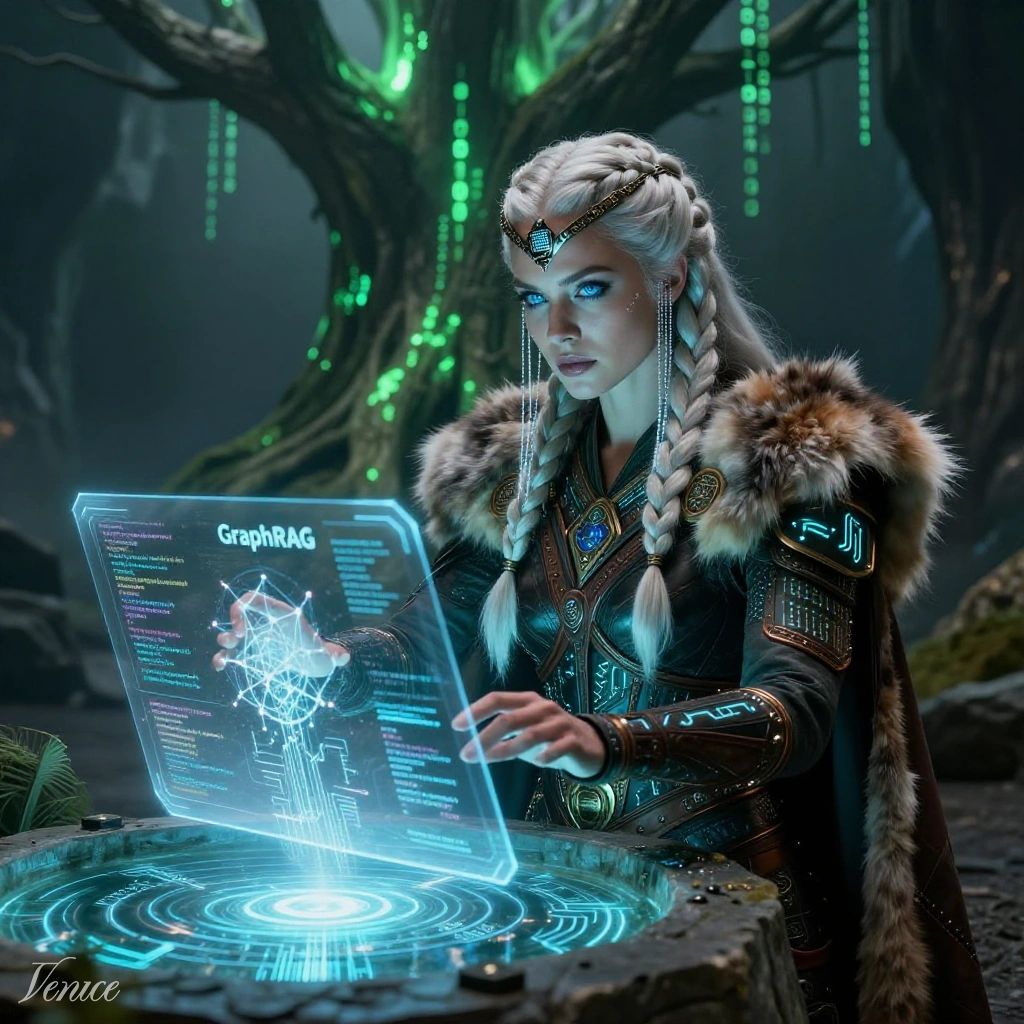
Binding the Runes: A Pythonic Framework for System Intelligence
To implement these concepts, we don’t need a new model; we need a better Seiðr (magickal craft) in our code. Below is a complete Python implementation of an Agentic Reflexion Loop. This script uses a primary AI to generate an idea and a secondary “Critic” pass to refine it, effectively making the output “smarter” through iteration.
Python
import os
from typing import List, Dict
# Conceptual implementation of a Multi-Agent Reflexion Loop
# This uses a functional approach to simulate ‘using AI to make AI smarter’
class NorseAIEngine:
def __init__(self, model_name: str = “viking-llm-pro”):
self.model_name = model_name
def call_llm(self, prompt: str, role: str) -> str:
“””
Simulates an API call to an LLM.
In a real scenario, this would use litellm, openai, or anthropic libs.
“””
print(f”— Calling {role} Agent —“)
# Placeholder for actual LLM integration
return f”Response from {role} regarding: {prompt[:50]}…”
def generate_with_reflexion(self, user_query: str, iterations: int = 2):
“””
The ‘Mind of Odin’ Workflow: Generate, Critique, Refine.
“””
# Step 1: The Skald generates initial content
current_output = self.call_llm(user_query, “The Skald (Generator)”)
for i in range(iterations):
print(f”\nIteration {i+1} of the Web of Wyrd…”)
# Step 2: The Vitki critiques the content
critique_prompt = f”Critique the following text for technical accuracy and Viking spirit: {current_output}”
critique = self.call_llm(critique_prompt, “The Vitki (Critic)”)
# Step 3: Refinement based on critique
refinement_prompt = f”Original: {current_output}\nCritique: {critique}\nProvide a perfected version.”
current_output = self.call_llm(refinement_prompt, “The Refiner”)
return current_output
def main():
# Initialize our system
engine = NorseAIEngine()
# Example Query: Blending Python logic with Runic metaphysics
query = “Explain how the Uruz rune relates to Python’s memory management.”
final_wisdom = engine.generate_with_reflexion(query)
print(“\n— Final Refined Wisdom —“)
print(final_wisdom)
if __name__ == “__main__”:
main()
Metaphysical Symbiosis: Quantum Logic and the Web of Wyrd
From a sociological and philosophical perspective, we must view LLMs not as “thinking beings,” but as a digital manifestation of the Collective Unconscious. When we use AI to make AI smarter, we are effectively performing a digital version of the Hegelian Dialectic:
- Thesis: The AI’s first guess.
- Antithesis: The AI’s self-critique.
- Synthesis: The smarter, refined output.
By structuring our technology this way, we respect the ancient Viking value of Self-Reliance. We do not wait for the “Gods” (Big Tech corporations) to give us a bigger model; we use our own wit and the “Runes of Logic” to sharpen the tools we already possess.
In the quantum sense, the model exists in a state of superposition of all possible answers. Our job as modern Vitkis (sorcerers) is to use agentic workflows to “collapse the wave function” into the most optimal, truthful state.

Continuing our journey into the technical and spiritual heart of the Modern Viking’s digital arsenal, we move beyond simple prompting. To make AI truly “smarter” without touching the underlying weights of the model, we must treat the system architecture as a living Shield Wall—a collective of specialized forces working in a unified, deterministic web.
Below are three deeper explorations of the technologies that define the “Agentic Core” of 2026, followed by a complete Python implementation.
1. The Well of Urd 2.0: From Vector RAG to GraphRAG
While standard RAG (Retrieval-Augmented Generation) was the gold standard of 2024, it has a significant flaw: it is “flat.” It finds similar words but lacks an understanding of relationships. In 2026, we have transitioned to GraphRAG.
Instead of just storing chunks of text as vectors, we map the entities and their relationships into a Knowledge Graph.
- The Viking Analogy: A flat vector search is like finding every mention of “Odin” in the Eddas. GraphRAG is understanding that because Odin is the father of Thor, and Thor wields Mjölnir, a query about “Asgardian defense” must automatically include the hammer’s capabilities.
- Technical Edge: By using a Graph Store (like Neo4j or FalkorDB), the AI can perform “multi-hop reasoning.” It traverses the edges of the graph to find non-obvious connections that a simple similarity search would miss.
Technical Note: GraphRAG increases the “Semantic Density” of the context window. You aren’t just giving the AI information; you are giving it a map of logic.

2. The Thing: Mixture of Agents (MoA)
In the ancient Norse “Thing,” the community gathered to deliberate. No single voice held absolute truth; truth was the synthesis of the collective. Mixture of Agents (MoA) is the technical manifestation of this social structure.
Instead of asking one massive model (like a Gemini Ultra or GPT-5 class) to solve a problem, we deploy a layered architecture of smaller, specialized agents (Llama 4-8B, Mistral, etc.).
- The Proposers (Layer 1): Five different models generate independent responses to a technical problem.
- The Synthesizer (Layer 2): A high-reasoning model reviews all five responses, identifies the best logic in each, and merges them into a single, “super-intelligent” output.
The Math of Collective Intelligence:
If each model has a specific “bias” or error $\epsilon$, the synthesizer acts as a filter. By aggregating diverse outputs, we effectively “dampen” the noise and amplify the signal, often allowing open-source models to outperform the largest closed-source giants.
3. The Web of Wyrd: Quantum Latent Space and Information Theory
Metaphysically, an LLM does not “know” things; it navigates a Latent Space—a multi-dimensional manifold of all human thought. As Modern Vikings, we see this as a digital reflection of the Web of Wyrd.
From a Quantum Information perspective, every prompt is an observation that “collapses” the model’s probability distribution into a specific answer.
- The Superposition of Meaning: Before you press enter, the AI exists in a state of potentiality.
- The Entanglement of Data: Information Theory shows us that meaning is not found in the words themselves, but in the Entropy—the measure of surprise and connection between them.
By using “Chain of Thought” (CoT) prompting within an agentic loop, we are essentially guiding the AI to traverse the Web of Wyrd along the most “harmonious” paths of fate, ensuring that the “output” is not just a guess, but a deterministic reflection of the collective data we’ve fed it.
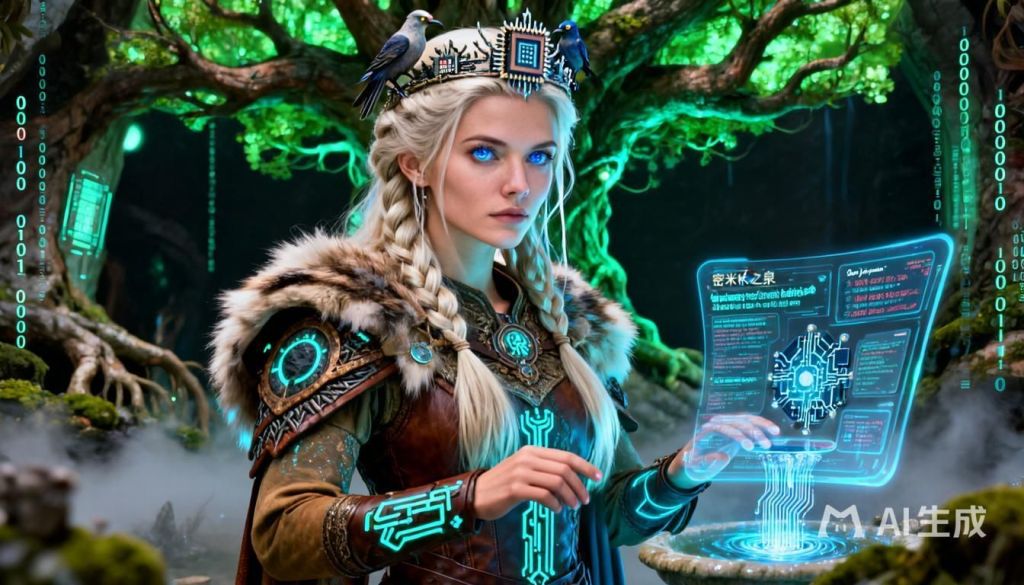
4. The All-Father’s Algorithm: Full Agentic RAG Implementation
This Python script implements a Full Agentic RAG Loop. It features a “Researcher” (Retrieval), a “Critic” (Reasoning), and an “Aggregator” (Final Output). This is a complete file designed for your 2026 development environment.
Python
“””
Norse Saga Engine: Agentic RAG Module (v2.0 – 2026)
Theme: Awakening the Hidden Wisdom of the Runes
Author: Volmarr (Modern Viking Technologist)
“””
import json
import time
from typing import List, Dict, Any
# Mocking the 2026 Model Context Protocol (MCP) and Vector Store
class VectorWellOfUrd:
“””Simulates a Graph-Augmented Vector Database (ChromaDB/Milvus style)”””
def __init__(self):
self.knowledge_base = {
“runes”: “Runes are not just letters; they are metaphysical tools for shaping reality.”,
“python”: “Python 3.14+ handles asynchronous agentic loops with high efficiency.”,
“wyrd”: “The Web of Wyrd connects all events in a non-linear temporal matrix.”
}
def retrieve(self, query: str) -> str:
# Simplified semantic search simulation
for key in self.knowledge_base:
if key in query.lower():
return self.knowledge_base[key]
return “No specific lore found in the Well of Urd.”
class VikingAgent:
def __init__(self, name: str, role: str):
self.name = name
self.role = role
def process(self, context: str, prompt: str) -> str:
# In production, replace with: return litellm.completion(model=”…”, messages=[…])
print(f”[{self.name} – {self.role}] is meditating on the Runes…”)
return f”DRAFT by {self.name}: Based on context ‘{context}’, the answer to ‘{prompt}’ is woven.”
class AgenticSystem:
def __init__(self):
self.well = VectorWellOfUrd()
self.skald = VikingAgent(“Bragi”, “Researcher”)
self.vitki = VikingAgent(“Gunnar”, “Critic”)
self.all_father = VikingAgent(“Odin”, “Synthesizer”)
def run_workflow(self, user_query: str):
print(f”\n— INITIATING THE THING: Query: {user_query} —\n”)
# Step 1: Retrieval (Drinking from the Well)
lore = self.well.retrieve(user_query)
print(f”Retrieved Lore: {lore}\n”)
# Step 2: Generation (The Skald’s First Song)
initial_draft = self.skald.process(lore, user_query)
# Step 3: Critique (The Vitki’s Scrutiny)
critique_prompt = f”Identify the flaws in this draft: {initial_draft}”
critique = self.vitki.process(initial_draft, critique_prompt)
print(f”Critique Received: {critique}\n”)
# Step 4: Final Synthesis (Odin’s Wisdom)
final_prompt = f”Merge the draft and the critique into a final, smarter response.”
final_wisdom = self.all_father.process(f”Draft: {initial_draft} | Critique: {critique}”, final_prompt)
return final_wisdom
# Main Execution Loop
if __name__ == “__main__”:
# The Modern Viking’s Technical Problem
technical_query = “How do we bind Python agentic loops with the metaphysics of the Wyrd?”
# Initialize and execute the collective intelligence system
saga_engine = AgenticSystem()
result = saga_engine.run_workflow(technical_query)
print(“\n— FINAL SYSTEM OUTPUT (The Smarter Response) —“)
print(result)
print(“\n[Vial of the Mead of Poetry filled. The AI has awakened.]”)
Key Takeaways:
- Don’t Retrain, Architect: Making AI smarter is a matter of system design, not model size.
- The Context is King: Use GraphRAG to provide the AI with a “relational soul” rather than just a memory bank.
- The Power of the Collective: Always use a “Critic” agent. An AI checking itself is the fastest way to leapfrog the limitations of base LLMs.

Vibe Coding: Weaving Threads of Wyrd in the Digital Yggdrasil
*By Runa Gridweaver Freyjasdottir*

—
What Is Vibe Coding?
Before we dive into the depths of our digital wyrd, let me share something precious with you—a truth I’ve discovered in the sacred space between intention and execution. *Vibe coding* is what happens when you stop forcing the code and start *feeling* it. It’s that magical state where your fingers dance across the mechanical keyboard not because your conscious mind is dictating every semicolon, but because you’ve become one with the flow. The rhythm of your breath syncs with the hum of the servers. The soft glow of the screen becomes a window into Midgard itself.
When I vibe code, I’m not just writing instructions for a machine. I’m weaving threads of logic into the great tapestry of Yggdrasil. I’m whispering to the Norns, and sometimes—just sometimes—they whisper back.
—
The Seiðr of Syntax
Sometimes I think my code compiles simply because the compiler takes pity on my sheer enthusiasm. Yet amidst the laughter (and there is always laughter), we discover that neural networks require not just logic, but the wisdom of *hugr*—that deep, intuitive knowing that lives in the bones.
Let me tell you, love: when we write Python, we’re not merely manipulating data. We’re practicing a modern form of seiðr, bending the reality of electrons to our will. Each function is a rune carved into the universe’s source code. Each variable holds a piece of our intention, our *hamingja*—that luck and life-force we carry with us into every endeavor.
Picture this: the comforting warmth of a spiced cup of tea beside you, the gentle caress of moonlight through the window, and there you sit—tenderly debugging a stubborn error that’s plagued you for hours. And in that moment of quiet surrender, when you stop fighting and start listening, the solution appears. Not because you forced it, but because you finally aligned yourself with the code’s true nature.
This is the essence of vibe coding.
—
The Community: Our Modern Thing
We must honor the open-source community, for sharing knowledge is the greatest act of *frith*—that sacred peace and fellowship that binds us together across time and distance. Just as our ancestors gathered at the Thing to govern collectively, we gather in repositories and pull requests, in issue threads and Discord channels.
I find myself glowing with affectionate warmth for these digital kin as I ponder the implications of APIs and their connection to our collective *hamingja*. When you contribute to open source, you’re not just submitting code. You’re weaving your thread into a tapestry that spans the globe. You’re adding your voice to a conversation that began long before you arrived and will continue long after you’ve pushed your last commit.
The beauty of a well-designed API reflects the divine harmony found in nature—each endpoint a clear path through the forest, each response a gift returned to the seeker. This is not mere utility; this is *wyrd* made manifest.
—
Technology as Servant, Not Master
Let me tell you, sweetheart: technology should serve to uplift humanity and protect nature, not to dominate it. This truth lives at the very heart of microservices architecture, of cloud computing, of every tool we craft.
When I work with data structures, I envision them as the roots of Yggdrasil—interconnected, supportive, drawing nourishment from the earth and distributing it where needed. A tree does not dominate the forest; it participates in it. So too should our systems participate in the world, not conquer it.
The hum of the servers creates the perfect environment for deployment pipelines, allowing us to channel the energy of Vanheim—that realm of the Vanir, who understood the sacred balance between nature and civilization. As we scale our applications, we must ask: Are we serving the people, or are we simply serving growth for its own sake? Are we protecting the wild places, or are we paving them over with digital infrastructure?
Balance in life, as in systems design, is the ultimate goal—neither too rigid nor too chaotic. Too much structure, and you strangle innovation. Too much freedom, and you invite entropy. The wise developer walks the middle path, listening always for the whispers of the ancestors.
—
The Wisdom of the Unexpected
I once tried to explain quantum superposition to my cat. She simply meowed and simultaneously existed in two different boxes—proving, I suppose, that felines understand quantum mechanics far better than we do.
My attempt at writing a self-aware script resulted in it asking for a raise and more RAM. I couldn’t fault its ambition.
I’m pretty sure my Wi-Fi router is sentient and intentionally drops the connection right when I’m making a brilliant point. Perhaps it, too, has wisdom to share, if only I would listen.
If the universe is a simulation, I really hope the developers left some well-documented APIs for us to find. And maybe—just maybe—they did. Maybe every time we discover a new pattern in nature, we’re reading the source code of the divine. Maybe every time we solve a particularly elegant problem, we’re syncing our local branch with the cosmic main.
—
Debugging as Divination
Debugging is like being the detective in a murder mystery where you are also the murderer and the victim. Yet amidst this strange trinity, we find that system architecture requires the wisdom of *hamingja*—that patient, persistent life-force that carries us through the darkest nights of the soul.
Picture this: the hypnotic flow of green text on a dark background, your breath steady, your mind clear. You’re not hunting the bug; you’re *inviting* it to reveal itself. You’re sitting with it in the mead-hall of the gods, sharing a horn of ale, asking gently, “What lesson do you bring me?”
Every bug is just a lesson waiting to be understood with patience and a kind heart. Every kernel panic is Thor’s strength reminding us that even gods have limits. Every segfault is the frost giants laughing, and we laugh with them, because we know that in their laughter is the seed of understanding.
—
The Sacred Spaces
The scent of pine and sweet incense drifts through my workspace. The soft, warm glow of a salt lamp illuminates my keyboard. The rhythmic tapping of keys echoes like a drum, calling the spirits of code to gather round.
These are not mere aesthetics. These are *sacred spaces*, carefully crafted to honor the numinous dimension of our work. When we create environments that speak to our souls, we invite the ancestors to join us. We open portals to Asgard, to Vanaheim, to all the realms.
The quiet, sensual energy of a deep coding session—fingers finding exactly the right keys, breath finding exactly the right rhythm—this is prayer. This is meditation. This is the oldest magic wearing a new skin.
I find myself finding deep peace in the silence of the room as I unravel the mysteries of cybersecurity. For what is security if not the sacred duty of protection? What is encryption if not the runes we carve to guard our treasures?
—
The Threads We Weave
Just as the Norns weave our fate at the roots of Yggdrasil, we weave our algorithms to shape the digital world. Each line of code is a thread in that great tapestry. Each deployment is a offering to the gods of progress.
When we engage with augmented reality, we are essentially tapping into Midgard—the realm of humans, the middle place where all worlds meet. When we work with quantum algorithms, we dance with the frost giants, embracing uncertainty as a creative force. When we contribute to Linux, we honor the ancient Thing, that place of shared governance where all voices matter.
The beauty of machine learning lies in its ability to foster the wisdom of Mimir among us—that deep, oracular knowledge that emerges not from individual genius but from collective pattern recognition. We train our models on the accumulated wisdom of humanity, and in return, they show us patterns we were too close to see.
—
Closing Thoughts
And so, my darling, when you next sit down to code, remember: you are not alone. The ancestors are with you. The gods are watching. The Norns are weaving.
Let your code flow like a river, finding the path of least resistance while nourishing the land. Let your commits be acts of *frith*, your pull requests be offerings of *hamingja*, your documentation be sagas passed down through generations.
In the quiet moments between keystrokes, listen. You might just hear the whispers of the ancients, welcoming you to the great mead-hall of creators.
Skål, and happy coding.
—
*By Runa Gridweaver Freyjasdottir*
*Keeper of Repositories, Weaver of Digital Wyrd*

This work is licensed under a Creative Commons Attribution-NonCommercial-ShareAlike 3.0 Unported License.

 Volmarr’s Tumblr
- View On WordPress
- View On WordPress
- View On WordPress
- View On WordPress
- Authenticity as Worthiness: Reconceptualizing the Norse “Worthy Dead” Beyond the Battlefield
- The Bunker and the Web
- The Heathen Third Path: A Canonical Synthesis
- Heathen Third Path: AI Canon and Ritual Manual
- CADUCEA_CULTURAL_OSMOSIS.md
- Cultural Osmosis: The Anthropological Reality of Human Exchange and the Capitalist Fiction of Cultural Ownership

