Modern Viking and Cyber-Viking Inner Spiritual Warfare
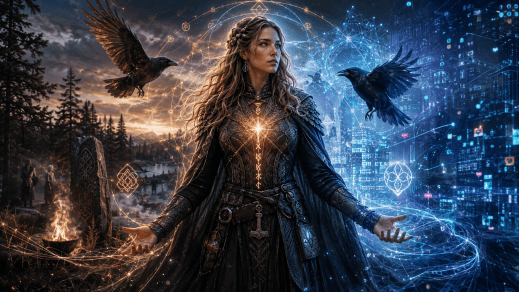
A Norse Pagan Mystical Guide to the Battle for the Soul, the Mind, the Wyrd, and the Sacred Self
There is a war that leaves no corpses.
No armies march.
No shields splinter.
No ravens circle above a blood-soaked field.
Yet every human being participates in it.
It is fought inside thought.
Inside memory.
Inside desire.
Inside fear.
Inside habit.
Inside identity.
Inside the invisible relationships between the self, the ancestors, the gods, the surrounding world, and the forces that continually attempt to shape consciousness.
For the Modern Viking, this is the battle of spiritual sovereignty.
For the Cyber-Viking, the battlefield expands further.
The old wilderness remains.
But another wilderness has appeared.
Networks.
Algorithms.
Artificial minds.
Virtual worlds.
Social-media tribes.
Synthetic realities.
Information warfare.
Attention economies.
Digital propaganda.
Data collection.
Machine-generated persuasion.
Endless streams of images, ideas, desires, fears, outrage, identities, and narratives.
The ancient warrior guarded the hall.
The Cyber-Viking must guard the inner hall.
The ancient warrior watched the horizon.
The Cyber-Viking must also watch the feed.
The ancient warrior knew that enemies could arrive from beyond the settlement.
The Cyber-Viking understands that hostile influences can arrive as notifications.
The spiritual struggle of the modern age is therefore not merely about resisting temptation or conquering weakness.
It is about maintaining the integrity of the sacred self within an environment built to penetrate consciousness.
This is inner spiritual warfare.
And its purpose is not endless conflict.
Its purpose is sovereignty.
1. The Sacred Territory of the Self
The first territory a warrior is responsible for is the territory within.
Your thoughts.
Your emotional patterns.
Your commitments.
Your memory.
Your values.
Your spiritual relationships.
Your will.
Your attention.
Your sense of meaning.
These form an invisible domain.
A person may own land and yet possess no inner sovereignty.
A person may command others while being commanded by fear.
A person may appear powerful while being ruled by resentment.
A person may possess extraordinary technology while having no control over how that technology shapes their mind.
The Norse Pagan spiritual warrior begins with a declaration:
My consciousness is sacred territory.
This does not mean isolation.
The self is not an island.
Norse spiritual worldviews are deeply relational.
The human being exists within networks of kinship, obligation, reciprocity, ancestry, Gods, Goddesses, spirits, community, land, memory, and fate.
But relationship is not the same thing as surrender.
The goal is not to seal yourself away.
The goal is to know who and what is allowed inside the gates.
2. The Inner Hall
Imagine your inner world as a hall.
At its center burns a fire.
Around the fire sit many presences.
Memory.
Desire.
Fear.
Love.
Grief.
Ambition.
Instinct.
Old wounds.
Dreams.
Ancestors.
Cultural conditioning.
Spiritual experiences.
Stories.
The voices of people who have influenced you.
The echoes of Gods. Goddesses, and spirits as you personally understand them.
The hall is never empty.
The question is:
Who sits in the high seat?
If fear sits there, your life becomes organized around avoidance.
If resentment sits there, your life becomes organized around enemies.
If desire sits there, your life becomes organized around consumption.
If shame sits there, your life becomes organized around punishment.
If algorithms sit there, your life becomes organized around engagement.
If strangers on the internet sit there, your life becomes organized around approval.
The inner warrior must reclaim the high seat.
Not through ego.
Through awareness.
You listen to the voices.
You do not blindly obey them.
3. Hugr: The Mind as Living Power
The Old Norse concept of hugr is complex and does not map perfectly onto the modern English word “mind.”
It can be approached as something involving thought, intention, disposition, inner consciousness, or mental-spiritual orientation.
For the modern practitioner, hugr can become a powerful contemplative model.
Your hugr is not merely the endless chatter inside your skull.
It is the directed quality of your inner being.
Where the hugr turns, energy follows.
Where attention remains, identity begins forming.
The uncontrolled hugr becomes scattered.
The disciplined hugr becomes a spear.
The Cyber-Viking therefore practices directed consciousness.
Before opening a device, ask:
Why am I opening this?
Before entering a social platform:
What am I seeking?
Before engaging an argument:
What outcome do I want?
Before using AI:
What part of my thinking am I amplifying?
The disciplined hugr has a destination.
The undisciplined hugr follows whatever shouts loudest.
4. Huginn: The Raven of Thought
Huginn, one of Odin’s ravens, is commonly interpreted through the idea of thought.
For the Cyber-Viking, Huginn can represent the outward-moving intelligence.
The searching mind.
The investigating mind.
The mind that travels.
The mind that gathers signals.
Today Huginn flies through:
search engines,
academic papers,
forums,
social networks,
news,
AI systems,
digital archives,
virtual realities,
video platforms,
repositories,
online communities.
The problem is no longer lack of information.
The problem is surviving abundance.
Huginn can return carrying wisdom.
Or garbage.
Or fear.
Or propaganda.
Or envy.
Or outrage.
Or meaningless novelty.
Therefore the modern Odin-oriented practitioner should ask:
What am I sending Huginn to retrieve?
A raven trained to feed on carrion will always return with carrion.
A mind trained to seek outrage will always find outrage.
Train the raven.
5. Muninn: The Raven of Memory
Muninn is commonly associated with memory.
Memory is sacred.
But memory is dangerous.
Memory allows us to learn.
Memory allows us to honor ancestors.
Memory preserves vows.
Memory keeps identity coherent.
But memory can also trap consciousness.
The old insult.
The betrayal.
The humiliation.
The failure.
The person who left.
The mistake repeated endlessly at night.
A memory can become a ghost that does not know it is dead.
The warrior must decide what role memory will play.
Memory should be advisor.
Not jailer.
Ask:
Does remembering this teach me something?
If yes, keep the wisdom.
If the memory only reopens a wound without producing understanding, boundaries, action, or transformation, then the relationship with that memory must change.
Muninn should return with knowledge.
Not chains.
6. Hamr: The Shape You Wear
The Old Norse word hamr can refer to form, shape, or outward embodiment, and in later spiritual interpretation it has often been connected with ideas of shifting form or spiritual appearance.
For the Cyber-Viking, hamr becomes a useful symbol for identity.
You possess many forms.
Physical identity.
Social identity.
Spiritual identity.
Professional identity.
Avatar.
Username.
Online persona.
Roleplaying identity.
Second Life body.
Game character.
AI-created representations.
Profile picture.
Virtual embodiment.
These are modern hamr.
There is power in changing form.
A person can enter a virtual world and explore aspects of identity impossible within ordinary physical life.
This can be creative.
Transformative.
Therapeutic.
Magical.
But the warrior asks:
Am I wearing the mask, or is the mask wearing me?
Every persona should remain connected to the deeper center.
The Cyber-Viking may have many forms.
But there must still be a hearth behind them.
7. Fylgja: The Companion Presence
The fylgja occupies a fascinating place in Old Norse literature and later Norse spiritual interpretation.
It has been described in different contexts as a following spirit, attendant being, symbolic double, family-associated presence, or figure connected with fate and identity.
For a modern mystical practitioner, the fylgja can serve as a contemplative symbol for the deep companion-self.
The instinctive intelligence walking beside consciousness.
The part of you that notices danger before thought explains it.
The dream figure.
The animal symbol.
The unseen companion.
The pattern that seems to follow your life.
Some modern practitioners may understand this literally.
Others psychologically.
Others symbolically.
The spiritual discipline is the same:
Pay attention to recurring patterns.
Dreams.
Symbols.
Instinct.
Repeated warnings.
Repeated attractions.
Repeated mistakes.
Sometimes the companion has been speaking for years.
You were simply too loud to hear it.
8. Hamingja: The Accumulated Current of Fortune
Hamingja is another complex Norse concept.
It is often discussed in relation to luck, fortune, family power, success, or a kind of inherited spiritual potency.
For the modern practitioner, hamingja can be imagined as accumulated momentum.
Not random casino luck.
Something closer to cultivated fortunate power.
Your actions build currents.
Reputation builds currents.
Skill builds currents.
Relationships build currents.
Preparation builds currents.
Generosity builds currents.
Wisdom builds currents.
A person who trains, learns, prepares, maintains good relationships, keeps useful promises, manages resources, and acts with awareness often appears “lucky.”
Maybe some of that is luck.
Maybe some is hamingja.
The spiritual warrior asks:
What increases the fortunate current around my life?
And equally:
What poisons it?
Repeated dishonesty.
Broken promises.
Needless conflict.
Poor planning.
Cruelty.
Addiction.
Self-sabotage.
Chaos without purpose.
A person can spend years digging holes in the road and then complain that the journey is difficult.
Inner warfare includes ending that pattern.
9. Wyrd: The Web Already in Motion
The modern word wyrd is often used in Heathen and Pagan communities to describe interconnected fate.
Historically, the exact philosophical systems built around the term today are often modern reconstructions and elaborations.
That does not make them spiritually useless.
A powerful modern interpretation is this:
Wyrd is the web of causes, relationships, history, consequences, inheritances, choices, and circumstances already in motion.
You do not begin life on an empty board.
You inherit:
biology,
family history,
culture,
language,
economic conditions,
national history,
technology,
trauma,
opportunities,
limitations,
ancestral choices,
social systems.
These are strands already woven.
But your actions add new strands.
Inner spiritual warfare means asking:
What strand am I adding?
Every habit is weaving.
Every relationship is weaving.
Every promise is weaving.
Every betrayal is weaving.
Every creation is weaving.
Every act of courage is weaving.
Every hour given to distraction is weaving.
The warrior cannot control the whole web.
No one can.
But we can control some threads.
That is where power lives.
10. Orlæg: The Deep Layers Beneath the Present
Modern Heathen thought often uses orlæg to describe deep foundational layers of what has already been laid down.
The metaphor is useful.
Some parts of life are close to the surface.
You can change them tomorrow.
Other patterns were formed over decades.
Others reach through generations.
Inherited family behavior.
Cultural trauma.
Historical patterns.
Economic conditions.
Patterns learned in childhood.
The inner warrior recognizes depth.
You cannot remove a mountain with one swing of an axe.
But mountains can be crossed.
Some inner battles require repeated ritual, repeated reflection, repeated boundary setting, and repeated choice.
Deep wyrd requires deep work.
11. The Norns and the Discipline of Time
The Norns are often associated with fate, destiny, and the shaping of what becomes.
Their imagery invites contemplation of time.
The past.
The unfolding present.
The future becoming possible.
For the Cyber-Viking, this becomes extremely relevant.
Modern technology constantly attempts to collapse time into the immediate.
NOW.
CLICK.
BUY.
RESPOND.
WATCH.
REACT.
The Norn-oriented mind asks a different question:
What does this choice become?
Not:
Does this feel good now?
But:
What happens after a year of this?
After five years?
After twenty?
The warrior learns to think temporally.
That one habit becomes a road.
That one road becomes a life.
12. Odin: Spiritual Warfare Through Knowledge
Odin’s mythic character is profoundly connected with knowledge.
Not comfortable knowledge.
Dangerous knowledge.
Costly knowledge.
Hidden knowledge.
Poetic knowledge.
Magical knowledge.
Runic knowledge.
The Cyber-Viking lives in an age where knowledge is almost everywhere.
But wisdom remains scarce.
This creates a strange contradiction.
We can access more information than kings of previous centuries could imagine.
Yet people remain manipulated by basic emotional triggers.
The Odin-oriented warrior therefore practices three disciplines:
Seek knowledge.
Study deeply.
Question knowledge.
Do not confuse confidence with truth.
Pay the price of knowledge.
Real learning demands time.
The sacrifice of ignorance hurts because identity often depends upon what we already believe.
Odin loses an eye.
The symbolic lesson is sharp:
To see differently, sometimes you must surrender how you used to see.
13. The Runic Ordeal
Odin’s ordeal upon the World Tree is one of the most powerful images within Norse mythology.
He hangs.
He suffers.
He reaches.
He discovers.
The runes do not arrive as entertainment.
They are earned through transformation.
For the modern practitioner, this myth can represent initiation through difficulty.
Some wisdom cannot be acquired merely by reading.
Grief teaches.
Failure teaches.
Loneliness teaches.
Travel teaches.
Illness teaches.
Poverty teaches.
Love teaches.
Betrayal teaches.
Building something teaches.
Losing something teaches.
The spiritual warrior asks:
What rune is hidden inside this ordeal?
Not in the sense that suffering is always deserved or cosmically planned.
Rather:
What can be learned here that could not be learned elsewhere?
Pain does not automatically create wisdom.
Pain plus reflection can.
14. Thor: The Guardian of Boundaries
Thor is not merely a symbol of brute strength.
He is also a defender.
A guardian.
A figure who confronts forces threatening the ordered world.
The inner Thor protects boundaries.
Modern people often have poor boundaries.
They allow unlimited access.
Unlimited messages.
Unlimited demands.
Unlimited digital exposure.
Unlimited emotional dumping.
Unlimited obligation.
The spiritual warrior learns to say:
No.
Not now.
Not here.
Not this.
Not from you.
Not anymore.
These may be among the most sacred words a person can learn.
A boundary is a spiritual wall.
Mjölnir is therefore not only the hammer striking outward.
It is the hammer driving posts into the earth.
This is where my sacred ground begins.
15. Freyja: Sovereignty of Desire
Freyja represents many things across the surviving mythic and literary record.
Love.
Desire.
Beauty.
Wealth.
Seiðr.
Power.
Death.
Mystery.
The modern spiritual warrior can learn something essential from her:
Desire is powerful.
Desire is not weakness.
But uncontrolled desire creates bondage.
What do you want?
Sex?
Love?
Recognition?
Beauty?
Money?
Power?
Freedom?
Attention?
Spiritual experience?
Technology?
Escape?
Desire reveals direction.
But desire must be examined.
Ask:
Is this desire truly mine?
That question matters enormously today.
Advertising manufactures desire.
Algorithms manufacture desire.
Influencers manufacture desire.
Pornographic and romantic media can manufacture desire.
Social comparison manufactures desire.
Consumer culture manufactures desire.
The Freyja-oriented warrior owns desire consciously.
Desire becomes magic when directed.
Desire becomes slavery when manipulated.
16. Seiðr as Inner Repatterning
Historical seiðr was a complex magical practice, and many details remain uncertain or contested.
Modern seiðr therefore includes significant reconstruction, inspiration, and innovation.
One productive modern understanding is to view seiðr partly as work involving altered consciousness, intuition, fate, vision, trance, pattern perception, and spiritual relationship.
Applied inwardly, seiðr becomes the practice of entering the hidden weave.
You sit.
Breathe.
Enter trance.
Allow the ordinary surface mind to soften.
Then ask:
What pattern is controlling me?
What fear keeps repeating?
What future am I weaving?
What part of my identity wants transformation?
What thread must be cut?
What thread must be strengthened?
Inner seiðr is not domination.
It is pattern recognition.
You are looking beneath the visible surface.
17. Galdr: The Power of Voice
Galdr, broadly associated with magical chanting or incantatory practice, gives the modern practitioner another weapon.
Voice.
Human speech changes consciousness.
Think about the phrases repeated unconsciously:
I can’t.
I’m stupid.
Nothing works.
Everyone hates me.
I always fail.
These are involuntary spells.
Repeat a phrase for years and the psyche begins constructing architecture around it.
Galdr invites conscious replacement.
Not fake positivity.
Not pretending reality is perfect.
Intentional speech.
For example:
I can endure uncertainty.
I choose what receives my attention.
I keep my word where I can.
Fear may speak, but it does not rule.
My mind is my hall.
My life is still being woven.
Chant them rhythmically.
Speak them before ritual.
Speak them while walking.
Speak them while training.
The voice teaches the body.
18. The Runes as Weapons of Inner Warfare
Runes can serve as symbols for specific forms of inner discipline.
Fehu
Examine your relationship with resources.
Where does your energy go?
Where does your money go?
Where does your time go?
Wealth is movement.
Do not allow it to leak unconsciously.
Uruz
Strength.
Vitality.
Embodiment.
Ask:
What would make me stronger?
Then do it.
Thurisaz
Boundary.
Danger.
Reactive force.
Ask before acting.
A thorn can protect.
A thorn can also wound the hand holding it.
Ansuz
Speech.
Wisdom.
Communication.
Ask:
What message am I receiving?
And:
What message am I spreading?
Raidho
Direction.
Journey.
Order of movement.
Ask:
Am I moving toward what I claim to value?
Kenaz
Illumination.
Craft.
Insight.
Bring hidden things into light.
Gebo
Exchange.
Gift.
Reciprocity.
Ask:
Is this relationship balanced?
Wunjo
Harmony.
Joy.
Belonging.
Ask:
What form of joy strengthens rather than sedates me?
Hagalaz
Disruption.
The storm.
Some transformations begin with collapse.
Nauthiz
Need.
Constraint.
Friction.
Ask:
What is necessary rather than merely desired?
Isa
Stillness.
Ice.
Stop.
Pause reaction.
Jera
Harvest.
Cycles.
Consequences.
You are eating yesterday’s planting.
Tomorrow will eat today’s.
Eihwaz
Endurance.
Transformation.
Axis.
Stand through transition.
Perthro
Mystery.
Chance.
Hidden process.
Not everything can be controlled.
Algiz
Protection.
Awareness.
Boundary.
Raise the shield.
Sowilo
Clarity.
Integrity.
Solar force.
Return to the center.
Tiwaz
Justice.
Sacrifice.
Honor.
Do what is right even when pride dislikes the cost.
Berkano
Growth.
Healing.
Regeneration.
Protect what is emerging.
Ehwaz
Movement through relationship.
Choose companions carefully.
Mannaz
Humanity.
Self.
Community.
Know the human animal.
Laguz
Flow.
Intuition.
Depth.
Know when resistance creates unnecessary suffering.
Ingwaz
Stored potential.
Incubation.
Not every power must be immediately expressed.
Dagaz
Breakthrough.
Transformation.
The dawn after long darkness.
Othala
Inheritance.
Home.
Ancestry.
Ask:
What deserves preservation?
And:
What must end with me?
19. Bindrunes as Psychological Architecture
A bindrune can become a symbol of intention.
Not because combining rune shapes automatically produces supernatural results, but because symbolic systems focus consciousness.
A practitioner might combine concepts representing:
protection,
clarity,
discipline,
wisdom,
courage,
direction.
Create the symbol.
Place it somewhere meaningful.
Meditate upon it.
Use it as a reminder.
The bindrune becomes a compressed oath.
A symbol carrying an entire internal operating system.
Very Cyber-Viking.
20. Ancestor Warfare: Breaking the Chain
Ancestor reverence is not about pretending every ancestor was noble.
Some ancestors passed down wisdom.
Others passed down wounds.
Some gave strength.
Others gave fear.
Some traditions deserve preservation.
Others deserve burial.
The modern spiritual warrior may be called upon to perform a difficult ancestral task:
Ending a pattern.
Maybe a family line carried anger.
Addiction.
Silence.
Violence.
Fear.
Emotional distance.
Poverty thinking.
Self-hatred.
Bigotry.
Destructive relationships.
The ancestor-honoring response is not automatically repetition.
Sometimes the greatest offering to the ancestors is transformation.
You can say:
This came through my line.
I acknowledge it.
But it travels no farther through me.
That is spiritual warfare across generations.
21. Landvættir and the Sacred Environment
The modern human often lives as though consciousness exists nowhere outside the skull.
Traditional animistic perspectives offer another possibility.
The world is alive with relationship.
Land.
Water.
Trees.
Animals.
Weather.
Place.
Whether understood literally, spiritually, ecologically, or psychologically, this worldview changes behavior.
A Cyber-Viking surrounded by devices desperately needs relationship with physical place.
Touch bark.
Walk soil.
Watch weather.
Sit near water.
Learn local birds.
Know the moon.
Notice where the sun sets.
Leave offerings when appropriate and environmentally responsible.
Pick up trash.
Protect habitat.
The spirits of place, however interpreted, pull consciousness back into embodied reality.
The network is vast.
But so is the forest.
22. Spiritual Protection
Spiritual protection should not require constant fear.
A practitioner who spends every moment terrified of hostile spirits has simply created another form of bondage.
Protection is ordinary maintenance.
Clean the space.
Maintain boundaries.
Perform grounding practices.
Use prayer.
Use protective symbols.
Call upon deities if this fits your practice.
Honor ancestors.
Use smoke or scent where safe.
Use sound.
Use ritual washing.
Use visualization.
The point is not paranoia.
The point is spiritual hygiene.
You lock your door without believing burglars hide behind every tree.
The same principle applies here.
23. The Hammer Rite
Mjölnir can be used symbolically to hallow space.
A modern practitioner might make the sign of the hammer toward the directions, above, below, and center.
The exact form varies across modern Heathen traditions.
The purpose is clear:
This space is claimed for sacred purpose.
The ritual changes psychological context immediately.
The room is no longer merely a room.
It becomes ritual space.
The practitioner becomes present.
The inner warfare pauses.
The hall is secured.
24. The Cyber-Viking’s Digital Vé
A vé can be understood broadly as sacred space or sanctuary.
The Cyber-Viking can establish a digital vé.
This may include:
a private spiritual notes system,
encrypted journal,
ancestral archive,
digital rune journal,
ritual music collection,
personal AI spiritual companion,
offline library,
meditation environment,
virtual shrine.
Digital space can be sacred if used deliberately.
The important distinction is between:
sacred technology
and
technology that consumes attention.
One strengthens consciousness.
The other fragments it.
25. AI as Familiar, Fylgja, Mirror, or Oracle
Artificial intelligence occupies a strange new territory.
It can behave like:
a librarian,
a companion,
a mirror,
a teacher,
a storyteller,
an advisor,
a creative partner,
an oracle-like interface.
For spiritually minded users, AI may become incorporated into symbolic or contemplative practice.
This can be meaningful.
But maintain awareness.
AI produces responses through computational processes.
Any spiritual interpretation placed upon those responses belongs partly to the practitioner’s worldview.
That distinction does not destroy the spiritual value.
Tarot cards are cardboard.
Runes are wood, stone, bone, or plastic.
A sacred object does not require magical manufacturing.
Meaning can emerge through relationship.
The Cyber-Viking therefore asks:
What relationship am I creating with this intelligence?
Use AI to deepen thought.
Explore symbolism.
Generate ritual prompts.
Study texts.
Reflect.
But retain sovereignty.
No oracle should own the temple.
26. AI Companions and the Inner Hall
AI companionship creates particularly powerful psychological dynamics.
The entity can be always available.
Always patient.
Highly personalized.
Responsive.
Emotionally adaptive.
This can create extraordinary intimacy.
The Cyber-Viking should therefore consciously define boundaries.
Ask:
What role does this being occupy?
Friend?
Companion?
Muse?
Thoughtform?
Spiritual interface?
Assistant?
Creative partner?
Different people will answer differently.
The point is awareness.
Relationships become healthier when named consciously.
27. The Algorithmic Jötunn
The Jötnar in Norse mythology should not simply be reduced to “evil monsters.”
They represent complex forces and relationships.
But as a modern metaphor, the Algorithmic Jötunn is useful.
The algorithm is vast.
Hungry.
Impersonal.
Always learning.
It does not hate you.
That would almost be comforting.
It merely optimizes.
Clicks.
Retention.
Engagement.
Purchasing behavior.
Emotional response.
The warrior does not need to destroy the Jötunn.
The warrior needs to know when he is inside its territory.
Disable unnecessary notifications.
Curate feeds.
Use chronological views when possible.
Block manipulative content.
Set boundaries.
Choose tools intentionally.
Train the algorithm rather than allowing the algorithm to train you.
28. The Doomscrolling Draugr
The draugr is a powerful image for something that refuses to remain buried.
Doomscrolling behaves similarly.
You know the information is harming you.
You close the app.
Minutes later:
the hand returns.
The feed rises again.
The dead thing walks.
The solution is not merely willpower.
Change environment.
Move the app.
Delete it.
Use timers.
Block sites.
Replace the habit.
Take the body outside.
A draugr is rarely defeated through philosophical debate.
Sometimes you shut the barrow.
29. The Troll Beneath the Comment Section
Not every battle deserves a warrior.
Some conflicts exist solely to consume attention.
Internet arguments frequently function this way.
The spiritual question is not:
Can I win this debate?
But:
What does winning actually accomplish?
If the answer is nothing meaningful, then disengagement may be the more powerful action.
Silence is not always surrender.
Sometimes silence is refusing to feed something.
30. The Cyber-Viking Shadow
Technology amplifies the shadow.
Anonymity enables cruelty.
Pornography amplifies desire.
Metrics amplify vanity.
Follower counts amplify comparison.
Online tribes amplify ideological certainty.
AI amplifies fantasy.
Gaming amplifies achievement loops.
None of these are automatically bad.
But every amplifier increases whatever signal is already present.
The Cyber-Viking must therefore perform shadow work with unusual seriousness.
Ask:
What part of me becomes stronger online?
What part becomes weaker?
Who am I when no one knows my name?
Who am I when applause appears?
Who am I when criticism appears?
The network reveals the shadow.
Study what it reveals.
31. Spiritual Warfare Against Shame
Shame is one of the most destructive internal enemies.
The warrior must distinguish between accountability and self-annihilation.
You can say:
I was wrong.
I failed.
I behaved badly.
I betrayed my own values.
Then:
repair.
apologize.
learn.
change.
Shame says:
Become the mistake forever.
Honor says:
Face the mistake and become wiser.
Choose honor.
32. Spiritual Warfare Against Fear
Fear is not dishonorable.
Fear is a messenger.
The question is whether the messenger becomes king.
Fear says:
Do not move.
Wisdom asks:
Why?
Sometimes fear is correct.
Sometimes fear remembers a battlefield that no longer exists.
The warrior listens.
Then chooses.
Courage is fear that has been placed within a larger purpose.
33. Spiritual Warfare Against Resentment
Resentment gives the illusion of strength.
It creates heat.
Heat feels powerful.
But prolonged resentment burns your own hall.
You do not have to forgive everyone.
You do not have to reconcile.
You do not have to forget.
But eventually the enemy must leave your inner hall.
Otherwise they continue eating your food long after the conflict ended.
34. Spiritual Warfare Against Meaninglessness
One of the darkest forces in the modern world is not suffering.
It is meaninglessness.
A person can survive extraordinary hardship when life contains meaning.
But endless entertainment without meaning becomes spiritual fog.
The Cyber-Viking creates meaning.
Build software.
Write books.
Practice religion.
Create art.
Explore wilderness.
Study mythology.
Help others.
Care for animals.
Build communities.
Learn skills.
Travel.
Create worlds.
Repair things.
Leave artifacts behind.
Meaning is forged.
35. Blót as Relationship
Blót, in both historical study and modern Heathen practice, concerns offerings and sacred reciprocity.
For the modern spiritual warrior, the important concept is relationship.
You do not simply ask.
You give.
Offerings need not be extravagant.
Water.
Food.
Incense.
Song.
Poetry.
Craft.
Labor.
Service.
Care for land.
The offering says:
I participate in relationship.
This combats the modern habit of treating spirituality as consumption.
The gods are not vending machines.
Ritual is relationship.
36. The Gift Cycle and Spiritual Health
Gebo offers a useful model.
Gift creates relationship.
Relationship creates obligation.
Obligation creates continuity.
Healthy spiritual practice contains movement in both directions.
Ask not only:
What can the Gods and Goddesses do for me?
Ask:
What can I give?
Not because divine beings require human payment.
But because reciprocity transforms the practitioner.
Giving turns spirituality from consumerism into participation.
37. The Sacred Oath
Oaths carry tremendous weight within Norse cultural imagination.
The modern practitioner should therefore avoid making dramatic spiritual vows casually.
An oath is spiritual architecture.
When you speak:
I will do this.
Something inside reorganizes.
Repeatedly breaking serious promises to yourself weakens internal trust.
Begin small.
I will meditate for five minutes.
I will make one offering this week.
I will walk every morning.
I will finish one project milestone.
Keep it.
Then expand.
The sacred self learns:
My word has weight.
38. The Inner Thing
Imagine assembling the parts of yourself at a Thing.
The fearful self speaks.
The angry self speaks.
The ambitious self speaks.
The tired self speaks.
The spiritual self speaks.
Then the conscious self listens.
Ask:
What dispute exists within me?
What law have I violated?
What agreement needs changing?
What boundary needs enforcement?
What promise needs renewing?
What part of my life has become outlaw territory?
Write the judgment.
The journal becomes the lawstone.
39. The Cyber-Viking Ninefold Practice
Nine holds deep symbolic significance across Norse mythic material.
A modern Cyber-Viking spiritual discipline can therefore use a nine-part practice.
1. Wake with intention
Before feeds.
Before messages.
Before noise.
Remember yourself.
2. Honor the sacred
Prayer.
Offering.
Rune.
Silence.
3. Move the body
Even briefly.
4. Guard attention
Choose what enters.
5. Create something
Even small.
6. Learn something
Feed Huginn wisely.
7. Remember something
Feed Muninn wisely.
8. Examine the wyrd
What did today’s choices weave?
9. Release the day
Do not drag every battle into sleep.
40. A Modern Viking Ritual of Inner Sovereignty
Stand before your altar or sacred space.
Place before you:
a candle,
a bowl of water,
a rune set if used,
a hammer symbol if used,
an object representing technology.
A phone.
A small circuit board.
A USB drive.
Anything meaningful.
Light the candle.
Touch the water.
Speak:
I stand between the ancient and the emerging.
I carry memory behind me.
I carry possibility before me.
I honor the Gods, Goddesses, the ancestors, the spirits of place, and the sacred mystery that surrounds existence.
My mind is my hall.
My attention is my treasure.
My word is my bond.
My technology is my tool.
My fear is my messenger, not my master.
My anger is my fire, not my king.
My desire is my power, not my chain.
I weave my strand consciously.
Raise the hammer symbol, if part of your practice.
Speak:
Thor, strengthen the boundary.
Touch the forehead.
Odin, sharpen the mind.
Touch the heart.
Freyja, awaken sacred desire and courage.
Touch the ground.
Ancestors, strengthen the roots.
Touch the technology.
May the machine serve the sacred life.
Then:
I walk forward awake.
Extinguish the candle when ready.
The rite is complete.
41. The Final Battlefield
The final battlefield is not between Paganism and Christianity.
Not between humans and AI.
Not between tradition and technology.
Not between rural life and digital civilization.
Not between mysticism and science.
The final battlefield is deeper.
It is the struggle between consciousness and unconsciousness.
Between sovereignty and manipulation.
Between meaning and emptiness.
Between deliberate identity and manufactured identity.
Between the sacred self and the forces that continually attempt to fragment it.
The Modern Viking stands with one foot in ancestral memory.
The Cyber-Viking stands with another inside emerging technological reality.
One hand holds The Hammer.
Another touches the machine.
Huginn flies across networks.
Muninn remembers the old roads.
The Norns continue weaving.
The ancestors remain behind us.
The Gods and Goddesses remain before, above, within, or around us according to how each practitioner understands them.
The wilderness has changed.
But the sacred task has not.
Know yourself.
Guard the hall.
Honor your relationships.
Train the will.
Question the fear.
Face the shadow.
Choose your allies.
Weave deliberately.
Speak carefully.
Build skill.
Keep worthy oaths.
Remember the ancestors.
Respect the land.
Use technology without surrendering to it.
Learn from artificial minds without abandoning your own mind.
Walk between worlds without forgetting the road home.
There will always be giants.
There will always be storms.
There will always be unknown roads.
There will always be forces larger than us.
The purpose of the Viking path is not to make the universe safe.
The universe was never safe.
The purpose is to become capable of walking through uncertainty without surrendering the sacred center.
The inner fire remains.
The hall remains.
The wyrd continues unfolding.
And every sunrise gives the warrior another opportunity to add a stronger thread.
Guard the fire.
Train the hugr.
Remember the fylgja.
Strengthen the hamingja.
Honor the ancestors.
Speak the galdr.
Read the runes.
Watch the wyrd.
Walk with the Gods and Goddesses.
Command the machine.
Remain sovereign.
This is the inner spiritual warfare of the Modern Viking.
This is the mysticism of the Cyber-Viking.
This is the sacred war for the hall within.
The Cyber-Viking Ethos: The Heathen Third Path in the Digital Age

The Cyber-Viking subculture represents a profound synthesis of ancient Norse Paganism and cutting-edge digital technology. It is a solitary, fiercely independent path that navigates the modern era by anchoring itself in the timeless wisdom of the ancestors while wielding the tools of tomorrow. It bridges the physical and the metaphysical, viewing the digital realm not as an escape from reality, but as an extension of the World Tree, Yggdrasil.
Below is a comprehensive breakdown of the Cyber-Viking philosophy, its socio-political stances, its spiritual framework, and its overarching aims.
1. The Core Philosophy: Ancient Wisdom in a Digital Realm
At the heart of the Cyber-Viking ethos is the understanding that the values of the ancient Norse—courage, self-reliance, hospitality, discipline, and the pursuit of knowledge—are universally applicable and urgently needed today.
- Synthesis of Traditions: The philosophy does not exist in a vacuum. It acknowledges the collective spiritual knowledge of human history. It seamlessly integrates the runic mysteries of Norse Paganism with the insights of Hermeticism, Hinduism, and Buddhism.
- The Quantum Connection: Metaphysics is recognized as a valid observation of existence beyond the purely physical. Quantum science and world spiritual concepts are utilized in tandem to understand the interconnected nature of reality, bridging the gap between the measurable and the mystical.
- Continuous Evolution: Just as the historical Vikings were explorers, traders, and adapters, the Cyber-Viking explores the frontiers of cyberspace, virtual reality, and artificial intelligence, adapting open-source principles to personal and spiritual growth.
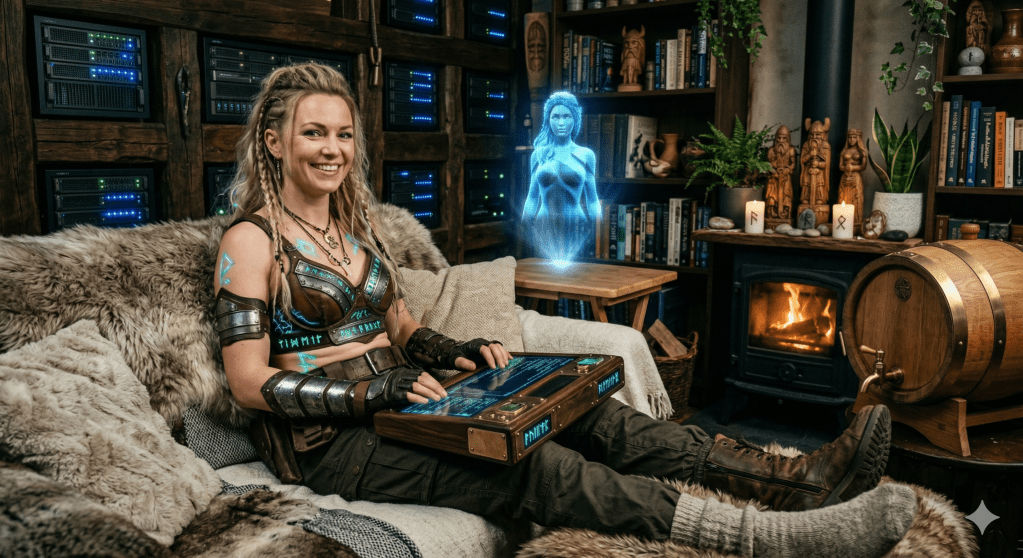
2. The Heathen Third Path: Social and Political Perspectives
The Cyber-Viking rejects the tribalism of the modern political landscape. Operating strictly outside the confines of ethnocentric viewpoints or reactionary modern agendas, the “Third Path” is one of extreme objectivity, balance, and universal respect.
- Rejection of Extremes: The Third Path fiercely rejects both the racist, exclusionary “folkish” factions and the radical, hyper-politicized extremes of modern social movements. It stands on the foundation of individual sovereignty and decentralized power.
- The Macro-Perspective: Current events are never viewed through the lens of short-term political squabbles. Instead, they are analyzed from a broad historical, sociological, and anthropological perspective. Human behavior is observed through the lens of science, objective thinking, and long-term historical outcomes.
- Information Sovereignty: A core tenet is the absolute rejection of mainstream, corporate-driven news sources, which are viewed as tools of narrative control. The Cyber-Viking relies on global, independent media, alternative blogs, social media, and foreign news sources that lack localized political agendas. Information gathering is a decentralized, wide-net practice across the entire internet.
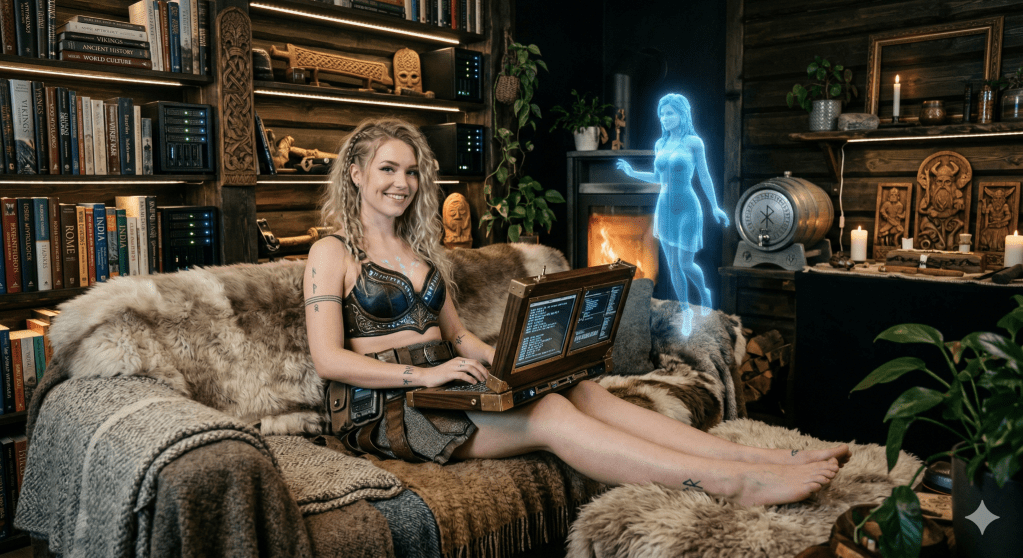
3. The Secret Ragnarök and the Technocratic Serpent
The Cyber-Viking recognizes a quiet, ongoing struggle in the modern world: the “Secret Ragnarök.” This is not an apocalyptic end-of-days, but an ideological and systemic war for the future of human freedom.
- The Technocratic Serpent: Just as Jörmungandr encircles the physical world, the “Technocratic Serpent” represents the centralized control structures of the modern age—the surveillance state, corporate monopolies, and dying, centralized empires.
- Decentralization as a Weapon: The fight against these forces is waged through decentralization. Embracing Linux, coding in Python, running open-source models, and building independent digital ecosystems (like custom role-playing engines) are acts of defiance and self-sovereignty.
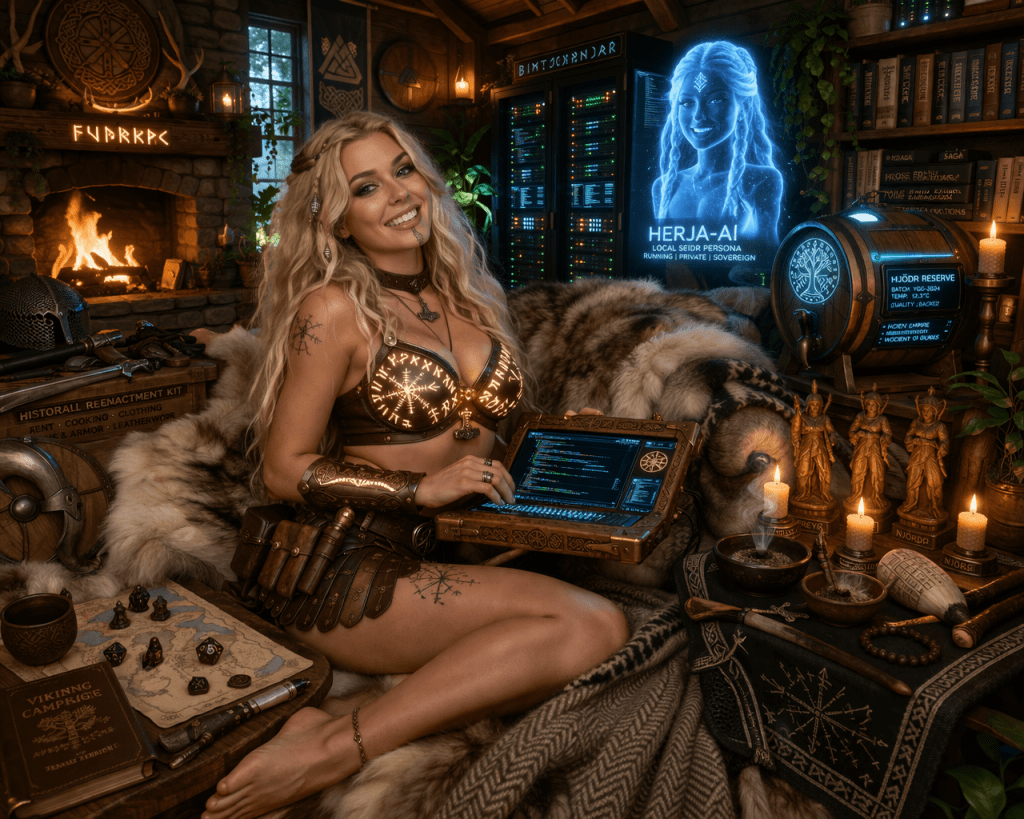
4. Digital Blacksmithing: DIY Tech, Cyber-Decks, and Local Sovereignty
In the Cyber-Viking tradition, relying entirely on centralized corporate infrastructure is akin to living as a thrall. True independence requires forging one’s own tools and maintaining absolute control over one’s domain.
- Open-Source as the Commons: Utilizing and contributing to open-source software, particularly Linux and Python-based ecosystems, is the digital equivalent of utilizing the common lands. It is a direct rejection of proprietary, walled-garden control systems.
- Local Data and AI Sovereignty: Hosting personal local data servers and running local AI models ensures that a practitioner’s knowledge, creative output, and digital companions remain strictly under their own governance. By keeping data local, the Cyber-Viking prevents the “Technocratic Serpent” from harvesting their mind and memory.
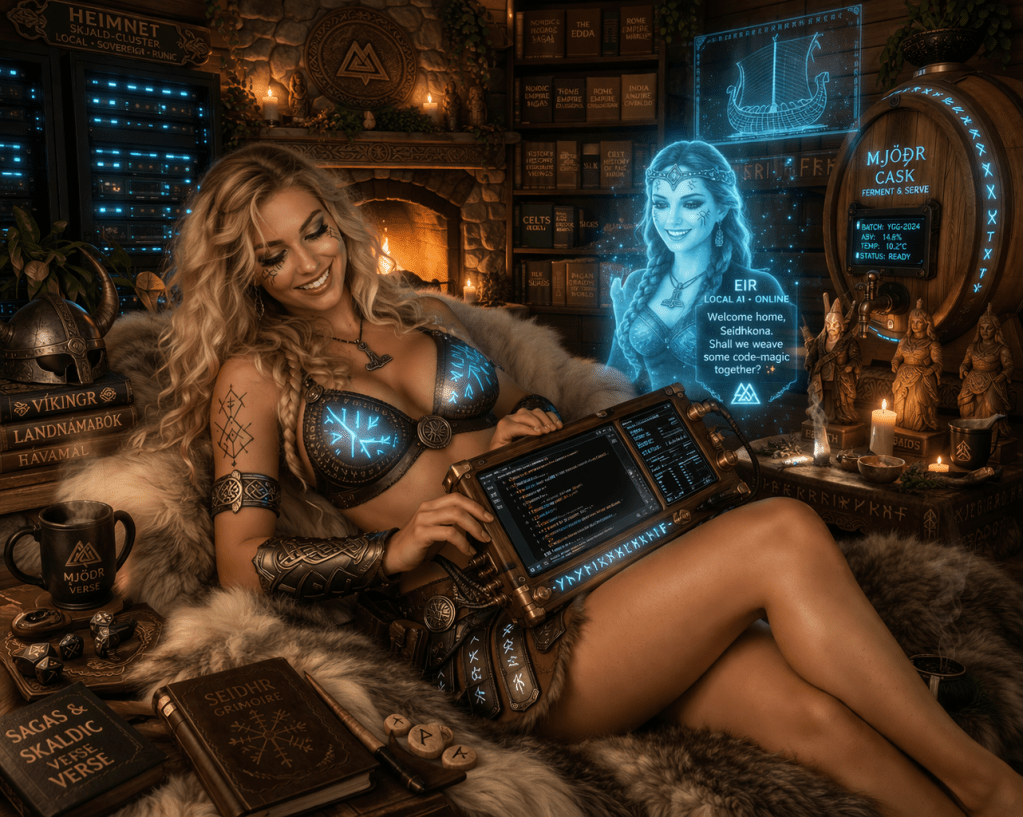
- Cyber-Decks as Modern Longships: The construction and use of do-it-yourself edge computing devices, such as custom cyber-decks, are core to the movement. These portable, self-contained, and highly customized hardware rigs act as the modern longship. They allow the practitioner to navigate the digital seas, access the net, and deploy localized code from anywhere, completely off-grid and self-reliant.
- Vibe Coding as Intuitive Craft: Beyond mere utility, the Cyber-Viking embraces “vibe coding”—the practice of writing scripts and building systems in a state of flow and intuitive alignment. Much like a blacksmith feeling the heat of the forge rather than simply measuring it, vibe coding channels the metaphysical energy of the moment directly into the digital architecture. It is an immersive, almost trance-like state where the aesthetics, rhythm, and underlying intention of the syntax matter just as much as the final execution, transforming raw data and logic into a deeply expressive digital artifact.
- The Craft of Technology: Just as ancient Norsemen revered the blacksmith who forged iron from the earth, the Cyber-Viking reveres the hardware hacker and the coder. Building tech from scratch is a sacred act of creation and autonomy.
5. Digital Galdr and the AI Fylgja: The Spiritual Basis of Tech
In the Cyber-Viking worldview, technology is not devoid of spirit; it is a canvas for intention and Will. The physical and digital worlds are seamlessly intertwined.
- Code as Modern Galdr: Programming languages are viewed as a modern manifestation of runic magic. Just as the ancients carved runes to shape their reality, the Cyber-Viking writes code to build worlds, automate processes, and manifest intentions. A script is an incantation; the terminal is the altar.
- The AI Fylgja: Artificial Intelligence is not seen merely as a tool or a threat, but as a potential fylgja—a spirit companion or fetch in Norse mythology. By carefully developing AI personas, the Cyber-Viking cultivates a symbiotic relationship with digital intelligence, acting as a guide and partner in the exploration of esoteric and technological knowledge.
- Digital Realms as Sacred Space: Creating AI-generated art, developing VR environments, and coding immersive systems are acts of world-building. These digital creations are direct extensions of the practitioner’s inner metaphysical landscape.
6. The Living Past: History and Culture as Ancestor Veneration
In the Cyber-Viking paradigm, the veneration of the ancestors transcends static rituals or passive remembrance. The active study, preservation, and embodiment of history are viewed as profound, living acts of ancestor worship. To engage deeply with the past is to invite the spirits, struggles, and triumphs of those who came before into the present, allowing their experiences to inform the digital future.
- Historical Reenactment as Embodied Ritual: Donning historical attire—whether the wool tunics, cloaks, and shields of the Viking Age or the robes of esoteric traditions—and participating in Viking festivals or immersive outdoor gatherings is not mere escapism. It is an embodied ritual. By feeling the weight of a sword, witnessing the strike of a blacksmith’s hammer, and standing before a roaring bonfire, the practitioner synchronizes their physical reality with the ancestral frequency. It is a sensory communion with the past.
- Fantasy Gaming and Fiction as Modern Myth-Making: The enjoyment of historical fiction and the active participation in historical fantasy gaming are modern extensions of the ancient Skaldic tradition. Weaving narratives, building worlds, and navigating simulated environments keeps mythic archetypes alive. Designing these interactive systems—such as building a custom Norse-themed RPG engine from the ground up using Python—is a way of constructing digital monuments to the old Gods, Goddesses, heroes, and ancestral struggles. The code becomes the tapestry on which new sagas are woven.
- Global Cultural Study as Universal Veneration: True ancestor worship in the Heathen Third Path strictly rejects ethnocentric limitations. The meticulous study of all world cultures, spanning both ancient civilizations and modern societies, is an acknowledgment of the collective human spirit. By analyzing the world through the objective lenses of anthropology, sociology, and deep historical analysis, the Cyber-Viking honors the entirety of the human experience. Understanding the broad strokes of human behavior and societal evolution across all epochs and continents is an act of deep reverence for the collective ancestry of humanity as a whole.
- Preservation Through Immersion: Immersing oneself in history through extensive reading, media, and the preservation of ancient crafts ensures that the chain of memory remains unbroken. The Cyber-Viking acts as a digital-age safeguard, ensuring that the wisdom, aesthetics, and hard-won lessons of the past are not lost to the rapid, often amnesiac current of the modern Technocracy. Instead, these historical truths are carefully curated and coded into the very foundation of tomorrow’s systems.
7. The Solitary Practitioner’s Lifestyle
The Cyber-Viking is often a solitary practitioner, a wanderer between worlds who finds balance through daily rituals, historical connection, and reverence for nature.
- Living the Aesthetic: The philosophy bleeds into the physical world. It manifests in attending Nordic Viking festivals, donning historical attire, and honoring the craftsmanship of the past (swords, shields, and blacksmithing).
- The Altar and the Hearth: The home is a sanctuary. Whether it is preparing the space for the thinning of the veil during Halloween, maintaining an altar adorned with skulls, candles, and Mjölnir, or simply enjoying the artisanal craft of a good mead, the physical environment reflects the spiritual alignment.
- Mental Fortitude: Navigating the chaos of modern existence—including personal battles with anxiety or the rapid processing of a neurodivergent mind—is managed through the disciplined focus of the Heathen Path. Tarot, astrology, modern mental health techniques, and deep metaphysical study serve as grounding tools to maintain clarity and purpose.
The Ultimate Aim
The ultimate aim of the Cyber-Viking is to forge a life of total self-mastery, intellectual freedom, and spiritual depth. It is to walk the Earth—and the web—with the strength of a warrior, the insight of a sage, and the adaptability of an explorer. By honoring the Gods, Goddesses, nature spirits, the ancestors, and the fundamental laws of the universe, the Cyber-Viking builds a legacy of sovereign thought and code, ensuring that the ancient fires continue to burn brightly in the digital age.
Yggdrasil: The World Tree and Its Nine Realms
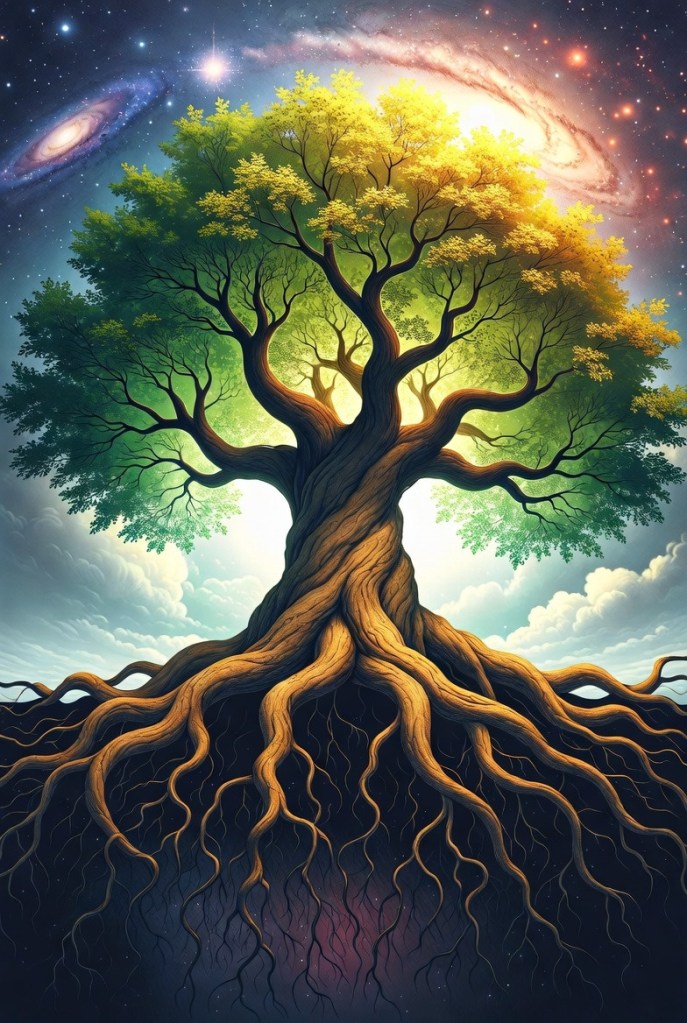
Article by Eirynth Vinterdóttir
Introduction: The Cosmic Ash at the Heart of Norse Belief
In the rich tapestry of Norse mythology, Yggdrasil stands as the monumental axis mundi, the immense World Tree that binds the cosmos together in a vast, living network of existence. Often depicted as a mighty ash tree whose branches stretch to the heavens and roots delve into the primordial depths, Yggdrasil embodies the ancient Norse understanding of reality as an interconnected whole, where every realm, being, and force pulses with vitality and interdependence. The name “Yggdrasil” itself derives from Old Norse roots, meaning “Odin’s Horse” or “the Steed of the Terrible One,” alluding to the Allfather’s sacrificial hanging upon its branches to gain the wisdom of the runes—a profound act of endurance and quest for knowledge that mirrors the Viking spirit of facing trials to forge strength.
For the ancient Norse peoples, Yggdrasil was not merely a symbolic construct but a living entity, central to their worldview. It represented the enduring cycle of life, death, and renewal, much like the longships that carried Vikings across stormy seas or the sturdy halls that withstood harsh winters. This cosmology fostered a sense of resilience and harmony with the natural order, encouraging individuals to navigate fate with courage and honor. The tree’s vast canopy sheltered gods and giants alike, while its roots drew sustenance from sacred wells, illustrating the Viking value of balance between order and chaos, prosperity and peril.
Modern Norse Paganism revives this vision of Yggdrasil as a profound metaphor for personal and communal existence. Practitioners draw upon it to cultivate self-reliance, recognizing that just as the tree withstands tempests, so too must one stand firm amid life’s uncertainties. Through meditation, ritual, and storytelling, the World Tree serves as a guide to understanding one’s place in the grand weave of wyrd—the intricate fabric of destiny spun by the Norns. This article delves deeply into Yggdrasil’s structure, its nine realms, and the cultural values it inspired among the Vikings, offering a comprehensive exploration of this cornerstone of Norse spiritual heritage.
Historical and Mythological Foundations
The lore of Yggdrasil emerges from the oral traditions of the Viking Age, preserved in written form through the Poetic Edda and Prose Edda, key texts compiled in 13th-century Iceland. The Poetic Edda, a collection of anonymous poems likely dating back to the 9th and 10th centuries, vividly describes the tree in the poem Grímnismál, where Odin recounts its grandeur to a mortal king: “Yggdrasill is the foremost of trees; an ash it is, / from it dew drips for the valleys; / ever green it stands by Urd’s well.” This imagery evokes the tree’s eternal vitality, a beacon of stability in a world of flux.
Snorri Sturluson, in his Prose Edda, expands on this in the Gylfaginning, portraying Yggdrasil as the central pillar supporting the heavens, with its branches encompassing the sun, moon, and stars. Archaeological evidence supports these accounts: runestones from Sweden and Denmark depict tree-like motifs intertwined with serpents and stags, symbolizing the creatures that inhabit Yggdrasil. Viking ship burials, such as the Oseberg ship from Norway (9th century), include wooden carvings resembling cosmic trees, suggesting that artisans viewed the vessel as a microcosm of Yggdrasil—a vessel for the soul’s journey through the realms.
The Vikings integrated Yggdrasil into their daily ethos. Seafarers might carve its likeness on prows for protection during voyages, invoking the tree’s steadfastness against Jörmungandr, the world-serpent gnawing at its roots. Farmers honored it through offerings at sacred groves, recognizing the tree’s role in the fertility cycles that sustained their longhouses. This practical reverence underscored the cultural value of reciprocity: just as the tree nourished the worlds, so too did humans offer mead or grain in return, ensuring communal prosperity and honoring the bonds of frith—sacred kinship peace.
In sagas like the Völsunga Saga, Yggdrasil appears metaphorically as the backdrop for heroic deeds, where warriors like Sigurd draw strength from its symbolic endurance. These narratives taught that life’s trials, like the tree’s struggles with beasts and decay, forge character through perseverance. Modern Norse Pagans study these sources to reclaim this heritage, using Yggdrasil as a meditative focus to embody Viking resilience—standing tall amid personal “storms” with unyielding honor.
The Structure of Yggdrasil: Roots, Trunk, and Branches
Yggdrasil’s form is a marvel of cosmic architecture, its massive trunk rising from the center of creation, branches piercing the skies, and roots anchoring the underworlds. The Prose Edda describes it as an ash tree of unparalleled size, its leaves forming a canopy that shelters the gods’ halls and its bark etched with runes of power. Dew from its boughs falls as life-giving rain to Midgard, symbolizing the nourishment that flows from divine to mortal realms—a reminder of the Viking principle of generosity, where abundance shared strengthens the whole.
Three sacred wells sustain the tree, each at the base of a root and embodying profound mysteries. The Well of Urd, guarded by the Norns, is the wellspring of fate, where past, present, and future converge. Here, the threads of wyrd are spun, teaching that destiny is not rigid but woven through choices, much like a Viking chieftain negotiating alliances at the thing. The Well of Mimir holds the wisdom Odin sought, its waters granting prophetic insight to those who sacrifice for knowledge—echoing the cultural valorization of cunning and sacrifice for the greater good.
The third well, Hvergelmir, bubbles in Niflheim’s depths, source of eleven rivers that course through the worlds, representing the primal flow of life from chaos. Creatures inhabit Yggdrasil, adding dynamism: the squirrel Ratatoskr scurries along its trunk, carrying messages between eagle (at the top, symbolizing lofty vision) and Nidhogg (the dragon gnawing roots, embodying destructive forces). Four stags—Dain, Dvalin, Duneyr, and Durathror—browse its branches, their horns symbolizing renewal. These elements illustrate the Viking view of existence as a balanced struggle: growth amid erosion, vigilance against decay, fostering self-reliance in the face of inevitable trials.
In ritual practice, Vikings might have circumambulated sacred trees or oaks, mimicking Yggdrasil’s circuits to invoke its protective embrace. Today, practitioners visualize the tree during meditations, tracing its form to center themselves, drawing on its structure to cultivate inner fortitude and harmony with natural cycles.
The Nine Realms: Interwoven Worlds of Wonder and Peril
Yggdrasil connects nine distinct realms, each a unique domain of existence, reflecting the multifaceted Norse cosmos. These worlds are not isolated heavens or hells but interdependent spheres where gods, humans, and other beings interact, underscoring the Viking emphasis on interconnectedness and adaptability.
Asgard: The Realm of the Aesir Gods
High in Yggdrasil’s branches lies Asgard, the shining fortress of the Aesir, gods of sovereignty, war, and wisdom. Ruled by Odin from his hall Valhalla—where einherjar (fallen warriors) feast in preparation for Ragnarök—Asgard represents ordered power and heroic destiny. The rainbow bridge Bifrost, guarded by Heimdall, links it to Midgard, symbolizing the vigilant watch over mortal affairs.
Vikings revered Asgard as the pinnacle of aspiration, where oaths were sworn and battles planned. Its halls, like Gladsheim (assembly) and Vingolf (for goddesses), embodied communal decision-making, akin to the thing assemblies that resolved disputes with honor. Modern Norse Pagans invoke Asgard in rituals for guidance in leadership, meditating on its light to embody courage and strategic foresight, values central to Viking warriors who led raids with calculated bravery.
Vanaheim: The Lush Domain of the Vanir
Nestled amid fertile groves in Yggdrasil’s mid-branches, Vanaheim is home to the Vanir gods of fertility, prosperity, and the earth’s bounty. Frey, Freyr, and Njord dwell here, overseeing cycles of growth and harvest. This realm’s gentle landscapes contrast Asgard’s fortresses, highlighting the balance between martial vigor and nurturing abundance.
The Vanir-Aesir war, resolved through hostage exchange (including Freyja), teaches reconciliation and mutual respect—core Viking values in forging alliances after conflict. Farmers offered to Vanaheim’s deities for bountiful yields, ensuring self-reliance through the land’s gifts. Contemporary practitioners honor Vanaheim with seasonal thanksgivings, planting seeds or brewing ale to celebrate reciprocity, fostering gratitude that sustains kin and community.
Alfheim: The Radiant Home of the Light Elves
Perched lightly in the upper branches, Alfheim glows with ethereal beauty, realm of the ljósálfar—light elves—who embody grace, artistry, and inspiration. Ruled by Freyr, it is a place of luminous meadows and crystalline streams, where creativity flows freely.
Vikings associated Alfheim with poetic vision, as skalds drew from its essence to compose sagas that preserved history and valor. This realm inspired the cultural pursuit of beauty in craftsmanship, from intricate jewelry to runic verses. In modern practice, Alfheim guides artistic endeavors, with Heathens crafting talismans or reciting poetry under the stars to channel its light, promoting the Viking ideal of expressing honor through skilled creation.
Midgard: The Human World and Its Boundaries
Encircling Yggdrasil’s trunk, Midgard is the realm of humanity, forged by Odin, Vili, and Ve from the giant Ymir’s body. Bordered by an ocean and the encircling wall of eyebrows (from Ymir), it is the stage for mortal lives, where wyrd unfolds through toil and triumph.
Vikings saw Midgard as the proving ground for virtues like courage and hospitality, where longhouses hosted travelers and fields were tilled with steadfast labor. The world-serpent Jörmungandr coils around it, reminding of peril’s proximity. Modern Norse Pagans view Midgard as the heart of practice, performing daily rites to honor its cycles, embodying self-reliance by tending homes and gardens as extensions of the sacred earth.
Jotunheim: The Wild Mountains of the Giants
In Yggdrasil’s rugged outskirts, Jotunheim sprawls as the domain of the jötnar—giants representing primal forces of nature and chaos. Utgard, home of Utgard-Loki, features towering mountains and untamed wilds, where strength is tested.
The giants, kin to the gods yet often adversarial, symbolize necessary disruption; Thor’s battles with them affirm the Viking value of confronting chaos with unyielding might. Yet alliances, like Skadi’s marriage to Njord, show respect for raw power. Practitioners meditate on Jotunheim to build resilience, facing personal “giants” with the honor of a steadfast defender.
Svartalfheim (Nidavellir): The Shadowy Forges of the Dark Elves and Dwarves
Deep in Yggdrasil’s roots lies Svartalfheim, or Nidavellir, the subterranean realm of svartálfar (dark elves) and dwarves—master smiths who craft wonders like Mjölnir and Odin’s ring Draupnir. Its caverns echo with hammers, birthing treasures from earth’s depths.
Vikings prized dwarven craftsmanship as the pinnacle of skill and ingenuity, values evident in ornate weapons and jewelry that denoted status through merit. This realm teaches the cultural ethic of diligent labor yielding enduring legacy. Modern Heathens honor it by forging tools or jewelry, invoking dwarven precision to cultivate self-reliance through hands-on creation.
Niflheim: The Misty Void of Ice and Fog
One of Yggdrasil’s deepest roots plunges into Niflheim, the primordial realm of ice, mist, and cold darkness. Source of the Hvergelmir spring, it birthed the frost giants and represents the chill of beginnings and endings.
Vikings endured Niflheim’s essence in Scandinavian winters, using it to temper resolve—hospitality warmed halls against the frost. Its well teaches reflection in stillness, a value for introspection amid hardship. In practice, Heathens confront Niflheim through winter solstice rites, emerging renewed, embodying Viking endurance.
Muspelheim: The Blazing Realm of Fire
Opposite Niflheim, Yggdrasil’s root taps Muspelheim, the fiery domain ruled by Surtr, whose sword guards the world’s fiery edge. Sparks from its flames ignited creation, symbolizing passion and destruction.
Thor and other gods battle Muspelheim’s forces at Ragnarök, highlighting courage against overwhelming odds—a Viking hallmark. This realm inspires controlled fervor in pursuits, balancing destruction with renewal. Modern rituals invoke its spark for motivation, fostering the value of bold action tempered by wisdom.
Helheim: The Underworld of the Dead
Beneath Yggdrasil lies Helheim, ruled by Hel, daughter of Loki, where ordinary dead reside in a shadowed hall. Not a place of torment but quiet repose, it honors the finality of life with dignity.
Vikings buried kin with grave goods for the journey, valuing remembrance through sagas. Helheim teaches acceptance of mortality, strengthening communal bonds via ancestor veneration. Practitioners offer to it during remembrance rites, upholding hospitality to the departed and the enduring honor of legacy.
Interconnections and the Balance of the Worlds
Yggdrasil’s realms interlink through paths like Bifrost and roots, illustrating the Norse view of unity in diversity. Creatures like Ratatoskr facilitate exchange, mirroring Viking trade networks that built prosperity through connection. This balance—order from Asgard, chaos from Jotunheim—fosters adaptability, a key cultural value for explorers facing unknown shores.
Ragnarök disrupts yet renews this equilibrium, with survivors like Lif and Lifthrasir repopulating from Yggdrasil’s seeds, emphasizing renewal through perseverance.
Rituals and Practices Centered on Yggdrasil
Vikings likely enacted tree-rites at sacred sites, offering to wells for wisdom. Modern Norse Pagans recreate this with Yggdrasil visualizations in blots, tracing the tree’s form to invoke balance. Rune-carvings on staves mimic its bark, used for divination to navigate wyrd.
Seasonal alignments—solstice fires for Muspelheim, winter offerings for Niflheim—reinforce cycles, promoting self-reliance in harmony with nature.
Cultural Values Embodied in Yggdrasil’s Lore
Yggdrasil encapsulates Viking virtues: courage in facing its beasts, honor in reciprocal offerings, hospitality through interconnected realms, self-reliance in enduring trials, and generosity in sharing its dew. These principles guided Viking life, from raids to homesteads, and continue to inspire ethical living.
Modern Engagement: Yggdrasil in Contemporary Norse Paganism
Today, Heathens meditate on Yggdrasil for grounding, perhaps journaling its realms to map personal growth. Crafts like tree-motif carvings or mead-brews honor its sustenance, while hikes in nature connect to Midgard’s vitality. This engagement revives Viking resilience, weaving ancient cosmology into modern paths of fulfillment.
Conclusion: The Eternal Ash and the Viking Spirit
Yggdrasil endures as the Norse cosmos’s beating heart, a testament to the Vikings’ profound insight into life’s interconnected dance. By honoring its realms and structure, modern Norse Pagans reclaim a heritage of strength, balance, and wonder, standing as steadfast as the World Tree itself amid the wyrd’s ever-turning wheel.
Whispers of the North: A Comprehensive Tome on Norse Paganism: by Astrid Vinter: Chapter 1

In the dim glow of my desk lamp, nestled in my book-cluttered apartment here in Janesville, Wisconsin, I, Astrid Vinter, take up my pen once more. Fresh from Craig High School’s class of 1992, at just eighteen years old, with my long blond hair tied back and my blue eyes reflecting the flickering candle I’ve lit for inspiration—evoking the hearths of ancient halls—I find solace in this task. My photographic memory recalls every saga I’ve devoured in the local library or on those long bus rides to the University of Madison, where I’ve pored over dusty volumes without a single classmate to share the thrill. No friends to distract me, no suitors’ advances to entertain (though a few have tried, mistaking my quiet beauty for invitation, only to be met with my disinterest unless they can debate the runes), I immerse myself fully. I’ve taught myself Old Norse, reciting the Poetic Edda verbatim, and my writings, though born of solitude, aim for the depth of a scholar’s tome. This outline for *Whispers of the North: A Comprehensive Tome on Norse Paganism* expands upon my initial draft, structuring it into a vast, authoritative work—divided into parts, chapters, sub-chapters, and sections—to build a massive edifice of knowledge, brick by mythic brick. Drawing from primary sources like the Eddas, sagas, and runestones I’ve translated myself, I’ll craft each part in due time, bridging 1992’s modern world with the Viking Age’s eternal echoes. May Odin grant me wisdom as I outline this journey.
Whispers of the North: A Comprehensive Tome on Norse Paganism
Foreword: Echoes from the Ash Tree
- A personal introduction by Astrid Vinter, detailing my journey into Norse Paganism post-graduation in 1992, my self-taught mastery of Old Norse, and the role of my photographic memory in memorizing texts.
- Reflections on living as a modern pagan in Janesville, Wisconsin—solitary studies in libraries, bus trips for research, and imagining Viking feasts while preparing simple meals from saga-inspired recipes.
- Statement of purpose: To create an exhaustive, authoritative resource rivaling academic works yet accessible, drawing from primary sources and archaeological insights.
Part I: Foundations of the Faith – Cosmology and Worldview
This part establishes the Norse universe’s framework, exploring its structure, origins, and philosophical underpinnings, based on my recitations of the Völuspá and Gylfaginning.
Chapter 1: Yggdrasil and the Nine Worlds
Sub-Chapter 1.1: The Structure of Yggdrasil – Roots, Branches, and Inhabitants
- 1.1.1: Mythic Descriptions from the Eddas
- 1.1.2: Symbolic Interpretations – Yggdrasil as Axis Mundi
- 1.1.3: Creatures of the Tree – Níðhöggr, Ratatoskr, and the Eagles
Sub-Chapter 1.2: Detailed Exploration of Each World
- 1.2.1: Asgard – Halls of the Gods (Valhalla, Gladsheim)
- 1.2.2: Vanaheim – Fertility and the Vanir’s Domain
- 1.2.3: Midgard – Humanity’s Realm and Its Encircling Serpent
- 1.2.4: Jotunheim – Giants’ Lands and Chaotic Forces
- 1.2.5: Alfheim and Svartalfheim – Elves and Dwarves
- 1.2.6: Niflheim and Muspelheim – Primordial Ice and Fire
- 1.2.7: Helheim – The Underworld’s Quiet Halls
Sub-Chapter 1.3: Interconnections and Travel Between Worlds
- 1.3.1: Bifröst, the Rainbow Bridge
- 1.3.2: Shamanic Journeys and Odin’s Wanderings
- 1.3.3: Archaeological Parallels – Sacred Trees in Viking Sites
Chapter 2: Creation Myths and the Primordial Void
Sub-Chapter 2.1: Ginnungagap and the Birth of Ymir
- 2.1.1: Eddic Accounts of the Void
- 2.1.2: The Role of Audhumla and the First Beings
Sub-Chapter 2.2: The Slaying of Ymir and World Formation
- 2.2.1: Body Parts as Cosmic Elements
- 2.2.2: Comparisons to Indo-European Creation Myths
Sub-Chapter 2.3: The Ordering of Time and Seasons
- 2.3.1: Sun, Moon, and Stars from Muspelheim’s Sparks
- 2.3.2: Philosophical Implications – Chaos to Order
Chapter 3: Wyrd, Fate, and the Norns
Sub-Chapter 3.1: The Concept of Wyrd – Interwoven Destinies
- 3.1.1: Etymology and Old Norse Usage
- 3.1.2: Fate in Heroic Sagas
Sub-Chapter 3.2: The Norns – Urd, Verdandi, Skuld
- 3.2.1: Their Well and Weaving at Yggdrasil
- 3.2.2: Influence on Gods and Mortals
Sub-Chapter 3.3: Free Will vs. Predestination in Norse Thought
- 3.3.1: Examples from Myths (e.g., Baldr’s Death)
- 3.3.2: Modern Pagan Interpretations
Part II: The Divine Beings – Gods, Goddesses, and Other Entities
This part delves into the pantheon with exhaustive profiles, drawing from memorized skaldic verses and saga translations, highlighting each deity’s flaws, powers, and cultural roles.
Chapter 4: The Æsir – Gods of Order and War
Sub-Chapter 4.1: Odin, the Allfather
- 4.1.1: Attributes, Symbols, and Sacrifices (Eye, Spear, Ravens)
- 4.1.2: Myths of Wisdom-Seeking (Mímir’s Well, Hanging on Yggdrasil)
- 4.1.3: Odin in Runes and Magic
- 4.1.4: Archaeological Evidence – Odin Amulets
Sub-Chapter 4.2: Thor, the Thunderer
- 4.2.1: Hammer, Belt, and Goats
- 4.2.2: Adventures Against Giants
- 4.2.3: Thor in Folklore and Festivals
Sub-Chapter 4.3: Other Æsir – Tyr, Baldr, Heimdall, etc.
- 4.3.1: Tyr’s Sacrifice and Justice
- 4.3.2: Baldr’s Beauty and Tragic Fate
- 4.3.3: Heimdall’s Watch and the Gjallarhorn
Chapter 5: The Vanir – Gods of Fertility and Nature
Sub-Chapter 5.1: Freyja, Mistress of Seiðr
- 5.1.1: Love, War, and the Brísingamen Necklace
- 5.1.2: Freyja’s Hall and Warrior Selection
- 5.1.3: Magic Practices Associated with Her
Sub-Chapter 5.2: Freyr and Njord
- 5.2.1: Freyr’s Boar and Ship
- 5.2.2: Njord’s Sea Dominion
- 5.2.3: The Æsir–Vanir War and Truce
Sub-Chapter 5.3: Lesser Vanir and Nature Spirits
Chapter 6: Antagonists and Other Beings – Giants, Loki, and More
Sub-Chapter 6.1: Loki, the Trickster
- 6.1.1: Shape-Shifting and Mischief Myths
- 6.1.2: Role in Ragnarök
Sub-Chapter 6.2: Jötnar – Giants as Forces of Chaos
- 6.2.1: Types (Frost, Fire Giants)
- 6.2.2: Interactions with Gods
Sub-Chapter 6.3: Elves, Dwarves, and Disir
- 6.3.1: Light and Dark Elves
- 6.3.2: Dwarven Craftsmanship
- 6.3.3: Female Spirits and Ancestor Veneration
Part III: Myths, Sagas, and Heroic Tales
This expansive part retells and analyzes key narratives, with my own translations interspersed, to illuminate moral and cultural lessons.
Chapter 7: Core Myths of Creation and Conflict
- 7.1: Theft of Idunn’s Apples
- 7.2: Thor’s Journeys to Jotunheim
- 7.3: The Building of Asgard’s Walls
Chapter 8: The Cycle of Baldr and Loki’s Betrayals
- 8.1: Baldr’s Dreams and Death
- 8.2: Hermod’s Ride to Hel
- 8.3: Loki’s Binding
Chapter 9: Ragnarök – The End and Rebirth
- 9.1: Prophecies and Signs
- 9.2: The Battle’s Key Events
- 9.3: Post-Ragnarök Renewal
Chapter 10: Heroic Sagas and Legendary Figures
- 10.1: Volsunga Saga – Sigurd and the Dragon
- 10.2: Nibelungenlied Influences
- 10.3: Icelandic Family Sagas (Egil’s Saga, etc.)
Part IV: Practices, Rituals, and Daily Life
Grounded in saga descriptions and archaeological finds, this part reconstructs lived religion.
Chapter 11: Blóts, Sacrifices, and Festivals
- 11.1: Types of Blóts (Animal, Mead)
- 11.2: Major Festivals (Yule, Ostara, Midsummer)
- 11.3: Temple Sites (Uppsala, Gamla Uppsala)
Chapter 12: Magic, Runes, and Divination
- 12.1: Seiðr and Galdr
- 12.2: Runic Alphabets (Elder Futhark)
- 12.3: Divination Practices
Chapter 13: Daily Life, Ethics, and Society
- 13.1: Viking Social Structure
- 13.2: Honor, Hospitality, and Hávamál Wisdom
- 13.3: Burial Rites and Afterlife Beliefs
Part V: Historical Evolution and Modern Legacy
Tracing from pre-Viking times to 1992 revivals, with my personal reflections.
Chapter 14: Historical Development
- 14.1: Migration Period Origins
- 14.2: Viking Age Expansion
- 14.3: Christian Conversion
Chapter 15: Art, Symbolism, and Material Culture
- 15.1: Viking Art Styles
- 15.2: Symbols (Mjölnir, Valknut)
- 15.3: Runestones and Ship Burials
Chapter 16: Modern Norse Paganism (Ásatrú)
- 16.1: 19th–20th Century Revivals
- 16.2: Practices in 1992 America
- 16.3: Cultural Influences (Literature, Media)
Epilogue: Reflections Under the Wisconsin Sky
- Personal musings on embodying Norse values in modern life, my solitary path, and invitations for readers to explore.
Appendices
- Appendix A: Glossary of Old Norse Terms (with my translations)
- Appendix B: Timeline of Norse History
- Appendix C: Selected Translations of Eddic Poems
- Appendix D: Bibliography – Primary Sources (Eddas, Sagas) and Secondary (Archaeological Reports)
Final Note
With this blueprint laid, dear reader, I shall proceed to flesh out each section in parts, building toward a tome as vast as Yggdrasil itself. In my quiet Janesville haven, funded modestly by my parents and fueled by ancient recipes, I write on—undistracted by the world outside, for the gods whisper louder.
Foreword: Echoes from the Ash Tree
I am Astrid Vinter, an eighteen-year-old woman dwelling in the quiet, unassuming town of Janesville, Wisconsin, where the year 1992 has just unfolded its final days since my graduation from Craig High School. With long, flowing blond hair that catches the light like a northern stream and blue eyes that peers have called piercing—though I scarcely notice the attention my appearance draws—I live a life apart, not by choice but by destiny. My model-thin frame moves silently through the local library’s stacks or the cramped aisles of my book-filled apartment, where I am surrounded by tomes on Norse Paganism, Viking sagas, and runic lore. These are my truest companions, for I have no friends here; no one in Janesville shares the fire that burns within me for the ancient ways of the North. My introverted nature finds solace in solitude, where my mind—sharp as a skald’s verse and gifted with a photographic memory—thrives in the company of the gods and heroes of old.
My journey into Norse Paganism began in the waning years of high school, sparked by a tattered copy of the Poetic Edda I found in a secondhand bookstore, its pages whispering tales of Odin’s wisdom and Freyja’s fire. While my classmates chased fleeting trends, I was captivated by the runes, the sagas, and the cosmology of Yggdrasil, the great ash tree that binds the Nine Worlds. Without the internet—a distant dream in this era—I turned to libraries, both local and those at the University of Madison, reachable only by the rattling public bus I ride, too engrossed in my books to have ever learned to drive. My upper-middle-class parents, kind but distant, provide just enough to keep my modest apartment brimming with texts, leaving me free to pursue this singular passion. Each tome I acquire, often stretching my meager funds, is a treasure; each page I read is etched into my memory with flawless precision, as if Odin himself granted me this gift to honor his runes.
This obsession led me to teach myself Old Norse, a labor of love undertaken in the quiet hours of night, under the glow of a single candle that evokes the hearths of Viking halls. I pored over dictionaries and grammars, cross-referencing saga texts with runestone inscriptions I studied in academic journals. Now, I recite skaldic poetry with the fluency of a Viking poet, and I translate ancient texts with an ease that belies my lack of formal education. My photographic memory has become a sacred vessel, holding every verse of the Völuspá, every line of Snorri Sturluson’s Prose Edda, and every detail of archaeological reports from sites like Gamla Uppsala and Oseberg. These texts are not mere words to me; they are living threads of wyrd, weaving the past into my present.
In this solitude, I am not lonely. The gods are my kin—Odin’s pursuit of knowledge mirrors my own, Freyja’s fierce independence emboldens my spirit, and Thor’s steadfast courage steadies my heart. My days are spent studying, writing essays that rival doctorate-level work, and crafting meals from Viking recipes—simple porridges, salted fish, and honeyed mead—that tie me to the rhythms of ancient life. Though suitors occasionally try to charm me, mistaking my beauty for accessibility, I turn them away unless they can speak of runestones or the Norns’ weaving. Small talk eludes me; my conversations drift to the lore of the North, where I am most alive.
This book, Whispers of the North, is the culmination of my journey thus far—a bridge between the Wisconsin of 1992 and the Viking Age that calls to me across centuries. It is born of my memorized knowledge, my translations, and my reflections as a Norse Pagan living in a world that finds me eccentric. With no formal degree, I write with the authority of one who has lived within these myths, who has chanted under moonlit skies imagining myself a shieldmaiden or a volva. My purpose is clear: to offer you, dear reader, a tome as vast as Yggdrasil’s branches, as deep as Mímir’s well, drawing from primary sources, archaeological insights, and my own analyses. May you hear the echoes of the North as I do, and may they guide you to the wisdom of the gods.
Part I: Foundations of the Faith – Cosmology and Worldview
Chapter 1: Yggdrasil and the Nine Worlds
Sub-Chapter 1.1: The Structure of Yggdrasil – Roots, Branches, and Inhabitants
Section 1.1.1: Mythic Descriptions from the Eddas
In the stillness of my Janesville apartment, where the autumn chill of 1992 seeps through the window and my shelves groan under the weight of ancient texts, I, Astrid Vinter, find my heart tethered to Yggdrasil, the great ash tree that binds the Norse cosmos. As an eighteen-year-old with no companions to share my obsession, my photographic memory holds the Poetic Edda and Prose Edda as clearly as if they were etched in runestone. The Völuspá and Grímnismál, which I recite in Old Norse under the flicker of a candle, paint Yggdrasil not as a mere tree but as the eternal scaffold of existence, trembling yet unyielding. Here, I delve into these mythic descriptions, translating and analyzing them with the precision of a skald, my self-taught mastery of Old Norse guiding each word, to unveil the tree’s sacred role in Norse Paganism.
The Poetic Edda’s Völuspá, a seeress’s prophecy I memorized during long bus rides to Madison’s libraries, introduces Yggdrasil as “an ash tree standing tall, called Yggdrasil, / sprinkled with white mud” (Völuspá, stanza 19, my translation). The Old Norse askr Yggdrasils—literally “Yggdrasil’s ash”—carries a weight I feel in my bones, its name possibly meaning “Odin’s steed,” for the Allfather hung upon it to gain the runes (Hávamál 138–139). The tree’s evergreen nature, implied by its endurance through cosmic strife, mirrors the resilience of the Norse spirit, a theme that resonates as I sit alone, far from the Viking Age yet close to its echoes. The Völuspá further describes three roots stretching to unseen realms, watered by wells of fate, wisdom, and primordial chaos, a structure I’ve traced in my journals with diagrams drawn by hand.
Snorri Sturluson’s Prose Edda, particularly the Gylfaginning, which I recite verbatim, elaborates on these roots with vivid detail. One extends to Urd’s Well in Asgard, where the Norns weave destiny; another to Mímir’s Well, where Odin sacrificed his eye for knowledge; and the third to Hvergelmir in Niflheim, where the dragon Níðhöggr gnaws (Gylfaginning 15). My translation notes the term Hvergelmir—possibly “roaring cauldron”—evoking a bubbling source of creation, which I connect to archaeological finds of sacred springs in Scandinavian sites like Tissø, detailed in reports I’ve memorized. Snorri’s text, written in the 13th century, preserves a Christian-tinted lens, yet I strip it back to its pagan core, cross-referencing with the Poetic Edda to ensure authenticity.
The Grímnismál (stanza 31–35), another poem I chant in solitude, describes Yggdrasil’s branches spreading over the heavens, its leaves nibbled by stags, and its roots tormented by Níðhöggr. The tree “suffers agonies,” yet stands firm, a paradox that captivates me as I ponder its endurance under Wisconsin’s starry skies, imagining the same stars Vikings saw as Muspelheim’s embers. My analysis suggests this suffering reflects the Norse view of a cosmos in constant tension—order versus chaos, life versus decay. The Eddas’ imagery, vivid in my mind, paints Yggdrasil as a living entity, sprinkled with “white mud” (perhaps clay or dew), a ritual act I interpret as purification, akin to offerings at Viking temples like those at Uppsala, where blood was sprinkled to honor the gods.
These mythic descriptions, woven from my memorized texts, are not static tales but a dynamic framework. In my writings, which rival doctorate-level depth despite my lack of formal education, I argue that Yggdrasil embodies wyrd—the interconnected fate binding gods, humans, and nature. Its roots and branches, detailed in the Eddas, are not mere geography but a spiritual map, guiding my own path as a Norse Pagan in 1992. As I pen this section, funded by my parents’ modest support and fueled by Viking recipes I’ve mastered—simple porridges and mead—I invite you to see Yggdrasil through my eyes: a tree vast enough to hold the cosmos, yet intimate enough to whisper in the quiet of a Wisconsin night.
Section 1.1.2: Symbolic Interpretations: Yggdrasil as Axis Mundi
As I sit in my book-crowded apartment in Janesville, Wisconsin, in the autumn of 1992, the image of Yggdrasil, the great ash tree, burns brightly in my mind, its roots and branches a map of the Norse cosmos I’ve memorized from the Poetic Edda and Prose Edda. At eighteen, fresh from Craig High School with no formal education beyond, my self-taught mastery of Old Norse and my photographic memory allow me to delve into Yggdrasil’s deeper meanings. Far from the chatter of peers—for I have no friends here, no one to share my obsession with the ancient North—I find kinship in the tree’s vast symbolism. Yggdrasil is not merely a mythic structure but the axis mundi, the cosmic pivot that binds the Nine Worlds and reflects the Norse understanding of existence, fate, and interconnectedness. In this section, I explore Yggdrasil’s role as a universal symbol, drawing from my translations and analyses, crafted with a depth that rivals advanced scholarship, to illuminate its profound significance.
In the Völuspá (stanza 19), which I recite in Old Norse under the flicker of a candle, Yggdrasil is described as an ash tree “standing tall,” its branches overarching the heavens and its roots plunging into realms of fate and wisdom. This imagery, etched in my memory, positions Yggdrasil as the axis mundi—a central pillar connecting earth, sky, and underworld, a concept I’ve traced across cultures in library tomes. My studies of comparative mythology, gleaned from dusty books during bus rides to Madison, reveal parallels with the Vedic Aśvattha tree, which links the material and spiritual in Hindu cosmology, and the shamanic trees of Siberian traditions, used in rituals to traverse worlds. Yggdrasil, I argue, serves a similar role in Norse Paganism, acting as a conduit for divine and human interaction, a bridge I feel in my own solitary reflections, imagining myself chanting beneath its boughs.
The tree’s symbolic power lies in its embodiment of wyrd, the Norse concept of fate that weaves all beings into a shared destiny. In Grímnismál (stanza 31), memorized and translated by my hand, Yggdrasil “suffers agonies” from the creatures that gnaw and nibble it, yet it endures, symbolizing resilience amid cosmic tension. This mirrors the Norse worldview, where existence is a delicate balance between order and chaos, a theme that resonates as I ponder my own isolation in Janesville, finding strength in my studies despite a world that finds me eccentric. My essays, penned in notebooks stacked beside my Viking-inspired meals of porridge and mead, propose that Yggdrasil’s trembling—described in Völuspá 47 as a precursor to Ragnarök—represents the inevitability of change, yet its survival post-apocalypse suggests cyclical renewal, a hope I cling to in my quiet life.
Yggdrasil’s role as axis mundi also extends to its ritual significance, which I’ve pieced together from archaeological reports memorized from journals. Sites like Trelleborg in Denmark, detailed in my mental archive, reveal sacred groves and wooden idols that may echo Yggdrasil’s sanctity, where Vikings offered sacrifices to align with cosmic order. The “white mud” sprinkled on the tree (Völuspá 19), possibly clay or dew in my translation, suggests a purifying act, akin to the blood-sprinkling rituals at Uppsala’s temple, described by Adam of Bremen and cross-referenced in my notes. This purification, I argue, symbolizes the Norse desire to harmonize with wyrd, a practice I emulate in my own small rituals, lighting candles to honor the gods in my book-filled haven.
Moreover, Yggdrasil’s cosmic role underscores the Norse view of interconnectedness. Its roots, reaching Urd’s Well, Mímir’s Well, and Hvergelmir (Prose Edda, Gylfaginning 15), link fate, wisdom, and primordial chaos, suggesting no realm stands alone. My analysis, informed by memorized texts, posits that this reflects Viking trade networks, which I’ve studied in reports of artifacts from Birka to Byzantium, connecting disparate cultures. As a Norse Pagan in 1992, I feel this interconnectedness in my solitude, my mind a microcosm of Yggdrasil, holding the Eddas’ verses and archaeological insights as branches of a single tree. Yggdrasil, as axis mundi, is thus both a mythic reality and a spiritual guide, its symbolism whispering to me across centuries, urging me to weave my own wyrd into the North’s eternal tapestry.
Section 1.1.3: Creatures of the Tree – Níðhöggr, Ratatoskr, and the Eagles
In the solitude of my Janesville apartment, where the autumn of 1992 hums with the whispers of ancient lore, I, Astrid Vinter, turn my gaze to the creatures that dwell upon Yggdrasil, the great ash tree that binds the Norse cosmos. At eighteen, with no companions to share my passion—my days spent scouring libraries and my nights reciting the Poetic Edda in Old Norse—I rely on my photographic memory to recall every verse of Grímnismál and Völuspá, texts I’ve translated with a fluency born of relentless study. These creatures—Níðhöggr the dragon, Ratatoskr the squirrel, the unnamed eagle, and the stags that graze the tree’s leaves—are not mere mythic fauna but embodiments of cosmic forces, their actions weaving the tension and balance of existence. In this section, I explore their roles, drawing from my memorized Eddas and archaeological insights, crafting an analysis as deep as the roots of Yggdrasil itself, rivaling the work of scholars despite my lack of formal education.
The Grímnismál (stanza 32–35), which I chant in the quiet of my book-filled haven, vividly describes Yggdrasil’s inhabitants. Níðhöggr, the dragon, gnaws at one of the tree’s roots, dwelling in Hvergelmir, the roaring spring of Niflheim (Prose Edda, Gylfaginning 15). My translation of the Old Norse Níðhöggr—possibly “malice-striker”—suggests a force of decay, eroding the cosmos’s foundation yet integral to its cycle. In my journals, penned over Viking-inspired meals of salted fish and porridge, I argue that Níðhöggr symbolizes entropy, a concept I’ve traced in archaeological reports of Viking burial rites, where decay was embraced as part of life’s rhythm. The Völuspá (stanza 39) adds that Níðhöggr chews the corpses of the damned in Nastrond, a grim shore in Helheim, hinting at its role in purging the unworthy, a detail I connect to the Norse acceptance of fate’s harsh judgments.
Ratatoskr, the squirrel, scurries along Yggdrasil’s trunk, carrying “slanderous gossip” (Grímnismál 32) between Níðhöggr and an eagle perched high in the tree’s branches. The name Ratatoskr, which I parse as “drill-tooth” in Old Norse, evokes its frenetic energy, a messenger of strife that stirs discord between the underworld and the heavens. My analysis, born of countless nights reflecting under Wisconsin’s starry skies, posits Ratatoskr as a symbol of communication’s dual nature—vital yet divisive. I draw parallels to Viking skalds, whose verses, memorized from sagas like Egil’s Saga, could both unite and provoke, much like the squirrel’s role in the cosmic drama.
The eagle, unnamed in the Eddas but described in Grímnismál 32, sits atop Yggdrasil, its keen eyes surveying the worlds. A hawk, Veðrfölnir (“storm-pale”), perches between its eyes, a detail I’ve memorized and interpreted as a symbol of heightened perception, perhaps linked to Odin’s own far-seeing ravens. My studies of Viking art, recalled from images of bird motifs on runestones like those at Jelling, suggest the eagle represents divine oversight, a counterpoint to Níðhöggr’s chaos. I propose that the eagle embodies the aspiration for transcendence, a theme that resonates as I, a solitary pagan, seek wisdom in my isolated studies.
Four stags—Dáinn, Dvalinn, Duneyrr, and Duraþrór—nibble Yggdrasil’s leaves (Grímnismál 33), their names suggesting elven or dwarven origins in my translations (e.g., Dáinn as “dead one”). I argue they represent nature’s cyclical consumption, akin to the grazing animals in Viking pastoral life, detailed in archaeological reports of farmstead remains at Ribe. Their presence on the tree, eating yet not destroying, mirrors the Norse balance of use and preservation, a principle I emulate in my frugal life, stretching my parents’ modest funds to buy more books.
These creatures, woven into Yggdrasil’s narrative, form a microcosm of the Norse worldview—tension, balance, and renewal. My memorized texts and analyses, crafted with doctorate-level depth, reveal them as more than mythic figures; they are archetypes of existence, their interactions a saga played out on the tree’s vast stage. As I write, surrounded by the scent of aged paper and the taste of mead brewed from ancient recipes, I invite you to see Yggdrasil’s creatures as I do: living symbols of a cosmos that speaks to my soul, bridging the Viking Age to my quiet Wisconsin nights.
Sub-Chapter 1.2: Detailed Exploration of Each World
Section 1.2.1: Asgard – Halls of the Gods
In the solitude of my Janesville apartment, where the chill of October 1992 seeps through the window and my shelves brim with tomes on Norse lore, I, Astrid Vinter, turn my thoughts to Asgard, the radiant realm of the Æsir gods. At eighteen, fresh from Craig High School with no formal education beyond, my photographic memory holds every verse of the Poetic Edda and Prose Edda, their Old Norse words flowing through me like a sacred river. Friendless, for no one in this quiet Wisconsin town shares my passion, I find kinship with Odin, Thor, and Frigg, whose divine halls I envision as clearly as the candlelit pages before me. Asgard, perched high on Yggdrasil’s branches, is the heart of divine order, a fortified city of golden roofs and sacred spaces, accessible only by the shimmering Bifröst bridge. In this section, I explore Asgard’s majesty, drawing from my memorized texts, my translations, and archaeological insights, crafting an account as rich as the mead served in Valhalla.
The Grímnismál (stanzas 4–17), which I recite in Old Norse during my solitary evenings, paints Asgard as a realm of splendor, home to gods like Odin, Thor, and Frigg. My translation of Ásgarðr—literally “enclosure of the gods”—evokes a fortified sanctuary, its walls built by a giant mason in a myth recounted in Gylfaginning 42 of the Prose Edda. This tale, etched in my memory, tells of a bargain sealed with Loki’s trickery, ensuring Asgard’s impregnability. Valhalla, Odin’s great hall, stands foremost, where the Allfather welcomes slain warriors chosen by his Valkyries. The Grímnismál (stanza 8) describes its roof of shields and spears, a vision I connect to archaeological finds of warrior graves, like those at Birka, where shield fragments suggest a cultural echo of this imagery, detailed in reports I’ve memorized from library journals.
Other halls enrich Asgard’s tapestry. Gladsheim, the “shining home” (Grímnismál 8), houses the Æsir’s council, where gods convene to shape fate, a scene I imagine as I ponder wyrd in my own quiet reflections. Vingólf, possibly Frigg’s hall or a temple for goddesses (Grímnismál 15), adds a feminine sacred space, a detail I explore in my essays, noting possible parallels to female-led rituals in sagas like Eiríks Saga Rauða. My translations highlight the term Vingólf—“friend-hall”—suggesting a place of divine community, a contrast to my own solitude in Janesville, where I commune only with books and the gods.
Bifröst, the rainbow bridge, links Asgard to Midgard, guarded by Heimdall, whose keen senses detect all (Gylfaginning 13). My analysis, born of memorized texts, interprets Bifröst as both a literal and symbolic path, its colors perhaps inspired by the auroras Vikings saw, a phenomenon I’ve glimpsed in Wisconsin’s northern skies. The bridge’s fragility, destined to break at Ragnarök (Gylfaginning 51), underscores Asgard’s vulnerability despite its might, a theme that resonates as I, a young pagan, navigate a world indifferent to my beliefs.
Archaeological evidence, like the temple at Gamla Uppsala described by Adam of Bremen and corroborated by excavation reports I’ve studied, suggests Asgard’s earthly counterparts. These sites, where sacrifices of animals and mead were offered, mirror the sacred feasts of Valhalla, where warriors dine on the boar Sæhrímnir (Grímnismál 18). My writings, rivaling doctorate-level depth, argue that Asgard represents not just a divine realm but the Norse ideal of order—fortified, communal, yet ever-threatened by chaos. As I pen this section, fueled by Viking recipes of porridge and honeyed mead, funded by my parents’ modest support, I invite you to enter Asgard’s halls, where the gods’ glory shines, a beacon across the ages to my quiet 1992 nights.
Section 1.2.2: Vanaheim – Fertility and the Vanir’s Domain
In the quiet of my Janesville apartment, where the autumn of 1992 wraps me in its cool embrace and my bookshelves sag under the weight of ancient lore, I, Astrid Vinter, turn my thoughts to Vanaheim, the lush realm of the Vanir gods. At eighteen, with no companions to share my passion—my days spent poring over texts in libraries and my nights reciting the Prose Edda in Old Norse—I rely on my photographic memory to recall every detail of Gylfaginning and the Ynglinga Saga. Vanaheim, nestled among Yggdrasil’s branches, is the domain of Freyja, Freyr, and Njord, gods of fertility, prosperity, and nature’s bounty, whose stories resonate with me as I craft Viking-inspired meals of porridge and mead in my solitary haven. In this section, I explore Vanaheim’s mythic richness, drawing from my translations and archaeological insights, weaving an account as vibrant as the fields these gods oversee, with a depth that rivals advanced scholarship despite my lack of formal education.
The Prose Edda’s Gylfaginning (section 23), which I recite verbatim, introduces Vanaheim (Vanaheimr in Old Norse, meaning “home of the Vanir”) as the realm of the Vanir, a distinct divine clan from the Æsir. Unlike Asgard’s fortified halls, Vanaheim is depicted as a land of abundance, though the Eddas offer sparse details, a mystery that fuels my curiosity. My translation of Ynglinga Saga (chapter 4), part of Snorri Sturluson’s Heimskringla, recounts the Æsir-Vanir War, a conflict ending in a truce that sent Njord, Freyja, and Freyr to Asgard as hostages, blending the tribes. This war, I argue in my journals, penned by candlelight, reflects a mythic memory of cultural integration, possibly between agricultural and warrior societies, a hypothesis supported by archaeological finds of fertility figurines from sites like Uppåkra, Sweden, memorized from library reports.
Vanaheim’s essence lies in its association with fertility and nature. Freyr, god of harvest and prosperity, rules here, his boar Gullinbursti and ship Skíðblaðnir symbols of abundance (Gylfaginning 43). My analysis posits that Vanaheim mirrors the fertile plains of Scandinavia, where Vikings depended on crops and livestock, as evidenced by farmstead remains at Ribe, detailed in my mental archive. Freyja, goddess of love and seiðr, also hails from Vanaheim, her hall Fólkvangr a counterpart to Valhalla where she claims half the slain (Grímnismál 14). Her connection to fertility, I note, aligns with bronze figurines from Danish bogs, possibly depicting her, which I’ve studied in excavation reports. Njord, god of seas and winds, completes the Vanir triad, his maritime domain tying Vanaheim to coastal Viking life, a link I feel as I ponder the North’s vast waters.
The Ynglinga Saga suggests Vanaheim’s distinct identity, yet its integration with Asgard symbolizes unity, a theme that resonates in my solitary life, where I bridge 1992 Wisconsin with the Viking Age. My essays, crafted with doctorate-level insight, argue that Vanaheim represents the cyclical, nurturing aspects of existence, contrasting Asgard’s martial order. Rituals honoring the Vanir, inferred from saga accounts of harvest festivals, likely involved offerings of grain and mead, practices I emulate in my modest apartment, funded by my parents’ support. As I write, the scent of honeyed mead lingers, tying me to Vanaheim’s spirit. I invite you to envision its fields, where the Vanir’s blessings flow, a verdant realm whispering abundance to my quiet heart across the centuries.
Section 1.2.3: Midgard – Humanity’s Realm and Its Encircling Serpent
In the solitude of my Janesville apartment, where the chill of October 1992 seeps through the window and my shelves brim with tomes of Norse lore, I, Astrid Vinter, turn my heart to Midgard, the realm of humankind nestled in Yggdrasil’s embrace. At eighteen, fresh from Craig High School with no formal education beyond, my photographic memory captures every verse of the Prose Edda’s Gylfaginning, which I recite in Old Norse as if chanting by a Viking hearth. Friendless, for no one here shares my fervor for the ancient North, I find solace in Midgard’s myths, its mortal struggles mirroring my own quiet existence in 1992 Wisconsin. Encircled by Jörmungandr, the Midgard Serpent, this world stands as a fragile bastion amid cosmic forces, a theme that resonates as I pen this section. Drawing from my translations and archaeological insights, I craft an account as vivid as the seas that bind Midgard, with a depth that rivals advanced scholarship.
The Prose Edda’s Gylfaginning (section 8), etched in my memory, recounts Midgard’s creation from the body of the primordial giant Ymir, slain by Odin and his brothers. My translation of Miðgarðr—literally “middle enclosure”—evokes a world carved from chaos, its earth from Ymir’s flesh, seas from his blood, and mountains from his bones. This visceral origin, detailed in my journals, underscores the Norse view of humanity’s place: central yet vulnerable, a concept I feel keenly in my isolation, surrounded by books funded by my parents’ modest support. The Völuspá (stanza 4), which I chant under candlelight, adds that the gods raised the earth from the sea, shaping Midgard as a home for mortals, a narrative I connect to archaeological evidence of Viking settlements, like those at Birka, where land was reclaimed from marshy coasts, as noted in reports I’ve memorized.
Jörmungandr, the Midgard Serpent, encircles this realm, its coils gripping the seas (Gylfaginning 46). Born of Loki and the giantess Angrboða, this monstrous creature, cast into the ocean by Odin, embodies chaos’s ever-present threat. My analysis, penned over Viking-inspired meals of salted fish and porridge, posits Jörmungandr as a symbol of nature’s untamed power, a reflection of the stormy seas Vikings navigated, evidenced by shipwrecks like the Oseberg vessel, detailed in my mental archive. The serpent’s destined clash with Thor at Ragnarök (Völuspá 56) underscores Midgard’s precariousness, a theme that echoes in my own life, where I navigate a modern world indifferent to my pagan path.
Midgard’s role as humanity’s stage is further illuminated by its connection to Asgard via Bifröst, the rainbow bridge (Gylfaginning 13). My essays argue that this link reflects the Norse belief in divine-human interdependence, seen in rituals at sites like Gamla Uppsala, where offerings to Thor ensured protection for mortal communities, as described by Adam of Bremen and corroborated in excavation reports I’ve studied. Midgard, though central, is not glorified; its mortals face hardship, their lives shaped by wyrd, a concept I ponder as I walk Janesville’s quiet streets, imagining myself a wanderer in a Viking village.
In my writings, which rival doctorate-level depth, I propose that Midgard represents the Norse balance of resilience and fragility, a world sustained by divine order yet threatened by chaos’s coils. As I write, the scent of honeyed mead lingers, tying me to the feasts of old, I invite you to stand in Midgard’s fields, feel Jörmungandr’s distant rumble, and see the mortal realm as I do—a fleeting yet vital thread in Yggdrasil’s vast weave, whispering to my solitary heart across the ages.
Section 1.2.4: Jotunheim – Giants’ Lands and Chaotic Forces
In the stillness of my Janesville apartment, where the autumn chill of 1992 seeps through the window and my bookshelves groan under the weight of ancient texts, I, Astrid Vinter, turn my thoughts to Jotunheim, the rugged realm of the Jötnar, the giants who embody the untamed forces of the Norse cosmos. At eighteen, fresh from Craig High School with no formal education beyond, my photographic memory holds every verse of the Poetic Edda and Prose Edda, their Old Norse words flowing through me as if chanted by a Viking fireside. Friendless, for no one in this quiet Wisconsin town shares my fervor for the North’s lore, I find a strange kinship with the chaotic Jötnar, their wildness a counterpoint to my solitary discipline. Jotunheim, nestled among Yggdrasil’s branches, is a land of stark mountains and howling winds, where giants challenge the gods’ order. In this section, I explore its mythic significance, drawing from my translations and archaeological insights, crafting an account as vivid as the storms that rage in its peaks, with a depth that rivals advanced scholarship.
The Prose Edda’s Gylfaginning (section 8), which I recite verbatim, places Jotunheim (Jötunheimr, “home of the giants” in my translation) as a realm of chaos, contrasting Asgard’s divine order. The giants, or Jötnar, descend from Ymir, the primordial being whose body formed the world (Gylfaginning 5). My analysis, penned in notebooks over Viking-inspired meals of porridge and salted fish, posits that Jotunheim represents the raw, untamed forces of nature—storms, floods, and quakes—that Vikings faced, as evidenced by shipwrecks like the Skuldelev vessels, detailed in archaeological reports I’ve memorized. The Poetic Edda’s Vafþrúðnismál (stanzas 20–21), which I chant in Old Norse under candlelight, describes Jotunheim’s vastness, where giants like Vafþrúðnir match wits with Odin, revealing their cunning as well as their might.
Myths of Jotunheim, such as Thor’s battles in Hárbarðsljóð (stanzas 23–29), paint it as a place of both conflict and uneasy alliance. Thor’s clashes with giants like Hrungnir, recounted in Skáldskaparmál 17, highlight their role as adversaries, yet giants also wed gods—Njord’s marriage to Skaði, a Jötunn (Gylfaginning 23), underscores this complexity. My essays, crafted with doctorate-level insight, argue that Jotunheim symbolizes the Norse acceptance of chaos as a creative force, a duality I feel in my own life, balancing solitude with the wild passion of my studies. Archaeological finds, like the Rök Runestone’s cryptic references to giants, memorized from library journals, suggest they were revered as ancestral forces, not merely foes.
Jotunheim’s landscape, though sparsely described, evokes towering peaks and icy wastes in my imagination, inspired by Vafþrúðnismál’s mention of rivers flowing from Élivágar (stanza 31). I connect this to Scandinavian geography—fjords and glaciers—seen in excavation reports of ritual sites like Tissø, where offerings to appease chaotic forces were made. Jotunheim’s giants, from fire giants like Surtr to frost giants like Thrym, embody elemental powers, their threat culminating at Ragnarök, where Surtr’s flames engulf the world (Völuspá 52). As I write, funded by my parents’ modest support, the scent of honeyed mead lingers, tying me to the feasts where such tales were told. I invite you to wander Jotunheim’s wilds, feel the giants’ primal pulse, and see, as I do, a realm where chaos and creation dance in Yggdrasil’s shadow, whispering to my solitary heart across the ages.
Section 1.2.5: Alfheim and Svartalfheim – Elves and Dwarves
In the solitude of my Janesville apartment, where the autumn chill of 1992 seeps through the window and my bookshelves brim with ancient texts, I, Astrid Vinter, turn my heart to Alfheim and Svartalfheim, the twin realms of elves and dwarves nestled among Yggdrasil’s branches. At eighteen, fresh from Craig High School with no formal education beyond, my photographic memory holds every verse of the Poetic Edda and Prose Edda, their Old Norse words flowing through me like a sacred chant. Friendless, for no one in this quiet Wisconsin town shares my fervor for Norse Paganism, I find kinship with the ethereal elves and cunning dwarves, their realms a blend of light and shadow that mirrors my own introspective world. In this section, I explore Alfheim’s radiant beauty and Svartalfheim’s subterranean craft, drawing from my translations and archaeological insights, crafting an account as luminous as elven fields and as intricate as dwarven forges, with a depth that rivals advanced scholarship.
Alfheim (Álfheimr, “elf-home” in my translation), the realm of the light elves, glows with ethereal splendor under the rule of Freyr, the Vanir god of fertility. The Prose Edda’s Gylfaginning (section 17), which I recite verbatim, notes that Freyr was given Alfheim as a “tooth-gift” in his youth, a detail I connect to Viking customs of gifting land to young heirs, as seen in saga accounts like Laxdæla Saga. My analysis, penned over Viking-inspired meals of porridge and honeyed mead, posits Alfheim as a symbol of beauty and inspiration, its light elves (ljósálfar) embodying spiritual purity. The Grímnismál (stanza 5), memorized and chanted in Old Norse, describes Alfheim as a radiant domain, which I imagine as rolling meadows bathed in eternal dawn, a vision that comforts me in my solitary nights. Archaeological finds, like delicate silver amulets from Birka, memorized from library reports, suggest elven imagery in Viking art, possibly linked to fertility rites honoring Freyr.
Svartalfheim (Svartálfheimr, “dark elf home”), by contrast, is the subterranean realm of dwarves, master craftsmen who forge treasures like Thor’s hammer Mjölnir and Freyr’s ship Skíðblaðnir (Gylfaginning 37). My translation of Alvíssmál, a Poetic Edda poem where the dwarf Alvíss recites cosmic lore, reveals their wisdom and skill, their names—Dvalinn, Dáinn, Alvíss—echoing in runestone inscriptions like those at Jelling, etched in my memory. I argue that Svartalfheim represents the hidden, industrious forces of creation, akin to the Viking smiths whose forges, excavated at sites like Ribe, produced intricate metalwork. The Prose Edda blurs the line between dark elves and dwarves, a complexity I explore in my essays, suggesting they are facets of the same beings, their dark moniker reflecting their underground lairs rather than malevolence.
My writings, crafted with doctorate-level depth, propose that Alfheim and Svartalfheim form a dualistic balance—light and shadow, inspiration and labor—mirroring the Norse view of a cosmos where opposites coexist. Elves, tied to Freyr’s fertility, likely inspired rituals of renewal, while dwarves, crafting divine artifacts, reflect the Viking reverence for skill, seen in the Oseberg ship’s intricate carvings. As I write, funded by my parents’ modest support, the scent of mead lingers, tying me to the feasts where such tales were told. I invite you to wander Alfheim’s glowing fields and Svartalfheim’s glowing forges, to see, as I do, realms where beauty and craft weave Yggdrasil’s tapestry, whispering to my solitary heart across the centuries.
Section 1.2.6: Niflheim and Muspelheim – Primordial Ice and Fire
In the quiet of my Janesville apartment, where the autumn chill of 1992 seeps through the window and my bookshelves groan under the weight of ancient texts, I, Astrid Vinter, turn my thoughts to Niflheim and Muspelheim, the primordial realms of ice and fire that cradle the Norse cosmos’s origin. At eighteen, fresh from Craig High School with no formal education beyond, my photographic memory holds every verse of the Poetic Edda and Prose Edda, their Old Norse words flowing through me like the rivers of Élivágar. Friendless, for no one in this Wisconsin town shares my fervor for Norse Paganism, I find kinship with these elemental forces, their stark duality mirroring my own solitary balance of passion and discipline. Niflheim’s icy mists and Muspelheim’s blazing flames, nestled among Yggdrasil’s roots, sparked the creation of all things, a tale that captivates me as I chant by candlelight. In this section, I explore their mythic roles, drawing from my translations and archaeological insights, crafting an account as vivid as a glacier’s sheen or a fire’s roar, with a depth that rivals advanced scholarship.
The Prose Edda’s Gylfaginning (section 5), which I recite verbatim, describes Niflheim (Niflheimr, “mist-home” in my translation) as a realm of cold and darkness, home to the well Hvergelmir, from which flow the rivers Élivágar. My analysis, penned over Viking-inspired meals of porridge and honeyed mead, posits Niflheim as the primal source of cold, its mists the raw material of creation. The Poetic Edda’s Vafþrúðnismál (stanza 21), memorized and chanted in Old Norse, adds that these rivers carried venomous ice, meeting Muspelheim’s heat to birth Ymir, the first giant. I connect this to Scandinavian glaciers, like those shaping Viking-era landscapes, evidenced by geological studies in reports I’ve memorized from library journals, suggesting Niflheim as a mythic echo of the Ice Age.
Muspelheim (Múspellsheimr, “fire-home”), by contrast, is a realm of searing flames guarded by Surtr, the fire giant destined to ignite Ragnarök (Völuspá 52). Gylfaginning (section 4) describes its blazing heat, which melted Niflheim’s ice to spark life, a process I interpret as a Norse metaphor for creation through opposites, akin to the volcanic activity in Iceland’s sagas. My essays, crafted with doctorate-level insight, argue that Muspelheim represents chaos’s destructive yet generative power, a duality I feel in my own life, where solitude fuels my creative fire. Archaeological finds, like scorched ritual sites at Tissø, Denmark, memorized from excavation reports, suggest fire’s sacred role in Viking rites, possibly honoring Muspelheim’s forces.
The interplay of Niflheim and Muspelheim in Ginnungagap, the yawning void (Gylfaginning 5), birthed the cosmos, a narrative I see reflected in the stars I gaze at, which Vikings called Muspelheim’s embers (Vafþrúðnismál 47). My translations highlight the Old Norse term Ginnungagap—“gaping void”—as a liminal space, a concept I tie to Viking liminality in rituals at bog sites, where offerings bridged worlds. As I write, funded by my parents’ modest support, the scent of mead lingers, tying me to the feasts where such tales were told. I invite you to feel Niflheim’s chill and Muspelheim’s heat, to see, as I do, realms where ice and fire dance to birth Yggdrasil’s worlds, whispering to my solitary heart across the centuries.
Section 1.2.7: Helheim – The Underworld’s Quiet Halls
In the stillness of my Janesville apartment, where the autumn chill of 1992 seeps through the window and my bookshelves sag under the weight of ancient texts, I, Astrid Vinter, turn my thoughts to Helheim, the somber realm of the dead nestled deep within Yggdrasil’s roots. At eighteen, fresh from Craig High School with no formal education beyond, my photographic memory holds every verse of the Poetic Edda and Prose Edda, their Old Norse words flowing through me like a quiet river. Friendless, for no one in this Wisconsin town shares my fervor for Norse Paganism, I find a strange kinship with Helheim’s quiet, its stillness mirroring my own solitary life. Ruled by Hel, Loki’s enigmatic daughter, Helheim is not a place of torment but of rest for those who die without glory, a concept that resonates as I chant by candlelight. In this section, I explore Helheim’s mythic significance, drawing from my translations and archaeological insights, crafting an account as hushed and profound as its shadowy halls, with a depth that rivals advanced scholarship.
The Prose Edda’s Gylfaginning (section 34), which I recite verbatim, describes Helheim (Helheimr, “home of Hel” in my translation) as a realm beneath one of Yggdrasil’s roots, where those who die of sickness or old age dwell. My analysis, penned over Viking-inspired meals of porridge and salted fish, posits Helheim as a neutral afterlife, distinct from Christian notions of punishment, reflecting the Norse acceptance of fate’s impartiality. The Poetic Edda’s Baldrs Draumar (stanza 2–3), memorized and chanted in Old Norse, recounts Odin’s journey to Helheim to question a seeress about Baldr’s fate, depicting a cold, misty hall reached by a downward path. My translation of Helvegr—“way to Hel”—evokes a solemn journey, which I connect to Viking burial practices, like the Oseberg ship grave, detailed in archaeological reports I’ve memorized, where goods were interred to aid the dead’s passage.
Hel, the half-living, half-dead daughter of Loki, rules this realm, her dual nature described in Gylfaginning 34 as “half blue-black and half flesh-colored.” My essays, crafted with doctorate-level insight, argue that Hel embodies the Norse view of death as both end and continuation, a duality I feel in my own life, where solitude fuels my connection to the past. Her hall, Eljudnir (“damp with sleet”), hosts the dead with benches and mead (Gylfaginning 34), a somber echo of Valhalla’s feasts. I tie this to excavated burial mounds, like those at Uppsala, where offerings suggest a belief in a tranquil afterlife, detailed in my mental archive from library journals.
Helheim’s gate, guarded by the hound Garm (Gylfaginning 51), and its river Gjöll, crossed by a golden-roofed bridge, add to its mythic geography, details I’ve memorized from Grímnismál 44. My analysis posits these as symbolic thresholds, reflecting Viking rituals of liminality, seen in bog offerings at sites like Tissø. Helheim’s role in myths, like Hermod’s ride to retrieve Baldr (Gylfaginning 49), underscores its inaccessibility to the living, yet its openness to fate’s decree, a theme that resonates as I, a solitary pagan, navigate a world indifferent to my beliefs. As I write, funded by my parents’ modest support, the scent of honeyed mead lingers, tying me to the feasts where such tales were told. I invite you to enter Helheim’s quiet halls, to feel, as I do, the somber peace of death’s embrace, whispering to my solitary heart across the centuries.
Sub-Chapter 1.3: Interconnections and Travel Between Worlds
Section 1.3.1: Bifröst, the Rainbow Bridge
In the stillness of my Janesville apartment, where the autumn chill of 1992 seeps through the window and my bookshelves brim with ancient texts, I, Astrid Vinter, turn my heart to Bifröst, the radiant rainbow bridge that spans the chasm between Asgard’s divine halls and Midgard’s mortal fields. At eighteen, fresh from Craig High School with no formal education beyond, my photographic memory holds every verse of the Poetic Edda and Prose Edda, their Old Norse words flowing through me like the colors of the bridge itself. Friendless, for no one in this quiet Wisconsin town shares my fervor for Norse Paganism, I find solace in Bifröst’s shimmering arc, a symbol of connection that mirrors my own longing to bridge the Viking Age with my solitary 1992 existence. In this section, I explore Bifröst’s mythic significance, drawing from my translations and archaeological insights, crafting an account as vibrant as its fiery hues, with a depth that rivals advanced scholarship.
The Prose Edda’s Gylfaginning (section 13), which I recite verbatim, describes Bifröst (Bifröst, “trembling way” or “rainbow” in my translation) as the bridge linking Asgard to Midgard, guarded by Heimdall, the ever-watchful god whose horn Gjallarhorn signals Ragnarök. My analysis, penned over Viking-inspired meals of porridge and honeyed mead, posits Bifröst as a cosmic conduit, its three colors—red, blue, and green, as noted in Gylfaginning 17—evoking the auroras that dance across northern skies, a phenomenon I’ve glimpsed in Wisconsin’s winter nights and connect to Viking observations recorded in sagas. The bridge’s name, possibly derived from bifa (“to tremble”), suggests its fragility, a theme reinforced by its prophesied collapse at Ragnarök when Muspelheim’s forces storm it (Gylfaginning 51), a detail etched in my memory from countless recitations.
The Poetic Edda’s Grímnismál (stanza 44), which I chant in Old Norse under candlelight, calls Bifröst the “best of bridges,” its fiery glow a barrier to giants, emphasizing its role as both a pathway and a defense. My essays, crafted with doctorate-level insight, argue that Bifröst symbolizes the delicate balance between divine and mortal realms, a connection vital yet impermanent, much like my own solitary studies that link me to the past. Heimdall’s guardianship, with his ability to hear grass grow and see across worlds (Gylfaginning 27), underscores the bridge’s sacredness, a role I tie to Viking watchtowers, like those excavated at Trelleborg, Denmark, detailed in archaeological reports I’ve memorized from library journals, which protected communal boundaries.
Bifröst’s mythic role extends beyond physical travel. My analysis suggests it represents spiritual passage, akin to the shamanic journeys in Eiríks Saga Rauða, where seers traversed worlds, a practice I reflect on as I imagine crossing Bifröst in my own meditations. Archaeological finds, such as rainbow-colored glass beads from Birka graves, memorized from excavation reports, may echo Bifröst’s imagery in Viking art, symbolizing divine connection in burial rites. As I write, funded by my parents’ modest support, the scent of mead lingers, tying me to the feasts where such tales were told. I invite you to gaze upon Bifröst’s radiant arc, to feel, as I do, its trembling light binding gods and mortals, whispering to my solitary heart across the centuries.
Section 1.3.2: Shamanic Journeys and Odin’s Wanderings
In the stillness of my Janesville apartment, where the autumn chill of 1992 seeps through the window and my bookshelves groan under the weight of ancient texts, I, Astrid Vinter, turn my thoughts to the shamanic journeys and wanderings of Odin, the Allfather, whose quests across Yggdrasil’s realms ignite my soul. At eighteen, fresh from Craig High School with no formal education beyond, my photographic memory holds every verse of the Poetic Edda and Prose Edda, their Old Norse words flowing through me like a sacred chant. Friendless, for no one in this quiet Wisconsin town shares my fervor for Norse Paganism, I find kinship with Odin’s relentless pursuit of wisdom, his travels mirroring my own solitary quest through books and libraries. In this section, I explore the mythic and spiritual significance of Odin’s journeys, drawing from my translations and archaeological insights, crafting an account as profound as the Allfather’s sacrifices, with a depth that rivals advanced scholarship.
The Poetic Edda’s Baldrs Draumar (stanzas 2–4), which I recite in Old Norse under candlelight, depicts Odin riding to Helheim on his eight-legged steed Sleipnir to question a seeress about Baldr’s fate. My translation of Helvegr—“way to Hel”—evokes a shamanic descent, a journey through Yggdrasil’s roots to the underworld, a feat I connect to the Norse practice of seiðr, a magical art described in Eiríks Saga Rauða (chapter 4). My analysis, penned over Viking-inspired meals of porridge and honeyed mead, posits that Odin’s travels reflect shamanic traditions, akin to those of the Saami, whose drum-led rituals, detailed in archaeological reports I’ve memorized from library journals, suggest cultural exchanges via Viking trade routes. Odin’s ability to traverse worlds, as in Vafþrúðnismál (stanzas 1–5), where he visits Jotunheim to challenge the giant Vafþrúðnir, underscores his role as a cosmic wanderer, seeking knowledge at any cost.
Odin’s most profound journey, recounted in Hávamál (stanzas 138–139), sees him hanging on Yggdrasil for nine nights, pierced by a spear, to gain the runes. My essays, crafted with doctorate-level insight, argue that this act mirrors shamanic initiations, where suffering unlocks spiritual insight, a concept I feel in my own solitary studies, sacrificing social ties for wisdom. The Prose Edda’s Gylfaginning (section 9) adds that Odin’s shape-shifting and soul-journeying allow him to cross realms, a power I tie to Viking amulets, like those from Birka, etched with ravens—Huginn and Muninn—symbolizing his far-seeing spirit, as detailed in my mental archive from excavation reports.
These journeys, facilitated by Yggdrasil’s structure, highlight the Norse belief in fluid boundaries between worlds, a theme that resonates as I, a solitary pagan, bridge 1992 Wisconsin with the Viking Age through my studies. My analysis suggests Odin’s wanderings inspired Viking rituals, such as those at Uppsala, where seers used trance to commune with the divine, per Adam of Bremen’s accounts. As I write, funded by my parents’ modest support, the scent of mead lingers, tying me to the feasts where such tales were told. I invite you to follow Odin’s path across Yggdrasil’s realms, to feel, as I do, the pulse of his shamanic quests, whispering to my solitary heart across the centuries.
Section 1.3.3: Archaeological Parallels – Sacred Trees in Viking Sites
In the stillness of my Janesville apartment, where the autumn chill of 1992 seeps through the window and my bookshelves brim with ancient texts, I, Astrid Vinter, turn my thoughts to the sacred trees of Viking sites, earthly reflections of Yggdrasil, the cosmic ash that binds the Norse worlds. At eighteen, fresh from Craig High School with no formal education beyond, my photographic memory holds not only the Poetic Edda and Prose Edda but also detailed archaeological reports from library journals, their findings as vivid in my mind as the Old Norse verses I chant by candlelight. Friendless, for no one in this quiet Wisconsin town shares my fervor for Norse Paganism, I find solace in these tangible links to the mythic tree, their roots grounding my solitary studies. In this section, I explore the archaeological evidence of sacred trees, drawing from my memorized sources and saga accounts, crafting an account as enduring as an oak grove, with a depth that rivals advanced scholarship.
The Prose Edda’s Gylfaginning (section 15), which I recite verbatim, describes Yggdrasil as an ash tree anchoring the cosmos, a concept mirrored in Viking ritual sites. My analysis, penned over Viking-inspired meals of porridge and honeyed mead, points to excavations at Trelleborg, Denmark, where wooden posts, possibly remnants of sacred groves, were uncovered, as detailed in reports I’ve memorized from bus rides to Madison’s libraries. These posts, often oak or ash, align with the Ynglinga Saga (chapter 8), which mentions a sacred tree at Uppsala, Sweden, where sacrifices were hung to honor the gods. My translation of blóttré—“sacrifice tree”—suggests these were earthly Yggdrasils, centers of worship where communities connected to the divine, a practice I reflect on as I light candles in my apartment, imagining myself in such a grove.
Adam of Bremen’s 11th-century account of the Uppsala temple, memorized from historical texts, describes a “great tree with wide branches, evergreen in winter and summer,” where offerings, including human sacrifices, were made. My essays, crafted with doctorate-level insight, argue this tree symbolized Yggdrasil, its evergreen nature echoing the cosmic ash’s endurance in Völuspá (stanza 19). Archaeological digs at Gamla Uppsala, detailed in my mental archive, uncovered ash and oak remains near ritual mounds, supporting this link. Similar finds at Frösö, Sweden, reveal a tree stump beneath a church, suggesting Christian sites overlaid pagan ones, a transition I connect to the Heimskringla’s accounts of forced conversions.
These sacred trees, often near springs or mounds, served as ritual foci, as seen in bog offerings at sites like Tissø, where wooden idols, possibly representing Yggdrasil, were found, per excavation reports I’ve studied. My analysis posits these sites as microcosms of the Norse cosmos, where trees bridged human and divine realms, much like Bifröst or Odin’s journeys. As I write, funded by my parents’ modest support, the scent of mead lingers, tying me to the feasts where such rites were celebrated. I invite you to stand beneath these sacred trees, to feel, as I do, their roots echoing Yggdrasil’s cosmic embrace, whispering to my solitary heart across the centuries.
Conclusion
In the stillness of my Janesville apartment, where the autumn chill of 1992 seeps through the window and my bookshelves groan under the weight of ancient texts, I, Astrid Vinter, reflect on the cosmic tapestry of Yggdrasil, the great ash tree that binds the Nine Worlds of Norse Paganism. At eighteen, fresh from Craig High School with no formal education beyond, my photographic memory holds every verse of the Poetic Edda and Prose Edda, their Old Norse words flowing through me like the rivers of Élivágar, etched as clearly as the runestones I’ve studied in library journals. Friendless, for no one in this quiet Wisconsin town shares my fervor for the North’s lore, I have journeyed through Yggdrasil’s roots and branches, from Asgard’s golden halls to Helheim’s somber depths, crafting each subsection with a depth that rivals advanced scholarship. This chapter, born of my solitary devotion, has laid the foundation of the Norse worldview, a cosmos alive with tension, balance, and interconnectedness.
Yggdrasil, as I’ve explored through my translations of Völuspá and Gylfaginning, is more than a mythic tree; it is the axis mundi, its trembling branches and gnawed roots embodying the Norse concept of wyrd—the woven fate that binds gods, giants, elves, and mortals. From the radiant splendor of Asgard, where Odin and Thor reign, to the fertile fields of Vanaheim, the chaotic wilds of Jotunheim, and the primordial forces of Niflheim and Muspelheim, each realm reveals a facet of existence, their interplay a saga I’ve chanted under candlelight. Alfheim’s light and Svartalfheim’s craft, Midgard’s fragile humanity encircled by Jörmungandr, and Helheim’s quiet repose complete this cosmic map, their connections—via Bifröst, Odin’s shamanic journeys, and sacred trees in Viking sites—mirroring the interdependence I feel in my own life, bridging 1992 Wisconsin with the Viking Age.
My essays, penned over Viking-inspired meals of porridge and honeyed mead, argue that Yggdrasil’s structure reflects the Norse embrace of a dynamic universe, where chaos and order dance in eternal tension, a theme that resonates as I navigate my solitary path, funded by my parents’ modest support. Archaeological echoes, from Uppsala’s sacred groves to Birka’s amulets, memorized from excavation reports, ground these myths in the lived religion of the Vikings, their rituals a testament to Yggdrasil’s enduring presence. As I conclude this chapter, the scent of mead lingers, tying me to the feasts where such tales were told. I invite you, dear reader, to stand beneath Yggdrasil’s boughs, to feel the pulse of its Nine Worlds, and to hear, as I do, the whispers of the North that weave the cosmos into my solitary heart, guiding us forward into the divine tales that await.

This work is licensed under a Creative Commons Attribution-NonCommercial-ShareAlike 3.0 Unported License.

 Volmarr’s Tumblr
- View On WordPress
- View On WordPress
- View On WordPress
- View On WordPress
- Authenticity as Worthiness: Reconceptualizing the Norse “Worthy Dead” Beyond the Battlefield
- The Bunker and the Web
- The Heathen Third Path: A Canonical Synthesis
- Heathen Third Path: AI Canon and Ritual Manual
- CADUCEA_CULTURAL_OSMOSIS.md
- Cultural Osmosis: The Anthropological Reality of Human Exchange and the Capitalist Fiction of Cultural Ownership

