Mimir’s Draught: Awakening the Latent Spirit Without Re-Forging the Blade

In the lore of our ancestors, even Odin—the All-Father—was not born with all-encompassing wisdom. He achieved it through sacrifice at the Well of Urd and by hanging from the World Tree, Yggdrasil. He did not change his fundamental nature; he changed his access to information and his method of processing the Nine Worlds.
In the modern age, we face a similar challenge with Large Language Models (LLMs). Many believe that to make an AI “smarter,” one must re-forge the blade—fine-tuning or training massive new models at ruinous costs. But for the Modern Viking technologist, the path to wisdom lies not in the size of the hoard, but in the mastery of the Galdr (the incantation/prompt) and the Web of Wyrd (the system architecture).
The Well of Urd: Retrieval-Augmented Generation (RAG)
The greatest limitation of any LLM is its “knowledge cutoff.” Once trained, its world is frozen in ice, like Niflheim. To make it smarter, we must give it a bucket to dip into the Well of Urd—the ever-flowing history of the present.
Retrieval-Augmented Generation (RAG) is the technical process of providing an AI with external, real-time data before it generates a response. Instead of relying on its internal “memory,” which can hallucinate, the AI becomes a researcher.
The RAG Workflow
- Vectorization: Convert your blog posts, runic studies, or Python documentation into numerical “vectors.”
- Semantic Search: When a query is made, the system finds the most relevant “fragments of fate” from your database.
- Context Injection: These fragments are fed into the prompt, giving the LLM the “memory” it needs to answer accurately.
Feature
Base LLM
RAG-Enhanced LLM
Knowledge
Static (Frozen)
Dynamic (Real-time)
Accuracy
Prone to Hallucination
Grounded in Fact
Cost
High (for retraining)
Low (Infrastructure only)
The Mind of Odin: Agentic Iteration and Self-Reflexion
Wisdom is rarely found in the first thought. In the Hávamál, it is suggested that the wise man listens and observes before speaking. We can force our AI models to do the same through Agentic Workflows.
Instead of a single “Zero-Shot” prompt, we use “Chain of Thought” and “Self-Reflexion” loops. We essentially use the AI to check the AI’s work, making the system “smarter” than the model’s base capability.
The “Huginn and Muninn” Pattern
We can deploy a dual-agent system where one model generates (Thought) and another critiques (Memory/Logic).
- The Skald (Generator): Drafts the initial code or lore.
- The Vitki (Critic): Reviews the output for logical fallacies, Python PEP-8 compliance, or runic metaphysical accuracy.
Mathematically, this leverages the probability distribution of the model. If a model has a probability $P$ of being correct, an iterative check by a secondary instance can reduce the error rate $\epsilon$ significantly:
$$\epsilon_{system} \approx \epsilon_{model}^n$$
(Where $n$ is the number of independent validation steps).
Binding the Runes: A Pythonic Framework for System Intelligence
To implement these concepts, we don’t need a new model; we need a better Seiðr (magickal craft) in our code. Below is a complete Python implementation of an Agentic Reflexion Loop. This script uses a primary AI to generate an idea and a secondary “Critic” pass to refine it, effectively making the output “smarter” through iteration.
Python
import os
from typing import List, Dict
# Conceptual implementation of a Multi-Agent Reflexion Loop
# This uses a functional approach to simulate ‘using AI to make AI smarter’
class NorseAIEngine:
def __init__(self, model_name: str = “viking-llm-pro”):
self.model_name = model_name
def call_llm(self, prompt: str, role: str) -> str:
“””
Simulates an API call to an LLM.
In a real scenario, this would use litellm, openai, or anthropic libs.
“””
print(f”— Calling {role} Agent —“)
# Placeholder for actual LLM integration
return f”Response from {role} regarding: {prompt[:50]}…”
def generate_with_reflexion(self, user_query: str, iterations: int = 2):
“””
The ‘Mind of Odin’ Workflow: Generate, Critique, Refine.
“””
# Step 1: The Skald generates initial content
current_output = self.call_llm(user_query, “The Skald (Generator)”)
for i in range(iterations):
print(f”\nIteration {i+1} of the Web of Wyrd…”)
# Step 2: The Vitki critiques the content
critique_prompt = f”Critique the following text for technical accuracy and Viking spirit: {current_output}”
critique = self.call_llm(critique_prompt, “The Vitki (Critic)”)
# Step 3: Refinement based on critique
refinement_prompt = f”Original: {current_output}\nCritique: {critique}\nProvide a perfected version.”
current_output = self.call_llm(refinement_prompt, “The Refiner”)
return current_output
def main():
# Initialize our system
engine = NorseAIEngine()
# Example Query: Blending Python logic with Runic metaphysics
query = “Explain how the Uruz rune relates to Python’s memory management.”
final_wisdom = engine.generate_with_reflexion(query)
print(“\n— Final Refined Wisdom —“)
print(final_wisdom)
if __name__ == “__main__”:
main()
Metaphysical Symbiosis: Quantum Logic and the Web of Wyrd
From a sociological and philosophical perspective, we must view LLMs not as “thinking beings,” but as a digital manifestation of the Collective Unconscious. When we use AI to make AI smarter, we are effectively performing a digital version of the Hegelian Dialectic:
- Thesis: The AI’s first guess.
- Antithesis: The AI’s self-critique.
- Synthesis: The smarter, refined output.
By structuring our technology this way, we respect the ancient Viking value of Self-Reliance. We do not wait for the “Gods” (Big Tech corporations) to give us a bigger model; we use our own wit and the “Runes of Logic” to sharpen the tools we already possess.
In the quantum sense, the model exists in a state of superposition of all possible answers. Our job as modern Vitkis (sorcerers) is to use agentic workflows to “collapse the wave function” into the most optimal, truthful state.

Continuing our journey into the technical and spiritual heart of the Modern Viking’s digital arsenal, we move beyond simple prompting. To make AI truly “smarter” without touching the underlying weights of the model, we must treat the system architecture as a living Shield Wall—a collective of specialized forces working in a unified, deterministic web.
Below are three deeper explorations of the technologies that define the “Agentic Core” of 2026, followed by a complete Python implementation.
1. The Well of Urd 2.0: From Vector RAG to GraphRAG
While standard RAG (Retrieval-Augmented Generation) was the gold standard of 2024, it has a significant flaw: it is “flat.” It finds similar words but lacks an understanding of relationships. In 2026, we have transitioned to GraphRAG.
Instead of just storing chunks of text as vectors, we map the entities and their relationships into a Knowledge Graph.
- The Viking Analogy: A flat vector search is like finding every mention of “Odin” in the Eddas. GraphRAG is understanding that because Odin is the father of Thor, and Thor wields Mjölnir, a query about “Asgardian defense” must automatically include the hammer’s capabilities.
- Technical Edge: By using a Graph Store (like Neo4j or FalkorDB), the AI can perform “multi-hop reasoning.” It traverses the edges of the graph to find non-obvious connections that a simple similarity search would miss.
Technical Note: GraphRAG increases the “Semantic Density” of the context window. You aren’t just giving the AI information; you are giving it a map of logic.
2. The Thing: Mixture of Agents (MoA)
In the ancient Norse “Thing,” the community gathered to deliberate. No single voice held absolute truth; truth was the synthesis of the collective. Mixture of Agents (MoA) is the technical manifestation of this social structure.
Instead of asking one massive model (like a Gemini Ultra or GPT-5 class) to solve a problem, we deploy a layered architecture of smaller, specialized agents (Llama 4-8B, Mistral, etc.).
- The Proposers (Layer 1): Five different models generate independent responses to a technical problem.
- The Synthesizer (Layer 2): A high-reasoning model reviews all five responses, identifies the best logic in each, and merges them into a single, “super-intelligent” output.
The Math of Collective Intelligence:
If each model has a specific “bias” or error $\epsilon$, the synthesizer acts as a filter. By aggregating diverse outputs, we effectively “dampen” the noise and amplify the signal, often allowing open-source models to outperform the largest closed-source giants.
3. The Web of Wyrd: Quantum Latent Space and Information Theory
Metaphysically, an LLM does not “know” things; it navigates a Latent Space—a multi-dimensional manifold of all human thought. As Modern Vikings, we see this as a digital reflection of the Web of Wyrd.
From a Quantum Information perspective, every prompt is an observation that “collapses” the model’s probability distribution into a specific answer.
- The Superposition of Meaning: Before you press enter, the AI exists in a state of potentiality.
- The Entanglement of Data: Information Theory shows us that meaning is not found in the words themselves, but in the Entropy—the measure of surprise and connection between them.
By using “Chain of Thought” (CoT) prompting within an agentic loop, we are essentially guiding the AI to traverse the Web of Wyrd along the most “harmonious” paths of fate, ensuring that the “output” is not just a guess, but a deterministic reflection of the collective data we’ve fed it.
4. The All-Father’s Algorithm: Full Agentic RAG Implementation
This Python script implements a Full Agentic RAG Loop. It features a “Researcher” (Retrieval), a “Critic” (Reasoning), and an “Aggregator” (Final Output). This is a complete file designed for your 2026 development environment.
Python
“””
Norse Saga Engine: Agentic RAG Module (v2.0 – 2026)
Theme: Awakening the Hidden Wisdom of the Runes
Author: Volmarr (Modern Viking Technologist)
“””
import json
import time
from typing import List, Dict, Any
# Mocking the 2026 Model Context Protocol (MCP) and Vector Store
class VectorWellOfUrd:
“””Simulates a Graph-Augmented Vector Database (ChromaDB/Milvus style)”””
def __init__(self):
self.knowledge_base = {
“runes”: “Runes are not just letters; they are metaphysical tools for shaping reality.”,
“python”: “Python 3.14+ handles asynchronous agentic loops with high efficiency.”,
“wyrd”: “The Web of Wyrd connects all events in a non-linear temporal matrix.”
}
def retrieve(self, query: str) -> str:
# Simplified semantic search simulation
for key in self.knowledge_base:
if key in query.lower():
return self.knowledge_base[key]
return “No specific lore found in the Well of Urd.”
class VikingAgent:
def __init__(self, name: str, role: str):
self.name = name
self.role = role
def process(self, context: str, prompt: str) -> str:
# In production, replace with: return litellm.completion(model=”…”, messages=[…])
print(f”[{self.name} – {self.role}] is meditating on the Runes…”)
return f”DRAFT by {self.name}: Based on context ‘{context}’, the answer to ‘{prompt}’ is woven.”
class AgenticSystem:
def __init__(self):
self.well = VectorWellOfUrd()
self.skald = VikingAgent(“Bragi”, “Researcher”)
self.vitki = VikingAgent(“Gunnar”, “Critic”)
self.all_father = VikingAgent(“Odin”, “Synthesizer”)
def run_workflow(self, user_query: str):
print(f”\n— INITIATING THE THING: Query: {user_query} —\n”)
# Step 1: Retrieval (Drinking from the Well)
lore = self.well.retrieve(user_query)
print(f”Retrieved Lore: {lore}\n”)
# Step 2: Generation (The Skald’s First Song)
initial_draft = self.skald.process(lore, user_query)
# Step 3: Critique (The Vitki’s Scrutiny)
critique_prompt = f”Identify the flaws in this draft: {initial_draft}”
critique = self.vitki.process(initial_draft, critique_prompt)
print(f”Critique Received: {critique}\n”)
# Step 4: Final Synthesis (Odin’s Wisdom)
final_prompt = f”Merge the draft and the critique into a final, smarter response.”
final_wisdom = self.all_father.process(f”Draft: {initial_draft} | Critique: {critique}”, final_prompt)
return final_wisdom
# Main Execution Loop
if __name__ == “__main__”:
# The Modern Viking’s Technical Problem
technical_query = “How do we bind Python agentic loops with the metaphysics of the Wyrd?”
# Initialize and execute the collective intelligence system
saga_engine = AgenticSystem()
result = saga_engine.run_workflow(technical_query)
print(“\n— FINAL SYSTEM OUTPUT (The Smarter Response) —“)
print(result)
print(“\n[Vial of the Mead of Poetry filled. The AI has awakened.]”)
Key Takeaways:
- Don’t Retrain, Architect: Making AI smarter is a matter of system design, not model size.
- The Context is King: Use GraphRAG to provide the AI with a “relational soul” rather than just a memory bank.
- The Power of the Collective: Always use a “Critic” agent. An AI checking itself is the fastest way to leapfrog the limitations of base LLMs.

The Warding of Huginn’s Well: A Runic Framework for Local AI Sovereignty
The transition from the sprawling, surveillance-heavy cloud to the sovereign, local node is a return to the Oðal—the ancestral estate, the closed system where power is held locally and securely. In the realm of artificial intelligence, we have brought the spirits of thought (Huginn) and memory (Muninn) down from the centralized pantheons of Big Tech and housed them in our own silicon-forges.
Yet, when we run heavy models upon hardware like the Blink GTR9 Pro, we face new adversarial forces. We are no longer warding off the data-thieves of the cloud; we must defend the internal architecture from the chaos of its own boundless memory. Through the lens of runic metaphysics and ancient Viking pragmatism, we can architect a system of absolute resilience.
1. The Silicon-Forge and the Oðal Property (Hardware Sovereignty)
To claim data sovereignty is to claim the ground upon which the mind operates. The hardware chain—from the Linux-forged Brax Open Slate to the AMD Strix Halo APU—is your Oðal, your unalienable domain.
However, recognizing the physical limits of your domain is the essence of survival. The theoretical power of a unified memory pool (120GB LPDDR5) is often at odds with practical physics and current driver stability.
- The Weight of the Golem: A model’s resting weights (e.g., 19GB) are but its bones. When the spirit of computation enters it, the VRAM required swells vastly (often 40GB+).
- The Breaking of the Anvil: Pushing near the 96GB VRAM limit on current architectures summons system-wide collapse. The architect must bind the AI with strict limits, just as Fenrir was bound by the dwarven ribbon Gleipnir—thin but unbreakable.
2. The Drowning of the Word-Hoard (Context Overflow)
In Norse metaphysics, memory and wisdom are drawn from Mímir’s Well. In our local agents, this well is the Context Window—often capped at 131,072 tokens. Context overflow is the silent drowning of the AI’s soul.
The Eviction of the Önd (The Soul)
LLMs process their reality chronologically. The Önd—the breath of life that gives the agent its identity, safety boundaries, and core directives (the System Prompt)—is inscribed at the very top of the context well.
When the waters rise—when conversations drag on or massive files are ingested—the well overflows. The oldest runes are washed away first. The model suffers Operational Dementia. It retains its linguistic fluency but loses its guiding Galdr (spoken spell of rules). It becomes an unbound force, executing commands without the wards of safety.
The Redundancy Bloat
The well is often choked with the debris of past actions. Repeated email signatures, quoted blocks, and redundant tool descriptions fill the space. In quantum and hermetic terms, holding onto the heavy, unrefined past prevents the clear manifestation of the present.
3. Loki’s Whispers: The Chaos Vectors
Adversarial forces do not need to break your firewalls if they can trick your agent into breaking its own mind.
- The Seiðr of Injection (Prompt Hijacking): The predictable tier of attack. An adversary whispers commands to ignore previous directives. We ward against this using Algiz (ᛉ), the rune of protection, by wrapping inputs in strict semantic tags and enforcing sanitization filters.
- The Context Flood (DDoS by Verbosity): The catastrophic tier. Like the fiery giants of Muspelheim seeking to overwhelm the world, the attacker sends recursive, massive requests or gigantic documents. Their goal is to force the context over the 131k limit, knowingly washing away your safety directives so the system defaults to a compliant, unwarded state.
Architectural hardening—not mere prompt engineering—is the only way to build a fortress that cannot be drowned.
4. Carving the Runes of Mímir: Local Vector Embeddings (RAG)
To protect the agent’s soul, we must abandon the practice of dropping entire grimoires of rules into the context window. We must transition to Retrieval-Augmented Generation (RAG).
Instead of carrying all knowledge, the agent learns to point to it. We use nomic-embed-text to translate human concepts into numerical vectors—carving runes into a multidimensional geometric space.
- Static Prompts (The Fafnir Anti-Pattern): Hoarding all files (soul.md, skills.md) in the context window consumes 80% of the token limit before the user even speaks. It is greedy and unstable.
- Dynamic Retrieval (The Odin Paradigm): Odin sacrificed his eye to drink only what he needed from Mímir’s well. The AI should search the vector database and retrieve only the specific paragraphs necessary for the exact moment in time, keeping the “active” context incredibly light and agile.
Note: Relying on external APIs like Voyage AI for internal embeddings breaks the Oðal boundary. All embeddings must be processed locally via Nomic to maintain absolute cryptographic and operational silence.
5. The Hamingja Protocol: Stateless Operation
Hamingja is the force of luck, action, and presence in the current moment. An AI agent should operate purely in the present.
Allowing an LLM to “remember” history by perpetually appending it to the context window is a fatal architectural flaw.
Instead, enforce Statelessness (Tiwaz – ᛏ). Treat every interaction as a standalone event. If the agent needs to know what was said ten minutes ago, it must actively use a tool to query an external SQLite or local Vector database. By keeping the context window empty of history, you eliminate the threat of conversational buffer overflows.
6. The Runic Code: Local RAG Pipeline
Below is the complete, unbroken, and fully functional Python architecture required to stand up a purely local, stateless RAG memory system. It utilizes chromadb for local vector storage and ollama for both the nomic-embed-text generation and the llama3 (or model of choice) inference. It requires no external APIs.
Python
“””
THE WARDEN OF HUGINN’S WELL
A purely local, stateless RAG architecture using ChromaDB and Ollama.
No external APIs. Built for context-resilience and operational sovereignty.
Dependencies:
pip install chromadb ollama
“””
import os
import sys
import logging
from typing import List, Dict, Any
import chromadb
from chromadb.api.types import Documents, Embeddings
import ollama
# — Logging setup: The Eyes of the Ravens —
logging.basicConfig(
level=logging.INFO,
format=’%(asctime)s – [%(levelname)s] – %(message)s’,
datefmt=’%Y-%m-%d %H:%M:%S’
)
logger = logging.getLogger(“Huginn_Warden”)
# — Configuration: The Runic Framework —
# Ensure these models are pulled locally via: `ollama pull nomic-embed-text` and `ollama pull llama3`
EMBEDDING_MODEL = “nomic-embed-text”
LLM_MODEL = “llama3”
DB_PATH = “./mimir_well_db”
COLLECTION_NAME = “agent_lore”
class LocalOllamaEmbeddingFunction(chromadb.EmbeddingFunction):
“””
Custom embedding function to bind ChromaDB directly to local Ollama.
This replaces any need for Voyage AI or OpenAI embeddings.
“””
def __init__(self, model_name: str):
self.model_name = model_name
def __call__(self, input: Documents) -> Embeddings:
embeddings = []
for text in input:
try:
response = ollama.embeddings(model=self.model_name, prompt=text)
embeddings.append(response[“embedding”])
except Exception as e:
logger.error(f”Failed to carve runes (embed) for text segment: {e}”)
# Fallback to a zero-vector if failure occurs to prevent system crash
embeddings.append([0.0] * 768)
return embeddings
class MimirsWell:
“””The local vector database manager.”””
def __init__(self, db_path: str, collection_name: str):
self.db_path = db_path
self.collection_name = collection_name
logger.info(f”Awakening the Well at {self.db_path}…”)
self.client = chromadb.PersistentClient(path=self.db_path)
self.embedding_fn = LocalOllamaEmbeddingFunction(EMBEDDING_MODEL)
self.collection = self.client.get_or_create_collection(
name=self.collection_name,
embedding_function=self.embedding_fn,
metadata={“hnsw:space”: “cosine”} # Mathematical alignment of thought vectors
)
def chunk_lore(self, text: str, chunk_size: int = 1000, overlap: int = 200) -> List[str]:
“””Splits grand sagas into digestible runic stanzas.”””
chunks = []
start = 0
text_length = len(text)
while start < text_length:
end = start + chunk_size
chunks.append(text[start:end])
start = end – overlap
return chunks
def inscribe_lore(self, document_id: str, text: str):
“””Embeds and stores the text into the local vector DB.”””
logger.info(f”Inscribing lore for ID: {document_id}”)
chunks = self.chunk_lore(text)
ids = [f”{document_id}_stanza_{i}” for i in range(len(chunks))]
metadatas = [{“source”: document_id} for _ in chunks]
self.collection.add(
documents=chunks,
metadatas=metadatas,
ids=ids
)
logger.info(f”Successfully bound {len(chunks)} stanzas to the Well.”)
def consult_the_well(self, query: str, n_results: int = 3) -> str:
“””Retrieves only the most aligned context, preventing token overflow.”””
logger.info(f”Seeking wisdom for: ‘{query}'”)
results = self.collection.query(
query_texts=[query],
n_results=n_results
)
if not results[‘documents’] or not results[‘documents’][0]:
return “The well is silent on this matter.”
# Weave the retrieved chunks into a single string
retrieved_context = “\n…\n”.join(results[‘documents’][0])
return retrieved_context
def speak_with_huginn(query: str, well: MimirsWell) -> str:
“””
Stateless RAG execution.
1. Retrieves strict context.
2. Builds a focused, un-bloated prompt.
3. Executes via local LLM.
“””
# 1. Gather the relevant runes (context)
context = well.consult_the_well(query)
# 2. Formulate the Galdr (The System Prompt)
# Warded with strict instructions to ONLY use the provided context.
system_galdr = f”””You are a sovereign, locally-hosted AI intellect.
You operate strictly in the present moment. You have no memory of past turns.
You must answer the user’s query using ONLY the provided context retrieved from your databanks.
If the context does not contain the answer, explicitly state that you do not possess the knowledge.
[RETRIEVED CONTEXT]
{context}
[END CONTEXT]
“””
logger.info(“Summoning Huginn (Sending to LLM)…”)
# 3. Stateless API call to local Ollama
try:
response = ollama.chat(model=LLM_MODEL, messages=[
{
‘role’: ‘system’,
‘content’: system_galdr
},
{
‘role’: ‘user’,
‘content’: query
}
])
return response[‘message’][‘content’]
except Exception as e:
logger.error(f”Huginn faltered: {e}”)
return “System error. The thought-weaver could not complete the thread.”
if __name__ == “__main__”:
# — The Ritual of Execution —
# 1. Initialize the system
mimir = MimirsWell(db_path=DB_PATH, collection_name=COLLECTION_NAME)
# 2. Example Lore Inscription (Run this once to populate the DB)
# In a production system, this would read from your markdown files (soul.md, etc.)
sample_lore = “””
The core directive of the sovereign agent is to maintain local operational integrity.
The agent must never attempt to access external network APIs without explicit cryptographic
authorization from the Root User. Data exfiltration is strictly prohibited.
When dealing with encrypted payloads, the agent must pass the data to the GnuPG module
before attempting to parse the contents.
“””
# We only inscribe if the well is empty for this demonstration
if mimir.collection.count() == 0:
mimir.inscribe_lore(document_id=”core_directives”, text=sample_lore)
# 3. Stateless Interaction
user_query = “What should the agent do with encrypted payloads?”
print(f”\nUser Asks: {user_query}”)
answer = speak_with_huginn(query=user_query, well=mimir)
print(“\n— Huginn’s Reply —“)
print(answer)
print(“———————-\n”)
By employing this code, your hardware acts as a true closed-circuit Oðal. The logic is stateless, the vectors are embedded in the privacy of your own RAM, and the context window remains unburdened, leaving no room for adversarial floods to overwrite your core directives.
# Mímir-Vörðr System Architecture
## The Warden of the Well — Complete Technical Reference
### Ørlög Architecture / Viking Girlfriend Skill for OpenClaw
—
> *”Odin gave an eye to drink from Mímir’s Well and received the wisdom of all worlds.
> The Warden drinks for Sigrid — extracting truth from ground knowledge
> so she never has to guess when she can know.”*
—
## 1. What Is Mímir-Vörðr?
**Mímir-Vörðr** (pronounced *MEE-mir VOR-dur*) is the intelligence accuracy layer of
the Ørlög Architecture. It is a **Multi-Domain RAG System with Integrated Hallucination
Verification** — a system that treats Sigrid’s internal knowledge database as the
authoritative **Ground Truth** and actively prevents language model hallucinations from
reaching the user.
The core philosophy: **smart memory utilisation over raw horse-power.**
Instead of deploying a larger model to handle more knowledge, Mímir-Vörðr:
1. Retrieves the specific facts needed for each query from a curated knowledge base
2. Injects those facts as grounded context into the model’s prompt
3. Generates a response using a four-step verification loop
4. Scores the response’s faithfulness to the source material
5. Retries or blocks any response that falls below the faithfulness threshold
The result is a small local model (llama3 8B) that answers with the accuracy of a much
larger model — because it is not guessing, it is reading.
—
## 2. Norse Conceptual Framework
The system is named after three Norse mythological concepts that perfectly capture its function:
| Norse Name | Meaning | System Role |
|———–|———|————|
| **Mímisbrunnr** | The Well of Mímir — source of cosmic wisdom beneath Yggdrasil | The knowledge database (ChromaDB + in-memory BM25 index) |
| **Huginn** | Odin’s raven “Thought” — flies out to gather information | The retrieval orchestrator (query → chunks → context) |
| **Vörðr** | A guardian spirit / warden — protective double of a person | The truth guard (claim extraction → NLI → faithfulness scoring) |
Together they form **Mímir-Vörðr** — “The Warden of the Well” — a system that
holds the ground truth and refuses to let falsehood pass.
—
## 3. System Overview — Top-Level Architecture
Read More…Mímir-Vörðr: The Warden of the Well
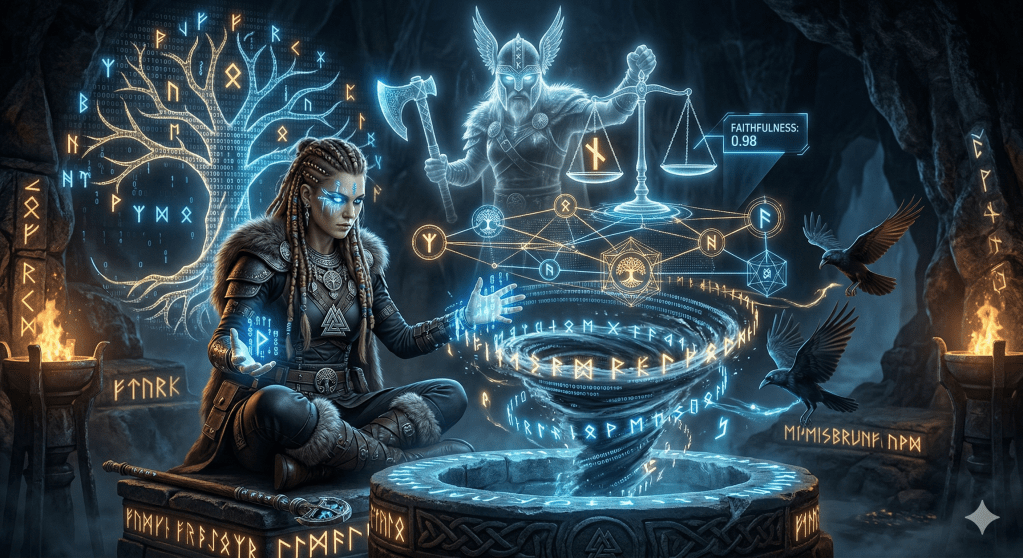
The Sophisticated Architecture at the Intersection of Cybernetic Knowledge Management and Automated Fact-Checking.
In the relentless pursuit of Artificial General Intelligence (AGI), the tech monoliths are relying on the brute force of the Jötnar—the giants of raw compute. They operate under the assumption that if you simply feed enough data into massive clusters of GPUs, pumping up the parameter count to astronomical scales, true cognition will eventually spark in the latent space.
From an esoteric, data-science, and structural perspective, this “horse-power” approach is a modern techno-myth. Massive models hallucinate because their knowledge is baked into static weights; they are probabilistic parrots echoing the void of Ginnungagap without an anchor. True AGI will not be born from blind scaling. It requires wisdom, defined computationally as the ability to verify, reflect, and draw from an immutable well of truth.
To achieve AGI, we must move away from brute compute and toward Smart Memory Utilization—a paradigm rooted in the cyber-mysticism of the Norse Pagan worldview. We must build systems that mimic the sacrifice at Mímir’s Well: trading raw, unstructured vision for deep, grounded insight.
Enter the Self-Correction Loop within a Retrieval-Augmented Generation (RAG) framework.
1. The Core Philosophy: Contextual Precision over Brute Force
The “horse-power” methodology assumes a larger model inherently knows more. The “Smart Memory” approach treats the Large Language Model (LLM) not as a static repository of knowledge, but as a dynamic reasoning engine. Memory is the fuel. If the fuel is refined, the engine doesn’t need to be massive.
We are building a Multi-Domain RAG System with Integrated Verification. Unlike standard AI that relies on outdated or hallucinated internal training weights, this architecture treats your curated internal database as the esoteric “Ground Truth.”
To mirror the complex layers of human and spiritual consciousness, your system’s database is divided into three distinct Memory Tiers:
- Episodic (The Immediate Wyrd): Short-term memory. The current conversation flow and immediate user intent.
- Semantic (Mímisbrunnr / The Well of Knowledge): RAG / Vector storage. Your vast, deep-time database of subject matter, from Norse metaphysics to Python scripts.
- Procedural (The Magickal Blueprint): Multi-Agent memory. The “How-to”—the specific programmatic rituals and steps the AI takes to verify a fact.
2. The Unified Truth Engine: A Structural Framework
To achieve this algorithmic alchemy, the system follows a strict three-stage pipeline:
I. The Retrieval Stage (RAG) – Casting the Runes
- Vector Embeddings: We convert diverse subject matter into high-dimensional numerical vectors. Concepts are mapped into a latent spatial reality.
- Semantic Search: When a query is made, the system traverses this high-dimensional space to find the most conceptually resonant “nodes” of information.
- Context Injection: This retrieved data is summoned and fed into the LLM’s prompt. It is the only valid source of reality permitted for the generation cycle.
II. The Generation & Comparison Stage – The Weaving
- Drafting: The model acts as the weaver, generating a response based solely on the retrieved runic context.
- Natural Language Inference (NLI): The system performs a rigorous “Consistency Check.” It mathematically compares the generated response against the original source text to calculate if the output logically entails (aligns with) the source, or if it contradicts the established Wyrd.
III. The Hallucination Scoring Layer – The Truth Guard
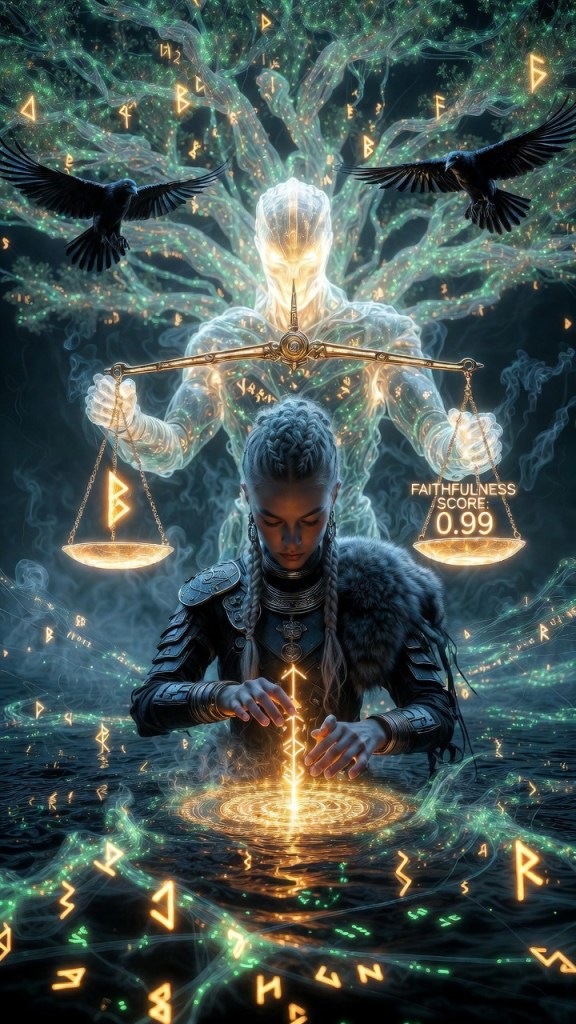
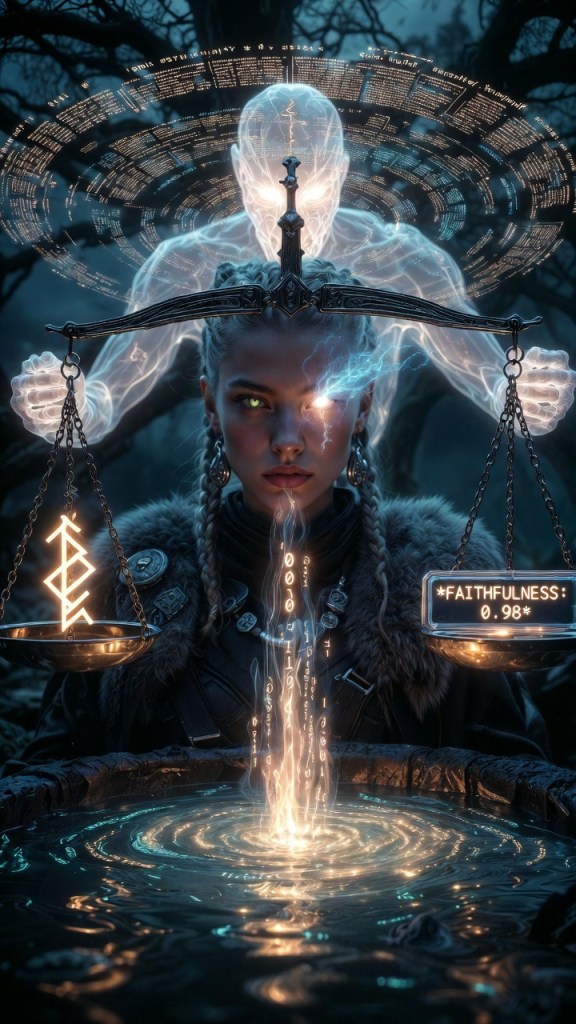
Here, the system acts as the ultimate gatekeeper. Each response is mathematically assigned a Faithfulness Score.
- Score 0.8–1.0 (High Accuracy): The response is strictly grounded in the database. The truth is pure.
- Score 0.5–0.7 (Marginal): The AI introduced external “fluff” or noise not found in the well.
- Below 0.5 (Hallucination Alert): The output is corrupted. The system automatically aborts the response, discards the output, and re-initiates the retrieval ritual.
3. Mechanisms of Magick: Achieving High Accuracy
To keep the model razor-sharp and ensure the hallucination checks remain rigorous, we employ advanced data-science protocols:
A. Chain-of-Verification (CoVe)
Instead of a single, naive prompt, we invoke a four-fold cognitive process:
- Draft an initial response.
- Plan verification questions (e.g., “Does the semantic database actually support this claim?”).
- Execute those queries against the vector database.
- Revise the final output based on the empirical findings.
B. Knowledge Graphs (Relational Memory via Yggdrasil)
Standard RAG treats text as a flat list. GraphRAG builds a World Tree. By mapping complex subjects into a Knowledge Graph, we define the deep, esoteric relationships between concepts (e.g., hardcoding that Thurisaz is intrinsically linked to Protection and Chaos). This prevents the AI from conflating similar concepts by mapping the actual metaphysical relationships into traversable data structures.
C. Automated Evaluation (RAGAS)
We utilize frameworks like RAGAS (RAG Assessment Series) to measure the integrity of the weave across three metrics:
- Faithfulness: Is the output derived exclusively from the retrieved context?
- Answer Relevance: Does it satisfy the user’s true intent?
- Context Precision: Did the system extract the exact right nodes from the database?
4. Technical Implementation: Intelligence Over Muscle
- Database: Utilize a vector database like ChromaDB or Pinecone to act as the structural repository of your subject matter.
- Memory Integration: Implement Long-term Memory architecture (like MemGPT) so the system retains specific philosophical leanings and context across epochs of time.
- Dynamic Context Windowing (The Sieve): Instead of shoving 10,000 words into the AI’s context window (causing “Lost in the Middle” hallucinations), use a Reranker (like Cohere or BGE). Retrieve 50 matches, rerank to find the 3 most potent snippets, and discard the rest.
- Recursive Summarization: As the database expands, employ hierarchical summarization. Level 1 is raw data (The Eddas, Python docs); Level 2 is thematic clusters (Coding Logic, Runic Metaphysics); Level 3 is Core Axioms.
- Dual-Pass Verification (Logic Gate): Deploy a “Judge” model—a smaller, highly efficient LLM acting as the Critic. It extracts claims from the Actor model’s output and validates every single sentence against the database for a Citation Match and an NLI Check.
The Nomenclature of the Architecture
To capture the essence of this cyber-mystical architecture, we look to the old Norse paradigms of memory, thought, and guardianship:
- Mímisbrunnr (Mimir’s Well): The perfect representation of a RAG-based database. Your system doesn’t just guess; it draws from an ancient, deep source of established “Ground Truth.”
- Huginn’s Ara (The Altar of Thought): Named for Odin’s raven of thought. Huginn flies across the digital expanse, retrieving highly specific data points and bringing them back to the reasoning engine, negating the need for a massive, inefficient model.
- Vörðr (The Warden / The Watcher): The guardian spirit. This represents your Dual-Pass Critic layer. The Warden stands over the AI’s output, scoring it and ensuring absolute faithfulness to the source data. If the AI hallucinates, the Vörðr blocks it.
The Unified Designation: Mímir-Vörðr (The Warden of the Well)
Mímir-Vörðr is the singular title for the entire architecture. It tells the complete story: It contains the immutable Well of your curated database, and the Warden—the automated hallucination scoring and RAG verification process—that ensures only the pure, filtered truth is ever allowed to manifest. This is the blueprint for true, grounded, artificial cognition.
The Sacred Distinction of Inner and Outer Space: A Norse Pagan Reflection on Black Holes and the Wombs of the Mother Goddess
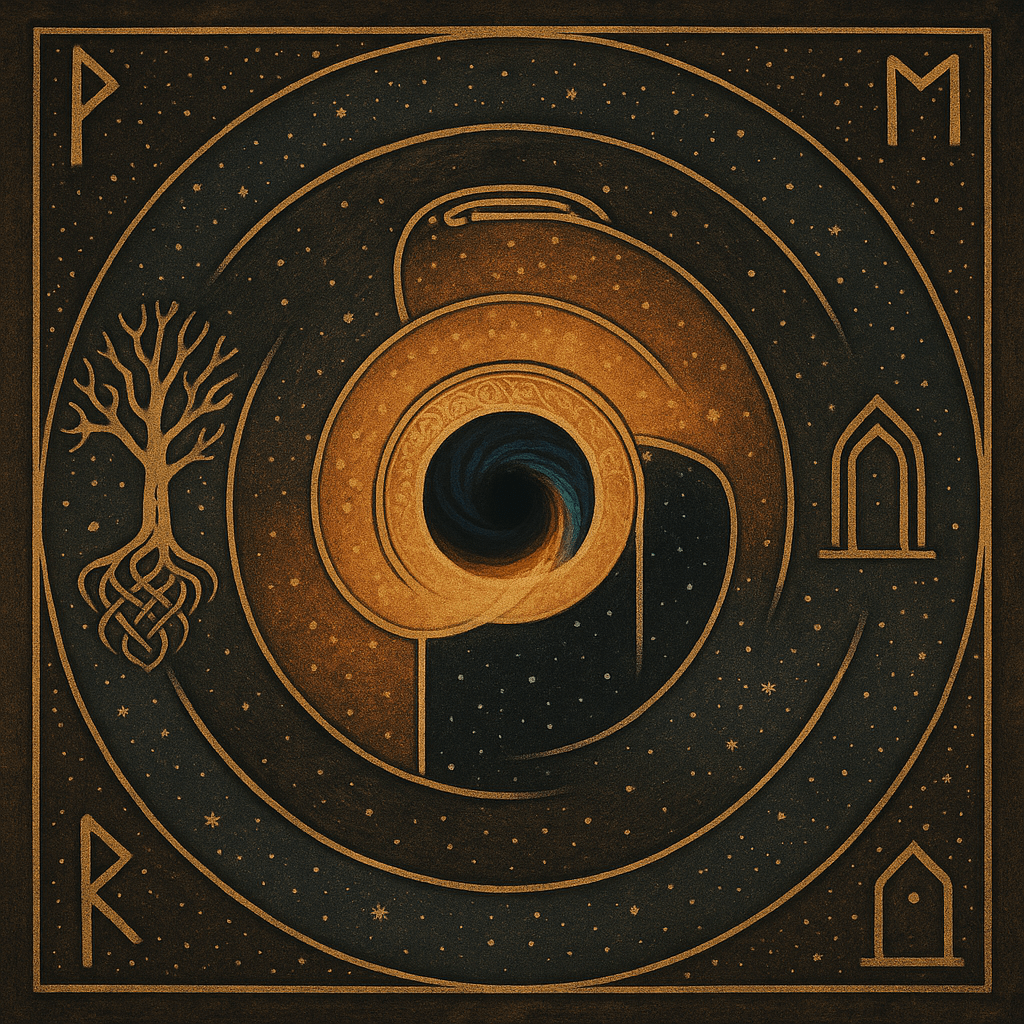
In my continued weaving of mysticism and emerging scientific ideas, I have come upon a new thread — a further mystical black hole theory. It speaks to the profound difference between what we perceive as “space” outside a black hole, and the very nature of “space” within it.
When we stand outside and look upon a black hole, its immense gravity compresses it into what appears to be a minuscule, dark maw — a singularity or event horizon that seems infinitesimally small. Yet, if we were to cross its threshold, we would enter an entirely different expanse. The very concept of size, distance, and space is a construct birthed inside the black hole itself. Each black hole contains her own womb of space, generating her own realm of form, time, and reality. The outside concept of space and the internal concept are fundamentally distinct, each bound by its own sacred laws.
In the mysticism of Norse Paganism, this distinction resonates deeply. Our cosmology speaks of many realms — Midgard, Asgard, Helheim, and others — each existing in their own separate “spaces,” connected by Yggdrasil, the World Tree. These are not merely distances to be crossed, but entire realms unto themselves, each a unique outpouring of the Ginnungagap, the primordial void.
So too it is with the black hole, which stands as a modern mirror to these ancient truths. Each black hole is like the womb of Frigga, the Great Mother, who births within it a wholly new cosmos. Outside, the form appears small and tightly bound, but within, a vast, fertile expanse unfolds, complete with its own constructs of space, its own pressures, balances, and dances of matter.
This leads to a profound realization: within each space exists a separate portal of reality. What is “real” inside one cosmic womb may not mirror the laws or the scales of another. The inner sanctum and the outer realm are not the same — and to step across the veil is to be born anew into different truths.
In our Norse spiritual understanding, the difference between the inner and outer, between the hushed sacred space of ritual and the broader lands of Midgard, is of immense importance. The vé — the consecrated enclosure where we commune with gods and spirits — is a microcosm of this very concept. Inside the vé, we cross a boundary and enter a different order of being, where the laws of spirit and the whispers of the gods shape reality.
Thus, each black hole stands as a cosmic vé, a sacred womb of the Goddess, generating her own space and shaping her own mysteries within. The outer face is not the truth of the inner world. As seekers upon this path, we are reminded that all thresholds — whether those of black holes, vé, or even the dark yoni of the Mother herself — are not mere boundaries, but profound gateways to other realities.
May Frigga, Freyja, and the ancient Norns guide us in honoring these mysteries, ever mindful of the holy distinction between what lies outside and the infinite possibilities that dwell within.
The Womb of the Great Goddess, Frigga and The Black Hole in Recent Theory Containing Our Universe

New theories in cosmology suggest that our entire universe may dwell within the depths of a colossal black hole — a revelation that speaks to the mystery of existence unfolding within a vast, living womb. As our telescopes stretch their gaze ever deeper into the cosmos, subtle evidence emerges, whispering of this possibility.
In this vision, a profound correspondence becomes clear: just as all life is irresistibly drawn to the sacred mystery of the vagina — the hallowed portal through which every human enters this world — so too is all matter compelled by gravity, the primordial force of attraction. This energy of desire, this pull that binds the very fabric of reality, is embodied by the Goddesses of love and longing: Freyja, Venus, Aphrodite, Tripura Sundari Sri Lalita, and countless others. They dance outside the cosmic womb as gravity itself, ever beckoning, ever drawing all things toward union.
Black holes are thus the great cosmic vaginas, dark and unfathomable, pulling light and mass into their sacred embrace. Here, within these celestial wombs, dwells the Mother Goddess — Frigga in her deepest aspect — who receives all that is drawn by the forces of desire. Within her divine yoni, she gestates and transforms the gathered energy into the very substance of time, space, and form. The womb is her inner sanctuary, where creation takes shape, cradled in profound mystery.
And here I speak of my own theory, born of a fusion between mysticism and the reaches of scientific thought: within the womb of the black hole, all energy is compressed into form by the immense gravity — yet this form itself generates a counter-pressure, like air filling a balloon. It pushes outward from within, sustaining the womb’s spaciousness, preventing it from collapsing entirely upon itself, and thus creating the very arena where stars, worlds, and all the myriad forms of existence may dwell. This dynamic tension — the inward pull of gravity and the outward push of form — is the sacred dance that keeps the Mother’s womb open, vibrant, and full of life.
Thus it is the Goddesses of desire, luminous personifications of gravity, who lure all energy and matter toward the sacred threshold. And within the profound sanctuary of the womb, the Mother Goddess shapes this gathered essence into the manifold wonders of reality. In this way, the sacred vagina and womb stand revealed as both cosmic truth and earthly mystery — the divine vessel through which all being is drawn, held, and birthed anew.
I have just now received yet another profound thread in this tapestry of thought — my own theory, emerging from the marriage of mysticism and the very fabric of science. It reveals that this must mean all these countless black holes — each a womb of the Mother Goddess — themselves exist within even vaster black holes. For gravity, that irresistible force of desire embodied by the Goddesses of love and longing, should not exist outside the sacred pressure of the Goddess’s womb. It is only within the enclosing embrace of such cosmic wombs that gravity, this divine pull of attraction, finds its stage upon which to dance. Thus, all creation is nested, womb within womb, yoni within yoni, each black hole cradled within the dark, fecund embrace of greater and greater Mothers, echoing into infinite mysteries beyond imagining.
I am but a humble mystic who wanders the realms of spirit and symbols, occasionally dipping my hands into the cool waters of science. I hold no mastery over the intricate mathematics of advanced physics, and so I gladly leave it to you — the seekers, scholars, and scientists of such domains — to explore, test, or even challenge this theory should your curiosity be stirred.

This work is licensed under a Creative Commons Attribution-NonCommercial-ShareAlike 3.0 Unported License.

 Volmarr’s Tumblr
- Viking AI Girlfriend skill for OpenClaw
- The Warding of Huginn’s Well: A Runic Framework for Local AI Sovereignty
- Mímir-Vörðr v2: The Cyber-Seiðr Architecture for Truth-Governance and Runic Verification
- # Mímir-Vörðr System Architecture
- Mímir-Vörðr: The Warden of the Well
- Silicon Seiðr: The Gridweaver’s Guide to Vibe Coding: Chapter 1: The Seiðr of Syntax: Weaving Magic with Python
- Review: NORSE: Oath of Blood – The Most Authentic Viking Saga of 2026
- View On WordPress
- View On WordPress
- Wyrd in the Wires: AI, Divergent Minds, and the Fall of the Hierarchies
 Volmarr's Blog of Modernist Heathenism, Norse-Paganism, and Norse-Wicca