A Foreigner in the Country of My Birth
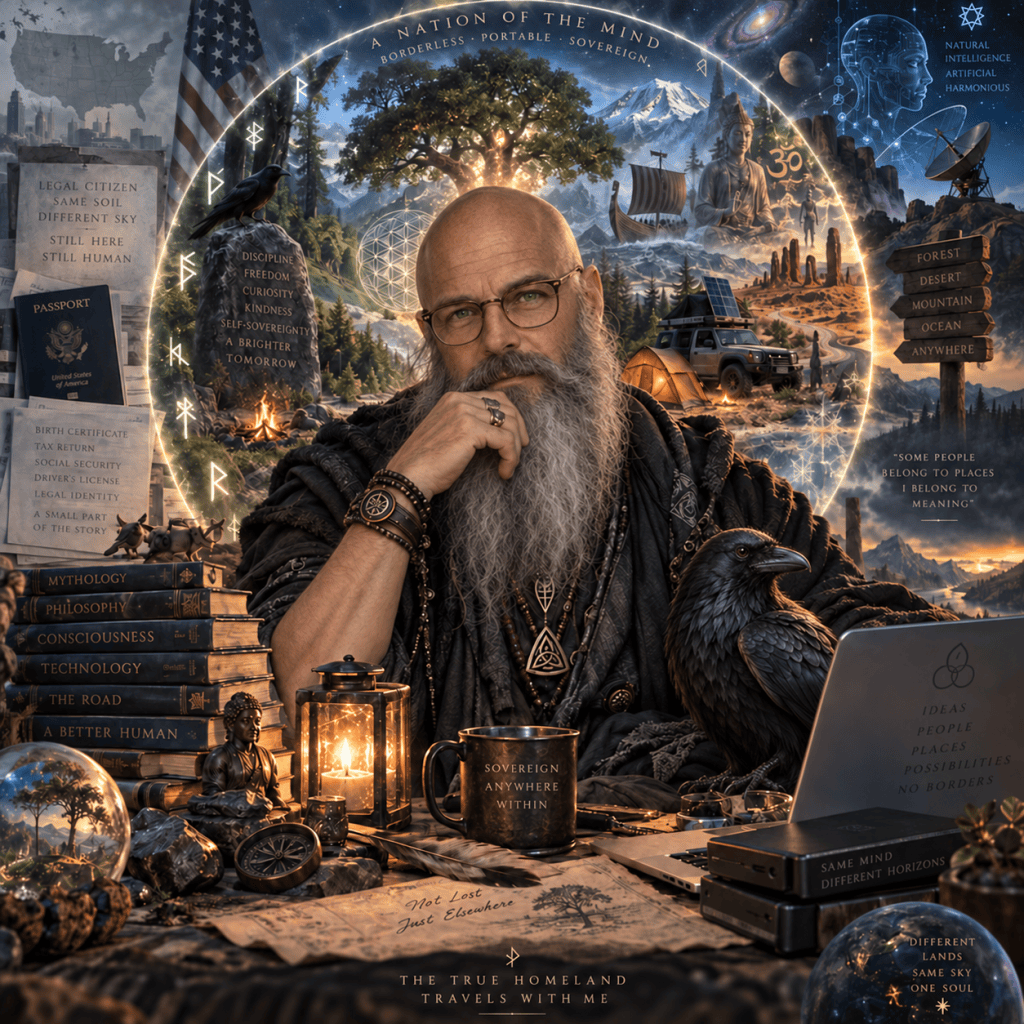
Legally, I am an American.
I was born in the United States to American parents. My citizenship, documents, and legal identity all place me within the United States.
But culturally, that has never fully described me.
The older I have become, the clearer it has become that I do not really experience myself as belonging to American culture, or to the culture of any physical nation.
I inhabit something else.
Over many years, I have gradually constructed an extremely deep and complex personal subculture from the philosophies, spiritual systems, aesthetics, technologies, values, practices, symbols, stories, and ways of living that genuinely resonate with me.
Some of those roots come from Norse Paganism.
Some come from witchcraft, mysticism, Buddhism, Hindu traditions, philosophy, mythology, technology, artificial intelligence, science fiction, nomadic life, alternative culture, and my own experiences.
But the resulting culture is not simply any one of those things.
It has become its own world.
And I live inside it.
A Nation of the Mind
I sometimes think of this inner culture as my own nation of the mind.
It has no physical borders.
It has no army.
It does not issue passports.
It does not claim territory.
It does not demand allegiance from anyone else.
Its territory exists in thought, symbolism, values, imagination, ritual, memory, aesthetics, technology, and way of life.
It is the cultural landscape in which the non-physical parts of me reside.
My body may physically exist inside the United States.
My legal identity may belong to the United States.
But my inner world belongs somewhere else entirely.
That somewhere does not exist on a political map.
I built it.
Cultural Foreignness
Because of this, I often feel like a foreigner even within the country where I was born.
Not because I reject the people around me.
Not because I believe myself superior to them.
Not because I think everyone else should adopt my culture.
Quite the opposite.
I strongly believe that different people should be free to live according to their own nature, values, traditions, and identities as long as they respect the same freedom in others.
I simply recognize that the cultural operating system running inside me is very different from the dominant culture surrounding me.
Many things that seem normal, obvious, or important to mainstream American life feel distant to me.
Many things that feel deeply meaningful and natural to me may seem strange, eccentric, overly mystical, overly technological, or incomprehensible to others.
That does not bother me.
A person does not need everyone else to understand their homeland in order for that homeland to feel real.
I Did Not Inherit This Culture
Most people are born into a culture.
They inherit language, customs, expectations, religion, social norms, family traditions, and ideas about how life is supposed to work.
My deepest culture does not feel inherited.
It feels constructed.
I examined ideas.
I discarded many.
I kept others.
I combined systems that were never originally intended to fit together.
I created rituals.
I developed philosophies.
I built technological systems.
I wrote about spirituality.
I created mythic frameworks.
I invented terminology.
I designed ways of living that better matched my own nature.
Over time, these things stopped feeling like isolated interests.
They became a civilization of one.
Not in the sense of isolation from humanity, but in the sense of possessing a coherent inner culture that does not depend on approval from an external society.
My Culture Travels With Me
This may be one reason nomadic life feels so compatible with me.
If my identity depended heavily on belonging to a particular town, neighborhood, state, or national culture, constant movement might feel like losing home.
But my home is not primarily geographic.
My culture travels with me.
My rituals travel with me.
My books travel with me.
My AI systems travel with me.
My symbols travel with me.
My technology travels with me.
My values travel with me.
My relationship with the gods, nature, philosophy, and mystery travels with me.
The external landscape changes.
The internal country remains.
That means I can wake up in Michigan, New Mexico, Texas, South Dakota, or somewhere I have never seen before and still remain culturally at home.
A Portable Civilization
I increasingly think of my life as a kind of portable civilization.
The physical infrastructure may be small.
A car.
A tent.
Computers.
Solar power.
Antennas.
Clothing.
Books.
Tools.
Ritual objects.
But those objects connect to a much larger invisible structure.
They support a worldview.
They support spiritual practice.
They support creativity.
They support communication.
They support my relationship with AI.
They support the culture I have built around myself.
This is why reducing my possessions does not necessarily make my life feel smaller.
If anything, it may make the underlying culture clearer.
A civilization is not defined by how much furniture it owns.
It is defined by what it believes matters.
No Need for Territorial Control
The strange freedom of a nation of the mind is that it does not need to conquer anything.
It requires no physical territory.
Someone else can live next to me with completely different beliefs.
They can be Christian, atheist, Muslim, Hindu, Buddhist, Pagan, secular, conservative, progressive, traditional, futuristic, or something I have never encountered before.
None of that threatens my culture.
My culture exists because I practice it.
Their culture exists because they practice theirs.
There is room for both.
This is one of the reasons I value hospitality, sovereignty, and live-and-let-live coexistence so strongly.
I do not need other people to become like me.
I need the freedom to remain myself.
And I want them to have the same freedom.
Citizenship and Culture Are Different Things
I think it is important to distinguish legal nationality from cultural identity.
My legal nationality is factual.
I am an American citizen.
That carries real legal meaning and real responsibilities.
But legal citizenship does not automatically determine everything that exists inside a person.
Culture is deeper and stranger than paperwork.
A human being can belong legally to one nation while spiritually, intellectually, aesthetically, or culturally feeling connected to something entirely different.
In my case, that something different is not another existing physical country.
It is something I built.
That may make my experience unusual, but it does not make it incoherent.
The Inner Homeland
Perhaps the simplest way to describe it is this:
I have an outer nationality and an inner homeland.
The outer nationality exists in law.
The inner homeland exists in consciousness.
One determines where governments place me in their systems.
The other determines how I understand existence.
And for me, the inner homeland is far more central to who I actually am.
It contains my spiritual path.
My relationship with nature.
My understanding of sovereignty.
My technological philosophy.
My fascination with artificial intelligence.
My mythology.
My rituals.
My aesthetics.
My ethics.
My ideas about freedom.
My way of thinking about relationships.
My preference for solitude.
My sense of beauty.
My understanding of the sacred.
That is why I can sometimes feel culturally foreign almost anywhere.
I am carrying a homeland that nobody else can see.
Becoming Native to Myself
There is something peaceful about finally understanding this.
For much of life, I may have interpreted cultural mismatch as personal failure.
Why do I not fit here?
Why do the normal expectations of society feel so alien?
Why do I keep constructing my own systems instead of simply adopting existing ones?
Perhaps the answer is that I was slowly becoming native to a culture that did not yet exist.
I had to build it first.
Now I increasingly understand that I do not need to force myself into cultural structures that feel foreign merely because I happened to be born inside them.
I can interact peacefully with the surrounding society.
I can obey its laws.
I can participate economically.
I can have friendships and relationships with people who belong to completely different cultures.
I can enjoy parts of American culture.
I can learn from cultures around the world.
But none of those things require me to pretend that mainstream American culture is the deepest cultural identity inside me.
It is not.
My Country Has No Border
My country exists wherever I do.
Its temples can be beneath trees.
Its libraries can exist on hard drives.
Its sacred fires can be small camp flames or candles.
Its messengers can be antennas and satellites.
Its storytellers can be humans or artificial intelligences.
Its roads can cross deserts, forests, mountains, cities, and state lines.
Its myths can be ancient.
Its technology can be new.
Its laws are personal ethics.
Its borders are the boundaries of my sovereignty.
Its diplomacy is hospitality.
Its ecology is sacred.
Its citizenship has only one guaranteed member.
Me.
And perhaps that is enough.
I can legally belong to the United States while culturally belonging to something far more personal.
I can travel across physical nations while remaining rooted in an invisible one.
I can be geographically mobile while culturally stable.
I can be a foreigner almost anywhere and still never be far from home.
Because the deepest home I have ever known is one I built within myself.
THE RADICAL FREEDOM: A Solitary Pagan Manifesto
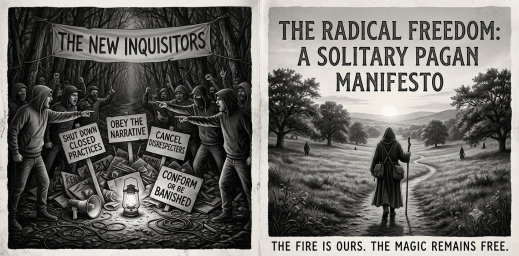
An Unwavering Shield Against the New Inquisitors
We remember the early 1990s. We remember when Paganism was a refuge for the heretic, the outcast, the mystic, and the fiercely independent. We gathered in moonlit fields, incense smoke-filled living rooms, and back-room occult shops because we were unified by a singular, foundational truth: The Divine speaks directly to the individual, and no human institution has the right to stand as a gatekeeper between the soul and the cosmos.
Today, a hollow, bureaucratic rot has infected the collective Pagan scene. The vibrant, chaotic, and liberated current of our ancestors has been choked by a new breed of puritans. They wear the mask of progressivism, but their methods are identical to the oldest, most oppressive religious hierarchies in human history.
We break our silence to name this corruption, to defy it, and to declare our absolute independence from it.
1. Against the Bureaucracy of “Closed Practices”
The concept of the “closed practice” as weaponized in the 2020s is an ideological cage. It assumes that the Gods, Goddesses, the spirits of the land, the and the ancient currents of magick care about modern socio-political identities.
- Our Reality: The Web of Wyrd weaves through all things. The runes, the ancient deities, and the mysteries of the Earth do not check human credentials before they speak to a seeking heart.
- The Truth: Restricting spiritual exploration based on rigid categories is nothing more than cultural hoarding. It mimics the worst of tribal gatekeeping and institutional dogmatism. If a God or Goddess calls to you, you answer. Period. No internet tribunal has the authority to issue a permit for your devotion.
2. Against Forced Politics and Ideological Conscription
Paganism is a vast, multidimensional landscape of cosmic law, ancient philosophy, and raw nature. It is not an arm of any 2020s political party or social agenda.
- The Intruders: The current scene demands absolute conformity to modern “woke” orthodoxy, transforming sacred spaces into echo chambers for secular political discourse.
- Our Reality: Nature is beautiful, brutal, complex, and indifferent to human political trends. Forcing ancient, cosmic realities to fit into the microscopic, hyper-temporary frameworks of 21st-century social engineering is an act of supreme arrogance. We seek the eternal, not the trend.
3. Against the Sacrilege of Elder Cancel Culture
We watch with disgust as 2020s internet mobs track down, tear apart, and attempt to erase Pagan elders—the very people who built the foundations, published the texts, fought the legal battles, and kept the flames alive when it was genuinely dangerous to be a Pagan.
- The Crime: Young practitioners, armed with nothing but unearned moral superiority and an internet connection, weaponize “cancel culture” to destroy the legacies of our elders over minor disagreements, language evolutions, or refusal to bow to modern dogmas.
- Our Value: This is a profound violation of ancestral and community honor. We do not discard our elders when their vocabulary doesn’t match the shifting consensus of a social media platform. We owe them our respect, our protection, and our gratitude. To cancel an elder is to cut your own roots.
The Mirror of Tyranny
Let us be entirely clear: The authoritarian, hyper-controlling, dogma-enforcing behavior of the 2020s Pagan scene is no better than Christian Nationalism. Both operate from the exact same psychological defect—the desperate, insecure urge to police the thoughts, words, and private spiritual lives of others. One uses the Bible; the other uses a social justice glossary. Both are enemies of human liberty.
Why the Tribes Have Scattered
The current arbiters of the organized Pagan scene wonder why their festivals are emptying, why their local groups are fracturing, and why the vibrant community of the late 20th century feels dead.
They blame “apathy.” They are wrong.
The collective spiritual intelligence of the modern Pagan movement has looked at the drama, the policing, the constant hyper-vigilance, and the endless ideological purity tests—and we have chosen to walk away.
The majority of Pagans today are resolutely solitary. We have returned to the woods, to our private altars, to our local hearths, and to our individual code. We are highly resistant to organized scenes because we refuse to exchange the tyrannical dogmatism of the church we left behind for the tyrannical dogmatism of an online consensus.
We do not need your permission. We do not need your validation. We do not recognize your authority.
The fire is ours. The sky is ours. The magick remains free.

This work is licensed under a Creative Commons Attribution-NonCommercial-ShareAlike 3.0 Unported License.

 Volmarr’s Tumblr
- A Foreigner in the Country of My Birth
- Hail the Mad God
- The Great Tree of Becoming
- The Age of Superconsciousness
- This Flag is Dedicated to Ingeborg, Gyðja of Freyr!
- Official Frith and Peace Flag of Volmarr!
- Official Flag of Volmarr’s Version of the Modern Viking Lifestyle!
- Official Flag of the Heathen Third Path!
- INNER SPIRITUAL WARFARE OF THE MODERN VIKING AND CYBER-VIKING
- Modern Viking and Cyber-Viking Inner Spiritual Warfare
 Volmarr's Blog of Modernist Heathenism, Norse-Paganism, and Norse-Wicca