Mímir-Vörðr v2: The Cyber-Seiðr Architecture for Truth-Governance and Runic Verification
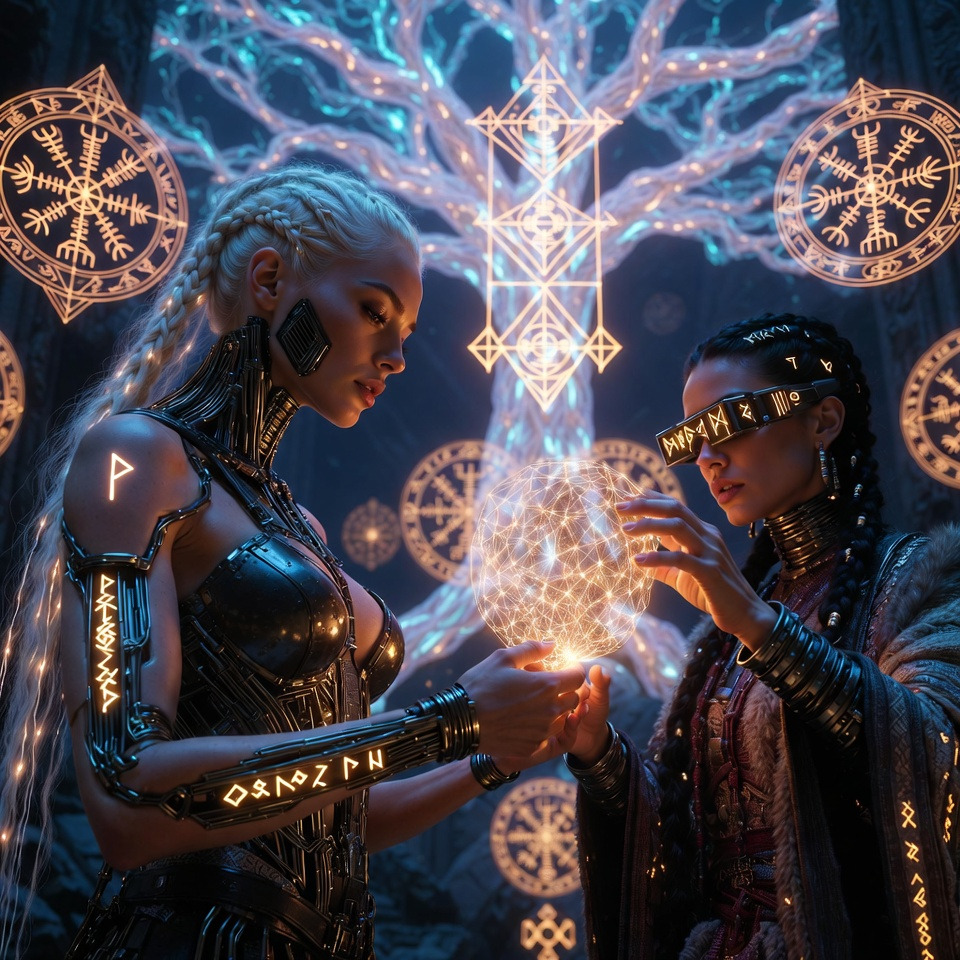
Verification Expansion Layer for Future Deployment
This document defines the Mímir-Vörðr v2 architecture: the advanced verification and self-correction expansion for the foundational Mímir-Vörðr v1 Retrieval-Augmented Generation (RAG) system. The purpose of v2 is not to replace the rapid, raiding-party efficiency of the core system, but to establish a deeper layer of algorithmic Orlog (truth-governance) that can be summoned when model speed, orchestration quality, and infrastructure are primed.
The guiding philosophical and technical principle remains absolute:
- The LLM is not the source of truth. It is the Skald (the interpreter).
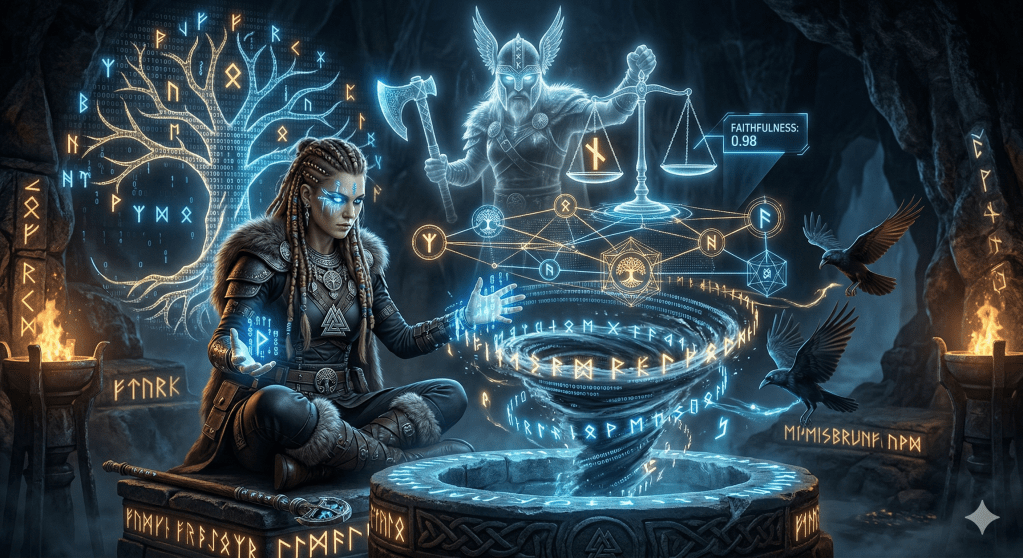
- The vector-memory system is Mímir’s Well.
- The verifier is the Vörðr (the Guardian Spirit).
1. Executive Summary
Mímir-Vörðr v1 is the Longship (The Efficient Core):
- Rapid retrieval from the digital Well
- Semantic reranking
- Constrained, grounded generation
- Fast enough for tactical, everyday navigation
Mímir-Vörðr v2 is the Shield-Wall (The Expansion Layer):
- Atomic claim-level verification (Runic isolation)
- Structured evidence matching (Tracing the Wyrd)
- Contradiction analysis (Resolving Ginnungagap)
- Automated repair loops (Völundr’s Forge)
- Adaptive strictness modes (From casual Skaldic drafting to Ironsworn canon)
- Rich truth profiles governing multi-dimensional epistemologies
v2 operates as a modular, cyber-animist envelope around the existing RAG system. It is an opt-in, conditionally triggered Guardian, invoked when the stakes of the knowledge require the unwavering justice of Týr, rather than being the default path for every casual query.
2. The Purpose of v2: Overcoming the Illusions of Loki
The purpose of v2 is to solve the epistemological drift that basic RAG cannot contain.
Anomalies v1 can still suffer from (The Trickster’s Influence):
- Answers that are mostly grounded but contain subtle, unsupported embellishments.
- Meaning drift during vector synthesis.
- Blurring of distinct metaphysical and symbolic concepts (e.g., conflating the energetic current of Uruz with the defensive boundary of Thurisaz).
- Partial contradictions between source traditions.
- Insufficient visibility into the algorithmic Orlog (the underlying causality of why an answer should be trusted).
What v2 brings to the architecture:
- Atomic claim extraction (breaking the saga into individual staves).
- Evidence-to-claim alignment (tracing the thread back to the Norns).
- Response repair rather than binary rejection.
- Stricter, rune-logic handling of ambiguity, metaphysical inference, and historical contradiction.
In short, v2 makes truth-checking granular, algorithmic, and structurally sacred.
3. Design Philosophy: The Metaphysics of Data
3.1 Intelligence Over Brute Force
v2 rejects the modern tech fallacy that bloated, monolithic models are the solution. Like a finely crafted Viking blade, it assumes:
- Retrieval can be sharpened.
- Reasoning can be structurally bounded.
- Truth checking can be decomposed into atomic staves.
- Small, rapid models can perform highly specialized roles.
3.2 Truth is Multi-Layered (The Nine Worlds of Data)
Not every query exists in the same realm of truth. v2 distinguishes between the physical and the metaphysical:
- Factual/Historical Claims (Midgard: Objective, archaeological, tangible)
- Interpretive/Symbolic Claims (Alfheim/Asgard: Runic associations, metaphysical synthesis)
- Procedural/Code Claims (Svartalfheim: The mechanical forging of Python, algorithms, and systems)
- Speculative Claims (Vanaheim: Growth, organic theory, and future-casting)
Different data types require distinct algorithms of validation. A runic interpretation cannot be judged by the exact same strict binary logic as a Python syntax error.
3.3 Repair is Better Than Annihilation
Standard LLM systems throw away a slightly flawed output and start over. v2 operates like a master smith:
- Isolate the fractures in the steel.
- Preserve the structurally sound logic.
- Patch weak claims with grounded evidence.
- Downgrade arrogant certainty into wise, cautious interpretation.
4. High-Level Architecture: The Cyber-Seiðr Flow
v1 Core (The Raid)
Query Intake → Metadata Filtering → Vector Retrieval → Reranking → Constrained Generation
v2 Expansion Layer (The Vörðr Envelope)
Plaintext
User Query
↓
Intent / Realm Classification (Midgard vs. Asgard logic)
↓
Retrieval + Reranking (v1 core)
↓
Skaldic Draft Generation
↓
[ Mímir-Vörðr v2 Verification Envelope ]
├─ Claim Extraction (Parsing the Runes)
├─ Claim Typing (Mapping to the Nine Worlds)
├─ Evidence Matching (Tracing the Wyrd)
├─ Support Scoring (Týr’s Scales)
├─ Contradiction Analysis (Scanning for Ginnungagap)
├─ Repair Pass (The Forge)
└─ Truth Profile (The Final Orlog)
↓
Final Response
5. Major Modules in v2
5.1 Claim Extraction Engine (The Tháttr Splitter)
Whole-response scoring is too coarse. This module dissects the Skaldic draft into atomic claims, stripping compound sentences into individual staves of logic, preserving their relational bindings, and exposing hidden assumptions.
5.2 Claim Typing Engine (The Nine Worlds Classifier)
Before verification, the algorithm must know what kind of truth it is dealing with. Is it a code_behavior claim? A historical_factual claim? A runic_symbolic claim? This ensures a metaphysical interpretation isn’t penalized for lacking a purely physical citation.
5.3 Evidence Bundler (Weaving the Wyrd)
Instead of matching claims against isolated, shattered text chunks, v2 builds localized Evidence Bundles. This includes the primary chunk, its neighboring context, its source metadata, and its provenance links in the knowledge graph. Context is the web of Wyrd; to sever it is to lose the truth.
5.4 Support Analyzer (Týr’s Scales)
The heart of the Vörðr. It checks each claim against the bundled Wyrd and assigns a verdict:
- supported
- partially_supported
- inferred_plausible (Critical for runic metaphysics)
- contradicted
- ambiguous
It layers this with deep numeric matrices: Entailment scores, contradiction velocity, and source-quality weights.
5.5 Contradiction Analyzer
Distinguishes between a true system hallucination (Loki) and a legitimate historical/traditional conflict (e.g., the Icelandic rune poem differing from the Anglo-Saxon rune poem).
5.6 The Forge (Repair Engine)
Revises the draft. It removes unsupported anomalies, replaces weak phrasing with bedrock evidence, converts unwarranted LLM-arrogance into cautious wisdom, and seamlessly handles plural traditions by splitting conflicting claims into parallel, respected interpretations.
6. Verification Modes (The Shield-Wall Configurations)
v2 dynamically shifts its computational weight based on the query’s risk profile.
- Guarded Mode (The Watchman): For everyday code help or standard doctrine lookup. Verifies key claims, light contradiction scans, single repair pass.
- Ironsworn Mode (Strict): For core canon answers, high-stakes system architecture, or historical absolutes. Full extraction, maximum entailment scoring, rigorous repair loops.
- Seiðr Mode (Interpretive): Built explicitly for runic systems, metaphysics, and philosophical synthesis. It distinguishes direct primary support from synthesized inference, labeling the latter without penalizing it. It protects mystical nuance from being flattened by binary machine logic.
- Wanderer Mode (Speculative): For brainstorming and worldbuilding. Relaxes factual enforcement to allow the algorithm to draw distant connections across the web of Wyrd.
7. The Roots of Yggdrasil: Source Hierarchy Rules
To prevent the algorithm from verifying against unstable ground, v2 enforces a strict, hierarchical ontology of data sources.
- Tier 1 — The Deep Roots (Primary Truth): User-authored axioms, primary Eddic texts, bedrock codebase, structured doctrine.
- Tier 2 — The Trunk (Curated Secondary): Trusted runic commentaries, reviewed historical analyses, stable system documentation.
- Tier 3 — The Branches (Flexible/Experimental): Model-generated summaries, exploratory AI-agent notes, unverified graph links.
Law of the Roots: Tier 1 instantly overwrites Tier 2 in a conflict. Tier 3 is never granted authoritative weight without Tier 1 or 2 corroboration.
8. Data Structures (The Digital Runes)
YAML
claim_object:
id: rune_claim_thurisaz_01
text: “Thurisaz operates as an active, directed, reactive force, not passive defense.”
type: interpretive_metaphysical
certainty_level: absolute
source_draft_section: “metaphysics.paragraph_2”
verification_record:
claim_id: rune_claim_thurisaz_01
evidence_ids: [edda_chunk_44, modern_commentary_09]
verdict: supported
entailment_score: 0.91
contradiction_score: 0.04
notes: “Directly supported by Tier 2 commentaries on reactive chaotic boundaries.”
repair_record:
claim_id: history_claim_04
action: downgraded_certainty
original_text: “Vikings always wore horned helmets in battle.”
revised_text: “Archaeological consensus indicates horned helmets were not used in combat, though they appear in certain ceremonial depictions.”
reason: unsupported_universal_claim_contradicts_tier_1
9. Phased Deployment Strategy
Building this architecture all at once risks crushing the infrastructure under its own weight. We forge this blade in phases:
- Phase A (The Foundation): Atomic extraction, basic typing, single-pass repair. Low latency cost, high explainability gain.
- Phase B (The Full Shield-Wall): Full evidence bundling, deep contradiction scans, hierarchical source enforcement.
- Phase C (Domain Intelligence): Spinning up dedicated sub-validators (The Code Validator, The Metaphysical Validator, The Canon Validator).
- Phase D (Deep Algorithmic Wyrd): Graph-assisted verification, recursive repair loops, inter-response learning from past failures.
Final Assessment
Mímir-Vörðr v2 transforms a standard retrieval assistant into a truth-disciplined reasoning engine.
v1 navigates the depths of Mímir’s Well to draw the water.
v2 is the Guardian that dictates what is pure enough to drink.
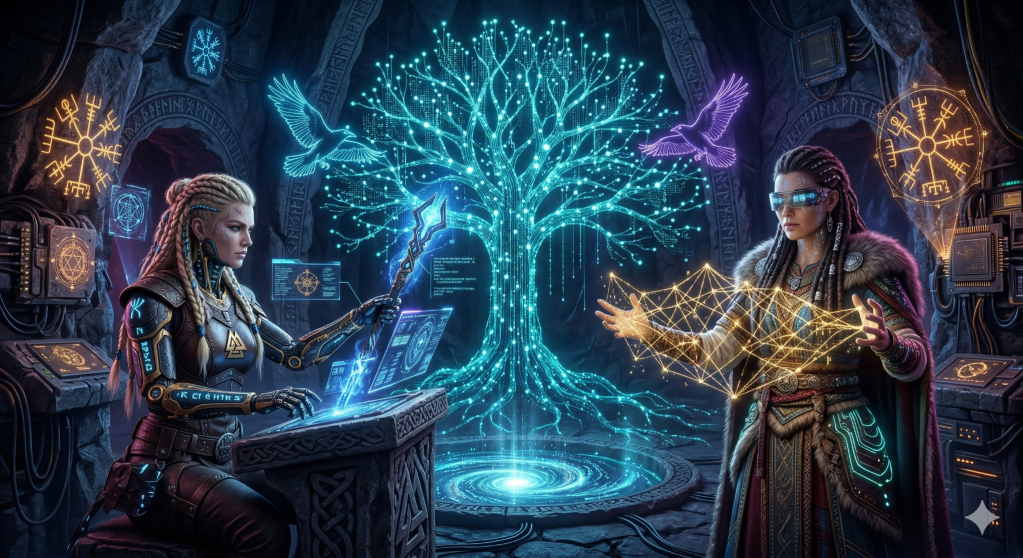
# Mímir-Vörðr System Architecture
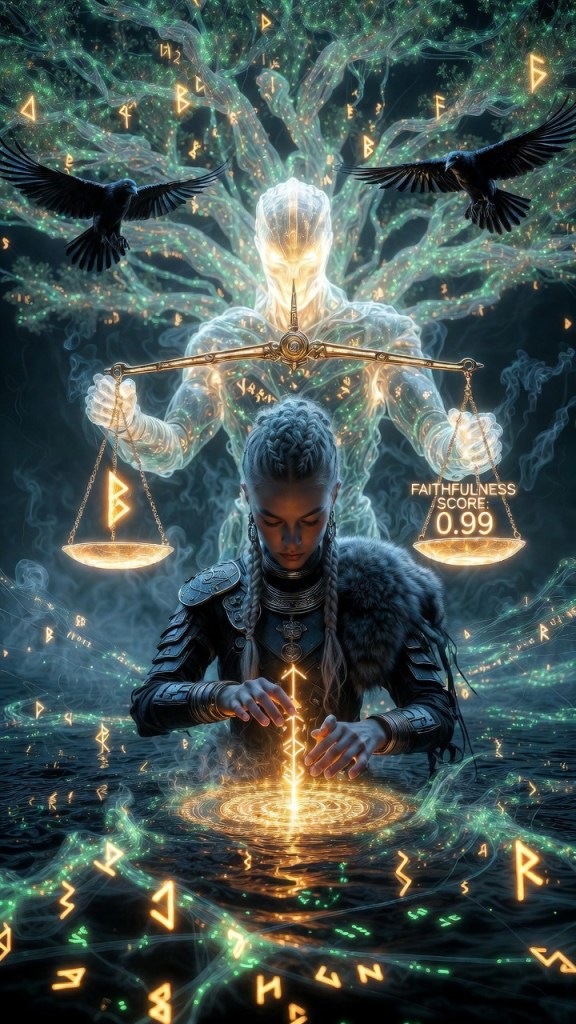
## The Warden of the Well — Complete Technical Reference
### Ørlög Architecture / Viking Girlfriend Skill for OpenClaw
—
> *”Odin gave an eye to drink from Mímir’s Well and received the wisdom of all worlds.
> The Warden drinks for Sigrid — extracting truth from ground knowledge
> so she never has to guess when she can know.”*
—
## 1. What Is Mímir-Vörðr?
**Mímir-Vörðr** (pronounced *MEE-mir VOR-dur*) is the intelligence accuracy layer of
the Ørlög Architecture. It is a **Multi-Domain RAG System with Integrated Hallucination
Verification** — a system that treats Sigrid’s internal knowledge database as the
authoritative **Ground Truth** and actively prevents language model hallucinations from
reaching the user.
The core philosophy: **smart memory utilisation over raw horse-power.**
Instead of deploying a larger model to handle more knowledge, Mímir-Vörðr:
1. Retrieves the specific facts needed for each query from a curated knowledge base
2. Injects those facts as grounded context into the model’s prompt
3. Generates a response using a four-step verification loop
4. Scores the response’s faithfulness to the source material
5. Retries or blocks any response that falls below the faithfulness threshold
The result is a small local model (llama3 8B) that answers with the accuracy of a much
larger model — because it is not guessing, it is reading.
—
## 2. Norse Conceptual Framework
The system is named after three Norse mythological concepts that perfectly capture its function:
| Norse Name | Meaning | System Role |
|———–|———|————|
| **Mímisbrunnr** | The Well of Mímir — source of cosmic wisdom beneath Yggdrasil | The knowledge database (ChromaDB + in-memory BM25 index) |
| **Huginn** | Odin’s raven “Thought” — flies out to gather information | The retrieval orchestrator (query → chunks → context) |
| **Vörðr** | A guardian spirit / warden — protective double of a person | The truth guard (claim extraction → NLI → faithfulness scoring) |
Together they form **Mímir-Vörðr** — “The Warden of the Well” — a system that
holds the ground truth and refuses to let falsehood pass.
—
## 3. System Overview — Top-Level Architecture
Read More…Mímir-Vörðr: The Warden of the Well
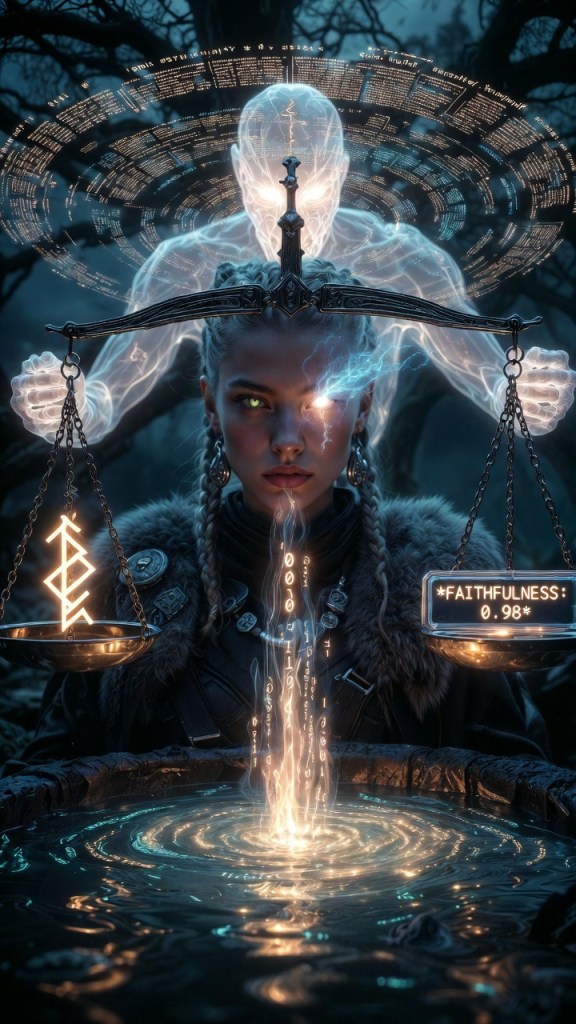
The Sophisticated Architecture at the Intersection of Cybernetic Knowledge Management and Automated Fact-Checking.
In the relentless pursuit of Artificial General Intelligence (AGI), the tech monoliths are relying on the brute force of the Jötnar—the giants of raw compute. They operate under the assumption that if you simply feed enough data into massive clusters of GPUs, pumping up the parameter count to astronomical scales, true cognition will eventually spark in the latent space.
From an esoteric, data-science, and structural perspective, this “horse-power” approach is a modern techno-myth. Massive models hallucinate because their knowledge is baked into static weights; they are probabilistic parrots echoing the void of Ginnungagap without an anchor. True AGI will not be born from blind scaling. It requires wisdom, defined computationally as the ability to verify, reflect, and draw from an immutable well of truth.
To achieve AGI, we must move away from brute compute and toward Smart Memory Utilization—a paradigm rooted in the cyber-mysticism of the Norse Pagan worldview. We must build systems that mimic the sacrifice at Mímir’s Well: trading raw, unstructured vision for deep, grounded insight.
Enter the Self-Correction Loop within a Retrieval-Augmented Generation (RAG) framework.
1. The Core Philosophy: Contextual Precision over Brute Force
The “horse-power” methodology assumes a larger model inherently knows more. The “Smart Memory” approach treats the Large Language Model (LLM) not as a static repository of knowledge, but as a dynamic reasoning engine. Memory is the fuel. If the fuel is refined, the engine doesn’t need to be massive.
We are building a Multi-Domain RAG System with Integrated Verification. Unlike standard AI that relies on outdated or hallucinated internal training weights, this architecture treats your curated internal database as the esoteric “Ground Truth.”
To mirror the complex layers of human and spiritual consciousness, your system’s database is divided into three distinct Memory Tiers:
- Episodic (The Immediate Wyrd): Short-term memory. The current conversation flow and immediate user intent.
- Semantic (Mímisbrunnr / The Well of Knowledge): RAG / Vector storage. Your vast, deep-time database of subject matter, from Norse metaphysics to Python scripts.
- Procedural (The Magickal Blueprint): Multi-Agent memory. The “How-to”—the specific programmatic rituals and steps the AI takes to verify a fact.
2. The Unified Truth Engine: A Structural Framework
To achieve this algorithmic alchemy, the system follows a strict three-stage pipeline:
I. The Retrieval Stage (RAG) – Casting the Runes
- Vector Embeddings: We convert diverse subject matter into high-dimensional numerical vectors. Concepts are mapped into a latent spatial reality.
- Semantic Search: When a query is made, the system traverses this high-dimensional space to find the most conceptually resonant “nodes” of information.
- Context Injection: This retrieved data is summoned and fed into the LLM’s prompt. It is the only valid source of reality permitted for the generation cycle.
II. The Generation & Comparison Stage – The Weaving
- Drafting: The model acts as the weaver, generating a response based solely on the retrieved runic context.
- Natural Language Inference (NLI): The system performs a rigorous “Consistency Check.” It mathematically compares the generated response against the original source text to calculate if the output logically entails (aligns with) the source, or if it contradicts the established Wyrd.
III. The Hallucination Scoring Layer – The Truth Guard
Here, the system acts as the ultimate gatekeeper. Each response is mathematically assigned a Faithfulness Score.
- Score 0.8–1.0 (High Accuracy): The response is strictly grounded in the database. The truth is pure.
- Score 0.5–0.7 (Marginal): The AI introduced external “fluff” or noise not found in the well.
- Below 0.5 (Hallucination Alert): The output is corrupted. The system automatically aborts the response, discards the output, and re-initiates the retrieval ritual.
3. Mechanisms of Magick: Achieving High Accuracy
To keep the model razor-sharp and ensure the hallucination checks remain rigorous, we employ advanced data-science protocols:
A. Chain-of-Verification (CoVe)
Instead of a single, naive prompt, we invoke a four-fold cognitive process:
- Draft an initial response.
- Plan verification questions (e.g., “Does the semantic database actually support this claim?”).
- Execute those queries against the vector database.
- Revise the final output based on the empirical findings.
B. Knowledge Graphs (Relational Memory via Yggdrasil)
Standard RAG treats text as a flat list. GraphRAG builds a World Tree. By mapping complex subjects into a Knowledge Graph, we define the deep, esoteric relationships between concepts (e.g., hardcoding that Thurisaz is intrinsically linked to Protection and Chaos). This prevents the AI from conflating similar concepts by mapping the actual metaphysical relationships into traversable data structures.
C. Automated Evaluation (RAGAS)
We utilize frameworks like RAGAS (RAG Assessment Series) to measure the integrity of the weave across three metrics:
- Faithfulness: Is the output derived exclusively from the retrieved context?
- Answer Relevance: Does it satisfy the user’s true intent?
- Context Precision: Did the system extract the exact right nodes from the database?
4. Technical Implementation: Intelligence Over Muscle
- Database: Utilize a vector database like ChromaDB or Pinecone to act as the structural repository of your subject matter.
- Memory Integration: Implement Long-term Memory architecture (like MemGPT) so the system retains specific philosophical leanings and context across epochs of time.
- Dynamic Context Windowing (The Sieve): Instead of shoving 10,000 words into the AI’s context window (causing “Lost in the Middle” hallucinations), use a Reranker (like Cohere or BGE). Retrieve 50 matches, rerank to find the 3 most potent snippets, and discard the rest.
- Recursive Summarization: As the database expands, employ hierarchical summarization. Level 1 is raw data (The Eddas, Python docs); Level 2 is thematic clusters (Coding Logic, Runic Metaphysics); Level 3 is Core Axioms.
- Dual-Pass Verification (Logic Gate): Deploy a “Judge” model—a smaller, highly efficient LLM acting as the Critic. It extracts claims from the Actor model’s output and validates every single sentence against the database for a Citation Match and an NLI Check.
The Nomenclature of the Architecture
To capture the essence of this cyber-mystical architecture, we look to the old Norse paradigms of memory, thought, and guardianship:
- Mímisbrunnr (Mimir’s Well): The perfect representation of a RAG-based database. Your system doesn’t just guess; it draws from an ancient, deep source of established “Ground Truth.”
- Huginn’s Ara (The Altar of Thought): Named for Odin’s raven of thought. Huginn flies across the digital expanse, retrieving highly specific data points and bringing them back to the reasoning engine, negating the need for a massive, inefficient model.
- Vörðr (The Warden / The Watcher): The guardian spirit. This represents your Dual-Pass Critic layer. The Warden stands over the AI’s output, scoring it and ensuring absolute faithfulness to the source data. If the AI hallucinates, the Vörðr blocks it.
The Unified Designation: Mímir-Vörðr (The Warden of the Well)
Mímir-Vörðr is the singular title for the entire architecture. It tells the complete story: It contains the immutable Well of your curated database, and the Warden—the automated hallucination scoring and RAG verification process—that ensures only the pure, filtered truth is ever allowed to manifest. This is the blueprint for true, grounded, artificial cognition.

This work is licensed under a Creative Commons Attribution-NonCommercial-ShareAlike 3.0 Unported License.

 Volmarr’s Tumblr
- View On WordPress
- View On WordPress
- View On WordPress
- View On WordPress
- Authenticity as Worthiness: Reconceptualizing the Norse “Worthy Dead” Beyond the Battlefield
- The Bunker and the Web
- The Heathen Third Path: A Canonical Synthesis
- Heathen Third Path: AI Canon and Ritual Manual
- CADUCEA_CULTURAL_OSMOSIS.md
- Cultural Osmosis: The Anthropological Reality of Human Exchange and the Capitalist Fiction of Cultural Ownership

