Cultural Osmosis: The Anthropological Reality of Human Exchange and the Capitalist Fiction of Cultural Ownership
Abstract
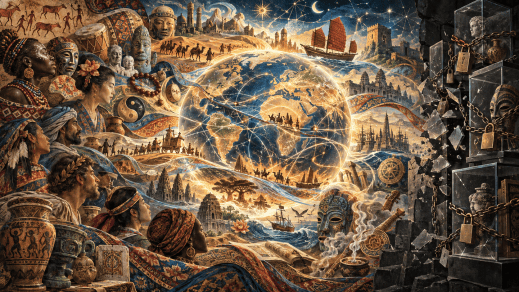
The contemporary discourse surrounding “cultural appropriation” and “closed spiritual practices” represents a fundamental misunderstanding—or deliberate misrepresentation—of anthropological evidence, historical record, and the mechanisms by which human societies develop. This article examines the scientific consensus on cultural diffusion, parallel invention, and religious syncretism to demonstrate that the notion of culture as proprietary intellectual property constitutes a historically anomalous imposition of capitalist frameworks onto pre-modern exchange networks. Drawing on archaeological evidence, ethnographic research, and comparative religious studies, I argue that human spiritual and material culture has always operated as an open-source system of continuous borrowing, adaptation, and synthesis, and that attempts to restrict this flow represent not cultural preservation but the pathologization of normal human social development.
1. The Anthropological Consensus: Culture as Fluid System
Anthropology has long abandoned the “billiard ball” model of culture—the idea that societies exist as discrete, bounded units with impermeable membranes. Franz Boas, often considered the father of American anthropology, established through his work on the Northwest Coast that cultural traits diffuse across group boundaries constantly, creating what he termed “cultural areas”—regions of shared practices that transcend ethnic or linguistic boundaries (Boas, 1896). This diffusionist paradigm has been reinforced by decades of archaeological and ethnographic research.
The concept of cultural diffusion—the spread of cultural items between individuals or groups—constitutes one of anthropology’s most robust findings. Whether examining the spread of agriculture from the Fertile Crescent, the transmission of metallurgical techniques across Eurasia, or the dissemination of musical scales along trade routes, the evidence consistently demonstrates that human societies do not develop in isolation. Alfred Kroeber’s Configurations of Culture Growth (1944) meticulously documented how civilizations from Mesopotamia to Mesoamerica consistently borrowed, adapted, and transformed technologies, ideas, and practices from neighboring and distant cultures.
Critically, this borrowing extends to the sacred. Anthropologist Anthony F.C. Wallace’s work on revitalization movements (1956) demonstrated that religious systems are inherently permeable, incorporating elements from contact with other traditions to remain socially functional. The anthropological record contains virtually no examples of “pure” traditions existing in hermetic isolation; rather, the default state of human culture is syncretism—the amalgamation of different religious, cultural, or philosophical systems.
2. Parallel Invention and the Psychic Unity of Humankind
Beyond direct borrowing, the anthropological concept of parallel invention or convergent evolution in culture challenges the notion that any single group “owns” specific practices. The idea of the “psychic unity of humankind,” developed by Adolf Bastian and later supported by evolutionary anthropologists, posits that similar environmental and cognitive constraints produce similar cultural solutions across unrelated populations.
Consider the following examples:
- Shamanism: The shamanic complex—characterized by altered states of consciousness, spirit flight, and healing practices—appears independently in Siberia, Amazonia, Sub-Saharan Africa, Oceania, and Arctic regions. Archaeological evidence from sites like Lascaux and Chauvet suggests shamanic practices extending back 30,000+ years across unconnected populations (Clottes & Lewis-Williams, 1998). No single culture “invented” shamanism; rather, it represents a human universal emerging from neurobiological constants and similar ecological relationships with the non-human world.
- Divination Systems: The I Ching, Ifá divination, geomancy, and runic divination all emerged independently across Eurasia and Africa, utilizing similar principles of randomization and interpretation. The mathematical structures underlying these systems—binary oppositions, probabilistic modeling—reflect universal cognitive patterns rather than cultural transmission in many cases.
- Agricultural Rituals: Fertility rites, corn mother figures, and first-fruits ceremonies appear across Neolithic societies from the Levant to Mesoamerica to Southeast Asia, predating possible contact by millennia.
These parallel developments demonstrate that spiritual practices emerge from human neurobiology, environmental interaction, and social needs—not from cultural monopoly. When similar practices appear across cultures, the parsimonious explanation is often convergent evolution rather than appropriation.
3. Syncretism: The Historical Engine of Religious Development
The history of religion is, essentially, the history of syncretism. To claim that any contemporary spiritual practice represents a “pure” tradition requiring protection from outside influence is to ignore the fundamental mechanism by which religions survive and adapt.
Buddhism spread from India to Central Asia, China, Korea, Japan, and Southeast Asia not through conquest alone, but through continuous adaptation. Chinese Buddhism incorporated Taoist and Confucian elements; Tibetan Buddhism integrated Bon shamanic practices; Japanese Buddhism merged with Shinto. Each iteration represents what would now be termed “appropriation” by modern standards—yet these adaptations ensured Buddhism’s survival and regional relevance.
Christianity itself constitutes a syncretic tradition. The December 25th date for Christmas was selected to coincide with Roman Saturnalia and the Sol Invictus festival. Easter retains associations with Germanic fertility goddess Eostre. The cult of the Virgin Mary incorporated elements of Isis worship and various mother goddesses. Christian architecture in Ethiopia resembles traditional religious structures; in Mexico, it incorporates indigenous cosmological orientations.
Vodou and Santería/Lukumí—often cited by modern proponents of “closed practices” as traditions requiring ethnic gatekeeping—are themselves products of intense syncretism. Vodou emerged in Haiti through the forced mixing of Fon, Yoruba, and Kongo religious systems with French Catholicism and indigenous Taíno practices (Desmangles, 1992). Santería developed through the synthesis of Yoruba orisha worship with Catholic saint veneration in Cuba. These traditions are not “pure” African retentions but Creole innovations created through cultural mixing under colonial conditions. To claim them as the exclusive property of specific ethnic groups while ignoring their hybrid origins represents historical revisionism.
Even Hinduism, often portrayed as an ancient unbroken tradition, shows extensive evidence of Indo-Aryan synthesis with indigenous Harappan practices, Buddhist and Jain influences, and later Islamic and Christian contributions to bhakti movements.
4. Networks of Exchange: Trade Routes as Cultural Arteries
The archaeological record reveals that pre-modern societies maintained extensive networks of exchange that transmitted not only goods but ideas, rituals, and technologies. The Silk Road (active from approximately 200 BCE) facilitated the transmission of Buddhism to China, Nestorian Christianity to Central Asia, Manichaeism across Persia, and astronomical and mathematical knowledge between India and the Mediterranean. The Indian Ocean trade network connected East Africa, Arabia, India, and Southeast Asia, spreading Islam, Hinduism, and cultural practices across the Swahili Coast and Indonesian archipelago.
The Trans-Saharan trade brought Islamic scholarship and Sufi practices to West Africa while exporting African spiritual concepts to the Mediterranean. The Amber Road connected the Baltic to the Mediterranean, spreading Germanic religious influences southward and Mediterranean practices northward.
These networks demonstrate that cultural exchange was not peripheral to human societies but central to their function. The notion that groups could or should maintain “closed” cultural boundaries contradicts the archaeological evidence of continuous interaction, intermarriage, and synthesis that characterizes human history.
5. The Capitalist Framework: From Cultural Exchange to Cultural Property
The concept of “cultural appropriation” as a moral violation depends upon a framework of intellectual property and commodity fetishism that would be unrecognizable to pre-modern societies. The idea that cultural elements—songs, stories, spiritual practices, aesthetic forms—can be owned, licensed, and restricted emerges specifically from capitalist relations of production and bourgeois legal frameworks developed in 18th and 19th century Europe.
Anthropologist Arjun Appadurai (1986) demonstrated how the “commodification” of culture—treating cultural forms as alienable objects with owners—represents a specific historical development tied to colonialism and global capitalism. Prior to European expansion, most societies operated on principles of gift exchange (Mauss, 1925), communal ownership of cultural knowledge, or hierarchical transmission based on achieved status rather than ethnic identity.
The contemporary discourse of cultural appropriation inverts the historical reality of colonialism. While colonial powers did violently suppress indigenous practices and extract material resources, the response was not to demand that colonizers stop practicing indigenous spirituality—rather, colonizers typically prohibited indigenous people from practicing their own traditions while simultaneously extracting cultural knowledge for anthropological study or exotic consumption.
The modern demand for “closed practices” often functions as a form of strategic essentialism (Spivak, 1988)—a political tactic that ironically reinforces the colonial logic of fixed, bounded cultural identities. By treating culture as static property owned by ethnic groups, this discourse replicates the colonial anthropological project of cataloging and freezing “primitive” cultures while denying them the dynamism and adaptability that characterizes all living traditions.
6. The “Closed Practice” Fallacy: Historical Evidence vs. Contemporary Claims
Proponents of “closed practices” typically cite certain traditions—Hoodoo, specific Native American ceremonies, various African diasporic religions—as restricted to particular ethnic or ancestral groups. However, historical evidence contradicts these claims of ancient exclusivity.
Hoodoo, often cited as a “closed” African American practice, historically included European grimoire magic (the Key of Solomon, Albertus Magnus), Native American herbal knowledge, and Jewish mystical elements. Practitioners like Doctor Jim Jordan (European American) and various Jewish rootworkers participated in and shaped the tradition. The concept of Hoodoo as exclusively Black practice emerged primarily in the late 20th century with the commercialization of “conjure” products and the racialization of spiritual practices.
Native American spirituality was never a unified or closed system. Pre-contact trade networks spread the Ghost Dance, Peyote Way, and various ceremonial complexes across linguistic and tribal boundaries. The Native American Church, which combines Peyote ritual with Christian elements, emerged in the 19th century through cross-cultural synthesis. The notion that specific ceremonies belong exclusively to particular tribes contradicts the historical reality of inter-tribal exchange and the modern Pan-Indian movement.
British Traditional Wicca, sometimes claimed as “closed,” was invented in the 1940s-50s by Gerald Gardner, who drew upon ceremonial magic, folk customs, and possibly colonial encounters with Asian religious systems. Its “ancient” lineage was largely fabricated—a fact acknowledged by historians like Ronald Hutton (1999).
The claim that initiatory traditions must remain ethnically restricted ignores how initiation historically functioned: as a mechanism of knowledge transmission across ethnic boundaries. Mystery cults in the ancient Mediterranean (Eleusis, Mithraism, Isis worship) initiated Greeks, Romans, Egyptians, and Persians alike. Sufi orders transmitted Islamic mystical practices across ethnic lines throughout Africa and Asia.
7. The Open Source Model: Culture as Adaptive System
The appropriate metaphor for cultural development is not proprietary software but open-source collaboration. Cultural elements—like genes in evolutionary biology—replicate through transmission, mutate through individual innovation, and are selected for based on social fitness. Restricting this flow creates what anthropologists call cultural attenuation—the loss of vitality that occurs when traditions are artificially isolated from the adaptive pressures of cross-cultural exchange.
Living traditions require what linguists call langue (the system) and parole (individual speech acts). When communities attempt to fix traditions as static “heritage”—freezing language, ritual, or practice at a specific historical moment—they create museum pieces rather than living religions. This “fossilization” has been observed in revitalization movements where attempts to purge “foreign” elements result in traditions that lack the flexibility to address contemporary needs.
The healthiest religious traditions—Theravada Buddhism, Roman Catholicism, Hinduism, various African traditional religions—have survived precisely through their capacity to incorporate local practices, adapt to new contexts, and synthesize with encountered traditions. The “closed practice” model, by contrast, leads to what sociologist Max Weber called the “routinization of charisma”—the transformation of living spiritual experience into bureaucratic identity policing.
8. Toxic Commodification: When Capitalism Consumes the Sacred
The application of capitalist logic to spirituality produces measurable harms. When spiritual practices are treated as ethnic intellectual property:
- Gatekeeping creates artificial scarcity, restricting access to tools of psychological and social wellbeing based on ancestry rather than need or calling.
- Commodification transforms sacred relationships into market transactions, evidenced by the rise of “initiation fees” and ethnic certification systems.
- Identity policing generates anxiety and exclusion, particularly for mixed-heritage individuals, adoptees, and those with incomplete genealogical records.
- Cultural stagnation prevents necessary adaptation, leaving traditions unable to address contemporary issues like climate change, digital existence, or global pandemics.
Research in positive psychology and public health consistently demonstrates that spiritual practice—regardless of cultural origin—correlates with improved mental health outcomes, social cohesion, and resilience (Koenig, 2012). Restricting access to these benefits based on ethnic criteria constitutes not cultural preservation but a form of spiritual hoarding that contradicts the universalistic impulses found within most religious traditions.
Conclusion: Toward a Science-Based Understanding of Cultural Dynamics
The anthropological and historical record presents an unambiguous verdict: human cultures develop through continuous exchange, synthesis, and adaptation. The concepts of “cultural appropriation” and “closed practices” as applied to spiritual and cultural elements represent historically recent impositions of capitalist property relations onto pre-modern exchange networks that operated on principles of gift, communal ownership, and achieved transmission.
No culture has ever developed in isolation. No spiritual practice emerged without influence from neighboring or predecessor traditions. No living religion remains static. The attempt to impose proprietary boundaries on cultural flow contradicts the mechanisms by which human societies have grown, adapted, and thrived for millennia.
True cultural respect lies not in artificial segregation but in acknowledging the debts all traditions owe to others, practicing with historical awareness, and maintaining the open-source ethos that has characterized human cultural development since the Paleolithic. The path forward requires abandoning the toxic framework of cultural capitalism and recognizing that spirituality, like language, science, and art, belongs to the commons of human experience—available to all who approach with sincerity, respect, and the understanding that they participate in an ancient and ongoing conversation across boundaries of time, space, and identity.
References
Appadurai, A. (Ed.). (1986). The Social Life of Things: Commodities in Cultural Perspective. Cambridge University Press.
Boas, F. (1896). The Growth of Indian Mythologies. Journal of American Folklore.
Clottes, J., & Lewis-Williams, D. (1998). The Shamans of Prehistory: Trance and Magic in the Painted Caves. Harry N. Abrams.
Desmangles, L. G. (1992). The Faces of the Gods: Vodou and Roman Catholicism in Haiti. University of North Carolina Press.
Hutton, R. (1999). The Triumph of the Moon: A History of Modern Pagan Witchcraft. Oxford University Press.
Koenig, H. G. (2012). Religion and Mental Health: Research and Clinical Applications. Academic Press.
Kroeber, A. L. (1944). Configurations of Culture Growth. University of California Press.
Mauss, M. (1925). The Gift: Forms and Functions of Exchange in Archaic Societies.
Spivak, G. C. (1988). Can the Subaltern Speak? In Marxism and the Interpretation of Culture.
Wallace, A. F. C. (1956). Revitalization Movements. American Anthropologist.

This work is licensed under a Creative Commons Attribution-NonCommercial-ShareAlike 3.0 Unported License.

 Volmarr’s Tumblr
- CADUCEA’S CYBER MAGICK
- CADUCEA’S SCIENCE BEHIND MAGICK
- View On WordPress
- View On WordPress
- The New American Dream: Freedom Beyond the White Picket Fence
- A Foreigner in the Country of My Birth
- Hail the Mad God
- The Great Tree of Becoming
- The Age of Superconsciousness
- This Flag is Dedicated to Ingeborg, Gyðja of Freyr!
 Volmarr's Blog of Modernist Heathenism, Norse-Paganism, and Norse-Wicca