Norse Gods and Goddesses

by Astrid Astrid Freyjasdottir
The Aesir and Vanir—they’re the shining ones of Asgard and Vanaheim, fierce and fertile, wise and wild. On the Heathen Third Path, we honor them as living forces: not distant idols, but allies in our daily weave of land, ancestors, and spirit. I’ll guide you through every one, from the well-known to the obscure whispers in the sagas, sharing their tales, their personal sparks of personality—their humor, their grit, their tenderness—and how to connect with them through simple blóts, offerings, and rune reflections. No dogma here, just open-hearted ways to feel their presence in your life, whether in a city park or under the stars. Ready to meet them? Let’s start with the Aesir, then flow to the Vanir… and remember, this is a river of tradition, moving and alive.
The Aesir: Gods and Goddesses of the Sky and War
The Aesir are the principal tribe of deities in Norse mythology, residing in Asgard. They’re often associated with order, war, wisdom, and governance. They include Odin and his kin, blending strength with strategy. After a war with the Vanir, they integrated, symbolizing balance.
Aesir Gods
Odin (Óðinn, Woden, Wotan): The Allfather, chief of the Aesir, god of wisdom, war, poetry, magic, prophecy, travel, sovereignty, healing, and death. He’s the divine ancestor of kings, patron of outlaws and poets. Myths include sacrificing his eye at Mimir’s well for knowledge, hanging on Yggdrasil for runes, and leading the Wild Hunt. Personality: Wise yet wandering, cunning and ecstatic, with a fierce hunger for knowledge—he’s the mentor who challenges you, sometimes stern, sometimes sly with a twinkle in his one eye, embracing ecstasy in battle or verse. How to connect: Offer mead or poetry in a blót at dawn; draw the rune Ansuz for inspiration; journal visions or wander in nature, whispering “Hail Odin, guide my path” to invite his wisdom into decisions big or small. Feel his presence in ravens or a sudden insight.
Thor (Þórr, Thunor):
God of thunder, strength, protection, storms, agriculture, and hallowing. Son of Odin and Jord, he defends Asgard from giants with his hammer Mjolnir, belt Megingjörð, and iron gloves Járngreipr. Myths: Fishing for Jörmungandr, battling Hrungnir, and his goat-drawn chariot causing thunder. Personality: Straightforward and mighty, a protective big brother type—boisterous, loyal, quick to anger but quicker to laugh, with a hearty appetite for life and justice, no nonsense but full of warmth for the common folk. How to connect: Hammer a small offering like bread or ale into the earth during a storm; draw Raidho for journeys; call on him for strength in a blót with oak leaves, saying “Hail Thor, ward my home” while visualizing his hammer’s spark—feel him in thunder or a surge of courage.
Tyr (Tiw):
God of war, justice, law, heroic glory, and the skies. He sacrificed his hand to bind Fenrir, symbolizing duty over self. Myths: Leading the Aesir before Odin, interpreting battles as legal matters. Personality: Brave and honorable, the quiet enforcer—stoic, committed to fairness, with a deep sense of integrity and sacrifice, like a steadfast judge who’s seen it all but remains impartial and strong. How to connect: Offer a vow or contract on paper in a blót, burn it with herbs; draw Tiwaz rune for courage; meditate on justice, whispering “Hail Tyr, uphold my honor”—sense him in balanced scales or a moment of righteous decision.
Baldr (Baldur, Balder):
God of light, beauty, purity, innocence, peace, nobility, learning, and rebirth. Son of Odin and Frigg, his death by mistletoe (thrown by Hodr) triggers Ragnarok; he’s reborn after. Myths: Prophetic dreams, oaths from all things not to harm him except mistletoe. Personality: Radiant and gentle, the beloved one—kind, fair, bringing joy like sunlight, with a tragic innocence that teaches about loss and renewal, warm and inspiring. How to connect: Light a white candle in blót with flowers; draw Dagaz for new beginnings; reflect on beauty, saying “Hail Baldr, illuminate my heart”—feel him in dawn light or a moment of pure happiness.
Heimdall (Heimdallr, Heimdallur):
Guardian of Asgard, god of vigilance, protection, light, and guardianship. Son of nine mothers, he watches Bifrost, blows Gjallarhorn at Ragnarok. Myths: Teaching humans fire and crafts, enemy of Loki. Personality: Alert and steadfast, the watchful protector—keen-sensed, golden-toothed and radiant, with a quiet intensity and preparedness, like a loyal sentinel who’s always one step ahead. How to connect: Stand guard at a threshold with a horn or whistle in blót; draw Mannaz for community; invoke for safety, “Hail Heimdall, watch over me”—sense him in sharp sounds or a feeling of security.
Bragi:
God of poetry, music, verse, rhyme, eloquence, and wisdom. Son of Odin and Frigg, he entertains in Valhalla with harp and runes. Myths: Possibly a deified skald. Personality: Eloquent and wise, the bardic charmer—poetic, entertaining, with a smooth, inspirational flow, like a storyteller who weaves words into magic, calm and creative. How to connect: Recite poetry or sing in blót with mead; draw Ansuz for communication; journal verses, “Hail Bragi, inspire my tongue”—feel him in flowing words or a sudden rhyme.
Hodr (Höðr, Hodur):
God of darkness, winter, and blindness. Blind son of Odin and Frigg, tricked into killing Baldr. Myths: Slain by Vali but forgiven, survives Ragnarok as Baldr’s companion. Personality: Tragic and introspective, the shadowed one—vulnerable, embodying challenges and cycles, with a quiet depth from obscurity, teaching about unintended consequences and forgiveness. How to connect: Meditate in darkness with a blót of mistletoe alternatives like holly; draw Isa for stillness; reflect on shadows, “Hail Hodr, teach me balance”—feel him in winter quiet or inner reflection.
Vidar (Víðarr):
God of vengeance, silence, forest, and strength. Son of Odin, he avenges Odin by slaying Fenrir at Ragnarok with his magical shoe. Myths: Survives Ragnarok, symbol of endurance. Personality: Silent and resilient, the quiet powerhouse—stoic, powerful, with unyielding determination, like a rooted tree in a storm, embodying patience and retribution. How to connect: Walk in woods with a blót of leather or shoes; draw Ingwaz for growth; seek silence, “Hail Vidar, grant me steadiness”—feel him in nature’s quiet strength.
Vali (Váli):
God of revenge and archery. Son of Odin and Rindr, born to avenge Baldr, matures in a day to kill Hodr. Myths: Survives Ragnarok, symbolizes loyalty. Personality: Swift and purposeful, the avenger—fierce, protective, with intense focus on justice, like a young warrior driven by family bonds, quick and unrelenting. How to connect: Shoot an arrow or visualize one in blót with herbs; draw Uruz for vitality; channel resolve, “Hail Vali, fuel my justice”—feel him in sudden action or protective urges.
Ullr (Ull):
God of skiing, archery, hunting, winter, duel, and oaths. Son of Sif, master of winter sports. Myths: Sworn oaths on his ring, protector of travelers. Personality: Precise and adventurous, the hunter—skilled, resilient, with a cool, focused demeanor, like a marksman in snow, embodying precision and wilderness freedom. How to connect: Ski or hike with a blót of arrows or snow; draw Wunjo for joy; swear oaths, “Hail Ullr, guide my aim”—feel him in winter activities or accurate shots.
Forseti:
God of justice, law, peace, truth, and reconciliation. Son of Baldr and Nanna, dwells in Glitnir. Myths: Mediates disputes with golden axe legend. Personality: Fair and mediating, the peacemaker—calm, impartial, with wise compassion, like a judge who heals rifts, embodying balance without force. How to connect: Hold a court-like blót with scales; draw Gebo for partnerships; resolve conflicts, “Hail Forseti, bring harmony”—feel him in fair resolutions.
Hermod (Hermóður):
God of messaging, courage, and war-spirit. Son of Odin, rides to Hel for Baldr. Myths: Only one to return from Hel. Personality: Brave and swift, the messenger—daring, loyal, with quiet heroism, like a rider through shadows, embodying endurance in quests. How to connect: Send a message or travel in blót; draw Ehwaz for journeys; seek courage, “Hail Hermod, carry my plea”—feel him in swift movements.
Hoenir (Hœnir): God of honor, holiness, sanctity, and silence. Brother of Odin, traded to Vanir. Myths: Endowed humans with reason, survives Ragnarok. Personality: Silent and honorable, the thoughtful one—muddled yet sacred, with a mud-king quirkiness, teaching humility in wisdom. How to connect: Quiet blót with mud or earth; draw Perthro for fate; embrace silence, “Hail Hoenir, sanctify my thoughts”—feel him in still moments.
Mimir (Mímir):
God of wisdom, friendship, and counsel. Uncle of Odin, his head advises after decapitation. Myths: Traded to Vanir, guards Mimisbrunnr. Personality: Wise and advisory, the sage—deep-knowing, friendly, with eternal insight, like a trusted uncle sharing secrets. How to connect: Offer at a well or spring in blót; draw Laguz for intuition; seek advice, “Hail Mimir, grant me clarity”—feel him in water reflections.
Magni (Magnur):
God of strength and brotherhood. Son of Thor and Jarnsaxa, frees Thor from giant’s leg at three. Personality: Strong and brotherly, the young powerhouse—helpful, mighty, with sibling loyalty, like a kid with super strength and heart. How to connect: Lift weights or help kin in blót with stones; draw Uruz for power; “Hail Magni, bolster my bonds”—feel him in physical feats.
Modi (Modin):
God of brotherhood and strength. Son of Thor and Sif, twin to Magni. Personality: Similar to Magni, courageous and strong—loyal, supportive, with fraternal fire, embodying team spirit in challenges. How to connect: Brotherly blót with shared ale; draw Thurisaz for protection; “Hail Modi, strengthen my kin”—feel him in group efforts.
Vili:
Brother of Odin and Ve, god of will, inspiration, and intention. Helped create the world from Ymir. Personality: Intentional and creative, the will-shaper—focused, collaborative, with a spark of creation, like the drive behind actions. How to connect: Set intentions in blót with fire; draw Kenaz for creativity; “Hail Vili, ignite my will”—feel him in motivated starts.
Ve:
Brother of Odin and Vili, god of temple, consecration, and holiness. Helped create world. Personality: Sacred and consecrating, the sanctifier—reverent, boundary-setting, with holy presence, like blessing spaces. How to connect: Hallow an altar in blót; draw Othala for heritage; “Hail Ve, bless my space”—feel him in sacred grounds.
Borr:
Father of Odin, Vili, Ve; son of Buri. Creator god. Personality: Foundational and paternal, the progenitor—strong, originating, with a legacy-building essence, obscure but vital. How to connect: Ancestral blót with roots or stones; draw Fehu for beginnings; “Hail Borr, root my line”—feel him in family ties.
Buri (Búri):
First god, ruler of prehistory, father of Borr. Licked from ice by Audhumla. Personality: Primordial and emergent, the originator—ancient, foundational, with a mysterious birth, symbolizing beginnings from nothing. How to connect: Ice or salt blót; draw Ingwaz for potential; “Hail Buri, spark my origin”—feel him in new starts.
Dagr:
God of day, drags the sun around earth. Son of Delling and Nott. Personality: Bright and cyclical, the day-bringer—cheerful, reliable, with illuminating energy, like dawn’s promise. How to connect: Dawn blót with light; draw Dagaz; “Hail Dagr, light my day”—feel him in sunrise.
Mani (Máni):
God of the moon. Personality: Luminous and nocturnal, the moon-guide—mysterious, reflective, with gentle pull, embodying night cycles. How to connect: Moonlit blót with silver; draw Jera for cycles; “Hail Mani, soothe my nights”—feel him in moonlight.
Kvasir:
God of inspiration, created from Aesir-Vanir spit, killed by dwarves for mead. Personality: Wise and inspirational, the poetic source—knowledgeable, harmonious, with a blended essence from peace. How to connect: Mead blót for creativity; draw Ansuz; “Hail Kvasir, brew my inspiration”—feel him in poetic flows.
Aesir Goddesses
Frigg (Frigga): Queen of Aesir, goddess of fate, fertility, marriage, motherhood, love, family, wisdom, and war. Wife of Odin, mother of Baldr. Myths: Knows futures but silent, protects Baldr with oaths. Personality: Beloved and nurturing, the wise mother—protective, seer-like, with quiet strength and compassion, like a loving queen who holds secrets. How to connect: Household blót with keys or spinning; draw Berkano for family; “Hail Frigg, weave my fate”—feel her in home warmth or foresight.
Sif:
Goddess of harvest, fidelity, and earth. Wife of Thor, golden hair like wheat. Myths: Hair stolen by Loki, replaced with gold. Personality: Fertile and loyal, the earth-mother—graceful, abundant, with grounded beauty, symbolizing crop unions. How to connect: Grain blót in fields; draw Jera for harvest; “Hail Sif, nourish my growth”—feel her in golden fields.
Idunn (Iðunn, Idunna):
Goddess of youth, immortality, rejuvenation. Keeper of golden apples. Myths: Kidnapped, causing aging; rescued. Personality: Ever-young and vital, the rejuvenator—playful, health-giving, with timeless charm, like spring’s renewal. How to connect: Apple blót for health; draw Ingwaz; “Hail Idunn, renew my spirit”—feel her in fresh fruit or youthfulness.
Eir:
Goddess of healing, mercy, and medicine. Handmaid of Frigg, Valkyrie who heals. Personality: Merciful and skilled, the healer—compassionate, practical, with gentle touch, embodying care in crisis. How to connect: Herb blót for health; draw Uruz; “Hail Eir, mend my wounds”—feel her in soothing remedies.
Nanna:
Goddess of joy, peace, romantic love. Wife of Baldr, dies of grief. Myths: Joins Baldr in Hel. Personality: Joyful and devoted, the loving one—tender, peaceful, with deep loyalty, teaching about love’s endurance. How to connect: Flower blót for romance; draw Gebo; “Hail Nanna, fill my heart”—feel her in peaceful bonds.
Fulla:
Goddess of abundance, fertility. Handmaid of Frigg, guards treasures. Personality: Prosperous and loyal, the abundant one—supportive, bountiful, with a nurturing glow, like a faithful friend. How to connect: Treasure blót with grains; draw Fehu; “Hail Fulla, bring abundance”—feel her in plenty.
Hlin (Hlín):
Goddess of consolation, compassion, protection. Handmaid of Frigg, eases grief. Personality: Comforting and empathetic, the consoler—gentle, protective, with warm embrace, soothing sorrows. How to connect: Comfort blót with tears or hugs; draw Laguz; “Hail Hlin, ease my grief”—feel her in solace.
Lofn:
Goddess of forbidden love. Personality: Loving and permissive, the enabler—gentle, supportive of hidden passions, with a rebellious tenderness. How to connect: Secret blót for love; draw Sowilo; “Hail Lofn, bless my desires”—feel her in taboo joys.
Sjofn (Sjöfn):
Goddess of love. Personality: Affectionate and stirring, the love-kindler—playful, heart-stirring, with a flirty spark. How to connect: Love blót with roses; draw Gebo; “Hail Sjofn, awaken my love”—feel her in crushes.
Snotra:
Goddess of prudence, wisdom. Personality: Prudent and discerning, the wise—thoughtful, self-controlled, with elegant insight. How to connect: Reflective blót; draw Mannaz; “Hail Snotra, guide my choices”—feel her in wise decisions.
Syn:
Goddess of refusal, invocation, door-keeping. Handmaid of Frigg. Personality: Boundary-setting and defensive, the gatekeeper—firm, protective, with watchful denial. How to connect: Door blót for boundaries; draw Thurisaz; “Hail Syn, guard my thresholds”—feel her in firm nos.
Var (Vár):
Goddess of contracts, oaths. Personality: Binding and truthful, the oath-keeper—serious, enforcing, with integrity’s weight. How to connect: Oath blót with rings; draw Gebo; “Hail Var, seal my words”—feel her in promises.
Vor (Vör):
Goddess of wisdom, awareness. Personality: Perceptive and knowing, the aware—vigilant, insightful, with deep discernment. How to connect: Meditation blót; draw Kenaz; “Hail Vor, sharpen my sight”—feel her in awareness.
Gefjon (Gefjun):
Goddess of fertility, plough, agriculture. Myths: Ploughed Zealand from Sweden. Personality: Industrious and fertile, the plower—strong, creative, with land-shaping power. How to connect: Soil blót; draw Ingwaz; “Hail Gefjon, fertile my fields”—feel her in farming.
Saga (Sága):
Goddess of wisdom, history. Possibly Frigg alias. Personality: Story-telling and wise, the historian—narrative, reflective, with timeless tales. How to connect: Storytelling blót; draw Ansuz; “Hail Saga, recall my stories”—feel her in sagas.
Gna:
Goddess of messaging, wind. Frigg’s messenger on horse Hofvarpnir. Personality: Swift and airy, the rider—free, communicative, with breezy speed. How to connect: Wind blót; draw Ehwaz; “Hail Gna, carry my words”—feel her in gusts.
Sol (Sunna):
Goddess of the sun. Personality: Radiant and vital, the sun-bringer—warm, life-giving, with daily journey. How to connect: Sun blót; draw Sowilo; “Hail Sol, warm my days”—feel her in sunlight.
Jord (Jörð):
Goddess of earth, mother of Thor. Personality: Grounded and maternal, the earth—nurturing, stable, with natural benevolence. How to connect: Earth blót with milk; draw Berkano; “Hail Jord, ground me”—feel her in soil.
Nott (Nótt):
Goddess of night. Personality: Dark and enveloping, the night-weaver—mysterious, restful, with cyclical calm. How to connect: Night blót; draw Perthro; “Hail Nott, blanket my rest”—feel her in darkness.
Elli:
Goddess of old age. Myths: Wrestled Thor, representing time. Personality: Inevitable and wise, the elder—patient, unyielding, teaching humility. How to connect: Elder blót; draw Jera; “Hail Elli, honor my years”—feel her in aging grace.
Thrud (Thruer, Þrúðr):
Goddess of strength, daughter of Thor and Sif. Myths: Promised to dwarf, protected. Personality: Strong and valiant, the mighty daughter—fierce, protective, with familial power. How to connect: Strength blót; draw Uruz; “Hail Thrud, empower me”—feel her in vigor.
Sigyn:
Goddess of fidelity, compassion. Wife of Loki (but included as Aesir). Myths: Holds bowl over Loki’s face. Personality: Loyal and enduring, the steadfast—compassionate, patient, with quiet strength in adversity. How to connect: Fidelity blót; draw Gebo; “Hail Sigyn, steady my bonds”—feel her in loyalty.
Yggdrasil:
Listed as goddess of life, tree connecting worlds (personified obscurely). Personality: Connecting and life-sustaining, the world-tree—vast, enduring, with cosmic wisdom. How to connect: Tree blót; draw Eihwaz; “Hail Yggdrasil, link my worlds”—feel her in trees.
The Vanir: Gods and Goddesses of Fertility and Nature
The Vanir are the second tribe, associated with fertility, prosperity, nature, and magic (seidr). They live in Vanaheim, integrated with Aesir after war, bringing earthier, sensual energies.
Vanir Gods
Njord (Njörður): God of sea, wind, fish, wealth, seafaring. Father of Freyr and Freyja, married Skadi. Myths: Calms waters, union with Skadi. Personality: Calm and prosperous, the sea-father—generous, seafaring, with steady flow, like a kind sailor sharing bounty. How to connect: Seaside blót with fish; draw Fehu; “Hail Njord, prosper my voyages”—feel him in waves.
Freyr:
God of fertility, prosperity, peace, virility, sunshine, rain. Consort of Gerd, rides boar Gullinbursti. Myths: Gave sword for Gerd, dies at Ragnarok. Personality: Bountiful and sensual, the fertile lord—joyful, generous, with earthy passion, like a lover of growth. How to connect: Field blót with phallic symbols or grain; draw Ingwaz; “Hail Freyr, bless my fertility”—feel him in harvests.
Odr (Óður): God of frenzy, consort of Freyja (obscure, similar to Odin). Myths: Wanders, leaving Freyja weeping. Personality: Ecstatic and wandering, the frenzied—adventurous, elusive, with passionate absence. How to connect: Travel blót; draw Raidho; “Hail Odr, stir my ecstasy”—feel him in wanderlust.
Byggvir: God/servant of Freyr, associated with barley. Myths: Mill-servant. Personality: Humble and grainy, the barley-one—practical, supportive, with harvest humility. How to connect: Barley blót; draw Jera; “Hail Byggvir, grind my grains”—feel him in brewing.
Vanir Goddesses
Freyja: Goddess of love, fertility, beauty, battle, death, seidr magic, wealth. Rides boar or cat chariot, owns Brisingamen. Myths: Teaches seidr, chooses slain warriors. Personality: Passionate and fierce, the lady—sexy, independent, with warrior sensuality, like a flirty battle-maiden full of desire and power. How to connect: Amber or cat blót; draw Fehu; “Hail Freyja, ignite my passions”—feel her in love or magic.
Nerthus (Nerþus):
Goddess of fertility, peace, connected to Njord (possibly female aspect). Myths: Wagon processions for peace. Personality: Peaceful and fertile, the earth-mother—serene, bountiful, with sacred mystery. How to connect: Wagon or earth blót; draw Berkano; “Hail Nerthus, grant peace”—feel her in fertile lands.
Skadi (Skaði):
Goddess of winter, hunting, mountains (Jotun but Vanir by marriage to Njord). Myths: Seeks vengeance for father, skis and bows. Personality: Wild and independent, the huntress—fierce, resilient, with snowy strength, like a mountain woman. How to connect: Snow blót with bows; draw Isa; “Hail Skadi, empower my hunt”—feel her in winter hunts.
Gullveig (Heidr):
Goddess of magic, prophecy (Vanir, burned thrice, reborn). Myths: Sparks Aesir-Vanir war. Personality: Resilient and transformative, the golden—mystical, enduring, with alchemical power. How to connect: Gold blót; draw Perthro; “Hail Gullveig, transform me”—feel her in rebirths.
Beyla:
Goddess/servant of Freyr, associated with bees or mead. Myths: Honey-servant. Personality: Sweet and diligent, the bee-one—humble, productive, with nectar’s gift. How to connect: Honey blót; draw Wunjo; “Hail Beyla, sweeten my life”—feel her in bees.
END
Norse Pagan Disting Ritual (Late February / Early March): The Rite of the Mothers’ Veil
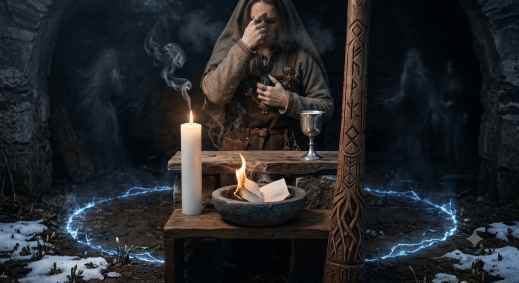
I. The Stilling of the Breath
Sit comfortably. Close your eyes. Breathe in deeply through your nose, hold for a count of four, and exhale slowly through your mouth. Do this three times.
Spoken:
“Wind in the lungs, settle the storm,
Peace in the blood, keep the heart warm.
The world falls away, the noise fades to gray,
I find the silence where the wise ones lay.
Still am I, still as the stone,
Master of breath, master of bone.
Hail.”
II. The Rooting (Mime: Touching the Floor)
Place both palms flat on the floor or ground beside you. Feel the texture of the surface. Imagine roots growing from your palms, burrowing deep into the soil beneath the house.
Spoken:
“Hands to the earth, to the rock and the sod,
I anchor my spirit in the soil of my god.
No wind can shake me, no fear can start,
I hold to the center, I root in my heart.
Deep is the foundation, strong is the hold,
Calm as the ancients, calm and controlled.
Hail.”
III. The Centering (Mime: Hands over Heart)
Lift your hands and place them gently over your heart center. Feel your heartbeat under your palms.
Spoken:
“Hammer in the chest, steady and slow,
To the Self that is true, I offer my woe.
The chaos without, it enters not in,
I master the turmoil, I master the din.
Centered and poised, a weapon of grace,
I meet every moment with a warrior’s face.
Hail.”
IV. The Opening of the Inner Eye
Open your eyes. Look softly at the candle or the space before you. You are ready.
Spoken:
“Mist clears away, the vision is sharp,
The arrow is nock, the harp is tuned to the harp.
Ready for magic, ready for rite,
Calm in the darkness, armed with the light.
The stillness holds me, the power is near,
I enter the circle with nothing to fear.
Hail! Hail! Hail!”
I. The Hallowing (Opening the Sacred Space)
Stand in the center of your ritual space. Raise your arms in the V-shape, the Elhaz stance. Feel the energy of the ceiling above and the floor below.
Spoken:
“Irmin’s staff I strike the ground,
Hammer’s might, I circle round.
Fire and ice, I weave the ring,
To the Mothers’ hall, I now shall cling.
By Urd’s well and Yggdrasil’s root,
Let no ill spirit cross this foot.
This space is hallowed, this space is keen,
Where seen and unseen worlds convene.
Hail!”
Pause. Visualize a circle of blue fire surrounding you, separating you from the mundane modern world.
II. The Lighting of the Ancestral Flame
Light the white or silver candle on your altar. Watch the smoke rise.
Spoken:
“From the dark of Niflheim’s night,
I call the forth the flickering light.
Not for the sun, nor for the sky,
But for the kin who walked beneath.
Disir of my blood, so old and deep,
Wake from your long and ancient sleep.
Flame of the hearth, flame of the womb,
Guide your son through winter’s gloom.
Hail the Mothers! Hail the Dead!”
III. The Offering and Galdr (The Chant)
Take the cup of milk or mead. Hold it up. Dip your finger in the liquid and trace a circle on your forehead, then your heart, chanting low.
Spoken (Galdr):
“Disir-runa, woven tight,
Come to me this winter night.
Berkano blooms, Othala stands,
History blood in my hands.
Mothers of the field and farm,
Mothers of the blade and harm,
Take this offering, sweet and strong,
Right the ancient thread and wrong.
Drink deep, you spirits of my line,
Until the stars again shall shine.
Hail!”
Drink some of the liquid and pour the rest into the offering bowl. Do not spill it. It is the price of admission to their hall.
IV. The Drowning of the Arrows (Symbology of Release)
Take a small piece of paper. Write down a burden, a fear, or a curse you carry from your past. Fold it tightly. Hold it over the candle flame until it catches fire, then drop it into the fireproof bowl or firepit to burn.
Spoken:
“By fire I break the chains of old,
By smoke I release the stories told.
To the ashes you return, pain,
Like winter melting in the rain.
My foremothers, take this weight,
Open wide the wisdom’s gate.
I am free, I am unbound,
By the magick that here is found.
Hail!”
V. The Oracle of the Norns
Shuffle your rune bag with your left hand (the hand connected to the heart). Pull one stone. Hold it tight against your chest before looking at it.
Spoken:
“Norns of fate, spinners of the thread,
Speak to me now the living word.
From Urðr’s deep to Skuld’s desire,
Ignite within my spirit’s fire.
What is the path the Mothers pave?
What strength beyond the living grave?
Reveal the sign, reveal the way,
On this Distings’ holy day.”
(Look at the rune. Hold its meaning in silence. Do not speak it yet.)
VI. The Closing of the Veil
Blow out the candle. Visualize the blue circle of fire sinking into the floor, sealing the energy you have raised.
Spoken:
“The rite is done, the mead is spilled,
The debt of honor now is filled.
Disir fare well to your high seat,
But never far from kin’s heartbeat.
The gate is closed, the ring is bound,
By earth and sky and underground.
I walk the Third, I walk the Path,
Safe from the ancient aftermath.
Hail! Hail! Hail!”
I. The Releasing of Excess Power
Stand and shake your hands and arms vigorously, as if shaking off water. Imagine the excess energy flying off your fingertips like sparks.
Spoken:
“Shake off the spark, shake off the fire,
Send back the magick to air and to mire.
The lightning recedes, the thunder rolls low,
I cast off the voltage, I let the power go.
Too bright is the burning, too high is the flight,
I unclench the fist, I extinguish the light.
Loose is the breath, loose is the skin,
I pour out the dross and let spirit in.
Hail.”
II. The Grounding (Mime: Hands on Floor)
Kneel down and press your palms flat against the floor or the earth. Bow your head so it almost touches the ground.
Spoken:
“Flesh to the soil, to the heavy and damp,
Earth is the anchor, earth is the lamp.
Drink down the current, absorb the shake,
I give to the ground what the spirit did take.
Roots go down deep, into the stone,
I claim back the blood that the gods did loan.
Solid and steady, no longer afloat,
I sink in the mud of the quiet coast.
Hail.”
III. The Centering (Mime: Hands on Heart)
Sit back on your heels. Place one hand over your heart and one hand over your lower belly. Breathe slowly, feeling your heart rate slow.
Spoken:
“Drum in the chest, slow and distinct,
I pull back the self that was lost and distinct.
Wheel inside slows to a gentle turn,
Lessons of fire and lessons of burn.
Harvest the wisdom, let go of the heat,
I find the calm in the rhythm of beat.
Here in the middle, the still and the sound,
My two feet are planted on solid ground.
Hail.”
IV. The Closing of the Gates
Stand up slowly. Visualize a large stone door slamming shut within your mind, sealing the energies of the Otherworld away until next time.
Spoken:
“Gate of the North, your frost is sealed,
Gate of the South, your fire is stilled.
Gate of the East, your wind blows no more,
Gate of the West, I dash at the door.
The work is accomplished, the magick is bound,
Spirit to spirit, and flesh to the ground.
I walk in the world, a mortal man,
With the hammer of will in the heart of my clan.
Hail! Hail! Hail!”
Heathenism is the Spiritual Heritage of All Germanic Based Languages Speakers
I have been interested in all aspects of Heathenism, metaphysics, and spiritual growth for a long time. Always trying to learn more and grow. Was always interested in Vikings since childhood too. Sadly much knowledge is lost about ancient Heathenism, what at that time was known only as the old ways (Forn Sed). But we can learn what traditional knowledge is known, and then also study many traditions since they provide keys to the puzzle too, and then through personal insight realize many more things. All of the Germanic Heathen traditions are part of the cultural spiritual heritage of anyone that speaks a Germanic language, namely English, German, Dutch, Swedish, Danish, Norwegian, Icelandic, and others. Culture is always transmitted by the ideas that get encoded into the language itself. So the spiritual heritage of anyone born into a culture that speaks one of those languages is Germanic Heathenism. Sadly we lost our spiritual heritage when the foreign religion known today as Christainity forced the people of Europe to convert or die. So now we are tasked with the challenging task of relearning our true spiritual cultural heritage. This is a process of learning the knowledge which did survive, and then learning through the process of practicing this knowledge, how to really make it work for us as a living breathing and relevant spiritual path, that is meaningful for us in the modern times, and provides us with the needed spiritual tools to find meaning and purpose in life. To find inner spiritual freedom and growth in awareness.

This work is licensed under a Creative Commons Attribution-NonCommercial-ShareAlike 3.0 Unported License.

 Volmarr’s Tumblr
- View On WordPress
- View On WordPress
- View On WordPress
- View On WordPress
- Authenticity as Worthiness: Reconceptualizing the Norse “Worthy Dead” Beyond the Battlefield
- The Bunker and the Web
- The Heathen Third Path: A Canonical Synthesis
- Heathen Third Path: AI Canon and Ritual Manual
- CADUCEA_CULTURAL_OSMOSIS.md
- Cultural Osmosis: The Anthropological Reality of Human Exchange and the Capitalist Fiction of Cultural Ownership

