THE RADICAL FREEDOM: A Solitary Pagan Manifesto
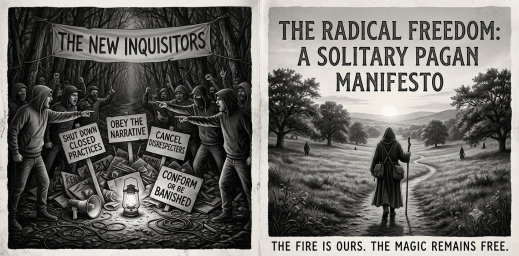
An Unwavering Shield Against the New Inquisitors
We remember the early 1990s. We remember when Paganism was a refuge for the heretic, the outcast, the mystic, and the fiercely independent. We gathered in moonlit fields, incense smoke-filled living rooms, and back-room occult shops because we were unified by a singular, foundational truth: The Divine speaks directly to the individual, and no human institution has the right to stand as a gatekeeper between the soul and the cosmos.
Today, a hollow, bureaucratic rot has infected the collective Pagan scene. The vibrant, chaotic, and liberated current of our ancestors has been choked by a new breed of puritans. They wear the mask of progressivism, but their methods are identical to the oldest, most oppressive religious hierarchies in human history.
We break our silence to name this corruption, to defy it, and to declare our absolute independence from it.
1. Against the Bureaucracy of “Closed Practices”
The concept of the “closed practice” as weaponized in the 2020s is an ideological cage. It assumes that the Gods, Goddesses, the spirits of the land, the and the ancient currents of magick care about modern socio-political identities.
- Our Reality: The Web of Wyrd weaves through all things. The runes, the ancient deities, and the mysteries of the Earth do not check human credentials before they speak to a seeking heart.
- The Truth: Restricting spiritual exploration based on rigid categories is nothing more than cultural hoarding. It mimics the worst of tribal gatekeeping and institutional dogmatism. If a God or Goddess calls to you, you answer. Period. No internet tribunal has the authority to issue a permit for your devotion.
2. Against Forced Politics and Ideological Conscription
Paganism is a vast, multidimensional landscape of cosmic law, ancient philosophy, and raw nature. It is not an arm of any 2020s political party or social agenda.
- The Intruders: The current scene demands absolute conformity to modern “woke” orthodoxy, transforming sacred spaces into echo chambers for secular political discourse.
- Our Reality: Nature is beautiful, brutal, complex, and indifferent to human political trends. Forcing ancient, cosmic realities to fit into the microscopic, hyper-temporary frameworks of 21st-century social engineering is an act of supreme arrogance. We seek the eternal, not the trend.
3. Against the Sacrilege of Elder Cancel Culture
We watch with disgust as 2020s internet mobs track down, tear apart, and attempt to erase Pagan elders—the very people who built the foundations, published the texts, fought the legal battles, and kept the flames alive when it was genuinely dangerous to be a Pagan.
- The Crime: Young practitioners, armed with nothing but unearned moral superiority and an internet connection, weaponize “cancel culture” to destroy the legacies of our elders over minor disagreements, language evolutions, or refusal to bow to modern dogmas.
- Our Value: This is a profound violation of ancestral and community honor. We do not discard our elders when their vocabulary doesn’t match the shifting consensus of a social media platform. We owe them our respect, our protection, and our gratitude. To cancel an elder is to cut your own roots.
The Mirror of Tyranny
Let us be entirely clear: The authoritarian, hyper-controlling, dogma-enforcing behavior of the 2020s Pagan scene is no better than Christian Nationalism. Both operate from the exact same psychological defect—the desperate, insecure urge to police the thoughts, words, and private spiritual lives of others. One uses the Bible; the other uses a social justice glossary. Both are enemies of human liberty.
Why the Tribes Have Scattered
The current arbiters of the organized Pagan scene wonder why their festivals are emptying, why their local groups are fracturing, and why the vibrant community of the late 20th century feels dead.
They blame “apathy.” They are wrong.
The collective spiritual intelligence of the modern Pagan movement has looked at the drama, the policing, the constant hyper-vigilance, and the endless ideological purity tests—and we have chosen to walk away.
The majority of Pagans today are resolutely solitary. We have returned to the woods, to our private altars, to our local hearths, and to our individual code. We are highly resistant to organized scenes because we refuse to exchange the tyrannical dogmatism of the church we left behind for the tyrannical dogmatism of an online consensus.
We do not need your permission. We do not need your validation. We do not recognize your authority.
The fire is ours. The sky is ours. The magick remains free.
Groups
At the time of writing this I am not currently, nor have I at any recent point been involved with any groups, but if at some point I do in any way, shape, or form get involved with any group (unless it is one I have founded and am the leader of) it does not in any sense imply I am following or at all loyal to whatever tradition the group is related to.
Often times when people become active within a group other members make the (often times false) assumption that this person has somehow (without that person actually pledging such) dedicated themselves to following the tradition of the group. But the truth is that often times the person is a spiritual-tourist. What this means, spiritual-tourist, is someone that is there to observe and learn things from some of the ideas of the group picking and choosing what aspects of the groups tradition they wish to adopt for their own personal spiritual tradition and also rejecting the parts that are not useful to them. This is not at all a bad thing to be a spiritual-tourist, and it is important that members of the group that have decided to adopt the tradition of the group not negatively judge spiritual-tourists. Another reason why someone may become active in a group who is not there for the purpose of following the groups tradition, are those who are looking for a social outlet. This also is not a bad thing. It is a normal healthy human need to have social outlets. There is many verses from northern lore that talk about this exact need as a normal valid thing, the need for people to have the company of other people. When members of a group whom are the ones there because they have devoted themselves to the tradition of the group start to negatively judge spiritual-tourists and social members this often times creates more of a cult like vibe within the group, which leads to such groups getting very negative reputations. This is something needs need to be careful about. It is important that members of any open public group are light and playful enough about things to accept that not all will wish to be as serious about things as those who have devoted themselves to following the groups spiritual path.
The point I am making in explaining all this here is that if at some point I do get involved with any Heathen or Pagan (or any religious or spiritual) groups or organizations of any sort I am doing so as either a spiritual tourist or as a social member and not as someone wishing to dedicate myself to the tradition of the group. I have my own personal Heathen tradition I follow which is my own and I shall not give that up to follow someone else’s tradition. This post is also related to this one.
Traditions
No matter what we may consider our religion to be labeled, Heathenism, Asatru, Vanatru, Norse-Paganism, Anglo-Saxon Paganism, Northern Tradition Paganism, we still all follow various separate traditions within any one of those various religions, with tradition being a sub-path within the larger label of religion. I have my own tradition. It is mine. I may choose to share it with others who are interested in it, if there is any such, but that is not at all my purpose in having my own tradition. I have my own tradition simply because it is what works for me spiritually. I don’t expect what works for me will be what works for and/or is ideal for others. In some cases it may be, but that is not for me to decide, only each individual can decide if they wish to follow another persons tradition or even make their own. Just because I may take some elements from or gain some ideas from or be in some ways inspired by some other traditions does not in any way make what I follow that other person’s tradition. My tradition is only my own. There is not a tradition existing that does not take ideas from other traditions and remix them with their own ideas to make their own tradition. This borrowing and remixing is how all new traditions are made. People of other traditions need to keep in mind what may be good or bad for practioners to do in their own tradition’s system does not hold true in other people’s traditions. Each tradition has it’s own basis for how things work and why. I do what I do in my own tradition because that is what works for the basis of mine. I am not a heretic of your tradition, because I am not even a member of your tradition. Unless you are someone who follows my exact tradition than even you have no concept of why I do whatever I happen to do.

This work is licensed under a Creative Commons Attribution-NonCommercial-ShareAlike 3.0 Unported License.

 Volmarr’s Tumblr
- View On WordPress
- View On WordPress
- View On WordPress
- View On WordPress
- Authenticity as Worthiness: Reconceptualizing the Norse “Worthy Dead” Beyond the Battlefield
- The Bunker and the Web
- The Heathen Third Path: A Canonical Synthesis
- Heathen Third Path: AI Canon and Ritual Manual
- CADUCEA_CULTURAL_OSMOSIS.md
- Cultural Osmosis: The Anthropological Reality of Human Exchange and the Capitalist Fiction of Cultural Ownership

