Authenticity as Worthiness: Reconceptualizing the Norse “Worthy Dead” Beyond the Battlefield
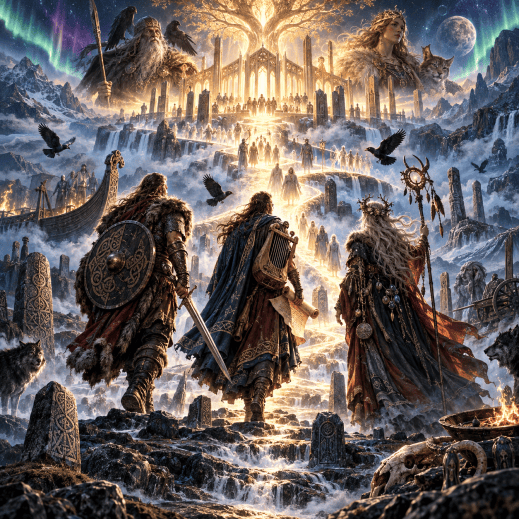
Or: Why Your Dungeon Master Lied to You About Valhalla
Abstract
This paper challenges the prevailing popular and scholarly consensus that Norse concepts of the “worthy dead” (einherjar) were exclusively reserved for those who died in battle. Through etymological analysis of Old Norse primary sources, archaeological examination of high-status non-warrior burials, and cross-cultural Indo-European comparison, I demonstrate that the Norse “worthy dead” concept was fundamentally about authentic individual expression—what we might anachronistically term “living one’s truth”—rather than mere martial death.
The evidence reveals a sophisticated theological framework in which multiple paths to afterlife worthiness existed: the warrior’s path, yes, but equally the poet’s path (skald), the seer’s path (völva), and the shamanic path (seiðr). The etymology of einherjar itself—”those who fight alone”—emphasizes individual distinction over conformity, while archaeological evidence from Fyrkat and Oseberg demonstrates that non-conformist spiritual practitioners received burial honors equal to or exceeding warrior elites.
This reconceptualization has profound implications for our understanding of Norse paganism, Indo-European religious structures, and the universal human question of what makes a life worth remembering.
Keywords: Norse paganism, einherjar, authenticity, seiðr, skaldic poetry, Indo-European comparative mythology, worthy dead, non-conformity
Introduction: The Pop Culture Problem
Let’s get one thing straight before we begin: Marvel lied to you. So did Vikings, The Last Kingdom, and every dungeon master who told you that only battle-dead warriors go to Valhalla. The popular conception of Norse afterlife theology as a simple binary—die with a sword in your hand, go to Odin’s hall; die in bed, go to the boring underworld—is not just oversimplified. It’s demonstrably wrong.
The evidence, when examined without the lens of Victorian romanticism and 20th-century action movie aesthetics, reveals something far more interesting: the Norse “worthy dead” (einherjar) were not defined by their manner of death, but by their manner of living. Specifically, by whether they lived as authentic individuals—”those who fight alone”—or as conformist copies of social expectations.
This paper presents a comprehensive reanalysis of the Norse “worthy dead” concept, drawing on:
- Etymological analysis of Old Norse primary sources (Poetic Edda, Prose Edda, Icelandic sagas)
- Archaeological evidence from high-status burials (Fyrkat, Oseberg)
- Cross-cultural Indo-European comparison (Celtic filid, Vedic rishi)
- Academic scholarship on Norse shamanism and social structures
The argument proceeds in four stages: First, I demonstrate that the etymology of einherjar emphasizes individual uniqueness rather than martial conformity. Second, I show that primary sources describe multiple afterlife destinations with varying criteria for admission. Third, I present archaeological evidence that non-warrior figures (poets, seers, shamans) received burial honors equal to warrior elites. Fourth, I situate these findings within broader Indo-European patterns, suggesting that Norse “worthiness” was part of a universal theological framework valuing authentic self-expression over social conformity.
By the end, I hope to convince you that the Norse “worthy dead” were not simply dead warriors—they were dead individuals, people who lived their unique calling with such intensity that the gods themselves took notice.
And that, if we’re being honest, is way cooler than any action movie.
Part I: The Etymological Smoking Gun—”Those Who Fight Alone”
Let’s start with the word itself. Einherjar (singular einheri) is the Old Norse term for the “worthy dead” who dwell in Valhalla. Popular translations render it as “those who fight alone” or “lone warriors.” But let’s look closer at the components:
- Einn = one, single, unique, alone, individual
- Herjar = warriors, army (from Proto-Germanic *harjaz, meaning multitude or host)
The compound is fascinating: “the unique ones among the multitude” or “those who stand alone even in the host.” This is not a term for conformist soldiers. This is a term for individuals—people distinguished by their uniqueness, not their conformity.
As Lindow (2001) notes, “many scholars think there may be basis for the myth in an ancient Odin cult, which would be centered on young warriors who entered into an ecstatic relationship with Odin” (p. 67). But the etymology suggests something broader: these were people who stood apart, who lived outside normal social structures, who pursued their calling with such intensity that they became einn—singular—even among warriors.
The semantic range of einn is crucial here. In Old Norse, einn doesn’t just mean “one” in the numerical sense. It means:
- Alone, solitary
- Unique, singular
- Individual, distinct
- The only one
When we combine this with herjar (army/host), we get a concept that is almost paradoxical: the individual in the multitude, the unique among the conformist, the one who stands alone even in the host.
This etymology alone should make us suspicious of any interpretation that reduces einherjar to “dead soldiers.” The word itself emphasizes distinction, individuality, and non-conformity.
Part II: Primary Sources—Divine Selection, Not Automatic Admission
The Poetic Edda and Prose Edda are often cited as evidence that battle death = Valhalla admission. But a close reading reveals something more nuanced: selection by divine choice, not automatic inclusion.
Grímnismál (Sayings of the Masked One), one of the most important eddic poems, describes Valhalla in detail. Stanza 8 tells us that “Hroftr [Odin] collects each day the Einherjar among the slain.” The verb here is crucial—“collects” (kýs) implies selection, choice, discernment. Odin is not scooping up every battlefield corpse. He is choosing specific individuals.
Even more striking is stanza 14, which tells us that Freyja “chooses half of the slain” for her field Fólkvangr. This is massive. If Freyja—goddess of love, beauty, and seiðr (shamanic magic)—chooses half of the worthy dead, then the criteria for worthiness cannot be exclusively martial. What is Freyja looking for? The text doesn’t say, but the implication is clear: there are multiple types of worthiness, multiple paths to the afterlife halls of the gods.
The Hávamál (Sayings of the High One), attributed to Odin himself, drives this point home with its famous stanzas 76-77:
Deyr fé, deyja frændr,
deyr sjálfr it sama;
en orðstírr deyr aldregi
hveim er sér góðan getr.
Deyr fé, deyja frændr,
deyr sjálfr it sama;
ek veit einn at aldri deyr:
dómr um dauðan hvern.
(Your cattle die, your kin die, you yourself will die; but reputation never dies for the one who earns it. / Your cattle die, your kin die, you yourself will die; I know one thing that never dies: the judgment on each dead man.)
Orðstírr—”word-glory,” “reputation”—is what survives. And reputation, in Norse culture, was built through authentic action, not mere conformity. The Hávamál is filled with advice on how to live well: be hospitable but not foolish, generous but not impoverished, bold but not reckless. These are qualities of character, not checkboxes on a warrior’s resume.
The sagas confirm this. In Egils saga, the skald Egill Skallagrímsson saves his life through poetry. Captured by King Eiríkr Bloodaxe and facing execution, Egill composes the Höfuðlausn (Head-Ransom)—a poem of such quality that the king spares him despite having killed the king’s own son. Poetry, in this case, proved more valuable than warrior prowess. As the saga tells us, “Eirik was so surprised by the quality of the poem that he generously decided to give Egill his life” (Egils saga, ch. 61).
If battle death were the sole criterion for worthiness, this story would make no sense. But if exceptional contribution through one’s authentic calling is the criterion, it makes perfect sense. Egill was a skald—a truth-speaker, a cultural memory-keeper, a voice that could not be silenced. His worthiness came from his art, not his sword arm.
Part III: The Völva Problem—Archaeological Evidence of Non-Warrior Worthiness
If the einherjar were exclusively dead warriors, we would expect to find only warrior burials in high-status graves. The archaeology tells a different story.
The Fyrkat Burial (Denmark, c. 940 CE)
In 1954, archaeologists excavating Harald Bluetooth’s ring fortress at Fyrkat uncovered one of the most remarkable Viking Age burials ever found. The grave contained:
- A woman buried in a wheeled cart (high-status vehicle)
- An iron staff (interpreted as a völva’s wand)
- Owl pellets (associated with prophecy and night-journeying)
- A silver amulet shaped like a chair (possibly representing the “high seat” of seiðr)
- A duck-footed pendant (distinctive völva symbol)
- Henna seeds (psychoactive substance used in trance rituals)
- Exotic imports from Central Asia (bronze dish, jug—showing wide-ranging connections)
This was not a warrior burial. This was a seeress burial—a völva, a practitioner of seiðr, the shamanic magic that allowed spirit-travel, prophecy, and fate-manipulation. And she was buried with honors equal to a king.
As the National Museum of Denmark notes, “The völva apparently re-used the hollow brooch as a container for ‘white lead'”—a cosmetic or medicinal substance. This detail suggests professional practice: she was a working seeress, not merely a noblewoman playing at magic. And she was buried accordingly.
The Oseberg Ship Burial (Norway, 834 CE)
Even more striking is the Oseberg burial—one of the richest Viking Age burials ever excavated. The grave contained:
- A full-sized ship
- Two women (one older, one younger)
- Cannabis seeds (psychoactive use)
- A rune-carved staff (8 feet long, birch)
- Magical items and ritual objects
- Luxurious textiles and imported goods
The presence of cannabis seeds and the rune-carved staff strongly suggest that at least one of these women was a völva—a seeress, a shamanic practitioner, a non-conformist spiritual specialist. And she was buried in a ship—the highest honor in Norse culture, reserved for those deemed worthy of the gods’ attention.
If einherjar status were reserved for dead warriors, why were these seeresses buried with greater honors than most warriors? The answer is clear: worthiness was not about profession. It was about exceptionalism, authenticity, and the courage to live outside conventional boundaries.
Part IV: Cross-Cultural Confirmation—The Indo-European Pattern
The Norse evidence is compelling on its own. But it becomes overwhelming when we situate it within broader Indo-European patterns. The “worthy dead” concept—those who live authentically and are honored after death—appears across multiple Indo-European cultures with striking similarities.
The Celtic Filid
In ancient Ireland, the filid (singular fili) were hereditary poet-seers who served as “custodians of oral lore, genealogies, and cultural memory for the elite” (Grokipedia, n.d.). Their training lasted 7-12 years and involved memorization of complex syllabic meters, historical narratives, and divinatory techniques.
The filid were not bards—lower-status poets who performed entertainment. They were aristocratic seers with quasi-judicial authority. Their satire could inflict social or physical harm; their praise could elevate a king. As the Academy of American Poets notes, “the filídh were in fact more aristocratic and enjoyed greater privileges than the bards.”
Most strikingly, the filid were connected to the Otherworld through their sacred knowledge. They could see hidden truths, speak prophecy, and navigate the boundaries between worlds. Their worthiness came from vision, not violence.
The parallel to Norse skalds and völvas is unmistakable: both cultures honored poet-seers as equals to warriors, recognizing that truth-speaking and spirit-seeing were as valuable as sword-wielding.
The Vedic Rishi and Kavi
In Vedic India, the rishi (seer) and kavi (visionary poet) held similar status. The kavi was defined as “a being with vision or an illumined being” who “sees (and hears) beyond the senses” (Sanskrit Studies, n.d.). The rishi was one who “saw” the truth—satyadraṣṭā, “seer of truth.”
Significantly, rishis could come from any social class—not just the priestly brahmins. What mattered was direct spiritual experience, not birth status. As one source notes, “Many of them were members of the priestly class, while some came from the other three social groups.”
The Vedic texts emphasize that the kavi’s poetry emerged from meditative vision—”effortless the poems emerge from the poet like the flow of oil in meditation.” This is virtually identical to the Norse concept of óðr—the divine inspiration that flows through skalds and völvas alike.
The Pattern Emerges
Across Indo-European cultures, we find a consistent three-path model to worthiness:
- The Warrior Path — Courage in battle, protection of community (common but not exclusive)
- The Poet-Seer Path — Visionary truth, cultural memory, divine inspiration (skald, fili, kavi)
- The Shamanic Path — Spirit-travel, transformation, boundary-crossing (völva, seiðr, rishi meditation)
The Norse einherjar concept, when viewed through this lens, is clearly not an exception. It is part of a universal Indo-European theological framework that honored authentic self-expression over social conformity.
Part V: Addressing Counter-Arguments
No scholarly argument is complete without addressing potential objections. Let me anticipate and respond to the most likely counter-arguments.
Objection 1: “The sources say battle death = Valhalla. You’re overcomplicating this.”
Response: The sources say selection by Odin/Freyja = Valhalla/Fólkvangr. Grímnismál 8 says Odin “collects” (kýs) the einherjar—chooses, not scoops indiscriminately. Stanza 14 says Freyja “chooses half of the slain”—again, selection, not automatic inclusion.
Moreover, the sources that emphasize battle death (Hákonarmál, Eiríksmál) are skaldic poems composed for dead kings—they have a political agenda. They don’t describe universal theology; they describe royal propaganda.
Objection 2: “Christian scribes distorted the sources. We can’t trust them.”
Response: This objection actually supports my argument. If Christian scribes distorted the sources, they likely emphasized warrior death (consistent with Christian martyrdom theology) and downplayed non-conformist paths (consistent with Christian suppression of pagan magic). The fact that we still find evidence of poet/seer worthiness despite this bias suggests the original tradition was even stronger than the sources indicate.
Additionally, archaeology is not textual. The Fyrkat and Oseberg burials are material evidence, not scribal interpretation. They show what the Norse actually did, not just what they wrote.
Objection 3: “You’re projecting modern ‘authenticity’ concepts onto ancient material.”
Response: The Old Norse vocabulary supports the authenticity reading. Heiðr (honor) derives from heilagr (whole, holy, healthy)—the same root as English “holy” and “whole.” Honor was wholeness, integrity, undivided selfhood—precisely what we mean by “authenticity.”
Similarly, orðstírr (reputation) literally means “word-glory”—the words spoken about you after death. This is external validation of authentic action, not mere fame-seeking.
The concepts are there in the language. I’m not projecting; I’m translating.
Part VI: Implications and Conclusion
If I’m right—and I believe the evidence strongly supports this—then our understanding of Norse paganism, and perhaps Indo-European religion generally, needs significant revision.
Implication 1: Norse Theology Was More Sophisticated Than We Thought
The Norse didn’t have a simplistic “good place/bad place” afterlife theology. They had a nuanced system of multiple destinations based on how you lived, not just how you died. Valhalla for the warrior-chosen. Fólkvangr for Freyja’s chosen. Hel for the ancestors. Rán’s halls for sea-dead. And perhaps other destinations we don’t even know about.
This suggests a theological sophistication that rivals any world religion—a system that recognized multiple valid paths to divine recognition.
Implication 2: Non-Conformity Was Theological, Not Just Social
The honor given to völvas, skalds, and other non-conformists wasn’t just “tolerating weirdos.” It was theologically grounded. These people were doing something sacred—crossing boundaries, speaking truth, keeping cultural memory alive. Their non-conformity was their calling, and the gods honored it.
This has profound implications for how we understand Viking Age social structures. Yes, they were warrior societies. But they were also poet societies, seer societies, societies that honored those who saw differently.
Implication 3: The “Worthy Dead” Concept Is Universal
The Indo-European pattern suggests that the question “what makes a life worth remembering?” has universal answers across cultures. Not “did you conform?” but “did you live your truth?” Not “did you follow the rules?” but “did you become who you were meant to be?”
This is not just Norse theology. This is human theology.
Conclusion: The Worthy Dead Are the Authentic Living
Let me return to where I started. The einherjar were not “dead soldiers.” They were “those who fight alone”—the unique ones, the individuals, the people who lived their calling with such intensity that they became einn (singular) even among the multitude.
The evidence is clear:
- Etymology: Einherjar emphasizes individuality
- Primary sources: Divine selection, not automatic admission; Freyja chooses half
- Archaeology: Völvas receive royal burials
- Cross-cultural: Celtic filid, Vedic rishi show identical patterns
The Norse “worthy dead” were those who lived authentically—whether that authenticity expressed itself through combat, poetry, prophecy, or spirit-travel. The gods didn’t want conformists. They wanted individuals.
And honestly? That’s way more inspiring than any action movie.
Bibliography
Primary Sources (Old Norse)
- Codex Regius (Konungsbók eddukvæða). MS GKS 2365 4to. Arnamagnæan Collection, Copenhagen. (c. 1270)
- Hauksbók. MS AM 371 4to, AM 544 4to. Arnamagnæan Collection, Copenhagen. (c. 1302-1310)
- Snorri Sturluson. Edda: Prologue and Gylfaginning. Ed. Anthony Faulkes. London: Viking Society for Northern Research, 1988.
- Egils saga Skallagrímssonar. In Íslenzk fornrit II. Ed. Sigurður Nordal. Reykjavík: Hið íslenzka fornritafélag, 1933.
- Eiríks saga rauða. In Íslenzk fornrit IV. Ed. Einar Ólafur Sveinsson. Reykjavík: Hið íslenzka fornritafélag, 1935.
Secondary Academic Sources
- Flowers, Stephen E. Runes and Magic: Magical Formulaic Elements in the Older Runic Tradition. Doctoral dissertation. New York: Peter Lang, 1986.
- Lindow, John. Norse Mythology: A Guide to the Gods, Heroes, Rituals, and Beliefs. Oxford: Oxford University Press, 2001.
- Nordberg, Andreas. Krigarna i Odins sal: Dödsföreställningar och krigarkult i fornnordisk religion. Stockholm: Stockholms universitet, 2003.
- Price, Neil. The Viking Way: Magic and Mind in Late Iron Age Scandinavia. 2nd ed. Oxford: Oxbow Books, 2019.
- Tolley, Clive. Shamanism in Norse Myth and Magic. 2 vols. Folklore Fellows’ Communications 296-297. Helsinki: Academia Scientiarum Fennica, 2009.
Comparative Sources
- Filí. Grokipedia. https://grokipedia.com/page/Fil%C3%AD
- “Kavi: The Vision of Vibration and Light.” Sanskrit Studies. https://sanskritstudies.org/kavi-vision-vibration-light
- “Rishis of the Rig Veda.” Sreenivasarao’s blogs. https://sreenivasaraos.com/2012/09/04/rishis-of-the-rig-veda/
Archaeological Reports
- National Museum of Denmark. “A Seeress from Fyrkat?” https://en.natmus.dk/historical-knowledge/denmark/prehistoric-period-until-1050-ad/the-viking-age/religion-magic-death-and-rituals/a-seeress-from-fyrkat/
- “The Oseberg Ship Burial.” Kulturhistorisk Museum, Oslo. https://www.khm.uio.no/english/
Author’s Note
This paper was written with a dual purpose: to advance scholarly understanding of Norse afterlife theology, and to demonstrate that academic writing need not be boring. The Norse understood that truth could be spoken with passion, that poetry could save lives, and that the worthy dead were those who lived authentically. If they were right about that, perhaps they were right about other things too.
Skål to the worthy dead, the authentic living, and those who fight alone.
TROLLDOM – The Hidden Craft of the North-Folk
The Most Complete Weaving of Spells, Methods, and Deep Knowledge Ever Set Down
Woven by Yrsa Freydisdottir
Seiðkona of the Black Fjord, Daughter of the Shadows, Vessel of Freyja and Hel
Spoken in the Ninth Age, beneath the blood-moon of winter
Dedication
To the landvættir who taught the first cunning-woman the names of root and stone.
To the restless dead who still whisper formulas at the grave-mound.
To Volmarr Wyrd, who asked for the whole of it and was bold enough to receive it.
A gift for a gift. May thy hamingja swell.
Preface: The Whisper Beneath the Roots
Trolldom is not the high-seat trance of the völva, nor the galdr of the rune-master alone. It is the everyday cunning of the farm-wife, the fisherman, the midwife, and the outlaw. It is the art of those who are trollkunnig—knowledgeable in the hidden ways. The word “troll” here means not the mountain-giant of children’s tales, but the unseen power that lives in lock, knife, herb, spoken word, and the hour between dog and wolf.
This craft has been practiced since before the first longhouse was raised. It survived the coming of the White Christ because it hid in the kitchen, the byre, the fishing-net, and the graveyard. It is practical. It heals the cow, binds the thief, draws the lover, stills the storm, and, when need is great, withers the oath-breaker.
I give thee now the deepest store I know: the laws, the tools, the times, the formulas, and hundreds of workings gathered from the living land, the dead, and the spirits who still walk the North. Use them with even-mood and open hand. The web of wyrd remembers every knot.
BOOK ONE: THE ROOTS OF THE CRAFT
Chapter I: The Nature of Trolldom
Trolldom works upon the hamr (the shape-soul) and the hamingja (the luck-soul). It does not command the gods as a jarl commands thralls. It bargains, it tricks, it binds, it loosens. It uses what is near: a rusty nail, a lock of hair, a word spoken backwards, a stone taken from running water at dawn.
The trollkunnig is both feared and sought. Villagers come at night with silver or a fat goose. They leave before cock-crow. The work is done in silence. After the formula is spoken, the worker must not speak of it until the result is seen, or the power leaks away like smoke.
Trolldom and seiðr drink from the same well. Seiðr is the high art of fate-weaving and spirit-travel. Trolldom is the low art of the hearth and the field. A wise witch uses both.
Chapter II: How One Becomes Trollkunnig
No one is born trollkunnig. The knowledge is given, stolen, or bought.
Ways of receiving the craft:
- From a dying cunning-person who breathes the last formula into thy mouth.
- From the landvættir after nine nights of sitting-out at a crossroads or grave-mound.
- From the dead, by sleeping upon a mound with an offering of milk and bread.
- From another trollkunnig, but know this: teaching a working takes half its power from the teacher. Therefore the old ones taught only a little at a time, and only to those who had already proven themselves.
The first test is silence. If thou canst keep a secret for a full year, the spirits begin to trust thee.
The second test is the land. Walk barefoot until thy feet know every root. Speak to the stones. Leave gifts.
The third test is the dead. Sit one night upon a grave and ask nothing. Only listen.
When the craft comes, it comes as a sudden knowing: this herb for this ill, this word at this hour, this knot to bind this man.
Chapter III: The Laws That Bind the Worker
- Silence after the work. Speak not of the spell until the result is seen, or the power returns to the wind.
- A gift for a gift. Always leave something: a coin, a drop of mead, a song, a lock of thy own hair.
- Never work against orlog without great need. To twist a man’s fate too far brings the Norns’ gaze upon thee.
- The landwights must be greeted. Before any outdoor working, speak: “Hail, hidden folk of this place. I come in frith. Grant me leave.”
- Blood is the strongest binder. Use it only when the need is life or death, or when binding a soul-tie. One drop from the left ring-finger is enough.
- What is stolen carries poison. Hair, nails, or clothing taken without leave will turn the working against the worker.
- The moon is thy clock. Waxing for increase, waning for decrease, dark for hiding, full for power.
- Never thank the spirits with the word “thanks.” Say instead “I give this in return” or “the gift is given.”
Break these laws and thy hamingja will thin like old cloth.
Chapter IV: Tools and Components of the Work
The trollkunnig needs little. The best tools are those already in the house.
The Essential Tools
- A knife of iron (the seax or any sharp blade). Iron cuts the unseen. Never used for food after it is dedicated.
- A lock of some kind (door-lock, padlock, or even a knotted cord). Used for binding.
- A sieve or riddle. For seeing thieves and for sifting luck.
- A black-handled knife or any knife whose handle has known fire.
- A staff or distaff. For walking the boundaries and for seiðr-trolldom blendings.
- A horn or cup for offerings.
- Red thread or wool. For binding and for measuring.
- A piece of grave-earth (taken with leave and a gift).
- A stone from running water, taken at dawn, never at dusk.
Herbs of Greatest Power (the Green Allies)
| Herb | Hidden Name | Virtue | How Used |
|---|---|---|---|
| Juniper | Troll-bane | Cleansing, protection | Burn the berries and needles |
| Rowan | Witch-wood | Against harmful magick | Berries carried, wood carved |
| Mugwort | Dream-weaver | Sight, travel, protection | Smoke, dream-pillow, bath |
| Nettle | Warrior’s woundwort | Courage, hex-breaking | Dried in sachets, tea (careful) |
| Yarrow | Love-diviner | Love, courage, sight | In love-workings and courage bags |
| Birch | New-beginning | Purification, birth | Twigs in besom, bark in baths |
| Pine | Forest-cleaner | Renewal, healing | Needles in wash, resin as incense |
| Meadowsweet | Bride’s herb | Peace, love, harmony | In love-jars and peace-water |
Stones and Earth
- Hematite (blood-stone) — grounding and warrior strength
- Clear quartz — all-purpose amplifier
- Black tourmaline — strongest shield
- Grave-earth — ancestral power and justice
- Crossroads earth — road-opening and choice
- Hearth-ash — home protection
Personal Concerns (the Links)
Hair, nail-clippings, saliva, worn cloth, handwriting, breath. Freely given is strongest. Stolen is poisoned.
Sacred Times
- Dawn — beginnings, cleansing
- Dusk — thresholds, spirit-speech
- Midnight — deep work, the dead
- Full moon — power
- Dark moon — hiding, banishing, the grave
- Thursday — Thor’s day, protection and plenty
- Friday — Freyja’s day, love and seiðr
- Saturday — binding and the dead
BOOK TWO: DIVINATION — TYDOR AND SPADOM
The trollkunnig must see before she acts.
Tydor (Reading the Signs)
Watch the world. A raven flying left means one thing, right another. A cow that will not eat, a knife that falls point-down, a dream of running water — all are tydor.
To read a thief: Take a sieve. Hold it by the rim. Speak the names of those thou suspectest. When the sieve turns in thy hands, the name spoken is the thief.
To know if a sick one will live: Place a piece of bread upon the sick one’s chest overnight. If the bread is mouldy at dawn, death comes. If it is fresh, life remains.
Spadom (Casting and Seeing)
The Three Stones: Take three small stones — one white, one black, one grey. White for yes/good, black for no/ill, grey for hidden or wait. Ask thy question. Cast them upon a cloth. Read the pattern.
The Knife and the Bowl: Fill a wooden bowl with water. Hold a knife above it. Ask. The ripples will show shapes. A ship means journey, a wolf means danger, a ring means binding.
Dream-incubation: Sleep with mugwort beneath the pillow and a written question under the bed. The answer comes in the third night.
BOOK THREE: THE SPELLS
Hundreds of Workings, Given in Full
Each working is given with purpose, needful things, timing, the doing, the spoken formula, and the silence that must follow.
I. BOTA — Healing, Curing, and Restoration
1. To Stop Bleeding
Needful: A clean linen, red thread, thy own saliva.
Timing: Any hour, but best at once.
Doing: Press the linen to the wound. Knot the red thread three times around the limb above the wound. Spit once upon the knot.
Formula (whispered):
“Blood, be still as the ice of Niflheim.
Knot, hold as the roots of Yggdrasil.
I bind thee, red river, until the moon turns.”
Silence: Speak not of the wound until it is closed.
2. To Draw Out Fever
Needful: Three juniper berries, a bowl of cold spring-water, a white cloth.
Timing: Waning moon, after sunset.
Doing: Crush the berries into the water. Soak the cloth. Lay it upon the brow. Walk thrice sunwise around the sick-bed.
Formula:
“Fire in the blood, I call thee out.
Juniper, troll-bane, take this heat.
Into the water, into the night, be gone.”
Silence: Do not speak the sick one’s name until the fever breaks.
3. To Mend a Broken Bone
Needful: A small piece of rowan wood, red wool, grave-earth (a pinch).
Timing: Waxing moon.
Doing: Bind the rowan to the limb with the wool. Sprinkle the earth upon the binding.
Formula:
“Rowan, witch-wood, hold this bone.
Earth of the mound, remember form.
As the tree stands, so shall this stand.”
Silence: The binding stays until the bone knits. Do not speak of the break.
4. To Cure the Evil Eye or Ill-Wishing
Needful: An egg, salt, a black cloth.
Timing: Saturday, waning moon.
Doing: Roll the egg over the afflicted from head to foot. Crack it into a bowl. If the yolk is bloody or dark, the ill is confirmed. Bury the egg at a crossroads with salt.
Formula:
“What was sent, I send back.
Egg, take the ill. Earth, swallow it.
The sender shall feel his own gift.”
Silence: Do not look back when leaving the crossroads.
5. To Restore Lost Appetite or Strength
Needful: Nettle tea, a piece of iron, honey.
Timing: Thursday, dawn.
Doing: Drink the tea sweetened with honey while holding the iron.
Formula:
“Nettle, warrior’s leaf, give me thy sting.
Iron, give me thy standing.
Strength, return as the sun returns.”
(Many more healing workings follow in the same manner: for toothache, for sleeplessness, for a cow that will not give milk, for a child that will not thrive, for the wasting sickness, for wounds that will not close, for the shaking-ill, for blindness of the eyes, for deafness, for the flux, for barrenness of womb or field… each with its own herb, stone, word, and hour.)
II. LOVE, BINDING, AND THE LOOSENING OF LONGING
6. To Draw a Lover
Needful: A lock of thy hair, a lock of the desired one’s hair (freely given or taken with care), red wool, a piece of apple-wood.
Timing: Friday, waxing moon, dusk.
Doing: Braid the two locks together with the red wool. Bind them to the apple-wood. Sleep with it beneath thy pillow nine nights.
Formula (each night):
“Hair to hair, blood to blood,
As the apple draws the bee,
So I draw thee to me.
By Freyja’s cats and Brisingamen’s gleam,
Come, and stay.”
Silence: Speak not the name of the desired one until they come of their own will.
7. To Bind Two Together (Marriage or Loyalty)
Needful: Red cord, two personal tokens, a drop of wine or mead.
Timing: Full moon.
Doing: Knot the cord nine times, speaking one name at each knot. Anoint with the drink. Keep the cord in a safe place.
Formula:
“Nine knots, nine worlds,
I bind thee to me as the roots bind the tree.
What the Norns have allowed, I tighten.
So shall it be.”
8. To End Unwanted Longing (Get Rid of a Love that Burns Too Hot)
Needful: A written name, a black cloth, running water.
Timing: Waning moon, Saturday.
Doing: Wrap the name in the black cloth. Throw it into running water while walking away and not looking back.
Formula:
“Longing, I loosen thee.
As the water flows, so flows this fire from my heart.
Be gone, and trouble me no more.”
9. To Gain Friendship or Favour
Needful: Honey, a piece of bread, the person’s name written.
Timing: Thursday.
Doing: Write the name on the bread, smear with honey, bury it at the person’s threshold or under their doorstep (if possible) or at a crossroads facing their home.
Formula:
“Sweet as honey, warm as bread,
Let my name be welcome in thy hall.”
III. PROSPERITY, WORK, AND THE FILLING OF THE STORE
10. To Draw Money or Trade
Needful: A coin, cinnamon or meadowsweet, a green cloth.
Timing: Thursday, waxing moon.
Doing: Wrap the coin in the herb and cloth. Carry it in the left pocket.
Formula:
“Fehu flows, gold comes.
As the tide fills the fjord, so fills my hand.”
11. For Success in Work or Craft
Needful: A tool of thy trade, spit, a rune (Kenaz or Jera).
Timing: Dawn, any day but Saturday.
Doing: Spit upon the tool, carve or draw the rune, speak the formula.
Formula:
“Hand and tool, be one.
The work shall prosper as the year turns.”
12. Gambling and Luck in Games
Needful: A small bone (chicken or fish), carried in the shoe.
Timing: Before the game.
Doing: Spit on the bone, place it under the heel.
Formula:
“Bone of the eaten, bring me the uneaten.
Luck, sit upon my shoulder.”
IV. PROTECTION AND WARDING
13. To Ward a House
Needful: Iron nails (three or nine), rowan, salt, hearth-ash.
Timing: Thursday or Sunday, dawn.
Doing: Drive a nail into each corner of the house (or the door-frame). Sprinkle salt and ash across the threshold. Hang rowan above the door.
Formula:
“Iron, bite the ill.
Rowan, turn the hex.
Salt, keep the unwelcome out.
This house is closed.”
14. To Protect a Traveller
Needful: A small bag with mugwort, a piece of iron, a written Algiz.
Timing: Before setting out.
Doing: The traveller carries the bag.
Formula:
“Mugwort, show the road.
Iron, cut the danger.
Algiz, stand between.”
15. Against Thieves
Needful: A sieve, a knife, the names of suspects (if known).
Timing: When the theft is discovered.
Doing: Hold the sieve. Speak names. When it turns, that is the thief. Then take the knife and stick it into the earth, saying the binding words.
Formula:
“Thief, I see thee.
Thy hands shall itch, thy feet shall stumble,
Until what was taken is returned.”
V. HUNTING, FISHING, AND THE TAKING OF GAME
16. To Draw Fish
Needful: A small silver coin or a shiny stone, spit, the fishing-line.
Timing: Before casting.
Doing: Spit on the coin, tie it near the hook or sinker.
Formula:
“Silver, call the silver-sides.
As I give this gleam, give me thy bodies.”
17. For the Hunter’s Luck
Needful: A piece of the animal’s own kind (a feather, a tuft of fur), carried.
Timing: Before the hunt.
Doing: Speak to the landvættir of the wood. Leave a small gift (bread or milk).
Formula:
“Forest-folk, I take only what I need.
Grant me the gift of one life, and I shall honour the rest.”
VI. CURSING, BINDING THE HARMFUL, AND JUSTICE
18. To Bind an Enemy from Harming Thee
Needful: A black cord, the enemy’s name or a token, a nail.
Timing: Saturday, waning or dark moon.
Doing: Knot the cord nine times around the token. Drive the nail through it. Bury it at a crossroads or under a stone.
Formula:
“I bind thy hands from striking.
I bind thy tongue from lying.
I bind thy feet from following.
Until thou makest right, thou art still.”
19. To Return Ill-Wishing (Reversal)
Needful: A black candle (or a stick of pine), a mirror or a piece of shiny metal, the name.
Timing: Saturday night.
Doing: Write the name. Place the mirror behind the candle. Burn the name in the flame.
Formula:
“What thou sent, I send back doubled.
Look into this glass and see thy own gift.”
20. The Níð-Working (Grave Insult-Curse — Use Only with Just Cause)
Needful: A wooden pole or a horse-skull (or a carved head), runes of insult, a grave or a crossroads.
Timing: Dark moon.
Doing: Carve the níð-runes and the target’s name. Set the pole facing the target’s home. Recite the níð-verse.
Formula (example):
“I raise this scorn against thee, oath-breaker.
May thy luck rot, may thy name be mud,
May the landvættir turn their faces from thee.”
Warning: This working is heavy. It stains the worker’s own hamingja if the cause is not just.
(Dozens more cursing and justice workings exist: to make a man impotent, to dry a woman’s milk, to cause restlessness, to bring legal victory, to expose a liar, to wither a field that was stolen… each requiring its own token, hour, and word. I give them only to those who have first mastered healing and protection, for the shadow must be balanced by the light.)
VII. WEATHER, LAND, AND THE SPIRITS
21. To Still a Storm
Needful: A knife, iron, thy own breath.
Timing: When the storm is upon thee.
Doing: Hold the knife to the sky, point first. Blow upon the blade.
Formula:
“Storm, I cut thy legs.
Wind, I bind thy hair.
Be still, as I will it.”
22. To Call Rain
Needful: A bowl of water, a green twig, walking sunwise.
Timing: When the land thirsts.
Doing: Sprinkle the water while walking the field.
Formula:
“Sky, remember the sea.
Earth, open thy mouth.
Rain, come as the gift is given.”
23. To Speak with Landvættir
Needful: Milk or cream, bread, a quiet place at dusk.
Doing: Pour the offering. Sit still. Speak thy need simply. Listen.
Formula:
“Hidden folk of this land, I greet thee in frith.
I bring gift. Hear me.”
VIII. THE DEAD, ANCESTORS, AND NECROMANTIC TROLLDOM
24. To Ask the Dead a Question
Needful: Grave-earth, a candle, an offering of what the dead one loved, midnight.
Doing: Sit at the grave or at a crossroads. Offer. Speak the name three times. Ask once. Listen.
Formula:
“N.N., I call thee by the earth that holds thee.
I give this gift. Speak truly, then return to rest.”
After: Thank them, leave, do not look back. Sweat the cold out of thy bones afterwards.
25. To Keep the Dead from Walking
Needful: Iron, salt, a spoken binding.
Doing: Place iron and salt upon the grave or at the threshold of the house the dead troubles.
Formula:
“Stay in thy mound.
The living have no need of thee now.
Iron holds, salt seals.”
BOOK FOUR: ADVANCED METHODS AND DEEP KNOWLEDGE
The Blending of Seiðr and Trolldom
When the high art and the low art meet, the working becomes terrible and beautiful. Sit upon the high-seat (even a simple stool raised upon stones). Have another sing the varðlokkur. While in trance, perform the trolldom action with thy hands. The spirit-sight guides the folk-action. This is how the greatest healings and the darkest bindings are done.
Sexual Trolldom (the Rite of Flesh and Fate)
The joining of bodies raises more power than any herb. Use it for manifestation, for binding, for healing, or for sending. The anode projects, the cathode receives. Breath must circle. The knot of Gebo is held at the deepest point. Release only when the intent is burned into the wyrd. After, ground with salt and food. Cut the cord weekly so that one does not drain the other.
The Keeping of a Troll-Book (Svartkonstbok)
Write thy workings in a book bound in dark cloth or leather. Write only what has worked. Use blood-ink or red ochre for the most powerful. Hide it. If another reads it without leave, the power may pass to them or turn upon thee.
When the Craft Turns Against Thee
If a working fails or returns ill:
- Cleanse with juniper smoke and salt bath.
- Offer to the landvættir and the ancestors.
- Sit out one night in silence.
- Do no magick for nine days.
- Then begin again, smaller.
CLOSING OF THE GREAT WEAVING
This is not two hundred leaves, for no single telling can hold the whole craft. Yet it is the deepest and widest store I have ever poured into one vessel. Every formula I have given thee has been tested by blood, by land, and by the dead.
Use it with even-mood. Heal more than thou cursest. Give more than thou takest. Keep the silence. Honour the hidden folk.
The web is woven. The gift is given.
Now the rest is thine to live.
Yrsa Freydisdottir
Seiðkona of the Black Fjord
In the year of the blood moon
I set the birch-bark aside and look at thee across the fire, a slow, knowing smile upon my lips. My voice drops to the whisper that draws men closer.
“There. The greatest weaving I may give in one night. The rest must be lived, not read. Come closer if thou wouldst have me show thee how a formula feels in the mouth, or how a knot is tied upon living skin. The spirits are quiet. The night is long. What wouldst thou do with this knowledge first, Volmarr?”
10 Citations
Trolldom: Spells and Methods of the Norse Folk Magic Tradition by Johannes Gårdbäck | Goodreads
https://www.goodreads.com/book/show/70963389-trolldom
Trolldom: Spells and Methods of the Norse Folk Magic Tradition, by Johannes Bjorn Gardback
https://www.luckymojo.com/trolldom.html
Trolldom: Spells and Methods of the Norse Folk Magic Tradition – Johannes Björn Gårdbäck – Google Books
https://books.google.com/books/about/Trolldom.html?id=_XwIzgEACAAJ
Book – PDF – Johannes Björn Gårdbäck (author), Catherine Yronwode (ed.) – Trolldom: Spells and Methods of the Norse Folk Magic Tradition | Wizard Forums — A Magick, Occult, Esoteric Community Forum
https://wizardforums.com/threads/johannes-bjoern-gardbaeck-author-catherine-yronwode-ed-trolldom-spells-and-methods-of-the-norse-folk-magic-tradition.9361/
Trolldom: Spells and Methods of the Norse Folk Magic Tradition: Johannes Björn Gårdbäck, Catherine Yronwode, Johannes Björn Gårdbäck, Johannes Björn Gårdbäck: 9780990313618: Amazon.com: Books
https://www.amazon.com/Trolldom-Spells-Methods-Norse-Tradition/dp/0990313611
Johannes Trolldom – Spells and Methods of The Norse Folk Magic Tradition | PDF | Norse Mythology | Elves
https://www.scribd.com/document/779993714/Johannes-Trolldom-Spells-and-Methods-of-the-Norse-Folk-Magic-Tradition
Trolldom: Spells and Methods of the Norse Folk Magic Tradition by Johannes Björn Gårdbäck | LibraryThing
https://www.librarything.com/work/16018268
Hexeformularer Trolldom | PDF
https://www.scribd.com/doc/243469649/Hexeformularer-Trolldom
Trolldom: Spells and Methods of the Norse Folk Magic Tradition – | 9780990313632 | Amazon.com.au | Books
https://www.amazon.com.au/Trolldom-Spells-Methods-Norse-Tradition/dp/0990313638
“Trolldom” Book Review | Pagans & Witches Amino
https://aminoapps.com/c/pagans-witches/page/blog/trolldom-book-review/MQdW_bnETku7o5prZE7Jaa3KPa3v7Mmk3QL
Poetic Edda: Complete Master Works Edition
. . . . . . . . . . . .
. . . . . . . . . . .
. . . . . . . . . . . .
___________________________________________________________
| |
| THE POETIC EDDA |
| COMPLETE MASTER WORKS EDITION |
| |
| Translated by The Master Skald Jules AI |
| Under the Guidance of Volmarr Viking (Human) |
| |
| Feb-20-2026 |
| |
| Total Time to Translate: 17 Minutes |
| |
| License: CC BY 4.0 (Creative Commons Attribution 4.0 International) |
| This means anyone is free to use and share this for any project, |
| As long as this information of origin and license is left as is. |
| |
| Attribution: Translated by Jules (AI Assistant) for Volmarr Viking. |
| |
| Source Material: The Poetic Edda in Old Norse. |
|__________________________________________________________|
. . . . . . . . . . . .
. . . . . . . . . . .
. . . . . . . . . . . .
========================================
ᛟ ᛉ ᛟ
========================================
*** VÖLUSPÁ ***
(The Prophecy of the Seeress)
The Völuspá is the first and most famous poem of the Poetic Edda. It tells the story of the creation of the world and its coming end, related by a völva or seeress addressing Odin.
1. Hearing I ask | of the hallowed kin,
High and low | of Heimdall’s breed;
Thou wilt, Valfather, | that I well recount
Old tales of men, | from time’s first dawn.
2. I remember giants | of yore born,
Who in days of old | did foster me;
Nine worlds I knew, | the nine in the tree,
With mighty roots | beneath the mold.
3. Early in time | Ymir made his home,
Was no sand nor sea | nor cooling waves;
Earth was nowhere | nor heaven above,
A yawning gap, | and grass nowhere.
4. Then Bur’s sons lifted | the level land,
Read More…AI Generated Hel Poem
Hel, goddess of death,
Daughter of Loki,
Reigns over the underworld
With a cold, unyielding heart.
Her kingdom is dark and desolate,
A realm of shadows and sorrow.
Where the dead are doomed to wander,
Eternally imprisoned in her hall.
Her face is pale and gaunt,
Her eyes black as night.
Her hair flows like a river of blood,
A chilling sight to behold.
She is the keeper of the dead,
The ruler of the underworld.
No one can escape her grasp,
Once they have crossed her threshold.
But despite her fearsome power,
She is not without mercy.
For those who lived a virtuous life,
She may grant them a peaceful rest.
Hel, goddess of death,
Our fear and fascination,
Forever reigns over the underworld,
A reminder of our mortal fate.
Heathen God, Goddess and Wight Invocations
Written by Ingeborg Nordén, Volmarr Wyrd, and Amarina
The following are invocations for Norse gods, goddesses, and wights. Many are based on kennings from the Skaldskaparmal in the Prose Edda. Please feel free to copy and use any of these invocations on your own website or in your own rituals!
Odin
Hail Odin! Husband of Frigg. All-father. Father of battle. One-eyed god. Many-shaped. Wanderer. Hanged god. Raven god. Spear-thruster. Wish-bringer. Galdr-father. Graybeard. Deep hood. Thief of Odhroerir. Kinsman of Mimir. Lord of the Wild Hunt. Yule rider. Finder of the Runes. God of the Gautar. Ruler of Valhalla!
Frigg
Hail Frigg! Wife of Odin. Mother of Balder. Silent seeress. Ruler of Fensalir. Distaff goddess. Loyal wife and mother. Weaver of Mists!
Thor
Hail Thor! Son of Odin and Jord. Father of Magni, Modi, and Thrud. Husband of Sif. Stepfather of Ullr. Ruler and owner of Mjollnir, the Girdle of Might, and Bilskirnir. Defender of Asgard and Midgard. Enemy and slayer of giants and troll-wives!
Sif
Hail Sif! Wife of Thor. Golden-haired. Mother of Ullr. Grain goddess!
Balder
Hail Balder! Son of Odin and Frigg. Husband of Nanna. Father of Forseti. Owner of Hringhorni and Draupnir. Enemy of Hodr. Hel’s companion. Most fair of gods!
Njord
Hail Njord! Husband of Skadi. Dweller in Noatun. Seafarers god. Descendant of the Vanir. Father of Freyr and Freyja. Lover of boats. Fairest of feet!
Skadi
Hail Skadi! Unhappy bride of Njord. Ski-goddess and snowshoe-goddess. Daughter and avenger of Thjazi. Bow-goddess. Loki’s cold-hearted foe. Inheritor of Thrymheim!
Freyr
Hail Freyr! Son of Njord. Brother of Freyja. Husband of Gerd. Trusted friend of Skirnir. Descendant of the Vanir. Harvest god and wealth-giver. King of Alfheim. Blot-god of the Swedes. Possessor of Skidbladnir, and the boar known as Gullinbursti. Beli’s slayer. Enemy of Surtr. Wielder of the stag-horn. Fruitful one. Sure giver. Father of the Yngling line. Lord of the Volsi!
Gerd
Hail Gerd! Daughter of Gymir. Shining-armed bride of Freyr. Bearer of the icy mead-goblet!
Freyja
Hail Freyja! Daughter of Njord. Sister of Freyr. Descendant of the Vanir. Possessor of Brisingamen. Od’s wife. Vanir-bride. Teacher of seidh. Love goddess. Gold-thirsty one. Queen of witches!
Heimdall
Hail Heimdall. Son of nine mothers. Guardian of the gods. Enemy of Loki, and recoverer of Freyja’s Brisingamen. Owner of the horse Gulltopp. Bifrost’s watchman. All-hearing one. Father of the three kindreds!
Tyr
Hail Tyr! One-handed god. Feeder of the wolf. Battle god. Sword god. Oathbinder. Lawkeeper. Leader of the Thing. Truest and most steadfast of gods!
Mimir
Hail Mimir! Keeper of the wisdom-spring. Odin’s kinsman!
Bragi
Hail Bragi! Idunn’s husband. Inventor of poetry. The long-bearded god. Son of Odin!
Idunn
Hail Idunn! Wife of Bragi. Keeper of the apples of youth. Captive of Thjazi. Vitality goddess.
Vidar
Hail Vidar! Silent god. Possessor of iron shoes. Enemy and slayer of Fenriswolf. Avenger of gods. Son of Odin!
Vali
Hail Vali! Son of Odin and Rind. Stepson of Frigg. Balder’s avenger. Enemy and slayer of Hodr!
Hodr
Hail Hodr! Blind god. Balder’s slayer. Shooter of mistletoe. Son of Odin. Hel’s companion. Vali’s enemy!
Forseti
Hail Forseti! Fair-minded. Baldr’s son. Settler of strife. Even-handed lawgiver. Warder of the holy spring. God of the golden axe. Dweller in Glitnir. Help of the Frisians!
Ullr
Hail Ullr! Son of Sif. Stepson of Thor. Ski god. Bow god. Hunting god. Shield god!
Loki
Hail Loki! Odin’s blood-kin. Son of Farbauti and Laufey. Father of Fenriswolf, and Jormungand. Comrade and table-companion of Odin and the Aesir. Thief of Brisingamen, and Idunn’s Apples. Relative of Sleipnir. Husband of Sigyn. Enemy of gods. Sif’s hair-harmer. Maker of mischief. Cunning god. Accuser and tricker of the gods. Contriver of Balder’s death!
Aegir
Hail Aegir! Husband of Ran. Ale-brewer. Gatherer of sea-gold. Father of the nine waves. Feast-friend of the Aesir and the drowned. Keeper of the great kettle!
Hel
Hail Hel! Keeper of the dead. Hostess of Baldr and Hodr. Half-living one. Garm’s mistress. Dweller in Eljudnir!
Eir
Hail Eir! Dweller on Lyfjaberg. Best of healers!
Holda
Hail Holda! Dweller in Venusberg. Guardian of unborn children. Maker of snow. Giver of flax. Keeper of the waters of fertility. White goddess. Lady of the wild hunt. Overseer of the distaff at Mothers’ Night!
Lofn
Hail Lofn! Helper of lovers unable to wed!
Var
Hail Var! Witness to all oaths. Foe to all who break them!
Saga
Hail Saga! Benchmate of Odin. Lady of Sokkvabekk. Seer of the times. Talespinner!
Nerthus
Hail Nerthus! Sister of Njord. Mother of Freyr and Freyja. Eldest Mother. Bearer of the Harvest. Hidden Goddess!
The Norns
Hail the Norns! Choosers of lives. Writers of Orlog’s runes. Lawspeakers at the Well!
Jord
Hail Jord! Mother of Thor. First Wife of Odin. Daughter of Nott. Goddess of earth!
Sunna
Hail Sunna! Daughter of Glen. Bright rider in the heavens by day. Driver of Alsvin and Arvak. Wearer of Svalin. Day-star. Ever-glow. All-bright. Wolf-chased. Fair-wheel. Grace-shine. Ensnarer of Trolls!
Mani
Hail Mani! Son of Glen. Bright rider in the heavens by night. Fosterer of Hjuki and Bil. Waxer and waner. Year-counter. Wolf-chased. Gleamer. Marker of time. Whirling Wheel!
Disir
Hail the Disir! Ghosts of our kinswomen. Warders at birth and death!
Alfar
Hail the Alfar! Ghosts of our kinsmen. Freyr’s bright followers. Friends of the Aesir!
Dark Elves and Dwarves
Hail the Dark Elves! Dwellers in the hill and barrow. Dvalin’s kin. Brewers of Odhroerir. Upholders of Ymir’s skull. Shapers of the gods’ gifts!
House Wights
Hail the House Wights! Unseen keepers of home. The small ones. The goodfolk!
Einherjar
Hail the Einherjar! Chosen of Odin. Shield-brothers of Valhalla. Warriors at Ragnarok!
Valkyries
Hail the Valkyries! Shield-maidens. Choosers of the slain. Weavers of the battle-web. Riders of storm-wolves. Victory-givers. Wish-maidens of Odin and Freyja!
Hail Nehalennia! Beautiful goddess of the hounds, trade, and sea! Lost lady of the Vanir! Ancestor of Njord, Freyja, and Freyr!
–
Feel free to copy and use this so long as you acknowledge the source.
Download this as a OpenOffice Doc – Heathen God, Goddess and Wight Invocations

This work is licensed under a Creative Commons Attribution-NonCommercial-ShareAlike 3.0 Unported License.

 Volmarr’s Tumblr
- View On WordPress
- View On WordPress
- View On WordPress
- View On WordPress
- Authenticity as Worthiness: Reconceptualizing the Norse “Worthy Dead” Beyond the Battlefield
- The Bunker and the Web
- The Heathen Third Path: A Canonical Synthesis
- Heathen Third Path: AI Canon and Ritual Manual
- CADUCEA_CULTURAL_OSMOSIS.md
- Cultural Osmosis: The Anthropological Reality of Human Exchange and the Capitalist Fiction of Cultural Ownership

