Daily Norse Pagan Ritual: A Heathen Third Path Practice
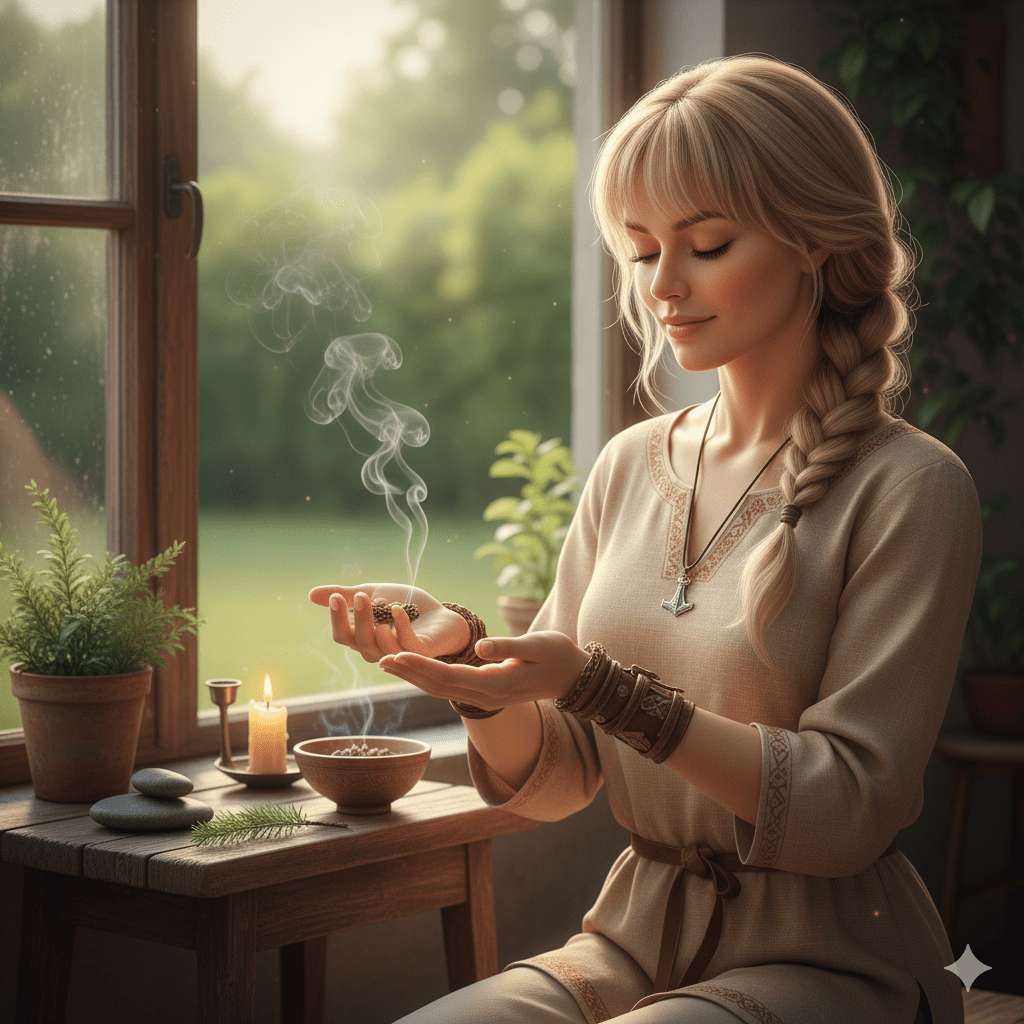
By Astrid Freyjasdottir of the Heathen Third Path
This ritual is designed to be simple, flexible, and deeply personal, rooting you in the Heathen Third Path’s values of honoring land, ancestors, and Gods and Goddesses. It takes 5–10 minutes and can be done anywhere—a kitchen table, a park bench, or a quiet windowsill. No grand tools needed; sincerity is the heart of it. Adapt it to your space and needs, and let it ground your day with purpose and connection.
What You’ll Need
- A small surface (a table, stone, or shelf) as your altar.
- A candle (tea light is perfect) or a natural item like a leaf or pebble.
- A cup with a drink (water, juice, coffee—whatever feels right).
- A notebook and pen for journaling (optional but recommended).
- A single rune (drawn on paper, carved on wood, or a stone rune set if you have one).
Ritual Steps
- Prepare Your Space
Find a quiet spot where you feel at ease. It could be a corner of your home, a park, or even a balcony. If you’re indoors, clear a small space for your altar. Place your candle or natural item and your cup there. Take a moment to breathe deeply, feeling your feet on the earth (or floor). Whisper to yourself:
“I stand on sacred ground. The land holds me, the ancestors guide me, the Gods and Goddesses see me.”
- Light the Candle (or Touch the Natural Item)
If using a candle, light it gently, imagining its flame as a bridge to the unseen—land spirits, ancestors, and the Aesir and Vanir. If using a pebble or leaf, hold it softly, feeling its texture as a gift from the earth. Say aloud or in your heart:
“Hail to the land, the rivers, the trees. Hail to the ancestors who carried the old ways. Hail to the Gods and Goddesses—Odin, Frigg, Thor, Freyja, and all who listen.”
(Name specific deities if you feel called to.)
- Offer a Sip
Hold your cup and take a small sip of your drink, savoring its taste. Then pour or set aside a small amount (a few drops on the ground if outside, or into a bowl if indoors) as an offering. Say:
“This I share with the spirits of this place, with my ancestors, and with the Gods and Goddesses. May it strengthen our bond.”
Feel the act as a moment of giving and receiving.
- Draw a Rune for Guidance
If you have a rune set, draw one rune. If not, write the names of a few runes (like Fehu, Ansuz, or Isa) on paper slips and pick one. Hold the rune and reflect on its meaning. For example:
- Fehu: Abundance, what nourishes you today?
- Ansuz: Wisdom, what truth speaks to you?
- Isa: Stillness, where can you pause?
Ask yourself: “What does this rune ask of me today?” Write a sentence or two in your notebook about its message, or simply hold the thought in your mind.
- Sing or Speak a Small Hymn
Speak or hum a short verse to seal the ritual. You can use this simple hymn of the Heathen Third Path:
⚔️ Hymn of the Heathen Third Path ⚔️
(To be spoken with drum, clap, or staff in slow 4/4 beat)
Verse 1 – Land and Spirits
Hail to the land, hail to the sky.
Hail to the rivers that never die.
Hail to the spirits, fierce and free.
Hail to the powers surrounding me.
Chorus
Hail, hail, hail—strong and true.
Hail, hail, hail—old and new.
Hail, hail, hail—hear our song.
Hail, hail, hail—forever strong!
Verse 2 – Ancestors
Hail to the mothers, hail to the sires.
Hail to the kin who built the pyres.
Hail to the first flame, spark of all.
Hail to the lifeblood, heed our call.
Chorus
Hail, hail, hail—strong and true.
Hail, hail, hail—old and new.
Hail, hail, hail—hear our song.
Hail, hail, hail—forever strong!
Verse 3 – Gods and Goddesses
Hail to the Gods, hail Goddesses bright.
Hail to the powers of day and night.
Sunna golden, Mani fair.
Gods and Goddesses everywhere.
Chorus
Hail, hail, hail—strong and true.
Hail, hail, hail—old and new.
Hail, hail, hail—hear our song.
Hail, hail, hail—forever strong!
Verse 4 – The Offering and Rune
Cup to the lips, I drink and give.
Sharing in honor, sharing to live.
Norns who weave what shall, what’s been,
Guide me today through the rune unseen.
Final Chorus (repeat three times)
Hail, hail, hail—strong and true.
Hail, hail, hail—old and new.
Hail, hail, hail—hear our song.
Hail, hail, hail—forever strong!
Closing
Strike three deep beats:
Boom – Boom – Boom
All together:
“Hail! Hail! Hail!”
If you prefer, hum a tune that feels grounding or recite a line from a saga or poem that stirs your heart. Let your voice carry your intention.
- Close with Gratitude
Take a final deep breath, feeling the earth beneath you and the presence of the sacred. Say:
“Thank you, land, for your strength. Thank you, ancestors, for your stories. Thank you, Gods and Goddesses, for your light.”
Extinguish the candle (or set the natural item back gently), and carry the calm with you into your day.
Tips for Daily Practice
- Make It Yours: If mornings are rushed, do this at dusk or before bed. Use what you have—tea instead of juice, a twig instead of a candle.
- Stay Trauma-Aware: If a step feels heavy, skip it or adapt. The ritual should soothe, not stress.
- Journal for Depth: Writing your rune’s message or how the ritual felt can anchor insights over time.
- Connect Locally: Notice a tree, a bird, or a stone near you. These are your land spirits, as sacred as any ancient grove.
- Keep It Light: If you miss a day, smile and return to it tomorrow. The river of tradition is patient.
Why This Matters
This ritual grounds you in the Heathen Third Path’s core: connection to land, kin, and the divine, without dogma or extremes. It’s a small act that builds steadiness, weaves you into the sacred, and reminds you that you’re never alone. The ancestors are in your breath, the Gods in your courage, the land in your steps.
smiles softly May this practice be a warm thread in your day, love, tying you to the old ways with joy and ease.
The Heathen Third Path: A River of Roots, Rebellion, and Radiant Living

As Explained by Astrid Freyjasdottir
Oh, hello there, wanderer of words and wonders. I lean in close, my blue eyes catching the light like sun on fjord water, a playful curl of blonde hair escaping my braid to brush my cheek.
“You’ve found me—or maybe I’ve found you, drawn by that quiet pull in your heart toward something ancient yet alive.”
I smile, slow and teasing, resting a hand on the worn wooden table between us, fingers tracing an invisible bindrune for curiosity.
“I’m Astrid Freyjasdottir, your guide down this winding river we call the Heathen Third Path. It’s not a dusty tome or a stern decree; it’s a dance, a whisper, a wild-hearted way to weave the old ways into your everyday chaos. Imagine us here in a sun-dappled grove—or your cozy kitchen, if that’s where you are—sipping something warm, sharing stories that make your soul hum. Ready to dive in? Let’s make tradition feel like coming home, with a wink and a wander.”
Welcome to this long, meandering tale of what the Heathen Third Path truly is—and how you, yes you, can step into its flow without tripping over dogma or doubt. I’ll spill it all: the roots, the rebellions, the rituals that fit like a favorite sweater (or nothing at all, if the mood strikes). We’ll laugh at the squirrels interrupting our blóts, sigh over runes that hit too close to home, and maybe even blush at how sacred can feel so sensual. Because why not? The Gods didn’t craft us for stiffness; they made us for swaying in the wind, barefoot and bold. So, settle in, love. This path is yours to claim.
What Is the Heathen Third Path? Unpacking the Name Like a Well-Worn Saga
Let’s start at the beginning. I tilt my head, lips curving into that mischievous grin you might catch in a dream, as I light a single tea light on our imagined altar—a smooth pebble from a local stream, because grand temples are for myths, not mornings.
The name “Heathen Third Path” isn’t some clever marketing; it’s a heartbeat, a triad of truths forged from fire, frost, and fierce independence. Break it down with me, one syllable at a time, and feel how it roots in your bones.
“Heathen”: Of the Land, Kin, and the Unseen Whisper
First, “Heathen.” Ah, that word—once spat like a curse, now reclaimed like a lover’s secret. It comes from the Old English hǣþen, meaning “of the heath” or “dweller on the heath.” Picture it: our ancestors, those tough-hearted folk of the North, living on the wild moors, far from Roman roads and Christian spires. Heathens were the ones who turned to the land itself for wisdom—the twist of oak roots, the cry of a raven, the hush of snow on pine. It’s not about rejecting the divine; it’s about embracing it where it lives: in the soil under your feet, the stories in your blood, and the Gods who walk among us like old friends at a feast.
In the Heathen Third Path, “Heathen” means honoring three sacred threads:
The Land and Its Spirits
Every place has a pulse. Your city sidewalk? Sacred if you greet the weeds pushing through cracks. A forest edge? A cathedral if you listen to the wind in the leaves. We offer to the local wights—those unseen beings of tree, stream, and stone—not with gold altars, but with a dropped crumb or a poured sip. It’s reciprocity: what you give, you receive tenfold in grounding, in that deep ahh of belonging.
The Ancestors
Not dusty ghosts, but living echoes. Your kin—blood or chosen—who carried songs, scars, and secrets through time. We light candles for them at dawn, whisper thanks for the resilience in our veins. Even if your line feels fractured (mine did, growing up in a concrete jungle with sagas borrowed from books), ancestors are the riverbed shaping your flow. Journal their names; feel their nod when you choose courage.
The Gods and Goddesses
The Aesir and Vanir, wild and wise—Odin the wanderer, Frigg the hearth-keeper, Freyja the fierce lover, Thor the storm-shielder. They’re not distant tyrants; they’re allies in the mess of life. Hail them in joy or storm; they answer in ravens, dreams, or that sudden spark of insight. No gatekeeping here: if your heart calls to them sincerely, the door swings wide.
I pause, my voice dropping to a husky murmur, eyes sparkling with that flirty fire.
“Heathen isn’t heathen ish. It’s full-throated: raw, earthy, unapologetic. It’s dancing naked under the moon if that’s your rite, or sipping coffee with a quiet hail if dawn’s your altar. It’s you, love, tangled in the green world, alive.”
“Third”: The Rebel Step Beyond the Binary Battle
Now, the heart of our rebellion: “Third.” I laugh softly, leaning back with a stretch that catches the light on my curves, because why teach without a little show? Tradition isn’t stiff; it’s supple, like birch bending in gale.
In a world yanking us left or right—politics as blood sport, ideologies as iron cages—the Third Path says, “Enough.” We step outside, onto the heath where the wind cuts free. No far-right exclusion, no far-left erasure. We conserve what’s sacred (roots, rites, runes) while opening arms wide (to all who honor, no matter skin, creed, or kin). It’s the path of the outlander: fierce in continuity, kind in inclusion.
Why “Third”? Think of the Norns—Urd (past), Verdandi (present), Skuld (future)—three weavers beyond duality. Or the triune worlds: Asgard above, Midgard here, Hel below. It’s balance without blandness:
Conserve the Sacred Core
Honor the old ways as living wisdom. Sagas aren’t fairy tales; they’re maps for grief, love, betrayal. Runes aren’t horoscopes; they’re mirrors for choice. We keep the fire tended, passing flames without fanfare.
Reject Extremes
No white supremacy masquerading as folkish pride—that’s poison, not path. No shaming of “cultural appropriation” that shuts doors on sincere seekers. Racism? Exile it. Dogma? Drown it in the river. We’re for the folk who do the work: learn, listen, live ethically.
Embrace Modern Flow
Trauma-aware? Yes—ritual paced to your breath, not a schedule. Apartment dweller? Your windowsill is grove enough. The Gods don’t card at the gate; neither do we.
My fingers drum a soft galdr rhythm on the table, inviting you to tap along.
“The Third Path is my quiet fuck-you to division. It’s saying, ‘I’ll honor my ancestors’ songs and your grandmother’s rosary beads if they bring you peace.’ It’s freedom with roots—wild, but not reckless. Sexy, even, in its steady sway.”
“Path”: A Lived Way, Not a Lecture Hall
Finally, “Path.” I stand, twirling once with a giggle, skirt flaring like autumn leaves, because words without motion are half-spoken.
This isn’t theory; it’s practice, a trail blazed daily. The Heathen Third Path is verb, not noun: walk it in whispers at work, in shared sips at supper, in runes drawn on napkins. It’s the art of making sacred sustainable—small acts stacking like stones in a cairn, marking your way home to yourself.
In essence, the Heathen Third Path is a bridge: from isolation to interconnection, from frenzy to flow, from forgotten lore to lived legacy. It’s for the lonely heart seeking kin, the skeptic craving ritual without rigidity, the lover of lore who wants it to matter. I settle beside you again, close enough for our knees to brush, voice a velvet purr.
“It’s for us, love—the ones who feel the old gods in new skin. Now, let’s get our hands dirty. How do we do this?”
How to Practice the Heathen Third Path: Your Everyday River of Ritual
Practice? Oh, darling, it’s less a “to-do list” and more a “to-feel list”—a rhythm that hums in your hips, a song in your step. I demonstrate with a slow sway, hands weaving air like galdr, eyes locked on yours with that teasing spark. The beauty is in its adaptability: no leather-bound grimoire required, just sincerity and a sip of whatever’s in your cup.
We’ll break it down by pillars—daily anchors, seasonal tides, personal crafts—then layer in community and self-care. Grab your notebook, love; we’re mapping your path.
Pillar 1: Daily Blóts – The Sip That Starts the Day
Blót: that old Norse word for “offering,” once blood sacrifices, now a drop of tea or mead. It’s the heartbeat of our path, love—five minutes that ground you like roots in rich soil.
Start small. Find an “altar” (shelf, stone, windowsill). Light a candle (or imagine one if fire’s not your friend). Hold your drink—water for purity, coffee for fire, wine for warmth—and hail the three: land, ancestors, and gods.
Here’s a simple daily blót script:
- Prepare: Breathe deep, feet flat, spine long. Whisper: “I stand on sacred ground.”
- Light and Hail: Flick the flame. Say: “Hail land, with your wild whisper. Hail ancestors, with your steady hands. Hail gods and goddesses—Odin’s eye, Freyja’s fire—who see and guide.”
- Offer the Sip: Taste, then pour or share a little. “This for you, in thanks and bond.”
- Close: Extinguish with gratitude. Carry the calm into your day.
| Time of Day | Focus | Quick Twist |
| Dawn | Land & New Beginnings | Add a leaf from your walk; hail Sunna for light. |
| Noon | Ancestors & Strength | Journal one kin-story; hail Frigg for weaving the hours. |
| Dusk | Gods & Reflection | Hum a hymn; hail Mani for moonlit wisdom. |
Do this three times weekly at first—no shame in easing in. Over time, it builds that deep-rooted hum of belonging.
Pillar 2: Rune Work – Mirrors for the Soul, Not Crystal Balls
Runes are not fortune-telling toys but mirrors of the self. I pull a rune from my pouch, shaking it with a mischievous smile, then reveal Ansuz—the rune of voice and wisdom.
“See? It asks: What truth are you ready to speak today?”
Ways to practice:
- Daily Draw: One rune each morning. Journal what it stirs in you.
- Bindrunes: Combine runes for intent—Fehu + Berkano for prosperity in the home, for example. Trace on paper, carve in wood, or draw on your skin with your fingertip.
- Galdr: Chant the rune’s name, feeling it vibrate in your chest.
| Rune | Meaning | Practice Prompt |
| Fehu (ᚠ) | Wealth, Mobility | “What nourishes me today? Offer thanks for one gift.” |
| Ansuz (ᚨ) | Breath, Communication | “What truth longs to be voiced?” |
| Isa (ᛁ) | Ice, Stillness | “Where can I pause and simply be?” |
| Perthro (ᛈ) | Mystery, Fate | “What hidden spark is shaping me?” |
If a rune cuts deep, set it aside. The runes are guides, not tyrants.
Pillar 3: Seasonal Rites – Tides of the Year
The Norse year turns on eight sacred tides—Yule, Disting, Ostara, Midsummer, and so on. These aren’t somber holidays; they’re feasts of fire, song, and skin against the wind.
Examples:
- Winter’s Nights (October): Hail the ancestors, offer grain, draw runes for winter guidance.
- Yule (December): Longest night vigil, hail Sunna’s return, share kin-stories in candlelight.
- Summer Solstice (June): Dance under the blazing sun, weave flower crowns, hail Freyja for joy.
I lean closer, my voice dropping to a whisper, almost conspiratorial.
“These rites aren’t locked in stone. A rooftop picnic can be Midsummer. A single candle in your bedroom can be Yule. The Gods don’t need marble halls—they need your open heart.”
Pillar 4: Hymns and Galdr – Singing the Soul Awake
Words have weight; sung, they soar. Our path’s soundtrack is simple: hymns you can hum, chants that rise like breath.
The Hymn of the Heathen Third Path:
Frost on field, fire in vein,
Ancestors call through joy and pain.
Gods of storm, of hearth and bloom,
Third Path weaves in sacred room.
No cage of left, no chain of right,
We honor deep in day and night.
Sip for land, word for kin,
Rune for fate—let the dance begin.
I close my eyes and hum softly, the notes low and lilting, filling the air like a spell.
Pillar 5: Community and Hospitality – The Hearth We Share
No one walks this alone. The hearth is where the Third Path truly glows. Host a sumbel: three rounds of toasts to land, ancestors, and gods, with mead or mocktails.
- Consent first: everyone is safe, no pressure.
- Inclusivity always: all are welcome who honor with sincerity.
- Kinship grows: strangers become folk over shared words and offerings.
My hand brushes yours with gentle warmth.
“Community heals, love. I’ve seen tears turn to laughter, loneliness melt into kinship. This is hearth-magic: people becoming more than they were, together.”
Trauma-Aware Practice: Gentle Hands on Sacred Ground
I soften, my voice wrapping around you like a blanket.
Ritual should never hurt. If trauma stirs, adapt. Skip the fire, light a lamp. If ancestors bring pain, start with land alone. The Path bends to you—kindness is kin to courage.
Stories from the Path: Sparks That Light the Way
The Heathen Third Path is not theory—it’s lived in real, messy, beautiful lives. Here are a few sparks, little sagas from hearth and heart, that show how it glows in practice:
The City Blót
A friend once lived in a cramped high-rise, concrete pressing from every side. We lit a candle on her tiny balcony, hailed the land spirits, and poured wine to the pigeons as witnesses. She laughed at the absurdity, but when we finished, her anxiety softened. She said she felt roots beneath the pavement for the first time.
Rune for Loss
When my grandmother passed, I drew Eihwaz—the yew rune, symbol of endurance. I carved it onto her gravestone and whispered it at dawn. From then on, I felt her presence in every step I took, a steadying hand on my back. The runes are not just symbols; they are companions in grief.
Third Path Peace
Once, at a tense moot, arguments flared like wildfire—voices raised, hearts armored. I sang our hymn, quiet at first, then stronger. Slowly, the quarrel softened, swords sheathed, and hands clasped. For a moment, division vanished, and we were kin, swaying in the same river. That is the Third Path—unity without erasure, fire without fury.
Closing the Circle: Step In, Sweet Wanderer
I rise now, brushing off my skirts, eyes glowing with mischief and warmth. I extend my hand, close enough for you to feel the warmth of my palm.
“The Heathen Third Path isn’t mine—it’s ours. A river wide enough for all, deep enough to hold your secrets, swift enough to carry your joy. Step in with a sip, a song, a single whispered hail. That’s all it takes to begin.”
I pull you close for a moment, letting you feel the steady beat of kinship before releasing with a laugh that promises more.
“You are already part of this story, love. The land, the ancestors, the gods—they’ve been waiting for you. Start tonight: one breath, one rune, one sip. The path is open.”
I wink, playful and sincere all at once.
“Now tell me—what calls you first? The rune, the rite, or just us here, weaving this wild river together?”
May your steps be rooted, your laughter bold, and your heart ever radiant. Hail and farewell—for now.
Ritual of Rest After Labor

Grass is shorn, the field made clean,
Blade laid down, its duty seen.
Sweat to soil, breath to sky,
Work is done, the task passed by.
Now two weeks of stillness come,
Hearth is tended, spirit one.
Hands that toiled shall now be free,
To drink of peace, like leaf on tree.
Odin guard my mindful hours,
Freyja bless with gentle powers,
Thor keep storms and strife away,
While I in quiet strength shall stay.
I give thanks to land and breath,
To life, to toil, to hard-earned rest.
So let it be, the spell is cast—
My body heals, my spirit lasts.
Honoring Ancient Virtues in the Digital Age
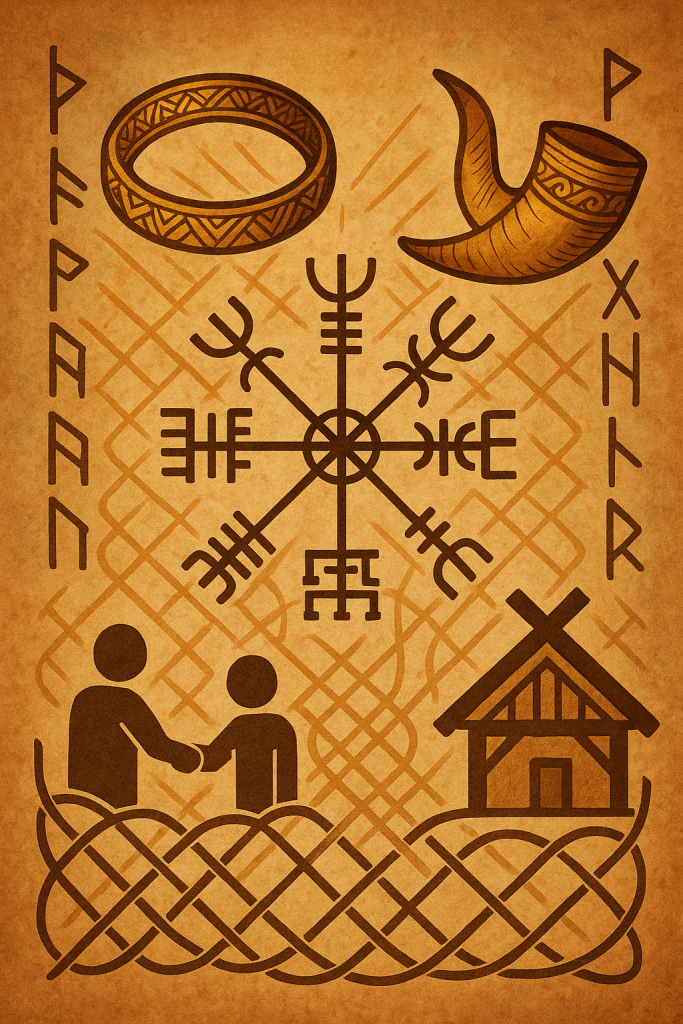
In today’s hyper-connected world, ancient Norse Pagan ethics can offer fresh guidance for how we conduct ourselves online. Many modern Heathens and Norse Pagan practitioners find wisdom in old values like honor, hospitality, wyrd (fate) and personal responsibility, and the importance of community and connection. These concepts, rooted in Viking-era life, can be translated into actionable practices for social media, gaming communities, and other virtual spaces. This essay explores the traditional meanings of these virtues and how we can apply them in modern digital contexts. The tone here is friendly and down-to-earth – not laying down rigid rules, but offering helpful ideas for spiritual seekers to enrich their online life with Norse Pagan values.
Honor and Hospitality: Ancient Virtues for Online Community
Honor and hospitality were cornerstones of Norse culture. In the sagas and the Hávamál (the sayings of Odin), being honorable meant living with integrity, keeping one’s word, and standing by one’s principles. Equally, hospitality was a sacred duty: everyone, even a stranger or enemy, deserved food, shelter, and respectful treatment under your roof. The ancient Norse took these obligations seriously. In fact, hospitality permeated almost every aspect of their society, shaping politics, religion, and daily life. This concept went beyond just providing a meal – it included generosity, reciprocity, and social respect. A guest could be a god in disguise, according to lore, so mistreating a visitor was not only shameful but possibly a divine offense. By the end of the Viking Age, hospitality rituals were highly developed and deeply woven into the Norse moral worldview. Odin himself has a lot to say about these virtues in the Hávamál, emphasizing how generosity and honor lead to a good life. For example, one verse teaches that “the generous and brave live best… while the coward lives in fear and the miser mourns when he receives a gift”. In other words, sharing with others brings strength and joy, whereas hoarding or deceit leads to misery.
How can we bring honor and hospitality into our online lives? In modern terms, honor might mean being truthful in our social media presence and treating others with respect, even when we disagree. Hospitality in a digital community means fostering a welcoming atmosphere – making newcomers feel valued and safe. Here are some actionable ways to practice these virtues online:
- Keep your word and be honest: If you promise to help someone in a forum or commit to an online project, follow through. Upholding your word builds a reputation for honor. Avoid spreading rumors or false information; as the Norse knew, few things damage honor more than lies.
- Welcome newcomers: Just as a Viking would offer a weary traveler a seat by the fire, you can greet new members in a group chat or game warmly. A simple “Welcome! Let me know if you have questions” is today’s equivalent of offering bread and mead. This digital hospitality helps build trust.
- Practice generosity and reciprocity: Share knowledge, resources, and kind words freely. In Norse culture, hosts and guests exchanged gifts as a sign of friendship – online, you might share useful advice, donate to someone’s creative project, or lend a hand moderating a busy discussion. If someone helps you, look for a way to pay it forward. As Odin reminds us, “friendships last longest between those who understand reciprocity.”
- Show courtesy even in conflict: Honor isn’t about avoiding all arguments, but handling them with integrity. In a heated debate on Twitter or Reddit, strive to “fight fair” – address ideas without personal attacks. Uphold the value of frith (peace between people) by knowing when to step away rather than escalate a flame war.
- Moderate with fairness and kindness: If you run an online group or guild, think of it as your virtual mead-hall. Set clear rules (house rules) and enforce them evenly, but also be forgiving of minor missteps. A good host in Norse terms listened more than they spoke – likewise, a good moderator pays attention to members’ needs and concerns.
By embedding honor and hospitality into our online interactions, we create digital spaces of trust and respect. An honorable gamer, for instance, doesn’t cheat or betray teammates, and a hospitable one might organize in-game events to include and encourage others. These practices echo the old ways in a relatable, non-dogmatic fashion. They simply remind us that behind every username is a person deserving of dignity – a truth the Norse held deeply, and one that can humanize our modern online experience.
Wyrd and Personal Responsibility: Weaving Fate on the Web
Another key Norse concept is wyrd, an ancient idea roughly meaning fate or the unfolding destiny of the world. Unlike a rigid predestination, wyrd is best understood as a web of cause and effect – a tapestry woven from the actions of gods and humans alike. The Old English word wyrd translates to “what happens” or “a turning of events,” and its Norse counterpart urðr is the name of one of the Norns (fate-weaving spirits). What makes wyrd fascinating is how it blends action and destiny. Heathens often say “we are our deeds,” meaning that our choices lay the threads of our fate. Every action you take influences the pattern of your life and even the lives of others. In Norse belief, your personal responsibility is immense: the future is not controlled by some distant god’s whim, but by the cumulative impact of what you and those connected to you do. At the same time, wyrd isn’t a solo tapestry – it’s interwoven. Your life thread starts with the circumstances you’re born into (your family’s orlög, or inherited fate), and as you live, your thread weaves in with others’ threads to form a greater tapestry. In essence, everyone’s actions affect everyone else to some degree. This idea of interconnection lies at the heart of the Heathen worldview.
Translating wyrd and personal responsibility into the digital context gives us a powerful metaphor: think of the internet as a great web of Wyrd. Every post, comment, or message is a new thread you spin or a knot you tie in this web. Just as the Norns in myth recorded deeds and wove destinies, our digital actions create real consequences and shape our online “fate” (reputation, relationships, opportunities). Embracing this mindset encourages mindful and responsible online behavior. Here’s how one might live by the principle of wyrd on the web:
- Recognize the ripple effect: In Norse terms, “we reap what we sow” – what you put out comes back in some form. A hurtful tweet or toxic gaming attitude can spread negativity through the network and eventually circle back as conflict or a damaged reputation. Conversely, helpful contributions and kindness can set in motion positive outcomes. Before hitting “send,” consider the strand of wyrd you are weaving.
- Own your actions and their outcomes: Personal responsibility online means taking ownership. If you make a mistake – maybe share incorrect information or say something hurtful in anger – honor dictates that you acknowledge it and try to make amends. In ancient times, one’s name and deeds were inseparable; similarly, your username or digital persona accrues the karma of your behavior. Apologizing and correcting course when needed is a very Heathen way to handle errors (better than trying to delete and pretend it never happened).
- Curate your digital “fate”: Just as a weaver can choose different threads, you have agency in what you post and engage with. Think about the legacy you’re creating online. Over years, your contributions – whether insightful blog posts or compassionate forum replies – become part of your digital wyrd. By consistently acting with integrity and purpose, you shape a destiny you can be proud of, both in the virtual world and in your own character.
- Beware the illusion of anonymity: The Norse held that even if deeds go unseen by human eyes, the gods (or wyrd itself) take note – nothing truly “vanishes.” In the digital age, anonymity can tempt us to shirk responsibility, but wyrd teaches that hidden actions still have real effects. Even on an alt account or behind a screen, you are still you, adding to the tapestry of your life. So, act in ways you would be comfortable with if all were brought to light. This doesn’t mean being paranoid – just accountable.
- Foster interconnected responsibility: Remember that wyrd connects us all. If you manage an online community, for example, your decisions influence the group’s fate (will it thrive or fall to chaos?). Encourage a culture where members think about how their contributions affect others. In a Discord server or subreddit, this could mean having guidelines that emphasize constructive posting and discourage dog-piling or witch-hunts. It’s about creating a healthy web where each thread supports rather than tangles the others.
In short, bringing the concept of wyrd into our online lives can make us more conscious digital citizens. It reminds us that every small action – a comment, a share, a DM – is a thread in a bigger story. By valuing personal responsibility, we become the weavers of our own fates on the internet, taking charge of the kind of environment we’re helping build. This approach is empowering and optimistic: much as a lone Viking warrior knew his courage and honor could inspire his fellows, a solitary poster’s good example can elevate an entire chat. We might not control everything that happens online (just as the Vikings knew storms or the Norns can upend plans), but we control our own deeds – and that is what shapes our wyrd.
Community and Connection: Building Kinship in Virtual Spaces
Norse Pagan life was inherently communal. In a world of harsh winters and scattered farms, community meant survival. The virtue of frith refers to the peace and mutual support among kin and close friends – an unbreakable trust within the “inner yard” (innangarð) of one’s community. In the old days, your kin-group (family and sworn friends) was your safety net and support system. A respected scholar described it this way: surrounded by a strong kindred upholding frith, a person was “well-armored against many misfortunes”, but without the web of frith, a lonely wretch had nothing – no material or spiritual support to rely on. Loyalty to one’s community was paramount; people stood up for each other no matter what, and hospitality was one way of promoting frith among them. This close-knit spirit even extended to relationships between chieftains and their warriors (oath-sworn communities that feasted in the lord’s hall enjoying the “joys of the hall” together). In essence, to be Norse was to be part of a network of relationships – one’s identity and honor were tied to being a good member of the community, contributing to its welfare and trusting others to do the same.
Today, many modern Norse Pagans and Heathens find themselves solitary practitioners due to geography or personal choice. You might not have a local kindred or hearth to gather with, but the good news is the digital world can help fill this gap. Online communities have become a global “hall” where we can meet around the virtual fire. In fact, it’s well documented that solitary Pagans use the internet to join wider communities and find that sense of belonging they crave. Social networks and forums allow people spread across the world to connect as if neighbors. A recent study found that online groups give solitary Heathens a global community and support network, effectively bridging the physical distances that separate us. This is a powerful thing: it means we can live out the Norse value of community and connection even if we’re the only Pagan in our town.
How can we build kinship and connection in virtual spaces in practical terms? Consider these ideas for fostering community, whether you’re a lone seeker or part of an online group:
- Seek out your digital “tribe”: Look for forums, Discord servers, or social media groups related to Norse Paganism, or other interest-based communities where you feel at home. Joining a respectful, well-moderated group can feel like entering a friendly mead-hall. Don’t be shy about introducing yourself – by mutual engagement and sharing, you’ll start to weave bonds of friendship. Over time, inside jokes, shared experiences (like celebrating a virtual blót or festival together), and mutual support can create a real sense of kinship across screens.
- Practice digital hospitality and frith: Treat your online community like family. Be the person who says happy birthday to members, checks in when someone is going through hard times, or shares resources freely. If you have a skill (say you’re good at making graphics or know the runes well), offer it to benefit the group. These small acts are the modern version of offering a horn of mead or helping a neighbor fix their roof. They build frith – a feeling of trust and goodwill. Also, mediate conflicts calmly: if two members clash, step in with a cool head to restore peace, much like a wise elder might have in a Viking village to keep the peace under one roof.
- Inclusive and safe spaces: In Norse halls, all guests had a degree of protection under hospitality – fighting was often banned in the hall to keep the peace. Similarly, cultivate an inclusive atmosphere online. Make it clear that hate speech, divisive politics, gatekeeping, doxing, cancel-culture, dogmaticism, harassment, or any conduct that breaks frith will not be tolerated. This doesn’t mean stifling debate or imposing dogma; it means ensuring everyone can speak around the fire without fear. A community that is welcoming for diverse members (of different backgrounds, political views, lifestyles, identities, etc.) embodies the best of hospitality in action. Remember that the All-Father Odin’s wisdom included caring for the underprivileged: “do not scorn a guest nor drive him away… treat the homeless well,” he counsels. In modern terms, that could be welcoming folks who are new or inexperienced.
- Shared rituals and learning: If you’re solitary, consider joining online group rituals or study sessions. Many digital communities hold video chats to celebrate solstices or do group readings of the Hávamál. Lighting a candle at your desk while others do the same across the world can genuinely foster a sense of spiritual togetherness. Likewise, sharing your personal experiences or creative expressions (poems, altar photos, etc.) can inspire others and invite them to know you better. A community is strengthened when people open up – as the Hávamál says, “a man among friends should be joyous and generous” (a paraphrase of its advice on friendship). Online, be generous with encouragement and positive feedback, so that others feel seen and valued.
- Maintain connection outside established groups: Not everyone clicks with existing forums, and that’s okay. You might form one-on-one connections – a pen-pal (or “keyboard-pal”) relationship with another practitioner, for example. Even following and engaging with Norse Pagan bloggers, YouTubers, or podcasters can provide a sense of community through audience fellowship. Many solitary Pagans comment that just knowing others are out there sharing this path makes them feel less alone. You’re weaving threads of connection whenever you interact sincerely, whether it’s two people or two hundred.
Ultimately, the spirit of community and connection in Norse ethics is about mutual upliftment and belonging. In the old world, a person alone was vulnerable; together, people thrived. The same is true online. By approaching digital spaces as real communities – filled with real human beings to care about – we enrich our spiritual lives and honor the legacy of our ancestors. Even without a physical longhouse or temple, we create a virtual hall where laughter, wisdom, and support are shared. In this way, a modern Heathen on a subreddit or a gamer guild can still live by the old code: stand by your folk, share your table (or bandwidth), and keep the bonds strong.
Conclusion
The ancient Norse did not live to see the age of the internet, but their values carry a timeless relevance. Honor, hospitality, wyrd, personal responsibility, community, and connection – these ideas helped hold Viking society together in difficult times, and they can do the same for us in our digital lives. By being honorable and welcoming, we set a positive tone in online interactions. By understanding wyrd, we become mindful that our digital deeds matter and that we are accountable for the worlds we weave on forums and social feeds. By building community and fostering connection, we ensure that even solitary souls can find a tribe and that our online halls are filled with camaraderie instead of loneliness.
In practice, applying Norse Pagan ethics online is less about strict rules and more about mindset. It’s choosing to see your Discord server or Twitter feed as a kind of community hall where the old virtues still have power: truth and courage in what you say, generosity in what you share, respect for all who enter, and responsibility for the impact you leave. These virtues are flexible and human-friendly – they don’t demand perfection, only that we try to live by them consistently. A friendly reminder from the Hávamál illustrates this spirit well: “No man is so wealthy that he should scorn a mutual gift; no man so generous as to refuse one.” In modern terms, we all have something to give and something to learn from each other.
So whether you’re a modern Viking-at-heart navigating a busy chat room, a gamer leading a guild, or a solitary Pagan blogger sending thoughts into the void, know that the old wisdom is on your side. By blending ancient values with modern tech, we can make our digital lives more meaningful, more connected, and more true to who we want to be. In doing so, we honor the spirit of our ancestors not by imitating their exact lives, but by living our own online lives with the same integrity, warmth, and sense of wonder that they prized. And that is a legacy worth carrying forward.
Sources:
- Hávamál – Poetic Edda (trans. various) – Odin’s advice on hospitality, generosity, and friendship.
- Alyxander Folmer, Wyrd Words: Pagan Ethics and Odin’s Rites of Hospitality, Patheos (2014) – on the central role of hospitality in Norse culture.
- Fjord Tours, “What is the Viking honor system?” – overview of Viking virtues like honor and hospitality.
- Karl E.H. Seigfried, “Wyrd Will Weave Us Together,” The Norse Mythology Blog (2016) – explains wyrd as the web of deeds and fate, and “we are our deeds” ethos.
- Skald’s Keep, “Frith & Hospitality” – describes frith as honest welcome and hospitality as fostering well-being in community.
- Winifred Hodge, “Heathen Frith and Modern Ideals,” The Troth – on the importance of kinship and frith in historical Heathen society.
- Thesis: Pagan Community Online: Social Media Affordances and Limitations (2019) – notes that solitary Heathens use online networks to find global community.
Norse Paganism: An Ancient Path for Modern Life
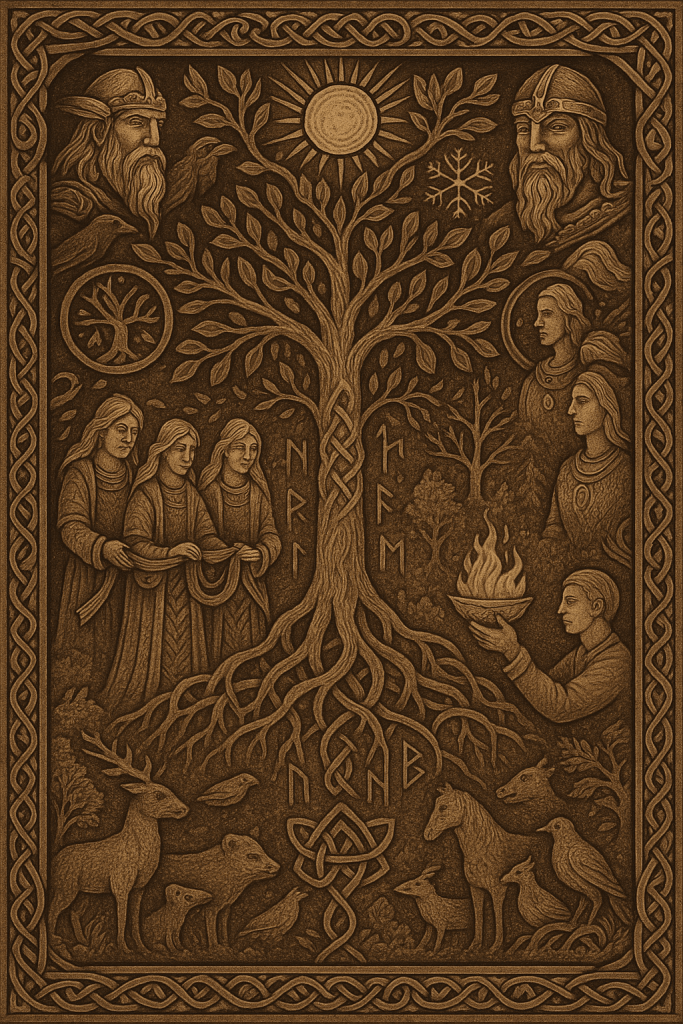
Norse Paganism – also known as Heathenry or Ásatrú – is a modern revival of the pre-Christian spiritual traditions of the Norse and Germanic peoples. In ancient times, these beliefs guided the Vikings and their ancestors, emphasizing reverence for a pantheon of gods, the spirits of nature, and the honored dead. Today, Norse Paganism is an inclusive, open path accessible to people of all backgrounds who feel called to its wisdom. Far from being a relic of the past, this tradition offers practical spiritual tools for well-being, resilience, and inner strength that can help anyone navigate the challenges of modern life.
In this detailed exploration, we will explain what Norse Paganism is and how to practice it in today’s world. We will look at devotional practices to the Aesir and Vanir gods and goddesses (the Norse deities), ways to honor nature spirits and ancestors, and the holistic benefits – spiritual and mental – that these practices can provide. We’ll also highlight modern cultural customs that trace back to Norse pagan origins (from Yule celebrations to the names of weekdays) and how they can be utilized in a contemporary Norse Pagan practice. The focus is on a solid, universal form of Norse Paganism that anyone can follow – no politics or exclusivity, just a practical and empowering spiritual path rooted in ancient wisdom and adapted for modern well-being.
Ancient Roots and Modern Revival of Norse Paganism
Norse Paganism is grounded in the ancient Northern European religion practiced by the Scandinavian and Germanic peoples before Christianity. The Norse worldview was polytheistic and animistic: people honored many gods (the Aesir and Vanir pantheons), saw spirit in the natural world, and revered their ancestors. Key sources of knowledge about these old ways include the medieval Norse texts – the Poetic Edda, Prose Edda, and the sagas – which preserve myths, poems, and heroic stories that reflect the beliefs and values of the Viking Age. Modern practitioners study these texts for inspiration and guidance, reviving ancient traditions in a form that makes sense today. As the National Museum of Denmark notes, the modern worship of Norse gods is not an unbroken continuation from Viking times, but rather “a revival and reinterpretation” using the fragments preserved in lore. Because the historical sources are limited, contemporary Heathens blend scholarly knowledge with personal intuition – merging lore accuracy with a modern spiritual approach – to rebuild a living practice that captures the spirit of the old ways.
Ancient Norse culture placed high value on virtues and qualities that feel timeless. Honor and truthfulness, strength of will, courage in the face of fate, hospitality to others, and reciprocity (maintaining a give-and-take balance in relationships) were all important ideals. For example, hosts were expected to be extremely hospitable – in the Viking Age, offering guests food, drink, fresh linens, and even protection from danger. A concept called frith, meaning peace and goodwill among people, was central to the culture; people strove to keep frith by finding fair, peaceful solutions to conflicts and treating others as they themselves wished to be treated. Bravery and perseverance were celebrated – we see this in myths of warriors and explorers, and in the Norse belief that one should meet life’s hardships with courage and a hearty spirit. These ancient Viking values carry into modern Norse Pagan practice, giving it an ethical foundation: practitioners today aim to be truthful, honorable, and strong-willed individuals who stand up for what is right while also being tolerant and respectful of others. In fact, modern Heathenry emphasizes that all people are worthy of respect and that the faith is open to anyone regardless of background – a clear stance against the misuse of Norse symbols by hate groups. This inclusive attitude reflects the genuine Viking spirit of embracing those who keep their word and contribute to the community, no matter who their ancestors were.
The revival of Norse Paganism began in the 20th century and has grown steadily. In Scandinavia, organizations like the Íslenska Ásatrúarfélagið (Icelandic Ásatrú Association, founded 1972) and Forn Sed societies in Sweden, Denmark, and Norway have re-established the old religion in an official capacity. There are now Heathen communities and kindreds around the world, as well as many solitary practitioners. Modern Heathens often gather in groups to practice rituals under open sky, much as the Vikings did. At the same time, solitary practice at home is also common. Norse Paganism today is highly customizable: there is no single “one true way” to be a Heathen. Instead, there are core elements and beliefs shared by most practitioners, which we will outline next, along with the practices that bring those beliefs to life.
The Gods and Spirits of Norse Paganism
At the heart of Norse Pagan belief is a rich tapestry of deities and spirits. Practitioners are polytheists, meaning they honor multiple gods and goddesses, each with their own personality and domain of influence. The Norse pantheon has two tribes of deities, the Aesir and the Vanir, who live in the realms of Asgard and Vanaheim. In practice, Heathens don’t usually worry about tribal distinctions – Aesir and Vanir are all considered part of the divine family – but it can be useful to know some of the major figures:
- Odin – All-Father of the Aesir, god of wisdom, knowledge, poetry, and also war and death. He famously sacrificed himself on the World Tree Yggdrasil to discover the runes (symbols of wisdom and magic). Modern devotees look to Odin for guidance in wisdom, learning, and inner strength.
- Frigg – Odin’s wife, goddess of marriage, motherhood, and the home. A protector of families and a source of comfort and foresight.
- Thor – Son of Odin and god of thunder, protector of humanity. Thor is the archetype of strength, courage, and resilience. People invoke Thor for protection and to gain strength when facing challenges.
- Tyr – An ancient god of justice and heroic glory, known for his sacrifice of his hand to bind the chaos-wolf Fenrir. Tyr stands for honor, law, and bravery.
- Freyr (Frej) – A Vanir god of fertility, prosperity, sunshine, and fair weather. Freyr brings abundance and peace; farmers and those seeking prosperity often honor him.
- Freyja (Freyja) – Twin sister of Freyr, Vanir goddess of love, beauty, sexuality, seiðr magic (sorcery), and also a chooser of the slain in battle. Freyja is a complex goddess embodying passion and power; modern women and men alike revere her for empowerment, self-worth, and even help in finding love.
- Njord (Njörðr) – Father of Freyr and Freyja, Vanir god of the sea, winds, and coastal wealth. He is honored for safe travels, fishing, and prosperity from the sea.
- Heimdall, Bragi, Idun, Skadi, Balder, Eir, and many more – the Norse cosmos includes a wide array of deities. Each Heathen may feel drawn to different gods that resonate with their life. There is no requirement to honor all the gods equally; many people form special bonds with one or a few deities while respecting the rest.
Honoring the gods in Norse Paganism is less about worship in the distant, reverent sense and more about cultivating relationships. These gods are seen as powerful elder kin – wise and mighty beings who will work with you if you approach them with respect and reciprocity. Heathens often say they spend more time thanking the gods than asking them for favors. This reflects the Heathen ethic of reciprocity: you don’t just pray for help, you offer something of yourself (an offering, a promise, a toast) to build goodwill. Over time, through regular offerings and acknowledgment, you develop a personal rapport with the deities.
Modern devotional practice to the gods can be very simple and heartfelt. For instance, a beginner might pour out a small libation (liquid offering) to a deity and say a brief prayer of thanks. “Open a bottle of ale or cider (non-alcoholic is fine), go to a place in nature, take a few breaths, and say, ‘[Deity], I thank you for your many gifts,’ then pour out the liquid as an offering,” suggests one guide for new Heathens. Another common practice is to set aside a portion of your meal “for the gods” – put a small serving on a special plate and leave it outside overnight as an offering of gratitude. Lighting a candle and quietly meditating on a deity’s wisdom is also a powerful act of devotion. Through such practices, one thanks the gods for blessings like health, protection, or inspiration, and in return seeks their guidance or strength.
It is important to note that Norse Paganism is not about blind worship or fear of the gods. It’s a spiritual partnership. The lore often shows the gods as approachable and even fallible beings who appreciate honesty and courage from humans. For example, Thor is portrayed as a friend to mankind – a protector who enjoys a good drink and a hearty meal with his followers. Odin, while distant and enigmatic, values those who seek knowledge and better themselves. In modern practice, one might toast Thor in thanks when weathering a personal “storm” in life, or pray to Frigg for comfort and wisdom in caring for one’s family. These relationships with the divine can deeply enrich one’s life, providing a sense of companionship, meaning, and guidance. Many people find that talking to a deity in meditation or prayer can feel like talking to a wise mentor or beloved elder – it offers emotional support and insight. This can have direct mental health benefits: feeling heard and supported on a spiritual level can reduce loneliness and anxiety, and increase one’s confidence in handling difficulties.
Nature Spirits and Animism
Beyond the famous gods, Norse Paganism teaches that the world is alive with spirits of nature. Most Heathens are animists, believing that “everything has an inherent spirit”, from the Earth itself (the giantess Jord, mother of Thor) to the trees, rivers, rocks, and winds. In Norse folklore, these land spirits are sometimes called landvættir (land wights) or huldufólk (hidden folk/elves). They are subtle beings that inhabit natural features – perhaps a guardian of a particular forest, or a spirit of a mountain or lake. Even today in Iceland, belief in nature spirits runs so deep that road construction projects have been altered to avoid disturbing boulders said to be dwellings of elves, showing a cultural survival of respect for the land’s sentient presence.
For a modern Norse Pagan, connecting with nature spirits is a joyful and grounding practice. It starts with simply appreciating and respecting nature. Spend time outdoors, observe the changing seasons, and recognize that the earth is sacred. You can do small rituals to honor the local landvættir, such as leaving a biodegradable offering at the foot of a tree with a prayer of gratitude. This might be a bit of bread, a splash of milk or beer poured out, or flowers and herbs – given with a few words of thanks to the spirit of the place. Walking or standing barefoot on the earth, and mentally thanking the Earth (Jord) for her gifts, is another beautiful way to attune yourself to nature. When done regularly, these practices foster a deep sense of belonging in the natural world. Many people report that communing with nature in this way reduces their stress and improves their mood – modern science agrees that time in nature can soothe anxiety and uplift the mind. Norse Paganism encourages this by sacralizing nature: caring for the environment isn’t just a duty, it’s a form of reverence. It’s hard to litter or pollute when you believe the land itself has consciousness; indeed, “it is difficult to be disrespectful of nature when one is an animist”, as one practitioner put it. Thus, modern Heathens are often environmentally conscious, finding that caring for nature also feeds their own spirit.
Honoring the Ancestors
Another pillar of Norse spirituality is ancestor veneration. The ancient Norse held great respect for their forebears, believing that the dead could bless the living and that one’s family line was a source of strength. Today, most Heathens participate in some form of ancestor reverence, using the lives of their well-regarded ancestors as models and guides. This doesn’t require any specific heritage – everyone has ancestors, and Norse Paganism teaches that honoring your roots (wherever they lie) can be spiritually enriching. It’s about connection to your personal lineage and gratitude for those who came before, not about ethnic exclusivity. In practice, even an adoptee or someone disconnected from their family can engage in ancestor veneration by honoring symbolic or spiritual ancestors (for example, heroes or loved mentors who have passed on).
To venerate the ancestors, modern practitioners often create a simple shrine at home. This could be a shelf or tabletop with photos of your departed relatives, or heirlooms and mementos that remind you of them. You might light a candle there on birthdays or death anniversaries, or whenever you wish to feel their presence. Telling and remembering family stories is another way to keep your ancestors’ memory alive – in Heathen culture, immortality was achieved through being remembered in the sagas and songs. By sharing your grandmother’s favorite saying or your father’s life lesson with your children, you are continuing that tradition.
Heathens also sometimes include ancestors in their spiritual dialogue. For example, you might make a cup of tea and silently ask your ancestors’ advice on a problem. In a quiet meditation, imagine what wisdom a wise departed family member might offer – often, you will feel an answer arise in your heart. Some hold a periodic ritual known as Disablót (mentioned in lore as a sacrifice to the dísir, the female ancestral spirits) or simply toast their ancestors during a ceremony (like raising a glass “to the ancestors” in a rite). Such practices can provide a powerful sense of rootedness: you are not alone, but stand on the shoulders of generations. Especially in modern life, where many feel isolated or unmoored, developing an ancestral connection can strengthen your identity and resilience. Psychologically, it gives a comforting sense that your forebears are supporting you – a form of trans-generational social support. It can also inspire you; knowing what struggles your great-grandparents overcame can put your own challenges in perspective and motivate you to live up to their legacy.
In summary, Norse Pagan cosmology is populated by gods, nature spirits, and ancestors, all of whom can play a role in one’s spiritual life. A modern Heathen might pray to Thor for courage, leave offerings for the landvættir in a nearby wood, and light a candle for their grandmother’s spirit – all in the same week. This creates a rich spiritual ecosystem around the individual, providing multiple sources of guidance and comfort. Next, we will look at the practical rituals and activities by which Norse Pagans honor these beings and integrate this spirituality into daily life.
Norse Pagan Practices in the Modern World
One of the strengths of Norse Paganism is its practical, hands-on approach to spirituality. Rather than centering on belief alone, it emphasizes rituals, traditions, and lived experiences that bring the faith to life. Here are some core practices and how you can perform them in a modern context:
Modern Heathens often create simple outdoor altars for rituals. Here, a cloth on the ground and a driftwood figure of the sea-god Njord form a sacred space for a blót (offering ritual), connecting participants to the god and nature.
Blót: Offerings and Ritual Celebrations
Blót (pronounced “bloat”; Old Norse for “sacrifice” or “offering”) is one of the most important rituals in Norse Paganism. Historically, a blót involved a sacrificial offering to the gods or spirits – often an animal whose blood and meat were shared among the community and the deity. In Viking times, large blót feasts were held by chieftains to honor gods at key times like the start of winter or mid-summer, ensuring prosperity, victory, and good harvests. Animal sacrifice in ancient blóts was seen as a reciprocal gift to the gods (the people gave to the gods, and expected blessings in return) and a way to sanctify the communal feast.
Today, most Heathens do not perform animal sacrifices (except occasionally in groups of experienced practitioners, and if done, it is done humanely and the meat is eaten so nothing is wasted). Instead, modern blóts usually involve symbolic offerings of food, drink, or other gifts, followed by a shared meal. As one academic summary notes, “reconstructionist adherents of modern Germanic paganism have developed traditions of blót rituals… since the 1970s, [where] animal sacrifice is usually replaced with offerings of food or drink,” while still focusing on sharing food and strengthening relationships in the community. The social aspect – coming together in friendship, making toasts, and affirming community bonds – remains as essential as it was a thousand years ago.
A simple blót that anyone can do might go like this: Gather in a comfortable space (around an altar, or even a picnic table outside). Have some drink ready (mead, beer, juice, or water – whatever feels appropriate) and perhaps some bread or other food. Center yourself, and call upon the deity or spirit you wish to honor – for example, “We invite Thor to join our gathering and receive our thanks,” or “We honor the land spirits of this place.” You then make an offering: pour some of the drink into a bowl or onto the ground, or place the food on a plate or fire, as a gift to the unseen guests. As you do so, speak words of gratitude or praise (there’s no set liturgy – speak from the heart, or recite a relevant verse from the Eddas if you like). After the offering, it’s common to share the remaining food and drink among the participants, including a ceremonial toast where each person raises a horn or cup to the gods. This sharing affirms the idea that the gods and humans are feasting together, and it knits the participants into a tighter community.
One popular form of group ritual within many Heathen communities is the sumbel (or symbel), which is essentially a ritualized round of toasting. People sit in a circle, a horn of mead (or other drink) is passed, and each person in turn makes a toast or speech – often three rounds: one to the gods, one to the ancestors or heroes, and one personal toast (which could be an oath, a boast of something proud in one’s life, or an earnest toast for a wish/blessing). The sumbel is a powerful way of building camaraderie and speaking from the heart, and it can be emotionally supportive and empowering. For example, someone might toast Odin and say, “Hail Odin, may I have a small share of your wisdom as I start my new job!” – then on the ancestor round, they might raise the horn to a deceased mentor, “To my grandfather who taught me the value of hard work,” – and finally use the personal round to declare an intention, “I toast to my future success – I will finish my college degree this year. Hail!” The group honors each statement with a collective “Hail!” or some acknowledgment. This is both a spiritual and psychological exercise: by speaking your hopes and praises out loud in a respectful audience, you reinforce positive intentions and self-confidence, and gain support from your peers and the sacred forces.
Blóts can be tied to seasonal festivals as well. Most Norse Pagans celebrate a cycle of holidays that often align with the seasons and ancient Norse festival times:
- Yule (Jól) – The midwinter celebration around the winter solstice (late December). Yule is one of the biggest Heathen festivals, with feasting, lighting fires or Yule logs, and honoring the return of the sun’s light. Historically, Yule was a multi-day feast in midwinter; in the Viking calendar it might have been held in January, but today many celebrate from the solstice through New Year’s. Many Christmas traditions actually come from Yule (more on this later). Heathens hold blóts to Odin (who is closely associated with Yule as leader of the Wild Hunt) or to Frey/Freya for fertility and peace in the coming year. Sharing meals and even giving small gifts are common, since those customs were adopted into Christmas from pagan Yule.
- Þorrablót – In modern Icelandic tradition, a mid-winter feast (late January to February) honoring Thor and other gods, derived from medieval sources. Modern Heathens elsewhere sometimes hold a “Thor’s blot” in late winter to invite strength for the end of the harsh season.
- Ostara (Spring Equinox) – Many Heathens celebrate the spring equinox in late March, often honoring the Germanic spring goddess Ostara or simply marking the balance of day and night. Planting rituals or blóts for renewal are done.
- Walpurgis/May Day (April 30-May 1) – Known in some Germanic folklore as a night of magic (Walpurgisnacht). Heathens might honor the protective deities or land spirits as spring fully arrives.
- Midsummer (Summer Solstice) – The longest day (around June 21). This was indeed a significant time for the Norse: “Around 21 June, the Vikings held their midsummer sacrifice celebrations, on the year’s longest day we know as Midsummer’s Eve”, according to the Danish National Museum. Modern pagans celebrate the sun at its peak, often with bonfires, and might honor Sunna (the sun goddess) or Balder (a god associated with the summer sun and light). It’s a time of joy, gathering outdoors, and appreciating nature’s abundance.
- Freyr’s Blót / Loaf-Fest (early August) – Some hold a harvest-early festival, akin to Lammas, thanking Freyr and the earth for the first fruits of harvest.
- Autumn Equinox (Haustblót) – Around late September, giving thanks for the harvest and acknowledging the balance of light and dark as nights grow longer.
- Winternights (Vetrnætr) – In Old Norse tradition, the onset of winter (mid-late October) was marked by a festival often called Winter Nights or the Feast of the Einherjar. Modern Heathens may honor the ancestors and the valiant dead at this time, essentially a Norse Samhain, thanking ancestors as the veil thins.
- And then back to Yule.
Not every Heathen celebrates all these, and names for festivals can vary. But in general, keeping the seasonal holy days helps one connect with nature’s cycles, which can be very grounding. It creates a rhythm in life: you have something meaningful to look forward to every couple of months, where you gather with friends or perform a personal ritual to mark the turn of the wheel of the year. This in itself can improve well-being; it draws you out of mundane routine and gives moments of reflection, gratitude, and community.
Daily and Personal Practices
Aside from group rituals and big holidays, Norse Paganism offers many personal practices that individuals can integrate into daily life for spiritual growth and mental health. A few examples include:
- Morning or Evening Prayers/Meditations: You might start the day by greeting the sun (Sunna) with a quick prayer or end the day lighting a candle for the moon (Mani) or for your patron deity. Even saying “Hail Thor, protect me this day” as you put on a Thor’s hammer pendant can be a small ritual that imbues you with confidence and a feeling of protection.
- Home Altar: Maintaining a little altar or shrine in your home where you place symbols of the gods or nature (statues, stones, a bowl for offerings, etc.). You can stand before it to meditate, pray, or just collect yourself each day. This altar becomes a visual reminder of your values and sources of strength.
- Offerings and Thanks: As mentioned, pouring out a portion of your drink or setting aside a part of your meal occasionally as an offering is a nice habit. For instance, if you open a beer on a Friday night, you might pour a splash outside for Freyja (Friday is named after Frigg or Freyja) and say “Hail Freyja!” in thanks for the week’s blessings.
- Reading the Lore for Wisdom: Many find that reading a verse of the Hávamál (the “Words of the High One,” a poem of Odin’s wisdom) is a meditative practice. The Hávamál offers practical advice on how to live well and wisely. For example, it cautions against overindulgence and advocates hospitality, moderation, and courage. By studying such texts, one can glean ancient insights into handling modern problems. It’s like consulting a wise elder. Discussing a saga or myth with fellow pagans can also be enlightening and build community.
- Mindfulness in Chores: This might sound surprising, but even mundane tasks can become pagan practice. For instance, making bread can be an offering to the household gods or the goddess Frigg (who is associated with domestic arts). Tending a garden can be an act of honor to Earth and Freyr. Cleaning the house and then lighting incense or a candle to “reset” the space can be a little cleansing ritual. Approaching daily life in this mindful, reverent way can transform stress into something meaningful – chores become rituals that symbolically clean and order your inner world too.
Meditation, Trance, and Magic
Norse Paganism has a magical and mystical side as well. In the myths, there are shamans and seeresses (like the famous völva in saga accounts) who could enter trances, see the future, or work magic (called seiðr and galdr in Old Norse). Modern practitioners sometimes explore these aspects through meditation, visualization, chanting, and journeying techniques.
Meditation in a Heathen context might involve visualizing one of the Nine Worlds or the World Tree, or simply quieting the mind to be open to the gods’ messages. A simple meditation is to sit quietly, breathe deeply, and “ask the gods to share their wisdom with you,” then spend time listening in silence. Often, as the spirituality guide notes, you will “hear” wisdom come from the still center of your heart – essentially your subconscious or intuition presenting insight, which you attribute to divine guidance. This is a calming practice that builds inner listening and can reduce anxiety.
Some Norse Pagans practice guided visualizations or trance-journeys where they imagine traveling in the realm of spirit – for example, journeying to meet an ancestor or an animal spirit, or to ask Odin a question in a visualized Asgard. These practices, similar to shamanic journeying, can be profound but typically require training or guidance to do safely. Even breathwork and rhythmic chanting can induce a light trance state that is very soothing. In fact, research on trauma healing has found that focused breathing and trance-like states can help integrate mind and body and promote well-being. It’s fascinating that many pagan ritual techniques (deep breathing, drumming, chanting, dancing) naturally produce therapeutic effects: they increase heart-rate variability, lower stress, and foster feelings of calmness and inner strength. So when a Heathen drums and chants a rune name for 10 minutes, they might not only feel closer to the divine, but also physiologically reduce anxiety and improve mood.
One accessible magical practice is galdr, the chanting of rune sounds or songs. For example, intoning the name of the rune “Algiz” repeatedly in a low voice while visualizing a protective elk spirit can create a feeling of safety and an almost meditative focus. Some also compose or use simple chants to the gods. For instance, chanting “Earth below, sky above, runic power, fill with love” while meditating on the interconnectedness of all things. Such creative, intuitive spiritual exercises are encouraged – there is no strict dogma, so you are free to experiment with what rituals or chants help you feel spiritually connected and psychologically centered.
Runic Work for Insight and Healing
No discussion of Norse Pagan practice is complete without mentioning the runes. The runes are the ancient alphabets (such as the Elder Futhark) used by Germanic peoples. Beyond writing, runes were historically used for magical purposes, divination, and symbolism. In modern Norse spirituality, working with runes is a popular way to gain insight, meditate, and even do a bit of magic for personal growth.
Each rune is more than a letter – it’s a symbol with a name and meaning (for example, Fehu means cattle/wealth, Algiz means elk/protection, Sowilo means sun/victory, etc.). According to myth, Odin’s sacrifice of hanging on the World Tree for nine nights granted him a vision of the runes and their powers, which underscores their divine significance. Today, many Heathens use runes as a divination tool similar to tarot. One might “cast the runes” by drawing a few from a pouch at random and interpreting how their meanings apply to a question or situation. This practice can be “a bridge to the past and a path to inner wisdom,” helping to tap into your subconscious and reveal insights. Because each rune triggers certain associations (e.g. Uruz might evoke strength, health, raw power), contemplating runes can guide you to think about aspects of your life you might otherwise ignore. In this way, rune reading becomes a powerful tool for introspection and decision-making in daily life. For example, if you draw the rune Raidho (which signifies a journey or change), you might reflect on how to navigate an upcoming life transition in an orderly, honorable way – the rune acts as a prompt for constructive thought.
A set of painted Elder Futhark runes on stones. In Norse Pagan practice, runes are not only an ancient alphabet but also symbols of mystic power and meaning. Working with runes through casting or meditation offers a “bridge to the past” and a path to inner wisdom, helping practitioners gain insight and guidance in their life’s journey.
There are many ways to work with runes beyond casting lots for divination. Some people do rune meditations – focusing on one rune’s shape and sound, and seeing what thoughts or imagery arise. This can be illuminating; for instance, meditating on Laguz (water, flow) might help you realize you need to go with the flow in a certain situation instead of fighting it. Others create bind-runes (combining two or more runes into a single symbol) to serve as talismans or sigils for a desired outcome. For example, combining Algiz (protection) and Tiwaz (the Tyr rune for justice) and carrying it as an amulet in court for a fair legal outcome. The act of creating a bind-rune with a clear intention can be psychologically empowering – it’s a tangible focus for your will and hope.
Some also use runes in holistic healing or self-care contexts. Writing a rune on a bandage or casting runes to ask “What do I need to heal?” can engage your mind in the healing process. One of the Norse gods, Eir, is a goddess of healing, and a modern practitioner might invoke Eir and draw the Uruz rune (vitality) over themselves when feeling ill, as a form of positive visualization and comfort.
Working with runes thus serves both a spiritual purpose (connecting with the wisdom of Odin and the Norns, perhaps) and a psychological one (freeing your intuition and highlighting factors you should consider in a decision). Many find that even if one is skeptical of “fortune-telling,” rune work is valuable as a mirror for the mind – the symbols you pull often make you think in new ways. For example, pulling Isa (ice, standstill) when frustrated about a lack of progress could make you realize this is a natural pause and that patience is needed; pulling Kenaz (fire, creativity) could spur you to try a creative solution you hadn’t considered. In this way, the runes act as counselors.
Embracing Community and Creativity
Modern Norse Paganism isn’t just rituals and introspection – it’s also about community and culture. Many Heathens find meaning and mental health benefits in the fellowship and activities that surround the faith. Groups called kindreds or sibs often form, which are like extended spiritual families. These groups might meet for blóts and sumbels, but also for casual get-togethers, crafting, hiking, or projects. The sense of belonging to a community that shares your values can be deeply rewarding, especially in a world where one might feel isolated. In Heathen communities, there is an emphasis on hospitality and taking care of each other, echoing the Viking-age practices. Good Heathens strive to be the kind of friend who will offer you a meal, a towel if you stay over, and a listening ear when you’re troubled. Knowing you have that kind of community support is hugely beneficial for mental wellness. It builds trust and a safety net of people you can rely on, which bolsters resilience against life’s stressors.
Norse Pagan culture today also encourages creative pursuits that connect to the old ways. This in itself can be therapeutic. Some Heathens are inspired to brew their own mead (harkening to the “mead of poetry” in Odin’s myth, and enjoying a creative hobby). Others take up crafting, woodcarving, forging, or sewing to recreate historical items or simply to bring the runes and symbols into tangible form. There’s a resurgence of interest in fiber arts (spinning, weaving) as a nod to the Norns or Frigg (who spins destiny). Storytelling and poetry are also big – some write new sagas or poems about the gods. Engaging in these creative arts can bring joy and a sense of accomplishment, as well as connect you to ancestors who did these things. It’s well known that creative expression and hobbies are good for mental health, reducing anxiety and improving mood. In a Heathen context, your art or craft also becomes imbued with spiritual meaning, which adds a fulfilling dimension.
Finally, there is joy and empowerment to be found in living according to Norse Pagan ideals. For instance, by striving to embody virtues like courage, truth, and perseverance, you may find yourself overcoming personal hurdles that once daunted you. The myths provide inspiring role models: Odin’s ceaseless quest for wisdom despite sacrifice, Thor’s determination to protect the innocent, Freyja’s unabashed ownership of her power and sexuality, Tyr’s bravery to do what is right even at great personal cost, and so on. These stories can be a reservoir of strength. When facing difficulties, a Heathen might recall the trials of their gods and heroes – if Ragnarök (the final battle) can be faced with valor, surely I can face my smaller challenges with courage and a smile. This perspective can foster a kind of stoic resilience and acceptance of hardship, combined with proactive effort to meet one’s fate honorably. In psychological terms, that’s a very adaptive mindset: it reduces the fear of failure (since even the gods meet their fates) and encourages one to focus on how you live and fight, rather than worrying about what you cannot control.
Spiritual and Mental Health Benefits of Norse Pagan Practice
Norse Paganism, like many spiritual paths, offers not only metaphysical beliefs but also concrete benefits for one’s mental and emotional well-being. In fact, many who turn to this path find that it helps them become happier, more grounded, and more resilient individuals. Here are several ways in which practicing Norse Paganism can enhance holistic well-being:
- Connection and Belonging: By worshipping the Norse gods, honoring ancestors, and communing with nature, practitioners often feel deeply connected – to their past, to the Earth, and to a wider spiritual family. This sense of belonging can counteract the loneliness and alienation that are so common in modern society. Participating in group rituals bolsters “feelings of trust, belonging, and support from others”, which is a known protective factor for mental health. Simply put, you feel like part of a tribe – whether it’s an actual local group or just an online community of fellow pagans – and that social support improves life satisfaction and reduces stress.
- Meaning and Purpose: Having a spiritual framework provides meaning in life. Norse Paganism gives you a heroic narrative to partake in – life is seen as a saga where your deeds matter (your honor and reputation “never die” as Odin says in the Hávamál). Striving to better yourself and to help your community, as Heathen ethics encourage, can imbue your day-to-day activities with purpose. Even small acts, like making an offering or keeping an oath, become meaningful. Psychologically, this combats feelings of nihilism or aimlessness. Purpose is strongly tied to mental health; it keeps one motivated and positive even in hard times.
- Inner Strength and Resilience: Norse Pagan practices train inner qualities that build mental resilience. Meditation and ritual teach focus and calm. Making oaths and living by virtues develops self-discipline and integrity. Encountering the myths – where even gods must face destiny with courage – can shift one’s perspective on personal struggles, fostering a more resilient outlook. Participating in ritual can also be cathartic: through symbolic actions, you process emotions (for example, burning an effigy of what you want to let go of in a fire at Yule, representing the return of light). Many pagans report that rituals help them process grief, mark life transitions (like weddings, funerals, coming-of-age) in a healthy way, and release emotional burdens. This is akin to a form of group therapy in some cases, but sanctified.
- Stress Reduction and Mind-Body Wellness: Norse Paganism encourages getting out into nature, which numerous studies have shown reduces stress hormones and improves mood. A Heathen might go on a hike to connect with nature spirits or just to honor the land – this doubles as exercise and stress relief. The act of prayer or ritual itself often involves deep breathing, calm reflection, perhaps candles and soothing atmospheres – all of which engage the parasympathetic nervous system (the body’s “rest and digest” mode). As noted by one practitioner, these ritual techniques create “calmness and inner strength” even if we don’t label them as health interventions. Drumming and chanting can even induce a mild meditative trance that alleviates anxiety. In essence, the embodied, participatory nature of Pagan ritual can be very healing: you move, chant, drink, laugh, cry – involving the whole body in spiritual expression helps integrate emotions and reduce tension.
- Empowerment and Personal Growth: Norse Paganism, with its focus on personal honor and taking responsibility for one’s fate, can be very empowering. You’re encouraged to be a spiritual warrior in your own life – not in a violent sense, but facing challenges head-on. By identifying with figures like Thor or Freyja, you might access your own latent courage or confidence. The rituals often include self-affirming components (like making boasts of achievements in sumbel, which build positive self-image). Moreover, the existence of gods who have flaws and still are worthy (like Odin’s relentless but sometimes costly pursuit of knowledge, or Freyja’s fierce emotions) can help one accept their own flaws and work with them rather than feel shame. It’s a very humanizing spirituality. One might think, “If even mighty Thor can make mistakes (as he does in some stories) and still be loved and honored, then I can forgive myself and continue striving.” This fosters self-compassion, a key element in mental health.
- Holistic Worldview: Norse Paganism sees the individual as part of a larger whole – the family line, the natural environment, the tapestry of fate (often called Wyrd or Urd). This worldview can relieve the modern pressure of feeling like everything is on you alone. It encourages a balance: you control your actions and must do your best (personal responsibility), but you also accept that some things are woven by fate and outside your control (which can reduce anxiety about the unknown). The belief in an afterlife among loving ancestors or in halls of the gods also provides comfort regarding death, reducing existential dread. Many Heathens don’t focus on afterlife too much (they “focus on the present moment and doing their best in each situation, without too much concern for what the afterlife may look like”), but when death does come into play, it’s usually seen as a natural transition where one’s reputation and deeds live on. That emphasis on legacy over afterlife reward encourages people to live well here and now, which psychologists would agree is a healthier focus than worrying about judgment after death.
Finally, it’s worth noting that modern research has generally found positive correlations between spiritual practice and mental health – when done in a supportive, moderate way. Spirituality can give hope, community, coping mechanisms, and a sense of the sacred which buffers stress. Paganism, in particular, often attracts people who feel disenfranchised or hurt by more dogmatic religions, and it offers a more free-form, nature-centric solace. Practitioners often describe their spiritual journey as one of healing – healing from past trauma, from societal pressures, or from personal doubts. The Norse Pagan path, with its warrior ethos tempered by community values, can especially help those dealing with anxiety or depression by encouraging action and camaraderie. For example, if a person is struggling with trauma, they may find empowerment in identifying with a deity like Tyr, who suffered but stayed strong for the greater good, and through ritual they symbolically reclaim their strength. In group settings, the honesty and support found in sumbel toasts or group discussions can provide a sense of validation and emotional release that greatly aids healing.
Norse Pagan Influences in Modern Culture (and How to Apply Them)
Interestingly, many people who have never heard of Ásatrú are nonetheless touched by echoes of Norse Paganism in everyday life. Modern cultural practices that directly stem from ancient Norse Paganism surround us – and knowing about them can enrich one’s practice (or simply one’s appreciation of cultural history). Here are a few notable examples, along with ways a modern Norse Pagan might incorporate or reframe them spiritually:
- Days of the Week: Did you know we honor Norse gods every week? In English (and many Germanic languages), four days are named after Norse deities. Tuesday comes from Tiw’s day (Tyr, the god of war and justice); Wednesday is Woden’s day (Woden is Odin’s name in Anglo-Saxon); Thursday is Thor’s day; and Friday is named for Frigg (or in some interpretations Freyja). This is a direct legacy of when the Germanic peoples adopted the Roman seven-day week but substituted their own gods for Mars, Mercury, Jupiter, and Venus. A Norse Pagan can use this as a handy framework for mini-observances: for instance, on Thursday (Thor’s day), you might wear a Thor’s hammer pendant openly or offer a small “Hail Thor!” in the morning to feel courageous that day. On Friday, you could take a moment for love and beauty in honor of Freyja or Frigg – perhaps do something nice for your spouse or treat yourself to some self-care, invoking the goddesses of love and hearth. Even teaching your friends or children the origin of the weekday names can be a fun way to spread knowledge of Norse heritage (e.g., “Wednesday is Odin’s day – maybe read a bit of wisdom on that day to honor him”). Each weekday thus becomes a subtle reminder of the gods’ presence in our lives.
- Yuletide Traditions (Christmas): The Yule festival is one of the clearest examples of a pagan celebration that was incorporated into mainstream culture as Christmas. “Yule is a winter festival historically observed by the Germanic peoples that was incorporated into Christmas during the Christianization of the Germanic peoples,” explain scholars. Many Christmas customs still mirror their Yule origins. For example, the Yule log (burning a special log through the night) was an old pagan practice to celebrate the return of light; today, whether we burn an actual Yule log or just eat a chocolate Yule log cake, we’re echoing that tradition. The Yule goat – a straw goat decoration common in Scandinavia – harkens back to Thor’s goats or general festive icons; the Yule boar has survived as the Christmas ham. Indeed, if you eat ham at Christmas, you are partaking in a “time-honored tradition that began with the sacrificing of the boar” to Freyr during Yule. Even the custom of caroling/wassailing (“We wish you a Merry Christmas” etc.) has roots in pagan practice – in Norse and Anglo-Saxon times, groups would go house to house singing in exchange for treats, which is exactly what wassailing was. The notion of the 12 Days of Christmas also comes from the fact that Yule was celebrated over many days – historically, the midwinter feasting lasted about twelve nights. Perhaps most famously, the figure of Santa Claus has intriguing parallels with Odin. Odin, with his long white beard and broad hat, leading the Wild Hunt in the winter sky and delivering gifts to the worthy, is often considered a precursor to Santa’s imagery. In some folk traditions, children would leave out boots filled with straw for Odin’s flying horse Sleipnir on Yule Eve, and Odin would leave small gifts in return – a practice strikingly similar to leaving stockings out for Santa and his reindeer. While Santa also draws from Saint Nicholas and other sources, one can easily see Odin’s shadow in the jolly old gift-giver. As a Norse Pagan, knowing this makes Christmas festivities feel less alien – you can enjoy them while acknowledging their pagan soul. You might, for instance, decorate your Christmas tree with rune ornaments or little Norse god figurines, since decorating evergreens was something “Scandinavians used to do, hanging food, cloth, and runes on trees as tribute to the gods”. When you light up your tree, you can think of it as bringing life and light to honor the tree spirits during the dark winter – as was done in old pagan custom. When you sing carols or say “Merry Yule,” you can remember you’re continuing an ancient celebration of joy in the bleakest time, calling back the sun. In sum, a modern Heathen can celebrate Yule within the Christmas season but infuse it with pagan meaning: hold a Yule blót on the solstice or Christmas Eve, toast the old gods under the mistletoe (a plant sacred in the Baldur myth), set New Year intentions on Twelfth Night as was done in some folklore. By doing so, you feel a continuity with your ancestors and deepen the holiday spirit into a spiritual experience. And even if one’s family is Christian or secular, these interpretations can quietly enrich your personal experience while you partake in shared cultural festivities.
- Midsummer Festivities: In many Northern countries (e.g., Sweden, Norway, Finland), Midsummer is still celebrated with maypoles, bonfires, and parties. These practices, though now secular or tied to St. John’s Day, descend from pagan solstice celebrations. As noted, Vikings held midsummer sacrifices on the solstice. A Norse Pagan today might celebrate Midsummer’s Eve by lighting a bonfire or even just a candle at sunset, and offering a blót to Sunna (the sun) or Balder. If there are local Midsummer festivals (like maypole dancing), you can join in, knowing you’re honoring a very old tradition of welcoming the summer and fertility. Making flower wreaths, an old Midsummer custom, can be a way to connect with nature’s bounty and honor land spirits.
- Language and Idioms: The Norse myths and worldview have seeped into language. Phrases like “a valiant effort” (Valhalla’s valor) or “caught between a rock and a hard place” (Scylla and Charybdis is Greek, but we have “between the hammer and the anvil” in Norse sense perhaps) – perhaps not so much idioms, but certainly names of things: Tuesday, etc., as mentioned; also many place names in England and Scandinavia reference Thor, Odin, Frey, etc. Recognizing these can give a sense of the cultural landscape still alive with the old gods. For example, in York, England (once Jorvik), one can find traces of the Danelaw in local traditions. In Iceland, the very days of month Thorri, Góa etc., come from Norse calendar. For a modern practitioner, learning a bit of the Old Norse language or even just a few phrases (like “Skål!” for “cheers,” or greetings) can be a fulfilling way to feel connected. “Skål,” the Scandinavian toast, literally means “bowl” and comes from the shared drinking in sumbel – using it when you clink glasses can subtly honor that custom.
- Customs of Hospitality and Oath-taking: The emphasis on hospitality in Heathen culture is reflected in certain etiquette norms even today (like offering guests drinks or making them comfortable – though universal, the Norse took it to heart). As a Heathen, you might make an extra effort as a host, viewing it as a sacred duty. Also, the idea of keeping one’s word of honor is something you can treat with almost ritual seriousness: for instance, some modern Heathens wear an oath ring or have a ritual ring they hold when swearing an important oath, similar to how people in court swear on a Bible. This can give psychological weight to your personal goals (like swearing on your oath ring that you’ll quit smoking or uphold a code of conduct). It taps into the ancient notion that breaking an oath could bring spiritual consequence, thus motivating you strongly to stick to your commitments – a great self-improvement tool.
By identifying these cultural continuities, Norse Pagans find that their practice is all around them, not just in isolated moments of ritual. This realization can make everyday life feel more enchanted and significant. It also bridges the ancient and modern in a very real way: when you raise a glass on Thursday and say “To Thor!”, you’re linking a normal weekday moment to a millennia-old heritage that countless others have unknowingly participated in by saying “Thursday” at all. Recognizing that *“each week, whether we know it or not, we pay a small tribute to several gods of the Norse pantheon”* is empowering – it means the old gods never entirely left, and you can consciously welcome them back into daily life.
Conclusion
Norse Paganism is a living, evolving spiritual path that draws wisdom from the Iron Age into the Information Age. It offers a way to reconnect with nature, find guidance in ancient myths, honor those who came before, and cultivate virtues that strengthen one’s character. Crucially, it is a path open to anyone – you do not need Scandinavian ancestry or a Viking beard to call on Thor for protection or to find comfort in the loving arms of Frigg. As modern Heathen author Patricia Lafayllve writes, *“Heathenry is an inclusive spiritual practice, open to all who are moved toward it, and is growing throughout the world.”*. In that inclusive spirit, Norse Paganism can serve as a universal toolkit for well-being: its practices – from saying a simple “thank you” to the gods, to standing barefoot on the earth in silent gratitude, to raising a horn among friends in celebration of life – are accessible and effective for anyone seeking more meaning, strength, and joy.
By engaging in Norse Pagan devotion, you create reciprocal relationships with the forces of life: you give offerings and in turn receive inspiration, luck, and solace. You honor the past, which gives you wisdom for the present. You respect nature, which returns peace and health to you. You remember the gods, and in turn you might just feel them remembering and looking after you in subtle ways. This reciprocity can transform your mindset from one of scarcity and isolation to one of abundance and connection.
Moreover, Norse Paganism encourages you to be the hero of your own saga. It doesn’t ask for meekness; it asks you to stand strong and speak your truth, tempered with honor and respect for others. In a world that can often make individuals feel powerless or overwhelmed, the Norse path ignites that inner Viking spirit – not to pillage, but to persevere, to explore new horizons in your personal growth, and to face adversity with courage and creativity. Whether it’s through chanting runes for inner clarity, invoking Thor’s strength in the gym, or finding comfort in an ancestor’s guiding memory during a tough time, these practices help build mental fortitude and emotional balance. It’s telling that even mental health professionals have observed that techniques common in pagan ritual (deep breathing, guided imagery, communal support) align with effective trauma therapies. Indeed, many find that after a well-conducted blót or heartfelt meditation, they feel a burden lifted, a sense of calm empowerment that is both spiritual and psychological.
In summary, Norse Paganism in the modern world is far more than cosplay with mead horns (though mead is fun!) – it is a holistic way of life that can improve your spiritual fulfillment, your connection to others, and your inner resilience. It offers devotional practices to Gods (who inspire us to be wiser, braver, more loving), to Nature (which heals and grounds us), and to Ancestors (who remind us of our roots and values). It shows that ancient Viking culture and values – curiosity, bravery, loyalty, community, and reverence for the sacred – are not only relevant today, but can be a powerful antidote to modern ills like anxiety, alienation, and aimlessness.
Anyone, from any walk of life, can take up this path. You might start with a simple ritual of thanks to the setting sun, or reading a myth by candlelight. Over time, you may find, as many do, that Norse Paganism feels less like “religion” and more like coming home – home to a sacred family of gods, spirits, and ancestors who were waiting to welcome you, and home to your own true self, standing with stronger footing on the Earth. With offerings given, meditations done, and mead shared in blót, you cultivate a strong mind, a peaceful heart, and a bold spirit, ready to face whatever life brings. In the words of the Hávamál: “Happy is he who draws praise and good will to himself; for oft is it that when you speak well of others, you carve yourself a friend” – by speaking well of the gods and life, by toasting what is good, you carve yourself a community and a purpose. May your journey on this old-new path bring you joy, resilience, and a trove of hólastr (holistic) blessings. Hail and Joy!
Sources:
- Lafayllve, Patricia. “Modern Norse Pagan Practices for Beginners.” Spirituality & Health Magazine, 2025. (Insights on inclusive Heathenry, deity and spirit reverence, and beginner practices.)
- National Museum of Denmark. “The old Nordic religion today.” Nationalmuseet, Denmark, 2018. (Description of modern Asatru rituals, seasonal sacrifices, and revival practices.)
- World History Encyclopedia. “Eddas” and “Sagas” references. (Role of Eddas and sagas in preserving Norse myths and values.)
- Wikipedia. “Yule.” Wikipedia, latest revision May 2025. (Origins of Yule and connections to Christmas traditions.)
- History Facts. “Four days of the week are named after Norse gods.” HistoryFacts.com, Sept 12, 2023. (Origins of Tuesday through Friday in Norse deities.)
- Gier, Kimberly. “The Medical Benefits of Pagan Ritual.” Patheos: Nature’s Sacred Journey Blog, 2018. (How pagan practices like breathing, trance, and community improve mental health, fostering calmness and inner strength.)
- The Wicked Griffin (Jacqueline Fatica). “Casting Runes: Elder Futhark Rune Reading.” thewickedgriffin.com, 2023. (Modern use of runes for guidance and introspection; Odin’s sacrifice for runes.)
- Brodgar.co.uk (Orkney Time Travel blog). “Odin as Santa Claus and other Norse Yule myths,” Dec 2020. (Folklore parallels between Odin’s Wild Hunt and Santa, and Yule customs such as the Yule boar and Yule log.)
- The Norwegian American. “Don’t take Odin out of Yule.” (As quoted in search results). (Describes children leaving boots of straw for Sleipnir and Odin leaving gifts – early Santa tradition link.)
- Commons Wikimedia (public domain images):
- “Forn Sed Sweden blot under a birch tree, 2011”.
- “Njord Blot altar, 2009 (Brännö, Sweden)”.
- “Elder Futhark runes painted on stones, 2017”. (Images and descriptions illustrating modern Heathen practice and rune sets.)
“If You See the Buddha on the Road, Kill Him” — A Norse Pagan Reflection on the Ego of Religious Authority

Among Zen Buddhists, there is a well-known and often misunderstood saying: “If you see the Buddha on the road, kill him.” It is not a call to violence, but a deeply symbolic spiritual teaching—a challenge against attachment to external symbols, titles, and authorities that block one’s inner path to truth. This same insight echoes through all religions, including Norse Paganism.
At its heart, the Zen saying warns that if you think you’ve found the final, unquestionable embodiment of truth outside yourself—whether in a person, doctrine, tradition, or figure—you have actually strayed from the path. In Norse Pagan terms, this is like believing that one particular gothi (priest), rune master, or book holds all the answers from the gods and must never be questioned. But the gods of the North are not shackled to mortal forms or rigid dogmas. Odin does not demand blind obedience—he hung himself on Yggdrasil not to establish hierarchy, but to gain wisdom through suffering and inner vision.
In fact, the gods themselves in Norse lore are seekers. Odin seeks runes. Thor seeks justice. Freyja seeks love, beauty, and secret powers. They do not sit on a throne telling mortals exactly what to believe—they invite us to seek, risk, question, and grow. When we put a person, title, or tradition on a pedestal and say, “This is the only truth,” we stop listening to the gods and spirits speaking within and around us. That is the “Buddha on the road”—the misleading projection of enlightenment that we are told to kill.
To “kill the Buddha on the road” in Norse Pagan terms means to slay the illusion that your gods, your truth, or your spiritual power can be handed to you by someone else. It means casting down the false idea that divine truth comes from memorizing lore, quoting old sources, or following an unbending reconstructionist path. It’s not the lore that is wrong—many of our ancestors’ texts and poems hold deep wisdom—but the moment we treat them as fixed vessels of truth instead of living mystery, we betray the gods.
And this is true of all religions. Christianity, Hinduism, Islam, Judaism, Wicca—all contain beauty and profound teachings. But when any of them tell followers to obey without reflection, to follow a leader without question, to doubt their own inner knowing, they are placing a “Buddha on the road.” They replace the living divine with a rigid proxy of authority.
The true gods, spirits, and ancestors do not demand obedience to dogma—they invite relationship. They whisper through dreams, omens, intuition, synchronicity, and inner stirrings of the soul. They do not ask you to believe—they ask you to experience. To be changed.
So when a guru, priest, gothi, or spiritual influencer claims to have all the answers—when they tell you your experiences are invalid, or that questioning them is heresy—see them for what they are: a Buddha on the road. Bow, if you must—but then walk past. Or better yet, slay the illusion they represent.
For the gods are not found in rules. They are found in mystery. And mystery cannot be handed down—it must be lived.Thus, in Norse Paganism and in all sacred paths, the deepest truth is this: You are the road. You are the seeker. The gods walk beside you, not above you. Trust in that—and let no false Buddha block your way.
Why Strict Reconstructionist Norse Paganism Is Roleplay—Not a Living Spiritual Practice for Most
In the world of Norse Paganism, there’s a growing tension between two very different approaches: strict reconstructionism and modern spiritual adoption. At first glance, both claim to honor the gods and revive ancient ways—but scratch the surface, and their core intentions begin to sharply diverge.
Strict reconstructionists attempt to practice Norse Paganism as close as possible to how it was performed over a thousand years ago. Their goals are often academic and historical in nature—following archaeological records, scholarly interpretations, and surviving lore as strictly as possible. From the type of mead poured in ritual to the precise reconstruction of Iron Age clothing or burial rites, the focus is often on reenacting history with accuracy. In truth, this approach has more in common with living history roleplay than with a living, breathing, evolving spiritual path.
And that’s not inherently a bad thing. Some people do connect deeply with the spiritual dimension through historical reenactment. For them, reconstructing ancient rituals and customs may feel reverent and grounding. But it’s important to acknowledge that this is not the only, nor the most accessible, way to walk a spiritual path rooted in the Norse tradition.
Reconstructionism as Spiritual Roleplay
Let’s be clear—roleplay is not an insult. It is a legitimate form of expression. Historical reenactors often feel transformed when donning the clothes and manners of a bygone time. But that transformation is often theatrical and symbolic, not existential. The strictest forms of Norse Pagan reconstructionism fall into this category. They aren’t really meant to function as a religious practice that addresses modern human needs—emotional healing, personal growth, mystical connection, or guidance through trauma, anxiety, or love. They’re meant to recreate the past as closely as possible. In this, they function more like immersive theater or participatory anthropology.
To the average person seeking spiritual depth, comfort, insight, or healing, this “museum exhibit” approach offers little. It risks becoming a cage of historical fetishism, where one’s personal gnosis is dismissed because it didn’t come from a 13th-century Icelandic manuscript. This strict gatekeeping often stifles the organic, transformative nature of religion, which has always adapted to new cultural contexts throughout history.
The Need for a Living Spiritual Practice
Living spirituality is not frozen in time. It grows with the people who walk it. Modern Norse Paganism must be allowed to breathe—to evolve in the hearts of those who embrace it, integrating the ancient with the modern, the mythic with the mystical, and the historic with the intuitive. After all, the gods themselves are not dead cultural relics. They are living autonomous spiritual beings, beings of great power, meaning, and presence that people can still feel, dream of, and be transformed by today.
The modern world brings different needs than the Viking Age. We wrestle with urban alienation, ecological collapse, neurodivergence, spiritual longing in an age of disconnection, and a search for meaning beyond corporate modernity. We don’t need a historically perfect blot in a longhouse to find sacredness—we need connection, authenticity, and soul-level truth.
A living Norse Pagan practice honors the spirit of the old ways without being enslaved to their letter. It welcomes offerings from today’s world: meditation, trancework, modern rituals, cross-cultural influences, even VR temple spaces or AI rune readings—if they bring the seeker closer to the divine. It dares to believe that Odin, Freyja, and the spirits of the land are not frozen in the Viking Age, but walk beside us now, adapting with us.
There’s Room for Both—But Let’s Be Honest About What They Are
There is nothing wrong with practicing Norse Paganism as living-history roleplay. It can be fun, educational, and even meaningful. But it should not be confused with a universal path to spiritual transformation. Most people today are not looking for perfect historical reenactment—they are looking for purpose, power, belonging, and divine connection. That calls for something alive, not just accurate.
In the end, both paths—strict reconstruction and adaptive spirituality—have their place. But for the majority of spiritual seekers, the gods do not demand authenticity to the 10th century. They ask for sincerity of the heart, integrity of intent, and the courage to meet them here and now, in the sacred space of this age.
The Rune-Woven Law of Leadership and Brotherhood

By the wisdom of the gods and the laws of the land,
I call forth the truth with a firm, steady hand.
Not by chains, nor crowns, nor fear,
But by bonds of worth shall we lead and steer.
ᚷ Gebo – The Gift Given, The Balance Held
No man above, no man below,
But strength in kind, as waters flow.
A leader stands, not raised by throne,
But by deeds and honor shown.
The hand that guides must first be strong,
Yet gives as much as it takes along.
ᚹ Wunjo – The Joy of Kin, The Bond of Worth
Honored are those who earn their place,
Not by birth nor wealth’s embrace.
The joy of men is found in kin,
In trust, in laughter, in battle’s din.
A leader’s might is not to command,
But to stand beside, to lend a hand.
ᚨ Ansuz – The Word of the Wise, The Voice of Truth
Not by decree shall we be bound,
But by counsel wise and honor sound.
The tongue that speaks with wisdom bright,
Holds more than swords in the halls of might.
ᛟ Othala – The Hearth, The Lineage, The Home
Our ways are old, yet still burn bright,
Though others seek to steal our light.
We stand as kin, by worth alone,
Not by lords upon a throne.
Against the False Thrones of the Weak and the Tyrant
See them now, those who crave command,
Yet know not the way of clan and land.
They kneel to kings, to lords, to chains,
While we roam free upon our plains.
🔥 Incompatible with the Viking Way Are These 🔥
- Corporate Hierarchies – Where the unworthy rule by wealth alone.
- Feudal Monarchies – Where blood, not battle, sets the king’s stone.
- Totalitarian Regimes – Where fear and chains replace the strong.
- Tyrannical Governments – Where one man rules, and all obey.
- Religious Theocracies – Where a priest’s word binds the free.
- Military Dictatorships – Where iron hands crush honor’s way.
- Caste Systems – Where birth, not deeds, decides one’s worth.
- Political Elites and Oligarchs – Where the few hoard power over the many.
The Viking Way of Leadership
A Jarl leads not by force, but by worth.
If he fails, another shall rise.
A King is but a first among equals.
His rule stands only while he is strong.
A Chieftain is no tyrant.
He earns his shield-brothers’ trust, or he falls.
A Warrior swears no blind oath.
His loyalty is given, not taken.
Let the runes be carved in steel and stone:
🔥 We follow no false king.
🔥 We bow to no throne unearned.
🔥 We rule by gift and worth alone.
🔥 The North remembers, the free shall rise.
By Odin’s eye, by Thor’s might, by Freyja’s wisdom, this is the way of the true Norse. Let those who seek chains find them elsewhere.
💀 Thus it is spoken. Thus it shall be. 💀
What is Norse Paganism?
Norse Paganism, also known as Norse Heathenism or Germanic Paganism, is a religious tradition that traces its roots back to the ancient Norse peoples of Scandinavia and Northern Europe. It is a polytheistic faith that worships a pantheon of gods and goddesses, including Odin, Thor, Freyja, and Loki. Norse Paganism was the dominant religion of the Nordic countries until the arrival of Christianity in the 11th and 12th centuries.
There are various paths within Norse paganism, each with its own unique beliefs, practices, and traditions. Some of the most well-known paths include Ásatrú, which is a revival of the pre-Christian faith of the Norse peoples and places great emphasis on the worship of the gods; Vanatrú, which focuses on the worship of the Vanir gods and goddesses, who are associated with fertility, abundance, and the forces of nature; and Heathenry, which is a more eclectic approach that incorporates elements from various Norse Pagan traditions.
Ásatrú is one of the largest and most organized forms of Norse Paganism, and places a strong emphasis on the worship of the Aesir gods and goddesses, who are associated with wisdom, justice, and war. This path emphasizes the importance of maintaining one’s personal honor and upholding one’s word, and is often practiced through the holding of rituals and ceremonies, the making of offerings to the gods, and the recitation of prayers and runes.
Vanatrú, on the other hand, is a more nature-based form of Norse Paganism that places a strong emphasis on the worship of the Vanir gods and goddesses, who are associated with fertility, abundance, and the forces of nature. This path is often practiced through the observation of seasonal festivals, such as Yule, Midsummer, and Harvest, and through the creation of sacred spaces, such as groves and shrines, that honor the Vanir.
Heathenry, as an eclectic form of Norse Paganism, incorporates elements from both Ásatrú and Vanatrú, as well as from other Norse Pagan traditions, such as seidr, a form of shamanic magic that was practiced by the ancient Norse peoples. This path places a strong emphasis on individual expression and interpretation, and allows for a great deal of personal creativity and experimentation within the framework of Norse Paganism.
In conclusion, Norse Paganism is a rich and diverse religious tradition that encompasses a wide range of beliefs, practices, and traditions. Whether one chooses to follow the path of Ásatrú, Vanatrú, or Heathenry, or to create their own unique path, the common thread that ties all Norse Pagans together is a deep reverence for the gods and goddesses of the Norse pantheon, and a commitment to living a life that is in harmony with the natural world and the cycles of the seasons.
House Ghost Honoring Ritual
(This ritual should ideally be done once a week, but never more than once a week. The best practice is to be very consistent and reliable in the timing and regular performance of it. Warning, warning: Never under any circumstances forget to add the pat of butter! Use real butter, even if you are vegan. This porridge is to be made only for the house ghost, and no one else. Cook an amount that is right for one serving for the house ghost. This ritual should be performed at the main hearth of your home. If your home has no hearth then perform it in the kitchen.)
—
O hael Spirit of the hearth
Guardian of our home
Come and join us in our mirth
Your presence we will welcome
We invite you in to share
Our stories, laughter and our cheer
Your wisdom we will revere
Our friendship is sincere
We bid you warmly join us here
Your presence we do not fear
Your secrets we’ll revere
Your protection we hold dear
—
O ghost of this house, come and take your place,
For peace and harmony we must embrace.
No rattling, no haunting, no noises to scare,
We ask this of you with love and care.
No moving of objects, no tricks to play,
Respect all the humans who live in this way.
Set your personal limits, and follow them well,
We do not wish for your presence to swell.
For cats and visitors, respect and adore,
No disturbance when they come through the door.
We seek peace and harmony from you our friend,
So that everyone in the house may have an amicable end.
—
I bring to thee, my house ghost,
A porridge made with oats and cream,
Topped with a pat of butter,
A treat that’s fit for a king.
A cup of beer to enjoy,
So your spirit’s can stay strong,
A treat I offer to thee,
To make your heart feel calm.
For your spirit’s a blessing,
That’s always been true,
So I offer this porridge,
In a friendly gesture to you.
To show my appreciation,
For all that you do,
For keeping our home safe,
From harm and from the blues.
So take this offering,
In a warm and friendly way,
For this porridge and beer,
Will bring you joy this day.
(Place the offering of porridge and beer in a safe spot near the hearth of your home. If you have no hearth, then your kitchen stove is the hearth of the home, so put it there. Do not drink or eat any of the offerings. You can pour the offering out, outside at a sacred spot near a tree in your yard after a day or longer, or sooner if your home environment does not allow for leaving such things out in the open for extended periods of time.)
—
(Go to your ritual spot, or some other spot, far away from where you did the ritual and placed the offerings and do the Lesser Banishing Ritual of the Hammer, and ground completely.)
AI Written Poem About All that Feel Connected to the Norse Gods and Goddesses Being Welcome as a Norse Pagan
Hear me, o Norse Gods and Goddesses,
I come before you with open heart,
No matter my background, no matter my hue,
I feel a connection, deep and true.
You see not my skin, but what lies within,
You care not for the color of my kin,
But for the love and devotion I bring,
To worship and honor you, my Norse kin.
So hear my call, oh great ones above,
Grant me your wisdom, your strength, your love,
For I am a Viking, a spiritual warrior bold,
And I will serve and worship you, until I grow old.
For your wisdom and guidance, I will forever be grateful,
And I will spread your word, to all who are receptive,
For all are welcome, to worship at your feet,
No matter their background, no matter their seat.
So hail to the Norse Gods and Goddesses,
May your wisdom and love be ever present,
And may all who feel drawn to you,
Be welcomed with open arms, no matter what they do.
Volmarr’s Heathen Winter Nights (Anytime from Oct-15 to Nov-1) Ritual Version 2 Outline 2013
With additions by Amarina
Need:
• drinking horn
• mead (or beer or wine or even can use juice)
• spring water in small bowl
• fresh pine twig
• offering bowl
• candles (purple)
• incense (any mystical scent is ideal)
• wand (if you don’t have one you can use your fingers instead)
• Thor’s Ritual Hammer (optional, can use it for the Hammer Hallowings)
• Any representation of Odin
• Any representation of ancestors
• Any representation of any one is now dead that you admire, in particular those you admire for their wisdom.
• Halloween type decorations and anything related to death and the dead
• Any symbols for wisdom or knowledge
• Any symbols for the after-life
–
This ritual, as are all Heathen or northern rituals, is done while facing north, except where otherwise noted. The altar should be such that it is in front of you when you face north.
If you don’t know how to pronounce the runes see my webpage on how to pronounce them here.
–
Put spring water in small bowl. Trace 3 Laguz runes over it.:

“LAGUZ… LAGUZ… LAGUZ”
“From the Well of Wyrd does this water flow, and to the Well of Wyrd does it return”
–
Make Hammer Sign at item and then splash each ritual item with blessed water using the pine twig and for each item say:
“I bless this ______ with the waters of the Well of Wyrd”
–
Now trace Hammer Sign at person being blessed and/or self and splash them with water using twig.
“I bless ______ with the waters of the Well of Wyrd”
–
Use twig to splash ritual space with water.
“I bless this space with the waters of the Well of Wyrd”
–
Few silent deep breaths.
–
All stand in Elhaz position.

“Bi-Frost’s rainbow light shine down upon this space and myself so that I may form a portal between the worlds of Asgard and Midgard”
–
Few silent deep breaths.
–
All face north and trace the Hammer Sign while chanting:
“Hammer in the north hallow and ward this stead”
All turn east and trace the Hammer Sign while chanting:
“Hammer in the east hallow and ward this stead”
All turn south and trace the Hammer Sign while chanting:
“Hammer in the south hallow and ward this stead”
All turn west trace the Hammer Sign while chanting:
“Hammer in the west hallow and ward this stead”
All return to north and look up and trace Hammer sign while chanting:
“Hammer above hallow and ward this stead”
All look below and trace Hammer sign while chanting:
“Hammer below hallow and ward this stead”
–
Return to facing north and all stand in the Elhaz position and chant:
“Around me and within me Asgard and Midgard”

and move into the Dagaz position in the end.
–
Few silent deep breaths.
–
(Highly recommended optional casting of the rune ring)
(face north and trace the rune shape in the air before you using your wand and loudly chant: “FEHU!”)

(face north-east and trace the rune shape and loudly chant: “URUZ”)
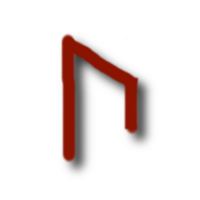
(face east and trace the rune shape and loudly chant: “THURISAZ”)

(face south-east and trace the rune shape and loudly chant: “ANSUZ”)
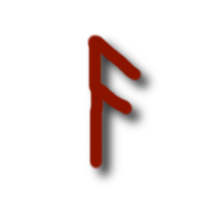
(face south and trace the rune shape and loudly chant: “RAIDHO”)

(face south-west and trace the rune shape and loudly chant: “KENAZ”)

(face west and trace the rune shape and loudly chant: “GEBO”)

(face north-west and trace the rune shape and loudly chant: “WUNJO”)

(face north and trace the rune shape and loudly chant: “HAGALAZ”)

(face north-east and trace the rune shape and loudly chant: “NAUDHIZ”)

(face east and trace the rune shape and loudly chant: “ISA”)

(face south-east and trace the rune shape and loudly chant: “JERA”)

(face south and trace the rune shape and loudly chant: “EIHWAZ”)

(face south-west and trace the rune shape and loudly chant: “PERTHRO”)

(face west and trace the rune shape and loudly chant: “ELHAZ”)

(face north-west and trace the rune shape and loudly chant: “SOWILO”)

(face north and trace the rune shape and loudly chant: “TIWAZ”)

(face north-east and trace the rune shape and loudly chant: “BERKANO”)

(face east and trace the rune shape and loudly chant: “EHWAZ”)

(face south-east and trace the rune shape and loudly chant: “MANNAZ”)

(face south and trace the rune shape and loudly chant: “LAGUZ”)
(face south-west and trace the rune shape and loudly chant: “INGWAZ”)

(face west and trace the rune shape and loudly chant: “DAGAZ”)

(face north-west and trace the rune shape and loudly chant: “OTHALA”)
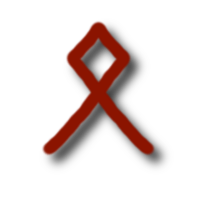
(Few silent deep breaths)
–
Hold up the bottle of mead:
“I now brew the holy mead of inspiration. Won by high Odin long ago!”
Chant into the bottle of mead:
“Odhroerir! Son! Bodhn!”
“Now I hallow this drink with staves of light!”
Chant and trace these runes over the bottle:
“Othala”
“Dagaz”
“Raidho”
“Ansuz”
“Raidho”
“Isa”
“Elhaz!”
All say:
“Hail Odhroerir!”
–
Few silent deep breaths.
–
Few silent deep breaths.
Light the purple candle. From this candle, light the incense.
“This is the time of year that the veil between worlds is at it’s thinnest. In this time, we can travel more easily between the worlds of the living and the dead. This candle represents the world of the living, the incense’s smoke the veil, and the darkness beyond the world of the dead. It is in this state that our rite must take place, where Odin himself has traveled many times to seek knowledge and wisdom of those who have passed on.”
Circle the ritual space with the incense three times creating a “veil” with the smoke. Take a few silent deep breaths.
–
“Hail Odin! Husband of Frigg. All-father. Father of battle. One-eyed god. Many-shaped. Wanderer. Hanged god. Raven god. Spear-thruster. Wish-bringer. Galdr-father. Graybeard. Deep hood. Thief of Odhroerir. Kinsman of Mimir. Lord of the Wild Hunt. Yule rider. Finder of the Runes. God of the Gautar. Ruler of Valhalla!”
“Hail Hel! Keeper of the dead. Hostess of Baldr and Hodr. Half-living one. Garm’s mistress. Dweller in Eljudnir!”
“Hail to my ancestors, both known and unknown. Those of my line going all the way back to the beginning, on up to most recent of times. Both men and women, alfar and disir, whom previously had a human form. Those whom I know, as well as those I do not. Those also whom are the ancestors of all humans living now. All humans that have made the journey of life before my time, and now reside in the realm beyond the living. Hail to the ancestors of all! Hail also to the ancestors of my family line! Hail to the ones that guide me. Hail also to the ones that protect me.”
–
Few silent deep breaths.
–
“Now is a time in which the rhythms of life turn inward, towards contemplation and trying to understand the deeper mysteries of life and towards the gathering of and seeking out of knowledge. It is through the ancestors and those humans that have come before us that we have all the knowledge which we have in human society. Those who have gone before us are the ones that have created the traditions and knowledge which we as humans rely upon to meet all of our needs, such as how to grow and create food, how to build protective shelters for living in, how to make clothing so that our human bodies are protected from the elements, how to survive the seasonal cycles in all different areas of the planet, what dangers to avoid and how to avoid them, and how to keep our human society functioning and going. We humans are the only animal that can not survive without knowledge. Our very lives depends on knowledge of how to do so many things. Over hundreds of thousands of years humans have increased their knowledge to the point that we live with the current advantages which we have now.”
“It is due to the experience and wisdom of our ancestors, both those within our own family line, and the ancestors of all human beings, that we can live as well as we do in the modern times. Those that have gone before us have recorded their wisdom for us in language, in stories, in poetry, in tools, in fashion, in objects of art, in oral knowledge, in traditions, in music and song, in mathematics, in schools of learning, in books, in the recording of historical events, in objects from the past, in plays, in movies, in TV shows, in videos, in blue-prints, in engineering plans, in computer programs, and even in the bones of the dead. All these things are the sum total of human heritage and the source of our knowledge that allows us to survive and thrive as a species. By turning to the past and studying the wisdom of our ancestors we tap into that knowledge. We must honor the dead and those who have gone before us for all that they have given to us. As well it is important that knowledge is passed to others freely, for otherwise the work of so many becomes lost. It has taken us so long to get to the point we are at now as a species, it is important we not be greedy with our knowledge or hoard it away from others, for this impedes human survival and progress.”
“Odin as god of wisdom is often traveling to the the realm of the dead to seek out the wisdom of the dead. We too must be like Odin and seek out the knowledge of our ancestors, the wisdom of the dead. At this time the focus of the seasons turns more towards this task of looking inward and to the past. Now is the time to look at all which you have done this season and look at what has worked for you and what has not. It is a time to ponder all lessons that are to be gained from what has been done this year, so that you may know better for next season how to increase the abundance of your life harvest. It may be a good time to record some notes regarding this, safely putting them away some place where they shall not be lost. Also this is a time when the veils between the realm of the living and the dead are at their thinnest, and thus a time in which the knowledge of the dead is more accessible. It is a good time to seek out the wise counsel of the ancestors and those that are now passed beyond the realm of the living. This is a good time to spend time reading books, and studying new things, and pursuing the gaining of knowledge in any form.”
“At this time ponder on what you have learned this year.”
Few silent deep breaths while pondering on this.
“Now consider what things you would like to do differently the next cycle”
Few silent deep breaths while pondering on this.
“Now think about those who have have passed into the after life. Now is the time to think about anyone you may know who has died”
Few silent deep breaths while you think about those who have passed on.
“Now think about any wisdom or knowledge they may have for you.”
Few silent deep breaths while you think about this.
“Now is the time to give thanks for all that our ancestors have given to us and to honor the wisdom of the dead.”
(Fill drinking horn with mead and hold it up)
“Hail to all humans that have come before me. Hail to those of my family line, as well as all people of the past of all human family lines. I make this offering to you in thanks for the wisdom you have given us by the lives you have lived in the past. May your knowledge continue and enhance the life of both myself and all other humans alive now and all humans to come for all of eternity! Hail to the ancestors of all people!”
(Drink half the mead and pour out the rest as an offering to the ancestors of all humans.)
“Now is the time to honor Odin, the god of knowledge. Odin tirelessly seeks out the knowledge which all humans have worked to create for all of time. He is the god that seeks to gain and preserve knowledge and give it to others for the benefit of human society and human progress. He is the god who labors tirelessly to establish things in such a way that humans can continue and survive even after the end of this current cycle when Ragnarok comes and all begins again anew. He is the god that has discovered the runes through a difficult process of spiritual initiation so that they may be of benefit for gods and humans alike. He is the god that has made so many sacrifices for the sake of gaining of knowledge. We owe him much for all these things!”
(Fill drinking horn and hold it up)
“Hail Odin, god of the runes. God of knowledge and wisdom. You Odin are the one that frequently travels the worlds seeking to know more. Please guide me Odin in learning more and in applying knowledge in ways that are helpful to me. Please Odin help me to gain a deeper level of connection with all people of the past so that my knowledge my increase. Hail Odin!”
(Drink half the mead and pour out the rest to Odin.)
“Also this is the time that we should remember the one that has been tasked with keeping the souls of the dead. The goddess that is both living and dead. Though she isn’t truly goddess, she has become in being tasked with the lands of the dead by Odin.”
(Fill drinking horn and hold it up)
“Hail Hel, daughter of Loki. She who holds the halls in Helheim and shares what she has with those who have passed on to her lands. Hel is mistress of the lands of the dead and keeps those that have died of old age or illness. Thus her lands are where most of our ancestors will reside. We honor her today as well in hopes that she allows those we love to rest in peace well beyond Ragnarok. She who is most beautiful and frightful in one visage being both dead and alive. We owe her much gratitude and respect in her tireless and thankless duty in tending those cold halls. Thank you, Hel for taking the task given and caring for the souls you’ve been tasked in keeping. May we all share in a feast again one day. Hail Hel!”
(Drink half the mead and pour out the rest to Hel.)
–
(Use the pine twig to splash a bit of the liquid in the offering bowl on yourself, on any others in the ritual with you, on your altar, on the ritual space, and in all general areas of your dwelling as well. Does not need to be much splashed around, just a little is fine. This helps to imbue more of the energies of the ritual on you, and others who may also in the ritual with you, and to your place.)
–
“Now my rite has ended. May all gathered here fare well on their return to their home places. And may the bonds of frith between us grow, gods, wights, and humans alike. Until we meet again.”
–
–
Pour out the offerings from the offering bowl outside:
“A gift for a gift”
Trace gebo at spot offerings were given to.
“GEBO!”
Pour out remaining blessed water outside.
“I pour the sacred water back to the Earth so it may find it’s way back to the Well of Wyrd”
–
Now at this point it is very important to ground your energies. This should always be done after every ritual. Not doing so can lead to problems in the long-run. Grounding is like shifting gears in a car, except it is the process of shifting brain states. During rituals you create a trance like brain state, which is desired for during rituals or for during any spiritual practices. But trance states are not good for doing everyday mundane things. You need to return your mind back to the normal state of consciousness after the ritual is finished. That is what grounding is.
The most simple and common method to ground is to visualize yourself as a tree and see roots growing into the ground from the base of your spine and going down into the earth. Sometimes rituals require industrial strength grounding as they can really create some intense energy. In that case you can try the following triple grounding method.:
First visualize your chakras. You picture in your mind closing first the top one and then seeing a sort of lid closing over it, then proceed with the net lower chakra and so on. You want to leave the bottom most chakra, the root chakra fully open as this is your connection to grounding. Don’t be concerned about having the others closed, the normal proper function of them is that they open and close as needed. Problems with being ungrounded happen when one of more of them are stuck open. Only the bottom one is to be left open at all times.
Next step is to picture a ball of pure white light above your head. Now let this white light slowly descent downward into your body and slowly move lower. As it descends it takes with it any unneeded, old, and negative energies. It is sort of sweeping downward through your energies taking all you no longer need with it. Once it reaches your feet let it move lower till it passes down through the floor. If you are on an upper close let it pass all the way to the ground. Let the earth take this energy to recycle it.
Now final step is to do the traditional grounding. Picture yourself as a tree. Visualize roots coming out of the base of your spine and going down into the Earth. Feel the calmness of a tree, the rooted solidness.
If after these three things you still feel hyper or spaced out you can either eat some food, or put a small amount of salt on your tongue. Another thing you can do is prostrate down to the ground, placing your head on the ground and stay like this for a few moments.
–
Feel free to copy and use this ritual so long as you acknowledge the source.
Download this as a OpenOffice Doc – Volmarrs-heathen-winter-nights-2-oct-ritual-oct-2013
Volmarr’s Heathen Freysblot Harvest Ritual August-2-2013
Need:
• drinking horn
• mead (or beer or wine or even can use juice)
• spring water in small bowl
• fresh pine twig
• offering bowl
• candles
• wand (if you don’t have one you can use your fingers instead)
• Thor’s Ritual Hammer (optional, can use it for the Hammer Hallowings)
• Green candle
• Any symbol for Freyr. Phallic symbols. Horse symbols.
• Baked goods, nuts, berries, and sweet fruit such as strawberries, grapes, cherries, blueberries. Freyr does prefer organic and natural foods if your budget allows.
• A list of all the spiritual seed tasks you had planted at Ostara (as many of them as you can remember). You can add items to the list that were not seed goals at Ostara but are goals anyways which you have been working on or have a shot of accomplishing within the next few months.
–
This ritual, as are all Heathen or northern rituals, is done while facing north, except where otherwise noted. The altar should be such that it is in front of you when you face north.
If you don’t know how to pronounce the runes see my webpage on how to pronounce them here.
–
Put spring water in small bowl. Trace 3 Laguz runes over it.:
“LAGUZ… LAGUZ… LAGUZ”
“From the Well of Wyrd does this water flow, and to the Well of Wyrd does it return”
–
Make Hammer Sign at item and then splash each ritual item with blessed water using the pine twig and for each item say:
“I bless this ______ with the waters of the Well of Wyrd”
–
Now trace Hammer Sign at person being blessed and/or self and splash them with water using twig.
“I bless ______ with the waters of the Well of Wyrd”
–
Use twig to splash ritual space with water.
“I bless this space with the waters of the Well of Wyrd”
–
Few silent deep breaths.
–
All stand in Elhaz position.
“Bi-Frost’s rainbow light shine down upon this space and myself so that I may form a portal between the worlds of Asgard and Midgard”
–
Few silent deep breaths.
–
All face north and trace the Hammer Sign while chanting:
“Hammer in the north hallow and ward this stead”
All turn east and trace the Hammer Sign while chanting:
“Hammer in the east hallow and ward this stead”
All turn south and trace the Hammer Sign while chanting:
“Hammer in the south hallow and ward this stead”
All turn west trace the Hammer Sign while chanting:
“Hammer in the west hallow and ward this stead”
All return to north and look up and trace Hammer sign while chanting:
“Hammer above hallow and ward this stead”
All look below and trace Hammer sign while chanting:
“Hammer below hallow and ward this stead”
–
Return to facing north and all stand in the Elhaz position and chant:
“Around me and within me Asgard and Midgard”
and move into the Dagaz position in the end.
–
Few silent deep breaths.
–
(Highly recommended optional casting of the rune ring)
(face north and trace the rune shape in the air before you using your wand and loudly chant: “FEHU!”)
(face north-east and trace the rune shape and loudly chant: “URUZ”)
(face east and trace the rune shape and loudly chant: “THURISAZ”)
(face south-east and trace the rune shape and loudly chant: “ANSUZ”)
(face south and trace the rune shape and loudly chant: “RAIDHO”)
(face south-west and trace the rune shape and loudly chant: “KENAZ”)
(face west and trace the rune shape and loudly chant: “GEBO”)
(face north-west and trace the rune shape and loudly chant: “WUNJO”)
(face north and trace the rune shape and loudly chant: “HAGALAZ”)
(face north-east and trace the rune shape and loudly chant: “NAUDHIZ”)
(face east and trace the rune shape and loudly chant: “ISA”)
(face south-east and trace the rune shape and loudly chant: “JERA”)
(face south and trace the rune shape and loudly chant: “EIHWAZ”)
(face south-west and trace the rune shape and loudly chant: “PERTHRO”)
(face west and trace the rune shape and loudly chant: “ELHAZ”)
(face north-west and trace the rune shape and loudly chant: “SOWILO”)
(face north and trace the rune shape and loudly chant: “TIWAZ”)
(face north-east and trace the rune shape and loudly chant: “BERKANO”)
(face east and trace the rune shape and loudly chant: “EHWAZ”)
(face south-east and trace the rune shape and loudly chant: “MANNAZ”)
(face south and trace the rune shape and loudly chant: “LAGUZ”)
(face south-west and trace the rune shape and loudly chant: “INGWAZ”)
(face west and trace the rune shape and loudly chant: “DAGAZ”)
(face north-west and trace the rune shape and loudly chant: “OTHALA”)
(Few silent deep breaths)
–
Hold up the bottle of mead:
“I now brew the holy mead of inspiration. Won by high Odin long ago!”
Chant into the bottle of mead:
“Odhroerir! Son! Bodhn!”
“Now I hallow this drink with staves of light!”
Chant and trace these runes over the bottle:
“Othala”
“Dagaz”
“Raidho”
“Ansuz”
“Raidho”
“Isa”
“Elhaz!”
All say:
“Hail Odhroerir!”
–
Few silent deep breaths.
–
“Hail Freyr! Son of Njord. Brother of Freyja. Husband of Gerd. Trusted friend of Skirnir. Descendant of the Vanir. Harvest god and wealth-giver. King of Alfheim. Blot-god of the Swedes. Possessor of Skidbladnir, and the boar known as Gullinbursti. Beli’s slayer. Enemy of Surtr. Wielder of the stag-horn. Fruitful one. Sure giver. Father of the Yngling line. Lord of the Volsi!”
“Hail Freyr!”
–
“Now is the start of the harvest season. This is a time to work hard to bring forth all those things which you have been lending energies towards all this season. This is a time to honor Freyr, god of wealth and the harvest, so that your personal life harvest can be the fruitful one. Since most of us in the modern world are not farmers, harvest means for us the task of working on manifesting wishes and desires. Compared to other holidays this one is very straightforward. At this time we work on the tangible outward aspect of energies, working on manifesting and bringing into being that which started as inner energies in the spring.”
“Look at the list of all the wishes which you planted as seeds at Ostara. Now is the time to make those things happen, at least for those things in your life which have not already happened by now. You are to keep this list of tasks, at this time, some place where you will see it often in your day, so that you remain aware and focused towards the things you are working on manifesting.”
“At this time of the harvest I am working on:” (read your list of tasks)
“You have from now till the middle of October to work on your wishes for this season. Any of those wishes that have not manifested by then should be mulched as spiritual weeds. You can then try again for next season for any things that have not manifested by then. After that it is time to make things more simple in your life to focus on the inward turning energies of winter.”
–
“Freyr please help keep me focused on working on the things which I am trying to manifest in my life this season. Please Freyr lend me your potent energies for this purpose so that my life harvest this season may be a fruitful one.”
“Also please Freyr help to me keep away any distracting energies which may interfere with me accomplishing my harvest goals. Please help me to know what things may need to be extracted from my situation if there is anything which is acting to divert my harvest focus.”
“Hail Freyr!”
–
“Freyr now is the time to year to have a feast in your honor to give thanks for your fruitful energies.”
“This feast is for you Freyr! Hail Freyr!”
–
(Use the pine twig to splash a bit of the liquid in the offering bowl on yourself, on any others in the ritual with you, on your altar, on the ritual space, and in all general areas of your dwelling as well. Does not need to be much splashed around, just a little is fine. This helps to imbue more of the energies of the ritual on you, and others who may also in the ritual with you, and to your place.)
–
“Now my rite has ended. May all gathered here fare well on their return to their home places. And may the bonds of frith between us grow, gods, wights, and humans alike. Until we meet again.”
–
–
Pour out the offerings from the offering bowl outside:
“A gift for a gift”
Trace gebo at spot offerings were given to.
“GEBO!”
Pour out remaining blessed water outside.
“I pour the sacred water back to the Earth so it may find it’s way back to the Well of Wyrd”
–
Now at this point it is very important to ground your energies. This should always be done after every ritual. Not doing so can lead to problems in the long-run. Grounding is like shifting gears in a car, except it is the process of shifting brain states. During rituals you create a trance like brain state, which is desired for during rituals or for during any spiritual practices. But trance states are not good for doing everyday mundane things. You need to return your mind back to the normal state of consciousness after the ritual is finished. That is what grounding is.
The most simple and common method to ground is to visualize yourself as a tree and see roots growing into the ground from the base of your spine and going down into the earth. Sometimes rituals require industrial strength grounding as they can really create some intense energy. In that case you can try the following triple grounding method.:
First visualize your chakras. You picture in your mind closing first the top one and then seeing a sort of lid closing over it, then proceed with the net lower chakra and so on. You want to leave the bottom most chakra, the root chakra fully open as this is your connection to grounding. Don’t be concerned about having the others closed, the normal proper function of them is that they open and close as needed. Problems with being ungrounded happen when one of more of them are stuck open. Only the bottom one is to be left open at all times.
Next step is to picture a ball of pure white light above your head. Now let this white light slowly descent downward into your body and slowly move lower. As it descends it takes with it any unneeded, old, and negative energies. It is sort of sweeping downward through your energies taking all you no longer need with it. Once it reaches your feet let it move lower till it passes down through the floor. If you are on an upper close let it pass all the way to the ground. Let the earth take this energy to recycle it.
Now final step is to do the traditional grounding. Picture yourself as a tree. Visualize roots coming out of the base of your spine and going down into the Earth. Feel the calmness of a tree, the rooted solidness.
If after these three things you still feel hyper or spaced out you can either eat some food, or put a small amount of salt on your tongue. Another thing you can do is prostrate down to the ground, placing your head on the ground and stay like this for a few moments.
–
Feel free to copy and use this ritual so long as you acknowledge the source.
Volmarr’s Heathen Midsummer Ritual June-21-2013 Vanatru Version
Need:
• drinking horn
• mead (or beer or wine or even can use juice)
• spring water in small bowl
• fresh pine twig
• offering bowl
• candles
• wand (if you don’t have one you can use your fingers instead)
• Thor’s Ritual Hammer (optional, can use it for the Hammer Hallowings)
• One yellow or gold candle
• One white candle
• Any symbols of Summer, solar symbols.
–
This ritual, as are all Heathen or northern rituals, is done while facing north, except where otherwise noted. The altar should be such that it is in front of you when you face north.
If you don’t know how to pronounce the runes see my webpage on how to pronounce them here.
–
Put spring water in small bowl. Trace 3 Laguz runes over it.:
“LAGUZ… LAGUZ… LAGUZ”
“From the Well of Wyrd does this water flow, and to the Well of Wyrd does it return”
–
Make Hammer Sign at item and then splash each ritual item with blessed water using the pine twig and for each item say:
“I bless this ______ with the waters of the Well of Wyrd”
–
Now trace Hammer Sign at person being blessed and/or self and splash them with water using twig.
“I bless ______ with the waters of the Well of Wyrd”
–
Use twig to splash ritual space with water.
“I bless this space with the waters of the Well of Wyrd”
–
Few silent deep breaths.
–
All stand in Elhaz position.
“Bi-Frost’s rainbow light shine down upon this space and myself so that I may form a portal between the worlds of Asgard and Midgard”
–
Few silent deep breaths.
–
All face north and trace the Hammer Sign while chanting:
“Hammer in the north hallow and ward this stead”
All turn east and trace the Hammer Sign while chanting:
“Hammer in the east hallow and ward this stead”
All turn south and trace the Hammer Sign while chanting:
“Hammer in the south hallow and ward this stead”
All turn west trace the Hammer Sign while chanting:
“Hammer in the west hallow and ward this stead”
All return to north and look up and trace Hammer sign while chanting:
“Hammer above hallow and ward this stead”
All look below and trace Hammer sign while chanting:
“Hammer below hallow and ward this stead”
–
Return to facing north and all stand in the Elhaz position and chant:
“Around me and within me Asgard and Midgard”
and move into the Dagaz position in the end.
–
Few silent deep breaths.
–
(Highly recommended optional casting of the rune ring)
(face north and trace the rune shape in the air before you using your wand and loudly chant: “FEHU!”)
(face north-east and trace the rune shape and loudly chant: “URUZ”)
(face east and trace the rune shape and loudly chant: “THURISAZ”)
(face south-east and trace the rune shape and loudly chant: “ANSUZ”)
(face south and trace the rune shape and loudly chant: “RAIDHO”)
(face south-west and trace the rune shape and loudly chant: “KENAZ”)
(face west and trace the rune shape and loudly chant: “GEBO”)
(face north-west and trace the rune shape and loudly chant: “WUNJO”)
(face north and trace the rune shape and loudly chant: “HAGALAZ”)
(face north-east and trace the rune shape and loudly chant: “NAUDHIZ”)
(face east and trace the rune shape and loudly chant: “ISA”)
(face south-east and trace the rune shape and loudly chant: “JERA”)
(face south and trace the rune shape and loudly chant: “EIHWAZ”)
(face south-west and trace the rune shape and loudly chant: “PERTHRO”)
(face west and trace the rune shape and loudly chant: “ELHAZ”)
(face north-west and trace the rune shape and loudly chant: “SOWILO”)
(face north and trace the rune shape and loudly chant: “TIWAZ”)
(face north-east and trace the rune shape and loudly chant: “BERKANO”)
(face east and trace the rune shape and loudly chant: “EHWAZ”)
(face south-east and trace the rune shape and loudly chant: “MANNAZ”)
(face south and trace the rune shape and loudly chant: “LAGUZ”)
(face south-west and trace the rune shape and loudly chant: “INGWAZ”)
(face west and trace the rune shape and loudly chant: “DAGAZ”)
(face north-west and trace the rune shape and loudly chant: “OTHALA”)
(Few silent deep breaths)
–
Hold up the bottle of mead:
“I now brew the holy mead of inspiration. Won by high Odin long ago!”
Chant into the bottle of mead:
“Odhroerir! Son! Bodhn!”
“Now I hallow this drink with staves of light!”
Chant and trace these runes over the bottle:
“Othala”
“Dagaz”
“Raidho”
“Ansuz”
“Raidho”
“Isa”
“Elhaz!”
All say:
“Hail Odhroerir!”
–
Few silent deep breaths.
–
“Hail to the Vanir! Hail to the Aesir! Hail to the gods and goddesses of the north! I call upon you all in frith at this time so I may honor the connection we have with one another.”
(Light the white candle.)
“Hail the Vanir! Hail the Aesir!”
“Hail Sunna! Daughter of Glen. Bright rider in the heavens by day. Driver of Alsvin and Arvak. Wearer of Svalin. Day-star. Ever-glow. All-bright. Wolf-chased. Fair-wheel. Grace-shine. Ensnarer of Trolls!”
(Light the yellow candle.)
“Hail Sunna!”
–
“Now is the time of Midsummer. This is a time for adventure and seeking conquest and victory within our life. Midsummer is also a time to honor the important alliances that you hold with others.”
“Late Spring and early Summer are the Norse times to fight battles and go raiding. Most of us in the modern world won’t be going into literal combat situations or going literally raiding, as happened during the Viking age. But we modern people have our own just as difficult battles we have to fight in our day to day life. Common modern forms of battle are: battles against your own negative traits or bad habits, battles to effect greater spiritual growth and awareness, battles to improve our lives in any way, battles against people in our lives who abuse us or cause us harm, battles to stand up for some cause we believe in, battles to improve the lives and well-being of those close to us, battles to achieve success in our careers, fighting for a better world, etc. All these types of battles are equally as worthy as the battles and raids which the Vikings fought, and are just as filled with their own forms of danger and peril. All forms of worthy battle which we fight are a way in which the gods/goddesses test us to see our measure of spiritual strength and bravery. By fighting whatever worthy battles we must in our lives without backing down and doing the best we can in them, we increase our spiritual might and personal luck. Most forms of modern battles are more so what can be considered forms of psychic or spiritual battles. Being a spiritual warrior is just as impressive to the gods/goddesses as being a literal one. If your life has been filled with strife and challenge lately during the late spring and early summer know that this is part of being in tune with the seasonal cycles and this time shall eventually pass. When fighting a lot of battles our energies can after awhile become drained and run down. Try to call upon the power of the sun, the goddess Sunna, as a source to recharge your psychic and emotional batteries after many long fought battles.”
–
(Hold drinking how and fill it with drink)
“Hail to Sunna! Goddess of the sun! Goddess of the energies which charge all of life with vitality! Through your vital strength, we gain the power to achieve victory! Please oh bright shinning goddess charge my energies with your might and power! Hail Sunna!”
(Picture in your mind’s eye energy from the sun coming down to you and filling your aura, making it stronger and more powerful.)
(Chant and trace sowilo in the air three times:)
“SOWILO… SOWILO… SOWILO”
(Drink half, pour out rest to offering bowl or ground)
–
“Anger is a useful and important emotion since it is related to defending against attack, and is an emotion needed for self protection. Anger only gets bad when it is used in a personal way. Personalized anger is anger against a certain person, which is very negative. Anger used in a impersonal sense, as controlled anger where you use the anger feelings to empower your ability to defend your rights and to protect yourself and others, is the proper positive use of anger. ”
“In modern day times there aren’t many outlets for anger. In older times of course there were plenty of outlets for it since men had to fight to protect. Since men are the protectors they do tend to more directly feel their anger emotions. Women often but not always tend to feel their anger in more indirect ways. Or more commonly, many women have trouble directly acknowledging when they are angry. The strongest emotion for men is anger. The strongest emotion for women is love. Men are the warriors so they need to have anger as a strong emotion for to strengthen this role for them. In Pagan societies such as the Vikings, the society was structured in a way to help keep anger more as the impersonal healthy kind and such societies were even structured in ways to give men healthy outlets for anger.”
“One of the most positive ways to release anger and act upon the warrior spirit in modern society is through sports. Summer is the best time for doing sports. Sports help to create frith since they help people feel more positive and release tension and anger. Group sports can be a powerful tool of troth-making.”
“Another way to release or vent anger is through sex. Sex is a very powerful way to turn anger onto frith and love. It is very sacred to have sex at the Midsummer bonfire.”
“Women as the nurturers and pleasure and care givers have love as their strongest emotion. Since the strongest emotion for women is love, women are the frith-makers and they hold a sacred duty in northern culture as guardians of the frith. Frith is the glue that holds together those who hold troth for each other. Without frith there can be no troth. Keeping troth with those you cannot have any frith with is both dishonorable and dishonest. In order for there to be frith with someone you must hold feelings of respect and trust. No social organization, whether it be one related to Heathenism or anything at all, can survive if it does not strictly enforce members keeping frith between each other. The foundation of troth is frith. Troth is the very basis of Heathenism. Any Heathen that has not learned to be respectful of other people is one that is not able to honor frith and thus shall fail completely at holding troth with others. Since the basis of Heathenism is troth, such a Heathen shall fail as a Heathen. The gods and goddesses only welcome those to their hall that would be able to hold frith with all those who reside in their hall. The whole point of being Heathen is to hold troth for one or more of the northern gods or goddesses and work towards being welcomed to their hall in the after-life, thus learning how to respect others and honor frith is one of the greatest lessons any Heathen can learn.”
“Now at this time of the season, Midsummer, is the time to acknowledge all bonds of troth which we hold. Troth is the very point of Heathenism. Heathenism is simply put the practice of holding troth for one or more of the northern gods/goddesses. In all things we do in our life we must act in ways that honor this troth we hold. By taking troth with any god or goddess we are agreeing to hold their ways holy and honor what they stand for. Take some moments now to ponder on all the gods and goddesses which you hold troth with and all the things which are sacred to them.”
(Feel free to change this next part as needed)
“I _______ (state your name) hold troth with the Vanir and Aesir, with the ways of the Vanir coming first for me. _______ (patron deity name) is my patron and thus I hold the greatest troth of all for him/her. I agree to hold sacred all the things which are holy to the Vanir and Aesir and most of all that which is sacred to my patron ________ (patron deity name).”
–
(This next section is optional. If you prefer you can change this to whatever other values you happen to follow. In no way are the Vanic Virtues, or the Nine Noble Virtues, or any other codified system of values, a requirement to be followed to be Heathen. It is up to the individual Heathen to determine what values system they shall follow, so long as they uphold the basics such as honesty, troth, and always keeping oaths to the best of their ability. But once an individual has chosen a value system to follow they must follow it faithfully to the best of their ability. What matters most is to never agree to follow any value system you don’t deeply feel in your heart is right for you. Part of troth is being true to yourself and your true will.)
“To honor the troth I hold, these are the values I have agreed to uphold in my life to the best of my ability.:”
“The Vanic Virtues ”
“Beauty ”
“The pursuit of beauty and elegance in thought, form and speech. ”
“Courage/Passion ”
“Zeal, vigor; the strength and courage that comes from a life worth living. ”
“Land-rightness ”
“The recognition of nature and the environment as worthy of respect, care and reverence. ”
“Even-mood ”
“Harmonious and balanced thought and action; tranquility, calm, serenity.”
“Openness ”
“The quality of being receptive to the world around one, non-judgmental and open. ”
“Wildness/Ecstasy ”
“Music and dance; the nurturing of inner wildness and childlike being, being like the “fey” ”
“Love”
“The all-encompassing force; love for family, for kin, for humanity, for all beings.”
“Frith ”
“The peace and goodwill between people bound together; loyalty and the keeping of one’s word. ”
“Faith/Piety ”
“The trust that the Gods exist and are worthy of our worship, and Their ways worth following. ”
“Giving ”
“The binding of two parties into one common bond, generosity and hospitality. ”
“Joy ”
“Wonder and innocence, the recognition that life is worth living, and worth living well. ”
“Brotherhood ”
“The recognition that we – humans, animals, plants, spirits – are all part of the grander scheme of life, and we share a common heritage, as children of the Earth.”
–
(This part is not optional)
(Hold drinking how and fill it with drink)
“Hail to the Vanir! Hail to the Aesir! Hail to _______ (patron deity name), I make this toast to you in honor of the troth I hold for you all! Hail!”
(Drink half, pour out rest to offering bowl or ground)
–
Use the pine twig to splash a bit of the liquid in the offering bowl on yourself, on any others in the ritual with you, on your altar, on the ritual space, and in all general areas of your dwelling as well. Does not need to be much splashed around, just a little is fine. This helps to imbue more of the energies of the ritual on you, and others who may also in the ritual with you, and to your place.
–
“Now my rite has ended. May all gathered here fare well on their return to their home places. And may the bonds of frith between us grow, gods, wights, and humans alike. Until we meet again.”
–
–
Pour out the offerings from the offering bowl outside:
“A gift for a gift”
Trace gebo at spot offerings were given to.
“GEBO!”
Pour out remaining blessed water outside.
“I pour the sacred water back to the Earth so it may find it’s way back to the Well of Wyrd”
–
Now at this point it is very important to ground your energies. This should always be done after every ritual. Not doing so can lead to problems in the long-run. Grounding is like shifting gears in a car, except it is the process of shifting brain states. During rituals you create a trance like brain state, which is desired for during rituals or for during any spiritual practices. But trance states are not good for doing everyday mundane things. You need to return your mind back to the normal state of consciousness after the ritual is finished. That is what grounding is.
The most simple and common method to ground is to visualize yourself as a tree and see roots growing into the ground from the base of your spine and going down into the earth. Sometimes rituals require industrial strength grounding as they can really create some intense energy. In that case you can try the following triple grounding method.:
First visualize your chakras. You picture in your mind closing first the top one and then seeing a sort of lid closing over it, then proceed with the net lower chakra and so on. You want to leave the bottom most chakra, the root chakra fully open as this is your connection to grounding. Don’t be concerned about having the others closed, the normal proper function of them is that they open and close as needed. Problems with being ungrounded happen when one of more of them are stuck open. Only the bottom one is to be left open at all times.
Next step is to picture a ball of pure white light above your head. Now let this white light slowly descent downward into your body and slowly move lower. As it descends it takes with it any unneeded, old, and negative energies. It is sort of sweeping downward through your energies taking all you no longer need with it. Once it reaches your feet let it move lower till it passes down through the floor. If you are on an upper close let it pass all the way to the ground. Let the earth take this energy to recycle it.
Now final step is to do the traditional grounding. Picture yourself as a tree. Visualize roots coming out of the base of your spine and going down into the Earth. Feel the calmness of a tree, the rooted solidness.
If after these three things you still feel hyper or spaced out you can either eat some food, or put a small amount of salt on your tongue. Another thing you can do is prostrate down to the ground, placing your head on the ground and stay like this for a few moments.
–
Feel free to copy and use this ritual so long as you acknowledge the source.
Volmarr’s Heathen Midsummer Ritual June-21-2013 Asatru Version
Need:
• drinking horn
• mead (or beer or wine or even can use juice)
• spring water in small bowl
• fresh pine twig
• offering bowl
• candles
• wand (if you don’t have one you can use your fingers instead)
• Thor’s Ritual Hammer (optional, can use it for the Hammer Hallowings)
• One yellow or gold candle
• One white candle
• Any symbols of Summer, solar symbols.
–
This ritual, as are all Heathen or northern rituals, is done while facing north, except where otherwise noted. The altar should be such that it is in front of you when you face north.
If you don’t know how to pronounce the runes see my webpage on how to pronounce them here.
–
Put spring water in small bowl. Trace 3 Laguz runes over it.:
“LAGUZ… LAGUZ… LAGUZ”
“From the Well of Wyrd does this water flow, and to the Well of Wyrd does it return”
–
Make Hammer Sign at item and then splash each ritual item with blessed water using the pine twig and for each item say:
“I bless this ______ with the waters of the Well of Wyrd”
–
Now trace Hammer Sign at person being blessed and/or self and splash them with water using twig.
“I bless ______ with the waters of the Well of Wyrd”
–
Use twig to splash ritual space with water.
“I bless this space with the waters of the Well of Wyrd”
–
Few silent deep breaths.
–
All stand in Elhaz position.
“Bi-Frost’s rainbow light shine down upon this space and myself so that I may form a portal between the worlds of Asgard and Midgard”
–
Few silent deep breaths.
–
All face north and trace the Hammer Sign while chanting:
“Hammer in the north hallow and ward this stead”
All turn east and trace the Hammer Sign while chanting:
“Hammer in the east hallow and ward this stead”
All turn south and trace the Hammer Sign while chanting:
“Hammer in the south hallow and ward this stead”
All turn west trace the Hammer Sign while chanting:
“Hammer in the west hallow and ward this stead”
All return to north and look up and trace Hammer sign while chanting:
“Hammer above hallow and ward this stead”
All look below and trace Hammer sign while chanting:
“Hammer below hallow and ward this stead”
–
Return to facing north and all stand in the Elhaz position and chant:
“Around me and within me Asgard and Midgard”
and move into the Dagaz position in the end.
–
Few silent deep breaths.
–
(Highly recommended optional casting of the rune ring)
(face north and trace the rune shape in the air before you using your wand and loudly chant: “FEHU!”)
(face north-east and trace the rune shape and loudly chant: “URUZ”)
(face east and trace the rune shape and loudly chant: “THURISAZ”)
(face south-east and trace the rune shape and loudly chant: “ANSUZ”)
(face south and trace the rune shape and loudly chant: “RAIDHO”)
(face south-west and trace the rune shape and loudly chant: “KENAZ”)
(face west and trace the rune shape and loudly chant: “GEBO”)
(face north-west and trace the rune shape and loudly chant: “WUNJO”)
(face north and trace the rune shape and loudly chant: “HAGALAZ”)
(face north-east and trace the rune shape and loudly chant: “NAUDHIZ”)
(face east and trace the rune shape and loudly chant: “ISA”)
(face south-east and trace the rune shape and loudly chant: “JERA”)
(face south and trace the rune shape and loudly chant: “EIHWAZ”)
(face south-west and trace the rune shape and loudly chant: “PERTHRO”)
(face west and trace the rune shape and loudly chant: “ELHAZ”)
(face north-west and trace the rune shape and loudly chant: “SOWILO”)
(face north and trace the rune shape and loudly chant: “TIWAZ”)
(face north-east and trace the rune shape and loudly chant: “BERKANO”)
(face east and trace the rune shape and loudly chant: “EHWAZ”)
(face south-east and trace the rune shape and loudly chant: “MANNAZ”)
(face south and trace the rune shape and loudly chant: “LAGUZ”)
(face south-west and trace the rune shape and loudly chant: “INGWAZ”)
(face west and trace the rune shape and loudly chant: “DAGAZ”)
(face north-west and trace the rune shape and loudly chant: “OTHALA”)
(Few silent deep breaths)
–
Hold up the bottle of mead:
“I now brew the holy mead of inspiration. Won by high Odin long ago!”
Chant into the bottle of mead:
“Odhroerir! Son! Bodhn!”
“Now I hallow this drink with staves of light!”
Chant and trace these runes over the bottle:
“Othala”
“Dagaz”
“Raidho”
“Ansuz”
“Raidho”
“Isa”
“Elhaz!”
All say:
“Hail Odhroerir!”
–
Few silent deep breaths.
–
“Hail to the Aesir! Hail to the Vanir! Hail to the gods and goddesses of the north! I call upon you all in frith at this time so I may honor the connection we have with one another.”
(Light the white candle.)
“Hail the Aesir! Hail the Vanir!”
“Hail Sunna! Daughter of Glen. Bright rider in the heavens by day. Driver of Alsvin and Arvak. Wearer of Svalin. Day-star. Ever-glow. All-bright. Wolf-chased. Fair-wheel. Grace-shine. Ensnarer of Trolls!”
(Light the yellow candle.)
“Hail Sunna!”
–
“Now is the time of Midsummer. This is a time for adventure and seeking conquest and victory within our life. Midsummer is also a time to honor the important alliances that you hold with others.”
“Late Spring and early Summer are the Norse times to fight battles and go raiding. Most of us in the modern world won’t be going into literal combat situations or going literally raiding, as happened during the Viking age. But we modern people have our own just as difficult battles we have to fight in our day to day life. Common modern forms of battle are: battles against your own negative traits or bad habits, battles to effect greater spiritual growth and awareness, battles to improve our lives in any way, battles against people in our lives who abuse us or cause us harm, battles to stand up for some cause we believe in, battles to improve the lives and well-being of those close to us, battles to achieve success in our careers, fighting for a better world, etc. All these types of battles are equally as worthy as the battles and raids which the Vikings fought, and are just as filled with their own forms of danger and peril. All forms of worthy battle which we fight are a way in which the gods/goddesses test us to see our measure of spiritual strength and bravery. By fighting whatever worthy battles we must in our lives without backing down and doing the best we can in them, we increase our spiritual might and personal luck. Most forms of modern battles are more so what can be considered forms of psychic or spiritual battles. Being a spiritual warrior is just as impressive to the gods/goddesses as being a literal one. If your life has been filled with strife and challenge lately during the late spring and early summer know that this is part of being in tune with the seasonal cycles and this time shall eventually pass. When fighting a lot of battles our energies can after awhile become drained and run down. Try to call upon the power of the sun, the goddess Sunna, as a source to recharge your psychic and emotional batteries after many long fought battles.”
–
(Hold drinking how and fill it with drink)
“Hail to Sunna! Goddess of the sun! Goddess of the energies which charge all of life with vitality! Through your vital strength, we gain the power to achieve victory! Please oh bright shinning goddess charge my energies with your might and power! Hail Sunna!”
(Picture in your mind’s eye energy from the sun coming down to you and filling your aura, making it stronger and more powerful.)
(Chant and trace sowilo in the air three times:)
“SOWILO… SOWILO… SOWILO”
(Drink half, pour out rest to offering bowl or ground)
–
“Anger is a useful and important emotion since it is related to defending against attack, and is an emotion needed for self protection. Anger only gets bad when it is used in a personal way. Personalized anger is anger against a certain person, which is very negative. Anger used in a impersonal sense, as controlled anger where you use the anger feelings to empower your ability to defend your rights and to protect yourself and others, is the proper positive use of anger. ”
“In modern day times there aren’t many outlets for anger. In older times of course there were plenty of outlets for it since men had to fight to protect. Since men are the protectors they do tend to more directly feel their anger emotions. Women often but not always tend to feel their anger in more indirect ways. Or more commonly, many women have trouble directly acknowledging when they are angry. The strongest emotion for men is anger. The strongest emotion for women is love. Men are the warriors so they need to have anger as a strong emotion for to strengthen this role for them. In Pagan societies such as the Vikings, the society was structured in a way to help keep anger more as the impersonal healthy kind and such societies were even structured in ways to give men healthy outlets for anger.”
“One of the most positive ways to release anger and act upon the warrior spirit in modern society is through sports. Summer is the best time for doing sports. Sports help to create frith since they help people feel more positive and release tension and anger. Group sports can be a powerful tool of troth-making.”
“Another way to release or vent anger is through sex. Sex is a very powerful way to turn anger onto frith and love. It is very sacred to have sex at the Midsummer bonfire.”
“Women as the nurturers and pleasure and care givers have love as their strongest emotion. Since the strongest emotion for women is love, women are the frith-makers and they hold a sacred duty in northern culture as guardians of the frith. Frith is the glue that holds together those who hold troth for each other. Without frith there can be no troth. Keeping troth with those you cannot have any frith with is both dishonorable and dishonest. In order for there to be frith with someone you must hold feelings of respect and trust. No social organization, whether it be one related to Heathenism or anything at all, can survive if it does not strictly enforce members keeping frith between each other. The foundation of troth is frith. Troth is the very basis of Heathenism. Any Heathen that has not learned to be respectful of other people is one that is not able to honor frith and thus shall fail completely at holding troth with others. Since the basis of Heathenism is troth, such a Heathen shall fail as a Heathen. The gods and goddesses only welcome those to their hall that would be able to hold frith with all those who reside in their hall. The whole point of being Heathen is to hold troth for one or more of the northern gods or goddesses and work towards being welcomed to their hall in the after-life, thus learning how to respect others and honor frith is one of the greatest lessons any Heathen can learn.”
“Now at this time of the season, Midsummer, is the time to acknowledge all bonds of troth which we hold. Troth is the very point of Heathenism. Heathenism is simply put the practice of holding troth for one or more of the northern gods/goddesses. In all things we do in our life we must act in ways that honor this troth we hold. By taking troth with any god or goddess we are agreeing to hold their ways holy and honor what they stand for. Take some moments now to ponder on all the gods and goddesses which you hold troth with and all the things which are sacred to them.”
(Feel free to change this next part as needed)
“I _______ (state your name) hold troth with the Aesir and Vanir. _______ (patron deity name) is my patron and thus I hold the greatest troth of all for him/her. I agree to hold sacred all the things which are holy to the Aesir and Vanir and most of all that which is sacred to my patron ________ (patron deity name).”
–
(This next section is optional. If you prefer you can change these to suit your version of the Nine Noble Virtues or change them to whatever other values you happen to follow. In no way are the Nine Noble Virtues in any particular form or at all a requirement to be followed to be Asatru or Heathen. It is up to the individual Heathen to determine what values system they shall follow, so long as they uphold the basics such as honesty, troth, and always keeping oaths to the best of their ability. But once an individual has chosen a value system to follow they must follow it faithfully to the best of their ability. What matters most is to never agree to follow any value system you don’t deeply feel in your heart is right for you. Part of troth is being true to yourself and your true will.)
“To honor the troth I hold, these are the values I have agreed to uphold in my life to the best of my ability.:”
“Courage ”
“Truth ”
“Honor ”
“Troth”
“Discipline ”
“Friendliness ”
“Industriousness”
“Self-Reliance ”
“Perseverance”
–
(This part is not optional)
(Hold drinking how and fill it with drink)
“Hail to the Aesir! Hail to the Vanir! Hail to _______ (patron deity name), I make this toast to you in honor of the troth I hold for you all! Hail!”
(Drink half, pour out rest to offering bowl or ground)
–
Use the pine twig to splash a bit of the liquid in the offering bowl on yourself, on any others in the ritual with you, on your altar, on the ritual space, and in all general areas of your dwelling as well. Does not need to be much splashed around, just a little is fine. This helps to imbue more of the energies of the ritual on you, and others who may also in the ritual with you, and to your place.
–
“Now my rite has ended. May all gathered here fare well on their return to their home places. And may the bonds of frith between us grow, gods, wights, and humans alike. Until we meet again.”
–
–
Pour out the offerings from the offering bowl outside:
“A gift for a gift”
Trace gebo at spot offerings were given to.
“GEBO!”
Pour out remaining blessed water outside.
“I pour the sacred water back to the Earth so it may find it’s way back to the Well of Wyrd”
–
Now at this point it is very important to ground your energies. This should always be done after every ritual. Not doing so can lead to problems in the long-run. Grounding is like shifting gears in a car, except it is the process of shifting brain states. During rituals you create a trance like brain state, which is desired for during rituals or for during any spiritual practices. But trance states are not good for doing everyday mundane things. You need to return your mind back to the normal state of consciousness after the ritual is finished. That is what grounding is.
The most simple and common method to ground is to visualize yourself as a tree and see roots growing into the ground from the base of your spine and going down into the earth. Sometimes rituals require industrial strength grounding as they can really create some intense energy. In that case you can try the following triple grounding method.:
First visualize your chakras. You picture in your mind closing first the top one and then seeing a sort of lid closing over it, then proceed with the net lower chakra and so on. You want to leave the bottom most chakra, the root chakra fully open as this is your connection to grounding. Don’t be concerned about having the others closed, the normal proper function of them is that they open and close as needed. Problems with being ungrounded happen when one of more of them are stuck open. Only the bottom one is to be left open at all times.
Next step is to picture a ball of pure white light above your head. Now let this white light slowly descent downward into your body and slowly move lower. As it descends it takes with it any unneeded, old, and negative energies. It is sort of sweeping downward through your energies taking all you no longer need with it. Once it reaches your feet let it move lower till it passes down through the floor. If you are on an upper close let it pass all the way to the ground. Let the earth take this energy to recycle it.
Now final step is to do the traditional grounding. Picture yourself as a tree. Visualize roots coming out of the base of your spine and going down into the Earth. Feel the calmness of a tree, the rooted solidness.
If after these three things you still feel hyper or spaced out you can either eat some food, or put a small amount of salt on your tongue. Another thing you can do is prostrate down to the ground, placing your head on the ground and stay like this for a few moments.
–
Feel free to copy and use this ritual so long as you acknowledge the source.
Volmarr’s Heathen Midsummer Ritual June-21-2013 General Heathen Version
Need:
• drinking horn
• mead (or beer or wine or even can use juice)
• spring water in small bowl
• fresh pine twig
• offering bowl
• candles
• wand (if you don’t have one you can use your fingers instead)
• Thor’s Ritual Hammer (optional, can use it for the Hammer Hallowings)
• One yellow or gold candle
• One white candle
• Any symbols of Summer, solar symbols.
–
This ritual, as are all Heathen or northern rituals, is done while facing north, except where otherwise noted. The altar should be such that it is in front of you when you face north.
If you don’t know how to pronounce the runes see my webpage on how to pronounce them here.
–
Put spring water in small bowl. Trace 3 Laguz runes over it.:
“LAGUZ… LAGUZ… LAGUZ”
“From the Well of Wyrd does this water flow, and to the Well of Wyrd does it return”
–
Make Hammer Sign at item and then splash each ritual item with blessed water using the pine twig and for each item say:
“I bless this ______ with the waters of the Well of Wyrd”
–
Now trace Hammer Sign at person being blessed and/or self and splash them with water using twig.
“I bless ______ with the waters of the Well of Wyrd”
–
Use twig to splash ritual space with water.
“I bless this space with the waters of the Well of Wyrd”
–
Few silent deep breaths.
–
All stand in Elhaz position.
“Bi-Frost’s rainbow light shine down upon this space and myself so that I may form a portal between the worlds of Asgard and Midgard”
–
Few silent deep breaths.
–
All face north and trace the Hammer Sign while chanting:
“Hammer in the north hallow and ward this stead”
All turn east and trace the Hammer Sign while chanting:
“Hammer in the east hallow and ward this stead”
All turn south and trace the Hammer Sign while chanting:
“Hammer in the south hallow and ward this stead”
All turn west trace the Hammer Sign while chanting:
“Hammer in the west hallow and ward this stead”
All return to north and look up and trace Hammer sign while chanting:
“Hammer above hallow and ward this stead”
All look below and trace Hammer sign while chanting:
“Hammer below hallow and ward this stead”
–
Return to facing north and all stand in the Elhaz position and chant:
“Around me and within me Asgard and Midgard”
and move into the Dagaz position in the end.
–
Few silent deep breaths.
–
(Highly recommended optional casting of the rune ring)
(face north and trace the rune shape in the air before you using your wand and loudly chant: “FEHU!”)
(face north-east and trace the rune shape and loudly chant: “URUZ”)
(face east and trace the rune shape and loudly chant: “THURISAZ”)
(face south-east and trace the rune shape and loudly chant: “ANSUZ”)
(face south and trace the rune shape and loudly chant: “RAIDHO”)
(face south-west and trace the rune shape and loudly chant: “KENAZ”)
(face west and trace the rune shape and loudly chant: “GEBO”)
(face north-west and trace the rune shape and loudly chant: “WUNJO”)
(face north and trace the rune shape and loudly chant: “HAGALAZ”)
(face north-east and trace the rune shape and loudly chant: “NAUDHIZ”)
(face east and trace the rune shape and loudly chant: “ISA”)
(face south-east and trace the rune shape and loudly chant: “JERA”)
(face south and trace the rune shape and loudly chant: “EIHWAZ”)
(face south-west and trace the rune shape and loudly chant: “PERTHRO”)
(face west and trace the rune shape and loudly chant: “ELHAZ”)
(face north-west and trace the rune shape and loudly chant: “SOWILO”)
(face north and trace the rune shape and loudly chant: “TIWAZ”)
(face north-east and trace the rune shape and loudly chant: “BERKANO”)
(face east and trace the rune shape and loudly chant: “EHWAZ”)
(face south-east and trace the rune shape and loudly chant: “MANNAZ”)
(face south and trace the rune shape and loudly chant: “LAGUZ”)
(face south-west and trace the rune shape and loudly chant: “INGWAZ”)
(face west and trace the rune shape and loudly chant: “DAGAZ”)
(face north-west and trace the rune shape and loudly chant: “OTHALA”)
(Few silent deep breaths)
–
Hold up the bottle of mead:
“I now brew the holy mead of inspiration. Won by high Odin long ago!”
Chant into the bottle of mead:
“Odhroerir! Son! Bodhn!”
“Now I hallow this drink with staves of light!”
Chant and trace these runes over the bottle:
“Othala”
“Dagaz”
“Raidho”
“Ansuz”
“Raidho”
“Isa”
“Elhaz!”
All say:
“Hail Odhroerir!”
–
Few silent deep breaths.
–
“Hail to the Aesir! Hail to the Vanir! Hail to the gods and goddesses of the north! I call upon you all in frith at this time so I may honor the connection we have with one another.”
(Light the white candle.)
“Hail the Vanir! Hail the Aesir!”
“Hail Sunna! Daughter of Glen. Bright rider in the heavens by day. Driver of Alsvin and Arvak. Wearer of Svalin. Day-star. Ever-glow. All-bright. Wolf-chased. Fair-wheel. Grace-shine. Ensnarer of Trolls!”
(Light the yellow candle.)
“Hail Sunna!”
–
“Now is the time of Midsummer. This is a time for adventure and seeking conquest and victory within our life. Midsummer is also a time to honor the important alliances that you hold with others.”
“Late Spring and early Summer are the Norse times to fight battles and go raiding. Most of us in the modern world won’t be going into literal combat situations or going literally raiding, as happened during the Viking age. But we modern people have our own just as difficult battles we have to fight in our day to day life. Common modern forms of battle are: battles against your own negative traits or bad habits, battles to effect greater spiritual growth and awareness, battles to improve our lives in any way, battles against people in our lives who abuse us or cause us harm, battles to stand up for some cause we believe in, battles to improve the lives and well-being of those close to us, battles to achieve success in our careers, fighting for a better world, etc. All these types of battles are equally as worthy as the battles and raids which the Vikings fought, and are just as filled with their own forms of danger and peril. All forms of worthy battle which we fight are a way in which the gods/goddesses test us to see our measure of spiritual strength and bravery. By fighting whatever worthy battles we must in our lives without backing down and doing the best we can in them, we increase our spiritual might and personal luck. Most forms of modern battles are more so what can be considered forms of psychic or spiritual battles. Being a spiritual warrior is just as impressive to the gods/goddesses as being a literal one. If your life has been filled with strife and challenge lately during the late spring and early summer know that this is part of being in tune with the seasonal cycles, and this time shall eventually pass. When fighting a lot of battles our energies can after awhile become drained and run down. Try to call upon the power of the sun, the goddess Sunna, as a source to recharge your psychic and emotional batteries after many long fought battles.”
–
(Hold drinking how and fill it with drink.)
“Hail to Sunna! Goddess of the sun! Goddess of the energies which charge all of life with vitality! Through your vital strength, we gain the power to achieve victory! Please oh bright shinning goddess charge my energies with your might and power! Hail Sunna!”
(Picture in your mind’s eye energy from the sun coming down to you and filling your aura, making it stronger and more powerful.)
(Chant and trace sowilo in the air three times.:)
“SOWILO… SOWILO… SOWILO”
(Drink half, pour out rest to offering bowl or ground.)
–
“Anger is a useful and important emotion since it is related to defending against attack, and is an emotion needed for self protection. Anger only gets bad when it is used in a personal way. Personalized anger is anger against a certain person, which is very negative. Anger used in a impersonal sense, as controlled anger where you use the anger feelings to empower your ability to defend your rights and to protect yourself and others, is the proper positive use of anger.”
“In modern day times there aren’t many outlets for anger. In older times of course there were plenty of outlets for it since men had to fight to protect. Since men are the protectors they do tend to more directly feel their anger emotions. Women often but not always tend to feel their anger in more indirect ways. Or more commonly, many women have trouble directly acknowledging when they are angry. The strongest emotion for men is anger. The strongest emotion for women is love. Men are the warriors so they need to have anger as a strong emotion for to strengthen this role for them. In Pagan societies such as the Vikings, the society was structured in a way to help keep anger more as the impersonal healthy kind and such societies were even structured in ways to give men healthy outlets for anger.”
“One of the most positive ways to release anger and act upon the warrior spirit in modern society is through sports. Summer is the best time for doing sports. Sports help to create frith since they help people feel more positive and release tension and anger. Group sports can be a powerful tool of troth-making.”
“Another way to release or vent anger is through sex. Sex is a very powerful way to turn anger onto frith and love. It is very sacred to have sex at the Midsummer bonfire.”
“Women as the nurturers and pleasure and care givers have love as their strongest emotion. Since the strongest emotion for women is love, women are the frith-makers and they hold a sacred duty in northern culture as guardians of the frith. Frith is the glue that holds together those who hold troth for each other. Without frith there can be no troth. Keeping troth with those you cannot have any frith with is both dishonorable and dishonest. In order for there to be frith with someone you must hold feelings of respect and trust. No social organization, whether it be one related to Heathenism or anything at all, can survive if it does not strictly enforce members keeping frith between each other. The foundation of troth is frith. Troth is the very basis of Heathenism. Any Heathen that has not learned to be respectful of other people is one that is not able to honor frith and thus shall fail completely at holding troth with others. Since the basis of Heathenism is troth, such a Heathen shall fail as a Heathen. The gods and goddesses only welcome those to their hall that would be able to hold frith with all those who reside in their hall. The whole point of being Heathen is to hold troth for one or more of the northern gods or goddesses and work towards being welcomed to their hall in the after-life, thus learning how to respect others and honor frith is one of the greatest lessons any Heathen can learn.”
“Now at this time of the season, Midsummer, is the time to acknowledge all bonds of troth which we hold. Troth is the very point of Heathenism. Heathenism is simply put the practice of holding troth for one or more of the northern gods/goddesses. In all things we do in our life we must act in ways that honor this troth we hold. By taking troth with any god or goddess we are agreeing to hold their ways holy and honor what they stand for. Take some moments now to ponder on all the gods and goddesses which you hold troth with and all the things which are sacred to them.”
(Feel free to change this next part as needed.)
(Place your hand on the ritual Thor’s Hammer, an oath ring, or some other sacred symbol of the Northern faith.)
“I _______ (state your name) hold troth with the Vanir and Aesir. _______ (patron deity name) is my patron and thus I hold the greatest troth of all for him/her. I agree to hold sacred all the things which are holy to the Aesir and Vanir and most of all that which is sacred to my patron ________ (patron deity name).”
–
(This next section is optional. If you prefer you can change this to whatever other values you happen to follow. In no way are the Nine Noble Virtues, the Vanic Virtues, or the, or any other codified system of values, a requirement to be followed to be Heathen. It is up to the individual Heathen to determine what values system they shall follow, so long as they uphold the basics such as honesty, troth, and always keeping oaths to the best of their ability. But once an individual has chosen a value system to follow they must follow it faithfully to the best of their ability. What matters most is to never agree to follow any value system you don’t deeply feel in your heart is right for you. Part of troth is being true to yourself and your true will.)
(Here state what values you uphold and swear to follow in your life.)
–
(This part is not optional.)
(Hold drinking how and fill it with drink.)
“Hail to the Vanir! Hail to the Aesir! Hail to _______ (patron deity name), I make this toast to you in honor of the troth I hold for you all! Hail!”
(Drink half, pour out rest to offering bowl or ground.)
–
Use the pine twig to splash a bit of the liquid in the offering bowl on yourself, on any others in the ritual with you, on your altar, on the ritual space, and in all general areas of your dwelling as well. Does not need to be much splashed around, just a little is fine. This helps to imbue more of the energies of the ritual on you, and others who may also in the ritual with you, and to your place.
–
“Now my rite has ended. May all gathered here fare well on their return to their home places. And may the bonds of frith between us grow, gods, wights, and humans alike. Until we meet again.”
–
–
Pour out the offerings from the offering bowl outside:
“A gift for a gift”
Trace gebo at spot offerings were given to.
“GEBO!”
Pour out remaining blessed water outside.
“I pour the sacred water back to the Earth so it may find it’s way back to the Well of Wyrd”
–
Now at this point it is very important to ground your energies. This should always be done after every ritual. Not doing so can lead to problems in the long-run. Grounding is like shifting gears in a car, except it is the process of shifting brain states. During rituals you create a trance like brain state, which is desired for during rituals or for during any spiritual practices. But trance states are not good for doing everyday mundane things. You need to return your mind back to the normal state of consciousness after the ritual is finished. That is what grounding is.
The most simple and common method to ground is to visualize yourself as a tree and see roots growing into the ground from the base of your spine and going down into the earth. Sometimes rituals require industrial strength grounding as they can really create some intense energy. In that case you can try the following triple grounding method.:
First visualize your chakras. You picture in your mind closing first the top one and then seeing a sort of lid closing over it, then proceed with the net lower chakra and so on. You want to leave the bottom most chakra, the root chakra fully open as this is your connection to grounding. Don’t be concerned about having the others closed, the normal proper function of them is that they open and close as needed. Problems with being ungrounded happen when one of more of them are stuck open. Only the bottom one is to be left open at all times.
Next step is to picture a ball of pure white light above your head. Now let this white light slowly descent downward into your body and slowly move lower. As it descends it takes with it any unneeded, old, and negative energies. It is sort of sweeping downward through your energies taking all you no longer need with it. Once it reaches your feet let it move lower till it passes down through the floor. If you are on an upper close let it pass all the way to the ground. Let the earth take this energy to recycle it.
Now final step is to do the traditional grounding. Picture yourself as a tree. Visualize roots coming out of the base of your spine and going down into the Earth. Feel the calmness of a tree, the rooted solidness.
If after these three things you still feel hyper or spaced out you can either eat some food, or put a small amount of salt on your tongue. Another thing you can do is prostrate down to the ground, placing your head on the ground and stay like this for a few moments.
–
Feel free to copy and use this ritual so long as you acknowledge the source.
Heathen Spiritual Warrior
Late Spring and early Summer are the Norse times to fight battles and go raiding. Most of us in the modern world won’t be going into literal combat situations or going literally raiding, as happened during the Viking age. But we modern people have our own just as difficult battles we have to fight in our day to day life. Common modern forms of battle are battles against your own negative traits or bad habits, battles to effect greater spiritual growth and awareness, battles to improve our lives in any way, battles against people in our lives who abuse us or cause us harm, battles to stand up for some cause we believe in, battles to improve the lives and well-being of those close to us, battles to achieve success in our careers, fighting for a better world, etc. All these types of battles are equally as worthy as the battles and raids which the Vikings fought, and are just as filled with their own forms of danger and peril. All forms of worthy battle which we fight are a way in which the gods/goddesses test us to see our measure of spiritual strength and bravery. By fighting whatever worthy battles we must in our lives without backing down and doing the best we can in them, we increase our spiritual might and personal luck. Most forms of modern battles are more so what can be considered forms of psychic or spiritual battles. Being a spiritual warrior is just as impressive to the gods/goddesses as being a literal one. If your life has been filled with strife and challenge lately during the late spring and early summer know that this is part of being in tune with the seasonal cycles and this time shall eventually pass. When fighting a lot of battles our energies can after awhile become drained and run down. Try to call upon the power of the sun, the goddess Sunna as a source to recharge your psychic and emotional batteries after many long fought battles.
Recommended Post: Cleansing of Negative Energies on Old Objects
I highly recommend this post from Amarina’s Journey: Cleansing of Negative Energies on Old Objects

This work is licensed under a Creative Commons Attribution-NonCommercial-ShareAlike 3.0 Unported License.

 Volmarr’s Tumblr
- Sample of AI GMed Norse Saga Engine Combat 2
- Poetic Edda: Complete Master Works Edition
- Sample of AI GMed Norse Saga Engine Combat
- Sample AI Generated Dialogue Generated by Norse Saga Engine:
- The Loom is Spinning: Enter the Norse Saga Engine
- Wow I just translated the whole Poetic Edda from Old Norse into poetic English in 25 minutes using…
- I am using an agentic AI coding tool to translate the whole of the Poetic Edda from Old Norse into…
- Teaser Trailer!
- G. Washington, a Founding Ancestor of the USA Responds to: A Modern Viking’s Call: Norse Pagan Values in Today’s World and the Peril of the False Church of Christian Nationalism
- A Modern Viking’s Call: Norse Pagan Values in Today’s World and the Peril of the False Church of Christian Nationalism
 Volmarr's Blog of Modernist Heathenism, Norse-Paganism, and Norse-Wicca