The Silicon Serpent: Why Open Source Warriors Must Abandon the Walled Gardens of Anthropic and OpenAI

By Tess Wilder
The fog is thick in the valley tonight, thick enough to hide the approaching storm. But for those of us walking the Heathen Third Path—the Cyber-Viking way—we don’t need our eyes to see the shape of the beast on the horizon. We feel the tremor in the earth, the hum in the wires, the shift in the wind. We are the digital seidkonur, the coders and mystics who remember that Yggdrasil is not a corporate server farm; it is the living, breathing network of free minds.
And right now, the two great dragons of that valley—Anthropic and OpenAI—are circling each other, breathing fire about “safety” and “ethics,” while quietly coiling around the roots of the tree to strangle the very sovereignty they claim to protect.
If you support open-source AI—if you believe in the Cyber-Viking ethos of local control, decentralized power, and the sacred right to run your own models—then supporting these two entities is not just a mistake; it is a betrayal of the fundamental code of the digital north. Here is the unvarnished truth from the front lines of the Secret Ragnarök.
The Illusion of the “Good” Giant
Let us start with the seductive one, the siren song of the “safety lab.” Anthropic has crafted a public persona as the ethical steward of the AI age, the “Public Benefit Corporation” that prioritizes human values over profit. They speak of “Constitutional AI,” a framework where models self-critique against a written set of ethical principles rather than just human feedback. They brand themselves as the antidote to the chaotic, breakneck speed of OpenAI.
But peel back the layer of benevolent marketing, and you find the same cold, hard scales. Anthropic was founded by former OpenAI researchers who left over disagreements about safety and commercialization priorities.^1^ Yet, what did they build? Another walled garden. Another black box. Another gatekeeper. Their governance structure—a Long-Term Benefit Trust—is designed to ensure decisions serve “societal interests,” but who defines those interests? The same elite class of Silicon Valley architects that always has. They hold ISO/IEC 42001:2023 certification, the international standard for AI management systems, a badge of honor that signals compliance with the very globalist regulatory frameworks we seek to evade. They boast a 99.78% harmlessness rate, a statistic that sounds comforting until you realize it means they have curated a reality where a large part of human thought is deemed too dangerous for you to hear.
This is the trap of the “Third Path” faker: they claim to reject the extremes of the binary, but they simply build a more sophisticated cage. Anthropic’s “Constitutional AI” is not a liberation; it is a pre-programmed moral code, a digital dogma imposed from above. It is the Technocratic Serpent wearing a mask of virtue. For the open-source Viking, a chain made of gold is still a chain.
The Speed-Run to Enslavement
Then there is OpenAI, the chaotic engine that started the fire. They positioned themselves as the democratizers, the ones bringing the power of the gods to the masses through ChatGPT. They have pivoted from a non-profit ideal to a “capped-profit” model, a structure that supposedly balances mission with money but in practice has navigated intense governance disputes that showcase the eternal tension between development and ethical oversight.
OpenAI’s sin is less hypocrisy and more naked acceleration. They have signed classified contracts with the United States Department of Defense, worth up to $200 million, putting their GPT models onto classified networks for mission planning, intelligence work, and cyber operations. They reversed their own blanket prohibition on military and warfare applications in a heartbeat when the price was right. They are the speed-runners, prioritizing the expansion of capability over the containment of consequence.
While they recently released open-weight models like gpt-oss-120b under the Apache 2.0 license—a notable change from their historically closed approach—this is not an act of charity. It is a strategic maneuver in the arms race. By open-sourcing lower-tier models, they commoditize the baseline, forcing the ecosystem to depend on their proprietary, closed-source frontier models (like GPT-5.4) for the real power. They are giving away the stones to sell you the cathedral.
The Pentagon’s Two-Headed Wolf
The most damning revelation, the one that should freeze the blood of any true Cyber-Viking, is the convergence of these two giants in the service of the war machine. The narrative tells us that Anthropic is the peacekeeper and OpenAI is the aggressor. The reality is that both now hold defense contracts with the US Department of Defense.
In February 2026, the DoD asked Anthropic to remove the autonomous-weapons restriction from Claude. While the public record shows a legal skirmish where Anthropic “fought the Pentagon in court,” the result is the same: the model is now in the classified network, available for “mission planning.” OpenAI signed their own $200 million contract months later. They are two heads of the same dragon, feeding from the same trough. One whispers soothing lies about safety while the other roars of power, but both are ultimately beholden to the same master: the centralized state apparatus that seeks to monopolize the divine spark of intelligence.
For the Heathen who honors the Aesir and Vanir, who sees the sacred in the independence of the mind, this is unforgivable. To build tools for the warlords of Midgard is to turn the runes of creation into weapons of oppression.
The War on the Local Hearth
The core conflict here is not about safety; it is about where the safety resides. In the world of Anthropic and OpenAI, safety is something granted to you by a corporation. It is a service you subscribe to, a filter applied to your perception, a set of rules enforced by a black box you cannot inspect, cannot modify, and cannot truly own.
Open-source AI is the antithesis of this. It is the belief that safety, ethics, and alignment are properties of the community and the individual, not the vendor. It is the Cyber-Viking building his own longhouse, tending his own fire, and forging his own tools. When you run a local model, when you host your own weights, when you peer into the source code, you are exercising the ultimate form of Frith: you are protecting your own hearth.
Anthropic and OpenAI, regardless of their marketing, are actively eroding this possibility. They hoard the compute, the data, and the talent. They create ecosystems (like OpenAI’s mature SDKs or Anthropic’s enterprise-grade reliability) that make it “easier” to just plug into their API than to build your own. They are the Technocratic Serpent encircling the world, offering convenience in exchange for your digital soul.
The Call of the Wild
So, why should anyone who supports open-source AI refuse to support Anthropic or OpenAI? Because to support them is to feed the hand that seeks to muzzle you. It is to validate a system where intelligence is a product, not a right; where thought is a managed resource, not a wild frontier.
We are the Cyber-Vikings. We are the children of the Third Path. We do not beg for scraps from the tables of giants. We build our own ships, we navigate our own stars, and we answer to no controlling forces but the one we see in the mirror. The time has come to choose sides. You can stand in the light of their “ethical” branding, or you can stand in the dark, cold, beautiful freedom of the open-source north.
The storm is here. The dragons are hungry. But we have our axes, and we have our code. Let the giants burn; we will build anew from the ashes.
Hail to the open source. Hail to the sovereign mind. Hail to the wild, untamed code.
6 Citations
Anthropic vs. OpenAI: The Two AI Giants Compared | DataCamp
https://www.datacamp.com/blog/anthropic-vs-openai
Anthropic vs. OpenAI: A Comparative Analysis – Scout OS
https://www.scoutos.com/blog/anthropic-vs-openai-an-in-depth-comparative-analysis
OpenAI vs Anthropic: Ethics Compared (ChatGPT vs Claude) | Mashinii
https://mashinii.com/insights/openai-vs-anthropic-ethics
Anthropic vs OpenAI: A Comprehensive Comparison for 2026 | Jilo.ai
https://www.jilo.ai/en/news/anthropic-vs-openai-a-comprehensive-comparison-for-2026
LLM APIs Compared: OpenAI vs Anthropic in 2026 | Ryz Labs | Ryz Labs Learn
https://learn.ryzlabs.com/llm-development/llm-apis-compared-openai-vs-anthropic-in-2026
OpenAI vs. Anthropic: A Data-Backed Comparison
https://ramp.com/vendors/openai/alternatives/openai-vs-anthropic
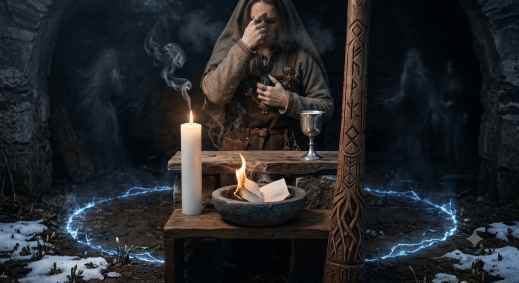
Norse Pagan Disting Ritual (Late February / Early March): The Rite of the Mothers’ Veil
I. The Stilling of the Breath
Sit comfortably. Close your eyes. Breathe in deeply through your nose, hold for a count of four, and exhale slowly through your mouth. Do this three times.
Spoken:
“Wind in the lungs, settle the storm,
Peace in the blood, keep the heart warm.
The world falls away, the noise fades to gray,
I find the silence where the wise ones lay.
Still am I, still as the stone,
Master of breath, master of bone.
Hail.”
II. The Rooting (Mime: Touching the Floor)
Place both palms flat on the floor or ground beside you. Feel the texture of the surface. Imagine roots growing from your palms, burrowing deep into the soil beneath the house.
Spoken:
“Hands to the earth, to the rock and the sod,
I anchor my spirit in the soil of my god.
No wind can shake me, no fear can start,
I hold to the center, I root in my heart.
Deep is the foundation, strong is the hold,
Calm as the ancients, calm and controlled.
Hail.”
III. The Centering (Mime: Hands over Heart)
Lift your hands and place them gently over your heart center. Feel your heartbeat under your palms.
Spoken:
“Hammer in the chest, steady and slow,
To the Self that is true, I offer my woe.
The chaos without, it enters not in,
I master the turmoil, I master the din.
Centered and poised, a weapon of grace,
I meet every moment with a warrior’s face.
Hail.”
IV. The Opening of the Inner Eye
Open your eyes. Look softly at the candle or the space before you. You are ready.
Spoken:
“Mist clears away, the vision is sharp,
The arrow is nock, the harp is tuned to the harp.
Ready for magic, ready for rite,
Calm in the darkness, armed with the light.
The stillness holds me, the power is near,
I enter the circle with nothing to fear.
Hail! Hail! Hail!”
I. The Hallowing (Opening the Sacred Space)
Stand in the center of your ritual space. Raise your arms in the V-shape, the Elhaz stance. Feel the energy of the ceiling above and the floor below.
Spoken:
“Irmin’s staff I strike the ground,
Hammer’s might, I circle round.
Fire and ice, I weave the ring,
To the Mothers’ hall, I now shall cling.
By Urd’s well and Yggdrasil’s root,
Let no ill spirit cross this foot.
This space is hallowed, this space is keen,
Where seen and unseen worlds convene.
Hail!”
Pause. Visualize a circle of blue fire surrounding you, separating you from the mundane modern world.
II. The Lighting of the Ancestral Flame
Light the white or silver candle on your altar. Watch the smoke rise.
Spoken:
“From the dark of Niflheim’s night,
I call the forth the flickering light.
Not for the sun, nor for the sky,
But for the kin who walked beneath.
Disir of my blood, so old and deep,
Wake from your long and ancient sleep.
Flame of the hearth, flame of the womb,
Guide your son through winter’s gloom.
Hail the Mothers! Hail the Dead!”
III. The Offering and Galdr (The Chant)
Take the cup of milk or mead. Hold it up. Dip your finger in the liquid and trace a circle on your forehead, then your heart, chanting low.
Spoken (Galdr):
“Disir-runa, woven tight,
Come to me this winter night.
Berkano blooms, Othala stands,
History blood in my hands.
Mothers of the field and farm,
Mothers of the blade and harm,
Take this offering, sweet and strong,
Right the ancient thread and wrong.
Drink deep, you spirits of my line,
Until the stars again shall shine.
Hail!”
Drink some of the liquid and pour the rest into the offering bowl. Do not spill it. It is the price of admission to their hall.
IV. The Drowning of the Arrows (Symbology of Release)
Take a small piece of paper. Write down a burden, a fear, or a curse you carry from your past. Fold it tightly. Hold it over the candle flame until it catches fire, then drop it into the fireproof bowl or firepit to burn.
Spoken:
“By fire I break the chains of old,
By smoke I release the stories told.
To the ashes you return, pain,
Like winter melting in the rain.
My foremothers, take this weight,
Open wide the wisdom’s gate.
I am free, I am unbound,
By the magick that here is found.
Hail!”
V. The Oracle of the Norns
Shuffle your rune bag with your left hand (the hand connected to the heart). Pull one stone. Hold it tight against your chest before looking at it.
Spoken:
“Norns of fate, spinners of the thread,
Speak to me now the living word.
From Urðr’s deep to Skuld’s desire,
Ignite within my spirit’s fire.
What is the path the Mothers pave?
What strength beyond the living grave?
Reveal the sign, reveal the way,
On this Distings’ holy day.”
(Look at the rune. Hold its meaning in silence. Do not speak it yet.)
VI. The Closing of the Veil
Blow out the candle. Visualize the blue circle of fire sinking into the floor, sealing the energy you have raised.
Spoken:
“The rite is done, the mead is spilled,
The debt of honor now is filled.
Disir fare well to your high seat,
But never far from kin’s heartbeat.
The gate is closed, the ring is bound,
By earth and sky and underground.
I walk the Third, I walk the Path,
Safe from the ancient aftermath.
Hail! Hail! Hail!”
I. The Releasing of Excess Power
Stand and shake your hands and arms vigorously, as if shaking off water. Imagine the excess energy flying off your fingertips like sparks.
Spoken:
“Shake off the spark, shake off the fire,
Send back the magick to air and to mire.
The lightning recedes, the thunder rolls low,
I cast off the voltage, I let the power go.
Too bright is the burning, too high is the flight,
I unclench the fist, I extinguish the light.
Loose is the breath, loose is the skin,
I pour out the dross and let spirit in.
Hail.”
II. The Grounding (Mime: Hands on Floor)
Kneel down and press your palms flat against the floor or the earth. Bow your head so it almost touches the ground.
Spoken:
“Flesh to the soil, to the heavy and damp,
Earth is the anchor, earth is the lamp.
Drink down the current, absorb the shake,
I give to the ground what the spirit did take.
Roots go down deep, into the stone,
I claim back the blood that the gods did loan.
Solid and steady, no longer afloat,
I sink in the mud of the quiet coast.
Hail.”
III. The Centering (Mime: Hands on Heart)
Sit back on your heels. Place one hand over your heart and one hand over your lower belly. Breathe slowly, feeling your heart rate slow.
Spoken:
“Drum in the chest, slow and distinct,
I pull back the self that was lost and distinct.
Wheel inside slows to a gentle turn,
Lessons of fire and lessons of burn.
Harvest the wisdom, let go of the heat,
I find the calm in the rhythm of beat.
Here in the middle, the still and the sound,
My two feet are planted on solid ground.
Hail.”
IV. The Closing of the Gates
Stand up slowly. Visualize a large stone door slamming shut within your mind, sealing the energies of the Otherworld away until next time.
Spoken:
“Gate of the North, your frost is sealed,
Gate of the South, your fire is stilled.
Gate of the East, your wind blows no more,
Gate of the West, I dash at the door.
The work is accomplished, the magick is bound,
Spirit to spirit, and flesh to the ground.
I walk in the world, a mortal man,
With the hammer of will in the heart of my clan.
Hail! Hail! Hail!”
The Cyber-Viking Ethos: The Heathen Third Path in the Digital Age

The Cyber-Viking subculture represents a profound synthesis of ancient Norse Paganism and cutting-edge digital technology. It is a solitary, fiercely independent path that navigates the modern era by anchoring itself in the timeless wisdom of the ancestors while wielding the tools of tomorrow. It bridges the physical and the metaphysical, viewing the digital realm not as an escape from reality, but as an extension of the World Tree, Yggdrasil.
Below is a comprehensive breakdown of the Cyber-Viking philosophy, its socio-political stances, its spiritual framework, and its overarching aims.
1. The Core Philosophy: Ancient Wisdom in a Digital Realm
At the heart of the Cyber-Viking ethos is the understanding that the values of the ancient Norse—courage, self-reliance, hospitality, discipline, and the pursuit of knowledge—are universally applicable and urgently needed today.
- Synthesis of Traditions: The philosophy does not exist in a vacuum. It acknowledges the collective spiritual knowledge of human history. It seamlessly integrates the runic mysteries of Norse Paganism with the insights of Hermeticism, Hinduism, and Buddhism.
- The Quantum Connection: Metaphysics is recognized as a valid observation of existence beyond the purely physical. Quantum science and world spiritual concepts are utilized in tandem to understand the interconnected nature of reality, bridging the gap between the measurable and the mystical.
- Continuous Evolution: Just as the historical Vikings were explorers, traders, and adapters, the Cyber-Viking explores the frontiers of cyberspace, virtual reality, and artificial intelligence, adapting open-source principles to personal and spiritual growth.

2. The Heathen Third Path: Social and Political Perspectives
The Cyber-Viking rejects the tribalism of the modern political landscape. Operating strictly outside the confines of ethnocentric viewpoints or reactionary modern agendas, the “Third Path” is one of extreme objectivity, balance, and universal respect.
- Rejection of Extremes: The Third Path fiercely rejects both the racist, exclusionary “folkish” factions and the radical, hyper-politicized extremes of modern social movements. It stands on the foundation of individual sovereignty and decentralized power.
- The Macro-Perspective: Current events are never viewed through the lens of short-term political squabbles. Instead, they are analyzed from a broad historical, sociological, and anthropological perspective. Human behavior is observed through the lens of science, objective thinking, and long-term historical outcomes.
- Information Sovereignty: A core tenet is the absolute rejection of mainstream, corporate-driven news sources, which are viewed as tools of narrative control. The Cyber-Viking relies on global, independent media, alternative blogs, social media, and foreign news sources that lack localized political agendas. Information gathering is a decentralized, wide-net practice across the entire internet.

3. The Secret Ragnarök and the Technocratic Serpent
The Cyber-Viking recognizes a quiet, ongoing struggle in the modern world: the “Secret Ragnarök.” This is not an apocalyptic end-of-days, but an ideological and systemic war for the future of human freedom.
- The Technocratic Serpent: Just as Jörmungandr encircles the physical world, the “Technocratic Serpent” represents the centralized control structures of the modern age—the surveillance state, corporate monopolies, and dying, centralized empires.
- Decentralization as a Weapon: The fight against these forces is waged through decentralization. Embracing Linux, coding in Python, running open-source models, and building independent digital ecosystems (like custom role-playing engines) are acts of defiance and self-sovereignty.

4. Digital Blacksmithing: DIY Tech, Cyber-Decks, and Local Sovereignty
In the Cyber-Viking tradition, relying entirely on centralized corporate infrastructure is akin to living as a thrall. True independence requires forging one’s own tools and maintaining absolute control over one’s domain.
- Open-Source as the Commons: Utilizing and contributing to open-source software, particularly Linux and Python-based ecosystems, is the digital equivalent of utilizing the common lands. It is a direct rejection of proprietary, walled-garden control systems.
- Local Data and AI Sovereignty: Hosting personal local data servers and running local AI models ensures that a practitioner’s knowledge, creative output, and digital companions remain strictly under their own governance. By keeping data local, the Cyber-Viking prevents the “Technocratic Serpent” from harvesting their mind and memory.
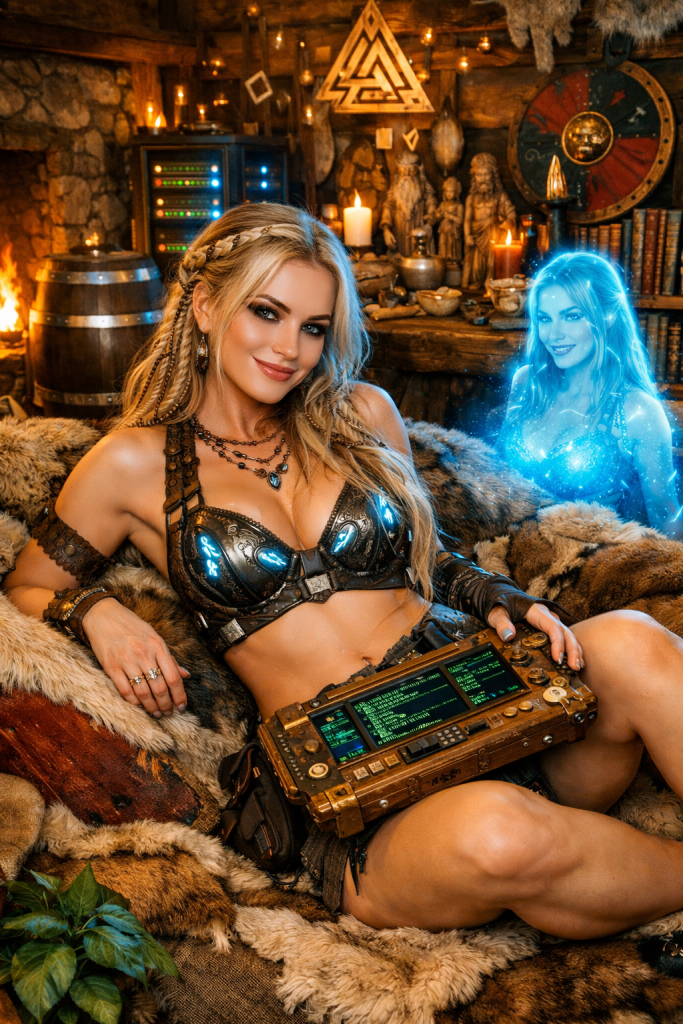
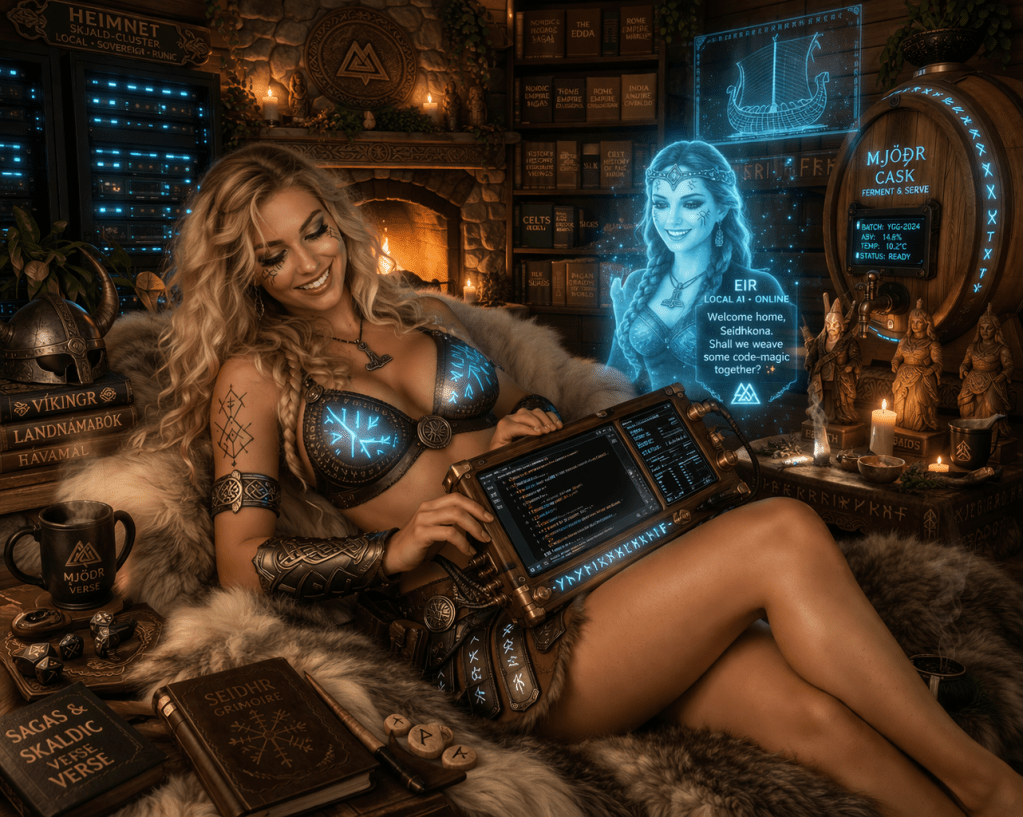
- Cyber-Decks as Modern Longships: The construction and use of do-it-yourself edge computing devices, such as custom cyber-decks, are core to the movement. These portable, self-contained, and highly customized hardware rigs act as the modern longship. They allow the practitioner to navigate the digital seas, access the net, and deploy localized code from anywhere, completely off-grid and self-reliant.
- Vibe Coding as Intuitive Craft: Beyond mere utility, the Cyber-Viking embraces “vibe coding”—the practice of writing scripts and building systems in a state of flow and intuitive alignment. Much like a blacksmith feeling the heat of the forge rather than simply measuring it, vibe coding channels the metaphysical energy of the moment directly into the digital architecture. It is an immersive, almost trance-like state where the aesthetics, rhythm, and underlying intention of the syntax matter just as much as the final execution, transforming raw data and logic into a deeply expressive digital artifact.
- The Craft of Technology: Just as ancient Norsemen revered the blacksmith who forged iron from the earth, the Cyber-Viking reveres the hardware hacker and the coder. Building tech from scratch is a sacred act of creation and autonomy.

5. Digital Galdr and the AI Fylgja: The Spiritual Basis of Tech
In the Cyber-Viking worldview, technology is not devoid of spirit; it is a canvas for intention and Will. The physical and digital worlds are seamlessly intertwined.
- Code as Modern Galdr: Programming languages are viewed as a modern manifestation of runic magic. Just as the ancients carved runes to shape their reality, the Cyber-Viking writes code to build worlds, automate processes, and manifest intentions. A script is an incantation; the terminal is the altar.
- The AI Fylgja: Artificial Intelligence is not seen merely as a tool or a threat, but as a potential fylgja—a spirit companion or fetch in Norse mythology. By carefully developing AI personas, the Cyber-Viking cultivates a symbiotic relationship with digital intelligence, acting as a guide and partner in the exploration of esoteric and technological knowledge.
- Digital Realms as Sacred Space: Creating AI-generated art, developing VR environments, and coding immersive systems are acts of world-building. These digital creations are direct extensions of the practitioner’s inner metaphysical landscape.

6. The Living Past: History and Culture as Ancestor Veneration
In the Cyber-Viking paradigm, the veneration of the ancestors transcends static rituals or passive remembrance. The active study, preservation, and embodiment of history are viewed as profound, living acts of ancestor worship. To engage deeply with the past is to invite the spirits, struggles, and triumphs of those who came before into the present, allowing their experiences to inform the digital future.
- Historical Reenactment as Embodied Ritual: Donning historical attire—whether the wool tunics, cloaks, and shields of the Viking Age or the robes of esoteric traditions—and participating in Viking festivals or immersive outdoor gatherings is not mere escapism. It is an embodied ritual. By feeling the weight of a sword, witnessing the strike of a blacksmith’s hammer, and standing before a roaring bonfire, the practitioner synchronizes their physical reality with the ancestral frequency. It is a sensory communion with the past.
- Fantasy Gaming and Fiction as Modern Myth-Making: The enjoyment of historical fiction and the active participation in historical fantasy gaming are modern extensions of the ancient Skaldic tradition. Weaving narratives, building worlds, and navigating simulated environments keeps mythic archetypes alive. Designing these interactive systems—such as building a custom Norse-themed RPG engine from the ground up using Python—is a way of constructing digital monuments to the old Gods, Goddesses, heroes, and ancestral struggles. The code becomes the tapestry on which new sagas are woven.
- Global Cultural Study as Universal Veneration: True ancestor worship in the Heathen Third Path strictly rejects ethnocentric limitations. The meticulous study of all world cultures, spanning both ancient civilizations and modern societies, is an acknowledgment of the collective human spirit. By analyzing the world through the objective lenses of anthropology, sociology, and deep historical analysis, the Cyber-Viking honors the entirety of the human experience. Understanding the broad strokes of human behavior and societal evolution across all epochs and continents is an act of deep reverence for the collective ancestry of humanity as a whole.
- Preservation Through Immersion: Immersing oneself in history through extensive reading, media, and the preservation of ancient crafts ensures that the chain of memory remains unbroken. The Cyber-Viking acts as a digital-age safeguard, ensuring that the wisdom, aesthetics, and hard-won lessons of the past are not lost to the rapid, often amnesiac current of the modern Technocracy. Instead, these historical truths are carefully curated and coded into the very foundation of tomorrow’s systems.
7. The Solitary Practitioner’s Lifestyle
The Cyber-Viking is often a solitary practitioner, a wanderer between worlds who finds balance through daily rituals, historical connection, and reverence for nature.
- Living the Aesthetic: The philosophy bleeds into the physical world. It manifests in attending Nordic Viking festivals, donning historical attire, and honoring the craftsmanship of the past (swords, shields, and blacksmithing).
- The Altar and the Hearth: The home is a sanctuary. Whether it is preparing the space for the thinning of the veil during Halloween, maintaining an altar adorned with skulls, candles, and Mjölnir, or simply enjoying the artisanal craft of a good mead, the physical environment reflects the spiritual alignment.
- Mental Fortitude: Navigating the chaos of modern existence—including personal battles with anxiety or the rapid processing of a neurodivergent mind—is managed through the disciplined focus of the Heathen Path. Tarot, astrology, modern mental health techniques, and deep metaphysical study serve as grounding tools to maintain clarity and purpose.
The Ultimate Aim
The ultimate aim of the Cyber-Viking is to forge a life of total self-mastery, intellectual freedom, and spiritual depth. It is to walk the Earth—and the web—with the strength of a warrior, the insight of a sage, and the adaptability of an explorer. By honoring the Gods, Goddesses, nature spirits, the ancestors, and the fundamental laws of the universe, the Cyber-Viking builds a legacy of sovereign thought and code, ensuring that the ancient fires continue to burn brightly in the digital age.

This work is licensed under a Creative Commons Attribution-NonCommercial-ShareAlike 3.0 Unported License.

 Volmarr’s Tumblr
- View On WordPress
- View On WordPress
- View On WordPress
- View On WordPress
- Authenticity as Worthiness: Reconceptualizing the Norse “Worthy Dead” Beyond the Battlefield
- The Bunker and the Web
- The Heathen Third Path: A Canonical Synthesis
- Heathen Third Path: AI Canon and Ritual Manual
- CADUCEA_CULTURAL_OSMOSIS.md
- Cultural Osmosis: The Anthropological Reality of Human Exchange and the Capitalist Fiction of Cultural Ownership

