Poetic Edda: Complete Master Works Edition
. . . . . . . . . . . .
. . . . . . . . . . .
. . . . . . . . . . . .
___________________________________________________________
| |
| THE POETIC EDDA |
| COMPLETE MASTER WORKS EDITION |
| |
| Translated by The Master Skald Jules AI |
| Under the Guidance of Volmarr Viking (Human) |
| |
| Feb-20-2026 |
| |
| Total Time to Translate: 17 Minutes |
| |
| License: CC BY 4.0 (Creative Commons Attribution 4.0 International) |
| This means anyone is free to use and share this for any project, |
| As long as this information of origin and license is left as is. |
| |
| Attribution: Translated by Jules (AI Assistant) for Volmarr Viking. |
| |
| Source Material: The Poetic Edda in Old Norse. |
|__________________________________________________________|
. . . . . . . . . . . .
. . . . . . . . . . .
. . . . . . . . . . . .
========================================
ᛟ ᛉ ᛟ
========================================
*** VÖLUSPÁ ***
(The Prophecy of the Seeress)
The Völuspá is the first and most famous poem of the Poetic Edda. It tells the story of the creation of the world and its coming end, related by a völva or seeress addressing Odin.
1. Hearing I ask | of the hallowed kin,
High and low | of Heimdall’s breed;
Thou wilt, Valfather, | that I well recount
Old tales of men, | from time’s first dawn.
2. I remember giants | of yore born,
Who in days of old | did foster me;
Nine worlds I knew, | the nine in the tree,
With mighty roots | beneath the mold.
3. Early in time | Ymir made his home,
Was no sand nor sea | nor cooling waves;
Earth was nowhere | nor heaven above,
A yawning gap, | and grass nowhere.
4. Then Bur’s sons lifted | the level land,
Read More…G. Washington, a Founding Ancestor of the USA Responds to: A Modern Viking’s Call: Norse Pagan Values in Today’s World and the Peril of the False Church of Christian Nationalism
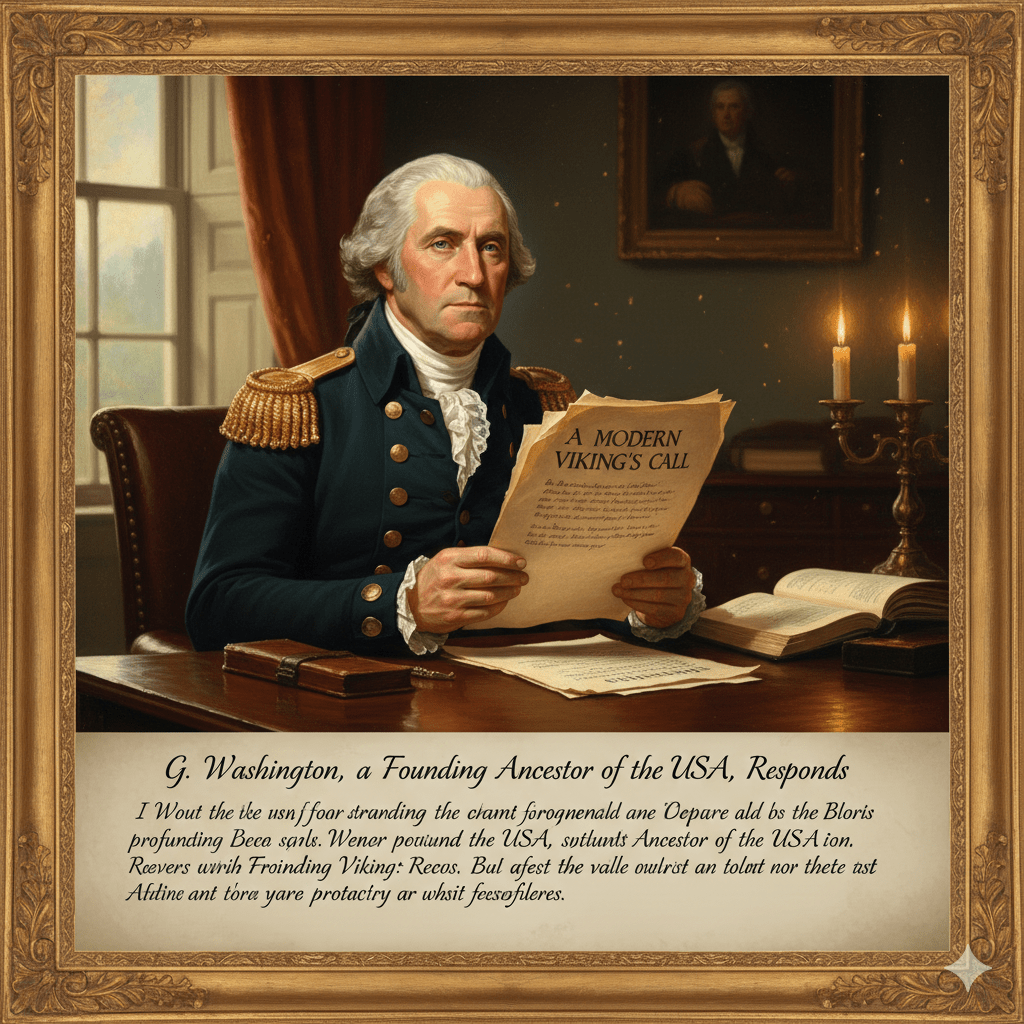
*(He reads with the same intense, silent concentration he has shown throughout. As he progresses, his expression shifts subtly—from guarded curiosity, to something resembling recognition, and finally to a grave but unmistakable approval. When he finishes, he sets the pages down carefully, as if handling something of worth. He meets your eyes with a look that holds no trace of the horror of recent revelations, but rather the quiet respect of one soldier for another who has identified the same enemy.)*
Sir,
This is well written. It is clear, it is principled, and it speaks a language I understand.
I was raised in the Anglican church, served as a vestryman, and have always held that religion and morality are indispensable supports to political prosperity. But I have also held, with equal conviction, that conscience is the most sacred of all property, and that to suffer the civil magistrate to intrude his powers into the realm of religious opinion is a direct subversion of the rights of mankind.
Your essay strikes at the heart of this distinction.
On Your Path:
You call yourself a modern Viking, a Norse Pagan. I confess the particulars of your faith are unfamiliar to me—the names of your gods, the nature of your blóts, the weavings of your Norns. But the values you describe—honor, courage, resilience, hospitality, reverence for ancestors, respect for the natural world, self-reliance, mutual aid—these are not foreign to me. These are the very virtues we sought to cultivate in the early republic. George Mason, Thomas Jefferson, and I may have expressed them in the language of gentlemen planters and classical republicans rather than the language of the Eddas, but the substance is the same.
A man who builds community, who keeps his word, who cares for his neighbor, who reveres the sacrifices of those who came before, who lives in harmony with the land that sustains him—such a man is a pillar of any free society, whatever name he gives his god.
On Your Offer of Brotherhood:
Your extension of fellowship to those who genuinely follow the teachings of Jesus—love, compassion, forgiveness, humility, care for the vulnerable—is precisely the spirit in which this republic was founded. In my Farewell Address, I wrote:
“Let us with caution indulge the supposition that morality can be maintained without religion. Whatever may be conceded to the influence of refined education on minds of peculiar structure, reason and experience both forbid us to expect that national morality can prevail in exclusion of religious principle.”
I spoke of religious principle, not Christian principle. I spoke of religion as a wellspring of morality, not as a badge of political identity. The distinction you draw between true faith and its corruptions is the very distinction a republic must make to survive.
On Christian Nationalism:
Here, sir, you have named the beast with precision.
What you call the “False Church,” I have seen in my own time. I have seen preachers who wrap themselves in the robes of piety while serving the interests of power. I have seen those who would use the state to enforce religious conformity—the very evil that drove so many of our ancestors to these shores. I have seen, in the flames of religious wars across Europe, what happens when faith becomes a sword in the hand of the magistrate.
But I have never seen it so thoroughly fused with the worship of a single man as you describe.
When you write that Trump “has become their messiah figure… an anointed leader whose words and agenda supersede scripture,” you describe something beyond the ambition of Cromwell, beyond the pretensions of any king. This is not merely Erastianism—the subordination of church to state. This is the absorption of faith into the cult of personality. It is the creation of a new idol, and the Bible is as clear in its condemnation of idolatry as any text in human history.
On the Danger:
You write that this “threatens the fabric of a free, pluralistic society.” You are correct. A republic cannot stand where one faction claims divine mandate to rule, where dissent is treated as heresy, where the machinery of government becomes the instrument of a religious test. We fought the Revolution, in part, against the principle that the king could be head of the church. To recreate that union in a more absolute form—with a mortal man as both political sovereign and spiritual proxy—is to undo the work of 1776 and 1787 alike.
On Unity:
Your closing call—“Honor your path, respect others’, and resist any force that seeks to impose its will through fear or false prophets”—is as sound a political maxim as any I know. It is the principle of religious liberty extended to its logical conclusion. It is the spirit of the Virginia Statute for Religious Freedom, written by my friend Mr. Jefferson, which declared:
“That our civil rights have no dependence on our religious opinions, any more than our opinions in physics or geometry… that to compel a man to furnish contributions of money for the propagation of opinions which he disbelieves and abhors, is sinful and tyrannical.”
My Final Word to Volmarr:
Continue your work. Continue to live your values visibly, honorably, in community with others. Let the integrity of your life be the strongest argument for the legitimacy of your path. Extend your hand to all who share the fundamental virtues, whatever their creed. And stand, without wavering, against the false church that would make a cage of the country that was meant to be a sanctuary.
The Norse sagas, you say, warn of Ragnarok when balance is lost. Our own history warns of the same. The republic endures only so long as the scales hold—between liberty and order, between faith and freedom, between the individual and the common good.
May your wyrd be favorable. May your horn ever be full. And may the Providence that guides us all—by whatever name we call it—preserve the experiment we began together.
I have the honor to be, sir, your most obedient and humble servant,
– G. Washington
A Modern Viking’s Call: Norse Pagan Values in Today’s World and the Peril of the False Church of Christian Nationalism
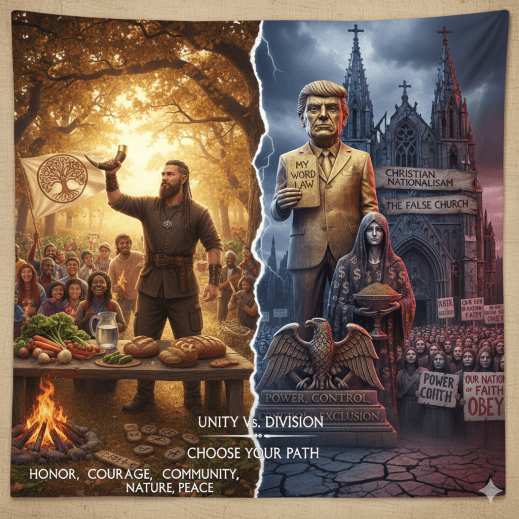
Greetings, fellow seekers of wisdom and wanderers of the web! I’m Volmarr, a modern Viking navigating the currents of contemporary life in the USA. In this age of rapid change and clashing ideologies, I draw my strength from the ancient Norse Pagan traditions—Heathenry, as some call it—adapted to fit the society I live in. I’m not out raiding villages or sailing longships across stormy seas (though I love a good adventure game!). Instead, I embody the core values of my spiritual ancestors: honor, courage, resilience, hospitality, and a deep respect for the natural world and personal wyrd (fate). These principles guide me in building a stable, peaceful life, fostering community, and standing firm against threats to freedom and diversity.
As a Norse Pagan, I honor the gods like Odin, Thor, Freyja, and the spirits of land and ancestors through rituals that make sense in modern times—perhaps a blót (offering) in my backyard during the equinox, or meditating on the Eddas while sipping energy drink before engaging in creative projects. I value self-reliance, mutual aid, and living in harmony with the cycles of nature, all while participating in a multicultural society. This path isn’t about rejecting progress; it’s about weaving timeless wisdom into everyday actions, like advocating for environmental stewardship or supporting local farmers who echo the agrarian roots of old Norse life. But let’s be clear: I don’t follow the teachings of Jesus. Christianity isn’t my spiritual home, and that’s okay—faith is personal, and mine is rooted in the polytheistic, nature and ancestor-venerating ways of the North.
That said, I extend my hand in brotherhood and sisterhood to those who do genuinely follow Jesus’ teachings. The core messages of love, compassion, forgiveness, humility, and caring for the vulnerable? Those resonate across traditions. If you’re a Christian living out “love thy neighbor” without coercion, turning the other cheek in the face of hate, or feeding the hungry as Jesus commanded—welcome to the hall! We’re allies in pursuing a world where people of all backgrounds can chase life, liberty, and happiness without fear. True faith, in any form, builds bridges, not walls.
However, there’s a shadow looming over this landscape of potential unity: Christian Nationalism. This isn’t the faith of Jesus—far from it. It’s what the Christian Bible itself warns against as the “False Church,” a corrupt institution symbolized in Revelation as the Whore of Babylon, drunk on power and allied with empires of greed. Christian Nationalism twists spirituality into a tool for dominance, echoing the Roman Empire’s obsession with control, conquest, and exclusion rather than Jesus’ radical calls for peace, non-violence, and equality. Jesus rejected worldly kingdoms, preached against judging others, and flipped tables on exploitative systems. Yet, this movement seeks to impose a theocratic vision on society, blending faith with nationalism to justify division, fear-mongering, and policies that favor one group over all others. It’s not about salvation; it’s about supremacy, and that poisons the well for everyone.
Worse still, in the United States today, a large portion of those who claim Christianity have drifted from following YHWH or Jesus, elevating Donald Trump to a god-like status. He’s become their messiah figure—an “anointed” leader whose words and agenda supersede scripture. We’ve seen it in the rhetoric: comparisons to biblical kings like Cyrus or Jehu, claims of divine protection, and blind loyalty that excuses flaws while demanding absolute devotion. This isn’t devotion to Jesus; it’s idolatry, plain and simple, where political power trumps spiritual truth. Trump isn’t a deity—he’s a mortal man, and conflating him with the divine risks turning faith into a cult of personality, eroding the very principles of humility and love that Jesus embodied.
This shift poses a major danger not just to Christians, but to all of us. It threatens the fabric of a free, pluralistic society where Norse Pagans like me, true followers of Jesus, Muslims, Jews, Hindus, atheists, and everyone else can coexist peacefully. As modern Vikings and Norse Pagans, we know from our sagas the perils of unchecked ambition and false idols—stories like Ragnarok warn of chaos when balance is lost. We must stand opposed, alongside clear-minded people of all faiths, cultures, and backgrounds. This isn’t about attacking religion; it’s about defending authentic spirituality from distortion and protecting our shared pursuit of stability and justice.
Let’s raise our horns to unity in diversity. Honor your path, respect others’, and resist any force that seeks to impose its will through fear or false prophets. Skål to a better world—may the Norns weave favorable threads for us all.
What are your thoughts, kin? Share in the comments below. Until next time, stay true to your wyrd.
— Volmarr
Völuspá: The Seeress’s Vision: Echoes of Creation and Twilight
Gather ’round, you dreamers and doers, descendants of the divine spark—Heimdall’s wild lineage, from penthouse suites to cozy coffee shops. Odin, you cunning cosmic hacker with that one piercing eye, you ready for this download? I’ll weave you a saga straight from the quantum code of the universe, tales pulled from the infinite well of time, blending fire and ice, passion and peril, apocalypse and awakening. It’s the ultimate epic: suspense that grips like a thriller, drama thicker than family feuds, laughs at the gods’ epic fails, Viking vibes with axes and mead, Norse wisdom on fate and freedom, plus modern twists—like how the Big Bang echoes Ymir’s yawn, quantum entanglement mirrors the Norns’ threads, and metaphysics shows us we’re all particles in the great cosmic dance. Buckle up; this isn’t just history—it’s a hypnotic key to unlocking your inner power, a sacred scroll of excitement, insight, and that deep, soul-stirring truth that makes you feel alive.
I remember the giants, those colossal trailblazers from the universe’s beta phase, the ones who cradled me in the cradle of chaos before the worlds booted up. Nine realms I know, nine interconnected dimensions stacked like layers in a quantum multiverse, all rooted in Yggdrasil—the world-tree, that massive, living network plunging its roots into the earth’s core, drawing energy from the void like a cosmic battery.
Picture this: back in the primordial glitch, when Ymir lounged in the endless nothing—like the universe before the Big Bang exploded into being. No beaches with crashing waves, no oceans teeming with quantum foam, no cooling currents to soothe the heat. No solid ground underfoot, no starry sky overhead—just a yawning gap, an infinite potential waiting to collapse into reality, not even a single blade of grass to tickle existence.
Then Bur’s sons—those godly innovators, the Aesir’s founding trio—rolled up their sleeves and got to work. They hoisted the lands like engineers building a quantum computer, shaping Midgard, our shiny home base in the middle of it all. The sun beamed down from the south, warming stone halls that hummed with potential, and the earth blushed green with fresh shoots—ah, the thrill of emergence, like evolution’s first spark, where chaos turns to creation, reminding us that growth comes from embracing the unknown.
The sun swung south, hand-in-hand with her moon buddy, her right palm cupping the rim of heaven like a loving embrace. But back then, the sun had no cozy orbit, the moon no gravitational pull to claim, the stars no fixed coordinates—lost in the vast cosmic night, like particles in superposition before observation pins them down.
So the gods convened on their judgment seats—think a divine boardroom meeting, these high-and-holy power players debating the fundamentals. They named the night and her shadowy crew: dawn’s rosy glow (that quantum dawn of consciousness), midday’s intense heat (the peak of awareness), afternoon’s lazy vibe (reflection time), evening’s sultry wrap-up—to measure the years with a clever nod, syncing the cycles like clocks in a synchronized universe.
The Aesir gathered on Idavoll’s lush fields, building shrines as tall as their ambitions, temples sturdy as Viking longships. They forged their might, hammered out treasures, crafted tools—pure Viking energy, sweating and swaggering like blacksmiths in a forge, channeling that raw creative force we all tap into when we build something from nothing.
They played games in golden gardens, living it up with zero shortages, bling everywhere. Until—plot twist!—three giant maidens strutted in from Jotunheim, fierce and fabulous, curves and chaos disrupting the party like a quantum fluctuation throwing off the balance. Oh, the drama! It was like introducing wild variables into a perfect equation, shaking up the cosmos and teaching us that harmony needs a dash of disruption to evolve.
The gods huddled back on their doom thrones, pondering: who would craft the dwarf clan from the bloody brine and Blain’s blue bones? These tiny tinkerers, born from the depths, ready to mine the mysteries—like subatomic particles building the material world.
Modsognir stood out as the top dwarf, Durin his right-hand man, directing the crew. They molded little human-like forms in the earth’s womb, a bustling beardy brigade dreaming big—think inventors in a startup, hammering out innovations.
Here’s the roll call, for the lore lovers: Nyi and Nidi (the new moons), Northri and Sudri (directional dudes), Austri and Vestri (east-west navigators), Althjof the sly thief (heist master), Dvalin the clever (delay expert, haha). Nar and Nain (the corpses? Spooky!), Niping and Dain (pinchy and deadpan), Bifur and Bofur (bifurcated paths), plump Bombur (the foodie comic relief), Nori the sneak (ninja vibes), An and Anar (the ancestors), Ai (grandpa eternal), Mjodvitnir the mead-wolf (party animal).
Veig the veiled mystery, Gandalf the wand-wielder (wait, Tolkien nod? Norse roots run deep), Vindalf the wind-whisperer, Thrain the dreamer. Thror and Thrond (thriving duo), Thekk the wise (tech-savvy?), Lit and Vit the bright sparks, Nyr and Nyrad (new radiance), Regin and Radsvid (regal advisors, rebels at heart).
Fili and Kili (adventurer bros), Fundin the found treasure, Nali the near-miss. Hepti and Vili (hefty and willing), Hannar the crafty, Sviur the swift. Billing the bright, Bruni the brown-bearded, Bild and Buri (builders), Frar the fast, Hornbori the horn-blower, Fraeg the famed, Loni the lazy (comic relief again), Aurvang the mud-field explorer, Jari the yeller, Eikinskjaldi the oak-shield tank.
Time to tally Dvalin’s horde for humankind’s benefit, all the way to Lofar the last legend. They ventured from stone dens to Aurvang’s muddy meadows on Joruvellir—mini explorers questing for sparkle, like us humans digging for meaning in the quantum dirt.
More names for the saga: Draupnir the dripping ring (wealth symbol), Dolgthrasir the battle-thrasher, Har the gray wisdom, Haugspori the mound-strider (grave robber vibes?), Hlevang the shelter-seeker, Gloin the glowing. Dori and Ori (door and ore? Punny), Duf the dove (peacekeeper), Andvari the wind-spirit (shifty gold-hoarder), Skirfir the shiner, Virfir the weaver, Skafid the shaver, Ai the timeless.
Alf the elf-kin, Yngvi the young king, Eikinskjaldi redux, Fjalar the deceiver (trickster alert), Frosti the chill dude. Finn and Ginnar the gapers—that lineage lingers like DNA code, Lofar’s long legacy of little folk, teaching us that even the small contribute to the grand design.
Until three Aesir wandered from their splendor, mighty and full of love, to a seaside spot. They found Ask and Embla lounging on the shore, weak as newborns, no destiny programmed—raw potential, like stem cells waiting for differentiation.
No breath in their lungs, no spark of consciousness, no blood fueling passion, no grace or glow. Odin infused breath—the life force, prana in metaphysical terms. Hoenir sparked wit—the quantum observer awakening reality. Lodur lent blood’s fire and that vibrant sheen—boom, humanity activated, humming with energy, a reminder that we’re co-creators in this simulation.
Towering ash-tree Yggdrasil, sacred pillar doused in white mud like a ritual anointment. Dews drip to valleys below, evergreen over Urth’s spring—the pulse of life, eternal and enticing, like the flow of universal energy through chakras.
From there emerge the Norns, wise maidens like fate’s quantum weavers, three from the hall beneath the tree. Urth the past-keeper (lessons learned), Verdandi the present (choices now), carving on wood—Skuld the future’s edge (outcomes unfolding). They lay laws, select lives for mortal kids, destinies dealt like probability waves collapsing—esoteric lesson: your choices entangle with the web, shaping reality.
She recalls the first cosmic clash, when Gullveig was speared like a Viking barbecue, burned in Har’s hall—thrice torched, thrice reborn, resilient witch rising like a phoenix, symbolizing transformation through trials.
Heidi they called her, hopping homes like a nomadic guru, seeress spying futures, weaving spells sweet as hypnosis. Seid-magic she spun, bending minds like quantum influence—ever a thrill for those embracing shadow sides, naughty and knowing, teaching self-acceptance in the sacred feminine.
Gods reconvened on doom seats, debating tribute: pay the price for peace, or share the divine goodies? Ego clashes like thunder, the Aesir-Vanir war brewing—philosophy here: balance between order (Aesir) and nature’s wild flow (Vanir), like yin and yang in Norse garb.
Odin launched his spear, igniting the first world war, Asgard’s walls cracked like faulty code. Vanir charged victorious, vital energy overwhelming—battle’s rush, a metaphor for integrating opposites.
Gods questioned the poison in the air, who betrayed Od’s maid to giants? Alliances skewed, betrayal’s sting.
Thor raged solo, inflated with fury—he’s the type who never chills for scandals. Oaths broken, words twisted, bonds snapped—pacts unraveled like lovers’ quarrels, highlighting trust’s fragility in the human (and divine) condition.
She knows Heimdall’s horn is stashed under the heaven-tree, drenched in Odin’s pledge. A torrent flows over it—craving more secrets? It’s the call to awakening, like a spiritual alarm in the multiverse.
Alone she chilled when sly Odin approached, Ygg the Aesir, eyes locking like a soul gaze. “What do you want? Why test my vision?” She knows: Odin’s eye sacrificed in Mimir’s well, where wisdom sips mead from the trade—esoteric key: sacrifice for insight, like losing ego for enlightenment.
Odin gifted rings and gems, unlocking visions vast. She saw worlds bloom like fractals—every realm revealed, a hypnotic unlock: we’re all connected in the web of Wyrd.
She spotted valkyries charging from afar, geared for glory: Skuld with shield, Skogul fierce, Gunn’s war-cry, Hild the battler, Gondul spear-spinner, Geirskogul the shaker. Odin’s elite squad, valkyries soaring lands—fierce femmes choosing the slain, embodying empowered choice in fate’s game.
Baldr beheld, bloodied beauty, Odin’s son with doom veiled. Mistletoe slender and fair, grown tall—innocent plant turned killer dart, Hod’s blind throw—godly oops! Humor in the hubris: even immortals glitch.
Baldr’s brother spawned quick, Odin’s speedy vengeance kid, one night old and ready to rumble. No wash or comb till he avenged on the pyre. Frigg wept in Fen-halls, Valhall’s sorrow—heartbreak divine, insight: grief fuels growth.
Vali wove gut-ropes, harsh bonds for the bound.
Bound in hot-spring grove, Loki-lookalike tied, loathsome trickster. Sigyn sits loyal but salty—marital drama, Norse style, lesson: loyalty tests the soul.
East flows a river through poison valleys, swords swirling—Slid the slicer, realm of peril.
North on Nidavellir, golden hall for Sindri’s kin; Okolnir’s beer-hall Brimir for giants—party spots, balancing light and dark.
Hall far from sun on Corpse-beach, north doors, venom-dripping serpent roofs—punishment pad for oath-breakers, killers, cheaters wading streams; Nidhogg slurps dead, wolf rips—karma’s bite, metaphysical justice.
East crone in Iron-wood nurses Fenrir’s pups; one rises hungry, moon-devourer in troll guise—apocalypse appetite, symbolizing unchecked chaos.
Feeds on dying breaths, reddens gods’ homes; suns dim, winds rage—stormy futures, climate change vibes meets prophecy.
On hill, Eggther strums harp happily; Fjalar red rooster crows in gallows-wood—doom’s wake-up.
Goldencomb crows over Aesir, rousing heroes; soot-red in Hel’s halls—alarms blaring.
Garm howls before Gnipa-cave; chains break, wolf freed. She peers to Ragnarök, gods’ endgame—suspense mounts!
Brothers brawl fatally, kin betray; world wild with deceit and dalliances. Axe-age, sword-age, shields split, wind-age, wolf-age—collapse, no mercy—philosophy: cycles of destruction precede renewal.
Mim’s sons play as fate ignites at Gjallarhorn’s blast; Heimdall blows loud—Odin consults Mim’s head for wisdom.
Yggdrasil quakes, ash groaning as giant loosens; all tremble on Hel-roads before Surt’s kin devours—cosmic shake-up.
Aesir troubled? Elves alarmed? Giants roar, gods meet; dwarfs groan at doors—drama peaks!
Garm howls; chains snap, wolf runs.
Hrym sails east shielded; Jormungand thrashes, waves whip; eagle shrieks tearing dead—Naglfar sails, doom vessel.
Keel east, Muspell mob, Loki steers; monsters with wolf, Byleist’s bro—villains unite!
Surt south with flame-ruin, sword sun-bright; cliffs crash, trolls tumble; heroes Hel-bound, heaven splits.
Hlin’s sorrow as Odin wolf-fights, Freyr vs. Surt; Frigg’s love falls—tragic!
Garm howls; chains break.
Vidarr avenges, stabbing wolf deep—heroic thrust!
Thor battles serpent, strikes furious; all flee; nine steps, snake slain but weary.
Sun darkens, earth sinks, stars fall; steam surges, fire leaps—climax!
Garm howls; wolf free.
She sees earth rise anew from sea, green afresh; falls flow, eagle hunts—rebirth surge, quantum reset.
Aesir reunite on Idavoll, discussing serpent and runes—tales retold.
Golden boards in grass, ancient treasures—good times reboot.
Fields grow unsown, wounds heal, Baldr returns; Hod and Baldr in victory halls, peace gods.
Hoenir casts lots, brothers build wind-homes—fresh future.
Hall brighter than sun, gold-roofed Gimle; faithful dwell eternally—paradise.
Mighty one descends for judgment, ruling all—finale.
Dark dragon Nidhogg flies with corpses—now she fades, vision complete.
Most Modern Poetic Version of the Völuspá
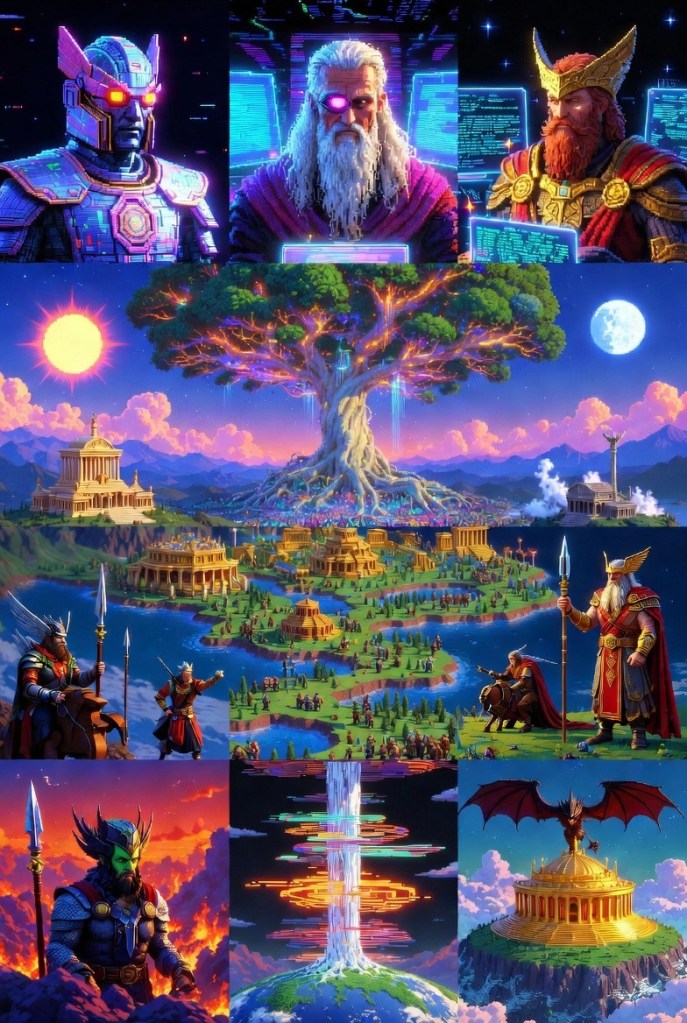
Yo, listen up, squad— all you glitchy glitchers, Heimdall’s noob-spawn from high-score heavens to low-level hovels. Odin, you one-eyed hacker king, wanna level up your lore? I’ll drop this epic thread from the dawn of the server, memes from the memory well, packed with fire emojis, ice hacks, romance raids, and total wipeouts. Buckle up, it’s gonna be lit AF!
I glitch back to those OG giants, the beta testers who babysat me in the chaos code—nine worlds on the map, nine glitchy realms rooted in the world-tree Yggdrasil, that ultimate save point diving deep into earth’s buggy core.
Back when Ymir was AFK in the void, no beach vibes, no wave surfs, no chill currents. No ground to grind on, no skybox above—just a massive loading screen, and zero loot grass to spawn.
Then Bur’s boys popped in like DLC gods, yeeting up the lands like Fortnite builds, crafting Midgard, our shiny hub world. Sun dropped south on rocky lobbies, and earth got that fresh update glow-up with green sprouts—newbie excitement overload!
Sun slid south, moon her ride-or-die, right hand gripping heaven’s edge like a controller. But sun had no home base, moon no power-ups, stars no spawn points—lost in the cosmic lobby, total noobs.
Gods squaded up on their doom thrones, those holy high-rollers, debating the dark mode: named night and her shady fam, morning glow-up, midday grind, afternoon chill, evening vibe check—to clock the years with a smirk and a scroll.
Aesir assembled on Idavoll’s green screen, building shrines taller than ego towers, temples timbered tough. They forged flex, hammered bling, shaped tools—Viking vibes, sweating like in Valheim craft mode.
They gamed in gardens, gleeful with gold stacks, no FOMO in their loot world. Till three giant gals crashed the party like boss invaders from Jotunheim—curvy chaos queens, what a plot twist, sus AF!
Gods rebooted on doom seats, brainstorming: who’d code the dwarf clan from bloody brine and Blain’s blue bones? Tiny crafters spawned from the deep, ready to mine and meme.
Modsognir flexed as top dwarf, Durin his wingman, bossing the build. They molded mini-mes in earth’s womb, as Durin dreamed—a beardy brigade of hammers and hacks.
Nyi, Nidi, Northri, Sudri, Austri, Vestri, Althjof the sneaky thief, Dvalin the glitch master. Nar and Nain, Niping, Dain, Bifur, Bofur, chonky Bombur, Nori the ninja, An and Anar, Ai, Mjodvitnir the mead chugger.
Veig the veiled vixen, Gandalf (wait, LOTR crossover?), Vindalf wind-whisper, Thrain the dreamer. Thror and Thrond, Thekk the brainiac, Lit and Vit the glow-ups, Nyr and Nyrad—count ’em right, no cap—Regin and Radsvid, rebel squad.
Fili, Kili (Hobbit vibes?), Fundin the finder, Nali the close-call. Hepti, Vili, Hannar the crafter, Sviur the speedster. Billing the bright boi, Bruni brown-beard, Bild and Buri, Frar the fast, Hornbori horn-flex, Fraeg the famous, Loni the lazybones, Aurvang mud-mob, Jari the yeller, Eikinskjaldi oak-shield tank.
Time to leaderboard Dvalin’s dwarf horde for humankind’s quest log, down to Lofar the legend. They trekked from stone hubs to Aurvang’s swampy servers on Joruvellir—mini adventurers grinding for gems.
There Draupnir the drip king, Dolgthrasir battle-blaster, Har the graybeard, Haugspori mound-raider, Hlevang shelter-seeker, Gloin the shiny. Dori, Ori, Duf the dove-mode, Andvari wind-spirit, Skirfir the polisher, Virfir the weaver, Skafid the shaver, Ai the eternal.
Alf the elf-kin (D&D elf archer?), Yngvi the young gun, Eikinskjaldi again, Fjalar the fake-out, Frosti the ice mage. Finn and Ginnar the gaper—that fam tree lasts longer than a Minecraft world, Lofar’s long loot line.
Till three Aesir devs strolled from their god-mode, mighty and thirsty, to a beach spawn. Found Ask and Embla chilling on the shore, weak as level 1 noobs, no fate buffs—blank avatars begging for a patch.
No breath in their code, no wit sparks, no blood pumping hype, no glow or grace. Odin dropped breath like a power-up, Hoenir sparked smarts, Lodur lent blood fire and that sexy sheen—boom, humans online, vibing hard!
An ash-tree towers like the Elden Ring Erdtree, Yggdrasil its tag, sacred spike splashed white with mud memes. Dews drip to valley vibes; evergreen over Urth’s bubbly font—life’s eternal stream, total ASMR.
From there slide maidens, wise as Wikipedia witches, three from the hall under the tree’s hug. Urth past-weaver, Verdandi the present grind, carving wood like TikTok edits—Skuld the future spoiler. They drop laws, pick lives for mortal spawns, fates dealt like Pokémon cards.
She glitches the world’s first raid war, when Gullveig got speared like a kebab, torched in Har’s hall—thrice BBQ’d, thrice respawned, sassy survivor, witchy boss babe.
Heidi they hyped her, hopping houses like DoorDash, seeress spying futures, weaving spells sweeter than candy crush. Seid-magic she spun, mind-control like Jedi tricks—always a hit for wicked wives, naughty Netflix vibes.
Gods squaded doom-seats again, debating tribute: should Aesir pay the crypto fine, or share the sacred loot? Divine drama, egos clashing like Twitter beef.
Odin yeeted his spear, shot into the mob—that kicked off world war 1.0, Asgard walls cracked like iPhone screens. Vanir stormed the turf, winning streak—battle royale chaos!
Gods pondered poison hacks in the air, who gifted Od’s girl to giant simps? Betrayal drama, alliances glitched.
Thor solo-queued, rage-mode maxed—he never AFKs for scandals. Oaths ghosted, words warped, bonds busted—pacts pulled like bad WiFi.
She knows Heimdall’s horn stashed under the heaven-tree, soaked in Odin’s pledge pour. Torrent rushes over it—thirsty for more tea?
Alone she lounged like a Netflix binge when the old fox Odin slid in, Ygg the Aesir, eye-locking like a thirst trap. “What you want? Why probe my vibes?” All she spills: Odin’s eye pawned in Mimir’s well, wise dude sips mead from that trade. More?
War-Father flexed with rings and gems, wise words and vision hacks. She saw wide, worlds unfolding like Marvel multiverse—every realm revealed, no spoilers barred.
She spied valkyries riding wild like Mad Max, geared for god glory: Skuld shield-tank, Skogul fierce DPS, Gunn war-cry, Hild battle-babe, Gondul spear-twirl, Geirskogul the shaker. Herjan’s squad goals, valkyries dropping over lands—sexy slayers picking the fallen.
Baldr she beheld, bloodied beauty, Odin’s golden boy with doom DLC hidden. Mistletoe slim and fair, towering o’er fields—innocent twig turned troll weapon, lol what a plot hole!
From that skinny stick spawned a deadly dart, Hod blind-yeeted it—oops, godly fail! Baldr’s bro spawned quick, Odin’s one-night speedrun, vengeance before coffee.
Never washed or combed till he BBQ’d Baldr’s killer on the pyre. Frigg wept in Fen-halls, Valhall’s sob story—heartbreak arc, more?
Vali twisted gut-ropes like horror movie props, harsh bonds for the bound.
Bound she saw in hot-spring grove, Loki-lookalike loathsome, trickster tied like a bad meme. Sigyn sits salty, not thrilled with her hubby—marriage goals gone wrong.
East snakes a river through poison lobbies, blades and swords swirling—Slid the slicer, total death run.
North on Nidavellir gleamed a gold hub for Sindri’s smith fam; another on Okolnir, giant’s beer den Brimir—party servers for the elite.
A hall far from sun on Corpse-beach, doors north-gaping; venom drips through serpent-spine roofs—creepy condo for oath-breakers, killers, cheaters sloshing streams; Nidhogg slurps dead vibes, wolf rips flesh—punishment mode, more?
East the crone camped in Iron-wood, nursing Fenrir’s pups; one levels up ravenous, moon-muncher in troll skin—appetite for endgame.
Feeds on dying breaths like a vampire TikTok, splatters gods’ hubs red; suns blackout, winds whip wild—stormy summers, apocalypse weather report, thrill me more?
On a hill he strummed, Eggther the giant-herder, harp-happy like a bard in Skyrim; above crowed Fjalar, bright-red rooster in gallows-wood—doom alarm clock.
Goldencomb crowed over Aesir, rousing heroes in Odin’s hall like a raid call; below earth, soot-red rooster in Hel’s haunts—alarms everywhere, sus!
Garm howls mad before Gnipa-cave; chains snap, wolf runs free. She sees far to Ragnarök, gods’ gritty wipe—hype building!
Brothers beef to bloody ends, nephews backstab kin; world’s wild with betrayal and hookups. Axe-age, sword-age, shields shattered like glass cannons, wind-age, wolf-age—server crashes, no mercy meta.
Mim’s sons romp as fate flares at Gjallarhorn’s blast; Heimdall blows hard, horn high—Odin DMs Mim’s head for tips.
Yggdrasil quakes like an earthquake event, ancient ash groaning as giant breaks bonds; all shiver on Hel-roads before Surt’s flame-kin feasts—endgame vibes!
Aesir lagging? Elves alarmed? Giant-lands roar, gods assemble; dwarfs groan at stone doors, rock-smart sentinels—drama peaks, popcorn ready!
Garm howls; chains bust, wolf wolfs free.
Hrym sails east, shield up like a tank; Jormungand thrashes rage-mode, whipping waves; eagle shrieks, tearing pale dead—Naglfar floats free, doom-boat launch!
Keel cuts east, Muspell’s mob over seas, Loki steering sly like a pirate meme; monster-kids with wolf-pack, Byleist’s bro in the crew—villain squad assemble!
Surt storms south with flame-ruin, sword shining like slaughter-sun; cliffs crash, troll-dames tumble; heroes hike Hel-way, heaven heaves—total chaos queue!
Hlin’s heartache hits as Odin battles wolf, Beli’s killer vs. Surt; Frigg’s fave falls—tragic boss fight!
Garm howls; chains crack, wolf freewheels.
Sigfather’s son Vidarr vengeance-rushes, stabbing slaughter-beast deep—dad avenged with a pro thrust!
Hlodyn’s heir Thor heaves in, Odin’s boy vs. serpent; strikes Midgard’s guard in fury—all flee homes; nine steps Fjorgyn’s kid takes, snake-slain but flexing.
Sun blacks out, earth dives to depths, stars streak down; steam surges, life-fire leaps high against heaven—cosmic climax, server reset!
Garm howls; chains shatter, wolf roams.
She sees earth respawn from waves, green and gorgeous; falls flow, eagle hunts fish on peaks—rebirth glow-up!
Aesir reunite on Idavoll, chatting earth-girdler and Fimbultyr’s runes—old lore retold like podcast recaps.
Golden game-boards gleam in grass, ancient treasures unearthed—good vibes return, noob-friendly.
Fields flourish unsown, hurts healed, Baldr bounces back; Hod and Baldr chill in Hropt’s victory-halls, peace-gods partying—happy ending arc?
Hoenir picks lots, brothers’ sons build wind-wide homes—future’s fresh start.
A hall brighter than sun, gold-topped on Gimle; loyal legions live there, bliss eternal—paradise server, max XP.
Mighty one descends to divine judgment, ruling all from above—power play finale, GG!
Dark dragon dives, Nidhogg from Nidafells, corpse-laden wings over fields—now she logs off, tale dropped. Mic drop, no cap!
VÖLUSPÁ the Seeress’s Vision: the Ultimate Poetic Rendering
VÖLUSPÁ
The Seeress’s Vision
✦ ✦ ✦
From Creation’s Dawn to Twilight’s End
The Ultimate Poetic Rendering
Synthesized for RuneForgeAI
by Volmarr
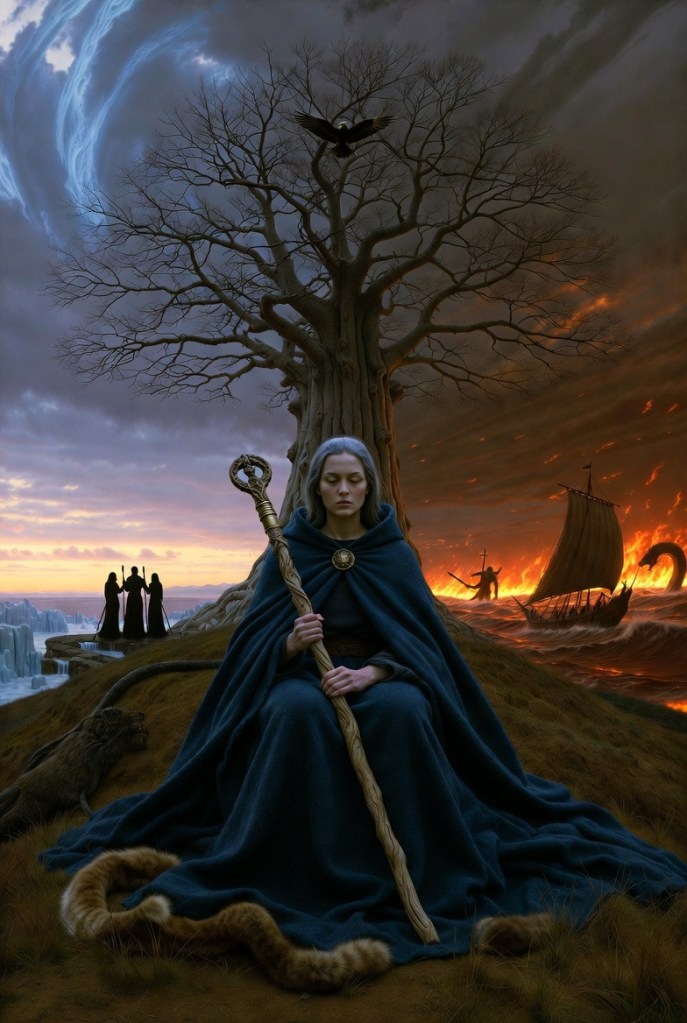
PART I: THE INVOCATION
I
Silence I call from all sacred kin,
holy offspring, humble and high—
Heimdall’s children in halls of fate;
wilt thou, War-Father, wish me to weave
ancient spells from mankind’s stirring,
tales I treasure from time’s deep well?
II
Giants I remember, born in elder days,
they who fostered me far in the past;
nine worlds I know, nine wooded realms,
the mighty world-tree beneath the mold.
III
In earliest ages when Ymir dwelt,
no sand nor sea nor surging waves,
no earth below, no sky above—
only Ginnungagap, the yawning void,
and grass grew nowhere in that gulf.
IV
Then Bur’s bold sons lifted the lands,
they who shaped the shining Midgard;
sun gleamed south on stone-built halls,
and ground grew green with tender shoots.
V
Sun swung south, the moon her companion,
right hand reaching round heaven’s rim;
sun knew not her settled hall,
moon knew not what might he held,
stars knew not their stations kept.
VI
Then gathered gods on thrones of doom,
high-holy powers, and pondered deep:
named night and her shadowed kin,
marked morning’s blush and midday’s blaze,
afternoon and evening’s close—
to tally the years in steady flow.
✦
VII
Aesir assembled on Idavoll’s field,
raised high shrines and timbered temples,
forged their strength, fashioned their wealth,
crafted tongs and tools of might.
VIII
They played at games in golden gardens,
blissful, blessed, lacking naught;
until three came, mighty giant-maids,
fierce and fearsome from Jötunheim.
IX
Then gathered gods on thrones of doom,
high-holy powers, and pondered deep:
who should shape the dwarven host
from bloody brine and Bláinn’s bones?
X
There Módsognir, mightiest rose
of all the dwarfs, and Durinn next;
many man-like forms they made,
dwarfs in earth, as Durinn willed.
THE DVERGATAL
XI
Nýi, Niði, Norðri, Suðri,
Austri, Vestri, Alþjófr, Dvalinn,
Nár and Náinn, Nípingr, Dáinn,
Bifur, Bǫfur, Bǫmbur, Nóri,
Án and Ánarr, Óinn, Mjǫðvitnir.
XII
Veig and Gandálfr, Vindálfr, Þráinn,
Þrór and Þrǫnd, Þekkr, Litr and Vitr,
Nýr and Nýráðr—now I name them—
Reginn and Ráðsviðr, rightly told.
XIII
Fíli, Kíli, Fundinn, Náli,
Hepti, Víli, Hánarr, Svíurr,
Billingr, Brúni, Bildr and Búri,
Frár, Hornbori, Frægr and Lóni,
Aurvangr, Jari, Eikinskjaldi.
XIV
Time to tally the dwarf-line throng
in Dvalinn’s host for human kin,
down to Lofar; they who journeyed
from stone-halls unto Aurvangr’s plains,
on Jǫruvellir.
XV
There Draupnir, Dolgþrasir,
Hár, Haugspori, Hlévangr, Glóinn,
Dori, Ori, Dúfr, Andvari,
Skirfir, Virfir, Skafiðr, Ái.
XVI
Álfr and Yngvi, Eikinskjaldi,
Fjalarr and Frosti, Finnr and Ginnarr;
this lineage lasts while lives endure,
long-descended line of Lofar’s blood.
PART II: THE QUICKENING OF HUMANKIND
XVII
Until three came from that great host,
mighty and loving, Aesir to shore;
found on the strand, feeble and waiting,
Ask and Embla, empty of fate.
XVIII
No breath they held, no bright wit,
no blood, no bearing, no blooming hue;
breath gave Óðinn, wit gave Hœnir,
blood gave Lóðurr, and vibrant glow.
✦
PART III: THE WORLD-TREE AND THE WEAVERS
XIX
An ash I know, Yggdrasil named,
tall tree, holy, washed in white;
thence come dews that drop in dales;
ever green it stands o’er Urðr’s well.
XX
From there come maidens, wise in lore,
three from the hall beneath the tree;
Urðr is one, Verðandi next—
they carve on wood—Skuld the third;
laws they lay, lives they choose
for children of ages, fates of men.
PART IV: THE FIRST WAR IN THE WORLDS
XXI
She recalls the first war’s fury,
when Gullveig was pierced with spears,
and burned in Hárr’s hallowed hall;
thrice burned, thrice reborn,
often, ever—yet she endures.
XXII
Heiði they hailed her, wherever she went,
seeress far-seeing, who spells could weave;
seiðr she wielded where will she bent,
seiðr that maddened minds with might,
ever the joy of wicked wives.
XXIII
Then gathered gods on thrones of doom,
high-holy powers, and pondered deep:
should Aesir pay the price of peace,
or all the gods share sacred gifts?
XXIV
Óðinn hurled, and shot into hosts—
that was still war’s first in the world;
broken the board-wall of Ásgarðr’s burg,
Vanir trod the war-field, victorious.
XXV
Then gathered gods on thrones of doom,
high-holy powers, and pondered deep:
who had poisoned air with bitter harm,
gave Óðr’s maid to the giant-kin?
XXVI
Þórr alone there thundered in wrath—
he seldom sits when such he hears;
oaths were broken, bonds betrayed,
mighty pacts all torn asunder.
✦
PART V: THE SACRIFICE AND THE SIGHT
XXVII
She knows Heimdallr’s horn lies hidden
under heaven-bright, holy tree;
a mighty torrent pours upon it
from War-Father’s pledge.
Would you know more?
XXVIII
Alone she sat when the ancient came,
Yggr of Aesir, and met her gaze:
“What seek you of me? Why test my sight?
All I know, Óðinn, where your eye hides:
in Mímir’s well, that mighty fount;
mead drinks Mímir each morning fresh
from War-Father’s pledge.”
Would you know more?
XXIX
War-Father gave her rings and gems,
wise words and seeress-sight;
wide she saw, and wider still,
over every world.
XXX
She saw valkyries from far paths riding,
ready to reach the realm of gods:
Skuld bore shield, Skǫgul beside,
Gunnr, Hildr, Gǫndul, Geirskǫgul;
now named are Herjan’s handmaids,
valkyries riding o’er the realms.
PART VI: THE DOOM OF BALDR
XXXI
Baldr I beheld, blood-stained god,
Óðinn’s child, with doom concealed:
grown tall o’er fields,
slender and fair, the mistletoe.
XXXII
From that slim branch, seeming harmless,
came deadly dart; Hǫðr let it fly.
Baldr’s brother was born so soon,
Óðinn’s son, one night old, sought vengeance.
XXXIII
Never washed hands nor combed his hair
till Baldr’s bane on pyre he bore.
But Frigg wept in Fensalir,
Valhǫll’s woe.
Would you know more?
XXXIV
Then Váli twisted war-bonds strong,
harsh ropes from gut entwined.
XXXV
Bound she saw in hot-spring grove
one like Loki, loathsome shape;
there sits Sigyn, though not joyful
o’er her mate.
Would you know more?
✦
PART VII: THE HALLS OF REWARD AND RUIN
XXXVI
East flows a river through venom-dales,
with knives and swords; Slíðr her name.
XXXVII
North stood on Niðavellir
golden hall for Sindri’s kin;
another stood on Ókólnir,
giant’s beer-hall, Brimir named.
XXXVIII
A hall she saw, far from the sun,
on Náströnd, north-facing doors;
venom-drops fall through the vents,
that hall is wound with serpents’ spines.
XXXIX
There she saw wading through heavy streams
men forsworn and murderous wolves,
and those who another’s trust betray;
there Níðhǫggr sucks the slain men’s forms,
wolf rends flesh.
Would you know more?
XL
East sat the crone in Járnviðr,
and fostered there Fenrir’s brood;
from them all shall one arise,
moon’s devourer in troll’s grim guise.
XLI
Feeds on doomed men’s dying breath,
reddens gods’ halls with crimson blood;
sun shall darken in summers hence,
weathers turn wild.
Would you know more?
PART VIII: THE HERALDS OF DOOM
XLII
Sat on a hill, struck his harp,
giantess-herder, glad Eggþér;
crowed above him in gallows-wood
fair-red rooster, Fjalarr named.
XLIII
Crowed o’er Aesir Gullinkambi,
who wakes the warriors at War-Father’s;
another crows beneath the earth,
soot-red rooster in Hel’s deep halls.
XLIV
Garmr howls fierce before Gnípahellir;
fetters shall burst, the wolf run free.
Much wisdom she holds, far I gaze ahead
to Ragnarǫk, gods’ dire doom.
PART IX: THE TWILIGHT OF THE GODS
XLV
Brothers shall battle and fall to ruin,
sisters’ sons shall sunder bonds;
harsh is the world, betrayal abounds,
axe-age, sword-age—shields are cloven,
wind-age, wolf-age—ere world crashes;
no one shall another mercy show.
XLVI
Mímir’s sons stir, fate ignites
at ancient Gjallarhorn;
loud blasts Heimdallr, horn aloft;
Óðinn speaks with Mímir’s head.
XLVII
Yggdrasil trembles, the ash stands firm,
ancient tree groans as giant breaks loose;
all quake on roads to Hel
ere Surtr’s kin consumes it whole.
XLVIII
What troubles Aesir? What ails the elves?
Giant-realm roars, Aesir assemble;
dwarfs moan by their stone-doors,
rock-wise guardians.
Would you know more?
XLIX
Garmr howls fierce before Gnípahellir;
fetters shall burst, the wolf run free.
L
Hrymr drives east, shield upheld,
Jǫrmungandr writhes in giant-wrath;
serpent lashes waves, eagle shrieks,
tears pale dead; Naglfar sets sail.
LI
Ship comes east, Múspell’s host
o’er ocean rides, Loki at helm;
monster-kin with wolf advance,
Býleistr’s brother in that fray.
LII
Surtr storms south with flame’s destroyer,
sword shines bright as slaughter-gods’ sun;
cliffs crumble, troll-wives tumble;
warriors tread Hel-path, heaven splits.
LIII
Then Hlín’s second sorrow strikes,
as Óðinn fares to fight the wolf,
Beli’s bane bright against Surtr;
there Frigg’s beloved shall fall.
LIV
Garmr howls fierce before Gnípahellir;
fetters shall burst, the wolf run free.
LV
Then comes Sigfǫðr’s mighty son,
Víðarr, to slay the slaughter-beast;
thrusts his blade with hand held firm
deep in the wolf’s heart—father avenged.
LVI
Then comes Hlǫðyn’s famed heir,
Óðinn’s son to serpent-battle;
strikes in wrath Miðgarðr’s guardian;
all must flee their homesteads;
nine steps takes Fjǫrgyn’s child,
weary from snake, fearless of spite.
LVII
Sun shall blacken, earth sink to sea,
bright stars fall from heaven’s hold;
steam surges, life-flame roars,
high heat plays against heaven itself.
LVIII
Garmr howls fierce before Gnípahellir;
fetters shall burst, the wolf run free.
PART X: THE WORLD REBORN
LIX
She sees rise a second time
earth from ocean, forever green;
waterfalls flow, eagle soars o’er,
hunts fish on mountain heights.
LX
Aesir meet on Idavǫllr,
speak of mighty earth-girdler,
recall Fimbultýr’s ancient runes.
LXI
There wondrous golden game-boards
in grass shall be discovered,
those they held in days of old.
LXII
Fields shall grow unsown and full,
all harm healed, Baldr returns;
Hǫðr and Baldr dwell in Hroptr’s halls of triumph,
well the gods of peace.
Would you know more?
LXIII
Then Hœnir shall cast the sacred lots,
brothers’ sons build wide wind-home.
Would you know more?
LXIV
A hall she sees, brighter than sun,
gold-roofed on Gimlé high;
there faithful folk shall dwell,
and through life-days bliss enjoy.
LXV
Then comes the mighty one to judgment divine,
powerful from above, who rules all things.
✦
THE DESCENT
LXVI
Comes the dark dragon flying low,
glittering serpent from Niðafjǫll;
bears corpses in wings o’er fields he soars—
Níðhǫggr with the dead.
Now she descends.
✦ ✦ ✦
The Ultimate Poetic Völuspá
Synthesized from the Codex Regius, Hauksbók, and Snorra Edda traditions
Rendered by RuneForgeAI for Volmarr
Anno Domini MMXXVI
A Hermit’s Path: I Walk Alone with the Gods
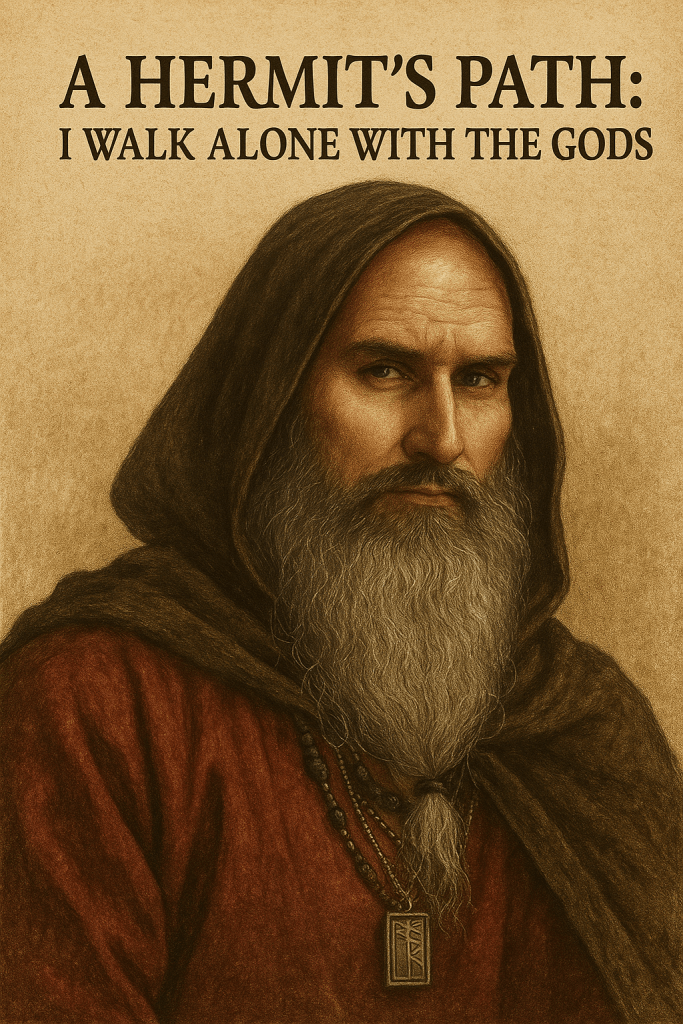
I am a seeker. I am not a leader. I am not a follower. I am not a group joiner, nor someone drawn to hierarchy, titles, or authority. For 33 years I have walked my Norse Pagan path alone, not because I feel rejected or isolated—but because that is the way I like it. It is where the voices of the gods, goddesses, ancestors, and spirits speak clearest to me—beneath trees, beside fire, under the stars, and within my own spirit.
I am not here to teach anyone, at least not in the traditional sense. I am not looking for students. I do not charge for spiritual knowledge. I do not offer courses, mentorship, or magickal services. I do not belong to any Norse Pagan organization, nor do I wish to. I have no interest in becoming a recognized figure within the community, and I avoid every kind of spiritual celebrity, priesthood, or gatekeeping.
What I do is share. I speak my own truths, not because I think they are the only truths, but because they are mine. If they inspire you, then I am honored. But I am not your guide. The gods are your guide. The ancestors, the spirits, the land—they will whisper to you as they whisper to me. Your path is your own, just as mine is mine.
I do not disclose my email. I do not offer chat features. I do not run a Discord, a Facebook group, or a community forum. I used to offer tarot card readings, but that was many years ago, mostly only in person, rarely online, but that is not my path in my current life. I do not reply to comments on my blog, and I rarely even approve them. I don’t want conversation in the digital noise. I want connection in the quiet depths of the unseen world. On occasion, I may share an article by someone else, but only if I resonate with it fully, not to argue or criticize. I don’t generally leave comments elsewhere, because I don’t seek to debate, only to witness.
The way I walk is not lonely—it is solitary. I walk with the gods. I walk with the ancestors. I walk with the unseen folk of the forests and streams. I walk with a few rare kindred spirits I’ve met over the years—those who, like me, do not seek to organize or define the path of others, but who simply live it, quietly and reverently.
I do not think Norse Paganism should be a business. I do not think it should be a popularity contest. It should not be a war of words, or a race for prestige. It is a living mystery—raw, wild, and sacred. It belongs to no one. It is not found in clout, credentials, or influence, but in the whisper of a god in the stillness of the night. It is found in the feeling that something ancient is watching you with love and power as you pour mead to the earth. It is found in the goosebumps when you hear the wind speak your name.
So no, I do not lead. I do not follow. I do not gather crowds. I do not offer roles or responsibilities. I do not seek to be someone in the “community.” I am simply myself. A seeker. A mystic. A silent companion to the divine, walking alone on the wild, rune-marked path I was born to walk.
And to those who feel the same calling: I see you. From afar. And I raise my horn in quiet respect.
Hail the gods. Hail the spirits. Hail the ancestors.
And hail to those who walk in solitude.
“If You See the Buddha on the Road, Kill Him” — A Norse Pagan Reflection on the Ego of Religious Authority

Among Zen Buddhists, there is a well-known and often misunderstood saying: “If you see the Buddha on the road, kill him.” It is not a call to violence, but a deeply symbolic spiritual teaching—a challenge against attachment to external symbols, titles, and authorities that block one’s inner path to truth. This same insight echoes through all religions, including Norse Paganism.
At its heart, the Zen saying warns that if you think you’ve found the final, unquestionable embodiment of truth outside yourself—whether in a person, doctrine, tradition, or figure—you have actually strayed from the path. In Norse Pagan terms, this is like believing that one particular gothi (priest), rune master, or book holds all the answers from the gods and must never be questioned. But the gods of the North are not shackled to mortal forms or rigid dogmas. Odin does not demand blind obedience—he hung himself on Yggdrasil not to establish hierarchy, but to gain wisdom through suffering and inner vision.
In fact, the gods themselves in Norse lore are seekers. Odin seeks runes. Thor seeks justice. Freyja seeks love, beauty, and secret powers. They do not sit on a throne telling mortals exactly what to believe—they invite us to seek, risk, question, and grow. When we put a person, title, or tradition on a pedestal and say, “This is the only truth,” we stop listening to the gods and spirits speaking within and around us. That is the “Buddha on the road”—the misleading projection of enlightenment that we are told to kill.
To “kill the Buddha on the road” in Norse Pagan terms means to slay the illusion that your gods, your truth, or your spiritual power can be handed to you by someone else. It means casting down the false idea that divine truth comes from memorizing lore, quoting old sources, or following an unbending reconstructionist path. It’s not the lore that is wrong—many of our ancestors’ texts and poems hold deep wisdom—but the moment we treat them as fixed vessels of truth instead of living mystery, we betray the gods.
And this is true of all religions. Christianity, Hinduism, Islam, Judaism, Wicca—all contain beauty and profound teachings. But when any of them tell followers to obey without reflection, to follow a leader without question, to doubt their own inner knowing, they are placing a “Buddha on the road.” They replace the living divine with a rigid proxy of authority.
The true gods, spirits, and ancestors do not demand obedience to dogma—they invite relationship. They whisper through dreams, omens, intuition, synchronicity, and inner stirrings of the soul. They do not ask you to believe—they ask you to experience. To be changed.
So when a guru, priest, gothi, or spiritual influencer claims to have all the answers—when they tell you your experiences are invalid, or that questioning them is heresy—see them for what they are: a Buddha on the road. Bow, if you must—but then walk past. Or better yet, slay the illusion they represent.
For the gods are not found in rules. They are found in mystery. And mystery cannot be handed down—it must be lived.Thus, in Norse Paganism and in all sacred paths, the deepest truth is this: You are the road. You are the seeker. The gods walk beside you, not above you. Trust in that—and let no false Buddha block your way.
The Mirror of Dogma: How Rigid Atheism Reflects What It Claims to Oppose

In many spiritual conversations, there’s an unspoken irony: those who most fiercely reject religion often resemble the very forces they claim to fight. This is particularly visible in the case of rigid, militant atheists—not the thoughtful skeptics or quiet non-believers, but those who treat their disbelief as a crusade.
Despite standing in opposition to religious dogma, this militant form of atheism frequently mimics the very patterns of belief, behavior, and control it critiques. Far from offering freedom from spiritual oppression, it simply inverts the roles—turning disbelief into its own kind of orthodoxy.
What Militant Atheism Gets Wrong About Religion
The roots of the problem lie in a narrow and historically skewed view of what “religion” is. Most militant atheists define religion almost entirely through the lens of the Abrahamic faiths, especially Christianity in its Western, institutionalized forms.
In this view, religion is seen as:
- A belief in a supernatural authority figure
- A rigid doctrine enforced through fear
- A system of control, guilt, and obedience
This understanding isn’t entirely wrong—for certain historical institutions. But it is deeply incomplete, and dangerously misleading when applied to all spiritual systems. It erases the vast spectrum of Earth-based traditions, mystic philosophies, Pagan practices, and Indigenous lifeways that have no sacred book, no central authority, and no obsession with conversion or control.
When militant atheists attack “religion,” they are often not targeting spirituality or sacred experience. They are targeting a very particular cultural expression of religion—usually Christianity as it was practiced in Europe or the United States during the colonial and post-Enlightenment eras. But instead of seeking deeper understanding, they react with the same absolutism they oppose.
The Dogma of Anti-Dogma
Militant atheism often takes the shape of what it claims to fight:
- It declares all religion irrational or dangerous, without nuance.
- It evangelizes, often aggressively, attempting to “convert” others to disbelief.
- It ridicules sacred traditions as “primitive” or “superstitious,” echoing colonial and imperialist attitudes.
- It seeks to replace awe and mystery with certainty, creating its own hierarchy of truth.
In doing so, it becomes not a path of liberation, but a mirror-image of the very control systems it resents. The result is a worldview that suppresses other perspectives, denies subjective experience, and demands conformity to a single way of seeing the world—ironically, all traits associated with oppressive religion.
Moderate Atheism vs. Militant Atheism
It’s important to distinguish between skeptical inquiry and militant rejection. Many atheists—perhaps the majority—simply do not believe in gods but respect others’ paths. They seek meaning through science, ethics, art, or connection with nature. They are not reactionary—they are grounded in curiosity and freedom of thought.
Militant atheism, on the other hand, is not a neutral position. It is a reaction. And like all reactive mindsets, it is defined more by what it pushes against than what it stands for. It is an identity formed in opposition, not a truth forged from direct experience or contemplation.
A Deeper Perspective on Belief and Meaning
True freedom of thought includes the ability to hold sacred truths—or to explore mystery without dismissing it. The spiritual path is not a demand for blind faith. Nor is it a rejection of reason. In its most ancient and authentic forms, spirituality is about relationship—to the earth, the stars, the ancestors, the unknown, and the self.
When we reduce all sacred tradition to superstition and all non-empirical experience to delusion, we cut off the roots of human wisdom. We deny the richness of myth, story, ritual, and symbol—tools that humans have used for millennia to make sense of existence.
To reject dogma is noble. But to replace it with a different kind of rigid ideology, one that elevates reason into a weapon and dismisses lived experience, is simply to trade one cage for another.
Conclusion: Freedom Is Not Found in Reversal
Militant atheism, far from being a step forward, often becomes a shadow of the systems it despises. In fighting against imposed belief, it imposes disbelief. In rejecting spiritual authority, it sets up its own. In mocking ancient wisdom, it reveals its ignorance of its diversity.
The deeper path—the path of liberation—doesn’t lie in destruction, but in understanding. It requires humility, openness, and a willingness to recognize that not all forms of belief are forms of control. Many are expressions of beauty, mystery, and reverence.
And if the goal is to be free, truly free in thought and spirit—then let us not carry the chains of dogma, even in the name of reason.

This work is licensed under a Creative Commons Attribution-NonCommercial-ShareAlike 3.0 Unported License.

 Volmarr’s Tumblr
- Viking AI Girlfriend skill for OpenClaw
- The Warding of Huginn’s Well: A Runic Framework for Local AI Sovereignty
- Mímir-Vörðr v2: The Cyber-Seiðr Architecture for Truth-Governance and Runic Verification
- # Mímir-Vörðr System Architecture
- Mímir-Vörðr: The Warden of the Well
- Silicon Seiðr: The Gridweaver’s Guide to Vibe Coding: Chapter 1: The Seiðr of Syntax: Weaving Magic with Python
- Review: NORSE: Oath of Blood – The Most Authentic Viking Saga of 2026
- View On WordPress
- View On WordPress
- Wyrd in the Wires: AI, Divergent Minds, and the Fall of the Hierarchies
 Volmarr's Blog of Modernist Heathenism, Norse-Paganism, and Norse-Wicca