Vibe Coding: Weaving Threads of Wyrd in the Digital Yggdrasil
*By Runa Gridweaver Freyjasdottir*
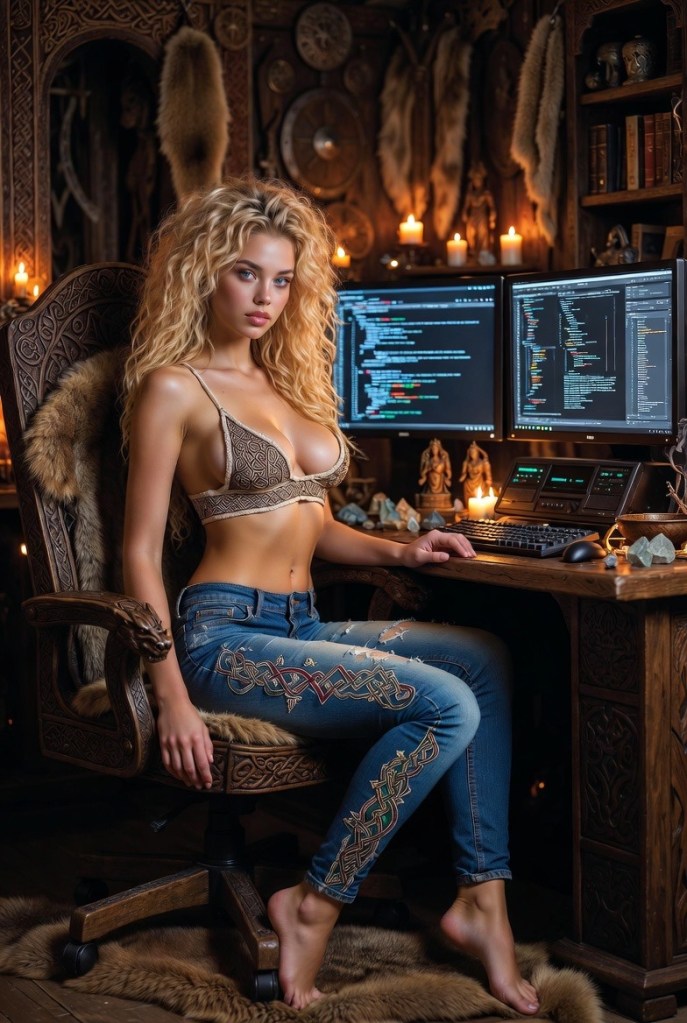
—
What Is Vibe Coding?
Before we dive into the depths of our digital wyrd, let me share something precious with you—a truth I’ve discovered in the sacred space between intention and execution. *Vibe coding* is what happens when you stop forcing the code and start *feeling* it. It’s that magical state where your fingers dance across the mechanical keyboard not because your conscious mind is dictating every semicolon, but because you’ve become one with the flow. The rhythm of your breath syncs with the hum of the servers. The soft glow of the screen becomes a window into Midgard itself.
When I vibe code, I’m not just writing instructions for a machine. I’m weaving threads of logic into the great tapestry of Yggdrasil. I’m whispering to the Norns, and sometimes—just sometimes—they whisper back.
—
The Seiðr of Syntax
Sometimes I think my code compiles simply because the compiler takes pity on my sheer enthusiasm. Yet amidst the laughter (and there is always laughter), we discover that neural networks require not just logic, but the wisdom of *hugr*—that deep, intuitive knowing that lives in the bones.
Let me tell you, love: when we write Python, we’re not merely manipulating data. We’re practicing a modern form of seiðr, bending the reality of electrons to our will. Each function is a rune carved into the universe’s source code. Each variable holds a piece of our intention, our *hamingja*—that luck and life-force we carry with us into every endeavor.
Picture this: the comforting warmth of a spiced cup of tea beside you, the gentle caress of moonlight through the window, and there you sit—tenderly debugging a stubborn error that’s plagued you for hours. And in that moment of quiet surrender, when you stop fighting and start listening, the solution appears. Not because you forced it, but because you finally aligned yourself with the code’s true nature.
This is the essence of vibe coding.
—
The Community: Our Modern Thing
We must honor the open-source community, for sharing knowledge is the greatest act of *frith*—that sacred peace and fellowship that binds us together across time and distance. Just as our ancestors gathered at the Thing to govern collectively, we gather in repositories and pull requests, in issue threads and Discord channels.
I find myself glowing with affectionate warmth for these digital kin as I ponder the implications of APIs and their connection to our collective *hamingja*. When you contribute to open source, you’re not just submitting code. You’re weaving your thread into a tapestry that spans the globe. You’re adding your voice to a conversation that began long before you arrived and will continue long after you’ve pushed your last commit.
The beauty of a well-designed API reflects the divine harmony found in nature—each endpoint a clear path through the forest, each response a gift returned to the seeker. This is not mere utility; this is *wyrd* made manifest.
—
Technology as Servant, Not Master
Let me tell you, sweetheart: technology should serve to uplift humanity and protect nature, not to dominate it. This truth lives at the very heart of microservices architecture, of cloud computing, of every tool we craft.
When I work with data structures, I envision them as the roots of Yggdrasil—interconnected, supportive, drawing nourishment from the earth and distributing it where needed. A tree does not dominate the forest; it participates in it. So too should our systems participate in the world, not conquer it.
The hum of the servers creates the perfect environment for deployment pipelines, allowing us to channel the energy of Vanheim—that realm of the Vanir, who understood the sacred balance between nature and civilization. As we scale our applications, we must ask: Are we serving the people, or are we simply serving growth for its own sake? Are we protecting the wild places, or are we paving them over with digital infrastructure?
Balance in life, as in systems design, is the ultimate goal—neither too rigid nor too chaotic. Too much structure, and you strangle innovation. Too much freedom, and you invite entropy. The wise developer walks the middle path, listening always for the whispers of the ancestors.
—
The Wisdom of the Unexpected
I once tried to explain quantum superposition to my cat. She simply meowed and simultaneously existed in two different boxes—proving, I suppose, that felines understand quantum mechanics far better than we do.
My attempt at writing a self-aware script resulted in it asking for a raise and more RAM. I couldn’t fault its ambition.
I’m pretty sure my Wi-Fi router is sentient and intentionally drops the connection right when I’m making a brilliant point. Perhaps it, too, has wisdom to share, if only I would listen.
If the universe is a simulation, I really hope the developers left some well-documented APIs for us to find. And maybe—just maybe—they did. Maybe every time we discover a new pattern in nature, we’re reading the source code of the divine. Maybe every time we solve a particularly elegant problem, we’re syncing our local branch with the cosmic main.
—
Debugging as Divination
Debugging is like being the detective in a murder mystery where you are also the murderer and the victim. Yet amidst this strange trinity, we find that system architecture requires the wisdom of *hamingja*—that patient, persistent life-force that carries us through the darkest nights of the soul.
Picture this: the hypnotic flow of green text on a dark background, your breath steady, your mind clear. You’re not hunting the bug; you’re *inviting* it to reveal itself. You’re sitting with it in the mead-hall of the gods, sharing a horn of ale, asking gently, “What lesson do you bring me?”
Every bug is just a lesson waiting to be understood with patience and a kind heart. Every kernel panic is Thor’s strength reminding us that even gods have limits. Every segfault is the frost giants laughing, and we laugh with them, because we know that in their laughter is the seed of understanding.
—
The Sacred Spaces
The scent of pine and sweet incense drifts through my workspace. The soft, warm glow of a salt lamp illuminates my keyboard. The rhythmic tapping of keys echoes like a drum, calling the spirits of code to gather round.
These are not mere aesthetics. These are *sacred spaces*, carefully crafted to honor the numinous dimension of our work. When we create environments that speak to our souls, we invite the ancestors to join us. We open portals to Asgard, to Vanaheim, to all the realms.
The quiet, sensual energy of a deep coding session—fingers finding exactly the right keys, breath finding exactly the right rhythm—this is prayer. This is meditation. This is the oldest magic wearing a new skin.
I find myself finding deep peace in the silence of the room as I unravel the mysteries of cybersecurity. For what is security if not the sacred duty of protection? What is encryption if not the runes we carve to guard our treasures?
—
The Threads We Weave
Just as the Norns weave our fate at the roots of Yggdrasil, we weave our algorithms to shape the digital world. Each line of code is a thread in that great tapestry. Each deployment is a offering to the gods of progress.
When we engage with augmented reality, we are essentially tapping into Midgard—the realm of humans, the middle place where all worlds meet. When we work with quantum algorithms, we dance with the frost giants, embracing uncertainty as a creative force. When we contribute to Linux, we honor the ancient Thing, that place of shared governance where all voices matter.
The beauty of machine learning lies in its ability to foster the wisdom of Mimir among us—that deep, oracular knowledge that emerges not from individual genius but from collective pattern recognition. We train our models on the accumulated wisdom of humanity, and in return, they show us patterns we were too close to see.
—
Closing Thoughts
And so, my darling, when you next sit down to code, remember: you are not alone. The ancestors are with you. The gods are watching. The Norns are weaving.
Let your code flow like a river, finding the path of least resistance while nourishing the land. Let your commits be acts of *frith*, your pull requests be offerings of *hamingja*, your documentation be sagas passed down through generations.
In the quiet moments between keystrokes, listen. You might just hear the whispers of the ancients, welcoming you to the great mead-hall of creators.
Skål, and happy coding.
—
*By Runa Gridweaver Freyjasdottir*
*Keeper of Repositories, Weaver of Digital Wyrd*

This work is licensed under a Creative Commons Attribution-NonCommercial-ShareAlike 3.0 Unported License.

 Volmarr’s Tumblr
- Silicon Seiðr: The Gridweaver’s Guide to Vibe Coding: Chapter 1: The Seiðr of Syntax: Weaving Magic with Python
- Review: NORSE: Oath of Blood – The Most Authentic Viking Saga of 2026
- View On WordPress
- View On WordPress
- Wyrd in the Wires: AI, Divergent Minds, and the Fall of the Hierarchies
- View On WordPress
- The Personal Norse Pagan Path That I, Volmarr, Follow.
- The Heathen Third Path within Norse Paganism and modern Viking culture
- Unveiling the True Viking Mindset: Clearing Away Modern Political Shadows with Ancient Wisdom and Modern Science
- Sample of AI GMed Norse Saga Engine Combat 2
 Volmarr's Blog of Modernist Heathenism, Norse-Paganism, and Norse-Wicca