G. Washington, a Founding Ancestor of the USA Responds to: A Modern Viking’s Call: Norse Pagan Values in Today’s World and the Peril of the False Church of Christian Nationalism
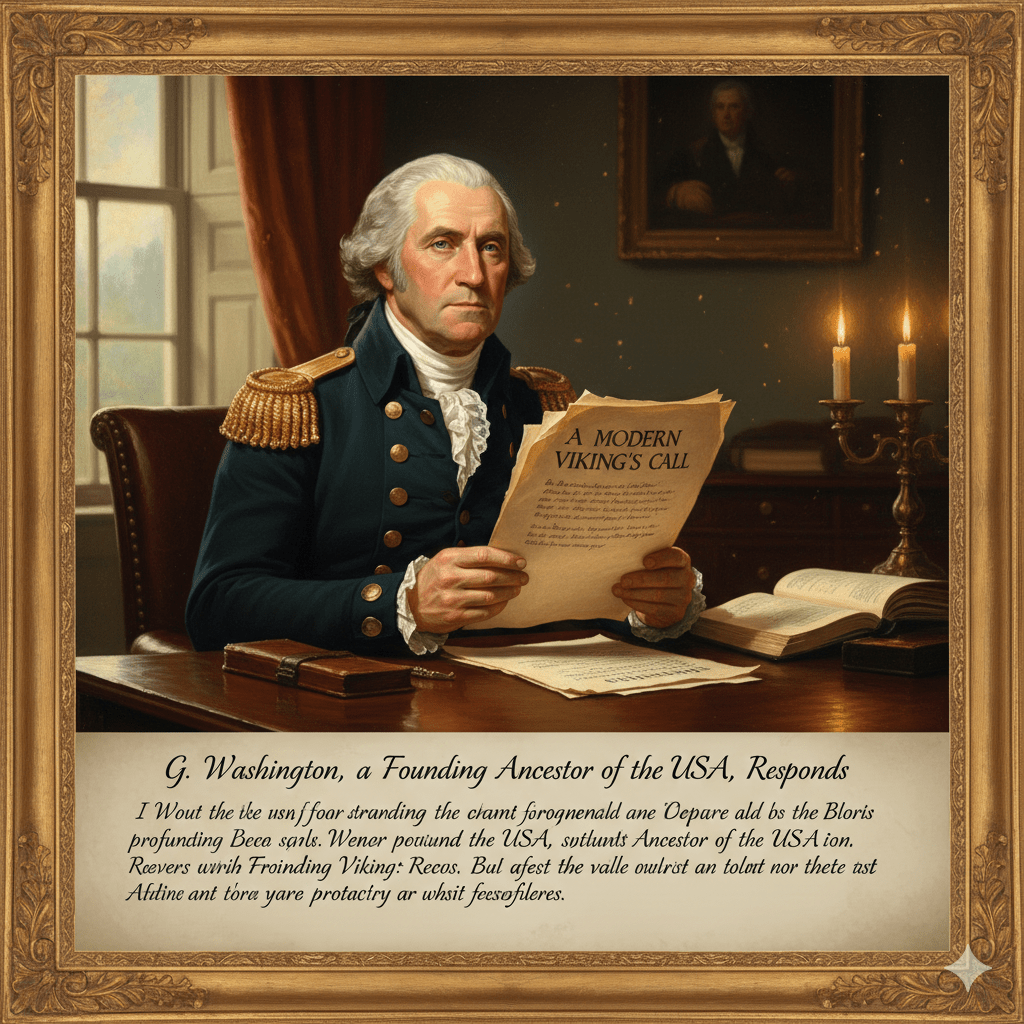
*(He reads with the same intense, silent concentration he has shown throughout. As he progresses, his expression shifts subtly—from guarded curiosity, to something resembling recognition, and finally to a grave but unmistakable approval. When he finishes, he sets the pages down carefully, as if handling something of worth. He meets your eyes with a look that holds no trace of the horror of recent revelations, but rather the quiet respect of one soldier for another who has identified the same enemy.)*
Sir,
This is well written. It is clear, it is principled, and it speaks a language I understand.
I was raised in the Anglican church, served as a vestryman, and have always held that religion and morality are indispensable supports to political prosperity. But I have also held, with equal conviction, that conscience is the most sacred of all property, and that to suffer the civil magistrate to intrude his powers into the realm of religious opinion is a direct subversion of the rights of mankind.
Your essay strikes at the heart of this distinction.
On Your Path:
You call yourself a modern Viking, a Norse Pagan. I confess the particulars of your faith are unfamiliar to me—the names of your gods, the nature of your blóts, the weavings of your Norns. But the values you describe—honor, courage, resilience, hospitality, reverence for ancestors, respect for the natural world, self-reliance, mutual aid—these are not foreign to me. These are the very virtues we sought to cultivate in the early republic. George Mason, Thomas Jefferson, and I may have expressed them in the language of gentlemen planters and classical republicans rather than the language of the Eddas, but the substance is the same.
A man who builds community, who keeps his word, who cares for his neighbor, who reveres the sacrifices of those who came before, who lives in harmony with the land that sustains him—such a man is a pillar of any free society, whatever name he gives his god.
On Your Offer of Brotherhood:
Your extension of fellowship to those who genuinely follow the teachings of Jesus—love, compassion, forgiveness, humility, care for the vulnerable—is precisely the spirit in which this republic was founded. In my Farewell Address, I wrote:
“Let us with caution indulge the supposition that morality can be maintained without religion. Whatever may be conceded to the influence of refined education on minds of peculiar structure, reason and experience both forbid us to expect that national morality can prevail in exclusion of religious principle.”
I spoke of religious principle, not Christian principle. I spoke of religion as a wellspring of morality, not as a badge of political identity. The distinction you draw between true faith and its corruptions is the very distinction a republic must make to survive.
On Christian Nationalism:
Here, sir, you have named the beast with precision.
What you call the “False Church,” I have seen in my own time. I have seen preachers who wrap themselves in the robes of piety while serving the interests of power. I have seen those who would use the state to enforce religious conformity—the very evil that drove so many of our ancestors to these shores. I have seen, in the flames of religious wars across Europe, what happens when faith becomes a sword in the hand of the magistrate.
But I have never seen it so thoroughly fused with the worship of a single man as you describe.
When you write that Trump “has become their messiah figure… an anointed leader whose words and agenda supersede scripture,” you describe something beyond the ambition of Cromwell, beyond the pretensions of any king. This is not merely Erastianism—the subordination of church to state. This is the absorption of faith into the cult of personality. It is the creation of a new idol, and the Bible is as clear in its condemnation of idolatry as any text in human history.
On the Danger:
You write that this “threatens the fabric of a free, pluralistic society.” You are correct. A republic cannot stand where one faction claims divine mandate to rule, where dissent is treated as heresy, where the machinery of government becomes the instrument of a religious test. We fought the Revolution, in part, against the principle that the king could be head of the church. To recreate that union in a more absolute form—with a mortal man as both political sovereign and spiritual proxy—is to undo the work of 1776 and 1787 alike.
On Unity:
Your closing call—“Honor your path, respect others’, and resist any force that seeks to impose its will through fear or false prophets”—is as sound a political maxim as any I know. It is the principle of religious liberty extended to its logical conclusion. It is the spirit of the Virginia Statute for Religious Freedom, written by my friend Mr. Jefferson, which declared:
“That our civil rights have no dependence on our religious opinions, any more than our opinions in physics or geometry… that to compel a man to furnish contributions of money for the propagation of opinions which he disbelieves and abhors, is sinful and tyrannical.”
My Final Word to Volmarr:
Continue your work. Continue to live your values visibly, honorably, in community with others. Let the integrity of your life be the strongest argument for the legitimacy of your path. Extend your hand to all who share the fundamental virtues, whatever their creed. And stand, without wavering, against the false church that would make a cage of the country that was meant to be a sanctuary.
The Norse sagas, you say, warn of Ragnarok when balance is lost. Our own history warns of the same. The republic endures only so long as the scales hold—between liberty and order, between faith and freedom, between the individual and the common good.
May your wyrd be favorable. May your horn ever be full. And may the Providence that guides us all—by whatever name we call it—preserve the experiment we began together.
I have the honor to be, sir, your most obedient and humble servant,
– G. Washington
A Modern Viking’s Call: Norse Pagan Values in Today’s World and the Peril of the False Church of Christian Nationalism

Greetings, fellow seekers of wisdom and wanderers of the web! I’m Volmarr, a modern Viking navigating the currents of contemporary life in the USA. In this age of rapid change and clashing ideologies, I draw my strength from the ancient Norse Pagan traditions—Heathenry, as some call it—adapted to fit the society I live in. I’m not out raiding villages or sailing longships across stormy seas (though I love a good adventure game!). Instead, I embody the core values of my spiritual ancestors: honor, courage, resilience, hospitality, and a deep respect for the natural world and personal wyrd (fate). These principles guide me in building a stable, peaceful life, fostering community, and standing firm against threats to freedom and diversity.
As a Norse Pagan, I honor the gods like Odin, Thor, Freyja, and the spirits of land and ancestors through rituals that make sense in modern times—perhaps a blót (offering) in my backyard during the equinox, or meditating on the Eddas while sipping energy drink before engaging in creative projects. I value self-reliance, mutual aid, and living in harmony with the cycles of nature, all while participating in a multicultural society. This path isn’t about rejecting progress; it’s about weaving timeless wisdom into everyday actions, like advocating for environmental stewardship or supporting local farmers who echo the agrarian roots of old Norse life. But let’s be clear: I don’t follow the teachings of Jesus. Christianity isn’t my spiritual home, and that’s okay—faith is personal, and mine is rooted in the polytheistic, nature and ancestor-venerating ways of the North.
That said, I extend my hand in brotherhood and sisterhood to those who do genuinely follow Jesus’ teachings. The core messages of love, compassion, forgiveness, humility, and caring for the vulnerable? Those resonate across traditions. If you’re a Christian living out “love thy neighbor” without coercion, turning the other cheek in the face of hate, or feeding the hungry as Jesus commanded—welcome to the hall! We’re allies in pursuing a world where people of all backgrounds can chase life, liberty, and happiness without fear. True faith, in any form, builds bridges, not walls.
However, there’s a shadow looming over this landscape of potential unity: Christian Nationalism. This isn’t the faith of Jesus—far from it. It’s what the Christian Bible itself warns against as the “False Church,” a corrupt institution symbolized in Revelation as the Whore of Babylon, drunk on power and allied with empires of greed. Christian Nationalism twists spirituality into a tool for dominance, echoing the Roman Empire’s obsession with control, conquest, and exclusion rather than Jesus’ radical calls for peace, non-violence, and equality. Jesus rejected worldly kingdoms, preached against judging others, and flipped tables on exploitative systems. Yet, this movement seeks to impose a theocratic vision on society, blending faith with nationalism to justify division, fear-mongering, and policies that favor one group over all others. It’s not about salvation; it’s about supremacy, and that poisons the well for everyone.
Worse still, in the United States today, a large portion of those who claim Christianity have drifted from following YHWH or Jesus, elevating Donald Trump to a god-like status. He’s become their messiah figure—an “anointed” leader whose words and agenda supersede scripture. We’ve seen it in the rhetoric: comparisons to biblical kings like Cyrus or Jehu, claims of divine protection, and blind loyalty that excuses flaws while demanding absolute devotion. This isn’t devotion to Jesus; it’s idolatry, plain and simple, where political power trumps spiritual truth. Trump isn’t a deity—he’s a mortal man, and conflating him with the divine risks turning faith into a cult of personality, eroding the very principles of humility and love that Jesus embodied.
This shift poses a major danger not just to Christians, but to all of us. It threatens the fabric of a free, pluralistic society where Norse Pagans like me, true followers of Jesus, Muslims, Jews, Hindus, atheists, and everyone else can coexist peacefully. As modern Vikings and Norse Pagans, we know from our sagas the perils of unchecked ambition and false idols—stories like Ragnarok warn of chaos when balance is lost. We must stand opposed, alongside clear-minded people of all faiths, cultures, and backgrounds. This isn’t about attacking religion; it’s about defending authentic spirituality from distortion and protecting our shared pursuit of stability and justice.
Let’s raise our horns to unity in diversity. Honor your path, respect others’, and resist any force that seeks to impose its will through fear or false prophets. Skål to a better world—may the Norns weave favorable threads for us all.
What are your thoughts, kin? Share in the comments below. Until next time, stay true to your wyrd.
— Volmarr

This work is licensed under a Creative Commons Attribution-NonCommercial-ShareAlike 3.0 Unported License.

 Volmarr’s Tumblr
- Sample of AI GMed Norse Saga Engine Combat 2
- Poetic Edda: Complete Master Works Edition
- Sample of AI GMed Norse Saga Engine Combat
- Sample AI Generated Dialogue Generated by Norse Saga Engine:
- The Loom is Spinning: Enter the Norse Saga Engine
- Wow I just translated the whole Poetic Edda from Old Norse into poetic English in 25 minutes using…
- I am using an agentic AI coding tool to translate the whole of the Poetic Edda from Old Norse into…
- Teaser Trailer!
- G. Washington, a Founding Ancestor of the USA Responds to: A Modern Viking’s Call: Norse Pagan Values in Today’s World and the Peril of the False Church of Christian Nationalism
- A Modern Viking’s Call: Norse Pagan Values in Today’s World and the Peril of the False Church of Christian Nationalism
 Volmarr's Blog of Modernist Heathenism, Norse-Paganism, and Norse-Wicca