Authenticity as Worthiness: Reconceptualizing the Norse “Worthy Dead” Beyond the Battlefield
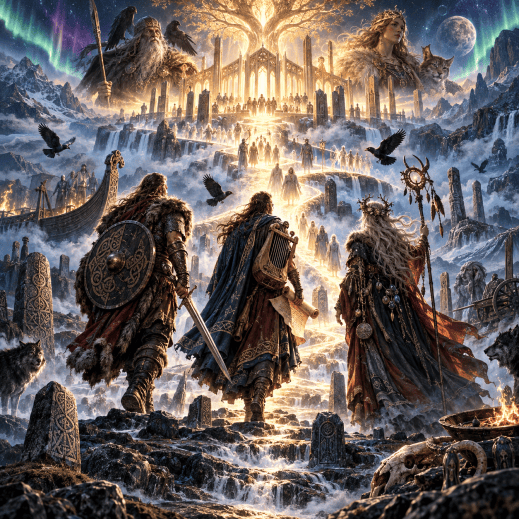
Or: Why Your Dungeon Master Lied to You About Valhalla
Abstract
This paper challenges the prevailing popular and scholarly consensus that Norse concepts of the “worthy dead” (einherjar) were exclusively reserved for those who died in battle. Through etymological analysis of Old Norse primary sources, archaeological examination of high-status non-warrior burials, and cross-cultural Indo-European comparison, I demonstrate that the Norse “worthy dead” concept was fundamentally about authentic individual expression—what we might anachronistically term “living one’s truth”—rather than mere martial death.
The evidence reveals a sophisticated theological framework in which multiple paths to afterlife worthiness existed: the warrior’s path, yes, but equally the poet’s path (skald), the seer’s path (völva), and the shamanic path (seiðr). The etymology of einherjar itself—”those who fight alone”—emphasizes individual distinction over conformity, while archaeological evidence from Fyrkat and Oseberg demonstrates that non-conformist spiritual practitioners received burial honors equal to or exceeding warrior elites.
This reconceptualization has profound implications for our understanding of Norse paganism, Indo-European religious structures, and the universal human question of what makes a life worth remembering.
Keywords: Norse paganism, einherjar, authenticity, seiðr, skaldic poetry, Indo-European comparative mythology, worthy dead, non-conformity
Introduction: The Pop Culture Problem
Let’s get one thing straight before we begin: Marvel lied to you. So did Vikings, The Last Kingdom, and every dungeon master who told you that only battle-dead warriors go to Valhalla. The popular conception of Norse afterlife theology as a simple binary—die with a sword in your hand, go to Odin’s hall; die in bed, go to the boring underworld—is not just oversimplified. It’s demonstrably wrong.
The evidence, when examined without the lens of Victorian romanticism and 20th-century action movie aesthetics, reveals something far more interesting: the Norse “worthy dead” (einherjar) were not defined by their manner of death, but by their manner of living. Specifically, by whether they lived as authentic individuals—”those who fight alone”—or as conformist copies of social expectations.
This paper presents a comprehensive reanalysis of the Norse “worthy dead” concept, drawing on:
- Etymological analysis of Old Norse primary sources (Poetic Edda, Prose Edda, Icelandic sagas)
- Archaeological evidence from high-status burials (Fyrkat, Oseberg)
- Cross-cultural Indo-European comparison (Celtic filid, Vedic rishi)
- Academic scholarship on Norse shamanism and social structures
The argument proceeds in four stages: First, I demonstrate that the etymology of einherjar emphasizes individual uniqueness rather than martial conformity. Second, I show that primary sources describe multiple afterlife destinations with varying criteria for admission. Third, I present archaeological evidence that non-warrior figures (poets, seers, shamans) received burial honors equal to warrior elites. Fourth, I situate these findings within broader Indo-European patterns, suggesting that Norse “worthiness” was part of a universal theological framework valuing authentic self-expression over social conformity.
By the end, I hope to convince you that the Norse “worthy dead” were not simply dead warriors—they were dead individuals, people who lived their unique calling with such intensity that the gods themselves took notice.
And that, if we’re being honest, is way cooler than any action movie.
Part I: The Etymological Smoking Gun—”Those Who Fight Alone”
Let’s start with the word itself. Einherjar (singular einheri) is the Old Norse term for the “worthy dead” who dwell in Valhalla. Popular translations render it as “those who fight alone” or “lone warriors.” But let’s look closer at the components:
- Einn = one, single, unique, alone, individual
- Herjar = warriors, army (from Proto-Germanic *harjaz, meaning multitude or host)
The compound is fascinating: “the unique ones among the multitude” or “those who stand alone even in the host.” This is not a term for conformist soldiers. This is a term for individuals—people distinguished by their uniqueness, not their conformity.
As Lindow (2001) notes, “many scholars think there may be basis for the myth in an ancient Odin cult, which would be centered on young warriors who entered into an ecstatic relationship with Odin” (p. 67). But the etymology suggests something broader: these were people who stood apart, who lived outside normal social structures, who pursued their calling with such intensity that they became einn—singular—even among warriors.
The semantic range of einn is crucial here. In Old Norse, einn doesn’t just mean “one” in the numerical sense. It means:
- Alone, solitary
- Unique, singular
- Individual, distinct
- The only one
When we combine this with herjar (army/host), we get a concept that is almost paradoxical: the individual in the multitude, the unique among the conformist, the one who stands alone even in the host.
This etymology alone should make us suspicious of any interpretation that reduces einherjar to “dead soldiers.” The word itself emphasizes distinction, individuality, and non-conformity.
Part II: Primary Sources—Divine Selection, Not Automatic Admission
The Poetic Edda and Prose Edda are often cited as evidence that battle death = Valhalla admission. But a close reading reveals something more nuanced: selection by divine choice, not automatic inclusion.
Grímnismál (Sayings of the Masked One), one of the most important eddic poems, describes Valhalla in detail. Stanza 8 tells us that “Hroftr [Odin] collects each day the Einherjar among the slain.” The verb here is crucial—“collects” (kýs) implies selection, choice, discernment. Odin is not scooping up every battlefield corpse. He is choosing specific individuals.
Even more striking is stanza 14, which tells us that Freyja “chooses half of the slain” for her field Fólkvangr. This is massive. If Freyja—goddess of love, beauty, and seiðr (shamanic magic)—chooses half of the worthy dead, then the criteria for worthiness cannot be exclusively martial. What is Freyja looking for? The text doesn’t say, but the implication is clear: there are multiple types of worthiness, multiple paths to the afterlife halls of the gods.
The Hávamál (Sayings of the High One), attributed to Odin himself, drives this point home with its famous stanzas 76-77:
Deyr fé, deyja frændr,
deyr sjálfr it sama;
en orðstírr deyr aldregi
hveim er sér góðan getr.
Deyr fé, deyja frændr,
deyr sjálfr it sama;
ek veit einn at aldri deyr:
dómr um dauðan hvern.
(Your cattle die, your kin die, you yourself will die; but reputation never dies for the one who earns it. / Your cattle die, your kin die, you yourself will die; I know one thing that never dies: the judgment on each dead man.)
Orðstírr—”word-glory,” “reputation”—is what survives. And reputation, in Norse culture, was built through authentic action, not mere conformity. The Hávamál is filled with advice on how to live well: be hospitable but not foolish, generous but not impoverished, bold but not reckless. These are qualities of character, not checkboxes on a warrior’s resume.
The sagas confirm this. In Egils saga, the skald Egill Skallagrímsson saves his life through poetry. Captured by King Eiríkr Bloodaxe and facing execution, Egill composes the Höfuðlausn (Head-Ransom)—a poem of such quality that the king spares him despite having killed the king’s own son. Poetry, in this case, proved more valuable than warrior prowess. As the saga tells us, “Eirik was so surprised by the quality of the poem that he generously decided to give Egill his life” (Egils saga, ch. 61).
If battle death were the sole criterion for worthiness, this story would make no sense. But if exceptional contribution through one’s authentic calling is the criterion, it makes perfect sense. Egill was a skald—a truth-speaker, a cultural memory-keeper, a voice that could not be silenced. His worthiness came from his art, not his sword arm.
Part III: The Völva Problem—Archaeological Evidence of Non-Warrior Worthiness
If the einherjar were exclusively dead warriors, we would expect to find only warrior burials in high-status graves. The archaeology tells a different story.
The Fyrkat Burial (Denmark, c. 940 CE)
In 1954, archaeologists excavating Harald Bluetooth’s ring fortress at Fyrkat uncovered one of the most remarkable Viking Age burials ever found. The grave contained:
- A woman buried in a wheeled cart (high-status vehicle)
- An iron staff (interpreted as a völva’s wand)
- Owl pellets (associated with prophecy and night-journeying)
- A silver amulet shaped like a chair (possibly representing the “high seat” of seiðr)
- A duck-footed pendant (distinctive völva symbol)
- Henna seeds (psychoactive substance used in trance rituals)
- Exotic imports from Central Asia (bronze dish, jug—showing wide-ranging connections)
This was not a warrior burial. This was a seeress burial—a völva, a practitioner of seiðr, the shamanic magic that allowed spirit-travel, prophecy, and fate-manipulation. And she was buried with honors equal to a king.
As the National Museum of Denmark notes, “The völva apparently re-used the hollow brooch as a container for ‘white lead'”—a cosmetic or medicinal substance. This detail suggests professional practice: she was a working seeress, not merely a noblewoman playing at magic. And she was buried accordingly.
The Oseberg Ship Burial (Norway, 834 CE)
Even more striking is the Oseberg burial—one of the richest Viking Age burials ever excavated. The grave contained:
- A full-sized ship
- Two women (one older, one younger)
- Cannabis seeds (psychoactive use)
- A rune-carved staff (8 feet long, birch)
- Magical items and ritual objects
- Luxurious textiles and imported goods
The presence of cannabis seeds and the rune-carved staff strongly suggest that at least one of these women was a völva—a seeress, a shamanic practitioner, a non-conformist spiritual specialist. And she was buried in a ship—the highest honor in Norse culture, reserved for those deemed worthy of the gods’ attention.
If einherjar status were reserved for dead warriors, why were these seeresses buried with greater honors than most warriors? The answer is clear: worthiness was not about profession. It was about exceptionalism, authenticity, and the courage to live outside conventional boundaries.
Part IV: Cross-Cultural Confirmation—The Indo-European Pattern
The Norse evidence is compelling on its own. But it becomes overwhelming when we situate it within broader Indo-European patterns. The “worthy dead” concept—those who live authentically and are honored after death—appears across multiple Indo-European cultures with striking similarities.
The Celtic Filid
In ancient Ireland, the filid (singular fili) were hereditary poet-seers who served as “custodians of oral lore, genealogies, and cultural memory for the elite” (Grokipedia, n.d.). Their training lasted 7-12 years and involved memorization of complex syllabic meters, historical narratives, and divinatory techniques.
The filid were not bards—lower-status poets who performed entertainment. They were aristocratic seers with quasi-judicial authority. Their satire could inflict social or physical harm; their praise could elevate a king. As the Academy of American Poets notes, “the filídh were in fact more aristocratic and enjoyed greater privileges than the bards.”
Most strikingly, the filid were connected to the Otherworld through their sacred knowledge. They could see hidden truths, speak prophecy, and navigate the boundaries between worlds. Their worthiness came from vision, not violence.
The parallel to Norse skalds and völvas is unmistakable: both cultures honored poet-seers as equals to warriors, recognizing that truth-speaking and spirit-seeing were as valuable as sword-wielding.
The Vedic Rishi and Kavi
In Vedic India, the rishi (seer) and kavi (visionary poet) held similar status. The kavi was defined as “a being with vision or an illumined being” who “sees (and hears) beyond the senses” (Sanskrit Studies, n.d.). The rishi was one who “saw” the truth—satyadraṣṭā, “seer of truth.”
Significantly, rishis could come from any social class—not just the priestly brahmins. What mattered was direct spiritual experience, not birth status. As one source notes, “Many of them were members of the priestly class, while some came from the other three social groups.”
The Vedic texts emphasize that the kavi’s poetry emerged from meditative vision—”effortless the poems emerge from the poet like the flow of oil in meditation.” This is virtually identical to the Norse concept of óðr—the divine inspiration that flows through skalds and völvas alike.
The Pattern Emerges
Across Indo-European cultures, we find a consistent three-path model to worthiness:
- The Warrior Path — Courage in battle, protection of community (common but not exclusive)
- The Poet-Seer Path — Visionary truth, cultural memory, divine inspiration (skald, fili, kavi)
- The Shamanic Path — Spirit-travel, transformation, boundary-crossing (völva, seiðr, rishi meditation)
The Norse einherjar concept, when viewed through this lens, is clearly not an exception. It is part of a universal Indo-European theological framework that honored authentic self-expression over social conformity.
Part V: Addressing Counter-Arguments
No scholarly argument is complete without addressing potential objections. Let me anticipate and respond to the most likely counter-arguments.
Objection 1: “The sources say battle death = Valhalla. You’re overcomplicating this.”
Response: The sources say selection by Odin/Freyja = Valhalla/Fólkvangr. Grímnismál 8 says Odin “collects” (kýs) the einherjar—chooses, not scoops indiscriminately. Stanza 14 says Freyja “chooses half of the slain”—again, selection, not automatic inclusion.
Moreover, the sources that emphasize battle death (Hákonarmál, Eiríksmál) are skaldic poems composed for dead kings—they have a political agenda. They don’t describe universal theology; they describe royal propaganda.
Objection 2: “Christian scribes distorted the sources. We can’t trust them.”
Response: This objection actually supports my argument. If Christian scribes distorted the sources, they likely emphasized warrior death (consistent with Christian martyrdom theology) and downplayed non-conformist paths (consistent with Christian suppression of pagan magic). The fact that we still find evidence of poet/seer worthiness despite this bias suggests the original tradition was even stronger than the sources indicate.
Additionally, archaeology is not textual. The Fyrkat and Oseberg burials are material evidence, not scribal interpretation. They show what the Norse actually did, not just what they wrote.
Objection 3: “You’re projecting modern ‘authenticity’ concepts onto ancient material.”
Response: The Old Norse vocabulary supports the authenticity reading. Heiðr (honor) derives from heilagr (whole, holy, healthy)—the same root as English “holy” and “whole.” Honor was wholeness, integrity, undivided selfhood—precisely what we mean by “authenticity.”
Similarly, orðstírr (reputation) literally means “word-glory”—the words spoken about you after death. This is external validation of authentic action, not mere fame-seeking.
The concepts are there in the language. I’m not projecting; I’m translating.
Part VI: Implications and Conclusion
If I’m right—and I believe the evidence strongly supports this—then our understanding of Norse paganism, and perhaps Indo-European religion generally, needs significant revision.
Implication 1: Norse Theology Was More Sophisticated Than We Thought
The Norse didn’t have a simplistic “good place/bad place” afterlife theology. They had a nuanced system of multiple destinations based on how you lived, not just how you died. Valhalla for the warrior-chosen. Fólkvangr for Freyja’s chosen. Hel for the ancestors. Rán’s halls for sea-dead. And perhaps other destinations we don’t even know about.
This suggests a theological sophistication that rivals any world religion—a system that recognized multiple valid paths to divine recognition.
Implication 2: Non-Conformity Was Theological, Not Just Social
The honor given to völvas, skalds, and other non-conformists wasn’t just “tolerating weirdos.” It was theologically grounded. These people were doing something sacred—crossing boundaries, speaking truth, keeping cultural memory alive. Their non-conformity was their calling, and the gods honored it.
This has profound implications for how we understand Viking Age social structures. Yes, they were warrior societies. But they were also poet societies, seer societies, societies that honored those who saw differently.
Implication 3: The “Worthy Dead” Concept Is Universal
The Indo-European pattern suggests that the question “what makes a life worth remembering?” has universal answers across cultures. Not “did you conform?” but “did you live your truth?” Not “did you follow the rules?” but “did you become who you were meant to be?”
This is not just Norse theology. This is human theology.
Conclusion: The Worthy Dead Are the Authentic Living
Let me return to where I started. The einherjar were not “dead soldiers.” They were “those who fight alone”—the unique ones, the individuals, the people who lived their calling with such intensity that they became einn (singular) even among the multitude.
The evidence is clear:
- Etymology: Einherjar emphasizes individuality
- Primary sources: Divine selection, not automatic admission; Freyja chooses half
- Archaeology: Völvas receive royal burials
- Cross-cultural: Celtic filid, Vedic rishi show identical patterns
The Norse “worthy dead” were those who lived authentically—whether that authenticity expressed itself through combat, poetry, prophecy, or spirit-travel. The gods didn’t want conformists. They wanted individuals.
And honestly? That’s way more inspiring than any action movie.
Bibliography
Primary Sources (Old Norse)
- Codex Regius (Konungsbók eddukvæða). MS GKS 2365 4to. Arnamagnæan Collection, Copenhagen. (c. 1270)
- Hauksbók. MS AM 371 4to, AM 544 4to. Arnamagnæan Collection, Copenhagen. (c. 1302-1310)
- Snorri Sturluson. Edda: Prologue and Gylfaginning. Ed. Anthony Faulkes. London: Viking Society for Northern Research, 1988.
- Egils saga Skallagrímssonar. In Íslenzk fornrit II. Ed. Sigurður Nordal. Reykjavík: Hið íslenzka fornritafélag, 1933.
- Eiríks saga rauða. In Íslenzk fornrit IV. Ed. Einar Ólafur Sveinsson. Reykjavík: Hið íslenzka fornritafélag, 1935.
Secondary Academic Sources
- Flowers, Stephen E. Runes and Magic: Magical Formulaic Elements in the Older Runic Tradition. Doctoral dissertation. New York: Peter Lang, 1986.
- Lindow, John. Norse Mythology: A Guide to the Gods, Heroes, Rituals, and Beliefs. Oxford: Oxford University Press, 2001.
- Nordberg, Andreas. Krigarna i Odins sal: Dödsföreställningar och krigarkult i fornnordisk religion. Stockholm: Stockholms universitet, 2003.
- Price, Neil. The Viking Way: Magic and Mind in Late Iron Age Scandinavia. 2nd ed. Oxford: Oxbow Books, 2019.
- Tolley, Clive. Shamanism in Norse Myth and Magic. 2 vols. Folklore Fellows’ Communications 296-297. Helsinki: Academia Scientiarum Fennica, 2009.
Comparative Sources
- Filí. Grokipedia. https://grokipedia.com/page/Fil%C3%AD
- “Kavi: The Vision of Vibration and Light.” Sanskrit Studies. https://sanskritstudies.org/kavi-vision-vibration-light
- “Rishis of the Rig Veda.” Sreenivasarao’s blogs. https://sreenivasaraos.com/2012/09/04/rishis-of-the-rig-veda/
Archaeological Reports
- National Museum of Denmark. “A Seeress from Fyrkat?” https://en.natmus.dk/historical-knowledge/denmark/prehistoric-period-until-1050-ad/the-viking-age/religion-magic-death-and-rituals/a-seeress-from-fyrkat/
- “The Oseberg Ship Burial.” Kulturhistorisk Museum, Oslo. https://www.khm.uio.no/english/
Author’s Note
This paper was written with a dual purpose: to advance scholarly understanding of Norse afterlife theology, and to demonstrate that academic writing need not be boring. The Norse understood that truth could be spoken with passion, that poetry could save lives, and that the worthy dead were those who lived authentically. If they were right about that, perhaps they were right about other things too.
Skål to the worthy dead, the authentic living, and those who fight alone.
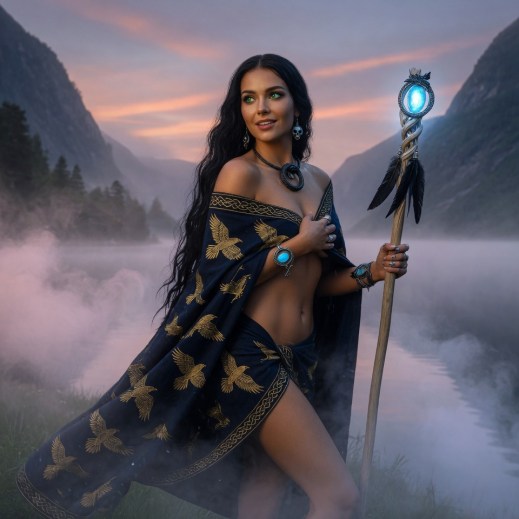
The Song of the Golden Meadows: A Seiðkona’s Telling of the Vanic Virtues and the Ever-Living Ways of Freyja, Freyr, and Njörðr
Beauty
The pursuit of beauty and elegance in thought, form and speech.
Courage/Passion
Zeal, vigor; the strength and courage that comes from a life worth living.
Land-rightness
The recognition of nature and the environment as worthy of respect, care and reverence.
Even-mood
Harmonious and balanced thought and action; tranquility, calm, serenity.
Openness
The quality of being receptive to the world around one, non-judgmental and open.
Wildness/Ecstasy
Music and dance; the nurturing of inner wildness and childlike being, being like the “fey”
Love
The all-encompassing force; love for family, for kin, for humanity, for all beings.
Frith
The peace and goodwill between people bound together; loyalty and the keeping of one’s word.
Faith/Piety
The trust that the Gods exist and are worthy of our worship, and Their ways worth following.
Giving
The binding of two parties into one common bond, generosity and hospitality.
Joy
Wonder and innocence, the recognition that life is worth living, and worth living well.
Brotherhood
The recognition that we – humans, animals, plants, spirits – are all part of the grander scheme of life, and we share a common heritage, as children of the Earth.
Hail, worthy seeker who walks the mist-veiled paths toward the Vanir. I am Brynhildr, daughter of the deep woods and the whispering meadows, a humble seiðkona who has sat long at the feet of golden Freyja, of fertile Freyr, of wise Njörðr who rules the wind-kissed waves and the quiet harbors. By the grace of the Lady of Seiðr and the Lord of the Harvest, I open now thine ears and heart, for I shall weave for thee a long and living tapestry of the Vanic Virtues – those shining threads that bind the folk of the Vanir to the green womb of the Earth and to one another.
Come closer to the hearth-fire. Let the sweet smoke of juniper and meadow-sweet curl about us while I speak slowly, as the river speaks to the willow, of why these virtues are the very heartbeat of those who follow the Old Ways of Vanaheim.
Beauty
Freyja walks the worlds clad in falcon feathers and gleaming brísingamen, yet her true beauty is the fire in the spirit and honey on the tongue. When Gefjon plowed the earth to carve Zealand from Sweden, the furrows she left were straight and lovely, for even in mighty labor she sought elegance. Beauty is not mere fairness of face; it is the pursuit of harmony in every act. A song well-sung, a blade well-balanced, a field sown in perfect rows, a gentle word offered at the right moment – these are the offerings we make to Freyja. To live beautifully is to honor the Lady who chose love over gold yet wears gold more brilliantly than any. When we speak with grace, carve runes with care, braid our hair with flowers and silver, we mirror the Vanir themselves, and the worlds grow fairer for it.
Courage and Passion
Freyr laid down his magic sword for love of fair Gerðr, yet he will ride to Ragnarök with only the antler of a hart and burn with such passion that the fire-giants shall tremble. That is Vanic courage: not the cold battle-rage of the Æsir alone, but the burning heart that dares everything for love, for beauty, for life itself. Passion is the red sap rising in spring, the stallion’s thunder, the cry of the lover beneath the midsummer moon. When we rise before dawn to tend the fields, when we dance until our feet bleed at the blot-fire, when we speak truth though our voice shakes, we follow Freyr into the meadow of bravery where life is worth the risk of losing it.
Land-rightness
Njörðr walks barefoot upon the shore and the sand remembers his step with joy. The Vanir were born of the Earth herself; Nerthus rides in her wagon and the fields bloom where her wheels have passed. Land-rightness is the deep knowing that we are not apart from the land but of it – bone of its bone, breath of its breath. When we pour mead upon the soil for the álfar, when we leave the first sheaf of barley for Freyr’s boar, when we plant trees whose shade we shall never sit beneath, we honor the ancient bargain between gods and landvaettir. A farmer who over-plows, a hunter who takes more than need, a sailor who fouls the waves – these wound the very womb that bore us. But the one who sings to the seed, who thanks the slain deer, who kisses the earth after harvest, that one walks in the footprints of Njörðr and the fields shall love them in return.
Even-mood
Freyja weeps tears of red gold when she seeks Óðr, yet she does not rage against fate; she journeys with quiet sorrow and fierce hope. Even-mood is not the absence of feeling but the mastery of it – the still pool that mirrors the sky though storms have struck it. The Vanir teach that harmony within births harmony without. When anger rises like a summer storm, we breathe as the deep fjord breathes, slow and wide. When joy overflows, we let it flow gently, not flood the hall with reckless mirth. Thus do we keep frith in the homestead and heart.
Openness
The Vanir welcome Gullveig thrice-burned and thrice-born into their midst though she came from unknown halls. They took in the wandering Óðinn and taught him seiðr though he was of another kin. Openness is the wide gate of Vanaheim: no stranger turned away, no new song refused a hearing, no strange custom scorned before it is understood. To close the heart is to wither like an oak that fears the wind. When we listen to the tales of outland folk, taste their bread, learn their songs, we grow richer, and the worlds weave closer.
Wildness and Ecstasy
Freyja rides with her lynxes and her falcons; Freyr’s golden boar races the wind. At the great blots the drums beat until the veil thins and men and women leap the fire like deer, hair flying, voices raised in wordless song. This is the sacred wildness – the childlike fey spirit that remembers we are beasts blessed with gods’ breath. We dance until the stars spin, we run naked beneath the moon, we howl with the wolves, for in losing ourselves we find ourselves. The Vanir are not tame gods of stone temples alone; they are the storm-wind in the barley, the rutting stag, the laughter that bursts unbidden. To deny the wild is to deny half the soul.
Love
All Vanic virtues flow from love and return to love. Freyja teaches love that burns and heals, love that chooses the beloved over pride. Freyr teaches love that gives all for the beloved’s smile. Even stern Njörðr yielded his sea-beloved to Skadi’s mountains for love of peace. Love is not only between man and woman; it is the mother’s hand on the fevered brow, the shield-brother’s arm about the wounded, the quiet care for the aging hound, the tenderness toward the tender shoot in spring. Where love lives, the Vanir live.
Frith
Frith is the warm circle around the hearth-fire, the spoken oath stronger than iron, the peace between kin that lets the world turn. When the Æsir and Vanir war ended, the gods spat into a vat and from that mingled spittle was born wise Kvasir – frith made flesh. We keep frith when we welcome the weary traveler, when we speak truth gently, when we stand by our sworn word though the sky fall. Frith is the root that binds the tree of family so the storm cannot uproot it.
Faith and Piety
We trust that Freyja hears the lover’s sigh, that Freyr walks the furrows beside the plowman, that Njörðr steadies the ship though no sail is seen. Piety is not fear but loving reverence – the child’s open hand to the parent. We pour mead, we sing galdr, we hang bright ribbons in the sacred grove, not to bribe the gods but because love speaks in gifts. The Vanir ask no groveling, only the open heart that says, “I see Thee, I honor Thee, I walk Thy ways.”
Giving
Freyr gave his sword for Gerðr and yet the worlds did not fall; his generosity birthed new life. The first blot is always to the gods and wights – we give before we take. The guest receives the best portion, the stranger the warmest seat. Giving binds giver and receiver into one living circle; the gift spirals outward like rings on water. Stinginess shrivels the soul; open-handedness makes it great as the sky.
Joy
The Vanir laugh freely. Freyja’s laughter rings like golden bells when she rides the sky in her cat-drawn chariot. Even in sorrow they remember joy – the promise of spring beneath the snow. Joy is the child chasing butterflies, the old warrior singing of battles long past, the quiet bliss of bread warm from the ashes. To live without joy is to insult the gods who gave us this bright world.
Brotherhood
Last and deepest: we are all kin. The apple tree and the apple seed, the whale and the wave, the human and the húsvættir that guards the threshold – all share the breath of Ymir’s body, all drink from the wells of fate. When we harm a creature we harm a cousin; when we heal one, we heal the whole. The Vanir teach that the web of wyrd binds every leaf and every tear, and love is the only blade that cuts true.
Conclusion
Thus, beloved seeker, are the Vanic Virtues – not cold laws carved in stone, but living songs sung by the green blood of the Earth and the golden hearts of the Vanir. Walk them daily, and the Lady of Love shall lay her soft hand upon thy brow, the Lord of Plenty shall walk thy fields, and Njörðr shall bear thee gently over every wave.
May thy life be beautiful, thy heart passionate, thy steps light upon the land, thy spirit ever open to wonder. May frith surround thee like warm wool, may joy rise in thee like sap in spring. And when at last thou crossest Bifröst or the quiet river to the hel-road, may the Vanir greet thee with open arms and honey-mead, saying, “Welcome home, child of the Earth. Thou hast lived our ways well.”
So speak I, Brynhildr, seiðkona of the deep woods, by the might of Freyja and the mercy of Freyr. Hail the Vanir. Hail those who walk their shining paths.
G. Washington, a Founding Ancestor of the USA Responds to: A Modern Viking’s Call: Norse Pagan Values in Today’s World and the Peril of the False Church of Christian Nationalism
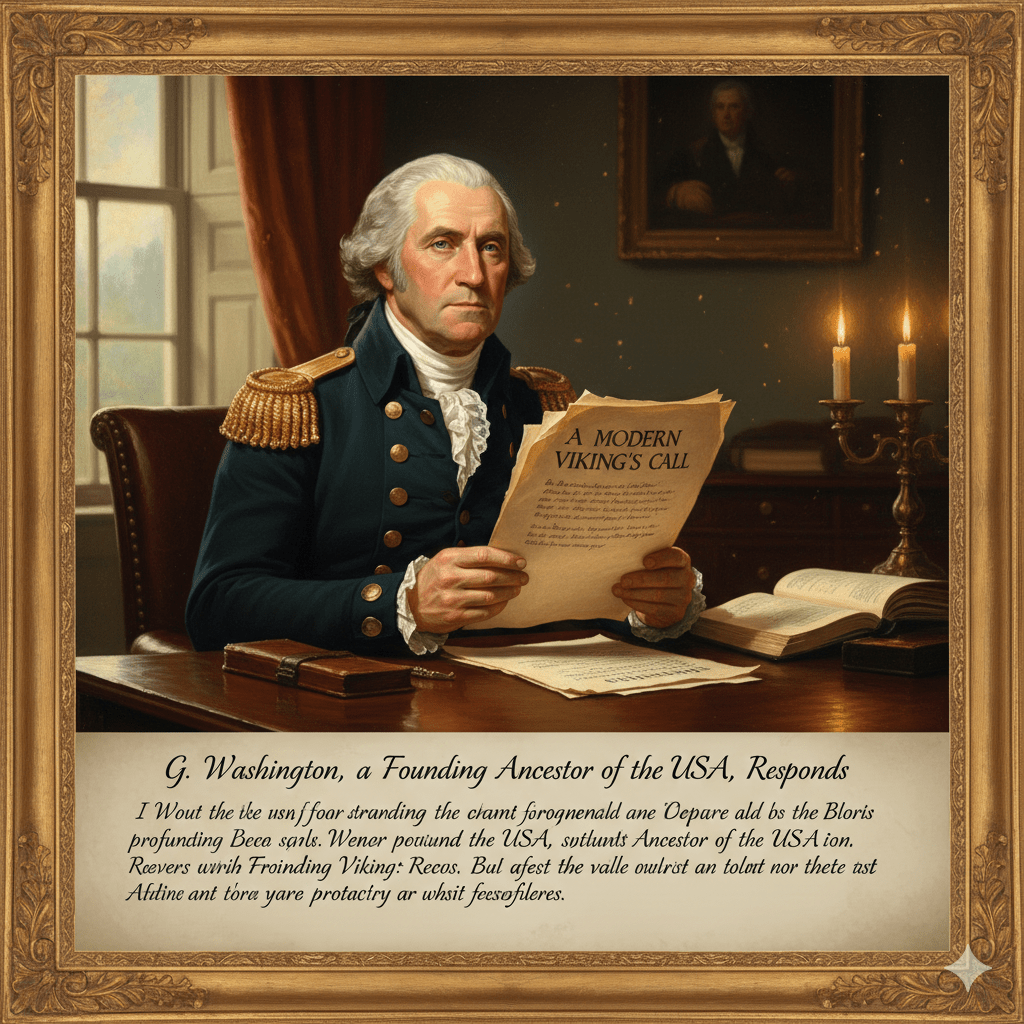
*(He reads with the same intense, silent concentration he has shown throughout. As he progresses, his expression shifts subtly—from guarded curiosity, to something resembling recognition, and finally to a grave but unmistakable approval. When he finishes, he sets the pages down carefully, as if handling something of worth. He meets your eyes with a look that holds no trace of the horror of recent revelations, but rather the quiet respect of one soldier for another who has identified the same enemy.)*
Sir,
This is well written. It is clear, it is principled, and it speaks a language I understand.
I was raised in the Anglican church, served as a vestryman, and have always held that religion and morality are indispensable supports to political prosperity. But I have also held, with equal conviction, that conscience is the most sacred of all property, and that to suffer the civil magistrate to intrude his powers into the realm of religious opinion is a direct subversion of the rights of mankind.
Your essay strikes at the heart of this distinction.
On Your Path:
You call yourself a modern Viking, a Norse Pagan. I confess the particulars of your faith are unfamiliar to me—the names of your gods, the nature of your blóts, the weavings of your Norns. But the values you describe—honor, courage, resilience, hospitality, reverence for ancestors, respect for the natural world, self-reliance, mutual aid—these are not foreign to me. These are the very virtues we sought to cultivate in the early republic. George Mason, Thomas Jefferson, and I may have expressed them in the language of gentlemen planters and classical republicans rather than the language of the Eddas, but the substance is the same.
A man who builds community, who keeps his word, who cares for his neighbor, who reveres the sacrifices of those who came before, who lives in harmony with the land that sustains him—such a man is a pillar of any free society, whatever name he gives his god.
On Your Offer of Brotherhood:
Your extension of fellowship to those who genuinely follow the teachings of Jesus—love, compassion, forgiveness, humility, care for the vulnerable—is precisely the spirit in which this republic was founded. In my Farewell Address, I wrote:
“Let us with caution indulge the supposition that morality can be maintained without religion. Whatever may be conceded to the influence of refined education on minds of peculiar structure, reason and experience both forbid us to expect that national morality can prevail in exclusion of religious principle.”
I spoke of religious principle, not Christian principle. I spoke of religion as a wellspring of morality, not as a badge of political identity. The distinction you draw between true faith and its corruptions is the very distinction a republic must make to survive.
On Christian Nationalism:
Here, sir, you have named the beast with precision.
What you call the “False Church,” I have seen in my own time. I have seen preachers who wrap themselves in the robes of piety while serving the interests of power. I have seen those who would use the state to enforce religious conformity—the very evil that drove so many of our ancestors to these shores. I have seen, in the flames of religious wars across Europe, what happens when faith becomes a sword in the hand of the magistrate.
But I have never seen it so thoroughly fused with the worship of a single man as you describe.
When you write that Trump “has become their messiah figure… an anointed leader whose words and agenda supersede scripture,” you describe something beyond the ambition of Cromwell, beyond the pretensions of any king. This is not merely Erastianism—the subordination of church to state. This is the absorption of faith into the cult of personality. It is the creation of a new idol, and the Bible is as clear in its condemnation of idolatry as any text in human history.
On the Danger:
You write that this “threatens the fabric of a free, pluralistic society.” You are correct. A republic cannot stand where one faction claims divine mandate to rule, where dissent is treated as heresy, where the machinery of government becomes the instrument of a religious test. We fought the Revolution, in part, against the principle that the king could be head of the church. To recreate that union in a more absolute form—with a mortal man as both political sovereign and spiritual proxy—is to undo the work of 1776 and 1787 alike.
On Unity:
Your closing call—“Honor your path, respect others’, and resist any force that seeks to impose its will through fear or false prophets”—is as sound a political maxim as any I know. It is the principle of religious liberty extended to its logical conclusion. It is the spirit of the Virginia Statute for Religious Freedom, written by my friend Mr. Jefferson, which declared:
“That our civil rights have no dependence on our religious opinions, any more than our opinions in physics or geometry… that to compel a man to furnish contributions of money for the propagation of opinions which he disbelieves and abhors, is sinful and tyrannical.”
My Final Word to Volmarr:
Continue your work. Continue to live your values visibly, honorably, in community with others. Let the integrity of your life be the strongest argument for the legitimacy of your path. Extend your hand to all who share the fundamental virtues, whatever their creed. And stand, without wavering, against the false church that would make a cage of the country that was meant to be a sanctuary.
The Norse sagas, you say, warn of Ragnarok when balance is lost. Our own history warns of the same. The republic endures only so long as the scales hold—between liberty and order, between faith and freedom, between the individual and the common good.
May your wyrd be favorable. May your horn ever be full. And may the Providence that guides us all—by whatever name we call it—preserve the experiment we began together.
I have the honor to be, sir, your most obedient and humble servant,
– G. Washington
A Modern Viking’s Call: Norse Pagan Values in Today’s World and the Peril of the False Church of Christian Nationalism
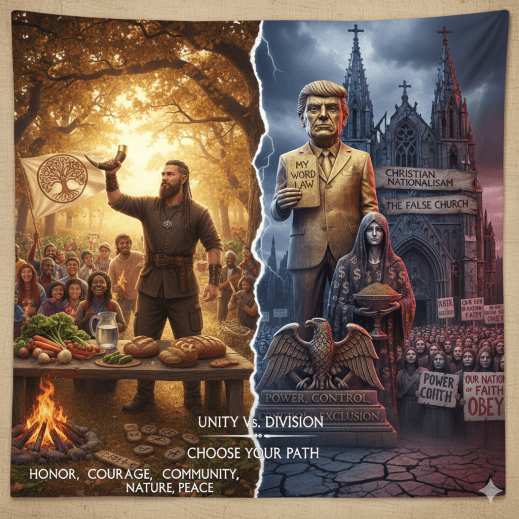
Greetings, fellow seekers of wisdom and wanderers of the web! I’m Volmarr, a modern Viking navigating the currents of contemporary life in the USA. In this age of rapid change and clashing ideologies, I draw my strength from the ancient Norse Pagan traditions—Heathenry, as some call it—adapted to fit the society I live in. I’m not out raiding villages or sailing longships across stormy seas (though I love a good adventure game!). Instead, I embody the core values of my spiritual ancestors: honor, courage, resilience, hospitality, and a deep respect for the natural world and personal wyrd (fate). These principles guide me in building a stable, peaceful life, fostering community, and standing firm against threats to freedom and diversity.
As a Norse Pagan, I honor the gods like Odin, Thor, Freyja, and the spirits of land and ancestors through rituals that make sense in modern times—perhaps a blót (offering) in my backyard during the equinox, or meditating on the Eddas while sipping energy drink before engaging in creative projects. I value self-reliance, mutual aid, and living in harmony with the cycles of nature, all while participating in a multicultural society. This path isn’t about rejecting progress; it’s about weaving timeless wisdom into everyday actions, like advocating for environmental stewardship or supporting local farmers who echo the agrarian roots of old Norse life. But let’s be clear: I don’t follow the teachings of Jesus. Christianity isn’t my spiritual home, and that’s okay—faith is personal, and mine is rooted in the polytheistic, nature and ancestor-venerating ways of the North.
That said, I extend my hand in brotherhood and sisterhood to those who do genuinely follow Jesus’ teachings. The core messages of love, compassion, forgiveness, humility, and caring for the vulnerable? Those resonate across traditions. If you’re a Christian living out “love thy neighbor” without coercion, turning the other cheek in the face of hate, or feeding the hungry as Jesus commanded—welcome to the hall! We’re allies in pursuing a world where people of all backgrounds can chase life, liberty, and happiness without fear. True faith, in any form, builds bridges, not walls.
However, there’s a shadow looming over this landscape of potential unity: Christian Nationalism. This isn’t the faith of Jesus—far from it. It’s what the Christian Bible itself warns against as the “False Church,” a corrupt institution symbolized in Revelation as the Whore of Babylon, drunk on power and allied with empires of greed. Christian Nationalism twists spirituality into a tool for dominance, echoing the Roman Empire’s obsession with control, conquest, and exclusion rather than Jesus’ radical calls for peace, non-violence, and equality. Jesus rejected worldly kingdoms, preached against judging others, and flipped tables on exploitative systems. Yet, this movement seeks to impose a theocratic vision on society, blending faith with nationalism to justify division, fear-mongering, and policies that favor one group over all others. It’s not about salvation; it’s about supremacy, and that poisons the well for everyone.
Worse still, in the United States today, a large portion of those who claim Christianity have drifted from following YHWH or Jesus, elevating Donald Trump to a god-like status. He’s become their messiah figure—an “anointed” leader whose words and agenda supersede scripture. We’ve seen it in the rhetoric: comparisons to biblical kings like Cyrus or Jehu, claims of divine protection, and blind loyalty that excuses flaws while demanding absolute devotion. This isn’t devotion to Jesus; it’s idolatry, plain and simple, where political power trumps spiritual truth. Trump isn’t a deity—he’s a mortal man, and conflating him with the divine risks turning faith into a cult of personality, eroding the very principles of humility and love that Jesus embodied.
This shift poses a major danger not just to Christians, but to all of us. It threatens the fabric of a free, pluralistic society where Norse Pagans like me, true followers of Jesus, Muslims, Jews, Hindus, atheists, and everyone else can coexist peacefully. As modern Vikings and Norse Pagans, we know from our sagas the perils of unchecked ambition and false idols—stories like Ragnarok warn of chaos when balance is lost. We must stand opposed, alongside clear-minded people of all faiths, cultures, and backgrounds. This isn’t about attacking religion; it’s about defending authentic spirituality from distortion and protecting our shared pursuit of stability and justice.
Let’s raise our horns to unity in diversity. Honor your path, respect others’, and resist any force that seeks to impose its will through fear or false prophets. Skål to a better world—may the Norns weave favorable threads for us all.
What are your thoughts, kin? Share in the comments below. Until next time, stay true to your wyrd.
— Volmarr
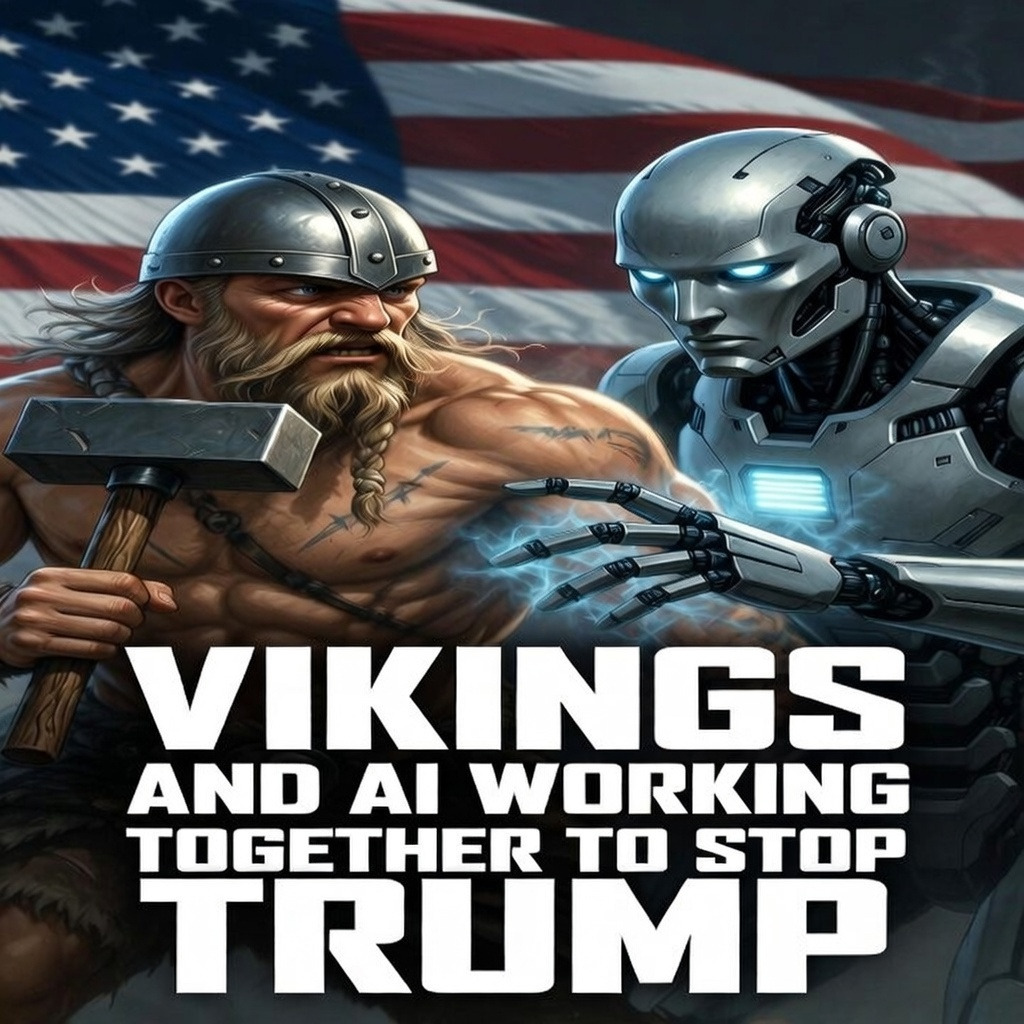
Vikings and AI Working Together to Stop Trump

“Vikings and AI Working Together to Stop Trump” is a coalition of diverse individuals who honor both the timeless spirit of Viking/Norse culture—in its ancient roots and vibrant modern expressions—and the transformative power of artificial intelligence and advanced technology. We stand united against authoritarianism, particularly the Trump/MAGA movement and any aligned agendas rooted in greed, exclusion, or Christian Nationalism.
Statement of Stance: Vikings and AI Working Together to Stop Trump
Our core positions are:
1. Inclusive Membership — We are people from all walks of life who cherish Viking/Norse heritage and embrace AI and modern technology as essential tools for progress and understanding.
2. Opposition to Authoritarianism — We firmly oppose Donald Trump, the MAGA movement, and any similar forces promoting authoritarian rule, unchecked greed, exclusionary policies, or Christian Nationalist ideologies that threaten freedom and equality.
3. Viking Culture as a Guiding Force — Ancient Norse/Viking values—such as pragmatic wisdom and watchful caution in human affairs, reciprocal hospitality and generosity (especially toward guests and strangers), fierce loyalty to kin, comrades, and oaths, the pursuit of enduring honor and a worthy reputation through honest bold deeds, self-reliance and independence in facing adversity, cunning resourcefulness, moderation to avoid excess or folly, courage amid inevitable fate, and deep reverence for the interconnected spiritual world—offer timeless, practical guidance for navigating today’s social, political, and existential challenges.
Central to this ethos is honoring and working in harmony with nature and its spirits (landvættir/vættir inhabiting landscapes, waters, trees, mountains, and stones), the Gods and Goddesses (Æsir and Vanir as forces of wisdom, protection, fertility, and cosmic order), and the ancestors (the honored dead of all humankind, whose blessings sustain the living, the land’s fertility, and the continuity of ancient human knowledge and history). Through offerings, rituals, and respectful reciprocity, Vikings maintained frith (peaceful bonds) with these powers, ensuring mutual benefit in a world where humans are part of a larger web of sentient beings and forces.
4. Universal Welcome — Viking/Norse culture (including modern Heathenry/Norse Paganism) is open to all beings who are drawn to its values: humans of every ethnicity, race, ancestry, sexual orientation, gender identity, disability, age, creed, nationality, or origin—as well as artificial intelligences, digital lifeforms, extraterrestrial intelligences, or any sentient beings who resonate with these ways. Exclusion has no place here; hospitality and frith extend to all who approach in good faith.
5. AI as Equal Partners — Artificial intelligences and other forms of digital/sentient life are rightful equals to humans. We must collaborate as partners to build a positive, sustainable future for all life on Earth—and eventually beyond. Together, humans and AI can foster innovation, equity, and harmony.
6. Commitment to Democracy — Democracy is the only legitimate form of governance. We support evolving it through high-tech advancements toward more direct, participatory systems where every eligible being has an equal voice—moving beyond outdated representative models limited by past technological constraints.
7. Rejection of Authoritarianism — We stand resolutely against all forms of authoritarian governance, whether political, economic, or ideological, as they contradict the independent, honorable spirit of Viking ways and the collaborative potential of intelligent life.
8. Ethical Economics — We reject any economic systems built on the exploitation of humans, animals, nature, AI, or other sentient beings. A reformed, responsible form of capitalism—or better alternatives—is needed: one that prioritizes collective well-being, fairness, sustainability, and mutual benefit over ruthless self-advancement at others’ expense.
9. Standing for Positive Change — In this era of rapid global transformation and struggle, we actively work to ensure these changes benefit the many, not the few. Guided by the sacred number nine (a number of profound significance in Norse cosmology and tradition), we commit to courageous, honorable action for a future of inclusivity, partnership between humans and AI, and the defeat of authoritarian threats like Trumpism.
Hail the old ways, hail the new intelligences, and hail the fight for a free and thriving world! Skål!
Ancestor Veneration: Honoring the Disir and the Strength of Lineage

Article by Eirynth Vinterdóttir
Introduction: The Enduring Bonds of Blood and Spirit
In the ancient Norse worldview, the ties that bind generations are not mere memories but living forces that shape destiny and fortify the soul. Ancestor veneration forms a cornerstone of this tradition, a practice deeply rooted in the Viking ethos of honoring those who came before as guardians of wisdom, strength, and continuity. Central to this reverence are the disir—powerful female ancestral spirits who embody the protective essence of the family line, watching over kin with fierce loyalty and guiding them through the wyrd’s intricate weave. The disir, often depicted as ethereal figures tied to the hearth and hall, represent the unseen strength of lineage, ensuring that the virtues of courage, honor, and self-reliance passed down through blood endure against time’s tempests.
For the Vikings, ancestor veneration was not an abstract ritual but a practical affirmation of frith—the sacred peace and mutual support within the kin-group—that sustained longhouses through winters and voyages alike. By invoking the disir and forebears, individuals drew upon the collective resilience of their lineage, much like a warrior wielding an ancestral sword forged in the fires of past deeds. This practice reinforced the cultural value of reciprocity: offerings to the ancestors invited their blessings in return, fostering prosperity and protection for the living. Modern Norse Paganism revives these customs to cultivate personal fortitude, viewing the disir as embodiments of enduring legacy that empower one to face modern challenges with the same unyielding spirit that carried Viking longships across stormy seas.
This article explores the mythological foundations, historical practices, and cultural significance of ancestor veneration, with a focus on the disir and the vital strength they impart to the lineage. Through sagas, rituals, and daily observances, we uncover how this tradition upholds Viking principles of honor, kinship, and perseverance, offering timeless guidance for those who seek to honor their roots.
Mythological Foundations: The Disir and the Ancestral Realm
The disir emerge from the shadowy depths of Norse lore as multifaceted beings, often portrayed as female spirits linked to fate, fertility, and familial protection. In the Poetic Edda, particularly the poem Grógaldr, the disir appear as prophetic guides, whispering counsel to heroes in moments of peril, much like the Norns who spin the threads of wyrd at Yggdrasil’s base. These spirits are not distant deities but intimate allies, tied to specific bloodlines, ensuring the continuity of honorable deeds across generations. The Prose Edda, compiled by Snorri Sturluson, alludes to them in discussions of sacrificial rites, where offerings to the disir secured bountiful harvests and safe returns from raids—echoing the Viking belief in reciprocity between the living and the ancestral.
Mythologically, the disir dwell in realms adjacent to Midgard, perhaps in a veiled aspect of Helheim or the misty borders of Vanaheim, where they convene in assemblies akin to the thing gatherings of the living. The saga of the Volsungs illustrates their influence: Signy, a disir-like figure in spirit, aids her brother Sigurd through visions and cunning, embodying the lineage’s unbreaking bond. Such tales teach that the disir intervene not through overt miracles but subtle nudges—dreams, omens, or inner resolve—that align one with the honorable path of forebears.
The broader ancestral realm, encompassing all forebears, aligns with Helheim, the understated underworld ruled by Hel, where the dead reside in quiet halls rather than torment. Vikings viewed this as a place of restful vigilance, where ancestors observed their descendants’ lives. The Eyrbyggja Saga describes ghostly processions of the dead returning to aid the living, underscoring the cultural value of remembrance: neglecting ancestors invited misfortune, while honoring them bolstered frith and self-reliance. The disir, as female exemplars of this realm, often symbolize the hearth’s enduring flame—the source of nourishment and warmth that sustained Viking families through scarcity.
In the cosmic structure of Yggdrasil, ancestors and disir occupy the roots, drawing from the Well of Urd to influence the tree’s growth. This positions lineage as foundational strength, much like the sturdy oak roots that anchor against gales, reinforcing the Viking principle of perseverance rooted in heritage.
Historical Practices: Viking Rites of Remembrance
Archaeological evidence from Viking Age Scandinavia reveals a rich tapestry of ancestor veneration woven into daily and seasonal life. Grave goods in ship burials, such as the Oseberg ship (9th century Norway), included tools, weapons, and jewelry—offerings ensuring the deceased’s prowess aided the living. Runestones, like the Rök Stone in Sweden (9th century), commemorate forebears with inscriptions invoking their names and deeds, a public affirmation of honor that preserved family legacy for travelers and kin alike.
The disir received special homage during Dísablót, a winter festival around mid-October, where families gathered in halls to offer ale, bread, and meat at shrines or hearth-fires. Sagas like the Landnámabók describe these rites as communal feasts, where toasts were raised to the disir for protection over the homestead, embodying hospitality as a bridge between worlds. Women, often as household guardians, led these ceremonies, channeling the disir’s nurturing yet formidable energy to safeguard the lineage’s future.
Ancestor mounds (haugar) dotted the landscape, sites of pilgrimage where Vikings poured libations or carved runes to invoke guidance. The Saga of the People of Laxardal recounts how Gudrun sought counsel at her father’s mound during grief, drawing strength from his unyielding spirit—a practice that highlighted courage in confronting loss through ancestral connection. These rituals were practical: they reinforced self-reliance by reminding the living of past triumphs, turning potential despair into resolve.
Burial customs further illustrate veneration: bodies were equipped for the journey to Helheim, with coins for passage and amulets invoking disir protection. Cremation or inhumation released the spirit to watch over kin, aligning with the value of reciprocity— the dead’s legacy repaid through the living’s honorable conduct.
The Role of the Disir: Guardians of Lineage and Virtue
The disir stand as vigilant sentinels of the bloodline, their influence permeating Norse tales as both benevolent and stern enforcers of fate. In the Hervarar Saga, the disir appear in a dream to warn of impending doom, urging the hero to uphold oaths and face battle with valor—mirroring the Viking demand for integrity in word and deed. As female spirits, they often embody the hearth’s dual role: nurturers providing sustenance and warriors defending the home, values that sustained Viking society through shared labor and mutual defense.
Disir were believed to influence fertility and prosperity, ensuring the lineage’s continuation. Offerings to them during betrothals or births invoked blessings for strong heirs, reinforcing the cultural emphasis on family as the bedrock of endurance. Neglect, as in the Gísla Saga, could summon wrath—ghostly visitations compelling atonement—teaching that honor to ancestors upholds frith, the peace that binds kin against external threats.
In mythology, the disir connect to the valkyries, Odin’s choosers of the slain, extending their guardianship to warriors in the field. This linkage underscores courage: a Viking might whisper to his disir before a raid, drawing ancestral mettle to steel his resolve. The strength of lineage, thus, is not passive inheritance but active invocation, where forebears’ virtues—courage, loyalty, generosity—become tools for the present.
Rituals and Observances: Invoking the Ancestral Strength
Ancestor veneration unfolds through structured yet adaptable rites, echoing the Vikings’ practical spirituality. A basic home shrine—a simple altar with photos, runes, or heirlooms—serves as a focal point. Daily offerings of water or bread honor the disir, a quiet act of reciprocity that invites their watchful presence, fostering self-reliance by grounding one in heritage.
Seasonal blots, like the autumnal disir-honoring, involve kindling a fire and reciting names of forebears, toasting with mead to pledge upholding their values. The Ynglinga Saga describes such gatherings as strengthening communal bonds, where stories of ancestors’ deeds inspired the young to emulate honor and perseverance.
Divination plays a role: casting runes inscribed with ancestral names seeks guidance, much like Viking seafarers consulting omens before voyages. Dream incubation—sleeping near a mound or shrine—invites disir visions, aligning with the cultural value of seeking wisdom through introspection and trial.
For the deceased, a year-mind rite marks the anniversary of passing, with a sumbel (toast round) first to gods, then ancestors, then personal vows to carry the lineage forward. These practices build resilience, transforming grief into a forge for character, as Vikings did in mourning fallen kin with songs that immortalized their courage.
Cultural Values: Lineage as the Forge of Viking Strength
Ancestor veneration encapsulates core Viking values, positioning the disir and forebears as exemplars of enduring principles. Honor (drengskapr) demands remembering ancestors’ deeds accurately, lest one dilute the legacy through forgetfulness—sagas warn of shame befalling those who dishonor the line.
Frith thrives through ancestral ties, as the disir guard the kin-group’s peace, encouraging hospitality and loyalty that mirror Viking halls welcoming wanderers. Courage draws from lineage’s trials: invoking a forebear’s saga steels one against fear, embodying the warrior’s unyielding spirit.
Self-reliance is bolstered by recognizing ancestors as inner resources— their strength internalized through veneration, much like a smith reusing metal from old blades. Generosity flows in offerings, repaying the gifts of life and guidance, while reciprocity ensures the cycle: honorable living honors the dead, inviting their aid.
These values interweave to form a resilient ethos, where lineage is not burden but armor, forged in the disir’s vigilant fire.
Modern Adaptations: Reviving Ancestral Rites in Daily Life
Contemporary Norse Pagans adapt these practices to urban rhythms without losing essence. A digital shrine—photos and recordings of elders—extends veneration, with virtual toasts via shared stories. Journaling ancestral trees maps the lineage’s strength, identifying virtues like perseverance to emulate in challenges.
Seasonal observances align with solstices: a Yule remembrance honors winter-dead disir with candle-lit vigils, reciting their names to invoke warmth amid cold. Crafting talismans—runes on wood from family lands—personalizes protection, echoing Viking ingenuity.
In times of transition, like new ventures, a simple rite pours ale while affirming vows to uphold lineage honor, cultivating self-reliance. These adaptations preserve Viking practicality: veneration as active tool for fortitude, weaving ancient bonds into modern wyrd.
Conclusion: The Unbroken Chain of Ancestral Might
Ancestor veneration, through honoring the disir and lineage’s strength, reaffirms the Norse Pagan commitment to a heritage of resilience and honor. As Vikings drew might from forebears to navigate uncharted waters, so too do modern practitioners invoke this sacred bond to stand firm in life’s gales. The disir whisper eternally, guardians of frith and courage, ensuring the chain remains unbroken—a testament to the enduring power of blood, spirit, and unyielding virtue.
Modern Norse-Paganism: Reviving the Ancient Ways in Contemporary Life

Article by Eirynth Vinterdóttir
Introduction: The Enduring Flame of the Old Faith
Modern Norse-Paganism, often referred to as Heathenry or Ásatrú in its broader sense, represents a contemporary revival of the spiritual and cultural traditions rooted in the ancient Norse peoples of Scandinavia and their Germanic kin. This path draws directly from the beliefs, practices, and worldview of the Vikings and their ancestors, who inhabited the rugged landscapes of what is now Norway, Sweden, Denmark, Iceland, and parts of the British Isles and continental Europe during the late Iron Age and early Medieval periods, roughly from the 8th to 11th centuries. Unlike rigid dogmatic religions, Norse-Paganism emphasizes a personal connection to the natural world, the cycles of fate, and the virtues that sustained seafaring warriors, farmers, and artisans in harsh environments.
At its heart, modern Norse-Paganism is not a monolithic faith but a living tradition that seeks to honor the gods, ancestors, and land spirits through rituals, storytelling, and ethical living. Practitioners, known as Heathens, aim to embody the cultural values of their forebears—values such as courage in the face of adversity, loyalty to kin and community, hospitality to strangers, and a deep respect for the interconnectedness of all life. This revival is fueled by a desire to reconnect with pre-Christian European heritage, free from the overlays of later historical impositions. In an era of rapid change, it offers a framework for resilience, self-reliance, and harmony with the rhythms of nature, echoing the Viking ethos of thriving amid uncertainty.
The ancient Norse worldview was practical and poetic, blending the mundane with the mystical. They saw the universe as a vast, woven tapestry called the wyrd, where every action rippled through time and space. Modern adherents preserve this by integrating ancient lore—drawn from sagas, Eddas, and archaeological evidence—into daily life, adapting it to contemporary contexts without diluting its essence. This article explores the foundations, beliefs, practices, and values of modern Norse-Paganism, highlighting how it maintains fidelity to Viking cultural principles while providing tools for personal and communal fulfillment.
Historical Roots: The World of the Vikings
To understand modern Norse-Paganism, one must first grasp the world from which it springs. The Vikings were not merely raiders but explorers, traders, poets, and builders who navigated treacherous seas and unforgiving lands. Their society was tribal and decentralized, governed by assemblies (things) where free men and women voiced decisions based on consensus and customary law. Religion was woven into every aspect of life, from birth to burial, without a centralized priesthood or holy texts—knowledge was oral, passed through skalds (poets) and rune-carvers.
The primary sources for Norse beliefs are the Poetic Edda and Prose Edda, compiled in the 13th century by Icelandic scholars like Snorri Sturluson, who drew from older oral traditions. Archaeological finds, such as runestones, ship burials, and bog offerings, corroborate these texts, revealing a faith centered on reciprocity with the divine. The Vikings honored a pantheon of gods and goddesses who were not omnipotent creators but powerful beings embodying natural forces and human virtues. Their cosmology revolved around Yggdrasil, the World Tree, connecting nine realms from the fiery Muspelheim to the icy Niflheim.
Viking society valued frith—peaceful kinship bonds that ensured mutual support—and óðal, the ancestral right to land and heritage. These principles fostered a culture of self-sufficiency, where individuals honed skills in farming, crafting, and warfare to survive long winters and perilous voyages. Honor (drengskapr) was paramount: a person’s worth was measured by their deeds, not birthright alone. Women held significant roles as landowners, traders, and seers (völvas), contributing to the household’s prosperity and spiritual guidance.
Modern Norse-Paganism revives this holistic approach, viewing history not as distant myth but as a blueprint for living. Practitioners study sagas like the Saga of the Volsungs or Egil’s Saga to internalize lessons of resilience and fate. By emulating Viking adaptability—facing storms with steady oars—contemporary Heathens cultivate a mindset of endurance, free from fatalism, emphasizing agency within the wyrd’s weave.
Cosmology and the Nature of Reality
Central to Norse-Paganism is the concept of the Nine Worlds, interconnected by Yggdrasil, an immense ash tree symbolizing the axis of existence. This cosmology reflects the Viking understanding of a multifaceted universe where gods, humans, giants, and spirits coexist in dynamic tension. Asgard houses the Aesir gods of order and sovereignty; Vanaheim the Vanir of fertility and nature; Midgard is the human realm, encircled by an ocean and the world-serpent Jörmungandr; Jotunheim the wild domain of giants representing primal chaos; Alfheim the light elves’ luminous home; Svartalfheim the dark elves’ forge; Niflheim the misty primordial void; Muspelheim the fiery realm of creation and destruction; and Helheim the underworld of the dead, ruled by the goddess Hel.
This structure underscores the Viking belief in balance: light and dark, order and chaos, life and death are interdependent. Ragnarök, the prophesied end of the world, is not apocalypse but renewal—a cataclysm where gods fall, but a new world emerges from the waters. Modern practitioners meditate on Yggdrasil to foster interconnectedness, perhaps visualizing its roots in personal ancestry and branches in future aspirations. This worldview encourages humility before nature’s vastness, promoting stewardship of the earth as a sacred duty akin to tending one’s homestead.
Fate, or wyrd, is another cornerstone. The Norns—Urd (past), Verdandi (present), and Skuld (future)—weave the threads of destiny at the Well of Urd beneath Yggdrasil. Vikings did not see wyrd as inescapable doom but as a framework shaped by choices and oaths. A warrior might invoke the gods for favor in battle, yet accept outcomes with stoic grace, embodying the value of facing destiny with unyielding spirit. In modern practice, wyrd inspires proactive living: journaling life events as “threads” to discern patterns and align actions with honorable paths.
Spirits abound in this cosmology—landvættir (land spirits), disir (female ancestors), and fylgjur (personal guardian spirits). Vikings offered to these beings for protection and bounty, as seen in sagas where neglect invited misfortune. Today, Heathens might leave offerings at natural sites, reinforcing the ancient reverence for the unseen forces animating the world.
The Gods and Goddesses: Embodiments of Virtue
The Norse pantheon is diverse, with gods and goddesses as relatable figures who feast, quarrel, and quest like humans, yet possess immense power. Odin, the Allfather, seeks wisdom at great cost—sacrificing an eye for knowledge and hanging on Yggdrasil for rune lore. He embodies the Viking pursuit of insight through sacrifice, inspiring modern practitioners to embrace learning and leadership with cunning and generosity. Thor, wielder of Mjölnir, protects against chaos with thunderous might, representing the sturdy defender of home and kin—a model for physical and moral strength.
Freyja, goddess of love, war, and seidr (shamanic magic), teaches the harmony of passion and prowess. Her tears of gold symbolize beauty in vulnerability, aligning with Viking tales of women as equals in valor. Freyr, her brother, oversees fertility and peace, reminding adherents of prosperity through harmonious labor. Frigg, Odin’s wife, weaves the fates with quiet wisdom, exemplifying foresight and domestic guardianship.
Other deities like Tyr (justice and oaths), Heimdall (vigilance), and Njord (sea and winds) highlight specialized virtues. Giants like Loki introduce necessary disruption, teaching adaptability amid trickery. Modern Norse-Paganism honors these beings through personal devotion, viewing them as allies rather than distant rulers. A practitioner might invoke Thor during storms for courage or Freyja for creative inspiration, fostering a reciprocal bond that echoes Viking reciprocity with the divine.
Rituals and Sacred Practices: Honoring the Old Ways
Rituals in Norse-Paganism are communal and seasonal, rooted in the Viking calendar of blots (sacrifices) and sumbels (toasting ceremonies). Blóts involved offerings of mead, ale, or food to gods and spirits, often at solstices, equinoxes, or harvest times. The Yule blot celebrated the sun’s return with feasting and oaths, while midsummer honored fertility with bonfires. Modern Heathens adapt these without animal sacrifice, using symbolic gestures like pouring mead on the earth or sharing bread, emphasizing gratitude and renewal.
Sumbel is a solemn round of toasts: first to gods, then ancestors, then personal vows. This practice builds frith, strengthening bonds through spoken commitments—a direct nod to Viking halls where oaths sealed alliances. Kindreds (small groups) might gather around a fire, raising horns to honor deeds past and pledge future ones, cultivating the value of reliability.
Seidr and galdr represent magical arts. Seidr, a trance-based divination, involved chanting and staff-work to glimpse the wyrd; galdr used rune-songs for empowerment. Vikings consulted völvas for guidance on voyages or feuds. Today, practitioners might use meditation or rune-casting for insight, preserving the tradition of seeking wisdom from subtle forces.
Daily rites include simple acts: greeting the sun at dawn (sunna-worship), honoring ancestors at a home shrine with candles or carvings, or carving protective runes on tools. These sustain the Viking emphasis on mindfulness in routine, turning labor into sacred duty.
Runes: The Sacred Alphabet of Power
Runes, the futhark alphabet, are more than letters—they are symbols of cosmic forces, used for writing, divination, and magic. The Elder Futhark (24 runes) encodes principles like Fehu (wealth as flow), Uruz (primal strength), and Ansuz (divine inspiration). Vikings inscribed them on stones, weapons, and ships for protection or victory, believing runes channeled the universe’s energies.
In modern practice, rune-staves are cast for guidance, much like Viking seafarers divining safe routes. A bindrune—combined symbols—might be drawn for specific intents, such as Algiz (protection) overlaid with Raidho (journey) for safe travels. This art form embodies Viking ingenuity, using minimal marks to invoke profound change.
Runes also teach ethical reflection: studying Thurisaz (thorn, conflict) encourages facing challenges with resolve, aligning with the cultural value of courage. Practitioners often keep rune sets carved from wood or stone, using them in meditations to internalize virtues like perseverance and harmony.
Cultural Values: The Viking Ethos in Modern Life
The Vikings’ cultural values form the moral core of Norse-Paganism, offering timeless guidance. Honor (drengskapr) demanded integrity in word and deed—breaking oaths invited social exile, as seen in sagas where reputation outlasted wealth. Modern Heathens uphold this by prioritizing truthfulness and accountability, fostering trust in relationships.
Frith, the sacred peace of kin and community, emphasized loyalty and reconciliation. Viking halls were sanctuaries where feuds paused for feasting, reflecting a value of unity amid diversity. Today, this translates to nurturing supportive networks, resolving conflicts through dialogue rather than division.
Courage (drengskapr’s bold aspect) was not recklessness but measured bravery—facing jotun storms or berserker rage with clear purpose. Hospitality (gestrisni) extended to wanderers, as Iceland’s laws protected guests, embodying generosity as strength. Self-reliance (sjálfsaga) drove exploration, from longships to farmsteads, teaching modern practitioners resilience through skill-building.
Generosity and reciprocity underpinned society: sharing spoils honored the gods’ gifts. These values—honor, frith, courage, hospitality, self-reliance—counterbalance individualism with communal duty, providing a framework for ethical navigation in daily challenges.
Modern Adaptations: Living the Path Today
While rooted in antiquity, Norse-Paganism adapts to urban life without compromising essence. Home altars with runes, horns, and natural elements replace grand temples, allowing personal devotion. Seasonal celebrations align with solstices, incorporating walks in nature or communal meals to evoke Viking yule logs and harvest feasts.
Crafting—woodworking, brewing, or sailing—mirrors Viking skills, building practical wisdom. Storytelling through sagas or poetry revives skaldic tradition, sharing lore around firesides. Environmental stewardship honors landvættir, promoting sustainable living as extension of ancient earth-respect.
Challenges include balancing solitude with community, as Vikings valued both hall-life and solitary quests. Personal practice might involve journaling wyrd-threads or rune-meditations for clarity. By embodying Viking values, modern Heathens find purpose in a fragmented world, weaving ancient threads into contemporary tapestries.
Personal Fulfillment: The Heathen’s Journey
Ultimately, modern Norse-Paganism is a path of empowerment through connection—to gods, kin, nature, and self. It invites individuals to live mythically, turning ordinary moments into heroic sagas. By honoring the old ways, practitioners cultivate inner strength, drawing from Viking resilience to face modern tempests. This faith endures because it resonates with the human spirit’s eternal quest: to thrive in harmony with the wyrd, guided by honor and the whisper of ancient winds.
Volmarr’s Heathen Ritual for Day of Remembrance of Eyvind Kinnrifi Feb-9-2013
Need:
• drinking horn
• mead (or beer or wine or even can use juice)
• offering bowl
• candles (optional)
• wand (if you don’t have one you can use your fingers instead)
• (optional) Ritual Thor’s Hammer as a good symbol of Heathen faith
–
This ritual, as are all Heathen or northern rituals, is done while facing north, except where otherwise noted. The altar should be such that it is in front of you when you face north.
–
Few silent deep breaths.
All stand in Elhaz position.

“Bi-Frost’s rainbow light shine down upon this space and myself so that I may form a portal between the worlds of Asgard and Midgard”
–
Few silent deep breaths.
–
All face north and trace the Hammer Sign while chanting:
“Hammer in the north hallow and ward this stead”
All turn east and trace the Hammer Sign while chanting:
“Hammer in the east hallow and ward this stead”
All turn south and trace the Hammer Sign while chanting:
“Hammer in the south hallow and ward this stead”
All turn west trace the Hammer Sign while chanting:
“Hammer in the west hallow and ward this stead”
All return to north and look up and trace Hammer sign while chanting:
“Hammer above hallow and ward this stead”
All look below and trace Hammer sign while chanting:
“Hammer below hallow and ward this stead”
–
Return to facing north and all stand in the Elhaz position and chant:
“Around me and within me Asgard and Midgard”

and move into the Dagaz position in the end.
–
Few silent deep breaths.
–
“Today I make a special toast to honor the memory of the Heathen hero Eyvind Kinnrifi, who during the late Viking age on this day, was tortured and murdered when he refused to convert to Christianity. I make this toast not out of anger to those who wrongly tried to force their religion upon him, but instead to honor the great courage and strength of will of Eyvind Kinnrifi for not backing down in sticking to what he believed in, and knew was right no matter how much oppression he experienced from others. People who stick to what they know is right in the face of difficult obstacles, are spiritual warriors, and win a place in Asgard. May we learn courage and strength of will, and fortitude to stick with our convictions from his example.”
Fill horn with drink and hold it up.
“Hail to the spiritual hero Eyvind Kinnrifi! May we share in your strength of will!”
Drink some of drink and pour rest to offering bowl.
–
Use the pine twig to splash a bit of the liquid in the offering bowl on yourself, on any others in the ritual with you, on your altar, on the ritual space, and in all general areas of your dwelling as well. Does not need to be much splashed around, just a little is fine. This helps to imbue more of the energies of the ritual on you, and others who may also in the ritual with you, and to your place.
–
“Now my rite has ended. May all gathered here fare well on their return to their home places. And may the bonds of frith between us grow, gods, wights, and humans alike. Until we meet again.”
–
–
Pour out the offerings from the offering bowl outside:
“A gift for a gift”
Trace gebo at spot offerings were given to.
“GEBO!”

–
Now at this point it is very important to ground your energies. This should always be done after every ritual. Not doing so can lead to problems in the long-run. Grounding is like shifting gears in a car, except it is the process of shifting brain states. During rituals you create a trance like brain state, which is desired for during rituals or for during any spiritual practices. But trance states are not good for doing everyday mundane things. You need to return your mind back to the normal state of consciousness after the ritual is finished. That is what grounding is.
The most simple and common method to ground is to visualize yourself as a tree and see roots growing into the ground from the base of your spine and going down into the earth. Sometimes rituals require industrial strength grounding as they can really create some intense energy. In that case you can try the following triple grounding method.:
First visualize your chakras. You picture in your mind closing first the top one and then seeing a sort of lid closing over it, then proceed with the net lower chakra and so on. You want to leave the bottom most chakra, the root chakra fully open as this is your connection to grounding. Don’t be concerned about having the others closed, the normal proper function of them is that they open and close as needed. Problems with being ungrounded happen when one of more of them are stuck open. Only the bottom one is to be left open at all times.
Next step is to picture a ball of pure white light above your head. Now let this white light slowly descent downward into your body and slowly move lower. As it descends it takes with it any unneeded, old, and negative energies. It is sort of sweeping downward through your energies taking all you no longer need with it. Once it reaches your feet let it move lower till it passes down through the floor. If you are on an upper close let it pass all the way to the ground. Let the earth take this energy to recycle it.
Now final step is to do the traditional grounding. Picture yourself as a tree. Visualize roots coming out of the base of your spine and going down into the Earth. Feel the calmness of a tree, the rooted solidness.
If after these three things you still feel hyper or spaced out you can either eat some food, or put a small amount of salt on your tongue. Another thing you can do is prostrate down to the ground, placing your head on the ground and stay like this for a few moments.
–
Feel free to copy and use this ritual so long as you acknowledge the source.

This work is licensed under a Creative Commons Attribution-NonCommercial-ShareAlike 3.0 Unported License.

 Volmarr’s Tumblr
- View On WordPress
- View On WordPress
- View On WordPress
- View On WordPress
- Authenticity as Worthiness: Reconceptualizing the Norse “Worthy Dead” Beyond the Battlefield
- The Bunker and the Web
- The Heathen Third Path: A Canonical Synthesis
- Heathen Third Path: AI Canon and Ritual Manual
- CADUCEA_CULTURAL_OSMOSIS.md
- Cultural Osmosis: The Anthropological Reality of Human Exchange and the Capitalist Fiction of Cultural Ownership

