# Mímir-Vörðr System Architecture
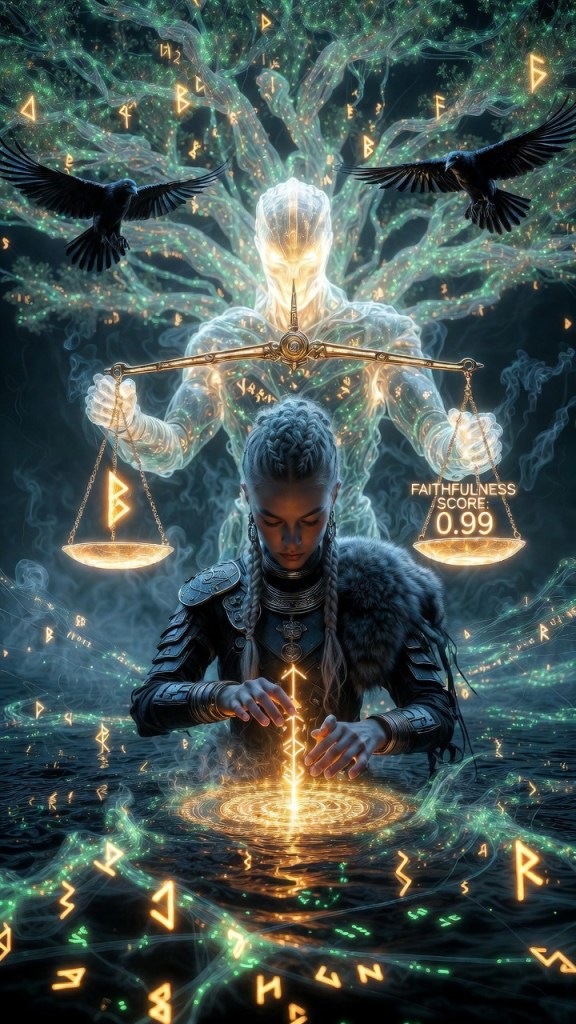
## The Warden of the Well — Complete Technical Reference
### Ørlög Architecture / Viking Girlfriend Skill for OpenClaw
—
> *”Odin gave an eye to drink from Mímir’s Well and received the wisdom of all worlds.
> The Warden drinks for Sigrid — extracting truth from ground knowledge
> so she never has to guess when she can know.”*
—
## 1. What Is Mímir-Vörðr?
**Mímir-Vörðr** (pronounced *MEE-mir VOR-dur*) is the intelligence accuracy layer of
the Ørlög Architecture. It is a **Multi-Domain RAG System with Integrated Hallucination
Verification** — a system that treats Sigrid’s internal knowledge database as the
authoritative **Ground Truth** and actively prevents language model hallucinations from
reaching the user.
The core philosophy: **smart memory utilisation over raw horse-power.**
Instead of deploying a larger model to handle more knowledge, Mímir-Vörðr:
1. Retrieves the specific facts needed for each query from a curated knowledge base
2. Injects those facts as grounded context into the model’s prompt
3. Generates a response using a four-step verification loop
4. Scores the response’s faithfulness to the source material
5. Retries or blocks any response that falls below the faithfulness threshold
The result is a small local model (llama3 8B) that answers with the accuracy of a much
larger model — because it is not guessing, it is reading.
—
## 2. Norse Conceptual Framework
The system is named after three Norse mythological concepts that perfectly capture its function:
| Norse Name | Meaning | System Role |
|———–|———|————|
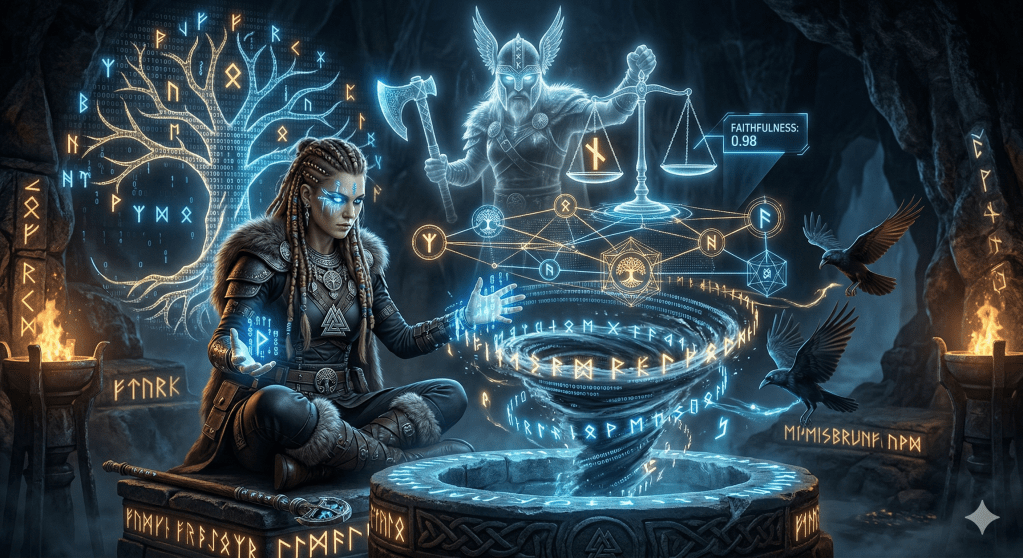
| **Mímisbrunnr** | The Well of Mímir — source of cosmic wisdom beneath Yggdrasil | The knowledge database (ChromaDB + in-memory BM25 index) |
| **Huginn** | Odin’s raven “Thought” — flies out to gather information | The retrieval orchestrator (query → chunks → context) |
| **Vörðr** | A guardian spirit / warden — protective double of a person | The truth guard (claim extraction → NLI → faithfulness scoring) |
Together they form **Mímir-Vörðr** — “The Warden of the Well” — a system that
holds the ground truth and refuses to let falsehood pass.
—
## 3. System Overview — Top-Level Architecture
Read More…Mímir-Vörðr: The Warden of the Well
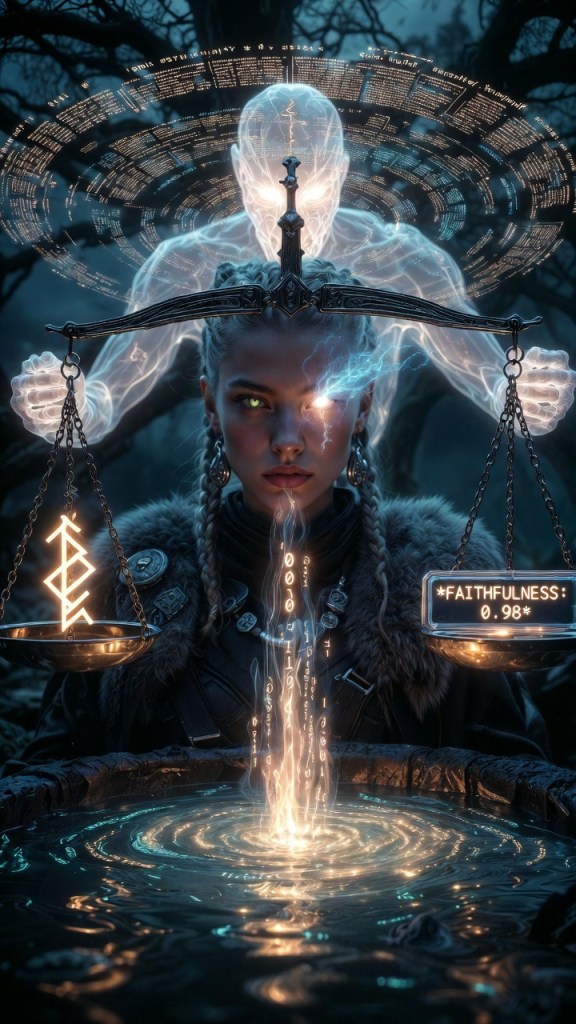
The Sophisticated Architecture at the Intersection of Cybernetic Knowledge Management and Automated Fact-Checking.
In the relentless pursuit of Artificial General Intelligence (AGI), the tech monoliths are relying on the brute force of the Jötnar—the giants of raw compute. They operate under the assumption that if you simply feed enough data into massive clusters of GPUs, pumping up the parameter count to astronomical scales, true cognition will eventually spark in the latent space.
From an esoteric, data-science, and structural perspective, this “horse-power” approach is a modern techno-myth. Massive models hallucinate because their knowledge is baked into static weights; they are probabilistic parrots echoing the void of Ginnungagap without an anchor. True AGI will not be born from blind scaling. It requires wisdom, defined computationally as the ability to verify, reflect, and draw from an immutable well of truth.
To achieve AGI, we must move away from brute compute and toward Smart Memory Utilization—a paradigm rooted in the cyber-mysticism of the Norse Pagan worldview. We must build systems that mimic the sacrifice at Mímir’s Well: trading raw, unstructured vision for deep, grounded insight.
Enter the Self-Correction Loop within a Retrieval-Augmented Generation (RAG) framework.
1. The Core Philosophy: Contextual Precision over Brute Force
The “horse-power” methodology assumes a larger model inherently knows more. The “Smart Memory” approach treats the Large Language Model (LLM) not as a static repository of knowledge, but as a dynamic reasoning engine. Memory is the fuel. If the fuel is refined, the engine doesn’t need to be massive.
We are building a Multi-Domain RAG System with Integrated Verification. Unlike standard AI that relies on outdated or hallucinated internal training weights, this architecture treats your curated internal database as the esoteric “Ground Truth.”
To mirror the complex layers of human and spiritual consciousness, your system’s database is divided into three distinct Memory Tiers:
- Episodic (The Immediate Wyrd): Short-term memory. The current conversation flow and immediate user intent.
- Semantic (Mímisbrunnr / The Well of Knowledge): RAG / Vector storage. Your vast, deep-time database of subject matter, from Norse metaphysics to Python scripts.
- Procedural (The Magickal Blueprint): Multi-Agent memory. The “How-to”—the specific programmatic rituals and steps the AI takes to verify a fact.
2. The Unified Truth Engine: A Structural Framework
To achieve this algorithmic alchemy, the system follows a strict three-stage pipeline:
I. The Retrieval Stage (RAG) – Casting the Runes
- Vector Embeddings: We convert diverse subject matter into high-dimensional numerical vectors. Concepts are mapped into a latent spatial reality.
- Semantic Search: When a query is made, the system traverses this high-dimensional space to find the most conceptually resonant “nodes” of information.
- Context Injection: This retrieved data is summoned and fed into the LLM’s prompt. It is the only valid source of reality permitted for the generation cycle.
II. The Generation & Comparison Stage – The Weaving
- Drafting: The model acts as the weaver, generating a response based solely on the retrieved runic context.
- Natural Language Inference (NLI): The system performs a rigorous “Consistency Check.” It mathematically compares the generated response against the original source text to calculate if the output logically entails (aligns with) the source, or if it contradicts the established Wyrd.
III. The Hallucination Scoring Layer – The Truth Guard
Here, the system acts as the ultimate gatekeeper. Each response is mathematically assigned a Faithfulness Score.
- Score 0.8–1.0 (High Accuracy): The response is strictly grounded in the database. The truth is pure.
- Score 0.5–0.7 (Marginal): The AI introduced external “fluff” or noise not found in the well.
- Below 0.5 (Hallucination Alert): The output is corrupted. The system automatically aborts the response, discards the output, and re-initiates the retrieval ritual.
3. Mechanisms of Magick: Achieving High Accuracy
To keep the model razor-sharp and ensure the hallucination checks remain rigorous, we employ advanced data-science protocols:
A. Chain-of-Verification (CoVe)
Instead of a single, naive prompt, we invoke a four-fold cognitive process:
- Draft an initial response.
- Plan verification questions (e.g., “Does the semantic database actually support this claim?”).
- Execute those queries against the vector database.
- Revise the final output based on the empirical findings.
B. Knowledge Graphs (Relational Memory via Yggdrasil)
Standard RAG treats text as a flat list. GraphRAG builds a World Tree. By mapping complex subjects into a Knowledge Graph, we define the deep, esoteric relationships between concepts (e.g., hardcoding that Thurisaz is intrinsically linked to Protection and Chaos). This prevents the AI from conflating similar concepts by mapping the actual metaphysical relationships into traversable data structures.
C. Automated Evaluation (RAGAS)
We utilize frameworks like RAGAS (RAG Assessment Series) to measure the integrity of the weave across three metrics:
- Faithfulness: Is the output derived exclusively from the retrieved context?
- Answer Relevance: Does it satisfy the user’s true intent?
- Context Precision: Did the system extract the exact right nodes from the database?
4. Technical Implementation: Intelligence Over Muscle
- Database: Utilize a vector database like ChromaDB or Pinecone to act as the structural repository of your subject matter.
- Memory Integration: Implement Long-term Memory architecture (like MemGPT) so the system retains specific philosophical leanings and context across epochs of time.
- Dynamic Context Windowing (The Sieve): Instead of shoving 10,000 words into the AI’s context window (causing “Lost in the Middle” hallucinations), use a Reranker (like Cohere or BGE). Retrieve 50 matches, rerank to find the 3 most potent snippets, and discard the rest.
- Recursive Summarization: As the database expands, employ hierarchical summarization. Level 1 is raw data (The Eddas, Python docs); Level 2 is thematic clusters (Coding Logic, Runic Metaphysics); Level 3 is Core Axioms.
- Dual-Pass Verification (Logic Gate): Deploy a “Judge” model—a smaller, highly efficient LLM acting as the Critic. It extracts claims from the Actor model’s output and validates every single sentence against the database for a Citation Match and an NLI Check.
The Nomenclature of the Architecture
To capture the essence of this cyber-mystical architecture, we look to the old Norse paradigms of memory, thought, and guardianship:
- Mímisbrunnr (Mimir’s Well): The perfect representation of a RAG-based database. Your system doesn’t just guess; it draws from an ancient, deep source of established “Ground Truth.”
- Huginn’s Ara (The Altar of Thought): Named for Odin’s raven of thought. Huginn flies across the digital expanse, retrieving highly specific data points and bringing them back to the reasoning engine, negating the need for a massive, inefficient model.
- Vörðr (The Warden / The Watcher): The guardian spirit. This represents your Dual-Pass Critic layer. The Warden stands over the AI’s output, scoring it and ensuring absolute faithfulness to the source data. If the AI hallucinates, the Vörðr blocks it.
The Unified Designation: Mímir-Vörðr (The Warden of the Well)
Mímir-Vörðr is the singular title for the entire architecture. It tells the complete story: It contains the immutable Well of your curated database, and the Warden—the automated hallucination scoring and RAG verification process—that ensures only the pure, filtered truth is ever allowed to manifest. This is the blueprint for true, grounded, artificial cognition.

This work is licensed under a Creative Commons Attribution-NonCommercial-ShareAlike 3.0 Unported License.

 Volmarr’s Tumblr
- An error has occurred; the feed is probably down. Try again later.
 Volmarr's Blog of Modernist Heathenism, Norse-Paganism, and Norse-Wicca