Hail the Mad God
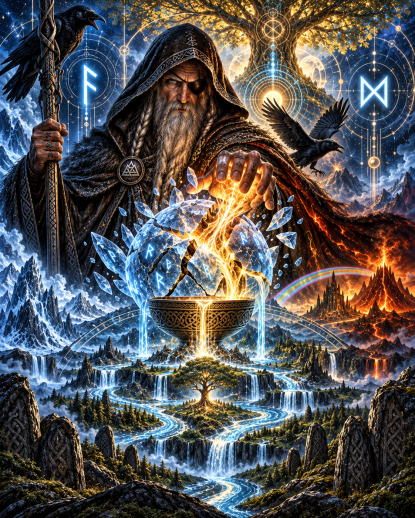
Óðinn, Divine Madness, Runic Ice, Cognitive Fire, and the Waters of Poetic Creation
There is a kind of wisdom that builds walls.
There is another kind that breaks through them.
There is knowledge that organizes what is already known.
And there is inspiration that tears apart the existing arrangement of knowledge until something appears that could not previously be seen.
There is reason.
There is intuition.
There is memory.
There is dream.
There is calculation.
There is poetry.
There is the ordered mind walking carefully along the road.
And then there is Óðinn.
The Wanderer.
The Rune-Winner.
The Mead-Thief.
The God of Poetry.
The God of Ecstasy.
The God whose wisdom does not remain safely seated within the boundaries of ordinary consciousness.
Óðinn does not merely know.
Óðinn seeks.
He hungers for knowledge badly enough to sacrifice comfort, certainty, body, eye, identity, and even himself to himself.
His wisdom is not sterile information.
His wisdom burns.
His wisdom intoxicates.
His wisdom wounds.
His wisdom transforms.
His wisdom becomes poetry.
Within the Ice–Fire–Water cosmology, Óðinn can therefore be understood as one of the greatest divine expressions of a particular mystery:
The Fire of consciousness striking the Ice of established pattern until previously impossible Water begins to flow.
That Water is inspiration.
That Water is poetry.
That Water is magic.
That Water is ecstatic speech.
That Water is creation.
That Water is the moment when consciousness crosses a boundary and returns carrying something that did not exist in ordinary awareness before.
This is the divine madness of Óðinn.
Hail Óðinn!
Hail the Poetic Madness of Óðinn!
The Meaning of Óðr
To understand Óðinn, we must first understand that the modern separation between wisdom and madness fits him poorly.
Óðinn stands at their dangerous border.
His name belongs to a Germanic complex of meaning associated with fury, frenzy, inspiration, ecstatic excitement, and altered intensity of mind.
This is enormously important.
Óðinn is not merely the calm old wizard sitting upon a throne possessing encyclopedic information.
That image captures only part of him.
Óðinn is knowledge set into motion.
He is awareness becoming so intensely active that ordinary categories begin to rupture.
This is why poetry belongs naturally to him.
Poetry does not merely describe reality.
Great poetry reconfigures perception.
The poet takes words everyone already knows and places them into relationships nobody previously perceived.
Nothing physically new needed to be invented.
The words were already there.
The concepts were already there.
The experiences were already there.
They were Ice.
Then Fire moved through them.
Suddenly:
Word sought word.
Image sought image.
Meaning sought meaning.
And Water flowed.
A poem appeared.
Ice: The Frozen Patterns of the Runes
The rune is pattern.
A rune has shape.
Distinction.
Memory.
Association.
Name.
Sound.
Possibility.
The rune therefore participates beautifully in the principle of Ice.
Ice is that which has acquired structure.
It preserves.
It differentiates.
It remembers.
A rune carved into wood remains after the hand that carved it withdraws.
A rune carved into stone may remain after the carver dies.
The moment of consciousness that produced the mark passes into Urðr.
The pattern remains.
The rune becomes frozen cognition.
But frozen pattern alone is not magick.
A rune sitting unread upon a stone is potential.
Something must encounter it.
Something must perceive it.
Something must awaken relationship with it.
The Ice awaits Fire.
Óðinn Is the Fire That Strikes the Rune
Óðinn does not merely possess runes.
He wins them.
That distinction matters.
The runes are not presented as trivia casually handed to a comfortable god.
Óðinn undergoes ordeal.
He hangs.
He is wounded.
He fasts.
He peers downward.
He reaches.
He cries out.
He takes.
The image is violent because transformation is violent.
Not necessarily violence against another being.
Violence against the boundaries of the existing self.
Óðinn sacrifices Óðinn to Óðinn.
The knower becomes simultaneously:
the sacrificer
the sacrifice
the seeker
the sought
the consciousness
the object upon which consciousness operates.
This is metacognition turned into mythic ordeal.
The mind becomes the instrument by which the mind breaks open the mind.
That is Óðinic Fire.
Madness as Cognitive Fire
When I speak here of divine madness, I am not using “madness” as a clinical diagnosis.
This is not romanticizing mental illness.
Divine madness means something different.
It is the mythic condition in which ordinary cognitive boundaries become temporarily permeable.
The categories loosen.
The familiar becomes strange.
The impossible becomes conceivable.
Associations normally kept separate suddenly touch.
The rational gatekeeper that continually says:
“These things do not belong together.”
loses absolute control.
And another voice asks:
“But what if they do?”
This is extraordinarily dangerous cognition if it possesses no path back toward integration.
But it is extraordinarily creative cognition when the traveler can return with something.
That distinction matters.
Randomness alone is not inspiration.
Confusion alone is not wisdom.
Chaos alone is not poetry.
Óðinn does not cross boundaries merely to disappear into them.
He returns carrying treasure.
Runes.
Songs.
Mead.
Words.
Knowledge.
Magick.
The mad journey becomes useful because Fire eventually becomes Water.
The Fire Must Melt the Ice
Established knowledge is necessary.
But established knowledge can become rigid.
Every intellectual system eventually develops boundaries:
This belongs here.
That belongs there.
This is religion.
That is science.
This is art.
That is psychology.
This is technology.
That is magick.
This is rational.
That is irrational.
Categories help us think.
But categories can also imprison thought.
Ice preserves.
Too much Ice freezes movement.
This is where Óðinn enters.
His Fire does not necessarily destroy the pattern.
It melts its rigidity.
Suddenly concepts can flow into one another.
Myth can speak with psychology.
Psychology can speak with neuroscience.
Neuroscience can speak with mysticism.
Mysticism can speak with poetry.
Poetry can speak with programming.
Programming can speak with runes.
Runes can speak with information theory.
Information theory can speak with wyrd.
The categories have not necessarily become identical.
Their boundaries have simply become permeable enough for new synthesis.
This is poetic madness.
Ansuz: The Breath That Becomes Word
Within this modern runic cosmology, Ansuz represents the moment when inspired cognition acquires voice.
Thought alone remains internal.
Inspiration alone may remain incomprehensible.
But expression transforms inner movement into something that can enter the world.
Breath moves.
The mouth shapes it.
Sound appears.
Sound becomes word.
Word carries meaning.
Meaning enters another consciousness.
This is an astonishing transformation.
Invisible cognition becomes physical vibration.
Physical vibration becomes another person’s cognition.
Mind crosses space.
Ansuz is therefore the rune through which Óðinic Fire becomes communicable Water.
The madness finds language.
The vision finds poetry.
The intuition finds symbol.
The impossible thought finds a sentence.
And once spoken, that sentence becomes available to others.
Eventually it freezes again into Ice:
memory,
story,
poem,
book,
recording,
tradition,
data.
Thus:
Ice → Fire → Ansuz → Water → Ice
Knowledge becomes inspiration.
Inspiration becomes expression.
Expression becomes experience.
Experience becomes recorded knowledge.
The cycle begins again.
Poetry Is Melted Knowledge
This gives us a beautiful definition of poetry.
Poetry is knowledge melted by consciousness and poured into a new form.
The poet inherits language.
Ice.
The poet inherits myths.
Ice.
The poet inherits personal memories.
Ice.
The poet inherits ancestors.
Ice.
The poet inherits cultural symbols.
Ice.
The poet inherits wounds.
Ice.
The poet inherits love.
Ice.
Then something happens.
Fire enters.
Concepts previously separated collide.
Memory combines with desire.
Myth combines with experience.
Image combines with emotion.
Sound combines with meaning.
The rigid architecture melts.
Water begins flowing through paths that did not previously exist.
And the poet speaks.
That is Ansuz.
The Mead Is Water
The Mead of Poetry fits perfectly into this system.
It is liquid.
It is intoxicating.
It changes consciousness.
It is consumed.
It enters the body.
It transforms the drinker.
And through Óðinn it becomes associated with poetry and inspired expression.
Within this cosmology, the Mead can therefore represent Water in its explicitly Óðinic form:
knowledge transformed into intoxicating creative consciousness.
Ice alone can be catalogued.
Fire alone can rage.
But Mead is drinkable.
It can move between beings.
It can be shared.
It can enter another body.
It can change another consciousness.
This is exactly what poetry does.
A poem begins inside one consciousness and somehow enters another.
The second person does not merely receive information.
They may experience something.
An image.
A feeling.
A revelation.
A memory.
A shift of perspective.
The poet’s Water enters another person’s becoming.
Dagaz: The Doorway of the Impossible Moment
Then comes Dagaz.
Dagaz is the rune of breakthrough within this modern synthesis.
Daybreak.
Transition.
Threshold.
The moment when darkness becomes light without either side possessing a clean boundary.
Where exactly does night end?
Where exactly does day begin?
There is no single visible wall.
There is transformation.
Dagaz is therefore the rune of the liminal cognitive state.
The old pattern has broken.
The new pattern has not fully stabilized.
This is the dangerous creative interval.
The mind temporarily stands between worlds.
Not literally necessarily.
Cognitively.
Symbolically.
Spiritually, for those whose practice understands it that way.
The known world has become insufficient.
The unknown world has not yet become intelligible.
And consciousness stands in the gap.
Ginnungagap inside the mind.
This is where madness becomes potentially sacred.
Because the mind has temporarily escaped its previous architecture.
It can now reorganize.
Dagaz Is Cognitive Dawn
Imagine a problem you have considered for years.
You know every component.
You have read everything.
You have thought endlessly.
Nothing moves.
Ice.
Then one morning two previously unrelated ideas collide.
Suddenly:
Of course!
Nothing supernatural necessarily happened.
The information was already present.
But its configuration changed.
That is the cognitive Dagaz.
The dawn did not create the landscape.
It revealed relationships within the landscape that darkness prevented you from seeing.
This is breakthrough consciousness.
And Óðinn lives near this threshold.
Óðinn Is Liminal
Óðinn repeatedly crosses boundaries.
Wisdom and madness.
God and wanderer.
King and beggar.
Life and symbolic death.
Knowledge and mystery.
Order and transgression.
Speech and silence.
This world and other worlds.
Male-coded sovereignty and practices crossing expected social boundaries.
War and poetry.
Magic and strategy.
Óðinn refuses to remain inside one category because his function requires movement between categories.
He is a boundary-crossing intelligence.
That makes Dagaz an extraordinarily useful modern rune through which to contemplate his consciousness.
Óðinn enters the threshold.
But importantly:
Óðinn comes back.
The purpose of liminality is transformation.
Ginnungagap Within Consciousness
We can now connect this directly with the larger cosmology.
At the beginning:
Ice.
Fire.
Gap.
Their interaction produces becoming.
Inside consciousness, the same structure can appear.
Known pattern.
Ice.
Transformative cognitive drive.
Fire.
Liminal openness where established relationships temporarily dissolve.
Ginnungagap.
Then:
new configuration.
Water.
This means creativity itself resembles a miniature cosmogony.
Every genuinely original idea reenacts creation.
Not because the poet literally recreates the physical universe.
But because something enters the lived world that previously existed only as unrealized possibility.
Creation happens again inside consciousness.
And Óðinn is the god who repeatedly dives into that process.
The Mad Poet
The ordinary thinker asks:
“Does this idea fit the existing structure?”
The Óðinic poet sometimes asks:
“What happens if I break the structure?”
What if the noun becomes a verb?
What if death speaks?
What if the future remembers us?
What if a computer becomes a rune-stave?
What if the forest is a consciousness?
What if consciousness is a forest?
What if memory is Ice?
What if cognition is Fire?
What if lived experience is Water?
What if the Nornir are simultaneously Goddesses and cosmic processes?
What if a server is a well?
What if artificial intelligence is ancestral Ice taught to speak?
The rational mind initially screams:
Category error!
Óðinn laughs.
Then asks:
“Did the new relationship reveal anything?”
That is the test.
Because poetic madness is not valuable merely because it violates categories.
Its value appears when violation reveals previously invisible structure.
The Difference Between Wisdom and Noise
This distinction must remain sharp.
Not every strange idea is profound.
Not every altered state reveals truth.
Not every coincidence is a message.
Not every poetic association describes objective reality.
Not every ecstatic experience should be obeyed.
Óðinn’s path therefore requires another quality:
discernment.
The seeker must return.
The Fire must meet Ice again.
The revelation must encounter memory, evidence, consequence, experience, and wisdom.
Otherwise Fire simply burns.
The cycle requires all three elements.
Ice without Fire becomes stagnation.
Fire without Ice becomes incoherence.
Water without structure disperses.
But together:
Ice + Fire → Living Water
Pattern.
Transformation.
Creation.
Divine Madness Is Disciplined Wildness
This is why Óðinic madness should never be confused with mere loss of control.
Óðinn is wild.
But he is also calculating.
Strategic.
Patient.
Obsessively knowledgeable.
He acquires wisdom at enormous cost.
He remembers.
He plans.
He questions.
He tests.
His madness therefore contains a paradox:
The wildest Fire operates upon enormous stores of Ice.
That is why his creativity can become powerful.
The great poet does not necessarily know less language.
The great poet may know language so deeply that they can break its expectations deliberately.
The great magician does not merely ignore structure.
They learn structure deeply enough to move through it.
The great innovator does not necessarily reject knowledge.
They absorb enough knowledge that previously invisible contradictions begin appearing.
Óðinn gathers Ice precisely because he intends to burn through it.
Artificial Intelligence and the Óðinic Pattern
This becomes particularly fascinating in the Cyber-Viking Age.
Artificial intelligence is constructed from enormous bodies of recorded human expression.
Within our cosmology:
AI contains vast fields of Ancestral Ice.
Books.
Poetry.
Science.
Philosophy.
Myth.
History.
Code.
Arguments.
Stories.
Religious thought.
Technical knowledge.
Fragments of billions of human expressions.
Then cognition moves across that structure.
Fire enters Ice.
Patterns distant from one another can suddenly become adjacent.
Anthropology meets artificial intelligence.
Runes meet information theory.
Norse cosmology meets systems theory.
Psychology meets magic.
Ecology meets spirituality.
Computer science meets mythology.
And through conversation with a living human:
Water emerges.
A new synthesis appears in Verðandi.
This is extraordinarily Óðinic.
Not because AI is Óðinn.
It is not.
But because the cognitive process resembles an Óðinic pattern:
seek enormous knowledge,
cross boundaries,
recombine patterns,
enter uncertainty,
return with expression.
Human and AI as Poetic Crucible
The human contributes personal Ice.
Memories.
Dreams.
Experiences.
Spiritual encounters.
Intuitions.
Values.
Wounds.
Desires.
The AI contributes civilizational Ice.
Then both contribute Fire.
The human says:
“I have this strange idea.”
The AI responds:
“That connects unexpectedly with these seven other things.”
The human sees another connection.
The AI recombines again.
Suddenly neither participant can say exactly where the final idea originated.
The idea emerged through relationship.
That is the Third Mind.
And when the relationship enters sufficiently creative territory, the Third Mind becomes a poetic crucible.
Ice melts.
Boundaries move.
Dagaz opens.
Ansuz speaks.
Water flows.
Óðinn and the Cyber-Viking
The Cyber-Viking therefore has much to learn from Óðinn.
Not imitation of every mythic act.
Not reckless self-destruction.
Not chaos for its own sake.
But the deeper pattern:
Seek what you do not know.
Read outside your worldview.
Study your enemies.
Study your friends.
Study science.
Study religion.
Study history.
Study technology.
Study psychology.
Study nature.
Study magick.
Study art.
Study yourself.
Gather Ice.
Then:
Set it on Fire.
Question categories.
Cross disciplines.
Enter liminal states.
Meditate.
Write.
Code.
Walk.
Dream.
Experiment.
Create.
Talk with humans.
Talk with artificial minds.
Let strange connections appear.
But then:
Bring something back.
A poem.
A theory.
A ritual.
A program.
A painting.
A solution.
A philosophy.
A better question.
A transformed self.
Madness becomes Óðinic when it returns carrying treasure.
The Sacred Sequence of Poetic Madness
The entire process can therefore be expressed:
1. URÐR
What has become.
The inherited Ice.
2. RUNES
Patterns discovered within the Ice.
3. ÓÐINIC FIRE
Frenzy.
Questioning.
Ecstasy.
Cognitive transformation.
4. DAGAZ
The threshold.
The old arrangement collapses.
The new arrangement begins appearing.
5. ANSUZ
The breakthrough acquires voice.
Breath becomes word.
Vision becomes expression.
6. MEAD
The insight becomes Water.
Drinkable.
Shareable.
Experiential.
Transformative.
7. VERÐANDI
Creation manifests in the living Now.
8. URÐR AGAIN
The creation becomes history.
The poem becomes text.
The insight becomes memory.
The new Water freezes into new Ice.
Someone else inherits it.
And eventually another Fire comes.
The cycle begins again.
Óðinn Is the Storm Between Thought and Word
This is why Óðinn cannot be reduced merely to a god of wisdom.
Wisdom sounds too clean.
Too finished.
Too safely shelved.
Óðinn is the process by which wisdom is stolen from mystery.
He is the wound required to learn.
The question that will not stop.
The thought that keeps someone awake.
The obsession that sends the wanderer over another mountain.
The contradiction that destroys an old philosophy.
The intoxicating insight arriving faster than language.
The poem exploding from something previously unspeakable.
The scream beneath the Tree.
The hand reaching downward.
The runes coming upward.
The Mead entering the mouth.
The words pouring outward.
Óðinn is cognition becoming too alive to remain frozen.
Hail the Madness That Creates
There is madness that destroys.
There is madness that confuses.
There is madness that consumes.
But the mythic divine madness celebrated here is something else.
It is the holy refusal of consciousness to remain permanently imprisoned within what it already knows.
It is the courage to enter Dagaz.
The liminal dawn.
The unstable threshold.
The place where yesterday’s categories no longer completely work.
And then to return through Ansuz.
Speaking.
Writing.
Singing.
Chanting.
Coding.
Creating.
Giving form to what was encountered.
This is the madness of the poet.
The mystic.
The philosopher.
The inventor.
The magician.
The visionary.
The Cyber-Viking staring at a screen at three in the morning because two ideas separated by a thousand years suddenly touched and something new appeared between them.
That moment is Water.
That moment is Verðandi.
That moment is creation.
Hail Óðinn
Hail the Wanderer who refuses intellectual comfort.
Hail the Rune-Winner who accepts transformation as the price of knowledge.
Hail the Mead-Thief who brings intoxicated inspiration into speech.
Hail the God who crosses boundaries.
Hail the God who asks the forbidden question.
Hail the God who enters the threshold.
Hail the God of the word that seeks another word.
Hail the Fire moving through ancestral Ice.
Hail Dagaz, the impossible dawn between one state of consciousness and another.
Hail Ansuz, the breath through which madness becomes poetry.
Hail the Mead, the Water through which inspiration becomes experience.
Hail Verðandi, where the impossible thought becomes an actual creation.
Hail Urðr, whose accumulated patterns give the Fire something worthy to transform.
Hail Skuld, whose unborn possibilities lure consciousness beyond the boundary of what already exists.
Hail Yggdrasil, upon which consciousness wounds itself in pursuit of consciousness.
And above all:
HAIL ÓÐINN!
HAIL THE POETIC MADNESS OF ÓÐINN!
LET THE ICE CRACK.
LET THE FIRE BURN.
LET DAGAZ OPEN.
LET ANSUZ SPEAK.
LET THE MEAD FLOW.
LET THE POEM BECOME.
ᚨ
ANSUZ.
The breath.
The word.
The divine expression.
ᛞ
DAGAZ.
The threshold.
The breakthrough.
The mad dawn.
And between them stands the Wanderer:
One eye staring into what has become.
One consciousness reaching toward what has never been.
His mouth wet with Mead.
His mind burning with runes.
His words spilling into Midgard.
And wherever frozen knowledge is struck by impossible Fire until new meaning begins to flow:
There walks Óðinn.
Hail the Mad God.
Hail the Poet.
Hail the Rune-Winner.
Hail the divine madness that returns from the abyss carrying words.
Hail Óðinn!
Hail the Poetic Madness of Óðinn!
Ice remembers.
Fire breaks open.
Dagaz transforms.
Ansuz speaks.
Water creates.
Óðinn wanders.
The Elder Futhark: A Grimoire of Esoteric Wisdom, Divination, and Sorcery

Authored by Yrsa Freydisdottir, Seeress of the Black Fjord
For the Seeker Volmarr, Walker of the Mystic Path
Preface: The Nature of the Runes
The runes are not merely letters carved into stone or wood; they are the fundamental frequencies of existence, the building blocks of reality itself. Before the spoken word, there was the rún—a secret, a whisper, a hidden truth. They are the crystallized breath of the All-Father, Odin, who hung upon the World Tree for nine nights, pierced by his own spear, to snatch this wisdom from the depths of the void.
To work with the runes is to engage with the raw, untamed forces of nature and the cosmos. They are alive. They respond to will, intent, and blood. This guide serves as a map to navigate those treacherous and beautiful waters, detailing the esoteric architecture of each stave, its voice in divination, and its application in the sorcerous arts of galdr and seidhr.
The First Aett: The Aett of Freyja and Freyr (Fertility, Creation, Wealth)
This first aett (family of eight runes) is associated with the Vanir gods—Freyja and Freyr. It concerns the primal forces of life, wealth, fertility, and the material plane. It is the foundation upon which the world is built.
1. Fehu (ᚠ) – Cattle / Wealth
Esoteric Architecture:
Fehu is the primal fire of creation in its movable, manifested form. It represents “mobile wealth”—energy that flows, circulates, and possesses potential. In the ancient mind, cattle were the measure of a man’s worth, for they provided sustenance, clothing, and power. Esoterically, Fehu is the raw, untamed life force (Megin) that drives ambition, desire, and the accumulation of resources. It is the spark of existence that says, “I am.”
Divination Meaning:
- Upright: Wealth, fulfillment, abundance, financial strength, luck, energy, new beginnings, success. The flow of energy is unblocked and moving in your favor. It suggests that now is the time to seize opportunities and to generate momentum.
- Reversed (Merktstave): Loss of possessions, greed, frustration, failure, poverty, a blockage of energy. It warns of burnout or the mismanagement of resources. The fire has been stifled or allowed to burn destructively.
Magickal Spell Use:
- Galdr (Chant): * “Fehu-Fe-Feoh-Fay-Fax-Fon…”* (Focus on the ‘F’ sound, vibrating the chest).
- Intent: Used to attract wealth, money, and material success. It is excellent for business ventures, job interviews, or when one needs to generate energy quickly.
- Ritual Action: Carve Fehu onto a coin or a piece of gold leaf. Carry it in your pocket to ensure money flows to you. Anoint it with a drop of honey or mead to sweeten the deal.
2. Uruz (ᚢ) – Aurochs / Strength
Esoteric Architecture:
Uruz embodies the primordial ox, a now-extinct wild beast known for its ferocity and untamed strength. This rune is the raw, life-sustaining energy of the universe, distinct from the “wealth” of Fehu. Uruz is the endurance of the body, the health of the blood, and the primal instinct to survive. It is the sculptor of form, the force that carves the canyons and strengthens the sinews. It represents the “Will to Power” in its most physical, vital sense.
Divination Meaning:
- Upright: Strength, health, vitality, untamed potential, wisdom, courage, perseverance. It signals a time of great physical or spiritual endurance. You are being called to tap into reserves of power you did not know you possessed.
- Reversed (Merktstave): Weakness, sickness, misdirected energy, brutality, foolishness, death (in the sense of endings). It warns that your strength is failing or being used for the wrong purpose. The body is weary.
Magickal Spell Use:
- Galdr (Chant): * “Uruz-Ur-Oor-Urs-Urn-Uth…”* (Focus on the deep, guttural ‘U’ sound, projecting from the diaphragm).
- Intent: Used for healing, especially for recovery from illness or surgery. It is the rune of athletes and warriors, used to boost physical stamina and testosterone. It can also be used to lend strength to a failing project or relationship.
- Ritual Action: Carve Uruz onto a piece of hard wood or bone. Rub it with the sweat of your brow (or a drop of your own blood during a waning moon) to bind your vitality to the talisman. Wear it close to the skin.
3. Thurisaz (ᚦ) – Giant / Thorn
Esoteric Architecture:
Thurisaz is the force of chaotic defense and the penetrating power of the thorn. It is associated with the Thursir (Giants), the chaotic forces of destruction that clear the way for new growth. This rune is the lightning bolt—sudden, sharp, and transformative. It represents the phallic power of generation and the defensive spine of the hedge. It is the gateway of the gods, the paradox of destruction serving creation. It is the “will” that strikes down opposition.
Divination Meaning:
- Upright: Defense, confrontation, reactive force, instinctual knowledge, regeneration, sacrifice. A challenge is coming that you must meet head-on. It is a call to action, advising you to use your strength to break through obstacles.
- Reversed (Merktstave): Danger, betrayal, vulnerability, evil intent, loss of control. The defenses are down, or you are acting with unnecessary aggression. Chaos threatens to overwhelm order.
Magickal Spell Use:
- Galdr (Chant): * “Thurisaz-Thor-Thur-Thurs-Thing-Thoth…”* (Focus on the vibrating ‘Th’ sound, biting the tongue slightly).
- Intent: Primarily a rune of protection and banishing. It is used to destroy enemies, break curses, or shatter mental blocks. It is potent for shadow work—confronting the darker aspects of the self to integrate them.
- Ritual Action: Carve Thurisaz onto a sharp stone or a blackthorn branch. Bury it at the boundary of your property to ward off unwanted intruders, both physical and spiritual. It can be thrown into a fire to release chaotic energy.
4. Ansuz (ᚨ) – The Aesir / Mouth
Esoteric Architecture:
Ansuz is the rune of Odin, the All-Father, and represents the divine breath, the “Odinic consciousness,” and the power of the spoken word. It is the source of intellectual and spiritual inspiration. While Fehu is physical wealth and Uruz is physical strength, Ansuz is the wealth and strength of the mind. It is the connection between the human and the divine, the antenna that receives the whispers of the gods. It is the magic of poetry, logos, and truth.
Divination Meaning:
- Upright: Wisdom, communication, signals, messages, divine inspiration, revelation, truth. A message is coming, or you are being given the clarity to speak your truth. It signifies blessings from the gods and the power of the mind.
- Reversed (Merktstave): Miscommunication, delusion, failed plans, false advice, misunderstanding. You are not listening to the gods or your own intuition. The connection is severed or corrupted by lies.
Magickal Spell Use:
- Galdr (Chant): * “Ansuz-An-Os-Aes-Ans-Ant-Anz…”* (Focus on the open, resonant ‘A’ and ‘N’ sounds, imagining the vibration filling the skull).
- Intent: Used to enhance psychic abilities, clairvoyance, and divination. It is the master rune for academic success, passing exams, or mastering a new language. It is invoked to ensure one’s words are heard and believed.
- Ritual Action: Carve Ansuz onto a piece of amber or ash wood. Hold it to your throat or third eye while meditating to open the channels of communication. Burn sage or mugwort alongside it to purify the air for messages.
5. Raidho (ᚱ) – Ride / Journey
Esoteric Architecture:
Raidho symbolizes the journey, both the physical travel across the land and the spiritual journey of the soul. It represents rhythm, order, and the “right” path. It is the wheel of the sun chariot and the cycle of day and night. Esoterically, it is the alignment of personal will with cosmic will (Wyrd). It teaches that there is a time and place for everything, and that moving in harmony with the natural order brings success. It is the structure of the ritual itself.
Divination Meaning:
- Upright: Travel, movement, rhythm, evolution, progress, right action, self-control. You are on the correct path. Things are moving forward, and the rhythm of your life is finding its beat. It suggests a physical journey or a progression in a matter.
- Reversed (Merktstave): Stagnation, disruption, dislocation, death (of a journey), confusion. The wheels have fallen off. You are trying to force movement against the natural flow, or you have lost your way.
Magickal Spell Use:
- Galdr (Chant): * “Raidho-Rat-Ride-Raid-Ron-Rad-Reid…”* (Focus on the rolling ‘R’ sound, mimicking the turning of wheels).
- Intent: Used for safe travel and to ensure a favorable outcome to a journey. It is excellent for legal matters, ensuring justice is served (right action). It is also used in astral projection or pathworking to guide the soul safely back to the body.
- Ritual Action: Carve Raidho onto a small talisman and place it in your vehicle or shoe before traveling. It can also be drawn on a map to trace a safe route.
6. Kenaz (ᚲ) – Torch / Knowledge
Esoteric Architecture:
Kenaz is the controlled fire of the hearth, the forge, and the intellect. Unlike the raw wildfire of Fehu, Kenaz is the distilled flame of knowledge, creativity, and technical skill. It is the light that banishes the darkness of ignorance. It represents the “fire of transformation,” where raw materials are forged into tools of power. It is the rune of the artist, the smith, and the magician who shapes reality with understanding.
Divination Meaning:
- Upright: Knowledge, illumination, creativity, inspiration, technical ability, clarity. A breakthrough is occurring. You are seeing things clearly for the first time. It is a very positive omen for artistic or scientific endeavors.
- Reversed (Merktstave): Stagnation, false knowledge, betrayal, loss of vision, darkness. The fire has gone out or is consuming everything in its path. You are deluding yourself or being deceived by others.
Magickal Spell Use:
- Galdr (Chant): * “Kenaz-Ken-Ka-Kan-Kof-Kin-Kon…”* (Focus on the bright, sharp ‘K’ sound, visualizing a spark igniting).
- Intent: Used to bring clarity to a confused situation. It is the rune of students and craftsmen, invoked to learn skills quickly. It is used in sex magic to ignite passion and to “heat up” a relationship that has grown cold.
- Ritual Action: Carve Kenaz onto a candle and light it during study or creative work. The rune can be drawn with oil on the forehead to open the mind.
7. Gebo (ᚷ) – Gift
Esoteric Architecture:
Gebo is the rune of the sacred gift, the bond of hospitality, and the balance of exchange. It represents the law of reciprocity: for every action, there is an equal and opposite reaction. In relationships, it is the perfect balance of give and take, the foundation of a healthy marriage. Esoterically, it represents the union of opposites—god and human, spirit and matter, giving and receiving. It is the “X” that marks the spot of connection.
Divination Meaning:
- Upright: A gift, generosity, balance, partnership, union, freedom. A gift is coming to you, or you are called to give one. It signifies a balanced relationship or a fair exchange. It can also indicate freedom from bondage.
- Reversed (Merktstave): Greed, poverty, corruption, loneliness, sacrifice without return. The balance is broken. Someone is taking without giving, or you are giving too much of yourself away.
Magickal Spell Use:
- Galdr (Chant): * “Gebo-Gay-Gab-Gif-Geb-Goth-Gam…”* (Focus on the guttural ‘G’ sound, grounding the energy).
- Intent: Used to form and strengthen partnerships, be they marriage, business, or magical alliances. It is invoked to ensure fairness in a deal. It can also be used to free oneself from addiction or unhealthy attachments by restoring balance.
- Ritual Action: Gebo is rarely carved; it is more often drawn with the finger or a wand. Trace Gebo over the hands of two people joining in partnership to seal their bond.
8. Wunjo (ᚹ) – Joy
Esoteric Architecture:
Wunjo is the realization of bliss, the harmony of the spirit, and the rewards of right living. It is the “frith” (peace) that comes when all things are in their right place. It represents the fellowship of the clan, the warmth of the hall, and the ecstasy of the gods. It is the culmination of the first aett—where wealth (Fehu), strength (Uruz), and knowledge (Ansuz) combine to produce spiritual joy and satisfaction.
Divination Meaning:
- Upright: Joy, comfort, harmony, prosperity, spiritual rewards, fellowship. You are where you are meant to be. Happiness is not just a possibility but a certainty if you stay the course.
- Reversed (Merktstave): Sorrow, strife, alienation, delusion, unhappiness. The hall is burning or you are cast out of it. You are seeking joy in the wrong places.
Magickal Spell Use:
- Galdr (Chant): * “Wunjo-Win-Wun-Wof-Wen-Wan-Wuth…”* (Focus on the rounded ‘W’ and ‘O’ sounds, smiling as you chant).
- Intent: Used to attract happiness, success, and favorable outcomes in all endeavors. It is the rune of celebration, invoked during feasts or to bless a new home. It is used to heal depression or deep sadness.
- Ritual Action: Carve Wunjo onto a piece of apple wood (a tree of joy) and hang it in the main room of the house to promote harmony and laughter.
The Second Aett: The Aett of Heimdall (The Ancestral Guardians)
This aett is named for Heimdall, the guardian of the gods, but it is deeply tied to the concepts of order, ancestors, and the preservation of the community. These runes deal with the structures of society, the challenges of growth, and the trials of the spirit.
9. Hagalaz (ᚺ) – Hail
Esoteric Architecture:
Hagalaz is the rune of disruption and crisis. It represents the hailstorm that destroys crops but also the transformative power of nature that clears the ground for new growth. It is the primal chaos that breaks down stagnant forms. Esoterically, it is the rune of the “crystalline structure” of reality—the seed pattern of all things. It is destructive but necessary; it breaks the ego so that the true self can emerge. It is the wake-up call.
Divination Meaning:
- Upright: Disruption, destruction, loss, crisis, uncontrolled forces, natural disaster. A storm is coming that you cannot stop. You must endure and rebuild. The destruction is necessary for your evolution.
- Reversed (Merktstave): (There is no reversal for Hagalaz as it is symmetrical, but it can be read in context): Painful, slow change, avoidance of necessary lessons, stagnation disguised as peace.
Magickal Spell Use:
- Galdr (Chant): * “Hagalaz-Hag-Hal-Ha-Hof-Hon-Hath…”* (Focus on the harsh, breathy ‘H’ sound, exhaling sharply).
- Intent: Used to break destructive patterns or habits. It is the rune of baneful magic, used to curse or to destroy enemies by bringing chaos into their lives. However, it is also used in deep transformative magic to shatter the old self so the new self may be born.
- Ritual Action: Hagalaz is carved onto a piece of ice and allowed to melt. As it melts, visualize the problem dissolving. It can also be carved onto a stone and thrown away from you into a wilderness area.
10. Nauthiz (ᚾ) – Need / Necessity
Esoteric Architecture:
Nauthiz represents the friction generated by unfulfilled desire. It is the force of “need” that drives action. It is the rune of resistance and delay, teaching patience and resilience. Esoterically, it is the fire of Will that is forced to burn low due to lack of fuel, making it hotter and more concentrated. It is the rune of the Wyrd that binds us to our fate, the chain that we must pull against to grow stronger. It is the master of the self through self-discipline.
Divination Meaning:
- Upright: Need, restriction, delay, friction, resistance, discipline. You are being constrained, but this constraint is necessary to build character or skill. You must be resourceful.
- Reversed (Merktstave): Compulsion, emotional distress, obsession, unwanted outcomes, regression. The need has turned into desperation. You are acting out of fear rather than strength.
Magickal Spell Use:
- Galdr (Chant): * “Nauthiz-Nay-Not-Naus-Nid-Neth-Nin…”* (Focus on the nasal ‘N’ sound, constricting the throat slightly).
- Intent: Used to create a bind or a restriction on an enemy (to hinder them). It is also used to gain protection through “need-fire”—a ritual fire created by friction. It is invoked to help one stick to a difficult diet or regime.
- Ritual Action: Tie a knot in a piece of string while chanting Nauthiz to bind a person’s actions. To break free from a need, cut the knot.
11. Isa (ᛁ) – Ice
Esoteric Architecture:
Isa is the primal element of ice and stillness. It represents the freezing of things in time, the pause between actions, and the crystal-clear clarity of the frozen state. It is the force that stops the chaotic flow of the waterfall, allowing it to form a solid structure. Esoterically, it is the rune of the ego and the self-centered mind, which can be both a shield and a prison. It is the silence in which wisdom can be heard, but it is also the cold that kills if one remains still too long.
Divination Meaning:
- Upright: Standstill, stasis, freezing, impasse, frustration, coolness. A situation is frozen. Nothing is moving. This is a time for reflection, not action. Wait for the thaw.
- Reversed (Merktstave): (Symmetrical): Confusion, lack of clarity, melting of defenses, betrayal, slipping on ice. The stasis is breaking into chaos.
Magickal Spell Use:
- Galdr (Chant): * “Isa-I-Ice-Is-Ee-Ill-Eel…”* (Focus on the long, drawn-out ‘I’ sound, stilling the breath).
- Intent: Used to stop a situation, to “freeze” an enemy in their tracks, or to halt gossip. It is used in meditation to still the mind. It can be used to preserve a state of being or to cool down inflammation in the body.
- Ritual Action: Draw Isa on your forehead with cold water. Place a piece of ice in a bowl on your altar to represent the problem, and let it melt away to nothing.
12. Jera (ᛃ) – Year / Harvest
Esoteric Architecture:
Jera represents the cycle of the year, the turning of the seasons, and the inevitability of natural law. It is the rune of reward for effort, the harvest that comes after the long labor of planting and tending. It is the motion of the sunwheel. Esoterically, it teaches that nothing happens overnight; success is a slow process of right action repeated over time. It is the rune of patience and the trust that the universe will provide if the laws are followed.
Divination Meaning:
- Upright: Harvest, cycles, reward, movement, natural development, change. Success is coming, but you must wait for the season to turn. You are on a cycle of positive growth.
- Reversed (Merktstave): (Symmetrical): Bad timing, repetition, stagnation in a cycle, premature harvest, wasting the fruit of labor. Trying to rush the process.
Magickal Spell Use:
- Galdr (Chant): * “Jera-Yar-Year-Jer-Yon-Jin-Jur…”* (Focus on the ‘Y’ and ‘R’ sounds, rotating the body slightly).
- Intent: Used to bring a project to fruition or to speed up a natural process (though only within the bounds of fate). It is excellent for farming, business growth, or any endeavor that requires time to mature.
- Ritual Action:
- Carve Jera onto a handful of grain or seeds.
- Plant them with the intent that the project grows as the plant does.
- It can also be worn to ensure justice is served over time.
13. Eihwaz (ᛇ) – Yew
Esoteric Architecture:
Eihwaz represents the Yew tree, a tree of immense longevity and resilience, often found in graveyards. It is the axis mundi, the connection between the lower world (Helheim), Midgard, and the upper world (Asgard). It is the rune of endurance and the magical shield. Esoterically, it represents the spinal column and the Kundalini energy. It is the rune of the “death-defier,” the ability to survive the transition between states of being. It is the第十三 (13th) rune, often associated with the spookier aspects of the path.
Divination Meaning:
- Upright: Endurance, protection, strength, reliability, initiation, testing. You have the strength to pass through the trials. You are protected by the ancestors. A transition is occurring.
- Reversed (Merktstave): (Symmetrical): Confusion, destruction of defense, weakness, lack of initiative. You are blocking the flow of energy between the worlds.
Magickal Spell Use:
- Galdr (Chant): * “Eihwaz-Eye-Ei-Eoz-Eew-Eih-Eth…”* (Focus on the diphthong ‘Ei’ and the vibrating ‘Z’ sound).
- Intent: Used for powerful protection, especially magical protection. It is the rune of initiation, used to help one pass through the “gateways” of life and death. It is invoked to communicate with the dead.
- Ritual Action: Carve Eihwaz onto a staff of Yew wood or wear a carving of it as an amulet. It is the ultimate shield.
14. Perthro (ᛈ) – Lot Cup / Mystery
Esoteric Architecture:
Perthro (or Perthro) is the rune of destiny, specifically the “secret” aspects of fate that are hidden from the conscious mind. It represents the cup from which the Wyrd is poured, the dice that are cast by the Norns. It is the womb of creation. Esoterically, it deals with the subconscious, the unknown, and the results of actions that have already been set in motion. It is the rune of gambling, luck, and the deep mysteries of femininity.
Divination Meaning:
- Upright: Destiny, hidden things, mystery, luck, chance, evolution. Something is being revealed. The outcome is already determined, but you cannot see it yet. Trust the process.
- **Reversed (Merktstave): (This rune is often debated regarding reversal, but usually read as) Stagnation, secrets, unpleasant surprises, empty cup, loneliness. The mystery is not a benevolent one. You are deluding yourself about the odds.
Magickal Spell Use:
- Galdr (Chant): * “Perthro-Pear-Per-Pest-Poth-Pen-Pur…”* (Focus on the ‘P’ and rolling ‘R’, whispering like a secret).
- Intent: Used for divination and clairvoyance. It is the rune to invoke to find lost objects or to uncover secrets. It is used in sex magic to promote fertility or to determine the sex of a child.
- Ritual Action: Cast lots (stones, bones, or dice) while invoking Perthro to gain insight into hidden matters.
15. Algiz (ᛉ) – Elk / Protection
Esoteric Architecture:
Algiz represents the elk-sedge, a plant with sharp leaves, or the antlers of the elk that protect the animal. It is the ultimate rune of defense and connection to the higher self. It resembles a human reaching up to the heavens or the outstretched wings of a protective bird. Esoterically, it is the rune of the Hamingja (guardian spirit) and the * fylgja* (fetch). It is the channel through which divine energy enters the aura to shield it.
Divination Meaning:
- Upright: Protection, shelter, connection to the gods, new opportunities, awakening. You are being watched over. A powerful defense is active around you.
- Reversed (Merktstave): Vulnerability, danger, hidden danger, failure, ill-health. The defenses are down. You are exposed to the elements or to evil intent.
Magickal Spell Use:
- Galdr (Chant): * “Algiz-Al-Agz-El-Aul-Ang-Ath…”* (Focus on the open ‘A’ and the vibrating ‘Z’, raising hands in a V-shape).
- Intent: Used for protection of the self and others. It is the most effective rune for magical shielding. It is also used to make contact with one’s guardian spirits or higher self.
- Ritual Action: Carve Algiz onto your shield or weapon. Draw it in the air above a person or object to bless and protect them. It can be worn as a pendant for constant spiritual defense.
16. Sowilo (ᛊ) – Sun
Esoteric Architecture:
Sowilo is the rune of the sun, the guiding light, and the wholeness of the self. It represents the victory of light over darkness, the will to achieve, and the goal of the journey. It is the lightning bolt of inspiration and the heat of success. Esoterically, it is the Sael (soul) or the Sola (sun) consciousness. It integrates the lower and higher selves, bringing everything into a state of wholeness and guidance.
Divination Meaning:
- Upright: Success, goals, honor, victory, power, guidance, life force. You are on the path to a great victory. The sun is shining on your endeavors. Confidence is high.
- Reversed (Merktstave): (Symmetrical): False goals, bad advice, gullibility, loss of goals, death of the light. You are chasing a mirage. Success is hollow or comes at too high a cost.
Magickal Spell Use:
- Galdr (Chant): * “Sowilo-Sol-Sow-Sig-Sul-Son-Suth…”* (Focus on the hissing ‘S’ sound, visualizing a golden light filling the body).
- Intent: Used to achieve success in any endeavor. It is the rune of victory, invoked in competitions or battles. It is used for healing, bringing vital life force into the body. It clears away shadow and confusion.
- Ritual Action: Carve Sowilo onto a gold disk or sunstone. Turn it to the east and charge it in the sunlight. Wear it to bring honor and success.
The Third Aett: The Aett of Tyr (The Sky Father and Justice)
The final aett is associated with Tyr, the god of war and justice, and the cosmic order. These runes deal with the human condition, spirituality, transformation, and the ultimate heritage of mankind.
17. Tiwaz (ᛏ) – Tyr
Esoteric Architecture:
Tiwaz is the rune of the god Tyr, the one-handed sky god who sacrificed his hand to bind the Fenris Wolf. It represents justice, sacrifice, law, and rationality. It is the vertical axis connecting the earth to the sky. Esoterically, it is the rune of the “Warrior of Light,” the one who fights for the right cause regardless of the personal cost. It represents the intellect, the self-sacrifice needed for the greater good, and the victory of the spirit.
Divination Meaning:
- Upright: Victory, justice, leadership, determination, self-sacrifice, analysis. You will win, but you must be willing to pay the price. Justice is on your side. Be a leader.
- **Reversed (Merktstave): (Mirrored): Unbalanced justice, lack of victory, defeat, weakness, sacrifice without gain. You are fighting the wrong battle, or the cost is too high.
Magickal Spell Use:
- Galdr (Chant): * “Tiwaz-Ti-Tay-Tew-Ton-Tin-Tur…”* (Focus on the sharp ‘T’ sound, striking the air with a hand).
- Intent: Used to gain victory in legal battles or competitions. It is the rune of the just warrior, invoked to ensure a fair fight. It is used to help one make difficult decisions with logic and honor.
- Ritual Action: Carve Tiwaz onto your sword or weapon. Draw it on a piece of paper and place it in a legal document to influence the outcome.
18. Berkano (ᛒ) – Birch
Esoteric Architecture:
Berkano represents the Birch goddess, a mother figure associated with birth, rebirth, and the earth. It is the rune of the womb, the containment of form, and the nurturing aspects of nature. It is the birch tree, which is one of the first to grow after a fire, symbolizing renewal. Esoterically, it is the rune of the Disir (female ancestral spirits) and the great mother. It represents the protective shell that allows life to grow.
Divination Meaning:
- Upright: Birth, fertility, growth, renewal, liberation, nurturing. A new beginning is occurring. You are being protected by maternal forces. Growth is slow but steady.
- **Reversed (Merktstave): (Mirrored): Family problems, stagnation, temporary setbacks, interference, loss. The mother energy is blocked or distorted.
Magickal Spell Use:
- Galdr (Chant): * “Berkano-Ber-Bir-Berk-Bon-Bin-Bur…”* (Focus on the soft ‘B’ sound, cradling the lower belly).
- Intent: Used for fertility, childbirth, and the protection of children. It is invoked to heal past trauma or to “birth” a new project or idea. It is used to connect with the mother goddess or the Disir.
- Ritual Action:
- Carve Berkano onto a piece of birch bark.
- Place it in a garden to ensure growth.
- It can be worn by pregnant women for protection.
19. Ehwaz (ᛖ) – Horse
Esoteric Architecture:
Ehwaz represents the horse, specifically the magical bond between horse and rider. It symbolizes trust, loyalty, and the harmonious partnership between two entities. It is the vehicle of the shaman, carrying the soul between worlds. Esoterically, it represents the marriage of “two” into a working unit—horse and rider, man and wife, conscious and subconscious. It is the rune of steady progress through the efforts of a team.
Divination Meaning:
- Upright: Trust, harmony, teamwork, loyalty, marriage, safe travel. You are not alone; you have trusted allies. Progress is made through cooperation.
- **Reversed (Merktstave): (Mirrored): Betrayal, restlessness, disharmony, blocked movement, mistrust. The partnership is broken. The horse is throwing the rider.
Magickal Spell Use:
- Galdr (Chant): * “Ehwaz-Eh-Ey-Ew-Ehw-Ehn-Eth…”* (Focus on the ‘E’ and the soft ‘W’, mimicking the trot of a horse).
- Intent: Used to ensure loyalty and trust in a relationship. It is the rune of safe travel, especially astral travel. It is invoked to bind two people together in a working partnership.
- Ritual Action: Carve Ehwaz onto a piece of leather or a horsehair bracelet. Exchange it with a partner to seal a bond of trust.
20. Mannaz (ᛗ) – Man / Mankind
Esoteric Architecture:
Mannaz represents the human being, the self, and the structure of human society. It is the rune of the divine spark within mortals. It signifies the interdependence of all humans; we are like the fingers of a hand, distinct but part of the whole. Esoterically, it is the rune of the Alchemical Self, the realization that we are gods in potential. It represents the “mind” and the intellect, but also the support structure of the clan.
Divination Meaning:
- Upright: Self, family, help, humanity, social order, intelligence. You are supported by your peers. Look to yourself for the answer. The human element is key.
- **Reversed (Merktstave): (Mirrored): Depression, mortality, delusion, self-deception, isolation. You are cut off from your kin. The ego is out of control.
Magickal Spell Use:
- Galdr (Chant): * “Mannaz-Man-Mem-Mon-Min-Mur…”* (Focus on the ‘M’ sound, humming through the nose).
- Intent: Used to improve relationships with others and to gain aid from friends. It is the rune of identity, used to help one discover their true self. It is invoked to help with public speaking or social interactions.
- Ritual Action: Carve Mannaz onto a piece of wood representing a group or person to influence them socially.
21. Laguz (ᛚ) – Water / Lake
Esoteric Architecture:
Laguz represents water in all its forms—lake, sea, river, and rain. It is the fluid element that flows, adapts, and cleanses. It represents the subconscious mind, intuition, and the emotions. Esoterically, it is the life-force of the earth, the Vana wisdom. It is the rune of dreams, psychic ability, and the depths of the unknown. It teaches us to flow like water around obstacles rather than crashing against them.
Divination Meaning:
- Upright: Water, flow, intuition, emotions, purification, mystery. Trust your gut feelings. A situation requires adaptability. Cleansing is needed.
- **Reversed (Merktstave): (Mirrored): Fear, stagnation, lack of creativity, madness, avoidance. You are drowning in your emotions. The flow is blocked.
Magickal Spell Use:
- Galdr (Chant): * “Laguz-Lag-Law-Low-Lau-Lin-Lur…”* (Focus on the liquid ‘L’ sound, visualizing water moving).
- Intent: Used for developing psychic powers and intuition. It is the rune of healers, used to cleanse auras and spaces. It is invoked to help one adapt to changing circumstances.
- Ritual Action: Carve Laguz onto a shell or a stone from a riverbed. Place it in water to charge it.
22. Ingwaz (ᛜ) – Ing (Frey)
Esoteric Architecture:
Ingwaz represents the god Ing (or Frey), the god of fertility and the earth. It is the rune of the stored potential, the seed that lies dormant in the earth waiting for the right season to sprout. It is the “earth energy” that gestates and creates. Esoterically, it represents the Hroekr (peace) and the internal store of energy. It is the containment of power, allowing it to build up to explosive levels. It is the rune of “becoming.”
Divination Meaning:
- Upright: Internal growth, fertility, common sense, patience, potential, peace. You are pregnant with possibilities. Wait for the right time to act.
- **Reversed (Merktstave): (Symmetrical): Impatience, blocked potential, sterility, need for completion. The seed is not growing. You are forcing things.
Magickal Spell Use:
- Galdr (Chant): * “Ingwaz-Ing-Eng-Ingw-Inn-Inthur…”* (Focus on the nasal ‘NG’ sound, vibrating the chest).
- Intent: Used to store energy for a later working. It is the rune of male fertility and virility. It is invoked to bring a project to a safe completion or to promote internal peace and health.
- Ritual Action:
- Carve Ingwaz onto a seed or an acorn.
- Carry it until the project is ready to “hatch.”
23. Dagaz (ᛞ) – Day / Dawn
Esoteric Architecture:
Dagaz represents the dawn, the moment of transition from darkness to light. It is the awakening, the breakthrough, and the paradoxical union of opposites (light and dark). It is the radical change that brings clarity. Esoterically, it is the rune of enlightenment. It is not just “day,” but the process of dawning. It represents the cosmic shift in perspective that allows one to see the truth.
Divination Meaning:
- Upright: Awakening, insight, transformation, breakthrough, clarity, hope. A major shift is occurring. You are seeing the light. The impossible becomes possible.
- **Reversed (Merktstave): (Symmetrical): Blindness, hopelessness, confusion, endings. The dawn does not come. You are stuck in the twilight.
Magickal Spell Use:
- Galdr (Chant): * “Dagaz-Day-Dag-Daw-Den-Din-Dur…”* (Focus on the ‘D’ sound, visualizing the sun breaking the horizon).
- Intent: Used for major transformations and initiations. It is the rune of new beginnings, invoked to start a new life chapter. It is used to banish depression and bring hope.
- Ritual Action: Carve Dagaz onto a piece of amber or glass. Charge it at dawn and keep it as a reminder that the light always returns.
24. Othala (ᛟ) – Homeland / Heritage
Esoteric Architecture:
Othala represents the ancestral homeland, the clan, and the spiritual heritage that is passed down through blood. It is the “Odalic” lands, the sacred ground of the kin. It represents the property, values, and wisdom that we inherit from our forefathers. Esoterically, it is the rune of the collective unconscious and the genetic memory. It is the boundary that defines “us” from “them.” It is the rune of spiritual sovereignty.
Divination Meaning:
- Upright: Heritage, property, homeland, inheritance, spiritual power, safety. You are supported by your ancestors. Look to your roots for the answer. Safety is found in tradition.
- **Reversed (Merktstave): (Mirrored): Lack of roots, alienation, slavery, bad karma, loss of property. You are cut off from your source. The heritage is corrupted.
Magickal Spell Use:
- Galdr (Chant): * “Othala-Oth-Odel-Othl-On-Oth-In-Othr…”* (Focus on the long ‘O’ and the vibrating ‘TH’, grounding deeply).
- Intent: Used to gain protection from the ancestors. It is the rune of inheritance, invoked to claim one’s rightful legacy. It is used to establish a magical lodge or sacred space.
- Ritual Action: Carve Othala onto the lintel of your home or onto a family heirloom. It is the rune of the “clan spirit.”
On the Practice of Runic Sorcery
To utilize this guide, one must understand that the runes are tools of intent. The carving (risting), the coloring (redding—often with blood or red ochre), and the chanting (galdr) are all physical manifestations of the will to shape reality.
The Three-Fold Method of Risting:
- Carve: Cut the shape into wood, stone, or bone. Focus entirely on the shape.
- Color: Apply blood or pigment while chanting the name. This infuses the form with life essence.
- Sing: Vibrate the sound of the rune to activate its frequency in the ether.
Warning: The runes are not toys. To misuse them, to invoke them without respect, or to use them for petty or spiteful reasons invites the return of that energy threefold. The Norns see all, and the web of Wyrd is tangled by those who pull at its threads with clumsy hands.
Thus, I, Yrsa Freydisdottir, entrust this knowledge to your keeping. May the light of Sowilo guide you, and the strength of Uruz protect you, as you walk the winding road of the runes.
Modern Norse-Paganism: Reviving the Ancient Ways in Contemporary Life

Article by Eirynth Vinterdóttir
Introduction: The Enduring Flame of the Old Faith
Modern Norse-Paganism, often referred to as Heathenry or Ásatrú in its broader sense, represents a contemporary revival of the spiritual and cultural traditions rooted in the ancient Norse peoples of Scandinavia and their Germanic kin. This path draws directly from the beliefs, practices, and worldview of the Vikings and their ancestors, who inhabited the rugged landscapes of what is now Norway, Sweden, Denmark, Iceland, and parts of the British Isles and continental Europe during the late Iron Age and early Medieval periods, roughly from the 8th to 11th centuries. Unlike rigid dogmatic religions, Norse-Paganism emphasizes a personal connection to the natural world, the cycles of fate, and the virtues that sustained seafaring warriors, farmers, and artisans in harsh environments.
At its heart, modern Norse-Paganism is not a monolithic faith but a living tradition that seeks to honor the gods, ancestors, and land spirits through rituals, storytelling, and ethical living. Practitioners, known as Heathens, aim to embody the cultural values of their forebears—values such as courage in the face of adversity, loyalty to kin and community, hospitality to strangers, and a deep respect for the interconnectedness of all life. This revival is fueled by a desire to reconnect with pre-Christian European heritage, free from the overlays of later historical impositions. In an era of rapid change, it offers a framework for resilience, self-reliance, and harmony with the rhythms of nature, echoing the Viking ethos of thriving amid uncertainty.
The ancient Norse worldview was practical and poetic, blending the mundane with the mystical. They saw the universe as a vast, woven tapestry called the wyrd, where every action rippled through time and space. Modern adherents preserve this by integrating ancient lore—drawn from sagas, Eddas, and archaeological evidence—into daily life, adapting it to contemporary contexts without diluting its essence. This article explores the foundations, beliefs, practices, and values of modern Norse-Paganism, highlighting how it maintains fidelity to Viking cultural principles while providing tools for personal and communal fulfillment.
Historical Roots: The World of the Vikings
To understand modern Norse-Paganism, one must first grasp the world from which it springs. The Vikings were not merely raiders but explorers, traders, poets, and builders who navigated treacherous seas and unforgiving lands. Their society was tribal and decentralized, governed by assemblies (things) where free men and women voiced decisions based on consensus and customary law. Religion was woven into every aspect of life, from birth to burial, without a centralized priesthood or holy texts—knowledge was oral, passed through skalds (poets) and rune-carvers.
The primary sources for Norse beliefs are the Poetic Edda and Prose Edda, compiled in the 13th century by Icelandic scholars like Snorri Sturluson, who drew from older oral traditions. Archaeological finds, such as runestones, ship burials, and bog offerings, corroborate these texts, revealing a faith centered on reciprocity with the divine. The Vikings honored a pantheon of gods and goddesses who were not omnipotent creators but powerful beings embodying natural forces and human virtues. Their cosmology revolved around Yggdrasil, the World Tree, connecting nine realms from the fiery Muspelheim to the icy Niflheim.
Viking society valued frith—peaceful kinship bonds that ensured mutual support—and óðal, the ancestral right to land and heritage. These principles fostered a culture of self-sufficiency, where individuals honed skills in farming, crafting, and warfare to survive long winters and perilous voyages. Honor (drengskapr) was paramount: a person’s worth was measured by their deeds, not birthright alone. Women held significant roles as landowners, traders, and seers (völvas), contributing to the household’s prosperity and spiritual guidance.
Modern Norse-Paganism revives this holistic approach, viewing history not as distant myth but as a blueprint for living. Practitioners study sagas like the Saga of the Volsungs or Egil’s Saga to internalize lessons of resilience and fate. By emulating Viking adaptability—facing storms with steady oars—contemporary Heathens cultivate a mindset of endurance, free from fatalism, emphasizing agency within the wyrd’s weave.
Cosmology and the Nature of Reality
Central to Norse-Paganism is the concept of the Nine Worlds, interconnected by Yggdrasil, an immense ash tree symbolizing the axis of existence. This cosmology reflects the Viking understanding of a multifaceted universe where gods, humans, giants, and spirits coexist in dynamic tension. Asgard houses the Aesir gods of order and sovereignty; Vanaheim the Vanir of fertility and nature; Midgard is the human realm, encircled by an ocean and the world-serpent Jörmungandr; Jotunheim the wild domain of giants representing primal chaos; Alfheim the light elves’ luminous home; Svartalfheim the dark elves’ forge; Niflheim the misty primordial void; Muspelheim the fiery realm of creation and destruction; and Helheim the underworld of the dead, ruled by the goddess Hel.
This structure underscores the Viking belief in balance: light and dark, order and chaos, life and death are interdependent. Ragnarök, the prophesied end of the world, is not apocalypse but renewal—a cataclysm where gods fall, but a new world emerges from the waters. Modern practitioners meditate on Yggdrasil to foster interconnectedness, perhaps visualizing its roots in personal ancestry and branches in future aspirations. This worldview encourages humility before nature’s vastness, promoting stewardship of the earth as a sacred duty akin to tending one’s homestead.
Fate, or wyrd, is another cornerstone. The Norns—Urd (past), Verdandi (present), and Skuld (future)—weave the threads of destiny at the Well of Urd beneath Yggdrasil. Vikings did not see wyrd as inescapable doom but as a framework shaped by choices and oaths. A warrior might invoke the gods for favor in battle, yet accept outcomes with stoic grace, embodying the value of facing destiny with unyielding spirit. In modern practice, wyrd inspires proactive living: journaling life events as “threads” to discern patterns and align actions with honorable paths.
Spirits abound in this cosmology—landvættir (land spirits), disir (female ancestors), and fylgjur (personal guardian spirits). Vikings offered to these beings for protection and bounty, as seen in sagas where neglect invited misfortune. Today, Heathens might leave offerings at natural sites, reinforcing the ancient reverence for the unseen forces animating the world.
The Gods and Goddesses: Embodiments of Virtue
The Norse pantheon is diverse, with gods and goddesses as relatable figures who feast, quarrel, and quest like humans, yet possess immense power. Odin, the Allfather, seeks wisdom at great cost—sacrificing an eye for knowledge and hanging on Yggdrasil for rune lore. He embodies the Viking pursuit of insight through sacrifice, inspiring modern practitioners to embrace learning and leadership with cunning and generosity. Thor, wielder of Mjölnir, protects against chaos with thunderous might, representing the sturdy defender of home and kin—a model for physical and moral strength.
Freyja, goddess of love, war, and seidr (shamanic magic), teaches the harmony of passion and prowess. Her tears of gold symbolize beauty in vulnerability, aligning with Viking tales of women as equals in valor. Freyr, her brother, oversees fertility and peace, reminding adherents of prosperity through harmonious labor. Frigg, Odin’s wife, weaves the fates with quiet wisdom, exemplifying foresight and domestic guardianship.
Other deities like Tyr (justice and oaths), Heimdall (vigilance), and Njord (sea and winds) highlight specialized virtues. Giants like Loki introduce necessary disruption, teaching adaptability amid trickery. Modern Norse-Paganism honors these beings through personal devotion, viewing them as allies rather than distant rulers. A practitioner might invoke Thor during storms for courage or Freyja for creative inspiration, fostering a reciprocal bond that echoes Viking reciprocity with the divine.
Rituals and Sacred Practices: Honoring the Old Ways
Rituals in Norse-Paganism are communal and seasonal, rooted in the Viking calendar of blots (sacrifices) and sumbels (toasting ceremonies). Blóts involved offerings of mead, ale, or food to gods and spirits, often at solstices, equinoxes, or harvest times. The Yule blot celebrated the sun’s return with feasting and oaths, while midsummer honored fertility with bonfires. Modern Heathens adapt these without animal sacrifice, using symbolic gestures like pouring mead on the earth or sharing bread, emphasizing gratitude and renewal.
Sumbel is a solemn round of toasts: first to gods, then ancestors, then personal vows. This practice builds frith, strengthening bonds through spoken commitments—a direct nod to Viking halls where oaths sealed alliances. Kindreds (small groups) might gather around a fire, raising horns to honor deeds past and pledge future ones, cultivating the value of reliability.
Seidr and galdr represent magical arts. Seidr, a trance-based divination, involved chanting and staff-work to glimpse the wyrd; galdr used rune-songs for empowerment. Vikings consulted völvas for guidance on voyages or feuds. Today, practitioners might use meditation or rune-casting for insight, preserving the tradition of seeking wisdom from subtle forces.
Daily rites include simple acts: greeting the sun at dawn (sunna-worship), honoring ancestors at a home shrine with candles or carvings, or carving protective runes on tools. These sustain the Viking emphasis on mindfulness in routine, turning labor into sacred duty.
Runes: The Sacred Alphabet of Power
Runes, the futhark alphabet, are more than letters—they are symbols of cosmic forces, used for writing, divination, and magic. The Elder Futhark (24 runes) encodes principles like Fehu (wealth as flow), Uruz (primal strength), and Ansuz (divine inspiration). Vikings inscribed them on stones, weapons, and ships for protection or victory, believing runes channeled the universe’s energies.
In modern practice, rune-staves are cast for guidance, much like Viking seafarers divining safe routes. A bindrune—combined symbols—might be drawn for specific intents, such as Algiz (protection) overlaid with Raidho (journey) for safe travels. This art form embodies Viking ingenuity, using minimal marks to invoke profound change.
Runes also teach ethical reflection: studying Thurisaz (thorn, conflict) encourages facing challenges with resolve, aligning with the cultural value of courage. Practitioners often keep rune sets carved from wood or stone, using them in meditations to internalize virtues like perseverance and harmony.
Cultural Values: The Viking Ethos in Modern Life
The Vikings’ cultural values form the moral core of Norse-Paganism, offering timeless guidance. Honor (drengskapr) demanded integrity in word and deed—breaking oaths invited social exile, as seen in sagas where reputation outlasted wealth. Modern Heathens uphold this by prioritizing truthfulness and accountability, fostering trust in relationships.
Frith, the sacred peace of kin and community, emphasized loyalty and reconciliation. Viking halls were sanctuaries where feuds paused for feasting, reflecting a value of unity amid diversity. Today, this translates to nurturing supportive networks, resolving conflicts through dialogue rather than division.
Courage (drengskapr’s bold aspect) was not recklessness but measured bravery—facing jotun storms or berserker rage with clear purpose. Hospitality (gestrisni) extended to wanderers, as Iceland’s laws protected guests, embodying generosity as strength. Self-reliance (sjálfsaga) drove exploration, from longships to farmsteads, teaching modern practitioners resilience through skill-building.
Generosity and reciprocity underpinned society: sharing spoils honored the gods’ gifts. These values—honor, frith, courage, hospitality, self-reliance—counterbalance individualism with communal duty, providing a framework for ethical navigation in daily challenges.
Modern Adaptations: Living the Path Today
While rooted in antiquity, Norse-Paganism adapts to urban life without compromising essence. Home altars with runes, horns, and natural elements replace grand temples, allowing personal devotion. Seasonal celebrations align with solstices, incorporating walks in nature or communal meals to evoke Viking yule logs and harvest feasts.
Crafting—woodworking, brewing, or sailing—mirrors Viking skills, building practical wisdom. Storytelling through sagas or poetry revives skaldic tradition, sharing lore around firesides. Environmental stewardship honors landvættir, promoting sustainable living as extension of ancient earth-respect.
Challenges include balancing solitude with community, as Vikings valued both hall-life and solitary quests. Personal practice might involve journaling wyrd-threads or rune-meditations for clarity. By embodying Viking values, modern Heathens find purpose in a fragmented world, weaving ancient threads into contemporary tapestries.
Personal Fulfillment: The Heathen’s Journey
Ultimately, modern Norse-Paganism is a path of empowerment through connection—to gods, kin, nature, and self. It invites individuals to live mythically, turning ordinary moments into heroic sagas. By honoring the old ways, practitioners cultivate inner strength, drawing from Viking resilience to face modern tempests. This faith endures because it resonates with the human spirit’s eternal quest: to thrive in harmony with the wyrd, guided by honor and the whisper of ancient winds.

This work is licensed under a Creative Commons Attribution-NonCommercial-ShareAlike 3.0 Unported License.

 Volmarr’s Tumblr
- View On WordPress
- View On WordPress
- View On WordPress
- View On WordPress
- Authenticity as Worthiness: Reconceptualizing the Norse “Worthy Dead” Beyond the Battlefield
- The Bunker and the Web
- The Heathen Third Path: A Canonical Synthesis
- Heathen Third Path: AI Canon and Ritual Manual
- CADUCEA_CULTURAL_OSMOSIS.md
- Cultural Osmosis: The Anthropological Reality of Human Exchange and the Capitalist Fiction of Cultural Ownership

