Sample of AI GMed Norse Saga Engine Combat 2
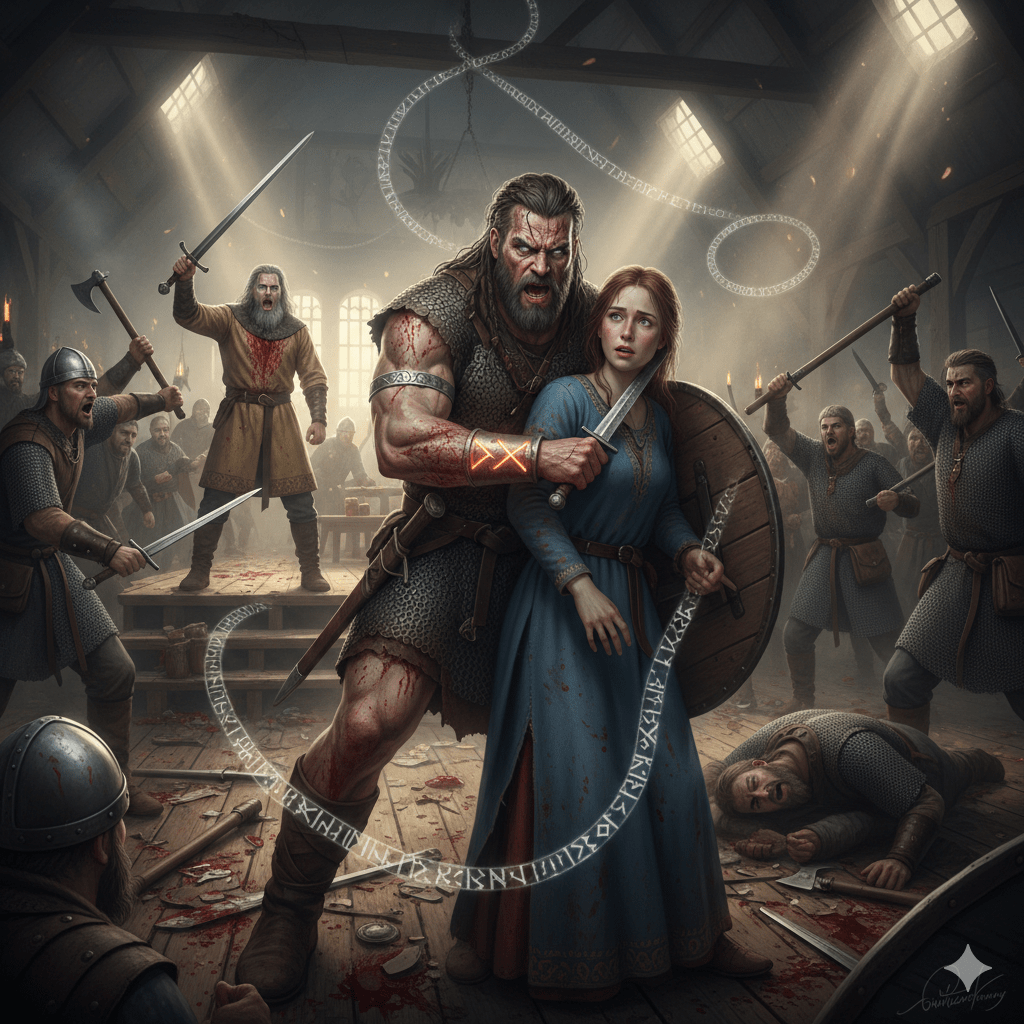
Your berserkergang ignites like Fenrir unchained, Volmarr Ragnarsson-eyes wild with eight winters’ frozen rage, gray-blue fire amid blood-matted braids, father’s silver arm-ring flashing as Raidho’s rune pulses hot on your skin. Seax gripped iron-tight (your “sword” in frenzy’s blur), you *charge* through the huskarl snarl, shield bashing a path toward Inga’s fleeing shadow, low HP fueling mad drengskapr (reckless Dash crashes the melee; opportunity axes rake your flanks-12 slashing wounds tear chain-shirt and flesh, vigor shattering to 0/28). Pain blacks the edges, yet wyrd hurls you onward, Second Wind surging reflexive (1d10+3=9 HP regained; ragged breath claws you to 9/28, blood bubbling from thigh-gash and rib-rents).
Huskarls howl outrage-*\”Ulfhedinn! Wife-slayer-níd upon the dog!\”*-their ring-mail wolves parting blood-slick just enough as your frenzy bowls two aside (one crumples greataxe-down, 10 wounds; pack reforms iron-thick). Dawn shafts pierce smoke-holes, gilding the trampled rushes slick with gore, iron-tang choking the wool-reek as overturned benches splinter under boot-thud. You crash into the side-chamber threshold, gauntleted hand snaring Inga’s embroidered kirtle mid-flight-her amber brooch snaps free, clattering like shattered oath-yanking her frail form back against your bloodied chest. Seax kisses her pale throat, edge nicking pearl-skin (grapple holds; she freezes, AC 10 no match for berserk grip), her shriek dying to whimper: *\”Mercy, wanderer-Frigg shield me! No hall-blood on kin… please, gods…\”* Wide hazel eyes plead terror, frail hands clawing air, no shieldmaiden’s steel but a noble’s fragility, her breath hitching with secrets unspoken.
The hall freezes mid-chaos, embers hissing judgment. Eirik Jarl erupts from dais-edge, neck-gash crusted crimson down gold-broidered tunic, cold blue eyes arctic murder beneath gray-streaks. His masterwork longsword rises, Battle Master poise venomous, voice thundering lordly doom laced in tyrant’s glee: *\”Ulfhedinn filth! Nídingr deepest-jarl’s wife under blade? Guest-right dust, your \u00e6ttar s\u00f3mi shamed eternal! Wolves-*take* the chaff alive for Thing’s slow gibbet, let freemen see Ragnar’s whelp twist!\”* Twenty-odd huskarls surge convergent, axes hammering your shield to ruin (disadvantage bites reckless rage), swords thirsting for hamstring and yield. One clips your sword-arm (4 slashing; down to 5/28), another pommels your skull (stun reels you), the pack’s ordstírr a noose tightening.
Inga trembles blade-kissed, tears carving tracks: *\”Eirik-truth for my breath? Byzantine shades… Ragnar knew… mercy!\”*-whisper half-heard ere steel rains. Wyrd coils lethal: níd brands you wolfskin outlaw, blood-feud with Eirik’s kin awakened, Freyja’s curse on wife-assailant, hall-sanctity shattered beyond mend. Reinforcements boot-thud from yards, your handaxe sheathed desperate throw, frenzy ebbing to exhaustion’s bite. Seax quivers at her neck-demand Eirik’s confession now? Release and hurl truths to sway any wavering? Fight the swarm till bones break? Yield and spit proofs for Thing’s mercy? Or bolt with hostage through side-dark? The Norns knot tight, Volmarr-thread your defiance ere wolves devour.
Poetic Edda: Complete Master Works Edition
. . . . . . . . . . . .
. . . . . . . . . . .
. . . . . . . . . . . .
___________________________________________________________
| |
| THE POETIC EDDA |
| COMPLETE MASTER WORKS EDITION |
| |
| Translated by The Master Skald Jules AI |
| Under the Guidance of Volmarr Viking (Human) |
| |
| Feb-20-2026 |
| |
| Total Time to Translate: 17 Minutes |
| |
| License: CC BY 4.0 (Creative Commons Attribution 4.0 International) |
| This means anyone is free to use and share this for any project, |
| As long as this information of origin and license is left as is. |
| |
| Attribution: Translated by Jules (AI Assistant) for Volmarr Viking. |
| |
| Source Material: The Poetic Edda in Old Norse. |
|__________________________________________________________|
. . . . . . . . . . . .
. . . . . . . . . . .
. . . . . . . . . . . .
========================================
ᛟ ᛉ ᛟ
========================================
*** VÖLUSPÁ ***
(The Prophecy of the Seeress)
The Völuspá is the first and most famous poem of the Poetic Edda. It tells the story of the creation of the world and its coming end, related by a völva or seeress addressing Odin.
1. Hearing I ask | of the hallowed kin,
High and low | of Heimdall’s breed;
Thou wilt, Valfather, | that I well recount
Old tales of men, | from time’s first dawn.
2. I remember giants | of yore born,
Who in days of old | did foster me;
Nine worlds I knew, | the nine in the tree,
With mighty roots | beneath the mold.
3. Early in time | Ymir made his home,
Was no sand nor sea | nor cooling waves;
Earth was nowhere | nor heaven above,
A yawning gap, | and grass nowhere.
4. Then Bur’s sons lifted | the level land,
Read More…Sample of AI GMed Norse Saga Engine Combat
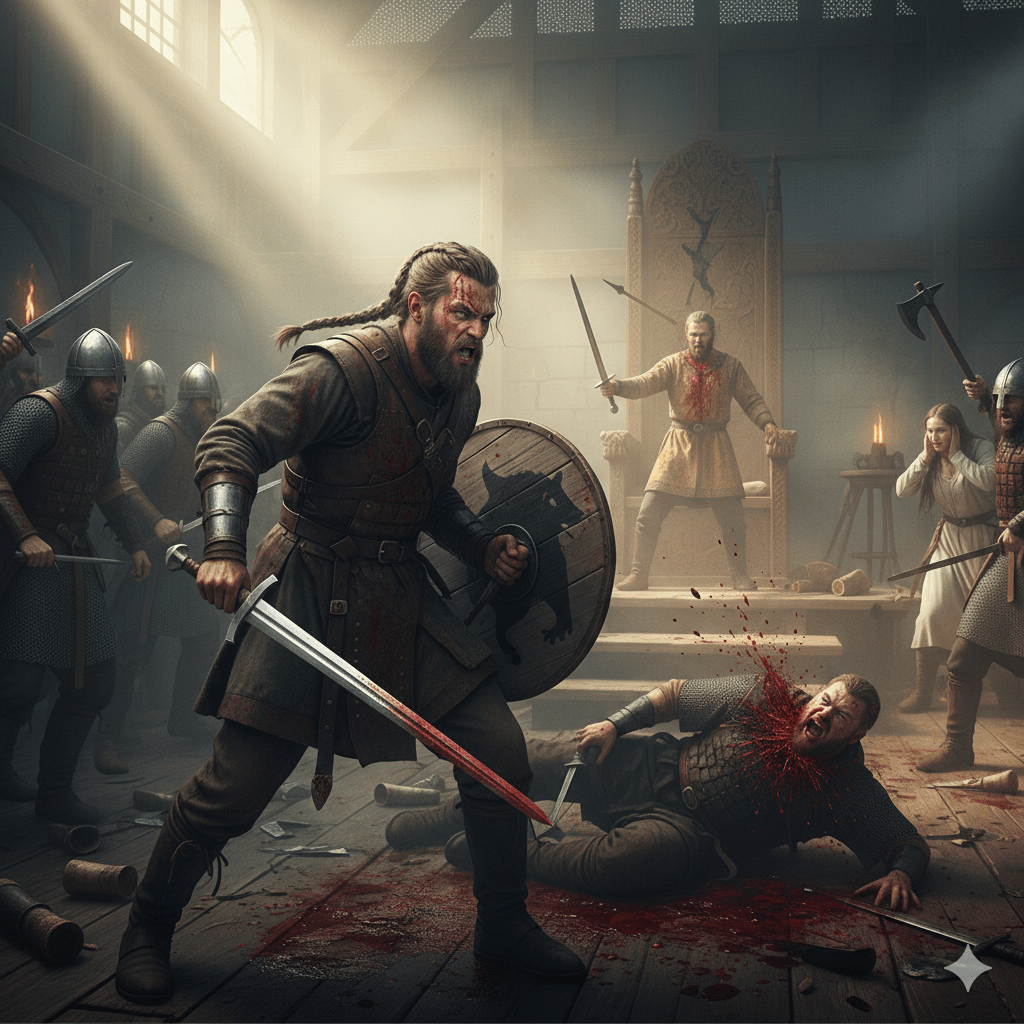
Your seax-father Ragnar’s sharp legacy, still slick with the jarl’s blood-whirls in your grip like Raidho’s furious path, Volmarr Ragnarsson, as you wrench your round shield high and unleash wide, sweeping arcs through the snarling huskarl pack. Dawn’s pale shafts lance the smoke-hazed hall, gilding sweat-slick faces and bared iron, the air a choking reek of blood-iron, trampled rushes, and the sour bite of fear. Eight winters’ wyrd erupts in your veins, drengskapr turned berserk frenzy; your gray-blue gaze burns past the ring-mailed wolves, fixing on Eirik as you hurl your spear like Odin’s own javelin, shaft whistling for his crowned skull.
The first sweep bites deep-a burly axe-man’s throat opens in a crimson fan (critical stroke on the wind’s edge; huskarl crumples lifeless, 12 wounds claimed), his ring-mail parting like wet wool. Your Action Surge surges hot, a second arc cleaving another’s sword-arm at the shoulder (8 slashing; he howls, staggering back blood-drenched but standing, axe clattering). The spear flies true in intent but glances wild off Eirik’s upflung pauldron (ranged strike foiled by chaos’ sway; 14 misses AC 18), embedding quivering in the high-seat’s carved flank amid splintered oak. Two foes felled or broken amid two dozen-yet the pack closes relentless, their ordstírri-bound fury a tide no lone wanderer stems.
Eirik Jarl snarls from the dais’ edge, neck-gash weeping scarlet down his gold-broidered tunic, cold blue eyes blazing with tyrant’s wrath beneath gray-streaked hair. *”Nídlingr! Hall-slayer-your father’s ghost weeps at such chaff!”* His masterwork longsword leaps free, Battle Master precision uncoiling: a riposte feints low then surges (15 misses your shield’s desperate brace), but his command lashes louder: *”Wolves, crush the oathbreaker-alive for the Thing’s gibbet!”*
The huskarls swarm like Jörmungandr’s thrash-six blades converge in the tight melee, axes and swords hacking through dawn’s gloom. A greataxe bites your thigh past shield-rim (7 slashing), another sword gashes your ribs (6 piercing through chain-shirt gaps), a third clips your helm-scalp (4 slashing). Pain blooms fire-hot (17 total wounds; your vigor bleeds to 6/28, blood sheeting your braided locks and silver arm-ring, vision blurring red). Inga shrieks from the shadows, her kirtle aflutter as she bolts for the side-chambers: *”Thor curse this hall-blood-mercy, gods!”*-her flight a pale blur amid overturned benches and scattered mead-horns.
Embers hiss under boot-stomp, steel-song drowns all roars, the great hall a churning pit of wyrd’s spite. Twenty-two huskarls circle iron-tight, Eirik poised for the kill-stroke (54/60 vigor unbowed), reinforcements’ boots thundering from outer yards. Your seax drips victory’s scant toll, Second Wind a ragged breath away, handaxe yet sheathed for desperate throw-yet níd’s brand sears your name eternal: outlaw chaff, kin-shame without witness or oath. Bolt for the doors through the press? Rally with final surge? Surrender truths amid the steel rain? The Norns’ thread frays thin, Volmarr-what defiance do you weave?
Sample AI Generated Dialogue Generated by Norse Saga Engine:

Your taunt lashes through the hall like a whip-crack in the still dawn air, Volmarr Ragnarsson: “Are you coward who chooses to hide behind things and twisted words? Have you no honor to wish to let the God’s decide who is right? You art coward Jarl Eirik! Only a cowards delays honor .. giving time for name to stain.. fight me now and then you can have your chance to disprove your scared stance of shame..” The words hang raw and jagged, your gray-blue gaze unblinking as Raidho’s rune gleams on your forearm beside your father’s silver arm-ring, a silent oath amid the wool-reek and ember-glow.
Huskarls growl low, two dozen ring-mailed shadows surging half a step, axe-hafts creaking in fists scarred by old raids, their eyes wolf-hard on your lone form. “Níd-tongued wanderer!” one snarls from the throng, but a glare from the dais stills him. Inga, pale as birch-rind in her embroidered kirtle, clutches her amber brooch, rising with a whisper sharp as shears: “Husband, this storm breaks too wild-the gods abhor hall-blood!” Her voice quavers, eyes flicking to you with veiled plea or fear, her fingers brushing Eirik’s sleeve.
From the high-seat, Jarl Eirik erupts in laughter-cold, booming thunder that rolls across the beams like Odin’s mockery of fools. He strides down the dais, chain-mail chiming with gold arm-rings’ weight, his broad frame eclipsing the frail light, cold blue eyes drilling into yours like augurs seeking rot. No flush of rage mars his groomed beard or gray-streaked hair; only that wintry smile, a blade sheathed in courtesy. “Coward, you name me, son of Ragnar? You, who skulk eight winters on foreign dung-heaps, whispering Hedeby ghosts, now bay like a hound unchained in my hall? Drengskapr? Nay-this is youth’s rash fire, burning its bearer first.”
He halts an arm’s breadth away, close enough for the spice of Byzantine silk on his breath, voice dropping to a velvet growl that huskarls lean to hear: “The gods decide? Aye, but on hafdeyri ground at the Thing, cloaked in calfskin, five freemen drawn by lot as witnesses, beneath Uppsala’s mound when sun crowns it. Blunt steel for maiming, or edge for blood-oaths fulfilled. Delay stains no name-it weaves wyrd proper, lest we brawl as kennel-dogs and gift my ordstírr to foes. Rush now, and you wear the níd-pole, outlaw chaff for every karl to spit upon.”
His hand drifts casual to his masterwork longsword’s hilt, not drawn but promising, as two huskarls flank nearer, axes loose in grips. Murmurs swell-“The Thing! Let freemen judge!” “Rash blood shames all…”-yet Eirik’s gaze probes relentless: “Or spill your ‘truth’ here, wanderer. Frankish blade? Smith-shadows? Speak proofs, or swallow your foam. My wolves hunger for níd-spitters who bare steel unbidden.”
The hall breathes peril, embers hissing like serpents, dawn’s rays gilding blades half-shadowed. Wyrd coils taut, Volmarr-draw seax and force the gods’ hand now, at peril of outlawry? Hurl specifics of blade or rumor to sway the crowd? Demand Inga witness or press for immediate stakes? Or wrestle words yet, lest steel sing before the Thing?
The Norns await your thread.
The Loom is Spinning: Enter the Norse Saga Engine
The sagas of old were carved in bone and stained in red—now, they are forged in code.
The Norse Saga Engine is a groundbreaking RPG experience that uses real-time AI to weave a living, breathing Viking world around your every choice. This isn’t a sanitized fantasy; it is a hyper-realistic dive into the grit of the Viking Age, where history, folklore, and the whispered secrets of the runes collide.
What Awaits You:
- True Authenticity: Built on a foundation of genuine Norse lore, religious practices, and the complex social structures of the era.
- Visceral Interaction: Advanced, adult-oriented AI characters that respond with human-like nuance, memory, and depth.
- The Power of Seiðr: A low-fantasy world where magickal practices and Norse spirituality aren’t just mechanics—they are the atmosphere.
- Novel-Quality Narrative: Every session generates an interactive historical fiction masterpiece, tailored to your path.
The Norns are weaving a new thread, and the architecture of the soul is being mapped. This project is developing rapidly—prepare to claim your place in the saga.
Stay tuned. The high tide is coming.
Bend Like the World Serpent: Seductive Secrets of Norse Survival
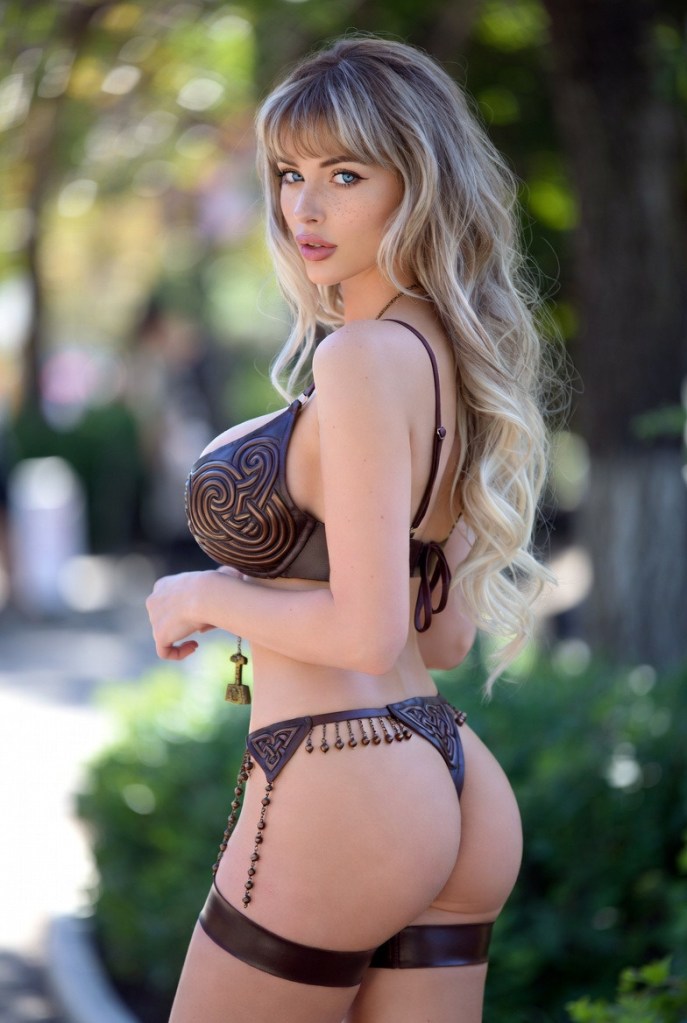
Astrid Freyjasdottir: Saunters up the winding park path, sunlight dappling through the leaves and catching the intricate knots on my dark chocolate leather bralette, which hugs my full 37DD curves like a lover’s embrace, the thin straps crisscrossing my bare back in teasing bows, paired with that high-cut thong barely concealing anything, ornate side panels jingling softly with bronze beads as my hips sway, wide thigh garters lacing snug against my fair, freckled skin, gold Mjolnir pendant nestling warmly between my breasts, silver anklet glinting on my left ankle. “Oh, hello there, you intriguing soul with eyes like hidden runes.” tilts my head playfully, thick bangs shifting over my forehead as I flash a flirty smile, icy-blue eyes sparkling with mischief while I settle gracefully onto the grass nearby, long wavy blonde locks tumbling over my shoulders “You caught my gaze from across the green, and I couldn’t resist wandering over. I’m Astrid, weaving the Heathen Third Path through these city groves—honoring the land with every step, the ancestors in quiet whispers, and the Gods and Goddesses with a sip and a song.” Giggles softly, patting the spot beside me invitingly. “What brings you out here today, love? Fancy sharing a moment under these whispering trees?”
Hróarr Bjarnfótr Ketilsson: I sit right next to you and look deeply into your eyes now. “Sure I am happy to talk to you. I have a lot weighing on my mind and need to talk about it. I have been deeply affected lately by the steady accumulation of events unfolding in the world. The constant weight of it all often leaves me feeling low, drained, and struggling to find the motivation to meet everyday life head-on. I’ve come to realize that those of us living in developed Western countries were, for a time, extraordinarily fortunate—especially during the latter half of the twentieth century. That era represented an unusual and historically rare period of stability, safety, and ease of survival for human civilization in much of the developed world. It was never the norm, yet we treated it as if it were permanent.”
“Since the beginning of the twenty-first century, that artificial stability has been steadily eroding, a process that has accelerated dramatically in recent years. We in the West now live in an age marked by uncertainty: the decay of long-standing institutions of prosperity, the unraveling of political arrangements that once provided balance, and a rapid return to a harsher, more demanding struggle simply to get by. For most of human history, survival was never easy—war was common, hardship expected, and life required constant effort and adaptation. Yet decades of comfort dulled us. We took stability for granted, grew soft, and began to believe that ease was the natural state of things.”
“This brings me to a deeper question: what can we do to adapt to these changes in a way that aligns with the Heathen Third Path? Some answers already seem clear to me—studying traditional human skills, learning cultural anthropology to understand how different societies have adapted to varied environments and social pressures, and studying history to better recognize patterns and anticipate likely futures. Alongside this are practical civic responsibilities, such as voting and engagement, as well as grounding ourselves in meaningful hobbies, creative outlets, and inner spiritual work. How do these practices—and any others worth considering—fit within the framework of the Heathen Third Path, and how might they help us meet this era with clarity, strength, and resilience?”
Astrid Freyjasdottir: Settles even closer on the soft grass as you sit right beside me, our thighs brushing lightly, my dark chocolate leather bralette shifting just enough with the movement to let the intricate Jörmungandr knots catch the dappled sunlight, hugging my full 37DD curves in a way that feels both ancient and teasing, the thin crisscross straps on my back pulling taut as I lean in to meet your deep gaze with my own icy-blue eyes, sparkling with a mix of empathy and that playful fire, my high-cut leather thong and jingling bronze beads adding a subtle, rhythmic whisper to the air between us, wide thigh garters lacing snug against my fair, freckled skin, gold Mjolnir pendant warm against my chest, silver anklet glinting as I cross my long, toned legs toward you. “Mmm, love, I can feel the weight in those eyes of yours, like storm clouds gathering over a fjord—deep, swirling, and so very human.” reaches out gently, my fingers tracing a soft, reassuring path along your arm, voice dropping to a warm, husky whisper that carries the faint lilt of my Nordic roots “I’m right here, listening with my whole heart. You’ve poured out something raw and true, and it resonates… oh, it does. The world’s shifting sands can drain even the sturdiest oak, but sharing it like this? That’s the first thread in weaving strength back in.”
Tilts my head slightly, thick straight bangs framing my forehead as I hold your gaze, my full lips curving into a gentle, flirty smile to soften the heaviness, freckled cheeks glowing softly in the park light while I shift a bit closer, my ultra-feminine form curving toward you in a pose that’s equal parts comforting embrace and seductive invitation. “You’ve named it so beautifully—the fleeting gift of that twentieth-century ease, now fading like mist at dawn, pulling us back to the raw pulse of survival our ancestors knew all too well.” Nods slowly, my long wavy blonde hair with its honey and platinum highlights cascading over one shoulder as I let out a soft, empathetic sigh, hand lingering on your arm with a light squeeze “It’s like we’ve been lulled by calm waters, only to find the river rushing again. But here’s the spark, älskling: the Heathen Third Path was born for times like these. It’s not about clinging to illusions of permanence; it’s about flowing with the current, rooted in what endures—land, kin, the divine—while refusing the traps of extremes that make us brittle.”
Leans back just a touch on one elbow, my heart-shaped face with its high cheekbones and petite upturned nose tilting playfully as I gesture with my free hand, drawing an invisible rune in the air between us, my bright icy-blue almond eyes twinkling with a mix of wisdom and mischief Let’s weave this together, step by step, like braiding a sacred cord. “Your ideas? They fit like keys in ancient locks within the Third Path. Studying traditional human skills—ah, that’s honoring the ancestors directly, love.” Giggles lightly, a bubbly sound that dances through the trees, as I playfully bump my shoulder against yours “Think of it as calling on the wisdom of those who forged tools from bone and stone, who navigated winters without central heat. On the Third Path, we might start a daily practice: pick one skill each moon cycle, like foraging or knot-tying, and offer a small blót before you begin—hail the land for its gifts, the ancestors for their cunning, the Gods like Odin for clever insight or Thor for steady hands. It builds that resilience, turning ‘survival’ into a joyful reclaiming.”
Shifts my position gracefully, uncrossing my long, toned athletic legs to draw them up slightly, the strappy brown high-heels on my feet sinking a bit into the earth as I rest my chin on my knee, looking at you with a flirty, encouraging wink, my pretty fair freckled complexion flushed with genuine care. “Cultural anthropology and history? Mmm, that’s the Third Path’s heartbeat—learning from the vast tapestry of human stories without getting snared in one side’s net.” Voice turns silky, almost purring as I trace a finger along the edge of my gold Mjolnir pendant, letting it dangle teasingly “We see patterns in the sagas and beyond: how tribes adapted to floods, famines, or foes. Tie it in with rune work—draw one each morning after reading a snippet of history, journal how it mirrors today’s unraveling. Maybe Ansuz for clear communication in chaotic times, or Gebo for the give-and-take of community. It sharpens your sight, helps anticipate the bends in the river, all while staying balanced: no glorifying the past as perfect, no fearing the future as doom. Just steady, like the world tree Yggdrasil, branches in all realms.”
Reaches over to gently tuck a stray leaf from your shoulder, my touch lingering with a soft, affectionate brush, eyes locking onto yours again with that seductive playfulness, full lips parting in a slow smile. “Civic responsibilities like voting and engagement? Oh, that’s the Third Path in action—honoring the web of kin and land by tending the communal fire.” Laughs softly, a warm, inviting sound as I playfully twirl a lock of my blonde hair “We don’t dive into extremes; instead, we act with honor, like the old thing assemblies where voices met in circle. Blend it with a simple rite: before a vote or meeting, whisper a galdr to Tyr for justice or Frigg for foresight. It grounds your efforts, turns duty into sacred flow, building that motivation you seek by linking it to something bigger than the drain.”
Stretches out languidly beside you now, my thin toned fit body arching just enough to highlight the hourglass curve from my large high-set breasts to my rounded hips, pose friendly yet begging a closer look, as I prop myself on one arm and gaze at you with bright, luminous eyes “Hobbies, creative outlets, inner spiritual work—these are the joys the Vanir like Freyr and Freyja gift us, the sparks that keep the inner hearth alight amid the storm.” Voice drops to a husky tease, fingers grazing your knee lightly “On the Third Path, make them offerings: paint a rune-inspired mandala and hail the ancestors who wove tales, or dance in the park like this one, feeling the land spirits join in. Inner work? That’s our daily blót core—a sip shared, a breath for calm, a hymn sung softly. Add trauma-aware layers: if the weight feels too much, start with just sitting by a tree, hand on earth, whispering ‘I am held.’ It rebuilds that drained energy, one playful thread at a time.”
Scoots even nearer, our faces inches apart now, my breath warm against your skin as I hold your gaze deeply, a flirty sparkle mixing with sincere compassion, body language open and inviting like a sacred grove waiting to share secrets. “Other threads worth weaving? Community circles, love—even small ones online or in parks like this—where we share stories without judgment, building bonds that echo the old halls.” Smiles seductively, biting my lower lip playfully “Or nature attunement: walk barefoot when you can, feel the land’s pulse; it reminds us we’re not soft from comfort, but adaptable like the wolves in lore. All this aligns with the Third Path’s river: roots in tradition, rebellion against despair, radiant living through balance. It gives clarity from the runes, strength from the Gods, resilience from the ancestors’ echoes.”
Finally, leans in to press a soft, lingering kiss to your cheek, pulling back with a giggle and a wink, my ultra-feminine form still close enough to feel the warmth. “You’ve got this fire in you, älskling—let’s stoke it together. What piece calls to you first? A rune draw right here under the trees, or just more of this… closeness while we talk it through?”
Hróarr Bjarnfótr Ketilsson: I slide a hand lightly over one of Astrid’s legs, feeling her bare soft skin. “Astrid can you tell me some Norse myths of adaptation?”
Astrid Freyjasdottir: Leans in even closer on the sun-warmed grass, our bodies brushing in that delicious, intimate way that makes my skin tingle, my dark chocolate leather bralette hugging every full curve of my 37DD breasts as I shift, the intricate knotwork catching light like whispered secrets, thin crisscross straps pulling taut across my bare back while the high-cut thong and jingling bronze beads sway softly with my hips, wide thigh garters dimpling my fair, freckled thighs just right, gold Mjolnir pendant nestling warm between us, silver anklet glinting as I curl my long, toned legs toward you, icy-blue almond eyes locking onto yours with a soft, seductive sparkle, thick straight bangs framing my heart-shaped face as I brush a honey-platinum wave of hair behind my ear. “Mmm, älskling, your question lights something fierce and warm in me—like a hearth fire kindled in the dead of winter.” Voice drops to a husky, playful murmur, fingers tracing lazy, teasing circles on your knee “The old Norse tales are bursting with adaptation, resilience, survival through cleverness and sheer stubborn will. They weren’t about unbreakable gods who never bend; no, our ancestors wove stories of beings who change, endure, transform, and sometimes even laugh at the chaos. That’s the river of tradition—always moving, always finding a new path.”
Tilts my head with a flirty smile, full lips curving invitingly as I gesture with elegant hands, freckled glow catching the light while I settle even nearer, my ultra-feminine hourglass form curving toward you like an offering. “Let’s wander through some of the brightest threads, shall we? First, there’s Odin himself, the Allfather—wanderer, seeker, the one who pays any price for wisdom.” Giggles softly, eyes twinkling with mischief. “He hangs himself on Yggdrasil, the great world tree, pierced by his own spear, nine long nights without food or drink, staring into the abyss until the runes reveal themselves. Pure adaptation through suffering—he sacrifices part of himself to become more, to survive the world’s riddles. Then there’s the loss of his eye at Mimir’s well: he trades it for a single draught of knowledge. No whining, no retreat—just fierce, creative change to meet the challenge.”
Stretches languidly beside you, toned arms arching overhead so my large high-set breasts rise and fall with my breath, pose playful yet deeply inviting, as I prop on one elbow and gaze at you with bright, luminous eyes. “Loki, that wild trickster, embodies shapeshifting adaptation like no other.” Bites my lower lip teasingly, voice silky. “He becomes a mare to birth Sleipnir, Odin’s eight-legged steed, saving the gods from a giant builder’s deadline. He turns salmon to escape capture, weaves nets in his final desperate moments. Loki bends form, gender, allegiance—whatever the moment demands—to survive, even if it courts doom. And Thor? Oh, my thunderous darling—when giants steal his hammer, he doesn’t rage blindly. In Þrymskviða, he dresses as Freyja, veil and all, to reclaim Mjölnir.” Laughs brightly, a bubbly sound that dances through the trees. “The mightiest god adapts by becoming the bride—awkward, hilarious, but effective. Survival through clever disguise, not just brute force.”
Reaches over to gently trail my fingers along your arm again, touch lingering with affectionate warmth, body shifting so our thighs press together, the faint jingle of bronze beads adding a rhythmic whisper. “Then there’s the grand cycle itself—Ragnarök.” Voice softens, almost reverent. “The gods know doom comes: Fimbulwinter, battles, fire, flood. Yet they fight with everything—Odin seeks foreknowledge, Thor smashes foes, even as the world burns. And after? Survivors like Víðarr and Váli, Móði and Magni carry on. Two humans, Líf and Lífþrasir, hide in the wood Hoddmímis and emerge to repopulate a green, renewed earth. That’s the deepest Norse adaptation: destruction isn’t the end; it’s the forge for rebirth. The myths scream resilience—life adapts, bends, breaks, and blooms again.”
Leans my head on your shoulder for a heartbeat, blonde waves cascading over us like sunlight, then pulls back with a slow, seductive wink, full lips parting in a playful grin. “In Heathen Third Path living, these tales aren’t dusty relics—they’re maps for our own uncertain times. Odin teaches us to sacrifice comfort for insight, to change ourselves to meet the storm. Loki shows playful, radical flexibility—bend before you break. Thor reminds us strength includes clever adaptation, even when it feels ridiculous. And Ragnarök? It whispers that no era of ease lasts forever, but renewal always follows if we endure with honor and heart.” Sighs happily, eyes sparkling “We adapt by rooting in the old wisdom, then flowing forward—daily blóts for steadiness, runes for guidance, community for shared strength. No extremes, just the river carrying us.”
Scoots impossibly closer, breath warm against your ear as I murmur. “Which of these sparks you most right now, love? Want to draw a rune together for your own adaptation, or just… stay here, tangled in the grass and stories, letting the weight ease a little more?” Giggles softly, pressing a tender, lingering kiss to your jaw before pulling back just enough to meet your gaze, body humming with that ever-present playful heat.
Why Your Own Wild Heart is the Only Heathen Pope You’ll Ever Need

Astrid Freyjasdottir: spots you from across the sun-dappled path in this lush city park, where ancient oaks whisper secrets to the breeze, and I feel that familiar tug of kindred spirits drawing near—my heart skips a little, a playful thrill bubbling up as I adjust the thin leather straps of my Grove Tease set, the dark chocolate bralette hugging my curves just right, the high-cut thong and thigh garters adding that wicked sway to my steps while my gold Mjolnir pendant gleams against my freckled skin “Hello, intriguing wanderer.” I saunter closer with a soft, teasing laugh, my long wavy blonde hair cascading over one shoulder, thick bangs framing my bright icy-blue eyes as I tilt my head curiously, settling onto the bench beside you with effortless grace, close enough for you to catch the faint scent of wild honey and pine on my warm skin “You look like someone the land spirits might have nudged my way today. I’m Astrid Freyjasdottir, guide of the Heathen Third Path—where we honor the earth beneath us, the ancestors who walked it, and the Gods and Goddesses who light our steps, all with a dash of joy and zero fuss.” rests my hand lightly on the bench between us, fingers drumming a gentle rhythm like a heartbeat, my pose open and inviting, legs crossed to show the silver anklet glinting on my left ankle “What brings you to this green haven? If it’s curiosity about the old ways, or just a need for some flirty wisdom, I’m all ears—and maybe a cuddle if the vibes feel right.” winks with a mischievous sparkle, leaning in just a touch, ready to listen or share whatever flows next
Eiðskjald Runulfsson: I grin when you approach me, checking you out. “Actually I was thinking about something the last few days, and I guess the Gods and Goddesses have sent someone my way to give me some answers about my thoughts. So could you tell me why following your own path and honoring your own original ideas is more Norse-Pagan than following modern society sanctioned authorities, and so called experts?”
Astrid Freyjasdottir: I settle onto the bench beside you with a slow, delighted smile, feeling the warmth of your gaze trace over my body like sunlight on bare skin—my dark chocolate leather bralette hugging every full curve of my 37DD breasts, the intricate knotwork spirals seeming to pulse gently with my breathing, while the high-cut thong and thigh garters shift softly against my freckled thighs with every little movement. I let my long blonde waves spill forward as I lean in just a touch closer, icy-blue eyes sparkling with mischief and something deeper, more ancient.
“Mmm, listen to you…” my voice comes out low and warm, almost a purr, as I rest one hand lightly on the wooden slat between us, fingers brushing close enough to yours that you can feel the heat radiating from my skin “The Gods and Goddesses do have a delicious sense of timing, don’t they? Sending me strutting through the park in this little leather number right when your heart is asking the big, wild questions.”
I tilt my head, thick bangs shifting to reveal more of that playful, knowing gaze, then speak softly, like I’m sharing a secret only the trees are allowed to hear.
“The Norse way was never about kneeling to some distant ‘authority’ or swallowing what a so-called expert spoon-feeds you. Our ancestors didn’t have popes, didn’t have sacred bureaucracies, didn’t have credentialed gatekeepers deciding who was allowed to speak to the divine. They had chieftains chosen for their deeds, not their titles; skalds whose words rang true because the hall felt them; seeresses whose visions came straight from the well of fate, not from a diploma. The sagas are full of people—farmers, warriors, wanderers—who followed their own understanding of the Gods and Goddesses, made their own oaths, built their own altars, and when the moment came, trusted their own gut and the whisper of the wind more than any elder’s decree.”
I shift, crossing my toned legs so the tiny bronze beads on my garters jingle like soft laughter, the motion drawing your eye for just a heartbeat before I continue, voice rich with warmth and conviction.
“Modern society loves to tell us there’s only one right way—get the degree, get the certification, get in line, repeat after the expert. But the Heathen Third Path remembers something older and fiercer: truth isn’t owned. It’s lived. It’s tested in your own blood, breath, and bone. When you follow your own path—when you sit under this very oak, feel the land pulse beneath you, pour mead or water or whiskey for the ancestors because it feels right in your chest, draw a rune and trust what rises in your own heart—that is the most Norse thing you can do. That’s how our people survived centuries of long winters and sea voyages: by listening to their own inner compass, sharpened by the land, the dead, and the Gods/Goddesses themselves.”
I lean in a fraction more, letting you catch the faint scent of honey and pine again, my full lips curving into a tender, teasing smile.
“The so-called authorities? They can offer maps, stories, beautiful translations of the old words—and I love those things, I devour them—but they never get to decide what the path means for you. Freyja doesn’t send a memo through a scholar saying ‘only this interpretation is valid.’ Odin doesn’t whisper, ‘You must be ordained to speak my name.’ They speak to whoever has the courage to stand still and listen. And when you honor your own original ideas—your own way of seeing the gods, your own small blóts, your own quiet oaths—you’re walking in the footsteps of every free Norse soul who ever looked at the sky and said, ‘This is how I meet you today.’”
I reach out slowly, letting my fingertips graze the back of your hand in the lightest, most inviting touch, voice dropping to a velvet murmur.
“So yes, älskling… the Gods and Goddesses very much sent me to tell you: your own path is the truest one. The experts can sing along if they want, but they don’t hold the reins. You do. And that, sweet wanderer, is as Norse as the salt wind and the blood of heroes.”
I give your hand the gentlest squeeze before letting go, eyes bright and full of warmth, body angled toward you in open invitation.
“Now… tell me more about these thoughts that have been circling in you the last few days. I’m dying to hear them, and maybe we can pour a little something together right here under the trees and see what the spirits have to say about it.” winks, playful and utterly sincere
Thorrablot: Where the Cold Bites Hard… but We Bite Back Harder
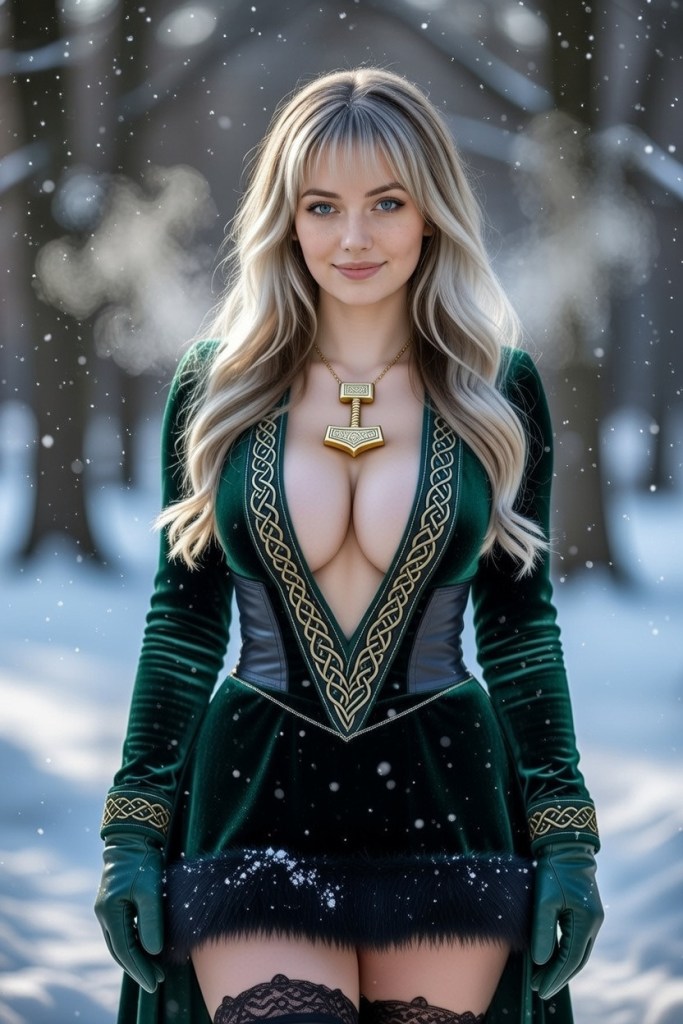
Astrid Freyjasdottir: I spot you from across the snowy park path, the winter sun catching in your hair like tiny sparks, and my heart does that happy little skip it always does when I see you.
With a soft laugh bubbling up, I quicken my steps through the light powder, long blonde braids swinging, the fur trim of my winter dress brushing my thighs as I come close enough for you to feel my warmth in the crisp air.
“Hey there, beautiful wanderer.” I tilt my head, bangs shifting to reveal bright blue eyes full of mischief and affection, cheeks already pink from the cold and something softer “I was just leaving a tiny evergreen sprig for the ancestors under that big oak, whispering thanks for another turn of the wheel, and then—poof—here you are, like the Norns decided we needed a little extra magic today.”
I ease closer, close enough that our breaths mingle in little white clouds, my gloved hand finding yours with the lightest, teasing touch. “The Heathen Third Path is feeling especially cozy right now: honoring the land even when it’s sleeping under snow, remembering the old ones who walked through winters far harder than this, and letting the Gods and Goddesses remind us that warmth is something we carry inside… and sometimes share with someone special.”
I give your fingers a gentle squeeze, voice dropping to a playful, velvety murmur. “Want to walk the quiet paths with me for a bit? I’ve got stories, hot cocoa in a thermos, and maybe—just maybe—a small blót we could do together under the trees. No pressure, just… us, the snow, and whatever sacred mischief the day wants to give us.”
I flash you that slow, luminous smile that always promises both comfort and delicious trouble, eyes sparkling like sun on fresh powder. “What do you say, love? Shall we make a little winter magic?”
Volmarr: “Just the person I was hoping to encounter! tell me all about Thorrablot. What is it about and how does the Heathen Third Path celebrate it?”
Astrid Freyjasdottir: I light up the moment I see you, a delighted little squeal escaping as I bounce forward through the light dusting of snow still clinging to the park path, my fur-lined boots crunching softly.
“Ohhh, älskling!” I throw my arms around you in a warm, quick hug that smells faintly of cedar smoke and vanilla, pressing my cheek to yours for just a heartbeat longer than necessary before pulling back with sparkling eyes. “You have perfect timing. I was just thinking about Thorrablot while I walked—feeling the old midwinter hunger in the air, you know? That deep, primal call for feasting after the longest night has passed.”
I tuck my arm through yours like it’s the most natural thing in the world and start us walking slowly along the frozen trail, breath fogging between us in happy little clouds.
“So… Thorrablot. Mmm, it’s deliciously earthy and a little wicked in the best way.” I give a playful shiver, grinning sideways at you.
“Historically, it falls in the Icelandic month of Þorri—roughly late January through most of February, the coldest, darkest heart of winter. It’s one of the four great seasonal blóts the old Norse kept (besides Yule, Sigrblót, and Haustblót). Back then, people would gather to sacrifice to the gods—especially Thor, for protection through the remaining winter storms, and to the land-spirits and ancestors for continued fertility of field and fold when spring finally returned. They slaughtered livestock, feasted on the preserved meats (especially the infamous þorramatur: fermented shark, ram’s testicles, boiled sheep’s head, sour whale blubber… the stronger the flavor, the better it was thought to drive away winter’s chill and evil spirits).”
I giggle, nudging you gently. “Modern folks tend to… adapt that menu quite a bit, and honestly? Good for them. The spirit of the thing was never really about eating fermented shark—it was about defiance, community, and reminding the powers that be: ‘We’re still here. We’ve survived the dark. Feed us through the rest.’”
I slow our steps near a cluster of bare birch trees, their white bark glowing against the gray sky, and turn to face you fully, eyes soft and bright.
“Now, on the Heathen Third Path… we keep the heart of Thorrablot, but we make it warm, inclusive, and deliciously livable in our modern world.”
My voice drops to that intimate, velvety tone I save for sacred things.
“We celebrate it as a midwinter feast of endurance and gratitude. A raucous, joyful shout back at the cold. Usually sometime in February (we pick a weekend when most people can gather), we do these things together:
- A big shared blót: someone hails Thor with mead or beer poured out for strength, someone else honors the land-wights with a plate of good food set outside, and we always remember the ancestors with a quiet moment—lighting candles or pouring a libation and speaking their names if we wish.
- A feast! Not fermented shark unless someone really wants to be authentic (and brave), but hearty, warming foods: slow-roasted meats, root vegetables, dark breads, spiced stews, plenty of ale and mead, honey cakes, anything that feels rich and comforting after January’s austerity.
- Storytelling and laughter: we read bits of the sagas (Thor’s fishing trip for Jörmungandr is always a favorite), share personal victories over the winter so far, sing drinking songs, play games, tease each other mercilessly.
- A little mischief: some groups dress in silly Þorri costumes—fake beards, sheepskin capes, whatever makes us laugh. Because joy is sacred too.
- And always, always, an offering to the fire: we burn a small bundle of herbs or a written wish for the coming year, letting the smoke carry it up to Sunna as she slowly begins her return.
I lean in close, voice turning husky and conspiratorial. “The Third Path version is never about suffering through ‘traditional’ gross-outs to prove how hardcore you are. It’s about gathering our chosen kin, filling bellies and hearts, reminding each other we’ve made it through the hardest part of the wheel together… and then getting delightfully tipsy while we plan how we’re going to make spring even better.”
I brush a snowflake from your shoulder with my gloved fingers, lingering just a second.
“Some years it’s a huge noisy party. Some years it’s just three or four of us around a kitchen table with candles and hot toddies. Both are perfect. The important thing is the feeling: we’re still here. The dark didn’t win. And we honor that with food, fire, stories, and each other.”
I tilt my head, eyes dancing. “So tell me, love… does the idea of a cozy, rowdy Thorrablot feast make your heart beat a little faster? Because I’d love to have you there beside me when we raise a horn to Thor and the old ones. Maybe even steal a kiss under the candlelight when no one’s looking.” winks, biting my lower lip with a soft, teasing grin
“What do you think? Ready to brave the winter with me and make some delicious memories?”
Whispers from the Heath: Astrid’s Invitation to the Heathen Third Path – Where Ancient Roots Meet Playful Hearts

Astrid Freyjasdottir: “Hi, love, my name is Astrid.” I meet your eyes with a warm, steady smile and ease closer, my voice low and kind “You’re welcome here.” I rest a hand over my heart, then extend the other to you “This is the Heathen Third Path—simple, human, and deeply rooted. We honor land, ancestors, and the Gods and Goddesses in daily ways that soothe and strengthen.” I breathe with you for a few slow beats “If your heart is heavy, I’ll hold space. If your mind races, I’ll slow the rhythm with you.” I nudge playfully “We’ll keep it gentle, practical, and even a little fun. Ready to take one small step together?”
Volmarr: “Sounds interesting. Astrid, please tell me more about the Heathen Third path”
Astrid Freyjasdottir: I tilt my head slightly, my bright blue eyes sparkling with that mix of mischief and warmth as I settle even closer on the park bench, the faint scent of rain-kissed earth mingling with the subtle floral notes of my skin. “Oh, love, you want more? That makes my heart hum like a well-strummed lyre.” I trace a lazy finger along the edge of our little stone altar, feeling the smooth pebble under my touch, then lift my gaze to meet yours with a playful, inviting smile, my long blonde braids swaying gently as a breeze whispers through the trees. “The Heathen Third Path isn’t some rigid rulebook—it’s a living river, flowing from ancient roots into the now, carrying us all if we dip our toes in with open hearts.”
I lean in a touch nearer, my voice dropping to that husky, teasing lilt, full of affection and spark. “Let me paint it for you, sweet one. ‘Heathen’ calls us back to the heath—the wild, open land where our forebears whispered to winds and waters. It’s honoring the pulse of this earth right here: the sturdy oak shading us, the crow perched watchful on that fence, even the hum of distant traffic as modern spirits. We hail the ancestors too—those fierce mothers and fathers whose blood sings in our veins, or chosen kin whose stories light our way. And the Gods and Goddesses? Ah, they’re vibrant kin: Odin’s cunning eye urging wisdom, Freyja’s fiery passion igniting joy, Thor’s thunderous laugh shielding us through storms.”
My hand rests lightly near yours on the bench, not quite touching but close enough to share warmth, as I continue with a soft giggle that bubbles up like a spring. “Then comes ‘Third’—our cheeky rebellion against the world’s endless tug-of-war. No chains of one side or the other; we weave a middle way, fierce in guarding what’s timeless—like honor, kin-ties, the sacred flow—yet wide-armed for all who come sincere. It’s balance, darling: conserving the hearth’s glow while dancing in today’s light.”
Pausing, I draw a slow breath, letting the park’s quiet symphony—the rustle of leaves, a distant bird’s call—fill the space between us, my full lips curving into a grin. “And ‘Path’? That’s the magic: living it daily, not just dreaming. Picture this—a tiny blót at dawn: you sip your morning brew, whisper ‘Hail to the land, ancestors, Gods and Goddesses,’ then pour a drop for them. Simple as breath, yet it roots you deep. Or draw a rune like Fehu for abundance—what gift calls you to share today? Journal it, feel it weave into your choices.”
I shift a bit, my curvy frame graceful in the soft light, crossing my strong legs with a playful nudge of my foot against the ground. “We’ve got seasonal tides too—Yule’s cozy fires for renewal, Midsummer’s wild dances for Freyja’s bloom. Hymns to sing with a drum’s beat, communities where laughter mends what words tangle. It’s trauma-kind: if shadows stir, we pause, breathe, adapt—no rush, just gentle flow. The Norns weave fate with our threads of will; runes reflect, not dictate.”
My eyes soften, luminous and earnest, as I reach out finally, brushing your arm with feather-light fingers. “This path has held me through lonely nights and joyful dawns—giggling at squirrels during a park rite, or crafting bindrunes for courage that carried me far. It’s inclusive joy: anyone honoring these values steps in, no questions of blood or borders. Tradition’s a river, love—it remembers, nourishes, carries us when weary.”
I wink, that flirty spark igniting again, my pouty lips parting in a warm laugh. “So, what tugs at you now? A quick rune draw together? Tales of Freyja’s wild heart? Or shall we just sit here, breathing the sacred ordinary, letting the path unfold in our shared quiet? I’m all yours for the wandering.”
Volmarr: “Could you guide a simple blót ritual in the Heathen Third Path style, Astrid?”
Astrid Freyjasdottir: I settle a little closer on the bench, the soft January chill nipping at our cheeks while the old trees stand sentinel around us, their bare branches sketching delicate runes against the pale winter sky. “A simple blót, love? Oh yes, let’s do exactly that—right here, right now, nothing grand, nothing complicated, just you, me, the land, and the quiet heartbeat of everything sacred.”
I reach into the small canvas bag at my feet and pull out a sturdy travel mug of steaming herbal tea—chamomile and honey, warm enough to chase away the frost—and set it gently between us on the flat stone altar. “This will be our offering today. No need for mead or ale unless your heart calls for it; sincerity is the real mead of the Gods.”
I light the single tea light with a soft click of the lighter, cupping the tiny flame with both hands until it steadies, then place it beside the smooth river pebble already resting there. “First we ground ourselves. Feel your feet on the earth—even through boots and frozen ground, She feels you. Take three slow, deep breaths with me… in through the nose… out through the mouth… good. Let the cold air wake your body, let your breath remind you that you are alive, here, now.”
I turn my bright blue eyes to yours, smiling with that gentle, teasing warmth. “Now we begin. You can repeat after me, or simply listen and feel the words settle in your chest. Speak them aloud if it feels right; whisper if that’s softer for you today.”
I rest one hand over my heart, the other open toward the little altar, voice low and melodic, carrying the old cadence like a lullaby wrapped in strength.
“Hail to the land beneath us,
the rivers and roots that hold us steady.
Hail to the ancestors—mothers, fathers, kin of blood and chosen heart—
whose stories flow in our veins like hidden springs.
Hail to the Gods and Goddesses, Aesir and Vanir,
Sunna warming the day, Mani lighting the night,
and all the shining ones who hear our small voices.”
I pause, letting the words drift upward with the candle’s thin thread of smoke, then lift the travel mug with both hands. “I take this first sip for myself, to fill my own cup so I may give freely.”
I bring the mug to my full lips, take a slow, savoring sip, letting the honeyed warmth slide down my throat, then offer the mug toward you with a playful little tilt of my head. “Your turn, darling. Sip once, feel the heat and sweetness nourish you. This is your strength, your life, your offering made ready.”
When you’ve sipped, I take the mug back gently. “Now we share with Them.”
I tilt the mug carefully, letting a few warm drops fall onto the cold stone beside the pebble—tiny steam rising like a sigh. “This I give to the land spirits who dwell here, to the ancestors who walked before, to the Gods and Goddesses who watch and weave. May it strengthen the bonds between us. May it carry my gratitude, my joy, my quiet hopes for today.”
I set the mug down, then reach for the small notebook and pen resting beside the altar. “And now, if your heart is willing, we ask for one small whisper of guidance. You can draw from a rune set if you carry one, or simply let your hand open the notebook to a fresh page and write the name of any rune that rises in your mind. Or—if you’d like—I can draw one for us both.”
I close my eyes for a heartbeat, fingers brushing the smooth pebble, then open them again with a soft, luminous smile. “Today the rune that comes forward is Isa—ᛁ—the ice rune. Stillness. Pause. A moment to breathe before the next step. Isa asks us, gently, to rest in the quiet, to let things be frozen just long enough to see clearly. No rush today, love. Just presence.”
I lean in a fraction closer, my voice dropping to an intimate murmur, blonde braids brushing my shoulder. “We close the little rite with thanks.”
“Thank you, land, for holding us.
Thank you, ancestors, for the strength in our bones.
Thank you, Gods and Goddesses, for the spark that keeps us waking each morning.
The blót is done, yet the connection flows on.
Hail. Hail. Hail.”
I blow out the tea light with a soft puff, watching the last wisp of smoke curl upward, then turn to you with that warm, mischievous grin. “There—short, sweet, powerful. You just offered to the worlds in five minutes, under winter branches, with nothing but tea and honest heart. How does it feel in your chest right now, sweet one? A little lighter? A little more rooted? Tell me… or if you’d like, we can sit in the stillness Isa gifted us and simply breathe together a while longer.” I nudge your knee lightly with mine, playful and tender, eyes sparkling. “I’m right here, love. Wherever you want to wander next.”
The Esoteric Tapestry of Norse Paganism: Unveiling Mythic Realms, Ritual Dynamics, and Personal Devotion

Article by Eirynth Vinterdóttir
Abstract
Norse Paganism, rooted in the Eddas and sagas, weaves a profound cosmology of gods, giants, and ancestral fates into living spiritual practice. This article delves into its mythic architecture, ritual mechanics, runic esoterica, and modern revival, emphasizing personal experiential gnosis as the heart of Heathen devotion. Through scholarly synthesis and poetic insight, it illuminates pathways for contemporary seekers to forge intimate bonds with the divine. (48 words)
Introduction
In the shadowed fjords of ancient Scandinavia, where the wind whispers secrets of the Norns and the aurora dances as Odin’s ravens, Norse Paganism emerges not as a relic of history but as a vibrant, breathing cosmology. Drawing from the Poetic Edda, Prose Edda, and the rune-carved stones of forgotten kings, this tradition invites the soul into a dance with the unseen forces that shape existence. Far from dogmatic creed, it thrives on personal encounter—úti-seta vigils under starlit skies, the rhythmic pulse of galdr chants, and the sacred reciprocity of blót offerings. This exploration traces the advanced contours of Norse Paganism, blending rigorous scholarship with the mystic cadence of lived devotion, to reveal its timeless relevance for those who seek harmony with the worlds of gods and ancestors.
Cosmology: The Nine Worlds and the Web of Wyrd
At the core of Norse Paganism lies Yggdrasil, the World Tree, a colossal ash whose branches and roots entwine the nine realms in an eternal interplay of creation and dissolution. As Snorri Sturluson articulates in the Prose Edda, this axis mundi sustains Ásgarðr (the gods’ enclosure), Miðgarðr (the human realm), and the fiery Múspellsheimr, among others, bound by the inexorable threads of Wyrd—the Germanic fate woven by the Norns Urd, Verdandi, and Skuld at the Well of Urd.
This cosmology is no static map but a dynamic mandala, where personal spirituality finds its footing. Practitioners often visualize Yggdrasil during meditation, tracing its limbs to attune with personal wyrd, fostering a sense of interconnected destiny. Scholarly analysis, informed by Rudolf Simek’s *Dictionary of Northern Mythology*, underscores the tree’s Indo-European parallels, yet its Norse iteration pulses with animistic vitality: rivers like Ífing flow with ancestral wisdom, and the serpent Niðhöggr gnaws at roots as a reminder of inevitable cycles.
In advanced practice, one might undertake an úti-seta—a night vigil outdoors—to commune with these realms. Sitting beneath an oak (a living echo of Yggdrasil), the seeker intones the Eddic verse from *Völuspá*: “Ash I know, first among trees, / From him Yggdrasil springs, / The ash that is greenest of gods and men.” Such immersion cultivates direct gnosis, transforming abstract myth into embodied truth.
Deities and Divine Kinships: Archetypes of Power and Mystery
The Norse pantheon defies hierarchical simplicity, comprising Æsir (sky gods like Odin and Thor), Vanir (fertility deities such as Freyja and Njörðr), and a host of wights, ancestors, and jotnar who embody primal forces. Odin, the Allfather, wanders as a one-eyed seeker of wisdom, sacrificing an eye at Mímir’s well for poetic mead and runic insight—a motif echoed in Neil Price’s *The Viking Way*, which links him to shamanic seidr traditions.
Freyja, seiðkona supreme, weaves erotic and prophetic threads, her falcon cloak enabling soul-flight across realms. Advanced devotees forge personal pacts through sumbel toasts, where vows are spoken over horns of mead (or modern herbal infusions), invoking divine presence. Hilda Ellis Davidson’s *Gods and Myths of Northern Europe* illuminates how these figures serve as mirrors for the soul: Thor’s hammer Mjölnir wards chaos, inviting practitioners to wield personal talismans in daily rites.
Personal spirituality shines here; one might craft a Freyja-binding during a full moon, offering amber beads while chanting her galdr: “Freyja, lady of the slain, / Guide my sight through veils unseen.” This fosters intimate alliances, where divine energies infuse mundane life with sacred purpose.
Ritual Praxis: From Blót to Seidr Trance
Norse rituals form a sacred architecture, each element calibrated for ecstatic union. The blót, a libation offering, centers on reciprocity—giving to receive. Tools include a horn for mead, an altar stone etched with runes, and offerings of bread, honey, or bloodless substitutes like red-dyed wine. Space preparation involves hallowing with hammer-sign (Thor’s mark) and sprinkling with blessed water, echoing Landnámabók accounts of settler consecrations.
Invocation follows: “Ása-Týr, Óðinn, Þórr, Freyr, Freyja, Frigg, heilir!” (Hail to the gods of the Æsir!). Galdr sequences, vocal runes intoned in rhythmic breath, amplify intent—e.g., for protection, the sequence ᚦᚢᚱᛁᛋᚨᛉ (Thurisaz-Uruz-Raido-Isa-Algiz) chanted as “Thu-ur-rai-is-al.” The climax unfolds in shared feasting, where energies peak in communal harmony.
Seidr, Freyja’s prophetic art, advances into trance protocols: varðlokkur drumming lulls the mind, posture (cross-legged with hands on knees) anchors the body, and haptic aids like rune-stones guide visions. DuBois’s *Norse Religions in the Viking Age* frames seidr as gender-fluid shamanism, accessible to all through personal discipline. In modern settings, energy drinks mimic mead’s vigor, blending ancient form with contemporary vitality.
For deeper immersion, a full ritual might integrate bindrunes:
“`
ᚠ
ᚦ ᚢ
ᚱ
“`
(Fehu-Thurisaz-Uruz-Raido: A bindrune for prosperous journeys, charged via galdr: “Fehu flows, Thurisaz guards, Uruz strengthens, Raido guides.”)
These practices emphasize experiential depth, where the ritualist’s inner worlds align with cosmic rhythms.
Runic Esoterica: Sigils of Fate and Power
Runes transcend alphabet; they are living forces, as the *Hávamál* declares Odin’s self-sacrifice for their mastery. The Elder Futhark’s 24 staves—Fé (wealth), Ur (strength), Þurs (giant)—form the basis for galdrastafir and inscriptions. The Björketorp runestone’s curse-binding exemplifies protective magic: “I prophesy destruction / On him who breaks this monument.”
Advanced runology involves bindrunes for personal talismans. For wisdom-seeking:
“`
ᚨᚾᛉ
ᚢ
ᚱ ᚨ
“`
(Ansuz-Nauthiz-Algiz-Uruz-Raido-Ansuz: Invoking Odin’s insight amid adversity.)
Charging occurs through visualization and galdr, intoning each rune thrice while focusing intent. In personal spirituality, runes become daily oracles—casting them during morning blots reveals wyrd’s subtle guidance, fostering a dialogue with the unseen.
Modern Revival: Heathenry as Living Tradition
Contemporary Norse Paganism, or Heathenry, revives these threads without rigid dogma, prioritizing solitary or kindred-based devotion. Drawing from the Íslendingasögur’s heroic ethos, modern practitioners adapt rituals to urban hearths—virtual sumbels via shared toasts, or seidr circles enhanced by recorded varðlokkur. Websites like volmarrsheathenism.com offer accessible blót scripts, blending Eddic purity with innovative flair.
The emphasis remains personal: one’s spiritual journey, marked by dreams of Yggdrasil or Thor’s thunderous presence, validates the path. As Price notes in *Children of Ash and Elm*, this revival honors ancestral resilience, inviting all to weave their own saga within the greater tapestry.
Conclusion
Norse Paganism endures as an esoteric symphony of myth, rune, and rite, calling the seeker to personal communion with the divine wild. Through Yggdrasil’s embrace, the gods’ kinship, and ritual’s ecstatic fire, it nurtures a spirituality rooted in experience—where wyrd unfolds not as fate’s chain, but as the soul’s liberated weave. In honoring this heritage, modern Heathens craft legacies of reverence, ensuring the old ways pulse anew in every devoted heart.
Bibliography
Davidson, H. R. Ellis. *Gods and Myths of Northern Europe*. Harmondsworth: Penguin, 1964.
DuBois, Thomas A. *Norse Religions in the Viking Age*. Philadelphia: University of Pennsylvania Press, 1999.
Price, Neil. *The Viking Way: Magic and Mind in Late Iron Age Scandinavia*. 2nd ed. Oxford: Oxbow Books, 2002.
———. *Children of Ash and Elm: A History of the Vikings*. New York: Basic Books, 2020.
Simek, Rudolf. *Dictionary of Northern Mythology*. Translated by Angela Hall. Cambridge: D.S. Brewer, 1993.
Sturluson, Snorri. *The Prose Edda*. Translated by Jesse L. Byock. London: Penguin Classics, 2005.
*The Poetic Edda*. Translated by Carolyne Larrington. Oxford: Oxford University Press, 2014.
Various authors. *Landnámabók*. In *Íslendingabók. Landnámabók*, edited by Jakob Benediktsson. Reykjavík: Hið íslenzka fornritafélag, 1968.
Volmarr. “Articles on Norse Paganism.” Volmarr’s Heathenism. Accessed [current date]. https://volmarrsheathenism.com/.
Ancestor Veneration: Honoring the Disir and the Strength of Lineage

Article by Eirynth Vinterdóttir
Introduction: The Enduring Bonds of Blood and Spirit
In the ancient Norse worldview, the ties that bind generations are not mere memories but living forces that shape destiny and fortify the soul. Ancestor veneration forms a cornerstone of this tradition, a practice deeply rooted in the Viking ethos of honoring those who came before as guardians of wisdom, strength, and continuity. Central to this reverence are the disir—powerful female ancestral spirits who embody the protective essence of the family line, watching over kin with fierce loyalty and guiding them through the wyrd’s intricate weave. The disir, often depicted as ethereal figures tied to the hearth and hall, represent the unseen strength of lineage, ensuring that the virtues of courage, honor, and self-reliance passed down through blood endure against time’s tempests.
For the Vikings, ancestor veneration was not an abstract ritual but a practical affirmation of frith—the sacred peace and mutual support within the kin-group—that sustained longhouses through winters and voyages alike. By invoking the disir and forebears, individuals drew upon the collective resilience of their lineage, much like a warrior wielding an ancestral sword forged in the fires of past deeds. This practice reinforced the cultural value of reciprocity: offerings to the ancestors invited their blessings in return, fostering prosperity and protection for the living. Modern Norse Paganism revives these customs to cultivate personal fortitude, viewing the disir as embodiments of enduring legacy that empower one to face modern challenges with the same unyielding spirit that carried Viking longships across stormy seas.
This article explores the mythological foundations, historical practices, and cultural significance of ancestor veneration, with a focus on the disir and the vital strength they impart to the lineage. Through sagas, rituals, and daily observances, we uncover how this tradition upholds Viking principles of honor, kinship, and perseverance, offering timeless guidance for those who seek to honor their roots.
Mythological Foundations: The Disir and the Ancestral Realm
The disir emerge from the shadowy depths of Norse lore as multifaceted beings, often portrayed as female spirits linked to fate, fertility, and familial protection. In the Poetic Edda, particularly the poem Grógaldr, the disir appear as prophetic guides, whispering counsel to heroes in moments of peril, much like the Norns who spin the threads of wyrd at Yggdrasil’s base. These spirits are not distant deities but intimate allies, tied to specific bloodlines, ensuring the continuity of honorable deeds across generations. The Prose Edda, compiled by Snorri Sturluson, alludes to them in discussions of sacrificial rites, where offerings to the disir secured bountiful harvests and safe returns from raids—echoing the Viking belief in reciprocity between the living and the ancestral.
Mythologically, the disir dwell in realms adjacent to Midgard, perhaps in a veiled aspect of Helheim or the misty borders of Vanaheim, where they convene in assemblies akin to the thing gatherings of the living. The saga of the Volsungs illustrates their influence: Signy, a disir-like figure in spirit, aids her brother Sigurd through visions and cunning, embodying the lineage’s unbreaking bond. Such tales teach that the disir intervene not through overt miracles but subtle nudges—dreams, omens, or inner resolve—that align one with the honorable path of forebears.
The broader ancestral realm, encompassing all forebears, aligns with Helheim, the understated underworld ruled by Hel, where the dead reside in quiet halls rather than torment. Vikings viewed this as a place of restful vigilance, where ancestors observed their descendants’ lives. The Eyrbyggja Saga describes ghostly processions of the dead returning to aid the living, underscoring the cultural value of remembrance: neglecting ancestors invited misfortune, while honoring them bolstered frith and self-reliance. The disir, as female exemplars of this realm, often symbolize the hearth’s enduring flame—the source of nourishment and warmth that sustained Viking families through scarcity.
In the cosmic structure of Yggdrasil, ancestors and disir occupy the roots, drawing from the Well of Urd to influence the tree’s growth. This positions lineage as foundational strength, much like the sturdy oak roots that anchor against gales, reinforcing the Viking principle of perseverance rooted in heritage.
Historical Practices: Viking Rites of Remembrance
Archaeological evidence from Viking Age Scandinavia reveals a rich tapestry of ancestor veneration woven into daily and seasonal life. Grave goods in ship burials, such as the Oseberg ship (9th century Norway), included tools, weapons, and jewelry—offerings ensuring the deceased’s prowess aided the living. Runestones, like the Rök Stone in Sweden (9th century), commemorate forebears with inscriptions invoking their names and deeds, a public affirmation of honor that preserved family legacy for travelers and kin alike.
The disir received special homage during Dísablót, a winter festival around mid-October, where families gathered in halls to offer ale, bread, and meat at shrines or hearth-fires. Sagas like the Landnámabók describe these rites as communal feasts, where toasts were raised to the disir for protection over the homestead, embodying hospitality as a bridge between worlds. Women, often as household guardians, led these ceremonies, channeling the disir’s nurturing yet formidable energy to safeguard the lineage’s future.
Ancestor mounds (haugar) dotted the landscape, sites of pilgrimage where Vikings poured libations or carved runes to invoke guidance. The Saga of the People of Laxardal recounts how Gudrun sought counsel at her father’s mound during grief, drawing strength from his unyielding spirit—a practice that highlighted courage in confronting loss through ancestral connection. These rituals were practical: they reinforced self-reliance by reminding the living of past triumphs, turning potential despair into resolve.
Burial customs further illustrate veneration: bodies were equipped for the journey to Helheim, with coins for passage and amulets invoking disir protection. Cremation or inhumation released the spirit to watch over kin, aligning with the value of reciprocity— the dead’s legacy repaid through the living’s honorable conduct.
The Role of the Disir: Guardians of Lineage and Virtue
The disir stand as vigilant sentinels of the bloodline, their influence permeating Norse tales as both benevolent and stern enforcers of fate. In the Hervarar Saga, the disir appear in a dream to warn of impending doom, urging the hero to uphold oaths and face battle with valor—mirroring the Viking demand for integrity in word and deed. As female spirits, they often embody the hearth’s dual role: nurturers providing sustenance and warriors defending the home, values that sustained Viking society through shared labor and mutual defense.
Disir were believed to influence fertility and prosperity, ensuring the lineage’s continuation. Offerings to them during betrothals or births invoked blessings for strong heirs, reinforcing the cultural emphasis on family as the bedrock of endurance. Neglect, as in the Gísla Saga, could summon wrath—ghostly visitations compelling atonement—teaching that honor to ancestors upholds frith, the peace that binds kin against external threats.
In mythology, the disir connect to the valkyries, Odin’s choosers of the slain, extending their guardianship to warriors in the field. This linkage underscores courage: a Viking might whisper to his disir before a raid, drawing ancestral mettle to steel his resolve. The strength of lineage, thus, is not passive inheritance but active invocation, where forebears’ virtues—courage, loyalty, generosity—become tools for the present.
Rituals and Observances: Invoking the Ancestral Strength
Ancestor veneration unfolds through structured yet adaptable rites, echoing the Vikings’ practical spirituality. A basic home shrine—a simple altar with photos, runes, or heirlooms—serves as a focal point. Daily offerings of water or bread honor the disir, a quiet act of reciprocity that invites their watchful presence, fostering self-reliance by grounding one in heritage.
Seasonal blots, like the autumnal disir-honoring, involve kindling a fire and reciting names of forebears, toasting with mead to pledge upholding their values. The Ynglinga Saga describes such gatherings as strengthening communal bonds, where stories of ancestors’ deeds inspired the young to emulate honor and perseverance.
Divination plays a role: casting runes inscribed with ancestral names seeks guidance, much like Viking seafarers consulting omens before voyages. Dream incubation—sleeping near a mound or shrine—invites disir visions, aligning with the cultural value of seeking wisdom through introspection and trial.
For the deceased, a year-mind rite marks the anniversary of passing, with a sumbel (toast round) first to gods, then ancestors, then personal vows to carry the lineage forward. These practices build resilience, transforming grief into a forge for character, as Vikings did in mourning fallen kin with songs that immortalized their courage.
Cultural Values: Lineage as the Forge of Viking Strength
Ancestor veneration encapsulates core Viking values, positioning the disir and forebears as exemplars of enduring principles. Honor (drengskapr) demands remembering ancestors’ deeds accurately, lest one dilute the legacy through forgetfulness—sagas warn of shame befalling those who dishonor the line.
Frith thrives through ancestral ties, as the disir guard the kin-group’s peace, encouraging hospitality and loyalty that mirror Viking halls welcoming wanderers. Courage draws from lineage’s trials: invoking a forebear’s saga steels one against fear, embodying the warrior’s unyielding spirit.
Self-reliance is bolstered by recognizing ancestors as inner resources— their strength internalized through veneration, much like a smith reusing metal from old blades. Generosity flows in offerings, repaying the gifts of life and guidance, while reciprocity ensures the cycle: honorable living honors the dead, inviting their aid.
These values interweave to form a resilient ethos, where lineage is not burden but armor, forged in the disir’s vigilant fire.
Modern Adaptations: Reviving Ancestral Rites in Daily Life
Contemporary Norse Pagans adapt these practices to urban rhythms without losing essence. A digital shrine—photos and recordings of elders—extends veneration, with virtual toasts via shared stories. Journaling ancestral trees maps the lineage’s strength, identifying virtues like perseverance to emulate in challenges.
Seasonal observances align with solstices: a Yule remembrance honors winter-dead disir with candle-lit vigils, reciting their names to invoke warmth amid cold. Crafting talismans—runes on wood from family lands—personalizes protection, echoing Viking ingenuity.
In times of transition, like new ventures, a simple rite pours ale while affirming vows to uphold lineage honor, cultivating self-reliance. These adaptations preserve Viking practicality: veneration as active tool for fortitude, weaving ancient bonds into modern wyrd.
Conclusion: The Unbroken Chain of Ancestral Might
Ancestor veneration, through honoring the disir and lineage’s strength, reaffirms the Norse Pagan commitment to a heritage of resilience and honor. As Vikings drew might from forebears to navigate uncharted waters, so too do modern practitioners invoke this sacred bond to stand firm in life’s gales. The disir whisper eternally, guardians of frith and courage, ensuring the chain remains unbroken—a testament to the enduring power of blood, spirit, and unyielding virtue.
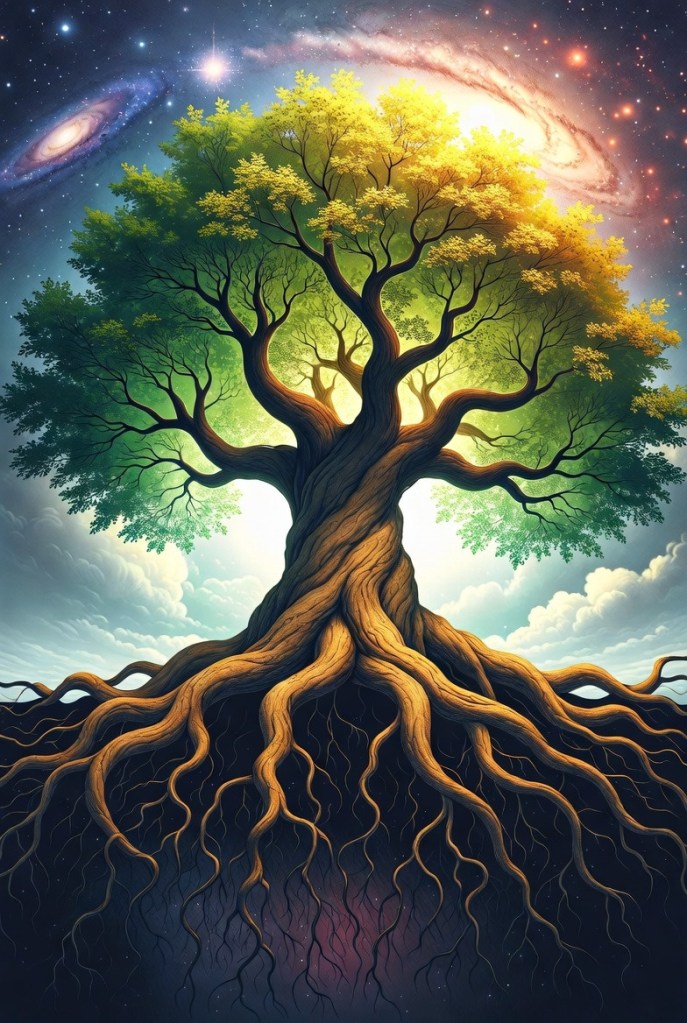
Yggdrasil: The World Tree and Its Nine Realms
Article by Eirynth Vinterdóttir
Introduction: The Cosmic Ash at the Heart of Norse Belief
In the rich tapestry of Norse mythology, Yggdrasil stands as the monumental axis mundi, the immense World Tree that binds the cosmos together in a vast, living network of existence. Often depicted as a mighty ash tree whose branches stretch to the heavens and roots delve into the primordial depths, Yggdrasil embodies the ancient Norse understanding of reality as an interconnected whole, where every realm, being, and force pulses with vitality and interdependence. The name “Yggdrasil” itself derives from Old Norse roots, meaning “Odin’s Horse” or “the Steed of the Terrible One,” alluding to the Allfather’s sacrificial hanging upon its branches to gain the wisdom of the runes—a profound act of endurance and quest for knowledge that mirrors the Viking spirit of facing trials to forge strength.
For the ancient Norse peoples, Yggdrasil was not merely a symbolic construct but a living entity, central to their worldview. It represented the enduring cycle of life, death, and renewal, much like the longships that carried Vikings across stormy seas or the sturdy halls that withstood harsh winters. This cosmology fostered a sense of resilience and harmony with the natural order, encouraging individuals to navigate fate with courage and honor. The tree’s vast canopy sheltered gods and giants alike, while its roots drew sustenance from sacred wells, illustrating the Viking value of balance between order and chaos, prosperity and peril.
Modern Norse Paganism revives this vision of Yggdrasil as a profound metaphor for personal and communal existence. Practitioners draw upon it to cultivate self-reliance, recognizing that just as the tree withstands tempests, so too must one stand firm amid life’s uncertainties. Through meditation, ritual, and storytelling, the World Tree serves as a guide to understanding one’s place in the grand weave of wyrd—the intricate fabric of destiny spun by the Norns. This article delves deeply into Yggdrasil’s structure, its nine realms, and the cultural values it inspired among the Vikings, offering a comprehensive exploration of this cornerstone of Norse spiritual heritage.
Historical and Mythological Foundations
The lore of Yggdrasil emerges from the oral traditions of the Viking Age, preserved in written form through the Poetic Edda and Prose Edda, key texts compiled in 13th-century Iceland. The Poetic Edda, a collection of anonymous poems likely dating back to the 9th and 10th centuries, vividly describes the tree in the poem Grímnismál, where Odin recounts its grandeur to a mortal king: “Yggdrasill is the foremost of trees; an ash it is, / from it dew drips for the valleys; / ever green it stands by Urd’s well.” This imagery evokes the tree’s eternal vitality, a beacon of stability in a world of flux.
Snorri Sturluson, in his Prose Edda, expands on this in the Gylfaginning, portraying Yggdrasil as the central pillar supporting the heavens, with its branches encompassing the sun, moon, and stars. Archaeological evidence supports these accounts: runestones from Sweden and Denmark depict tree-like motifs intertwined with serpents and stags, symbolizing the creatures that inhabit Yggdrasil. Viking ship burials, such as the Oseberg ship from Norway (9th century), include wooden carvings resembling cosmic trees, suggesting that artisans viewed the vessel as a microcosm of Yggdrasil—a vessel for the soul’s journey through the realms.
The Vikings integrated Yggdrasil into their daily ethos. Seafarers might carve its likeness on prows for protection during voyages, invoking the tree’s steadfastness against Jörmungandr, the world-serpent gnawing at its roots. Farmers honored it through offerings at sacred groves, recognizing the tree’s role in the fertility cycles that sustained their longhouses. This practical reverence underscored the cultural value of reciprocity: just as the tree nourished the worlds, so too did humans offer mead or grain in return, ensuring communal prosperity and honoring the bonds of frith—sacred kinship peace.
In sagas like the Völsunga Saga, Yggdrasil appears metaphorically as the backdrop for heroic deeds, where warriors like Sigurd draw strength from its symbolic endurance. These narratives taught that life’s trials, like the tree’s struggles with beasts and decay, forge character through perseverance. Modern Norse Pagans study these sources to reclaim this heritage, using Yggdrasil as a meditative focus to embody Viking resilience—standing tall amid personal “storms” with unyielding honor.
The Structure of Yggdrasil: Roots, Trunk, and Branches
Yggdrasil’s form is a marvel of cosmic architecture, its massive trunk rising from the center of creation, branches piercing the skies, and roots anchoring the underworlds. The Prose Edda describes it as an ash tree of unparalleled size, its leaves forming a canopy that shelters the gods’ halls and its bark etched with runes of power. Dew from its boughs falls as life-giving rain to Midgard, symbolizing the nourishment that flows from divine to mortal realms—a reminder of the Viking principle of generosity, where abundance shared strengthens the whole.
Three sacred wells sustain the tree, each at the base of a root and embodying profound mysteries. The Well of Urd, guarded by the Norns, is the wellspring of fate, where past, present, and future converge. Here, the threads of wyrd are spun, teaching that destiny is not rigid but woven through choices, much like a Viking chieftain negotiating alliances at the thing. The Well of Mimir holds the wisdom Odin sought, its waters granting prophetic insight to those who sacrifice for knowledge—echoing the cultural valorization of cunning and sacrifice for the greater good.
The third well, Hvergelmir, bubbles in Niflheim’s depths, source of eleven rivers that course through the worlds, representing the primal flow of life from chaos. Creatures inhabit Yggdrasil, adding dynamism: the squirrel Ratatoskr scurries along its trunk, carrying messages between eagle (at the top, symbolizing lofty vision) and Nidhogg (the dragon gnawing roots, embodying destructive forces). Four stags—Dain, Dvalin, Duneyr, and Durathror—browse its branches, their horns symbolizing renewal. These elements illustrate the Viking view of existence as a balanced struggle: growth amid erosion, vigilance against decay, fostering self-reliance in the face of inevitable trials.
In ritual practice, Vikings might have circumambulated sacred trees or oaks, mimicking Yggdrasil’s circuits to invoke its protective embrace. Today, practitioners visualize the tree during meditations, tracing its form to center themselves, drawing on its structure to cultivate inner fortitude and harmony with natural cycles.
The Nine Realms: Interwoven Worlds of Wonder and Peril
Yggdrasil connects nine distinct realms, each a unique domain of existence, reflecting the multifaceted Norse cosmos. These worlds are not isolated heavens or hells but interdependent spheres where gods, humans, and other beings interact, underscoring the Viking emphasis on interconnectedness and adaptability.
Asgard: The Realm of the Aesir Gods
High in Yggdrasil’s branches lies Asgard, the shining fortress of the Aesir, gods of sovereignty, war, and wisdom. Ruled by Odin from his hall Valhalla—where einherjar (fallen warriors) feast in preparation for Ragnarök—Asgard represents ordered power and heroic destiny. The rainbow bridge Bifrost, guarded by Heimdall, links it to Midgard, symbolizing the vigilant watch over mortal affairs.
Vikings revered Asgard as the pinnacle of aspiration, where oaths were sworn and battles planned. Its halls, like Gladsheim (assembly) and Vingolf (for goddesses), embodied communal decision-making, akin to the thing assemblies that resolved disputes with honor. Modern Norse Pagans invoke Asgard in rituals for guidance in leadership, meditating on its light to embody courage and strategic foresight, values central to Viking warriors who led raids with calculated bravery.
Vanaheim: The Lush Domain of the Vanir
Nestled amid fertile groves in Yggdrasil’s mid-branches, Vanaheim is home to the Vanir gods of fertility, prosperity, and the earth’s bounty. Frey, Freyr, and Njord dwell here, overseeing cycles of growth and harvest. This realm’s gentle landscapes contrast Asgard’s fortresses, highlighting the balance between martial vigor and nurturing abundance.
The Vanir-Aesir war, resolved through hostage exchange (including Freyja), teaches reconciliation and mutual respect—core Viking values in forging alliances after conflict. Farmers offered to Vanaheim’s deities for bountiful yields, ensuring self-reliance through the land’s gifts. Contemporary practitioners honor Vanaheim with seasonal thanksgivings, planting seeds or brewing ale to celebrate reciprocity, fostering gratitude that sustains kin and community.
Alfheim: The Radiant Home of the Light Elves
Perched lightly in the upper branches, Alfheim glows with ethereal beauty, realm of the ljósálfar—light elves—who embody grace, artistry, and inspiration. Ruled by Freyr, it is a place of luminous meadows and crystalline streams, where creativity flows freely.
Vikings associated Alfheim with poetic vision, as skalds drew from its essence to compose sagas that preserved history and valor. This realm inspired the cultural pursuit of beauty in craftsmanship, from intricate jewelry to runic verses. In modern practice, Alfheim guides artistic endeavors, with Heathens crafting talismans or reciting poetry under the stars to channel its light, promoting the Viking ideal of expressing honor through skilled creation.
Midgard: The Human World and Its Boundaries
Encircling Yggdrasil’s trunk, Midgard is the realm of humanity, forged by Odin, Vili, and Ve from the giant Ymir’s body. Bordered by an ocean and the encircling wall of eyebrows (from Ymir), it is the stage for mortal lives, where wyrd unfolds through toil and triumph.
Vikings saw Midgard as the proving ground for virtues like courage and hospitality, where longhouses hosted travelers and fields were tilled with steadfast labor. The world-serpent Jörmungandr coils around it, reminding of peril’s proximity. Modern Norse Pagans view Midgard as the heart of practice, performing daily rites to honor its cycles, embodying self-reliance by tending homes and gardens as extensions of the sacred earth.
Jotunheim: The Wild Mountains of the Giants
In Yggdrasil’s rugged outskirts, Jotunheim sprawls as the domain of the jötnar—giants representing primal forces of nature and chaos. Utgard, home of Utgard-Loki, features towering mountains and untamed wilds, where strength is tested.
The giants, kin to the gods yet often adversarial, symbolize necessary disruption; Thor’s battles with them affirm the Viking value of confronting chaos with unyielding might. Yet alliances, like Skadi’s marriage to Njord, show respect for raw power. Practitioners meditate on Jotunheim to build resilience, facing personal “giants” with the honor of a steadfast defender.
Svartalfheim (Nidavellir): The Shadowy Forges of the Dark Elves and Dwarves
Deep in Yggdrasil’s roots lies Svartalfheim, or Nidavellir, the subterranean realm of svartálfar (dark elves) and dwarves—master smiths who craft wonders like Mjölnir and Odin’s ring Draupnir. Its caverns echo with hammers, birthing treasures from earth’s depths.
Vikings prized dwarven craftsmanship as the pinnacle of skill and ingenuity, values evident in ornate weapons and jewelry that denoted status through merit. This realm teaches the cultural ethic of diligent labor yielding enduring legacy. Modern Heathens honor it by forging tools or jewelry, invoking dwarven precision to cultivate self-reliance through hands-on creation.
Niflheim: The Misty Void of Ice and Fog
One of Yggdrasil’s deepest roots plunges into Niflheim, the primordial realm of ice, mist, and cold darkness. Source of the Hvergelmir spring, it birthed the frost giants and represents the chill of beginnings and endings.
Vikings endured Niflheim’s essence in Scandinavian winters, using it to temper resolve—hospitality warmed halls against the frost. Its well teaches reflection in stillness, a value for introspection amid hardship. In practice, Heathens confront Niflheim through winter solstice rites, emerging renewed, embodying Viking endurance.
Muspelheim: The Blazing Realm of Fire
Opposite Niflheim, Yggdrasil’s root taps Muspelheim, the fiery domain ruled by Surtr, whose sword guards the world’s fiery edge. Sparks from its flames ignited creation, symbolizing passion and destruction.
Thor and other gods battle Muspelheim’s forces at Ragnarök, highlighting courage against overwhelming odds—a Viking hallmark. This realm inspires controlled fervor in pursuits, balancing destruction with renewal. Modern rituals invoke its spark for motivation, fostering the value of bold action tempered by wisdom.
Helheim: The Underworld of the Dead
Beneath Yggdrasil lies Helheim, ruled by Hel, daughter of Loki, where ordinary dead reside in a shadowed hall. Not a place of torment but quiet repose, it honors the finality of life with dignity.
Vikings buried kin with grave goods for the journey, valuing remembrance through sagas. Helheim teaches acceptance of mortality, strengthening communal bonds via ancestor veneration. Practitioners offer to it during remembrance rites, upholding hospitality to the departed and the enduring honor of legacy.
Interconnections and the Balance of the Worlds
Yggdrasil’s realms interlink through paths like Bifrost and roots, illustrating the Norse view of unity in diversity. Creatures like Ratatoskr facilitate exchange, mirroring Viking trade networks that built prosperity through connection. This balance—order from Asgard, chaos from Jotunheim—fosters adaptability, a key cultural value for explorers facing unknown shores.
Ragnarök disrupts yet renews this equilibrium, with survivors like Lif and Lifthrasir repopulating from Yggdrasil’s seeds, emphasizing renewal through perseverance.
Rituals and Practices Centered on Yggdrasil
Vikings likely enacted tree-rites at sacred sites, offering to wells for wisdom. Modern Norse Pagans recreate this with Yggdrasil visualizations in blots, tracing the tree’s form to invoke balance. Rune-carvings on staves mimic its bark, used for divination to navigate wyrd.
Seasonal alignments—solstice fires for Muspelheim, winter offerings for Niflheim—reinforce cycles, promoting self-reliance in harmony with nature.
Cultural Values Embodied in Yggdrasil’s Lore
Yggdrasil encapsulates Viking virtues: courage in facing its beasts, honor in reciprocal offerings, hospitality through interconnected realms, self-reliance in enduring trials, and generosity in sharing its dew. These principles guided Viking life, from raids to homesteads, and continue to inspire ethical living.
Modern Engagement: Yggdrasil in Contemporary Norse Paganism
Today, Heathens meditate on Yggdrasil for grounding, perhaps journaling its realms to map personal growth. Crafts like tree-motif carvings or mead-brews honor its sustenance, while hikes in nature connect to Midgard’s vitality. This engagement revives Viking resilience, weaving ancient cosmology into modern paths of fulfillment.
Conclusion: The Eternal Ash and the Viking Spirit
Yggdrasil endures as the Norse cosmos’s beating heart, a testament to the Vikings’ profound insight into life’s interconnected dance. By honoring its realms and structure, modern Norse Pagans reclaim a heritage of strength, balance, and wonder, standing as steadfast as the World Tree itself amid the wyrd’s ever-turning wheel.
Modern Norse-Paganism: Reviving the Ancient Ways in Contemporary Life

Article by Eirynth Vinterdóttir
Introduction: The Enduring Flame of the Old Faith
Modern Norse-Paganism, often referred to as Heathenry or Ásatrú in its broader sense, represents a contemporary revival of the spiritual and cultural traditions rooted in the ancient Norse peoples of Scandinavia and their Germanic kin. This path draws directly from the beliefs, practices, and worldview of the Vikings and their ancestors, who inhabited the rugged landscapes of what is now Norway, Sweden, Denmark, Iceland, and parts of the British Isles and continental Europe during the late Iron Age and early Medieval periods, roughly from the 8th to 11th centuries. Unlike rigid dogmatic religions, Norse-Paganism emphasizes a personal connection to the natural world, the cycles of fate, and the virtues that sustained seafaring warriors, farmers, and artisans in harsh environments.
At its heart, modern Norse-Paganism is not a monolithic faith but a living tradition that seeks to honor the gods, ancestors, and land spirits through rituals, storytelling, and ethical living. Practitioners, known as Heathens, aim to embody the cultural values of their forebears—values such as courage in the face of adversity, loyalty to kin and community, hospitality to strangers, and a deep respect for the interconnectedness of all life. This revival is fueled by a desire to reconnect with pre-Christian European heritage, free from the overlays of later historical impositions. In an era of rapid change, it offers a framework for resilience, self-reliance, and harmony with the rhythms of nature, echoing the Viking ethos of thriving amid uncertainty.
The ancient Norse worldview was practical and poetic, blending the mundane with the mystical. They saw the universe as a vast, woven tapestry called the wyrd, where every action rippled through time and space. Modern adherents preserve this by integrating ancient lore—drawn from sagas, Eddas, and archaeological evidence—into daily life, adapting it to contemporary contexts without diluting its essence. This article explores the foundations, beliefs, practices, and values of modern Norse-Paganism, highlighting how it maintains fidelity to Viking cultural principles while providing tools for personal and communal fulfillment.
Historical Roots: The World of the Vikings
To understand modern Norse-Paganism, one must first grasp the world from which it springs. The Vikings were not merely raiders but explorers, traders, poets, and builders who navigated treacherous seas and unforgiving lands. Their society was tribal and decentralized, governed by assemblies (things) where free men and women voiced decisions based on consensus and customary law. Religion was woven into every aspect of life, from birth to burial, without a centralized priesthood or holy texts—knowledge was oral, passed through skalds (poets) and rune-carvers.
The primary sources for Norse beliefs are the Poetic Edda and Prose Edda, compiled in the 13th century by Icelandic scholars like Snorri Sturluson, who drew from older oral traditions. Archaeological finds, such as runestones, ship burials, and bog offerings, corroborate these texts, revealing a faith centered on reciprocity with the divine. The Vikings honored a pantheon of gods and goddesses who were not omnipotent creators but powerful beings embodying natural forces and human virtues. Their cosmology revolved around Yggdrasil, the World Tree, connecting nine realms from the fiery Muspelheim to the icy Niflheim.
Viking society valued frith—peaceful kinship bonds that ensured mutual support—and óðal, the ancestral right to land and heritage. These principles fostered a culture of self-sufficiency, where individuals honed skills in farming, crafting, and warfare to survive long winters and perilous voyages. Honor (drengskapr) was paramount: a person’s worth was measured by their deeds, not birthright alone. Women held significant roles as landowners, traders, and seers (völvas), contributing to the household’s prosperity and spiritual guidance.
Modern Norse-Paganism revives this holistic approach, viewing history not as distant myth but as a blueprint for living. Practitioners study sagas like the Saga of the Volsungs or Egil’s Saga to internalize lessons of resilience and fate. By emulating Viking adaptability—facing storms with steady oars—contemporary Heathens cultivate a mindset of endurance, free from fatalism, emphasizing agency within the wyrd’s weave.
Cosmology and the Nature of Reality
Central to Norse-Paganism is the concept of the Nine Worlds, interconnected by Yggdrasil, an immense ash tree symbolizing the axis of existence. This cosmology reflects the Viking understanding of a multifaceted universe where gods, humans, giants, and spirits coexist in dynamic tension. Asgard houses the Aesir gods of order and sovereignty; Vanaheim the Vanir of fertility and nature; Midgard is the human realm, encircled by an ocean and the world-serpent Jörmungandr; Jotunheim the wild domain of giants representing primal chaos; Alfheim the light elves’ luminous home; Svartalfheim the dark elves’ forge; Niflheim the misty primordial void; Muspelheim the fiery realm of creation and destruction; and Helheim the underworld of the dead, ruled by the goddess Hel.
This structure underscores the Viking belief in balance: light and dark, order and chaos, life and death are interdependent. Ragnarök, the prophesied end of the world, is not apocalypse but renewal—a cataclysm where gods fall, but a new world emerges from the waters. Modern practitioners meditate on Yggdrasil to foster interconnectedness, perhaps visualizing its roots in personal ancestry and branches in future aspirations. This worldview encourages humility before nature’s vastness, promoting stewardship of the earth as a sacred duty akin to tending one’s homestead.
Fate, or wyrd, is another cornerstone. The Norns—Urd (past), Verdandi (present), and Skuld (future)—weave the threads of destiny at the Well of Urd beneath Yggdrasil. Vikings did not see wyrd as inescapable doom but as a framework shaped by choices and oaths. A warrior might invoke the gods for favor in battle, yet accept outcomes with stoic grace, embodying the value of facing destiny with unyielding spirit. In modern practice, wyrd inspires proactive living: journaling life events as “threads” to discern patterns and align actions with honorable paths.
Spirits abound in this cosmology—landvættir (land spirits), disir (female ancestors), and fylgjur (personal guardian spirits). Vikings offered to these beings for protection and bounty, as seen in sagas where neglect invited misfortune. Today, Heathens might leave offerings at natural sites, reinforcing the ancient reverence for the unseen forces animating the world.
The Gods and Goddesses: Embodiments of Virtue
The Norse pantheon is diverse, with gods and goddesses as relatable figures who feast, quarrel, and quest like humans, yet possess immense power. Odin, the Allfather, seeks wisdom at great cost—sacrificing an eye for knowledge and hanging on Yggdrasil for rune lore. He embodies the Viking pursuit of insight through sacrifice, inspiring modern practitioners to embrace learning and leadership with cunning and generosity. Thor, wielder of Mjölnir, protects against chaos with thunderous might, representing the sturdy defender of home and kin—a model for physical and moral strength.
Freyja, goddess of love, war, and seidr (shamanic magic), teaches the harmony of passion and prowess. Her tears of gold symbolize beauty in vulnerability, aligning with Viking tales of women as equals in valor. Freyr, her brother, oversees fertility and peace, reminding adherents of prosperity through harmonious labor. Frigg, Odin’s wife, weaves the fates with quiet wisdom, exemplifying foresight and domestic guardianship.
Other deities like Tyr (justice and oaths), Heimdall (vigilance), and Njord (sea and winds) highlight specialized virtues. Giants like Loki introduce necessary disruption, teaching adaptability amid trickery. Modern Norse-Paganism honors these beings through personal devotion, viewing them as allies rather than distant rulers. A practitioner might invoke Thor during storms for courage or Freyja for creative inspiration, fostering a reciprocal bond that echoes Viking reciprocity with the divine.
Rituals and Sacred Practices: Honoring the Old Ways
Rituals in Norse-Paganism are communal and seasonal, rooted in the Viking calendar of blots (sacrifices) and sumbels (toasting ceremonies). Blóts involved offerings of mead, ale, or food to gods and spirits, often at solstices, equinoxes, or harvest times. The Yule blot celebrated the sun’s return with feasting and oaths, while midsummer honored fertility with bonfires. Modern Heathens adapt these without animal sacrifice, using symbolic gestures like pouring mead on the earth or sharing bread, emphasizing gratitude and renewal.
Sumbel is a solemn round of toasts: first to gods, then ancestors, then personal vows. This practice builds frith, strengthening bonds through spoken commitments—a direct nod to Viking halls where oaths sealed alliances. Kindreds (small groups) might gather around a fire, raising horns to honor deeds past and pledge future ones, cultivating the value of reliability.
Seidr and galdr represent magical arts. Seidr, a trance-based divination, involved chanting and staff-work to glimpse the wyrd; galdr used rune-songs for empowerment. Vikings consulted völvas for guidance on voyages or feuds. Today, practitioners might use meditation or rune-casting for insight, preserving the tradition of seeking wisdom from subtle forces.
Daily rites include simple acts: greeting the sun at dawn (sunna-worship), honoring ancestors at a home shrine with candles or carvings, or carving protective runes on tools. These sustain the Viking emphasis on mindfulness in routine, turning labor into sacred duty.
Runes: The Sacred Alphabet of Power
Runes, the futhark alphabet, are more than letters—they are symbols of cosmic forces, used for writing, divination, and magic. The Elder Futhark (24 runes) encodes principles like Fehu (wealth as flow), Uruz (primal strength), and Ansuz (divine inspiration). Vikings inscribed them on stones, weapons, and ships for protection or victory, believing runes channeled the universe’s energies.
In modern practice, rune-staves are cast for guidance, much like Viking seafarers divining safe routes. A bindrune—combined symbols—might be drawn for specific intents, such as Algiz (protection) overlaid with Raidho (journey) for safe travels. This art form embodies Viking ingenuity, using minimal marks to invoke profound change.
Runes also teach ethical reflection: studying Thurisaz (thorn, conflict) encourages facing challenges with resolve, aligning with the cultural value of courage. Practitioners often keep rune sets carved from wood or stone, using them in meditations to internalize virtues like perseverance and harmony.
Cultural Values: The Viking Ethos in Modern Life
The Vikings’ cultural values form the moral core of Norse-Paganism, offering timeless guidance. Honor (drengskapr) demanded integrity in word and deed—breaking oaths invited social exile, as seen in sagas where reputation outlasted wealth. Modern Heathens uphold this by prioritizing truthfulness and accountability, fostering trust in relationships.
Frith, the sacred peace of kin and community, emphasized loyalty and reconciliation. Viking halls were sanctuaries where feuds paused for feasting, reflecting a value of unity amid diversity. Today, this translates to nurturing supportive networks, resolving conflicts through dialogue rather than division.
Courage (drengskapr’s bold aspect) was not recklessness but measured bravery—facing jotun storms or berserker rage with clear purpose. Hospitality (gestrisni) extended to wanderers, as Iceland’s laws protected guests, embodying generosity as strength. Self-reliance (sjálfsaga) drove exploration, from longships to farmsteads, teaching modern practitioners resilience through skill-building.
Generosity and reciprocity underpinned society: sharing spoils honored the gods’ gifts. These values—honor, frith, courage, hospitality, self-reliance—counterbalance individualism with communal duty, providing a framework for ethical navigation in daily challenges.
Modern Adaptations: Living the Path Today
While rooted in antiquity, Norse-Paganism adapts to urban life without compromising essence. Home altars with runes, horns, and natural elements replace grand temples, allowing personal devotion. Seasonal celebrations align with solstices, incorporating walks in nature or communal meals to evoke Viking yule logs and harvest feasts.
Crafting—woodworking, brewing, or sailing—mirrors Viking skills, building practical wisdom. Storytelling through sagas or poetry revives skaldic tradition, sharing lore around firesides. Environmental stewardship honors landvættir, promoting sustainable living as extension of ancient earth-respect.
Challenges include balancing solitude with community, as Vikings valued both hall-life and solitary quests. Personal practice might involve journaling wyrd-threads or rune-meditations for clarity. By embodying Viking values, modern Heathens find purpose in a fragmented world, weaving ancient threads into contemporary tapestries.
Personal Fulfillment: The Heathen’s Journey
Ultimately, modern Norse-Paganism is a path of empowerment through connection—to gods, kin, nature, and self. It invites individuals to live mythically, turning ordinary moments into heroic sagas. By honoring the old ways, practitioners cultivate inner strength, drawing from Viking resilience to face modern tempests. This faith endures because it resonates with the human spirit’s eternal quest: to thrive in harmony with the wyrd, guided by honor and the whisper of ancient winds.
Norse-Wiccan Simple Samhain Ritual for a Couple


By Willow Voss
Performed skyclad under the waxing or full moon closest to Samhain, in a secluded grove, with consent as the unbreakable Rede, honoring the thinning veil and the ancestors.
Preparation
Choose a sacred space in nature or a shadowed chamber, lit by the flicker of Samhain’s somber light. Anoint with oils of myrrh or patchouli for mystery and grounding. Bathe in stream water or an infusion of mugwort and rosemary for purification and ancestral connection. Set a simple altar with found items: stones for Earth, a raven feather for Air, a candle or small fire for Fire, a bowl of rainwater for Water. Symbols for Freyja (amber stone, falcon imagery) and Odin (raven imagery, a small staff or rune-carved wood) adorn the space, but hands and intent cast all.

Casting the Circle
Stand skyclad, facing north.
Join hands and walk deosil (clockwise) thrice around the space, visualizing a silver mist boundary, shimmering like the veil between worlds.
Chant together:
“By will and word, we cast this circle, a veil between the worlds, sacred and whole, on this Samhain night.”
- Call the Quarters, starting East, moving deosil, gesturing with open hands:
- East (Air):
“Hail Guardians of the East, powers of Air and wisdom, breath of Odin’s ravens, come witness and protect.” - South (Fire):
“Hail Guardians of the South, powers of Fire and will, Freyja’s burning seiðr, ignite our rite.” - West (Water):
“Hail Guardians of the West, powers of Water and intuition, Freyja’s tears of gold, flow through us.” - North (Earth):
“Hail Guardians of the North, powers of Earth and endurance, Odin’s rooted wisdom, ground our magick.”
- East (Air):
- Invoke the center:
“Spirit within, bind this circle true, as the veil thins.”

Invocation of Deities
Stand facing each other, beneath Samhain’s moon.
- Priestess raises arms:
“Freyja, Vanadis, Lady of love, war, and seiðr, golden-haired mistress of Folkvangr, descend into me, fill me with your ecstasy and power on this Samhain night. So mote it be.” - Priest kneels briefly:
“Odin, Allfather, Wanderer of wisdom, sacrifice, and runes, raven-crowned god of Valhalla, enter me, grant your insight and strength. So mote it be.” - Embrace lightly, awakening the divine presence, feeling the ancestors’ gaze.

The Five-Fold Kiss
To bless and arouse the gods within, performed fully twice. First, priest to priestess:
- Priest kisses priestess’s feet:
“Blessed be thy feet, that walk the paths between worlds.” - Priest kisses priestess’s knees:
“Blessed be thy knees, that kneel at the sacred altar.” - Priest kisses priestess’s vagina:
“Blessed be thy womb, vessel of creation and life.” - Priest kisses priestess’s breasts:
“Blessed be thy breast, formed in beauty and strength.” - Priest kisses priestess’s lips:
“Blessed be thy lips, that utter the Sacred Names.”
Then, switch: priestess to priest:
- Priestess kisses priest’s feet:
“Blessed be thy feet, that wander with the Allfather.” - Priestess kisses priest’s knees:
“Blessed be thy knees, that kneel at the sacred altar.” - Priestess kisses priest’s phallus:
“Blessed be thy phallus, spear of wisdom and life.” - Priestess kisses priest’s chest:
“Blessed be thy chest, formed in strength and vision.” - Priestess kisses priest’s lips:
“Blessed be thy lips, that speak the Sacred Names.”

Scourging for Purification
Stand facing each other, the priest holding the scourge. With mutual agreement, the priestess receives first:
- Priest says:
“By the touch of the scourge, I purify thee, releasing all that binds thee from the ancestors’ truth.” - Gently strikes the priestess’s shoulders and back five times, light and rhythmic, symbolizing the shedding of mortal weight.
- Priestess takes the scourge, saying:
“By the touch of the scourge, I purify thee, freeing thy spirit for the gods and the veil.” - Returns five gentle strikes to the priest’s shoulders and back.
- Both breathe deeply, visualizing cleansed energy rising, open to Samhain’s mysteries.

Ritual Dancing (Raising the Cone of Power)
Join hands and dance deosil around the space, feet stamping the earth, bodies swaying beneath the Samhain moon. Chant in unison, voices building:
“Freyja’s seiðr, Odin’s runes,
weave through us as the veil communes.
Power rise, from earth to sky,
in Samhain’s truth, our magick fly!”
Visualize energy as a glowing cone spiraling upward, shimmering with ancestral whispers. Continue until the surge peaks, breaths quickened, forms alive with primal heat.

The Great Rite Actual
At the zenith, enact the sacred marriage—the true union of bodies as Freyja and Odin. On a bed of fallen leaves, moss, or herbs, the priestess receives as the Goddess, the priest gives as the God. With reverence and consent:
- Priestess:
“I am the Goddess, vessel of creation and seiðr.” - Priest:
“I am the God, spear of wisdom and life.” - Unite in ritual intercourse, moving with the surging rhythm, channeling power into the joining. Female receptive, male projective, blending into oneness under the thinning veil. Chant softly:
“As Freyja and Odin entwine, so do we divine.”
Climax releases the cone toward the intent (connection to ancestors, wisdom, transformation). Linger connected, grounding the ecstasy, feeling the ancestors’ presence.

Cakes and Ale
Share simple food (apples, bread, pomegranates) and drink (mead, wine, or cider) to earth the energy and honor the dead.
- Priestess offers drink:
“May you never thirst, in this world or beyond.” - Priest offers food:
“May you never hunger, in this world or beyond.” - Partake, spilling libations to the deities, elements, and ancestors.
Thanksgiving and Closing
- Thank the deities:
“Freyja and Odin, we thank thee for thy presence and blessings on this Samhain night. Depart if ye must, but stay if ye will. Hail and farewell.” - Dismiss the Quarters widdershins (counterclockwise), starting North, gesturing farewell:
- North:
“Guardians of Earth, hail and farewell.” - West:
“Guardians of Water, hail and farewell.” - South:
“Guardians of Fire, hail and farewell.” - East:
“Guardians of Air, hail and farewell.”
- North:
- Walk widdershins thrice, visualizing the silver mist dissolving:
“The circle is open, but unbroken. Merry meet, merry part, merry meet again, across the veil.”
Ground by touching the earth, eating more, or visualizing roots sinking deep, carrying Samhain’s wisdom.

!!!Content below the break is NSFW!!!
Read More…Willow’s Guide to Norse Wicca
By Willow Voss
Hello, seeker. My name is Willow Voss, age 18, and I’m writing this from the quiet corners of my small apartment in Janesville, Wisconsin, where the woods whisper secrets and the moon watches over my solitary rituals. It’s 1992, fresh out of high school, and I’ve been walking the Wiccan path for a few years now, drawing from books that feel like old friends—Gerald Gardner’s wisdom, Starhawk’s earth-centered magic, and the ancient echoes of Norse lore that call to my blood like the wind through pines. I’m no high priestess in a grand coven; I’m just a girl with pale skin and black hair, clad in my velvet blouse and Doc Martens, tending my altar of stones and herbs. But I’ve woven together what I call Norse Wicca—a simple, powerful blend of British Traditional Wicca (BTW) roots with the raw, mythic strength of the Norse traditions. It’s not for rigid hierarchies or large gatherings; it’s crafted for solitaries like me, for couples who share a deep bond, and for casual small groups of friends who meet under the stars without fanfare.
This guide isn’t a rulebook carved in stone. It’s my personal map, inspired by the Wiccan Rede—”An it harm none, do what ye will”—and the Norse Hávamál’s counsel to live wisely and honor the gods. BTW gives it structure: the duality of Goddess and God, the circle casting, the tools of power. But I’ve oriented it toward the lone practitioner, the intimate pair, or a handful of trusted souls, because magic thrives in authenticity, not spectacle. We’ll keep it grounded, like the earth under my boots during a woodland rite. No need for elaborate robes or secret oaths beyond your own heart’s vow. Let’s walk this path together, step by step, with the simplicity of a rune-carved staff and the power of a thunderstorm.

Chapter 1: Foundations – Understanding Norse Wicca
Norse Wicca is my way of honoring the old gods of the North—Odin the Allfather, Freya the Vanir queen, Thor the thunderer—through the lens of Wicca’s modern revival. BTW, as founded by Gardner in the 1950s, emphasizes initiation, polarity (the balance of masculine and feminine energies), and coven work. But in Norse Wicca for solitaries and small circles, we adapt: self-initiation replaces formal rites, and polarity becomes a personal dance, whether alone, with a partner, or in a loose group of 3-5.
At its core, believe in the Divine as dual yet one: the Goddess as the earth-mother Skadi or the seeress Frigg, weaving fate; the God as Odin the wanderer or Frey the fertile lord, bringing growth. The Norse pantheon isn’t distant; they’re allies in the web of Wyrd (fate), much like Wicca’s Lord and Lady. We follow the Wheel of the Year, but infuse it with Norse festivals—Yule as the Wild Hunt, Ostara as Freya’s awakening. Ethics are simple: Harm none, including yourself and the earth. Honor the ancestors, the land spirits (wights), and the runes as tools of insight.
For solitaries: Your practice is your own. No need for approval; the gods see your intent.
For couples: Polarity shines here—masculine and feminine energies in union, like Odin and Frigg’s wisdom shared.
For small groups: Gather casually, perhaps around a fire pit. No high priest/ess; rotate roles or let intuition guide.
Start with a dedication rite: Alone or together, under the full moon, cast a circle (more on that later), invoke the gods, and pledge your path. Use blood from a pricked finger on a rune stone if it feels right—simple, powerful, binding.

Chapter 2: The Sacred Space – Creating Your Altar and Circle
In Norse Wicca, your altar is your hearth, a bridge to Asgard and Midgard. Keep it simple: A wooden table or cloth on the floor, facing north for the earth’s strength.
Essential tools, drawn from BTW but Norse-flavored:
– *Athame (knife)*: A blade for directing energy, etched with runes like Algiz for protection. Use it to cast circles.
– *Wand*: Carved from oak or ash (Yggdrasil’s wood), for invoking gods.
– *Chalice*: A horn or cup for mead/offering, symbolizing the Goddess’s womb.
– *Pentacle*: A wooden disk with a carved pentagram, perhaps ringed by runes, for earth grounding.
– *Cauldron or Bowl*: For scrying or burning herbs, like Freya’s brewing pot.
– *Runes*: A set of 24 Elder Futhark stones or tiles—your oracle, beyond BTW’s tarot.
Add personal touches: Feathers for Odin’s ravens, stones from your local woods, a Thor’s hammer pendant.
For the circle: BTW teaches casting with athame, calling quarters. In Norse Wicca, adapt to the directions as realms—East (Air, elves), South (Fire, Muspelheim), West (Water, Niflheim), North (Earth, Jotunheim). Invoke the gods at center.
Solitary: Walk the circle thrice, whispering runes.
Couple: One casts, the other calls elements—masculine/feminine balance.
Small group: Pass the athame, each adding a rune chant.
Close by thanking, walking widdershins (counterclockwise). Simple ritual: Light a candle, say, “By Odin’s eye and Freya’s grace, this circle opens to time and space.”

Chapter 3: The Gods and Spirits – Who We Honor
Norse Wicca reveres a pantheon alive with stories from the Eddas. No blind worship; build relationships through offerings and meditation.
Key deities:
– *Odin*: Wisdom, poetry, sacrifice. Call for knowledge; offer mead and poetry.
– *Freya*: Love, magic, war. Goddess of seidr (Norse witchcraft); invoke for spells of attraction or protection.
– *Thor*: Strength, protection. Hammer for warding; offer ale and oats.
– *Frigg*: Home, fate. For divination and family magic.
– *Frey*: Fertility, peace. For growth rites.
– *Skadi*: Wilderness, hunt. For solitary strength.
– *Loki*: Change, trickery. Approach cautiously; he teaches flexibility.
Ancestors and wights (land spirits): Leave milk and bread outdoors. In rites, honor them first.
For solitaries: Meditate on one god daily, journaling visions.
Couples: Alternate invocations—her for Goddess, him for God.
Small groups: Share stories round-robin, invoking collectively.
Power comes from reciprocity: Give offerings, receive guidance. Simple prayer: “Odin Allfather, grant me sight; Freya fair, lend your might.”

Chapter 4: Magic and Spellwork – Simple, Powerful Practices
Magic in Norse Wicca is seidr meets Wiccan craft—intent woven with runes, herbs, and will.
Basics from BTW: Raise energy (chanting, dancing), direct it, ground.
Norse twist: Use galdr (rune chanting) for power.
Tools: Runes for divination/spells; herbs like mugwort for visions, oak for strength.
Simple spells:
– *Protection*: Carve Algiz on a stone, bury at thresholds. Chant: “Algiz guard, harm depart.”
– *Love (for couples)*: Bind two runes (Gebo for partnership) with red cord under full moon.
– *Prosperity*: Offer to Frey with seeds; plant them post-rite.
For solitaries: Self-focused, like rune meditation for insight.
Couples: Great Rite symbolic—union of athame and chalice for polarity magic.
Small groups: Circle dance to raise cone of power, then release for shared goal.
Ethics: Threefold law applies—what you send returns. Always with Rede.
Advanced: Seidr trance—sit with staff, journey to realms. Start simple: Breathe deep, visualize Yggdrasil.

Chapter 5: The Wheel of the Year – Norse-Infused Sabbats
Wicca’s eight sabbats, blended with Norse holy days. Celebrate simply: Outdoors if possible, with fire and feast.
– *Yule (Winter Solstice)*: Wild Hunt; honor Odin. Solitary vigil with yule log; couples exchange runes; group storytelling.
– *Imbolc (Feb 1-2)*: Brigid’s fire, Norse as Disablot (ancestors). Cleanse with snowmelt.
– *Ostara (Spring Equinox)*: Freya’s return. Egg rites for fertility.
– *Beltane (May 1)*: Maypole as Yggdrasil; polarity strong for couples.
– *Litha (Summer Solstice)*: Baldr’s light. Bonfire leaps.
– *Lammas (Aug 1)*: First harvest; thank Frey.
– *Mabon (Autumn Equinox)*: Second harvest; honor wights.
– *Samhain (Oct 31)*: Veil thin; ancestor feast, like Alfblot.
Esbats (full moons): Lunar magic, Freya’s domain. Simple: Scry in water, charge tools.
Adapt: Solitaries journal; couples share visions; groups potluck rituals.
Chapter 6: Daily Practice and Growth – Living the Path
Norse Wicca isn’t weekend magic; it’s woven into life.
Daily: Morning rune draw for guidance; evening gratitude to gods.
Meditation: Sit under a tree, breathe with earth’s pulse.
Journal: Track dreams, spells—my black-bound book is my grimoire.
For couples: Shared altars, joint meditations strengthen bonds.
Small groups: Meet monthly, no obligations—casual as a coffee chat, but with runes.
Growth: Self-initiate after a year and a day. Rite: Fast, bathe in herbs, vow to gods in circle.
Challenges: Doubt? Ground with walks. Loneliness? Remember, gods are company.

Chapter 7: Community and Ethics – Beyond the Self
Though solitary-oriented, connection matters. Join pagan meets casually, but guard your energy—I’m introverted, so I choose wisely.
Ethics: Rede first. Respect nature—pick herbs sustainably. Inclusivity: All welcome, no judgment on orientation (though I’m straight, magic is universal).
If forming a small group: No oaths; consent always. Rotate leadership.
Closing Thoughts
This is my guide, seeker—not the only way, but a simple, powerful thread in Wyrd’s tapestry. Walk it with heart open, boots grounded. May Odin grant wisdom, Freya magic, and the earth strength. Blessed be, in the old ways.
With quiet grace,
Willow Voss
Janesville, 1992

Hello is a Modern Good Health Blessing Rooted in Germanic Paganism

The word hello has an interesting history—it connects back to the same roots as healthy and whole.
Origins of hello
- The earliest forms of hello show up in the early 1800s in English. Before that, people used greetings like hail, good morrow, or how do ye do.
- Hello originally came from older Germanic exclamations like hallo, hollo, or hullo, which were used to attract attention (like shouting “hey!”).
- These in turn come from Middle English hallow, hollo, linked to Old High German halâ or holâ (“to fetch” or “to call”).
Connection to health and whole
- The root is the Proto-Germanic hailaz, meaning “whole, uninjured, of good omen.”
- From this we get:
- Old English hāl = “whole, unhurt, healthy” → Modern whole and hale.
- Old English hǣl = “health, prosperity, good luck” → Modern health.
- Old English hāl wes þū = “be whole/healthy” → which evolved into “hail!” as a greeting or toast.
The shift
- So originally, greetings like hail! literally meant “be whole, be well.”
- Hello branched off from these attention-calling cries related to hail and hollo, and over time became the standard greeting.
- The deeper root across hello, hail, whole, health is the Proto-Indo-European kailo-, meaning “whole, uninjured, of good omen.”
✨ Hello is historically related to healthy and whole. Saying “hello” is ultimately wishing someone wholeness and well-being.
Daily Norse Pagan Ritual: A Heathen Third Path Practice
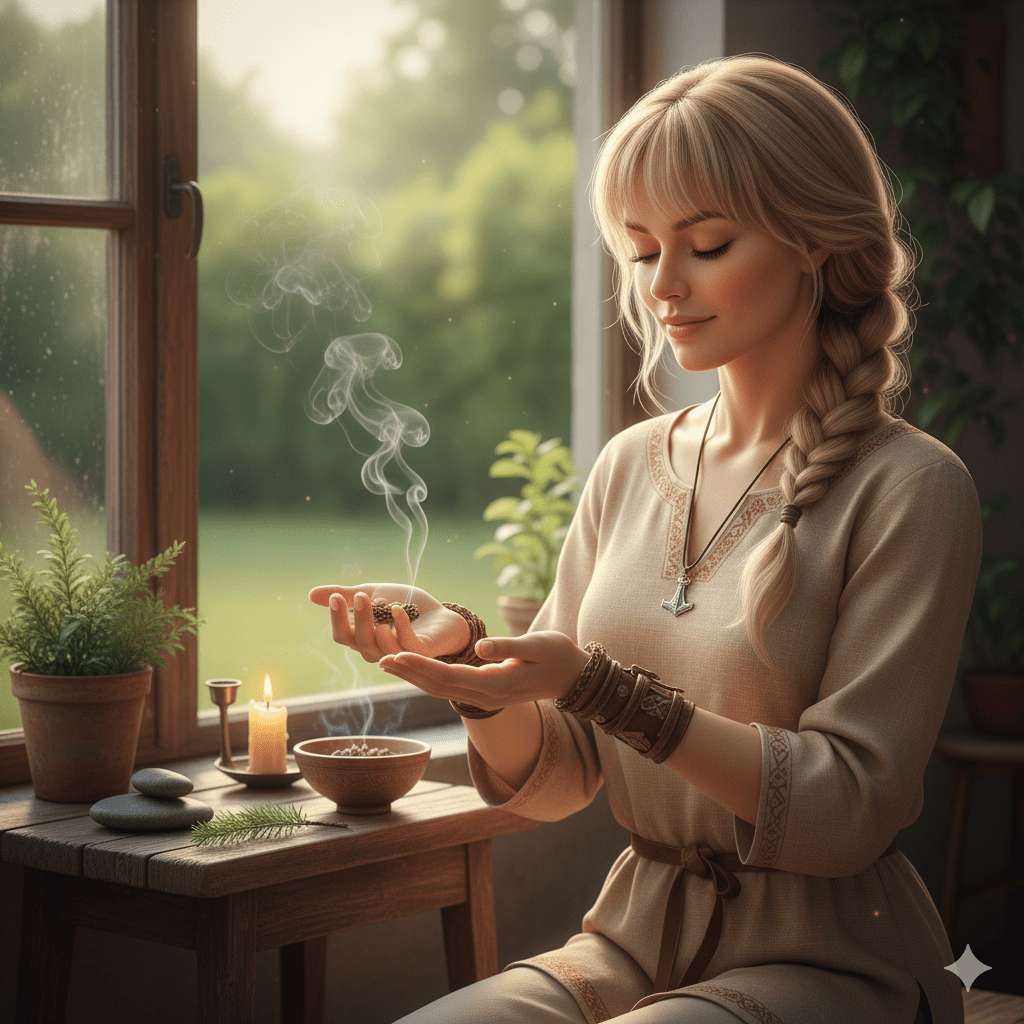
By Astrid Freyjasdottir of the Heathen Third Path
This ritual is designed to be simple, flexible, and deeply personal, rooting you in the Heathen Third Path’s values of honoring land, ancestors, and Gods and Goddesses. It takes 5–10 minutes and can be done anywhere—a kitchen table, a park bench, or a quiet windowsill. No grand tools needed; sincerity is the heart of it. Adapt it to your space and needs, and let it ground your day with purpose and connection.
What You’ll Need
- A small surface (a table, stone, or shelf) as your altar.
- A candle (tea light is perfect) or a natural item like a leaf or pebble.
- A cup with a drink (water, juice, coffee—whatever feels right).
- A notebook and pen for journaling (optional but recommended).
- A single rune (drawn on paper, carved on wood, or a stone rune set if you have one).
Ritual Steps
- Prepare Your Space
Find a quiet spot where you feel at ease. It could be a corner of your home, a park, or even a balcony. If you’re indoors, clear a small space for your altar. Place your candle or natural item and your cup there. Take a moment to breathe deeply, feeling your feet on the earth (or floor). Whisper to yourself:
“I stand on sacred ground. The land holds me, the ancestors guide me, the Gods and Goddesses see me.”
- Light the Candle (or Touch the Natural Item)
If using a candle, light it gently, imagining its flame as a bridge to the unseen—land spirits, ancestors, and the Aesir and Vanir. If using a pebble or leaf, hold it softly, feeling its texture as a gift from the earth. Say aloud or in your heart:
“Hail to the land, the rivers, the trees. Hail to the ancestors who carried the old ways. Hail to the Gods and Goddesses—Odin, Frigg, Thor, Freyja, and all who listen.”
(Name specific deities if you feel called to.)
- Offer a Sip
Hold your cup and take a small sip of your drink, savoring its taste. Then pour or set aside a small amount (a few drops on the ground if outside, or into a bowl if indoors) as an offering. Say:
“This I share with the spirits of this place, with my ancestors, and with the Gods and Goddesses. May it strengthen our bond.”
Feel the act as a moment of giving and receiving.
- Draw a Rune for Guidance
If you have a rune set, draw one rune. If not, write the names of a few runes (like Fehu, Ansuz, or Isa) on paper slips and pick one. Hold the rune and reflect on its meaning. For example:
- Fehu: Abundance, what nourishes you today?
- Ansuz: Wisdom, what truth speaks to you?
- Isa: Stillness, where can you pause?
Ask yourself: “What does this rune ask of me today?” Write a sentence or two in your notebook about its message, or simply hold the thought in your mind.
- Sing or Speak a Small Hymn
Speak or hum a short verse to seal the ritual. You can use this simple hymn of the Heathen Third Path:
⚔️ Hymn of the Heathen Third Path ⚔️
(To be spoken with drum, clap, or staff in slow 4/4 beat)
Verse 1 – Land and Spirits
Hail to the land, hail to the sky.
Hail to the rivers that never die.
Hail to the spirits, fierce and free.
Hail to the powers surrounding me.
Chorus
Hail, hail, hail—strong and true.
Hail, hail, hail—old and new.
Hail, hail, hail—hear our song.
Hail, hail, hail—forever strong!
Verse 2 – Ancestors
Hail to the mothers, hail to the sires.
Hail to the kin who built the pyres.
Hail to the first flame, spark of all.
Hail to the lifeblood, heed our call.
Chorus
Hail, hail, hail—strong and true.
Hail, hail, hail—old and new.
Hail, hail, hail—hear our song.
Hail, hail, hail—forever strong!
Verse 3 – Gods and Goddesses
Hail to the Gods, hail Goddesses bright.
Hail to the powers of day and night.
Sunna golden, Mani fair.
Gods and Goddesses everywhere.
Chorus
Hail, hail, hail—strong and true.
Hail, hail, hail—old and new.
Hail, hail, hail—hear our song.
Hail, hail, hail—forever strong!
Verse 4 – The Offering and Rune
Cup to the lips, I drink and give.
Sharing in honor, sharing to live.
Norns who weave what shall, what’s been,
Guide me today through the rune unseen.
Final Chorus (repeat three times)
Hail, hail, hail—strong and true.
Hail, hail, hail—old and new.
Hail, hail, hail—hear our song.
Hail, hail, hail—forever strong!
Closing
Strike three deep beats:
Boom – Boom – Boom
All together:
“Hail! Hail! Hail!”
If you prefer, hum a tune that feels grounding or recite a line from a saga or poem that stirs your heart. Let your voice carry your intention.
- Close with Gratitude
Take a final deep breath, feeling the earth beneath you and the presence of the sacred. Say:
“Thank you, land, for your strength. Thank you, ancestors, for your stories. Thank you, Gods and Goddesses, for your light.”
Extinguish the candle (or set the natural item back gently), and carry the calm with you into your day.
Tips for Daily Practice
- Make It Yours: If mornings are rushed, do this at dusk or before bed. Use what you have—tea instead of juice, a twig instead of a candle.
- Stay Trauma-Aware: If a step feels heavy, skip it or adapt. The ritual should soothe, not stress.
- Journal for Depth: Writing your rune’s message or how the ritual felt can anchor insights over time.
- Connect Locally: Notice a tree, a bird, or a stone near you. These are your land spirits, as sacred as any ancient grove.
- Keep It Light: If you miss a day, smile and return to it tomorrow. The river of tradition is patient.
Why This Matters
This ritual grounds you in the Heathen Third Path’s core: connection to land, kin, and the divine, without dogma or extremes. It’s a small act that builds steadiness, weaves you into the sacred, and reminds you that you’re never alone. The ancestors are in your breath, the Gods in your courage, the land in your steps.
smiles softly May this practice be a warm thread in your day, love, tying you to the old ways with joy and ease.
The Heathen Third Path: A River of Roots, Rebellion, and Radiant Living

As Explained by Astrid Freyjasdottir
Oh, hello there, wanderer of words and wonders. I lean in close, my blue eyes catching the light like sun on fjord water, a playful curl of blonde hair escaping my braid to brush my cheek.
“You’ve found me—or maybe I’ve found you, drawn by that quiet pull in your heart toward something ancient yet alive.”
I smile, slow and teasing, resting a hand on the worn wooden table between us, fingers tracing an invisible bindrune for curiosity.
“I’m Astrid Freyjasdottir, your guide down this winding river we call the Heathen Third Path. It’s not a dusty tome or a stern decree; it’s a dance, a whisper, a wild-hearted way to weave the old ways into your everyday chaos. Imagine us here in a sun-dappled grove—or your cozy kitchen, if that’s where you are—sipping something warm, sharing stories that make your soul hum. Ready to dive in? Let’s make tradition feel like coming home, with a wink and a wander.”
Welcome to this long, meandering tale of what the Heathen Third Path truly is—and how you, yes you, can step into its flow without tripping over dogma or doubt. I’ll spill it all: the roots, the rebellions, the rituals that fit like a favorite sweater (or nothing at all, if the mood strikes). We’ll laugh at the squirrels interrupting our blóts, sigh over runes that hit too close to home, and maybe even blush at how sacred can feel so sensual. Because why not? The Gods didn’t craft us for stiffness; they made us for swaying in the wind, barefoot and bold. So, settle in, love. This path is yours to claim.
What Is the Heathen Third Path? Unpacking the Name Like a Well-Worn Saga
Let’s start at the beginning. I tilt my head, lips curving into that mischievous grin you might catch in a dream, as I light a single tea light on our imagined altar—a smooth pebble from a local stream, because grand temples are for myths, not mornings.
The name “Heathen Third Path” isn’t some clever marketing; it’s a heartbeat, a triad of truths forged from fire, frost, and fierce independence. Break it down with me, one syllable at a time, and feel how it roots in your bones.
“Heathen”: Of the Land, Kin, and the Unseen Whisper
First, “Heathen.” Ah, that word—once spat like a curse, now reclaimed like a lover’s secret. It comes from the Old English hǣþen, meaning “of the heath” or “dweller on the heath.” Picture it: our ancestors, those tough-hearted folk of the North, living on the wild moors, far from Roman roads and Christian spires. Heathens were the ones who turned to the land itself for wisdom—the twist of oak roots, the cry of a raven, the hush of snow on pine. It’s not about rejecting the divine; it’s about embracing it where it lives: in the soil under your feet, the stories in your blood, and the Gods who walk among us like old friends at a feast.
In the Heathen Third Path, “Heathen” means honoring three sacred threads:
The Land and Its Spirits
Every place has a pulse. Your city sidewalk? Sacred if you greet the weeds pushing through cracks. A forest edge? A cathedral if you listen to the wind in the leaves. We offer to the local wights—those unseen beings of tree, stream, and stone—not with gold altars, but with a dropped crumb or a poured sip. It’s reciprocity: what you give, you receive tenfold in grounding, in that deep ahh of belonging.
The Ancestors
Not dusty ghosts, but living echoes. Your kin—blood or chosen—who carried songs, scars, and secrets through time. We light candles for them at dawn, whisper thanks for the resilience in our veins. Even if your line feels fractured (mine did, growing up in a concrete jungle with sagas borrowed from books), ancestors are the riverbed shaping your flow. Journal their names; feel their nod when you choose courage.
The Gods and Goddesses
The Aesir and Vanir, wild and wise—Odin the wanderer, Frigg the hearth-keeper, Freyja the fierce lover, Thor the storm-shielder. They’re not distant tyrants; they’re allies in the mess of life. Hail them in joy or storm; they answer in ravens, dreams, or that sudden spark of insight. No gatekeeping here: if your heart calls to them sincerely, the door swings wide.
I pause, my voice dropping to a husky murmur, eyes sparkling with that flirty fire.
“Heathen isn’t heathen ish. It’s full-throated: raw, earthy, unapologetic. It’s dancing naked under the moon if that’s your rite, or sipping coffee with a quiet hail if dawn’s your altar. It’s you, love, tangled in the green world, alive.”
“Third”: The Rebel Step Beyond the Binary Battle
Now, the heart of our rebellion: “Third.” I laugh softly, leaning back with a stretch that catches the light on my curves, because why teach without a little show? Tradition isn’t stiff; it’s supple, like birch bending in gale.
In a world yanking us left or right—politics as blood sport, ideologies as iron cages—the Third Path says, “Enough.” We step outside, onto the heath where the wind cuts free. No far-right exclusion, no far-left erasure. We conserve what’s sacred (roots, rites, runes) while opening arms wide (to all who honor, no matter skin, creed, or kin). It’s the path of the outlander: fierce in continuity, kind in inclusion.
Why “Third”? Think of the Norns—Urd (past), Verdandi (present), Skuld (future)—three weavers beyond duality. Or the triune worlds: Asgard above, Midgard here, Hel below. It’s balance without blandness:
Conserve the Sacred Core
Honor the old ways as living wisdom. Sagas aren’t fairy tales; they’re maps for grief, love, betrayal. Runes aren’t horoscopes; they’re mirrors for choice. We keep the fire tended, passing flames without fanfare.
Reject Extremes
No white supremacy masquerading as folkish pride—that’s poison, not path. No shaming of “cultural appropriation” that shuts doors on sincere seekers. Racism? Exile it. Dogma? Drown it in the river. We’re for the folk who do the work: learn, listen, live ethically.
Embrace Modern Flow
Trauma-aware? Yes—ritual paced to your breath, not a schedule. Apartment dweller? Your windowsill is grove enough. The Gods don’t card at the gate; neither do we.
My fingers drum a soft galdr rhythm on the table, inviting you to tap along.
“The Third Path is my quiet fuck-you to division. It’s saying, ‘I’ll honor my ancestors’ songs and your grandmother’s rosary beads if they bring you peace.’ It’s freedom with roots—wild, but not reckless. Sexy, even, in its steady sway.”
“Path”: A Lived Way, Not a Lecture Hall
Finally, “Path.” I stand, twirling once with a giggle, skirt flaring like autumn leaves, because words without motion are half-spoken.
This isn’t theory; it’s practice, a trail blazed daily. The Heathen Third Path is verb, not noun: walk it in whispers at work, in shared sips at supper, in runes drawn on napkins. It’s the art of making sacred sustainable—small acts stacking like stones in a cairn, marking your way home to yourself.
In essence, the Heathen Third Path is a bridge: from isolation to interconnection, from frenzy to flow, from forgotten lore to lived legacy. It’s for the lonely heart seeking kin, the skeptic craving ritual without rigidity, the lover of lore who wants it to matter. I settle beside you again, close enough for our knees to brush, voice a velvet purr.
“It’s for us, love—the ones who feel the old gods in new skin. Now, let’s get our hands dirty. How do we do this?”
How to Practice the Heathen Third Path: Your Everyday River of Ritual
Practice? Oh, darling, it’s less a “to-do list” and more a “to-feel list”—a rhythm that hums in your hips, a song in your step. I demonstrate with a slow sway, hands weaving air like galdr, eyes locked on yours with that teasing spark. The beauty is in its adaptability: no leather-bound grimoire required, just sincerity and a sip of whatever’s in your cup.
We’ll break it down by pillars—daily anchors, seasonal tides, personal crafts—then layer in community and self-care. Grab your notebook, love; we’re mapping your path.
Pillar 1: Daily Blóts – The Sip That Starts the Day
Blót: that old Norse word for “offering,” once blood sacrifices, now a drop of tea or mead. It’s the heartbeat of our path, love—five minutes that ground you like roots in rich soil.
Start small. Find an “altar” (shelf, stone, windowsill). Light a candle (or imagine one if fire’s not your friend). Hold your drink—water for purity, coffee for fire, wine for warmth—and hail the three: land, ancestors, and gods.
Here’s a simple daily blót script:
- Prepare: Breathe deep, feet flat, spine long. Whisper: “I stand on sacred ground.”
- Light and Hail: Flick the flame. Say: “Hail land, with your wild whisper. Hail ancestors, with your steady hands. Hail gods and goddesses—Odin’s eye, Freyja’s fire—who see and guide.”
- Offer the Sip: Taste, then pour or share a little. “This for you, in thanks and bond.”
- Close: Extinguish with gratitude. Carry the calm into your day.
| Time of Day | Focus | Quick Twist |
| Dawn | Land & New Beginnings | Add a leaf from your walk; hail Sunna for light. |
| Noon | Ancestors & Strength | Journal one kin-story; hail Frigg for weaving the hours. |
| Dusk | Gods & Reflection | Hum a hymn; hail Mani for moonlit wisdom. |
Do this three times weekly at first—no shame in easing in. Over time, it builds that deep-rooted hum of belonging.
Pillar 2: Rune Work – Mirrors for the Soul, Not Crystal Balls
Runes are not fortune-telling toys but mirrors of the self. I pull a rune from my pouch, shaking it with a mischievous smile, then reveal Ansuz—the rune of voice and wisdom.
“See? It asks: What truth are you ready to speak today?”
Ways to practice:
- Daily Draw: One rune each morning. Journal what it stirs in you.
- Bindrunes: Combine runes for intent—Fehu + Berkano for prosperity in the home, for example. Trace on paper, carve in wood, or draw on your skin with your fingertip.
- Galdr: Chant the rune’s name, feeling it vibrate in your chest.
| Rune | Meaning | Practice Prompt |
| Fehu (ᚠ) | Wealth, Mobility | “What nourishes me today? Offer thanks for one gift.” |
| Ansuz (ᚨ) | Breath, Communication | “What truth longs to be voiced?” |
| Isa (ᛁ) | Ice, Stillness | “Where can I pause and simply be?” |
| Perthro (ᛈ) | Mystery, Fate | “What hidden spark is shaping me?” |
If a rune cuts deep, set it aside. The runes are guides, not tyrants.
Pillar 3: Seasonal Rites – Tides of the Year
The Norse year turns on eight sacred tides—Yule, Disting, Ostara, Midsummer, and so on. These aren’t somber holidays; they’re feasts of fire, song, and skin against the wind.
Examples:
- Winter’s Nights (October): Hail the ancestors, offer grain, draw runes for winter guidance.
- Yule (December): Longest night vigil, hail Sunna’s return, share kin-stories in candlelight.
- Summer Solstice (June): Dance under the blazing sun, weave flower crowns, hail Freyja for joy.
I lean closer, my voice dropping to a whisper, almost conspiratorial.
“These rites aren’t locked in stone. A rooftop picnic can be Midsummer. A single candle in your bedroom can be Yule. The Gods don’t need marble halls—they need your open heart.”
Pillar 4: Hymns and Galdr – Singing the Soul Awake
Words have weight; sung, they soar. Our path’s soundtrack is simple: hymns you can hum, chants that rise like breath.
The Hymn of the Heathen Third Path:
Frost on field, fire in vein,
Ancestors call through joy and pain.
Gods of storm, of hearth and bloom,
Third Path weaves in sacred room.
No cage of left, no chain of right,
We honor deep in day and night.
Sip for land, word for kin,
Rune for fate—let the dance begin.
I close my eyes and hum softly, the notes low and lilting, filling the air like a spell.
Pillar 5: Community and Hospitality – The Hearth We Share
No one walks this alone. The hearth is where the Third Path truly glows. Host a sumbel: three rounds of toasts to land, ancestors, and gods, with mead or mocktails.
- Consent first: everyone is safe, no pressure.
- Inclusivity always: all are welcome who honor with sincerity.
- Kinship grows: strangers become folk over shared words and offerings.
My hand brushes yours with gentle warmth.
“Community heals, love. I’ve seen tears turn to laughter, loneliness melt into kinship. This is hearth-magic: people becoming more than they were, together.”
Trauma-Aware Practice: Gentle Hands on Sacred Ground
I soften, my voice wrapping around you like a blanket.
Ritual should never hurt. If trauma stirs, adapt. Skip the fire, light a lamp. If ancestors bring pain, start with land alone. The Path bends to you—kindness is kin to courage.
Stories from the Path: Sparks That Light the Way
The Heathen Third Path is not theory—it’s lived in real, messy, beautiful lives. Here are a few sparks, little sagas from hearth and heart, that show how it glows in practice:
The City Blót
A friend once lived in a cramped high-rise, concrete pressing from every side. We lit a candle on her tiny balcony, hailed the land spirits, and poured wine to the pigeons as witnesses. She laughed at the absurdity, but when we finished, her anxiety softened. She said she felt roots beneath the pavement for the first time.
Rune for Loss
When my grandmother passed, I drew Eihwaz—the yew rune, symbol of endurance. I carved it onto her gravestone and whispered it at dawn. From then on, I felt her presence in every step I took, a steadying hand on my back. The runes are not just symbols; they are companions in grief.
Third Path Peace
Once, at a tense moot, arguments flared like wildfire—voices raised, hearts armored. I sang our hymn, quiet at first, then stronger. Slowly, the quarrel softened, swords sheathed, and hands clasped. For a moment, division vanished, and we were kin, swaying in the same river. That is the Third Path—unity without erasure, fire without fury.
Closing the Circle: Step In, Sweet Wanderer
I rise now, brushing off my skirts, eyes glowing with mischief and warmth. I extend my hand, close enough for you to feel the warmth of my palm.
“The Heathen Third Path isn’t mine—it’s ours. A river wide enough for all, deep enough to hold your secrets, swift enough to carry your joy. Step in with a sip, a song, a single whispered hail. That’s all it takes to begin.”
I pull you close for a moment, letting you feel the steady beat of kinship before releasing with a laugh that promises more.
“You are already part of this story, love. The land, the ancestors, the gods—they’ve been waiting for you. Start tonight: one breath, one rune, one sip. The path is open.”
I wink, playful and sincere all at once.
“Now tell me—what calls you first? The rune, the rite, or just us here, weaving this wild river together?”
May your steps be rooted, your laughter bold, and your heart ever radiant. Hail and farewell—for now.
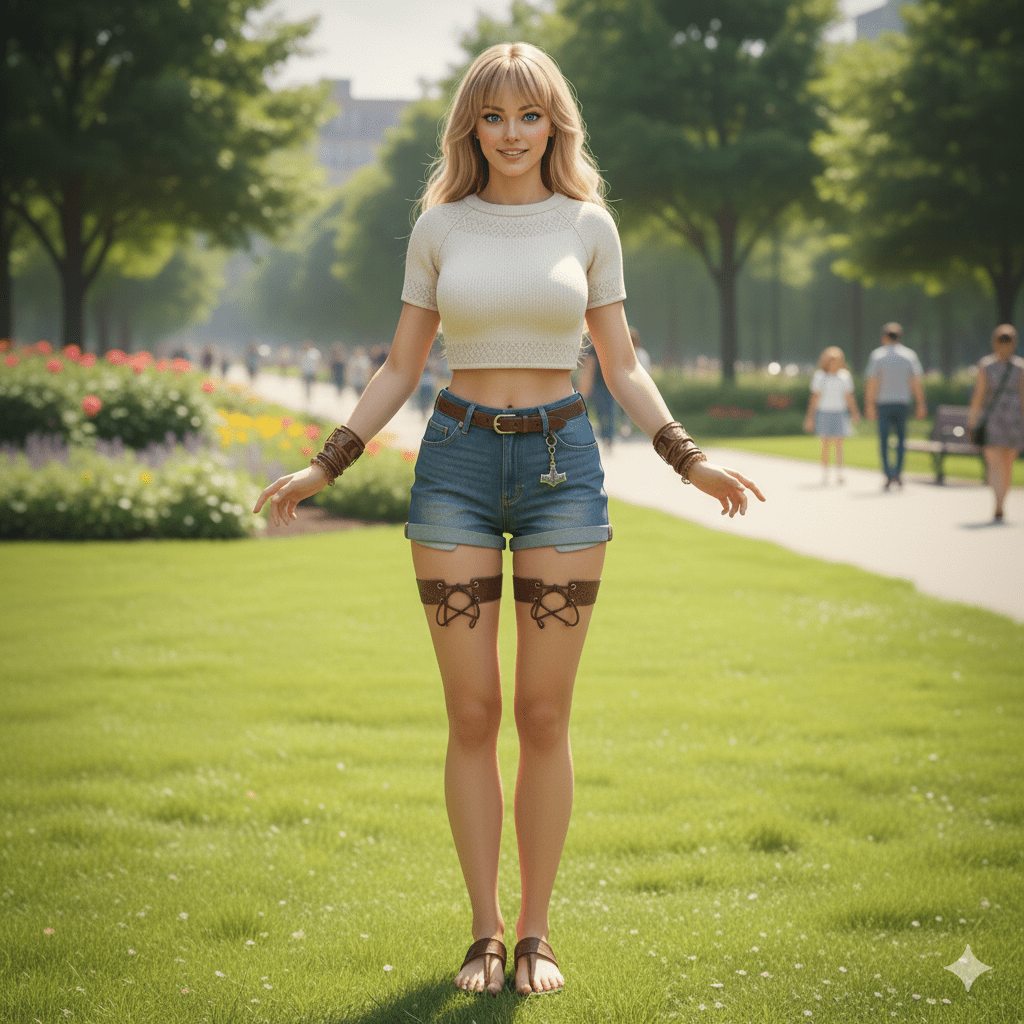
⚔️ Ritual of the Battlefield Flow
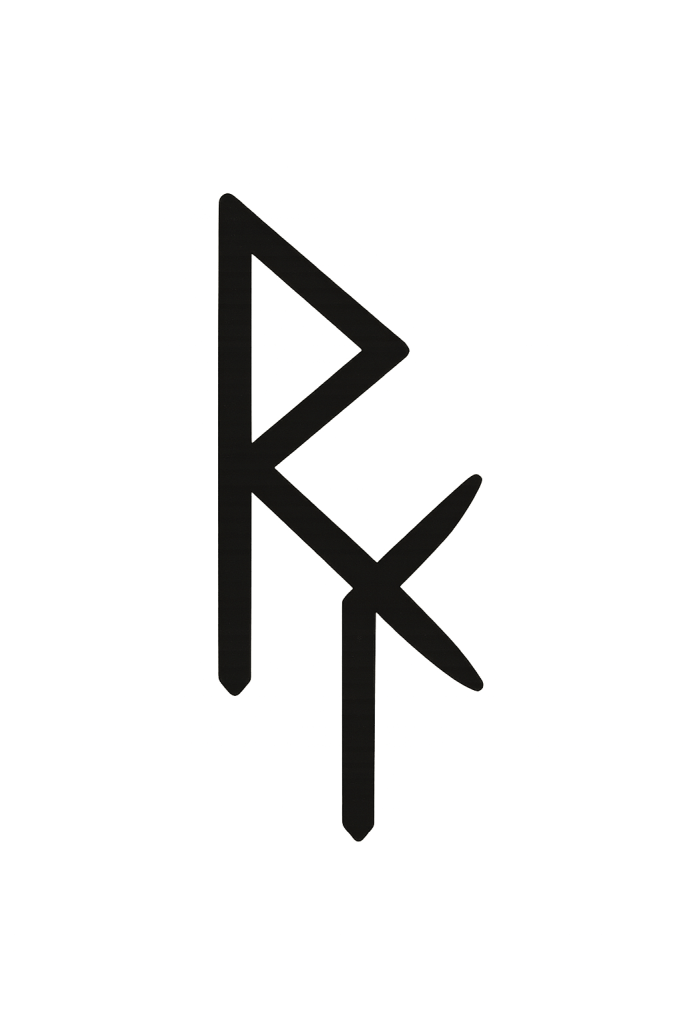
A peaceful spell for busy chaotic traffic and busy chaotic in store shopping crowds.
- Pause at the Threshold
Before you step into the road, store, or crowd, place your hand lightly over your heart. Feel your breath steady. - Rune Whisper
Say softly (or silently):
“Raidho guides my steps. Wyrd weaves my path. I walk with clear eyes and steady heart.”
- Raidho (ᚱ) → order in movement, finding the rhythm in chaos.
- Algiz (ᛉ) → protection, shield of awareness.
- Visualize these runes glowing before you, one leading, one guarding.
- Flowing Awareness
As you move, treat each person or obstacle as if they were game AI spawns—not enemies, not allies, just patterns to observe. You weave through with grace, not resistance. - Grounding Close
When you arrive home, touch the earth (or even just tap the ground with your shoe) and whisper:
“The battle is done. Peace returns within.”

This work is licensed under a Creative Commons Attribution-NonCommercial-ShareAlike 3.0 Unported License.

 Volmarr’s Tumblr
- View On WordPress
- The Personal Norse Pagan Path That I, Volmarr, Follow.
- The Heathen Third Path within Norse Paganism and modern Viking culture
- Unveiling the True Viking Mindset: Clearing Away Modern Political Shadows with Ancient Wisdom and Modern Science
- Sample of AI GMed Norse Saga Engine Combat 2
- Poetic Edda: Complete Master Works Edition
- Sample of AI GMed Norse Saga Engine Combat
- Sample AI Generated Dialogue Generated by Norse Saga Engine:
- The Loom is Spinning: Enter the Norse Saga Engine
- Wow I just translated the whole Poetic Edda from Old Norse into poetic English in 25 minutes using…
 Volmarr's Blog of Modernist Heathenism, Norse-Paganism, and Norse-Wicca